

Heart failure outcomes with empagliflozin in patients with type 2 diabetes at high cardiovascular risk: results of the EMPA-REG OUTCOME ® trial
Open accessThe DOI matches its Crossref record; 29 of the 29 references it cites were found in a registry or an index.
Abstract
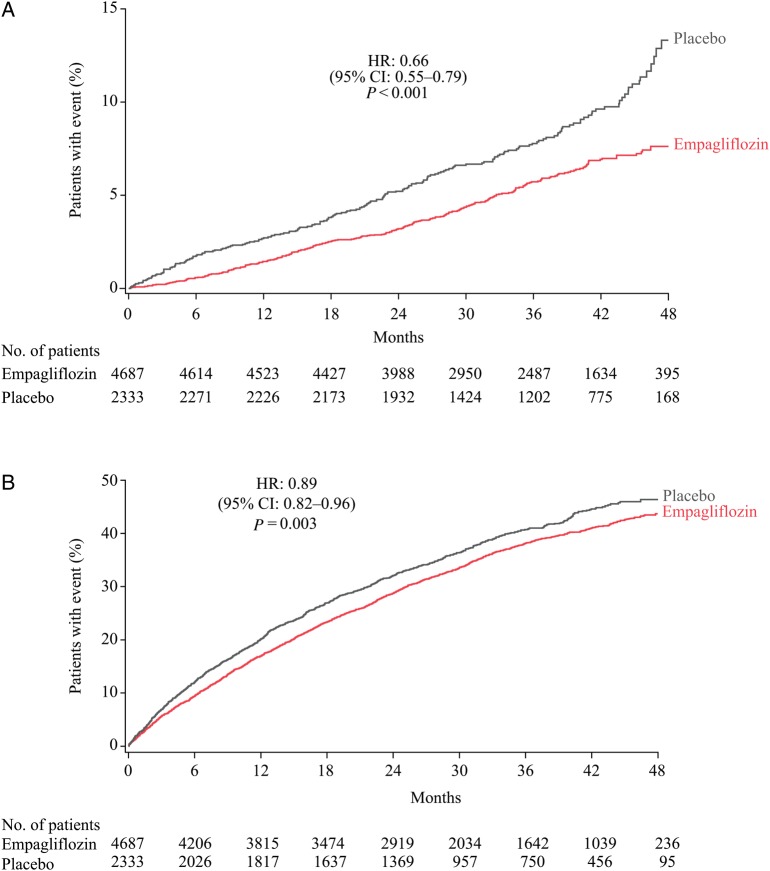
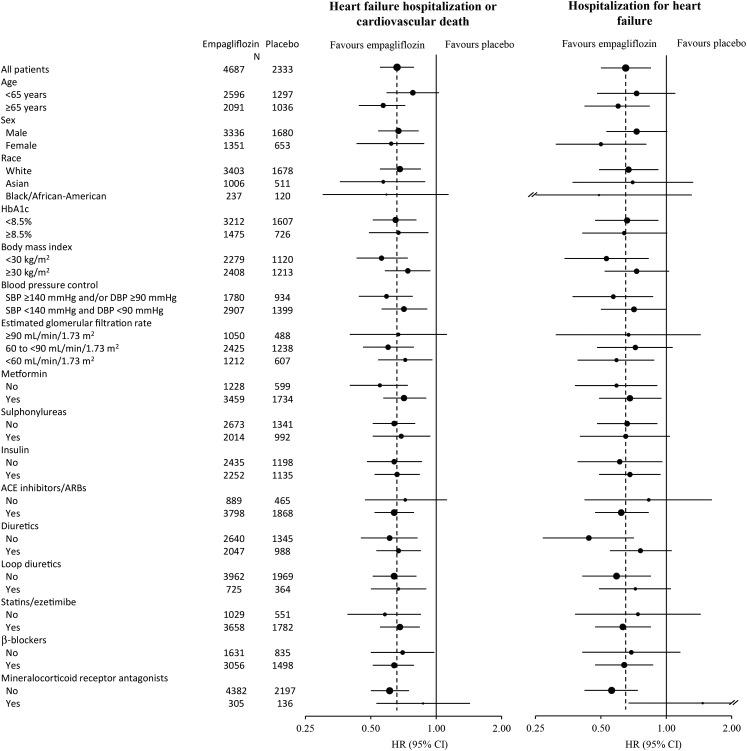
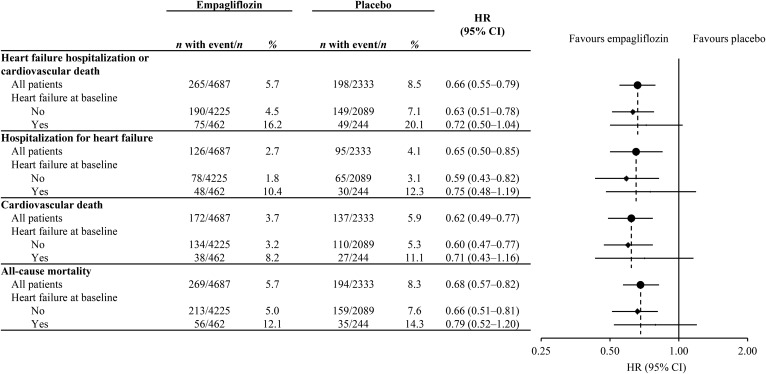
AIMS: We previously reported that in the EMPA-REG OUTCOME(®) trial, empagliflozin added to standard of care reduced the risk of 3-point major adverse cardiovascular events, cardiovascular and all-cause death, and hospitalization for heart failure in patients with type 2 diabetes and high cardiovascular risk. We have now further investigated heart failure outcomes in all patients and in subgroups, including patients with or without baseline heart failure. METHODS AND RESULTS: Patients were randomized to receive empagliflozin 10 mg, empagliflozin 25 mg, or placebo. Seven thousand and twenty patients were treated; 706 (10.1%) had heart failure at baseline. Heart failure hospitalization or cardiovascular death occurred in a significantly lower percentage of patients treated with empagliflozin [265/4687 patients (5.7%)] than with placebo [198/2333 patients (8.5%)] [hazard ratio, HR: 0.66 (95% confidence interval: 0.55-0.79); P < 0.001], corresponding to a number needed to treat to prevent one heart failure hospitalization or cardiovascular death of 35 over 3 years. Consistent effects of empagliflozin were observed across subgroups defined by baseline characteristics, including patients with vs. without heart failure, and across categories of medications to treat diabetes and/or heart failure. Empagliflozin improved other heart failure outcomes, including hospitalization for or death from heart failure [2.8 vs. 4.5%; HR: 0.61 (0.47-0.79); P < 0.001] and was associated with a reduction in all-cause hospitalization [36.8 vs. 39.6%; HR: 0.89 (0.82-0.96); P = 0.003]. Serious adverse events and adverse events leading to discontinuation were reported by a higher proportion of patients with vs. without heart failure at baseline in both treatment groups, but were no more common with empagliflozin than with placebo. CONCLUSION: In patients with type 2 diabetes and high cardiovascular risk, empagliflozin reduced heart failure hospitalization and cardiovascular death, with a consistent benefit in patients with and without baseline heart failure.
Overview
The claims and statistics of this paper haven’t been checked yet.
Free: it reads the open-access text and checks the first 5 claims that cite a source we can check. Create a free account to check every claim.
Integrity signals
Registry
Cites
Statistics
Figures
Verification
Claims the paper makes
The claims and statistics of this paper haven’t been checked yet.
Free: it reads the open-access text and checks the first 5 claims that cite a source we can check. Create a free account to check every claim.
Claims other papers make about this one
Each is checked against this paper’s own text: does it say what the citing paper says it does?
The source backs part of the claim, not all of it — or backs it for a different population, condition or comparison.
In the citing paper
“Little is known about the effect of SGLT2 inhibitors on the broad spectrum of both inpatient and outpatient worsening heart failure events, because these were not documented in trials with these drugs in type 2 diabetes.1–5”
From Effect of Empagliflozin on the Clinical Stability of Patients With Heart Failure and a Reduced Ejection Fraction: The EMPEROR-Reduced Trial (2021) · cites this paper as [1]
Experimental — accuracy not yet measuredThe source backs part of the claim, not all of it — or backs it for a different population, condition or comparison.
In the citing paper
“Recent cardiovascular outcomes trials demonstrate that therapies that inhibit sodium glucose cotransporter (SGLT)2 may reduce heart failure morbidity and mortality and slow decline in renal function (7,8,23,42,43).”
From Evaluation of renal and cardiovascular protection mechanisms of SGLT2 inhibitors: model-based analysis of clinical data (2018) · cites this paper as [8]
Experimental — accuracy not yet measuredThe cited source says what the claim attributes to it.
In the citing paper
“Sodium-glucose cotransporter 2 (SGLT2) inhibitors have been shown to reduce the risk of hospitalizations for heart failure in 8 large-scale trials, including those that focused on type 2 diabetes, heart failure with a reduced ejection fraction, and chronic kidney disease.1–8”
From Effect of Empagliflozin on the Clinical Stability of Patients With Heart Failure and a Reduced Ejection Fraction: The EMPEROR-Reduced Trial (2021) · cites this paper as [1]
The cited source says what the claim attributes to it.
In the citing paper
“hospitalizations for heart failure (2.7% versus 4.1%; 35% RRR)”
From Clinical management of stable coronary artery disease in patients with type 2 diabetes mellitus: a scientific statement from the American Heart Association (2020) · cites this paper as [219]
Self-check
Percentages, sums and reported differences re-computed from the paper’s own numbers.
The self-check needs the paper’s full text.
Citations
Cites
Empagliflozin, Cardiovascular Outcomes, and Mortality in Type 2 Diabetes
Zinman, B., Wanner, C., Lachin, J. M., Fitchett, D., Bluhmki, E., Hantel, S., Mattheus, M., Devins, T., Johansen, O. E., Woerle, H. J., et al. (2015) · New England Journal of Medicine · doi:10.1056/nejmoa1504720 · Cited by 12,315
Self-citationESC Guidelines for the diagnosis and treatment of acute and chronic heart failure 2012
Authors/Task Force Members, McMurray, J. J. V., Adamopoulos, S., Anker, S. D., Auricchio, A., Böhm, M., Dickstein, K., Falk, V., Filippatos, G., Fonseca, C., et al. (2012) · European Heart Journal · doi:10.1093/eurheartj/ehs104 · Cited by 6,879
Saxagliptin and cardiovascular outcomes in patients with type 2 diabetes mellitus
Scirica, B. M., Bhatt, D. L., Braunwald, E., Steg, P. G., Davidson, J., Hirshberg, B., Ohman, P., Frederich, R., Wiviott, S. D., Hoffman, E. B., et al. (2013) · New England Journal of Medicine · doi:10.1056/nejmoa1307684 · Cited by 3,470
ESC Guidelines for the Diagnosis and Treatment of Acute and Chronic Heart Failure 2012
Authors/Task Force Members, McMurray, J. J. V., Adamopoulos, S., Anker, S. D., Auricchio, A., Böhm, M., Dickstein, K., Falk, V., Filippatos, G., Fonseca, C., et al. (2012) · European Journal of Heart Failure · doi:10.1093/eurjhf/hfs105 · Cited by 2,644
(2013) · European Heart Journal · doi:10.1093/eurheartj/eht108 · Cited by 1,955
Cherney, D. Z. I., Perkins, B. A., Soleymanlou, N., Maione, M., Lai, V., Lee, A., Fagan, N. M., Woerle, H. J., Johansen, O. E., Broedl, U. C., et al. (2014) · Circulation · doi:10.1161/circulationaha.113.005081 · Cited by 1,329
Self-citationType 2 diabetes and incidence of cardiovascular diseases: a cohort study in 1.9 million people
Shah, A. D., Langenberg, C., Rapsomaniki, E., Denaxas, S., Pujades-Rodriguez, M., Gale, C. P., Deanfield, J., Smeeth, L., Timmis, A., & Hemingway, H. (2015) · The Lancet Diabetes & Endocrinology · doi:10.1016/s2213-8587(14)70219-0 · Cited by 1,225
Intensive glucose control and macrovascular outcomes in type 2 diabetes
Turnbull, F. M., Abraira, C., Anderson, R. J., Byington, R. P., Chalmers, J. P., Duckworth, W. C., Evans, G. W., Gerstein, H. C., Holman, R. R., Moritz, T. E., et al. (2009) · Diabetologia · doi:10.1007/s00125-009-1470-0 · Cited by 1,189 · cited 1×
“less intensive glucose control.(4) Furthermore, specific glucose-lowering medications have not been shown to improve heart failure outcomes and some may actually have deleterious effects.”
BackgroundMetabolic response to sodium-glucose cotransporter 2 inhibition in type 2 diabetic patients
Ferrannini, E., Muscelli, E., Frascerra, S., Baldi, S., Mari, A., Heise, T., Broedl, U. C., & Woerle, H.-J. (2014) · Journal of Clinical Investigation · doi:10.1172/jci72227 · Cited by 1,134
Self-citationRonco, C., McCullough, P., Anker, S. D., Anand, I., Aspromonte, N., Bagshaw, S. M., Bellomo, R., Berl, T., Bobek, I., Cruz, D. N., et al. (2010) · European Heart Journal · doi:10.1093/eurheartj/ehp507 · Cited by 1,104
Research works printed but not linked: 1
- Jordan J, Tank J, Heusser K, Heise T, Wanner C, Heer M, Macha S, Mattheus M, Lund SS, Woerle HJ, Broedl UC Empagliflozin has no discernible effect on muscle sympathetic nerve activity in patients with type 2 diabetes despite reductions in blood pressure and weight. Diabetes 2014; 63: A265 [1030-P].
Cited by
Items 901–947 of 947
The Possible CardioprotectiveEffect of Empagliflozin During Endotoxemia in Mice Model
Al-killidar, S. M., & Muhammad-Baqir, B. M. (2025) · Maaen Journal for Medical Sciences · doi:10.55810/2789-9136.1074
KOC, S. G., Koç, L. Z., Köker, G., & Şahintürk, Y. (2025) · Research Square · doi:10.21203/rs.3.rs-6968533/v1
Belal, A., Suresh, S., & Sayrafizadeh, F. (2025) · International Journal For Multidisciplinary Research · doi:10.36948/ijfmr.2025.v07i04.51363
Olabode, O., Agunbiade, A., Bhatt, J., Asasfeh, E., & Misir, A. (2025) · International Journal For Multidisciplinary Research · doi:10.36948/ijfmr.2025.v07i04.51435
Benjamin, N. Z. Y., Gupta, A., Turjman, T., Syed, W., Anghan, A., Koodarath, C., Salahuddin, N., Khawar, M. M., Edu, A. Y., Rodriguez, P. R. T., et al. (2025) · SN Comprehensive Clinical Medicine · doi:10.1007/s42399-025-02103-y
“The lack of significant differences in all-cause mortality and cardiovascular mortality aligns with major trials such as DECLARE-TIMI 58 and EMPA-REG OUTCOME, which reported comparable benefits for both drugs in reducing cardiovascular mortality in T2DM patients [10, 11].”
Csatordai, M. (2025) · SZTE Repository of Dissertations (University of Szeged) · doi:10.14232/phd.12581
Lwin, C., Roumie, C. L., Greevy, R. A., Beck, C., Snyder, K., & Hackstadt, A. J. (2025) · Clinical Epidemiology · doi:10.2147/clep.s540048
Soni, A., Lawal, O. P., Oyovwi, J. O., Olaniyi, H. I., Anosike, W. O., Orobator, E. T., Gabriels, N., Ghori, I. A. K., & Olaniyi, A. O. (2025) · Cureus · doi:10.7759/cureus.96593
“For example, the EMPA-REG OUTCOME trial reported a 35% reduction in HHF events among patients taking empagliflozin [9,20].”
InfluentialQuinaglia, T., Silva, G., Matos‐Souza, J. R., Coelho‐Filho, O. R., Nadruz, W., & Sposito, A. C. (2025) · Current Atherosclerosis Reports · doi:10.1007/s11883-025-01368-x
Additional file 1 of Empagliflozin prevents doxorubicin-induced myocardial dysfunction
Sabatino, J., De Rosa, S., Tammè, L., Iaconetti, C., Sorrentino, S., Polimeni, A., Mignogna, C., Amorosi, A., Spaccarotella, C., Yasuda, M., et al. (2020) · Figshare · doi:10.6084/m9.figshare.12315764
Davies, M. J., Drexel, H., Jornayvaz, F. R., Pataky, Z., Seferović, P. M., & Wanner, C. (2022) · Figshare · doi:10.6084/m9.figshare.20438492
Self-citationNatali, A., Nesti, L., Tricò, D., & Ferrannini, E. (2021) · Figshare · doi:10.6084/m9.figshare.16696428
Flozins - modern treatment for patients with type 2 diabetes
Augustyn, D., Pawlikowski, K., Korpalski, M., Żygłowicz, M., Marciniak, M., Torbicki, A., Gaworek, P., Pawluczyk, M., & Trybuła, A. (2025) · Quality in Sport · doi:10.12775/qs.2025.43.61318
Maass, N. M., LARMORE, Z., Bertone, M. A., & Trautwein, M. (2016) · INFM-OAR (INFN Catania) · doi:10.5281/zenodo.160298
Tanaka, A., Shimabukuro, M., Teragawa, H., Okada, Y., Takamura, T., Taguchi, I., Toyoda, S., Tomiyama, H., Ueda, S., Higashi, Y., et al. (2021) · Figshare · doi:10.6084/m9.figshare.14870309
Voronenko, O. S. (2021) · Electronic Kharkiv National University Institutional Repository (Kharkiv National University) · Cited by 1
Rynkiewicz, A. K. K. I. K., Sadowski, J. K. K. I. K., Nowek, P. K. K. I. K., & Cygański, P. K. K. I. K. (2018) · Via Medica Journals
Дилшодбековна, З. Д. (2025) · Central Asian Journal of Academic Research · doi:10.70413/cajar-v03-i10-s35140
ВЛИЯНИЕ ЭМПАГЛИФЛОЗИНА НА СЕРДЕЧНО-СОСУДИСТЫЕ ИСХОДЫ У БОЛЬНЫХ С САХАРНЫМ ДИАБЕТОМ 2 ТИПА
Дилшодбековна, З. Д., & Зокирова, Д. (2025) · New Uzbekistan Journal of Academic Research · doi:10.70413/yoitj-v02-i10-s38005
Wang, A., Xiong, C., Fu, R., Jiang, Z., Folkvaljon, F., Bailes, Z., Edwards, D., Li, W., & Mesenbrink, P. G. (2025) · Springer series in pharmaceutical statistics · doi:10.1007/978-3-032-02192-2_10
Bafail, D. A., & Alhalees, N. H. Y. (2026) · Experimental and Therapeutic Medicine · doi:10.3892/etm.2026.13079 · Cited by 1
“Among SGLT2i, the most commonly used agents were empagli‑ flozin (26,27,29,34,35,40‑45), dapagliflozin (23,30,31,36,46‑50) and canagliflozin (24,25,28,37‑39), while other less frequently used agents included ertugliflozin and sotagliflozin (32,33).”
InfluentialEvans, R. J., Brown, O. S., & Saleh, D. M. (2025) · Bulletin of pioneering researches of medical and clinical science · doi:10.51847/hckiohvr1m
Calderón, A. S. (2024) · UCrea (University of Cantabria)
Gupta, R., Sunner, S. S., & Lam, A. P. (2026) · Current Opinion in Physiology · doi:10.1016/j.cophys.2026.100930 · Cited by 1
Nargiza, S., Мухамедова, Ш. Ю., Shakhnoz, U., & Guzal, M. (2026) · Current Cardiology Reviews · doi:10.2174/011573403x403324251130140853
Sodium glucose transporter 2 inhibitors for heart failure
Usuda, D., Furukawa, D., Imaizumi, R., Ono, R., Kaneoka, Y., Nakajima, E., Kato, M., Sugawara, Y., Shimizu, R., Inami, T., et al. (2026) · World Journal of Cardiology · doi:10.4330/wjc.v18.i3.118227
田村, 遥. (2022) · Institutional Repositories DataBase (IRDB)
Ali, M. I. M., Ayad, A. S. A. M., Mohammed, M. Y. K., Ahmed, A. E., Shawky, M. A.-G., & Ead, K. A. (2026) · Al-Azhar Assiut Medical Journal · doi:10.4103/azmj.azmj_75_25
Jodłowska-Siewert, E., Chen, Y., Zhang, S., Li, J., Dellavalle, R. P., Zhang, R., & Hou, J. (2026) · JMIR Diabetes · doi:10.2196/85083
Ignatova, Y. S., Shaputko, D. N., Борзалиевна, П. Т., & Barbarash, O. L. (2026) · Russian Journal of Cardiology · doi:10.15829/1560-4071-2026-6464
Adalarasan, S., Govind, K. M. S., B, R. V. R., Prasanthini, S., Shalini, P., Yogesh, S., & Hariharan, C. (2026) · International Journal of Science and Research Archive · doi:10.30574/ijsra.2026.19.1.0749
Li, J., Dai, W., Alavi, R., Carreño, J. E., Arakaki, X., Pahlevan, N. M., & Kloner, R. A. (2026) · Journal of the American Heart Association · doi:10.1161/jaha.125.047087
Safety profile of empagliflozin in clinical practice: A scoping review of real-world evidence
Malwatta, M. A. L. D., Wasana, P. W. D., & Gunawardena, S. (2026) · Asian Journal of Medical Sciences · doi:10.71152/ajms.v17i6.5296
Diastolic dysfunction and diabetes: the DIADAD study—a retrospective cohort study from Liverpool
Wali, L., Abbara, M. A., Ekhelikar, S., Pilling, J., Albouaini, K., & Murray, S. W. (2026) · Postgraduate Medical Journal · doi:10.1093/postmj/qgag079
Meliala, C. V. B., Tuba, S., Priyono, A., Sulaiman, S. A. S., Sumaryono, B., & Sari, E. P. (2026) · International Journal of Applied Mathematics Sciences and Technology for National Defense · doi:10.58524/app.sci.def.v4i2.1134
Kaya, O. K., & Köker, G. (2026) · The Anatolian Journal of Cardiology · doi:10.14744/anatoljcardiol.2026.6348
Sani, H. S., Aghaei, S., Kalantari, S., Madadi, R., Kalantari, Z., & Maafi, A. A. (2026) · PubMed Central · doi:10.30476/ijms.2026.109620.4497
Clinical Evidence of Cardioprotective Effects of SGLT2 Inhibitors
Usman, M. S., Verma, S., & Pandey, A. (2026) · Handbook of experimental pharmacology · doi:10.1007/164_2026_827
Empagliflozins effect on molecular processes in hyperglycemia and failing cardiac myocytes
Edwards, T. A. (2026) · eScholarship (California Digital Library)
Bai, Y., Bai, Y., & Liu, S. (2026) · iScience · doi:10.1016/j.isci.2026.117578
Muhajiriansyah, M., & Binuko, R. S. D. (2023) · Health Information Jurnal Penelitian · Cited by 8
Comorbidity in Internal Medicine: Shared Mechanisms of Cardiovascular, Metabolic and Kidney Diseases
Likhosherstova, U. (2026) · Journal of chemical health risks
SGLT1 inhibition in cystic fibrosis: From preclinical evidence to clinical potential
Liang, X., Liu, Y., Jia, S., Zhang, K., & Xu, J. (2026) · Molecular Therapy Advances · doi:10.1016/j.omta.2026.201868
Fung, E., Hui, E., Yang, X., Lui, L. T., Cheng, K. F., Li, Q., Fan, Y., Sahota, D. S., Ma, B. H. M., Lee, J. S. W., et al. (2018) · doi:10.3389/fphys.2018.00347.s001
Kongmalai, T., Hadnorntun, P., Leelahavarong, P., Kongmalai, P., Srinonprasert, V., Chirakarnjanakorn, S., Chaikledkaew, U., McKay, G., Attia, J., & Thakkinstian, A. (2023) · doi:10.3389/fendo.2023.1216160.s001
Chen, X., Wang, L., Li, H., Huang, W., Huang, S., Zhao, L., & Guo, W. (2022) · doi:10.3389/fcvm.2022.1067806.s001
Metadata
- Authors
- Fitchett, D., Zinman, B., Wanner, C., Lachin, J. M., Hantel, S., Salsali, A., Johansen, O. E., Woerle, H. J., Broedl, U. C., & Inzucchi, S. E.
- Affiliations
- St. Michael's Hospital (CA)
- Mount Sinai Hospital (CA)
- University of Würzburg (DE)
- George Washington University (US)
- Boehringer Ingelheim (Germany) (DE)
- Boehringer Ingelheim (United States) (US)
- Boehringer Ingelheim (Norway) (NO)
- Yale University (US)
- Corresponding author
- Fitchett, David
- ORCID
- Venue
- European Heart Journal
- Publisher
- Oxford University Press (OUP)
- Published
- 2016-01-26
- Volume
- 37
- Issue
- 19
- Pages
- 1526-1534
- ISSN
- 0195-668X (ISSN-L)
- 1522-9645
- PMC
- PMC4872285
- OpenAlex
- W2273304042
- Cited by
- 907
- References
- 29
- Citations by year
- 2026: 18 · 2025: 30 · 2024: 32 · 2023: 55 · 2022: 75 · 2021: 115 · 2020: 102 · 2019: 142 · 2018: 124 · 2017: 131 · 2016: 81
- FWCI
- 160.00
- Type
- journal article
- Language
- en
- Open access
- hybrid
- doi.org
- Licence
- cc-by-nc
- Locations
- European Heart Journal (publishedVersion, cc-by-nc)
- Europe PMC (PubMed Central) (publishedVersion, cc-by-nc)
- PubMed Central (publishedVersion, cc-by-nc)
- PubMed (publishedVersion)
- Lirias (KU Leuven) (submittedVersion, other-oa)
- Docusalut (Conselleria de Salut i Consum del Govern de les Illes Balears) (submittedVersion, cc-by-nc)
- Hispana (submittedVersion, cc-by-nc)
- HighWire Press Open Archive (submittedVersion)
- Online Publication Service of Würzburg University (Würzburg University) (submittedVersion, cc-by-nc)
- Funders
- Boehringer Ingelheim and Eli Lilly and Company
- Topics
- Health Sciences › Medicine › Endocrinology, Diabetes and Metabolism › Diabetes Treatment and Management
- Health Sciences › Medicine › Cardiology and Cardiovascular Medicine › Heart Failure Treatment and Management
- Health Sciences › Medicine › Cardiology and Cardiovascular Medicine › Cardiovascular Function and Risk Factors
- Keywords
- empagliflozin, type 2 diabetes, heart failure hospitalization, cardiovascular mortality, SGLT2 inhibitors, EMPA-REG OUTCOME trial, high cardiovascular risk, all-cause hospitalization, serious adverse events, subgroup analysis, number needed to treat, cardiovascular risk reduction, heart failure treatment, drug discontinuation
About these checks
Registry, retraction, Cites and statistics results are computed, not judged, with one exception: a printed reference that no index lists is read once by a model before it counts as a citation error. Claims are extracted by a model and kept only when their quote appears verbatim in the text; each cited source is then checked, with a model’s help, for whether it says what the claim relies on. Those verdicts can be wrong — read the claim’s quote and the cited source before relying on one.
Statistics and arithmetic are recomputed, not judged.
Confidence bands are shown only for fields calibrated on our annotated test set. None is calibrated yet, so no band is shown.
What counts as a claim ›How we measure confidence ›How we check this ›
Are you an author, or do you see a problem with this page? Request a review
Data sources
Bibliographic data: Semantic Scholar, OpenAlex, Crossref.
Contains information from the Semantic Scholar Academic Graph Datasets, made available under the ODC Attribution License (ODC-BY 1.0).
Semantic Scholar’s data is described in: Kinney, R., et al. (2023). The Semantic Scholar Open Data Platform. arXiv:2301.10140.
