

Heart failure outcomes with empagliflozin in patients with type 2 diabetes at high cardiovascular risk: results of the EMPA-REG OUTCOME ® trial
Open accessThe DOI matches its Crossref record; 29 of the 29 references it cites were found in a registry or an index.
Abstract
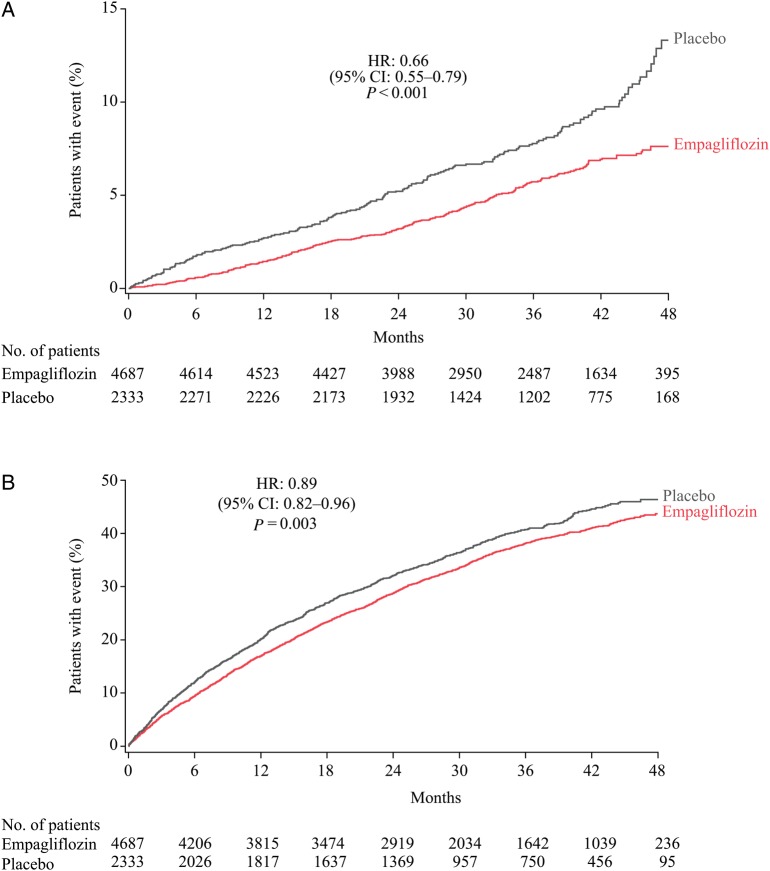
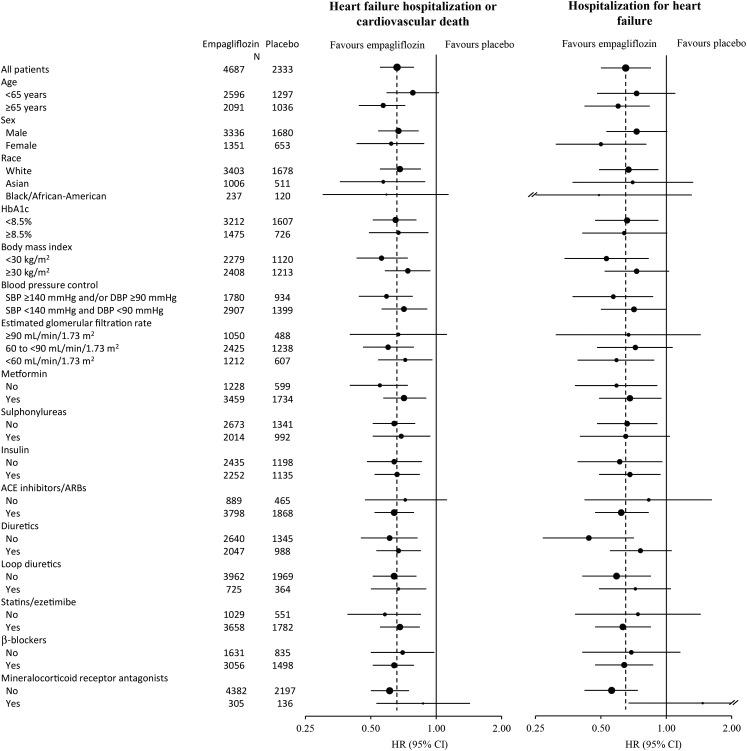
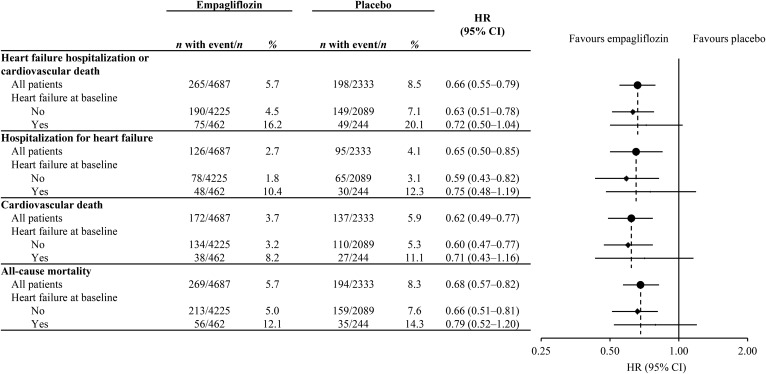
AIMS: We previously reported that in the EMPA-REG OUTCOME(®) trial, empagliflozin added to standard of care reduced the risk of 3-point major adverse cardiovascular events, cardiovascular and all-cause death, and hospitalization for heart failure in patients with type 2 diabetes and high cardiovascular risk. We have now further investigated heart failure outcomes in all patients and in subgroups, including patients with or without baseline heart failure. METHODS AND RESULTS: Patients were randomized to receive empagliflozin 10 mg, empagliflozin 25 mg, or placebo. Seven thousand and twenty patients were treated; 706 (10.1%) had heart failure at baseline. Heart failure hospitalization or cardiovascular death occurred in a significantly lower percentage of patients treated with empagliflozin [265/4687 patients (5.7%)] than with placebo [198/2333 patients (8.5%)] [hazard ratio, HR: 0.66 (95% confidence interval: 0.55-0.79); P < 0.001], corresponding to a number needed to treat to prevent one heart failure hospitalization or cardiovascular death of 35 over 3 years. Consistent effects of empagliflozin were observed across subgroups defined by baseline characteristics, including patients with vs. without heart failure, and across categories of medications to treat diabetes and/or heart failure. Empagliflozin improved other heart failure outcomes, including hospitalization for or death from heart failure [2.8 vs. 4.5%; HR: 0.61 (0.47-0.79); P < 0.001] and was associated with a reduction in all-cause hospitalization [36.8 vs. 39.6%; HR: 0.89 (0.82-0.96); P = 0.003]. Serious adverse events and adverse events leading to discontinuation were reported by a higher proportion of patients with vs. without heart failure at baseline in both treatment groups, but were no more common with empagliflozin than with placebo. CONCLUSION: In patients with type 2 diabetes and high cardiovascular risk, empagliflozin reduced heart failure hospitalization and cardiovascular death, with a consistent benefit in patients with and without baseline heart failure.
Overview
The claims and statistics of this paper haven’t been checked yet.
Free: it reads the open-access text and checks the first 5 claims that cite a source we can check. Create a free account to check every claim.
Integrity signals
Registry
Cites
Statistics
Figures
Verification
Claims the paper makes
The claims and statistics of this paper haven’t been checked yet.
Free: it reads the open-access text and checks the first 5 claims that cite a source we can check. Create a free account to check every claim.
Claims other papers make about this one
Each is checked against this paper’s own text: does it say what the citing paper says it does?
The source backs part of the claim, not all of it — or backs it for a different population, condition or comparison.
In the citing paper
“Little is known about the effect of SGLT2 inhibitors on the broad spectrum of both inpatient and outpatient worsening heart failure events, because these were not documented in trials with these drugs in type 2 diabetes.1–5”
From Effect of Empagliflozin on the Clinical Stability of Patients With Heart Failure and a Reduced Ejection Fraction: The EMPEROR-Reduced Trial (2021) · cites this paper as [1]
Experimental — accuracy not yet measuredThe source backs part of the claim, not all of it — or backs it for a different population, condition or comparison.
In the citing paper
“Recent cardiovascular outcomes trials demonstrate that therapies that inhibit sodium glucose cotransporter (SGLT)2 may reduce heart failure morbidity and mortality and slow decline in renal function (7,8,23,42,43).”
From Evaluation of renal and cardiovascular protection mechanisms of SGLT2 inhibitors: model-based analysis of clinical data (2018) · cites this paper as [8]
Experimental — accuracy not yet measuredThe cited source says what the claim attributes to it.
In the citing paper
“Sodium-glucose cotransporter 2 (SGLT2) inhibitors have been shown to reduce the risk of hospitalizations for heart failure in 8 large-scale trials, including those that focused on type 2 diabetes, heart failure with a reduced ejection fraction, and chronic kidney disease.1–8”
From Effect of Empagliflozin on the Clinical Stability of Patients With Heart Failure and a Reduced Ejection Fraction: The EMPEROR-Reduced Trial (2021) · cites this paper as [1]
The cited source says what the claim attributes to it.
In the citing paper
“hospitalizations for heart failure (2.7% versus 4.1%; 35% RRR)”
From Clinical management of stable coronary artery disease in patients with type 2 diabetes mellitus: a scientific statement from the American Heart Association (2020) · cites this paper as [219]
Self-check
Percentages, sums and reported differences re-computed from the paper’s own numbers.
The self-check needs the paper’s full text.
Citations
Cites
Empagliflozin, Cardiovascular Outcomes, and Mortality in Type 2 Diabetes
Zinman, B., Wanner, C., Lachin, J. M., Fitchett, D., Bluhmki, E., Hantel, S., Mattheus, M., Devins, T., Johansen, O. E., Woerle, H. J., et al. (2015) · New England Journal of Medicine · doi:10.1056/nejmoa1504720 · Cited by 12,315
Self-citationESC Guidelines for the diagnosis and treatment of acute and chronic heart failure 2012
Authors/Task Force Members, McMurray, J. J. V., Adamopoulos, S., Anker, S. D., Auricchio, A., Böhm, M., Dickstein, K., Falk, V., Filippatos, G., Fonseca, C., et al. (2012) · European Heart Journal · doi:10.1093/eurheartj/ehs104 · Cited by 6,879
Saxagliptin and cardiovascular outcomes in patients with type 2 diabetes mellitus
Scirica, B. M., Bhatt, D. L., Braunwald, E., Steg, P. G., Davidson, J., Hirshberg, B., Ohman, P., Frederich, R., Wiviott, S. D., Hoffman, E. B., et al. (2013) · New England Journal of Medicine · doi:10.1056/nejmoa1307684 · Cited by 3,470
ESC Guidelines for the Diagnosis and Treatment of Acute and Chronic Heart Failure 2012
Authors/Task Force Members, McMurray, J. J. V., Adamopoulos, S., Anker, S. D., Auricchio, A., Böhm, M., Dickstein, K., Falk, V., Filippatos, G., Fonseca, C., et al. (2012) · European Journal of Heart Failure · doi:10.1093/eurjhf/hfs105 · Cited by 2,644
(2013) · European Heart Journal · doi:10.1093/eurheartj/eht108 · Cited by 1,955
Cherney, D. Z. I., Perkins, B. A., Soleymanlou, N., Maione, M., Lai, V., Lee, A., Fagan, N. M., Woerle, H. J., Johansen, O. E., Broedl, U. C., et al. (2014) · Circulation · doi:10.1161/circulationaha.113.005081 · Cited by 1,329
Self-citationType 2 diabetes and incidence of cardiovascular diseases: a cohort study in 1.9 million people
Shah, A. D., Langenberg, C., Rapsomaniki, E., Denaxas, S., Pujades-Rodriguez, M., Gale, C. P., Deanfield, J., Smeeth, L., Timmis, A., & Hemingway, H. (2015) · The Lancet Diabetes & Endocrinology · doi:10.1016/s2213-8587(14)70219-0 · Cited by 1,225
Intensive glucose control and macrovascular outcomes in type 2 diabetes
Turnbull, F. M., Abraira, C., Anderson, R. J., Byington, R. P., Chalmers, J. P., Duckworth, W. C., Evans, G. W., Gerstein, H. C., Holman, R. R., Moritz, T. E., et al. (2009) · Diabetologia · doi:10.1007/s00125-009-1470-0 · Cited by 1,189 · cited 1×
“less intensive glucose control.(4) Furthermore, specific glucose-lowering medications have not been shown to improve heart failure outcomes and some may actually have deleterious effects.”
BackgroundMetabolic response to sodium-glucose cotransporter 2 inhibition in type 2 diabetic patients
Ferrannini, E., Muscelli, E., Frascerra, S., Baldi, S., Mari, A., Heise, T., Broedl, U. C., & Woerle, H.-J. (2014) · Journal of Clinical Investigation · doi:10.1172/jci72227 · Cited by 1,134
Self-citationRonco, C., McCullough, P., Anker, S. D., Anand, I., Aspromonte, N., Bagshaw, S. M., Bellomo, R., Berl, T., Bobek, I., Cruz, D. N., et al. (2010) · European Heart Journal · doi:10.1093/eurheartj/ehp507 · Cited by 1,104
Research works printed but not linked: 1
- Jordan J, Tank J, Heusser K, Heise T, Wanner C, Heer M, Macha S, Mattheus M, Lund SS, Woerle HJ, Broedl UC Empagliflozin has no discernible effect on muscle sympathetic nerve activity in patients with type 2 diabetes despite reductions in blood pressure and weight. Diabetes 2014; 63: A265 [1030-P].
Cited by
Items 801–900 of 947
Sodium–glucose co-transporter-2 inhibitors
Lee, M. M. Y., Docherty, K. F., & Jhund, P. S. (2022) · Oxford University Press eBooks · doi:10.1093/med/9780198766223.003.0051 · Cited by 1
Pharmacological Targets in Chronic Heart Failure with Reduced Ejection Fraction
Moloce, M.-A., Costache, I. I., Nicolae, A., & Aursulesei, V. O. (2022) · Life · doi:10.3390/life12081112 · Cited by 1
“73 m2 in DAPA-HF, type 1 diabetes, or systolic blood pressure < 95 to 100 mmHg [19].”
BackgroundScreening for Chronic Kidney Disease
Osman, M. A., Ibrahim, K. S., Shah, N. A., Shojai, S., Okpechi, I. G., & Bello, A. K. (2022) · Wiley eBooks · doi:10.1002/9781119105954.ch4 · Cited by 1
Nyshchuk-Oliinyk, N. B. (2022) · Психологічне здоров’я · doi:10.32689/2663-0672-2022-1-11 · Cited by 1
CLINICAL EFFECTIVENESS OF EMPAGLIFLOZIN IN PATIENTS WITH HEART FAILURE
Росул, М. М., Блецкан, М. М., Ivano, N. V., Korabelschykova, M. O., & Rudakova, S. O. (2023) · Wiadomości Lekarskie · doi:10.36740/wlek202303130 · Cited by 1
Diabetes and Cardiovascular Disease
Coutiño-Castelán, D., Abundes-Velasco, A., Santos, F. D. D. L., Arias, E., González, C. M., Ortíz, A. M., Morales, J. L., Cruz, J. L. B. D. L., Fonseca, C. E. H., Custodio-Sánchez, P., et al. (2023) · Springer eBooks · doi:10.1007/978-3-031-25519-9_50 · Cited by 1
Tawhari, M. H., Aldahash, R., Almutairi, F. M., Albogami, M., Rokon, A. E., Alsomali, F. A., Alanazi, K. H., Alshehri, A. A., Almutairi, T. H., Alharbi, A., et al. (2023) · Journal of Family and Community Medicine · doi:10.4103/jfcm.jfcm_111_23 · Cited by 1
el-Andari, R., Fialka, N., Kang, J. J. H., Bozso, S., Nagendran, J., & Nagendran, J. (2023) · American Journal of Cardiovascular Drugs · doi:10.1007/s40256-023-00618-0 · Cited by 1
Bielinskyi, M. V., Fedorov, S. V., Herashchenko, S. B., Herashchenko, A. S., Kozlova, I. V., & Havrysh, T. (2024) · World of Medicine and Biology · doi:10.26724/2079-8334-2024-3-89-23-28 · Cited by 1
Moderne Antidiabetika in der Kardiologie
Schneider, C., & Pfister, R. (2018) · Aktuelle Kardiologie · doi:10.1055/a-0655-7407 · Cited by 1
“Subgruppenanalysen der existierenden Studien weisen jedoch darauf hin, dass das Risiko für kardiovaskuläre Ereignisse auch in dieser speziellen Patientengruppe durch SGLT-2-Inhibitoren, zumindest bei Diabetikern, reduziert wird [18,19].”
BackgroundEMPA-REG OUTCOME and reduction of the risk of heart failure in patients with diabetes
Karásek, D. (2016) · Interní medicína pro praxi · doi:10.36290/int.2016.038 · Cited by 1
A translational viewpoint explaining its potential salutary effects
de Leeuw, A. E., & de Boer, R. A. (2016) · European Heart Journal - Cardiovascular Pharmacotherapy · doi:10.1093/ehjcvp/pvw015 · Cited by 1
Lüscher, T. F. (2016) · European Heart Journal · doi:10.1093/eurheartj/ehw306 · Cited by 2
Editorial commentary: Anti-glycemic drugs and heart failure—A new era
FITCHETT, D. H. (2016) · Trends in Cardiovascular Medicine · doi:10.1016/j.tcm.2016.08.005 · Cited by 1
Self-citationGlycemic Control and Heart Failure: Separating the Contributors to Left Ventricular Dysfunction
Marwick, T. H., & Cooper, M. E. (2016) · Circulation Cardiovascular Imaging · doi:10.1161/circimaging.116.004613 · Cited by 1
New heart failure pharmacotherapy in clinical trials: a hope in progress
Selim, A. M. A., Zolty, R., & Chatzizisis, Y. S. (2017) · Expert Review of Cardiovascular Therapy · doi:10.1080/14779072.2017.1358614 · Cited by 1
“hospitalization in patients treated with empagliflozin (compared to placebo) [9].”
BackgroundMacIsaac, R. J., & Ekinci, E. I. (2017) · Annals of Translational Medicine · doi:10.21037/atm.2017.10.11 · Cited by 2
“lowering medications, diuretics and the presence of absence of heart failure at baseline (4,7).”
BackgroundCardiodiabesity and Related Updates
Turner, J. R. (2018) · Therapeutic Innovation & Regulatory Science · doi:10.1177/2168479017747867 · Cited by 1
Wanner, C., von Eynatten, M., & Zinman, B. (2018) · Circulation · doi:10.1161/circulationaha.118.035881 · Cited by 1
Self-citationEditorial commentary: Premature heart disease mortality: A sobering reality calling for action
Manolis, A. S., & Manolis, A. A. (2019) · Trends in Cardiovascular Medicine · doi:10.1016/j.tcm.2019.09.008 · Cited by 1
A Novel Cardioprotective Therapy That Also Improves Glycemia
Neal, B. C., & Arnott, C. G. (2020) · JAMA · doi:10.1001/jama.2020.1905 · Cited by 1
Progress in drug treatment of older patients with chronic heart failure
Zhang, S.-T., & Liu, F. (2020) · Aging Pathobiology and Therapeutics · doi:10.31491/apt.2020.12.037
“The EMPA-REG OUTCOME study showed that compared with the placebo group, type 2 diabetes patients with cardiovascular disease who used the SGLT-2 inhibitor Empagliflozin could reduce the incidence of the main composite cardiovascular endpoint by 14%, all-cause mortality by 38%, and hospitalization risk of heart failure…”
MethodZeidler, B., Thomas, C. R., Salvas, J. P., Javier, A. J. S., Richards, A. M., Bean, L. A., Earl, C. C., Agrawal, A., Narra, N., Zeng, L., et al. (2026) · JCI Insight · doi:10.64898/2026.03.11.710889 · Cited by 1
Packer, M., Butler, J., Filippatos, G. S., Jamal, W., Salsali, A., Schnee, J., Kimura, K., Zeller, C., George, J., Brueckmann, M., et al. (2016) · European Journal of Heart Failure · doi:10.1002/ejhf.1536 · Cited by 27
Self-citationSyncope and sudden cardiac death: some answers to clinical challenges
Lüscher, T. F. (2016) · European Heart Journal · doi:10.1093/eurheartj/ehw168
Kai, M., & Kai, H. (2016) · Circulation Journal · doi:10.1253/circj.cj-16-1269
New Pharmacological Approaches in Heart Failure Therapy: Developments and Possibilities
Cuthbert, J. J., Pellicori, P., Shah, P. P., & Clark, A. L. (2017) · Future Cardiology · doi:10.2217/fca-2016-0068
The challenge of risk estimation in cardiovascular prevention
Lüscher, T. F. (2017) · European Heart Journal · doi:10.1093/eurheartj/ehx082
Diabetes and the cardiovascular system
FRCP, D. L. M. (2017) · Wiley eBooks · doi:10.1002/9781119052210.ch6
Tschöpe, D. (2017) · Journal of Diabetes and its Complications · doi:10.1016/j.jdiacomp.2017.04.020
Herzinsuffizienz und Diabetes: Therapeutische Strategien unter Berücksichtigung aktueller Studien
Rau, M., & Lehrke, M. (2017) · Der Klinikarzt · doi:10.1055/s-0043-113349
OBSOLETE: Stage A Heart Failure: Identification and Management of Heart Failure Risk Factors
Nayor, M. G. (2017) · Elsevier eBooks · doi:10.1016/b978-0-12-801238-3.64288-5
Seguridad de los fármacos antidiabéticos en pacientes con insuficiencia cardiaca
Carrasco-Sánchez, F. J., Ostos-Ruiz, A. I., & Soto-Martín, M. (2017) · Revista Clínica Española · doi:10.1016/j.rce.2017.07.007
Seufert, J., Galle, J.-C., Manning, M., Schmid, V., & Lehrke, M. (2017) · Diabetologie und Stoffwechsel · doi:10.1055/s-0043-112658
“Insbesondere die frühzeitige Risikoreduktion von kardiovaskulärem Tod, stationären Aufnahmen wegen Herzinsuffizienz sowie neuer oder sich verschlechternder Nephropathie nach Therapiebeginn deuten darauf hin, dass diese Effekte eher hämodynamischer Natur sind und nicht auf eine Vermeidung von Atherosklerose zurückführb…”
BackgroundInfluentialSafety of diabetes drugs in patients with heart failure
Carrasco-Sánchez, F. J., Ostos-Ruiz, A. I., & Soto-Martín, M. (2017) · Revista Clínica Española (English Edition) · doi:10.1016/j.rceng.2017.07.002
Typ-2-Diabetes im Alter: Beispiel für eine Patienten-zentrierte medikamentöse Therapie
Müller‐Wieland, D. (2018) · DMW - Deutsche Medizinische Wochenschrift · doi:10.1055/s-0043-106792 · Cited by 1
Fisher, M. (2018) · Wiley eBooks · doi:10.1002/9781119374800.ch39
Cho, Y., & Kang, E. S. (2018) · Journal of Lipid and Atherosclerosis · doi:10.12997/jla.2018.7.1.21
Barry, A. R., & Mitchelmore, B. R. (2018) · The Canadian Journal of Hospital Pharmacy · doi:10.4212/cjhp.v71i4.2831 · Cited by 2
Typ-2-Diabetes im Alter: Beispiel für eine patientenzentrierte medikamentöse Therapie
Müller‐Wieland, D. (2018) · Diabetes aktuell · doi:10.1055/a-0655-3997
Javed, Z. (2018) · Repository@Hull (Worktribe) (University of Hull)
Fall 47: Therapie – 81 Jahre, ♀, DM Typ 2, Altersdiabetes
Fischer, A., & Nawroth, P. P. (2018) · Springer eBooks · doi:10.1007/978-3-662-55972-7_47
Saad, M., Gomceli, U., Ravi, P., Lacoste, A. G., Shah, N., & Vittorio, T. J. (2018) · Drugs in Context · doi:10.7573/dic.212549
Diabetestherapie geriatrischer Patienten: Was sagen die Leitlinien?
Bahrmann, A. (2018) · Geriatrie-Report · doi:10.1007/s42090-018-0059-5
Therapie geriatrischer Patienten mit Diabetes: Nicht alles geht, aber vieles
Bahrmann, A. (2019) · CME · doi:10.1007/s11298-019-6904-5
Heart Failure and Metabolic Factors
Nilsson, P. M., Molvin, J., & Magnusson, M. (2019) · Updates in hypertension and cardiovascular protection · doi:10.1007/978-3-319-93320-7_8
Komorowska, A., & Lelonek, M. (2019) · Folia Cardiologica · doi:10.5603/fc.2019.0039
New Trend of Heart Failure Treatment
Tsutsui, H. (2018) · Nihon Naika Gakkai Zasshi · doi:10.2169/naika.107.1115
Владимировна, Х. Е., Васильевна, Б. О., Николаевич, О. В., & Игоревна, М. М. (2018) · The Bulletin of Contemporary Clinical Medicine · Cited by 1
Nekrasov, A. A., Timoschenko, E. S., Strongin, L. G., Анатольевна, Н. Т., Baranova, A. A., Ботова, С. Н., Timoschenko, M. V., & Yaroslavtseva, M. A. (2019) · Diabetes Mellitus · doi:10.14341/dm10099
The role of the heart failure nurse and use of sodium glucose cotransporter-2 inhibitors
Melville, M. (2019) · British Journal of Cardiac Nursing · doi:10.12968/bjca.2019.0055
(New antidiabetics and cardiovascular safety in the light of clinical trials)
Ječmenová, M., Václavík, J., & Táborský, M. (2019) · Cor et Vasa · doi:10.33678/cor.2019.008
“studie již měli manifestní srdeční selhání, tak i u těch, kterým bylo srdeční selhání de novo diagnostikováno během studie.(36) Koncem roku 2015 byla na nefrologickém kongrese prezentována renální data studie EMPA-REG OUTCOME, která kromě již prezentovaného snížení makrovaskulárního rizika prokázala i snížení mikrovas…”
Valle-Munoz, A., Morillas-Climent, H., & Vicedo-López, Á. (2019) · Revista Española de Cardiología Suplementos · doi:10.1016/s1131-3587(20)30006-6 · Cited by 1
Kardiovaskuläre Effekte von SGLT-2-Inhibitoren
Mustroph, J., & Neef, S. (2020) · Diabetes aktuell · doi:10.1055/a-1152-2157
Jäämaa‐Holmberg, S. (2020) · Työväentutkimus Vuosikirja · Cited by 1
Dziewięcka, E. M., Winiarczyk, M., Gliniak, M., Kaciczak, M., Wiśniowska‐Śmiałek, S., Karabinowska, A., Holcman, K., Kostkiewicz, M., Hlawaty, M., Leśniak‐Sobelga, A., et al. (2020) · Cardiology Journal · doi:10.5603/cj.a2020.0100
Focus on New Diabetes Treatment Options with Cardiovascular Benefits
Jun, J. K. (2019) · Journal of Contemporary Pharmacy Practice · doi:10.37901/jcphp18-00029
Diabetes mellitus and chronic heart failure: the current state of problem
Bentsa, T. М. (2018) · Medicine of Ukraine · doi:10.37987/1997-9894.2018.2(218).195620
Treatment of Heart Failure with Preserved Ejection Fraction
Fedson, S., Misra, A., & Deswal, A. M. (2020) · Elsevier eBooks · doi:10.1016/b978-0-323-60987-6.00039-9 · Cited by 1
Kozioł, M., Krasowska, D., Lewicki, M., Pawlicki, M., Łopuszyńska, A. M., Krasa, A. M., & Piekarska, E. (2020) · Journal of Education Health and Sport · doi:10.12775/jehs.2020.10.08.054
Az SGLT2-gátló kezelés evidenciái a csökkent ejekciós frakcióval járó szívelégtelenség terápiájában
Sepp, R. (2020) · Cardiologia Hungarica · doi:10.26430/chungarica.2020.50.6.438
Sousa, L. S., Nascimento, F. D. A., Rocha, J. S., & Parise, M. R. (2021) · International Journal of Cardiovascular Sciences · doi:10.36660/ijcs.20200339 · Cited by 2
Christidi, E. (2021) · cIRcle (University of British Columbia) · doi:10.14288/1.0402336
Sedykh, D. Y., Кашталап, В. В., & Барбараш, О. Л. (2021) · Medical alphabet · doi:10.33667/2078-5631-2021-29-8-12
The role of SGLT2 inhibitors in heart failure
Lusk, K. A., Benitez, R. M., Carter, J., Diocee, H., & Snoga, J. L. (2022) · American Journal of Pharmacotherapy and Pharmaceutical Sciences · doi:10.25259/ajpps_5_2021
[The Multidisciplinary Management of Type 2 Diabetes: an Integrated Care Model]
Berra, C., & Pradelli, L. (2021) · Farmeconomia Health economics and therapeutic pathways · doi:10.7175/fe.v22i2s.1512
Chang, L., & Kim, M. I. (2016) · Hospital Medicine Clinics · doi:10.1016/j.ehmc.2016.05.004
CHILTON, R. J. (2017) · The American Journal of Medicine · doi:10.1016/j.amjmed.2017.04.003
Medikamentöse Herzinsuffizienztherapie
Bewarder, Y., Ewen, S., Kindermann, I., & Böhm, M. (2017) · CardioVasc · doi:10.1007/s15027-017-1052-x
Balijepalli, C., Shirali, R., Kandaswamy, P., Ustyugova, A., Pfarr, E., Lund, S. S., & Druyts, E. (2018) · Diabetes Therapy · doi:10.1007/s13300-018-0543-9
The role of the heart failure nurse and use of sodium glucose cotransporter-2 inhibitors
Mellville, M. (2019) · Journal of Prescribing Practice · doi:10.12968/jprp.2019.1.12.602
CHILTON, R. J. (2017) · The American Journal of Cardiology · doi:10.1016/j.amjcard.2017.05.008
Stage A Heart Failure: Identification and Management of Heart Failure Risk Factors
Alexander, K. M., & Nayor, M. G. (2017) · Elsevier eBooks · doi:10.1016/b978-0-12-809657-4.64288-6
Градик, Т., & Циснецька, А. (2022) · Actual Problems of Medicine and Pharmacy · doi:10.52914/apmp.v3i1.42
Effects of the ketogenic diet in mice with hind limb ischemiaPreprint
Shalamu, A., Dong, Z., Liu, B., Pan, L., Yun, C., Ma, X., Hu, K., Sun, A., & Ge, J. (2022) · Research Square · doi:10.21203/rs.3.rs-1645846/v1
Jamieson, A. (2022) · Oxford University Press eBooks · doi:10.1093/med/9780198766223.003.0035
Nyshchuk-Oliinyk, N. B. (2022) · Bulletin of Problems Biology and Medicine · doi:10.29254/2077-4214-2022-2-1-164-208-225
Empagliflozin as a part of optimal medical therapy for chronic heart failure
Uskach, T. M. (2022) · Russian Cardiology Bulletin · doi:10.17116/cardiobulletin20221702116 · Cited by 1
Sarker, A., Ramesh, A. S., Tello, C. M., Jamil, D., Tran, H. H.-V., Mansoor, M., Butt, S. R., Satnarine, T., Ratna, P., & Hamid, P. (2022) · Cureus · doi:10.7759/cureus.29069
“With their diuretic-like effect, SGLT2 inhibitors exhibit a similar response to thiazide and loop diuretics, which reduce blood pressure through natriuresis, leading to decreased plasma volume [19-25,28-30].”
BackgroundDiabetes Mellitus Type 2, Prediabetes, and Chronic Heart Failure
Mirzazada, V., kizi, S. S. S., Ismayilova, N., Huseynova, A., Nurmammadova, G., Ismayilova, S., & Aliyeva, A. (2023) · IntechOpen eBooks · doi:10.5772/intechopen.106391
SGLT2 Inhibitors for Nephrologists
Mahmood, M. B. U. R., & Farishta, S. (2022) · EMJ Nephrology · doi:10.33590/emjnephrol/22-00083
Choday, S., Ravi, N., Parisapogu, A., Ojinna, B. T., & Sherpa, M. L. (2023) · Cureus · doi:10.7759/cureus.34687 · Cited by 1
“The introduction of sodium-glucose cotransporter 2 (SGLT2) inhibitors has shown a reduction in hospitalizations for HF patients in the CANVAS [3] and EMPA-REG OUTCOME trials [4].”
BackgroundGADVE, S. S., Chavanda, S., Gogate, Y., Harale, V., Dasgupta, A., & Patwardhan, M. (2022) · Journal of Diabetology · doi:10.4103/jod.jod_24_22
Fusco, S. A. D., Spinelli, A., Aquilani, S., Borrelli, N., Iannopollo, G., Gulizia, M. M., Gabrielli, D., Oliva, F. G., & Colivicchi, F. (2023) · European Heart Journal Supplements · doi:10.1093/eurheartjsupp/suad107
“4,5 Accordingly, randomized clinical trials (RCTs) have been conducted to evaluate the effect of SGLT2-i in patients with heart failure regardless of the presence of diabetes mellitus.”
BackgroundHeart Failure and Cardiac Dysfunction in Diabetes
Afari, M. E., & Givertz, M. M. (2023) · Contemporary cardiology · doi:10.1007/978-3-031-13177-6_27
А.А., Ж., М.Л., К., М.Х., М., В.Д., X., & А.Г., Х. (2023) · Zenodo (CERN European Organization for Nuclear Research) · doi:10.5281/zenodo.8380146
SGLT2 Inhibitors: A Promising New Tool in Cardiology
(2023) · International Journal of Diabetes & Metabolic Disorders · doi:10.33140/ijdmd.08.03.09
Canagliflozin produces a vasorelaxation effect on isolated rat thoracic aorta via NO/cGMP pathwaysPreprint
Tariq, M. S., Anjum, İ., Mushtaq, M. N., Barkat, K., Badshah, S. F., Ashraf, M. U., Malik, M. N. H., Jardan, Y. A. B., Nafidi, H., & Bourhia, M. (2023) · Research Square · doi:10.21203/rs.3.rs-3508820/v1
Koltsov, A. V., & Tyrenko, V. V. (2024) · Bulletin of the Russian Military Medical Academy · doi:10.17816/brmma562963
Assessment of cardiovascular effects of non-insulin blood-glucose-lowering agents
Comoglio, N. H. (2019) · theses.fr (ABES) · doi:10.70675/5005dc38zdb1cz426cz8401z845e901eb81b
Firdaus, Z. A., Wan, M. H. S. F., Aiza, Z. A. H., Zaliha, I., Rohana, A. G., & Kassim, S. S. (2024) · International Journal of Cardiology · doi:10.1016/j.ijcard.2024.131744
Davies, M. J., Drexel, H., Jornayvaz, F. R., Pataky, Z., Seferovic, P. M., & Wanner, C. (2022) · Figshare · doi:10.6084/m9.figshare.20438489
Self-citationA Bibliometric Analysis of Comorbidity of Heart Failure and Type 2 Diabetes in 2015-2024Preprint
Liao, T., Wang, C., Tan, X., Xie, G., Liu, X., & Ouyang, F. (2024) · SSRN Electronic Journal · doi:10.2139/ssrn.4822553
Dadashova, G. M., Гаджиев, А. Б., Халилов, А. Н., Джафаров, Р. И., Юсифли, Р. Х., Алиева, Х. А., Рагимова, Э. С., Гулиева, Л. Т., Багиров, М. М., Алиева, И. Б., et al. (2024) · Кардиология в Беларуси · doi:10.34883/pi.2024.16.3.006
Kardio- und Nephroprotektion mit modernen Antidiabetika: Auf begleitende Statine verzichten?
Heim, T. M. (2024) · Info Diabetologie · doi:10.1007/s15034-024-5028-5
SGLT2 Inhibitors and Mechanism of Cardiovascular Benefits in Type 2 Diabetes
Nandave, M. (2024) · Springer eBooks · doi:10.1007/978-981-97-7568-2_2 · Cited by 1
Analysis of echocardiographic changes in patients whit central sleep apnea treated with GLT2i
Kalaydzhiev, P., Ilieva, R., Georgieva, N., Yakov, S., Somleva, D., Voynova, G., Spasova, N., Kinova, E., & Goudev, A. (2024) · Bulgarian Cardiology · doi:10.3897/bgcardio.30.e140848
Росул, М. М., Блецкан, М. М., Ivanio, N. V., & Korabelschykova, M. O. (2025) · Науковий вісник Ужгородського університету Серія Медицина · doi:10.32782/2415-8127.2025.71.9
Metadata
- Authors
- Fitchett, D., Zinman, B., Wanner, C., Lachin, J. M., Hantel, S., Salsali, A., Johansen, O. E., Woerle, H. J., Broedl, U. C., & Inzucchi, S. E.
- Affiliations
- St. Michael's Hospital (CA)
- Mount Sinai Hospital (CA)
- University of Würzburg (DE)
- George Washington University (US)
- Boehringer Ingelheim (Germany) (DE)
- Boehringer Ingelheim (United States) (US)
- Boehringer Ingelheim (Norway) (NO)
- Yale University (US)
- Corresponding author
- Fitchett, David
- ORCID
- Venue
- European Heart Journal
- Publisher
- Oxford University Press (OUP)
- Published
- 2016-01-26
- Volume
- 37
- Issue
- 19
- Pages
- 1526-1534
- ISSN
- 0195-668X (ISSN-L)
- 1522-9645
- PMC
- PMC4872285
- OpenAlex
- W2273304042
- Cited by
- 907
- References
- 29
- Citations by year
- 2026: 18 · 2025: 30 · 2024: 32 · 2023: 55 · 2022: 75 · 2021: 115 · 2020: 102 · 2019: 142 · 2018: 124 · 2017: 131 · 2016: 81
- FWCI
- 160.00
- Type
- journal article
- Language
- en
- Open access
- hybrid
- doi.org
- Licence
- cc-by-nc
- Locations
- European Heart Journal (publishedVersion, cc-by-nc)
- Europe PMC (PubMed Central) (publishedVersion, cc-by-nc)
- PubMed Central (publishedVersion, cc-by-nc)
- PubMed (publishedVersion)
- Lirias (KU Leuven) (submittedVersion, other-oa)
- Docusalut (Conselleria de Salut i Consum del Govern de les Illes Balears) (submittedVersion, cc-by-nc)
- Hispana (submittedVersion, cc-by-nc)
- HighWire Press Open Archive (submittedVersion)
- Online Publication Service of Würzburg University (Würzburg University) (submittedVersion, cc-by-nc)
- Funders
- Boehringer Ingelheim and Eli Lilly and Company
- Topics
- Health Sciences › Medicine › Endocrinology, Diabetes and Metabolism › Diabetes Treatment and Management
- Health Sciences › Medicine › Cardiology and Cardiovascular Medicine › Heart Failure Treatment and Management
- Health Sciences › Medicine › Cardiology and Cardiovascular Medicine › Cardiovascular Function and Risk Factors
- Keywords
- empagliflozin, type 2 diabetes, heart failure hospitalization, cardiovascular mortality, SGLT2 inhibitors, EMPA-REG OUTCOME trial, high cardiovascular risk, all-cause hospitalization, serious adverse events, subgroup analysis, number needed to treat, cardiovascular risk reduction, heart failure treatment, drug discontinuation
About these checks
Registry, retraction, Cites and statistics results are computed, not judged, with one exception: a printed reference that no index lists is read once by a model before it counts as a citation error. Claims are extracted by a model and kept only when their quote appears verbatim in the text; each cited source is then checked, with a model’s help, for whether it says what the claim relies on. Those verdicts can be wrong — read the claim’s quote and the cited source before relying on one.
Statistics and arithmetic are recomputed, not judged.
Confidence bands are shown only for fields calibrated on our annotated test set. None is calibrated yet, so no band is shown.
What counts as a claim ›How we measure confidence ›How we check this ›
Are you an author, or do you see a problem with this page? Request a review
Data sources
Bibliographic data: Semantic Scholar, OpenAlex, Crossref.
Contains information from the Semantic Scholar Academic Graph Datasets, made available under the ODC Attribution License (ODC-BY 1.0).
Semantic Scholar’s data is described in: Kinney, R., et al. (2023). The Semantic Scholar Open Data Platform. arXiv:2301.10140.
