

Heart failure outcomes with empagliflozin in patients with type 2 diabetes at high cardiovascular risk: results of the EMPA-REG OUTCOME ® trial
Open accessThe DOI matches its Crossref record; 29 of the 29 references it cites were found in a registry or an index.
Abstract
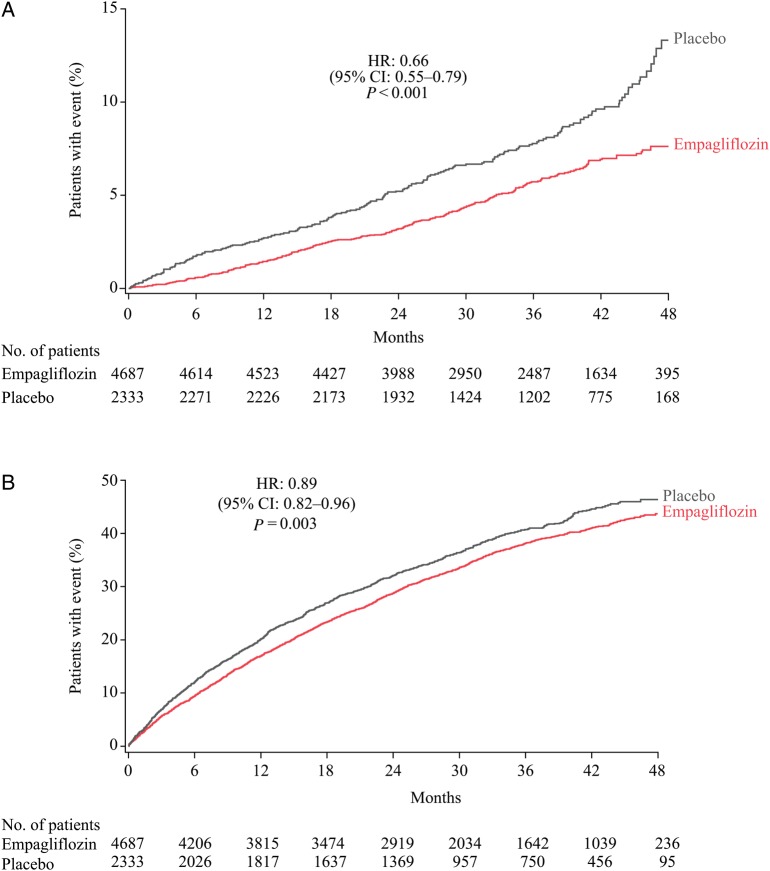
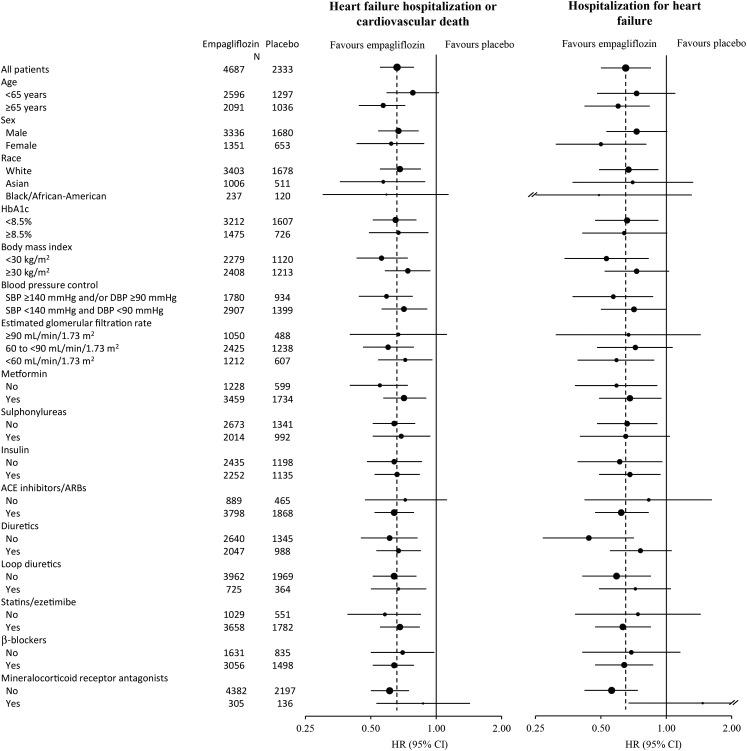
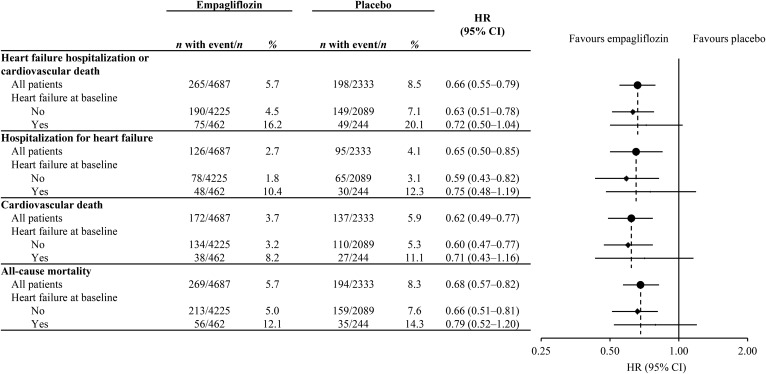
AIMS: We previously reported that in the EMPA-REG OUTCOME(®) trial, empagliflozin added to standard of care reduced the risk of 3-point major adverse cardiovascular events, cardiovascular and all-cause death, and hospitalization for heart failure in patients with type 2 diabetes and high cardiovascular risk. We have now further investigated heart failure outcomes in all patients and in subgroups, including patients with or without baseline heart failure. METHODS AND RESULTS: Patients were randomized to receive empagliflozin 10 mg, empagliflozin 25 mg, or placebo. Seven thousand and twenty patients were treated; 706 (10.1%) had heart failure at baseline. Heart failure hospitalization or cardiovascular death occurred in a significantly lower percentage of patients treated with empagliflozin [265/4687 patients (5.7%)] than with placebo [198/2333 patients (8.5%)] [hazard ratio, HR: 0.66 (95% confidence interval: 0.55-0.79); P < 0.001], corresponding to a number needed to treat to prevent one heart failure hospitalization or cardiovascular death of 35 over 3 years. Consistent effects of empagliflozin were observed across subgroups defined by baseline characteristics, including patients with vs. without heart failure, and across categories of medications to treat diabetes and/or heart failure. Empagliflozin improved other heart failure outcomes, including hospitalization for or death from heart failure [2.8 vs. 4.5%; HR: 0.61 (0.47-0.79); P < 0.001] and was associated with a reduction in all-cause hospitalization [36.8 vs. 39.6%; HR: 0.89 (0.82-0.96); P = 0.003]. Serious adverse events and adverse events leading to discontinuation were reported by a higher proportion of patients with vs. without heart failure at baseline in both treatment groups, but were no more common with empagliflozin than with placebo. CONCLUSION: In patients with type 2 diabetes and high cardiovascular risk, empagliflozin reduced heart failure hospitalization and cardiovascular death, with a consistent benefit in patients with and without baseline heart failure.
Overview
The claims and statistics of this paper haven’t been checked yet.
Free: it reads the open-access text and checks the first 5 claims that cite a source we can check. Create a free account to check every claim.
Integrity signals
Registry
Cites
Statistics
Figures
Verification
Claims the paper makes
The claims and statistics of this paper haven’t been checked yet.
Free: it reads the open-access text and checks the first 5 claims that cite a source we can check. Create a free account to check every claim.
Claims other papers make about this one
Each is checked against this paper’s own text: does it say what the citing paper says it does?
The source backs part of the claim, not all of it — or backs it for a different population, condition or comparison.
In the citing paper
“Little is known about the effect of SGLT2 inhibitors on the broad spectrum of both inpatient and outpatient worsening heart failure events, because these were not documented in trials with these drugs in type 2 diabetes.1–5”
From Effect of Empagliflozin on the Clinical Stability of Patients With Heart Failure and a Reduced Ejection Fraction: The EMPEROR-Reduced Trial (2021) · cites this paper as [1]
Experimental — accuracy not yet measuredThe source backs part of the claim, not all of it — or backs it for a different population, condition or comparison.
In the citing paper
“Recent cardiovascular outcomes trials demonstrate that therapies that inhibit sodium glucose cotransporter (SGLT)2 may reduce heart failure morbidity and mortality and slow decline in renal function (7,8,23,42,43).”
From Evaluation of renal and cardiovascular protection mechanisms of SGLT2 inhibitors: model-based analysis of clinical data (2018) · cites this paper as [8]
Experimental — accuracy not yet measuredThe cited source says what the claim attributes to it.
In the citing paper
“Sodium-glucose cotransporter 2 (SGLT2) inhibitors have been shown to reduce the risk of hospitalizations for heart failure in 8 large-scale trials, including those that focused on type 2 diabetes, heart failure with a reduced ejection fraction, and chronic kidney disease.1–8”
From Effect of Empagliflozin on the Clinical Stability of Patients With Heart Failure and a Reduced Ejection Fraction: The EMPEROR-Reduced Trial (2021) · cites this paper as [1]
The cited source says what the claim attributes to it.
In the citing paper
“hospitalizations for heart failure (2.7% versus 4.1%; 35% RRR)”
From Clinical management of stable coronary artery disease in patients with type 2 diabetes mellitus: a scientific statement from the American Heart Association (2020) · cites this paper as [219]
Self-check
Percentages, sums and reported differences re-computed from the paper’s own numbers.
The self-check needs the paper’s full text.
Citations
Cites
Empagliflozin, Cardiovascular Outcomes, and Mortality in Type 2 Diabetes
Zinman, B., Wanner, C., Lachin, J. M., Fitchett, D., Bluhmki, E., Hantel, S., Mattheus, M., Devins, T., Johansen, O. E., Woerle, H. J., et al. (2015) · New England Journal of Medicine · doi:10.1056/nejmoa1504720 · Cited by 12,315
Self-citationESC Guidelines for the diagnosis and treatment of acute and chronic heart failure 2012
Authors/Task Force Members, McMurray, J. J. V., Adamopoulos, S., Anker, S. D., Auricchio, A., Böhm, M., Dickstein, K., Falk, V., Filippatos, G., Fonseca, C., et al. (2012) · European Heart Journal · doi:10.1093/eurheartj/ehs104 · Cited by 6,879
Saxagliptin and cardiovascular outcomes in patients with type 2 diabetes mellitus
Scirica, B. M., Bhatt, D. L., Braunwald, E., Steg, P. G., Davidson, J., Hirshberg, B., Ohman, P., Frederich, R., Wiviott, S. D., Hoffman, E. B., et al. (2013) · New England Journal of Medicine · doi:10.1056/nejmoa1307684 · Cited by 3,470
ESC Guidelines for the Diagnosis and Treatment of Acute and Chronic Heart Failure 2012
Authors/Task Force Members, McMurray, J. J. V., Adamopoulos, S., Anker, S. D., Auricchio, A., Böhm, M., Dickstein, K., Falk, V., Filippatos, G., Fonseca, C., et al. (2012) · European Journal of Heart Failure · doi:10.1093/eurjhf/hfs105 · Cited by 2,644
(2013) · European Heart Journal · doi:10.1093/eurheartj/eht108 · Cited by 1,955
Cherney, D. Z. I., Perkins, B. A., Soleymanlou, N., Maione, M., Lai, V., Lee, A., Fagan, N. M., Woerle, H. J., Johansen, O. E., Broedl, U. C., et al. (2014) · Circulation · doi:10.1161/circulationaha.113.005081 · Cited by 1,329
Self-citationType 2 diabetes and incidence of cardiovascular diseases: a cohort study in 1.9 million people
Shah, A. D., Langenberg, C., Rapsomaniki, E., Denaxas, S., Pujades-Rodriguez, M., Gale, C. P., Deanfield, J., Smeeth, L., Timmis, A., & Hemingway, H. (2015) · The Lancet Diabetes & Endocrinology · doi:10.1016/s2213-8587(14)70219-0 · Cited by 1,225
Intensive glucose control and macrovascular outcomes in type 2 diabetes
Turnbull, F. M., Abraira, C., Anderson, R. J., Byington, R. P., Chalmers, J. P., Duckworth, W. C., Evans, G. W., Gerstein, H. C., Holman, R. R., Moritz, T. E., et al. (2009) · Diabetologia · doi:10.1007/s00125-009-1470-0 · Cited by 1,189 · cited 1×
“less intensive glucose control.(4) Furthermore, specific glucose-lowering medications have not been shown to improve heart failure outcomes and some may actually have deleterious effects.”
BackgroundMetabolic response to sodium-glucose cotransporter 2 inhibition in type 2 diabetic patients
Ferrannini, E., Muscelli, E., Frascerra, S., Baldi, S., Mari, A., Heise, T., Broedl, U. C., & Woerle, H.-J. (2014) · Journal of Clinical Investigation · doi:10.1172/jci72227 · Cited by 1,134
Self-citationRonco, C., McCullough, P., Anker, S. D., Anand, I., Aspromonte, N., Bagshaw, S. M., Bellomo, R., Berl, T., Bobek, I., Cruz, D. N., et al. (2010) · European Heart Journal · doi:10.1093/eurheartj/ehp507 · Cited by 1,104
Research works printed but not linked: 1
- Jordan J, Tank J, Heusser K, Heise T, Wanner C, Heer M, Macha S, Mattheus M, Lund SS, Woerle HJ, Broedl UC Empagliflozin has no discernible effect on muscle sympathetic nerve activity in patients with type 2 diabetes despite reductions in blood pressure and weight. Diabetes 2014; 63: A265 [1030-P].
Cited by
Items 701–800 of 947
Bauersachs, J. K., & Böhm, M. (2022) · Der Kardiologe · doi:10.1007/s12181-021-00524-2 · Cited by 3
Bibliometric and visualized analysis of sodium–Glucose cotransporter 2 inhibitors
Sun, H. Y., Wang, Z., Wang, Y., Rong, H., Wang, D., Liu, X., Jin, K., Sun, Z., & Fan, Q. (2023) · Frontiers in Pharmacology · doi:10.3389/fphar.2022.1009025 · Cited by 4
“Notably, SGLT2 inhibitors can reduce hospitalization for heart failure and delay the progression of renal disease, regardless of existing atherosclerotic cardiovascular disease or heart failure history (Fitchett et al., 2016; Neal et al., 2017; Wiviott et al., 2019; Zelniker et al., 2019).”
BackgroundMethodInfluentialSheikh, A. M., Sheikh, A., Alhozali, A. M., & Alshaikhi, S. A. (2023) · Cureus · doi:10.7759/cureus.44133 · Cited by 3
“All SGLT2 inhibitors have been shown to reduce the risk of worsening heart failure and subsequent hospitalization and death, with empagliflozin, dapagliflozin, and canagliflozin additionally demonstrating a reduction in the risk of major adverse cardiovascular events [11-15].”
BackgroundAntifibrotic effects of sodium-glucose cotransporter 2 inhibitors in patients with heart failure
Ignatova, Y. S., Shuster, S., Борзалиевна, П. Т., & Барбараш, О. Л. (2023) · Russian Journal of Cardiology · doi:10.15829/1560-4071-2024-5580 · Cited by 3
Bonilha, I., Gomes, É. I. L., do Carmo, H. R. P., Breder, I. S. S., Barreto, J., Breder, J. D. S. C., Munhoz, D., de Carvalho, L. S. F., Quinaglia, T., Kimura-Medorima, S. T., et al. (2024) · International Journal of Molecular Sciences · doi:10.3390/ijms25074108 · Cited by 3
“Empagliflozin, a sodium-glucose co-transporter 2 (SGLT2) inhibitor, has demonstrated benefits in reducing cardiovascular events and mortality in T2D patients [10].”
BackgroundPandey, A., Kolkailah, A. A., McGuire, D. K., Frederich, R. C., Cater, N. B., Cosentino, F., Pratley, R. E., Dagogo-Jack, S. E., Cherney, D. Z. I., Wynant, W., et al. (2025) · European Journal of Heart Failure · doi:10.1002/ejhf.3511 · Cited by 3
Need for Outcome Scenario Analysis of Clinical Trials in Diabetes
García-Verdugo, R., Erbach, M., & Schnell, O. (2016) · Journal of Diabetes Science and Technology · doi:10.1177/1932296816670925 · Cited by 3
Sourij, H., Edlinger, R., Prischl, F. C., Auinger, M., Kaser, S., Horn, S., Paulweber, B., Kautzky‐Willer, A., Säemann, M. D., Prager, R., et al. (2019) · Wiener klinische Wochenschrift · doi:10.1007/s00508-018-1425-x · Cited by 3
Hypertension Treatment in Diabetes
Bensimhon, H. F., & Cavender, M. A. (2019) · Heart Failure Clinics · doi:10.1016/j.hfc.2019.06.008 · Cited by 4
Known–Unknowns in Geriatric Cardiology
Cocco, G., & Amiet, P. (2020) · OBM Geriatrics · doi:10.21926/obm.geriatr.2001111 · Cited by 4
Singh, A. K., & Singh, R. (2021) · Diabetes & Metabolic Syndrome Clinical Research & Reviews · doi:10.1016/j.dsx.2021.102282 · Cited by 3
Lopatin, Y. M., Arutyunov, G. P., As, A., Ageev, F. T., Antsiferov, M. B., Барбараш, О. Л., Вадимовна, В. С., Георгиевна, В. Н., Galstyan, G. R., Galyavich, A. S., et al. (2022) · Russian Journal of Cardiology · doi:10.15829/1560-4071-2022-4945 · Cited by 3
Chen, X., Wang, L., Li, H., Huang, W., Huang, S., Zhao, L., & Guo, W. (2022) · Frontiers in Cardiovascular Medicine · doi:10.3389/fcvm.2022.1067806 · Cited by 3
Nishimura, R., Takeshima, T., Iwasaki, K., & Aoi, S. (2023) · Expert Opinion on Pharmacotherapy · doi:10.1080/14656566.2023.2206016 · Cited by 3
Athyros, V. G., Imprialos, K. P., Doumas, M. N., & Karagiannis, A. I. (2016) · Clinical Lipidology · doi:10.1080/17584299.2016.1230316 · Cited by 3
“[3] The mechanisms driving the effects of empagliflozin on HF and CVD death are not clear.[4] Potential mechanisms include osmotic diuresis, modulation of the cardiorenal axis that reduced plasma volume and less sodium retention, reduction in arterial stiffness, reduced left ventricular afterload, fall in body weight…”
BackgroundLiraglutide for weight management: benefits and risks
Tomlinson, B., Hu, M., Zhang, Y., Chan, P., & Liu, Z.-M. (2017) · Current Medical Research and Opinion · doi:10.1080/03007995.2016.1271315 · Cited by 3
Association between SGLT2 inhibitors and diabetic ketoacidosis among patients fasting in RamadanPreprint
Ruqaib, A. M. A., Alghamdi, A. A., Jamaan, A. A., Abdulmowla, M. M., Deaji, F. F. A., & Alsuwaidan, S. D. (2023) · Research Square · doi:10.21203/rs.3.rs-2466697/v1 · Cited by 4
Nandave, M. (2024) · Springer eBooks · doi:10.1007/978-981-97-7568-2_6 · Cited by 3
van der Wal, H. H., Beverborg, N. G., van Veldhuisen, D. J., Voors, A. A., & van der Meer, P. (2016) · Expert Opinion on Pharmacotherapy · doi:10.1080/14656566.2016.1197201 · Cited by 4
“flozin on cardiovascular events was consistent in patients with and without HF at baseline [44].”
BackgroundAspects of the safety of hypoglycemic drugs according to the results of clinical trials
Хохлов, А. Л., Горелов, К. В., & Rybachkova, J. V. (2023) · Patient-Oriented Medicine and Pharmacy · doi:10.37489/2949-1924-0016 · Cited by 2
Behzad, H., Mashayekhi, S., Asham, H., Sarbakhsh, P., & Entezari‐Maleki, T. (2024) · Journal of Cardiovascular and Thoracic Research · doi:10.34172/jcvtr.33103 · Cited by 2
“…(eGFR 30 ml/min), patients undergoing dialysis, patients in cardiogenic shock, severe infections, cancer, liver failure (Child Pugh score > 6), uncontrolled autoimmune and inflammatory diseases, pregnancy and lactation, a history of serious hypersensitivity reactions to empagliflozin or…”
BackgroundDemidova, T. Y., Кislyak, O. A., Геннадьевна, Л. К., & Харчилава, Л. Д. (2024) · FOCUS Endocrinology · doi:10.62751/2713-0177-2024-5-4-15 · Cited by 2
Sasidharan, A., Sajith Kumar, S., Suchitralakshmi, G., Rajsekar, K., & Bagepally, B. S. (2025) · Health Policy and Technology · doi:10.1016/j.hlpt.2025.101077 · Cited by 3
Kümet, Ö., Polat, F., Durmaz, O., Can, V., Kaya, A., Ayhan, G., & Özbek, E. (2026) · Diabetes Research and Clinical Practice · doi:10.1016/j.diabres.2026.113147 · Cited by 2
Sodium-Glucose Cotransporter 2 (SGLT2) Inhibitors and Stroke ― Reply ―
Kaku, K., Lee, J., Kaspers, S., Woerle, H. J., & George, J. T. (2017) · Circulation Journal · doi:10.1253/circj.cj-17-0395 · Cited by 2
Self-citationCardiovascular outcome trials in type 2 diabetes: A critical analysis
Ashraf, H., & Ahmad, J. (2018) · Diabetes & Metabolic Syndrome Clinical Research & Reviews · doi:10.1016/j.dsx.2018.09.001 · Cited by 3
Khazova, E. V., Bulashova, O. V., OSLOPOV, V. N., & MALKOVA, M. I. (2018) · The Bulletin of Contemporary Clinical Medicine · doi:10.20969/vskm.2018.11(5).124-129 · Cited by 2
Heart failure prevention with sodium‐glucose cotransporter 2 inhibitors
Khan, M. S., & Butler, J. (2019) · Journal of Diabetes · doi:10.1111/1753-0407.12932 · Cited by 2
“Glycosuria along with natriuresis leads to osmotic diuresis, which may result in reduced preload.(19) This condition, coupled with modification of the intrarenal renin-angiotensin axis, reduction in arterial stiffness, and systemic blood pressure lowering, may contribute to optimize loading conditions of the myocardiu…”
BackgroundDiabetestherapie geriatrischer Patienten: Was sagen die Leitlinien?
Bahrmann, A. (2019) · CardioVasc · doi:10.1007/s15027-019-1451-2 · Cited by 2
PRIORITIES OF ANTI-HYPERGLYCAEMIC DRUG THERAPY IN PATIENTS WITH TYPE 2 DIABETES AND HEART FAILURE
Росул, М. М., Блецкан, М. М., Ivano, N. V., Korabelschykova, M. O., & Rubtsova, Y. I. (2020) · Wiadomości Lekarskie · doi:10.36740/wlek202003139 · Cited by 2
Series: Cardiovascular outcome trials for diabetes drugs Empagliflozin and EMPA-REG OUTCOME
Fisher, M. (2020) · British Journal of Diabetes · doi:10.15277/bjd.2020.254 · Cited by 2
Type 2 diabetes mellitus and chronic heart failure: new treatment strategies
Bondarenko, I. Z., & Bubnova, M. G. (2021) · Cardiosomatics · doi:10.17816/22217185.2021.4.201062 · Cited by 2
Opportunistic screening for asymptomatic left ventricular dysfunction in type 2 diabetes mellitus
Zhou, M., Huang, D., Cheng, Y., Lau, Y. M., Lai, W. H., Lau, Y.-M., Hai, J. J., Lau, C., Chan, E. W., Yue, W. S., et al. (2022) · Postgraduate Medical Journal · doi:10.1136/postgradmedj-2022-141548 · Cited by 3
Habon, T., & Sepp, R. (2022) · Cardiologia Hungarica · doi:10.26430/chungarica.2022.52.2.122 · Cited by 2
“Az empagliflozinnak fenti hatása független volt a kovariánsoktól (11).”
Is there a paradigm shift in preventing diabetic heart failure? A review of SGLT2 inhibitors
KHAKDE, S., Jawaid, H., Yasmin, F., Ali, M. B., & REHMAN, A. (2022) · Minerva Endocrinology · doi:10.23736/s2724-6507.20.03221-6 · Cited by 2
Ehsan, P., Aburumman, R. N., Muthanna, S. I., Menon, S. R., Vithani, V., Sutariya, B., Montenegro, D. M., Chukwu, M., & Penumetcha, S. S. (2022) · Cureus · doi:10.7759/cureus.31777 · Cited by 5
“However, recent studies have shown that SGLT2-I are effective in improving negative cardiovascular (CV) and renal outcomes in diabetic patients [3-6].”
BackgroundCherney, D. Z. I., Cosentino, F., McGuire, D. K., Kolkailah, A. A., Dagogo-Jack, S. E., Pratley, R. E., Frederich, R. C., Maldonado, M., Liu, C., & Cannon, C. P. (2023) · Kidney International Reports · doi:10.1016/j.ekir.2023.01.011 · Cited by 4
Herashchenko, A. S., & Fedorov, S. V. (2023) · Прикарпатський вісник наукового товариства імені Шевченка ПУЛЬС · doi:10.21802/2304-7437-2023-19(67)-55-62 · Cited by 2
Performance of sodium-glucose cotransporter 2 inhibitors in cardiovascular disease
Khater, J., Malakouti, S., Khoury, A. E., & Cortese, B. (2024) · Journal of Cardiovascular Medicine · doi:10.2459/jcm.0000000000001598 · Cited by 2
Pure Sensory Thalamic Stroke Presenting As Hemiballismus: A Case Report
King, B., Jamil, H., Dekhne, A., Bajwa, D., Nolte, J., FERGUSON, P. W., & Inam, S. H. A. (2024) · Cureus · doi:10.7759/cureus.68708 · Cited by 2
“The thalamus plays a critical role in sensory and motor functions, emotional processing, and cognitive abilities, making thalamic stroke evaluations crucial for accurate diagnosis and treatment planning [8].”
BackgroundSakai, C., Tamaru, S., Sugai, K., Takeuchi, H., & Suzuki, R. (2025) · Journal of Diabetes Investigation · doi:10.1111/jdi.70085 · Cited by 2
“The use of SGLT2i has been suggested to decrease the frequency of loop diuretics 25 .”
January 2017 at a Glance: Oncology, Diabetes and Antidiabetic Treatment, Pulmonary Hypertension
Metra, M. (2017) · European Journal of Heart Failure · doi:10.1002/ejhf.741 · Cited by 2
Bolstering your armamentarium with SGLT2 inhibitors
Novak, L. M., & Kruger, D. F. (2017) · The Nurse Practitioner · doi:10.1097/01.npr.0000524665.16846.63 · Cited by 3
Back to square one: what is a normal blood pressure and for whom?
Lüscher, T. F. (2018) · European Heart Journal · doi:10.1093/eurheartj/ehy356 · Cited by 2
Stelmaszyk, A., Wesołowska, A., Pomieczyńska, K., Iskakova, S., Frydrychowicz, M., Dworacki, G., & Dworacka, M. (2018) · Saudi Pharmaceutical Journal · doi:10.1016/j.jsps.2018.07.008 · Cited by 2
“Mostly, there are available some indirect data which support the idea that dapagliflozin reduces cardiovascular risk e.g. it was documented that empagliflozin – another SGLT2-inhibitor – reduces the risk of death due to cardiovascular reasons by about one-third (Fitchett et al., 2016).”
BackgroundHeart failure and diabetes: management and open issues
Schütt, K. S., & Marx, N. (2019) · Herz · doi:10.1007/s00059-019-4792-9 · Cited by 2
Nine contemporary therapeutic directions in heart failure
Almarzooq, Z., Pareek, M., Sinnenberg, L. E., Vaduganathan, M., & Mehra, M. R. (2019) · Heart Asia · doi:10.1136/heartasia-2018-011150 · Cited by 2
Diabetes mellitus Typ 2: Wie schützen wir die Nieren am besten?
Brenner, S., & Wanner, C. (2019) · DMW - Deutsche Medizinische Wochenschrift · doi:10.1055/a-0662-1919 · Cited by 2
Self-citationDiabetes and Cardiovascular Disease
Coutiño-Castelán, D., Abundes-Velasco, A., Santos, F. D. D. L., Arias, E., González, C. M., Ortíz, A. M., Morales, J. L., Cruz, J. L. B. D. L., Fonseca, C. E. H., & Custodio-Sánchez, P. (2019) · Springer eBooks · doi:10.1007/978-3-030-11815-0_46 · Cited by 2
A look at new therapeutic opportunities in patients with non-alcoholic fatty liver disease
Mishina, E. Е., Mayorov, A. Y., Васильевна, Б. А., Bogomolov, P., Matsievich, M. V., & Kokina, K. Y. (2019) · Obesity and metabolism · doi:10.14341/omet9986 · Cited by 2
ADVANCES IN LAPAROSCOPIC PANCREATIC SURGERY.
Martel, G., Kirk, G., & Jones, C. A. (2019) · PubMed Central · Cited by 2
Alkagiet, S., & Τζιόμαλος, Κ. (2020) · World Journal of Diabetes · doi:10.4239/wjd.v11.i5.150 · Cited by 2
Sharma, A., Wu, J., Xu, H., Hernandez, A. F., Felker, G. M., Al‐Khatib, S. M., Green, J., Matsouaka, R., Fonarow, G. C., Singh, J. P., et al. (2020) · Journal of the American Heart Association · doi:10.1161/jaha.119.012405 · Cited by 2
Lu, A., Fan, H., Xu, J., Li, J., & Zhao, H. (2020) · Medical Science Monitor · doi:10.12659/msm.922129 · Cited by 2
Zilli, R. W., Rached, C. D. A., da Silva, F. P., & Baena, R. C. (2020) · Revista da Associação Médica Brasileira · doi:10.1590/1806-9282.66.4.458 · Cited by 2
Koçyiğit, D., Kocyigit, A. S., & Hussain, M. (2020) · Minerva Cardioangiologica · doi:10.23736/s0026-4725.20.05398-0 · Cited by 2
Kale, S. C., & Tahrani, A. A. (2021) · Metabolism Open · doi:10.1016/j.metop.2021.100082 · Cited by 3
“Trials EMPA-REG OUTCOME [33,38,42,67] DECLARE-TIMI 58 [32] CANVAS-program [30,43] CREDENCE [31]”
BackgroundSodium-Glucose Cotransporter-2 Inhibitors: Heart Failure and Renal Protection Indications
Hussein, M. T. E., & Bell, N. (2021) · The Journal for Nurse Practitioners · doi:10.1016/j.nurpra.2021.09.002 · Cited by 2
Vícha, M., Skála, T., Jelínek, L., Pavlů, L., Jarkovský, J., Dušek, L., Benešová, K., & Táborský, M. (2021) · Biomedical Papers · doi:10.5507/bp.2021.069 · Cited by 2
Vícha, M., Skála, T., Benešová, K., Dušek, L., Flašík, J., Pavlů, L., Hudec, Š., & Táborský, M. (2022) · Cor et Vasa · doi:10.33678/cor.2021.103 · Cited by 2
Sodium-glucose co-transporter 2 inhibitors and erythrocytosis: a review
Shah, N. Z., Bandara, T., Deshmukh, H., Batten, L., Walton, C., & Sathyapalan, T. (2022) · British Journal of Diabetes · doi:10.15277/bjd.2022.384 · Cited by 3
Lin, H.-S., Yang, C., Yin, T., Sung, P., Chiang, J. Y., Shao, P., Chen, Y.-L., Huang, C., Yip, H., & Chen, K. (2023) · PubMed Central · Cited by 4
Are Sodium-Glucose Cotransporter 2 Inhibitors Really Useful and Safe for Advanced Heart Failure?
Okumura, T., & Murohara, T. (2018) · Circulation Journal · doi:10.1253/circj.cj-18-0584 · Cited by 2
Empagliflozin and Protecting Microvascular Support of Heart Mechanics
Mantsounga, C., & Morrison, A. (2019) · JACC Basic to Translational Science · doi:10.1016/j.jacbts.2019.08.003 · Cited by 2
Empagliflozin's Anti-Inflammatory Spectrum in Type 2 Diabetes Mellitus: Piecing Together the Puzzle
Linthout, S. V., Spillmann, F., & Verma, S. (2025) · European Journal of Heart Failure · doi:10.1002/ejhf.3604 · Cited by 2
Vijayakumar, S., Vaduganathan, M., & Butler, J. (2018) · Expert Review of Cardiovascular Therapy · doi:10.1080/14779072.2018.1423962 · Cited by 1
Medical and Revascularization Management of Stable Ischemic Heart Disease: An Overview
Radaideh, Q., Shammas, N. W., Daher, G. E., & Rachwan, R. J. (2021) · International Journal of Angiology · doi:10.1055/s-0040-1722739 · Cited by 1
Recent Advances in Sodium Glucose Cotransporter-2 Inhibitors
Cho, D. H. (2021) · Journal of Korean Diabetes · doi:10.4093/jkd.2021.22.2.113 · Cited by 1
Крутиков, Е. С., Tsvetkov, V. A., Chistyakova, S., & Akaev, R. O. (2021) · Nephrology (Saint-Petersburg) · doi:10.36485/1561-6274-2021-25-6-56-62 · Cited by 1
Hussein, M. T. E., & Reeves, C. (2023) · The Journal for Nurse Practitioners · doi:10.1016/j.nurpra.2023.104716 · Cited by 1
Salutary Effects of Nutritional Ketosis for the Diseased Human Heart
Crabtree, C. D., Buga, A., Han, Y., Simonetti, O. P., & Volek, J. S. (2025) · Current Atherosclerosis Reports · doi:10.1007/s11883-025-01333-8 · Cited by 1
Gheorghiu, M., Trandafir, M.-F., Savu, O., Păsărică, D., & Bleoţu, C. (2025) · Journal of Clinical Medicine · doi:10.3390/jcm14217585 · Cited by 1
D’Oro, A., D’Costa, Z. U., Tang, J., Min, S., Jackson, L. R., & Essien, U. R. (2025) · American Journal of Preventive Cardiology · doi:10.1016/j.ajpc.2025.101361 · Cited by 1
“SLGT2 inhibitors have also been associated with decreased rates of heart failure related hospitalization or cardiovascular death in AF and, therefore, could be used as a cardioprotective medication in AF patients with diabetes[112].”
Bogomolov, A. N., Николаевна, К. О., Kozlov, K. L., & Golikova, E. N. (2025) · Russian Journal of Geriatric Medicine · doi:10.37586/2686-8636-4-2025-546-556 · Cited by 1
Euglycemic Ketoacidosis Induced by Dapagliflozin in a Non‐Diabetic Patient With Cardiac Amyloidosis
Hamoud, S. A. S., & Harding, E. (2026) · Clinical Case Reports · doi:10.1002/ccr3.71818 · Cited by 1
Lin, D. S., Lo, H.-Y., Huang, K.-C., Lin, T., Huang, C.-Y., Lee, J.-K., & Lin, L. (2026) · European journal of medical research · doi:10.1186/s40001-026-03849-4 · Cited by 1
Sutanto, R., Ichwantoro, S., & Raditya, R. A. (2026) · The International Journal of Medical Science and Health Research · doi:10.70070/35d6zz82 · Cited by 1
Hady, Y. A. A. E., Elaziz, A. A. S. A. A., & Mahmoud, A. A. (2026) · Revista Portuguesa de Cardiologia · doi:10.1016/j.repc.2026.04.007 · Cited by 2
Kardiovaskuläre Effekte von SGLT-2-Hemmern
Drexel, H., & Säly, C. (2016) · Der Diabetologe · doi:10.1007/s11428-016-0079-4 · Cited by 1
“Bei weiterführenden Subgruppenanalysen konnte jüngst eine Reduktion der stationären Aufnahmen wegen Herzinsuffizienz und des kardiovaskulären Todes (kombinierter Endpunkt) durch die Empagliflozinbehandlung bestätigt werden – unabhängig davon, ob in der Ausgangssituation eine Herzinsuffizienz vorlag oder nicht [10].”
BackgroundThe SGLT2 inhibitor empagliflozin: results of EMPA-REG OUTCOMER trial
Okamura, T., & Koiwai, K. (2016) · Folia Pharmacologica Japonica · doi:10.1254/fpj.148.282 · Cited by 1
Aoki, Y. (2016) · Diabetes Research - Open Journal · doi:10.17140/droj-2-128 · Cited by 1
The year in cardiology 2016: heart failure
Maggioni, A. P., & Ruschitzka, F. T. (2016) · European Heart Journal · doi:10.1093/eurheartj/ehw638 · Cited by 1
The year in cardiology 2016: prevention
Piepoli, M. F., Taddei, S., & Laufs, U. (2017) · European Heart Journal · doi:10.1093/eurheartj/ehw637 · Cited by 1
Is diabetes still a state of premature cardiovascular death?
Fisher, M. (2016) · Practical Diabetes · doi:10.1002/pdi.2057 · Cited by 2
Sánchez‐Más, J., Guillen, E. S., Lopez, M., Soriano-Filiu, Á., Sánchez-Pérez, M. C., Hernández-Martínez, A. M., Lax, A., & Pascual-Figal, D. A. (2017) · Diabetes & Metabolism · doi:10.1016/j.diabet.2017.09.008 · Cited by 1
Dyspnoe bei Diabetes und Herzinsuffizienz
Schütt, K. S. (2017) · Der Diabetologe · doi:10.1007/s11428-017-0291-x · Cited by 1
Impact of SGLT2i on cardiovascular outcomes and heart failure in patients with type 2 diabetes
Rodríguez, J. J., Ortega‐Paz, L., Brugaletta, S., Sabaté, M., & equally., †. T. T. A. C. (2018) · AIMS Medical Science · doi:10.3934/medsci.2018.1.67 · Cited by 1
Cardiologists' approach to managing cardiovascular risk in patients with type 2 diabetes
Rocha, N. A., & Das, S. R. (2019) · Journal of Diabetes · doi:10.1111/1753-0407.12918 · Cited by 1
Bhuiyan, M. M. R., & Begum, A. (2019) · Obesity Medicine · doi:10.1016/j.obmed.2019.100099 · Cited by 1
Sodium–Glucose Cotransporter-2 Inhibitors and Heart Failure Prevention in Type 2 Diabetes
Khan, M. S., & Butler, J. (2019) · Cardiac failure review · doi:10.15420/cfr.2019.06.r1 · Cited by 1
Yazaki, M., Nabeta, T., Inomata, T., Maemura, K., Ooki, T., Fujita, T., Iida, Y., Ikeda, Y., Ishii, S., Naruke, T., et al. (2019) · Circulation Reports · doi:10.1253/circrep.cr-19-0080 · Cited by 1
Gallwitz, B., & Schmieder, R. E. (2020) · Diabetologie und Stoffwechsel · doi:10.1055/a-1197-6223 · Cited by 1
“[14] Fitchett D, Zinman B, Wanner C et al.”
BackgroundЗуєв, К. О. (2021) · INTERNATIONAL JOURNAL OF ENDOCRINOLOGY (Ukraine) · doi:10.22141/2224-0721.16.3.2020.205273 · Cited by 1
SODIUM-GLUCOSE COTRANSPORTER-2 INHIBITORS AS NEW STRATEGY OF CHRONIC HEART FAILURE MANAGEMENT
Herashchenko, A. S., & Fedorov, S. V. (2020) · Emergency Medical Service · doi:10.36740/emems202003109 · Cited by 1
Efficacy of sodium-glucose co-transporter-2 inhibitors in patients with heart failure
Kovalenko, E. V., Витальевна, Л. М., Arabidze, G. G., & Kryakushkin, V. G. (2021) · Russian Journal of Cardiology · doi:10.15829/1560-4071-2021-4235 · Cited by 2
Management of Patients with Chronic Heart Failure and Diabetes Mellitus
Reznik, E. V., Nguyen, T. L., & Golukhov, G. N. (2021) · Rational Pharmacotherapy in Cardiology · doi:10.20996/1819-6446-2021-04-05 · Cited by 2
Gan, H., Tang, H. Y., Huang, Y., Wang, D., Pu, P., & Zuo, Z. (2021) · Reviews in Cardiovascular Medicine · doi:10.31083/j.rcm2203069 · Cited by 1
Ovchinnikov, A. G., Borisov, A. A., Zherebchikova, K., Рябцева, О. Ю., Gvozdeva, A. D., Masenko, V. P., & Ageev, F. T. (2021) · Russian Cardiology Bulletin · doi:10.17116/cardiobulletin20211603160 · Cited by 1
Arrieta, F., Pedro‐Botet, J., Iglesias, P., Obaya, J. C., Montánez, L., Maldonado, G. F., Becerra, A., Navarro, J., Perez, J. C., Petrecca, R., et al. (2022) · Clínica e Investigación en Arteriosclerosis (English Edition) · doi:10.1016/j.artere.2022.01.005 · Cited by 3
Chronic Kidney Disease and Heart Failure—A Nephrologic Approach
House, A. A., Ronco, C., & Herzog, C. A. (2019) · Elsevier eBooks · doi:10.1016/b978-0-12-815876-0.00054-1 · Cited by 1
Metadata
- Authors
- Fitchett, D., Zinman, B., Wanner, C., Lachin, J. M., Hantel, S., Salsali, A., Johansen, O. E., Woerle, H. J., Broedl, U. C., & Inzucchi, S. E.
- Affiliations
- St. Michael's Hospital (CA)
- Mount Sinai Hospital (CA)
- University of Würzburg (DE)
- George Washington University (US)
- Boehringer Ingelheim (Germany) (DE)
- Boehringer Ingelheim (United States) (US)
- Boehringer Ingelheim (Norway) (NO)
- Yale University (US)
- Corresponding author
- Fitchett, David
- ORCID
- Venue
- European Heart Journal
- Publisher
- Oxford University Press (OUP)
- Published
- 2016-01-26
- Volume
- 37
- Issue
- 19
- Pages
- 1526-1534
- ISSN
- 0195-668X (ISSN-L)
- 1522-9645
- PMC
- PMC4872285
- OpenAlex
- W2273304042
- Cited by
- 907
- References
- 29
- Citations by year
- 2026: 18 · 2025: 30 · 2024: 32 · 2023: 55 · 2022: 75 · 2021: 115 · 2020: 102 · 2019: 142 · 2018: 124 · 2017: 131 · 2016: 81
- FWCI
- 160.00
- Type
- journal article
- Language
- en
- Open access
- hybrid
- doi.org
- Licence
- cc-by-nc
- Locations
- European Heart Journal (publishedVersion, cc-by-nc)
- Europe PMC (PubMed Central) (publishedVersion, cc-by-nc)
- PubMed Central (publishedVersion, cc-by-nc)
- PubMed (publishedVersion)
- Lirias (KU Leuven) (submittedVersion, other-oa)
- Docusalut (Conselleria de Salut i Consum del Govern de les Illes Balears) (submittedVersion, cc-by-nc)
- Hispana (submittedVersion, cc-by-nc)
- HighWire Press Open Archive (submittedVersion)
- Online Publication Service of Würzburg University (Würzburg University) (submittedVersion, cc-by-nc)
- Funders
- Boehringer Ingelheim and Eli Lilly and Company
- Topics
- Health Sciences › Medicine › Endocrinology, Diabetes and Metabolism › Diabetes Treatment and Management
- Health Sciences › Medicine › Cardiology and Cardiovascular Medicine › Heart Failure Treatment and Management
- Health Sciences › Medicine › Cardiology and Cardiovascular Medicine › Cardiovascular Function and Risk Factors
- Keywords
- empagliflozin, type 2 diabetes, heart failure hospitalization, cardiovascular mortality, SGLT2 inhibitors, EMPA-REG OUTCOME trial, high cardiovascular risk, all-cause hospitalization, serious adverse events, subgroup analysis, number needed to treat, cardiovascular risk reduction, heart failure treatment, drug discontinuation
About these checks
Registry, retraction, Cites and statistics results are computed, not judged, with one exception: a printed reference that no index lists is read once by a model before it counts as a citation error. Claims are extracted by a model and kept only when their quote appears verbatim in the text; each cited source is then checked, with a model’s help, for whether it says what the claim relies on. Those verdicts can be wrong — read the claim’s quote and the cited source before relying on one.
Statistics and arithmetic are recomputed, not judged.
Confidence bands are shown only for fields calibrated on our annotated test set. None is calibrated yet, so no band is shown.
What counts as a claim ›How we measure confidence ›How we check this ›
Are you an author, or do you see a problem with this page? Request a review
Data sources
Bibliographic data: Semantic Scholar, OpenAlex, Crossref.
Contains information from the Semantic Scholar Academic Graph Datasets, made available under the ODC Attribution License (ODC-BY 1.0).
Semantic Scholar’s data is described in: Kinney, R., et al. (2023). The Semantic Scholar Open Data Platform. arXiv:2301.10140.
