

The Association of Cigarette Smoking With Depression and Anxiety: A Systematic Review
Open accessThe DOI matches its Crossref record; 172 of the 174 references it cites were found in a registry or an index, and 2 are not checked yet.
Abstract
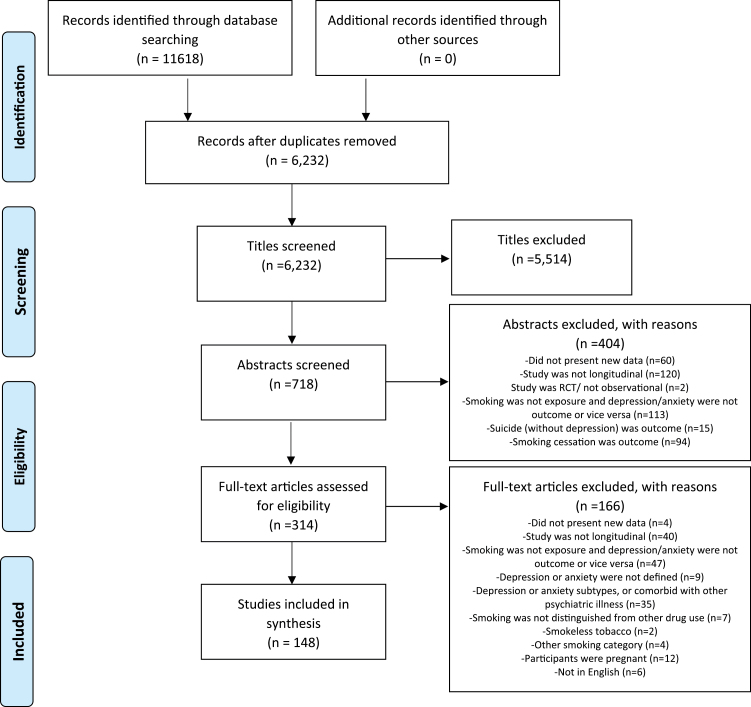
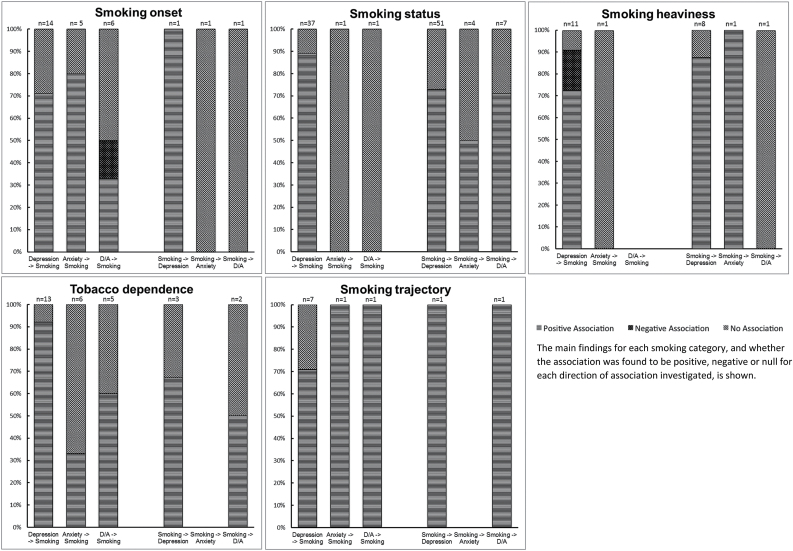
BACKGROUND: Many studies report a positive association between smoking and mental illness. However, the literature remains mixed regarding the direction of this association. We therefore conducted a systematic review evaluating the association of smoking and depression and/or anxiety in longitudinal studies. METHODS: Studies were identified by searching PubMed, Scopus, and Web of Science and were included if they: (1) used human participants, (2) were longitudinal, (3) reported primary data, (4) had smoking as an exposure and depression and/or anxiety as an outcome, or (5) had depression and/or anxiety as the exposure and smoking as an outcome. RESULTS: Outcomes from 148 studies were categorized into: smoking onset, smoking status, smoking heaviness, tobacco dependence, and smoking trajectory. The results for each category varied substantially, with evidence for positive associations in both directions (smoking to later mental health and mental health to later smoking) as well as null findings. Overall, nearly half the studies reported that baseline depression/anxiety was associated with some type of later smoking behavior, while over a third found evidence that a smoking exposure was associated with later depression/anxiety. However, there were few studies directly supporting a bidirectional model of smoking and anxiety, and very few studies reporting null results. CONCLUSIONS: The literature on the prospective association between smoking and depression and anxiety is inconsistent in terms of the direction of association most strongly supported. This suggests the need for future studies that employ different methodologies, such as Mendelian randomization (MR), which will allow us to draw stronger causal inferences. IMPLICATIONS: We systematically reviewed longitudinal studies on the association of different aspects of smoking behavior with depression and anxiety. The results varied considerably, with evidence for smoking both associated with subsequent depression and anxiety, and vice versa. Few studies supported a bidirectional relationship, or reported null results, and no clear patterns by gender, ethnicity, clinical status, length to follow-up, or diagnostic test. Suggesting that despite advantages of longitudinal studies, they cannot alone provide strong evidence of causality. Therefore, future studies investigating this association should employ different methods allowing for stronger causal inferences to be made, such as MR.
Overview
The claims and statistics of this paper haven’t been checked yet.
Free: it reads the open-access text and checks the first 5 claims that cite a source we can check. Create a free account to check every claim.
Integrity signals
Registry
Cites
Statistics
Figures
Verification
Claims the paper makes
The claims and statistics of this paper haven’t been checked yet.
Free: it reads the open-access text and checks the first 5 claims that cite a source we can check. Create a free account to check every claim.
Claims other papers make about this one
Each is checked against this paper’s own text: does it say what the citing paper says it does?
The source backs part of the claim, not all of it — or backs it for a different population, condition or comparison.
In the citing paper
“due to the high comorbidity between nicotine addiction and several anxiety-related disorders (Fluharty et al., 2016)”
From Age-dependent Effects of Tobacco Smoke and Nicotine on Cognition and the Brain: A Systematic Review of the Human and Animal Literature Comparing Adolescents and Adults. (2023) · cites this paper as Fluharty et al., 2016
Experimental — accuracy not yet measuredIn the citing paper
“Depressive disorders are heritable conditions with heritability rates of approximately 40% 12”
From Depressive symptoms predict clinical recurrence of inflammatory bowel disease (2022) · cites this paper as [12]
In the citing paper
“Importantly, there were no studies showing that smoking was associated with a later reduction in anxiety or depression rates.”
From An application of the stress-diathesis model: A review about the association between smoking tobacco, smoking cessation, and mental health (2023) · cites this paper as Fluharty et al. (2017)
In the citing paper
“Over a third of studies found that smoking at baseline led to later onset of anxiety or depression.”
From An application of the stress-diathesis model: A review about the association between smoking tobacco, smoking cessation, and mental health (2023) · cites this paper as Fluharty et al. (2017)
Self-check
Percentages, sums and reported differences re-computed from the paper’s own numbers.
The self-check needs the paper’s full text.
Citations
Cites
Diagnostic and Statistical Manual of Mental Disorders
Williams, J. B. W., & First, M. (2013) · Encyclopedia of Social Work · doi:10.1093/acrefore/9780199975839.013.104 · Cited by 109,519
Power failure: why small sample size undermines the reliability of neuroscience
Button, K. S., Ioannidis, J. P. A., Mokrysz, C., Nosek, B. A., Flint, J., Robinson, E. S. J., & Munafò, M. R. (2013) · Nature Reviews Neuroscience · doi:10.1038/nrn3475 · Cited by 7,641
A mega-analysis of genome-wide association studies for major depressive disorder
Major Depressive Disorder Working Group of the Psychiatric GWAS Consortium, Ripke, S., Wray, N. R., Lewis, C. M., Hamilton, S. P., Weissman, M. M., Breen, G., Byrne, E. M., Blackwood, D. H. R., Boomsma, D. I., et al. (2013) · Molecular Psychiatry · doi:10.1038/mp.2012.21 · Cited by 1,120
Life course outcomes of young people with anxiety disorders in adolescence
WOODWARD, L. J., & FERGUSSON, D. M. (2001) · Journal of the American Academy of Child & Adolescent Psychiatry · doi:10.1097/00004583-200109000-00018 · Cited by 1,051
Change in mental health after smoking cessation: systematic review and meta-analysis
Taylor, G., McNeill, A., Girling, A., Farley, A., Lindson-Hawley, N., & Aveyard, P. (2014) · BMJ · doi:10.1136/bmj.g1151 · Cited by 1,039
Smoking and Major Depression: A Causal Analysis
Kendler, K. S. (1993) · Archives of General Psychiatry · doi:10.1001/archpsyc.1993.01820130038007 · Cited by 792
Neurobiological similarities in depression and drug dependence: a self-medication hypothesis
Markou, A. (1998) · Neuropsychopharmacology · doi:10.1016/s0893-133x(97)00113-9 · Cited by 767
Adult Sequelae of Adolescent Depressive Symptoms
Kandel, D. B. (1986) · Archives of General Psychiatry · doi:10.1001/archpsyc.1986.01800030073007 · Cited by 638
Major Depression and Stages of Smoking: A Longitudinal Investigation
Breslau, N., Peterson, E. L., Schultz, L. R., Chilcoat, H. D., & Andreski, P. (1998) · Archives of General Psychiatry · doi:10.1001/archpsyc.55.2.161 · Cited by 633
Swendsen, J., Conway, K. P., Degenhardt, L., Glantz, M., Jin, R., Merikangas, K. R., Sampson, N., & Kessler, R. C. (2010) · Addiction · doi:10.1111/j.1360-0443.2010.02902.x · Cited by 597
Cited by
Items 101–200 of 1,000
The stigma of smoking among women: A systematic review
David, J.-C., Fonte, D., Sutter‐Dallay, A., Auriacombe, M., Serre, F., Rascle, N., & Loyal, D. (2023) · Social Science & Medicine · doi:10.1016/j.socscimed.2023.116491 · Cited by 49
Ranjit, A., Korhonen, T., Buchwald, J., Heikkila, K. V., Tuulio‐Henriksson, A., Rose, R. J., Kaprio, J. A., & Latvala, A. (2019) · Drug and Alcohol Dependence · doi:10.1016/j.drugalcdep.2019.03.012 · Cited by 48
Slomp, F. M., Bara, T. D. S., Picharski, G. L., & Cordeiro, M. L. (2019) · Neuropsychiatric Disease and Treatment · doi:10.2147/ndt.s217069 · Cited by 48
“In a longitudinal study, Hill and colleagues found that several familial factors may influence the onset of daily smoking in adolescents, including poverty, parental smoking, and a lack of rules and monitoring.(9) Tobacco consumption has been associated with a number of psychopathological conditions in recent decades,…”
BackgroundKim, S., Park, I.-H., Kim, M., Park, A., Jhon, M., Kim, J., Kang, H., Ryu, S., Lee, J., & Kim, J. (2021) · BMC Psychiatry · doi:10.1186/s12888-021-03449-y · Cited by 45
Association between depression and epigenetic age acceleration: A co‐twin control study
Liu, C., Wang, Z., Hui, Q., Goldberg, J. H., Smith, N. L., Shah, A. J., Murrah, N. V., Shallenberger, L. H., Diggers, E., Bremner, J. D., et al. (2022) · Depression and Anxiety · doi:10.1002/da.23279 · Cited by 44
“, 2019), which are also known factors associated with depression (Fluharty et al., 2017; Jantaratnotai et al., 2017; Sarris et al., 2020).”
BackgroundPathophysiology of nAChRs: Limbic circuits and related disorders
Mineur, Y. S., Soares, A. R., Etherington, I. M., Abdulla, Z. I., & Picciotto, M. R. (2023) · Pharmacological Research · doi:10.1016/j.phrs.2023.106745 · Cited by 44
Shen, L., Xu, X., Yue, S., & Yin, S. (2024) · BMC Psychiatry · doi:10.1186/s12888-024-05766-4 · Cited by 45
“Systematic evaluations have shown that smoking and alcohol consumption increase the risk of depression [23–24].”
BackgroundJimènez-Barragan, M., Falguera‐Puig, G., Curto-Garcia, J. J., Monistrol, O., Coll-Navarro, E., Tarragó-Grima, M., Ezquerro-Rodriguez, O., Ruiz, A. C., Codina, L., Urquizu, X., et al. (2024) · BMC Pregnancy and Childbirth · doi:10.1186/s12884-024-06695-6 · Cited by 51
“Increasing evidence suggests that smoking influences mental health negatively [39] and that there is a co-occurrence between depression/anxiety and smoking [40–42].”
BackgroundConti, A. A., Tolomeo, S., Steele, J. D., & Baldacchino, A. (2020) · Neuroscience & Biobehavioral Reviews · doi:10.1016/j.neubiorev.2020.04.018 · Cited by 44
Lambert, L., Draper, Z. A., Warren, M. A., Joshanloo, M., Chiao, E.-L., Schwam, A., & Arora, T. (2021) · Journal of Happiness Studies · doi:10.1007/s10902-021-00413-1 · Cited by 50
Associations of lifestyle with mental health and well-being in Chinese adults: a nationwide study
Wang, X., Wu, Y., Shi, X., Chen, Y., Xu, Y., Xu, H., Ma, Y., & Zang, S. (2023) · Frontiers in Nutrition · doi:10.3389/fnut.2023.1198796 · Cited by 48
“The evidence suggests that individuals’ lifestyle factors, such as smoking status (53), diet behaviors (54), physical activity (55), sedentary behavior (56), and alcohol consumption (57), are associated with depression and anxiety status.”
BackgroundJanes, A. C., Zegel, M., Ohashi, K., Betts, J. M., Molokotos, E. K., Olson, D. P., Moran, L. V., & Pizzagalli, D. A. (2018) · Neuropsychopharmacology · doi:10.1038/s41386-018-0069-x · Cited by 42
Prospective associations between multiple lifestyle behaviors and depressive symptoms
Werneck, A. O., Vancampfort, D., Stubbs, B., da Silva, D. R. P., Cucato, G. G., Christófaro, D. G. D., Santos, R. D., Ritti‐Dias, R. M., & Bittencourt, M. S. (2022) · Journal of Affective Disorders · doi:10.1016/j.jad.2021.12.131 · Cited by 42
Hajek, A., & König, H. (2022) · BMC Oral Health · doi:10.1186/s12903-022-02047-y · Cited by 46
“Moreover, previous research demonstrated an association between adverse lifestyle factors (no sports activity, currently smoking and high alcohol intake) and lower oral health-related quality of life [27] and a higher likelihood of depression and anxiety [28, 29].”
Depressive symptoms predict clinical recurrence of inflammatory bowel disease
Jordi, S. B. U., Lang, B. M., Auschra, B., von Känel, R., Biedermann, L., Greuter, T., Schreiner, P., Rogler, G., Krupka, N., Sulz, M. C., et al. (2022) · Inflammatory Bowel Diseases · doi:10.1093/ibd/izab136 · Cited by 41
Sex-stratified genome-wide association meta-analysis of major depressive disorder
Thomas, J. T., Thorp, J. G., Huider, F., Grimes, P. Z., Wang, R., Youssef, P., Coleman, J. R. I., Byrne, E. M., Adams, M. J., van Loo, H. M., et al. (2025) · Nature Communications · doi:10.1038/s41467-025-63236-1 · Cited by 45
Tobacco and COVID-19: a crisis within a crisis?
Alla, F., Berlin, I., Nguyen‐Thanh, V., Guignard, R., Pasquereau, A., Quelet, S., Schwarzinger, M., & Arwidson, P. (2020) · Canadian Journal of Public Health · doi:10.17269/s41997-020-00427-x · Cited by 41
Fan, Z., Gong, X., Xu, H., Wang, H., Zeng, N.-X., Li, L., Yan, C., Wu, L., & Chen, Y. (2021) · Journal of Psychiatric Research · doi:10.1016/j.jpsychires.2021.11.013 · Cited by 41
van Hooijdonk, K. J. M., Rubio, M., Simons, S. S. H., van Noorden, T. H. J., Luijten, M., Geurts, S. A. E., & Vink, J. M. (2022) · International Journal of Environmental Research and Public Health · doi:10.3390/ijerph19020812 · Cited by 43
Risk and protective factors for anxiety during COVID-19 pandemic
Zhong, J., Zhong, C., Qiu, L., Li, J., Lai, J., Lu, W., Wang, S., Zhong, J., Zhao, J., & Zhou, Y. (2021) · BMC Public Health · doi:10.1186/s12889-021-11118-8 · Cited by 42
Feng, Z., Tong, W. K., Zhang, X., & Tang, Z. (2023) · BMC Psychiatry · doi:10.1186/s12888-023-04999-z · Cited by 46
“The association between smoking and mental illness has long been suspected, but causality and underlying mechanisms remain to be studied [47].”
BackgroundWium‐Andersen, M. K., Kobylecki, C. J., Afzal, S., & Nordestgaard, B. G. (2017) · Acta Psychiatrica Scandinavica · doi:10.1111/acps.12793 · Cited by 40
Prevalence of depressive symptoms and its related factors among China's older adults in 2016
Tang, X., Qi, S., Zhang, H., & Wang, Z. (2021) · Journal of Affective Disorders · doi:10.1016/j.jad.2021.04.041 · Cited by 40
Tang, Z., Yang, X., Tan, W., Ke, Y.-F., Kou, C., Zhang, M., Liu, L., Zhang, Y., Li, X., Li, W., et al. (2024) · Journal of Affective Disorders · doi:10.1016/j.jad.2024.02.055 · Cited by 44
Sun, H., & Li, S. (2024) · Frontiers in Psychiatry · doi:10.3389/fpsyt.2024.1407741 · Cited by 46
“Furthermore, smoking has been associated with various mental health problems such as anxiety and depression, which are two major risk factors for sleep disorders (29).”
BackgroundRaffetti, E., Donato, F., Forsell, Y., & Galanti, M. R. (2018) · European Child & Adolescent Psychiatry · doi:10.1007/s00787-018-1237-6 · Cited by 41
Parikh, N. S., Omran, S. S., Kamel, H., Elkind, M. S. V., & Willey, J. Z. (2020) · Preventive Medicine · doi:10.1016/j.ypmed.2020.106131 · Cited by 39
Hamzeh, B., Farnia, V., Moradinazar, M., Pasdar, Y., Shakiba, E., Najafi, F., & Alikhani, M. (2020) · Substance Abuse Treatment Prevention and Policy · doi:10.1186/s13011-020-00324-z · Cited by 41
Eidan, A. J., AL-Harmoosh, R. A., & Al-Amarei, H. M. (2019) · Journal of Interferon & Cytokine Research · doi:10.1089/jir.2018.0134 · Cited by 38
Johnstad, P. G. (2024) · Frontiers in Public Health · doi:10.3389/fpubh.2023.1268339 · Cited by 41
Moretta, P., Cavallo, N. D., Candia, C., Lanzillo, A., Marcuccio, G., Santangelo, G., Marcuccio, L., Ambrosino, P., & Maniscalco, M. (2024) · Journal of Clinical Medicine · doi:10.3390/jcm13216418 · Cited by 40
“Individuals with psychiatric conditions may use smoking as a form of self-medication and are more likely to be cigarette smokers than those without psychiatric comorbidities, inadvertently increasing their risk of developing COPD [59].”
BackgroundAssociation Between E-cigarette Use and Depression in US Adults
Saeed, O. B., Chavan, B. B., & Haile, Z. T. (2020) · Journal of Addiction Medicine · doi:10.1097/adm.0000000000000604 · Cited by 40
“The bi-directional association between cigarette smoking and depressive symptoms has been reported previously (Windle and Windle, 2001; Callaghan et al., 2014; Talati et al., 2016; Fluharty et al., 2017).”
BackgroundThe associations of smoking dependence motives with depression among daily smokers
Piirtola, M., Kaprio, J. A., Baker, T. R., Piasecki, T. M., Piper, M. E., & Korhonen, T. (2021) · Addiction · doi:10.1111/add.15390 · Cited by 39
“Previously, associations of smoking dependence or smoking dependence motives with depression have been investigated in a limited number of studies using mainly uni-dimensional measures [1].”
BackgroundTebar, W. R., Christófaro, D. G. D., Diniz, T. A., Lofrano‐Prado, M. C., Botero, J. P., Correia, M. D. A., Cucato, G. G., Ritti‐Dias, R. M., & do Prado, W. L. (2021) · Frontiers in Nutrition · doi:10.3389/fnut.2021.630586 · Cited by 40
Adolescent depression symptoms and e-cigarette progression
Moustafa, A. F., Testa, S. M., Rodriguez, D., Pianin, S., & Audrain-McGovern, J. E. (2021) · Drug and Alcohol Dependence · doi:10.1016/j.drugalcdep.2021.109072 · Cited by 41
Donaldson, C. D., Stupplebeen, D. A., Fecho, C. L., Ta, T., Zhang, X., & Williams, R. J. (2022) · Addictive Behaviors · doi:10.1016/j.addbeh.2022.107365 · Cited by 40
Weekend catch-up sleep and depression: results from a nationally representative sample in Korea
Kim, K. M., Han, S. M., Min, I. K., Heo, K., Kim, W., & Chu, M. K. (2021) · Sleep Medicine · doi:10.1016/j.sleep.2021.02.058 · Cited by 38
Alhusban, A. A., Hammad, A. M., Alzaghari, L. F., Shallan, A. I., & Shnewer, K. (2022) · Biomedical Chromatography · doi:10.1002/bmc.5513 · Cited by 40
Basile, C., Parlati, A. L. M., Paolillo, S., Marzano, F., Nardi, E., Chirico, A., Buonocore, D., Colella, A., Fontanarosa, S., Cotticelli, C., et al. (2023) · Medicina · doi:10.3390/medicina59050948 · Cited by 37
“In depressed patients, smoking and inactivity are potential risk factors for HD [55].”
BackgroundThe prevalence and correlates of severe depression in a cohort of Mexican teachers
Soria-Saucedo, R., López‐Ridaura, R., Lajous, M., & Wirtz, V. J. (2018) · Journal of Affective Disorders · doi:10.1016/j.jad.2018.02.036 · Cited by 41
Alam, M. M., Ahmed, S., Dipti, R. K., Siddiquee, R.-E.-J., & Hawlader, M. D. H. (2020) · Asian Journal of Psychiatry · doi:10.1016/j.ajp.2020.102312 · Cited by 40
Xu, Y., Li, F., Liu, X., & Zhong, B. (2018) · Psychiatry Research · doi:10.1016/j.psychres.2018.04.016 · Cited by 36
Cigarette smoking and cognitive function among older adults living in the community
Amini, R., Sahli, M., & Ganai, S. (2020) · Aging Neuropsychology and Cognition · doi:10.1080/13825585.2020.1806199 · Cited by 36
“Although there are some controversies over the causal relationship between smoking and depression (Fluharty et al., 2017), our research shows that, in general, the currently smoking group was more likely to be depressed.”
BackgroundAssociation between vmPFC gray matter volume and smoking initiation in adolescents
Xiang, S., Jia, T., Xie, C., Cheng, W., Chaarani, B., Banaschewski, T., Barker, G. J., Bokde, A. L. W., Büchel, C., Desrivières, S., et al. (2023) · Nature Communications · doi:10.1038/s41467-023-40079-2 · Cited by 40
Nguyen, N. P. T., Peyser, N. D., Olgin, J. E., Pletcher, M. J., Beatty, A. L., Modrow, M. F., Carton, T. W., Khatib, R., Djibo, D. A., Ling, P. M., et al. (2023) · PLoS ONE · doi:10.1371/journal.pone.0289058 · Cited by 36
“Use of either tobacco or cannabis are related to poor mental health [12–14] with the mixed literature on the direction of these relationships [14,15].”
BackgroundRace differences in depression vulnerability following Hurricane Katrina.
Ali, J. S., Farrell, A. S., Alexander, A. C., Forde, D. R., Stockton, M. B., & Ward, K. D. (2016) · Psychological Trauma Theory Research Practice and Policy · doi:10.1037/tra0000217 · Cited by 37
“The present study will evaluate postdisaster disparities in depressive symptoms among a population of ever smokers, who have substantially higher rates of depression than nonsmokers (Fluharty et al., 2016; Luger, Suls, & Vander Weg, 2014).”
(2017) · Europe PMC (PubMed Central) · Cited by 35
Yu, X., Tian, S., Wu, L., Zheng, H., Liu, M., & Wu, W. (2024) · Journal of Affective Disorders · doi:10.1016/j.jad.2024.01.083 · Cited by 35
Paine, N. J., Bacon, S., Bourbeau, J., Tan, W. C., Lavoie, K., Aaron, S. D., Chapman, K. R., FitzGerald, J. M., Hernandez, P., Marciniuk, D. D., et al. (2018) · Respiratory Medicine · doi:10.1016/j.rmed.2018.11.006 · Cited by 43
“Non-COPD patients with psychiatric disorders (such as depressive and anxiety disorders) typically have worse health behaviours, including higher rates of smoking [5,6] and lower levels of physical activity (PA) [7].”
BackgroundShin, H., Park, S., Yon, H., Ban, C. Y., Turner, S., Cho, S., Shin, Y. H., Shin, J. U., Koyanagi, A., Jacob, L., et al. (2023) · World Journal of Pediatrics · doi:10.1007/s12519-022-00673-8 · Cited by 34
“A likely increase in mental health complications may have resulted in adolescents using cigarettes to cope with the stress [26].”
BackgroundBadellino, H., Gobbo, M. E., Torres, E., & Aschieri, M. E. (2020) · International Journal of Social Psychiatry · doi:10.1177/0020764020966020 · Cited by 36
“The link between smoking and anxiety-depression has been evidenced in several publications (Fluharty et al., 2017), although it is not possible to establish a clear causal relationship or to know which of the two factors precedes the other.”
BackgroundStreck, J. M., Kalkhoran, S. M., Bearnot, B. I., Gupta, P. S., Kalagher, K. M., Regan, S., Wakeman, S. E., & Rigotti, N. A. (2020) · Drug and Alcohol Dependence · doi:10.1016/j.drugalcdep.2020.108438 · Cited by 34
Lee, J., & Howard, J. T. (2022) · Journal of Racial and Ethnic Health Disparities · doi:10.1007/s40615-022-01414-3 · Cited by 35
Henderson, A. D., Adesanya, E., Mulick, A. R., Matthewman, J., Vu, N., Davies, F., Smith, C. H., Hayes, J., Mansfield, K. E., & Langan, S. (2023) · BMC Medicine · doi:10.1186/s12916-023-02948-x · Cited by 38
Consommation de tabac et usage de cigarette électronique en France
Andler, R., Guignard, R., Spilka, S., Nézet, O. L., Pasquereau, A., Richard, J., & Nguyen‐Thanh, V. (2018) · Revue des Maladies Respiratoires · doi:10.1016/j.rmr.2018.01.008 · Cited by 33
Prakash, K., Churchill, S. A., & Smyth, R. (2022) · Economic Modelling · doi:10.1016/j.econmod.2022.105937 · Cited by 36
Review of biologic and behavioral risk factors linking depression and peripheral artery disease
Ramirez, J. L., Drudi, L. M., & Grenon, S. M. (2018) · Vascular Medicine · doi:10.1177/1358863x18773161 · Cited by 33
The longitudinal analysis for the association between smoking and the risk of depressive symptoms
Park, S. K., Oh, C., Kim, E., Ryoo, J., & Jung, J. Y. (2024) · BMC Psychiatry · doi:10.1186/s12888-024-05828-7 · Cited by 33
“In a systematic review for 148 prospective studies, over a third of the studies demonstrated that smoking exposure at baseline was associated with later depression, suggesting the significant association between prolonged smoking and increased susceptibility to depression [8].”
BackgroundInfluentialCollett, G., Craenen, K., Young, W. R., Gilhooly, M., & Anderson, R. M. (2020) · International Journal of Radiation Biology · doi:10.1080/09553002.2020.1793017 · Cited by 35
Diep, C., Bhat, V., Wijeysundera, D. N., Clarke, H. A., & Ladha, K. S. (2021) · The Canadian Journal of Psychiatry · doi:10.1177/0706743721996112 · Cited by 35
“We were able to replicate a similar association between cannabis use and depression, with the difference in effect estimates possibly attributed to our additional inclusion of the 2017 to 2018 survey data and consideration of additional plausible confounding variables in regression modeling such as cigarette smoking,…”
BackgroundMethodIslam, M. S., Rahman, M. E., Banik, R., Emran, M. G. I., Saiara, N., Hossain, S., Hasan, M. T., Sikder, M. T., Smith, L., & Potenza, M. N. (2021) · Frontiers in Psychology · doi:10.3389/fpsyg.2021.663687 · Cited by 33
Prevalence and predictors of depression among emergency physicians: a national cross-sectional study
Chen, Y., Shen, X., Feng, J. B., Lei, Z., Zhang, W., Song, X., & Lv, C. (2022) · BMC Psychiatry · doi:10.1186/s12888-022-03687-8 · Cited by 33
“More specifically, it can be a mechanism of coping with depression [52].”
BackgroundVong, V., Simpson, S., Phaiju, S., Davenport, R. A., Neate, S. L., Pisano, M. I., & Reece, J. C. (2023) · Multiple Sclerosis and Related Disorders · doi:10.1016/j.msard.2023.104501 · Cited by 33
Sinikumpu, S., Jokelainen, J. J., Tasanen, K., Timonen, M., & Huilaja, L. (2023) · Acta Dermato Venereologica · doi:10.2340/actadv.v103.2922 · Cited by 32
“Smoking (25), alcohol use (26), body mass index (BMI) (27), physical activity (28), socioeconomic status (29), and a history of skin disease with pruritus (30) were considered as possible confounders because of their known association with psychological symptoms.”
BackgroundExplaining sexual minority young adult cigarette smoking disparities.
Hinds, J. T., Loukas, A., & Perry, C. L. (2019) · Psychology of Addictive Behaviors · doi:10.1037/adb0000465 · Cited by 32
Jacobs, J. M., Traeger, L. N., Eusebio, J. R., Simon, N. M., Sequist, L. V. D., Greer, J. A., Temel, J. S., & Pirl, W. F. (2017) · Journal of Psychosomatic Research · doi:10.1016/j.jpsychores.2017.05.009 · Cited by 32
Sharma, R., Martins, N. A., Tripathi, A., Caponnetto, P., Garg, N., Nepovimová, E., Kuča, K., & Prajapati, P. (2020) · International Journal of Environmental Research and Public Health · doi:10.3390/ijerph17082868 · Cited by 38
Fagan, M. J., Sebastiano, K. M. D., Qian, W., Leatherdale, S. T., & Faulkner, G. (2020) · Preventive Medicine Reports · doi:10.1016/j.pmedr.2020.101148 · Cited by 35
“Moreover, in adults and youth alike, it is understood that stress, anxiety and depression are related to SSBs and smoking behaviours (Richards and Smith, 2016; Fluharty et al., 2017; Chaiton et al., 2009; Iwamoto and Smiler, 2013).”
BackgroundAssociation between herpes simplex virus 1 exposure and the risk of depression in UK Biobank
Ye, J., Wen, Y. F., Chu, X., Li, P., Cheng, B., Cheng, S., Liu, L., Zhang, L., Ma, M., Qi, X., et al. (2020) · Clinical and Translational Medicine · doi:10.1002/ctm2.108 · Cited by 34
Wang, Y., Duan, Z., Romm, K. F., Ma, Y., Evans, W. D., Bennett, B., Fuss, C., Klinkhammer, K. E., Wysota, C. N., & Berg, C. J. (2022) · Addictive Behaviors · doi:10.1016/j.addbeh.2022.107422 · Cited by 34
Patanavanich, R., Vityananan, P., Neelapaichit, N., Chariyalertsak, S., Kessomboon, P., Assanangkornchai, S., Taneepanichskul, S., & Aekplakorn, W. (2022) · Tobacco Induced Diseases · doi:10.18332/tid/155333 · Cited by 32
Predictive Association of Smoking with Depressive Symptoms: a Longitudinal Study of Adolescent Twins
Ranjit, A., Buchwald, J., Latvala, A., Heikkilä, K., Tuulio-Henriksson, A., Rose, R. J., Kaprio, J., & Korhonen, T. (2019) · Prevention Science · doi:10.1007/s11121-019-01020-6 · Cited by 30
Hoang, T. H.-L., Nguyễn, V. M., Adermark, L., Alvarez, G. G., Shelley, D., & Ng, N. (2024) · AIDS and Behavior · doi:10.1007/s10461-024-04279-1 · Cited by 31
“However, a systematic review has shown some inconsistency regarding the direction of this association [111].”
BackgroundJareebi, M. A., & Alqassim, A. Y. (2024) · Medicine · doi:10.1097/md.0000000000038602 · Cited by 34
“30–32] Our finding of increased BMI conferring higher odds of depression (OR = 1.02 per kg/m 2 ) is consistent with previous observational studies [33–36] and meta-analyses of bidirectional associations between depression and obesity.”
ResultInfluentialThe influence of physical exercise on negative emotions in adolescents: a meta-analysis
Wang, T., Li, W., Deng, J., Zhang, Q., & Liu, Y. (2024) · Frontiers in Psychiatry · doi:10.3389/fpsyt.2024.1457931 · Cited by 33
The acute effects of nicotine on corticostriatal responses to distinct phases of reward processing
Wang, K. S., Zegel, M., Molokotos, E. K., Moran, L. V., Olson, D. P., Pizzagalli, D. A., & Janes, A. C. (2020) · Neuropsychopharmacology · doi:10.1038/s41386-020-0611-5 · Cited by 31
Chyderiotis, S., Benmarhnia, T., Spilka, S., Beck, F., Andler, R., Legleye, S., & Menvielle, G. (2020) · BMC Public Health · doi:10.1186/s12889-020-09050-4 · Cited by 30
“For 2017, the distribution was (1: [0–20€], 2: [22-50], 3: [51–120], 4: [121–300€], 5: [302 and more] Chyderiotis et al.”
BackgroundHammad, A. M., Swiss, G. M. S., Hall, F. S., Hikmat, S., Sari, Y., Al‐Qirim, T. M., & Amawi, H. A. (2021) · Neuroscience · doi:10.1016/j.neuroscience.2021.03.030 · Cited by 30
Donato, F., Triassi, M., Loperto, I., Maccaro, A., Mentasti, S., Crivillaro, F., Elvetico, A., Croce, E., & Raffetti, E. (2021) · Environmental Health and Preventive Medicine · doi:10.1186/s12199-021-00988-4 · Cited by 32
“Among factors associated with depression and other mental health problems, an association of tobacco smoking and alcohol consumption with mental health problems in adolescence has been observed in most studies [4, 5].”
BackgroundSabbah, H. A., Assaf, E. A., & Dabeet, E. (2022) · Frontiers in Public Health · doi:10.3389/fpubh.2022.963760 · Cited by 30
“The most severe well-known health outcomes associated with smoking are cancer, heart disease, stroke, lung disease (1), nicotine addiction (7), anxiety disorders, and depression (8).”
BackgroundMarathon running improves mood and negative affect
Roeh, A., Lembeck, M., Papazova, I., Pross, B., Hansbauer, M., Schoenfeld, J., Haller, B., Halle, M., Falkai, P., Scherr, J., et al. (2020) · Journal of Psychiatric Research · doi:10.1016/j.jpsychires.2020.08.005 · Cited by 32
Lawrence, W. R., Gates, M. A., Hosler, A. S., Leinung, M. C., Zhang, X., Zhang, W., Du, Z., Schymura, M. J., & Boscoe, F. P. (2020) · Social Science & Medicine · doi:10.1016/j.socscimed.2020.113643 · Cited by 29
Mori, Y., Mouri, A., Kunisawa, K., Hirakawa, M., Kubota, H., Kosuge, A., Niijima, M., Hasegawa, M., Kurahashi, H., Murakami, R., et al. (2021) · Behavioural Brain Research · doi:10.1016/j.bbr.2021.113191 · Cited by 29
Schulz, J. A., West, J. C., Hall, J. P., & Villanti, A. C. (2022) · American Journal of Preventive Medicine · doi:10.1016/j.amepre.2022.05.004 · Cited by 29
Two Different Mismatches: Integrating the Developmental and the Evolutionary-Mismatch Hypothesis
Hoogland, M., & Ploeger, A. (2022) · Perspectives on Psychological Science · doi:10.1177/17456916221078318 · Cited by 30
Kang, W., & Malvaso, A. (2023) · Journal of Affective Disorders · doi:10.1016/j.jad.2023.11.013 · Cited by 31
Zhou, H., Ji, Y., Sun, L., Wang, Z., Jin, S.-Y., Wang, S., Chen, Y., Yin, D., & Li, J. (2024) · Journal of Affective Disorders · doi:10.1016/j.jad.2024.01.061 · Cited by 29
Neyazi, A., Mohammadi, A. Q., Razaqi, N., Rahimi, B. A., Sifat, S., Rahimy, N., Tareen, Z., Mehmood, Q., Satapathy, P., & Griffiths, M. D. (2024) · Discover Mental Health · doi:10.1007/s44192-024-00090-5 · Cited by 33
Assari, S., Smith, J. L., Zimmerman, M. A., & Bazargan, M. (2019) · International Journal of Environmental Research and Public Health · doi:10.3390/ijerph16071208 · Cited by 31
“Smoking is linked to depression [2] and poor quality of life [3].”
BackgroundWilson, J. M., Schwartz, A., Farley, K. X., Bradbury, T. L., & Guild, G. N. (2020) · The Journal of Arthroplasty · doi:10.1016/j.arth.2020.10.009 · Cited by 28
Ayed, M. Y. A., Moosa, S., Robert, A. A., & Dawish, M. A. A. (2020) · Diabetes & Metabolic Syndrome Clinical Research & Reviews · doi:10.1016/j.dsx.2020.12.034 · Cited by 30
Sumbe, A., Wilkinson, A. V., Clendennen, S. L., Bataineh, B. S., Sterling, K. L., Chen, B., & Harrell, M. B. (2022) · Tobacco Prevention & Cessation · doi:10.18332/tpc/144500 · Cited by 28
Anderson, A. R., Kurz, A. S., Szabo, Y. Z., McGuire, A. P., & Frankfurt, S. B. (2022) · Journal of Health Psychology · doi:10.1177/13591053211072685 · Cited by 29
“, 2010), but findings from a systematic review indicate that the current understanding of direction of causation is not clear (Fluharty et al., 2017).”
BackgroundVaping and Mental Health Conditions in Children: An Umbrella Review
Khan, A. M., Ahmed, S., Sarfraz, Z., & Farahmand, P. (2023) · Substance Abuse Research and Treatment · doi:10.1177/11782218231167322 · Cited by 32
Kasani, P. H., Lee, J. E., Park, C., Yun, C., Jang, J., & Lee, S. (2023) · Frontiers in Nutrition · doi:10.3389/fnut.2023.1165854 · Cited by 29
Mitrou, F., Nguyen, H. T., Le, H., & Zubrick, S. R. (2023) · Empirical Economics · doi:10.1007/s00181-023-02483-x · Cited by 30
Duko, B., Ayano, G., Pereira, G. F., Betts, K. S., & Alati, R. (2020) · Social Psychiatry and Psychiatric Epidemiology · doi:10.1007/s00127-020-01949-y · Cited by 30
Caruso, M. J., Crowley, N. A., Reiss, D. E., Caulfield, J. I., Lüscher, B., Cavigelli, S. A., & Kamens, H. M. (2018) · Neuroscience · doi:10.1016/j.neuroscience.2018.01.006 · Cited by 29
Liu, H., Xiang, R., & Chen, Z. (2025) · Journal of Affective Disorders · doi:10.1016/j.jad.2025.03.037 · Cited by 27
Alenazi, S. F., Hammad, S. M., & Mohamed, A. E. (2019) · Electronic physician · doi:10.19082/7522 · Cited by 31
Metadata
- Authors
- Fluharty, M., Taylor, A. E., Grabski, M., & Munafò, M. R.
- Affiliations
- University of Bristol (GB)
- Corresponding author
- Fluharty, Meg
- Venue
- Nicotine & Tobacco Research
- Publisher
- Oxford University Press (OUP)
- Published
- 2016-05-19
- Volume
- 19
- Issue
- 1
- Pages
- 3-13
- ISSN
- 1462-2203 (ISSN-L)
- 1469-994X
- PMC
- PMC5157710
- OpenAlex
- W2407654663
- Semantic Scholar
- addb21010e31f40cbf5d94796e74ad8c4f684175
- Cited by
- 1,299
- References
- 173
- Citations by year
- 2026: 128 · 2025: 185 · 2024: 155 · 2023: 217 · 2022: 166 · 2021: 176 · 2020: 133 · 2019: 76 · 2018: 38 · 2017: 19 · 2016: 6
- FWCI
- 5.44
- Type
- journal article
- Language
- en
- Open access
- hybrid
- doi.org
- Licence
- Locations
- Nicotine & Tobacco Research (publishedVersion, cc-by)
- PubMed Central (publishedVersion, cc-by)
- PubMed (publishedVersion)
- Explore Bristol Research (submittedVersion, cc-by)
- UCL Discovery (University College London) (submittedVersion)
- HighWire Press Open Archive (submittedVersion)
- Bristol Research (University of Bristol) (submittedVersion, cc-by)
- Funders
- University of Bristol
- Medical Research Council (MC_UU_12013/6)
- Topics
- Health Sciences › Medicine › Public Health, Environmental and Occupational Health › Smoking Behavior and Cessation
- Health Sciences › Medicine › Psychiatry and Mental health › Mental Health Treatment and Access
- Health Sciences › Medicine › Epidemiology › Substance Abuse Treatment and Outcomes
- Keywords
- cigarette smoking, depression, anxiety, bidirectional relationship, smoking onset, tobacco dependence, smoking heaviness, smoking trajectories, mental health, causal inference, Mendelian randomization
- MeSH terms
- Anxiety, Anxiety Disorders, Depression, Depressive Disorder, Humans, Prospective Studies, Sex Characteristics, Smoking, Tobacco Use Disorder
About these checks
Registry, retraction, Cites and statistics results are computed, not judged, with one exception: a printed reference that no index lists is read once by a model before it counts as a citation error. Claims are extracted by a model and kept only when their quote appears verbatim in the text; each cited source is then checked, with a model’s help, for whether it says what the claim relies on. Those verdicts can be wrong — read the claim’s quote and the cited source before relying on one.
Statistics and arithmetic are recomputed, not judged.
Confidence bands are shown only for fields calibrated on our annotated test set. None is calibrated yet, so no band is shown.
What counts as a claim ›How we measure confidence ›How we check this ›
Are you an author, or do you see a problem with this page? Request a review
Data sources
Bibliographic data: Semantic Scholar, OpenAlex, Crossref.
Contains information from the Semantic Scholar Academic Graph Datasets, made available under the ODC Attribution License (ODC-BY 1.0).
Semantic Scholar’s data is described in: Kinney, R., et al. (2023). The Semantic Scholar Open Data Platform. arXiv:2301.10140.
