

The Association of Cigarette Smoking With Depression and Anxiety: A Systematic Review
Open accessThe DOI matches its Crossref record; 172 of the 174 references it cites were found in a registry or an index, and 2 are not checked yet.
Abstract
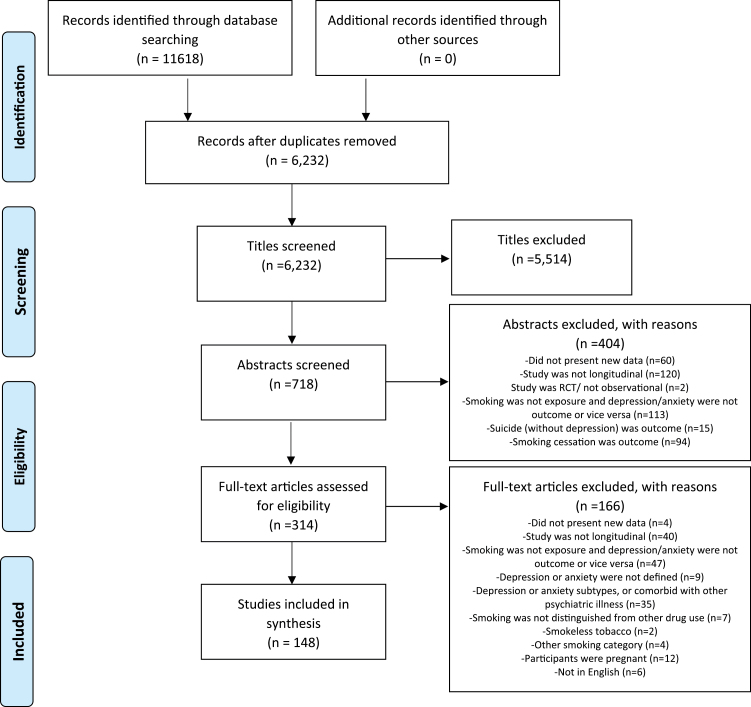
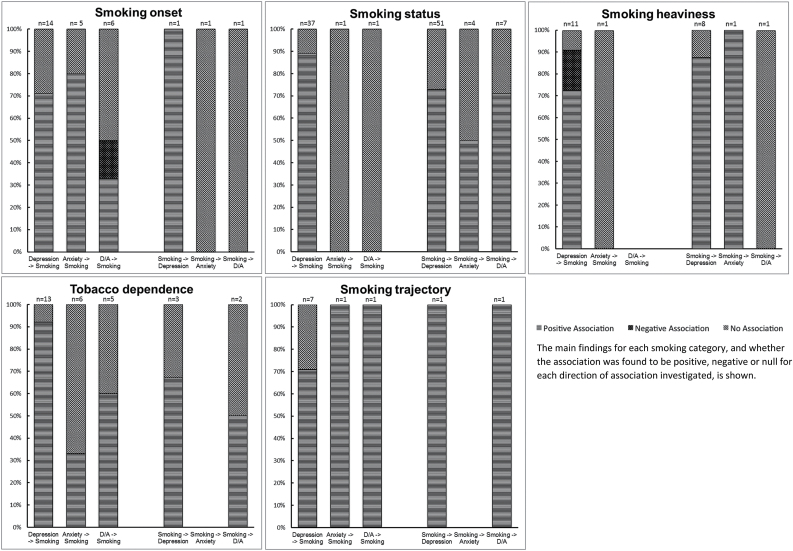
BACKGROUND: Many studies report a positive association between smoking and mental illness. However, the literature remains mixed regarding the direction of this association. We therefore conducted a systematic review evaluating the association of smoking and depression and/or anxiety in longitudinal studies. METHODS: Studies were identified by searching PubMed, Scopus, and Web of Science and were included if they: (1) used human participants, (2) were longitudinal, (3) reported primary data, (4) had smoking as an exposure and depression and/or anxiety as an outcome, or (5) had depression and/or anxiety as the exposure and smoking as an outcome. RESULTS: Outcomes from 148 studies were categorized into: smoking onset, smoking status, smoking heaviness, tobacco dependence, and smoking trajectory. The results for each category varied substantially, with evidence for positive associations in both directions (smoking to later mental health and mental health to later smoking) as well as null findings. Overall, nearly half the studies reported that baseline depression/anxiety was associated with some type of later smoking behavior, while over a third found evidence that a smoking exposure was associated with later depression/anxiety. However, there were few studies directly supporting a bidirectional model of smoking and anxiety, and very few studies reporting null results. CONCLUSIONS: The literature on the prospective association between smoking and depression and anxiety is inconsistent in terms of the direction of association most strongly supported. This suggests the need for future studies that employ different methodologies, such as Mendelian randomization (MR), which will allow us to draw stronger causal inferences. IMPLICATIONS: We systematically reviewed longitudinal studies on the association of different aspects of smoking behavior with depression and anxiety. The results varied considerably, with evidence for smoking both associated with subsequent depression and anxiety, and vice versa. Few studies supported a bidirectional relationship, or reported null results, and no clear patterns by gender, ethnicity, clinical status, length to follow-up, or diagnostic test. Suggesting that despite advantages of longitudinal studies, they cannot alone provide strong evidence of causality. Therefore, future studies investigating this association should employ different methods allowing for stronger causal inferences to be made, such as MR.
Overview
The claims and statistics of this paper haven’t been checked yet.
Free: it reads the open-access text and checks the first 5 claims that cite a source we can check. Create a free account to check every claim.
Integrity signals
Registry
Cites
Statistics
Figures
Verification
Claims the paper makes
The claims and statistics of this paper haven’t been checked yet.
Free: it reads the open-access text and checks the first 5 claims that cite a source we can check. Create a free account to check every claim.
Claims other papers make about this one
Each is checked against this paper’s own text: does it say what the citing paper says it does?
The source backs part of the claim, not all of it — or backs it for a different population, condition or comparison.
In the citing paper
“due to the high comorbidity between nicotine addiction and several anxiety-related disorders (Fluharty et al., 2016)”
From Age-dependent Effects of Tobacco Smoke and Nicotine on Cognition and the Brain: A Systematic Review of the Human and Animal Literature Comparing Adolescents and Adults. (2023) · cites this paper as Fluharty et al., 2016
Experimental — accuracy not yet measuredIn the citing paper
“Depressive disorders are heritable conditions with heritability rates of approximately 40% 12”
From Depressive symptoms predict clinical recurrence of inflammatory bowel disease (2022) · cites this paper as [12]
In the citing paper
“Importantly, there were no studies showing that smoking was associated with a later reduction in anxiety or depression rates.”
From An application of the stress-diathesis model: A review about the association between smoking tobacco, smoking cessation, and mental health (2023) · cites this paper as Fluharty et al. (2017)
In the citing paper
“Over a third of studies found that smoking at baseline led to later onset of anxiety or depression.”
From An application of the stress-diathesis model: A review about the association between smoking tobacco, smoking cessation, and mental health (2023) · cites this paper as Fluharty et al. (2017)
Self-check
Percentages, sums and reported differences re-computed from the paper’s own numbers.
The self-check needs the paper’s full text.
Citations
Cites
Diagnostic and Statistical Manual of Mental Disorders
Williams, J. B. W., & First, M. (2013) · Encyclopedia of Social Work · doi:10.1093/acrefore/9780199975839.013.104 · Cited by 109,519
Power failure: why small sample size undermines the reliability of neuroscience
Button, K. S., Ioannidis, J. P. A., Mokrysz, C., Nosek, B. A., Flint, J., Robinson, E. S. J., & Munafò, M. R. (2013) · Nature Reviews Neuroscience · doi:10.1038/nrn3475 · Cited by 7,641
A mega-analysis of genome-wide association studies for major depressive disorder
Major Depressive Disorder Working Group of the Psychiatric GWAS Consortium, Ripke, S., Wray, N. R., Lewis, C. M., Hamilton, S. P., Weissman, M. M., Breen, G., Byrne, E. M., Blackwood, D. H. R., Boomsma, D. I., et al. (2013) · Molecular Psychiatry · doi:10.1038/mp.2012.21 · Cited by 1,120
Life course outcomes of young people with anxiety disorders in adolescence
WOODWARD, L. J., & FERGUSSON, D. M. (2001) · Journal of the American Academy of Child & Adolescent Psychiatry · doi:10.1097/00004583-200109000-00018 · Cited by 1,051
Change in mental health after smoking cessation: systematic review and meta-analysis
Taylor, G., McNeill, A., Girling, A., Farley, A., Lindson-Hawley, N., & Aveyard, P. (2014) · BMJ · doi:10.1136/bmj.g1151 · Cited by 1,039
Smoking and Major Depression: A Causal Analysis
Kendler, K. S. (1993) · Archives of General Psychiatry · doi:10.1001/archpsyc.1993.01820130038007 · Cited by 792
Neurobiological similarities in depression and drug dependence: a self-medication hypothesis
Markou, A. (1998) · Neuropsychopharmacology · doi:10.1016/s0893-133x(97)00113-9 · Cited by 767
Adult Sequelae of Adolescent Depressive Symptoms
Kandel, D. B. (1986) · Archives of General Psychiatry · doi:10.1001/archpsyc.1986.01800030073007 · Cited by 638
Major Depression and Stages of Smoking: A Longitudinal Investigation
Breslau, N., Peterson, E. L., Schultz, L. R., Chilcoat, H. D., & Andreski, P. (1998) · Archives of General Psychiatry · doi:10.1001/archpsyc.55.2.161 · Cited by 633
Swendsen, J., Conway, K. P., Degenhardt, L., Glantz, M., Jin, R., Merikangas, K. R., Sampson, N., & Kessler, R. C. (2010) · Addiction · doi:10.1111/j.1360-0443.2010.02902.x · Cited by 597
Cited by
Items 401–500 of 1,000
Navarra‐Ventura, G., Coronado-Simsic, V., Serra, P. R., Castro, A., García-Toro, M., Roca, M., & Gili, M. (2023) · Revista de Psiquiatría y Salud Mental · doi:10.1016/j.sjpmh.2023.08.001 · Cited by 15
État des lieux de la situation du tabagisme en France : tendances observées et nouveaux enjeux
Obradović, I., Pasquereau, A., Spilka, S., Andler, R., Douchet, M.-A., Guignard, R., Beck, F., & Nguyen‐Thanh, V. (2023) · Santé Publique · doi:10.3917/spub.pr1.0021 · Cited by 12
Koenig, H. G., VanderWeele, T. J., & Peteet, J. R. (2023) · Oxford University Press eBooks · doi:10.1093/oso/9780190088859.003.0001 · Cited by 12
Smoking and pulmonary health in women: A narrative review and behavioral health perspective
Menson, K. E., & Coleman, S. R. M. (2024) · Preventive Medicine · doi:10.1016/j.ypmed.2024.108029 · Cited by 14
Kagabo, R., Kim, J., Zubieta, J.-K., Kleinschmit, K., & Okuyemi, K. S. (2019) · Addictive Behaviors Reports · doi:10.1016/j.abrep.2019.100181 · Cited by 17
Lee, E. (2019) · Psychiatric Quarterly · doi:10.1007/s11126-019-09689-2 · Cited by 13
Self-Reported Food Insecurity and Depression among the Older Population in South Africa
Bishwajit, G., Kota, K., Buh, A. W., & Yaya, S. (2019) · Psych · doi:10.3390/psych2010004 · Cited by 12
“A recent meta-analysis reported that smoking was associated with depression and anxiety and vice versa, thus indicating a bidirectional relationship between the two [33,34].”
BackgroundFate or coincidence: do COPD and major depression share genetic risk factors?
Martucci, V. L., Richmond, B. W., Davis, L. K., Blackwell, T. S., Cox, N. J., Samuels, D. C., Edwards, D. R. V., & Aldrich, M. C. (2021) · Human Molecular Genetics · doi:10.1093/hmg/ddab068 · Cited by 16
“We identified three potentially pleiotropic SNPs that can be prioritized in future studies of MDD and COPD.”
BackgroundInfluentialAn empirical perspective on cigarette use in substance use recovery
Goodwin, R. D., Wu, M., & Davidson, L. (2021) · Psychological Medicine · doi:10.1017/s0033291721002300 · Cited by 12
van den Houdt, S. C. M., Mommersteeg, P. M. C., Widdershoven, J. W. M. G., & Kupper, N. H. M. (2023) · Psychosomatic Medicine · doi:10.1097/psy.0000000000001196 · Cited by 13
Goodwin, R. D. (2016) · Nicotine & Tobacco Research · doi:10.1093/ntr/ntw296 · Cited by 12
“Understanding where the weight of evidence lies in terms of: (1) the direction of effect; and (2) conclusions that can be drawn on the underlying mechanisms of these relationships is critical to moving the field forward.”
BackgroundBondø, P., Høye, A., Løchen, M., & Bramness, J. G. (2022) · Addiction · doi:10.1111/add.15950 · Cited by 11
“There is a well-established association between cigarette smoking and anxiety and depression [1].”
BackgroundAmialchuk, A. A., & Sapci, O. (2022) · Health Economics · doi:10.1002/hec.4469 · Cited by 12
Depressive symptoms among adults: Baseline findings of PURE Malaysia cohort study
Tamil, A. M., Ismail, N. H., Jaáfar, M. H., Isa, Z. M., Ismail, R., Nasir, N. M., Miskan, M., Abidin, N. Z., Razak, N. H. A., Joundi, R. A., et al. (2023) · Heliyon · doi:10.1016/j.heliyon.2023.e23042 · Cited by 16
Alpers, S. E., Druckrey-Fiskaaen, K. T., Madebo, T., Vold, J. H., Pallesen, S., Skogen, J. C., Lunde, L.-H., Mæland, S., & Fadnes, L. T. (2024) · BMC Public Health · doi:10.1186/s12889-024-17943-x · Cited by 13
“This observation is in line with previous research showing a strong link between mental health issues and smoking behavior [40, 41].”
BackgroundResultZhang, G., Wang, S., Ma, P., Li, S., Sun, X., Zhao, Y., & Pan, J. (2024) · BMC Psychiatry · doi:10.1186/s12888-024-05782-4 · Cited by 11
Burke, C., Taylor, G. M. J., Freeman, T. P., Sallis, H., Wootton, R. E., Munafo, M. R., Dardani, C., & Khouja, J. N. (2025) · Addiction · doi:10.1111/add.70001 · Cited by 12
Lai, S., Zeng, Y., Li, T., Li, Y., An, Y., & Ouyang, X. (2025) · Food Science & Nutrition · doi:10.1002/fsn3.70605 · Cited by 11
“Individuals who either had never smoked throughout their life span or had smoked < 100 cigarettes were defined as never smokers (Fluharty et al. 2017).”
Tuersun, Y., Xie, Y., Zhou, Q., Yu, Y., Wang, W., Wang, C., Liu, S., Song, Y., Liang, Z., & Qian, Y. (2025) · Frontiers in Psychiatry · doi:10.3389/fpsyt.2025.1639959 · Cited by 12
“Smoking has been shown to have an impact on mental health, with studies indicating its association with increased levels of anxiety and depression among various populations (46, 47).”
Vogtschmidt, Y. D., Nefs, G., Speight, J., Bot, M., Pouwer, F., & Soedamah‐Muthu, S. S. (2020) · Journal of Psychosomatic Research · doi:10.1016/j.jpsychores.2020.110160 · Cited by 11
Prescribed medication use among elementary teachers: Prevalence and associated factors
Coledam, D. H. C., & da Silva, Y. M. (2020) · Ciência & Saúde Coletiva · doi:10.1590/1413-812320202512.20912018 · Cited by 11
mendo, C. W., Maurel, M., Doré, I., O’Loughlin, J. L., & Sylvestre, M. (2021) · Nicotine & Tobacco Research · doi:10.1093/ntr/ntab046 · Cited by 11
“31 In our context, the first three assumptions translate into no unmeasured confounding of: (1) the association between depressive symptoms and friends smoking; (2) the association between depressive symptoms and daily/weekly smoking; and (3) the association between friends smoking and daily/weekly smoking.”
BackgroundFagan, M. J., Sebastiano, K. M. D., Qian, W., Leatherdale, S. T., & Faulkner, G. (2021) · International Journal of Environmental Research and Public Health · doi:10.3390/ijerph18083864 · Cited by 11
Inter/Transgenerational Effects of Drugs of Abuse: A Scoping Review
Zarrindast, M., Sadat‐Shirazi, M., Sadeghi-Adl, M., Akbarabadi, A., Ashabi, G., & Mokri, A. (2022) · CNS & Neurological Disorders - Drug Targets · doi:10.2174/1871527321666220429122819 · Cited by 11
Quatremère, G., Guignard, R., Andler, R., Sempé, S., Houzelle, N., & Nguyen‐Thanh, V. (2022) · International Journal of Environmental Research and Public Health · doi:10.3390/ijerph192214808 · Cited by 12
Bete, T., Lami, M., Negash, A., Eyeberu, A., Birhanu, A., Berhanu, B., Abdeta, T., Nigussie, S., Dechasa, D. B., Gemechu, K., et al. (2022) · Frontiers in Psychiatry · doi:10.3389/fpsyt.2022.955371 · Cited by 12
“This agrees with the finding of other studies in South Africa (81).”
ResultInfluentialLi, L., Liu, H., Fan, L., Zhang, N., Wang, X., Li, X., Han, X., Ge, T., Yao, X., Pan, L., et al. (2022) · Indoor Air · doi:10.1111/ina.13172 · Cited by 11
Depressive symptoms and vaping: The mediating effect of outcome expectancies among young adults
North, C. E., & Loukas, A. (2023) · Drug and Alcohol Dependence · doi:10.1016/j.drugalcdep.2023.109870 · Cited by 11
Alharbi, T. A. F., AlQurashi, A., Mahmud, I., Alharbi, R. J., Islam, S. M. S., Almustanyir, S., Maklad, A. E., AlSarraj, A., Mughaiss, L. N., Al‐Tawfiq, J. A., et al. (2023) · Healthcare · doi:10.3390/healthcare11081184 · Cited by 11
“A systematic review showed a bi-directional effect between psychological distress and smoking [36].”
BackgroundYimsaard, P., Gravely, S. M. L., Meng, G., Fong, G. T., Cummings, K. M., Hyland, A. J., Borland, R., Hammond, D. G., Kasza, K. A., Li, L., et al. (2023) · International Journal of Mental Health and Addiction · doi:10.1007/s11469-023-01058-2 · Cited by 11
“Although smoking prevalence has significantly declined over the last several decades, smoking rates among people with mental illness are approximately two to three times higher than in the general population (Fluharty et al., 2017; Law-rence et al., 2009; Smith et al., 2014).”
Wang, N., & Donaldson, C. D. (2023) · Addictive Behaviors · doi:10.1016/j.addbeh.2023.107830 · Cited by 11
Jia, Z., Li, S., Luo, Z., Tong, M., & Gao, T. (2023) · BMC Public Health · doi:10.1186/s12889-023-16582-y · Cited by 11
“Smoking is also closely associated with psychological behavior-related health effects such as anxiety, depression [8, 9], and attention-deficit/hyperactivity disorder [10].”
BackgroundThe prevalence of anxiety in respiratory and sleep diseases: A systematic review and meta-analysis
Storer, B., Holden, M., Kershaw, K. A., Braund, T. A., Chakouch, C., Coleshill, M. J., Haffar, S., Harvey, S. B., Sicouri, G., Newby, J. M., et al. (2024) · Respiratory Medicine · doi:10.1016/j.rmed.2024.107677 · Cited by 12
Schmitz, L., Gard, A. M., & Ware, E. B. (2019) · American Journal of Medical Genetics Part B Neuropsychiatric Genetics · doi:10.1002/ajmg.b.32748 · Cited by 11
Qi, B., Ramamurthy, J., Bennani, I. L., & Trakadis, Y. J. (2021) · American Journal of Medical Genetics Part B Neuropsychiatric Genetics · doi:10.1002/ajmg.b.32839 · Cited by 11
“There is a known positive association between smoking and depression (Fluharty, Taylor, Grabski, & Munafò, 2017), with recent Mendelian randomization studies supporting a causal effect of smoking on depression (Wootton et al., 2020; Yuan, Yao, & Larsson, 2020).”
BackgroundBazrafshan, M.-R., Jokar, M., Soufı, O., & Delam, H. (2021) · Journal of Substance Use · doi:10.1080/14659891.2021.1967479 · Cited by 12
“…anxiety in old age, the elderly people are often isolated, lonely, and unwilling to talk about their feelings or ask for help; according to self-medication theory, to reduce the severity of their stress and anxiety and depression symptoms, they smoke cigarettes and hookahs (Fluharty et al., 2016).”
BackgroundFalcaro, M., Osborn, D., Hayes, J., Couperthwaite, L. M. Z., Weich, S., & Walters, K. R. (2021) · BMJ Open · doi:10.1136/bmjopen-2020-048341 · Cited by 11
Gruson, K. I., Lo, Y., Volaski, H. A., Sharfman, Z. T., & Shah, P. (2022) · JAAOS Global Research and Reviews · doi:10.5435/jaaosglobal-d-22-00034 · Cited by 11
Personality Traits and Inflammation in Depressive Disorders
Wachowska, K., Gałecki, P., Szemraj, J., Śmigielski, J., & Orzechowska, A. (2022) · Journal of Clinical Medicine · doi:10.3390/jcm11071974 · Cited by 12
“It included 148 studies assessing the relationship between smoking and depression and/or anxiety in longitudinal studies and revealed the need for further analysis of this phenomenon [31].”
BackgroundLiu, Q., Leng, P., Gu, Y., Shang, X., Zhou, Y., Zhang, H., Zuo, L., Mei, G., Xiong, C., Wu, T., et al. (2022) · BMC Psychiatry · doi:10.1186/s12888-022-04316-0 · Cited by 12
Alizadeh, Z., Feizi, A., Rejali, M., Afshar, H., Keshteli, A. H., Abdollahi, M., & Adibi, P. (2020) · Serbian Journal of Experimental and Clinical Research · doi:10.2478/sjecr-2018-0079 · Cited by 10
Conway, K. P., Michel, E., Eig, S., He, J.-P., & Merikangas, K. R. (2025) · American Journal of Psychiatry · doi:10.1176/appi.ajp.20230988 · Cited by 12
Jensen, S. S., Gundtoft, P. H., Gjertsen, J., & Pedersen, A. B. (2025) · The Journals of Gerontology Series A · doi:10.1093/gerona/glaf074 · Cited by 11
The economic consequences of oral disorders at global, regional, and national levels
Yang, J., Zhang, Q., Zheng, D., & Hou, F. (2025) · BMC Oral Health · doi:10.1186/s12903-025-07205-6 · Cited by 10
“For example, implementing a sugar-sweetened beverage (SSB) tax can reduce consumption and generate revenue to fund oral health programs [41].”
Pericot‐Valverde, I., Heo, M., Akiyama, M. J., Norton, B. L., Agyemang, L. S., Niu, J., & Litwin, A. H. (2020) · BMC Infectious Diseases · doi:10.1186/s12879-020-05667-3 · Cited by 11
Kato, T., Takehara, K., Suto, M., Sampei, M., & Urayama, K. Y. (2021) · Journal of Affective Disorders · doi:10.1016/j.jad.2021.02.065 · Cited by 12
Bilsky, S. A., Luber, M. J., Cloutier, R. M., Dietch, J. R., Taylor, D. J., & Friedman, H. P. (2021) · Addictive Behaviors · doi:10.1016/j.addbeh.2021.106981 · Cited by 10
Angelis, F. D., Wendt, F. R., Pathak, G. A., Tylee, D. S., Goswami, A., Gelernter, J. E., & Polimanti, R. A. (2021) · Translational Psychiatry · doi:10.1038/s41398-021-01713-z · Cited by 10
“Conversely, the relationship between tobacco smoking and depressive status and anxiety is inconsistent in terms of the direction of association [98].”
Background25(OH)D levels are decreased in patients with difficult-to-treat depression
Grudet, C., Lindqvist, D., Malm, J., Westrin, Å., & Ventorp, F. (2022) · Comprehensive Psychoneuroendocrinology · doi:10.1016/j.cpnec.2022.100126 · Cited by 10
Zong, Q., Li, H., Jiang, N., Gong, Y., Zheng, J., & Yin, X. (2022) · Frontiers in Public Health · doi:10.3389/fpubh.2022.980208 · Cited by 11
Moscowchi, A., Moradian-Lotfi, S., Koohi, H., & Sadeghi, T. S. (2023) · Oral and Maxillofacial Surgery · doi:10.1007/s10006-023-01172-4 · Cited by 10
“This habit is detrimental to many organs in the body and may considerably reduce life expectancy and quality of life [11].”
Bautista, M. R., Mogul, A. S., & Fowler, C. D. (2023) · Frontiers in Psychiatry · doi:10.3389/fpsyt.2023.1134079 · Cited by 13
He, M., Zhou, J., Li, X., & Wang, R. (2023) · Frontiers in Psychiatry · doi:10.3389/fpsyt.2023.1206657 · Cited by 12
Moorehead, N. R., Goodie, J. L., & Krantz, D. S. (2024) · Health Psychology · doi:10.1037/hea0001339 · Cited by 10
Saguban, R. B., Alabd, A. M. A., Rondilla, E. M., Buta, J. B., Marzouk, S. A., Maestrado, R. B., Sankarapandian, C., Alkubati, S. A., Mostoles, R., Alshammari, S. A., et al. (2025) · Healthcare · doi:10.3390/healthcare13030294 · Cited by 10
Implications of electronic cigarette use for depressive mood: A nationwide cross-sectional study
Lee, S., Oh, Y. H., Kim, H.-J., Kong, M.-H., & Moon, J. H. (2020) · Medicine · doi:10.1097/md.0000000000022514 · Cited by 10
Okubo, R., & Tabuchi, T. (2020) · Journal of Affective Disorders · doi:10.1016/j.jad.2020.10.037 · Cited by 10
Tian, Z.-R., Xie, X., Li, X.-Y., Li, Y., Zhang, Q., Zhao, Y., Cheung, T. C. C., Ungvari, G. S., An, F.-R., & Xiang, Y. (2021) · PeerJ · doi:10.7717/peerj.11037 · Cited by 10
“Smoking is associated with higher risk of 224 medical conditions and psychiatric disturbances including depression (Chang 225 et al., 2020; Fluharty et al., 2017; Mathew et al., 2017).”
BackgroundBataineh, B. S., Wilkinson, A. V., Case, K. R., Clendennen, S. L., Sumbe, A., Chen, B., & Harrell, M. B. (2021) · Tobacco Prevention & Cessation · doi:10.18332/tpc/133571 · Cited by 11
Implication of problematic substance use in poststroke depression: an hospital-based study
Rabat, Y., Sibon, I., & Berthoz, S. (2021) · Scientific Reports · doi:10.1038/s41598-021-92639-5 · Cited by 10
Vascular and metabolic risk factors of late-life depression
Geraets, A. F. J., Köhler, S., & Schram, M. T. (2022) · Vessel Plus · doi:10.20517/2574-1209.2021.102 · Cited by 11
Sacre, H., Hajj, A., Badro, D. A., Selwan, C. A., Haddad, C., Aoun, R., & Salameh, P. (2022) · Psychological Reports · doi:10.1177/00332941221110545 · Cited by 10
“…stress and anxiety towards hardship, through the already known “ self-medication ” hypothesis of smoking, postulating that individuals turn towards smoking to cope with stress and alleviate their depression and anxiety symptoms (Bahelah et al., 2019; Chaiton et al., 2009; Fluharty et al., 2017).”
BackgroundA network approach to substance use, internalizing, and externalizing comorbidity in U.S. adults
Blondino, C., & Prom‐Wormley, E. C. (2022) · Addictive Behaviors · doi:10.1016/j.addbeh.2022.107421 · Cited by 10
Bista, S., Lechner, W. V., Anderson, M., Kenne, K. N., & Kenne, D. R. (2023) · The American Journal of Drug and Alcohol Abuse · doi:10.1080/00952990.2023.2171300 · Cited by 10
“Partially supporting hypotheses based on the extant literature (43), we observed a main effect for psychological distress such that higher levels of depression and anxiety were associated with greater e-cigarette use but not cigarette use overall.”
BackgroundJeong, H., Oh, J., Son, N., & Lee, S. (2023) · Nutrients · doi:10.3390/nu15081915 · Cited by 10
“Previous studies have identified low educational attainment levels and income [54], living in a rural area [55], living alone [56], smoking [58], chronic disease [59], and inadequate physical activity [60] as risk factors for depression.”
BackgroundWon, D., Jung, W., & Shin, D. W. (2023) · Korean Journal of Family Medicine · doi:10.4082/kjfm.22.0142 · Cited by 10
Kaushik, S., Ahmad, F., Choudhary, S., Mathkor, D. M., Mishra, B. N., Singh, V., & Haque, S. (2023) · Neuroscience & Biobehavioral Reviews · doi:10.1016/j.neubiorev.2023.105270 · Cited by 12
Holma, K. M., Holma, I. A. K., Ketokivi, M. A., Oquendo, M. A., & Isometsä, E. T. (2018) · Archives of Suicide Research · doi:10.1080/13811118.2018.1480986 · Cited by 11
Giurgescu, C., Zhang, L., Price, M., Dailey, R., Frey, H. A., Walker, D. S., Zenk, S. N., Engeland, C. G., Anderson, C. M., & Misra, D. P. (2020) · Public Health Nursing · doi:10.1111/phn.12780 · Cited by 10
“A recent systematic review of studies that examined the association between smoking and depressive symptoms among adults suggested two directions: (1) smoking was associated with depressive symptoms later in life, and (2) depressive symptoms were associated with smoking later in life (Fluharty et al., 2017).”
BackgroundStevens, E. R., Mazumdar, M., Caniglia, E. C., Khan, M. R., Young, K. E., Edelman, E. J., Gordon, A. J., Fiellin, D. A., Maisto, S. A., Chichetto, N. E., et al. (2020) · Journal of Primary Care & Community Health · doi:10.1177/2150132720949123 · Cited by 10
Chireh, B., Essien, S. K., & Novik, N. (2021) · Journal of Affective Disorders Reports · doi:10.1016/j.jadr.2021.100290 · Cited by 10
Aslan, G. K., İşleyen, E. K., & Kartal, A. (2022) · International Journal of Nursing Practice · doi:10.1111/ijn.13053 · Cited by 11
Tawba, W., Qadiri, M. E., Al-Adhami, M., Almehmeed, N., Al-Rawi, N. H., & Awad, M. (2024) · PeerJ · doi:10.7717/peerj.18167 · Cited by 9
“This could be explained by the self-medication theory that postulates that individuals turn to smoking to alleviate their psychological symptoms, suggesting that symptoms of depression and anxiety may lead to smoking ( Fluharty et al., 2016 ; Magid et al., 2009 ; Tien Nam et al., 2020 ).”
BackgroundMamun, M. A., Al‐Mamun, F., Ikram, T., Trisha, M. K., Limon, M. H., Mostofa, N. B., Chowdhury, T. B. K., Shanto, N. P., ALmerab, M. M., Apou, A. C., et al. (2024) · Cambridge Prisms Global Mental Health · doi:10.1017/gmh.2024.115 · Cited by 9
Abebe, S. A., Gashaw, F., Tsegaye, A., Angaw, D. A., Kindie, E. A., & Dejen, A. M. (2024) · BMC Women s Health · doi:10.1186/s12905-024-03432-1 · Cited by 9
Lone, A., Hadadi, A. S., Alnawah, A. K., Alshammary, A. A., Almutairi, R. M., Ali, S. I., & Abid, N. (2025) · Frontiers in Psychology · doi:10.3389/fpsyg.2025.1570557 · Cited by 11
Smith, K. E. (2018) · Substance Use & Misuse · doi:10.1080/10826084.2018.1512629 · Cited by 9
Aw, J. Y. H., Smurthwaite, K. S., & Bagheri, N. (2020) · Journal of Affective Disorders · doi:10.1016/j.jad.2020.08.032 · Cited by 9
Robles-Mariños, R., Angeles, A. I., & Alvarado, G. F. (2021) · Revista Colombiana de Psiquiatría · doi:10.1016/j.rcp.2020.11.002 · Cited by 14
Östergren, O. (2021) · Social Theory & Health · doi:10.1057/s41285-021-00159-z · Cited by 14
Pourat, N., Chen, X., Lu, C. M., Zhou, W., Hair, B. Y., Bolton, J., & Sripipatana, A. (2022) · Population Health Management · doi:10.1089/pop.2021.0293 · Cited by 9
“26,27,32 33–35 The association of a lower likelihood of smoking or being at high SUD risk with diabetes, however, may be indicative of better self-care practices of these patients because of health education, tobacco counseling, and subsequent better self-care efforts by such patients.”
Phiri, Y. V. A., Aydın, K., Yıldız, N. G., Motsa, M. P. S., Nkoka, O., Aydın, H. Z., & Chao, H. J. (2022) · Frontiers in Psychiatry · doi:10.3389/fpsyt.2022.983817 · Cited by 9
Pasch, K. E., Thomas, J. E., North, C. E., Marti, C. N., & Loukas, A. (2023) · Drug and Alcohol Dependence · doi:10.1016/j.drugalcdep.2023.109935 · Cited by 9
Guillot, C. R., Pang, R. D., Vilches, J. R., Arnold, M., Cajas, J., Alemán, A. M., & Leventhal, A. M. (2024) · Experimental and Clinical Psychopharmacology · doi:10.1037/pha0000668 · Cited by 9
Neurobiological associations between smoking and internalizing disorders
Lima, T. M. F., Castaldelli-Maia, J. M., Apter, G., & Leopoldo, K. (2023) · International Review of Psychiatry · doi:10.1080/09540261.2023.2252907 · Cited by 11
“Bidirectionality is also supported by evidence backing a twofold effect of nicotine in anxiety disorders: short-term relief of symptoms and long-term increases in symptom severity (Fluharty et al., 2017).”
BackgroundZeeman, A. D., Jonker, J., Groeneveld, L., de Krijger, E. M., & Meijer, E. (2023) · Advances in Mental Health · doi:10.1080/18387357.2023.2262627 · Cited by 9
“Furthermore, prolonged smoking is associated with an increased risk of depression, anxiety and cognitive impairment (Campos et al., 2017; Fluharty et al., 2017; World Health Organization, 2017).”
Suanrueang, P., & Peltzer, K. (2024) · Journal of Human Behavior in the Social Environment · doi:10.1080/10911359.2024.2316127 · Cited by 11
“In addition, over a half of 148 studies in a systematic review indicate the association between smoking behavior and depression and anxiety (Fluharty et al., 2017).”
Hammad, A. M., Alzaghari, L. F., Alfaraj, M., Lux, V., & Sunoqrot, S. (2024) · Toxics · doi:10.3390/toxics12080598 · Cited by 9
“The anxiety resulting from quitting smoking, as well as anxiety triggered by smoking, may influence smoking behavior, and research on the association between tobacco usage and anxiety conditions has yielded conflicting findings [for review, see [3]].”
ResultZhang, L., Zhang, Y., Zhou, J., Zhang, X., & Gao, L. (2024) · Psychology Research and Behavior Management · doi:10.2147/prbm.s470027 · Cited by 9
“63 The high school period is a critical stage for the rapid psychological and physiological development of adolescents.”
Loui, H., Li, J., JACKSON, N. J., Romero, R., Wisk, L. E., & Buhr, R. G. (2024) · BMC Public Health · doi:10.1186/s12889-024-20259-5 · Cited by 9
“While COVID-19 presented a strong case for improving overall health, it has also been a significant source of psychological distress, which may account for increasing tobacco use, at least in part due to the positive association between smoking and depression and anxiety [12].”
Non-suicidal self-injury and its risk factors among Iranian high school and university students
Abbasi-Ghahramanloo, A., Khodadoust, B., Adham, D., Gholami, A., Farokhi, R., Maghsodlou-Nejad, V., & Afrashteh, S. (2024) · Frontiers in Psychiatry · doi:10.3389/fpsyt.2024.1425411 · Cited by 9
Rihs, A., Schoeni, A., Scharf, T., Jakob, J., Tal, K., Sadowski, I. J., Humair, J., Frei, A. L., Brutsche, M. H., Rodondi, N., et al. (2025) · General Hospital Psychiatry · doi:10.1016/j.genhosppsych.2025.01.011 · Cited by 10
The relationship between unhealthy lifestyle behaviors and depression: Evidence from NHANES
Tian, Q., Guo, J., Ding, J., & Zhu, Y. (2025) · Journal of Affective Disorders · doi:10.1016/j.jad.2025.04.086 · Cited by 10
Smoking as a weight control strategy of Serbian adolescents
Kilibarda, B., Rakić, J. G., Scekic, S. M., & Krstev, S. (2020) · International Journal of Public Health · doi:10.1007/s00038-020-01469-1 · Cited by 9
Kutlu, R., Demirbaş, N., Yazıcı, T., & Karaoğlu, N. (2021) · Selçuk Tıp Dergisi · doi:10.30733/std.2021.01509 · Cited by 9
“Sigara kullanan kişi, sigara ile dikkat ve performansını arttığını, anksiyete ve depresif duygu durumunu azaldığını düşünmektedir (20,21).”
BackgroundInfluentialYona, T., Weisman, A., Gottlieb, U., & Masharawi, Y. (2022) · Physical Therapy · doi:10.1093/ptj/pzab278 · Cited by 10
Price, S. N., Hamann, H. A., Halaby, L., Trejo, J. I., Corella, F., & Weihs, K. L. (2022) · Behavioral Sleep Medicine · doi:10.1080/15402002.2022.2033243 · Cited by 9
Salah, A. B., DeAngelis, B. N., Morales, D., Bongard, S., Leufen, L., Johnson, R., Olmos, M., Alam, S., Kuzmina, S. V., Levenstein, S., et al. (2022) · Cogent Psychology · doi:10.1080/23311908.2022.2054162 · Cited by 9
Korbmacher, D., Bamberg, F., Peters, A., Linkohr, B., Ladwig, K.-H., Schwettmann, L., Weckbach, S., Schlett, C. L., & Rospleszcz, S. (2022) · Diagnostics · doi:10.3390/diagnostics12102356 · Cited by 9
“Indeed, previous findings on this association are inconsistent, with both positive and Null findings in prior studies [48].”
ResultElShahawi, H. H., Amin, G. R., Khalil, S. A., Morsy, M. H. A., Farwiez, M. G., & Nawara, M. M. (2022) · Middle East Current Psychiatry · doi:10.1186/s43045-022-00252-7 · Cited by 11
“[36] described the relation between depression and smoking as bidirectional, where smoking tobacco may lead to depression by altering hypothalamic-pituitary-adrenal axis which subsequently causes alteration in the monoamines leading to depression, and depressed patients may use to smoke tobacco aiming to decrease thei…”
Background
Metadata
- Authors
- Fluharty, M., Taylor, A. E., Grabski, M., & Munafò, M. R.
- Affiliations
- University of Bristol (GB)
- Corresponding author
- Fluharty, Meg
- Venue
- Nicotine & Tobacco Research
- Publisher
- Oxford University Press (OUP)
- Published
- 2016-05-19
- Volume
- 19
- Issue
- 1
- Pages
- 3-13
- ISSN
- 1462-2203 (ISSN-L)
- 1469-994X
- PMC
- PMC5157710
- OpenAlex
- W2407654663
- Semantic Scholar
- addb21010e31f40cbf5d94796e74ad8c4f684175
- Cited by
- 1,299
- References
- 173
- Citations by year
- 2026: 128 · 2025: 185 · 2024: 155 · 2023: 217 · 2022: 166 · 2021: 176 · 2020: 133 · 2019: 76 · 2018: 38 · 2017: 19 · 2016: 6
- FWCI
- 5.44
- Type
- journal article
- Language
- en
- Open access
- hybrid
- doi.org
- Licence
- Locations
- Nicotine & Tobacco Research (publishedVersion, cc-by)
- PubMed Central (publishedVersion, cc-by)
- PubMed (publishedVersion)
- Explore Bristol Research (submittedVersion, cc-by)
- UCL Discovery (University College London) (submittedVersion)
- HighWire Press Open Archive (submittedVersion)
- Bristol Research (University of Bristol) (submittedVersion, cc-by)
- Funders
- University of Bristol
- Medical Research Council (MC_UU_12013/6)
- Topics
- Health Sciences › Medicine › Public Health, Environmental and Occupational Health › Smoking Behavior and Cessation
- Health Sciences › Medicine › Psychiatry and Mental health › Mental Health Treatment and Access
- Health Sciences › Medicine › Epidemiology › Substance Abuse Treatment and Outcomes
- Keywords
- cigarette smoking, depression, anxiety, bidirectional relationship, smoking onset, tobacco dependence, smoking heaviness, smoking trajectories, mental health, causal inference, Mendelian randomization
- MeSH terms
- Anxiety, Anxiety Disorders, Depression, Depressive Disorder, Humans, Prospective Studies, Sex Characteristics, Smoking, Tobacco Use Disorder
About these checks
Registry, retraction, Cites and statistics results are computed, not judged, with one exception: a printed reference that no index lists is read once by a model before it counts as a citation error. Claims are extracted by a model and kept only when their quote appears verbatim in the text; each cited source is then checked, with a model’s help, for whether it says what the claim relies on. Those verdicts can be wrong — read the claim’s quote and the cited source before relying on one.
Statistics and arithmetic are recomputed, not judged.
Confidence bands are shown only for fields calibrated on our annotated test set. None is calibrated yet, so no band is shown.
What counts as a claim ›How we measure confidence ›How we check this ›
Are you an author, or do you see a problem with this page? Request a review
Data sources
Bibliographic data: Semantic Scholar, OpenAlex, Crossref.
Contains information from the Semantic Scholar Academic Graph Datasets, made available under the ODC Attribution License (ODC-BY 1.0).
Semantic Scholar’s data is described in: Kinney, R., et al. (2023). The Semantic Scholar Open Data Platform. arXiv:2301.10140.
