

The Association of Cigarette Smoking With Depression and Anxiety: A Systematic Review
Open accessThe DOI matches its Crossref record; 172 of the 174 references it cites were found in a registry or an index, and 2 are not checked yet.
Abstract
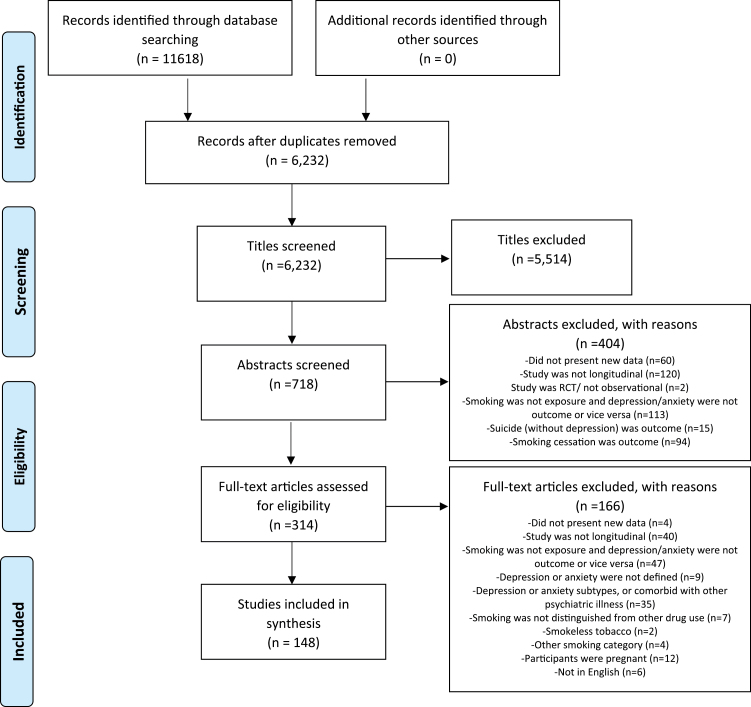
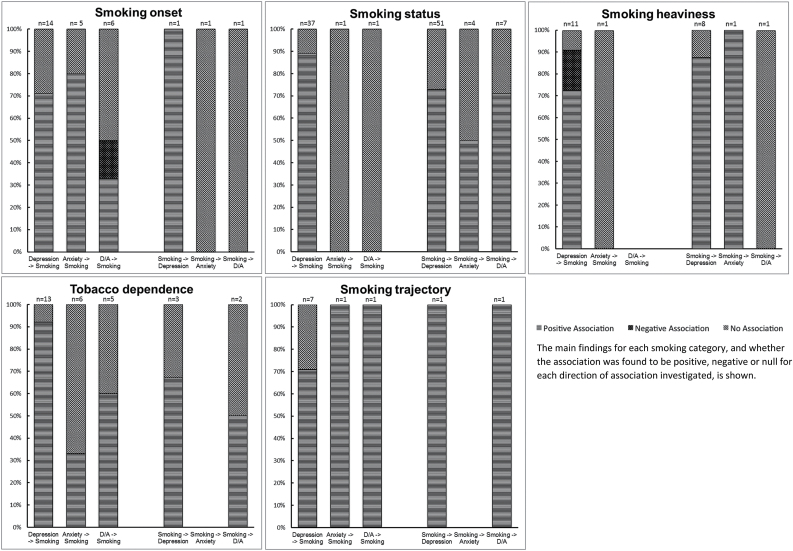
BACKGROUND: Many studies report a positive association between smoking and mental illness. However, the literature remains mixed regarding the direction of this association. We therefore conducted a systematic review evaluating the association of smoking and depression and/or anxiety in longitudinal studies. METHODS: Studies were identified by searching PubMed, Scopus, and Web of Science and were included if they: (1) used human participants, (2) were longitudinal, (3) reported primary data, (4) had smoking as an exposure and depression and/or anxiety as an outcome, or (5) had depression and/or anxiety as the exposure and smoking as an outcome. RESULTS: Outcomes from 148 studies were categorized into: smoking onset, smoking status, smoking heaviness, tobacco dependence, and smoking trajectory. The results for each category varied substantially, with evidence for positive associations in both directions (smoking to later mental health and mental health to later smoking) as well as null findings. Overall, nearly half the studies reported that baseline depression/anxiety was associated with some type of later smoking behavior, while over a third found evidence that a smoking exposure was associated with later depression/anxiety. However, there were few studies directly supporting a bidirectional model of smoking and anxiety, and very few studies reporting null results. CONCLUSIONS: The literature on the prospective association between smoking and depression and anxiety is inconsistent in terms of the direction of association most strongly supported. This suggests the need for future studies that employ different methodologies, such as Mendelian randomization (MR), which will allow us to draw stronger causal inferences. IMPLICATIONS: We systematically reviewed longitudinal studies on the association of different aspects of smoking behavior with depression and anxiety. The results varied considerably, with evidence for smoking both associated with subsequent depression and anxiety, and vice versa. Few studies supported a bidirectional relationship, or reported null results, and no clear patterns by gender, ethnicity, clinical status, length to follow-up, or diagnostic test. Suggesting that despite advantages of longitudinal studies, they cannot alone provide strong evidence of causality. Therefore, future studies investigating this association should employ different methods allowing for stronger causal inferences to be made, such as MR.
Overview
The claims and statistics of this paper haven’t been checked yet.
Free: it reads the open-access text and checks the first 5 claims that cite a source we can check. Create a free account to check every claim.
Integrity signals
Registry
Cites
Statistics
Figures
Verification
Claims the paper makes
The claims and statistics of this paper haven’t been checked yet.
Free: it reads the open-access text and checks the first 5 claims that cite a source we can check. Create a free account to check every claim.
Claims other papers make about this one
Each is checked against this paper’s own text: does it say what the citing paper says it does?
The source backs part of the claim, not all of it — or backs it for a different population, condition or comparison.
In the citing paper
“due to the high comorbidity between nicotine addiction and several anxiety-related disorders (Fluharty et al., 2016)”
From Age-dependent Effects of Tobacco Smoke and Nicotine on Cognition and the Brain: A Systematic Review of the Human and Animal Literature Comparing Adolescents and Adults. (2023) · cites this paper as Fluharty et al., 2016
Experimental — accuracy not yet measuredIn the citing paper
“Depressive disorders are heritable conditions with heritability rates of approximately 40% 12”
From Depressive symptoms predict clinical recurrence of inflammatory bowel disease (2022) · cites this paper as [12]
In the citing paper
“Importantly, there were no studies showing that smoking was associated with a later reduction in anxiety or depression rates.”
From An application of the stress-diathesis model: A review about the association between smoking tobacco, smoking cessation, and mental health (2023) · cites this paper as Fluharty et al. (2017)
In the citing paper
“Over a third of studies found that smoking at baseline led to later onset of anxiety or depression.”
From An application of the stress-diathesis model: A review about the association between smoking tobacco, smoking cessation, and mental health (2023) · cites this paper as Fluharty et al. (2017)
Self-check
Percentages, sums and reported differences re-computed from the paper’s own numbers.
The self-check needs the paper’s full text.
Citations
Cites
Diagnostic and Statistical Manual of Mental Disorders
Williams, J. B. W., & First, M. (2013) · Encyclopedia of Social Work · doi:10.1093/acrefore/9780199975839.013.104 · Cited by 109,519
Power failure: why small sample size undermines the reliability of neuroscience
Button, K. S., Ioannidis, J. P. A., Mokrysz, C., Nosek, B. A., Flint, J., Robinson, E. S. J., & Munafò, M. R. (2013) · Nature Reviews Neuroscience · doi:10.1038/nrn3475 · Cited by 7,641
A mega-analysis of genome-wide association studies for major depressive disorder
Major Depressive Disorder Working Group of the Psychiatric GWAS Consortium, Ripke, S., Wray, N. R., Lewis, C. M., Hamilton, S. P., Weissman, M. M., Breen, G., Byrne, E. M., Blackwood, D. H. R., Boomsma, D. I., et al. (2013) · Molecular Psychiatry · doi:10.1038/mp.2012.21 · Cited by 1,120
Life course outcomes of young people with anxiety disorders in adolescence
WOODWARD, L. J., & FERGUSSON, D. M. (2001) · Journal of the American Academy of Child & Adolescent Psychiatry · doi:10.1097/00004583-200109000-00018 · Cited by 1,051
Change in mental health after smoking cessation: systematic review and meta-analysis
Taylor, G., McNeill, A., Girling, A., Farley, A., Lindson-Hawley, N., & Aveyard, P. (2014) · BMJ · doi:10.1136/bmj.g1151 · Cited by 1,039
Smoking and Major Depression: A Causal Analysis
Kendler, K. S. (1993) · Archives of General Psychiatry · doi:10.1001/archpsyc.1993.01820130038007 · Cited by 792
Neurobiological similarities in depression and drug dependence: a self-medication hypothesis
Markou, A. (1998) · Neuropsychopharmacology · doi:10.1016/s0893-133x(97)00113-9 · Cited by 767
Adult Sequelae of Adolescent Depressive Symptoms
Kandel, D. B. (1986) · Archives of General Psychiatry · doi:10.1001/archpsyc.1986.01800030073007 · Cited by 638
Major Depression and Stages of Smoking: A Longitudinal Investigation
Breslau, N., Peterson, E. L., Schultz, L. R., Chilcoat, H. D., & Andreski, P. (1998) · Archives of General Psychiatry · doi:10.1001/archpsyc.55.2.161 · Cited by 633
Swendsen, J., Conway, K. P., Degenhardt, L., Glantz, M., Jin, R., Merikangas, K. R., Sampson, N., & Kessler, R. C. (2010) · Addiction · doi:10.1111/j.1360-0443.2010.02902.x · Cited by 597
Cited by
Items 701–800 of 1,000
Cirurgia cardíaca: estratégias de enfrentamento de pacientes com infecção da ferida operatória
Florisbal, G. S., da Rosa, D. S., & Ruschel, P. P. (2019) · Revista de Epidemiologia e Controle de Infecção · doi:10.17058/.v9i4.13422 · Cited by 4
Gambaryan, M. G., Васильевна, К. А., Анциферова, А. А., Mukaneeva, D. K., Kutsenko, V. A., Pustelenin, N. A., Khudyakov, M. B., Kudryavtsev, A. V., Михайловна, Ф. Е., Glukhovskaya, S. V., et al. (2024) · CARDIOVASCULAR THERAPY AND PREVENTION · doi:10.15829/1728-8800-2023-3842 · Cited by 4
Zvolensky, M. J., Shepherd, J. M., Argueta, S., Bizier, A., Clausen, B. K., Buckner, J. D., de Dios, M. A., & Cano, M. Á. (2024) · Experimental and Clinical Psychopharmacology · doi:10.1037/pha0000708 · Cited by 4
Moss-Alonso, E., Martínez-Vispo, C., López‐Durán, A., & Becoña, E. (2024) · International Journal of Mental Health and Addiction · doi:10.1007/s11469-024-01317-w · Cited by 5
“People with depression are at higher risk of becoming smokers, and smoking seems to be associated with later depression (Fluharty et al., 2017; Sánchez-Villegas et al., 2021).”
Carvajal, F., Lerma-Cabrera, J. M., de León, P. H.-P., & López‐Arana, S. (2024) · BMC Public Health · doi:10.1186/s12889-024-20173-w · Cited by 4
“Furthermore, as previous studies have already shown, we found that being a current smoker significantly increased the likelihood of belonging to the severe class [82, 83].”
ResultMiao, Y., Li, X., Shen, Z., Zhu, D., Bai, J., Zhang, J., Ren, R., Guo, D., Tarimo, C. S., Cui, J., et al. (2025) · Scientific Reports · doi:10.1038/s41598-025-85163-3 · Cited by 4
Wang, J., Orpana, H., Carrington, A., Kephart, G. C., Vasiliadis, H., & Leikin, B. (2025) · JMIR Public Health and Surveillance · doi:10.2196/66056 · Cited by 4
“A number of studies have shown that health behaviors (smoking [24], problematic substance use [25,26], and physical inactivity [27,28]) are associated with depression, anxiety, and psychological distress.”
Temporal dynamic changes of intrinsic brain regional activity in depression with smoking
Zhong, M., Hou, W., Liu, Z., Wang, F., Yang, J., Xu, Y., Long, X., Chen, Y., Kang, Y., Wang, Y., et al. (2025) · Journal of Affective Disorders · doi:10.1016/j.jad.2025.02.061 · Cited by 4
Sabol, R. M., Sun, C. N., Gudenburr, C. A., Zou, H., Fabian, T. J., & Xue, Y. (2025) · Journal of Psychiatric Research · doi:10.1016/j.jpsychires.2025.03.059 · Cited by 4
Hu, J., & He, L. (2025) · BMC Psychology · doi:10.1186/s40359-025-02853-3 · Cited by 6
“Additionally, smoking has been identified as a significant risk factor for depression, while regular physical activity has been shown to have a protective effect on mental health [15–16].”
Johnson, A. H., Lutati, D. C., Offer, J. Z., Brennan, J. C., Petre, B. M., York, J. J., Redziniak, D. E., & Turcotte, J. J. (2025) · The Knee · doi:10.1016/j.knee.2025.05.005 · Cited by 4
Vaping and Mental Health: Research Trends and Future Directions
Shukri, M. M., Sahib, F. H., & Conner, M. T. (2025) · Nicotine & Tobacco Research · doi:10.1093/ntr/ntaf128 · Cited by 4
Christen, S. E., Bekka, E., Schmid, Y., Benowitz, N. L., & Liakoni, E. (2025) · Swiss Medical Weekly · doi:10.57187/s.4346 · Cited by 4
Ahmed, S., Ahmad, E., Ali, A., Ashraf, H., Ain, H. U., Kasbati, M., Hassan, I. N., Abukhadijah, H. J., Ahmad, S., Ullah, I., et al. (2025) · American Journal of Preventive Cardiology · doi:10.1016/j.ajpc.2025.101076 · Cited by 4
Jackson, S. E., Cox, S., & Brown, J. (2025) · The Lancet Regional Health - Europe · doi:10.1016/j.lanepe.2025.101419 · Cited by 4
“44 These dynamics reinforce the need to understand economic inactivity not merely as an outcome of poor health behaviours, but as a social and public health issue shaped by broader inequality.”
Stea, T. H., Alvsvåg, L., & Kleppang, A. L. (2021) · International Journal of Environmental Research and Public Health · doi:10.3390/ijerph18189731 · Cited by 5
“Previous research suggested a bidirectional relationship between tobacco smoking and mental distress [17]; however, a systematic review concluded that the literature on the prospective associations between smoking, depression, and anxiety are inconsistent in terms of the direction of the most strongly supported associ…”
BackgroundAnsiedad y relación con el consumo de tabaco en estudiantes universitarios
Guerrero, G. H., & Delgado, R. P. (2023) · LATAM Revista Latinoamericana de Ciencias Sociales y Humanidades · doi:10.56712/latam.v4i1.248 · Cited by 4
Gravely, S. M. L., Driezen, P., McClure, E. A., Smith, D. M., & Fong, G. T. (2023) · CMAJ Open · doi:10.9778/cmajo.20220081 · Cited by 4
Bano, S., Sharif, H., Sajid, F., Hamid, S. B., & Badawy, A. A. ‐. (2023) · Behavioural Pharmacology · doi:10.1097/fbp.0000000000000736 · Cited by 4
von Below, A., Hällström, T., Sundh, V., Björkelund, C., & Hange, D. (2023) · BMJ Open · doi:10.1136/bmjopen-2023-075471 · Cited by 4
Koenig, H. G., VanderWeele, T. J., & Peteet, J. R. (2023) · Oxford University Press eBooks · doi:10.1093/oso/9780190088859.003.0014 · Cited by 4
Gravely, S. M. L., Driezen, P., Shahab, L., McClure, E. A., Hyland, A. J., Cummings, K. M., East, K. A., Chan, G., Walsh, H., Benowitz, N. L., et al. (2023) · International Journal of Mental Health and Addiction · doi:10.1007/s11469-023-01214-8 · Cited by 4
“…risky alcohol use (McKee et al., 2007; Weinberger et al., 2017, 2019), and those with poorer mental health, including depression (Fer-gusson et al., 2003; Fluharty et al., 2017; Johnson et al., 2006; Kock et al., 2023; Lipari and Horn, 2017; Prochaska et al., 2017; Sharma et al., 2016; WHO, 2021).”
Meta-Analysis: Factors Related with Premarital Sexual Behavior in Adolescents
Health, U. S. M. M. P. I. P., Tyas, A. C., Zahro, H., Health, U. S. M. M. P. I. P., Salsabila, P. F., Health, U. S. M. M. P. I. P., Ismail, A., Murti, B., & Health, U. S. M. M. P. I. P. (2024) · Journal of Health Promotion and Behavior · doi:10.26911/thejhpb.2024.09.03.03 · Cited by 4
Засимова, Л., & Колосницына, М. Г. (2025) · International Journal of Drug Policy · doi:10.1016/j.drugpo.2025.104726 · Cited by 4
Wang, W., Jiang, C., Yu, P., Nie, Z., Wang, N., & Zhang, X. (2025) · Frontiers in Endocrinology · doi:10.3389/fendo.2025.1559413 · Cited by 4
Raut, A. V., Chowdhary, S., Palhade, K., Ingole, K., Atram, S., Tupat, E., & Doma, S. (2019) · Annals of Indian Psychiatry · doi:10.4103/aip.aip_2_19 · Cited by 4
“The validated GMHAT-Primary Care (GMHAT-PC) version was used for determining the prevalence and severity of common psychological morbidities.[9,10] Data regarding tobacco and/or alcohol use were collected using the WHO-Alcohol, Smoking, and Substance Involvement Screening Test (WHO-ASSIST).”
BackgroundMethodYazdi, M., Roohafza, H., Feizi, A., & Sarafzadegan, N. (2018) · EXCLI journal · doi:10.17179/excli2018-1051 · Cited by 6
“…literature, we observed that some potential confounding variables such as shorter sleep duration (Glozier et al., 2010), low level of physical activity (Zschucke et al., 2013) and smoking (Fluharty et al., 2017) had significant association with higher scores of psychological problems profile.”
BackgroundThe effects of misspecification of the mediator and outcome in mediation analysis
Lutz, S. M., Sordillo, J. E., Hokanson, J. E., Wu, A. C., & Lange, C. (2020) · Genetic Epidemiology · doi:10.1002/gepi.22289 · Cited by 4
Alzyoud, S. A., & Massoud, F. (2020) · Journal of Health Research · doi:10.1108/jhr-09-2019-0209 · Cited by 4
Psychological and Behavioral Correlates of Readiness to Stop Smoking
Lucchiari, C., Masiero, M. A., & Pravettoni, G. (2020) · Journal of Addictions Nursing · doi:10.1097/jan.0000000000000349 · Cited by 4
Air Pollution Increases Depression Risk Among Young Women: Possible Natural World Resiliencies
HENDRYX, M. S., Luo, J., Chojenta, C., & Byles, J. (2020) · Ecopsychology · doi:10.1089/eco.2020.0010 · Cited by 4
“Smoking might be a consequence of depression, but can also contribute to depression through its physiological impacts (Fluharty, Taylor, Grabski, & Munafo, 2017; Taylor et al., 2014).”
Raffetti, E., Andersson, F., Donato, F., Kong, L., Efstathopoulos, P., Lavebratt, C., Forsell, Y., & Galanti, M. R. (2021) · Psychiatry Research · doi:10.1016/j.psychres.2021.113968 · Cited by 4
Smoking, distress and COVID-19 in England: Cross-sectional population surveys from 2016 to 2020
Kock, L. S., Brown, J., Shahab, L., Moore, G. F., Horton, M., & Brose, L. S. (2021) · Preventive Medicine Reports · doi:10.1016/j.pmedr.2021.101420 · Cited by 4
“Together these findings have concerning implications for existing smoking-related health inequalities considering the strong and potentially bi-directional associations between smoking and mental illness (Fluharty et al., 2017).”
Cigarette Smoking Behaviors and Beliefs in Persons Living With HIV in Nairobi, Kenya
Shuter, J., Ojoo, S. A., Oduor, P., Ondire, M., Khakali, L., Achieng, A. O., Masai, T. W., Potts, W., Bennett, M. E., Weinberger, A. H., et al. (2021) · Tobacco Use Insights · doi:10.1177/1179173x211053357 · Cited by 4
“Anxiety and depression both play important roles in cigarette smoking.(33) The rates of anxiety and depression that we observed were much lower than the 61.”
BackgroundDuncan, M. J., Leatherdale, S. T., & Patte, K. A. (2021) · Journal of Adolescent Health · doi:10.1016/j.jadohealth.2021.10.034 · Cited by 4
Feeling Not Wanted/Loved and Depression: Does Gender Matter?
Ahuja, M., Okoro, J. C., Frimpong, E., Doshi, R., & Wani, R. J. (2021) · Psychological Reports · doi:10.1177/00332941211062822 · Cited by 5
Mohamed, M. H., Voo, P., Maakip, I., & Robinson, F. (2022) · Malaysian Journal of Social Sciences and Humanities (MJSSH) · doi:10.47405/mjssh.v7i3.1315 · Cited by 4
Westmaas, J. L., Masters, M., Bandi, P., Majmundar, A., Asare, S., & Diver, W. R. (2022) · JMIR Infodemiology · doi:10.2196/36215 · Cited by 4
“Several studies have documented increased anxiety or depression linked to the pandemic [20-27], and for many who smoke, negative affect or stress is a trigger of cravings and/or smoking [28-31].”
BackgroundAbdollahpour, I., Golestannejad, Z., Salimi, Y., Nedjat, S., Aguilar-Palacioc, I., Mansournia, M. A., & de Courten, M. (2022) · Tobacco Use Insights · doi:10.1177/1179173x221100402 · Cited by 5
“While evidence from prospective studies, as the most powerful observational studies, declares a mutual relationship between depression and smoking,(14) there are still inconsistent reports underlying the role and strength of the association between smoking behaviors and depression.(15) Waterpipe is increasingly smoked…”
BackgroundResultInfluentialMarital Disruption and Disparity in Tobacco Use in Reproductive-Aged Women: Evidence from India
Datta, B. K., Ravula, H., Pollard, E. M., & Shimul, S. N. (2022) · Women · doi:10.3390/women2040034 · Cited by 4
Mikkelsen, C., Larsen, M. A. H., Sørensen, E., Hansen, T. F., Mikkelsen, S., Erikstrup, C., Nielsen, K. R., Bruun, M. T., Hjalgrim, H., Kessing, L. V., et al. (2022) · Psychiatry Research · doi:10.1016/j.psychres.2022.114944 · Cited by 7
Uikey, M. S., & Dayal, P. (2023) · Cureus · doi:10.7759/cureus.37688 · Cited by 4
“The results of the current study on psychiatric co-morbidity were comparable to previous studies [8,19,20].”
ResultHammad, A. M., Alzaghari, L. F., Alfaraj, M., Al-Shawaf, L., & Sunoqrot, S. (2023) · Drug Delivery and Translational Research · doi:10.1007/s13346-023-01331-w · Cited by 4
“[5]), anxiety disorders, both pre-existing and withdrawal-induced, may lead to tobacco usage.”
BackgroundApostol, M., Jordan, T. R., Leuchter, A. F., & Petersen, N. (2023) · Nature Mental Health · doi:10.1038/s44220-023-00154-5 · Cited by 5
Lee, S., Elam, K. K., Lohrmann, D. K., Luo, J., Chow, A., & Seo, D. (2024) · Addiction · doi:10.1111/add.16601 · Cited by 4
A cigaretta, az elektromos cigaretta és a vízipipa egészségre gyakorolt hatása
Farkas, Á., Tomisa, G., Kis, E., & Horváth, A. Z. (2021) · Orvosi Hetilap · doi:10.1556/650.2021.32079 · Cited by 4
The importance of the person/patient/survivor's lived experience across the cancer control continuum
Bovbjerg, D. H., Manculich, J., & Shelby, R. A. (2021) · Cancer · doi:10.1002/cncr.33878 · Cited by 5
“37 Cancer January 1, 2022 consistent with the broader literature from the general population.(16,17)”
Santiago-Torres, M., Mull, K. E., Sullivan, B. M., Prochaska, J. J., Zvolensky, M. J., & Bricker, J. B. (2024) · Depression and Anxiety · doi:10.1155/2024/1055801 · Cited by 3
“For example, some people may smoke more during heightened levels of emotional distress [10].”
Frndak, S., Syed, S., Saleh, J., Kocher, M., & Wen, X. (2021) · Journal of Clinical Nursing · doi:10.1111/jocn.16019 · Cited by 3
Boparai, J. K., Dunnett, S., Wu, M., Tassone, V. K., Duffy, S. F., Cuartas, V. Z., Chen, Z., Jung, H., Sabiston, C. M., Lou, W. Y. W., et al. (2024) · Interactive Journal of Medical Research · doi:10.2196/48396 · Cited by 5
“…adjusted for age [27], sex [28], race [29], education [30], marital status, socioeconomic status (ratio of family income-to-poverty threshold) [31], BMI [32], sleep time on weekdays or workdays [33], hours of sedentary activity [33], cigarette use [34], and general self-reported health condition.”
BackgroundZhang, Y., Zhen, F., Zhang, Y., & An, C. (2025) · Frontiers in Psychiatry · doi:10.3389/fpsyt.2024.1506726 · Cited by 3
“In addition, we incorporated factors known to be associated with depression from the existing literature, such as hypertension, smoking, age, and sleep disorders (28, 29) to conduct analyses.”
Chen, N., Xia, H., Pan, Y., & Wu, D. (2025) · Journal of Affective Disorders · doi:10.1016/j.jad.2025.119766 · Cited by 3
Alnashri, A., Albalwi, A., & El-Fatah, N. K. A. (2025) · Cureus · doi:10.7759/cureus.89532 · Cited by 3
“This creates a detrimental cycle in which mental health challenges lead to increased smoking, and smoking worsens mental health issues [5].”
Basauri-Delgado, M., Mesía-Guevara, J.-A., & Saintila, J. (2025) · Journal of Primary Care & Community Health · doi:10.1177/21501319251342090 · Cited by 3
“42 On the other hand, certain variables were identified as being associated with a lower prevalence of depressive symptoms.”
Viral infections and risk of mental illness: A Mendelian randomization study
Huang, J., Wang, Y.-F., Tang, M., Cui, Q., Guo, Y., & Gao, S. (2025) · Brain Behavior & Immunity - Health · doi:10.1016/j.bbih.2025.101104 · Cited by 3
“…there have been prior Mendelian research that have looked at the causes of psychiatric diseases, none have extensively examined the association between viral infections and psychiatric disorders (Fluharty et al., 2017; Ma et al., 2024; Marchi et al., 2024; Williams et al., 2022; Wu et al., 2025).”
Głuszek–Osuch, M., Cieśla, E., Sobaś, K., Suliga, E., & Głuszek, S. (2025) · Journal of Clinical Medicine · doi:10.3390/jcm14197090 · Cited by 3
“This may be due to interactions with other factors, such as symptoms of depression, as some long-term studies have indicated that cigarette smokers present with depression much more frequently than non-smokers [45].”
Durán‐Gómez, N., Martín‐Parrilla, M. Á., Montanero‐Fernández, J., López‐Jurado, C. F., Pérez-Civantos, D. V., & Cáceres, M. C. (2025) · BMJ Open · doi:10.1136/bmjopen-2024-097506 · Cited by 5
“In the case of creatinine and albumin levels, we found an opposite correlation to that expected, which could be explained by the confounding effect of age.”
Malinauskiene, V. A., & Малинаускас, Р. К. (2026) · Healthcare · doi:10.3390/healthcare14020263 · Cited by 3
“Smoking is linked to increased anxiety symptoms characterized by physiological arousal, indicating a bidirectional relationship where anxiety symptoms and smoking reinforce each other [64].”
A hierarchical Bayesian approach for predictive analytics of depression severity in medical students
Chen, Z., Liu, D., Marrero, W. J., Jacobson, N. C., & Thesen, T. (2026) · Healthcare Analytics · doi:10.1016/j.health.2026.100453 · Cited by 4
Petersen, S. M., Ibsen, D. B., & Andersen, A. (2026) · Journal of Diabetes & Metabolic Disorders · doi:10.1007/s40200-026-01875-x · Cited by 3
Mamić, M., Radmilović, G., Ivković, J., Dokozić, B., Mikulić, D., Mamić, I., Matijević, V., & Vukoja, I. (2026) · European Journal of Investigation in Health Psychology and Education · doi:10.3390/ejihpe16030035 · Cited by 3
“However, chronic nicotine use can exacerbate depressive and anxiety symptoms by altering neural circuits involved in stress regulation and increasing sensitivity to environmental stressors (Fluharty et al., 2017; Markou et al., 1998).”
Tobacco use and subjective well-being in university students from 29 countries: A brief report
Pengpid, S., & Peltzer, K. (2020) · Journal of Psychology in Africa · doi:10.1080/14330237.2020.1744302 · Cited by 3
Ansiedad y depresión en pacientes con enfermedad pulmonar obstructiva crónica
Campo‐Arias, A., Pedrozo‐Pupo, J. C., & Ospino, G. A. C. (2021) · Acta Médica Colombiana · doi:10.36104/amc.2021.1644 · Cited by 3
Tobacco use and mental health disparities in LGB youth
Goodin, A. J., Fallin‐Bennett, K., Anderson‐Hoagland, E., & Fallin‐Bennett, A. (2021) · Public Health Nursing · doi:10.1111/phn.12997 · Cited by 3
Cruz-Barreda, X. G., Hernández‐Vásquez, A., & Azañedo, D. (2022) · Preventive Medicine · doi:10.1016/j.ypmed.2022.107156 · Cited by 3
Tamaki, K., Saito, N., & Tomita, H. (2023) · Journal of Pain Research · doi:10.2147/jpr.s436034 · Cited by 3
Suchanecka, A., Boroń, A., Chmielowiec, K., Strońska-Pluta, A., Masiak, J., Lachowicz, M., Chmielowiec, J., Janiszewska‐Olszowska, J., & Grzywacz, A. (2024) · International Journal of Molecular Sciences · doi:10.3390/ijms25021218 · Cited by 3
“A systematic review performed by Fluharty et al. (2017) [67] showed that baseline anxiety or depression was associated with some later smoking behaviour (onset of smoking itself, increased smoking heaviness, or the transition from daily smoking into dependence) in nearly half of the analysed…”
BackgroundAssociation between smoking and central sensitization pain: a web-based cross-sectional study
Chiba, S., Yamada, K., Kawai, A., Hamaoka, S., Ikemiya, H., Hara, A., Wakaizumi, K., Tabuchi, T., Yamaguchi, K., Kawagoe, I., et al. (2024) · Journal of Anesthesia · doi:10.1007/s00540-023-03302-4 · Cited by 4
“Smoking is known to be a bidirectional risk factor for depression [11], and is thought to affect the central nervous system.”
BackgroundHan, D., Leventhal, A. M., & Seo, D. (2024) · Journal of Substance Use · doi:10.1080/14659891.2024.2323111 · Cited by 3
“Although associations between mental health symptoms and substance use behaviors are generally bi-directional (Boden & Fergusson, 2011; Fluharty et al., 2016), the linkage between polysubstance use and internalizing and externalizing mental health in our results may be potentially due to the…”
Kim, K., Chang, S. M., Hahm, B., & Kim, B. (2024) · Social Psychiatry and Psychiatric Epidemiology · doi:10.1007/s00127-024-02702-5 · Cited by 3
Locus of control and the long-term effects of parental smoking on mental health
Churchill, R. E. A., & Asante, A. D. (2024) · Social Science & Medicine · doi:10.1016/j.socscimed.2024.117401 · Cited by 3
Smoking to your kids gain? Childhood exposure to parental smoking and obesity
Prakash, K., & Kumar, S. (2025) · Economics & Human Biology · doi:10.1016/j.ehb.2025.101473 · Cited by 3
Meshkat, S., Lin, Q., Tassone, V. K., Janssen‐Aguilar, R., Pang, H. Y. M., Lou, W. Y. W., & Bhat, V. (2025) · PLoS ONE · doi:10.1371/journal.pone.0319070 · Cited by 4
“A growing body of evidence links tobacco use to psychiatric illnesses, including depression, though the relationship remains debated [9,10].”
Niño, M., Amick, B. C., Williams, M., Norton-Smith, K., & Bingham, S. (2025) · The Journal of Climate Change and Health · doi:10.1016/j.joclim.2025.100582 · Cited by 3
“Scholars find tobacco use is linked to poorer self-rated health [29,30] as well as elevated depressive symptoms [31,32].”
Skolnick, S., Brouwer, A. F., Cheng, C., & Tam, J. (2026) · Tobacco Control · doi:10.1136/tc-2025-059896 · Cited by 3
A study on effects of smoking on society: a case study
Kumar, V. (2018) · MOJ Public Health · doi:10.15406/mojph.2018.07.00227 · Cited by 3
SMOKING AND VITAL EXHAUSTION IN INDUSTRIAL WORKERS IN SOUTHERN URAL
Flores, M. (2019) · Экология человека · doi:10.33396/1728-0869-2019-6-59-64 · Cited by 3
Öztürk, E. N. Y., Uyar, M., Yücel, M., Şahin, T. K., & Türker, S. (2020) · Eskişehir Türk Dünyası Uygulama ve Araştırma Merkezi Halk Sağlığı Dergisi · doi:10.35232/estudamhsd.784095 · Cited by 3
Goudinoudi, Μ., Vasiliki, K., Ekmetzoglou, K., Korombeli, A., & Kouskouni, E. E. (2020) · Hellenic Journal of Nursing Science · doi:10.24283/hjns.202036 · Cited by 3
Alizadeh, Z., Roohafza, H., Feizi, A., & Sarrafzadegan, N. (2021) · International Journal of Mental Health and Addiction · doi:10.1007/s11469-021-00684-y · Cited by 3
“Some previous studies’ results indicate that depression might be the most important contributor of drug addiction and tobacco smoking (Fluharty et al., 2017).”
BackgroundSmoking and the Association with Mental Health
Isse, A. M. (2023) · IntechOpen eBooks · doi:10.5772/intechopen.104233 · Cited by 3
Genome-wide association studies in non-anxiety individuals identified novel risk loci for depression
Cheng, B., Qi, X., Meng, P., Cheng, S., Yang, X., Liu, L., Yao, Y., Jia, Y., Wen, Y. F., & Zhang, F. (2022) · European Psychiatry · doi:10.1192/j.eurpsy.2022.32 · Cited by 3
“In addition, smoking has been found to phenotypically and genetically correlate with depression [43, 48].”
BackgroundCross-sectional online survey of the impact of new tobacco health warnings in Colombia
Adams, S., Clavijo, A., Tamayo, R. M., & Maynard, O. (2022) · BMJ Open · doi:10.1136/bmjopen-2021-056754 · Cited by 3
Zeng, B., Yue, Y., Liu, T., Ahn, H. B., & Li, C. (2022) · Clinical Nursing Research · doi:10.1177/10547738221119343 · Cited by 3
“Variables of demographics, smoking (Fluharty et al., 2017), drinking (Boden & Fergusson, 2011), body mass index (BMI) (Milaneschi et al.”
BackgroundZhao, X., Wu, F., Shen, G., Wang, W., Yang, S., Hu, Y., Wu, Y., Xu, K., Zhao, L., Shen, X., et al. (2022) · Frontiers in Bioscience-Landmark · doi:10.31083/j.fbl2711309 · Cited by 3
“Peripheral ADPN levels appear inversely associated with anxiety and other diseases and may be a promising biomarker for diagnosis and disease monitoring [8].”
BackgroundResultKomiyama, M., Ozaki, Y., Wada, H., Yamakage, H., Satoh‐Asahara, N., Yasoda, A., Sunagawa, Y., Morimoto, T., Tamaki, S., Suzuki, M., et al. (2022) · BMC Complementary Medicine and Therapies · doi:10.1186/s12906-022-03788-7 · Cited by 3
“Smokers with nicotine dependence suffer from chronic downregulation of nicotinic receptors, which leads to reduced serotonin release; [16] consequently, smokers tend to develop depression [17, 18].”
BackgroundLoyal, D., Sutter, A.-L., Auriacombe, M., Serre, F., & Rascle, N. (2023) · Women & Health · doi:10.1080/03630242.2023.2228929 · Cited by 3
“This finding is important because various studies have reported that poor mental health may increase smoking heaviness and dependence (Fluharty et al. 2017).”
BackgroundTildy, B. E., McNeill, A. D., East, K. A., Gravely, S. M. L., Fong, G. T., Cummings, K. M., Borland, R., Chan, G., Lim, C. C. W., GARTNER, C. E., et al. (2023) · Tobacco Prevention & Cessation · doi:10.18332/tpc/168288 · Cited by 3
Pedersen, C. G., Nielsen, C. V., Lynggaard, V., Zwisler, A., & Maribo, T. (2023) · Health Education Research · doi:10.1093/her/cyad032 · Cited by 3
Wichaidit, W., Chotipanvithayakul, R., & Assanangkornchai, S. (2023) · Journal of Health Science and Medical Research · doi:10.31584/jhsmr.2023984 · Cited by 5
Ruiz, R. A., Lehavot, K., Heffner, J. L., Kava, C. M., & Ornelas, I. J. (2023) · Nicotine & Tobacco Research · doi:10.1093/ntr/ntad210 · Cited by 3
Amara, A., Omri, N., Bannour, R., Limam, M., Ghardallou, M. E., Mellouli, M., Sahli, J., & Mtiraoui, A. (2024) · International Journal of Adolescent Medicine and Health · doi:10.1515/ijamh-2023-0197 · Cited by 3
Correlating Cyberchondria and Health Anxiety: Demographic Insights from Stable Asthma Patients
Durak, B., & Kaya, A. E. (2024) · European Journal of Therapeutics · doi:10.58600/eurjther2026 · Cited by 5
“In a study conducted by Tanış et al., it was shown that individuals with high health anxiety were less satisfied with doctor examinations and tended to seek more information via the internet [11].”
BackgroundUnraveling the Impact of Widowhood Duration on Depression: Does Time Heal All Wounds?
Huang, X., Tey, N. P., & Lai, S. L. (2024) · Asia Pacific Journal of Public Health · doi:10.1177/10105395241244960 · Cited by 3
“9,21,22 Thus, the findings from this study lend further support to the marriage protection theory in that losing a spouse deprives the widowed person of the partner’s support.”
ResultShafiee, A., Goodarzi, M., Firouzabadi, S. R., Mohammadi, I., Sadeghi, D., Zarei, M., Abdollahi, A., Kolahdooz, A., & Bakhtiyari, M. (2024) · Depression and Anxiety · doi:10.1155/2024/8530368 · Cited by 3
“Many individuals with anxiety may smoke to self-medicate, seeking temporary relief from nicotine, despite its fl eeting e ff ects [32].”
Regulação emocional no uso problemático de tabaco: uma revisão integrativa
Semolini, F. F., da Silva, L. S., Freires, É. M., Vitta, A. S. L., Scatena, A., de MICHELI, D., Pereira, F. A., & Andrade, A. L. M. (2024) · Cuadernos de Educación y Desarrollo · doi:10.55905/cuadv16n8-146 · Cited by 3
Tashiro, T., Maeda, N., Mizuta, R., Abekura, T., Oda, S., Onoue, S., Arima, S., Suzuki, Y., & Urabe, Y. (2025) · BMJ Open · doi:10.1136/bmjopen-2024-089360 · Cited by 3
“Therefore, improving sleep is essential to safeguard the mental well-being of young women in Japan, a nation known for its sleep deprivation tendencies.”
Măirean, C., Cobzeanu, A., & Postolache, I.-C. (2025) · Psihologija · doi:10.2298/psi230824013m · Cited by 3
Ishihara, K., Kitajima, T., Ota, A., Yatsuya, H., & Iwata, N. (2025) · PubMed Central · doi:10.20407/fmj.2024-021 · Cited by 4
Haripottawekul, A., Voong, V., Furie, K. L., & Mahta, A. (2025) · Journal of Clinical Neuroscience · doi:10.1016/j.jocn.2025.111491 · Cited by 3
Metadata
- Authors
- Fluharty, M., Taylor, A. E., Grabski, M., & Munafò, M. R.
- Affiliations
- University of Bristol (GB)
- Corresponding author
- Fluharty, Meg
- Venue
- Nicotine & Tobacco Research
- Publisher
- Oxford University Press (OUP)
- Published
- 2016-05-19
- Volume
- 19
- Issue
- 1
- Pages
- 3-13
- ISSN
- 1462-2203 (ISSN-L)
- 1469-994X
- PMC
- PMC5157710
- OpenAlex
- W2407654663
- Semantic Scholar
- addb21010e31f40cbf5d94796e74ad8c4f684175
- Cited by
- 1,299
- References
- 173
- Citations by year
- 2026: 128 · 2025: 185 · 2024: 155 · 2023: 217 · 2022: 166 · 2021: 176 · 2020: 133 · 2019: 76 · 2018: 38 · 2017: 19 · 2016: 6
- FWCI
- 5.44
- Type
- journal article
- Language
- en
- Open access
- hybrid
- doi.org
- Licence
- Locations
- Nicotine & Tobacco Research (publishedVersion, cc-by)
- PubMed Central (publishedVersion, cc-by)
- PubMed (publishedVersion)
- Explore Bristol Research (submittedVersion, cc-by)
- UCL Discovery (University College London) (submittedVersion)
- HighWire Press Open Archive (submittedVersion)
- Bristol Research (University of Bristol) (submittedVersion, cc-by)
- Funders
- University of Bristol
- Medical Research Council (MC_UU_12013/6)
- Topics
- Health Sciences › Medicine › Public Health, Environmental and Occupational Health › Smoking Behavior and Cessation
- Health Sciences › Medicine › Psychiatry and Mental health › Mental Health Treatment and Access
- Health Sciences › Medicine › Epidemiology › Substance Abuse Treatment and Outcomes
- Keywords
- cigarette smoking, depression, anxiety, bidirectional relationship, smoking onset, tobacco dependence, smoking heaviness, smoking trajectories, mental health, causal inference, Mendelian randomization
- MeSH terms
- Anxiety, Anxiety Disorders, Depression, Depressive Disorder, Humans, Prospective Studies, Sex Characteristics, Smoking, Tobacco Use Disorder
About these checks
Registry, retraction, Cites and statistics results are computed, not judged, with one exception: a printed reference that no index lists is read once by a model before it counts as a citation error. Claims are extracted by a model and kept only when their quote appears verbatim in the text; each cited source is then checked, with a model’s help, for whether it says what the claim relies on. Those verdicts can be wrong — read the claim’s quote and the cited source before relying on one.
Statistics and arithmetic are recomputed, not judged.
Confidence bands are shown only for fields calibrated on our annotated test set. None is calibrated yet, so no band is shown.
What counts as a claim ›How we measure confidence ›How we check this ›
Are you an author, or do you see a problem with this page? Request a review
Data sources
Bibliographic data: Semantic Scholar, OpenAlex, Crossref.
Contains information from the Semantic Scholar Academic Graph Datasets, made available under the ODC Attribution License (ODC-BY 1.0).
Semantic Scholar’s data is described in: Kinney, R., et al. (2023). The Semantic Scholar Open Data Platform. arXiv:2301.10140.
