

The Association of Cigarette Smoking With Depression and Anxiety: A Systematic Review
Open accessThe DOI matches its Crossref record; 172 of the 174 references it cites were found in a registry or an index, and 2 are not checked yet.
Abstract
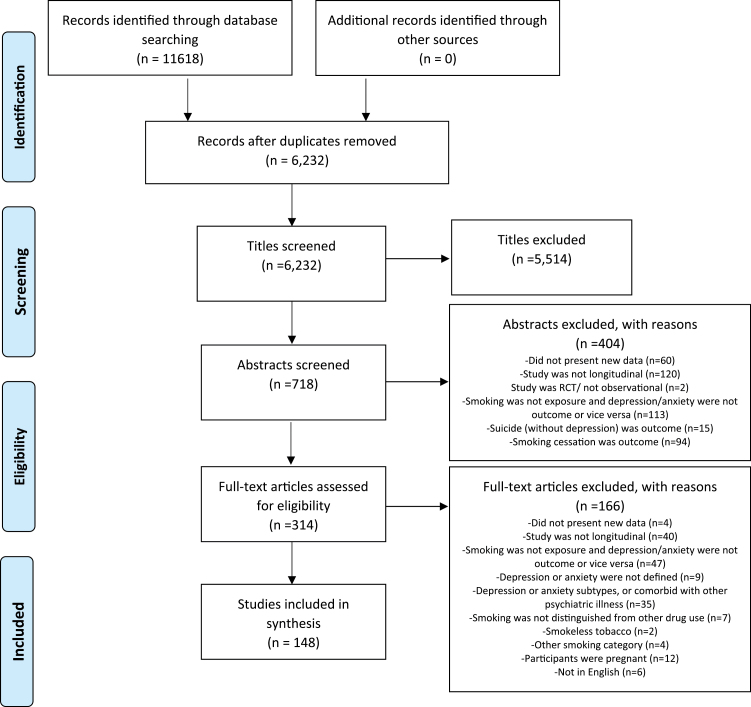
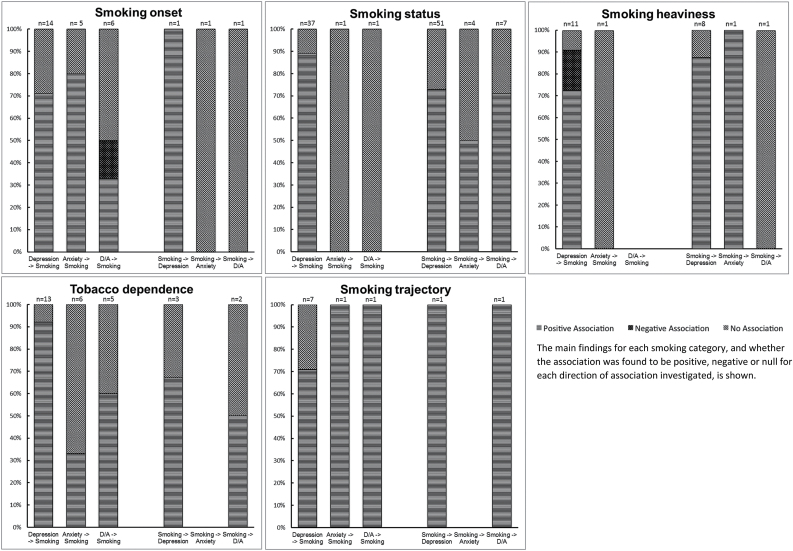
BACKGROUND: Many studies report a positive association between smoking and mental illness. However, the literature remains mixed regarding the direction of this association. We therefore conducted a systematic review evaluating the association of smoking and depression and/or anxiety in longitudinal studies. METHODS: Studies were identified by searching PubMed, Scopus, and Web of Science and were included if they: (1) used human participants, (2) were longitudinal, (3) reported primary data, (4) had smoking as an exposure and depression and/or anxiety as an outcome, or (5) had depression and/or anxiety as the exposure and smoking as an outcome. RESULTS: Outcomes from 148 studies were categorized into: smoking onset, smoking status, smoking heaviness, tobacco dependence, and smoking trajectory. The results for each category varied substantially, with evidence for positive associations in both directions (smoking to later mental health and mental health to later smoking) as well as null findings. Overall, nearly half the studies reported that baseline depression/anxiety was associated with some type of later smoking behavior, while over a third found evidence that a smoking exposure was associated with later depression/anxiety. However, there were few studies directly supporting a bidirectional model of smoking and anxiety, and very few studies reporting null results. CONCLUSIONS: The literature on the prospective association between smoking and depression and anxiety is inconsistent in terms of the direction of association most strongly supported. This suggests the need for future studies that employ different methodologies, such as Mendelian randomization (MR), which will allow us to draw stronger causal inferences. IMPLICATIONS: We systematically reviewed longitudinal studies on the association of different aspects of smoking behavior with depression and anxiety. The results varied considerably, with evidence for smoking both associated with subsequent depression and anxiety, and vice versa. Few studies supported a bidirectional relationship, or reported null results, and no clear patterns by gender, ethnicity, clinical status, length to follow-up, or diagnostic test. Suggesting that despite advantages of longitudinal studies, they cannot alone provide strong evidence of causality. Therefore, future studies investigating this association should employ different methods allowing for stronger causal inferences to be made, such as MR.
Overview
The claims and statistics of this paper haven’t been checked yet.
Free: it reads the open-access text and checks the first 5 claims that cite a source we can check. Create a free account to check every claim.
Integrity signals
Registry
Cites
Statistics
Figures
Verification
Claims the paper makes
The claims and statistics of this paper haven’t been checked yet.
Free: it reads the open-access text and checks the first 5 claims that cite a source we can check. Create a free account to check every claim.
Claims other papers make about this one
Each is checked against this paper’s own text: does it say what the citing paper says it does?
The source backs part of the claim, not all of it — or backs it for a different population, condition or comparison.
In the citing paper
“due to the high comorbidity between nicotine addiction and several anxiety-related disorders (Fluharty et al., 2016)”
From Age-dependent Effects of Tobacco Smoke and Nicotine on Cognition and the Brain: A Systematic Review of the Human and Animal Literature Comparing Adolescents and Adults. (2023) · cites this paper as Fluharty et al., 2016
Experimental — accuracy not yet measuredIn the citing paper
“Depressive disorders are heritable conditions with heritability rates of approximately 40% 12”
From Depressive symptoms predict clinical recurrence of inflammatory bowel disease (2022) · cites this paper as [12]
In the citing paper
“Importantly, there were no studies showing that smoking was associated with a later reduction in anxiety or depression rates.”
From An application of the stress-diathesis model: A review about the association between smoking tobacco, smoking cessation, and mental health (2023) · cites this paper as Fluharty et al. (2017)
In the citing paper
“Over a third of studies found that smoking at baseline led to later onset of anxiety or depression.”
From An application of the stress-diathesis model: A review about the association between smoking tobacco, smoking cessation, and mental health (2023) · cites this paper as Fluharty et al. (2017)
Self-check
Percentages, sums and reported differences re-computed from the paper’s own numbers.
The self-check needs the paper’s full text.
Citations
Cites
Diagnostic and Statistical Manual of Mental Disorders
Williams, J. B. W., & First, M. (2013) · Encyclopedia of Social Work · doi:10.1093/acrefore/9780199975839.013.104 · Cited by 109,519
Power failure: why small sample size undermines the reliability of neuroscience
Button, K. S., Ioannidis, J. P. A., Mokrysz, C., Nosek, B. A., Flint, J., Robinson, E. S. J., & Munafò, M. R. (2013) · Nature Reviews Neuroscience · doi:10.1038/nrn3475 · Cited by 7,641
A mega-analysis of genome-wide association studies for major depressive disorder
Major Depressive Disorder Working Group of the Psychiatric GWAS Consortium, Ripke, S., Wray, N. R., Lewis, C. M., Hamilton, S. P., Weissman, M. M., Breen, G., Byrne, E. M., Blackwood, D. H. R., Boomsma, D. I., et al. (2013) · Molecular Psychiatry · doi:10.1038/mp.2012.21 · Cited by 1,120
Life course outcomes of young people with anxiety disorders in adolescence
WOODWARD, L. J., & FERGUSSON, D. M. (2001) · Journal of the American Academy of Child & Adolescent Psychiatry · doi:10.1097/00004583-200109000-00018 · Cited by 1,051
Change in mental health after smoking cessation: systematic review and meta-analysis
Taylor, G., McNeill, A., Girling, A., Farley, A., Lindson-Hawley, N., & Aveyard, P. (2014) · BMJ · doi:10.1136/bmj.g1151 · Cited by 1,039
Smoking and Major Depression: A Causal Analysis
Kendler, K. S. (1993) · Archives of General Psychiatry · doi:10.1001/archpsyc.1993.01820130038007 · Cited by 792
Neurobiological similarities in depression and drug dependence: a self-medication hypothesis
Markou, A. (1998) · Neuropsychopharmacology · doi:10.1016/s0893-133x(97)00113-9 · Cited by 767
Adult Sequelae of Adolescent Depressive Symptoms
Kandel, D. B. (1986) · Archives of General Psychiatry · doi:10.1001/archpsyc.1986.01800030073007 · Cited by 638
Major Depression and Stages of Smoking: A Longitudinal Investigation
Breslau, N., Peterson, E. L., Schultz, L. R., Chilcoat, H. D., & Andreski, P. (1998) · Archives of General Psychiatry · doi:10.1001/archpsyc.55.2.161 · Cited by 633
Swendsen, J., Conway, K. P., Degenhardt, L., Glantz, M., Jin, R., Merikangas, K. R., Sampson, N., & Kessler, R. C. (2010) · Addiction · doi:10.1111/j.1360-0443.2010.02902.x · Cited by 597
Cited by
Items 201–300 of 1,000
Khan, M. M. A., Rahman, M. M., Jeamin, S. S., Mustagir, M. G., Haque, M. R., & Kaikobad, M. S. (2020) · PLoS ONE · doi:10.1371/journal.pone.0242872 · Cited by 33
“Sexual activity in these periods can make adolescents vulnerable to developing mental disorder like depression or anxiety [61, 62], which, in turn, could lead them to use tobacco or other substances [63, 64].”
BackgroundCOVID-19 stressors, wellbeing and health behaviours: a cross-sectional study
Bell, L., Smith, R., van de Venter, E. C., Shuttleworth, C., Wilson, K. S., & Lycett, D. (2021) · Journal of Public Health · doi:10.1093/pubmed/fdab241 · Cited by 28
Severe Social Anxiety Among Adolescents During COVID-19 Lockdown
Itani, M. H., Eltannir, E., Tinawi, H., Daher, D., El-Tannir, A., & Moukarzel, A. A. (2021) · Journal of Patient Experience · doi:10.1177/23743735211038386 · Cited by 31
“The co-occurrence varies with evidence that smoking is associated with subsequent depression and anxiety and vice versa.(52,53) Furthermore, smoking in adolescents is associated with both having close friends who smoke and lower socioeconomic status.”
BackgroundBrunoni, A. R., Szlejf, C., Suemoto, C. K., Santos, I. S., Goulart, A. C., Viana, M. C., Koyanagi, A., Barreto, S. M., Moreno, A. B., Carvalho, A. F., et al. (2019) · Acta Psychiatrica Scandinavica · doi:10.1111/acps.13109 · Cited by 31
“Nonetheless, a recent systematic review of longitudinal studies found inconsistent evidence of smoking predicting depression (42).”
BackgroundSubphenotyping depression using machine learning and electronic health records
Xu, Z., Wang, F., Adekkanattu, P. M., Bose, B., Vekaria, V., Brandt, P., Jiang, G., Kiefer, R. C., Luo, Y., Pacheco, J. A., et al. (2020) · Learning Health Systems · doi:10.1002/lrh2.10241 · Cited by 27
“32 An association between tobacco use and depression has also been shown by multiple previous studies 33-35 and cigarette use was positively associated with depressive symptoms among young people such as college students.”
Waterpipe Nicotine Dependence and Depressive Symptoms among Adolescent Waterpipe and Dual Users
Abbadi, A., Alnahar, J., Zoghoul, S. B. M., Bsoul, A., Alarood, S., Al-Mistarehi, A.-H. W., & Alzyoud, S. A. (2020) · Journal of Environmental and Public Health · doi:10.1155/2020/2364571 · Cited by 26
“Furthermore, tobacco smoking (cigarettes and waterpipe) is linked to depression and depressive symptoms [18–21], as smokers are more susceptible to develop depressive symptoms compared to nonsmokers [21, 22].”
BackgroundSampogna, G., Lovisi, G. M., Zinno, F., Vecchio, V. D., Luciano, M., Sol, É. G. L., Unger, R. J. G., Ventriglio, A., & Fiorillo, A. (2020) · Medicina · doi:10.3390/medicina57010011 · Cited by 30
“with the risk of developing depressive symptoms [9].”
BackgroundNi, X., Su, H., Lv, Y., Li, R., Chen, C., Zhang, D., Chen, Q., Zhang, S., Yang, Z., Sun, L., et al. (2022) · Frontiers in Psychiatry · doi:10.3389/fpsyt.2022.986389 · Cited by 27
Tseng, H.-H., Lee, J., Geng, J., & Chen, S. (2023) · Frontiers in Public Health · doi:10.3389/fpubh.2023.1070827 · Cited by 27
Vitale, E., Lupo, R., Artioli, G., Mea, R., Lezzi, P., Conte, L., & Nunzio, G. D. (2023) · PubMed Central · doi:10.23750/abm.v94i2.14230 · Cited by 31
Wang, N., Yan, X., Imm, K. R., Xu, T., Li, S., Gawronska, J., Wang, R., Smith, L., Yang, L., & Cao, C. (2023) · Journal of Affective Disorders · doi:10.1016/j.jad.2023.10.138 · Cited by 27
Tomita, A. M., & Manuel, J. I. (2018) · Nicotine & Tobacco Research · doi:10.1093/ntr/nty163 · Cited by 28
Linking Environmental Exposures to Depression: Insights from Epidemiology, Biology, and Methodology
Zhang, Z., Zhao, Q., Xu, J., Yang, K., Wu, Y., Lei, M., Wu, Q., Wang, H., Cai, W., An, Q., et al. (2025) · Brain Conflux · doi:10.71321/ymyc0370 · Cited by 26
“…and engagement in regular physical activity [38] have been associated with lower prevalence of depression, while unhealthy behaviors, including tobacco use [39], excessive alcohol intake [40] , sedentary lifestyles [41] , and poor dietary practices, have been linked to increased depression risk.”
Tobacco Use Trajectories in Young Adults: Analyses of Predictors Across Systems Levels
Berg, C. J., Haardörfer, R., Lanier, A. B., Childs, D., Foster, B., Getachew, B., & Windle, M. T. (2020) · Nicotine & Tobacco Research · doi:10.1093/ntr/ntaa048 · Cited by 26
Gage, S. H., Sallis, H., Lassi, G., Wootton, R. E., Mokrysz, C., Smith, G. D., & Munafo, M. R. (2020) · Psychological Medicine · doi:10.1017/s0033291720003402 · Cited by 27
Prevalence of Substance Use in University Students, Ethiopia
Shegute, T., & Wasihun, Y. (2021) · Substance Abuse Research and Treatment · doi:10.1177/11782218211003558 · Cited by 27
New-Onset Depression After Total Knee Arthroplasty: Consideration of the At-Risk Patient
Schwartz, A., Wilson, J. M., Farley, K. X., Bradbury, T. L., & Guild, G. N. (2021) · The Journal of Arthroplasty · doi:10.1016/j.arth.2021.04.008 · Cited by 26
Kock, L. S., Brown, J., Cox, S., McNeill, A. D., Robson, D., Shahab, L., Tattan‐Birch, H., & Brose, L. S. (2022) · Addictive Behaviors · doi:10.1016/j.addbeh.2022.107570 · Cited by 26
Factores asociados con consumo de tabaco en pacientes con depresión
Jiménez-Treviño, L., Velasco, Á., Rodríguez-Revuelta, J., Abad, I., de la Fuente-Tomás, L., González-Blanco, L., García-Álvarez, L., Fernández-Peláez, A. D., Menéndez-Miranda, I., Flórez, G., et al. (2019) · Adicciones · doi:10.20882/adicciones.1191 · Cited by 32
Mental Health Among School-Going Adolescents in Greater London: A Cross-Sectional Study
Al-Zawaadi, A., Hesso, I., & Kayyali, R. (2021) · Frontiers in Psychiatry · doi:10.3389/fpsyt.2021.592624 · Cited by 27
Monroe, D. C., McDowell, C. P., Kenny, R. A., & Herring, M. P. (2021) · Journal of Psychiatric Research · doi:10.1016/j.jpsychires.2021.05.017 · Cited by 25
Smoking and Stress in the General Population in Denmark
Buhelt, L., Pisinger, C., & Andreasen, A. (2021) · Tobacco Prevention & Cessation · doi:10.18332/tpc/132712 · Cited by 24
Leskelä, M., Jokelainen, J. J., Huilaja, L., & Sinikumpu, S. (2024) · Acta Dermato Venereologica · doi:10.2340/actadv.v104.14733 · Cited by 24
Chen, Y., Chaudhary, S., Wang, W., & Li, C. R. (2021) · Addiction Neuroscience · doi:10.1016/j.addicn.2021.100003 · Cited by 24
Kastaun, S., Brose, L. S., Scholz, E., Viechtbauer, W., & Kotz, D. (2022) · European Addiction Research · doi:10.1159/000523973 · Cited by 28
Prevalence of chronic pelvic pain and primary dysmenorrhea in women of reproductive age in Ecuador
Rosero, C. Y. D. L. M. V., Mazin, S. C., Nogueira, A. A., Vargas-Costales, J. A., Silva, J. C. R. E., dos Reis, F. J. C., & Poli‐Neto, O. B. (2022) · BMC Women s Health · doi:10.1186/s12905-022-01948-y · Cited by 24
“Nevertheless, the bidirectional relationship between smoking, anxiety, and depression may have obscured and complicated the interpretation of these findings [78].”
ResultLongitudinal transitions in e-cigarette and cigarette use among US adults: prospective cohort study
Kalan, M. E., & Brewer, N. T. (2023) · The Lancet Regional Health - Americas · doi:10.1016/j.lana.2023.100508 · Cited by 24
Takeuchi, T., Hashimoto, K., Koyama, A., Asakura, K., & Hashizume, M. (2024) · Life · doi:10.3390/life14050612 · Cited by 31
Zheng, Y., Yin, K., Li, L., Wang, X., Li, H., Li, W., & Fang, Z. (2024) · Journal of Affective Disorders · doi:10.1016/j.jad.2024.06.103 · Cited by 26
Modeling smoking-attributable mortality among adults with major depression in the United States
Tam, J., Taylor, G. M. J., Zivin, K., Warner, K. E., & Meza, R. (2020) · Preventive Medicine · doi:10.1016/j.ypmed.2020.106241 · Cited by 24
Engemann, K., Svenning, J., Arge, L., Brandt, J. G., Bruun, M. T., Didriksen, M., Erikstrup, C., Geels, C., Hertel, O., Horsdal, H. T., et al. (2021) · Health & Place · doi:10.1016/j.healthplace.2021.102678 · Cited by 27
Cigarette smoking and personality: interrogating causality using Mendelian randomisation
Sallis, H., Smith, G. D., & Munafo, M. R. (2018) · Psychological Medicine · doi:10.1017/s0033291718003069 · Cited by 25
“, 2015), and with associated mental health outcomes such as major depressive disorder (MDD) (Munafò and Araya, 2010; Fluharty et al., 2017).”
BackgroundE-Cigarette Use, Systemic Inflammation, and Depression
Farrell, K. R., Karey, E., Xu, S., Gibbon, G., Gordon, T., & Weitzman, M. L. (2021) · International Journal of Environmental Research and Public Health · doi:10.3390/ijerph181910402 · Cited by 23
PROMIS Depression and Anxiety in shoulder surgery patients
Baker, M., Albelo, F., Zhang, T., Schneider, M. B., Foster, M. J., Aneizi, A. A., Hasan, S. A., Gilotra, M. N., & Henn, R. F. (2022) · The Bone & Joint Journal · doi:10.1302/0301-620x.104b4.bjj-2021-1089.r1 · Cited by 24
Li, M., Xia, L., Yang, Y., Zhang, L., Zhang, S., Liu, T., Liu, Y., Kaslow, N. J., Jiang, F., Tang, Y., et al. (2022) · Frontiers in Psychology · doi:10.3389/fpsyg.2022.881408 · Cited by 24
Jiawei Xiaoyao San in treatment of anxiety disorder and anxiety: A review
Xie, J., Xu, D., Wang, C., & Huang, J. (2023) · Chinese Herbal Medicines · doi:10.1016/j.chmed.2022.12.007 · Cited by 24
Nelson, H. D., Cantor, A. G., Pappas, M., & Weeks, C. (2020) · Annals of Internal Medicine · doi:10.7326/m20-0579 · Cited by 26
“Anxiety disorders cause distress; are intrusive; interfere with relationships and daily function; are often associated with physical symptoms, such as restlessness, sleep disturbance, chronic headaches, gastrointestinal distress, and muscle tension (1); and are associated with depression (5) and substance abuse (6, 7).”
BackgroundNevriana, A., Pierce, M., Abel, K. M., Rossides, M., Wicks, S., Dalman, C., & Kosidou, K. (2022) · Journal of Psychiatric Research · doi:10.1016/j.jpsychires.2022.04.017 · Cited by 25
Duko, B., Pereira, G., Tait, R. J., Nyadanu, S. D., Betts, K., & Alati, R. (2021) · Drug and Alcohol Dependence · doi:10.1016/j.drugalcdep.2021.108993 · Cited by 22
Little evidence for an effect of smoking on multiple sclerosis risk: A Mendelian Randomization study
Mitchell, R. E., Bates, K., Wootton, R. E., Harroud, A., Richards, J. B., Smith, G. D., & Munafo, M. R. (2020) · PLoS Biology · doi:10.1371/journal.pbio.3000973 · Cited by 22
“MS diagnosis [40], and these, in turn, are associated with a higher rate of smoking.”
Quittschalle, J., Pabst, A., Löbner, M., Luppa, M., Heser, K., Wagner, M., van den Bussche, H., Hajek, A., König, H., Wiese, B., et al. (2021) · International Journal of Environmental Research and Public Health · doi:10.3390/ijerph18157959 · Cited by 25
“The results were inconsistent concerning the question whether smoking leads to depression or depression leads to smoking or whether, in addition, there is a bidirectional relationship between the two [50].”
BackgroundLi, X., Tan, Y., Li, S., & Xiaoxin, W. (2022) · BMC Psychology · doi:10.1186/s40359-022-00840-6 · Cited by 23
Hong, S. W., Teesdale‐Spittle, P. H., Page, R., Ellenbroek, B. A., & Truman, P. (2022) · Frontiers in Neuroscience · doi:10.3389/fnins.2022.885489 · Cited by 23
Jin, Y., Zhou, X., Deng, L., Xiong, X., Li, Y., Wei, Q., Dong, B., & Qiu, S. (2022) · Frontiers in Public Health · doi:10.3389/fpubh.2022.1038573 · Cited by 24
Qiu, Y., & Ma, X. (2024) · Journal of Affective Disorders · doi:10.1016/j.jad.2024.08.185 · Cited by 22
Polanka, B. M., Berntson, J., Vrany, E. A., & Stewart, J. C. (2018) · Annals of Behavioral Medicine · doi:10.1093/abm/kay007 · Cited by 24
“dysregulation [4, 5], altered platelet function [6], and impaired endothelial function [7], and the behavioral mechanisms of poor CVD medication adherence [8–10], reduced physical activity [11, 12], poor sleep quality [13], and smoking [11, 14].”
BackgroundChoi, N. G., Sullivan, J. E., DiNitto, D. M., & Kunik, M. E. (2019) · Preventive Medicine · doi:10.1016/j.ypmed.2019.06.007 · Cited by 24
Cook, S., Saburova, L., Bobrova, N., Avdeeva, E., Malyutina, S. K., Kudryavtsev, A. V., & Leon, D. A. (2021) · Journal of Affective Disorders · doi:10.1016/j.jad.2021.04.093 · Cited by 24
“The evidence from observational studies remains inconclusive with varying results from different studies (Boden et al., 2010; Fluharty et al., 2017; Kendler et al., 1993; Munafò et al., 2008) however a recent Mendelian Randomisation study indicates that the relationship is unlikely to be causal(Taylor et al.”
ResultAlmutawa, N., & Al-Mutairi, N. (2021) · Frontiers in Psychiatry · doi:10.3389/fpsyt.2021.801002 · Cited by 22
Almeida, R., Barbosa, C., Pereira, B., Diniz, M., Baena, A., & Conde, A. (2022) · International Journal of Environmental Research and Public Health · doi:10.3390/ijerph19116595 · Cited by 21
“In fact, although nicotine can act as a relaxant agent reducing anxiety levels [35], this relaxing effect is rather short-lived and then the organism starts to activate and go on this anxiety-related frenzy.”
BackgroundStevenson, J., Miller, C. L., Martin, K., Mohammadi, L., & Lawn, S. (2022) · BMJ Open · doi:10.1136/bmjopen-2021-055499 · Cited by 22
Najafipour, H., Masoumi, M., Amirzadeh, R., Rostamzadeh, F., Foad, R., & Farrokhi, M. S. (2022) · PubMed Central · doi:10.30476/ijms.2021.89898.2065 · Cited by 21
Hong, Y. J., Kim, Y., Moon, J., Park, S., Lee, J., Jung, K., Yoo, K. H., Kim, Y., & Choi, J. Y. (2023) · Therapeutic Advances in Respiratory Disease · doi:10.1177/17534666231216591 · Cited by 22
“29,32 Third, as the cutoff value of the BDI score was lower than in some other studies, patients with milder depression may have been included in our cohort 26 ; we used a BDI cutoff value of 18 points, and although there was a trend, it was not statistically significant.”
MethodBai, S., Zeledon, L. R., D’Amico, E. J., SHOPTAW, S. J., Avina, C., LaBorde, A. P., Anderson, M. M., Fitzpatrick, O. M., & Asarnow, J. R. (2018) · Journal of Pediatric Psychology · doi:10.1093/jpepsy/jsy048 · Cited by 23
Turuba, R., Pirkle, C. M., Bélanger, E., Ylli, A., Montes, F. G., & Vafaei, A. (2019) · Aging & Mental Health · doi:10.1080/13607863.2019.1571018 · Cited by 24
Riblet, N. B. V., Gottlieb, D. J., Hoyt, J. E., Watts, B. V., & Shiner, B. R. (2020) · General Hospital Psychiatry · doi:10.1016/j.genhosppsych.2020.03.007 · Cited by 22
Short-term improvement of mental health after a COVID-19 vaccination
Chourpiliadis, C. P., Lovik, A., Kähler, A. K., Valdimarsdóttir, U. A., Frans, E. M., Nyberg, F., Sullivan, P. F., & Fang, F. (2023) · PLoS ONE · doi:10.1371/journal.pone.0280587 · Cited by 23
“, recruitment type) are relevant to the assessment of potential selection bias [17], whereas others are related to mental health [3, 18–20] or both mental health and vaccination status [19, 21].”
BackgroundZhang, W., Jia, F.-F., Liu, B.-P., Li, Q., & Jia, C.-X. (2024) · Child Abuse & Neglect · doi:10.1016/j.chiabu.2024.106771 · Cited by 23
The Effect of Cigarette Use and Dual-Use on Depression and Sleep Quality
Kang, S.-G., & Bae, S. (2021) · Substance Use & Misuse · doi:10.1080/10826084.2021.1958855 · Cited by 22
“A hypothesis explaining this association is that smoking causes depression by increasing sensitivity to environmental stressors (Fluharty et al., 2017).”
BackgroundSim, Y. S., Yoo, S., Lee, K., Rhee, C. K., & Kim, Y. K. (2021) · Scientific Reports · doi:10.1038/s41598-021-97387-0 · Cited by 23
Li, Z., Sun, J., & Zhang, D. (2021) · Journal of Agricultural and Food Chemistry · doi:10.1021/acs.jafc.1c04647 · Cited by 20
Hajek, A., & König, H. (2021) · International Journal of Environmental Research and Public Health · doi:10.3390/ijerph182312302 · Cited by 20
“For example, previous research also demonstrated associations between cigarette smoking [27] or marital status [28] and our outcomes.”
ResultHwang, J. H., & Park, S.-W. (2022) · Epidemiology and Health · doi:10.4178/epih.e2022022 · Cited by 21
“Moreover, some of these studies did not consider psychological factors in their statistical models [26,27].”
BackgroundLi, Y., Wu, F., Mu, Q., Xu, K., Yang, S., Wang, P., Wu, Y., Wu, J., Wang, W., Li, H., et al. (2022) · CNS Neuroscience & Therapeutics · doi:10.1111/cns.13955 · Cited by 20
Mauries, S., Bertrand, L., Frija‐Masson, J., Benzaquen, H., Kalamarides, S., Sauvage, K., Lejoyeux, M., d’Ortho, M., & Geoffroy, P. A. (2023) · Sleep Medicine X · doi:10.1016/j.sleepx.2023.100085 · Cited by 20
Hoteit, R., Bou-Hamad, I., Hijazi, S., Ayna, D., Romani, M., & Morr, C. E. (2024) · PLoS ONE · doi:10.1371/journal.pone.0302265 · Cited by 21
“…health outcomes for those who smoke by increasing the risk for depression, anxiety, and stress by nearly 3 times, 4 times, and 4.5 times, respectively, compared to non-smokers; this is in line with studies that found a positive association between smoking exposure and depression or anxiety [71].”
ResultInfluentialRefinement of cg05575921 demethylation response in nascent smoking
Dawes, K., Andersen, A. M., Papworth, E., Hundley, B., Hutchens, N., Manawy, H. E., Becker, A., Sampson, L., Philibert, W., Gibbons, F. X., et al. (2020) · Clinical Epigenetics · doi:10.1186/s13148-020-00882-w · Cited by 21
“A large number of studies have examined the relationship between depression and substance use initiation [47].”
BackgroundInteraction Between Smoking and Internet Gaming Disorder on Spontaneous Brain Activity
Qiu, X., Han, X., Wang, Y., Ding, W., Sun, Y., Zhou, Y., Lei, H. C., & Lin, F. (2020) · Frontiers in Psychiatry · doi:10.3389/fpsyt.2020.586114 · Cited by 22
Gangguan Psikologis pada Mahasiswa Jenjang Sarjana: Faktor-Faktor Risiko dan Protektif
Prasetio, C. E., & Triwahyuni, A. (2022) · Gadjah Mada Journal of Psychology (GamaJoP) · doi:10.22146/gamajop.68205 · Cited by 23
What is behind the lifestyle risk factors for head and neck cancer?
Iftikhar, A., Islam, M. R., Shepherd, S. D., Jones, S., & Ellis, I. (2022) · Frontiers in Psychology · doi:10.3389/fpsyg.2022.960638 · Cited by 20
“A recent systematic review reported evidence for baseline smoking leading to mental illness and vice versa, with fewer studies showing a bidirectional relationship (Fluharty et al., 2017).”
BackgroundAmutah‐Onukagha, N., Doamekpor, L. A., & Gardner, M. (2016) · Journal of Racial and Ethnic Health Disparities · doi:10.1007/s40615-016-0312-2 · Cited by 20
“An alternative hypothesis suggests that smoking may lead to depression or anxiety, through effects on the brain’s physiology that elevate susceptibility to environmental stressors [21].”
Bazargan, M., Smith, J. L., Robinson, P., Uyanne, J., Abdulrahoof, R., Chuku, C. C., & Assari, S. (2019) · International Journal of Environmental Research and Public Health · doi:10.3390/ijerph16101756 · Cited by 20
“Smoking also increases the risk of comorbid chronic medical and mental conditions [34] such as cancer [33,35,36], hypertension [37], heart disease [38,39], pneumonia [40,41], stroke [39], anxiety [42–44], depression [42], and mortality [45].”
BackgroundCigarette Smoking, Mental Health, and Other Substance Use among Court-Involved Youth
Harrison, A., Ramo, D. E., Hall, S. M., Estrada-Gonzalez, V., & Tolou‐Shams, M. (2019) · Substance Use & Misuse · doi:10.1080/10826084.2019.1691593 · Cited by 21
Burke, C., Freeman, T. P., Sallis, H., Wootton, R. E., Burnley, A., Lange, J., Lees, R., Sawyer, K., & Taylor, G. M. J. (2024) · Psychological Medicine · doi:10.1017/s0033291724002587 · Cited by 21
“Previous narrative syntheses report mixed evidence of associations between tobacco use and later anxiety (Fluharty et al., 2017; Stevenson et al., 2022).”
Chen, Z., Wang, X., Teng, Z., Liu, M., Liu, F., Wu, R., Huang, J., & Liu, Z. (2024) · Journal of Affective Disorders · doi:10.1016/j.jad.2024.01.169 · Cited by 22
Chomchoei, C., Apidechkul, T., Keawdounglek, V., Wongfu, C., Khunthason, S., Kullawong, N., Tamornpark, R., Upala, P., & Yeemard, F. (2020) · Heliyon · doi:10.1016/j.heliyon.2020.e04273 · Cited by 25
Culbreth, R. E., Spears, C. A., Brandenberger, K. J., Feresin, R. G., Self‐Brown, S., Goodfellow, L. T., Swahn, M. H., & Gardenhire, D. S. (2021) · Respiratory Care · doi:10.4187/respcare.08381 · Cited by 19
“16,27,28,35 Specifically, our study identified an association between depression and child maltreatment with dual use, which expands on previous studies examining singular use of cigarettes and e-cigarettes.”
Exploring Transgender and Gender Diverse Young Adult Tobacco Use
Hinds, J. T., Chow, S., Loukas, A., & Perry, C. L. (2021) · Journal of Homosexuality · doi:10.1080/00918369.2021.1935621 · Cited by 19
Lin, W., & Chiao, C. (2021) · Journal of Adolescent Health · doi:10.1016/j.jadohealth.2021.07.022 · Cited by 21
Major Depressive Disorder and Lifestyle: Correlated Genetic Effects in Extended Twin Pedigrees
Huider, F., Milaneschi, Y., van der Zee, M. D., de Geus, E. J. C., Helmer, Q., Penninx, B. W. J. H., & Boomsma, D. I. (2021) · Genes · doi:10.3390/genes12101509 · Cited by 20
“Well-established associations exist for MDD and smoking [16], physical inactivity [25,70], and BMI and obesity [18,32], but findings regarding the underlying mechanisms tend to support different functional mechanisms.”
BackgroundLee, B., Levy, D. E., Macy, J. T., Elam, K. K., Bidulescu, A., & Seo, D. (2021) · Addiction · doi:10.1111/add.15758 · Cited by 21
Predictors of Post-Stroke Depression: A Retrospective Cohort Study
Chaudhary, D. P., Friedenberg, I., Sharma, V., Sharma, P., Abedi, V., Zand, R., & Li, J. (2022) · Brain Sciences · doi:10.3390/brainsci12080993 · Cited by 19
Prevalence of depression and anxiety among otolaryngology outpatients at Jordan University Hospital
Al‐Rawashdeh, B., Saleh, M., Mustafa, R. B., Alkhoujah, M. F., Elkhatib, A. H., Alsghaireen, H., & Hubaishy, L. (2018) · Perspectives In Psychiatric Care · doi:10.1111/ppc.12320 · Cited by 20
Sever, S., Doherty, P., Golder, S., & Harrison, A. S. (2020) · Open Heart · doi:10.1136/openhrt-2020-001264 · Cited by 20
Bolstad, I., Alakokkare, A., Bramness, J. G., Rognli, E. B., Levola, J., Mustonen, A., Miettunen, J., & Niemelä, S. (2022) · Acta Psychiatrica Scandinavica · doi:10.1111/acps.13506 · Cited by 18
Tjora, T., Skogen, J. C., & Sivertsen, B. (2023) · Nicotine & Tobacco Research · doi:10.1093/ntr/ntac208 · Cited by 18
Jiménez-Labaig, P., Aymerich, C., Rullan, A., Cacicedo, J., Braña, I., Nutting, C. M., Newbold, K. L., Harrington, K. J., & Catalán, A. (2024) · Radiotherapy and Oncology · doi:10.1016/j.radonc.2024.110649 · Cited by 21
Sheikh, M. A. (2017) · Frontiers in Psychology · doi:10.3389/fpsyg.2017.01317 · Cited by 20
“, 2016a) and with anxiety and depression in later life (Fluharty et al., 2016; Le et al., 2016; Sheikh et al., 2016a).”
BackgroundAnwar, A. H. M. M., Astell‐Burt, T., & Feng, X. (2019) · Social Science & Medicine · doi:10.1016/j.socscimed.2019.01.045 · Cited by 19
Erdsiek, F., & Brzoska, P. (2019) · Journal of Affective Disorders · doi:10.1016/j.jad.2019.04.081 · Cited by 18
Tomioka, K., Shima, M., & Saeki, K. (2021) · Harm Reduction Journal · doi:10.1186/s12954-021-00469-5 · Cited by 18
“, SPD was prevalent in older age-groups [4] or in younger age-groups [3, 6], a U-shaped association with a nadir for persons aged 65–69 years [5], or an inverted U-shaped relationship with a peak for persons aged 45–64 years [8]); (2) an increasing trend in the number of people with SPD [7]; (3) a falling trend in cig…”
BackgroundCommercial determinants of mental ill health: An umbrella review
Dun-Campbell, K., Hartwell, G., Maani, N., Tompson, A., van Schalkwyk, M. C., & Petticrew, M. P. (2024) · PLOS Global Public Health · doi:10.1371/journal.pgph.0003605 · Cited by 17
Imans, D., Abuhmed, T., Alharbi, M., & El–Sappagh, S. (2024) · Diagnostics · doi:10.3390/diagnostics14212385 · Cited by 20
Anxiety and depression in patients with vocal fold nodules, edema and polyps
Maksimovic, J. M., Vukašinović, M., Vlajinac, H., Jotic, A. D., Milovanović, M., Ivanov, S. Y., Maksimović, M., & Milovanovic, J. P. (2020) · European Archives of Oto-Rhino-Laryngology · doi:10.1007/s00405-020-06001-y · Cited by 18
Simanjuntak, T. D., Noveyani, A. E., & Kinanthi, C. A. (2023) · Jurnal Epidemiologi Kesehatan Indonesia · doi:10.7454/epidkes.v6i2.6313 · Cited by 18
LoSchiavo, C. E., Acuna, N., & Halkitis, P. N. (2020) · Annals of Behavioral Medicine · doi:10.1093/abm/kaaa052 · Cited by 18
Sever, S., Doherty, P., Harrison, A. S., & Golder, S. (2019) · BMC Cardiovascular Disorders · doi:10.1186/s12872-019-1245-6 · Cited by 18
“prospective association between physical activity and smoking with depression [40, 41], and some cohort studies that were unable to differentiate new onset depressive symptoms in cardiac populations [42–44].”
ResultЕвстифеева, С. Е., Shalnova, S. A., Kutsenko, V. A., Balanova, Y. А., Имаева, А. Э., Владимировна, К. А., Kotova, M. B., Maksimov, S. A., Аркадьевна, М. Г., Litinskaya, O. A., et al. (2023) · CARDIOVASCULAR THERAPY AND PREVENTION · doi:10.15829/1728-8800-2023-3796 · Cited by 17
Risk of cardiovascular diseases among young adults: a cross-sectional study in Malaysia
Azzani, M., Muagan, G. A. P., Atroosh, W. M. M., & Ng, I. Z. (2024) · BMJ Open · doi:10.1136/bmjopen-2024-084454 · Cited by 20
Chronic Obstructive Pulmonary Disease and Depression—The Vicious Mental Cycle
Corlăteanu, A., Covanţev, S., Iasabash, O., Lupu, L., Avadanii, M., & Siafakas, N. (2025) · Healthcare · doi:10.3390/healthcare13141699 · Cited by 18
Metadata
- Authors
- Fluharty, M., Taylor, A. E., Grabski, M., & Munafò, M. R.
- Affiliations
- University of Bristol (GB)
- Corresponding author
- Fluharty, Meg
- Venue
- Nicotine & Tobacco Research
- Publisher
- Oxford University Press (OUP)
- Published
- 2016-05-19
- Volume
- 19
- Issue
- 1
- Pages
- 3-13
- ISSN
- 1462-2203 (ISSN-L)
- 1469-994X
- PMC
- PMC5157710
- OpenAlex
- W2407654663
- Semantic Scholar
- addb21010e31f40cbf5d94796e74ad8c4f684175
- Cited by
- 1,299
- References
- 173
- Citations by year
- 2026: 128 · 2025: 185 · 2024: 155 · 2023: 217 · 2022: 166 · 2021: 176 · 2020: 133 · 2019: 76 · 2018: 38 · 2017: 19 · 2016: 6
- FWCI
- 5.44
- Type
- journal article
- Language
- en
- Open access
- hybrid
- doi.org
- Licence
- Locations
- Nicotine & Tobacco Research (publishedVersion, cc-by)
- PubMed Central (publishedVersion, cc-by)
- PubMed (publishedVersion)
- Explore Bristol Research (submittedVersion, cc-by)
- UCL Discovery (University College London) (submittedVersion)
- HighWire Press Open Archive (submittedVersion)
- Bristol Research (University of Bristol) (submittedVersion, cc-by)
- Funders
- University of Bristol
- Medical Research Council (MC_UU_12013/6)
- Topics
- Health Sciences › Medicine › Public Health, Environmental and Occupational Health › Smoking Behavior and Cessation
- Health Sciences › Medicine › Psychiatry and Mental health › Mental Health Treatment and Access
- Health Sciences › Medicine › Epidemiology › Substance Abuse Treatment and Outcomes
- Keywords
- cigarette smoking, depression, anxiety, bidirectional relationship, smoking onset, tobacco dependence, smoking heaviness, smoking trajectories, mental health, causal inference, Mendelian randomization
- MeSH terms
- Anxiety, Anxiety Disorders, Depression, Depressive Disorder, Humans, Prospective Studies, Sex Characteristics, Smoking, Tobacco Use Disorder
About these checks
Registry, retraction, Cites and statistics results are computed, not judged, with one exception: a printed reference that no index lists is read once by a model before it counts as a citation error. Claims are extracted by a model and kept only when their quote appears verbatim in the text; each cited source is then checked, with a model’s help, for whether it says what the claim relies on. Those verdicts can be wrong — read the claim’s quote and the cited source before relying on one.
Statistics and arithmetic are recomputed, not judged.
Confidence bands are shown only for fields calibrated on our annotated test set. None is calibrated yet, so no band is shown.
What counts as a claim ›How we measure confidence ›How we check this ›
Are you an author, or do you see a problem with this page? Request a review
Data sources
Bibliographic data: Semantic Scholar, OpenAlex, Crossref.
Contains information from the Semantic Scholar Academic Graph Datasets, made available under the ODC Attribution License (ODC-BY 1.0).
Semantic Scholar’s data is described in: Kinney, R., et al. (2023). The Semantic Scholar Open Data Platform. arXiv:2301.10140.
