

The Association of Cigarette Smoking With Depression and Anxiety: A Systematic Review
Open accessThe DOI matches its Crossref record; 172 of the 174 references it cites were found in a registry or an index, and 2 are not checked yet.
Abstract
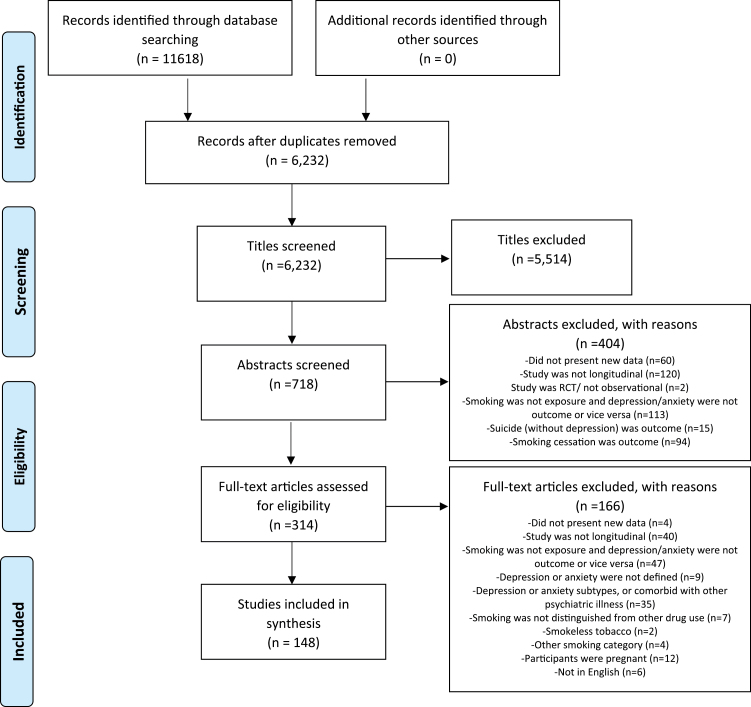
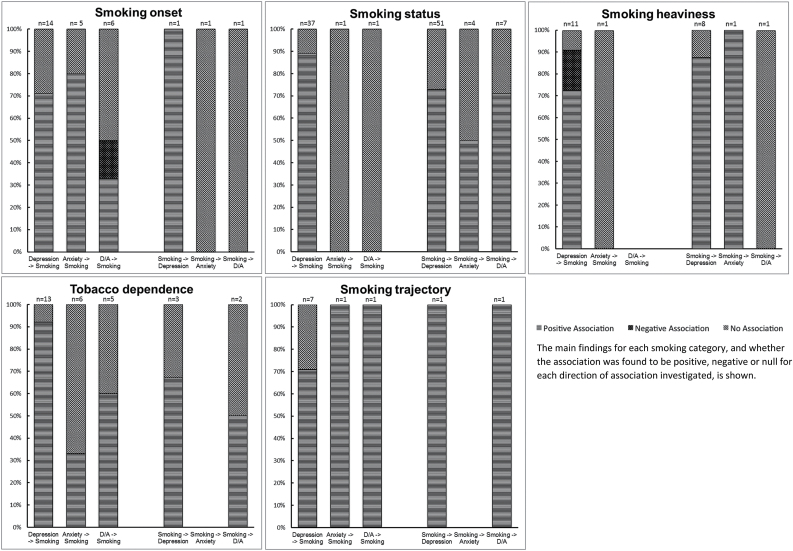
BACKGROUND: Many studies report a positive association between smoking and mental illness. However, the literature remains mixed regarding the direction of this association. We therefore conducted a systematic review evaluating the association of smoking and depression and/or anxiety in longitudinal studies. METHODS: Studies were identified by searching PubMed, Scopus, and Web of Science and were included if they: (1) used human participants, (2) were longitudinal, (3) reported primary data, (4) had smoking as an exposure and depression and/or anxiety as an outcome, or (5) had depression and/or anxiety as the exposure and smoking as an outcome. RESULTS: Outcomes from 148 studies were categorized into: smoking onset, smoking status, smoking heaviness, tobacco dependence, and smoking trajectory. The results for each category varied substantially, with evidence for positive associations in both directions (smoking to later mental health and mental health to later smoking) as well as null findings. Overall, nearly half the studies reported that baseline depression/anxiety was associated with some type of later smoking behavior, while over a third found evidence that a smoking exposure was associated with later depression/anxiety. However, there were few studies directly supporting a bidirectional model of smoking and anxiety, and very few studies reporting null results. CONCLUSIONS: The literature on the prospective association between smoking and depression and anxiety is inconsistent in terms of the direction of association most strongly supported. This suggests the need for future studies that employ different methodologies, such as Mendelian randomization (MR), which will allow us to draw stronger causal inferences. IMPLICATIONS: We systematically reviewed longitudinal studies on the association of different aspects of smoking behavior with depression and anxiety. The results varied considerably, with evidence for smoking both associated with subsequent depression and anxiety, and vice versa. Few studies supported a bidirectional relationship, or reported null results, and no clear patterns by gender, ethnicity, clinical status, length to follow-up, or diagnostic test. Suggesting that despite advantages of longitudinal studies, they cannot alone provide strong evidence of causality. Therefore, future studies investigating this association should employ different methods allowing for stronger causal inferences to be made, such as MR.
Overview
The claims and statistics of this paper haven’t been checked yet.
Free: it reads the open-access text and checks the first 5 claims that cite a source we can check. Create a free account to check every claim.
Integrity signals
Registry
Cites
Statistics
Figures
Verification
Claims the paper makes
The claims and statistics of this paper haven’t been checked yet.
Free: it reads the open-access text and checks the first 5 claims that cite a source we can check. Create a free account to check every claim.
Claims other papers make about this one
Each is checked against this paper’s own text: does it say what the citing paper says it does?
The source backs part of the claim, not all of it — or backs it for a different population, condition or comparison.
In the citing paper
“due to the high comorbidity between nicotine addiction and several anxiety-related disorders (Fluharty et al., 2016)”
From Age-dependent Effects of Tobacco Smoke and Nicotine on Cognition and the Brain: A Systematic Review of the Human and Animal Literature Comparing Adolescents and Adults. (2023) · cites this paper as Fluharty et al., 2016
Experimental — accuracy not yet measuredIn the citing paper
“Depressive disorders are heritable conditions with heritability rates of approximately 40% 12”
From Depressive symptoms predict clinical recurrence of inflammatory bowel disease (2022) · cites this paper as [12]
In the citing paper
“Importantly, there were no studies showing that smoking was associated with a later reduction in anxiety or depression rates.”
From An application of the stress-diathesis model: A review about the association between smoking tobacco, smoking cessation, and mental health (2023) · cites this paper as Fluharty et al. (2017)
In the citing paper
“Over a third of studies found that smoking at baseline led to later onset of anxiety or depression.”
From An application of the stress-diathesis model: A review about the association between smoking tobacco, smoking cessation, and mental health (2023) · cites this paper as Fluharty et al. (2017)
Self-check
Percentages, sums and reported differences re-computed from the paper’s own numbers.
The self-check needs the paper’s full text.
Citations
Cites
Diagnostic and Statistical Manual of Mental Disorders
Williams, J. B. W., & First, M. (2013) · Encyclopedia of Social Work · doi:10.1093/acrefore/9780199975839.013.104 · Cited by 109,519
Power failure: why small sample size undermines the reliability of neuroscience
Button, K. S., Ioannidis, J. P. A., Mokrysz, C., Nosek, B. A., Flint, J., Robinson, E. S. J., & Munafò, M. R. (2013) · Nature Reviews Neuroscience · doi:10.1038/nrn3475 · Cited by 7,641
A mega-analysis of genome-wide association studies for major depressive disorder
Major Depressive Disorder Working Group of the Psychiatric GWAS Consortium, Ripke, S., Wray, N. R., Lewis, C. M., Hamilton, S. P., Weissman, M. M., Breen, G., Byrne, E. M., Blackwood, D. H. R., Boomsma, D. I., et al. (2013) · Molecular Psychiatry · doi:10.1038/mp.2012.21 · Cited by 1,120
Life course outcomes of young people with anxiety disorders in adolescence
WOODWARD, L. J., & FERGUSSON, D. M. (2001) · Journal of the American Academy of Child & Adolescent Psychiatry · doi:10.1097/00004583-200109000-00018 · Cited by 1,051
Change in mental health after smoking cessation: systematic review and meta-analysis
Taylor, G., McNeill, A., Girling, A., Farley, A., Lindson-Hawley, N., & Aveyard, P. (2014) · BMJ · doi:10.1136/bmj.g1151 · Cited by 1,039
Smoking and Major Depression: A Causal Analysis
Kendler, K. S. (1993) · Archives of General Psychiatry · doi:10.1001/archpsyc.1993.01820130038007 · Cited by 792
Neurobiological similarities in depression and drug dependence: a self-medication hypothesis
Markou, A. (1998) · Neuropsychopharmacology · doi:10.1016/s0893-133x(97)00113-9 · Cited by 767
Adult Sequelae of Adolescent Depressive Symptoms
Kandel, D. B. (1986) · Archives of General Psychiatry · doi:10.1001/archpsyc.1986.01800030073007 · Cited by 638
Major Depression and Stages of Smoking: A Longitudinal Investigation
Breslau, N., Peterson, E. L., Schultz, L. R., Chilcoat, H. D., & Andreski, P. (1998) · Archives of General Psychiatry · doi:10.1001/archpsyc.55.2.161 · Cited by 633
Swendsen, J., Conway, K. P., Degenhardt, L., Glantz, M., Jin, R., Merikangas, K. R., Sampson, N., & Kessler, R. C. (2010) · Addiction · doi:10.1111/j.1360-0443.2010.02902.x · Cited by 597
Cited by
Items 501–600 of 1,000
Raffetti, E., Donato, F., Triolo, F., Andersson, F., Forsell, Y., & Galanti, M. (2022) · European Journal of Public Health · doi:10.1093/eurpub/ckac155 · Cited by 8
Underlying patterns of the co-occurrence of tobacco use and mental health among youth
Lee, B., Levy, D. E., & Seo, D. (2023) · Journal of Behavioral Medicine · doi:10.1007/s10865-022-00386-3 · Cited by 9
Sallis, H., Wootton, R. E., Smith, G. D., & Munafo, M. R. (2023) · International Journal of Epidemiology · doi:10.1093/ije/dyad022 · Cited by 9
Predictors of Discontinued E-Cigarette Use at One-Year Follow-Up in a Sample of Young Adults
Pokhrel, P., Kawamoto, C. T., Mettias, H., Elwir, T., & Herzog, T. A. (2023) · International Journal of Environmental Research and Public Health · doi:10.3390/ijerph20064770 · Cited by 10
“Indicators of mental health that are related to affect regulation, such as anxiety and depression, have been predictive of continued tobacco use [26] and have been associated with higher e-cigarette use [27].”
BackgroundAssociations of classical HLA alleles with depression and anxiety
Cheng, B., Yang, J., Cheng, S., Pan, C., Liu, L., Meng, P., Yang, X., Wei, W., Liu, H., Jia, Y., et al. (2023) · HLA · doi:10.1111/tan.15173 · Cited by 12
“Numerous studies have demonstrated that cigarette smoking and alcohol drinking are crucial risk factor for anxiety and depression, 34 and that anxiety and depression frequently co-occur with alcohol use disorder (AUD).”
BackgroundGut microbiota connects the brain and the heart: potential mechanisms and clinical implications
Zhang, Y., Huang, K., Duan, J., Zhao, R., & Yang, L. (2024) · Psychopharmacology · doi:10.1007/s00213-024-06552-6 · Cited by 11
“Smoking behavior and depression or anxiety may have bidirectional associations as reported, but direct evidence is inadequate (Fluharty et al. 2017).”
Gass, J. C., Morris, D. H., Winters, J. J., VanderVeen, J. W., & Chermack, S. T. (2017) · Journal of Substance Abuse Treatment · doi:10.1016/j.jsat.2017.10.006 · Cited by 9
Smethells, J. R., Burroughs, D., Saykao, A. T., Pentel, P. R., Rezvani, A. H., & LeSage, M. G. (2020) · Drug and Alcohol Dependence · doi:10.1016/j.drugalcdep.2020.108433 · Cited by 9
“The present study is an important initial step in preclinical research on the comorbidity of tobacco addiction and depression, and the findings are consistent with human studies suggesting that the relationship between cigarette smoking and depression may be causal (Munafò and Araya, 2010; Fluharty et al., 2016).”
BackgroundResultHalberstadt, A. L., Skrzynski, C. J., Wright, A. G. C., & Creswell, K. G. (2022) · Personality Disorders Theory Research and Treatment · doi:10.1037/per0000487 · Cited by 9
Héron, M., Faou, A.-L. L., Ibañez, G. E., Métadieu, B., Melchior, M., & El-Khoury, F. (2021) · Addiction Science & Clinical Practice · doi:10.1186/s13722-021-00254-6 · Cited by 9
“Anxiety and depressive symptoms are linked to smoking and quit attempts, [18] and information on these symptoms could also be useful for adapting clinicians’ customized smoking cessation advice.”
BackgroundZacharias, A. J., Lemaster, N. G., Hawk, G. S., Duncan, S. T., Thompson, K. L., Jochimsen, K. N., Stone, A. V., & Jacobs, C. A. (2021) · Arthroscopy Sports Medicine and Rehabilitation · doi:10.1016/j.asmr.2021.05.005 · Cited by 9
“Other confounders, such as tobacco use were also not assessed in this study, which has previously been shown to effect results of hip arthroscopy, as well as correlate with mental health.(24,25) Finally, without analysis of outcomes, such as pain scales and mental health scores, we were unable to assess for collineari…”
A multiple health behaviour change intervention to prevent depression: A randomized controlled trial
Gómez‐Gómez, I., Motrico, E., Moreno-Peral, P., Casajuana‐Closas, M., López‐Jiménez, T., Zabaleta‐del‐Olmo, E., Clavería, A., Llobera, J., Martí‐Lluch, R., Ramos, R., et al. (2023) · General Hospital Psychiatry · doi:10.1016/j.genhosppsych.2023.02.004 · Cited by 10
Barriers to Smoking Cessation Among Drug-Resistant Tuberculosis Patients in South Africa
Shangase, Z. P., Tsoka-Gwegweni, J. M., & Egbe, C. O. (2017) · Annals of Global Health · doi:10.1016/j.aogh.2017.05.007 · Cited by 11
“The exclusion criteria included patients younger than 18 years of age, those with a history of posttraumatic stress disorder, and those who suffered from depression, because depression has been associated with smoking.(24) Inclusion criteria were DR-TB inpatients who are smokers and who voluntarily agreed to participa…”
Meng, X. (2017) · Psychiatry Research · doi:10.1016/j.psychres.2017.08.075 · Cited by 10
“In agreement with previous literature, factors including being a woman, being a Caucasian, a regular smoker, and having a chronic disease were associated with first depressive episodes (Hung et al., 2013; Pedrelli et al., 2016; Ryu et al., 2016; Fluharty et al., 2017).”
Park, C.-J., Yook, J.-H., Kim, M., Lee, D., Lim, H.-M., & Hong, Y. (2019) · Annals of Occupational and Environmental Medicine · doi:10.35371/aoem.2019.31.e16 · Cited by 9
STUDENT WELL-BEING DURING THE COVID-19 PANDEMIC IN GREECE. RESULTS FROM THE C19 ISWS SURVEY.
Stathopoulou, T., Aliki, M., & Olga, P. (2020) · Zenodo (CERN European Organization for Nuclear Research) · doi:10.5281/zenodo.4038320 · Cited by 9
Mehrabi, F., Amiri, P., Naseri, P., & Azizi, F. (2022) · Archives of Iranian Medicine · doi:10.34172/aim.2022.85 · Cited by 8
“44 Another sex difference in the current result was that increased anxiety and stress were related to hookah smoking in women but not in men.”
Li, J., Jin, Y., Xu, S., Wilson, A. D., Chen, C., & Wang, Y. Y. (2024) · International Journal of Transgender Health · doi:10.1080/26895269.2023.2273360 · Cited by 9
Xi, S., Gu, Y., Guo, H., Liu, X., Zheng, Y.-L., Li, G., & Zhang, L. (2025) · Annals of Transplantation · doi:10.12659/aot.947351 · Cited by 8
Bae, Y., Kang, C., Choi, U., Jung, H., & Lee, S. (2025) · The International Journal of Psychiatry in Medicine · doi:10.1177/00912174251336045 · Cited by 8
“32 Those with severe psychiatric symptoms may also be more likely to quit, raising the possibility of reverse causality.”
Kim, J. Y., Kang, H. S., Jung, J., Jung, S. Y., Park, H. J., Park, J., Park, J. H., Lee, S. H., Chun, E. M., Park, D., et al. (2021) · Tuberculosis & respiratory diseases · doi:10.4046/trd.2020.0166 · Cited by 8
“Reportedly, dual users (those using both e-cigarettes and combustible cigarettes) tend to have a higher prevalence of depression, suicidal behaviors, or other psychiatric comorbidities than single users of each type of cigarette among adolescents [20,21].”
BackgroundLloyd, E. C., Reed, Z. E., & Wootton, R. E. (2021) · European Child & Adolescent Psychiatry · doi:10.1007/s00787-021-01918-z · Cited by 9
“Negative affect has been associated with subsequent initiation of smoking and smoking heaviness [53], as well as with AN [54, 55].”
Backgroundvan Sprang, E. D., Maciejewski, D. F., Milaneschi, Y., Kullberg, M. J., Elzinga, B. M., van Hemert, A. M., Hartman, C. A., & Penninx, B. W. J. H. (2023) · Social Psychiatry and Psychiatric Epidemiology · doi:10.1007/s00127-023-02432-0 · Cited by 9
“1 3 anxious psychopathology may be bidirectional [19, 20, 70].”
BackgroundPatel, U. K., Rao, A., Manihani, G. S. D., Patel, N. H., George, C., Vijayakumar, J., Evangeline, S. H., Alam, R., Ghuman, K., Francis, S. Z., et al. (2023) · Cureus · doi:10.7759/cureus.41968 · Cited by 8
“This can result in hypersecretion of cortisol and other neurotransmitters, which regulate individuals' responses to stress, leading to anxiety and depression [31].”
BackgroundJoyees, J., Marrie, R. A., Bernstein, C. N., Bolton, J. M., Fisk, J. D., Graff, L. A., Hitchon, C. A., Patten, S. B., Kowalec, K., & for the CIHR team in defining the burden and managing the effects of psychiatric comorbidity in chronic immunoinflammatory disease (2023) · Frontiers in Psychiatry · doi:10.3389/fpsyt.2023.1260420 · Cited by 8
“General population studies have found age, body mass index (BMI), income, education, and smoking to be factors associated with increased risk of anxiety symptoms (22–24), with income, education, and smoking more strongly associated with anxiety among females than males (25, 26).”
BackgroundPrevalence, Risk Factors, and Prognostic Value of Anxiety and Depression in Acute Myeloid Leukemia
Zhong, T., Xu, D., & Li, W. (2024) · Acta Haematologica · doi:10.1159/000536457 · Cited by 8
“…elucidated as follows: (1) smoking: we hypothesized that many smokers were vulnerable to mental illness and had heavier mental and fi nancial burden [24]; (2) high-risk strati fi cation: higher risk strati fi cation meant patients would have to receive more intensive therapies, which might accelerate…”
Yang, Y., Chen, Y., Jia, X., & Huang, X. (2024) · Journal of Affective Disorders · doi:10.1016/j.jad.2024.08.150 · Cited by 8
Chakrabarti, A., Saha, I., Kalita, M., Bhattacharya, D., Haque, B., Nagraj, A., Mukherjee, S., & Benegal, V. (2024) · The Indian Journal of Medical Research · doi:10.25259/ijmr_2407_23 · Cited by 8
“Tobacco is evidenced to possibly have a bidirectional relationship with anxiety or depression with smoking behavior leading to later onset of anxiety/depression or vice versa 18 .”
BackgroundDo Antidepressants Worsen COPD Outcomes in Depressed Patients with COPD?
Kaplan, A. G. (2024) · Pulmonary Therapy · doi:10.1007/s41030-024-00277-9 · Cited by 9
“A meta-analysis [41] reported that baseline depression/anxiety was associated with some type of later smoking behavior in some studies, while others found evidence that smoking exposure was associated with later depression/anxiety.”
Tang, Q., Yang, Y., Yang, M. L., Jiang, C., Zeng, J., Zhou, F., Xie, X., & Xiang, B. (2024) · Journal of Psychiatric Research · doi:10.1016/j.jpsychires.2024.11.057 · Cited by 8
Ju, C., Huang, C., Liu, X., & Liu, J. (2025) · Journal of Affective Disorders · doi:10.1016/j.jad.2025.01.024 · Cited by 9
Keyser‐Marcus, L., Vassileva, J., Stewart, K., & Johns, S. E. (2017) · The American Journal of Drug and Alcohol Abuse · doi:10.1080/00952990.2017.1287190 · Cited by 8
“quantity and frequency of use), and experience greater difficulty with reduction and cessation efforts (14).”
BackgroundPsychological Health and Smoking in Young Adulthood
Schmidt, A. M., Golden, S. D., Gottfredson, N. C., Ennett, S. T., Aiello, A. E., & Ribisl, K. M. (2019) · Emerging Adulthood · doi:10.1177/2167696819858812 · Cited by 8
Riyad, M. A., Ramadan, M. E., & Alkhadrawy, R. A.-A.-A. (2019) · The Egyptian Journal of Hospital Medicine · doi:10.21608/ejhm.2019.41559 · Cited by 8
Ho, Y., Lee, H., Lin, M., & Chang, H. (2020) · Nursing and Health Sciences · doi:10.1111/nhs.12752 · Cited by 10
Association between e-cigarette use and depression in US cancer survivors: a cross-sectional study
Antwi, G. O., & Rhodes, D. L. (2022) · Journal of Cancer Survivorship · doi:10.1007/s11764-022-01176-1 · Cited by 8
Depression among Elderly Residing in Old-age Homes in Devghat, Nepal
Lamichhane, P., Nepal, S., & Dhakal, K. (2022) · Nepal Journal of Health Sciences · doi:10.3126/njhs.v2i1.47161 · Cited by 8
Zhang, Y., Liu, J., Chen, L., Yang, T., Luo, X., Cui, X., Wu, S., He, Y., & Lu, J. (2023) · Child Abuse & Neglect · doi:10.1016/j.chiabu.2023.106470 · Cited by 9
Varaee, H., Mirzaei, M., Salehi‐Abargouei, A., Ahmadi, N., & Hosseinzadeh, M. (2023) · Journal of Affective Disorders · doi:10.1016/j.jad.2023.11.069 · Cited by 8
Gómez‐Gómez, I., Barquero‐Jimenez, C., Johnson, E., Cerón, S. C., Moreno-Peral, P., Bellón, J. Á., & Motrico, E. (2024) · Preventive Medicine · doi:10.1016/j.ypmed.2024.107847 · Cited by 9
Griffin, N. E., Feldman, R., Althouse, A. D., Yadav, D. K., & Phillips, A. E. (2024) · Pancreatology · doi:10.1016/j.pan.2024.02.011 · Cited by 8
Rahman, M. A., Tohan, M. M., Zaman, S., Islam, M. A., Rahman, M. S., Howlader, M. H., & Kundu, S. (2024) · BMC Psychiatry · doi:10.1186/s12888-024-06249-2 · Cited by 9
Garzón-Muvdi, T., Yang, W., Luksik, A. S., Ruiz‐Valls, A., Tamargo, R. J., Caplan, J. M., & Tamargo, R. J. (2016) · World Neurosurgery · doi:10.1016/j.wneu.2016.11.101 · Cited by 8
Endrighi, R., McQuaid, E. L., Bartlett, Y. K., Clawson, A. H., & Borrelli, B. (2018) · Annals of Behavioral Medicine · doi:10.1093/abm/kax011 · Cited by 11
Increasing Depression and Substance Use Among Former Smokers in the United States, 2002–2016
Cheslack‐Postava, K., Wall, M. M., Weinberger, A. H., & Goodwin, R. D. (2019) · American Journal of Preventive Medicine · doi:10.1016/j.amepre.2019.05.014 · Cited by 8
Cue restricted smoking increases quit rates with varenicline
Issa, J. S., Abe, T. M. O., Gaya, P. V., Bellini, B. B., de Moraes, I. R. A., Santos, J. M. B., Tomaz, P. R. X., Santos, P. D. L., & Tonstad, S. (2021) · Tobacco Prevention & Cessation · doi:10.18332/tpc/133570 · Cited by 8
“Relapses after week 12 to week 52 36 (20) 40 (18)”
Bagheri, S., Saghazade, A. R., Abbaszadeh‐Mashkani, S., Banafshe, H. R., Ghoreishi, F. S., Mesdaghinia, A., & Ghaderi, A. (2021) · Journal of Addictive Diseases · doi:10.1080/10550887.2021.2010971 · Cited by 8
Canas-Simião, H., Reis, C., Carreiras, D., Espada-Santos, P., & Paiva, T. (2022) · The Journal of Nervous and Mental Disease · doi:10.1097/nmd.0000000000001503 · Cited by 8
“Despite several studies reporting a clear association between tobacco use andmental illness, the literature remains inconsistent regarding the prospective directionality of this association (Fluharty et al., 2017).”
BackgroundEthnicity and Self-reported Depression Among Hispanic Immigrants in the U.S.
Adame, J. L., Lo, C. C., & Cheng, T. C. (2021) · Community Mental Health Journal · doi:10.1007/s10597-021-00801-0 · Cited by 9
Rabat, Y., Chanraud, S., Abdallah, M., Sibon, I., & Berthoz, S. (2021) · Biology · doi:10.3390/biology11010035 · Cited by 9
“This point might be particularly critical as a recent metanalysis [63] further emphasized a bidirectional link between smoking behavior and depression/anxiety, baseline depression/anxiety being associated with future smoking consumption, while smoking exposure contributed to the occurrence of later depression/anxiety.”
BackgroundBenzodiazepine Withdrawal: Clinical Aspects
Wright, S. L. (2020) · The Benzodiazepines Crisis · doi:10.1093/med/9780197517277.003.0008 · Cited by 7
The Potential Impact of Widespread Cessation Treatment for Smokers With Depression
Tam, J., Warner, K. E., Zivin, K., Taylor, G. M. J., & Meza, R. (2021) · American Journal of Preventive Medicine · doi:10.1016/j.amepre.2021.04.024 · Cited by 7
Wehrli, D., Gilljam, H., Koh, D., Matoori, S., Sartoretti, T., Boes, S., Hartmann, M., Roser, K., Ort, A., Wanner, P., et al. (2023) · Frontiers in Psychiatry · doi:10.3389/fpsyt.2023.1258272 · Cited by 7
“Individuals with mental illness also tend to start smoking at a younger age, smoke more heavily, and are more addicted to cigarettes than the general population (46).”
BackgroundVölker, M. P., Callies, C., Frank, J., Foo, J. C., Reinhard, I., Zillich, L., Klinger-König, J., Grabe, H. J., Beule, A. G., Erhardt, A., et al. (2025) · BMC Public Health · doi:10.1186/s12889-025-25959-0 · Cited by 7
“…Hill’s criteria of temporality and biological gradient, the observed dose–response and timing patterns strengthen the plausibility of a causal relationship [44]; although reverse causality remains possible: depression may contribute to smoking initiation [8, 16] or hinder smoking cessation [45].”
Occupational stress changes and new-onset depression among male Korean manufacturing workers
Kim, J., Kim, H., Kim, M. S., Yang, S.-C., Park, S., Leem, J., & Lee, D. (2023) · Annals of Occupational and Environmental Medicine · doi:10.35371/aoem.2023.35.e33 · Cited by 7
Understanding the Religion, Mental, and Social Health Relationship
Koenig, H. G., VanderWeele, T. J., & Peteet, J. R. (2023) · Oxford University Press eBooks · doi:10.1093/oso/9780190088859.003.0016 · Cited by 7
Haile, Z. T., Karim, S., Murton, K., Patibandla, S., & Haider, M. R. (2023) · International Journal of Gynecology & Obstetrics · doi:10.1002/ijgo.15285 · Cited by 8
Yim, G., Roberts, A. L., Lyall, K., Ascherio, A., & Weisskopf, M. G. (2024) · American Journal of Epidemiology · doi:10.1093/aje/kwae038 · Cited by 8
Zhang, C., Zhao, L., Dong, T., Zhao, J., Gao, C., & Zhao, F. (2024) · Frontiers in Psychology · doi:10.3389/fpsyg.2024.1361632 · Cited by 8
“These results align with existing research both domestically and internationally, emphasizing the importance of cultivating healthy lifestyle practices for the well-being of college students (Fluharty et al., 2017; Pearce et al., 2022).”
ResultDörner, M., Tyndall, A. J., Hainc, N., von Känel, R., Neumann, K., Euler, S., Schreiber, F., Arndt, P., Fuchs, E., Garz, C., et al. (2024) · Alzheimer s Research & Therapy · doi:10.1186/s13195-024-01519-3 · Cited by 7
“2.3) [46–50], concomitant AD pathology as binary variable according to the ATN classification (see Sect.”
MethodInfluentialCui, Y., & Du, H. (2025) · Clinical Gerontologist · doi:10.1080/07317115.2025.2482877 · Cited by 7
“Smoking was included as a covariate due to its well-documented association with an increased risk of depression (Fluharty et al., 2017) and hearing loss (Cruickshanks et al., 2015).”
Lee, E.-H., & Yu, H.-J. (2025) · Substance Abuse Treatment Prevention and Policy · doi:10.1186/s13011-025-00648-8 · Cited by 7
“Not only does smoking have a detrimental impact on physical health, but it also negatively affects mental health [7].”
Öfverholm, T., Hasselgren, M., Lisspers, K., Nager, A., Eliason, G., Giezeman, M., Janson, C., Kisiel, M. A., Montgomery, S., Ställberg, B., et al. (2025) · Scandinavian Journal of Primary Health Care · doi:10.1080/02813432.2025.2526667 · Cited by 7
“…reported that dyspnea was more strongly associated with depression in women than in men with cOPD [34] we could not confirm this finding in our study population. in line with other studies, we found that current smoking was associated with comorbid depression/ anxiety in patients with cOPD [35].”
Swahn, M. H., Palmier, J. B., Natuhamya, C., Mobley, K., Gittner, K. B., Lyons, M. J., Bbosa, G. S., Matovu, G., Mubiru, F., & Kavuma, A. (2025) · BMC Public Health · doi:10.1186/s12889-025-25602-y · Cited by 7
Percepções e vivências da Enfermagem quanto à proibição do tabagismo em um hospital psiquiátrico
de Oliveira, R. M., & Furegato, A. R. F. (2021) · SMAD Revista Eletrônica Saúde Mental Álcool e Drogas (Edição em Português) · doi:10.11606/issn.1806-6976.smad.2021.176380 · Cited by 7
Alqahtani, M. Μ., Pavela, G., Lein, D. H., Vilcassim, R., & Hendricks, P. S. (2022) · Respiratory Care · doi:10.4187/respcare.09579 · Cited by 7
“39 Indeed, studies found support for the negative reinforcement model of drug addiction (sometimes referred to as the “self-medication” model), in which individuals with mental health conditions use substances such as tobacco to regulate some of the associated psychological symptoms.”
Shell, A. L., Gonzenbach, V., Sawhney, M., Crawford, C. A., & Stewart, J. C. (2022) · Journal of Psychosomatic Research · doi:10.1016/j.jpsychores.2022.110992 · Cited by 7
Tobacco use modify exon IV BDNF gene methylation levels in depression
Quaioto, B. R., Borçoi, A. R., Mendes, S. O., Doblas, P. C., Vieira, T. D. S., Moreno, I. A. A., dos Santos, J. G., Hollais, A. W., Olinda, A. S., de Souza, M. L. M., et al. (2023) · Journal of Psychiatric Research · doi:10.1016/j.jpsychires.2023.01.038 · Cited by 8
The Tet2–Upf1 complex modulates mRNA stability under stress conditions
Xia, M., Yan, R., Wang, W., Kong, A., Zhang, M., Miao, Z., Ge, W., Wan, B., & Xu, X. (2023) · Frontiers in Genetics · doi:10.3389/fgene.2023.1158954 · Cited by 8
“, 2020) empty cage for 24 h, (Slavich and Sacher, 2019) cage tilt for 24 h (45°), (Fluharty et al., 2017) restraint stress for 2 h, (Schuckit, 2009) forced swimming at 4°C for 6 min, (Milaneschi et al.”
BackgroundMethodMarti, C. N., Arora, S., & Loukas, A. (2023) · Addictive Behaviors · doi:10.1016/j.addbeh.2023.107809 · Cited by 7
Hassan, S. S., Darwish, E. S., Ahmed, G. K., Azmy, S. R., & Haridy, N. A. (2023) · The Egyptian Journal of Neurology Psychiatry and Neurosurgery · doi:10.1186/s41983-023-00702-x · Cited by 8
“Thus, future research should examine this association using different approaches that allow stronger causal inferences [68].”
BackgroundEvaluation of sleep quality and depressive symptoms among medical students during COVID-19 pandemic
Samadi, S., Amirifard, H., Eslami, M. H., Khadembashiri, M. A., Khadembashiri, M. M., & Najafi, A. (2023) · Middle East Current Psychiatry · doi:10.1186/s43045-023-00338-w · Cited by 7
Depressive symptoms prospectively increase risk for new onset cigarette and ENDS dependence symptoms
Thomas, J. E., Pasch, K. E., Marti, C. N., & Loukas, A. (2023) · Addictive Behaviors · doi:10.1016/j.addbeh.2023.107870 · Cited by 8
Hoisington, A. J., Stearns‐Yoder, K. A., Stamper, C. E., Simonetti, J. A., Oslin, D. W., & Brenner, L. A. (2024) · Journal of Neuropsychiatry · doi:10.1176/appi.neuropsych.20220221 · Cited by 7
Harlow, A. F., Stokes, A., Han, D., Leventhal, A. M., & Barrington‐Trimis, J. L. (2024) · American Journal of Epidemiology · doi:10.1093/aje/kwae225 · Cited by 8
Kirchner, T., Tian, D., Li, J., Srivastava, P., & Zheng, Y. (2024) · Journal of the American Medical Informatics Association · doi:10.1093/jamia/ocae237 · Cited by 7
Avcu, A. B., Ulubaba, Z., Ünlü, U. E., Ünlü, N., Türkmenoğlu, S., Unal, M. N., Üner, Ş., Uçar, C., Vural, E., Uçar, A., et al. (2025) · Turkish Journal of Tobacco Control · doi:10.64511/tjtc.2025.6 · Cited by 7
Smoking status as a predictor of antidepressant medication use
Korhonen, T., Ranjit, A., Tuulio‐Henriksson, A., & Kaprio, J. A. (2016) · Journal of Affective Disorders · doi:10.1016/j.jad.2016.09.035 · Cited by 7
Kardash, E. V., Ertuzun, I. А., Khakimova, G. R., Kolyadin, A. N., Тарасов, С. А., Wagner, S., Andriambeloson, E., Ivashkin, V. T., & Epstein, O. I. (2018) · Dose-Response · doi:10.1177/1559325818779752 · Cited by 7
Variáveis clínicas e razões para busca de tratamento de pacientes tabagistas
dos Santos, C. B., Scortegagna, S. A., Franco, R. D. R. C., & Wibelinger, L. M. (2019) · SMAD Revista Eletrônica Saúde Mental Álcool e Drogas (Edição em Português) · doi:10.11606/issn.1806-6976.smad.2019.149180 · Cited by 7
Addicott, M. A. (2019) · Elsevier eBooks · doi:10.1016/b978-0-12-815298-0.00009-5 · Cited by 7
Smoking asthmatics, a neglected large phenotype of asthmatic patients
Katsaounou, P. A., Ioannou, M., Hyland, M. E., Odemyr, M., Otto, S., Anne, L., Matthias, G., Garcia, C. L., Xavier, J., & Ismail, K. (2019) · Open Journal of Asthma · doi:10.17352/oja.000010 · Cited by 8
“However, no direct correlation between smoking and depression/ anxiety was observed in our study, which is in line with previous reports [71].”
ResultGiovenco, D. P., Spillane, T. E., Baig, S. A., Dumas, S. E., Dongchung, T. Y., Sanderson, M., Sisti, J. S., Farley, S. M., Jasek, J. P., & Seligson, A. L. (2020) · Health & Place · doi:10.1016/j.healthplace.2020.102441 · Cited by 8
Baldonedo‐Mosteiro, C., Díaz, M. P. M., Correia, S., & Tardón, A. (2022) · International Journal of Environmental Research and Public Health · doi:10.3390/ijerph191710558 · Cited by 9
“In terms of the direction of association, the association between anxiety and depression with smoking is inconsistent [48].”
BackgroundCOVID-19 Quarantine Effects on Smoking Behavior and Mental Health of Smoking Adolescents
Taş, D., & Üneri, Ö. Ş. (2023) · Eurasian Journal of Medicine · doi:10.5152/eurasianjmed.2021.21058 · Cited by 8
Xu, C. D., Acevedo, P., Wang, L., Wang, N., Ozuna, K., Shafique, S., Karithara, A., Padilla, V., Mao, C., Xie, X., et al. (2023) · Brain Sciences · doi:10.3390/brainsci13040661 · Cited by 8
“In addition, there were inconsistent results regarding whether smoking caused anxiety and/or depression or vice versa [53].”
BackgroundWan, B., Wu, Y., Ma, N., Zhou, Z., & Lu, W. (2023) · PLoS ONE · doi:10.1371/journal.pone.0288034 · Cited by 7
“A bidirectional association was observed between smoking behavior and depression, but the causality remains unexplained [47].”
BackgroundTian, Y., Zhao, L., Pan, Y., Li, Z., Shen, X., Zhang, X., Tang, X., Feng, X., & Huang, X. (2023) · RSC Advances · doi:10.1039/d3ra03977c · Cited by 7
McGihon, R. E., Burns, R. J., Deschênes, S. S., & Schmitz, N. (2019) · Journal of Psychosomatic Research · doi:10.1016/j.jpsychores.2019.109737 · Cited by 7
Yang, X., Jing, W., Gao, C., & Attané, I. (2019) · American Journal of Men s Health · doi:10.1177/1557988319859733 · Cited by 7
“This may be because, through effects on individuals’ neurocircuitry, smoking increases susceptibility to environmental stressors, and may lead to depression or anxiety (Fluharty et al., 2017).”
BackgroundResultInfluentialPapazisis, A., Koreli, A., & Missouridou, E. (2019) · Materia Socio Medica · doi:10.5455/msm.2019.31.268-272 · Cited by 7
“Additionally, the relationship between nicotine dependence, anxiety and depression may be bidirectional with smoking initially used to alleviate symptoms but in fact worsening them over time as it dysregulates the hypothalamic-pituitary-adrenal system and results in hypersecretion of cortisol which in turn influences…”
BackgroundResultDuko, B., Pereira, G. F., Betts, K. S., Tait, R. J., Newnham, J. P., & Alati, R. (2021) · Addictive Behaviors · doi:10.1016/j.addbeh.2021.106871 · Cited by 7
Xiong, Z., Zhang, X., Zhang, M., & Cao, B. (2020) · International Conference on Machine Learning, Big Data and Business Intelligence (MLBDBI) · doi:10.1109/mlbdbi51377.2020.00019 · Cited by 7
“Besides that, there are three studies of recruiting African Americans that have shown evidences that depression is associated with later smoking behavior”, and other studies of ethnic groups generally conclude” associations between smoking and later depression and anxiety”[9, 10].”
BackgroundKim, B., Han, K., Chung, H., Kim, S. G., & Cho, S. (2023) · Cancer · doi:10.1002/cncr.34849 · Cited by 7
Darden, M., & Papageorge, N. (2018) · National Bureau of Economic Research · doi:10.3386/w25371 · Cited by 12
Parcesepe, A. M., Robertson, M. M., Berry, A., Maroko, A., Zimba, R., Grov, C., Westmoreland, D. A., Kulkarni, S., Rane, M. S., Salgado-You, W., et al. (2020) · medRxiv · doi:10.1101/2020.10.30.20221440 · Cited by 9
Islam, M. S., Rahman, M. E., Banik, R., Emran, M. G. I., Saiara, N., Hossain, S., Hasan, M. T., Sikder, M. T., Smith, L., & Potenza, M. N. (2020) · PsyArXiv (OSF Preprints) · doi:10.31234/osf.io/nfr5m · Cited by 11
Exploring the relationship between non-communicable diseases and depression
Everard, C., Vuik, S., Lerouge, A., & Cecchini, M. (2025) · OECD health working papers · doi:10.1787/02a1cfc5-en · Cited by 8
Lau, G. W. ‐., Deal, A. M., Page, A. B., Muss, H. B., & Nakamura, Z. M. (2025) · Psycho-Oncology · doi:10.1002/pon.70204 · Cited by 6
Cross-Sectional Associations of Lifestyle Behaviors with Depressive Symptoms in Adolescents
Kong, W., & Gu, J. (2022) · International Journal of Mental Health Promotion · doi:10.32604/ijmhp.2022.022123 · Cited by 8
Metadata
- Authors
- Fluharty, M., Taylor, A. E., Grabski, M., & Munafò, M. R.
- Affiliations
- University of Bristol (GB)
- Corresponding author
- Fluharty, Meg
- Venue
- Nicotine & Tobacco Research
- Publisher
- Oxford University Press (OUP)
- Published
- 2016-05-19
- Volume
- 19
- Issue
- 1
- Pages
- 3-13
- ISSN
- 1462-2203 (ISSN-L)
- 1469-994X
- PMC
- PMC5157710
- OpenAlex
- W2407654663
- Semantic Scholar
- addb21010e31f40cbf5d94796e74ad8c4f684175
- Cited by
- 1,299
- References
- 173
- Citations by year
- 2026: 128 · 2025: 185 · 2024: 155 · 2023: 217 · 2022: 166 · 2021: 176 · 2020: 133 · 2019: 76 · 2018: 38 · 2017: 19 · 2016: 6
- FWCI
- 5.44
- Type
- journal article
- Language
- en
- Open access
- hybrid
- doi.org
- Licence
- Locations
- Nicotine & Tobacco Research (publishedVersion, cc-by)
- PubMed Central (publishedVersion, cc-by)
- PubMed (publishedVersion)
- Explore Bristol Research (submittedVersion, cc-by)
- UCL Discovery (University College London) (submittedVersion)
- HighWire Press Open Archive (submittedVersion)
- Bristol Research (University of Bristol) (submittedVersion, cc-by)
- Funders
- University of Bristol
- Medical Research Council (MC_UU_12013/6)
- Topics
- Health Sciences › Medicine › Public Health, Environmental and Occupational Health › Smoking Behavior and Cessation
- Health Sciences › Medicine › Psychiatry and Mental health › Mental Health Treatment and Access
- Health Sciences › Medicine › Epidemiology › Substance Abuse Treatment and Outcomes
- Keywords
- cigarette smoking, depression, anxiety, bidirectional relationship, smoking onset, tobacco dependence, smoking heaviness, smoking trajectories, mental health, causal inference, Mendelian randomization
- MeSH terms
- Anxiety, Anxiety Disorders, Depression, Depressive Disorder, Humans, Prospective Studies, Sex Characteristics, Smoking, Tobacco Use Disorder
About these checks
Registry, retraction, Cites and statistics results are computed, not judged, with one exception: a printed reference that no index lists is read once by a model before it counts as a citation error. Claims are extracted by a model and kept only when their quote appears verbatim in the text; each cited source is then checked, with a model’s help, for whether it says what the claim relies on. Those verdicts can be wrong — read the claim’s quote and the cited source before relying on one.
Statistics and arithmetic are recomputed, not judged.
Confidence bands are shown only for fields calibrated on our annotated test set. None is calibrated yet, so no band is shown.
What counts as a claim ›How we measure confidence ›How we check this ›
Are you an author, or do you see a problem with this page? Request a review
Data sources
Bibliographic data: Semantic Scholar, OpenAlex, Crossref.
Contains information from the Semantic Scholar Academic Graph Datasets, made available under the ODC Attribution License (ODC-BY 1.0).
Semantic Scholar’s data is described in: Kinney, R., et al. (2023). The Semantic Scholar Open Data Platform. arXiv:2301.10140.
