

The Association of Cigarette Smoking With Depression and Anxiety: A Systematic Review
Open accessThe DOI matches its Crossref record; 172 of the 174 references it cites were found in a registry or an index, and 2 are not checked yet.
Abstract
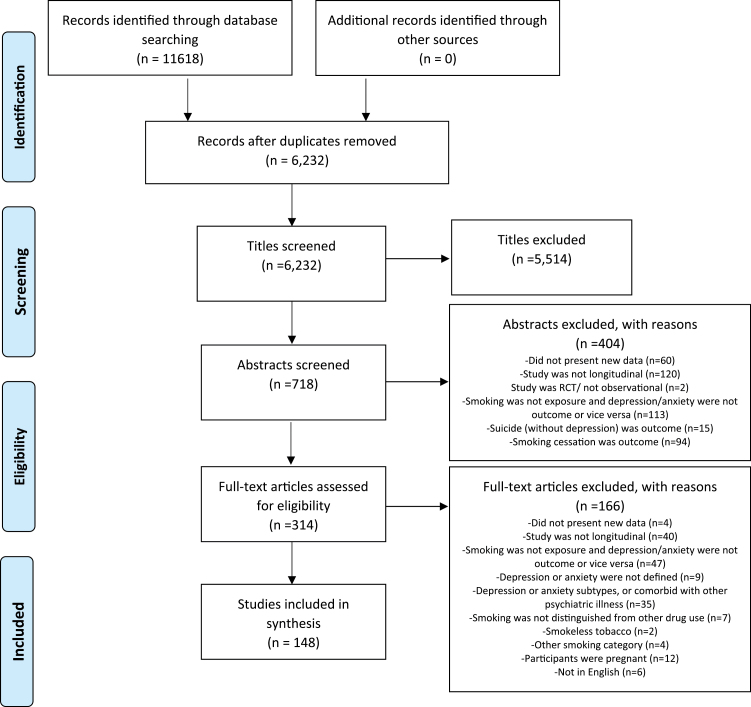
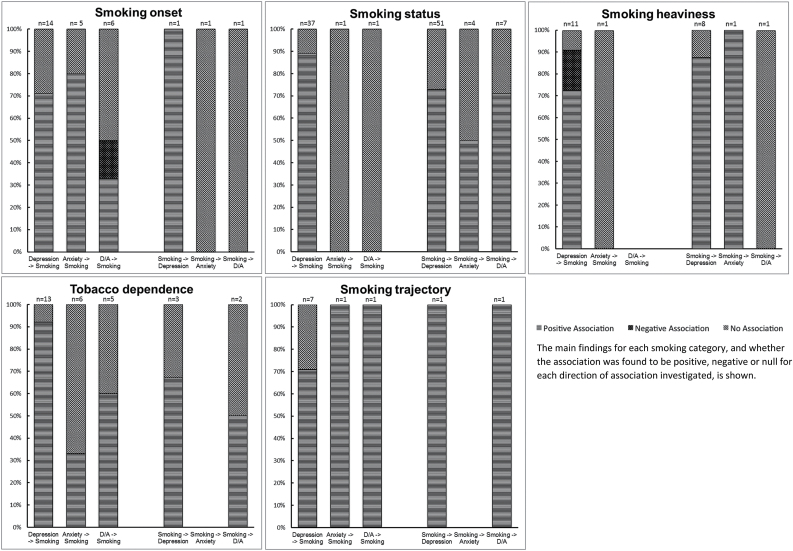
BACKGROUND: Many studies report a positive association between smoking and mental illness. However, the literature remains mixed regarding the direction of this association. We therefore conducted a systematic review evaluating the association of smoking and depression and/or anxiety in longitudinal studies. METHODS: Studies were identified by searching PubMed, Scopus, and Web of Science and were included if they: (1) used human participants, (2) were longitudinal, (3) reported primary data, (4) had smoking as an exposure and depression and/or anxiety as an outcome, or (5) had depression and/or anxiety as the exposure and smoking as an outcome. RESULTS: Outcomes from 148 studies were categorized into: smoking onset, smoking status, smoking heaviness, tobacco dependence, and smoking trajectory. The results for each category varied substantially, with evidence for positive associations in both directions (smoking to later mental health and mental health to later smoking) as well as null findings. Overall, nearly half the studies reported that baseline depression/anxiety was associated with some type of later smoking behavior, while over a third found evidence that a smoking exposure was associated with later depression/anxiety. However, there were few studies directly supporting a bidirectional model of smoking and anxiety, and very few studies reporting null results. CONCLUSIONS: The literature on the prospective association between smoking and depression and anxiety is inconsistent in terms of the direction of association most strongly supported. This suggests the need for future studies that employ different methodologies, such as Mendelian randomization (MR), which will allow us to draw stronger causal inferences. IMPLICATIONS: We systematically reviewed longitudinal studies on the association of different aspects of smoking behavior with depression and anxiety. The results varied considerably, with evidence for smoking both associated with subsequent depression and anxiety, and vice versa. Few studies supported a bidirectional relationship, or reported null results, and no clear patterns by gender, ethnicity, clinical status, length to follow-up, or diagnostic test. Suggesting that despite advantages of longitudinal studies, they cannot alone provide strong evidence of causality. Therefore, future studies investigating this association should employ different methods allowing for stronger causal inferences to be made, such as MR.
Overview
The claims and statistics of this paper haven’t been checked yet.
Free: it reads the open-access text and checks the first 5 claims that cite a source we can check. Create a free account to check every claim.
Integrity signals
Registry
Cites
Statistics
Figures
Verification
Claims the paper makes
The claims and statistics of this paper haven’t been checked yet.
Free: it reads the open-access text and checks the first 5 claims that cite a source we can check. Create a free account to check every claim.
Claims other papers make about this one
Each is checked against this paper’s own text: does it say what the citing paper says it does?
The source backs part of the claim, not all of it — or backs it for a different population, condition or comparison.
In the citing paper
“due to the high comorbidity between nicotine addiction and several anxiety-related disorders (Fluharty et al., 2016)”
From Age-dependent Effects of Tobacco Smoke and Nicotine on Cognition and the Brain: A Systematic Review of the Human and Animal Literature Comparing Adolescents and Adults. (2023) · cites this paper as Fluharty et al., 2016
Experimental — accuracy not yet measuredIn the citing paper
“Depressive disorders are heritable conditions with heritability rates of approximately 40% 12”
From Depressive symptoms predict clinical recurrence of inflammatory bowel disease (2022) · cites this paper as [12]
In the citing paper
“Importantly, there were no studies showing that smoking was associated with a later reduction in anxiety or depression rates.”
From An application of the stress-diathesis model: A review about the association between smoking tobacco, smoking cessation, and mental health (2023) · cites this paper as Fluharty et al. (2017)
In the citing paper
“Over a third of studies found that smoking at baseline led to later onset of anxiety or depression.”
From An application of the stress-diathesis model: A review about the association between smoking tobacco, smoking cessation, and mental health (2023) · cites this paper as Fluharty et al. (2017)
Self-check
Percentages, sums and reported differences re-computed from the paper’s own numbers.
The self-check needs the paper’s full text.
Citations
Cites
Diagnostic and Statistical Manual of Mental Disorders
Williams, J. B. W., & First, M. (2013) · Encyclopedia of Social Work · doi:10.1093/acrefore/9780199975839.013.104 · Cited by 109,519
Power failure: why small sample size undermines the reliability of neuroscience
Button, K. S., Ioannidis, J. P. A., Mokrysz, C., Nosek, B. A., Flint, J., Robinson, E. S. J., & Munafò, M. R. (2013) · Nature Reviews Neuroscience · doi:10.1038/nrn3475 · Cited by 7,641
A mega-analysis of genome-wide association studies for major depressive disorder
Major Depressive Disorder Working Group of the Psychiatric GWAS Consortium, Ripke, S., Wray, N. R., Lewis, C. M., Hamilton, S. P., Weissman, M. M., Breen, G., Byrne, E. M., Blackwood, D. H. R., Boomsma, D. I., et al. (2013) · Molecular Psychiatry · doi:10.1038/mp.2012.21 · Cited by 1,120
Life course outcomes of young people with anxiety disorders in adolescence
WOODWARD, L. J., & FERGUSSON, D. M. (2001) · Journal of the American Academy of Child & Adolescent Psychiatry · doi:10.1097/00004583-200109000-00018 · Cited by 1,051
Change in mental health after smoking cessation: systematic review and meta-analysis
Taylor, G., McNeill, A., Girling, A., Farley, A., Lindson-Hawley, N., & Aveyard, P. (2014) · BMJ · doi:10.1136/bmj.g1151 · Cited by 1,039
Smoking and Major Depression: A Causal Analysis
Kendler, K. S. (1993) · Archives of General Psychiatry · doi:10.1001/archpsyc.1993.01820130038007 · Cited by 792
Neurobiological similarities in depression and drug dependence: a self-medication hypothesis
Markou, A. (1998) · Neuropsychopharmacology · doi:10.1016/s0893-133x(97)00113-9 · Cited by 767
Adult Sequelae of Adolescent Depressive Symptoms
Kandel, D. B. (1986) · Archives of General Psychiatry · doi:10.1001/archpsyc.1986.01800030073007 · Cited by 638
Major Depression and Stages of Smoking: A Longitudinal Investigation
Breslau, N., Peterson, E. L., Schultz, L. R., Chilcoat, H. D., & Andreski, P. (1998) · Archives of General Psychiatry · doi:10.1001/archpsyc.55.2.161 · Cited by 633
Swendsen, J., Conway, K. P., Degenhardt, L., Glantz, M., Jin, R., Merikangas, K. R., Sampson, N., & Kessler, R. C. (2010) · Addiction · doi:10.1111/j.1360-0443.2010.02902.x · Cited by 597
Cited by
Items 301–400 of 1,000
Jahrami, H., Saif, Z., AlHaddad, M., Faris, M. E., Hammad, L., & Ali, B. (2020) · Heliyon · doi:10.1016/j.heliyon.2020.e04323 · Cited by 19
Ye, J., Wu, C., Chu, X., Wen, Y. F., Li, P., Cheng, B., Cheng, S., Liu, L., Zhang, L., Ma, M., et al. (2020) · European Psychiatry · doi:10.1192/j.eurpsy.2020.74 · Cited by 18
Khalatbari‐Soltani, S., Stanaway, F., Cvejic, E., Blyth, F., Naganathan, V., Handelsman, D. J., Couteur, D. G. L., Seibel, M. J., Waite, L. M., & Cumming, R. G. (2020) · International Journal for Equity in Health · doi:10.1186/s12939-020-01277-2 · Cited by 17
Kaplan, B., Thrul, J., & Cohen, J. E. (2021) · PLoS ONE · doi:10.1371/journal.pone.0253061 · Cited by 17
Cwalina, S. N., Pacek, L. R., Barrington‐Trimis, J. L., Tackett, A. P., & Pentz, M. A. (2021) · Substance Use & Misuse · doi:10.1080/10826084.2021.1954026 · Cited by 18
“Previous research has established strong bidirectional associations between mental health conditions and cigarette smoking (Boden et al., 2010; Fluharty et al., 2017; Prochaska et al., 2017) and electronic nicotine delivery system (ENDS) use (Bandiera et al., 2016, 2017; Cummins et al., 2014),…”
BackgroundPrevalence of depression and suicide ideation in Hong Kong doctors: a cross-sectional study
Ng, A. P. P., Chin, W. Y., Wan, E. Y. F., Chen, J. Y., & Lau, C. S. (2021) · Scientific Reports · doi:10.1038/s41598-021-98668-4 · Cited by 20
Du, X., Wu, R., Kang, L., Zhao, L., & Li, C. (2022) · Frontiers in Public Health · doi:10.3389/fpubh.2022.913636 · Cited by 18
“Another possible explanation is from a self-medication model, suggesting that smokers use nicotine to alleviate depressed mood [9,18,42].”
Mattiello, R., Ayala, C. O., Pedron, F. F., Ferreira, I. C. S., Ley, L. L. G., Paungartner, L. M., Martins, M. D. S., Bagatini, M. A., Batista, N. O. W., Cecagno, P. O. M., et al. (2022) · BMJ Open · doi:10.1136/bmjopen-2022-063902 · Cited by 17
Micheli, A. D., Provenzani, U., Solmi, M., van Pabst, A. E. V. L., Youssef, E., McGuire, P. K., & Fusar‐Poli, P. (2023) · Schizophrenia Research · doi:10.1016/j.schres.2023.02.008 · Cited by 18
Punjani, N., Flannigan, R. K., Oliffe, J. L., McCreary, D. R., Black, N., & Goldenberg, S. L. (2018) · American Journal of Men s Health · doi:10.1177/1557988318799022 · Cited by 17
Erdsiek, F., & Brzoska, P. (2020) · BMC Public Health · doi:10.1186/s12889-020-09970-1 · Cited by 17
Depression and food insecurity among patients with rheumatoid arthritis in NHANES
Cai, Q., Pesa, J. A., Wang, R., & Fu, A. Z. (2022) · BMC Rheumatology · doi:10.1186/s41927-021-00236-w · Cited by 17
“A systematic review reports smoking is associated with depression although the direction of the association is not clear [41].”
BackgroundGuo, Y., & Yan, J. (2024) · Archives of Public Health · doi:10.1186/s13690-024-01322-4 · Cited by 16
“This supports the view that smoking increases the risk of depression [34].”
BackgroundXiong, H., Ma, F., Tang, D., & Liu, D.-Q. (2024) · Frontiers in Psychiatry · doi:10.3389/fpsyt.2024.1455918 · Cited by 20
“A systematic review of 148 studies on the association of cigarette smoking with depression and anxiety found that smoking at baseline is associated with an increased risk of depression in later life (46).”
BackgroundBorges, G. L. G., Benjet, C. L., Orozco, R., & Medina‐Mora, M. E. (2018) · Journal of Psychiatric Research · doi:10.1016/j.jpsychires.2018.08.014 · Cited by 17
The Effect of Psychological Dependence on Smoking Urge and Nicotine Withdrawal Symptoms
Hezer, H., & Karalezli, A. (2019) · Ankara Medical Journal · doi:10.17098/amj.651955 · Cited by 17
“Sigara içme süresi (yıl) (ortanca, min-maks) 25,92±12,50 24 (12-60) 19,34±8,22 17 (8-35) 0,002”
InfluentialLiu, Q., Peng, X., Gu, Y., Shang, X., Zhou, Y., Zhang, H., Zuo, L., Mei, G., Xiong, C., Li, H., et al. (2021) · Aging · doi:10.18632/aging.202442 · Cited by 18
“Some LOH symptoms have been linked not only to aging but also to cigarette smoking [8–10]; these include erectile dysfunction [11, 12], sarcopenia [13, 14], frailty [15], depression [16], anxiety [17].”
BackgroundTherapy Management of Metabolic Disorder Comorbidity With Depression
Luo, H., Jiang, Z., & Ren, Y. (2021) · Frontiers in Psychology · doi:10.3389/fpsyg.2021.683320 · Cited by 22
Wilson, O. W. A., Bullen, C., Duffey, M., & Bopp, M. (2022) · Journal of American College Health · doi:10.1080/07448481.2022.2076097 · Cited by 19
“27 The relationship between smoking and depression is unclear, 28 while smoking has been shown to have a positive association with perceived stress.”
BackgroundModifiable risk factors of major depressive disorder: A Mendelian randomization study
Zheng, X., Li, T., Zhang, C., Zhang, C., Zhang, C., & Wan, B. (2023) · PLoS ONE · doi:10.1371/journal.pone.0289419 · Cited by 18
Development and initial testing of the brief adolescent smoking curiosity scale (ASCOS)
Khalil, G. E., Calabro, K. S., & Prokhorov, A. V. (2017) · Addictive Behaviors · doi:10.1016/j.addbeh.2017.11.008 · Cited by 16
“Finally, previous research has shown an association between depression and smoking initiation (Fluharty et al., 2016).”
BackgroundYazdi, M., Roohafza, H., Feizi, A., Rabiei, K., & Sarafzadegan, N. (2018) · Journal of Affective Disorders · doi:10.1016/j.jad.2018.04.120 · Cited by 16
Liu, N. H., Wu, C., Pérez‐Stable, E. J., & Muñoz, R. F. (2020) · Nicotine & Tobacco Research · doi:10.1093/ntr/ntaa036 · Cited by 16
Depression and Anxiety Among Patients on Chronic Opioid Therapy
Elrashidi, M. Y., Philpot, L. M., Ramar, P., Leasure, W. B., & Ebbert, J. O. (2018) · Health Services Research and Managerial Epidemiology · doi:10.1177/2333392818771243 · Cited by 16
Lara, L. F., Wastvedt, S., Hodges, J. S., Witkowski, P., Wijkstrom, M. N., Walsh, R. M., Singh, V. K., Schwarzenberg, S. J., Pruett, T. L., Posselt, A. M., et al. (2021) · Pancreas · doi:10.1097/mpa.0000000000001850 · Cited by 15
Wang, Q., Zhang, J., Yao, H., Jin, P., Zhao, F., & Zhang, P. (2022) · BMJ Open · doi:10.1136/bmjopen-2022-062431 · Cited by 17
The impact of pre-operative mental health on outcomes of foot and ankle surgery: A scoping review
Arshad, Z., Haq, I. I., Martins, A., & Bhatia, M. (2023) · Foot and Ankle Surgery · doi:10.1016/j.fas.2023.11.002 · Cited by 18
Associations between Life's Essential 8 and depression among US adults
Zhao, S., Tang, Y., Li, Y., Shen, H., & Liu, A. (2024) · Psychiatry Research · doi:10.1016/j.psychres.2024.115986 · Cited by 16
Zheng, P. Z., Scheffler, A., Ewing, S. K., Hue, T. F., Jones, S. B., Morshed, S., Mehling, W. E., Espin, A. T., Galivanche, A. R., Lotz, J. C., et al. (2025) · The Spine Journal · doi:10.1016/j.spinee.2024.12.029 · Cited by 16
Cumulative associations between health behaviours, mental well-being, and health over 30 years
Kekäläinen, T., Ahola, J., Reinilä, E., Savikangas, T., Kinnunen, M.-L., Pitkänen, T., & Kokko, K. (2025) · Annals of Medicine · doi:10.1080/07853890.2025.2479233 · Cited by 17
“For example, depressive symptoms may predict risky health behaviours [19,64] while good mental well-being may be a resource for smoking cessation [55]. these bidirectional interactions suggest that the relationships between health behaviours and health and mental well-being outcomes are not linear,…”
Peltzer, K., & Pengpid, S. (2017) · Journal of Psychology in Africa · doi:10.1080/14330237.2017.1347772 · Cited by 15
Association of dual and poly tobacco use with depressive symptoms and use of antidepressants
Chido‐Amajuoyi, O. G., Mantey, D. S., Omega‐Njemnobi, O., Yu, R. K., & Shete, S. S. (2020) · Addictive Behaviors · doi:10.1016/j.addbeh.2020.106790 · Cited by 16
Luo, X., Storey, S., Gandhi, P., Zhang, Z., Metzger, M., & Huang, K. (2021) · Health Informatics Journal · doi:10.1177/14604582211000785 · Cited by 16
Li, Y., Zhang, C., Ding, S., Li, J., Li, L., Kang, Y., Dong, X., Wan, Z., Luo, Y., Cheng, A. S. K., et al. (2021) · Journal of Affective Disorders · doi:10.1016/j.jad.2021.11.054 · Cited by 15
Bidirectional association between tobacco use and depression risk in the SUN cohort study
Sánchez‐Villegas, A., Gea, A., Lahortiga‐Ramos, F., Martínez-González, J., Molero, P., & Martínez‐González, M. Á. (2021) · Adicciones · doi:10.20882/adicciones.1725 · Cited by 15
“One of the most accepted explanations is that based on the self-medication hypothesis (as it has already been mentioned) that postulates that individuals turn to smoke to alleviate their symptoms but worsening them over time (Fluharty et al., 2017).”
BackgroundLi, C., Liang, X., Cheng, S., Wen, Y. F., Pan, C., Zhang, H., Chen, Y., Zhang, J., Zhang, Z., Yang, X., et al. (2022) · Journal of Psychiatric Research · doi:10.1016/j.jpsychires.2022.01.009 · Cited by 16
Weiss, J. R., Serdenes, R., Madtha, U., Zhao, H., Kim, V., Lopez‐Pastrana, J., Eakin, M. N., O’Toole, J., Cooper, C. B., Woodruff, P. G., et al. (2022) · Journal of the Academy of Consultation-Liaison Psychiatry · doi:10.1016/j.jaclp.2022.07.008 · Cited by 16
Westmaas, J. L., Chantaprasopsuk, S., Bontemps-Jones, J. E., Stephens, R. L., Thorne, C., & Abroms, L. C. (2022) · Preventive Medicine Reports · doi:10.1016/j.pmedr.2022.102059 · Cited by 17
“Our results also pointed out environmental and psychological disadvantages among people who wanted to quit smoking but who did not believe peer support was available for their quit attempt: individuals reporting never-present peer support for quitting had lower income and education, greater depressive symptomatology a…”
ResultChoi, S., Han, J.-E., Choi, J., Park, M.-J., Sung, S.-H., & Sung, A. D. (2022) · Healthcare · doi:10.3390/healthcare10112324 · Cited by 16
“In a systematic review of 148 longitudinal studies [45], the results varied considerably, with evidence that smoking was associated with subsequent depression and anxiety and vice versa.”
BackgroundAndersen, A. J., Hecker, I., Wallez, S., Witteveen, A. B., Lora, A., Mittendorfer‐Rutz, E., Corrao, G., Walter, H., Haro, J. M., Sijbrandij, M., et al. (2023) · BMC Public Health · doi:10.1186/s12889-023-15799-1 · Cited by 16
“Anxiety and depression are found to be associated with increased substance use, including both tobacco smoking uptake and frequency [6, 7], explained by a self-medication model, suggesting that individuals smoke to alleviate psychiatric symptoms [8].”
BackgroundClinical challenges facing patient participation in cardiac rehabilitation: cigarette smoking
Gaalema, D. E., Khadanga, S., & Pack, Q. R. (2023) · Expert Review of Cardiovascular Therapy · doi:10.1080/14779072.2023.2282026 · Cited by 15
“Similarly, smoking and depression are closely linked, and depression is a predictor of CR attendance as well, so the effect of smoking on CR attendance could be being moderated by depression [28,29].”
BackgroundMoody, D. L. B., Leibel, D. K., Pantesco, E. J., Wendell, C. R., Waldstein, S. R., Evans, M. K., & Zonderman, A. B. (2019) · Psychosomatic Medicine · doi:10.1097/psy.0000000000000765 · Cited by 15
“Thus, in those with symptoms of depression, physiological responses to the stress of discrimination may be amplified and, when experienced repeatedly, could contribute to an accelerated progression of atherosclerosis (97-99).”
BackgroundComparing smoking behavior between female-to-male and male-to-female transgender adults
Tamí‐Maury, I., Sharma, A., Chen, M., Blalock, J. A., Ortiz, J., Weaver, L., & Shete, S. S. (2020) · Tobacco Prevention & Cessation · doi:10.18332/tpc/114513 · Cited by 15
Bougas, N., Fresneau, B. C., Pinto, S., Mayet, A., Marchi, J., Pein, F. J. L., Mansouri, I., Journy, N., Jackson, A., Souchard, V., et al. (2021) · Cancer Epidemiology Biomarkers & Prevention · doi:10.1158/1055-9965.epi-21-0193 · Cited by 15
“In general population, several studies reported that baseline depression or anxiety was associated with later smoking, whereas some others supported the alternative hypothesis that smoking at baseline increases susceptibility to poor mental health condition (39).”
ResultRomm, K. F., Cohn, A. M., Wang, Y., & Berg, C. J. (2023) · Addictive Behaviors · doi:10.1016/j.addbeh.2023.107658 · Cited by 14
Nicotine dependence and incident psychiatric disorders: prospective evidence from US national study
Airagnes, G., Rico, M. S., Deguilhem, A., Blanco, C., Olfson, M., Vedrines, C. O., Lemogne, C., Limosin, F., & Hoertel, N. (2024) · Molecular Psychiatry · doi:10.1038/s41380-024-02748-6 · Cited by 16
“In contrast to several prior observational studies [10, 57, 58], we did not fi nd a signi fi cant association between nicotine dependence and major depressive disorder.”
Lui, C. K., Jacobs, W., & Yang, J. S. (2024) · Substance Use & Misuse · doi:10.1080/10826084.2024.2409723 · Cited by 14
“…et al., 2018; Gobbi et al., 2019; Lev-Ran et al., 2014; Onaemo et al., 2021; White et al., 2022), and tobacco use (Bierhoff et al., 2019; Fluharty et al., 2017; McKenzie et al., 2010; Moustafa et al., 2021; Obisesan et al., 2019; Prochaska et al., 2017; Saeed et al., 2020; Sung, 2021;…”
GWAS and systems biology analysis of depressive symptoms among smokers from the COPDGene cohort
Heinzman, J. T., Hoth, K. F., Cho, M. H., Sakornsakolpat, P., Regan, E. A., Make, B. J., Kinney, G. L., Wamboldt, F. S., Holm, K. E., Bormann, N. L., et al. (2018) · Journal of Affective Disorders · doi:10.1016/j.jad.2018.09.003 · Cited by 17
“Depression is also associated with smoking, although the directionality of the relationship is still debated (Fluharty et al., 2017).”
Li, J., Huang, D., Windle, M. T., Escoffery, C., Wang, W., Li, X., Tao, K., Haardörfer, R., Li, S., Berg, C. J., et al. (2021) · BMC Public Health · doi:10.1186/s12889-021-10888-5 · Cited by 14
Amiri, S., Fathi-Ashtiani, M., Sedghijalal, A., & Fathi-Ashtiani, A. (2021) · Journal of Addictive Diseases · doi:10.1080/10550887.2021.1886576 · Cited by 14
“In this regard, several studies show that smoking is associated with various diseases, both physical and mental, including cancer,(4) rheumatoid arthritis,(5) erectile dysfunction,(6) infertility in women,(7) heart failure,(8) sleep,(9) suicide,(10,11) depression(12) and anxiety.(13,14) Another important issue in the…”
BackgroundHu, K., Zou, S., Zhang, C. J. P., Wu, H., Akinwunmi, B. O., Wang, Z., & Ming, W. (2021) · JMIR Public Health and Surveillance · doi:10.2196/29718 · Cited by 14
“However, another study revealed that smoking exposure is associated with later depression/anxiety [38].”
BackgroundSafarini, O., Taya, H., Elhija, Y. A., Qadous, M., Farhoud, A., Thabaleh, A., Khayyat, A., Nazzal, Z. A. S., Abuhassan, A., Ghanim, N., et al. (2021) · Cureus · doi:10.7759/cureus.19098 · Cited by 14
“Additionally, smoking is associated with ED consumption and depression [16,17].”
BackgroundFeng, X., Liang, R., Shi, D., Wang, D., Guo, Y., Qiu, W., Cheng, M., Xu, T., Dong, C., Zhou, M., et al. (2022) · Environmental Science and Pollution Research · doi:10.1007/s11356-021-18317-1 · Cited by 14
“2020a), was associated with increased risk of depression (Fluharty et al. 2017).”
BackgroundMunarini, E., Stival, C., Boffi, R., Lugoboni, F., Veronese, C., Tinghino, B., Agnelli, G. M., Lugo, A., Gallus, S., & Giordano, R. (2022) · BMC Public Health · doi:10.1186/s12889-022-13404-5 · Cited by 16
“However, a systematic review concluded that it was not possible to identify a unique model to consider the relationship between anxiety and smoking and that a bidirectional relationship between the two is possible [61].”
BackgroundSiamisang, K., Kebadiretse, D., Tjirare, L. T., Muyela, C., Gare, K. P., & Masupe, T. (2022) · PLoS ONE · doi:10.1371/journal.pone.0273052 · Cited by 14
Physical Activity and Healthy Habits Influence Mood Profile Clusters in a Lithuanian Population
Terry, P. C., Parsons-Smith, R. L., Skurvydas, A., Lisinskienė, A., Majauskienė, D., Valančienė, D., Cooper, S., & Lochbaum, M. R. (2022) · Sustainability · doi:10.3390/su141610006 · Cited by 14
Wang, M., Li, T., Xie, Y., Zhang, D., Qu, Y., Zhai, S., Mou, X., Yang, Y., Zou, L., Tao, S., et al. (2023) · Journal of Affective Disorders · doi:10.1016/j.jad.2023.10.139 · Cited by 14
Symptom patterns of comorbid depression and anxiety among older adults in China and their predictors
Yu, L., & Chen, C. (2024) · PsyCh Journal · doi:10.1002/pchj.729 · Cited by 14
“Meanwhile, the effect of smoking in reducing the risk of the “ severe depression and anxiety ” pattern may be due to the inversion of causality: baseline depression or anxiety was found to be associated with some type of later smoking behavior (Fluharty et al., 2017; Morrell & Cohen, 2006).”
BackgroundHori, A., Inoue, Y., Kuwahara, K., Kunugita, N., Akter, S., Nishiura, C., Kinugawa, C., Endo, M., Ogasawara, T., Nagahama, S., et al. (2019) · Nicotine & Tobacco Research · doi:10.1093/ntr/ntz204 · Cited by 15
Factors Affecting Mental Status and Effects of Shift Working System in Healthcare Workers
Geniş, B. (2020) · Journal of Psychiatric Nursing · doi:10.14744/phd.2020.60590 · Cited by 20
Cho, I. Y., Chang, Y., Sung, E., Sohn, W., Kang, J., Shin, H. C., & Ryu, S. (2020) · Scientific Reports · doi:10.1038/s41598-020-77886-2 · Cited by 14
Ableidinger, S., & Holzinger, B. (2023) · Journal of Clinical Medicine · doi:10.3390/jcm12103437 · Cited by 13
“Alcohol has been found to be connected to stress and depression [50,51], and nicotine use is connected to stress and anxiety [52].”
BackgroundYou, M., Choi, J., & Son, Y. (2023) · Nursing Open · doi:10.1002/nop2.1667 · Cited by 13
Wicke, F. S., Otten, D., Schulz, A., Wild, P. S., Lackner, K. J., Münzel, T. F., König, J., Ernst, M., Wiltink, J., Reiner, I., et al. (2024) · Diabetology & Metabolic Syndrome · doi:10.1186/s13098-024-01273-4 · Cited by 15
“Depression also likely causes or worsens smoking in many patients, although the evidence on this is inconsistent [15].”
BackgroundGadgaard, N. R., Varnum, C., Nelissen, R. G. H. H., Vandenbroucke‐Grauls, C. M. J. E., Sørensen, H. T., & Pedersen, A. B. (2024) · European Geriatric Medicine · doi:10.1007/s41999-024-00989-w · Cited by 15
“Other factors, including smoking status, reduced immune status, and frailty might explain an increased vulnerability to infection among those with depression/anxiety [42–44].”
Prevalence and correlates of depression among Thai university students: nationwide study
Liangruenrom, N., Joshanloo, M., Hutaphat, W., & Kittisuksathit, S. (2025) · BJPsych Open · doi:10.1192/bjo.2025.21 · Cited by 14
“18,21,33 For example, individuals with depression are more likely to smoke, and smoking can lead to later depressive symptoms.”
Hu, H., Liu, W., Zhang, S., Pan, J., & Zheng, X. (2021) · Addictive Behaviors · doi:10.1016/j.addbeh.2021.106937 · Cited by 13
Garrett, P. I., Honeycutt, S. C., Marston, C., Allen, N., Barraza, A. G., Dewey, M. M., Turner, B., Peterson, A. M., & Hillhouse, T. M. (2021) · Pharmacology Biochemistry and Behavior · doi:10.1016/j.pbb.2021.173207 · Cited by 15
Ghaderi, A., Rosendahl, I., & Bohman, B. (2021) · Behavioural and Cognitive Psychotherapy · doi:10.1017/s1352465821000345 · Cited by 13
Predictors of age at menopause and psychiatric symptoms among postmenopausal females in Jordan
Alshogran, O. Y., Mahmoud, F. M. Z., & Alkhatatbeh, M. J. (2021) · Journal of Psychosomatic Obstetrics & Gynecology · doi:10.1080/0167482x.2021.1984425 · Cited by 13
Lubecka, B., Lubecki, M., Kasperczyk, J., Jośko-Ochojska, J., & Pudło, R. (2021) · International Journal of Environmental Research and Public Health · doi:10.3390/ijerph181910248 · Cited by 13
Gonsalves, M. A., Beck, Q. M., Fukuda, A. M., Tirrell, E., Kokdere, F., Kronenberg, E. F., Iadarola, N. D., Hagberg, S., Carpenter, L. L., & Barredo, J. (2022) · Neuromodulation Technology at the Neural Interface · doi:10.1016/j.neurom.2021.10.007 · Cited by 15
Psychosocial predictors of longitudinal changes in tobacco and cannabis use among young adults
Romm, K. F., Wang, Y., Duan, Z., Bennett, B., Fuss, C., Ma, Y., Blank, M. D., Bray, B. C., Ahluwalia, J. S., & Berg, C. J. (2022) · Addictive Behaviors · doi:10.1016/j.addbeh.2022.107264 · Cited by 13
Social Isolation and Worsening Health Behaviors Among Older Adults During the COVID-19 Pandemic
Choi, K. W., Waite, L. J., Finch, L. E., & Kotwal, A. (2023) · The Journals of Gerontology Series B · doi:10.1093/geronb/gbad122 · Cited by 13
Chu, W., Nishita, Y., Tange, C., Zhang, S., Furuya, K., Shimokata, H., Lee, M., Arai, H., & Otsuka, R. (2023) · Geriatrics and gerontology international/Geriatrics & gerontology international · doi:10.1111/ggi.14708 · Cited by 13
Anxiety, depression, and inflammation after restorative proctocolectomy
Gorrepati, V. S., Yadav, S. K., Stuart, A., Koltun, W. A., Messaris, E., Williams, E., & Coates, M. D. (2018) · International Journal of Colorectal Disease · doi:10.1007/s00384-018-3110-y · Cited by 13
Peltzer, K., & Pengpid, S. (2020) · South African Journal of Psychiatry · doi:10.4102/sajpsychiatry.v26.i0.1499 · Cited by 13
Molero, P., Ruiz-Estigarribia, L., Lahortiga‐Ramos, F., Sánchez‐Villegas, A., Bes‐Rastrollo, M., Escobar-González, M., Martínez‐González, M. Á., & Fernández‐Montero, A. (2019) · Journal of Affective Disorders · doi:10.1016/j.jad.2019.01.020 · Cited by 14
Determinants of depression in patients with comorbid depression following cardiac rehabilitation
Sever, S., Harrison, A. S., Golder, S., & Doherty, P. (2019) · Open Heart · doi:10.1136/openhrt-2018-000973 · Cited by 13
“The results of a recent systematic review has also supported the association of smoking with depressive symptoms in the general population.(37) A total of 148 cohort studies included in this review and a third of included studies explored the association between smoking status with later depression.”
ResultHigh-risk drug use among Palestinian adolescent refugees in the North West Bank Palestine
Snoubar, M., Kasim, S., Badawi, M., Shaban, Q., AbuAlrub, I., Hunjul, M., Khelfeh, N., Abuhassan, A., Hanani, A. A., Bilbeisi, S., et al. (2023) · Journal of Ethnicity in Substance Abuse · doi:10.1080/15332640.2023.2255850 · Cited by 12
“Whether smoking predicts depression or the opposite is controversial (Chaiton et al., 2009; Fluharty et al., 2017).”
van der Plas, E. A. A., Darji, H., Srivastava, D. K., Schapiro, M. L., Jeffe, D. B., Perkins, S. M., Howell, R. M., Leisenring, W. M., Armstrong, G. T., Oeffinger, K. C., et al. (2024) · Cancer · doi:10.1002/cncr.35236 · Cited by 12
“65,66 There is no consensus regarding the directionality of the relationship between smoking and emotional health (i.e., whether individuals turn to smoking by way of self ‐ medication, or whether smoking leads to depression/anxiety by altering the brain’s response to environmental stressors).”
BackgroundAssociations Between Cardiovascular Health (Life's Essential 8) and Mental Disorders
Xu, Y., Ning, W., Zhang, Y., Ba, Y., Liu, H., Liu, L., Wang, L., Guo, C., Xu, H., Weng, S., et al. (2024) · Clinical Cardiology · doi:10.1002/clc.70019 · Cited by 14
Ghernati, L., Tamim, H., Chokor, F. A. Z., Taktouk, M., Assi, B., Nasreddine, L., & Elbejjani, M. (2024) · Nutrition Research · doi:10.1016/j.nutres.2024.11.011 · Cited by 12
Jiang, C. S., Choi, S., & Gong, H. (2025) · Journal of Psychiatric Research · doi:10.1016/j.jpsychires.2025.02.006 · Cited by 13
Kiran, T., Halder, P., Sharma, D., Mehra, A., Goel, K., & Behera, A. (2025) · Journal of Health Population and Nutrition · doi:10.1186/s41043-025-00753-1 · Cited by 12
“Nicotine is often used by smokers as a mood enhancer to combat depression and stress (model of self-medication) [50].”
Sun, Z., Bo, Y., Sun, L., Li, Z., Xue, M., Zhang, C., Zhao, Y., Cairang, Z., Yu, Z., Han, Z., et al. (2025) · Journal of Affective Disorders · doi:10.1016/j.jad.2025.119993 · Cited by 13
Arshed, M., Kiran, M., Ashraf, W., Virk, M. K. S., Qamer, S., Umer, M. F., Umar, A., Saleem, J., Gillani, A. H., Hanif, A., et al. (2025) · BMC Public Health · doi:10.1186/s12889-025-25031-x · Cited by 12
“Similar findings from LMICs suggest that financial strain, household responsibilities, and gendered caregiving roles can compete with chronic disease management, diminishing adherence [53, 56].”
Innovations in parental smoking cessation assistance delivered in the child healthcare setting
Nabi-Burza, E., Winickoff, J. P., Drehmer, J. E., Gorzkowski, J. A., Klein, J. D., Levy, D. E., Ossip, D. J., Regan, S., Rigotti, N. A., & Walters, B. H. (2019) · Translational Behavioral Medicine · doi:10.1093/tbm/ibz070 · Cited by 12
Airagnes, G., Lemogne, C., Kab, S., Hoertel, N., Goldberg, M., Wahrendorf, M., Siegrist, J., Roquelaure, Y., Limosin, F., & Zins, M. (2019) · Journal of Epidemiology & Community Health · doi:10.1136/jech-2019-212703 · Cited by 12
van Binnendijk, S., van Amsterdam, J., Snijder, M. B., Schene, A. H., Derks, E. M., & van den Brink, W. (2020) · Journal of Dual Diagnosis · doi:10.1080/15504263.2020.1772526 · Cited by 12
Wamamili, B., Wallace‐Bell, M., Richardson, A. K., Grace, R. C., & Coope, P. (2020) · Addictive Behaviors · doi:10.1016/j.addbeh.2020.106635 · Cited by 12
Leung, C. Y., & Lee, S. (2021) · Journal of Occupational and Environmental Medicine · doi:10.1097/jom.0000000000002261 · Cited by 12
“Studies have also reported that depression is associated with increased healthcare use(5) and poorer health behaviors, such as cigarette smoking,(6) physical inactivity,(7) and inadequate sleep.(6) Recent studies of”
BackgroundZhong, R., Li, Z., Zhang, X., Chen, Q., & Lin, W. (2022) · Frontiers in Neurology · doi:10.3389/fneur.2022.834694 · Cited by 12
Factors associated with health anxiety in medical students at a private university in Lima, Peru
Robles-Mariños, R., Angeles, A. I., & Alvarado, G. F. (2022) · Revista Colombiana de Psiquiatría (English ed ) · doi:10.1016/j.rcpeng.2020.11.007 · Cited by 14
A retrospective analysis of substance use among female psychiatric patients in Saudi Arabia
Alodhayani, A. A., Almutairi, K. M., Vinluan, J. M., Alonazi, W. B., Alzahrani, H. G., Batais, M. A., Kaki, F. M., Almigbal, T. H., & Alsaad, S. M. (2022) · Frontiers in Psychology · doi:10.3389/fpsyg.2022.843785 · Cited by 13
“Depression and stress are strongly associated with cigarette smoking in population studies (Flurhurty et al., 2017).”
BackgroundNguyen, M. H., Do, X. T., Nguyen, T. T., Pham, D. M., Pham, T. T. M., Khuê, P. M., Giang, K. B., Binh, N., Nguyen, H. T., Nguyen, N.-M., et al. (2022) · Frontiers in Nutrition · doi:10.3389/fnut.2022.938769 · Cited by 14
Association of environmental volatile organic compounds with depression in adults: NHANES 2013-2018
Zhuang, Y., Zhang, X., Sun, X., Liu, Z., Yu, Q., Dong, C., Guan, Q., & Xu, Q. (2023) · Hygiene and Environmental Health Advances · doi:10.1016/j.heha.2023.100058 · Cited by 13
Li, X., Liu, L., Luo, N., Sun, Y., Bai, R., Xu, X., & Liu, L. (2023) · Archives of Gerontology and Geriatrics · doi:10.1016/j.archger.2023.105131 · Cited by 12
Depression and Substance Use Among Brazilian University Students During the COVID-19 Pandemic
Júnior, E. B. C., Noivo, I. S., Gouvea, T. C. C., Fernandes, M. N. D. F., & Gherardi‐Donato, E. C. D. S. (2023) · Journal of Psychoactive Drugs · doi:10.1080/02791072.2023.2244499 · Cited by 13
“A number of studies have shown a bidirectional relationship between depression and substance use (Fluharty et al. 2017; Wang et al. 2022).”
Ariaratnam, S., Kee, C. C., Krishnapillai, A. D. S., Sanaudi, R., Tohit, N. M., Kiau, H. B., Ghazali, S. S., & Omar, M. A. (2023) · Tobacco Induced Diseases · doi:10.18332/tid/169682 · Cited by 12
Metadata
- Authors
- Fluharty, M., Taylor, A. E., Grabski, M., & Munafò, M. R.
- Affiliations
- University of Bristol (GB)
- Corresponding author
- Fluharty, Meg
- Venue
- Nicotine & Tobacco Research
- Publisher
- Oxford University Press (OUP)
- Published
- 2016-05-19
- Volume
- 19
- Issue
- 1
- Pages
- 3-13
- ISSN
- 1462-2203 (ISSN-L)
- 1469-994X
- PMC
- PMC5157710
- OpenAlex
- W2407654663
- Semantic Scholar
- addb21010e31f40cbf5d94796e74ad8c4f684175
- Cited by
- 1,299
- References
- 173
- Citations by year
- 2026: 128 · 2025: 185 · 2024: 155 · 2023: 217 · 2022: 166 · 2021: 176 · 2020: 133 · 2019: 76 · 2018: 38 · 2017: 19 · 2016: 6
- FWCI
- 5.44
- Type
- journal article
- Language
- en
- Open access
- hybrid
- doi.org
- Licence
- Locations
- Nicotine & Tobacco Research (publishedVersion, cc-by)
- PubMed Central (publishedVersion, cc-by)
- PubMed (publishedVersion)
- Explore Bristol Research (submittedVersion, cc-by)
- UCL Discovery (University College London) (submittedVersion)
- HighWire Press Open Archive (submittedVersion)
- Bristol Research (University of Bristol) (submittedVersion, cc-by)
- Funders
- University of Bristol
- Medical Research Council (MC_UU_12013/6)
- Topics
- Health Sciences › Medicine › Public Health, Environmental and Occupational Health › Smoking Behavior and Cessation
- Health Sciences › Medicine › Psychiatry and Mental health › Mental Health Treatment and Access
- Health Sciences › Medicine › Epidemiology › Substance Abuse Treatment and Outcomes
- Keywords
- cigarette smoking, depression, anxiety, bidirectional relationship, smoking onset, tobacco dependence, smoking heaviness, smoking trajectories, mental health, causal inference, Mendelian randomization
- MeSH terms
- Anxiety, Anxiety Disorders, Depression, Depressive Disorder, Humans, Prospective Studies, Sex Characteristics, Smoking, Tobacco Use Disorder
About these checks
Registry, retraction, Cites and statistics results are computed, not judged, with one exception: a printed reference that no index lists is read once by a model before it counts as a citation error. Claims are extracted by a model and kept only when their quote appears verbatim in the text; each cited source is then checked, with a model’s help, for whether it says what the claim relies on. Those verdicts can be wrong — read the claim’s quote and the cited source before relying on one.
Statistics and arithmetic are recomputed, not judged.
Confidence bands are shown only for fields calibrated on our annotated test set. None is calibrated yet, so no band is shown.
What counts as a claim ›How we measure confidence ›How we check this ›
Are you an author, or do you see a problem with this page? Request a review
Data sources
Bibliographic data: Semantic Scholar, OpenAlex, Crossref.
Contains information from the Semantic Scholar Academic Graph Datasets, made available under the ODC Attribution License (ODC-BY 1.0).
Semantic Scholar’s data is described in: Kinney, R., et al. (2023). The Semantic Scholar Open Data Platform. arXiv:2301.10140.
