

The Association of Cigarette Smoking With Depression and Anxiety: A Systematic Review
Open accessThe DOI matches its Crossref record; 172 of the 174 references it cites were found in a registry or an index, and 2 are not checked yet.
Abstract
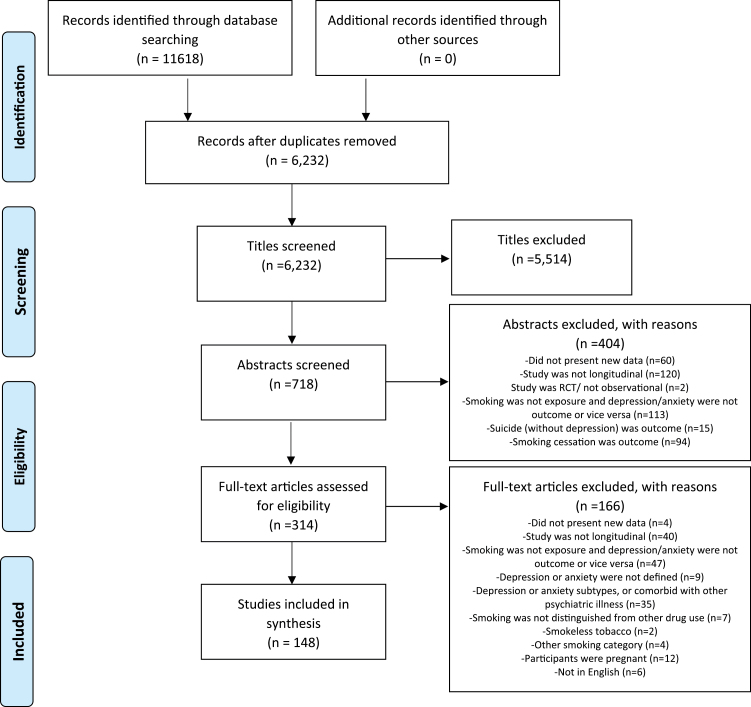
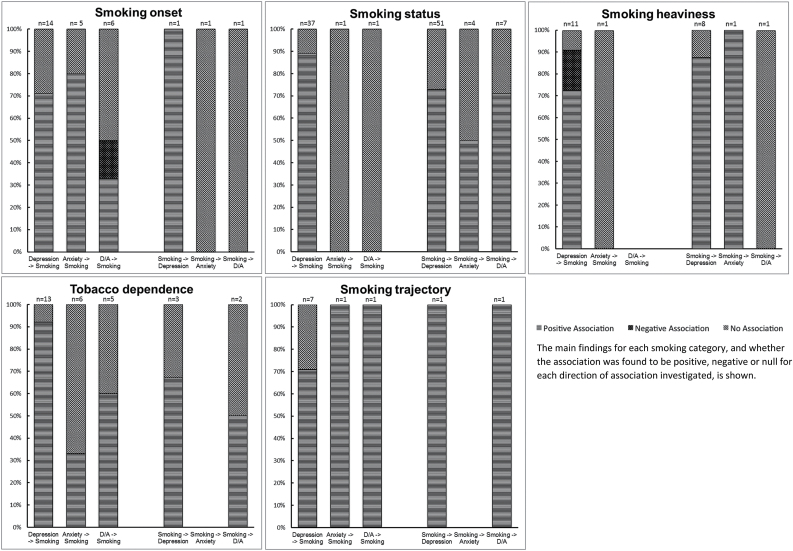
BACKGROUND: Many studies report a positive association between smoking and mental illness. However, the literature remains mixed regarding the direction of this association. We therefore conducted a systematic review evaluating the association of smoking and depression and/or anxiety in longitudinal studies. METHODS: Studies were identified by searching PubMed, Scopus, and Web of Science and were included if they: (1) used human participants, (2) were longitudinal, (3) reported primary data, (4) had smoking as an exposure and depression and/or anxiety as an outcome, or (5) had depression and/or anxiety as the exposure and smoking as an outcome. RESULTS: Outcomes from 148 studies were categorized into: smoking onset, smoking status, smoking heaviness, tobacco dependence, and smoking trajectory. The results for each category varied substantially, with evidence for positive associations in both directions (smoking to later mental health and mental health to later smoking) as well as null findings. Overall, nearly half the studies reported that baseline depression/anxiety was associated with some type of later smoking behavior, while over a third found evidence that a smoking exposure was associated with later depression/anxiety. However, there were few studies directly supporting a bidirectional model of smoking and anxiety, and very few studies reporting null results. CONCLUSIONS: The literature on the prospective association between smoking and depression and anxiety is inconsistent in terms of the direction of association most strongly supported. This suggests the need for future studies that employ different methodologies, such as Mendelian randomization (MR), which will allow us to draw stronger causal inferences. IMPLICATIONS: We systematically reviewed longitudinal studies on the association of different aspects of smoking behavior with depression and anxiety. The results varied considerably, with evidence for smoking both associated with subsequent depression and anxiety, and vice versa. Few studies supported a bidirectional relationship, or reported null results, and no clear patterns by gender, ethnicity, clinical status, length to follow-up, or diagnostic test. Suggesting that despite advantages of longitudinal studies, they cannot alone provide strong evidence of causality. Therefore, future studies investigating this association should employ different methods allowing for stronger causal inferences to be made, such as MR.
Overview
The claims and statistics of this paper haven’t been checked yet.
Free: it reads the open-access text and checks the first 5 claims that cite a source we can check. Create a free account to check every claim.
Integrity signals
Registry
Cites
Statistics
Figures
Verification
Claims the paper makes
The claims and statistics of this paper haven’t been checked yet.
Free: it reads the open-access text and checks the first 5 claims that cite a source we can check. Create a free account to check every claim.
Claims other papers make about this one
Each is checked against this paper’s own text: does it say what the citing paper says it does?
The source backs part of the claim, not all of it — or backs it for a different population, condition or comparison.
In the citing paper
“due to the high comorbidity between nicotine addiction and several anxiety-related disorders (Fluharty et al., 2016)”
From Age-dependent Effects of Tobacco Smoke and Nicotine on Cognition and the Brain: A Systematic Review of the Human and Animal Literature Comparing Adolescents and Adults. (2023) · cites this paper as Fluharty et al., 2016
Experimental — accuracy not yet measuredIn the citing paper
“Depressive disorders are heritable conditions with heritability rates of approximately 40% 12”
From Depressive symptoms predict clinical recurrence of inflammatory bowel disease (2022) · cites this paper as [12]
In the citing paper
“Importantly, there were no studies showing that smoking was associated with a later reduction in anxiety or depression rates.”
From An application of the stress-diathesis model: A review about the association between smoking tobacco, smoking cessation, and mental health (2023) · cites this paper as Fluharty et al. (2017)
In the citing paper
“Over a third of studies found that smoking at baseline led to later onset of anxiety or depression.”
From An application of the stress-diathesis model: A review about the association between smoking tobacco, smoking cessation, and mental health (2023) · cites this paper as Fluharty et al. (2017)
Self-check
Percentages, sums and reported differences re-computed from the paper’s own numbers.
The self-check needs the paper’s full text.
Citations
Cites
Diagnostic and Statistical Manual of Mental Disorders
Williams, J. B. W., & First, M. (2013) · Encyclopedia of Social Work · doi:10.1093/acrefore/9780199975839.013.104 · Cited by 109,519
Power failure: why small sample size undermines the reliability of neuroscience
Button, K. S., Ioannidis, J. P. A., Mokrysz, C., Nosek, B. A., Flint, J., Robinson, E. S. J., & Munafò, M. R. (2013) · Nature Reviews Neuroscience · doi:10.1038/nrn3475 · Cited by 7,641
A mega-analysis of genome-wide association studies for major depressive disorder
Major Depressive Disorder Working Group of the Psychiatric GWAS Consortium, Ripke, S., Wray, N. R., Lewis, C. M., Hamilton, S. P., Weissman, M. M., Breen, G., Byrne, E. M., Blackwood, D. H. R., Boomsma, D. I., et al. (2013) · Molecular Psychiatry · doi:10.1038/mp.2012.21 · Cited by 1,120
Life course outcomes of young people with anxiety disorders in adolescence
WOODWARD, L. J., & FERGUSSON, D. M. (2001) · Journal of the American Academy of Child & Adolescent Psychiatry · doi:10.1097/00004583-200109000-00018 · Cited by 1,051
Change in mental health after smoking cessation: systematic review and meta-analysis
Taylor, G., McNeill, A., Girling, A., Farley, A., Lindson-Hawley, N., & Aveyard, P. (2014) · BMJ · doi:10.1136/bmj.g1151 · Cited by 1,039
Smoking and Major Depression: A Causal Analysis
Kendler, K. S. (1993) · Archives of General Psychiatry · doi:10.1001/archpsyc.1993.01820130038007 · Cited by 792
Neurobiological similarities in depression and drug dependence: a self-medication hypothesis
Markou, A. (1998) · Neuropsychopharmacology · doi:10.1016/s0893-133x(97)00113-9 · Cited by 767
Adult Sequelae of Adolescent Depressive Symptoms
Kandel, D. B. (1986) · Archives of General Psychiatry · doi:10.1001/archpsyc.1986.01800030073007 · Cited by 638
Major Depression and Stages of Smoking: A Longitudinal Investigation
Breslau, N., Peterson, E. L., Schultz, L. R., Chilcoat, H. D., & Andreski, P. (1998) · Archives of General Psychiatry · doi:10.1001/archpsyc.55.2.161 · Cited by 633
Swendsen, J., Conway, K. P., Degenhardt, L., Glantz, M., Jin, R., Merikangas, K. R., Sampson, N., & Kessler, R. C. (2010) · Addiction · doi:10.1111/j.1360-0443.2010.02902.x · Cited by 597
Cited by
Handbook of Religion and Health
Koenig, H. G., VanderWeele, T., & Peteet, J. R. (2024) · doi:10.1093/oso/9780190088859.001.0001 · Cited by 1,139
Viertiö, S., Kiviruusu, O., Piirtola, M., Kaprio, J., Korhonen, T., Marttunen, M., & Suvisaari, J. (2021) · BMC Public Health · doi:10.1186/s12889-021-10560-y · Cited by 438
WHO's global oral health status report 2022: Actions, discussion and implementation
Jain, N., Dutt, U., Radenkov, I., & Jain, S. (2024) · Oral Diseases · doi:10.1111/odi.14516 · Cited by 356
Risk factors and protective factors of depression in older people 65+. A systematic review
Maier, A., Riedel-Heller, S. G., Pabst, A., & Luppa, M. (2021) · PLOS ONE · doi:10.1371/journal.pone.0251326 · Cited by 349
Minimal phenotyping yields genome-wide association signals of low specificity for major depression
MDD Working Group of the Psychiatric Genomics Consortium, Cai, N., Revez, J. A., Adams, M. J., Andlauer, T. F. M., Breen, G., Byrne, E. M., Clarke, T.-K., Forstner, A. J., Grabe, H. J., et al. (2020) · Nature Genetics · doi:10.1038/s41588-020-0594-5 · Cited by 344
Becker, T. D., Arnold, M. K., Ro, V., Martin, L., & Rice, T. R. (2021) · Nicotine & Tobacco Research · doi:10.1093/ntr/ntaa171 · Cited by 284
Lifestyle management in polycystic ovary syndrome – beyond diet and physical activity
Cowan, S., Lim, S., Alycia, C., Pirotta, S., Thomson, R., Gibson-Helm, M., Blackmore, R., Naderpoor, N., Bennett, C., Ee, C., et al. (2023) · BMC Endocrine Disorders · doi:10.1186/s12902-022-01208-y · Cited by 240
Cardiovascular Disease and Hair Cortisol: a Novel Biomarker of Chronic Stress
Iob, E., & Steptoe, A. (2019) · Current Cardiology Reports · doi:10.1007/s11886-019-1208-7 · Cited by 209
Marx, W., Manger, S. H., Blencowe, M., Murray, G., Ho, F. Y.-Y., Lawn, S., Blumenthal, J. A., Schuch, F., Stubbs, B., Ruusunen, A., et al. (2023) · The World Journal of Biological Psychiatry · doi:10.1080/15622975.2022.2112074 · Cited by 179
Guignard, R., Andler, R., Quatremère, G., Pasquereau, A., du Roscoät, E., Arwidson, P., Berlin, I., & Nguyen-Thanh, V. (2021) · European Journal of Public Health · doi:10.1093/eurpub/ckab054 · Cited by 160
“Previous research showed that anxiety and depressive mood are associated with tobacco smoking (11-14) and alcohol use disorders (15, 16), as both substances are used to cope with stress or break boredom, for example.”
BackgroundResultHossain, S., Anjum, A., Uddin, M. E., Rahman, M. A., & Hossain, M. F. (2019) · Journal of Affective Disorders · doi:10.1016/j.jad.2019.06.001 · Cited by 147
Kwapong, Y. A., Boakye, E., Khan, S. S., Honigberg, M. C., Martin, S. S., Oyeka, C. P., Hays, A. G., Natarajan, P., Mamas, M. A., Blumenthal, R. S., et al. (2023) · Journal of the American Heart Association · doi:10.1161/jaha.122.028332 · Cited by 160
Association of Rare Copy Number Variants With Risk of Depression
Kendall, K. M., Rees, E., Bracher-Smith, M., Legge, S., Riglin, L., Zammit, S., O’Donovan, M. C., Owen, M. J., Jones, I., Kirov, G., et al. (2019) · JAMA Psychiatry · doi:10.1001/jamapsychiatry.2019.0566 · Cited by 144
Association of early-, middle-, and late-life depression with incident dementia in a Danish cohort
Elser, H., Horváth-Puhó, E., Gradus, J. L., Smith, M. L., Lash, T. L., Glymour, M. M., Sørensen, H. T., & Henderson, V. W. (2023) · JAMA Neurology · doi:10.1001/jamaneurol.2023.2309 · Cited by 142
Changes in Tobacco Use During the 2020 COVID-19 Lockdown in New Zealand
Gendall, P. J., Hoek, J. A., Stanley, J., Jenkins, M., & Every‐Palmer, S. (2020) · Nicotine & Tobacco Research · doi:10.1093/ntr/ntaa257 · Cited by 138
Unhealthy behavior clustering and mental health status in United States college students
Jao, N. C., Robinson, L. D., Kelly, P. J., Ciecierski, C. C., & Hitsman, B. (2019) · Journal of American College Health · doi:10.1080/07448481.2018.1515744 · Cited by 120
Trends in depression among Adults in the United States, NHANES 2005–2016
Yu, B., Zhang, X., Wang, C., Sun, M., Jin, L., & Liu, X. (2020) · Journal of Affective Disorders · doi:10.1016/j.jad.2019.11.036 · Cited by 129
Carreras, G., Lugo, A., Stival, C., Amerio, A., Odone, A., Pacifici, R., Gallus, S., & Gorini, G. (2021) · Tobacco Control · doi:10.1136/tobaccocontrol-2020-056440 · Cited by 140
Association between anxiety and hypertension in adults: A systematic review and meta-analysis
Lim, L.-F., Solmi, M., & Cortese, S. (2021) · Neuroscience & Biobehavioral Reviews · doi:10.1016/j.neubiorev.2021.08.031 · Cited by 134
A cross-sectional study of smoking and depression among US adults: NHANES (2005–2018)
Wu, Z., Yue, Q., Zhao, Z., Wen, J., Tang, L., Zhong, Z., Yang, J., Yuan, Y., & Zhang, X. (2023) · Frontiers in Public Health · doi:10.3389/fpubh.2023.1081706 · Cited by 134
COVID-19 lockdown impact on mental health in a large representative sample of Italian adults
Amerio, A., Lugo, A., Stival, C., Fanucchi, T., Gorini, G., Pacifici, R., Odone, A., Serafini, G., & Gallus, S. (2021) · Journal of Affective Disorders · doi:10.1016/j.jad.2021.05.117 · Cited by 137
Anxiety and Depression Among Adult Patients With Diabetic Foot: Prevalence and Associated Factors
Ahmad, A., Abujbara, M. A., Jaddou, H. Y., Younes, N. A., & Ajlouni, K. M. (2018) · Journal of Clinical Medicine Research · doi:10.14740/jocmr3352w · Cited by 140
“In their recent systematic review of the literature, Fluharty M et al [30] have reviewed 148 longitudinal studies.”
BackgroundResultMental health problems and initiation of e-cigarette and combustible cigarette use.
Riehm, K. E., Young, A. S., Feder, K. A., Krawczyk, N., Tormohlen, K. N., Pacek, L. R., Mojtabai, R., & Crum, R. M. (2019) · Pediatrics · doi:10.1542/peds.2018-2935 · Cited by 124
Comorbid Major Depressive Disorder in Schizophrenia: A Systematic Review and Meta-Analysis
Etchecopar‐Etchart, D., Korchia, T., Loundou, A., Llorca, P., Auquier, P., Lançon, C., Boyer, L., & Fond, G. B. (2020) · Schizophrenia Bulletin · doi:10.1093/schbul/sbaa153 · Cited by 134
Mohamad, N. E., Sidik, S. M., Akhtari‐Zavare, M., & Gani, N. A. (2021) · BMC Public Health · doi:10.1186/s12889-021-10440-5 · Cited by 133
Tobacco outlet density and adolescents’ cigarette smoking: a meta-analysis
Finan, L. J., Lipperman‐Kreda, S., Abadi, M. H., Grube, J. W., Kaner, E., Balassone, A., & Gaidus, A. J. (2018) · Tobacco Control · doi:10.1136/tobaccocontrol-2017-054065 · Cited by 117
Symptom-level modelling unravels the shared genetic architecture of anxiety and depression
Thorp, J. G., Campos, A. I., Grotzinger, A. D., Gerring, Z. F., An, J., Ong, J., Wang, W., Shringarpure, S., Byrne, E. M., MacGregor, S., et al. (2021) · Nature Human Behaviour · doi:10.1038/s41562-021-01094-9 · Cited by 124
Anxiety and Nicotine Dependence: Emerging Role of the Habenulo-Interpeduncular Axis
Molas, S., DeGroot, S. R., Zhao-Shea, R., & Tapper, A. R. (2016) · Trends in Pharmacological Sciences · doi:10.1016/j.tips.2016.11.001 · Cited by 116
“Acutely, nicotine can induce a relief of anxiety and sustain tobacco use through positive emotional reinforcement (see also [8, 9]).”
BackgroundJacob, L., Haro, J. M., & Koyanagi, A. (2019) · PLOS ONE · doi:10.1371/journal.pone.0215182 · Cited by 96
Garey, L., Olofsson, H., Garza, T., Rogers, A. H., Kauffman, B. Y., & Zvolensky, M. J. (2020) · Current Addiction Reports · doi:10.1007/s40429-020-00321-z · Cited by 111
Yuan, S., Yao, H., & Larsson, S. C. (2020) · Scientific Reports · doi:10.1038/s41598-020-70458-4 · Cited by 104
Kerahrodi, J. G., Brähler, E., Wiltink, J., Michal, M., Schulz, A., Wild, P. S., Münzel, T. F., Toenges, G., Lackner, K. J., Pfeiffer, N., et al. (2019) · Scientific Reports · doi:10.1038/s41598-019-56440-9 · Cited by 100
Smartphones and the Neuroscience of Mental Health
Gillan, C. M., & Rutledge, R. B. (2021) · Annual Review of Neuroscience · doi:10.1146/annurev-neuro-101220-014053 · Cited by 90
“…2018), the gut microbiome (Kelly et al. 2015), social isolation (Richard et al. 2017), urban living (Paykel et al. 2000), socioeconomic status (Lorant et al. 2003), sleep (Ford & Kamerow 1989), drug use (Jané-Llopis & Matytsina 2006), alcohol (Weitzman 2004), and cigarettes (Fluharty et al. 2017).”
BackgroundExercise as a therapeutic modality for the prevention and treatment of depression
Blumenthal, J. A., & Rozanski, A. (2023) · Progress in Cardiovascular Diseases · doi:10.1016/j.pcad.2023.02.008 · Cited by 95
Milić, M., Gazibara, T. M., Pekmezovic, T. D., Kisić-Tepavčević, D., Maric, G. D., Popović, A. S., Stevanović, J., Patil, K. H., & Levine, H. (2020) · PLoS ONE · doi:10.1371/journal.pone.0227042 · Cited by 98
“While reciprocal association between smoking and depression has previously been observed, the directionality of this association has not yet been addressed [8, 9].”
BackgroundNomura, K., Minamizono, S., Maeda, E., Kim, R., Iwata, T., Hirayama, J., Ono, K., Fushimi, M., Goto, T., Mishima, K., et al. (2021) · Environmental Health and Preventive Medicine · doi:10.1186/s12199-021-00953-1 · Cited by 90
“In a metaanalysis [26], nearly half of the 148 studies reported that baseline depression was associated with later smoking behavior, while over a third found evidence that exposure to smoking was associated with later depression.”
BackgroundEze, I. C., Foraster, M., Schaffner, E., Vienneau, D., Pieren, R., Imboden, M., Wunderli, J. M., Cajochen, C., Brink, M., Röösli, M., et al. (2020) · Environment International · doi:10.1016/j.envint.2020.106014 · Cited by 89
“These included smoking status (Fluharty et al., 2017), alcohol consumption (Gea et al.”
BackgroundStubbs, B., Vancampfort, D., Firth, J., Solmi, M., Siddiqi, N., Smith, L., Carvalho, A. F., & Koyanagi, A. (2018) · Journal of Psychiatric Research · doi:10.1016/j.jpsychires.2018.05.018 · Cited by 82
Patterns of electronic cigarette use and level of psychological distress
Park, S. H., Lee, L., Shearston, J. A., & Weitzman, M. L. (2017) · PLoS ONE · doi:10.1371/journal.pone.0173625 · Cited by 84
Ge, J., Peng, W., & Lu, J. (2024) · Journal of the American Heart Association · doi:10.1161/jaha.124.036669 · Cited by 83
Ghazanfarpour, M., Bahrami, F., Fakari, F. R., Ashrafinia, F., Babakhanian, M., Dordeh, M., & Abdi, F. (2021) · Journal of Psychosomatic Obstetrics & Gynecology · doi:10.1080/0167482x.2021.1929162 · Cited by 83
Smoking and Neuropsychiatric Disease—Associations and Underlying Mechanisms
Hahad, O., Daiber, A., Michal, M., Kuntić, M., Lieb, K., Beutel, M. E., & Münzel, T. F. (2021) · International Journal of Molecular Sciences · doi:10.3390/ijms22147272 · Cited by 82
Associations of cigarette smoking with gray and white matter in the UK Biobank
Gray, J. C., Thompson, M. F., Benca‐Bachman, C. E., Owens, M. M., Murphy, M. A., & Palmer, R. H. C. (2020) · Neuropsychopharmacology · doi:10.1038/s41386-020-0630-2 · Cited by 78
Luk, T. T., Zhao, S. Z., Weng, X., Wong, J. Y. H., Wu, Y. S., Ho, S. Y., Lam, T. H., & Wang, M. P. (2020) · Tobacco Control · doi:10.1136/tobaccocontrol-2020-055960 · Cited by 78
Borges, N. D. C., de Deus, J. M., Guimarães, R. A., Conde, D. M., Bachion, M. M., de Moura, L. A., & Pereira, L. V. (2020) · PLoS ONE · doi:10.1371/journal.pone.0238634 · Cited by 88
Association of Posttraumatic Stress and Depressive Symptoms With Mortality in Women
Roberts, A. L., Kubzansky, L. D., Chibnik, L. B., Rimm, E. B., & Koenen, K. C. (2020) · JAMA Network Open · doi:10.1001/jamanetworkopen.2020.27935 · Cited by 77
TFOS Lifestyle: Impact of societal challenges on the ocular surface
Stapleton, F. J., Abad, J. C., Barabino, S., Burnett, A. M., Iyer, G. K., Lekhanont, K., Li, T., Liu, Y., Navas, A., Obinwanne, C. J., et al. (2023) · The Ocular Surface · doi:10.1016/j.jtos.2023.04.006 · Cited by 78
“There is a positive relationship between smoking and depression, anxiety, and psychological distress, although the evidence does not support a causal role for smoking in developing mental illnesses [232,233].”
BackgroundBlackwell, J., Saxena, S., Petersen, I., Hotopf, M., Creese, H., Bottle, A., Alexakis, C., & Pollok, R. C. (2021) · Gut · doi:10.1136/gutjnl-2020-322308 · Cited by 73
Kolokotroni, O., Mosquera, M. C., Quattrocchi, A., Heraclides, A., Demetriou, C. A., & Philippou, E. (2021) · BMC Public Health · doi:10.1186/s12889-021-10863-0 · Cited by 73
Zare, H., Meyerson, N. S., Nwankwo, C. A., & Thorpe, R. J. (2022) · International Journal of Environmental Research and Public Health · doi:10.3390/ijerph19106227 · Cited by 75
Associations between depression, lifestyle and brain structure: A longitudinal MRI study
Binnewies, J., Nawijn, L., van Tol, M., van der Wee, N. J. A., Veltman, D. J., & Penninx, B. W. J. H. (2021) · NeuroImage · doi:10.1016/j.neuroimage.2021.117834 · Cited by 73
“Low physical activity ( Vancampfort et al., 2015 ) and igh body mass index (BMI) ( Milaneschi et al., 2019 ) have consistently een associated with depression, as have smoking ( Fluharty et al., 2017 ) nd high alcohol consumption ( Boden & Fergusson, 2011 ).”
BackgroundHahad, O., Beutel, M. E., Gilan, D., Michal, M., Schulz, A., Pfeiffer, N., König, J., Lackner, K. J., Wild, P. S., Daiber, A., et al. (2022) · Journal of Affective Disorders · doi:10.1016/j.jad.2022.06.083 · Cited by 70
Xu, Z., Rasteh, A. M., Dong, A., Wang, P., & Liu, H. (2024) · Chinese Medicine · doi:10.1186/s13020-024-01018-5 · Cited by 71
“Nicotine can cause the brain to release dopamine to temporarily improve mood, but nicotine can create tolerance and addiction [83].”
BackgroundGarey, L., Olofsson, H., Garza, T., Shepherd, J. M., Smit, T., & Zvolensky, M. J. (2020) · Current Psychiatry Reports · doi:10.1007/s11920-020-01160-5 · Cited by 73
Understanding Mental Health Challenges in Cardiovascular Care
Borkowski, P., & Borkowska, N. (2024) · Cureus · doi:10.7759/cureus.54402 · Cited by 76
The association of anxiety and depression with mortality in a COPD cohort. The HUNT study, Norway
Vikjord, S. A. A., Brumpton, B. M., Mai, X., Vanfleteren, L. E. G. W., & Langhammer, A. (2020) · Respiratory Medicine · doi:10.1016/j.rmed.2020.106089 · Cited by 69
Karageorgiou, V., Casanova, F., O’Loughlin, J., Green, H., McKinley, T. J., Bowden, J., & Tyrrell, J. (2023) · BMC Medicine · doi:10.1186/s12916-023-03001-7 · Cited by 68
“Both exposures are associated with depression or TRD in observational epidemiological studies [5, 16, 32, 33].”
BackgroundElectronic cigarette use and mental health: A Canadian population-based study
Pham, T., Williams, J. V. A., Bhattarai, A., Dores, A. K., Isherwood, L. J., & Patten, S. B. (2019) · Journal of Affective Disorders · doi:10.1016/j.jad.2019.09.026 · Cited by 64
Abdelrahman, A. A., Noaman, M. M., Fawzy, M., Moheb, A., Karim, A. A., & Khedr, E. M. (2021) · Scientific Reports · doi:10.1038/s41598-020-80927-5 · Cited by 65
Anxiety and Depression: What Do We Know of Neuropeptides?
Kupcová, I., Danišovič, Ľ., Grgac, I., & Harsányi, Š. (2022) · Behavioral Sciences · doi:10.3390/bs12080262 · Cited by 71
“The use of these coping mechanisms is frequently seen in clinical practice even though a recent systematic review that collected 148 studies concerning the association of cigarette smoking behavior with depression and anxiety reported contrasting results because of inconsistencies in directions and strengths of the as…”
ResultLife's Essential 8 and Depression: A National Cross-Sectional Analysis in US Emerging Adults
You, Y., Zheng, K., Ablitip, A., Wang, D., Chen, C., Liu, Y., Chen, Y., & Ma, X. (2025) · Journal of Adolescent Health · doi:10.1016/j.jadohealth.2025.03.023 · Cited by 62
Keyes, K. M., Allel, K., Staudinger, U. M., Ornstein, K. A., & Calvo, E. (2019) · International review of neurobiology · doi:10.1016/bs.irn.2019.09.001 · Cited by 63
Gregory, K. D., Chelmow, D. P., Nelson, H. D., Niel, M. S. V., Conry, J. A., García, F., Kendig, S. M., O’Reilly, N., Qaseem, A., Ramos, D., et al. (2020) · Annals of Internal Medicine · doi:10.7326/m20-0580 · Cited by 66
The Behavioral Sequelae of Cannabis Use in Healthy People: A Systematic Review
Sorkhou, M., Bedder, R. H., & George, T. P. (2021) · Frontiers in Psychiatry · doi:10.3389/fpsyt.2021.630247 · Cited by 61
Guo, Y., Pai, M., Xue, B., & Lu, W. (2023) · Journal of Affective Disorders · doi:10.1016/j.jad.2023.06.046 · Cited by 63
“Many studies have reported a positive association between depression and smoking (Fluharty et al., 2016).”
BackgroundSmoking cessation apps: a systematic review of format, outcomes, and features
Barroso-Hurtado, M., Suárez-Castro, D., Martínez-Vispo, C., Becoña, E., & López-Durán, A. (2021) · International Journal of Environmental Research and Public Health · doi:10.3390/ijerph182111664 · Cited by 58
“Smokers also have a poorer quality of life [5] and a higher likelihood of having mental health problems [6], such as depression or anxiety [7].”
BackgroundAdjibade, M., Lemogne, C., Julia, C., Herçberg, S., Galan, P., Assmann, K. E., & Kesse‐Guyot, E. (2018) · Journal of Affective Disorders · doi:10.1016/j.jad.2018.05.038 · Cited by 62
Guillén, A. I., Marín‐Martín, C., Panadero, S., & Vázquez, J. J. (2019) · Addictive Behaviors · doi:10.1016/j.addbeh.2019.106246 · Cited by 65
“…high levels of tobacco consumption among homeless people and the physical and mental health risks associated with it (Fazel, Geddes, & Kushel, 2014; Fluharty, Taylor, Grabski, & Munafò, 2016; Garner & Ratschen, 2013; Moylan, Jacka, Pasco, & Berk, 2012), it is a problem that has often been ignored…”
BackgroundPsychological distress among smokers in the United States: 2008–2014
Zvolensky, M. J., Jardin, C., Wall, M. M., Gbedemah, M., Hasin, D., Shankman, S. A., Gallagher, M. W., Bakhshaie, J., & Goodwin, R. D. (2018) · Nicotine & Tobacco Research · doi:10.1093/ntr/ntx099 · Cited by 57
Porcelli, S., Kasper, S., Zohar, J., Souery, D., Montgomery, S., Ferentinos, P. P., Rujescu, D., Mendlewicz, J., Pich, E. M., Pollentier, S., et al. (2019) · Progress in Neuro-Psychopharmacology and Biological Psychiatry · doi:10.1016/j.pnpbp.2019.109835 · Cited by 64
“Despite smoking is common in patients affected by psychiatric disorders (85), the relationship between smoking and psychopathology is still not clear (86, 87).”
Comorbidity between mood and substance-related disorders: A systematic review and meta-analysis
Saha, S., Lim, C. C. W., Degenhardt, L. J., Cannon, D. L., Bremner, M., Prentis, F., Lawrence, Z., Heffernan, E., Meurk, C., Reilly, J., et al. (2021) · Australian & New Zealand Journal of Psychiatry · doi:10.1177/00048674211054740 · Cited by 61
“, 2019); however, only a few used temporally ordered longitudinal data (Esmaeelzadeh et al., 2018; Fluharty et al., 2017; Li et al., 2020; Mammen et al., 2018).”
BackgroundDickerson, A. S., Wu, A. C., Liew, Z., & Weisskopf, M. G. (2020) · Current Environmental Health Reports · doi:10.1007/s40572-020-00280-7 · Cited by 59
Constable, P. A., Al-Dasooqi, D., Bruce, R., & Senthil, M. P. (2022) · Clinical Optometry · doi:10.2147/opto.s355091 · Cited by 58
Assari, S., Smith, J. P., Mistry, R., Farokhnia, M., & Bazargan, M. (2019) · International Journal of Environmental Research and Public Health · doi:10.3390/ijerph16101826 · Cited by 58
“Smoking is associated with anxiety [2], depression [3], low quality of life [4], chronic medical conditions”
BackgroundColyer-Patel, K., Kuhns, L., Weidema, A., Lesscher, H., & Cousijn, J. (2023) · Neuroscience & Biobehavioral Reviews · doi:10.1016/j.neubiorev.2023.105038 · Cited by 54
“Further, due to the high comorbidity between nicotine addiction and several anxiety-related disorders (Fluharty et al., 2016), anxiety was included as a secondary outcome.”
BackgroundSecades-Villa, R., González-Roz, A., García-Pérez, Á., & Becoña, E. (2017) · PLOS ONE · doi:10.1371/journal.pone.0188849 · Cited by 49
Wiernik, E., Airagnes, G., Lequy, É., Gomajee, R., Melchior, M., Faou, A.-L. L., Limosin, F., Goldberg, M., Zins, M., & Lemogne, C. (2018) · Addictive Behaviors · doi:10.1016/j.addbeh.2018.10.021 · Cited by 53
“In addition, depressed smokers have a reduced likelihood to successfully quit as well as a greater tobacco dependence (Fluharty et al., 2017; Weinberger et al., 2017).”
BackgroundLotfi, K., Keshteli, A. H., Saneei, P., Afshar, H., Esmaillzadeh, A., & Adibi, P. (2022) · Frontiers in Nutrition · doi:10.3389/fnut.2022.843155 · Cited by 52
A Scoping Review on Biopsychosocial Predictors of Mental Health among Older Adults
Murniati, N., Aufa, B. A., Kusuma, D., & Kamso, S. (2022) · International Journal of Environmental Research and Public Health · doi:10.3390/ijerph191710909 · Cited by 56
“Mentally ill people are more likely than the general public to begin smoking at a younger age, smoke more frequently, and become addicted to cigarettes [66].”
BackgroundAmiri, S., Mahmood, N., Javaid, S. F., & Khan, M. A. (2024) · Healthcare · doi:10.3390/healthcare12222263 · Cited by 59
Lotfaliany, M., Hoare, E., Jacka, F. N., Kowal, P. R., Berk, M., & Mohebbi, M. (2019) · Journal of Affective Disorders · doi:10.1016/j.jad.2019.01.054 · Cited by 52
Avis, N. E., Levine, B. J., Goyal, N. G., Crawford, S. L., Hess, R., Colvin, A. B., Bromberger, J. T., & Greendale, G. A. (2020) · Cancer · doi:10.1002/cncr.32757 · Cited by 53
“Others have shown a positive association between cigarette smoking and depression and anxiety.(42) Having 2 comorbidities at the time of diagnosis, which was a predictor of being in the low PCS group, has been recognized as an important predictor of HRQL.”
Backgroundvan Assen, M. A. L. M., Helmink, J. H. M., & Gobbens, R. J. J. (2022) · BMC Geriatrics · doi:10.1186/s12877-021-02704-x · Cited by 52
“An explanation might be that smoking may lead to depression or anxiety, through effects on a person’s neurocircuitry that increases susceptibility to stressors in the environment [44], whereas smoking may effect loneliness as smoking is becoming more unacceptable in company with others.”
BackgroundHo, F. F., Sun, H., Zheng, H., Wong, D., Gao, Y., Mao, C., Cheung, Y. T., Lam, C. S., Wang, M. H., Wu, X., et al. (2024) · Gut · doi:10.1136/gutjnl-2023-331254 · Cited by 52
“45 According to these findings, Figure 2 Associations of each healthy lifestyle behaviour with the risk of irritable bowel syndrome (IBS).”
BackgroundVancampfort, D., Stubbs, B., Herring, M. P., Hallgren, M., & Koyanagi, A. (2018) · General Hospital Psychiatry · doi:10.1016/j.genhosppsych.2017.09.006 · Cited by 50
“Based on previous research, we focused on age, mobility, pain and discomfort, cognition, sleep and energy, depression, disability, physical activity, alcohol consumption, smoking, body mass index (BMI), and social cohesion as potentially influential factors in the anxiety-SB relationship for their previously reported…”
MethodBhandari, P., & Paswan, B. (2020) · Ageing International · doi:10.1007/s12126-020-09371-0 · Cited by 58
“In agreement with a recent study, findings of the present study showed that anxiety and depression both are positively associatedwith unhealthy smoking behaviour of elderly (Fluharty et al. 2017).”
ResultGage, S. H., & Patalay, P. (2021) · Journal of Adolescent Health · doi:10.1016/j.jadohealth.2021.03.002 · Cited by 54
Taylor, G. M. J., & Treur, J. L. (2023) · International Journal of Clinical and Health Psychology · doi:10.1016/j.ijchp.2022.100335 · Cited by 50
Goodwin, R. D., Wall, M. M., Garey, L., Zvolensky, M. J., Dierker, L., Galea, S., Gbedemah, M., Weinberger, A. H., Williams, J. M., Hu, M., et al. (2017) · Drug and Alcohol Dependence · doi:10.1016/j.drugalcdep.2016.11.038 · Cited by 51
Maternal Smoking in Pregnancy and Offspring Depression: a cross cohort and negative control study
Taylor, A. E., Carslake, D., de Mola, C. L., Rosenqvist, M. A., Nilsen, T. I. L., Bjørngaard, J. H., Horta, B. L., Pearson, R. M., Rai, D., Galanti, M. R., et al. (2017) · Scientific Reports · doi:10.1038/s41598-017-11836-3 · Cited by 55
Self-citationTobacco-induced sleep disturbances: A systematic review and meta-analysis
Catoire, S., Nourredine, M., Lefebvre, S., Couraud, S., Gronfier, C., Rey, R., Peter‐Derex, L., Geoffroy, P. A., & Rolland, B. (2021) · Sleep Medicine Reviews · doi:10.1016/j.smrv.2021.101544 · Cited by 50
Evaluating tobacco industry ‘transformation’: a proposed rubric and analysis
Edwards, R., Hoek, J. A., Karreman, N., & Gilmore, A. (2022) · Tobacco Control · doi:10.1136/tobaccocontrol-2021-056687 · Cited by 50
Lee, J. G. L., Shook‐Sa, B. E., Gilbert, J., Ranney, L. M., Goldstein, A. O., & Boynton, M. H. (2020) · Health Education & Behavior · doi:10.1177/1090198119893374 · Cited by 48
Universal depression prevention: An umbrella review of meta-analyses
Hoare, E., Collins, S., Marx, W., Callaly, E., Moxham-Smith, R., Cuijpers, P., Holte, A., Nierenberg, A. A., Reavley, N., Christensen, H., et al. (2021) · Journal of Psychiatric Research · doi:10.1016/j.jpsychires.2021.10.006 · Cited by 41
Barrera-Núñez, D. A., Reina, H. A. R., López‐Olmedo, N., Barrientos‐Gutiérrez, T., & Reynales-Shigematsu, L. M. (2022) · Salud Pública de México · doi:10.21149/12846 · Cited by 48
Depression and Anxiety Are Associated With Cardiovascular Health in Young Adults
Patterson, S., Marcus, M., Goetz, M., Vaccarino, V., & Gooding, H. C. (2022) · Journal of the American Heart Association · doi:10.1161/jaha.122.027610 · Cited by 50
“Individuals with either depression or anxiety may eat less heart-healthy foods or smoke 31 to cope with their negative emotional state.”
Lifestyles and the risk of depression in the “Seguimiento Universidad de Navarra” cohort
Ruiz-Estigarribia, L., Martínez‐González, M. Á., Díaz‐Gutiérrez, J., Sánchez‐Villegas, A., Lahortiga‐Ramos, F., & Bes‐Rastrollo, M. (2019) · European Psychiatry · doi:10.1016/j.eurpsy.2019.06.002 · Cited by 47
“Concerning the most studied modifiable lifestyle-related factors involved in the pathogenesis of depression; such as smoking [38], physical activity [39] and BMI [40], adherence to the MDS was the only factor in our score that individually showed an inverse and significant association with depression risk.”
BackgroundNyberg, J., Henriksson, M., Wall, A., Vestberg, T., Westerlund, M., Walser, M., Eggertsen, R., Danielsson, L., Kuhn, H. G., Åberg, N. D., et al. (2021) · BMC Psychiatry · doi:10.1186/s12888-021-03618-z · Cited by 51
Marsden, D., Loukas, A., Chen, B., Perry, C. L., & Wilkinson, A. V. (2019) · Addictive Behaviors · doi:10.1016/j.addbeh.2019.106078 · Cited by 50
“While tobacco product use and depressive symptoms have been examined extensively for cigarette smokers (Fluharty et al., 2017; Luger et al., 2014), fewer studies have examined ecigarette use and depressive symptoms (Bandiera, Loukas, Wilkinson, & Perry, 2016; Bandiera, Loukas, Xiaoyin, Wilkinson, & Perry, 2017; King,…”
BackgroundChen, S.-S., He, Y., Xie, G.-D., Chen, L.-R., Zhang, T., Yuan, M., Li, Y., Chang, J.-J., & Su, P. (2021) · Preventive Medicine · doi:10.1016/j.ypmed.2021.106902 · Cited by 46
Metadata
- Authors
- Fluharty, M., Taylor, A. E., Grabski, M., & Munafò, M. R.
- Affiliations
- University of Bristol (GB)
- Corresponding author
- Fluharty, Meg
- Venue
- Nicotine & Tobacco Research
- Publisher
- Oxford University Press (OUP)
- Published
- 2016-05-19
- Volume
- 19
- Issue
- 1
- Pages
- 3-13
- ISSN
- 1462-2203 (ISSN-L)
- 1469-994X
- PMC
- PMC5157710
- OpenAlex
- W2407654663
- Semantic Scholar
- addb21010e31f40cbf5d94796e74ad8c4f684175
- Cited by
- 1,299
- References
- 173
- Citations by year
- 2026: 128 · 2025: 185 · 2024: 155 · 2023: 217 · 2022: 166 · 2021: 176 · 2020: 133 · 2019: 76 · 2018: 38 · 2017: 19 · 2016: 6
- FWCI
- 5.44
- Type
- journal article
- Language
- en
- Open access
- hybrid
- doi.org
- Licence
- Locations
- Nicotine & Tobacco Research (publishedVersion, cc-by)
- PubMed Central (publishedVersion, cc-by)
- PubMed (publishedVersion)
- Explore Bristol Research (submittedVersion, cc-by)
- UCL Discovery (University College London) (submittedVersion)
- HighWire Press Open Archive (submittedVersion)
- Bristol Research (University of Bristol) (submittedVersion, cc-by)
- Funders
- University of Bristol
- Medical Research Council (MC_UU_12013/6)
- Topics
- Health Sciences › Medicine › Public Health, Environmental and Occupational Health › Smoking Behavior and Cessation
- Health Sciences › Medicine › Psychiatry and Mental health › Mental Health Treatment and Access
- Health Sciences › Medicine › Epidemiology › Substance Abuse Treatment and Outcomes
- Keywords
- cigarette smoking, depression, anxiety, bidirectional relationship, smoking onset, tobacco dependence, smoking heaviness, smoking trajectories, mental health, causal inference, Mendelian randomization
- MeSH terms
- Anxiety, Anxiety Disorders, Depression, Depressive Disorder, Humans, Prospective Studies, Sex Characteristics, Smoking, Tobacco Use Disorder
About these checks
Registry, retraction, Cites and statistics results are computed, not judged, with one exception: a printed reference that no index lists is read once by a model before it counts as a citation error. Claims are extracted by a model and kept only when their quote appears verbatim in the text; each cited source is then checked, with a model’s help, for whether it says what the claim relies on. Those verdicts can be wrong — read the claim’s quote and the cited source before relying on one.
Statistics and arithmetic are recomputed, not judged.
Confidence bands are shown only for fields calibrated on our annotated test set. None is calibrated yet, so no band is shown.
What counts as a claim ›How we measure confidence ›How we check this ›
Are you an author, or do you see a problem with this page? Request a review
Data sources
Bibliographic data: Semantic Scholar, OpenAlex, Crossref.
Contains information from the Semantic Scholar Academic Graph Datasets, made available under the ODC Attribution License (ODC-BY 1.0).
Semantic Scholar’s data is described in: Kinney, R., et al. (2023). The Semantic Scholar Open Data Platform. arXiv:2301.10140.
