

The Association of Cigarette Smoking With Depression and Anxiety: A Systematic Review
Open accessThe DOI matches its Crossref record; 172 of the 174 references it cites were found in a registry or an index, and 2 are not checked yet.
Abstract
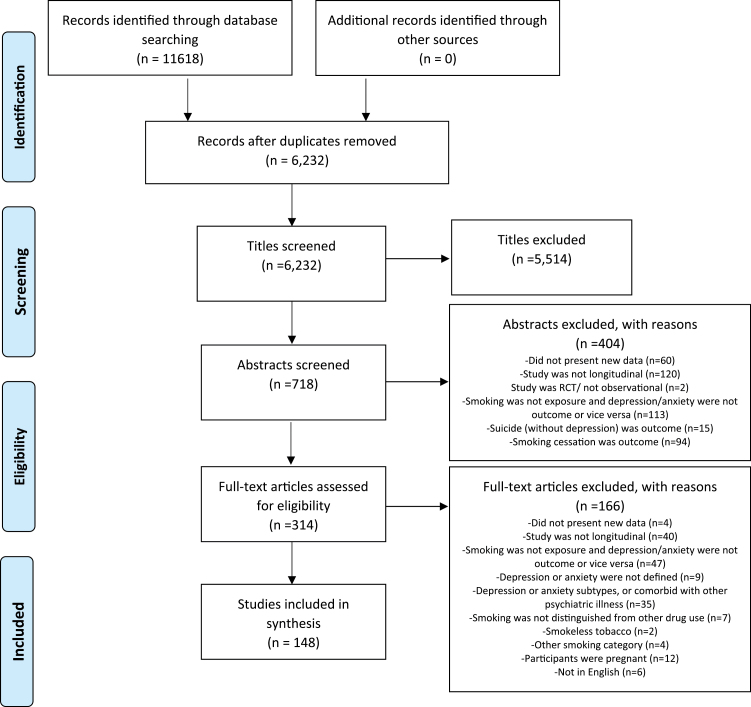
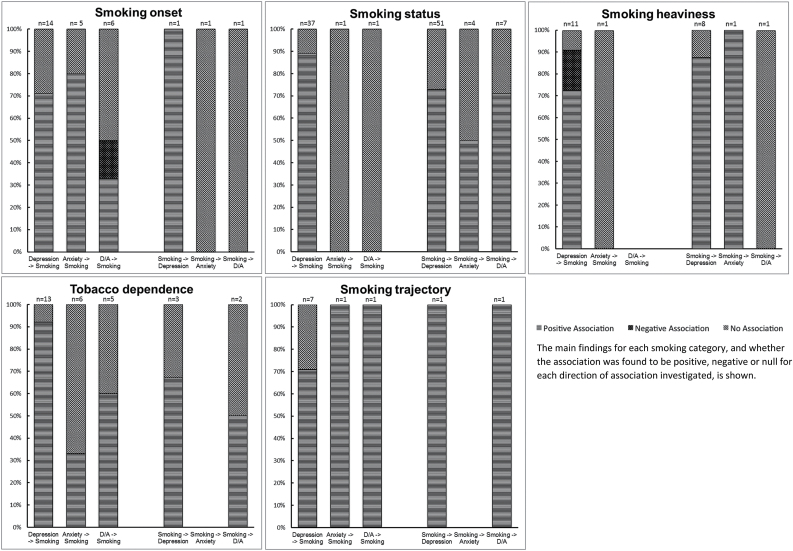
BACKGROUND: Many studies report a positive association between smoking and mental illness. However, the literature remains mixed regarding the direction of this association. We therefore conducted a systematic review evaluating the association of smoking and depression and/or anxiety in longitudinal studies. METHODS: Studies were identified by searching PubMed, Scopus, and Web of Science and were included if they: (1) used human participants, (2) were longitudinal, (3) reported primary data, (4) had smoking as an exposure and depression and/or anxiety as an outcome, or (5) had depression and/or anxiety as the exposure and smoking as an outcome. RESULTS: Outcomes from 148 studies were categorized into: smoking onset, smoking status, smoking heaviness, tobacco dependence, and smoking trajectory. The results for each category varied substantially, with evidence for positive associations in both directions (smoking to later mental health and mental health to later smoking) as well as null findings. Overall, nearly half the studies reported that baseline depression/anxiety was associated with some type of later smoking behavior, while over a third found evidence that a smoking exposure was associated with later depression/anxiety. However, there were few studies directly supporting a bidirectional model of smoking and anxiety, and very few studies reporting null results. CONCLUSIONS: The literature on the prospective association between smoking and depression and anxiety is inconsistent in terms of the direction of association most strongly supported. This suggests the need for future studies that employ different methodologies, such as Mendelian randomization (MR), which will allow us to draw stronger causal inferences. IMPLICATIONS: We systematically reviewed longitudinal studies on the association of different aspects of smoking behavior with depression and anxiety. The results varied considerably, with evidence for smoking both associated with subsequent depression and anxiety, and vice versa. Few studies supported a bidirectional relationship, or reported null results, and no clear patterns by gender, ethnicity, clinical status, length to follow-up, or diagnostic test. Suggesting that despite advantages of longitudinal studies, they cannot alone provide strong evidence of causality. Therefore, future studies investigating this association should employ different methods allowing for stronger causal inferences to be made, such as MR.
Overview
The claims and statistics of this paper haven’t been checked yet.
Free: it reads the open-access text and checks the first 5 claims that cite a source we can check. Create a free account to check every claim.
Integrity signals
Registry
Cites
Statistics
Figures
Verification
Claims the paper makes
The claims and statistics of this paper haven’t been checked yet.
Free: it reads the open-access text and checks the first 5 claims that cite a source we can check. Create a free account to check every claim.
Claims other papers make about this one
Each is checked against this paper’s own text: does it say what the citing paper says it does?
The source backs part of the claim, not all of it — or backs it for a different population, condition or comparison.
In the citing paper
“due to the high comorbidity between nicotine addiction and several anxiety-related disorders (Fluharty et al., 2016)”
From Age-dependent Effects of Tobacco Smoke and Nicotine on Cognition and the Brain: A Systematic Review of the Human and Animal Literature Comparing Adolescents and Adults. (2023) · cites this paper as Fluharty et al., 2016
Experimental — accuracy not yet measuredIn the citing paper
“Depressive disorders are heritable conditions with heritability rates of approximately 40% 12”
From Depressive symptoms predict clinical recurrence of inflammatory bowel disease (2022) · cites this paper as [12]
In the citing paper
“Importantly, there were no studies showing that smoking was associated with a later reduction in anxiety or depression rates.”
From An application of the stress-diathesis model: A review about the association between smoking tobacco, smoking cessation, and mental health (2023) · cites this paper as Fluharty et al. (2017)
In the citing paper
“Over a third of studies found that smoking at baseline led to later onset of anxiety or depression.”
From An application of the stress-diathesis model: A review about the association between smoking tobacco, smoking cessation, and mental health (2023) · cites this paper as Fluharty et al. (2017)
Self-check
Percentages, sums and reported differences re-computed from the paper’s own numbers.
The self-check needs the paper’s full text.
Citations
Cites
Diagnostic and Statistical Manual of Mental Disorders
Williams, J. B. W., & First, M. (2013) · Encyclopedia of Social Work · doi:10.1093/acrefore/9780199975839.013.104 · Cited by 109,519
Power failure: why small sample size undermines the reliability of neuroscience
Button, K. S., Ioannidis, J. P. A., Mokrysz, C., Nosek, B. A., Flint, J., Robinson, E. S. J., & Munafò, M. R. (2013) · Nature Reviews Neuroscience · doi:10.1038/nrn3475 · Cited by 7,641
A mega-analysis of genome-wide association studies for major depressive disorder
Major Depressive Disorder Working Group of the Psychiatric GWAS Consortium, Ripke, S., Wray, N. R., Lewis, C. M., Hamilton, S. P., Weissman, M. M., Breen, G., Byrne, E. M., Blackwood, D. H. R., Boomsma, D. I., et al. (2013) · Molecular Psychiatry · doi:10.1038/mp.2012.21 · Cited by 1,120
Life course outcomes of young people with anxiety disorders in adolescence
WOODWARD, L. J., & FERGUSSON, D. M. (2001) · Journal of the American Academy of Child & Adolescent Psychiatry · doi:10.1097/00004583-200109000-00018 · Cited by 1,051
Change in mental health after smoking cessation: systematic review and meta-analysis
Taylor, G., McNeill, A., Girling, A., Farley, A., Lindson-Hawley, N., & Aveyard, P. (2014) · BMJ · doi:10.1136/bmj.g1151 · Cited by 1,039
Smoking and Major Depression: A Causal Analysis
Kendler, K. S. (1993) · Archives of General Psychiatry · doi:10.1001/archpsyc.1993.01820130038007 · Cited by 792
Neurobiological similarities in depression and drug dependence: a self-medication hypothesis
Markou, A. (1998) · Neuropsychopharmacology · doi:10.1016/s0893-133x(97)00113-9 · Cited by 767
Adult Sequelae of Adolescent Depressive Symptoms
Kandel, D. B. (1986) · Archives of General Psychiatry · doi:10.1001/archpsyc.1986.01800030073007 · Cited by 638
Major Depression and Stages of Smoking: A Longitudinal Investigation
Breslau, N., Peterson, E. L., Schultz, L. R., Chilcoat, H. D., & Andreski, P. (1998) · Archives of General Psychiatry · doi:10.1001/archpsyc.55.2.161 · Cited by 633
Swendsen, J., Conway, K. P., Degenhardt, L., Glantz, M., Jin, R., Merikangas, K. R., Sampson, N., & Kessler, R. C. (2010) · Addiction · doi:10.1111/j.1360-0443.2010.02902.x · Cited by 597
Cited by
Items 601–700 of 1,000
Depression Among College Students: Prevalence And Associated Risk Factors
Dhillon, G. S., & Kaur, S. (2021) · Indian Journal of Mental Health(IJMH) · doi:10.30877/ijmh.9.2.2022.193-197 · Cited by 7
“Comparison of those having positive history of smoking were found to have more chances of developing depression compared to others which has also been highlighted in other studies [19-21] showing an association of baseline depression or anxiety with smoking behaviour.”
ResultNguyen, N. T., Nguyen, T., Vu, G. V., Truong, N., Pham, Y., Alvarez, G. G., Armstrong-Hough, M. J., & Shelley, D. (2024) · BMJ Open · doi:10.1136/bmjopen-2023-077015 · Cited by 6
Tobacco Use, Electronic Nicotine Delivery Systems, and Vulnerable Populations
Abozenah, M., Nazir, N. T., Sareen, N., Brandt, E. J., Pack, Q. R., Ibebuogu, U. N., Shetty, M., Singh, K., Stecker, E. C., & Yang, E. (2024) · JACC Advances · doi:10.1016/j.jacadv.2024.101362 · Cited by 7
Association between dietary flavonoid intake and anxiety: data from NHANES 2017–2018
Jin, L., Wu, L., Zhu, G., Yang, L., Zhao, D., He, J., & Zhang, Y. (2025) · BMC Public Health · doi:10.1186/s12889-025-22621-7 · Cited by 9
“Furthermore, smoking prevalence was notably higher in the anxious group, consistent with previous research [52].”
Nicotine from a Different Angle: Biological Effects from a Psychoneuroimmunological Perspective
Sinkevicius, L. V., Sakalauskaitė, S., Bukovskis, M., Lõokene, M., Valvere, V., Gradauskienė, B., & Viigimaa, M. (2025) · International Journal of Molecular Sciences · doi:10.3390/ijms26136437 · Cited by 8
“About 27% of subjects with cardiovascular diseases are current smokers [87].”
Hamdan, A., Daou, C. A. Z., Semaan, Z. M., Ghzayel, L., Barazi, R., & Lechien, J. R. (2025) · Journal of Voice · doi:10.1016/j.jvoice.2025.06.007 · Cited by 6
A systematic review of methylome-wide associations with anxiety disorders
Ingram, S. J., Zillich, L., Schiele, M. A., Domschke, K., Hettema, J. M., & Clark, S. L. (2026) · Translational Psychiatry · doi:10.1038/s41398-026-03950-6 · Cited by 6
Fuzzy‐Fractional Modeling and Analysis of Tobacco Smoking Dynamics via He–Laplace–Carson Framework
Qayyum, M., Bilal, A., zubaidi, A. A., Saeed, S. T., & Chambashi, G. (2026) · Journal of Mathematics · doi:10.1155/jom/9336693 · Cited by 6
Outdoor smoking in Nigeria: prevalence, correlates and predictors
Lasebikan, V. O., Lasebikan, T. O., & Adepoju, S. (2019) · BMC Public Health · doi:10.1186/s12889-019-7601-8 · Cited by 7
Yen, C., Fang, I., Hu, H., & Weng, S. (2022) · Journal of Clinical Medicine · doi:10.3390/jcm11051458 · Cited by 7
“reported that smoking is associated with subsequent depression and anxiety and has direct effects on neurocircuitry that causes patients to be more susceptible to environmental stressors [43].”
BackgroundCheng, B., Yang, X., Cheng, S., Li, C., Zhang, H., Liu, L., Meng, P., Jia, Y., Wen, Y. F., & Zhang, F. (2022) · Molecular Brain · doi:10.1186/s13041-022-00954-3 · Cited by 6
“The association between smoking with depression and anxiety was found to be bidirectional, with occasional smoking initially used to alleviate symptoms, but in fact worsening them over time [36].”
BackgroundAssociation between demographic factors, anxiety and depression in smokers
Gouveia, T. D. S., Pontes, N. D. S., de Lima, M. B. P., Santos, C. P., Ramos, E. M. C., Christófaro, D. G. D., & Ramos, D. (2022) · Cadernos Saúde Coletiva · doi:10.1590/1414-462x202230020591 · Cited by 8
“A systematic review, Fluharty et al. 6 showed that the association of anxiety and depression differed between men and women.”
BackgroundSever, S., Harrison, A. S., & Doherty, P. (2023) · Journal of Psychosomatic Research · doi:10.1016/j.jpsychores.2023.111342 · Cited by 6
“26 times increase in the odds of having new-onset depressive symptoms at the start of CR which was in line with the findings of previous studies [42].”
Loukas, A., Li, X., Wilkinson, A. V., & Marti, C. N. (2023) · Prevention Science · doi:10.1007/s11121-023-01572-8 · Cited by 6
“According to self-medication models (Fluharty et al., 2017; Khantzian, 1997), individuals may use ENDS to cope with the negative affect associated with elevated depressive symptoms.”
BackgroundMethodMenassa, M., Wesenhagen, K. E. J., Stronks, K., Franco, O. H., Verschuren, W. M. M., & Picavet, H. S. J. (2023) · Archives of Gerontology and Geriatrics · doi:10.1016/j.archger.2023.105222 · Cited by 6
Wong, V. W.-H., Yiu, E. K. L., Ng, C. H., Sarris, J. J., & Ho, F. Y. (2024) · Journal of Affective Disorders · doi:10.1016/j.jad.2023.12.079 · Cited by 7
Health behaviors and depressive symptoms in Peruvian adults: A national survey analysis
Vasquez-Chavesta, A. Z., Caira‐Chuquineyra, B., Fernandez‐Guzman, D., Llamo-Vilcherrez, A. P., Barboza, J. J., & Toro-Huamanchumo, C. J. (2024) · Journal of Affective Disorders Reports · doi:10.1016/j.jadr.2024.100733 · Cited by 6
Menson, K. E., & Coleman, S. R. M. (2024) · Preventive Medicine · doi:10.1016/j.ypmed.2024.108113 · Cited by 6
Li, H., Li, Y., Duan, Y., Wang, S., Liu, M., Luo, Y., Wang, J., Chen, Z., Yang, P., & Xie, J. (2024) · Journal of Affective Disorders · doi:10.1016/j.jad.2024.09.016 · Cited by 6
Irfan, F., AlFaris, E., Amin, H. S., Qureshi, R., Maflehi, N. A., Batais, M. A., Ahmed, A. M. A., Ponnamperuma, G. G., AlQahtani, S. S., AlTurki, A., et al. (2019) · Journal of Nature and Science of Medicine · doi:10.4103/jnsm.jnsm_68_18 · Cited by 6
“precedes depression, while a third of the studies indicating that smoking is preceded by depression.[19] This is in line with the other reported studies.”
BackgroundResultKim, H. H., Kim, E. M., & Kim, E. M. (2019) · Journal of Psychoactive Drugs · doi:10.1080/02791072.2019.1707914 · Cited by 6
“ing, which could chemically or psychologically help improve such conditions (Aubin et al. 2012; Catchpole et al. 2017; Fluharty et al. 2017; Hughes 2008).”
BackgroundWeidberg, S. E., González‐Roz, A., García–Fernández, G., & Secades‐Villa, R. (2020) · Addictive Behaviors · doi:10.1016/j.addbeh.2020.106715 · Cited by 6
Rognli, E. B., Bramness, J. G., & von Soest, T. (2021) · Psychological Medicine · doi:10.1017/s0033291720005401 · Cited by 6
Lattari, E., Pascouto, A. J. C., Oliveira, B. R. R., Silva, L. S., de Oliveira, A. J., Machado, S. E. D. C., & Neto, G. D. A. M. (2021) · Clinical Practice and Epidemiology in Mental Health · doi:10.2174/1745017902117010198 · Cited by 6
“In this sense, the relationship between smoke and depression may result from shared risk factors [34].”
BackgroundGaliatsatos, P., Oluyinka, M., Min, J., Schreiber, R., Lansey, D. G., Ikpe, R., Pacheco, M., DeJaco, V., Ellison-Barnes, A., Neptune, E., et al. (2022) · International Journal of Environmental Research and Public Health · doi:10.3390/ijerph191811755 · Cited by 7
Liu, L., Chen, J., Liang, S., Peng, X., Yang, W., Huang, A., Wang, X., Fan, F., & Zhao, J. (2023) · International Journal of Environmental Research and Public Health · doi:10.3390/ijerph20065024 · Cited by 7
Mihevc, M., & Šter, M. P. (2023) · Psychiatria Danubina · doi:10.24869/psyd.2023.250 · Cited by 6
“The self-medication hypothe - sis suggests that people may turn to smoking to alleviate symptoms of depression, while another hypothesis posits that smoking may alter neurocircuitry and increase vul - nerability to environmental factors, potentially leading to depression (Fluharty et al. 2017).”
BackgroundConner, T. S., Teah, G. E., Sibley, C. G., Turner, R. M., Scarf, D., & Mason, A. (2024) · Drug and Alcohol Review · doi:10.1111/dar.13822 · Cited by 6
Smoking, depression, and hospital costs of respiratory cancers: Examining race and sex variation
Husaini, B. A., Levine, R. S., Lammers, P., Hull, P. C., Novotny, M. L., & Moonis, M. (2017) · Family Medicine and Community Health · doi:10.15212/fmch.2017.0109 · Cited by 6
Lantini, R., Sillice, M. A., Fava, J. L., Jennings, E., Rosen, R. K., Horowitz, S., Becker, B. M., & Bock, B. C. (2017) · Addictive Behaviors · doi:10.1016/j.addbeh.2017.11.037 · Cited by 6
Lee, E. (2020) · Perspectives In Psychiatric Care · doi:10.1111/ppc.12503 · Cited by 6
Antwi, G. O., Lohrmann, D. K., Jayawardene, W. P., Chow, A., Obeng, C. S., & Sayegh, M. A. (2020) · Journal of Cancer Education · doi:10.1007/s13187-020-01837-8 · Cited by 7
Vestergaard, J. H., Sivapalan, P., S�rensen, R., Eklöf, J. V., Alispahic, I. A., von B�low, A., Seersholm, N. J., & Jensen, J. S. (2020) · ERJ Open Research · doi:10.1183/23120541.00036-2020 · Cited by 6
Muench, C., Malloy, E. J., & Juliano, L. M. (2020) · Journal of Consulting and Clinical Psychology · doi:10.1037/ccp0000605 · Cited by 7
de la Cruz, S. P., & Cebrino, J. (2021) · Journal of Clinical Medicine · doi:10.3390/jcm10112291 · Cited by 6
“It has been suggested that the relationship between smoking and depression/anxiety may be bidirectional, with smoking used to alleviate symptoms and these symptoms in turn leading to further smoking [72].”
BackgroundHosseini, Z., Mouseli, A., Aghamolaei, T., Mohseni, S., Shahini, S., & Dadipoor, S. (2022) · Journal of Substance Use · doi:10.1080/14659891.2022.2120423 · Cited by 6
“Besides physical problems, it can cause many different psychological problems such as anxiety, depression, attention deficit disorder, hyperactivity and aggressive behavior in adolescents (Fluharty et al., 2016; Giannakopoulos et al., 2010).”
BackgroundJohn, J., Savery, N., Velayutham, P., Mathan, K., & Davis, P. (2023) · Cureus · doi:10.7759/cureus.39809 · Cited by 8
“It concluded the study with an exciting statement that smoking leads to depression and anxiety, and likewise, depression and anxiety lead to smoking, and they had a bidirectional relationship [17].”
BackgroundSmoking Cessation Apps: a Systematic Review of Format, Outcomes, and Features (Preprint)Preprint
Barroso-Hurtado, M., Suárez-Castro, D., Martínez-Vispo, C., Becoña, E., & López‐Durán, A. (2021) · doi:10.2196/preprints.29617 · Cited by 6
Fried, E. I., & Miloyan, B. H. (2017) · PsyArXiv (OSF Preprints) · doi:10.31234/osf.io/pu3w7 · Cited by 6
Familial risk for depression and anxiety: What can we learn from siblings?
van Sprang, E. D. (2023) · doi:10.5463/thesis.124 · Cited by 11
Evidence review: The primary prevention of mental health conditions
VicHealth (2020) · doi:10.37309/2020.po906 · Cited by 13
Sri, S. S., Leelavathi, L., & Jayaraman, S. (2024) · Journal of Pioneering Medical Science · doi:10.47310/jpms2024130717 · Cited by 5
“This dysregulation of the HPA axis contributes to a heightened state of arousal and stress, worsening mental health conditions over time [8].”
Tu, D., Xu, Q., Sun, J., Li, P., & Ma, C. (2025) · Archives of Public Health · doi:10.1186/s13690-025-01607-2 · Cited by 5
“On the one hand, depression could lead to unhealthy lifestyles such as sedentary behavior, cigarette smoking, disordered eating behaviors, and weight gain, which are associated with an increased risk of CVD deaths [59, 60, 61, 62].”
Chen, X., Zhang, C., Lin, Y. C., Yang, Y., Zhao, Y., Wu, Y., Fu, X., Li, X., Guo, B., Yang, M., et al. (2025) · Journal of Affective Disorders · doi:10.1016/j.jad.2025.119673 · Cited by 8
Zech, J. M., Patel, T. A., & Cougle, J. R. (2025) · Journal of Anxiety Disorders · doi:10.1016/j.janxdis.2025.103060 · Cited by 6
Chakravartty, M., Shuvo, M. I. M., Kumari, S., Jhilik, T. C., Sarker, T., Akter, F., Hossain, M. M., Ahsan, A., Latif, A. H. M. M., & Mridha, M. K. (2025) · BMJ Open · doi:10.1136/bmjopen-2025-102000 · Cited by 5
“40 Among the 148 studies included in this review, some studies showed positive association between smoking and MHDs, some found a reverse association between MHDs and smoking and some studies reported no association.”
Zheng, Y., Xu, L., Chen, X., Liu, S., She, Y., Xu, G., Chen, J., Chang, R., Zhang, J., Cai, Y., et al. (2025) · Journal of Affective Disorders · doi:10.1016/j.jad.2025.120660 · Cited by 5
Wang, B., Chen, T. Y., Lee, M. H., Chan, K. H., Chan, S. S. C., Wong, I. C. K., & Wan, E. Y. F. (2026) · BMC Medicine · doi:10.1186/s12916-025-04600-2 · Cited by 5
“Prior studies have reported similar findings [75–77].”
Salah, A. B., Nakajima, M., DeAngelis, B. N., & Al’Absi, M. (2020) · Preventive Medicine Reports · doi:10.1016/j.pmedr.2020.101225 · Cited by 5
“, 2019) and poorer mental health and depression (Anda et al., 1990, 1999; Glassman et al., 1990; Boden et al., 2010; Fluharty et al., 2017; Breslau et al., 1998; Mathew et al., 2017; Taylor et al., 2014); and it is possible that chronic tobacco use moderates both the relationship between ELA and sleep problems as well…”
BackgroundHapsari, W. P., Satrio, T. H., Orient, Y., Ladzuardini, T. K., & Sihaloho, E. D. (2022) · Jurnal Ekonomi Kesehatan Indonesia · doi:10.7454/eki.v7i1.5411 · Cited by 5
“Another study also found that employed individuals consume more cigarettes than unemployed individuals (Gilani and Leon, 2013) and (Uguru et al., 2015).”
BackgroundGhaffari, R., Tabrizi, S. O., Abdolalipour, S., & Mirghafourvand, M. (2022) · International Journal of Health Promotion and Education · doi:10.1080/14635240.2022.2138719 · Cited by 5
Thepthien, B., Tinn, C. S., & Sharma, R. (2023) · International Journal of Mental Health and Addiction · doi:10.1007/s11469-023-01109-8 · Cited by 6
“…studies found EC,CC and dual use were associated with depression, (Smaoui et al., 2015; Weinberger et al., 2017; Wootton et al., 2020), anxiety (Fluharty et al., 2016; Morissette et al., 2007; Yan et al., 2019), and other mental health problems (Carter et al., 2014; Lawrence & Williams, 2016;…”
Suicide among Iranians doctors
Ghaffari, E. (2023) · International Journal of Science and Research Archive · doi:10.30574/ijsra.2023.9.2.0607 · Cited by 9
“Studies have shown that the choice of specialty may affect the risk of depression (3,5,20-22). in the last four years, the sudden death of doctors, especially young medical residents, has increased in Iran.”
BackgroundTian, Z. R., Sharma, A., Muresanu, D. F., Sharma, S., Feng, L., Zhang, Z., Li, C., Buzoianu, A. D., Lafuente, J. V., Nozari, A., et al. (2023) · International review of neurobiology · doi:10.1016/bs.irn.2023.07.002 · Cited by 5
The association between Peyronie’s disease and depression: a scoping review
Kraglund, R., Durukan, E., Giraldi, A. G. E., & Fode, M. M. (2023) · Sexual Medicine Reviews · doi:10.1093/sxmrev/qead045 · Cited by 6
Unraveling COVID-19 Relationship with Anxiety Disorders and Symptoms
Asgel, Z., Kouakou, M. R., Koller, D., Pathak, G. A., Cabrera‐Mendoza, B., & Polimanti, R. A. (2023) · Journal of Affective Disorders · doi:10.1016/j.jad.2024.02.061 · Cited by 5
Anxiety sensitivity in relation to smoking dependence motives among Latinx persons who smoke
Clausen, B. K., Yaggi, A., Bakhshaie, J., Jones, A. A., & Zvolensky, M. J. (2024) · Journal of Behavioral Medicine · doi:10.1007/s10865-024-00504-3 · Cited by 5
“There has been far less attention focused on cognitive-affective processes among Latinx persons who smoke despite voluminous work linking individual differences in such factors to the onset, maintenance, and relapse of smoking in the general population (Fluharty et al., 2016).”
Lim, J. H., Kim, D. B., Ko, J., Joo, M. J., & Park, E. (2024) · Tobacco Induced Diseases · doi:10.18332/tid/191750 · Cited by 5
“Socioeconomic factors might have affected the outcomes of this association since they are unmeasured confounding variables 30 .”
BackgroundPrevalence and Correlates of Depressive Symptoms among Patients with Cancer: A Cross-Sectional Study
Yu, W.-Z., Wang, H.-F., Huda, N., Yen, Y., Liu, Y., li, C., Ho, Y., & Chang, H. (2024) · Current Oncology · doi:10.3390/curroncol31100431 · Cited by 6
“According to the self-medication model, people smoke because they want to alleviate psychological symptoms [82].”
BackgroundThe associations of cardiovascular health and all-cause mortality among individuals with depression
Li, M., Huang, Y., Zhou, J., Xie, R., Lu, X., & Shen, Y. (2025) · Scientific Reports · doi:10.1038/s41598-025-85870-x · Cited by 5
“Smoking, a traditional risk factor for cardiovascular disease, has also been suggested to increase susceptibility to depression and anxiety 47 .”
The effect of smoking cessation on mental health: Evidence from a randomized trial
Meckel, K., & Rittenhouse, K. (2025) · Journal of Health Economics · doi:10.1016/j.jhealeco.2025.102969 · Cited by 5
Xie, J., Yang, H., Zhao, M., Magnussen, C. G., & Xi, B. (2025) · Frontiers in Public Health · doi:10.3389/fpubh.2025.1497136 · Cited by 5
Buglio, G. L., Cruciani, G., Liotti, M., Galli, F., Lingiardi, V., & Tanzilli, A. (2025) · Healthcare · doi:10.3390/healthcare13060610 · Cited by 5
“Future research should address these gaps to enhance the understanding of social isolation and loneliness in cardiovascular health.”
Latent profile analysis of demoralization syndrome in elderly stroke patients with disability
Wang, Y., Chen, Z., Zhao, Y. Y., Kong, L., Lu, T., Jiang, M. P., & Zhang, H. (2025) · Geriatric Nursing · doi:10.1016/j.gerinurse.2025.103447 · Cited by 5
Troelstra, S. A., Boot, C. R. L., Harting, J., Geuskens, G., Kunst, A. E., & van der Beek, A. J. (2020) · International Archives of Occupational and Environmental Health · doi:10.1007/s00420-020-01598-3 · Cited by 5
“2014) and mental health problems such as depression and anxiety (Fluharty et al. 2016; Prochaska et al. 2017).”
BackgroundDemir, F. Ü., Aslan, E. A., Batmaz, S., Çelikbaş, Z., Sayar, G. H., & Ünübol, H. (2022) · Journal of Dependence · doi:10.51982/bagimli.978640 · Cited by 11
Integrating Oral, Physical, and Mental Health Via Public Health Literacy
Schillinger, D., Banava, S., & Gansky, S. A. (2022) · HLRP Health Literacy Research and Practice · doi:10.3928/24748307-20220105-01 · Cited by 6
“Additionally, people with anxiety, depression, and schizophrenia are more likely to consume tobacco products (Fluharty et al., 2017).”
BackgroundSeo, Y., Lee, S., Lim, M. K., & Paek, Y. (2022) · International Journal of Mental Health and Addiction · doi:10.1007/s11469-022-00907-w · Cited by 5
“Although the association between cigarette smoking and depression is generally accepted, its directionality is unclear (Fluharty et al., 2017).”
Hahn, A. W., Ruderman, S. A., Nance, R. M., Whitney, B. M., Eltonsy, S., Haidar, L., Delaney, J. A., Drumright, L. N., Ma, J., Mayer, K. H., et al. (2022) · JAIDS Journal of Acquired Immune Deficiency Syndromes · doi:10.1097/qai.0000000000003132 · Cited by 5
Effectiveness of Bupropion and Varenicline for Smokers With Baseline Depressive Symptoms
Zhang, H., Gilbert, E., Hussain, S., Veldhuizen, S., Foll, B. L., Selby, P. L., & Zawertailo, L. A. (2022) · Nicotine & Tobacco Research · doi:10.1093/ntr/ntac288 · Cited by 5
Pokhrel, P., Lipperman‐Kreda, S., Wills, T. A., Kaholokula, J. K., Kawamoto, C. T., Amin, S., & Herzog, T. A. (2023) · Nicotine & Tobacco Research · doi:10.1093/ntr/ntad095 · Cited by 6
bin Hashim, M. A., Ismail, I. H., & Sabri, B. A. M. (2023) · Military Medicine · doi:10.1093/milmed/usad268 · Cited by 5
Li, S., Ji, Y., Yang, Q., Jiang, Y., & Haohao, Z. (2023) · Asian Journal of Psychiatry · doi:10.1016/j.ajp.2023.103825 · Cited by 5
Koenig, H. G., VanderWeele, T. J., & Peteet, J. R. (2023) · Oxford University Press eBooks · doi:10.1093/oso/9780190088859.003.0002 · Cited by 5
Wang, Y., Leng, S., Jin, Y., Tang, X., Xian, Z., & An, L. (2024) · BMC Public Health · doi:10.1186/s12889-024-19181-7 · Cited by 7
Salway, T. J., Delgado‐Ron, J. A., Rich, A. J., Dharma, C., Baams, L., & Fish, J. N. (2024) · SSM - Population Health · doi:10.1016/j.ssmph.2024.101697 · Cited by 6
Mersha, A. G., Bonevski, B., Maddox, R., Chamberlain, C., Clarke, K., Forster, J., (Wiradjuri), K. R. B., Booth, K., Segan, C., & Kennedy, M. (2024) · Nicotine & Tobacco Research · doi:10.1093/ntr/ntae213 · Cited by 5
“33 The connections between and tobacco use are complex, 34 necessitating further research to comprehend the underlying mechanisms.”
Goodie, J. L., Wilfong, K. M., & Kroke, P. C. (2019) · Elsevier eBooks · doi:10.1016/b978-0-12-815015-3.00010-6 · Cited by 5
Martínez-Vispo, C., López‐Durán, A., Senra, C., Rodríguez‐Cano, R., del Río, E. F., & Becoña, E. (2020) · Psicothema · doi:10.7334/psicothema2019.292 · Cited by 5
Melamed, O. C., Walsh, S. D., & Shulman, S. (2020) · Scandinavian Journal of Psychology · doi:10.1111/sjop.12699 · Cited by 5
Jamison, L. E., Howell, K. H., Decker, K. M., Schwartz, L. E., & Thurston, I. B. (2021) · Journal of Trauma & Dissociation · doi:10.1080/15299732.2020.1869646 · Cited by 6
“Additionally, tobacco use has been identified as a risk factor for depression (Center for Behavioral Health Statistics and Quality, 2016), with female smokers more likely to report past or current depression (Fluharty et al., 2016).”
BackgroundInfluentialAnxiety and psychological management of heart disease and heart surgery
Riordan, P., & Davis, M. (2021) · Handbook of clinical neurology · doi:10.1016/b978-0-12-819814-8.00026-3 · Cited by 6
The impact of adolescent stress on nicotine use and affective disorders in rodent models
Mooney‐Leber, S. M., Caruso, M. J., Gould, T. J., Cavigelli, S. A., & Kamens, H. M. (2021) · European Journal of Neuroscience · doi:10.1111/ejn.15421 · Cited by 6
Schnitzer, K., Senft, N., Tindle, H. A., Kelley, J. H. K., Notier, A. E., Davis, E. M., Rigotti, N. A., Douaihy, A. B., Levy, D. E., Singer, D. E., et al. (2021) · Journal of Substance Abuse Treatment · doi:10.1016/j.jsat.2021.108643 · Cited by 5
(2020) · Elsevier eBooks · doi:10.1016/c2018-0-04203-6 · Cited by 5
Elhabashy, M., Phan, L., Hamilton-Moseley, K. R., Broun, A., Duarte, D. A., Ajith, A. U., Jewett, B., Mead, E. L., Choi, K., & Chen-Sankey, J. C. (2022) · International Journal of Environmental Research and Public Health · doi:10.3390/ijerph19116680 · Cited by 5
“Previous studies found that prolonged nicotine use and dependence can worsen mental health symptoms, including anxiety and depression [36], and these symptoms may further trigger the increased use of nicotine and tobacco products [37,38].”
BackgroundThe Contribution of Health Behaviors to Depression Risk Across Birth Cohorts
Gueltzow, M., Bijlsma, M. J., van Lenthe, F. J., & Myrskylä, M. (2022) · Epidemiology · doi:10.1097/ede.0000000000001524 · Cited by 6
Jensen, C. Z., la Cour, J. L., Watt, T., Kanters, J. K., Poulsen, H. E., Faber, J. O., Ellervik, C., & Nygaard, B. (2022) · Thyroid · doi:10.1089/thy.2022.0335 · Cited by 5
Ismail, A., Chabbouh, A., Charro, E., Masri, J. E., Ghazi, M., Sadier, N. S., & Abbas, L. A. (2024) · Scientific Reports · doi:10.1038/s41598-024-55813-z · Cited by 6
“However, the relationship between depression and smoking is still mixed 48 and requires further investigation.”
BackgroundLiu, X., Li, Y., Chang, Y., Wang, Y., Li, W., Chen, N., & Cui, J. (2024) · BMC Psychiatry · doi:10.1186/s12888-024-06424-5 · Cited by 4
“For example, smoking, physical inactivity, poor diet quality, and short sleep duration have each been associated with higher likelihood of depression in past analyses [7, 18–20].”
Xie, C., Zhao, Z., Gao, L., Yuan, L., & Liu, L. (2025) · Psychology Research and Behavior Management · doi:10.2147/prbm.s499487 · Cited by 4
Yan, Q., Liu, G., Wang, R., Li, D., & Wang, D. (2025) · Journal of Health Population and Nutrition · doi:10.1186/s41043-025-00890-7 · Cited by 4
“Additionally, the associations between smoking and mental health may be influenced by shared genetic and environmental factors [39].”
Vogel, E. A., Romm, K. F., McMaughan, D., LoParco, C. R., Bhanot, P., Cavazos‐Rehg, P. A., Szlyk, H. S., Kasson, E. M., & Berg, C. J. (2025) · Substance Use & Addiction Journal · doi:10.1177/29767342251338946 · Cited by 4
“35 Factors related to both neurodivergence and tobacco use, such as reward processing, may also explain the .”
Hazumi, M., Matsui, K., Tabuchi, T., Okubo, R., Yoshiike, T., Kitamura, S., Kawamura, A., Nagao, K., Utsumi, T., Izuhara, M., et al. (2025) · Sleep Medicine · doi:10.1016/j.sleep.2025.106658 · Cited by 4
Barré, T., Beo, V. D., Protopopescu, C., Lahaie, E., Andler, R., Nguyen‐Thanh, V., Pasquereau, A., Carrieri, P., & Beck, F. (2025) · Drug and Alcohol Dependence Reports · doi:10.1016/j.dadr.2025.100381 · Cited by 4
“While the causal directions are unclear, the associations between depression and tobacco use (Fluharty et al., 2017; Yuan et al., 2020) or cannabis use (Churchill et al., 2025) are both well documented.”
Associations of uric acid and lipids with depression, dimensions of depression and anxiety symptoms
Kintzoglanakis, K., Kolias, P., Pavlou-Skantzis, L., Ntamka, P., Malles, A., Georgantzinos, I., Tzina, A. V., Themeli, T., & Karagiannakis, D. S. (2025) · Discover Mental Health · doi:10.1007/s44192-025-00313-3 · Cited by 4
“These findings are in line with the well-documented negative role of income inequality in depression [2], but also the vulnerability of females in anxiety [3] and the bi-directional relationship between smoking and anxiety [47].”
Alsaif, M. I., Rahmah, A. S. B., & Naser, A. Y. (2026) · Medicine · doi:10.1097/md.0000000000046968 · Cited by 4
“[43] Our findings highlighted a significant correlation between OHRQoL and mental health, such as depression and anxiety.”
Ozone Exposure (Outdoor–Indoor–Personal) and Mental Health in Young Adults
Wang, C., Zhou, R., Yang, C., Zhou, Y., Zhang, R., Hu, L., Li, Q., Dai, X., Fang, X., Weschler, C. J., et al. (2026) · Environmental Science & Technology · doi:10.1021/acs.est.5c14296 · Cited by 4
Zhu, Z., Cheung, H., Ding, K., Tan, Q., Zhu, Y., Cheng, D., Kong, S., Yin, X., Wang, D., Zhuang, K., et al. (2026) · Journal of Affective Disorders · doi:10.1016/j.jad.2026.121265 · Cited by 4
Hendriks, O., Kamal, A., Saini, P., Rose, A. K., Reisel, D., Newson, L. R., & McIntyre, J. C. (2026) · BJPsych International · doi:10.1192/bji.2025.10094 · Cited by 4
Metadata
- Authors
- Fluharty, M., Taylor, A. E., Grabski, M., & Munafò, M. R.
- Affiliations
- University of Bristol (GB)
- Corresponding author
- Fluharty, Meg
- Venue
- Nicotine & Tobacco Research
- Publisher
- Oxford University Press (OUP)
- Published
- 2016-05-19
- Volume
- 19
- Issue
- 1
- Pages
- 3-13
- ISSN
- 1462-2203 (ISSN-L)
- 1469-994X
- PMC
- PMC5157710
- OpenAlex
- W2407654663
- Semantic Scholar
- addb21010e31f40cbf5d94796e74ad8c4f684175
- Cited by
- 1,299
- References
- 173
- Citations by year
- 2026: 128 · 2025: 185 · 2024: 155 · 2023: 217 · 2022: 166 · 2021: 176 · 2020: 133 · 2019: 76 · 2018: 38 · 2017: 19 · 2016: 6
- FWCI
- 5.44
- Type
- journal article
- Language
- en
- Open access
- hybrid
- doi.org
- Licence
- Locations
- Nicotine & Tobacco Research (publishedVersion, cc-by)
- PubMed Central (publishedVersion, cc-by)
- PubMed (publishedVersion)
- Explore Bristol Research (submittedVersion, cc-by)
- UCL Discovery (University College London) (submittedVersion)
- HighWire Press Open Archive (submittedVersion)
- Bristol Research (University of Bristol) (submittedVersion, cc-by)
- Funders
- University of Bristol
- Medical Research Council (MC_UU_12013/6)
- Topics
- Health Sciences › Medicine › Public Health, Environmental and Occupational Health › Smoking Behavior and Cessation
- Health Sciences › Medicine › Psychiatry and Mental health › Mental Health Treatment and Access
- Health Sciences › Medicine › Epidemiology › Substance Abuse Treatment and Outcomes
- Keywords
- cigarette smoking, depression, anxiety, bidirectional relationship, smoking onset, tobacco dependence, smoking heaviness, smoking trajectories, mental health, causal inference, Mendelian randomization
- MeSH terms
- Anxiety, Anxiety Disorders, Depression, Depressive Disorder, Humans, Prospective Studies, Sex Characteristics, Smoking, Tobacco Use Disorder
About these checks
Registry, retraction, Cites and statistics results are computed, not judged, with one exception: a printed reference that no index lists is read once by a model before it counts as a citation error. Claims are extracted by a model and kept only when their quote appears verbatim in the text; each cited source is then checked, with a model’s help, for whether it says what the claim relies on. Those verdicts can be wrong — read the claim’s quote and the cited source before relying on one.
Statistics and arithmetic are recomputed, not judged.
Confidence bands are shown only for fields calibrated on our annotated test set. None is calibrated yet, so no band is shown.
What counts as a claim ›How we measure confidence ›How we check this ›
Are you an author, or do you see a problem with this page? Request a review
Data sources
Bibliographic data: Semantic Scholar, OpenAlex, Crossref.
Contains information from the Semantic Scholar Academic Graph Datasets, made available under the ODC Attribution License (ODC-BY 1.0).
Semantic Scholar’s data is described in: Kinney, R., et al. (2023). The Semantic Scholar Open Data Platform. arXiv:2301.10140.
