

Terrace Aware Data Structure for Phylogenomic Inference from Supermatrices
Open accessThe DOI matches its Crossref record; 43 of the 43 references it cites were found in a registry or an index.
Abstract
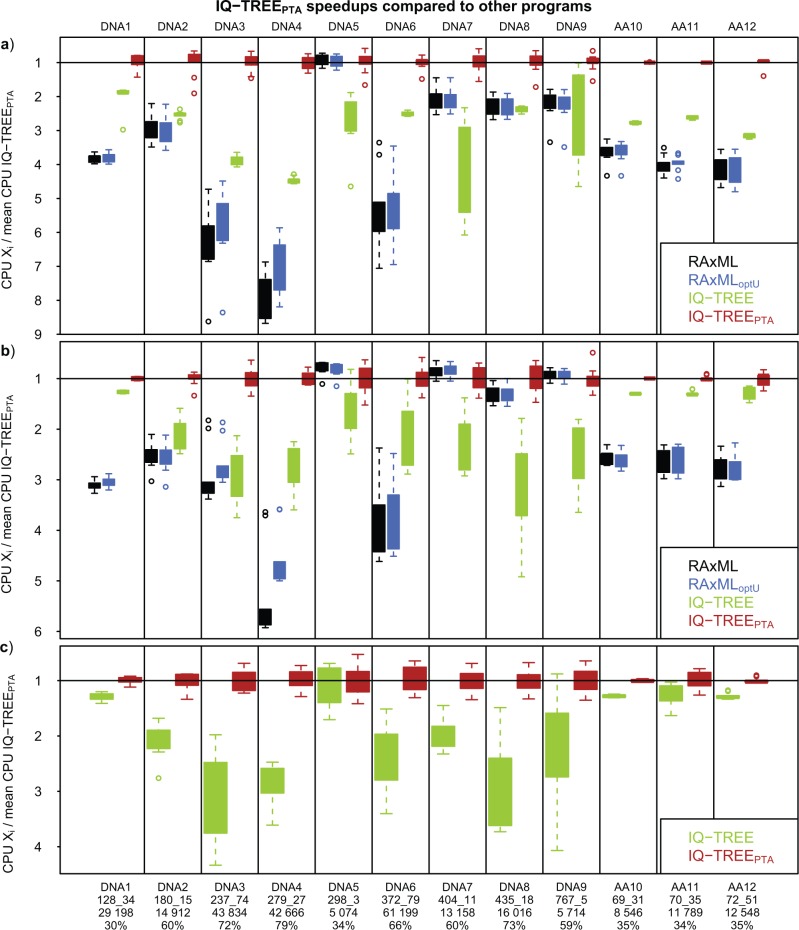
In phylogenomics the analysis of concatenated gene alignments, the so-called supermatrix, is commonly accompanied by the assumption of partition models. Under such models each gene, or more generally partition, is allowed to evolve under its own evolutionary model. Although partition models provide a more comprehensive analysis of supermatrices, missing data may hamper the tree search algorithms due to the existence of phylogenetic (partial) terraces. Here, we introduce the phylogenetic terrace aware (PTA) data structure for the efficient analysis under partition models. In the presence of missing data PTA exploits (partial) terraces and induced partition trees to save computation time. We show that an implementation of PTA in IQ-TREE leads to a substantial speedup of up to 4.5 and 8 times compared with the standard IQ-TREE and RAxML implementations, respectively. PTA is generally applicable to all types of partition models and common topological rearrangements thus can be employed by all phylogenomic inference software.
Overview
The claims and statistics of this paper haven’t been checked yet.
Free: it reads the open-access text and checks the first 5 claims that cite a source we can check. Create a free account to check every claim.
Integrity signals
Registry
Cites
Statistics
Figures



Verification
Claims the paper makes
The claims and statistics of this paper haven’t been checked yet.
Free: it reads the open-access text and checks the first 5 claims that cite a source we can check. Create a free account to check every claim.
Claims other papers make about this one
Each is checked against this paper’s own text: does it say what the citing paper says it does?
The source backs part of the claim, not all of it — or backs it for a different population, condition or comparison.
In the citing paper
“IQ-TREE 2 exploits partial terraces to improve tree search under partitioned models and achieves up to 4.5- and 8-fold speedups compared with IQ-TREE 1 and RAxML, respectively (Chernomor et al. 2016).”
From IQ-TREE 2: New Models and Efficient Methods for Phylogenetic Inference in the Genomic Era (2020) · cites this paper as Chernomor et al. 2016
Experimental — accuracy not yet measuredIn the citing paper
“This finding might not be entirely surprising because IQ-TREE represents the latest development in fast phylogenetic programs and has implemented a novel data structure to facilitate concatenation analysis (Chernomor et al. 2016).”
From Evaluating fast maximum likelihood-based phylogenetic programs using empirical phylogenomic data sets (2018) · cites this paper as Chernomor et al. 2016
Self-check
Percentages, sums and reported differences re-computed from the paper’s own numbers.
The self-check needs the paper’s full text.
Citations
Cites
1 retracted
RETRACTED ARTICLE: TREEFINDER: a powerful graphical analysis environment for molecular phylogenetics
Jobb, G., von Haeseler, A., & Strimmer, K. (2004) · BMC Evolutionary Biology · doi:10.1186/1471-2148-4-18 · Cited by 1,112
RetractedRAxML version 8: a tool for phylogenetic analysis and post-analysis of large phylogenies
Stamatakis, A. (2014) · Bioinformatics · doi:10.1093/bioinformatics/btu033 · Cited by 32,291 · cited 1×
“RAxML (Stamatakis 2014) x x TreeFinder ( IQ-TREE ( Jobb et al. 2004) x x x Nguyen et al. 2015) x x x EL, edge-linked; EUL, which yielded a substantial computation time and memory saving.”
MethodIQ-TREE: A Fast and Effective Stochastic Algorithm for Estimating Maximum-Likelihood Phylogenies
Nguyen, L.-T., Schmidt, H. A., von Haeseler, A., & Minh, B. Q. (2015) · Molecular Biology and Evolution · doi:10.1093/molbev/msu300 · Cited by 26,046 · cited 6×
“RAxML (Stamatakis 2014) x x TreeFinder ( IQ-TREE ( Jobb et al. 2004) x x x Nguyen et al. 2015) x x x EL, edge-linked; EUL, which yielded a substantial computation time and memory saving.”
BackgroundMethodInfluentialSelf-citationGuindon, S., Dufayard, J.-F., Lefort, V., Anisimova, M., Hordijk, W., & Gascuel, O. (2010) · Systematic Biology · doi:10.1093/sysbio/syq010 · Cited by 18,376
RAxML-VI-HPC: maximum likelihood-based phylogenetic analyses with thousands of taxa and mixed models
Stamatakis, A. (2006) · Bioinformatics · doi:10.1093/bioinformatics/btl446 · Cited by 15,582
Lanfear, R., Calcott, B., Ho, S. Y. W., & Guindon, S. (2012) · Molecular Biology and Evolution · doi:10.1093/molbev/mss020 · Cited by 5,732
Zwickl, D. J. (2006) · Texas ScholarWorks (Texas Digital Library) · Cited by 3,530
An Improved General Amino Acid Replacement Matrix
Le, S. Q., & Gascuel, O. (2008) · Molecular Biology and Evolution · doi:10.1093/molbev/msn067 · Cited by 3,127 · cited 1×
“For all partition models we assumed the GTR+ (Lanave et al. 1984; Yang 1994) and the LG+ (Yang 1994; Le and Gascuel 2008) models for all genes in the DNA and the AA alignments, respectively.”
MethodYang, Z. (1994) · Journal of Molecular Evolution · doi:10.1007/bf00160154 · Cited by 2,960 · cited 3×
“1984; Yang 1994) and the LG+ (Yang 1994; Le and Gascuel 2008) models for all genes in the DNA and the AA alignments, respectively.”
BackgroundMethodBroad phylogenomic sampling improves resolution of the animal tree of life
Dunn, C. W., Hejnol, A., Matus, D. Q., Pang, K., Browne, W. E., Smith, S. A., Seaver, E., Rouse, G. W., Obst, M., Edgecombe, G. D., et al. (2008) · Nature · doi:10.1038/nature06614 · Cited by 1,921
Cited by
Items 901–1,000 of 1,004
Inopinatum lactosum gen. & comb. nov., the first yeast-like fungus in Leotiomycetes
Haelewaters, D., Peterson, R., Nevalainen, H. K. M., & Aime, M. C. (2021) · INTERNATIONAL JOURNAL OF SYSTEMATIC AND EVOLUTIONARY MICROBIOLOGY · doi:10.1099/ijsem.0.004862 · Cited by 10
“ML was inferred for the concatenated SSU–ITS–LSU dataset under partitioned models, with rapid bootstrapping under 1000 replicates [34, 35].”
MethodAoki, T., Liyanage, P. N. H., Konkol, J. L., Ploetz, R. C., Smith, J. A., Kasson, M. T., Freeman, S., Geiser, D. M., & O'Donnell, K. L. (2021) · Mycologia · doi:10.1080/00275514.2021.1923300 · Cited by 10
“A ML-BS analysis of the combined data set was conducted after the best-fit model of molecular evolution was determined for each partition using ModelFinder (Kalyaanamoorthy et al. 2017) based on the Bayesian information criterion (BIC) scores (Chernomor et al. 2016).”
MethodKita, Y. F., & Kajihara, H. (2021) · Parasitology International · doi:10.1016/j.parint.2021.102430 · Cited by 10
Salvia fimbriaticalyx, a new species of Salvia (Lamiaceae) from Oaxaca, Mexico
Fragoso-Martínez, I., Martínez-Gordillo, M. J., & SALAS, S. (2021) · Phytotaxa · doi:10.11646/phytotaxa.518.4.1 · Cited by 10
Ditter, R. E., Campos, M., Pinto, J., Cornel, A. J., Rompão, H., & Lanzaro, G. C. (2022) · Frontiers in Tropical Diseases · doi:10.3389/fitd.2022.855272 · Cited by 10
“3 (32) to estimate a ML tree with 1,000 ultrafast bootstrap replicates and resampled partitions and then sites within resampled partitions (32–36).”
BackgroundNargar, K., O’Hara, K., Mertin, A. A., Bent, S. J., Nauheimer, L., Simpson, L., Zimmer, H. C., Molloy, B. P. J., & Clements, M. A. (2022) · Frontiers in Plant Science · doi:10.3389/fpls.2022.912089 · Cited by 10
“The chosen models were incorporated into subsequent ML analyses in IQ-TREE which were performed separately for each dataset using the edge-proportional partition model (Chernomor et al., 2016).”
MethodLindgren, A. R., Pratt, A., Vecchione, M., & Anderson, F. E. (2022) · Organisms Diversity & Evolution · doi:10.1007/s13127-022-00583-7 · Cited by 10
“We conducted partitioned ML analyses on the concatenated 50% filtered HaMStR (representative and all) and OrthoFinder matrices with the standard amino acid substitution models and our new decapodiform substitution model, using bestfitting models inferred for each orthogroup (Chernomor et al., 2016), in IQ-TREE 2.”
MethodCosta, W. J. E. M., Mattos, J. L. O., Lopes, S., de Amorim, P. F., & Katz, A. M. (2022) · PubMed · doi:10.6620/zs.2022.61-11 · Cited by 10
“The Maximum Likelihood was performed with IQ-TREE 2.0 software (Nguyen et al. 2015; Chernomor et al. 2016), support of the nodes was evaluated by the calculation of 1000 ultrafast bootstrap (Hoang et al. 2018), and 1000 bootstrap (Felsenstein 1985) replicates.”
MethodInfluentialMilec, L. J. M., Vanhove, M. P. M., Bukinga, F. M., Keyzer, E. L. R. D., Kapepula, L., Mulungula, P. M., Mulimbwa, N., Wagner, C. E., & Raeymaekers, J. A. M. (2022) · BMC Ecology and Evolution · doi:10.1186/s12862-022-02085-8 · Cited by 10
“The first run determined the best partition scheme (option -m MF + MERGE), allowing different models of molecular evolution in different genes/regions and, for PCGs, at the different codon positions [93].”
MethodTriana-Moreno, L. A., Yáñez, A., Kuo, L., Rothfels, C. J., Pena, N. T. L., Schwartsburd, P. B., & Sundue, M. (2022) · Taxon · doi:10.1002/tax.12858 · Cited by 10
Quijada, L., Baral, H.-O., Johnston, P. R., Pärtel, K., Mitchell, J. K., Hosoya, T., Hugo Madrid, L., Kosonen, T., Helleman, S., Rubio, E., et al. (2022) · Studies in Mycology · doi:10.3114/sim.2022.103.03 · Cited by 10
Tilapia lake virus: A structured phylogenetic approach
Abbadi, M., Basso, A., Biasini, L., Quartesan, R., Buratin, A., Davidovich, N., & Toffan, A. (2023) · Frontiers in Genetics · doi:10.3389/fgene.2023.1069300 · Cited by 10
“including or excluding ORFs through partition schemes (Chernomor et al., 2016) and discarding the ORFs which caused a decrease of support values.”
BackgroundHuang, W., Xu, H., Ma, X., & Zhu, R. (2023) · The Bryologist · doi:10.1639/0007-2745-126.2.226 · Cited by 10
Zwick, P., & Zwick, A. (2023) · Zootaxa · doi:10.11646/zootaxa.5316.1.1 · Cited by 10
Pollmann, M., Kuhn, D., König, C., Homolka, I., Paschke, S., Reinisch, R., Schmidt, A., Schwabe, N., Weber, J., Gottlieb, Y., et al. (2023) · Ecology and Evolution · doi:10.1002/ece3.10524 · Cited by 10
Young evolutionary origins of dioecy in the genus Asparagus
Bentz, P. C., Liu, Z., Yang, J., Zhang, L., Burrows, S., Burrows, J. E., Kanno, A., Mao, Z., & Leebens‐Mack, J. (2024) · American Journal of Botany · doi:10.1002/ajb2.16276 · Cited by 10
A regional study of the genus Phyllopsora (Ramalinaceae) in Asia and Melanesia
Kistenich, S., Bendiksby, M., Vairappan, C. S., Weerakoon, G., Wijesundara, S., Wolseley, P. A., & Timdal, E. (2019) · MycoKeys · doi:10.3897/mycokeys.53.33425 · Cited by 10
“We ran a detailed IQ-TREE analysis to find the best-fitting nucleotide substitution models and partitioning schemes (Chernomor et al. 2016; Kalyaanamoorthy et al. 2017) among models implemented in MrBayes (i.”
MethodTao, Y., Zhou, X., Liu, Z., Zhang, X., Nie, Y., Zheng, X., Li, S., Hu, X., Yang, G., Zhao, Q., et al. (2019) · Gene Expression Patterns · doi:10.1016/j.gep.2019.119078 · Cited by 10
Rajabizadeh, M., Pyron, R. A., Nazarov, R. A., Poyarkov, N. A., Adriaens, D., & Herrel, A. (2020) · PeerJ · doi:10.7717/peerj.9016 · Cited by 10
Jike, W., Li, M., Zadra, N., Barbaro, E., Sablok, G., Bertorelle, G., Rota‐Stabelli, O., & Varotto, C. (2020) · International Journal of Molecular Sciences · doi:10.3390/ijms21155247 · Cited by 10
“For phylogenomic reconstruction, the program ModelFinder implemented in IQ-TREE was used to identify the best partitioning scheme of the whole supermatrix using the fast relaxed clustering algorithm [61,62] by sampling the top 10% partition schemes using edge-linked branch lengths between partitions (option –spp).”
MethodCumberlidge, N., Johnson, E. C., Clark, P. F., & Genner, M. J. (2021) · European Journal of Taxonomy · doi:10.5852/ejt.2021.744.1309 · Cited by 10
“2.12 (Minh et al. 2020), on the IQ-TREE webserver, using an automatic model selection including the 16S locus as one partition, and each codon position of the H3 genes as separate partitions (Chernomor et al. 2016).”
MethodInfluentialLarsén, E., Wikström, N., Khodabandeh, A., & Rydin, C. (2022) · BMC Ecology and Evolution · doi:10.1186/s12862-022-01988-w · Cited by 10
“Phylogenetic analyses ModelFinder [92] as implemented in the IQ-TREE web server [93, 94] was used to find the best fitting models and partitions [92, 95].”
MethodGenomic analysis of an ultrasmall freshwater green alga, Medakamo hakoo
Kato, S., Misumi, O., Maruyama, S., Nozaki, H., Inui, Y., Takusagawa, M., Suzuki, S., Kuwata, K., Noda, S., Ito, N., et al. (2023) · Communications Biology · doi:10.1038/s42003-022-04367-9 · Cited by 10
Additions to the genus Chroogomphus (Boletales, Gomphidiaceae) from Pakistan
Kiran, M., Sattar, A., Zamir, K., Haelewaters, D., & Khalid, A. N. (2020) · MycoKeys · doi:10.3897/mycokeys.66.38659 · Cited by 10
“Phylogenetic relationships were inferred by Maximum Likelihood (ML) using IQ-TREE (Nguyen et al. 2015) from the command line, under partitioned models (Chernomor et al. 2016).”
BackgroundMethodSmith, W. L., Girard, M. G., H. J. Walker, Jr., & Davis, M. P. (2024) · NOAA professional paper NMFS · doi:10.7755/pp.24.13 · Cited by 10
von Rintelen, K., Rumpf, C. M. A., Wowor, D., Wessel, A., & von Rintelen, T. (2024) · Crustaceana · doi:10.1163/15685403-bja10383 · Cited by 9
Sromek, L., Johnson, K. P., Kunnasranta, M., Ylinen, E., Herrera, S. V., Andrievskaya, E., Alexeev, V., Русинек, О. Т., Rosing‐Asvid, A., & Nyman, T. (2024) · Molecular Ecology · doi:10.1111/mec.17523 · Cited by 9
“The concatenated species tree was inferred using the edge-linked partition model (Chernomor et al., 2016 ), with model selection (Kalyaanamoorthy et al., 2017) performed separately for each partition (genomic window).”
Chen, D., Yang, T., Chen, H., Zhang, X., Huang, F., Wan, S., Lu, Z., Liu, C., Lei, Y. H., Jiang, H., et al. (2025) · Plant Biotechnology Journal · doi:10.1111/pbi.70193 · Cited by 9
Marin, M. V., Parrish, S. M., Deng, Z., & Peres, N. A. (2025) · Plant Disease · doi:10.1094/pdis-11-24-2435-sc · Cited by 9
Fatemi, S., Haelewaters, D., Urbina, H., Brown, S., Houston, M. L., & Aime, M. C. (2022) · Journal of Fungi · doi:10.3390/jof8030302 · Cited by 10
Phylogeny of Didelphid marsupials (Didelphimorphia) from Acre, western Amazonia
Bonvicino, C. R., Lazar, A., Povill, C., Caramaschi, F. P., de Freitas, T. P. T., Crisóstomo, C. F., Botelho, A. L., & D’Andrea, P. S. (2022) · Mammalian Biology · doi:10.1007/s42991-022-00314-7 · Cited by 9
Initiation of speciation across multiple dimensions in a rock‐restricted, tropical lizard
Zozaya, S. M., Teasdale, L. C., Tedeschi, L. G., Higgie, M., Hoskin, C. J., & Moritz, C. C. (2022) · Molecular Ecology · doi:10.1111/mec.16787 · Cited by 9
“Each analysis was partitioned by locus (Chernomor et al., 2016) with modelfinder (Kalyaanamoorthy et al., 2017) used to determine the best substitution model for each locus.”
MethodWhelan, N. V., Johnson, N. A., Williams, A. S., Perkins, M. A., Beaver, C. E., & Mays, J. W. (2023) · Zoological Journal of the Linnean Society · doi:10.1093/zoolinnean/zlac106 · Cited by 9
Letsch, H. O., & Beran, F. (2023) · Insect Systematics and Diversity · doi:10.1093/isd/ixad019 · Cited by 9
“7.18 (Nguyen et al. 2015, Chernomor et al. 2016, Kalyaanamoorthy et al. 2017).”
InfluentialAméziane, N., Eléaume, M., & Roux, M. (2023) · Zoological Journal of the Linnean Society · doi:10.1093/zoolinnean/zlad101 · Cited by 9
Does Atp8 Exist in the Mitochondrial Genome of Proseriata (Metazoa: Platyhelminthes)?
Shimada, D., Hiruta, S. F., Takahoshi, K., & Kajihara, H. (2023) · Animal Gene · doi:10.1016/j.angen.2023.200161 · Cited by 9
Hsiao, Y., & Oberprieler, R. G. (2024) · Zoological Journal of the Linnean Society · doi:10.1093/zoolinnean/zlad190 · Cited by 9
Ruiz-Vargas, N., Ramanauskas, K., Tyszka, A. S., Bretz, E. C., Yeo, M. T. S., Mason‐Gamer, R. J., & Walker, J. F. (2024) · Annals of Botany · doi:10.1093/aob/mcae002 · Cited by 9
“…using the Phyx program pxcat , and the plastid tree was inferred using maximum likelihood as implemented in IQ-TREE v.1.6.12 (Nguyen et al. , 2015), with default model selection, the proportional partition model (Chernomor et al. , 2016) and 1000 UFBoot2 (Hoang et al. , 2018) replicates.”
MethodInfluentialBangiales (Rhodophyta) in New Zealand: current state of knowledge and future directions
Nelson, W. A., & Zuccarello, G. C. (2024) · New Zealand Journal of Botany · doi:10.1080/0028825x.2024.2307871 · Cited by 9
“Model selection (Kalyaanamoorthy et al. 2017) and partitioning to select the best partitions (Chernomor et al. 2016) were implemented in IQ-TREE, potential merging of partitions was also implemented.”
Huč, S., Hiley, A. S., McCowin, M. F., & Rouse, G. W. (2024) · Diversity · doi:10.3390/d16030134 · Cited by 9
Ameripathidae, a new family of antipatharian corals (Cnidaria, Anthozoa, Hexacorallia, Antipatharia)
Horowitz, J., Opresko, D. M., Herrera, S., Hansel, C. M., & Quattrini, A. M. (2024) · ZooKeys · doi:10.3897/zookeys.1203.121411 · Cited by 9
“A partitioned analysis (Chernomor et al. 2016) was conducted on the dataset using the best model for each locus [-m TESTMERGE (Kalyaanamoorthy et al. 2017)].”
MethodChemotaxonomic and molecular phylogenetic studies of selected Hypoxylon species from the Neotropics
Cedeño‐Sánchez, M. L., Lambert, C. R., Mejía, L. C., Ebada, S. S., & Stadler, M. (2024) · Mycology: An International Journal on Fungal Biology · doi:10.1080/21501203.2024.2378071 · Cited by 9
“The appropriate nucleotide exchange model was selected by ModelFinder (Chernomor et al. 2016; Kalyaanamoorthy et al. 2017) based on Bayesian inference criterion.”
PEREBOEV, D. D., Garibian, P. G., Павлович, К. Д., Efeykin, B. D., Galimov, Y. R., Petrusek, A., & Kotov, A. A. (2024) · Zoologica Scripta · doi:10.1111/zsc.12695 · Cited by 9
Calonectria eucalyptorum sp. nov., a new leaf blight pathogen of Eucalyptus from India
Negi, N., Ramkrishna, Meena, R. K., Bhandari, M. S., & Pandey, S. (2024) · International Microbiology · doi:10.1007/s10123-024-00602-x · Cited by 9
“The ML analysis employed the edge-unlinked partition model, which is the most parameter-rich partition model (Chernomor et al. 2016).”
Singh, G., Pasinato, A., Yriarte, A. L.-C., Pizarro, D., Divakar, P. K., Schmitt, I., & Grande, F. D. (2024) · BMC Genomics · doi:10.1186/s12864-024-10806-0 · Cited by 9
“This alignment was then used to infer a 1000 bootstrap maximum likelihood tree [47, 60, 61] to test the evolutionary distance between these SQSs found in LFF and of the LFF SQSs to those of the model taxa mentioned above (Additional Supplementary Material 3 showing species tree constructed from…”
MethodMedeiros, I. D., Ibáñez, A., Arnold, A. E., Hedderson, T. A. J., Miądlikowska, J., Flakus, A., Carbone, I., LaGreca, S. A., Magain, N., Mazur, E., et al. (2024) · American Journal of Botany · doi:10.1002/ajb2.16441 · Cited by 9
Dirks, A. C., Methven, A. S., Miller, A. N., Orozco-Quime, M., Maurice, S., Bonito, G. M., Wyk, J. V., Ahrendt, S. R., Kuo, A., Andreopoulos, W., et al. (2024) · Molecular Phylogenetics and Evolution · doi:10.1016/j.ympev.2025.108286 · Cited by 9
Genomic Patterns of Loss of Distyly and Polyploidization in Primroses
Mora‐Carrera, E., Yousefi, N., Potente, G., Stubbs, R. L., Keller, B., Léveillé‐Bourret, É., Grob, S., Celep, F., Tedoradze, G., & Conti, E. (2025) · Molecular Biology and Evolution · doi:10.1093/molbev/msaf162 · Cited by 9
“We generated statistical support for branches with 1,000 ultrafast bootstraps (BSs; Minh et al. 2013; Chernomor et al. 2016).”
Strangler unmasked: Parasitism of Cystoderma amianthinum by Squamanita paradoxa and S. pearsonii
Griffith, G. W., Gajda, K., Detheridge, A. P., Douglas, B., Bingham, J., Turner, A., Bowmaker, V., Evans, D. A., McAdoo, W. G., & Dentinger, B. T. M. (2019) · Fungal ecology · doi:10.1016/j.funeco.2018.11.012 · Cited by 9
Complete plastid genome ofApostasia shenzhenica(Orchidaceae)
Li, Y., Zhang-hai, L., Hu, Q., Zhai, J., Liu, Z., & Wu, S. (2019) · Mitochondrial DNA Part B · doi:10.1080/23802359.2019.1591192 · Cited by 9
Speciation in sympatric species of land snails from the genus Trochulus (Gastropoda, Hygromiidae)
Proćków, M., Kuźnik‐Kowalska, E., Pieńkowska, J. R., Żeromska, A., & Mackiewicz, P. (2020) · Zoologica Scripta · doi:10.1111/zsc.12458 · Cited by 9
“In IQ-TREE analyses, we used the substitution models proposed according to the associated ModelFinder programme (Chernomor et al., 2016; Kalyaanamoorthy et al., 2017), whereas in MrBayes analyses, 22 | PROĆKÓW et al. T A B L E 2 A na ly se d al ig nm en ts a nd a pp lie d nu cl eo tid e su bs tit…”
MethodPhotikwan, E., Damthongdee, A., Jongsook, H., & Chaowasku, T. (2021) · Willdenowia - Annals of the Botanic Garden and Botanical Museum Berlin-Dahlem · doi:10.3372/wi.51.51106 · Cited by 9
Roos, C., Miguez, R. P., Sabin, R., Louis, E. E., Hofreiter, M., Zinner, D. P., Leibniz Science Campus Primate Cognition, G. 3., & Leibniz Science Campus Primate Cognition, G. 3. (2021) · 动物学研究 · doi:10.24272/j.issn.2095-8137.2021.157 · Cited by 9
“For both tree reconstructions, we treated the mitogenome as a single partition and applied the optimal substitution model (GTR+I+G) determined by ModelFinder (Chernomor et al., 2016; Kalyaanamoorthy et al., 2017) in IQ-TREE under Bayesian Information Criterion (BIC).”
Kirschel, A. N. G., Moysi, M., Lukhele, S. M., Sebastianelli, M., Asfaw, T., Hadjioannou, L., Mortega, K. G., Monadjem, A., & Moyle, R. G. (2021) · Bulletin of the British Ornithologists Club · doi:10.25226/bboc.v141i4.2021.a6 · Cited by 9
Mind your Ps: A probabilistic model to aid the interpretation of molecular epidemiology data
Penedos, A. R., Fernández-García, A., Lazăr, M., Ralh, K., Williams, D. F., & Brown, K. E. (2022) · EBioMedicine · doi:10.1016/j.ebiom.2022.103989 · Cited by 9
Macrostructural Evolution of the Mitogenome of Butterflies (Lepidoptera, Papilionoidea)
Liu, D., Basso, A., Babbucci, M., Patarnello, T., & Negrisolo, E. (2022) · Insects · doi:10.3390/insects13040358 · Cited by 9
“A phylogenomic partition model was used [52].”
Nilgiriwala, K. S., Kadam, P., Patel, G., Shaikh, A., Mestry, T., Vaswani, S., Sakthivel, S., Poojary, A. A., Gandhi, B., Rohra, S., et al. (2022) · Journal of Medical Virology · doi:10.1002/jmv.27861 · Cited by 9
“3) [24] and visualised with Auspice (v2.”
Species of the common discomycete genus Bisporella reassigned to at least four genera
Mitchell, J. K., Quijada, L., Johnston, P. R., & Pfister, D. H. (2022) · Mycologia · doi:10.1080/00275514.2022.2058853 · Cited by 9
“Maximum likelihood (ML) analyses were run with IQTREE 1.6.6 (Chernomor et al. 2016; Nguyen et al. 2015), using models selected by ModelFinder (Kalyaanamoorthy et al. 2017) for each partitioned gene (see TABLE 2); ultrafast bootstrap (BS) analysis with 1000 replicates estimated branch support in the…”
MethodInfluentialOya, Y., Tsuyuki, A., & Kajihara, H. (2022) · Zootaxa · doi:10.11646/zootaxa.5178.5.2 · Cited by 9
Moreno‐Aguilar, M. F., Inda, L. A., Sánchez‐Rodríguez, A., Catalán, P., & Arnelas, I. (2022) · Plants · doi:10.3390/plants11172303 · Cited by 9
Stewart, R. D., Clugston, J. A. R., Williamson, J., Niemann, H. J., Little, D. P., & van der Bank, M. (2022) · South African Journal of Botany · doi:10.1016/j.sajb.2022.12.001 · Cited by 9
Benda, P., Uvizl, M., Vallo, P., Reiter, A., & Uhrín, M. (2023) · Acta Chiropterologica · doi:10.3161/15081109acc2022.24.2.001 · Cited by 9
“Then, we inferred the maximum-likelihood tree using the partition model in IQ-TREE (Nguyen et al., 2015; Chernomor et al., 2016).”
MethodGenome of the Lord Howe Island Stick Insect Reveals a Highly Conserved Phasmid X Chromosome
Stuart, O. P., Cleave, R., Magrath, M. J. L., & Mikheyev, A. S. (2023) · Genome Biology and Evolution · doi:10.1093/gbe/evad104 · Cited by 9
“We used PartitionFinder (Lanfear et al. 2012) and ModelFinder (Chernomor et al. 2016; Kalyaanamoorthy et al. 2017) to find the best supported partitions and substitution models.”
MethodRabarijaona, R. N., Ranaivoson, R. M., Yu, J., You, Y., Liu, B., Ye, J., Barrett, R. L., Rakotoarinivo, M., Lin, X., Wen, J., et al. (2023) · Taxon · doi:10.1002/tax.12980 · Cited by 9
Leo, P., Teixeira, M. D. M., Chander, A. M., Singh, N. K., Simpson, A., Yurkov, A. M., Karouia, F., Stajich, J., Mason, C. E., & Venkateswaran, K. (2023) · IMA Fungus · doi:10.1186/s43008-023-00119-4 · Cited by 9
“Tree reconstruction was performed with the supermatrix approach (Chernomor et al. 2016) and branch fidelity was tested using SH-aLRT (Anisimova and Gascuel 2006) and ultrafast bootstrap methods (Hoang et al. 2018).”
MethodGvoždík, V., Knytl, M., Zassi‐Boulou, A., Fornaini, N. R., & Bergelová, B. (2023) · Zoological Journal of the Linnean Society · doi:10.1093/zoolinnean/zlad119 · Cited by 9
Novel integrative data for Indomalayan echiniscids (Heterotardigrada): new species and old problems
Gąsiorek, P., & Michalczyk, Ł. (2024) · Organisms Diversity & Evolution · doi:10.1007/s13127-023-00628-5 · Cited by 9
“ModelF-inder (Kalyaanamoorthy et al., 2017) was used to choose the best-fit models (Chernomor et al., 2016) for Maximum Likelihood reconstructions, chosen according to the BIC: 18S rRNA – TIM2e + I + G4, 28S rRNA – TVMe + I + G4, ITS-1 – SYM + I + G4, ITS-2 – TPM2u + F + I + G4.”
Shen, H., Hou, Y., Wang, X., Li, Y., Wu, J., & Lou, H. (2024) · International Journal of Molecular Sciences · doi:10.3390/ijms25073859 · Cited by 9
“…Al stress (50 µ M AlCl 3 treatment for 0, 8, and 24 h), high-temperature stress (40 ◦ C high-temperature treatment for 0, 1, 2, and 3 days), low-temperature stress (2 ◦ C low-temperature treatment for 0, 1, 2, 4, and 6 days), and drought stress (drought without watering for 0, 40, and 60 days).”
BackgroundOn the systematic position of the horseshoe bats (Mammalia: Chiroptera) from Lesotho
Benda, P., Uvizl, M., Eiseb, S. J., & Avenant, N. L. (2024) · Mammalia · doi:10.1515/mammalia-2023-0119 · Cited by 9
Haelewaters, D., Caenegem, W. V., & De Kesel, A. (2022) · Ghent University Academic Bibliography (Ghent University) · Cited by 9
A Review of Approaches for Optimizing Phylogenetic Likelihood Calculations
Stamatakis, A. (2019) · Computational biology · doi:10.1007/978-3-030-10837-3_1 · Cited by 9
Okamoto, N., Oya, Y., & Kakui, K. (2020) · Marine Biology Research · doi:10.1080/17451000.2020.1766693 · Cited by 9
Knutson, V. L., Brenzinger, B., Schrödl, M., Wilson, N. G., & Giribet, G. (2020) · Molecular Phylogenetics and Evolution · doi:10.1016/j.ympev.2020.106943 · Cited by 9
Brozzo, A., Harl, J., Mattia, W. D., Teixeira, D., Walther, F., Groh, K., Páll‐Gergely, B., Glaubrecht, M., Hausdorf, B., & Neiber, M. T. (2020) · Cladistics · doi:10.1111/cla.12440 · Cited by 9
“For comparison of support values, an additional bootstrap analysis (1000 non-parametric bootstrap replications) was conducted using IQ-TREE (Chernomor et al., 2016; Minh et al., 2020) using the same partitions and evolutionary models as in the analysis with GARLI.”
MethodWei, X., Li, J., Xiao, J., & Huang, D. (2021) · International Journal of Biological Macromolecules · doi:10.1016/j.ijbiomac.2021.04.031 · Cited by 9
Halıcı, M. G., Kahraman, M., Kistenich, S., & Timdal, E. (2021) · TURKISH JOURNAL OF BOTANY · doi:10.3906/bot-2101-24 · Cited by 9
Uvizl, M., & Benda, P. (2021) · Mammalian Biology · doi:10.1007/s42991-021-00143-0 · Cited by 9
Alnaqeb, H., Greiman, S. E., Vandegrift, K. J., Campbell, M., Meagher, S., & Jiménez, F. A. (2022) · Systematics and Biodiversity · doi:10.1080/14772000.2022.2046199 · Cited by 9
“IQTree v.1.6.10 (Chernomor et al., 2016) was used to build a phylogenetic tree under the maximum likelihood inference and support for the branches was calculated using 1000 bootstrap replicates.”
MethodInfluentialБолотов, И. Н., Konopleva, E. S., Vikhrev, I. V., Win, T., Lunn, Z., Chan, N., Gofarov, M. Y., Kondakov, A. V., Tomilova, A. A., Pasupuleti, R., et al. (2022) · Journal of Zoological Systematics & Evolutionary Research · doi:10.1155/2022/6600359 · Cited by 9
The Cambrian cirratuliform Iotuba denotes an early annelid radiation
Zhang, Z., Smith, M. R., & Ren, X. (2023) · Proceedings of the Royal Society B Biological Sciences · doi:10.1098/rspb.2022.2014 · Cited by 9
“Maximumlikelihood tree search was conducted in ‘IQ-TREE’ [99], allowing each partition to have its own evolutionary rate over common branch lengths [98].”
MethodInfluentialHuber, B. A., Caspar, K. R., & Eberle, J. (2019) · Invertebrate Systematics · doi:10.1071/is18002 · Cited by 9
Two new species of Lactifluus (Fungi, Russulales) from tropical Quercus forest in eastern Mexico
Montoya, L., Caro, A., Ramos, A., & Bandala, V. M. (2019) · MycoKeys · doi:10.3897/mycokeys.59.38359 · Cited by 9
“…in an interface online (Trifinopoulos et al. 2016), we calculated the evolutionary model with a partitioning analysis (Kalyaanamoorthy et al. 2017; Chernomor et al. 2016) and Edge-unlinked partition model (Lopez et al. 2002), using the Bayesian Information Criterion (BIC), the Akaike Information…”
MethodConserving the iconic and highly threatened mahseer fishes of South and Southeast Asia.
Pinder, A. C. (2020) · Bournemouth University Research Online (Bournemouth University) · Cited by 9
Foerster, S. Í. A. (2025) · PeerJ · doi:10.7717/peerj.18621 · Cited by 8
“The optimal partitioning scheme for the genes was determined using ModelFinder ( Chernomor, Von Haeseler & Minh, 2016 ; Kalyaanamoorthy et al., 2017 ) in IQ-TREE (-m MF+MERGE), which also identi fi ed the best-fi t evolutionary model for each partition (Information S1) based on evolutionary…”
Host-Calibrated Time Tree Caps the Age of Giant Viruses
Tee, H. S., & Ku, C. (2025) · Molecular Biology and Evolution · doi:10.1093/molbev/msaf033 · Cited by 8
Hebeloma in the Malay Peninsula: Masquerading within Psathyrella
Eberhardt, U., Schütz, N., Beker, H. J., Lee, S. S., & Horak, E. (2021) · MycoKeys · doi:10.3897/mycokeys.77.57394 · Cited by 8
Fric, Z. F., Martinkova, B., Rindoš, M., Bartoňová, A. S., Wahlberg, N., & Maresova, J. P. (2022) · Molecular Phylogenetics and Evolution · doi:10.1016/j.ympev.2022.107605 · Cited by 8
Saccaggi, D. L., Maboeei, P., Powell, C., Ngubane-Ndhlovu, N. P., Allsopp, E., Wesley‐Smith, J., & ASCH, B. V. (2022) · Diversity · doi:10.3390/d14050342 · Cited by 8
Millas, P., Barra-Bucarei, L., Castro, J. F., Carrasco-Fernández, J., Chilian, J., Tapia, E., Santelices, C., Cisterna-Oyarce, V., Muñoz, V., Ortiz-Campos, J., et al. (2023) · Mycologia · doi:10.1080/00275514.2023.2180976 · Cited by 8
“Phylogenetic trees were inferred with the concatenated data set using maximum likelihood (ML) analysis in IQTREE (Chernomor et al. 2016; Kalyaanamoorthy et al. 2017; Nguyen et al. 2015), using default parameters.”
MethodKita, Y., & Kajihara, H. (2023) · Systematic Parasitology · doi:10.1007/s11230-023-10121-4 · Cited by 8
“Phylogenetic trees were reconstructed with a partition model (Chernomor et al., 2016) based on the maximum likelihood (ML) method performed in IQtree 1.6.12.”
InfluentialMcLaren, E. J., Bronstein, O., Kroh, A., Winkler, V., Miskelly, A. D., Sommer, B., & Byrne, M. (2023) · Invertebrate Systematics · doi:10.1071/is23038 · Cited by 8
“3.3.7a, see https://nbisweden.github.io/MrBayes/index.html; Ronquist et al. 2012; Nguyen et al. 2015; Chernomor et al. 2016).”
InfluentialEshak, M. I. Y., Rubbenstroth, D., Beer, M., & Pfaff, F. (2023) · Virus Evolution · doi:10.1093/ve/vead062 · Cited by 8
“Specifically, a partitioning model (−Q [Chernomor, Haeseler, and Minh 2016]) was used that allowed for individual substitution models and evolutionary rates in each partition.”
MethodHuang, F., Li, X., Ye, B., Zhou, Y., Dang, Z., Tang, W., Wang, L., Zhang, H., Chui, W., & Kui, J. (2023) · Genes · doi:10.3390/genes14122199 · Cited by 8
“The maximum likelihood phylogeny was inferred using IQ-TREE [22] with the Partition model [23] of nucleotide substitution, and ultrafast bootstraps [24] with 100,000 replicates were performed.”
MethodDingleyomyces lloydii (Hypocreales, Polycephalomycetaceae), gen. nov., comb. nov.
Johnston, P. R., & Park, D. (2023) · New Zealand Journal of Botany · doi:10.1080/0028825x.2023.2291453 · Cited by 8
Elameen, A., Maduna, S. N., Magerøy, M. H., van Eerde, A., Knudsen, G., Hagen, S. B., & Eiken, H. G. (2024) · BMC Genomics · doi:10.1186/s12864-023-09905-1 · Cited by 8
“We used ModelFinder [101] to select the best-fit-ting partitioning scheme and models of evolution using the corrected Akaike Information Criterion ( AICc ) and the edge-linked proportional partition model [102] as implemented in IQ-Tree v. 2.2.0.3 [103].”
MethodInfluentialScholz, T., Kuchta, R., Barčák, D., Cech, G., & Oros, M. (2024) · Parasite · doi:10.1051/parasite/2024016 · Cited by 8
“The optimal evolution models were estimated separately for the alignment of each marker with ModelFinder using the AICc criterion [36, 43].”
Phylogenomic approaches reveal a robust time-scale phylogeny of the Terminal Fusarium Clade
Lizcano-Salas, A. F., Duitama, J., Restrepo, S., & Ramírez, A. M. C. (2024) · IMA Fungus · doi:10.1186/s43008-024-00147-8 · Cited by 8
“The first phylog-enomic approach using all the genera was recently performed with excellent robustness of the F1 node but only used one approximation (maximum-likelihood approach using IQ-Tree) for the analysis (Han et al. 2023).”
MethodInfluentialMontoya-Martínez, A. C., Chávez-Luzanía, R. A., Olguín-Martínez, A. I., Ruíz-Castrejón, A., Moreno-Cárdenas, J. D., Esquivel‐Chávez, F., Parra-Cota, F. I., & Santos‐Villalobos, S. D. L. (2024) · Horticulturae · doi:10.3390/horticulturae10080865 · Cited by 8
“Mod-elFinder [26] was employed to identify the optimal molecular evolution models for each partition based on the Bayesian information criterion scores [27].”
MethodThe Evolution of Extreme Genetic Variability in a Parasite-Resistance Complex
Naser-Khdour, S., Scheuber, F., Fields, P. D., & Ebert, D. (2024) · Genome Biology and Evolution · doi:10.1093/gbe/evae222 · Cited by 8
“0.6 (Minh et al. 2020), we inferred the rooted species tree with 1,000 ultrafast bootstraps (Minh et al. 2013; Hoang et al. 2018) and a separate substitution model for each gene (Chernomor et al. 2016).”
InfluentialZhang, X., Leahy, I., Collemare, J., & Seidl, M. F. (2024) · Genome Biology and Evolution · doi:10.1093/gbe/evae228 · Cited by 8
“6.10 (Nguyen et al. 2015; Chernomor et al. 2016) to construct the maximum-likelihood phylogeny with partitioned model selection to allow selecting a substitution model (supplementary table S2, Supplementary Material online) for each BUSCO gene alignment and used both ultrafast bootstrap…”
Influential
Metadata
- Authors
- Chernomor, O., von Haeseler, A., & Minh, B. Q.
- Affiliations
- University of Vienna (AT)
- ORCID
- Chernomor, Olga
- Venue
- Systematic Biology
- Publisher
- Oxford University Press (OUP)
- Published
- 2016-04-26
- Volume
- 65
- Issue
- 6
- Pages
- 997-1008
- ISSN
- 1063-5157 (ISSN-L)
- 1076-836X
- PMC
- PMC5066062
- OpenAlex
- W2344940607
- Cited by
- 2,252
- References
- 41
- Citations by year
- 2026: 240 · 2025: 285 · 2024: 328 · 2023: 322 · 2022: 289 · 2021: 331 · 2020: 214 · 2019: 134 · 2018: 75 · 2017: 31 · 2016: 3
- FWCI
- 42.08
- Type
- journal article
- Language
- en
- Open access
- hybrid
- doi.org
- Licence
- cc-by-nc
- Locations
- Systematic Biology (publishedVersion, cc-by-nc)
- PubMed Central (publishedVersion, cc-by-nc)
- PubMed (publishedVersion)
- HighWire Press Open Archive (submittedVersion)
- Funders
- Austrian Science Fund (I-2805-B29, I-1824-B22)
- Topics
- Life Sciences › Biochemistry, Genetics and Molecular Biology › Molecular Biology › Genomics and Phylogenetic Studies
- Life Sciences › Biochemistry, Genetics and Molecular Biology › Molecular Biology › RNA and protein synthesis mechanisms
- Life Sciences › Agricultural and Biological Sciences › Ecology, Evolution, Behavior and Systematics › Plant Diversity and Evolution
- Keywords
- partition model, supermatrix, missing data, phylogenetic tree search, IQ-TREE, RAxML, data structures
- MeSH terms
- Algorithms, Classification, Biological Evolution, Models, Biological, Phylogeny, Software, Sequence Analysis, DNA
About these checks
Registry, retraction, Cites and statistics results are computed, not judged, with one exception: a printed reference that no index lists is read once by a model before it counts as a citation error. Claims are extracted by a model and kept only when their quote appears verbatim in the text; each cited source is then checked, with a model’s help, for whether it says what the claim relies on. Those verdicts can be wrong — read the claim’s quote and the cited source before relying on one.
Statistics and arithmetic are recomputed, not judged.
Confidence bands are shown only for fields calibrated on our annotated test set. None is calibrated yet, so no band is shown.
What counts as a claim ›How we measure confidence ›How we check this ›
Are you an author, or do you see a problem with this page? Request a review
Data sources
Bibliographic data: Semantic Scholar, OpenAlex, Crossref.
Contains information from the Semantic Scholar Academic Graph Datasets, made available under the ODC Attribution License (ODC-BY 1.0).
Semantic Scholar’s data is described in: Kinney, R., et al. (2023). The Semantic Scholar Open Data Platform. arXiv:2301.10140.
