

Terrace Aware Data Structure for Phylogenomic Inference from Supermatrices
Open accessThe DOI matches its Crossref record; 43 of the 43 references it cites were found in a registry or an index.
Abstract
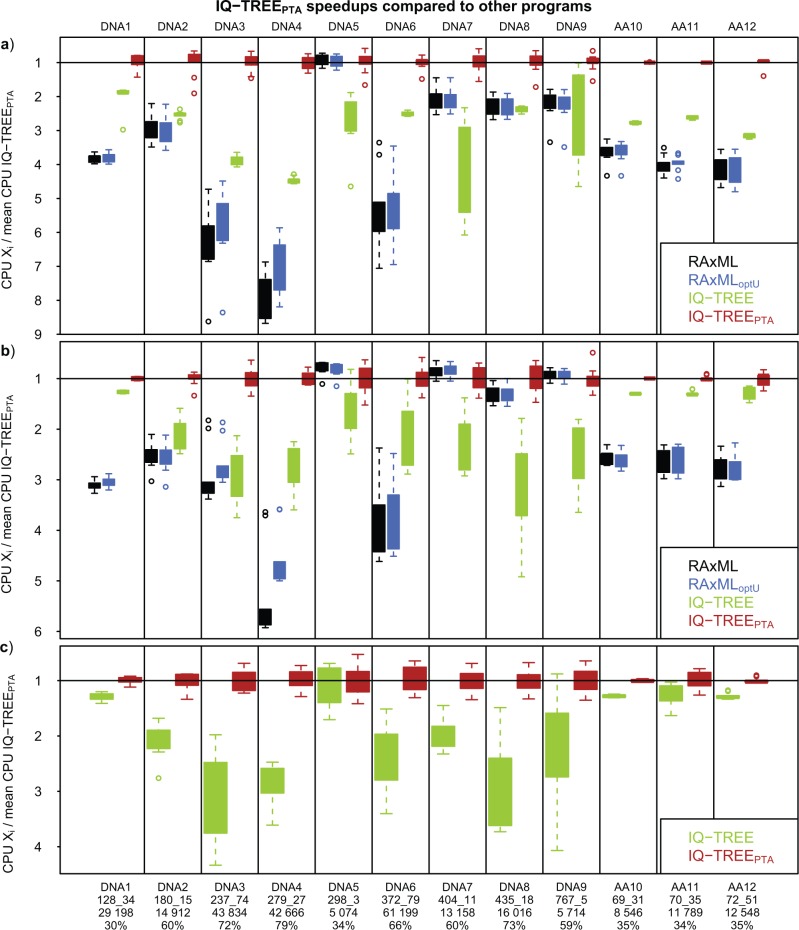
In phylogenomics the analysis of concatenated gene alignments, the so-called supermatrix, is commonly accompanied by the assumption of partition models. Under such models each gene, or more generally partition, is allowed to evolve under its own evolutionary model. Although partition models provide a more comprehensive analysis of supermatrices, missing data may hamper the tree search algorithms due to the existence of phylogenetic (partial) terraces. Here, we introduce the phylogenetic terrace aware (PTA) data structure for the efficient analysis under partition models. In the presence of missing data PTA exploits (partial) terraces and induced partition trees to save computation time. We show that an implementation of PTA in IQ-TREE leads to a substantial speedup of up to 4.5 and 8 times compared with the standard IQ-TREE and RAxML implementations, respectively. PTA is generally applicable to all types of partition models and common topological rearrangements thus can be employed by all phylogenomic inference software.
Overview
The claims and statistics of this paper haven’t been checked yet.
Free: it reads the open-access text and checks the first 5 claims that cite a source we can check. Create a free account to check every claim.
Integrity signals
Registry
Cites
Statistics
Figures



Verification
Claims the paper makes
The claims and statistics of this paper haven’t been checked yet.
Free: it reads the open-access text and checks the first 5 claims that cite a source we can check. Create a free account to check every claim.
Claims other papers make about this one
Each is checked against this paper’s own text: does it say what the citing paper says it does?
The source backs part of the claim, not all of it — or backs it for a different population, condition or comparison.
In the citing paper
“IQ-TREE 2 exploits partial terraces to improve tree search under partitioned models and achieves up to 4.5- and 8-fold speedups compared with IQ-TREE 1 and RAxML, respectively (Chernomor et al. 2016).”
From IQ-TREE 2: New Models and Efficient Methods for Phylogenetic Inference in the Genomic Era (2020) · cites this paper as Chernomor et al. 2016
Experimental — accuracy not yet measuredIn the citing paper
“This finding might not be entirely surprising because IQ-TREE represents the latest development in fast phylogenetic programs and has implemented a novel data structure to facilitate concatenation analysis (Chernomor et al. 2016).”
From Evaluating fast maximum likelihood-based phylogenetic programs using empirical phylogenomic data sets (2018) · cites this paper as Chernomor et al. 2016
Self-check
Percentages, sums and reported differences re-computed from the paper’s own numbers.
The self-check needs the paper’s full text.
Citations
Cites
1 retracted
RETRACTED ARTICLE: TREEFINDER: a powerful graphical analysis environment for molecular phylogenetics
Jobb, G., von Haeseler, A., & Strimmer, K. (2004) · BMC Evolutionary Biology · doi:10.1186/1471-2148-4-18 · Cited by 1,112
RetractedRAxML version 8: a tool for phylogenetic analysis and post-analysis of large phylogenies
Stamatakis, A. (2014) · Bioinformatics · doi:10.1093/bioinformatics/btu033 · Cited by 32,291 · cited 1×
“RAxML (Stamatakis 2014) x x TreeFinder ( IQ-TREE ( Jobb et al. 2004) x x x Nguyen et al. 2015) x x x EL, edge-linked; EUL, which yielded a substantial computation time and memory saving.”
MethodIQ-TREE: A Fast and Effective Stochastic Algorithm for Estimating Maximum-Likelihood Phylogenies
Nguyen, L.-T., Schmidt, H. A., von Haeseler, A., & Minh, B. Q. (2015) · Molecular Biology and Evolution · doi:10.1093/molbev/msu300 · Cited by 26,046 · cited 6×
“RAxML (Stamatakis 2014) x x TreeFinder ( IQ-TREE ( Jobb et al. 2004) x x x Nguyen et al. 2015) x x x EL, edge-linked; EUL, which yielded a substantial computation time and memory saving.”
BackgroundMethodInfluentialSelf-citationGuindon, S., Dufayard, J.-F., Lefort, V., Anisimova, M., Hordijk, W., & Gascuel, O. (2010) · Systematic Biology · doi:10.1093/sysbio/syq010 · Cited by 18,376
RAxML-VI-HPC: maximum likelihood-based phylogenetic analyses with thousands of taxa and mixed models
Stamatakis, A. (2006) · Bioinformatics · doi:10.1093/bioinformatics/btl446 · Cited by 15,582
Lanfear, R., Calcott, B., Ho, S. Y. W., & Guindon, S. (2012) · Molecular Biology and Evolution · doi:10.1093/molbev/mss020 · Cited by 5,732
Zwickl, D. J. (2006) · Texas ScholarWorks (Texas Digital Library) · Cited by 3,530
An Improved General Amino Acid Replacement Matrix
Le, S. Q., & Gascuel, O. (2008) · Molecular Biology and Evolution · doi:10.1093/molbev/msn067 · Cited by 3,127 · cited 1×
“For all partition models we assumed the GTR+ (Lanave et al. 1984; Yang 1994) and the LG+ (Yang 1994; Le and Gascuel 2008) models for all genes in the DNA and the AA alignments, respectively.”
MethodYang, Z. (1994) · Journal of Molecular Evolution · doi:10.1007/bf00160154 · Cited by 2,960 · cited 3×
“1984; Yang 1994) and the LG+ (Yang 1994; Le and Gascuel 2008) models for all genes in the DNA and the AA alignments, respectively.”
BackgroundMethodBroad phylogenomic sampling improves resolution of the animal tree of life
Dunn, C. W., Hejnol, A., Matus, D. Q., Pang, K., Browne, W. E., Smith, S. A., Seaver, E., Rouse, G. W., Obst, M., Edgecombe, G. D., et al. (2008) · Nature · doi:10.1038/nature06614 · Cited by 1,921
Cited by
Items 701–800 of 1,004
Lifestyles shape genome size and gene content in fungal pathogens
Fijarczyk, A., Hessenauer, P., Hamelin, R. C., & Landry, C. R. (2025) · eLife · doi:10.7554/elife.104975.4 · Cited by 14
Drozdova, P. B., Saranchina, A., Madyarova, E. V., Николаевич, Г. А., & Timofeyev, M. A. (2022) · International Journal of Molecular Sciences · doi:10.3390/ijms231810858 · Cited by 14
“The best partitioning scheme and evolutionary model for each partition were identified with IQTREE [91,92] v2.”
MethodWei, S., Jespersen, M. L., Baunwall, S. M. D., Myers, P. N., Smith, E. M., Dahlerup, J. F., Rasmussen, S., Nielsen, H. B., Licht, T. R., Bahl, M. I., et al. (2022) · Microbiome · doi:10.1186/s40168-022-01394-w · Cited by 14
Raghavan, R., Sundar, R. L., Arjun, C. P., Britz, R., & Dahanukar, N. (2023) · Vertebrate Zoology · doi:10.3897/vz.73.e98367 · Cited by 14
“Partition analysis (Chernomor et al. 2016) and ModelFinder (Kalyaanamoorthy et al. 2017) were used to identify the best partitioning scheme, and nucleotide substitution model based on the minimum Bayesian Information Criterion (BIC) (Schwarz 1978).”
MethodDahanukar, N., Sundar, R. L., Rangad, D., Proudlove, G. S., & Raghavan, R. (2023) · Vertebrate Zoology · doi:10.3897/vz.73.e101011 · Cited by 14
“Partition analysis (Chernomor et al. 2016) and ModelFinder (Kalyaanamoorthy et al. 2017) were used to identify the best partitioning scheme, and nucleotide substitution model for the partition scheme based on the minimum Bayesian Information Criterion (BIC) (Schwarz 1978).”
MethodVereecke, N., Vandekerckhove, A., Theuns, S., Haesebrouck, F., & Boyen, F. (2023) · Veterinary Research · doi:10.1186/s13567-023-01160-2 · Cited by 14
Guerra-Mateo, D., Gené, J., Baulin, V. A., & Cano, J. (2023) · Diversity · doi:10.3390/d15070795 · Cited by 14
Kusy, D., Motyka, M., & Bocák, L. (2023) · Insect Systematics and Diversity · doi:10.1093/isd/ixad017 · Cited by 14
“Before ML tree searches, best-fitting model selection for each partition was performed with ModelFinder (Chernomor et al. 2016, Kalyaanamoorthy et al. 2017) using the -MFP.”
Caenegem, W. V., Blondelle, A., Dumolein, I., Santamaria, B., Dick, C. W., Hiller, T., Liu, J., Quandt, C. A., Saucedo, R. V. V., Verbeken, A., et al. (2023) · Mycologia · doi:10.1080/00275514.2023.2230114 · Cited by 14
Lane, D. M., Valentine, D. L., & Peng, X. (2023) · BMC Genomics · doi:10.1186/s12864-023-09791-7 · Cited by 14
“All partitions shared the same set of branch lengths but are allowed to have its own evolution rate [33].”
BackgroundOkuya, K., Esaki, M., Tokorozaki, K., Hasegawa, T., & Ozawa, M. (2024) · Comparative Immunology Microbiology and Infectious Diseases · doi:10.1016/j.cimid.2024.102182 · Cited by 14
Minowa, A. K., Kieneke, A., Campos, A., Balsamo, M., Plewka, M., Guidi, L., Araújo, T. Q., & Garraffoni, A. R. S. (2024) · Zoological Journal of the Linnean Society · doi:10.1093/zoolinnean/zlae166 · Cited by 14
Kusy, D., Motyka, M., Fusek, L., Li, Y., Boček, M., Bílková, R., Ruskova, M., & Bocák, L. (2020) · Zoological Journal of the Linnean Society · doi:10.1093/zoolinnean/zlaa055 · Cited by 14
Gąsiorek, P., Oczkowski, A., Blagden, B., Kristensen, R. M., Bartels, P. J., Nelson, D. R., Suzuki, A., & Michalczyk, Ł. (2020) · Zoological Journal of the Linnean Society · doi:10.1093/zoolinnean/zlaa110 · Cited by 14
Notes on Trochila (Ascomycota, Leotiomycetes), with new species and combinations
Gómez-Zapata, P. A., Haelewaters, D., Quijada, L., Pfister, D. H., & Aime, M. C. (2021) · MycoKeys · doi:10.3897/mycokeys.78.62046 · Cited by 14
“The same methods as above were applied: alignment using MUSCLE (Edgar 2004), selection of nucleotide substitution models with the help of ModelFinder (Kalyaanamoorthy et al. 2017), ML using IQ-TREE (Nguyen et al. 2015; Chernomor et al. 2016; Hoang et al. 2017).”
MethodOthman, S. N., Putri, E. T., Messenger, K. R., Bae, Y., Yang, Y., Timothy, B. O. V. A., Thomas, R. E. E. D., Hina, A. M. I. N., Chuang, M., Jang, Y., et al. (2021) · Integrative Zoology · doi:10.1111/1749-4877.12538 · Cited by 14
Mitogenomic phylogeny of Callithrix with special focus on human transferred taxa
Malukiewicz, J., Cartwright, R. A., Curi, N. H. A., Dergam, J. A., Igayara, C. S., Moreira, S. B., Molina, C. V., Nicola, P. A., Noll, A., Passamani, M., et al. (2021) · BMC Genomics · doi:10.1186/s12864-021-07533-1 · Cited by 14
“The divergence time calculation was performed with the BEAST 2.4.8 package [2] using a relaxed lognormal clock model of lineage variation [18] and by applying a Yule tree prior and the best-fit model of sequence evolution as obtained by ModelFinder.”
MethodInfluentialHuang, C., Chen, L.-H., Lee, D., Liu, Y., Li, W., Lee, M., Chen, Y.-P., Lee, F., Chiou, C.-J., & Lin, Y.-J. (2021) · Infection Genetics and Evolution · doi:10.1016/j.meegid.2021.104885 · Cited by 14
Zhuang, X., & Cheng, C. ‐. C. (2021) · Genes · doi:10.3390/genes12111777 · Cited by 14
Slater‐Baker, M., Austin, A. D., Whitfield, J. B., & Fagan‐Jeffries, E. P. (2022) · Austral Entomology · doi:10.1111/aen.12582 · Cited by 14
“Consequently, all codons were partitioned separately (Chernomor et al. 2016) with the following models: TIM2 + F + G4, TVM + F + I + G4 and TVM + F + I + G4 for each codon, respectively.”
MethodJin, M., Shin, S., Ashman, L. G., Leschen, R. A. B., Zwick, A., de Keyzer, R., McKenna, D. D., & Ślipiński, A. (2022) · Molecular Phylogenetics and Evolution · doi:10.1016/j.ympev.2022.107486 · Cited by 14
Owen, C. L., Marshall, D. C., Wade, E. J., Meister, R. C., Goemans, G., Kunte, K. K., Moulds, M. S., Hill, K. B. R., Villet, M. H., Pham, T.-H., et al. (2022) · Systematic Biology · doi:10.1093/sysbio/syac043 · Cited by 14
Rancilhac, L., Miralles, A., Géniez, P., Mendez-Aranda, D., Beddek, M., Brito, J. C., Leblois, R., & Crochet, P. (2023) · Peer Community Journal · doi:10.24072/pcjournal.301 · Cited by 14
Gofton, A. W., Popa-Báez, Á.-D., Takano, A., Soennichsen, K. F., Michie, M., Short, M. N., Supriyono, S., Pascoe, J., Cusbert, S., & Mulley, R. C. (2023) · Parasites & Vectors · doi:10.1186/s13071-023-05937-4 · Cited by 13
“2.0 with proportional edge-linked partition models predicted for each orthologous gene set [43], 1000 bootstrap approximations [44], and gene and site concordance factors calculated for each node [45, 46].”
MethodInfluentialGeburzi, J. C., Rodríguez‐Flores, P. C., Derkarabetian, S., & Giribet, G. (2024) · Frontiers in Marine Science · doi:10.3389/fmars.2024.1429314 · Cited by 13
Carvalho, J. V. R. P., Carlson, R. M., Ghosh, J. S., Queiroz, V. F., de Oliveira, E. G., Botelho, B. B., Filho, C. A. D. C., Agarkova, I. V., McClung, O. W., Etten, J. L. V., et al. (2024) · Journal of Virology · doi:10.1128/jvi.00361-24 · Cited by 13
“Phylogenetic reconstructions were performed using the IQ-TREE 2 software (38– 40) based on the maximum likelihood method.”
Nge, F. J., Biffin, E., Rye, B. L., Wilson, P. G., van Dijk, K., Thiele, K. R., Waycott, M., & Barrett, M. D. (2025) · Australian Systematic Botany · doi:10.1071/sb24014 · Cited by 13
Constraints on chromosome evolution revealed by the 229 chromosome pairs of the Atlas blue butterfly
Wright, C. J., Absolon, D. E., Gascoigne‐Pees, M., Vila, R., Lawniczak, M., & Blaxter, M. (2025) · Current Biology · doi:10.1016/j.cub.2025.08.032 · Cited by 13
Complete mitochondrial genome of a Toque Macaque ( Macaca sinica )
Roos, C. (2018) · Mitochondrial DNA Part B · doi:10.1080/23802359.2018.1437834 · Cited by 13
“2015) using the optimal substitution model (TIM2þ IþG) as determined by ModelFinder (Chernomor et al. 2016; Kalyaanamoorthy et al. 2017) and 10,000 ultrafast bootstrap replicates (Minh et al.”
MethodInfluentialLi, C., Ashworth, M. P., Mackiewicz, P., Dąbek, P., Witkowski, J., Górecka, E., Krzywda, M., & Witkowski, A. (2020) · Molecular Phylogenetics and Evolution · doi:10.1016/j.ympev.2020.106808 · Cited by 13
Dias, G. R., Dupim, E. G., Vanderlinde, T., Mello, B., & Carvalho, A. B. (2020) · BMC Evolutionary Biology · doi:10.1186/s12862-020-01703-7 · Cited by 14
Etzler, F. E. (2020) · The Coleopterists Bulletin · doi:10.1649/0010-065x-74.mo18.1 · Cited by 13
Diploidy within a Haploid Genus of Entomopathogenic Fungi
Nielsen, K. N., Salgado, J. F. M., Natsopoulou, M. E., Kristensen, T., Stajich, J., & Licht, H. H. D. F. (2021) · Genome Biology and Evolution · doi:10.1093/gbe/evab158 · Cited by 13
Laurito, M., Ayala, A. M., Arias-Builes, D. L., & Almirón, W. R. (2021) · Journal of Medical Entomology · doi:10.1093/jme/tjab160 · Cited by 13
Sheth, S. D., Ghate, H. V., Dahanukar, N., & Hájek, J. (2021) · Arthropod Systematics & Phylogeny · doi:10.3897/asp.79.e68203 · Cited by 13
“Partition analysis (Chernomor et al. 2016) and ModelFinder (Kalyaanamoorthy et al.”
MethodSawflies out of Gondwana: phylogenetics and biogeography of Argidae (Hymenoptera)
Malagón‐Aldana, L. A., Jensen, A. R., Smith, D. R., Shinohara, A., & Vilhelmsen, L. (2021) · Systematic Entomology · doi:10.1111/syen.12527 · Cited by 13
“The best substitution and best partition scheme model for each partition was estimated in the same programme using the W-IQ-TREE Modelfinder algorithm (Chernomor et al., 2016; Kalyaanamoorthy et al., 2017) and selected according to the Bayesian information criterion scores (Schwarz, 1978), with an ‘edge unlinked’ part…”
MethodBlair, C. N., Bryson, R. W., García‐Vázquez, U. O., de, A. N., Lazcano, D., McCormack, J. E., & Klicka, J. (2021) · Biological Journal of the Linnean Society · doi:10.1093/biolinnean/blab139 · Cited by 13
Lin, Y.-N., Jiang, C., Cheng, Z., Wang, D., Shen, L., Xu, C., Xu, Z. H., & Bai, S. (2021) · PLANT PHYSIOLOGY · doi:10.1093/plphys/kiab543 · Cited by 13
Riana, E., Arnuphapprasert, A., Narapakdeesakul, D., Ngamprasertwong, T., Wangthongchaicharoen, M., Soisook, P., Bhodhibundit, P., & Kaewthamasorn, M. (2022) · Parasitology · doi:10.1017/s0031182022000117 · Cited by 13
“6-12 (Nguyen et al., 2015; Chernomor et al., 2016) using 1000 bootstrap (BS) replicates.”
Costa, D., Ramos, V., Tavares, R. M., Baptista, P. C., & Lino‐Neto, T. (2022) · Scientific Reports · doi:10.1038/s41598-022-06303-7 · Cited by 13
(2021) · Philippine Journal of Systematic Biology · doi:10.26757/pjsb2020b14006 · Cited by 13
Hemagglutinin Gene Variation Rate of H9N2 Avian Influenza Virus by Vaccine Intervention in China
Cao, Y., Liu, H., Liu, D., Liu, W., Luo, T., & Li, J. (2022) · Viruses · doi:10.3390/v14051043 · Cited by 13
“12, University of Vienna, Medical University of Vienna, Vienna, Austria) [15] using a maximum likelihood method, and the optimal replacement model was automatically calculated before the evolutionary tree was constructed [16].”
MethodKonopleva, E. S., Болотов, И. Н., Vikhrev, I. V., Inkhavilay, K., Gofarov, M. Y., Kondakov, A. V., Tomilova, A. A., Chapurina, Y. E., Do, V. T., Pfeiffer, J. M., et al. (2023) · Zoosystematics and Evolution · doi:10.3897/zse.99.90784 · Cited by 13
“6.12 (W-IQ-TREE) with automatic identification of the most appropriate evolutionary models (Chernomor et al. 2016) and ultrafast bootstrapping algorithm (UFBoot) with 5000 replicates (Hoang et al. 2017).”
MethodInfluentialCaenegem, W. V., Ceryngier, P., Romanowski, J., Pfister, D. H., & Haelewaters, D. (2023) · Frontiers in Fungal Biology · doi:10.3389/ffunb.2022.1040102 · Cited by 13
Satler, J. D., Herre, E. A., Heath, T. A., Machado, C. A., Zúñiga, A. G., Jandér, K. C., Eaton, D. A. R., & Nason, J. D. (2023) · Ecology and Evolution · doi:10.1002/ece3.9673 · Cited by 13
Španiel, S., Šlenker, M., Melichárková, A., Caboňová, M., Šandalová, M., Zeisek, V., Marhold, K., & Zozomová‐Lihová, J. (2023) · Evolution · doi:10.1093/evolut/qpad035 · Cited by 13
Barreto, M. B. B. D. B., Jaramillo, M. A., Hommersand, M. H., Ferreira, P. C. G., & Maggs, C. A. (2023) · Cryptogamie Algologie · doi:10.5252/cryptogamie-algologie2023v44a2 · Cited by 13
“…partitioned, and evolutionary models were selected by ModelFinder (Kalyaanamoorthy et al. 2017) using the Bayesian Information Criterion (BIC); partitioned models were used when appropriate (Chernomor et al. 2016); merge option was also included to increase model fit in IQ-TREE (Appendices 4; 5).”
MethodUnprecedented Antimicrobial and Cytotoxic Polyketides from Cultures of Diaporthe africana sp. nov.
Kemkuignou, B. M., Lambert, C. R., Stadler, M., Kouam, S. F., & Marín-Felix, Y. (2023) · Journal of Fungi · doi:10.3390/jof9070781 · Cited by 13
“9) alignment using distinct nucleotide substitution models [17,18].”
Evolutionary history, traits, and weediness inDigitaria(Poaceae: Panicoideae)
Touafchia, S., Maurin, O., Boonsuk, B., Hodkinson, T. R., Chantaranothai, P., Rakotomalala, N. H., Randrianarimanana, N. F. H., Randriamampianina, J. A., Roy, S. R., MacKinnon, L., et al. (2023) · Botanical Journal of the Linnean Society · doi:10.1093/botlinnean/boad014 · Cited by 13
Matheny, P. B., Kudzma, L. V., Graddy, M. G., Mardini, S., Noffsinger, C. R., Swenie, R. A., Walker, N. C., Campagna, S. R., Halling, R. E., Lebeuf, R., et al. (2023) · Fungal Systematics and Evolution · doi:10.3114/fuse.2023.12.09 · Cited by 13
Demographic reconstruction of the Western sheep expansion from whole-genome sequences
Miranda, P. M., Soares, A. E. R., & Günther, T. (2023) · G3 Genes Genomes Genetics · doi:10.1093/g3journal/jkad199 · Cited by 13
Beetle evolution illuminates the geological history of the World's most diverse tropical archipelago
Letsch, H. O., Balke, M., Kusy, D., McKenna, D. D., Narakusumo, R. P., Sagata, K., Toussaint, E. F. A., White, L. T., & Riedel, A. (2023) · Ecography · doi:10.1111/ecog.06898 · Cited by 13
“1.6.12 (Nguyen et al. 2015, Chernomor et al. 2016).”
InfluentialKelly, M. B. J., Khan, M. K., Wierucka, K., Jones, B. R., Shofner, R. M., Derkarabetian, S., & Wolff, J. O. (2023) · Proceedings of the Royal Society B Biological Sciences · doi:10.1098/rspb.2023.2035 · Cited by 13
“1.3 [35], implementing ModelFinder [36], to estimate the best-fit partitioned models by locus [37].”
MethodInfluentialHinckley, A., Camacho‐Sanchez, M., Chua, M. A. H., Rüedi, M., Lunde, D. P., Maldonado, J. E., Omar, H., Leonard, J. A., & Hawkins, M. T. R. (2023) · Zoological Journal of the Linnean Society · doi:10.1093/zoolinnean/zlad177 · Cited by 13
Xie, J., Lu, S., Tarafder, E., Pan, Y., Peng, K., Zeng, X., & Tian, F. (2023) · Fungal Biology · doi:10.1016/j.funbio.2023.12.007 · Cited by 13
The evolution of multi-component weapons in the superfamily of leaf-footed bugs
Miller, C. W., Kimball, R. T., & Forthman, M. (2024) · Evolution · doi:10.1093/evolut/qpae011 · Cited by 13
Dziuba, M. K., McIntire, K. M., Seto, K., Davenport, E. S., Rogalski, M. A., Gowler, C. D., Baird, E., Vaandrager, M., Huerta, C., Jaye, R. N., et al. (2024) · mBio · doi:10.1128/mbio.00582-24 · Cited by 13
“The tree inferred using the LG + F + R9 model selected by ModelFinder (38) was used as a guide tree for PMSF model analysis.”
MethodA giant virus infecting the amoeboflagellate Naegleria
Arthofer, P., Panhölzl, F., Delafont, V., Hay, A., Reipert, S., Cyran, N., Wienkoop, S., Willemsen, A., Sifaoui, I., Arberas-Jiménez, I., et al. (2024) · Nature Communications · doi:10.1038/s41467-024-47308-2 · Cited by 13
Manivannan, M., Gurung, N., Edgecombe, G. D., & Joshi, J. (2024) · Journal of Biogeography · doi:10.1111/jbi.14994 · Cited by 13
“The ML tree was generated in IQTree v.1.6.12 (Nguyen et al., 2015 ) using partition models (Chernomor et al., 2016) with branch support values esti - mated using Ultrafast bootstrapping (UB2) (Hoang et al., 2018) for 1000 replicates.”
InfluentialReassessing Hybridisation in Australian Tetragonula Stingless Bees Using Multiple Genetic Markers
Hereward, J., Smith, T. J., Gloag, R., Brookes, D. R., & Walter, G. H. (2025) · Ecology and Evolution · doi:10.1002/ece3.70912 · Cited by 13
Razafimandimbison, S. G., Kainulainen, K., Senterre, B., Morel, C., & Rydin, C. (2019) · Molecular Phylogenetics and Evolution · doi:10.1016/j.ympev.2019.106685 · Cited by 13
Zacca, T., Casagrande, M. M., Mielke, O. H. H., Huertas, B., Barbosa, E. P., Freitas, A. V. L., Lamas, G., Espeland, M., Brévignon, C., Nakahara, S., et al. (2020) · Insect Systematics & Evolution · doi:10.1163/1876312x-00001027 · Cited by 13
Wang, A., Conti-Jerpe, I. E., Richards, J. L., & Baker, D. M. (2020) · ZooKeys · doi:10.3897/zookeys.909.35278 · Cited by 13
“IQ-Tree (Nguyen et al. 2015) was used to infer evolutionary histories using the Maximum Likelihood (ML) method with a partitioned analysis (Chernomor et al. 2016) and 1500 pseudoreplicates using the bootstrap method to estimate the ML support values (BS).”
MethodSchmidt‐Lebuhn, A. N., Zeil‐Rolfe, I., Lepschi, B. J., & Gooden, B. (2020) · Taxon · doi:10.1002/tax.12321 · Cited by 13
Adrián‐Serrano, S., Lozano-Fernández, J., Pons, J., Rozas, J., & Arnedo, M. A. (2020) · Journal of Zoological Systematics & Evolutionary Research · doi:10.1111/jzs.12415 · Cited by 13
Total evidence and sensitivity phylogenetic analyses of egg‐brooding frogs (Anura: Hemiphractidae)
Echevarría, L. Y., la Riva, I. D., Venegas, P. J., Rojas‐Runjaic, F. J. M., Dias, I. R., & Castroviejo‐Fisher, S. (2020) · Cladistics · doi:10.1111/cla.12447 · Cited by 13
Davis, E. W., Okrent, R. A., Manning, V. A., & Trippe, K. M. (2021) · PLoS ONE · doi:10.1371/journal.pone.0247348 · Cited by 13
Price, M. R., Hadfield, M. G., Knapp, I. S. S., Toonen, R. J., & Forsman, Z. H. (2021) · PeerJ · doi:10.7717/peerj.10993 · Cited by 13
Hofmann, S., Jablonski, D., Litvinchuk, S. N., Masroor, R., & Schmidt, J. (2021) · PeerJ · doi:10.7717/peerj.11793 · Cited by 13
Mehta, P., Alle, S., Chaturvedi, A., Swaminathan, A., Saifi, S., Maurya, R., Chattopadhyay, P., Devi, P., Chauhan, R., Kanakan, A., et al. (2021) · Pathogens · doi:10.3390/pathogens10091109 · Cited by 13
“The aligned sequences were trimmed to remove gaps and a phylogenetic tree was generated using the default model of the IQ-TREE tool [41].”
MethodCosta, W. J. E. M., & Katz, A. M. (2021) · Taxonomy · doi:10.3390/taxonomy1040025 · Cited by 13
“[32]; a list of partitions and their respective models of nucleotide substitution appears in the Appendix E.”
BackgroundGlon, M. G., Broe, M. B., Crandall, K. A., Daly, M., Kong, S., Thoma, R. F., & Freudenstein, J. V. (2021) · Journal of Crustacean Biology · doi:10.1093/jcbiol/ruab073 · Cited by 13
Molecular phylogeny of the threadfin fishes (Polynemidae) using ultraconserved elements
Girard, M. G., Davis, M. P., Baldwin, C. C., Dettaï, A., Martin, R. P., & Smith, W. L. (2022) · Journal of Fish Biology · doi:10.1111/jfb.14997 · Cited by 13
Roe, C. C., Vazquez, A. J., Phillips, P. D., Allender, C. J., Bowen, R. A., Nottingham, R. D., Doyle, A., Wongsuwan, G., Wuthiekanun, V., Limmathurotsakul, D., et al. (2022) · PLoS neglected tropical diseases · doi:10.1371/journal.pntd.0010172 · Cited by 13
“The phylogeny was annotated with coding regions that show variable distribution, based on an analysis with LS-BSR [38] using the TVMe+ASC +R3 substitution model [49].”
MethodInfluentialA Novel Iridovirus Discovered in Deep-Sea Carnivorous Sponges
Canuti, M., Large, G., Verhoeven, J. T. P., & Dufour, S. C. (2022) · Viruses · doi:10.3390/v14081595 · Cited by 13
Baptista, L., Berning, B., Curto, M., Waeschenbach, A., Meimberg, H., dos Santos, A. M., & Ávila, S. P. (2022) · BMC Ecology and Evolution · doi:10.1186/s12862-022-02080-z · Cited by 13
“ML analyses were performed in W-IQ-Tree web server [110], set for 1,000 ultrafast bootstraps (UFBoot) [111], SH-aLRT branch tests [112] for 1,000 replicates, and partitioned models [113] for the individual gene partitions.”
MethodTwo C++ libraries for counting trees on a phylogenetic terrace
Biczok, R., Bozsoky, P., Eisenmann, P., Ernst, J., Ribizel, T., Scholz, F., Trefzer, A. C., Weber, F., Hamann, M., & Stamatakis, A. (2018) · Bioinformatics · doi:10.1093/bioinformatics/bty384 · Cited by 13
Wang, Y., Chen, Q., Chen, T., Zhang, J., He, W., Liu, L., Luo, Y., Sun, B., Zhang, Y., Tang, H., et al. (2019) · BMC Plant Biology · doi:10.1186/s12870-019-1915-7 · Cited by 13
The evolutionary history of mammoth wasps (Hymenoptera: Scoliidae)Preprint
Khouri, Z., Gillung, J. P., & Kimsey, L. S. (2022) · bioRxiv (Cold Spring Harbor Laboratory) · doi:10.1101/2022.01.24.474473 · Cited by 13
“Clausen, C. P. (1940). Entomophagous insects. McGraw-Hill book Company, Incorporated. Cock, M. J., Murphy, S. T., Kairo, M. T., Thompson, E., Murphy, R. J., & Francis, A. W. (2016). Trends in the classical biological control of insect pests by insects: an update of the BIOCAT database. BioControl, 61(4), 349-363. Core…”
BackgroundMethodInfluentialUvizl, M., Varadínová, Z. K., & Benda, P. (2024) · Zoologica Scripta · doi:10.1111/zsc.12650 · Cited by 12
“Then, the ML analysis was done in IQ-TREE (Chernomor et al., 2016; Nguyen et al., 2015).”
MethodPhylogenomics and biogeography of the small carpenter bees (Apidae: Xylocopinae: Ceratina)
Sless, T. J. L., Branstetter, M. G., Mikát, M., Odanaka, K. A., Tobin, K. B., & Rehan, S. M. (2024) · Molecular Phylogenetics and Evolution · doi:10.1016/j.ympev.2024.108133 · Cited by 12
Schoutteten, N., Yurkov, A. M., Spirin, V., Savchenko, A., Aime, M. C., Begerow, D., & Verbeken, A. (2024) · Studies in Mycology · doi:10.3114/sim.2024.109.07 · Cited by 12
“Maximum Likelihood analyses were performed using IQ-TREE v. 1.6.12 for single partitions and the seven-loci concatenated datasets (Nguyen et al. 2015, Chernomor et al. 2016).”
MethodInfluentialLi, J., de Oliveira, J. A., Pan, M., Deng, C., Antonín, V., Xiao, Z., Li, F. S., Li, T., Li, Y., Dai, Y., et al. (2024) · Mycosphere · doi:10.5943/mycosphere/15/1/13 · Cited by 12
Šlenker, M., Kantor, A., Senko, D., Mártonfiová, L., Šrámková, G., Cetlová, V., Dönmez, A. A., Yüzbaşioğlu, İ. S., & Zozomová‐Lihová, J. (2024) · Molecular Ecology · doi:10.1111/mec.17564 · Cited by 12
“We treated each gene as a separate partition with its best-fitting substitution model determined through the ModelFinder function of IQ-TREE v.1.6.12 (Chernomor, von Haeseler, and Minh 2016; Kalyaanamoorthy et al. 2017) based on the Bayesian information criterion.”
InfluentialContinuous colonization of the Atlantic coastal rain forests of South America from Amazônia
Nicholls, J. A., Ringelberg, J. J., Dexter, K. G., Loiseau, O., Stone, G. N., Coley, P. D., Hughes, C. E., Kursar, T. A., Koenen, E. J. M., Garcia, F. C. P., et al. (2025) · Proceedings of the Royal Society B Biological Sciences · doi:10.1098/rspb.2024.1559 · Cited by 12
“We performed a partitioned analysis [37] after inferring the best-partition scheme for the 810 genes and the best substitution model for each partition using the ModelFinder module implemented in IQ-TREE 2 [38].”
Cassar, L. F., Nabholz, B., Reboud, E. L., Chevalier, E., Lafon, B. J., Cotton, A. M., & Condamine, F. L. (2025) · Systematic Entomology · doi:10.1111/syen.12675 · Cited by 12
“Phylogenetic reconstruction was performed using IQ-TREE 2 (Minh et al ., 2020) using a partition set for each gene with the best model selected per gene by applying IQ-TREE 2 on each gene separately using ModelFin-der (Chernomor et al., 2016; Kalyaanamoorthy et al., 2017).”
Gittrich, M. R., Sanderson, C. M., Wainaina, J. M., Noel, C. M., Leopold, J. E., Babusci, E., Selbes, S. C., Farinas, O. R., Caine, J., Davis, J. S., et al. (2025) · PLoS ONE · doi:10.1371/journal.pone.0313947 · Cited by 12
“…the tree of all Klebsiella phages, the evolutionary model used was Blo-sum62+R5 for the large terminase, PMB+F+R3 for the small terminase, VT+F+I+G4 for the major capsid protein and the portal protein using the partition model and Maximum Likelihood phylogenetic inference in IQ-TREE 2.0 [118–120].”
InfluentialJohnson, M. M., Sung, K., Haddox, H. K., Vora, A. A., Araki, T., Victora, G. D., Song, Y. S., Fukuyama, J., & Matsen, F. A., IV (2025) · PLoS Computational Biology · doi:10.1371/journal.pcbi.1013758 · Cited by 12
A new Contradens from Laos (Bivalvia: Unionidae: Contradentini)
Konopleva, E. S., Болотов, И. Н., Spitsyn, V. M., Kondakov, A. V., Gofarov, M. Y., & Vikhrev, I. V. (2019) · Ecologica Montenegrina · doi:10.37828/em.2019.24.5 · Cited by 12
“The best-fit evolutionary models applied to each partition were calculated by ModelFinder within the IQ-Tree web-server (Chernomor et al. 2016; Kalyaanamoorthy et al. 2017), based on the Bayesian Information Criterion (BIC).”
MethodJantzen, J. R., Guimarães, P. J. F., Pederneiras, L. C., Oliveira, A. L. F., Soltis, P. S., & Soltis, P. S. (2021) · Botanical Journal of the Linnean Society · doi:10.1093/botlinnean/boab086 · Cited by 12
The phytogeography and genetic diversity of the weedy hydrophyte, Pistia stratiotes L.
Madeira, P. T., Dray, F. A., & Tipping, P. W. (2022) · Biological Invasions · doi:10.1007/s10530-022-02798-3 · Cited by 12
“The model for each sequence within IQ-TREE was chosen based on BIC (allowing “free rate hetero-geneity”).”
MethodInfluentialWang, X., Ren, Z., Wang, L., Chen, J., Zhang, P., Chen, J., Chen, X., Li, L., Lin, X., Qi, N., et al. (2022) · Virus Evolution · doi:10.1093/ve/veac049 · Cited by 12
Gostel, M. R., Sancho, G., Roque, N., Donato, M., & Funk, V. A. (2022) · Molecular Phylogenetics and Evolution · doi:10.1016/j.ympev.2022.107558 · Cited by 12
Origination of LTR Retroelement–Derived NYNRIN Coincides with Therian Placental Emergence
Plianchaisuk, A., Kusama, K., Kato, K., Sriswasdi, S., Tamura, K., & Iwasaki, W. (2022) · Molecular Biology and Evolution · doi:10.1093/molbev/msac176 · Cited by 11
“The bestfit nucleotide substitution models and partitioning schemes were automatically selected by ModelFinder (Kalyaanamoorthy et al. 2017) and PartitionFinder (Chernomor et al. 2016) in the IQ-TREE suite, respectively.”
BackgroundMethodMolfini, M., Mancini, E., & Bologna, M. A. (2022) · Zoologica Scripta · doi:10.1111/zsc.12569 · Cited by 12
“The ML analyses were carried out using the edge- unlinked partition model with separate models between partitions (Chernomor et al., 2016).”
MethodMuro, T., Hikida, H., Fujii, T., Kiuchi, T., & Katsuma, S. (2023) · Microbial Ecology · doi:10.1007/s00248-023-02198-7 · Cited by 12
Zeng, Y., Li, K., Liu, Q., Wu, Y., Hou, S., Zhao, G., Nguyen, S. N., Guo, P., & Shi, L. (2023) · Zoologica Scripta · doi:10.1111/zsc.12589 · Cited by 12
“The ML analysis was conducted by using IQ- TREE 2.1.3 (Chernomor et al., 2016) based on the same partitions and models selected in Partitionfinder 2.1.1 and performed 1000 bootstrap pseudoreplicates via the ultrafast bootstrap (UFB; Hoang et al., 2018) approximation algorithm.”
MethodInfluentialVisagie, C. M., Magistà, D., Ferrara, M., Balocchi, F., Duong, T. A., Eichmeier, A., Gramaje, D., Aylward, J., Baker, S., Barnes, I., et al. (2023) · IMA Fungus · doi:10.1186/s43008-023-00121-w · Cited by 12
“…et al. 2017) to calculate the best-fit model according to the Bayesian Information Criterion (BIC) score on the partitioned dataset (Chernomor et al. 2016), and infer the Maximum Likelihood phylogenetic tree based on 10,000 ultrafast bootstrap support (Hoang et al. 2018). taxonomy…”
MethodLange, R. D., Kleine, J., Hampe, F., Asselman, P., Manz, C., Crop, E. D., Delgat, L., Adamík, S., & Verbeken, A. (2023) · Persoonia - Molecular Phylogeny and Evolution of Fungi · doi:10.3767/persoonia.2023.51.04 · Cited by 12
Stukel, M., Porczak, A. E., Gordon, E. R. L., Vailionis, J. L., Haji, D., Buckley, T. R., Lemmon, A. R., Lemmon, E. M., & Simon, C. (2023) · Systematic Entomology · doi:10.1111/syen.12613 · Cited by 12
“The data were partitioned by gene, and partitions were merged using the -m TESTMERGE setting in ModelFinder, which re-implements the PartitionFinder algorithm (Chernomor et al., 2016; Kalyaanamoorthy et al., 2017; Lanfear et al., 2017).”
Method
Metadata
- Authors
- Chernomor, O., von Haeseler, A., & Minh, B. Q.
- Affiliations
- University of Vienna (AT)
- ORCID
- Chernomor, Olga
- Venue
- Systematic Biology
- Publisher
- Oxford University Press (OUP)
- Published
- 2016-04-26
- Volume
- 65
- Issue
- 6
- Pages
- 997-1008
- ISSN
- 1063-5157 (ISSN-L)
- 1076-836X
- PMC
- PMC5066062
- OpenAlex
- W2344940607
- Cited by
- 2,252
- References
- 41
- Citations by year
- 2026: 240 · 2025: 285 · 2024: 328 · 2023: 322 · 2022: 289 · 2021: 331 · 2020: 214 · 2019: 134 · 2018: 75 · 2017: 31 · 2016: 3
- FWCI
- 42.08
- Type
- journal article
- Language
- en
- Open access
- hybrid
- doi.org
- Licence
- cc-by-nc
- Locations
- Systematic Biology (publishedVersion, cc-by-nc)
- PubMed Central (publishedVersion, cc-by-nc)
- PubMed (publishedVersion)
- HighWire Press Open Archive (submittedVersion)
- Funders
- Austrian Science Fund (I-2805-B29, I-1824-B22)
- Topics
- Life Sciences › Biochemistry, Genetics and Molecular Biology › Molecular Biology › Genomics and Phylogenetic Studies
- Life Sciences › Biochemistry, Genetics and Molecular Biology › Molecular Biology › RNA and protein synthesis mechanisms
- Life Sciences › Agricultural and Biological Sciences › Ecology, Evolution, Behavior and Systematics › Plant Diversity and Evolution
- Keywords
- partition model, supermatrix, missing data, phylogenetic tree search, IQ-TREE, RAxML, data structures
- MeSH terms
- Algorithms, Classification, Biological Evolution, Models, Biological, Phylogeny, Software, Sequence Analysis, DNA
About these checks
Registry, retraction, Cites and statistics results are computed, not judged, with one exception: a printed reference that no index lists is read once by a model before it counts as a citation error. Claims are extracted by a model and kept only when their quote appears verbatim in the text; each cited source is then checked, with a model’s help, for whether it says what the claim relies on. Those verdicts can be wrong — read the claim’s quote and the cited source before relying on one.
Statistics and arithmetic are recomputed, not judged.
Confidence bands are shown only for fields calibrated on our annotated test set. None is calibrated yet, so no band is shown.
What counts as a claim ›How we measure confidence ›How we check this ›
Are you an author, or do you see a problem with this page? Request a review
Data sources
Bibliographic data: Semantic Scholar, OpenAlex, Crossref.
Contains information from the Semantic Scholar Academic Graph Datasets, made available under the ODC Attribution License (ODC-BY 1.0).
Semantic Scholar’s data is described in: Kinney, R., et al. (2023). The Semantic Scholar Open Data Platform. arXiv:2301.10140.
