

Terrace Aware Data Structure for Phylogenomic Inference from Supermatrices
Open accessThe DOI matches its Crossref record; 43 of the 43 references it cites were found in a registry or an index.
Abstract
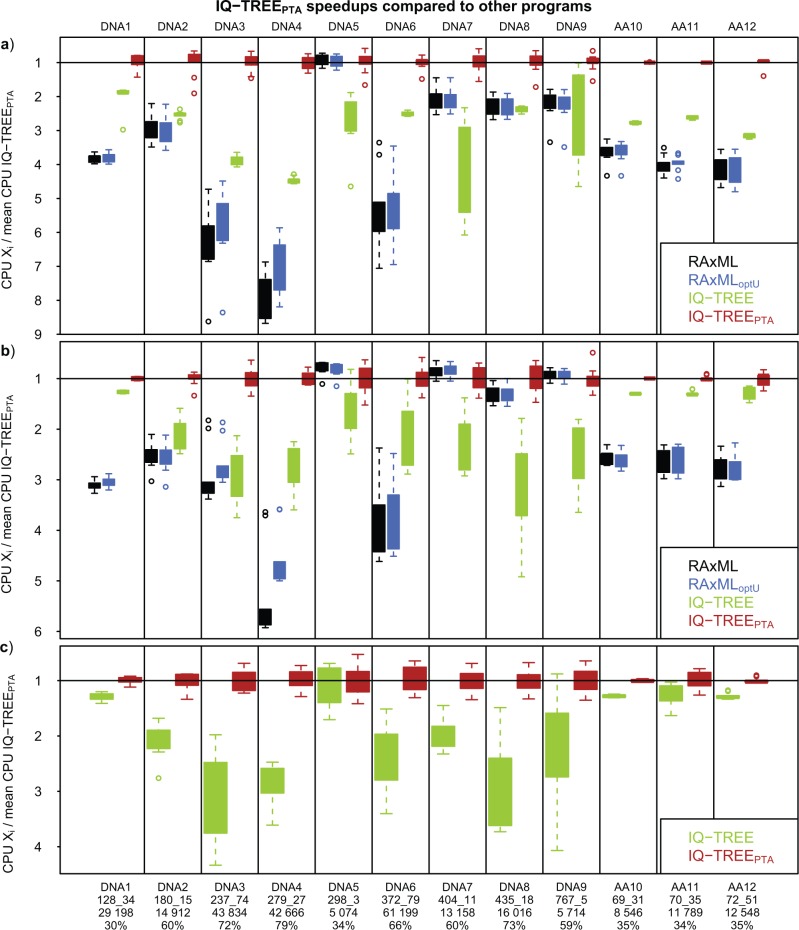
In phylogenomics the analysis of concatenated gene alignments, the so-called supermatrix, is commonly accompanied by the assumption of partition models. Under such models each gene, or more generally partition, is allowed to evolve under its own evolutionary model. Although partition models provide a more comprehensive analysis of supermatrices, missing data may hamper the tree search algorithms due to the existence of phylogenetic (partial) terraces. Here, we introduce the phylogenetic terrace aware (PTA) data structure for the efficient analysis under partition models. In the presence of missing data PTA exploits (partial) terraces and induced partition trees to save computation time. We show that an implementation of PTA in IQ-TREE leads to a substantial speedup of up to 4.5 and 8 times compared with the standard IQ-TREE and RAxML implementations, respectively. PTA is generally applicable to all types of partition models and common topological rearrangements thus can be employed by all phylogenomic inference software.
Overview
The claims and statistics of this paper haven’t been checked yet.
Free: it reads the open-access text and checks the first 5 claims that cite a source we can check. Create a free account to check every claim.
Integrity signals
Registry
Cites
Statistics
Figures



Verification
Claims the paper makes
The claims and statistics of this paper haven’t been checked yet.
Free: it reads the open-access text and checks the first 5 claims that cite a source we can check. Create a free account to check every claim.
Claims other papers make about this one
Each is checked against this paper’s own text: does it say what the citing paper says it does?
The source backs part of the claim, not all of it — or backs it for a different population, condition or comparison.
In the citing paper
“IQ-TREE 2 exploits partial terraces to improve tree search under partitioned models and achieves up to 4.5- and 8-fold speedups compared with IQ-TREE 1 and RAxML, respectively (Chernomor et al. 2016).”
From IQ-TREE 2: New Models and Efficient Methods for Phylogenetic Inference in the Genomic Era (2020) · cites this paper as Chernomor et al. 2016
Experimental — accuracy not yet measuredIn the citing paper
“This finding might not be entirely surprising because IQ-TREE represents the latest development in fast phylogenetic programs and has implemented a novel data structure to facilitate concatenation analysis (Chernomor et al. 2016).”
From Evaluating fast maximum likelihood-based phylogenetic programs using empirical phylogenomic data sets (2018) · cites this paper as Chernomor et al. 2016
Self-check
Percentages, sums and reported differences re-computed from the paper’s own numbers.
The self-check needs the paper’s full text.
Citations
Cites
1 retracted
RETRACTED ARTICLE: TREEFINDER: a powerful graphical analysis environment for molecular phylogenetics
Jobb, G., von Haeseler, A., & Strimmer, K. (2004) · BMC Evolutionary Biology · doi:10.1186/1471-2148-4-18 · Cited by 1,112
RetractedRAxML version 8: a tool for phylogenetic analysis and post-analysis of large phylogenies
Stamatakis, A. (2014) · Bioinformatics · doi:10.1093/bioinformatics/btu033 · Cited by 32,291 · cited 1×
“RAxML (Stamatakis 2014) x x TreeFinder ( IQ-TREE ( Jobb et al. 2004) x x x Nguyen et al. 2015) x x x EL, edge-linked; EUL, which yielded a substantial computation time and memory saving.”
MethodIQ-TREE: A Fast and Effective Stochastic Algorithm for Estimating Maximum-Likelihood Phylogenies
Nguyen, L.-T., Schmidt, H. A., von Haeseler, A., & Minh, B. Q. (2015) · Molecular Biology and Evolution · doi:10.1093/molbev/msu300 · Cited by 26,046 · cited 6×
“RAxML (Stamatakis 2014) x x TreeFinder ( IQ-TREE ( Jobb et al. 2004) x x x Nguyen et al. 2015) x x x EL, edge-linked; EUL, which yielded a substantial computation time and memory saving.”
BackgroundMethodInfluentialSelf-citationGuindon, S., Dufayard, J.-F., Lefort, V., Anisimova, M., Hordijk, W., & Gascuel, O. (2010) · Systematic Biology · doi:10.1093/sysbio/syq010 · Cited by 18,376
RAxML-VI-HPC: maximum likelihood-based phylogenetic analyses with thousands of taxa and mixed models
Stamatakis, A. (2006) · Bioinformatics · doi:10.1093/bioinformatics/btl446 · Cited by 15,582
Lanfear, R., Calcott, B., Ho, S. Y. W., & Guindon, S. (2012) · Molecular Biology and Evolution · doi:10.1093/molbev/mss020 · Cited by 5,732
Zwickl, D. J. (2006) · Texas ScholarWorks (Texas Digital Library) · Cited by 3,530
An Improved General Amino Acid Replacement Matrix
Le, S. Q., & Gascuel, O. (2008) · Molecular Biology and Evolution · doi:10.1093/molbev/msn067 · Cited by 3,127 · cited 1×
“For all partition models we assumed the GTR+ (Lanave et al. 1984; Yang 1994) and the LG+ (Yang 1994; Le and Gascuel 2008) models for all genes in the DNA and the AA alignments, respectively.”
MethodYang, Z. (1994) · Journal of Molecular Evolution · doi:10.1007/bf00160154 · Cited by 2,960 · cited 3×
“1984; Yang 1994) and the LG+ (Yang 1994; Le and Gascuel 2008) models for all genes in the DNA and the AA alignments, respectively.”
BackgroundMethodBroad phylogenomic sampling improves resolution of the animal tree of life
Dunn, C. W., Hejnol, A., Matus, D. Q., Pang, K., Browne, W. E., Smith, S. A., Seaver, E., Rouse, G. W., Obst, M., Edgecombe, G. D., et al. (2008) · Nature · doi:10.1038/nature06614 · Cited by 1,921
Cited by
Items 601–700 of 1,004
Oligocene divergence of frogmouth birds (Podargidae) across Wallace's Line
Oliver, P. M., Heiniger, H., Hugall, A. F., Joseph, L., & Mitchell, K. J. (2020) · Biology Letters · doi:10.1098/rsbl.2020.0040 · Cited by 18
“In IQTREE, we partitioned our data such that each partition had its own evolutionary rate but all partitions contributed to the branch lengths of a single best tree (-spp [26]), and we assessed topological support using 1000 ultrafast bootstrap replicates (resampling within partitions [27]).”
Gutierrez, N., de Brito, A. L. V. T., Mauad, A. V. S. R., & Smidt, E. D. C. (2020) · Botanical Journal of the Linnean Society · doi:10.1093/botlinnean/boaa092 · Cited by 18
Genetic Variability of Koi Herpesvirus In vitro—A Natural Event?
Klafack, S., Wang, Q., Zeng, W., Wang, Y., Li, Y., Zheng, S., Kempter, J., Lee, P.-Y. A., Matras, M., & Bergmann, S. M. (2017) · Frontiers in Microbiology · doi:10.3389/fmicb.2017.00982 · Cited by 18
“Phylogenetic trees were constructed with IQtree and ultrafast bootstrap (B = 1000; Minh et al., 2013; Nguyen et al., 2015; Chernomor et al., 2016).”
MethodDemotte, P. (2025) · EcoEvoRxiv · doi:10.5281/zenodo.15321226 · Cited by 18
Convergent extreme reductive evolution in ancient planthopper symbioses
Michalik, A., Franco, D. C., Deng, J., Prus-Frankowska, M., Stroiński, A., & Łukasik, P. (2026) · Nature Communications · doi:10.1038/s41467-026-69238-x · Cited by 17
“To decide on the partitioning scheme and the substitution model, we asked IQ-TREE2 to perform extended model selection on each gene with free rate heterogeneity and subsequently merge genes until the model fi t does not increase any further (setting: -m MFP + MERGE 69 .”
Testo, W., de Gasper, A. L., Molino, S., y Galán, J. M. G., Salino, A., Dittrich, V. A. D. O., & Sessa, E. B. (2022) · American Journal of Botany · doi:10.1002/ajb2.16062 · Cited by 17
“We conducted maximum likelihood analyses using IQTree 1.6.10 (Nguyen et al., 2015) with ultrafast bootstrapping (Hoang et al., 2018) and a partitioned data set (Chernomor et al., 2016) where each locus was modeled independently.”
MethodInfluentialGenomic diversification of the specialized parasite of the fungus-growing ant symbiosis
Gotting, K., May, D. S., Sosa‐Calvo, J., Khadempour, L., Francoeur, C. B., Berasategui, A., Thairu, M. W., Sandstrom, S., Carlson, C. M., Chevrette, M. G., et al. (2022) · Proceedings of the National Academy of Sciences · doi:10.1073/pnas.2213096119 · Cited by 17
Ren, C.-Q., Zhang, D., Liu, X., & Zhang, J. (2023) · Molecular Phylogenetics and Evolution · doi:10.1016/j.ympev.2023.107863 · Cited by 17
Eastman, K. E., Pendleton, A. L., Shaikh, M. A., Suttiyut, T., Ogas, R. A., Tomko, P., Gavelis, G. S., Widhalm, J. R., & Wisecaver, J. H. (2023) · G3 Genes Genomes Genetics · doi:10.1093/g3journal/jkad234 · Cited by 17
“The concatenated ML tree was constructed based on the combined 28S and H3 data matrix (Chernomor et al. 2016) consisting of 2 partitions and 2006 sites.”
MethodIntra- and interspecific variation of Amblyomma ticks from southern Africa
Smit, A., Mulandane, F. C., Labuschagne, M., Wojcik, S. H., Malabwa, C., Sili, G., Mandara, S., Dlamkile, Z., Ackermann, R., Vineer, H. R., et al. (2024) · Parasites & Vectors · doi:10.1186/s13071-024-06394-3 · Cited by 17
“Partitioning was applied to the super-matrix [53] with a 1000 bootstrap replicates using the ultrafast boot-strapping method [54].”
MethodSheikh, S., Fu, C.-J., Brown, M. W., & Baldauf, S. L. (2024) · Nature Communications · doi:10.1038/s41467-024-54029-z · Cited by 17
The genome assembly of the duckweed fern, Azolla caroliniana
Song, M. J., Rizzieri, Y. C., Li, F., Freund, F. D., Escalona, M., Toffelmier, E. M., Miller, C., Shaffer, H. B., Nguyen, O., Marimuthu, M. P. A., et al. (2025) · Journal of Heredity · doi:10.1093/jhered/esaf022 · Cited by 17
“3.5 (Minh et al. 2020), using the partition model -p, where each gene partition is allowed to have its own average substitution rate (Chernomor et al. 2016).”
InfluentialAndersen, A. N., Hoffmann, B. D., & Oberprieler, S. K. (2020) · Diversity · doi:10.3390/d12100386 · Cited by 17
“Model selection was inferred using a 3-codon partition file and linked branch lengths with the AutoMRE ‘ModelFinder’ function to find the best-fit model for tree inference [25].”
MethodSidharthan, A., Raghavan, R., Anoop, V. K., Philip, S., & Dahanukar, N. (2020) · Journal of Biogeography · doi:10.1111/jbi.13972 · Cited by 17
A New, Miniaturized Genus and Species of Snake (Cyclocoridae) from the Philippines
Weinell, J. L., Paluh, D. J., Siler, C. D., & Brown, R. M. (2020) · Ichthyology & Herpetology · doi:10.1643/ch2020110 · Cited by 17
“We treated each locus as a separate partition, and we used the automatic model-selection feature (Chernomor et al., 2016) to identify and assign the best-fit substitution model for each partition during tree inference.”
MethodBerbigier, A. P., Barros, J. H. D. S., Pontes, E. S., Lisboa, C. V., Gentile, R., Xavier, S. C. D. C., Jansen, A. M., & Roque, A. L. R. (2021) · Pathogens · doi:10.3390/pathogens10111442 · Cited by 17
Tian, H., Koski, T., Zhao, L., Liu, Z., & Sun, J. (2022) · Frontiers in Plant Science · doi:10.3389/fpls.2022.856841 · Cited by 17
Arnuphapprasert, A., Nugraheni, Y. R., Poofery, J., Aung, A., Kaewlamun, W., Chankeaw, W., Tasanaganjanakorn, T., Wattanamethanont, J., & Kaewthamasorn, M. (2022) · Ticks and Tick-borne Diseases · doi:10.1016/j.ttbdis.2022.102110 · Cited by 17
Talavera, A., Nie, Z., Ma, Z., Johnson, G. P., Ickert‐Bond, S. M., Zimmer, E. A., & Wen, J. (2023) · Molecular Phylogenetics and Evolution · doi:10.1016/j.ympev.2023.107866 · Cited by 17
Drift in the tropics: Phylogenetics and biogeographical patterns in Combretaceae
Maurin, O., Anest, A., Forest, F., Turner, I. M., Barrett, R. L., Cowan, R. C., Wang, L., Tomlinson, K. W., & Charles‐Dominique, T. (2023) · Global Ecology and Biogeography · doi:10.1111/geb.13737 · Cited by 17
“0 (Minh et al., 2020 ), selecting the ultrafast bootstrap (1000 replicates, UFBoot2; Chernomor et al., 2016 ) and the model selection option (- m MFP).”
MethodSierra, L. A. B., Mendes-Pereira, T., García, G. J. Y., Werkhaizer, C. Q., de Rezende, J. B., Rodrigues, T. A. B., Badotti, F., Cardoso, E. S. D. C., da Costa, A. M., Uetanabaro, A. P. T., et al. (2023) · PeerJ Materials Science · doi:10.7717/peerj-matsci.31 · Cited by 17
Evolution and postglacial colonization of Seewis hantavirus with Sorex araneus in Finland
Ling, J., Smura, T., Tamarit, D., Huitu, O., Voutilainen, L., Henttonen, H. A., Vaheri, A. I., Vapalahti, O., & Sironen, T. A. (2017) · Infection Genetics and Evolution · doi:10.1016/j.meegid.2017.11.010 · Cited by 17
Korábek, O., Petrusek, A., & Rovatsos, M. (2019) · ZooKeys · doi:10.3897/zookeys.827.33057 · Cited by 17
Transgressing Wallace's Line brings hyperdiverse weevils down to earth
Letsch, H. O., Balke, M., Toussaint, E. F. A., Narakusumo, R. P., Fiedler, K., & Riedel, A. (2020) · Ecography · doi:10.1111/ecog.05128 · Cited by 17
Zhou, Y., Nicholls, J. A., Liu, Z., HARTLEY, D. M., Szitó, A., Ślipiński, A., & Zwick, A. (2022) · Insect Systematics and Diversity · doi:10.1093/isd/ixac026 · Cited by 17
Bacteria can maintain rRNA operons solely on plasmids for hundreds of millions of years
Anda, M., Yamanouchi, S., Cosentino, S., Sakamoto, M., Ohkuma, M., Takashima, M., Toyoda, A., & Iwasaki, W. (2023) · Nature Communications · doi:10.1038/s41467-023-42681-w · Cited by 16
Fouquet, A., Ferrão, M., Rodrigues, M. T., Werneck, F. P., Prates, I., Moraes, L. J. C. D. L., Hrbek, T., Chaparro, J. C., LIMA, A. P., Pérez, R., et al. (2024) · Systematics and Biodiversity · doi:10.1080/14772000.2023.2291086 · Cited by 16
“We then selected the best-fit partition combination scheme and model of evolution for each partition using Modelfinder in IQTREE (Chernomor et al., 2016; Kalyaanamoorthy et al., 2017), according to the Bayesian Information Criterion (BIC).”
InfluentialEvolutionary Dynamics of RuBisCO: Emergence of the Small Subunit and its Impact Through Time
Amritkar, K., Cuevas-Zuviría, B., & Kaçar, B. (2024) · Molecular Biology and Evolution · doi:10.1093/molbev/msae268 · Cited by 16
“A maximum-likelihood phylogenetic tree was constructed for the concatenated alignment using IQ-Tree, with a partition model (Chernomor et al. 2016) and ModelFinder plus (Kalyaanamoorthy et al. 2017) to search and implement the best-fit evolutionary models corresponding to the RbcL (LG+R9) and RbcS…”
Within-host competition causes pathogen molecular evolution and perpetual microbiota dysbiosis
Stevens, E. J., Li, J., Hector, T. E., Drew, G., Hoang, K. L., Greenrod, S. T. E., Paterson, S., & King, K. C. (2025) · The ISME Journal · doi:10.1093/ismejo/wraf071 · Cited by 16
Kelava, S., Nakao, R., Mans, B. J., Cho, M., Mateo, K. B. T., Apanaskevich, D. A., Shao, R., Gofton, A. W., Teo, E. J. M., Ito, T., et al. (2025) · International Journal for Parasitology · doi:10.1016/j.ijpara.2025.04.016 · Cited by 16
A distinctive new species of flowerpecker (Passeriformes: Dicaeidae) from Borneo
SAUCIER, J. R., Milensky, C. M., Caraballo‐Ortiz, M. A., Ragai, R., Dahlan, N. F., & Edwards, D. P. (2019) · Zootaxa · doi:10.11646/zootaxa.4686.4.1 · Cited by 16
“We then concatenated the multiple sequence alignments for both genes, resulting in a matrix of 1,909 bp, and performed a Maximum Likelihood analysis with partitions using IQ-TREE, allowing the program to find the best-fit partitioning scheme possible to merge partitions (Chernomor et al. 2016).”
MethodSudasinghe, H., Ranasinghe, T., Pethiyagoda, R. S., Meegaskumbura, M., & Britz, R. (2020) · Ichthyological Research · doi:10.1007/s10228-020-00768-0 · Cited by 16
Hogan, M., Whittington, A. C., Broe, M. B., Ward, M. J., Gibbs, H. L., & Rokyta, D. R. (2021) · Journal of Molecular Evolution · doi:10.1007/s00239-021-10007-3 · Cited by 16
“5 (Nguyen et al. 2014; Chernomor et al. 2016; Kalyaanamoorthy et al. 2017; Hoang et al. 2017), with identical input commands described earlier minus the -st CODON option.”
MethodMiranda‐Blancas, R., Avelar, M., Rodriguez-Arteaga, A., Sinicropi, A., & Rudiño-Piñera, E. (2021) · Journal of Structural Biology · doi:10.1016/j.jsb.2021.107740 · Cited by 16
Disparate origins for endemic bird taxa from the ‘Gondwana Rainforests’ of Central Eastern Australia
Mitchell, K. J., Hugall, A. F., Heiniger, H., Joseph, L., & Oliver, P. M. (2021) · Biological Journal of the Linnean Society · doi:10.1093/biolinnean/blab031 · Cited by 16
“In each analysis, we partitioned our data such that each partition had its own evolutionary rate but all partitions contributed to the branch lengths of a single best tree (-spp; Chernomor et al., 2016), and we assessed topological support using 1000 ultrafast bootstrap replicates (resampling within partitions; Hoang…”
MethodNeiber, M. T., Walther, F., KIJASHKO, P. V., Mumladze, L., & Hausdorf, B. (2021) · Cladistics · doi:10.1111/cla.12479 · Cited by 16
Gippner, S., Travers, S. L., Scherz, M. D., Colston, T. J., Lyra, M. L., Mohan, A. V., MULTZSCH, M., Nielsen, S. V., Rancilhac, L., Glaw, F., et al. (2021) · Molecular Phylogenetics and Evolution · doi:10.1016/j.ympev.2021.107311 · Cited by 16
“The best-fitting substitu-tion models and gene-partitions were selected using ModelFinder as implemented in IQ-TREE (Chernomor et al., 2016; Kalyaanamoorthy et al., 2017).”
InfluentialSzarvas, J., Rebelo, A. R., Bortolaia, V., Leekitcharoenphon, P., Hansen, D. S., Nielsen, H. L., Nørskov‐Lauritsen, N., Kemp, M., Røder, B. L., Møller, J. K., et al. (2021) · Journal of Fungi · doi:10.3390/jof7110962 · Cited by 16
Ramisyllis kingghidorahi n. sp., a new branching annelid from Japan
Aguado, M. T., Ponz‐Segrelles, G., Glasby, C. J., Ribeiro, R. P., Nakamura, M., Oguchi, K., Omori, A., Kohtsuka, H., Fischer, C., Ise, Y., et al. (2022) · Organisms Diversity & Evolution · doi:10.1007/s13127-021-00538-4 · Cited by 16
“Circular mt-genome representation was obtained with GenomeVx (Conant & Wolfe, 2008).”
MethodOberski, J. T. (2022) · Insect Systematics and Diversity · doi:10.1093/isd/ixab022 · Cited by 16
Almeida, S. C., Neiva, J., Sousa, F., Martins, N., Cox, C. J., Melo‐Ferreira, J., Guiry, M. D., Serrão, E. Á., & Pearson, G. A. (2022) · Molecular Ecology · doi:10.1111/mec.16623 · Cited by 16
“…and phylogenetic and statistical approaches can account for ILS or other sources of discordance between gene and species trees (Ané et al., 2007; Chung & Ané, 2011; De Maio et al., 2015; Heled & Drummond, 2010; Larget et al., 2010; Mirarab et al., 2014), as well as the detection of potential…”
BackgroundThe histone code of the fungal genus Aspergillus uncovered by evolutionary and proteomic analyses
Zhang, X., Noberini, R., Bonaldi, T., Collemare, J., & Seidl, M. F. (2022) · Microbial Genomics · doi:10.1099/mgen.0.000856 · Cited by 16
“The maximum-likelihood phylogeny of Histone deacetylase domains (PF00850) found 537 in 94 Aspergilli and 15 outgroup species was determined using IQ-TREE (37,38).”
MethodInfluentialTaylor, J. D., Glover, E. A., Yuen, B., & Williams, S. T. (2022) · Journal of Molluscan Studies · doi:10.1093/mollus/eyac025 · Cited by 16
Sagorny, C., von Döhren, J., Rouse, G. W., & Ekin, T. (2022) · European Journal of Taxonomy · doi:10.5852/ejt.2022.845.1959 · Cited by 16
“1.6.12 (Nguyen et al. 2015; Chernomor et al. 2016) under optimal nucleotide substitution models and partitioning schemes as suggested by PartitionFinder.”
MethodInfluentialBorissov, S., Heller, K., Çıplak, B., & Chobanov, D. (2023) · Systematic Entomology · doi:10.1111/syen.12580 · Cited by 16
“Substitution models were inferred by the incorporated ModelFinder (Kalyaanamoorthy et al., 2017), using partitions (Chernomor et al., 2016).”
MethodRizal, L. M., Hereward, J., Brookes, D. R., Furlong, M. J., & Walter, G. H. (2022) · Fungal ecology · doi:10.1016/j.funeco.2023.101304 · Cited by 16
Maddison, W. P., & Szűts, T. (2019) · ZooKeys · doi:10.3897/zookeys.842.32970 · Cited by 16
“Because the options “-m MFP -spp” were used, IQ–TREE inferred models of evolution for each partition (Kalyaanamoorthy et al. 2017), and whether to merge partitions (Chernomor et al. 2016).”
MethodZakeri, Z., Otte, V., Sipman, H. J. M., Malíček, J., Cubas, P., Rico, V. J., Lenzová, V., Svoboda, D., & Divakar, P. K. (2019) · PLoS ONE · doi:10.1371/journal.pone.0216675 · Cited by 16
Zhang, C., Li, S., Zhang, Y., Zhu, Z.-M., Liu, J., & Gao, X. (2019) · Conservation Genetics · doi:10.1007/s10592-019-01227-8 · Cited by 16
Shen, Z., Mannion, A. J., Lin, M., Esmail, M. Y., Bakthavatchalu, V., Yang, S., Ho, C., Feng, Y., Smith, B. D., Elliott, J. J., et al. (2020) · INTERNATIONAL JOURNAL OF SYSTEMATIC AND EVOLUTIONARY MICROBIOLOGY · doi:10.1099/ijsem.0.004424 · Cited by 16
“12) using 1000 bootstrap replicates [21, 22].”
Leahy, L., Scheffers, B. R., Williams, S. E., & Andersen, A. N. (2020) · Diversity · doi:10.3390/d12120474 · Cited by 16
“Model selection was inferred using a 3-codon partition file and linked branch lengths with the AutoMRE ‘ModelFinder’ function to find the best-fit model for tree inference [49].”
MethodPauli, T., Meusemann, K., Kukowka, S., Sann, M., Donath, A., Mayer, C., Oeyen, J. P., Ballesteros, Y., Berg, A., van den Berghe, E., et al. (2021) · Insect Systematics and Diversity · doi:10.1093/isd/ixaa018 · Cited by 16
El-Gharabawy, H. M., Leal-Dutra, C. A., & Griffith, G. W. (2020) · Fungal Biology · doi:10.1016/j.funbio.2021.01.004 · Cited by 16
Sudasinghe, H., Dahanukar, N., Raghavan, R., Senavirathna, T., Shewale, D. J., Paingankar, M. S., Amarasinghe, A., Pethiyagoda, R. S., Rüber, L., & Meegaskumbura, M. (2020) · Biological Journal of the Linnean Society · doi:10.1093/biolinnean/blaa221 · Cited by 16
Ceballos-Escalera, A., Richards, J. L., Arias, M. B., Inward, D. J. G., & Vogler, A. P. (2022) · MycoKeys · doi:10.3897/mycokeys.88.77106 · Cited by 16
“Model testing, tree building, and ultrafast bootstrap approximation (n = 1000) were performed in IQ-Tree2 (Chernomor et al. 2016; Minh et al. 2020).”
MethodDey, P. K., López‐López, A., Morek, W., & Michalczyk, Ł. (2023) · Zoological Journal of the Linnean Society · doi:10.1093/zoolinnean/zlad161 · Cited by 15
Molluscan Genomes Reveal Extensive Differences in Photopigment Evolution Across the Phylum
McElroy, K. E., Audino, J. A., & Serb, J. M. (2023) · Molecular Biology and Evolution · doi:10.1093/molbev/msad263 · Cited by 15
“We then used catsequences (https://zenodo.org/record/4409153#.Y8gnmXbMJPY) to concatenate the 899 trimmed amino acid alignments and combined the accompanying partition configuration file with the ModelFinder results as input for the partitioned analysis in IQ-TREE2 (Chernomor et al. 2016).”
MethodInfluentialDebunking the Myth of Fusarium poae T-2/HT-2 Toxin Production
Witte, T. E., Hicks, C., Hermans, A., Shields, S., & Overy, D. P. (2024) · Journal of Agricultural and Food Chemistry · doi:10.1021/acs.jafc.3c08437 · Cited by 15
Main, D. C., Taft, J. M., Geneva, A. J., van Vuuren, B. J., & Tolley, K. A. (2024) · PeerJ · doi:10.7717/peerj.17076 · Cited by 15
“0.3 ( Minh et al., 2020b ) with the optimal model of molecular evolution estimated for each gene separately using the built-in ModelFinder implemented in IQ-TREE ( Chernomor, von Haeseler & Minh, 2016 ; Kalyaanamoorthy et al., 2017 ).”
MethodInfluentialPhylogenomic analysis reveals the evolutionary history of Paleartic needle-leaved junipers
Gutiérrez‐Larruscain, D., Vargas, P., Fernández‐Mazuecos, M., & Pausas, J. G. (2024) · Molecular Phylogenetics and Evolution · doi:10.1016/j.ympev.2024.108162 · Cited by 15
Ruiz, D. C., Vallès, J., Bayer, R. J., Palazzesi, L., Pellicer, J., Pérez-Lorenzo, I., Maurin, O., Françoso, E., Roy, S. R., Leitch, I. J., et al. (2024) · Journal of Systematics and Evolution · doi:10.1111/jse.13118 · Cited by 16
“ML analyses were conducted using the IQ ‐ TREE 2 partitioned analysis ( ‐ p) (Chernomor et al., 2016), specifying a substitution model for each gene partition.”
Lhéritier, M., Edgecombe, G. D., Garwood, R. J., Buisson, A., Gerbe, A., Koch, N. M., Vannier, J., Escarguel, G., Adrien, J., Fernández, V., et al. (2024) · Science Advances · doi:10.1126/sciadv.adp6362 · Cited by 15
Mera‐Rodríguez, D., Fernández‐Marín, H., & Rabeling, C. (2024) · Systematic Entomology · doi:10.1111/syen.12665 · Cited by 16
“We used ModelFinder (Chernomor et al., 2016; Kalyaanamoorthy et al., 2017) to find the best-fitting model of molecular evolution for each of the partitions.”
Explosion of goby fish diversity at the Eocene-Oligocene transition
McCraney, W. T., Thacker, C. E., Faircloth, B. C., Harrington, R. C., Near, T. J., & Alfaro, M. E. (2025) · Molecular Phylogenetics and Evolution · doi:10.1016/j.ympev.2025.108342 · Cited by 15
“First, we inferred phylogenies from the concatenated-partitioned dataset with maximum likelihood (ML) and Bayesian analysis with IQ-TREE and ExaBayes, respectively (Aberer et al., 2014; Chernomor et al., 2016; Izquierdo-Carrasco et al., 2011; Kalyaana-moorthy et al., 2017; Minh et al., 2020).”
Batelka, J., Kundrata, R., & Straka, J. (2025) · Systematic Entomology · doi:10.1111/syen.12683 · Cited by 15
“We organized partitions by locus, merging gene subsets with similar sub-stitution rates ( (cid:1) m TESTNEWMERGE), and utilized the -rclusterf setting at 10 (Chernomor et al., 2016) as implemented in ModelFinder (Kalyaanamoorthy et al., 2017).”
Haelewaters, D., Boer, P. J. D., Báthori, F., Rádai, Z., Reboleirа, А. S. P. S., Tartally, A., Pfliegler, W. P., Kesel, A. D., & Nedvěd, O. (2019) · Parasite · doi:10.1051/parasite/2019028 · Cited by 15
Fryar, S. C., Haelewaters, D., & Catcheside, D. (2019) · Mycological Progress · doi:10.1007/s11557-019-01499-x · Cited by 15
Towards an integrative taxonomy ofPhyllopsora(Ramalinaceae)
Kistenich, S., Bendiksby, M., Ekman, S., Cáceres, M. E. D. S., Hernández, J., & Timdal, E. (2019) · The Lichenologist · doi:10.1017/s0024282919000252 · Cited by 15
“…nucleotide substitution model among those implemented inMrBayes (i.e. 1-, 2- and 6-rate models), for finding the best partitioning scheme (Chernomor et al. 2016; Kalyaanamoorthy et al. 2017) and for constructing a maximum likelihood phylogeny with assessment of bootstrap branch support…”
MethodA new species of Caecilia (Gymnophiona, Caeciliidae) from the Magdalena valley region of Colombia
Acosta‐Galvis, A. R., Torres, M., & Pulido‐Santacruz, P. (2019) · ZooKeys · doi:10.3897/zookeys.884.35776 · Cited by 15
“…COI first codon position, COI second codon position, COI third codon position) using the partition finder algorithm (-m option TESTMERGE; Lanfear et al. 2012) in IQ-TREE and best fitting models for each partition selected by the same program (Chernomor et al. 2016; Kalyaanamoorthy et al. 2017).”
BackgroundMethodShetty, P., Farkas, A. E., Pap, B., Hupp, B., Ördög, V., Bíró, T., Varga, T., & Maróti, G. (2021) · Algal Research · doi:10.1016/j.algal.2021.102380 · Cited by 15
Phylogenetics of Archerfishes (Toxotidae) and Evolution of the Toxotid Shooting Apparatus
Girard, M. G., Davis, M. P., Tan, H. H., Wedd, D., Chakrabarty, P., Ludt, W. B., Summers, A., & Smith, W. L. (2022) · Integrative Organismal Biology · doi:10.1093/iob/obac013 · Cited by 15
Novel Bat Lyssaviruses Identified by Nationwide Passive Surveillance in Taiwan, 2018–2021
Hu, S.-C., Hsu, C.-L., Lee, F., Tu, Y., Chen, Y., Chang, J., & Hsu, W.-C. (2022) · Viruses · doi:10.3390/v14071562 · Cited by 15
Reilly, S. B., Karin, B. R., Stubbs, A. L., Arida, E. A., Arifin, U., Kaiser, H., Bi, K., Hamidy, A., Iskandar, D. T., & McGuire, J. A. (2022) · Evolution · doi:10.1111/evo.14592 · Cited by 15
“1.1 (Chernomor et al. 2016; Minh et al. 2020) with automatic model selection according to BIC scores (Kalyaanamoorthy et al. 2017).”
MethodInfluentialWalton, K., Scarsbrook, L., Mitchell, K. J., Verry, A. J. F., Marshall, B. A., Rawlence, N. J., & Spencer, H. G. (2022) · Molecular Ecology Resources · doi:10.1111/1755-0998.13696 · Cited by 15
“…that each partition had its own unspecified evolutionary rate, but all partitions contributed to the branch lengths of a single best tree (- spp; Chernomor et al., 2016), with topological support assessed using 1000 ultrafast- bootstrap replicates (resampling within partitions; Hoang et al.,…”
MethodGuacchio, E. D., Bureš, P., Iamonico, D., Carucci, F., Luca, D. D., Zedek, F., & Caputo, P. (2022) · Plant Biosystems - An International Journal Dealing with all Aspects of Plant Biology · doi:10.1080/11263504.2022.2131924 · Cited by 15
“We applied a partition model analysis (Chernomor et al. 2016), which allows each marker to have its own model of nucleotide substitution, using the PartitionFinder algorithm (option -m MFP + MERGE; Lanfear et al. 2012) that tries to merge partitions to reduce possible over-parameterization…”
Konopleva, E. S., Lheknim, V., Sriwoon, R., Kondakov, A. V., Tomilova, A. A., Gofarov, M. Y., Vikhrev, I. V., & Болотов, И. Н. (2022) · Diversity · doi:10.3390/d15010010 · Cited by 15
Silva, S. R., Miranda, V. F. O., Michael, T. P., Płachno, B. J., Matos, R. G., Adamec, L., Pond, S. L. K., Lucaci, A. G., Pinheiro, D. G., & Varani, A. M. (2023) · Molecular Phylogenetics and Evolution · doi:10.1016/j.ympev.2023.107711 · Cited by 15
Sato, C., Nendai, N., Nagata, N., Okuzaki, Y., Ikeda, H., Minamiya, Y., & Sota, T. (2023) · Molecular Phylogenetics and Evolution · doi:10.1016/j.ympev.2023.107735 · Cited by 15
Dittmer, J., Bredon, M., Moumen, B., Raimond, M., Grève, P., & Bouchon, D. (2023) · ISME Communications · doi:10.1038/s43705-023-00224-w · Cited by 15
“1 [73] was used to predict the optimal amino acid substitution model for each gene partition [74, 75] and to produce a Maximum Likelihood phylogenetic tree with 1000 bootstrap iterations.”
MethodChelladurai, J. R. J. J., Abraham, A., Quintana, T. A., Smith, V., & Ritchie, D. (2023) · Pathogens · doi:10.3390/pathogens12050675 · Cited by 15
“…supermatrix was performed with IQtree2 (Version 2.1.0) [45] with ultrafast bootstrap approximation [46], using ModelFinder [47] to determine the best-fit model for each gene in the supermatrix (that is, partition model) [48], according to Akaike information criterion (AIC) scores and weights.”
MethodInfluentialPinniped Diphyly and Bat Triphyly: More Homology Errors Drive Conflicts in the Mammalian Tree
Springer, M. S., & Gatesy, J. (2017) · Journal of Heredity · doi:10.1093/jhered/esx089 · Cited by 15
Burzyński, A., & Soroкa, М. (2018) · PeerJ · doi:10.7717/peerj.5573 · Cited by 15
Quijada, L., Tanney, J. B., Popov, E. S., Johnston, P. R., & Pfister, D. H. (2019) · Fungal Systematics and Evolution · doi:10.3114/fuse.2020.05.05 · Cited by 15
Sequencing and Analysis of the Complete Organellar Genomes of Prototheca wickerhamii
Bakuła, Z., Gromadka, R., Gawor, J., Siedlecki, P. S., Pomorski, J. J., Maciszewski, K., Gromadka, A., Karnkowska, A., & Jagielski, T. (2020) · Frontiers in Plant Science · doi:10.3389/fpls.2020.01296 · Cited by 15
Carrión–Olmedo, J. C., & Ron, S. R. (2021) · Evolutionary Systematics · doi:10.3897/evolsyst.5.62661 · Cited by 15
“To choose the substitution models that best adjusted to our sequences, we used Model Finder under the command MFP+MERGE (Kalyaanamoorthy et al. 2017; Chernomor et al. 2016) as implemented in IQTREE 1.6.8 (Nguyen et al. 2015).”
MethodInfluentialБогданов, А. С., Khlyap, L. A., Kefelioğlu, H., Selçuk, A. Y., Stakheev, V. V., & Baskevich, M. I. (2021) · Journal of Zoological Systematics & Evolutionary Research · doi:10.1111/jzs.12539 · Cited by 15
Ye, Y.-Q., Hao, Z.-P., Yue, Y.-Y., Ma, L., Ye, M.-Q., & Du, Z. (2022) · Frontiers in Marine Science · doi:10.3389/fmars.2022.919253 · Cited by 15
“The percentage of conserved protein (POCP) value was calculated as described by Qin et al. (2014).6 The ribosomal protein phylogenetic tree was reconstructed by FastTree (Price et al., 2009) using JTT+ CAT parameters and IQTREE (Nguyen et al., 2015; Chernomor et al., 2016) using the LG +F+I+G4 model.”
MethodThree New Species of Clonostachys (Hypocreales, Ascomycota) from China
Zeng, Z.-Q., & Zhuang, W.-Y. (2022) · Journal of Fungi · doi:10.3390/jof8101027 · Cited by 15
“12 [36] using the best model for each locus, as chosen by ModelFinder [37].”
MethodInfluentialLucentini, L., Plazzi, F., Sfriso, A., Pizzirani, C., Sfriso, A., & Chiesa, S. (2020) · Journal of Zoological Systematics & Evolutionary Research · doi:10.1111/jzs.12386 · Cited by 15
Distinct hybridization modes in wide- and narrow-ranged lineages of Causonis (Vitaceae)
Yu, J., Zhao, H. C., Niu, Y., You, Y., Barrett, R. L., Ranaivoson, R. M., Rabarijaona, R. N., Parmar, G., Yuan, L., Jin, X., et al. (2023) · BMC Biology · doi:10.1186/s12915-023-01718-8 · Cited by 14
“…136taxa-810nu dataset, we used IQ-TREE v.2.1.2 [96] to construct the phylogeny with the maximum likelihood (ML) approach using the concatenated ortholog alignments with 5000 ultrafast [97] under the edge-unlinked partitioned model [98], and the best model scheme was selected by ModelFinder [99].”
MethodInfluentialAcanthocephalans of marine and freshwater fishes from Taiwan with description of a new species
Lisitsyna, O. I., Barčák, D., Orosová, M., Fan, C., & Oros, M. (2023) · Folia Parasitologica · doi:10.14411/fp.2023.021 · Cited by 14
Metazoa‐level USCOs as markers in species delimitation and classification
Dietz, L., Mayer, C., Stolle, E., Eberle, J., Misof, B. Y., Podsiadłowski, L., Niehuis, O., & AHRENS, D. C. (2023) · Molecular Ecology Resources · doi:10.1111/1755-0998.13921 · Cited by 14
“For both the concatenated nucleotide dataset and the concatenated amino-acid dataset, the best fitting substitution model and partitioning scheme were inferred with ModelFinder (Chernomor et al., 2016; Kalyaanamoorthy et al., 2017) and PartitionFinder (Lanfear et al., 2014) as implemented in IQ-TREE using the full lis…”
MethodFerreira, J., Desutter‐Grandcolas, L., Nel, A., Josse, H., & de Campos, L. D. (2024) · Systematic Entomology · doi:10.1111/syen.12625 · Cited by 14
“The molecular data set was partitioned into five subsets, each corresponding to a molecular marker or its subunits (i.e., 12S, 16S, 18S, 28SA and 28SD), and the partition model implemented in IQ-TREE 2 was used (Chernomor et al., 2016).”
MethodPhylogenomic resolution of lampreys reveals the recent evolution of an ancient vertebrate lineage
Hughes, L. C., Bloom, D. D., Piller, K. R., Lang, N., & Mayden, R. L. (2025) · Proceedings of the Royal Society B Biological Sciences · doi:10.1098/rspb.2024.2101 · Cited by 14
de Chambrier, A., Brabec, J., Tran, B. T., & Scholz, T. (2019) · Parasitology Research · doi:10.1007/s00436-019-06326-6 · Cited by 14
Chamorro, M. L., de Medeiros, B. A. S., & Farrell, B. D. (2021) · Ecology and Evolution · doi:10.1002/ece3.7131 · Cited by 14
“The best partitioning scheme, with nine partitions (Appendix S4), was used in the search for the best tree (Chernomor et al., 2016), with support evaluated with ultrafast bootstrapping (Hoang et al., 2018).”
Donzelli, S., Spinella, F., Domenico, E. G. D., Pontone, M., Cavallo, I., Orlandi, G., Iannazzo, S., Ricciuto, G. M., ISG Virology Covid Team, Pellini, R., et al. (2022) · Computational and Structural Biotechnology Journal · doi:10.1016/j.csbj.2022.01.021 · Cited by 14
“For phylogenetic analysis, we inferred the maximum-likelihood tree using the edge-linked partition model in IQ-TREE (http://www.iqtree.org/) [34,35]. wide over than 80 millions of infected people with around 2 millions deaths.”
Satler, J. D., Herre, E. A., Heath, T. A., Machado, C. A., Zúñiga, A. G., & Nason, J. D. (2022) · Molecular Ecology · doi:10.1111/mec.16373 · Cited by 14
“6.12 (Chernomor et al., 2016; Nguyen et al., 2015).”
InfluentialPyron, R. A., Beamer, D. A., Holzheuser, C. R., Lemmon, E. M., Lemmon, A. R., Wynn, A. H., & O’Connell, K. A. (2022) · Conservation Genetics · doi:10.1007/s10592-021-01424-4 · Cited by 14
A New Species of the Pond Loaches Misgurnus (Cobitidae) from the South of Sakhalin Island
Shedko, S. V., & Васильева, Е. Д. (2022) · Journal of Ichthyology · doi:10.1134/s0032945222030158 · Cited by 14
“Maximum likelihood phylogenetic trees were constructed using the IQ-TREE v.12 software package (Nguyen et al., 2015; Chernomor et al., 2016), operating with optimal models of nucleotide substitutions (in the case of cyt b gene, with the “spp” option activated).”
Method
Metadata
- Authors
- Chernomor, O., von Haeseler, A., & Minh, B. Q.
- Affiliations
- University of Vienna (AT)
- ORCID
- Chernomor, Olga
- Venue
- Systematic Biology
- Publisher
- Oxford University Press (OUP)
- Published
- 2016-04-26
- Volume
- 65
- Issue
- 6
- Pages
- 997-1008
- ISSN
- 1063-5157 (ISSN-L)
- 1076-836X
- PMC
- PMC5066062
- OpenAlex
- W2344940607
- Cited by
- 2,252
- References
- 41
- Citations by year
- 2026: 240 · 2025: 285 · 2024: 328 · 2023: 322 · 2022: 289 · 2021: 331 · 2020: 214 · 2019: 134 · 2018: 75 · 2017: 31 · 2016: 3
- FWCI
- 42.08
- Type
- journal article
- Language
- en
- Open access
- hybrid
- doi.org
- Licence
- cc-by-nc
- Locations
- Systematic Biology (publishedVersion, cc-by-nc)
- PubMed Central (publishedVersion, cc-by-nc)
- PubMed (publishedVersion)
- HighWire Press Open Archive (submittedVersion)
- Funders
- Austrian Science Fund (I-2805-B29, I-1824-B22)
- Topics
- Life Sciences › Biochemistry, Genetics and Molecular Biology › Molecular Biology › Genomics and Phylogenetic Studies
- Life Sciences › Biochemistry, Genetics and Molecular Biology › Molecular Biology › RNA and protein synthesis mechanisms
- Life Sciences › Agricultural and Biological Sciences › Ecology, Evolution, Behavior and Systematics › Plant Diversity and Evolution
- Keywords
- partition model, supermatrix, missing data, phylogenetic tree search, IQ-TREE, RAxML, data structures
- MeSH terms
- Algorithms, Classification, Biological Evolution, Models, Biological, Phylogeny, Software, Sequence Analysis, DNA
About these checks
Registry, retraction, Cites and statistics results are computed, not judged, with one exception: a printed reference that no index lists is read once by a model before it counts as a citation error. Claims are extracted by a model and kept only when their quote appears verbatim in the text; each cited source is then checked, with a model’s help, for whether it says what the claim relies on. Those verdicts can be wrong — read the claim’s quote and the cited source before relying on one.
Statistics and arithmetic are recomputed, not judged.
Confidence bands are shown only for fields calibrated on our annotated test set. None is calibrated yet, so no band is shown.
What counts as a claim ›How we measure confidence ›How we check this ›
Are you an author, or do you see a problem with this page? Request a review
Data sources
Bibliographic data: Semantic Scholar, OpenAlex, Crossref.
Contains information from the Semantic Scholar Academic Graph Datasets, made available under the ODC Attribution License (ODC-BY 1.0).
Semantic Scholar’s data is described in: Kinney, R., et al. (2023). The Semantic Scholar Open Data Platform. arXiv:2301.10140.
