

Terrace Aware Data Structure for Phylogenomic Inference from Supermatrices
Open accessThe DOI matches its Crossref record; 43 of the 43 references it cites were found in a registry or an index.
Abstract
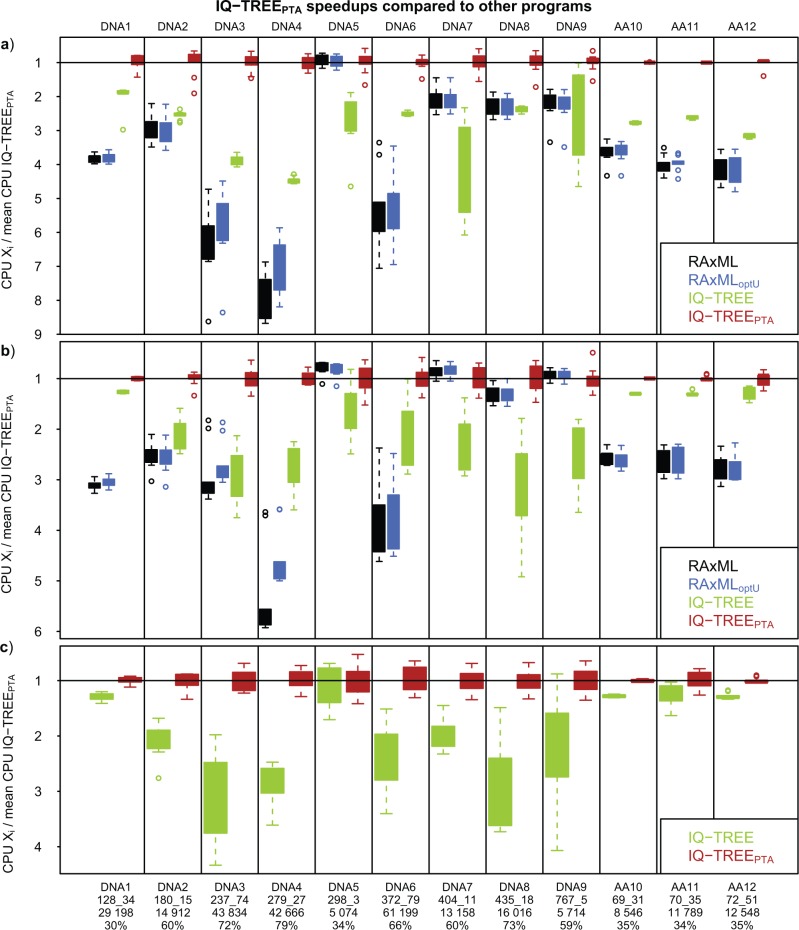
In phylogenomics the analysis of concatenated gene alignments, the so-called supermatrix, is commonly accompanied by the assumption of partition models. Under such models each gene, or more generally partition, is allowed to evolve under its own evolutionary model. Although partition models provide a more comprehensive analysis of supermatrices, missing data may hamper the tree search algorithms due to the existence of phylogenetic (partial) terraces. Here, we introduce the phylogenetic terrace aware (PTA) data structure for the efficient analysis under partition models. In the presence of missing data PTA exploits (partial) terraces and induced partition trees to save computation time. We show that an implementation of PTA in IQ-TREE leads to a substantial speedup of up to 4.5 and 8 times compared with the standard IQ-TREE and RAxML implementations, respectively. PTA is generally applicable to all types of partition models and common topological rearrangements thus can be employed by all phylogenomic inference software.
Overview
The claims and statistics of this paper haven’t been checked yet.
Free: it reads the open-access text and checks the first 5 claims that cite a source we can check. Create a free account to check every claim.
Integrity signals
Registry
Cites
Statistics
Figures



Verification
Claims the paper makes
The claims and statistics of this paper haven’t been checked yet.
Free: it reads the open-access text and checks the first 5 claims that cite a source we can check. Create a free account to check every claim.
Claims other papers make about this one
Each is checked against this paper’s own text: does it say what the citing paper says it does?
The source backs part of the claim, not all of it — or backs it for a different population, condition or comparison.
In the citing paper
“IQ-TREE 2 exploits partial terraces to improve tree search under partitioned models and achieves up to 4.5- and 8-fold speedups compared with IQ-TREE 1 and RAxML, respectively (Chernomor et al. 2016).”
From IQ-TREE 2: New Models and Efficient Methods for Phylogenetic Inference in the Genomic Era (2020) · cites this paper as Chernomor et al. 2016
Experimental — accuracy not yet measuredIn the citing paper
“This finding might not be entirely surprising because IQ-TREE represents the latest development in fast phylogenetic programs and has implemented a novel data structure to facilitate concatenation analysis (Chernomor et al. 2016).”
From Evaluating fast maximum likelihood-based phylogenetic programs using empirical phylogenomic data sets (2018) · cites this paper as Chernomor et al. 2016
Self-check
Percentages, sums and reported differences re-computed from the paper’s own numbers.
The self-check needs the paper’s full text.
Citations
Cites
1 retracted
RETRACTED ARTICLE: TREEFINDER: a powerful graphical analysis environment for molecular phylogenetics
Jobb, G., von Haeseler, A., & Strimmer, K. (2004) · BMC Evolutionary Biology · doi:10.1186/1471-2148-4-18 · Cited by 1,112
RetractedRAxML version 8: a tool for phylogenetic analysis and post-analysis of large phylogenies
Stamatakis, A. (2014) · Bioinformatics · doi:10.1093/bioinformatics/btu033 · Cited by 32,291 · cited 1×
“RAxML (Stamatakis 2014) x x TreeFinder ( IQ-TREE ( Jobb et al. 2004) x x x Nguyen et al. 2015) x x x EL, edge-linked; EUL, which yielded a substantial computation time and memory saving.”
MethodIQ-TREE: A Fast and Effective Stochastic Algorithm for Estimating Maximum-Likelihood Phylogenies
Nguyen, L.-T., Schmidt, H. A., von Haeseler, A., & Minh, B. Q. (2015) · Molecular Biology and Evolution · doi:10.1093/molbev/msu300 · Cited by 26,046 · cited 6×
“RAxML (Stamatakis 2014) x x TreeFinder ( IQ-TREE ( Jobb et al. 2004) x x x Nguyen et al. 2015) x x x EL, edge-linked; EUL, which yielded a substantial computation time and memory saving.”
BackgroundMethodInfluentialSelf-citationGuindon, S., Dufayard, J.-F., Lefort, V., Anisimova, M., Hordijk, W., & Gascuel, O. (2010) · Systematic Biology · doi:10.1093/sysbio/syq010 · Cited by 18,376
RAxML-VI-HPC: maximum likelihood-based phylogenetic analyses with thousands of taxa and mixed models
Stamatakis, A. (2006) · Bioinformatics · doi:10.1093/bioinformatics/btl446 · Cited by 15,582
Lanfear, R., Calcott, B., Ho, S. Y. W., & Guindon, S. (2012) · Molecular Biology and Evolution · doi:10.1093/molbev/mss020 · Cited by 5,732
Zwickl, D. J. (2006) · Texas ScholarWorks (Texas Digital Library) · Cited by 3,530
An Improved General Amino Acid Replacement Matrix
Le, S. Q., & Gascuel, O. (2008) · Molecular Biology and Evolution · doi:10.1093/molbev/msn067 · Cited by 3,127 · cited 1×
“For all partition models we assumed the GTR+ (Lanave et al. 1984; Yang 1994) and the LG+ (Yang 1994; Le and Gascuel 2008) models for all genes in the DNA and the AA alignments, respectively.”
MethodYang, Z. (1994) · Journal of Molecular Evolution · doi:10.1007/bf00160154 · Cited by 2,960 · cited 3×
“1984; Yang 1994) and the LG+ (Yang 1994; Le and Gascuel 2008) models for all genes in the DNA and the AA alignments, respectively.”
BackgroundMethodBroad phylogenomic sampling improves resolution of the animal tree of life
Dunn, C. W., Hejnol, A., Matus, D. Q., Pang, K., Browne, W. E., Smith, S. A., Seaver, E., Rouse, G. W., Obst, M., Edgecombe, G. D., et al. (2008) · Nature · doi:10.1038/nature06614 · Cited by 1,921
Cited by
Items 201–300 of 1,004
Tallowin, O., Tamar, K., Meiri, S., Allison, A., Kraus, F., Richards, S. J., & Oliver, P. M. (2018) · Molecular Phylogenetics and Evolution · doi:10.1016/j.ympev.2018.03.020 · Cited by 46
Giribet, G., Buckman-Young, R. S., Costa, C. S., Baker, C. M., Benavides, L. R., Branstetter, M. G., Daniels, S. R., & Pinto‐da‐Rocha, R. (2018) · Invertebrate Systematics · doi:10.1071/is18007 · Cited by 46
“All datasets were analysed under maximum likelihood in IQ-TREE (Nguyen et al. 2015) with the best-fit models estimated with ModelFinder (Kalyaanamoorthy et al. 2017), using partitioned models by gene (Chernomor et al. 2016), with 1000 replicates of a fast bootstrap approximation (Minh et al. 2013).”
MethodCondamine, F. L., Allio, R., Reboud, E. L., Dupuis, J. R., Toussaint, E. F. A., Mazet, N., Hu, S., Lewis, D. S., Kunte, K. K., Cotton, A. M., et al. (2023) · Molecular Phylogenetics and Evolution · doi:10.1016/j.ympev.2023.107758 · Cited by 46
Timing the evolution of phosphorus-cycling enzymes through geological time using phylogenomics
Boden, J. S., Zhong, J., Anderson, R. E., & Stüeken, E. E. (2024) · Nature Communications · doi:10.1038/s41467-024-47914-0 · Cited by 45
“Partitionedanalyses 74 were applied to allow each protein to evolve under appropriate substitutionmodels.”
Genome sequencing of Rhinorhipus Lawrence exposes an early branch of the Coleoptera
Kusy, D., Motyka, M., Andújar, C., Boček, M., Masek, M., Sklenarova, K., Kokas, F. Z., Bocáková, M., Vogler, A. P., & Bocák, L. (2018) · Frontiers in Zoology · doi:10.1186/s12983-018-0262-0 · Cited by 45
“IQ-TREE 1.5.5 [59] and RaxML [60] were used to calculate maximum likelihood (ML) trees using the IQ-TREE web server [61], with partitions identified by the ModelFinder tool of IQ-TREE using the Bayesian Information Criterion [62, 63].”
MethodInfluentialPestalotioid Species Associated with Medicinal Plants in Southwest China and Thailand
Sun, Y., Jayawardena, R. S., Sun, J., & Wang, Y. (2023) · Microbiology Spectrum · doi:10.1128/spectrum.03987-22 · Cited by 45
“The best-fit substitution models (Table 4) were determined by WIQ-TREE (85).”
MethodFellows Yates, J. A., Drucker, D. G., Reiter, E., Heumos, S., Welker, F., Münzel, S. C., Wojtal, P., Lázničková-Galetová, M., Conard, N. J., Herbig, A., et al. (2017) · Scientific Reports · doi:10.1038/s41598-017-17723-1 · Cited by 40
Carrillo, J. D., Rugman‐Jones, P. F., Husein, D., Stajich, J., Kasson, M. T., Carrillo, D., Stouthamer, R., & Eşkalen, A. (2019) · Fungal Genetics and Biology · doi:10.1016/j.fgb.2019.103269 · Cited by 44
Costa, W. J. E. M. (2021) · Taxonomy · doi:10.3390/taxonomy1020013 · Cited by 45
“[62]; the list of partitions and their respective models of nucleotide substitution are provided in the Appendix E.”
BackgroundWhen good mitochondria go bad: Cyto-nuclear discordance in landfowl (Aves: Galliformes)
Kimball, R. T., Guido, M., Hosner, P. A., & Braun, E. L. (2021) · Gene · doi:10.1016/j.gene.2021.145841 · Cited by 45
Lessard, B. D., Kurucz, N., Rodríguez, J., Carter, J. V., & Hardy, C. M. (2021) · Parasites & Vectors · doi:10.1186/s13071-021-04911-2 · Cited by 44
“6 [22], with 1000 ultrafast bootstrap replicates [23] and the best partitioning scheme [24] implementing a separate partition model for each codon position as follows: position 3, TN {40.”
MethodBarrera, C. A., Sosa‐Calvo, J., Schultz, T. R., Rabeling, C., & Bacci, M. (2021) · Systematic Entomology · doi:10.1111/syen.12513 · Cited by 44
Sless, T. J. L., Branstetter, M. G., Gillung, J. P., Krichilsky, E., Tobin, K. B., Straka, J., Rozen, J. G., Freitas, F. V., Martins, A. C., Bossert, S., et al. (2021) · Molecular Phylogenetics and Evolution · doi:10.1016/j.ympev.2021.107326 · Cited by 44
“1.2 using the “testmerge” option (Chernomor et al., 2016) and a GTR + G model to generate partitioned trees.”
MethodInfluentialConstantin, M. E., Fokkens, L., de Sain, M., Takken, F. L. W., & Rep, M. (2021) · Frontiers in Plant Science · doi:10.3389/fpls.2021.761740 · Cited by 45
“We used IQ-TREE to infer a phylogeny based on this partition file and concatenated alignment (IQ-TREE version 1.16.12 with parameters ‘-bb 1000 -m GTR -bsam GENESITE’ (Nguyen et al., 2015; Chernomor et al., 2016; Hoang et al., 2018).”
MethodInfluentialMiranda, F. R., Garbino, G. S. T., Machado, F. A., Perini, F. A., dos Santos, F. R., & Casali, D. (2022) · Journal of Mammalogy · doi:10.1093/jmammal/gyac059 · Cited by 43
“The best-fitting substitution model for each locus, obtained with ModelFinder in IQ-TREE, with Bayesian information criteria, and applied in coalescent species tree inference and species delimitation in *Beast2.”
MethodInfluentialMichalik, A., Franco, D. C., Deng, J., Szklarzewicz, T., Kobiałka, M., Stroiński, A., & Łukasik, P. (2023) · Frontiers in Physiology · doi:10.3389/fphys.2023.1135346 · Cited by 43
“The partition type was set to allow the 14 partitions (one for each marker) to allow different evolutionary rates (Chernomor et al., 2016).”
BackgroundShen, W., Cai, C., Dong, N., Chen, J., Zhang, R., & Cai, J. (2024) · Microbiome · doi:10.1186/s40168-023-01744-2 · Cited by 44
“For the construction of the maximum likelihood phylogenetic tree based on the 16S rRNA of all strains subjected to WGS, IQ-TREE Version 1.6.12 was employed [60].”
MethodInfluentialMackiewicz, P., Urantówka, A. D., Kroczak, A., & Mackiewicz, D. (2019) · Genome Biology and Evolution · doi:10.1093/gbe/evz209 · Cited by 43
Jin, M., Zwick, A., Ślipiński, A., de Keyzer, R., & Pang, H. (2020) · Systematic Entomology · doi:10.1111/syen.12424 · Cited by 43
“Partitions and models selected by ModelFinder were applied on edge-proportional partition model (−spp option).”
MethodZawierucha, K., Buda, J., Jaroměřská, T. N., Janko, K., & Gąsiorek, P. (2020) · Zoologischer Anzeiger · doi:10.1016/j.jcz.2020.09.004 · Cited by 43
Vereecke, N., Kvisgaard, L. K., Baele, G., Boone, C., Kunze, M., Larsen, L. E., Theuns, S., & Nauwynck, H. (2022) · Virus Evolution · doi:10.1093/ve/veac053 · Cited by 43
“1B) (Tullis, Burger, and Pintel 1993; Cotmore and Tattersall 2007; Boisvert, Fernandes, and Tijssen 2010; Tu et al. 2015). Aversely, PPV1a and PPV1c strains have mutations focalized in this sialic-acid-binding region, lowering and/or preventing its efficient cellular entrance, which is in line with its limited persist…”
García‐Cunchillos, I., Zamora, J. C., Ryberg, M. K., & Lado, C. (2022) · Molecular Phylogenetics and Evolution · doi:10.1016/j.ympev.2022.107609 · Cited by 44
Transposable elements drive the evolution of metazoan zinc finger genes
Wells, J. N., Chang, N., McCormick, J., Coleman, C., Ramos, N., Jin, B., & Feschotte, C. (2023) · Genome Research · doi:10.1101/gr.277966.123 · Cited by 44
“0.6 was used to generate a maximum likelihood tree from a partitioned analysis of the supergene alignment (Chernomor et al. 2016; Hoang et al. 2018; Minh et al. 2020).”
MethodInfluentialSeto, K., Simmons, D. R., Quandt, C. A., Frenken, T., Dirks, A. C., Clemons, R. A., McKindles, K. M., McKay, R. M. L., & James, T. Y. (2023) · mBio · doi:10.1128/mbio.01313-23 · Cited by 42
“An ML analysis was run with a partitioned model (118).”
MethodPatel, V., Chevignon, G., Manzano-Marín, A., Brandt, J. W., Strand, M. R., Russell, J. A., & Oliver, K. M. (2019) · Genome Biology and Evolution · doi:10.1093/gbe/evz252 · Cited by 42
Šlenker, M., Kantor, A., Marhold, K., Schmickl, R., Mandáková, T. M., Lysák, M. A., Perný, M., Caboňová, M., Slovák, M., & Zozomová‐Lihová, J. (2021) · Frontiers in Plant Science · doi:10.3389/fpls.2021.659275 · Cited by 42
South, E. J., Skinner, R. K., DeWalt, R. E., Davis, M. A., Johnson, K. P., TESLENKO, V. A., Lee, J. J., Malison, R. L., Hwang, J. M., Bae, Y. J., et al. (2021) · Insect Systematics and Diversity · doi:10.1093/isd/ixab014 · Cited by 42
Letsch, H. O., Simon, S., Frandsen, P. B., Liu, S., Machida, R., Mayer, C., Misof, B. Y., Niehuis, O., Zhou, X. Y., & Wipfler, B. (2021) · Systematic Entomology · doi:10.1111/syen.12505 · Cited by 42
“All single gene alignments were analysed using the ML tree search in iq-tree v. 1.6.12 (Nguyen et al., 2015; Chernomor et al., 2016).”
MethodInfluentialKnauber, H., Silberberg, J. R., Brandt, A., & Riehl, T. (2022) · Systematics and Biodiversity · doi:10.1080/14772000.2022.2099477 · Cited by 41
“, 2020), further utilizing partition models in the case of the COI- and the concatenated alignment (Chernomor et al., 2016).”
MethodInfluentialYu, J., Niu, Y., You, Y., Cox, C. J., Barrett, R. L., Trias‐Blasi, A., Guo, J., Wen, J., Lu, L., & Chen, Z. (2022) · New Phytologist · doi:10.1111/nph.18580 · Cited by 41
“T REE 2.1.2 (Nguyen et al ., 2015) with 5000 ultrafast bootstrap replicates (Hoang et al ., 2018) under edge-unlinked partitioned model (Chernomor et al ., 2016), where the best model scheme was selected by M ODEL F INDER (Kalyaanamoorthy et al ., 2017).”
InfluentialFour new species of Morchella from the Americas
Baroni, T. J., Beug, M. W., Cantrell, S. A., Clements, T. A., Iturriaga, T., Læssøe, T., Holgado-Rojas, M. E., Aguilar, F. M., Quispe, M. A., Lodge, D. J., et al. (2018) · Mycologia · doi:10.1080/00275514.2018.1533772 · Cited by 41
“Maximum likelihood (ML) analyses were implemented in IQ-TREE (Nguyen et al. 2015; http://www.iqtree.org/), applying separate models for each partition (Chernomor et al. 2016).”
MethodSmidt, E. D. C., Zavala‐Paez, M., Vieira, L. D. N., Viruel, J., Baura, V. A., Balsanelli, E., de Souza, E. M., & Chase, M. W. (2020) · PLoS ONE · doi:10.1371/journal.pone.0227991 · Cited by 41
“11 [41] with the concatenated unpartitioned scheme and tree search with 1,000 bootstrap replicates in a single run [42, 43].”
MethodThe phylogeny of Nereididae (Annelida) based on mitochondrial genomes
Alves, P. R., Halanych, K. M., & Santos, C. S. G. (2020) · Zoologica Scripta · doi:10.1111/zsc.12413 · Cited by 41
Molecular Phylogenetic Analysis of Acotylea (Platyhelminthes: Polycladida)
Oya, Y., & Kajihara, H. (2020) · ZOOLOGICAL SCIENCE · doi:10.2108/zs190136 · Cited by 41
“, 2015) under a partition model (Chernomor et al., 2016), and with Bayesian inference (BI) executed in MrBayes ver.”
MethodInfluentialIntegrative phylogenomics reveals a Permian origin of Adephaga beetles
Baca, S. M., Gustafson, G. T., Alexander, A. M., Gough, H. M., & Toussaint, E. F. A. (2021) · Systematic Entomology · doi:10.1111/syen.12506 · Cited by 41
“…criterion were used to select the best fitting model for unpartitioned analysis and the results from the sliding-window site characteristics based on entropy (SWSC-EN) method (Tagliacollo & Lanfear, 2018) discussed below, used to select an edge-linked partition model (Chernomor et al. , 2016).”
Xiao, T., Yan, H., & Ge, X. (2022) · BMC Plant Biology · doi:10.1186/s12870-021-03413-8 · Cited by 41
Armisén, D., Viala, S., Cordeiro, I. D. R. S., Crumière, A., Hendaoui, E., Bouquin, A. L., Duchemin, W., Santos, M. E., Toubiana, W., Vargas-Lowman, A., et al. (2022) · Molecular Biology and Evolution · doi:10.1093/molbev/msac229 · Cited by 41
“…To identify the best partitioning schemes and determine the best amino acid substitution model for each partition we used ModelFinder within IQ-TREE (Nguyen, et al. 2015; Kalyaanamoorthy, et al. 2017) (option: -m TESTMERGE) and an edge unlinked model (option: -sp) (Chernomor, et al. 2016).”
MethodEl‐Ganainy, S. M., Ismail, A. M., Iqbal, Z., Elshewy, E. S., Alhudaib, K. A., Almaghasla, M. I., & Magistà, D. (2022) · Journal of Fungi · doi:10.3390/jof8111203 · Cited by 41
Boulangé, C. L., Pedersen, H., Martin, F., Siegwald, L., Pallejá, A., Eklund, A. C., Jia, W. P., Zhang, H., Berger, B. W., Sprenger, N., et al. (2023) · International Journal of Molecular Sciences · doi:10.3390/ijms241411422 · Cited by 41
Evolution at the tips: Asclepias phylogenomics and new perspectives on leaf surfaces
Fishbein, M., Straub, S. C. K., Boutte, J., Hansen, K., Cronn, R., & Liston, A. (2018) · American Journal of Botany · doi:10.1002/ajb2.1062 · Cited by 41
Polymorphic characters in the reconstruction of the phylogeny of geoemydid turtles
Garbin, R. C., Ascarrunz, E., & Joyce, W. G. (2018) · Zoological Journal of the Linnean Society · doi:10.1093/zoolinnean/zlx106 · Cited by 40
Nielsen, S. V., Méndez, I. A. G., Gamble, T., Blumer, M., Pinto, B. J., Kratochvíl, L., & Rovatsos, M. (2019) · Biology Letters · doi:10.1098/rsbl.2019.0498 · Cited by 40
“Finally, we tested whether we could reject a phylogenetic hypothesis of Corytophanidae as sister to a clade composed of the remaining pleurodont families using two datasets: (1) a multi-locus molecular genetic dataset [21] using the maximum likelihood (ML)-based AU test with 10 000 RELL bootstraps, implemented in IQtr…”
MethodPatterson, B. D., Webala, P. W., Lavery, T. H., Agwanda, B. R., Goodman, S. M., Peterhans, J. C. K., & Demos, T. C. (2020) · ZooKeys · doi:10.3897/zookeys.929.50240 · Cited by 40
“10 (Chernomor et al. 2016; Nguyen et al. 2015) on the CIPRES portal for separate gene trees (cyt-b, ACOX2, COPS7A, ROGDI, and STAT5B) and a concatenated alignment, partitioned by gene, using the four nuclear introns.”
BackgroundMethodInfluentialGąsiorek, P., & Michalczyk, Ł. (2020) · Zoologica Scripta · doi:10.1111/zsc.12424 · Cited by 40
Sanderson, N. D., Swann, J., Barker, L., Kavanagh, J., Hoosdally, S., Crook, D. W., the GonFast Investigators Group, Street, T. L., & Eyre, D. W. (2020) · Genome Research · doi:10.1101/gr.262865.120 · Cited by 40
“1) (Chernomor et al. 2016) and branch lengths readjusted to account for recombination with ClonalFrameML (v1.”
BackgroundEvolution and lineage dynamics of a transmissible cancer in Tasmanian devils
Kwon, Y. M., Gori, K. C., Park, N., Potts, N., Swift, K., Wang, J., Stammnitz, M. R., Cannell, N., Baez‐Ortega, A., Comte, S., et al. (2020) · PLoS Biology · doi:10.1371/journal.pbio.3000926 · Cited by 40
“12 [54], under an edge-linked proportional partition model (-spp option) [55], in which each of the three data sources formed a subset of the partition, to which was assigned its own substitution model.”
BackgroundPapetti, C., Babbucci, M., Dettaï, A., Basso, A., Lucassen, M., Harms, L., Bonillo, C., Heindler, F. M., Patarnello, T., & Negrisolo, E. (2021) · Genome Biology and Evolution · doi:10.1093/gbe/evab017 · Cited by 40
Liu, C., Smit, S. J., Dang, J., Zhou, P., Godden, G. T., Jiang, Z., Liu, W., Liu, L., Lin, W., Duan, J., et al. (2023) · Molecular Plant · doi:10.1016/j.molp.2023.01.004 · Cited by 41
Wang, N., Hosner, P. A., Liang, B., Braun, E. L., & Kimball, R. T. (2017) · Molecular Phylogenetics and Evolution · doi:10.1016/j.ympev.2017.01.006 · Cited by 40
Huang, X., Wu, R., An, C., Xie, G.-L., Su, J.-H., Ouyang, S., Zhou, C., & Wu, X. (2017) · Molecular Phylogenetics and Evolution · doi:10.1016/j.ympev.2017.12.017 · Cited by 40
SARS-CoV-2 evolution during prolonged infection in immunocompromised patients
Marques, A. D., Graham-Wooten, J., Fitzgerald, A. S., Leonard, A. S., Cook, E. J., Everett, J. K., Rodino, K. G., Moncla, L. H., Kelly, B. J., Collman, R. G., et al. (2024) · mBio · doi:10.1128/mbio.00110-24 · Cited by 39
“Following alignments, IQ-Tree was used to infer maximum-likelihood trees using 1,000 bootstrap replicates (37).”
BackgroundMethodWu, R., Liu, X., Wang, S., Roe, K. J., Ouyang, S., & Wu, X. (2019) · ZooKeys · doi:10.3897/zookeys.812.29908 · Cited by 39
“ModelFinder (Chernomor et al. 2016; Kalyaanamoorthy et al. 2017) implemented Taxon GenBank accession number Reference”
Asadi, A., Montgelard, C., Nazarizadeh, M., Moghaddasi, A., Fatemizadeh, F., Simonov, E., Kami, H. G., & Kaboli, M. (2019) · Scientific Reports · doi:10.1038/s41598-018-37558-8 · Cited by 39
Medaka Population Genome Structure and Demographic History Described via Genotyping-by-Sequencing
Katsumura, T., Oda, S., Mitani, H., & Oota, H. (2019) · G3 Genes Genomes Genetics · doi:10.1534/g3.118.200779 · Cited by 39
Quantifying within-host diversity of H5N1 influenza viruses in humans and poultry in Cambodia
Moncla, L. H., Bedford, T., Dussart, P., Horm, S. V., Rith, S., Buchy, P., Karlsson, E. A., Li, L., Liu, Y., Zhu, H., et al. (2020) · PLoS Pathogens · doi:10.1371/journal.ppat.1008191 · Cited by 39
“IQTREE[37,38] was then used to infer a maximum likelihood phylogeny, and TreeTime[39] was used to infer a molecular clock and temporally-resolved phylogeny.”
MethodDistoseptispora bambusae sp. nov. (Distoseptisporaceae) on bamboo from China and Thailand
Sun, Y.-R., Goonasekara, I. D., Thambugala, K. M., Jayawardena, R. S., Wang, Y., & Hyde, K. D. (2020) · Biodiversity Data Journal · doi:10.3897/bdj.8.e53678 · Cited by 39
McCowin, M. F., Feehery, C., & Rouse, G. W. (2020) · Deep Sea Research Part I Oceanographic Research Papers · doi:10.1016/j.dsr.2020.103322 · Cited by 39
Using ultraconserved elements to reconstruct the termite tree of life
Hellemans, S., Wang, M., Hasegawa, N., Šobotník, J., Scheffrahn, R. H., & Bourguignon, T. (2021) · Molecular Phylogenetics and Evolution · doi:10.1016/j.ympev.2022.107520 · Cited by 39
Wong, D., Norman, H., Creedy, T. J., Jordaens, K., Moran, K. M., Young, A. D., Mengual, X., Skevington, J. H., & Vogler, A. P. (2023) · Molecular Phylogenetics and Evolution · doi:10.1016/j.ympev.2023.107759 · Cited by 39
Sosa‐Calvo, J., Forshage, M., & Buffington, M. L. (2024) · Journal of Hymenoptera Research · doi:10.3897/jhr.97.118567 · Cited by 39
“We tested for model violation based on assumptions of stationarity and homogeneity by performing a test of symmetry (Naser-Khdour et al. 2019) as implemented in IQ-TREE 2.1.3 (Chernomor et al. 2016; Minh et al. 2020) on the partitioned dataset above.”
MethodInfluentialFolt, B. P., Bauder, J. M., Spear, S. F., Stevenson, D. J., Hoffman, M., Oaks, J. R., Wood, P. L., Jenkins, C. L., Steen, D. A., & Guyer, C. (2019) · PLoS ONE · doi:10.1371/journal.pone.0214439 · Cited by 39
Dynamic quinone repertoire accompanied the diversification of energy metabolism in Pseudomonadota
Chobert, S.-C., Roger‐Margueritat, M., Flandrin, L., Berraies, S., Lefèvre, C. T., Pélosi, L., Junier, I., Varoquaux, N., Pierrel, F., & Abby, S. S. (2024) · The ISME Journal · doi:10.1093/ismejo/wrae253 · Cited by 38
“B 1000” for the computation of bootstrap supports [54, 56, 59], and the best model was computed for each marker protein individually using ModelFinder [55].”
Nivicolous Trichiales from the austral Andes: unexpected diversity including two new species
Ronikier, A., García‐Cunchillos, I., Janik, P., & Lado, C. (2020) · Mycologia · doi:10.1080/00275514.2020.1759978 · Cited by 38
Jadin, R. C., Blair, C. N., Orlofske, S. A., Jowers, M. J., Rivas, G. A., Vitt, L. J., Ray, J. M., Smith, E. N., & Murphy, J. C. (2020) · Organisms Diversity & Evolution · doi:10.1007/s13127-020-00461-0 · Cited by 38
The role of plant secondary metabolites in shaping regional and local plant community assembly
Endara, M., Soule, A. J., Forrister, D. L., Dexter, K. G., Pennington, R. T., Nicholls, J. A., Loiseau, O., Kursar, T. A., & Coley, P. D. (2021) · Journal of Ecology · doi:10.1111/1365-2745.13646 · Cited by 38
“We performed a partitioned analysis (Chernomor et al., 2016) after inferring the best- partition scheme for the 810 genes and the best substitution model for each partition using ModelFinder module implemented in IQtree 2 (Kalyaanamoorthy et al., 2017).”
MethodShchepin, O. N., Novozhilov, Y. K., Woyzichovski, J., Bog, M., Prikhodko, I. S., Fedorova, N. A., Gmoshinskiy, V. I., Dahl, M. B., Dagamac, N. H. A., Yajima, Y., et al. (2021) · Molecular Ecology · doi:10.1111/mec.16239 · Cited by 39
“Five partitions were defined (Chernomor et al., 2016): one for SSU (model K2P+R2), three for different codon positions in EF1A (models F81+F+I, F81+F+I, and TPM2u+F+G4 for the first, second, and third position, respectively), and one for COI (model K3Pu+F+I+G4).”
MethodExpanding the Menu: Are Polyphagy and Gene Family Expansions Linked across Lepidoptera?
Breeschoten, T., van der Linden, C. F. H., Ros, V. I. D., Schranz, M. E., & Simon, S. (2021) · Genome Biology and Evolution · doi:10.1093/gbe/evab283 · Cited by 38
“Phylogenetic relationships were inferred under the ML optimality criterion as implemented in IQ-TREE v. 1.6.12 (Nguyen et al. 2015; Chernomor et al. 2016) using the best scoring amino acid substitution matrix for each gene partition and the edge-proportional partition model allowing partitions to…”
InfluentialMarine viral particles reveal an expansive repertoire of phage-parasitizing mobile elements
Eppley, J. M., Biller, S. J., Luo, E., Burger, A., & DeLong, E. F. (2022) · Proceedings of the National Academy of Sciences · doi:10.1073/pnas.2212722119 · Cited by 39
“Trees were inferred from MSAs using IQ-TREE (64) with the partitioned LG + GAMMA model (65).”
MethodThe Evolutionary Origins of Extreme Halophilic Archaeal Lineages
Feng, Y., Neri, U., Gosselin, S., Louyakis, A. S., Papke, R. T., Gophna, U., & Gogarten, J. P. (2021) · Genome Biology and Evolution · doi:10.1093/gbe/evab166 · Cited by 37
Genome and life-history evolution link bird diversification to the end-Cretaceous mass extinction
Berv, J. S., Singhal, S., Field, D. J., Walker‐Hale, N., McHugh, S. W., Shipley, J. R., Miller, E. T., Kimball, R. T., Braun, E. L., Dornburg, A., et al. (2024) · Science Advances · doi:10.1126/sciadv.adp0114 · Cited by 37
“For each data type, we applied an optimal partition model selected with the MFP + MERGE approach in IQ-TREE ( 94 , 95 ), with each locus defined as the unit for partitioning.”
Iha, C., Grassa, C. J., Lyra, G. D. M., Davis, C. “., Verbruggen, H., & Oliveira, M. C. (2018) · Journal of Phycology · doi:10.1111/jpy.12765 · Cited by 38
Phylogenomics changes our understanding about earwig evolution
Wipfler, B., Koehler, W., Frandsen, P. B., Donath, A., Liu, S., Machida, R., Misof, B. Y., Peters, R. S., Shimizu, S., Zhou, X. Y., et al. (2020) · Systematic Entomology · doi:10.1111/syen.12420 · Cited by 37
“5.2 (Nguyen et al., 2015; Chernomor et al., 2016) using the best scoring amino-acid substitution matrix for each partition (option–spp).”
MethodInfluentialThe phylogeny and global biogeography of Primulaceae based on high-throughput DNA sequence data
Larson, D. A., Chanderbali, A. S., Maurin, O., Gonçalves, D. J. P., Dick, C. W., Soltis, P. S., Soltis, P. S., Fritsch, P. W., Clarkson, J. J., Grall, A., et al. (2023) · Molecular Phylogenetics and Evolution · doi:10.1016/j.ympev.2023.107702 · Cited by 37
Phylogeny, taxonomy, and biogeography of the Sphaeriinae (Bivalvia: Sphaeriidae)
Bespalaya, Y. V., Vinarski, M. V., Aksenova, O. V., Babushkin, E. S., Gofarov, M. Y., Kondakov, A. V., Konopleva, E. S., Kropotin, A. V., Mabrouki, Y., Ovchankova, N. B., et al. (2023) · Zoological Journal of the Linnean Society · doi:10.1093/zoolinnean/zlad139 · Cited by 36
Banker, S. E., Lemmon, A. R., Hassinger, A. T. B., Dye, M., Holland, S. D., Kortyna, M., Ospina, O. E., Ralicki, H. F., & Lemmon, E. M. (2019) · Systematic Biology · doi:10.1093/sysbio/syz074 · Cited by 36
Multiple early introductions of SARS-CoV-2 into a global travel hub in the Middle East
Tayoun, A. N. A., Loney, T., Khansaheb, H. H., Ramaswamy, S., Harilal, D., Deesi, Z., Varghese, R. M., Suwaidi, H. S. A., AlKhajeh, A. S., AlDabal, L. M. J. A., et al. (2020) · Scientific Reports · doi:10.1038/s41598-020-74666-w · Cited by 36
Phylogeny and biogeography of Ceiba Mill. (Malvaceae, Bombacoideae)
Pezzini, F. F., Dexter, K. G., Carvalho-Sobrinho, J., Kidner, C. A., Nicholls, J. A., de Queiroz, L. P., & Pennington, R. T. (2021) · Frontiers of Biogeography · doi:10.21425/f5fbg49226 · Cited by 36
Lindsey, C. R., Rosenzweig, F., & Herron, M. D. (2021) · BMC Biology · doi:10.1186/s12915-021-01087-0 · Cited by 36
Simpson, A., Sengupta, P., Zhang, F., Hameed, A., Parker, C. W., Singh, N. K., Miliotis, G., Rekha, P. D., Raman, K., Mason, C. E., et al. (2023) · Scientific Reports · doi:10.1038/s41598-023-44172-w · Cited by 36
Garvetto, A., Badis, Y., Perrineau, M., Rad‐Menéndez, C., Bresnan, E., & Gachon, C. M. M. (2019) · Fungal Biology · doi:10.1016/j.funbio.2019.04.004 · Cited by 37
“A manual concatenation of the three alignments was then analysed in IQ-TREE 1.5.5 with a 169 partitioned model (Chernomor et al., 2016), allowing each gene to evolve at its own pace (–spp 170 option).”
BackgroundMethodInfluentialProt-SpaM : fast alignment-free phylogeny reconstruction based on whole-proteome sequences
Leimeister, C.-A., Schellhorn, J., Dörrer, S., Gerth, M., Bleidorn, C., & Morgenstern, B. (2018) · GigaScience · doi:10.1093/gigascience/giy148 · Cited by 36
“The resulting super-matrix (68 loci, 20,787 amino acid positions) was subject to partitioned maximum likelihood analysis following best model and partition scheme selection in IQ-TREE version 1.6.2 [ 65, 66, 67].”
MethodInfluentialRathnayaka, A. R., Chethana, K. W. T., Manawasinghe, I. S., Wijesinghe, S., SILVA, N. I. D., Tennakoon, D. S., Phillips, A., Liu, J., Jones, E., Wang, Y., et al. (2023) · Mycosphere · doi:10.5943/mycosphere/14/1/14 · Cited by 35
White, N. D., & Braun, M. J. (2019) · Molecular Phylogenetics and Evolution · doi:10.1016/j.ympev.2019.106611 · Cited by 35
Unraveling the Spiraling Radiation: A Phylogenomic Analysis of Neotropical Costus L
Valderrama, E., Sass, C., Pinilla-Vargas, M., Skinner, D., Maas, P. J. M., de Kamer, H. M.-V., Landis, J. B., Guan, C. J., & Specht, C. D. (2020) · Frontiers in Plant Science · doi:10.3389/fpls.2020.01195 · Cited by 35
“10 (Nguyen et al., 2015; Chernomor et al., 2016; Kalyaanamoorthy et al., 2017) to explore merging those partitions corresponding to each gene using the greedy heuristic algorithm (Lanfear et al.”
MethodRoos, C., Helgen, K. M., Miguez, R. P., Thant, N. M. L., Lwin, N., Lin, A. K., Lin, A., Yi, K. M., Soe, P., Hein, Z. M., et al. (2020) · 动物学研究 · doi:10.24272/j.issn.2095-8137.2020.254 · Cited by 35
“For all reconstructions, the optimal substitution model (GTR+I+G), as determined with ModelFinder (Chernomor et al., 2016; Kalyaanamoorthy et al., 2017) in IQTREE under Bayesian Information Criterion (BIC), was applied.”
MethodPhylogeography and morphological evolution of Pseudechiniscus (Heterotardigrada: Echiniscidae)
Gąsiorek, P., Vončina, K., Zając, K., & Michalczyk, Ł. (2021) · Scientific Reports · doi:10.1038/s41598-021-84910-6 · Cited by 35
Berv, J. S., Campagna, L., Feo, T. J., Castro‐Astor, I. N., RIBAS, C. C., Prum, R. O., & Lovette, I. J. (2021) · Molecular Phylogenetics and Evolution · doi:10.1016/j.ympev.2021.107205 · Cited by 35
HyRAD-X Exome Capture Museomics Unravels Giant Ground Beetle Evolution
Toussaint, E. F. A., Gauthier, J., Bilat, J., Gillett, C. P. D. T., Gough, H. M., Lundkvist, H., Blanc, M., Muñoz-Ramírez, C. P., & Álvarez, N. (2021) · Genome Biology and Evolution · doi:10.1093/gbe/evab112 · Cited by 35
“All phylogenetic analyses using the different nucleotide alignments were performed in IQ-TREE 2.0.5 (Minh et al. 2020) using the edge-linked partition model (Chernomor et al. 2016).”
InfluentialFontenelle, J. P., Lovejoy, N. R., Kolmann, M. A., & Marques, F. P. L. (2021) · Biological Journal of the Linnean Society · doi:10.1093/biolinnean/blab090 · Cited by 35
Loss of a globally unique kelp forest from Oman
Coleman, M. A., Reddy, M. M., Nimbs, M. J., Marshell, A., Al-Ghassani, S., Bolton, J. J., Jupp, B. P., Clerck, O. D., Leliaert, F., Champion, C., et al. (2022) · Scientific Reports · doi:10.1038/s41598-022-08264-3 · Cited by 35
The link between increased Desulfovibrio and disease severity in Parkinson’s disease
Nie, S., Jing, Z., Wang, J., Deng, Y., Zhang, Y., Ye, Z., & Ge, Y. (2023) · Applied Microbiology and Biotechnology · doi:10.1007/s00253-023-12489-1 · Cited by 35
“12 (Chernomor et al. 2016) and visualized using Evolview3 (Subramanian et al.”
MethodSupertree Construction: Opportunities and ChallengesPreprint
Warnow, T. J. (2018) · arXiv (Cornell University) · doi:10.48550/arxiv.1805.03530 · Cited by 35
“Finally, there is a relationship between decisiveness and “phylogenetic terraces”, which occurs when there are multiple trees that have the same optimality score [111, 110, 35].”
BackgroundMesozoic origin of coleoid cephalopods and their abrupt shifts of diversification patterns
López-Córdova, D. A., Avaria-Llautureo, J., Ulloa, P. M., Braid, H. E., Revell, L. J., Fuchs, D., & Ibáñez, C. M. (2022) · Molecular Phylogenetics and Evolution · doi:10.1016/j.ympev.2021.107331 · Cited by 34
“In this analysis, we used separate nucleotide substitutions models for each partition as determined by ModelFinder (Kalyaanamoorthy et al. 2017, Chernomor et al., 2016).”
MethodHennen, D. A., Means, J. C., & Marek, P. E. (2022) · ZooKeys · doi:10.3897/zookeys.1096.73485 · Cited by 34
Viral diversity in wild and urban rodents of Yunnan Province, China
Kane, Y., Tendu, A. A., Li, R., Chen, Y., Mastriani, E., Lan, J., Hughes, A. C., Berthet, N., & Wong, G. (2023) · Emerging Microbes & Infections · doi:10.1080/22221751.2023.2290842 · Cited by 34
Otieno, J. R., Kamau, E., Oketch, J. W., Ngoi, J. M., Gichuki, A. M., Binter, Š., Otieno, G. P., Ngama, M., Agoti, C. N., Cane, P. A., et al. (2018) · Virus Evolution · doi:10.1093/ve/vey027 · Cited by 34
Leal-Dutra, C. A., Griffith, G. W., Neves, M. A., McLaughlin, D. J., McLaughlin, E. G., Clasen, L. A., & Dentinger, B. T. M. (2020) · IMA Fungus · doi:10.1186/s43008-019-0022-6 · Cited by 34
“…evolutionary models and partitioning scheme for this analysis were estimated by the built-in ModelFinder (option -m MF+MERGE) allowing the partitions to share the same set of branch lengths but with their own evolution rate (-spp option) (Chernomor et al. 2016; Kalyaanamoorthy et al. 2017).”
MethodYao, K., Deng, J., Ma, X., Dai, W., Chen, Q., Zhou, K., Ye, J., Shi, W., Wang, H., Li, D., et al. (2020) · Expert Review of Vaccines · doi:10.1080/14760584.2020.1831916 · Cited by 34
“11) [18] based on the maximum likelihood method.”
MethodApicidin biosynthesis is linked to accessory chromosomes in Fusarium poae isolates
Witte, T. E., Harris, L. J., Nguyen, H. D. T., Hermans, A., Johnston, A., Sproule, A., Dettman, J. R., Boddy, C. N. C., & Overy, D. P. (2021) · BMC Genomics · doi:10.1186/s12864-021-07617-y · Cited by 35
Machado, D. J., Scott, R., Guirales-Medrano, S., & Janies, D. A. (2021) · Cladistics · doi:10.1111/cla.12454 · Cited by 34
“6.12 (Nguyen et al., 2015; Chernomor et al., 2016; Kalyaanamoorthy et al., 2017; Hoang et al., 2018) for maximum-likelihood (ML) analysis.”
Influential
Metadata
- Authors
- Chernomor, O., von Haeseler, A., & Minh, B. Q.
- Affiliations
- University of Vienna (AT)
- ORCID
- Chernomor, Olga
- Venue
- Systematic Biology
- Publisher
- Oxford University Press (OUP)
- Published
- 2016-04-26
- Volume
- 65
- Issue
- 6
- Pages
- 997-1008
- ISSN
- 1063-5157 (ISSN-L)
- 1076-836X
- PMC
- PMC5066062
- OpenAlex
- W2344940607
- Cited by
- 2,252
- References
- 41
- Citations by year
- 2026: 240 · 2025: 285 · 2024: 328 · 2023: 322 · 2022: 289 · 2021: 331 · 2020: 214 · 2019: 134 · 2018: 75 · 2017: 31 · 2016: 3
- FWCI
- 42.08
- Type
- journal article
- Language
- en
- Open access
- hybrid
- doi.org
- Licence
- cc-by-nc
- Locations
- Systematic Biology (publishedVersion, cc-by-nc)
- PubMed Central (publishedVersion, cc-by-nc)
- PubMed (publishedVersion)
- HighWire Press Open Archive (submittedVersion)
- Funders
- Austrian Science Fund (I-2805-B29, I-1824-B22)
- Topics
- Life Sciences › Biochemistry, Genetics and Molecular Biology › Molecular Biology › Genomics and Phylogenetic Studies
- Life Sciences › Biochemistry, Genetics and Molecular Biology › Molecular Biology › RNA and protein synthesis mechanisms
- Life Sciences › Agricultural and Biological Sciences › Ecology, Evolution, Behavior and Systematics › Plant Diversity and Evolution
- Keywords
- partition model, supermatrix, missing data, phylogenetic tree search, IQ-TREE, RAxML, data structures
- MeSH terms
- Algorithms, Classification, Biological Evolution, Models, Biological, Phylogeny, Software, Sequence Analysis, DNA
About these checks
Registry, retraction, Cites and statistics results are computed, not judged, with one exception: a printed reference that no index lists is read once by a model before it counts as a citation error. Claims are extracted by a model and kept only when their quote appears verbatim in the text; each cited source is then checked, with a model’s help, for whether it says what the claim relies on. Those verdicts can be wrong — read the claim’s quote and the cited source before relying on one.
Statistics and arithmetic are recomputed, not judged.
Confidence bands are shown only for fields calibrated on our annotated test set. None is calibrated yet, so no band is shown.
What counts as a claim ›How we measure confidence ›How we check this ›
Are you an author, or do you see a problem with this page? Request a review
Data sources
Bibliographic data: Semantic Scholar, OpenAlex, Crossref.
Contains information from the Semantic Scholar Academic Graph Datasets, made available under the ODC Attribution License (ODC-BY 1.0).
Semantic Scholar’s data is described in: Kinney, R., et al. (2023). The Semantic Scholar Open Data Platform. arXiv:2301.10140.
