

Terrace Aware Data Structure for Phylogenomic Inference from Supermatrices
Open accessThe DOI matches its Crossref record; 43 of the 43 references it cites were found in a registry or an index.
Abstract
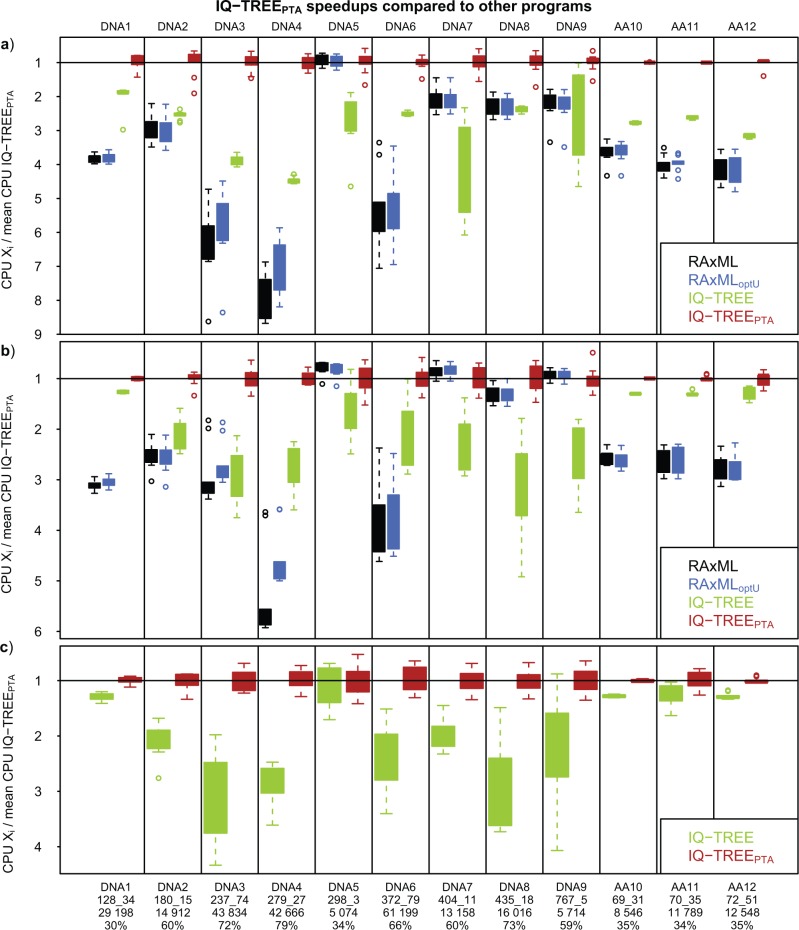
In phylogenomics the analysis of concatenated gene alignments, the so-called supermatrix, is commonly accompanied by the assumption of partition models. Under such models each gene, or more generally partition, is allowed to evolve under its own evolutionary model. Although partition models provide a more comprehensive analysis of supermatrices, missing data may hamper the tree search algorithms due to the existence of phylogenetic (partial) terraces. Here, we introduce the phylogenetic terrace aware (PTA) data structure for the efficient analysis under partition models. In the presence of missing data PTA exploits (partial) terraces and induced partition trees to save computation time. We show that an implementation of PTA in IQ-TREE leads to a substantial speedup of up to 4.5 and 8 times compared with the standard IQ-TREE and RAxML implementations, respectively. PTA is generally applicable to all types of partition models and common topological rearrangements thus can be employed by all phylogenomic inference software.
Overview
The claims and statistics of this paper haven’t been checked yet.
Free: it reads the open-access text and checks the first 5 claims that cite a source we can check. Create a free account to check every claim.
Integrity signals
Registry
Cites
Statistics
Figures



Verification
Claims the paper makes
The claims and statistics of this paper haven’t been checked yet.
Free: it reads the open-access text and checks the first 5 claims that cite a source we can check. Create a free account to check every claim.
Claims other papers make about this one
Each is checked against this paper’s own text: does it say what the citing paper says it does?
The source backs part of the claim, not all of it — or backs it for a different population, condition or comparison.
In the citing paper
“IQ-TREE 2 exploits partial terraces to improve tree search under partitioned models and achieves up to 4.5- and 8-fold speedups compared with IQ-TREE 1 and RAxML, respectively (Chernomor et al. 2016).”
From IQ-TREE 2: New Models and Efficient Methods for Phylogenetic Inference in the Genomic Era (2020) · cites this paper as Chernomor et al. 2016
Experimental — accuracy not yet measuredIn the citing paper
“This finding might not be entirely surprising because IQ-TREE represents the latest development in fast phylogenetic programs and has implemented a novel data structure to facilitate concatenation analysis (Chernomor et al. 2016).”
From Evaluating fast maximum likelihood-based phylogenetic programs using empirical phylogenomic data sets (2018) · cites this paper as Chernomor et al. 2016
Self-check
Percentages, sums and reported differences re-computed from the paper’s own numbers.
The self-check needs the paper’s full text.
Citations
Cites
1 retracted
RETRACTED ARTICLE: TREEFINDER: a powerful graphical analysis environment for molecular phylogenetics
Jobb, G., von Haeseler, A., & Strimmer, K. (2004) · BMC Evolutionary Biology · doi:10.1186/1471-2148-4-18 · Cited by 1,112
RetractedRAxML version 8: a tool for phylogenetic analysis and post-analysis of large phylogenies
Stamatakis, A. (2014) · Bioinformatics · doi:10.1093/bioinformatics/btu033 · Cited by 32,291 · cited 1×
“RAxML (Stamatakis 2014) x x TreeFinder ( IQ-TREE ( Jobb et al. 2004) x x x Nguyen et al. 2015) x x x EL, edge-linked; EUL, which yielded a substantial computation time and memory saving.”
MethodIQ-TREE: A Fast and Effective Stochastic Algorithm for Estimating Maximum-Likelihood Phylogenies
Nguyen, L.-T., Schmidt, H. A., von Haeseler, A., & Minh, B. Q. (2015) · Molecular Biology and Evolution · doi:10.1093/molbev/msu300 · Cited by 26,046 · cited 6×
“RAxML (Stamatakis 2014) x x TreeFinder ( IQ-TREE ( Jobb et al. 2004) x x x Nguyen et al. 2015) x x x EL, edge-linked; EUL, which yielded a substantial computation time and memory saving.”
BackgroundMethodInfluentialSelf-citationGuindon, S., Dufayard, J.-F., Lefort, V., Anisimova, M., Hordijk, W., & Gascuel, O. (2010) · Systematic Biology · doi:10.1093/sysbio/syq010 · Cited by 18,376
RAxML-VI-HPC: maximum likelihood-based phylogenetic analyses with thousands of taxa and mixed models
Stamatakis, A. (2006) · Bioinformatics · doi:10.1093/bioinformatics/btl446 · Cited by 15,582
Lanfear, R., Calcott, B., Ho, S. Y. W., & Guindon, S. (2012) · Molecular Biology and Evolution · doi:10.1093/molbev/mss020 · Cited by 5,732
Zwickl, D. J. (2006) · Texas ScholarWorks (Texas Digital Library) · Cited by 3,530
An Improved General Amino Acid Replacement Matrix
Le, S. Q., & Gascuel, O. (2008) · Molecular Biology and Evolution · doi:10.1093/molbev/msn067 · Cited by 3,127 · cited 1×
“For all partition models we assumed the GTR+ (Lanave et al. 1984; Yang 1994) and the LG+ (Yang 1994; Le and Gascuel 2008) models for all genes in the DNA and the AA alignments, respectively.”
MethodYang, Z. (1994) · Journal of Molecular Evolution · doi:10.1007/bf00160154 · Cited by 2,960 · cited 3×
“1984; Yang 1994) and the LG+ (Yang 1994; Le and Gascuel 2008) models for all genes in the DNA and the AA alignments, respectively.”
BackgroundMethodBroad phylogenomic sampling improves resolution of the animal tree of life
Dunn, C. W., Hejnol, A., Matus, D. Q., Pang, K., Browne, W. E., Smith, S. A., Seaver, E., Rouse, G. W., Obst, M., Edgecombe, G. D., et al. (2008) · Nature · doi:10.1038/nature06614 · Cited by 1,921
Cited by
Items 501–600 of 1,004
Schoutteten, N., Yurkov, A. M., Leroux, O., Haelewaters, D., Straeten, D. V. D., Miettinen, O., Boekhout, T., Begerow, D., & Verbeken, A. (2023) · Studies in Mycology · doi:10.3114/sim.2022.106.02 · Cited by 21
Museomics unveil systematics, diversity and evolution of Australian cycad-pollinating weevils
Hsiao, Y., Oberprieler, R. G., Zwick, A., Zhou, Y., & Ślipiński, A. (2023) · Proceedings of the Royal Society B Biological Sciences · doi:10.1098/rspb.2023.1385 · Cited by 21
Wu, X., Simpson, S., Youngblood, R. C., Liu, X. F., Scheffler, B. E., Rinehart, T. A., Alexander, L. W., & Hulse‐Kemp, A. M. (2023) · Horticulture Research · doi:10.1093/hr/uhad217 · Cited by 21
“2.0.3 [72] and RAxML-NG v1.”
InfluentialAn evolutionary view of the Fusarium core genome
Gómez-Chavarría, D. A., Rúa-Giraldo, Á. L., & Álzate, J. F. (2024) · BMC Genomics · doi:10.1186/s12864-024-10200-w · Cited by 21
The genomic and cellular basis of biosynthetic innovation in rove beetles
Kitchen, S. A., Naragon, T. H., Brückner, A., Ladinsky, M. S., Quinodoz, S. A., Badroos, J. M., Viliunas, J. W., Kishi, Y., Wagner, J. M., Miller, D. R., et al. (2024) · Cell · doi:10.1016/j.cell.2024.05.012 · Cited by 21
Phylogenetic insights into the Salicaceae: The evolution of willows and beyond
Ogutcen, E., Ferreira, P. D. L., Wagner, N. D., Marinček, P., Leong, J. V., Aubona, G., Cavender-Bares, J. M., Michálek, J., Schroeder, L., Sedio, B. E., et al. (2024) · Molecular Phylogenetics and Evolution · doi:10.1016/j.ympev.2024.108161 · Cited by 22
Kogay, R., Wolf, Y. I., Koonin, E. V., & Zhaxybayeva, O. (2020) · mBio · doi:10.1128/mbio.01206-20 · Cited by 21
“The individual gene alignments were concatenated, and each gene was treated as a separate partition (55) in the subsequent phylogenetic reconstruction.”
Ng, T. H., Annate, S., Jeratthitikul, E., Sutcharit, C., Limpanont, Y., & Panha, S. (2020) · Journal of Molluscan Studies · doi:10.1093/mollus/eyaa015 · Cited by 21
Wagner, T. A., Gu, A., Duke, S. E., Bell, A. A., Magill, C., & Liu, J. (2020) · Plant Disease · doi:10.1094/pdis-09-20-2038-re · Cited by 21
New mitogenomic lineages in Papio baboons and their phylogeographic implications
Roos, C., Knauf, S., Chuma, I. S., Maille, A., Callou, C., Sabin, R., Miguez, R. P., & Zinner, D. P. (2020) · American Journal of Physical Anthropology · doi:10.1002/ajpa.24186 · Cited by 21
Klotz, W., von Rintelen, T., Wowor, D., Lukhaup, C., & von Rintelen, K. (2021) · ZooKeys · doi:10.3897/zookeys.1009.54303 · Cited by 21
“BI and ML analyses were run using two gene partitions with the models specified above (for IQ-TREE, see Chernomor et al. 2016).”
MethodPolaszek, A., Al-Riyami, A., Lahey, Z. J., Al-Khatri, S. A. H., Shidi, R. H. A., & Hardy, I. C. W. (2021) · PLoS ONE · doi:10.1371/journal.pone.0250464 · Cited by 21
“The combined analysis (28S+CO1) was run with two partitions, one for each gene, using the best nucleotide substitution model identified in the previous step [21].”
MethodLobban, C. S., Majewska, R., Ashworth, M. P., Bizsel, N., Bosak, S., Kooistra, W. H. C. F., Lam, D. W., Navarro, J. N., Pennesi, C., Sato, S., et al. (2021) · Protist · doi:10.1016/j.protis.2021.125816 · Cited by 21
Nouhra, E. R., Kuhar, F., Truong, C., Pastor, N., Crespo, E. M., Mujic, A. B., Caiafa, M. V., & Smith, M. E. (2021) · Mycologia · doi:10.1080/00275514.2021.1894535 · Cited by 21
“ML was run on the IQ-Tree server (Chernomor et al. 2016; Trifinopoulos et al. 2016) with 1000 bootstrap iterations under models TVM+F+R4 for the ITS region and TN+F +R6 for the 28S region.”
MethodSudasinghe, H., Raghavan, R., Dahanukar, N., Pethiyagoda, R. S., Rüber, L., & Meegaskumbura, M. (2021) · Organisms Diversity & Evolution · doi:10.1007/s13127-021-00515-x · Cited by 21
Helmer, N., Blatterer, H., Hörweg, C., Reier, S., Sattmann, H., Schindelar, J., Szucsich, N. U., & Haring, E. (2021) · Pathogens · doi:10.3390/pathogens10111473 · Cited by 21
Church, S. H., & Extavour, C. G. M. (2022) · Molecular Biology and Evolution · doi:10.1093/molbev/msac012 · Cited by 21
Kale, P. R., Gupta, E., Bihari, C., Patel, N., Rooge, S. B., Pandey, A. K., Bajpai, M., Khillan, V., Chattopadhyay, P., Devi, P., et al. (2021) · Vaccines · doi:10.3390/vaccines10010054 · Cited by 21
Canuti, M., Fry, K., Cluff, H. D., Mira, F., Fenton, H. M. A., & Lang, A. S. (2022) · Transboundary and Emerging Diseases · doi:10.1111/tbed.14474 · Cited by 21
Ward, P. S., & Blaimer, B. B. (2022) · Zoological Journal of the Linnean Society · doi:10.1093/zoolinnean/zlab047 · Cited by 21
New polyketides from the liquid culture of Diaporthe breyniae sp. nov. (Diaporthales, Diaporthaceae)
Kemkuignou, B. M., Schweizer, L., Lambert, C. R., Anoumedem, E. G. M., Kouam, S. F., Stadler, M., & Marín-Felix, Y. (2022) · MycoKeys · doi:10.3897/mycokeys.90.82871 · Cited by 21
“ML trees using the supermatrix and single loci, respectively, were inferred using IQTree 2.1.3 with ModelFinder to determine optimal substitution models for each loci and partition, using 1000 bootstrap replicates to assign statistical support.”
MethodInfluentialEcological Load and Balancing Selection in Circumboreal Barnacles
Nunez, J. C. B., Rong, S., Damian‐Serrano, A., Burley, J. T., Elyanow, R., Ferranti, D. A., Neil, K. B., Glenner, H., Rosenblad, M. A., Blomberg, A., et al. (2020) · Molecular Biology and Evolution · doi:10.1093/molbev/msaa227 · Cited by 21
Draft genome of the Eutardigrade Milnesium tardigradum sheds light on ecdysozoan evolutionPreprint
Bemm, F., Burleigh, L. M., Förster, F., Schmucki, R., Ebeling, M., Janzen, C. J., Dandekar, T., Schill, R. O., Certa, U., & Schultz, J. (2017) · bioRxiv (Cold Spring Harbor Laboratory) · doi:10.1101/122309 · Cited by 22
“The maximum-likelihood tree was inferred using the edge-linked partition model in IQ-TREE [85].”
MethodCannizzaro, A. G., & Berg, D. J. (2022) · Molecular Phylogenetics and Evolution · doi:10.1016/j.ympev.2022.107464 · Cited by 20
Mauad, A. V. S. R., Petini‐Benelli, A., Izzo, T. J., & Smidt, E. D. C. (2022) · Revista Brasileira de Botânica · doi:10.1007/s40415-022-00840-1 · Cited by 21
“2015), with 1,000 ultra-fast bootstrap replicates and -bnni strategy to reduce support overestimation risk (Minh et al. 2013; Chernomor et al. 2016; Hoang et al. 2018).”
MethodKoch, N. M., Ekin, T., Miller, A. K., Stiller, J., & Rouse, G. W. (2023) · Proceedings of the Royal Society B Biological Sciences · doi:10.1098/rspb.2023.0988 · Cited by 20
“Second, tree inference was performed under a best-fit partitioned model with IQ-TREE 2 v. 2.1.3 [ 42 – 44], using the fast-relaxed clustering algorithm to merge individual loci (using parameters -m MFP + MERGE -rclusterf 10 -rcluster-max 3000).”
MethodInfluentialMontoya-Martínez, A. C., Figueroa-Brambila, K. M., Escalante-Beltrán, A., López-Montoya, N. D., Ruíz, V. V., Parra-Cota, F. I., Alvarado, M. I. E., & Santos‐Villalobos, S. D. L. (2023) · Horticulturae · doi:10.3390/horticulturae9090964 · Cited by 20
Болотов, И. Н., Konopleva, E. S., Vikhrev, I. V., Gofarov, M. Y., Kondakov, A. V., Александрович, Л. А., Soboleva, A. A., Chan, N., Lunn, Z., Win, T., et al. (2023) · Water · doi:10.3390/w15173117 · Cited by 20
Cedeño‐Sánchez, M. L., Cheng, T., Lambert, C. R., Kolařík, M., Kuhnert, E., Cox, R. J., Kalinowski, J., Verwaaijen, B., & Stadler, M. (2023) · Mycological Progress · doi:10.1007/s11557-023-01940-2 · Cited by 20
“A maximum-likelihood phylogenetic tree was constructed using IQ-TREE v. 2.1.3 [-b 1000 -abayes -m MFP] (Minh et al. 2020), with selection of the appropriate nucleotide exchange model by ModelFinder (Chernomor et al. 2016; Kalyaanamoorthy et al. 2017) based on Bayesian information criterion.”
InfluentialFan, Q. W., Yang, T., Li, H., Wang, X.-M., Liao, H., Shen, P., Yang, Z., Zeng, W.-B., & Wang, Y. (2024) · MycoKeys · doi:10.3897/mycokeys.103.116153 · Cited by 20
Backbone phylogeny of Salix based on genome skimming data
Chen, K., Wang, J.-D., Xiang, R.-Q., Yang, X., Yun, Q., Huang, Y., Sun, H., & Chen, J. (2024) · Acta Botanica Yunnanica · doi:10.1016/j.pld.2024.09.004 · Cited by 20
“…using IQ-TREE v.2 (Minh et al., 2020), and parameters were estimated separately for each CDS using an edge-linked proportional partition model that accounts for different evolutionary speeds and separate substitution models and separate rates across sites for partitions (Chernomor et al., 2016).”
Nou, N. O., Covington, J. K., Lai, D., Mayali, X., Seymour, C. O., Johnston, J., Jiao, J., Buessecker, S., Mosier, D., Muok, A. R., et al. (2024) · Nature Communications · doi:10.1038/s41467-024-53784-3 · Cited by 20
“…analysis with IQ-Tree v. 1.6.8 104 using independent model parameter estimation for each partition and allowing for independent evolutionary rates 105 (-spp, and branch support was inferred using Shimodaira-Hasegawa approximate likelihood ratio tests 106 (SH-aLRT) and ultrafast bootstrapping 107…”
InfluentialChen, Z., Huang, J., Li, J.-Y., Menke, F. L. H., Jones, J. D. G., & Guo, H. (2025) · Nature Communications · doi:10.1038/s41467-025-57231-9 · Cited by 20
“Ontheotherhand,the intraspecies phylogenetic tree of WRKY transcription factors was generatedusingthemaximum-likelihoodmethodundertheJTTmodel and gamma distribution by IQ-TREE 64 .”
Ferretti, N., Soresi, D., González, A., & Arnedo, M. A. (2019) · Systematics and Biodiversity · doi:10.1080/14772000.2019.1643423 · Cited by 20
Thanou, E., Paragamian, K., & Lymberakis, P. (2019) · Journal of Zoological Systematics & Evolutionary Research · doi:10.1111/jzs.12325 · Cited by 20
Moreno‐Aguilar, M. F., Arnelas, I., Sánchez‐Rodríguez, A., Viruel, J., & Catalán, P. (2020) · Frontiers in Plant Science · doi:10.3389/fpls.2020.00819 · Cited by 20
“randomized Maximum Parsimony (MP) trees, searching for bestscoring ML trees and estimating branch support for the best tree from 1,000 bootstrap replicates (BS) using the ultrafast bootstrap option (Minh et al., 2013; Chernomor et al., 2016) implemented in the software.”
MethodGibbons, K. L. (2020) · Taxon · doi:10.1002/tax.12236 · Cited by 20
Konopleva, E. S., Болотов, И. Н., Pfeiffer, J. M., Vikhrev, I. V., Kondakov, A. V., Gofarov, M. Y., Tomilova, A. A., Tanmuangpak, K., & Tumpeesuwan, S. (2021) · Scientific Reports · doi:10.1038/s41598-021-87633-w · Cited by 20
Shishido, T. K., Wahlsten, M., Laine, P., Rikkinen, J., Lundell, T., & Auvinen, P. (2021) · Microorganisms · doi:10.3390/microorganisms9071347 · Cited by 20
“12 [43,44] with ultrafast bootstrap (-bb 1000) [45].”
Global diversification and evolutionary history of onchidiid slugs (Gastropoda, Pulmonata)
Goulding, T. C., Khalil, M., Tan, S. H., Cumming, R. A., & Dayrat, B. (2021) · Molecular Phylogenetics and Evolution · doi:10.1016/j.ympev.2021.107360 · Cited by 20
Is there a loophole in Dollo's law? A DevoEvo perspective on irreversibility (of felid dentition)
Lynch, V. J. (2022) · Journal of Experimental Zoology Part B Molecular and Developmental Evolution · doi:10.1002/jez.b.23163 · Cited by 20
Lim, K., Lee, S., Orr, M. C., & Lee, S. (2022) · Scientific Reports · doi:10.1038/s41598-022-14938-9 · Cited by 20
Bagherzadeh, M. A., Izadi, M., Baesi, K., Jahromi, M. A. M., & Pirestani, M. (2022) · Scientific Reports · doi:10.1038/s41598-022-18152-5 · Cited by 20
“The phylogenetic tree was constructed by using IQ-TREE & TreeTime (phylogenic tree—S1) 56 .”
MethodMcGowan, J., Kilias, E. S., Alacid, E., Lipscombe, J., Jenkins, B. H., Gharbi, K., Kaithakottil, G., Macaulay, I. C., McTaggart, S. J., Warring, S. D., et al. (2023) · PLoS Genetics · doi:10.1371/journal.pgen.1010913 · Cited by 20
Levin, B., Simonov, E., Rastorguev, S., Boulygina, E., Сергеевич, Ш. Ф., Tsygankova, S., Gabrielyan, B. K., Roubenyan, H. R., Mayden, R. L., & Nedoluzhko, A. (2018) · Hydrobiologia · doi:10.1007/s10750-018-3688-7 · Cited by 20
Ascarrunz, E., Claude, J., & Joyce, W. G. (2019) · PeerJ · doi:10.7717/peerj.7476 · Cited by 21
Bogema, D. R., Yam, J., Micallef, M. L., Gholipour-Kanani, H., Go, J., Jenkins, C., & Dang, C. (2020) · Genomics · doi:10.1016/j.ygeno.2020.09.064 · Cited by 20
Lange, R. D., Adamčík, S., Adamčíková, K., Asselman, P., Borovička, J., Delgat, L., Hampe, F., & Verbeken, A. (2021) · IMA Fungus · doi:10.1186/s43008-021-00064-0 · Cited by 20
Are fleas highly modified Mecoptera? Phylogenomic resolution of Antliophora (Insecta: Holometabola)Preprint
Meusemann, K., Trautwein, M., Friedrich, F., BEUTEL, R. G., Wiegmann, B. M., Donath, A., Podsiadłowski, L., Petersen, M., Niehuis, O., Mayer, C., et al. (2020) · bioRxiv (Cold Spring Harbor Laboratory) · doi:10.1101/2020.11.19.390666 · Cited by 20
“Phylogenetic trees were calculated under the Maximum Likelihood optimality criterion using IQ-TREE (v. 1.4.2 and 1.4.4) (Nguyen et al., 2015; Chernomor et al., 2016) with a partition-based approach using the edge-proportional partition model to allow partitions to have evolved with different…”
MethodInfluentialSelf-citationJiang, W., Tan, W. C. C., Gao, H., Yu, X., Zhang, H., Bian, Y., Wang, Y., & Tian, X. (2020) · Genomics · doi:10.1016/j.ygeno.2020.07.007 · Cited by 19
Reyes-Puig, C. P., Wake, D. B., Kotharambath, R., Streicher, J. W., Koch, C., Cisneros-Heredia, D. F., Yánez-Muñóz, M. H., & Ron, S. R. (2020) · PeerJ · doi:10.7717/peerj.9934 · Cited by 20
Esquerré, D., Donnellan, S. C., Pavón‐Vázquez, C. J., Fenker, J., & Keogh, J. S. (2021) · Molecular Phylogenetics and Evolution · doi:10.1016/j.ympev.2021.107181 · Cited by 19
van Kleinwee, I., Larridon, I., Shah, T., Bauters, K., Asselman, P., Goetghebeur, P., Leliaert, F., & Veltjen, E. (2022) · Molecular Phylogenetics and Evolution · doi:10.1016/j.ympev.2022.107404 · Cited by 19
Bourret, T. B., Fajardo, S. N., Engert, C. P., & Rizzo, D. M. (2022) · Journal of Fungi · doi:10.3390/jof8030303 · Cited by 19
Winkworth, R. C., Neal, G., Ogas, R. A., Nelson, B. C. W., McLenachan, P. A., Bellgard, S. E., & Lockhart, P. J. (2022) · Genome Biology and Evolution · doi:10.1093/gbe/evac049 · Cited by 19
Ashworth, M. P., Majewska, R., Frankovich, T. A., Sullivan, M. J., Bosak, S., Filek, K., de Vijver, B. V., Arendt, M. D., Schwenter, J. A., Nel, R., et al. (2022) · Scientific Reports · doi:10.1038/s41598-022-19064-0 · Cited by 19
Mera‐Rodríguez, D., Jourdan, H., Ward, P. S., Shattuck, S. O., Cover, S. P., Wilson, E. O., & Rabeling, C. (2023) · Molecular Phylogenetics and Evolution · doi:10.1016/j.ympev.2023.107825 · Cited by 19
Multiple Routes to Color Convergence in a Radiation of Neotropical Poison Frogs
Twomey, E. M., Melo-Sampaio, P. R., Schulte, L. M., Bossuyt, F., Brown, J. L., & Castroviejo‐Fisher, S. (2023) · Systematic Biology · doi:10.1093/sysbio/syad051 · Cited by 19
“We searched for the best partition scheme and model of nucleotide evolution using ModelFinder (Kalyaanamoorthy et al. 2017), with the commands -m testnewmergeonly and -rcluster 30 and the Bayesian information criterion (Schwarz 1978).”
MethodInfluentialDittmer, J., Corretto, E., Serbina, L. Š., Michalik, A., Nováková, E., & Schuler, H. (2023) · mSystems · doi:10.1128/msystems.00578-23 · Cited by 19
“1 (73) was used to predict the optimal amino acid substitution model for each gene partition (74, 75) and to produce a maximum-likelihood phylogenetic tree with 1,000 bootstrap iterations.”
MethodWan, Y. C., Méndez, M. J. N., O’Connell, L. A., Uricchio, L. H., Roland, A. B., Maan, M. E., Ron, S. R., Betancourth‐Cundar, M., Pie, M. R., Howell, K. A., et al. (2023) · Molecular Biology and Evolution · doi:10.1093/molbev/msad206 · Cited by 19
“The sequences were partitioned by gene and codon and the best-partitioned model was determined using -TESTMERGE option (Chernomor et al. 2016; Kalyaanamoorthy et al. 2017) within IQTREE2.”
MethodWinn, J. C., Maduna, S. N., & der Merwe, A. E. B. (2023) · Genomics · doi:10.1016/j.ygeno.2023.110771 · Cited by 19
A phylogenomic monograph of West-Palearctic Nomada (Hymenoptera: Apidae)
Straka, J., Benda, D., Policarová, J., Astapenková, A., Wood, T. J., & Bossert, S. (2024) · Insect Systematics and Diversity · doi:10.1093/isd/ixad024 · Cited by 19
A novel and diverse family of filamentous DNA viruses associated with parasitic wasps
Guinet, B., Leobold, M., Herniou, E. A., Bloin, P., Burlet, N., Bredlau, J. P., Navratil, V., Ravallec, M., Uzbekov, R. E., Kester, K. M., et al. (2024) · Virus Evolution · doi:10.1093/ve/veae022 · Cited by 19
Stochasticity, determinism, and contingency shape genome evolution of endosymbiotic bacteria
Boyd, B. M., James, I., Johnson, K. P., Weiss, R. B., Bush, S. E., Clayton, D. H., & Dale, C. (2024) · Nature Communications · doi:10.1038/s41467-024-48784-2 · Cited by 19
“71 – 74 .”
Phylogenetics and biogeography of the olive family (Oleaceae)
Dupin, J., Hong‐Wa, C., Gaudeul, M., & Besnard, G. (2024) · Annals of Botany · doi:10.1093/aob/mcae100 · Cited by 19
Tran, T. H., Escapa, I. F., Roberts, A. Q., Gao, W., Obawemimo, A. C., Segre, J. A., Kong, H. H., Conlan, S., Kelly, M. S., & Lemon, K. P. (2024) · mSystems · doi:10.1128/msystems.01132-24 · Cited by 19
“1.3 (126) with: “-p,” [uses edge linked partition model and ModelFinder functions (127–129)], “-alrt 1000” (perform replicate SH-like approximate likelihood ratio test) and “-”
InfluentialBaird, A. B., McCarthy, T. J., Trujillo, R. G., Kang, Y. Y., Esmaeiliyan, M., Valdez, J., Woodman, N., & Bickham, J. W. (2017) · Systematics and Biodiversity · doi:10.1080/14772000.2017.1333539 · Cited by 19
Aliyu, H., Gorte, O., Neumann, A., & Ochsenreither, K. (2019) · Microbiology Resource Announcements · doi:10.1128/mra.01676-18 · Cited by 19
Price, B. W., Marshall, D. C., Barker, N. P., Simon, C., & Villet, M. H. (2019) · Systematic Entomology · doi:10.1111/syen.12360 · Cited by 19
“9 (Nguyen et al., 2015; Chernomor et al., 2016), first under a topologically unconstrained model and then with constraint trees enforced corresponding to the monophyly of all sampled members of Platypleura and the monophyly of the sampled African members of Platypleura.”
BackgroundMethodInfluentialIdentifying genetic markers for a range of phylogenetic utility–From species to family level
Choi, B., Crisp, M. D., Cook, L. G., Meusemann, K., Edwards, R. D., Toon, A., & Külheim, C. (2019) · PLoS ONE · doi:10.1371/journal.pone.0218995 · Cited by 19
Sabatinelli, G., Eberle, J., Fabrizi, S., & AHRENS, D. C. (2020) · Systematic Entomology · doi:10.1111/syen.12429 · Cited by 19
“Systematic Entomology published by John Wiley & Sons Ltd on behalf of Royal Entomological Society, Systematic Entomology, 45, 838–848 Model-based phylogenetic analyses under maximum likelihood (ML) were performed in iq-tree (v.1.6.7; Nguyen et al., 2015; Chernomor et al., 2016).”
MethodInfluentialEvolution of the codling moth pheromone via an ancient gene duplication
Lassance, J., Ding, B., & Löfstedt, C. (2021) · BMC Biology · doi:10.1186/s12915-021-01001-8 · Cited by 19
Smidt, E. D. C., Salazar, G. A., Mauad, A. V. S. R., Engels, M. E., Viruel, J., Clements, M. A., Pérez, I. J., & Chase, M. W. (2021) · Botanical Journal of the Linnean Society · doi:10.1093/botlinnean/boab028 · Cited by 19
β-elimination of hyaluronate by red king crab hyaluronidase
Sliadovskii, D., Ponomareva, T. V., Molchanov, M. V., Pozdnyakova-Filatova, I., Timchenko, M., Marchenkov, V. V., Gusev, O., & Sogorin, E. A. (2021) · Scientific Reports · doi:10.1038/s41598-021-01890-3 · Cited by 19
“A phylogenetic tree was constructed from MUSCLE-aligned sequences of hyaluronidases with the help of IQ-TREE31.”
MethodNew Species of Nectriaceae (Hypocreales) from China
Zeng, Z.-Q., & Zhuang, W.-Y. (2022) · Journal of Fungi · doi:10.3390/jof8101075 · Cited by 19
“The ML analysis was performed via IQ-Tree 1.6.12 [34] using the best model for each locus chosen by ModelFinder [35].”
MethodInfluentialOrtega, J. A., Brito, J., & Ron, S. R. (2022) · PeerJ · doi:10.7717/peerj.13761 · Cited by 19
Zhao, T., Yang, R., Lü, L., Ru, S.-S., Wayland, M. T., Chen, H.-X., Li, Y., & Li, L. (2023) · Animals · doi:10.3390/ani13071256 · Cited by 19
“The phylogenetic-terrace aware (PTA) data structure was used to facilitate the efficient analysis of the “AA” matrix under each partition model [56].”
MethodOh, M., Kim, S., & Lee, S. (2023) · Molecular Phylogenetics and Evolution · doi:10.1016/j.ympev.2023.107796 · Cited by 19
Pinder, A. C., Manimekalan, A., Knight, J. D. M., Krishnankutty, P., Britton, J. R., Philip, S., Dahanukar, N., & Raghavan, R. (2018) · PLoS ONE · doi:10.1371/journal.pone.0199328 · Cited by 19
Thanou, E., Kornilios, P., Lymberakis, P., & Leaché, A. D. (2019) · Current Zoology · doi:10.1093/cz/zoz018 · Cited by 19
“2015), with the “partitionfinder” and “Auto” options (Chernomor et al. 2016) that determined the best partitioning scheme and the best-fit substitution model for each partition ([the Hasegawa-Kishino-Yano model with invariable positions (HKYþI) for the 1 and HKY for the 2 and 3 codon position].”
MethodReyes-Puig, J. P., Reyes-Puig, C. P., Ron, S. R., Ortega, J. A., Guayasamin, J. M., Goodrum, M., Recalde, F., Vieira, J., Koch, C., & Yánez-Muñóz, M. H. (2019) · PeerJ · doi:10.7717/peerj.7405 · Cited by 19
Benavides, L. R., & Hormiga, G. (2020) · Invertebrate Systematics · doi:10.1071/is19032 · Cited by 19
McMullen, J. G., Bueno, E., Blow, F., & Douglas, A. E. (2021) · Genome Biology and Evolution · doi:10.1093/gbe/evab127 · Cited by 18
“The mMRS medium was also supplemented with azide, Tween-80, and bromocreosol purple (supplementary table S1B, Supplementary Material online) to select for Lactobacillales taxa (Choi et al. 2016).”
MethodGrollmann, M. M., Jørgensen, A., & Møbjerg, N. (2023) · Zootaxa · doi:10.11646/zootaxa.5284.2.7 · Cited by 18
“Combined 18S and 28S datasets ran with the same number of BS replicates in IQ-Tree using the partition model (Chernomor et al. 2016).”
MethodKelava, S., Apanaskevich, D. A., Shao, R., Gofton, A. W., Mans, B. J., Teo, E. J. M., Norval, G., Barker, D., Nakao, R., & Barker, S. C. (2024) · Medical and Veterinary Entomology · doi:10.1111/mve.12708 · Cited by 18
“1.3 (Chernomor et al., 2016; Minh et al., 2020) was used to infer ML phylogenies, whereas MrBayes v3.”
MethodInfluentialMathers, T. C., Paulini, M., Sotero-Caio, C., & Wood, J. M. D. (2026) · GigaScience · doi:10.1093/gigascience/giag036 · Cited by 18
Dynamic evolution of inverted repeats in Euglenophyta plastid genomes
Karnkowska, A., Bennett, M. S., & Triemer, R. E. (2018) · Scientific Reports · doi:10.1038/s41598-018-34457-w · Cited by 18
Knudsen, K., Adams, J. N., Kocourková, J., Wang, Y., Ortañez, J., & Stajich, J. (2020) · The Bryologist · doi:10.1639/0007-2745-123.1.011 · Cited by 18
Becker, K., Lambert, C. R., Wieschhaus, J., & Stadler, M. (2020) · Microorganisms · doi:10.3390/microorganisms8091397 · Cited by 18
“0-RC2, [24]) with a partitioned dataset [25] and ModelFinder for model selection [26].”
Meng, C., Zhang, Q., Yang, Z., Kun, G., Zeng, X., Chethana, K., & Wang, Y. (2021) · Biodiversity Data Journal · doi:10.3897/bdj.9.e60604 · Cited by 18
Fawley, M. W., Fawley, K. P., & Cahoon, A. B. (2021) · Journal of Phycology · doi:10.1111/jpy.13196 · Cited by 18
Gueratto, C., Benedetti, A. R., & Pinto‐da‐Rocha, R. (2021) · PeerJ · doi:10.7717/peerj.11682 · Cited by 18
Maduna, S. N., Vivian‐Smith, A., Jónsdóttir, Ó. D. B., Imsland, A. K. D., Klütsch, C. F. C., Nyman, T., Eiken, H. G., & Hagen, S. B. (2022) · Genomics · doi:10.1016/j.ygeno.2022.110297 · Cited by 18
Lu, W., Hu, X., Wang, Z., & Rao, G. (2022) · Cladistics · doi:10.1111/cla.12514 · Cited by 18
“Branch support was assessed with 1000 ultrafast bootstrap approximations (Chernomor et al., 2016; Nguyen et al., 2015).”
MethodProdigious polyphyly in Pleuroceridae (Gastropoda: Cerithioidea)
Whelan, N. V., Johnson, P. D., Garner, J. T., Garrison, N. L., & Strong, E. E. (2022) · Bulletin of the Society of Systematic Biologists · doi:10.18061/bssb.v1i2.8419 · Cited by 18
Winkler, I. S., Kirk‐Spriggs, A. H., Bayless, K. M., Soghigian, J., Meier, R., Pape, T., Yeates, D. K., Carvalho, A. B., Copeland, R. S., & Wiegmann, B. M. (2022) · PLoS ONE · doi:10.1371/journal.pone.0274292 · Cited by 18
“Maximum likelihood trees from each of 320 aligned loci each with a best-fitting model selected in ModelFinder [96] were calculated in IQTREE and summarized under the MSC in ASTRAL-III.”
MethodInfluentialLaine, V. N., Sävilammi, T., Wahlberg, N., Meramo, K., Ossa, G., Johnson, J. S., Blomberg, A. S., Yeszhanov, A., Verónica Yung, P., Paterson, S., et al. (2022) · Genome Biology and Evolution · doi:10.1093/gbe/evac175 · Cited by 18
The Hybrid Origin of the Indochinese Gray Langur Trachypithecus crepusculus
Roos, C., Liedigk, R., Thinh, V. N., Nadler, T., & Zinner, D. P. (2017) · International Journal of Primatology · doi:10.1007/s10764-017-0008-4 · Cited by 18
“We determined the optimal substitution models for each of the eight partitions with ModelFinder (Chernomor et al. 2016; Kalyaanamoorthy et al. 2017) in IQ-TREE under the Bayesian Information Criterion (BIC) (ESM Table SII).”
MethodAnts in Australia’s Monsoonal Tropics: CO1 Barcoding Reveals Extensive Unrecognised Diversity
Oberprieler, S. K., Andersen, A. N., & Moritz, C. C. (2018) · Diversity · doi:10.3390/d10020036 · Cited by 18
“Model selection was inferred using a 3-codon partition file and linked branch lengths with the AutoMRE ‘ModelFinder’ function to find the best-fit model for tree inference [79].”
MethodZhang, Y., Yuan, Y., Pang, Y., Yu, F.-L., Wang, D., Hu, X., Chen, X.-L., Ling-liang, G., & Yuan, C. (2019) · Plants · doi:10.3390/plants8070210 · Cited by 18
“Maximum likelihood (ML) method Before Maximum likelihood (ML) analysis with IQ-TREE(Chernomor et al., 2016; Lam-Tung et al., 2015).”
MethodInfluential
Metadata
- Authors
- Chernomor, O., von Haeseler, A., & Minh, B. Q.
- Affiliations
- University of Vienna (AT)
- ORCID
- Chernomor, Olga
- Venue
- Systematic Biology
- Publisher
- Oxford University Press (OUP)
- Published
- 2016-04-26
- Volume
- 65
- Issue
- 6
- Pages
- 997-1008
- ISSN
- 1063-5157 (ISSN-L)
- 1076-836X
- PMC
- PMC5066062
- OpenAlex
- W2344940607
- Cited by
- 2,252
- References
- 41
- Citations by year
- 2026: 240 · 2025: 285 · 2024: 328 · 2023: 322 · 2022: 289 · 2021: 331 · 2020: 214 · 2019: 134 · 2018: 75 · 2017: 31 · 2016: 3
- FWCI
- 42.08
- Type
- journal article
- Language
- en
- Open access
- hybrid
- doi.org
- Licence
- cc-by-nc
- Locations
- Systematic Biology (publishedVersion, cc-by-nc)
- PubMed Central (publishedVersion, cc-by-nc)
- PubMed (publishedVersion)
- HighWire Press Open Archive (submittedVersion)
- Funders
- Austrian Science Fund (I-2805-B29, I-1824-B22)
- Topics
- Life Sciences › Biochemistry, Genetics and Molecular Biology › Molecular Biology › Genomics and Phylogenetic Studies
- Life Sciences › Biochemistry, Genetics and Molecular Biology › Molecular Biology › RNA and protein synthesis mechanisms
- Life Sciences › Agricultural and Biological Sciences › Ecology, Evolution, Behavior and Systematics › Plant Diversity and Evolution
- Keywords
- partition model, supermatrix, missing data, phylogenetic tree search, IQ-TREE, RAxML, data structures
- MeSH terms
- Algorithms, Classification, Biological Evolution, Models, Biological, Phylogeny, Software, Sequence Analysis, DNA
About these checks
Registry, retraction, Cites and statistics results are computed, not judged, with one exception: a printed reference that no index lists is read once by a model before it counts as a citation error. Claims are extracted by a model and kept only when their quote appears verbatim in the text; each cited source is then checked, with a model’s help, for whether it says what the claim relies on. Those verdicts can be wrong — read the claim’s quote and the cited source before relying on one.
Statistics and arithmetic are recomputed, not judged.
Confidence bands are shown only for fields calibrated on our annotated test set. None is calibrated yet, so no band is shown.
What counts as a claim ›How we measure confidence ›How we check this ›
Are you an author, or do you see a problem with this page? Request a review
Data sources
Bibliographic data: Semantic Scholar, OpenAlex, Crossref.
Contains information from the Semantic Scholar Academic Graph Datasets, made available under the ODC Attribution License (ODC-BY 1.0).
Semantic Scholar’s data is described in: Kinney, R., et al. (2023). The Semantic Scholar Open Data Platform. arXiv:2301.10140.
