

Terrace Aware Data Structure for Phylogenomic Inference from Supermatrices
Open accessThe DOI matches its Crossref record; 43 of the 43 references it cites were found in a registry or an index.
Abstract
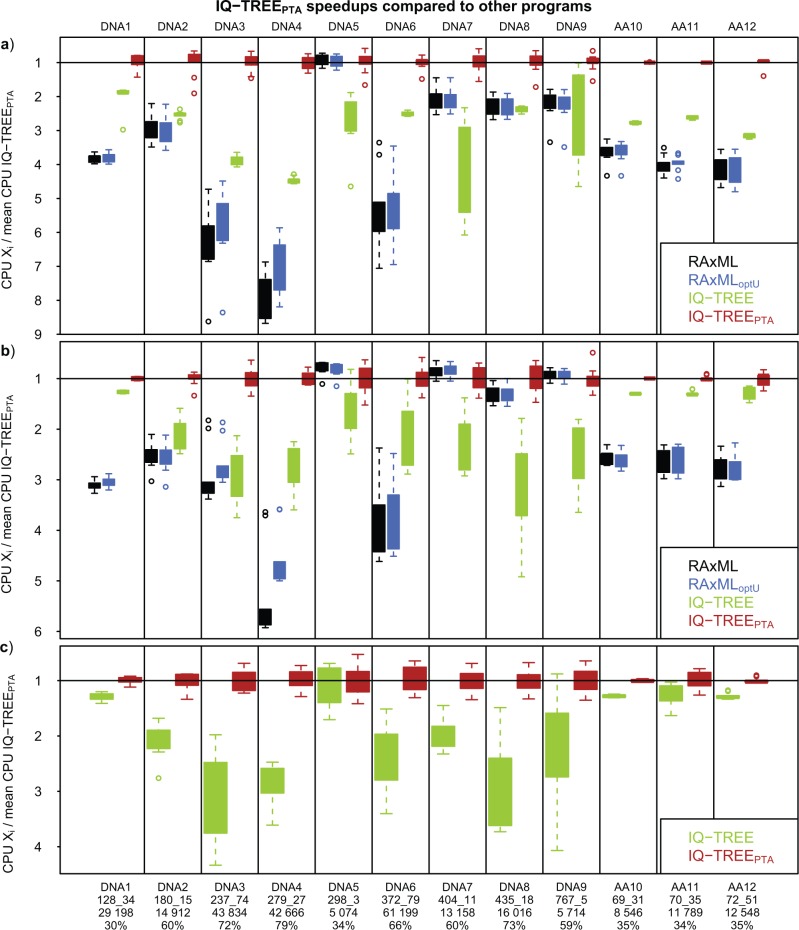
In phylogenomics the analysis of concatenated gene alignments, the so-called supermatrix, is commonly accompanied by the assumption of partition models. Under such models each gene, or more generally partition, is allowed to evolve under its own evolutionary model. Although partition models provide a more comprehensive analysis of supermatrices, missing data may hamper the tree search algorithms due to the existence of phylogenetic (partial) terraces. Here, we introduce the phylogenetic terrace aware (PTA) data structure for the efficient analysis under partition models. In the presence of missing data PTA exploits (partial) terraces and induced partition trees to save computation time. We show that an implementation of PTA in IQ-TREE leads to a substantial speedup of up to 4.5 and 8 times compared with the standard IQ-TREE and RAxML implementations, respectively. PTA is generally applicable to all types of partition models and common topological rearrangements thus can be employed by all phylogenomic inference software.
Overview
The claims and statistics of this paper haven’t been checked yet.
Free: it reads the open-access text and checks the first 5 claims that cite a source we can check. Create a free account to check every claim.
Integrity signals
Registry
Cites
Statistics
Figures



Verification
Claims the paper makes
The claims and statistics of this paper haven’t been checked yet.
Free: it reads the open-access text and checks the first 5 claims that cite a source we can check. Create a free account to check every claim.
Claims other papers make about this one
Each is checked against this paper’s own text: does it say what the citing paper says it does?
The source backs part of the claim, not all of it — or backs it for a different population, condition or comparison.
In the citing paper
“IQ-TREE 2 exploits partial terraces to improve tree search under partitioned models and achieves up to 4.5- and 8-fold speedups compared with IQ-TREE 1 and RAxML, respectively (Chernomor et al. 2016).”
From IQ-TREE 2: New Models and Efficient Methods for Phylogenetic Inference in the Genomic Era (2020) · cites this paper as Chernomor et al. 2016
Experimental — accuracy not yet measuredIn the citing paper
“This finding might not be entirely surprising because IQ-TREE represents the latest development in fast phylogenetic programs and has implemented a novel data structure to facilitate concatenation analysis (Chernomor et al. 2016).”
From Evaluating fast maximum likelihood-based phylogenetic programs using empirical phylogenomic data sets (2018) · cites this paper as Chernomor et al. 2016
Self-check
Percentages, sums and reported differences re-computed from the paper’s own numbers.
The self-check needs the paper’s full text.
Citations
Cites
1 retracted
RETRACTED ARTICLE: TREEFINDER: a powerful graphical analysis environment for molecular phylogenetics
Jobb, G., von Haeseler, A., & Strimmer, K. (2004) · BMC Evolutionary Biology · doi:10.1186/1471-2148-4-18 · Cited by 1,112
RetractedRAxML version 8: a tool for phylogenetic analysis and post-analysis of large phylogenies
Stamatakis, A. (2014) · Bioinformatics · doi:10.1093/bioinformatics/btu033 · Cited by 32,291 · cited 1×
“RAxML (Stamatakis 2014) x x TreeFinder ( IQ-TREE ( Jobb et al. 2004) x x x Nguyen et al. 2015) x x x EL, edge-linked; EUL, which yielded a substantial computation time and memory saving.”
MethodIQ-TREE: A Fast and Effective Stochastic Algorithm for Estimating Maximum-Likelihood Phylogenies
Nguyen, L.-T., Schmidt, H. A., von Haeseler, A., & Minh, B. Q. (2015) · Molecular Biology and Evolution · doi:10.1093/molbev/msu300 · Cited by 26,046 · cited 6×
“RAxML (Stamatakis 2014) x x TreeFinder ( IQ-TREE ( Jobb et al. 2004) x x x Nguyen et al. 2015) x x x EL, edge-linked; EUL, which yielded a substantial computation time and memory saving.”
BackgroundMethodInfluentialSelf-citationGuindon, S., Dufayard, J.-F., Lefort, V., Anisimova, M., Hordijk, W., & Gascuel, O. (2010) · Systematic Biology · doi:10.1093/sysbio/syq010 · Cited by 18,376
RAxML-VI-HPC: maximum likelihood-based phylogenetic analyses with thousands of taxa and mixed models
Stamatakis, A. (2006) · Bioinformatics · doi:10.1093/bioinformatics/btl446 · Cited by 15,582
Lanfear, R., Calcott, B., Ho, S. Y. W., & Guindon, S. (2012) · Molecular Biology and Evolution · doi:10.1093/molbev/mss020 · Cited by 5,732
Zwickl, D. J. (2006) · Texas ScholarWorks (Texas Digital Library) · Cited by 3,530
An Improved General Amino Acid Replacement Matrix
Le, S. Q., & Gascuel, O. (2008) · Molecular Biology and Evolution · doi:10.1093/molbev/msn067 · Cited by 3,127 · cited 1×
“For all partition models we assumed the GTR+ (Lanave et al. 1984; Yang 1994) and the LG+ (Yang 1994; Le and Gascuel 2008) models for all genes in the DNA and the AA alignments, respectively.”
MethodYang, Z. (1994) · Journal of Molecular Evolution · doi:10.1007/bf00160154 · Cited by 2,960 · cited 3×
“1984; Yang 1994) and the LG+ (Yang 1994; Le and Gascuel 2008) models for all genes in the DNA and the AA alignments, respectively.”
BackgroundMethodBroad phylogenomic sampling improves resolution of the animal tree of life
Dunn, C. W., Hejnol, A., Matus, D. Q., Pang, K., Browne, W. E., Smith, S. A., Seaver, E., Rouse, G. W., Obst, M., Edgecombe, G. D., et al. (2008) · Nature · doi:10.1038/nature06614 · Cited by 1,921
Cited by
Items 301–400 of 1,004
Phylogeny and Ecology of Trebouxia Photobionts From Bolivian Lichens
Kosecka, M., Kukwa, M., Jabłońska, A., Flakus, A., Flakus, P. R., Ptach-Styn, Ł., & Guzow‐Krzemińska, B. (2022) · Frontiers in Microbiology · doi:10.3389/fmicb.2022.779784 · Cited by 34
Zuccarello, G. C., Wen, X., & Kim, G. H. (2022) · ALGAE · doi:10.4490/algae.2022.37.9.11 · Cited by 34
Cedeño‐Sánchez, M. L., Charria‐Girón, E., Lambert, C. R., Luangsa-ard, J. J., Decock, C., Franke, R., Brönstrup, M., & Stadler, M. (2023) · MycoKeys · doi:10.3897/mycokeys.95.98125 · Cited by 34
“…phylogenetic tree was constructed using IQ-TREE v. 2.1.3 [-b 1000 -abayes -m MFP -nt AUTO] (Minh et al. 2020), The selection of the appropriate nucleotide exchange model was selected by ModelFinder (Chernomor et al. 2016; Kalyaanamoorthy et al. 2017) based on Bayesian inference criterion.”
InfluentialHaelewaters, D., Toome‐Heller, M., Albu, S., & Aime, M. C. (2019) · Fungal Systematics and Evolution · doi:10.3114/fuse.2020.05.12 · Cited by 34
“2015) under partitioned models (Chernomor et al. 2016). Appropriate models of nucleotide substitution were selected according to the corrected Akaike Information Criterion (AICc) through the built-in ModelFinder (Kalyaanamoorthy et al. 2017). Selected models were TIM2+F+R2 (SSU, -lnL = 6946.074), TIM2+F+G4 (ITS1, -lnL…”
MethodInfluentialBoudinot, B. E., Khouri, Z., Richter, A., Griebenow, Z. H., van de Kamp, T., Perrichot, V., & Barden, P. (2022) · bioRxiv (Cold Spring Harbor Laboratory) · doi:10.1101/2022.02.20.480183 · Cited by 35
Gąsiorek, P., & Michalczyk, Ł. (2020) · Royal Society Open Science · doi:10.1098/rsos.200581 · Cited by 33
“7 : 200581 (AICc) was used to find the best substitution models for two predefined partitions in the case of ML analysis [58].”
Huang, Z., Huang, W., Liu, X., Han, Z., Liu, G., Boamah, G. A., Wang, Y., Yu, F. G., Gan, Y., Xiao, Q., et al. (2021) · Molecular Ecology Resources · doi:10.1111/1755-0998.13439 · Cited by 33
Pillon, Y., Hopkins, H. C. F., Maurin, O., Epitawalage, N., Bradford, J. C., Rogers, Z. S., Baker, W. J., & Forest, F. (2021) · American Journal of Botany · doi:10.1002/ajb2.1688 · Cited by 33
“6.12 (Minh et al., 2020), using ultrafast bootstrap with partition models (Chernomor et al., 2016).”
MethodInfluentialAdmixture may be extensive among hyperdominant Amazon rainforest tree species
Larson, D. A., Vargas, O. M., Vicentini, A., & Dick, C. W. (2021) · New Phytologist · doi:10.1111/nph.17675 · Cited by 33
“The RT tests were conducted by subsetting each orthogroup alignment to include the four individuals of interest and estimating a gene tree with branch lengths for each subalignment using IQ-TREE v.1.6.3 (Nguyen et al., 2014; Chernomor et al., 2016).”
MethodInfluentialJohnson, K. P., Weckstein, J. D., Herrera, S. V., & Doña, J. (2021) · Molecular Phylogenetics and Evolution · doi:10.1016/j.ympev.2021.107297 · Cited by 33
Pyron, R. A., O’Connell, K. A., Duncan, S. C., Burbrink, F. T., & Beamer, D. A. (2022) · Systematic Biology · doi:10.1093/sysbio/syac065 · Cited by 33
The deep-rooted origin of disulfide-rich spider venom toxins
Shaikh, N. Y., & Sunagar, K. (2023) · eLife · doi:10.7554/elife.83761 · Cited by 33
Ghedotti, M. J., Gruber, J. N., Barton, R. W., Davis, M. P., & Smith, W. L. (2018) · Journal of Morphology · doi:10.1002/jmor.20894 · Cited by 33
Chan, K. O., & Grismer, L. L. (2019) · BMC Evolutionary Biology · doi:10.1186/s12862-019-1422-3 · Cited by 33
Complete Chloroplast Genomes of 14 Mangroves: Phylogenetic and Comparative Genomic Analyses
Shi, C., Han, K., Li, L., Seim, I., Lee, S. M., Xu, X., Yang, H., Fan, G., & Liu, X. (2020) · BioMed Research International · doi:10.1155/2020/8731857 · Cited by 33
Museomics: Phylogenomics of the Moth Family Epicopeiidae (Lepidoptera) Using Target Enrichment
Call, E., Mayer, C., Twort, V., Dietz, L., Wahlberg, N., & Espeland, M. (2021) · Insect Systematics and Diversity · doi:10.1093/isd/ixaa021 · Cited by 33
Yugueros, S. I., Peláez, J., Stajich, J., Fuertes-Rabanal, M., Sánchez‐Vallet, A., Largo‐Gosens, A., & Mélida, H. (2024) · The Cell Surface · doi:10.1016/j.tcsw.2024.100127 · Cited by 32
Weinell, J. L., Branch, W. R., Colston, T. J., Jackman, T. R., Kuhn, A., Conradie, W., & Bauer, A. M. (2019) · Molecular Phylogenetics and Evolution · doi:10.1016/j.ympev.2019.04.002 · Cited by 32
Harilal, D., Ramaswamy, S., Loney, T., Suwaidi, H. S. A., Khansaheb, H. H., Alkhaja, A., Varghese, R. M., Deesi, Z., Nowotny, N. R., Alsheikh-Ali, A. A. A., et al. (2020) · Clinical Chemistry · doi:10.1093/clinchem/hvaa187 · Cited by 32
Clonal spread of multi-resistant Gallibacterium anatis isolates among Iranian broilers and layers
Allahghadry, T., Ng, D. Y. K., Dibaei, A., & Bojesen, A. M. (2021) · Veterinary Research · doi:10.1186/s13567-021-00894-1 · Cited by 32
“12 using default setting, 100 bootstrap replications were included [29].”
MethodAssis, R. A. B., Varani, A. M., Sagawa, C. H. D., Patané, J. S. L., Setúbal, J. C., Uceda-Campos, G., da Silva, A. M., Zaini, P. A., Almeida, N. F., Moreira, L. M., et al. (2021) · Genomics · doi:10.1016/j.ygeno.2021.06.003 · Cited by 32
Trypanosoma rangeli Genetic, Mammalian Hosts, and Geographical Diversity from Five Brazilian Biomes
Dario, M. A., Pavan, M. G., Rodrigues, M. S., Lisboa, C. V., Kluyber, D., Desbiez, A. L. J., Herrera, H. M., Roque, A. L. R., Lima, L., Teixeira, M. M. G., et al. (2021) · Pathogens · doi:10.3390/pathogens10060736 · Cited by 32
“The ML tree reconstruction was performed in the IQ-Tree program [105,106] available on PhyloSuite v.”
MethodSancho, R., Inda, L. A., Díaz‐Pérez, A., Marais, D. L. D., Gordon, S., Vogel, J. P., Lusinska, J., Hasterok, R., Contreras‐Moreira, B., & Catalán, P. (2022) · The Plant Journal · doi:10.1111/tpj.15650 · Cited by 32
Deep-branching ANME-1c archaea grow at the upper temperature limit of anaerobic oxidation of methane
Merino, D. B., Zehnle, H., Teske, A., & Wegener, G. (2022) · Frontiers in Microbiology · doi:10.3389/fmicb.2022.988871 · Cited by 32
“Maximum likelihood phylogenetic trees of the alignment were calculated with IQTree with 100 bootstraps (Chernomor et al., 2016; Kalyaanamoorthy et al., 2017; Minh et al., 2020).”
MethodBrynildsrud, O. B., Tysnes, K. R., Robertson, L. J., & Debenham, J. J. (2018) · Zoonoses and Public Health · doi:10.1111/zph.12470 · Cited by 32
Gonçalves, D. J. P., Shimizu, G. H., Ortiz, E. M., Jansen, R. K., & Simpson, B. B. (2020) · American Journal of Botany · doi:10.1002/ajb2.1502 · Cited by 32
Extensive photobiont sharing in a rapidly radiating cyanolichen clade
Forno, M. D., Lawrey, J. D., Sikaroodi, M., Gillevet, P. M., Schuettpelz, E., & Lücking, R. (2020) · Molecular Ecology · doi:10.1111/mec.15700 · Cited by 32
Demos, T. C., Webala, P. W., Lutz, H. L., Peterhans, J. C. K., Goodman, S. M., Cortés‐Delgado, N., Bartonjo, M., & Patterson, B. D. (2019) · Zoologica Scripta · doi:10.1111/zsc.12388 · Cited by 31
The genome sequence of Samia ricini, a new model species of lepidopteran insect
Lee, J., Nishiyama, T., Shigenobu, S., Yamaguchi, K., Suzuki, Y., Shimada, T., Katsuma, S., & Kiuchi, T. (2020) · Molecular Ecology Resources · doi:10.1111/1755-0998.13259 · Cited by 31
Morphological convergence and adaptation in cave and pelagic scale worms (Polynoidae, Annelida)
Gonzalez, B. C., Martínez, A., Worsaae, K., & Osborn, K. J. (2021) · Scientific Reports · doi:10.1038/s41598-021-89459-y · Cited by 31
Simon, S., Breeschoten, T., Jansen, H. J., Dirks, R. P., Schranz, M. E., & Ros, V. I. D. (2021) · G3 Genes Genomes Genetics · doi:10.1093/g3journal/jkab311 · Cited by 31
Kneubehl, A. R., Krishnavajhala, A., Muñoz‐Leal, S., Replogle, A. J., Kingry, L. C., Bermúdez, S. E., Labruna, M. B., & López, J. E. (2022) · BMC Genomics · doi:10.1186/s12864-022-08523-7 · Cited by 31
Uvizl, M., Puechmaille, S. J., Power, S., Pippel, M., Carthy, S., Haerty, W., Myers, E. W., Teeling, E. C., & Huang, Z. (2023) · Molecular Biology and Evolution · doi:10.1093/molbev/msad278 · Cited by 32
“Next, we inferred the ML tree using the partition model in IQ-TREE (Nguyen et al. 2015; Chernomor et al. 2016) for each locus.”
MethodA simple method for data partitioning based on relative evolutionary rates
Rota, J., Malm, T., Chazot, N., Peña, C., & Wahlberg, N. (2018) · PeerJ · doi:10.7717/peerj.5498 · Cited by 31
Liang, B., Zhou, R.-B., Liu, Y.-L., Chen, B., Grismer, L. L., & Wang, N. (2018) · Molecular Phylogenetics and Evolution · doi:10.1016/j.ympev.2018.06.011 · Cited by 31
Pizarro, D., Divakar, P. K., Grewe, F., Leavitt, S. D., Huang, J., Grande, F. D., Schmitt, I., Wedin, M., Crespo, A., & Lumbsch, H. T. (2018) · Fungal Diversity · doi:10.1007/s13225-018-0407-7 · Cited by 32
“I model using ModelFinder (Chernomor et al. 2016).”
Higher‐level molecular phylogeny of jumping plant lice (Hemiptera: Sternorrhyncha: Psylloidea)
Cho, G., Malenovský, I., & Lee, S. (2019) · Systematic Entomology · doi:10.1111/syen.12345 · Cited by 31
“the gene partitions according to the Bayesian information criterion (Chernomor et al., 2016; Kalyaanamoorthy et al., 2017).”
MethodInfluentialThe Talaromyces pinophilus species complex
Peterson, S. W., & Jurjević, Ž. (2019) · Fungal Biology · doi:10.1016/j.funbio.2019.06.007 · Cited by 31
Jin, M., Zwick, A., Ślipiński, A., Marris, J. W. M., Thomas, M. C., & Pang, H. (2020) · Systematic Entomology · doi:10.1111/syen.12392 · Cited by 31
“…and re-coded (degen-NT) data matrices were partitioned by gene and codon position (39 blocks) and analysed in modelfinder with the +MERGE option (Chernomor et al., 2016; Kalyaanamoorthy et al., 2017) to determine a best-fit partitioning scheme and substitution models for maximum likelihood (ML)…”
MethodWeinell, J. L., Barley, A. J., Siler, C. D., Orlov, N. L., Ananjeva, N. B., Oaks, J. R., Burbrink, F. T., & Brown, R. M. (2020) · Zoological Journal of the Linnean Society · doi:10.1093/zoolinnean/zlaa090 · Cited by 31
“We treated each locus as a separate partition, and we used the automatic model-selection feature (Chernomor et al., 2016) to identify the optimal substitution model for each partition.”
MethodSteenwyk, J. L., Shen, X., Lind, A., Goldman, G. H., & Rokas, A. (2018) · bioRxiv (Cold Spring Harbor Laboratory) · doi:10.1101/370429 · Cited by 31
Eight new freshwater mussels (Unionidae) from tropical Asia
Болотов, И. Н., Konopleva, E. S., Vikhrev, I. V., Lopes‐Lima, M., Bogan, A. E., Lunn, Z., Chan, N., Win, T., Aksenova, O. V., Gofarov, M. Y., et al. (2019) · Scientific Reports · doi:10.1038/s41598-019-48528-z · Cited by 30
A phylogenomic resolution for the taxonomy of Aegean green lizards
Kornilios, P., Thanou, E., Lymberakis, P., Ilgaz, Ç., Kumlutaş, Y., & Leaché, A. D. (2019) · Zoologica Scripta · doi:10.1111/zsc.12385 · Cited by 30
Joseph, L., Merwin, J. T., & Smith, B. T. (2020) · Emu - Austral Ornithology · doi:10.1080/01584197.2020.1779596 · Cited by 30
Smith, C. H. (2021) · Genome Biology and Evolution · doi:10.1093/gbe/evab029 · Cited by 30
Discovery of novel fish papillomaviruses: From the Antarctic to the commercial fish market
Kraberger, S. J., Austin, C., Farkas, K., Desvignes, T., Postlethwait, J. H., Fontenele, R. S., Schmidlin, K., Bradley, R. W., Warzybok, P., Doorslaer, K. V., et al. (2021) · Virology · doi:10.1016/j.virol.2021.10.007 · Cited by 30
Domènech, M., Malumbres‐Olarte, J., Enguídanos, A., Múrria, C., & Arnedo, M. A. (2021) · Insect Conservation and Diversity · doi:10.1111/icad.12552 · Cited by 30
“6.1 (Nguyen et al., 2015; Chernomor et al., 2016) to infer a maximum likelihood tree using the edge-linked partition model and the GTR + I + G model of nucleotide substitution, as it is the most complex and parameter-rich model and the large number of sequences allowed for a correct estimation of…”
MethodInfluentialMolecular identification and genetic diversity of Bartonella spp. in 24 bat species from Thailand
Poofery, J., Narapakdeesakul, D., Riana, E., Arnuphapprasert, A., Nugraheni, Y. R., Ngamprasertwong, T., Wangthongchaicharoen, M., Soisook, P., Bhodhibundit, P., & Kaewthamasorn, M. (2021) · Transboundary and Emerging Diseases · doi:10.1111/tbed.14389 · Cited by 30
Molecular Epidemiology of HIV-1 in Eastern Europe and Russia
van de Klundert, M. A. A., Antonova, A. A., Teodoro, G. D., Diez, R. C., Chkhartishvili, N., Heger, E., Kuznetsova, A. I., Lebedev, A. V., Narayanan, A., Ozhmegova, E., et al. (2022) · Viruses · doi:10.3390/v14102099 · Cited by 30
Glon, M. G., Thoma, R. F., Taylor, C. A., Daly, M., & Freudenstein, J. V. (2018) · Journal of Crustacean Biology · doi:10.1093/jcbiol/ruy057 · Cited by 30
Rad‐Menéndez, C., Gerphagnon, M., Garvetto, A., Arce, P., Badis, Y., Sime‐Ngando, T., & Gachon, C. M. M. (2018) · Applied and Environmental Microbiology · doi:10.1128/aem.01826-18 · Cited by 30
Kornilios, P., Thanou, E., Lymberakis, P., Ilgaz, Ç., Kumlutaş, Y., & Leaché, A. D. (2019) · Journal of Biogeography · doi:10.1111/jbi.13524 · Cited by 30
Urantówka, A. D., Kroczak, A., & Mackiewicz, P. (2020) · BMC Genomics · doi:10.1186/s12864-020-07284-5 · Cited by 30
Laraba, I., McCormick, S. P., Vaughan, M. M., Geiser, D. M., & O'Donnell, K. L. (2021) · PLoS ONE · doi:10.1371/journal.pone.0250812 · Cited by 30
A General Substitution Matrix for Structural Phylogenetics
Garg, S. G., & Hochberg, G. K. A. (2025) · Molecular Biology and Evolution · doi:10.1093/molbev/msaf124 · Cited by 29
“In the analyses of specific protein families that follow, IQ-Tree’s modelfinder predominantly chose Q.3Di.”
InfluentialKennedy, S. R., Lim, J. Y., Adams, S. A., Krehenwinkel, H., & Gillespie, R. G. (2022) · Molecular Phylogenetics and Evolution · doi:10.1016/j.ympev.2022.107564 · Cited by 29
Smith, C. H., Pfeiffer, J. M., & Johnson, N. A. (2020) · Cladistics · doi:10.1111/cla.12423 · Cited by 29
“Phylogenomic analyses using maximum parsimony (MP), maximum likelihood (ML), and Bayesian inference (BI) analyses were performed in PAUP* v 4.0a165 (Swofford, 2003), IQ-TREE v 1.6.11 (Nguyen et al., 2015; Chernomor et al., 2016), and MrBayes v 3.2.6 (Ronquist et al., 2012), respectively.”
MethodInfluentialIsolation and Molecular Characterization of the Romaine Lettuce Phylloplane Mycobiome
Haelewaters, D., Urbina, H., Brown, S., Newerth-Henson, S., & Aime, M. C. (2021) · Journal of Fungi · doi:10.3390/jof7040277 · Cited by 29
Crithidia mellificae infection in different mammalian species in Brazil
Dario, M. A., Lisboa, C. V., da Silva, M. V., Herrera, H. M., Rocha, F. L., Furtado, M. C., Moratelli, R., Roque, A. L. R., & Jansen, A. M. (2021) · International Journal for Parasitology Parasites and Wildlife · doi:10.1016/j.ijppaw.2021.04.003 · Cited by 29
Maxicircle architecture and evolutionary insights into Trypanosoma cruzi complex
Berná, L., Greif, G., Pita, S., Faral‐Tello, P., Díaz-Viraqué, F., de Souza, R. D. C. M., Vallejo, G. A., Álvarez-Valín, F., & Robello, C. (2021) · PLoS neglected tropical diseases · doi:10.1371/journal.pntd.0009719 · Cited by 29
“In addition, to compare several approaches, ML trees were performed on both concatenated datasets with IQ-TREE [71] and PhyML [75] softwares.”
MethodInfluentialInvestigating Sources of Conflict in Deep Phylogenomics of Vetigastropod Snails
Cunha, T. J., Reimer, J. D., & Giribet, G. (2021) · Systematic Biology · doi:10.1093/sysbio/syab071 · Cited by 29
“8 (Nguyen et al. 2015; Chernomor et al. 2016; Kalyaanamoorthy et al. 2017), and with Bayesian inference (BI) in PhyloBayes MPI v1.”
MethodPlastome structure, evolution, and phylogeny of Selaginella
Zhou, X., Zhao, J., Yang, J., Péchon, T. L., Zhang, L., He, Z., & Zhang, L. (2022) · Molecular Phylogenetics and Evolution · doi:10.1016/j.ympev.2022.107410 · Cited by 30
Koch, T. L., Ramiro, I. B. L., Salcedo, P. F., Engholm, E., Jensen, K. J., Chase, K., Olivera, B. M., Bjørn-Yoshimoto, W. E., & Safavi-Hemami, H. (2022) · Molecular Biology and Evolution · doi:10.1093/molbev/msac075 · Cited by 29
“6.1 (Nguyen et al. 2015; Chernomor et al. 2016) run on a single thread on anM1 chip with eight cores @ 3.2 GHz with seed 889704.”
MethodInfluentialWei, M., Li, H., Wang, Q., Liu, R., Lin-xi, Y., & Li, Q. (2023) · Frontiers in Plant Science · doi:10.3389/fpls.2023.1193065 · Cited by 29
“The alignments were trimmed using trimAl software, and then a phylogeny tree was inferred under maximum likelihood with IQ-TREE (Capella-Gutiérrez et al., 2009; Chernomor et al., 2016).”
InfluentialIntegrating full and partial genome sequences to decipher the global spread of canine rabies virus
Holtz, A., Baele, G., Bourhy, H., & Zhukova, A. (2023) · Nature Communications · doi:10.1038/s41467-023-39847-x · Cited by 29
“2.2.2) 61 employing the GTR +I+ G4 model (determined by ModelFinder 62 ) with gene partitioning to account for potential variation in substitution rates by gene and evaluated with 1000 ultrafastbootstraps 61,63,64 (ranon 8 threads for 164 h:28 min).”
InfluentialZhou, N., Miao, K., Liu, C., Jia, L., Hu, J., Huang, Y., & Ji, Y. (2023) · Acta Botanica Yunnanica · doi:10.1016/j.pld.2023.07.009 · Cited by 29
“ML phylogeny was reconstructed using IQ-Tree v.2.1.3 (Chernomor et al., 2016; Nguyen et al., 2015) under the TVM þ F þ R6 model, with 1000 rapid-search replicates to estimate bootstrap (BS) support for each node.”
MethodInfluentialNew insight into parrots’ mitogenomes indicates that their ancestor contained a duplicated region
Urantówka, A. D., Kroczak, A., Silva, T. J., Zamora-Padrón, R., Gallardo, N. F., Blanch, J., Blanch, B., & Mackiewicz, P. (2018) · Molecular Biology and Evolution · doi:10.1093/molbev/msy189 · Cited by 29
“The best-fitted substitution models considering all possible codon and gene partitions in the ND2 and 37-gene alignments were found in ModelFinder (Chernomor et al. 2016; Kalyaanamoorthy et al. 2017) and PartitionFinder (Lanfear et al.”
MethodFoster, C. S. P., & Ho, S. Y. W. (2017) · Genome Biology and Evolution · doi:10.1093/gbe/evx198 · Cited by 29
“We partitioned the data set by codon position using the edge-linked partition model 140 (Chernomor et al. 2016), and implemented the GTR+Γ4 model of nucleotide substitution for each 141 subset.”
MethodJumbam, B., Haelewaters, D., Koch, R. A., Dentinger, B. T. M., Henkel, T. W., & Aime, M. C. (2019) · Mycological Progress · doi:10.1007/s11557-019-01530-1 · Cited by 29
Monnens, M., Thijs, S., Briscoe, A. G., Clark, M., Frost, E. J., Littlewood, D. T. J., Sewell, M. A., Smeets, K., Artois, T., & Vanhove, M. P. M. (2020) · International Journal of Biological Macromolecules · doi:10.1016/j.ijbiomac.2020.06.025 · Cited by 29
Zhou, Y., Caterino, M. S., Ren, D., & Ślipiński, A. (2020) · Cladistics · doi:10.1111/cla.12418 · Cited by 29
“The analyses were conducted in IQ-Tree using Edge-proportional algorithm for the partition models (-spp) (Chernomor et al., 2016).”
MethodKmentová, N., Cruz‐Laufer, A. J., Pariselle, A., Smeets, K., Artois, T. J., & M., V. M. P. (2021) · EcoEvoRxiv · doi:10.1016/j.ijpara.2022.01.003
Qi, M., Clark, J., Moody, E. R. R., Pisani, D., & Donoghue, P. C. J. (2024) · Genome Biology and Evolution · doi:10.1093/gbe/evae128 · Cited by 28
“6.12 (Nguyen et al. 2015; Chernomor et al. 2016).”
InfluentialRainforest conversion to monocultures favors generalist ants with large colonies
Kreider, J. J., Chen, T., Hartke, T. R., Buchori, D., Hidayat, P., Nazarreta, R., Scheu, S., & Drescher, J. (2021) · Ecosphere · doi:10.1002/ecs2.3717 · Cited by 28
“We calculated phylogenies in IQTREE with partitioned models and 10,000 bootstraps to infer branching support (Nguyen et al. 2015, Chernomor et al. 2016, Kalyaanamoorthy et al. 2017, Hoang et al. 2018).”
MethodEmser, S. V., Schaschl, H., Millesi, E., & Steinborn, R. (2021) · Frontiers in Genetics · doi:10.3389/fgene.2021.685806 · Cited by 28
“The best-fi tting substitution model, the TIM2+F+I+G4 model, was selected according to the Bayesian Information Criterion using ModelFinder (Lanfear et al., 2012; Chernomor et al., 2016; Kalyaanamoorthy et al., 2017).”
MethodWhole‐genome analyses disentangle reticulate evolution of primroses in a biodiversity hotspot
Stubbs, R. L., Theodoridis, S., Mora‐Carrera, E., Keller, B., Yousefi, N., Potente, G., Léveillé‐Bourret, É., Celep, F., Kochjarová, J., Tedoradze, G., et al. (2022) · New Phytologist · doi:10.1111/nph.18525 · Cited by 28
“We generated statistical support for branches with 1000 ultrafast bootstraps (BS) (Minh et al., 2013; Chernomor et al., 2016).”
MethodKornilios, P., Kumlutaş, Y., Lymberakis, P., & Ilgaz, Ç. (2018) · Journal of Zoological Systematics & Evolutionary Research · doi:10.1111/jzs.12205 · Cited by 29
Burbrink, F. T., Ruane, S., Kuhn, A., Rabibisoa, N., Randriamahatantsoa, B., Raselimanana, A. P., Andrianarimalala, M. S. M., Cadle, J. E., Lemmon, A. R., Lemmon, E. M., et al. (2019) · Systematic Biology · doi:10.1093/sysbio/syz026 · Cited by 28
“2015) where each partition was tested using ModelFinder (Chernomor et al. 2016; Kalyaanamoorthy et al. 2017) for over 279 substitutional models including up to six free rate gamma categories.”
MethodJimenez-Tenorio, M., Abalde, S., Pardos-Blas, J. R., & Zardoya, R. (2020) · European Journal of Taxonomy · doi:10.5852/ejt.2020.663 · Cited by 28
“…each partition according to the BIC (GTR+I+G for each codon position; HKY85+I+G for the rRNA genes) and a maximum likelihood (ML) tree was reconstructed (see Supplementary Material File 5) using IQtree 1.6.10 (Nguyen et al. 2015; Chernomor et al. 2016) in the CIPRES gateway (Miller et al. 2010).”
MethodInfluentialBaker, C. M., Sheridan, K., Derkarabetian, S., Pérez‐González, A., Vélez, S., & Giribet, G. (2020) · Invertebrate Systematics · doi:10.1071/is19069 · Cited by 28
Melichárková, A., Šlenker, M., Zozomová‐Lihová, J., Skokanová, K., Šingliarová, B., Kačmárová, T., Caboňová, M., Kempa, M., Šrámková, G., Mandáková, T. M., et al. (2020) · Frontiers in Plant Science · doi:10.3389/fpls.2020.588856 · Cited by 28
Małek, N., Michrowska, A., Mazurkiewicz, E., Mrówczyńska, E., Mackiewicz, P., & Mazur, A. J. (2021) · Scientific Reports · doi:10.1038/s41598-021-82074-x · Cited by 28
Gag proteins encoded by endogenous retroviruses are required for zebrafish development
Chang, N.-C., Wells, J. N., Wang, A. Y., Schofield, P., Huang, Y.-C., Truong, V. H., Simoes-Costa, M., & Feschotte, C. (2025) · Proceedings of the National Academy of Sciences · doi:10.1073/pnas.2411446122 · Cited by 27
Phylogenomic analyses revealed widely occurring hybridization events across Elsholtzieae (Lamiaceae)
Wang, Y., Wu, X., Chen, Y., Xu, C., Wang, Y., & Wang, Q. (2024) · Molecular Phylogenetics and Evolution · doi:10.1016/j.ympev.2024.108112 · Cited by 27
Coevolution with hosts underpins speciation in brood-parasitic cuckoos
Langmore, N. E., Grealy, A. C., Noh, H., Medina, I., Skeels, A., Grant, J., Murray, K., Kilner, R. M., & Holleley, C. E. (2024) · Science · doi:10.1126/science.adj3210 · Cited by 27
Deng, J., Stroiński, A., Szwedo, J., Ghanavi, H. R., Yapar, E., Franco, D. C., Prus-Frankowska, M., Michalik, A., Wahlberg, N., & Łukasik, P. (2024) · Systematic Entomology · doi:10.1111/syen.12666 · Cited by 27
“…we asked IQ-TREE2 to perform extended model selection on each gene with free rate heterogeneity followed by tree inference and subsequently merge two or more genes until the model fit does not increase any further (setting: -m MFP + MERGE; Chernomor et al., 2016; Kalyaanamoorthy et al., 2017).”
Crespo, L. C., Domènech, M., Enguídanos, A., Malumbres‐Olarte, J., Cardoso, P., Moya‐Laraño, J., Frías-López, C., Macías‐Hernández, N., Mas, E. D., Mazzuca, P., et al. (2018) · Biodiversity Data Journal · doi:10.3897/bdj.6.e29443 · Cited by 27
Laraba, I., Kim, H.-S., Proctor, R. H., Busman, M., O'Donnell, K. L., Felker, F. C., Aime, M. C., Koch, R. A., & Wurdack, K. J. (2019) · Mycologia · doi:10.1080/00275514.2019.1668991 · Cited by 27
“ModelFinder (Kalyaanamoorthy et al. 2017) identified TNe+I+G4, TIM2e+I+G4, and TIM3+F+I +G4 as the best-fit models of molecular evolution for RPB1, RPB2, and TEF1, respectively, using the Bayesian information criterion scores (Chernomor et al. 2016).”
MethodKosecka, M., Guzow‐Krzemińska, B., Černajová, I., Škaloud, P., Jabłońska, A., & Kukwa, M. (2021) · Scientific Reports · doi:10.1038/s41598-021-88110-0 · Cited by 27
Hotaling, S., Borowiec, M. L., Lins, L. S. F., Desvignes, T., & Kelley, J. L. (2021) · Molecular Phylogenetics and Evolution · doi:10.1016/j.ympev.2021.107211 · Cited by 27
Comprehensive Review of Tolypocladium and Description of a Novel Lineage from Southwest China
Yu, F.-M., Chethana, K. W. T., Wei, D.-P., Liu, J., Zhao, Q., Tang, S.-M., Lu, L., & Hyde, K. D. (2021) · Pathogens · doi:10.3390/pathogens10111389 · Cited by 27
Hühn, P., Dillenberger, M. S., Gerschwitz‐Eidt, M. A., Hörandl, E., Berasategui, J. A., Messerschmid, T. F. E., Paetzold, C., Rieger, B., & Kadereit, G. (2021) · Molecular Phylogenetics and Evolution · doi:10.1016/j.ympev.2021.107342 · Cited by 27
Tsai, K.-J., Tu, Y., Wu, C., Huang, C., Ting, L., Huang, Y., Pan, C.-H., Chang, C., Deng, M., & Lee, F. (2022) · Journal of Veterinary Medical Science · doi:10.1292/jvms.21-0649 · Cited by 27
“Phylogenetic relationships of viral isolates were analyzed by the maximum likelihood method with a best-fit substitution model and partition scheme [7, 13] evaluated using ModelFinder based on the Bayesian information criterion implemented in IQ-TREE version 1.”
MethodTarget capture data resolve recalcitrant relationships in the coffee family (Rubioideae, Rubiaceae)
Thureborn, O., Razafimandimbison, S. G., Wikström, N., & Rydin, C. (2022) · Frontiers in Plant Science · doi:10.3389/fpls.2022.967456 · Cited by 27
“The concatenated matrices were analyzed using IQTREE 2 using a partitioned model (Chernomor et al., 2016), with each gene treated as a separate partition with a GTR + G model specified for each partition and allowing the possibility of separate rates among partitions.”
MethodPhylogenomic inference of the higher classification of velvet ants (Hymenoptera: Mutillidae)
Waldren, G. C., Sadler, E. A., Murray, E. A., Bossert, S., Danforth, B. N., & Pitts, J. P. (2023) · Systematic Entomology · doi:10.1111/syen.12588 · Cited by 27
Mendes-Pereira, T., Araújo, J. P. M., Kloss, T. G., Costa‐Rezende, D. H., de Carvalho, D. S., & Goés‐Neto, A. (2023) · Journal of Fungi · doi:10.3390/jof9040457 · Cited by 27
“For selecting evolutionary models for phylogenetic analyses and data partition, we used ModelFinder [48,49].”
MethodBalboa, R. F., Bertola, L. D., Brüniche–Olsen, A., Rasmussen, M. S., Liu, X., Besnard, G., Salmona, J., Santander, C. G., He, S., Zinner, D. P., et al. (2024) · Nature Communications · doi:10.1038/s41467-023-44105-1 · Cited by 27
Crisp, M. D., Minh, B. Q., Choi, B., Edwards, R. D., Hereward, J., Külheim, C., Lin, Y. P., Meusemann, K., Thornhill, A. H., Toon, A., et al. (2024) · Journal of Systematics and Evolution · doi:10.1111/jse.13047 · Cited by 27
“1.6.10 (Nguyen et al., 2015), fi rst with a single partition and then with the DNA divided into 101 partitions (loci: Suppinfo S2), each with its own model (Chernomor et al., 2016), estimated using ModelFinder (Kalyaanamoorthy et al., 2017).”
InfluentialSelf-citationKornilios, P. (2017) · Zoologica Scripta · doi:10.1111/zsc.12243 · Cited by 27
“Specifically, for each combination, a maximum likelihood (ML) analysis was run using the online version of IQ-TREE 1.4.3 (Nguyen et al. 2015; Chernomor et al. 2016; Trifinopoulos et al. 2016).”
MethodInfluentialLeal-Dutra, C. A., Neves, M. A., Griffith, G. W., Reck, M. A., Clasen, L. A., & Dentinger, B. T. M. (2018) · MycoKeys · doi:10.3897/mycokeys.37.26303 · Cited by 27
“The best-fit evolutionary models for this analysis were estimated by the builtin ModelFinder (option -m MF+MERGE) allowing the partitions to share the same set of branch lengths but with their own evolution rate (-spp option) (Chernomor et al. 2016; Kalyaanamoorthy et al. 2017).”
BackgroundMethod
Metadata
- Authors
- Chernomor, O., von Haeseler, A., & Minh, B. Q.
- Affiliations
- University of Vienna (AT)
- ORCID
- Chernomor, Olga
- Venue
- Systematic Biology
- Publisher
- Oxford University Press (OUP)
- Published
- 2016-04-26
- Volume
- 65
- Issue
- 6
- Pages
- 997-1008
- ISSN
- 1063-5157 (ISSN-L)
- 1076-836X
- PMC
- PMC5066062
- OpenAlex
- W2344940607
- Cited by
- 2,252
- References
- 41
- Citations by year
- 2026: 240 · 2025: 285 · 2024: 328 · 2023: 322 · 2022: 289 · 2021: 331 · 2020: 214 · 2019: 134 · 2018: 75 · 2017: 31 · 2016: 3
- FWCI
- 42.08
- Type
- journal article
- Language
- en
- Open access
- hybrid
- doi.org
- Licence
- cc-by-nc
- Locations
- Systematic Biology (publishedVersion, cc-by-nc)
- PubMed Central (publishedVersion, cc-by-nc)
- PubMed (publishedVersion)
- HighWire Press Open Archive (submittedVersion)
- Funders
- Austrian Science Fund (I-2805-B29, I-1824-B22)
- Topics
- Life Sciences › Biochemistry, Genetics and Molecular Biology › Molecular Biology › Genomics and Phylogenetic Studies
- Life Sciences › Biochemistry, Genetics and Molecular Biology › Molecular Biology › RNA and protein synthesis mechanisms
- Life Sciences › Agricultural and Biological Sciences › Ecology, Evolution, Behavior and Systematics › Plant Diversity and Evolution
- Keywords
- partition model, supermatrix, missing data, phylogenetic tree search, IQ-TREE, RAxML, data structures
- MeSH terms
- Algorithms, Classification, Biological Evolution, Models, Biological, Phylogeny, Software, Sequence Analysis, DNA
About these checks
Registry, retraction, Cites and statistics results are computed, not judged, with one exception: a printed reference that no index lists is read once by a model before it counts as a citation error. Claims are extracted by a model and kept only when their quote appears verbatim in the text; each cited source is then checked, with a model’s help, for whether it says what the claim relies on. Those verdicts can be wrong — read the claim’s quote and the cited source before relying on one.
Statistics and arithmetic are recomputed, not judged.
Confidence bands are shown only for fields calibrated on our annotated test set. None is calibrated yet, so no band is shown.
What counts as a claim ›How we measure confidence ›How we check this ›
Are you an author, or do you see a problem with this page? Request a review
Data sources
Bibliographic data: Semantic Scholar, OpenAlex, Crossref.
Contains information from the Semantic Scholar Academic Graph Datasets, made available under the ODC Attribution License (ODC-BY 1.0).
Semantic Scholar’s data is described in: Kinney, R., et al. (2023). The Semantic Scholar Open Data Platform. arXiv:2301.10140.
