

Terrace Aware Data Structure for Phylogenomic Inference from Supermatrices
Open accessThe DOI matches its Crossref record; 43 of the 43 references it cites were found in a registry or an index.
Abstract
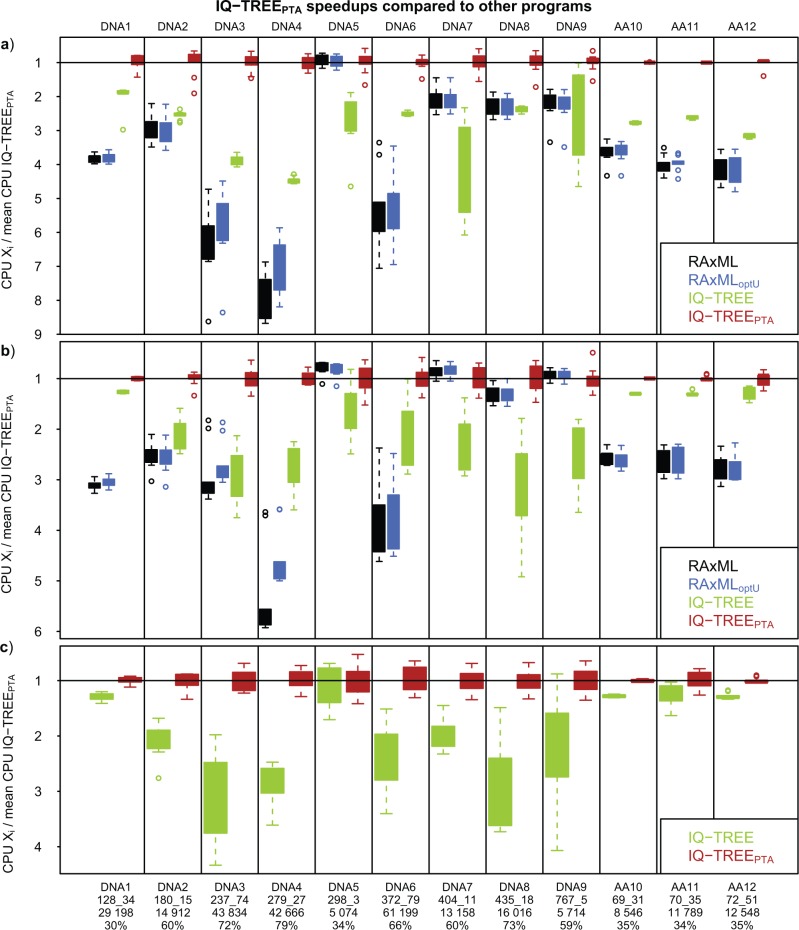
In phylogenomics the analysis of concatenated gene alignments, the so-called supermatrix, is commonly accompanied by the assumption of partition models. Under such models each gene, or more generally partition, is allowed to evolve under its own evolutionary model. Although partition models provide a more comprehensive analysis of supermatrices, missing data may hamper the tree search algorithms due to the existence of phylogenetic (partial) terraces. Here, we introduce the phylogenetic terrace aware (PTA) data structure for the efficient analysis under partition models. In the presence of missing data PTA exploits (partial) terraces and induced partition trees to save computation time. We show that an implementation of PTA in IQ-TREE leads to a substantial speedup of up to 4.5 and 8 times compared with the standard IQ-TREE and RAxML implementations, respectively. PTA is generally applicable to all types of partition models and common topological rearrangements thus can be employed by all phylogenomic inference software.
Overview
The claims and statistics of this paper haven’t been checked yet.
Free: it reads the open-access text and checks the first 5 claims that cite a source we can check. Create a free account to check every claim.
Integrity signals
Registry
Cites
Statistics
Figures



Verification
Claims the paper makes
The claims and statistics of this paper haven’t been checked yet.
Free: it reads the open-access text and checks the first 5 claims that cite a source we can check. Create a free account to check every claim.
Claims other papers make about this one
Each is checked against this paper’s own text: does it say what the citing paper says it does?
The source backs part of the claim, not all of it — or backs it for a different population, condition or comparison.
In the citing paper
“IQ-TREE 2 exploits partial terraces to improve tree search under partitioned models and achieves up to 4.5- and 8-fold speedups compared with IQ-TREE 1 and RAxML, respectively (Chernomor et al. 2016).”
From IQ-TREE 2: New Models and Efficient Methods for Phylogenetic Inference in the Genomic Era (2020) · cites this paper as Chernomor et al. 2016
Experimental — accuracy not yet measuredIn the citing paper
“This finding might not be entirely surprising because IQ-TREE represents the latest development in fast phylogenetic programs and has implemented a novel data structure to facilitate concatenation analysis (Chernomor et al. 2016).”
From Evaluating fast maximum likelihood-based phylogenetic programs using empirical phylogenomic data sets (2018) · cites this paper as Chernomor et al. 2016
Self-check
Percentages, sums and reported differences re-computed from the paper’s own numbers.
The self-check needs the paper’s full text.
Citations
Cites
1 retracted
RETRACTED ARTICLE: TREEFINDER: a powerful graphical analysis environment for molecular phylogenetics
Jobb, G., von Haeseler, A., & Strimmer, K. (2004) · BMC Evolutionary Biology · doi:10.1186/1471-2148-4-18 · Cited by 1,112
RetractedRAxML version 8: a tool for phylogenetic analysis and post-analysis of large phylogenies
Stamatakis, A. (2014) · Bioinformatics · doi:10.1093/bioinformatics/btu033 · Cited by 32,291 · cited 1×
“RAxML (Stamatakis 2014) x x TreeFinder ( IQ-TREE ( Jobb et al. 2004) x x x Nguyen et al. 2015) x x x EL, edge-linked; EUL, which yielded a substantial computation time and memory saving.”
MethodIQ-TREE: A Fast and Effective Stochastic Algorithm for Estimating Maximum-Likelihood Phylogenies
Nguyen, L.-T., Schmidt, H. A., von Haeseler, A., & Minh, B. Q. (2015) · Molecular Biology and Evolution · doi:10.1093/molbev/msu300 · Cited by 26,046 · cited 6×
“RAxML (Stamatakis 2014) x x TreeFinder ( IQ-TREE ( Jobb et al. 2004) x x x Nguyen et al. 2015) x x x EL, edge-linked; EUL, which yielded a substantial computation time and memory saving.”
BackgroundMethodInfluentialSelf-citationGuindon, S., Dufayard, J.-F., Lefort, V., Anisimova, M., Hordijk, W., & Gascuel, O. (2010) · Systematic Biology · doi:10.1093/sysbio/syq010 · Cited by 18,376
RAxML-VI-HPC: maximum likelihood-based phylogenetic analyses with thousands of taxa and mixed models
Stamatakis, A. (2006) · Bioinformatics · doi:10.1093/bioinformatics/btl446 · Cited by 15,582
Lanfear, R., Calcott, B., Ho, S. Y. W., & Guindon, S. (2012) · Molecular Biology and Evolution · doi:10.1093/molbev/mss020 · Cited by 5,732
Zwickl, D. J. (2006) · Texas ScholarWorks (Texas Digital Library) · Cited by 3,530
An Improved General Amino Acid Replacement Matrix
Le, S. Q., & Gascuel, O. (2008) · Molecular Biology and Evolution · doi:10.1093/molbev/msn067 · Cited by 3,127 · cited 1×
“For all partition models we assumed the GTR+ (Lanave et al. 1984; Yang 1994) and the LG+ (Yang 1994; Le and Gascuel 2008) models for all genes in the DNA and the AA alignments, respectively.”
MethodYang, Z. (1994) · Journal of Molecular Evolution · doi:10.1007/bf00160154 · Cited by 2,960 · cited 3×
“1984; Yang 1994) and the LG+ (Yang 1994; Le and Gascuel 2008) models for all genes in the DNA and the AA alignments, respectively.”
BackgroundMethodBroad phylogenomic sampling improves resolution of the animal tree of life
Dunn, C. W., Hejnol, A., Matus, D. Q., Pang, K., Browne, W. E., Smith, S. A., Seaver, E., Rouse, G. W., Obst, M., Edgecombe, G. D., et al. (2008) · Nature · doi:10.1038/nature06614 · Cited by 1,921
Cited by
Items 401–500 of 1,004
Phylogenomics, introgression, and demographic history of South American true toads (Rhinella)
Rivera, D., Prates, I., Firneno, T. J., Rodrigues, M. T., Caldwell, J. P., & Fujita, M. K. (2021) · Molecular Ecology · doi:10.1111/mec.16280 · Cited by 27
“…implements the greedy algorithm of PartitionFinder), testing the MrBayes’ substitution model set and considering the top 10% partition schemes using the fast relaxed clustering algorithm from PartitionFinder2 to save computational time (Chernomor et al., 2016; Lanfear et al., 2012, 2014, 2017).”
MethodOntano, A. Z., Steiner, H. G., & Sharma, P. P. (2021) · Molecular Phylogenetics and Evolution · doi:10.1016/j.ympev.2021.107378 · Cited by 26
“Tree topologies for individual loci and for concatenated datasets were computed with IQ-TREE v.1.6.11 (Chernomor et al., 2016; Nguyen et al., 2015), coupled with model selection of substitution and rate heterogeneity based on the Bayesian Information Criterion (Kalyaana-moorthy et al., 2017) and…”
MethodInfluentialDeng, J., Bennett, G. M., Franco, D. C., Prus-Frankowska, M., Stroiński, A., Michalik, A., & Łukasik, P. (2023) · Genome Biology and Evolution · doi:10.1093/gbe/evad120 · Cited by 26
“The partition type was set to allow the ten partitions (one for each marker) to have different speeds (Chernomor et al., 2016).”
BackgroundEvolution of bioluminescence in Anthozoa with emphasis on Octocorallia
DeLeo, D. M., Bessho‐Uehara, M., Haddock, S. H. D., McFadden, C. S., & Quattrini, A. M. (2024) · Proceedings of the Royal Society B Biological Sciences · doi:10.1098/rspb.2023.2626 · Cited by 26
Deep divergence among mitochondrial lineages in African jackals
Atickem, A., Stenseth, N. C., Drouilly, M., Bock, S., Roos, C., & Zinner, D. P. (2017) · Zoologica Scripta · doi:10.1111/zsc.12257 · Cited by 26
Korábek, O., Juřičková, L., Balashov, I. A., & Petrusek, A. (2018) · Bijdragen tot de Dierkunde · doi:10.1163/18759866-08702001 · Cited by 26
“We split the data into four partitions (16S rRNA gene and the three COI codon positions), and selected substitution models and performed maximum likelihood phylogenetic analysis with IQ-TREE 1.5.5 (Nguyen et al ., 2015; Chernomor et al ., 2016; Kalyaanamoorthy et al ., 2017).”
InfluentialHaelewaters, D., Kesel, A. D., Gorczak, M., Bao, K. H., Gort, G., Zhao, S. Y., & Pfister, D. H. (2019) · Northeastern Naturalist · doi:10.1656/045.025.s906 · Cited by 26
“We conducted maximum likelihood inference using IQ-TREE (Nguyen et al. 2015) from the command line, under partitioned models (Chernomor et al. 2016).”
MethodA new species of coral-feeding nudibranch (Mollusca: Gastropoda) from the Gulf of Thailand
Mehrotra, R., Arnold, S. L., Wang, A., Chavanich, S. A., Hoeksema, B. W., & Gutiérrez, M. C. (2020) · Marine Biodiversity · doi:10.1007/s12526-020-01050-2 · Cited by 26
Ashman, L. G., Shin, S., Zwick, A., Ślipiński, A., & McKenna, D. D. (2021) · Systematic Entomology · doi:10.1111/syen.12526 · Cited by 26
The Tetragnatha kauaiensis Genome Sheds Light on the Origins of Genomic Novelty in Spiders
Cerca, J., Armstrong, E. E., Vizueta, J., Fernández, R., Dimitrov, D., Petersen, B., Prost, S., Rozas, J., Petrov, D. A., & Gillespie, R. G. (2021) · Genome Biology and Evolution · doi:10.1093/gbe/evab262 · Cited by 26
Using all Gene Families Vastly Expands Data Available for Phylogenomic Inference
Smith, M. L., Vanderpool, D., & Hahn, M. W. (2022) · Molecular Biology and Evolution · doi:10.1093/molbev/msac112 · Cited by 25
“We used an edge-linked, proportional partition model (Chernomor et al. 2016) and 1000 ultrafast boot-strap replicates (Hoang et al. 2018).”
MethodRatmann, O., Wymant, C., Colijn, C., Danaviah, S., Essex, M., Frost, S. D. W., Gall, A., Gaseitsiwe, S., Grabowski, M. K., Gray, R. H., et al. (2017) · AIDS Research and Human Retroviruses · doi:10.1089/aid.2017.0061 · Cited by 26
Self-citationChaowasku, T., Damthongdee, A., Jongsook, H., Ngo, D. T., Hùng, L. T., Tran, D. M., & Suddee, S. (2018) · Candollea · doi:10.15553/c2018v732a11 · Cited by 26
“, 2015) under partition models (Chernomor et al., 2016) implemented with the “-spp” command, whereas Bayesian Markov chain Monte Carlo (MCMC; Yang & Rannala, 1997) phylogenetic analysis was performed in MrBayes v3.”
MethodInfluentialPhylogenomics supports a single origin of terrestriality in isopods
Thomas, J. (2024) · Proceedings of the Royal Society B Biological Sciences · doi:10.1098/rspb.2024.1042 · Cited by 25
“For the amino acid datasets, an initial model selection was performed between four amino acid substitution matrices (‘-m MFP -mset JTT,WAG,LG,Q.insect’), alongside all across site variation and base frequency models available in IQ-TREE [46,47].”
MethodDömel, J. S., Macher, T., Dietz, L., Duncan, S., Mayer, C., Rozenberg, A., Wolcott, K., Leese, F., & Melzer, R. R. (2019) · Frontiers in Zoology · doi:10.1186/s12983-019-0316-y · Cited by 25
A new North Eurasian species of the Alona affinis complex (Cladocera: Chydoridae)
Sinev, A. Y., Павлович, К. Д., & Kotov, A. A. (2020) · Zootaxa · doi:10.11646/zootaxa.4767.1.5 · Cited by 25
Comprehensive Transcriptome Sequencing of Tanaidacea with Proteomic Evidences for Their Silk
Kakui, K., Fleming, J. F., Mori, M., Fujiwara, Y., & Arakawa, K. (2021) · Genome Biology and Evolution · doi:10.1093/gbe/evab281 · Cited by 25
Human Follicular Mites: Ectoparasites Becoming Symbionts
Smith, G., Manzano-Marín, A., Reyes‐Prieto, M., Antunes, C. S. R., Ashworth, V., Goselle, O. N., Jan, A., Moya, A., Latorre, A., Perotti, M. A., et al. (2022) · Molecular Biology and Evolution · doi:10.1093/molbev/msac125 · Cited by 25
“…and outgroups was determined using Ortho fi nder (Emms and Kelly 2015), and used to model expansions and contractions over a species tree inferred using IQ-TREE (Nguyen et al. 2015; Chernomor et al. 2016; Hoang and Chernomor 2017; Kalyaanamoorthy et al. 2017; Wang et al. 2018; Crotty et al. 2020).”
Neogastropod (Mollusca, Gastropoda) phylogeny: A step forward with mitogenomes
Lemarcis, T., Fedosov, A. E., Kantor, Y., Abdelkrim, J., Zaharias, P., & Puillandre, N. (2022) · Zoologica Scripta · doi:10.1111/zsc.12552 · Cited by 25
“…partitioning by gene with edge- proportional (‘gene- partitioned + MFP) and edgeunlinked (‘gene partitioned + MFP + edge- unlinked’) partition models (Chernomor et al., 2016), partitioning by codon (except for 12S and 16S) with edge- proportional (‘codon partitioned + MFP’) and edge- unlinked…”
BackgroundComparative genomics of Staphylococcus capitis reveals species determinants
Chong, C. E., Bengtsson, R. J., & Horsburgh, M. J. (2022) · Frontiers in Microbiology · doi:10.3389/fmicb.2022.1005949 · Cited by 25
“…phylogeny of the strains was reconstructed by generating a maximum-likelihood (ML) tree with the substitution model GTR+G+ASC and 1,000 bootstrap replicates using IQTREE v 1.6.12 (Chernomor et al., 2016), based on the core genome alignment without the recombining regions identified by Gubbins v2.”
BackgroundMethodInfluentialPhylogenomics of darkling beetles (Coleoptera: Tenebrionidae) from the Atacama Desert
Ragionieri, L., Zúñiga‐Reinoso, Á., Bläser, M., & Predel, R. (2023) · PeerJ · doi:10.7717/peerj.14848 · Cited by 26
Tyszka, A. S., Bretz, E. C., Robertson, H. M., Woodcock-Girard, M. D., Ramanauskas, K., Larson, D. A., Stull, G. W., & Walker, J. F. (2023) · Frontiers in Plant Science · doi:10.3389/fpls.2023.1125107 · Cited by 25
“, 2012) and how best to account for molecular rate heterogeneity among partitions, which is valuable when some loci have experienced rate shifts (Lopez et al., 2002; Chernomor et al., 2016).”
BackgroundMethodInfluentialHe, T., Li, X., Iacovelli, R., Hackl, T., & Haslinger, K. (2023) · Journal of Fungi · doi:10.3390/jof9070704 · Cited by 25
Alhudaib, K. A., Ismail, A. M., & Magistà, D. (2023) · Journal of Fungi · doi:10.3390/jof9070705 · Cited by 25
“0 [43] was employed to calculate the best-fit evolution model based on BIC by ModelFinder [44] and to infer the phylogenetic tree Maximum likelihood (ML) relying upon 10,000 ultrafast bootstrap support replicates [45] on the partitioned dataset [46].”
MethodKogay, R., Neely, T. B., Birnbaum, D. P., Hankel, C., Shakya, M., & Zhaxybayeva, O. (2019) · Genome Biology and Evolution · doi:10.1093/gbe/evz206 · Cited by 25
“Individual alignments were concatenated, keeping each alignment as a separate partition in further phylogenetic analyses (Chernomor et al. 2016).”
MethodEvolution of Lomandroideae: Multiple origins of polyploidy and biome occupancy in Australia
Gunn, B. F., Murphy, D. J., Walsh, N. G., Conran, J. G., Pires, J. C., Macfarlane, T. D., & Birch, J. L. (2020) · Molecular Phylogenetics and Evolution · doi:10.1016/j.ympev.2020.106836 · Cited by 25
Phylogenomics and a revised tribal classification of subfamily Dipterocarpoideae (Dipterocarpaceae)
Cvetković, T., Hinsinger, D. D., Thomas, D. C., Wieringa, J. J., Velautham, E., & Strijk, J. S. (2022) · Taxon · doi:10.1002/tax.12648 · Cited by 25
Hanisch, P. E., Sosa‐Calvo, J., & Schultz, T. R. (2022) · Insect Systematics and Diversity · doi:10.1093/isd/ixab029 · Cited by 25
Every hooked beak is maintained by a prey: Ecological signal in cephalopod beak shape
Roscian, M., Herrel, A., Zaharias, P., Cornette, R., Fernández, V., Kruta, I., Cherel, Y., & Rouget, I. (2022) · Functional Ecology · doi:10.1111/1365-2435.14098 · Cited by 25
“We used IQ-TREE version 2.1.2 (Minh et al., 2020 ) to estimate a phylogeny from the concatenated alignments using partition models (Chernomor et al., 2016).”
MethodInfluentialClaramunt, S., Sheard, C., Brown, J. W., Cortés-Ramírez, G., Cracraft, J. L., Su, M., Weeks, B. C., & Tobias, J. A. (2025) · Current Biology · doi:10.1016/j.cub.2025.07.004 · Cited by 24
“We inferred a maximum likelihood phylogram in IQ-TREE 95 using automatic identification of an optimal partitioning scheme (by gene and codon position) and nucleotide substitution model ( ModelFinder algorithm 125 ).”
Ron, S. R., Carrión–Olmedo, J. C., Caminer, M. A., Sagredo, Y., Navarrete, M. J., Ortega, J. A., Varela-Jaramillo, A., Maldonado-Castro, G. A., & Terán, C. (2020) · ZooKeys · doi:10.3897/zookeys.993.53559 · Cited by 24
“(2017), and Ospina-Sarria and Duellman (2019). We exclude P.”
BackgroundMethodInfluentialGenetic Diversity of Porcine Circovirus 2 in Wild Boar and Domestic Pigs in Ukraine
Rudova, N. G., Buttler, J., Kovalenko, G., Sushko, M., Bolotin, V. I., Muzykina, L., Zinenko, O. I., Stegniy, B. Т., Dunaiev, Y. K., Sytiuk, M., et al. (2022) · Viruses · doi:10.3390/v14050924 · Cited by 24
“The consensus tree was edited in R studio using the treeio, ape, ggplot2, and ggtree [15,38].”
MethodKarmeinski, D., Meusemann, K., Goodheart, J. A., Schroedl, M., Martynov, A. V., Korshunova, T., Wägele, H., & Donath, A. (2021) · BMC Ecology and Evolution · doi:10.1186/s12862-021-01944-0 · Cited by 24
“The best fitting amino acid models for each partition were identified using ModelFinder [94], which was run using an edge-link partitioned approach [95].”
Rotondo, F., Klass, T., Scott, K., McCartney, M. P., Jacobs, J. M., & Ivey, M. L. L. (2022) · Plant Disease · doi:10.1094/pdis-02-22-0400-pdn · Cited by 24
Changes in parrot diversity after human arrival to the Caribbean
Oswald, J. A., Smith, B. T., Allen, J. M., Guralnick, R., Steadman, D. W., & LeFebvre, M. J. (2023) · Proceedings of the National Academy of Sciences · doi:10.1073/pnas.2301128120 · Cited by 24
“83) was used to determine the best - fit substitution model for each partition (84).”
Burckhardt, D., Serbina, L. Š., Malenovský, I., de Queiroz, D. L., Aléné, D. C., Cho, G., & Percy, D. M. (2023) · Zoological Journal of the Linnean Society · doi:10.1093/zoolinnean/zlad128 · Cited by 24
Capeding, M. R., Phee, L., Ming, C., Noti, M., Vidal, K., Carrou, G. L., Frézal, A., Moll, J. M., Vogt, J. K., Myers, P. N., et al. (2023) · Frontiers in Nutrition · doi:10.3389/fnut.2023.1319873 · Cited by 24
“The phylogenetic tree was inferred using IQtree2 (v. 2.1.2) (30, 31) using B. longum subspecies longum as an outgroup.”
MethodInfluentialThe multiplicity of thioredoxin systems meets the specific lifestyles of Clostridia
Anjou, C., Lotoux, A., Zhukova, A., Royer, M., Caulat, L. C., Capuzzo, E., Morvan, C., & Martin‐Verstraete, I. (2024) · PLoS Pathogens · doi:10.1371/journal.ppat.1012001 · Cited by 24
“2.2, with model selection [104]: -m TEST, partition [105] by 1st, 2nd and 3rd codon positions, and 1000 ultrafast bootstraps [106]).”
InfluentialKeegan, K. L., Lafontaine, J. D., Wahlberg, N., & Wagner, D. L. (2019) · Systematic Entomology · doi:10.1111/syen.12336 · Cited by 24
“For the IQ-TREE analysis, a model finding (Kalyaanamoorthy et al., 2017) as well as a partition finding (Chernomor et al., 2016) procedure (command TESTNEWMERGE) were run prior to searching for the maximum likelihood tree.”
MethodIs Colobus guereza gallarum a valid endemic Ethiopian taxon?
Zinner, D. P., Dereje, T., Stenseth, N. C., Bekele, A., Mekonnen, A., Doeschner, S., Atickem, A., & Roos, C. (2019) · Primate Biology · doi:10.5194/pb-6-7-2019 · Cited by 24
“The best-fit models for each dataset were determined with ModelFinder (Chernomor et al., 2016; Kalyaanamoorthy et al., 2017) in IQ-Tree under the Bayesian information criterion (BIC).”
Haelewaters, D., & Kesel, A. D. (2020) · MycoKeys · doi:10.3897/mycokeys.71.53421 · Cited by 24
“Maximum likelihood (ML) was inferred for each dataset under the selected model with IQ-TREE (Nguyen et al. 2015; Chernomor et al. 2016).”
MethodInfluentialRüedi, M., Saikia, U., Thabah, A., Görföl, T., Thapa, S., & Csorba, G. (2021) · Mammalian Biology · doi:10.1007/s42991-020-00081-3 · Cited by 24
Martin, B. T., Chafin, T. K., Douglas, M. R., Placyk, J. S., Birkhead, R. D., Phillips, C. A., & Douglas, M. E. (2021) · Molecular Ecology Resources · doi:10.1111/1755-0998.13350 · Cited by 24
“0.6; Minh et al. 2020) and full-locus partitions merged (Chernomor et al. 2016), with the top 10% of combinations employed and a per-partition model search (M ODEL F INDER : Kalyaanamoorthy et al. 2017).”
InfluentialAlmeida, T. E., Salino, A., Dubuisson, J., & Hennequin, S. (2021) · Botanical Journal of the Linnean Society · doi:10.1093/botlinnean/boaa107 · Cited by 24
Glon, H. E., Quattrini, A. M., Rodríguez, E., Titus, B. M., & Daly, M. (2021) · Molecular Phylogenetics and Evolution · doi:10.1016/j.ympev.2021.107233 · Cited by 24
Uribe, M., Payán, E., Brabec, J., Vélez, J., Taubert, A., Chaparro-Gutiérrez, J. J., & Hermosilla, C. R. (2021) · Pathogens · doi:10.3390/pathogens10070822 · Cited by 24
“The best-fitting model of nucleotide evolution was chosen according to the corrected Akaike information criterion in IQ-TREE ([80,81]) and nodal supports estimated through running 100 standard nonparametric bootstrap replicates.”
MethodInfluentialWGS- versus ORF5-Based Typing of PRRSV: A Belgian Case Study
Vandenbussche, F., Mathijs, É., Tignon, M., Vandersmissen, T., & Cay, A. B. (2021) · Viruses · doi:10.3390/v13122419 · Cited by 24
Biodiversity and biogeography of zooxanthellate soft corals across the Indo-Pacific
McFadden, C. S., Erickson, K. L., Lane, A., Nassongole, B. A. F., Aguilar, S., Dunakey, S. K., Durkin, K. M., Lalas, J. A. A., Kushida, Y., Macrina, L., et al. (2025) · Scientific Reports · doi:10.1038/s41598-025-98790-7 · Cited by 23
“For each barcode marker, a phylogenetic tree that included a single representative of each MOTU was constructed using maximum likelihood in IQTree v. 2.1.2 60 with an edge-linked partition model 61 (Supplementary Figs.”
InfluentialKusy, D., Motyka, M., & Bocák, L. (2020) · Insects · doi:10.3390/insects12010017 · Cited by 23
“Before ML tree searches, best-fitting model selection for each partition was performed with ModelFinder [45,46] using the -MFP and -merit BIC options.”
Nesi, N., Tsagkogeorga, G., Tsang, S. M., Nicolas, V., Lalis, A., Scanlon, A. T., Riesle‐Sbarbaro, S. A., Wiantoro, S., Hitch, A. T., Juste, J., et al. (2021) · Systematic Biology · doi:10.1093/sysbio/syab013 · Cited by 23
“We estimated topological concordances among our concatenated and MSC trees by performing weighted ShimodairaHasegawa and AU tests in IQ-TREE with 1000 RELL replicates (Kishino et al. 1990).”
MethodInfluentialNash, C. M., Lungstrom, L. L., Hughes, L. C., & Westneat, M. W. (2022) · Molecular Phylogenetics and Evolution · doi:10.1016/j.ympev.2022.107616 · Cited by 23
Varella, H. R., Kullander, S., Menezes, N. A., Oliveira, C., & López‐Fernández, H. (2023) · Zoological Journal of the Linnean Society · doi:10.1093/zoolinnean/zlad021 · Cited by 24
Adetogramma (Polypodiaceae), a new monotypic fern genus segregated from Polypodium
Almeida, T. E., Salino, A., Dubuisson, J., & Hennerquin, S. (2017) · PhytoKeys · doi:10.3897/phytokeys.78.12189 · Cited by 23
“2015) with partitioned matrix (Chernomor et al. 2016), automatic selection of the bestfit substitution model (using Bayesian Information Criterion, Schwarz 1978), and branch support assessed with 10,000 ultrafast bootstrap replicates (Minh et al.”
MethodDietz, L., Dömel, J. S., Leese, F., Mahon, A. R., & Mayer, C. (2019) · Molecular Phylogenetics and Evolution · doi:10.1016/j.ympev.2019.04.017 · Cited by 23
Letsch, H. O., Balke, M., Toussaint, E. F. A., & Riedel, A. (2019) · Systematic Entomology · doi:10.1111/syen.12396 · Cited by 23
“We used modelfinder as implemented in iq-tree v.1.6.10 (Nguyen et al., 2015; Chernomor et al., 2016; Kalyaanamoorthy et al., 2017) to find the best-fitting partitioning and model scheme.”
BackgroundMethodInfluentialXiang, Y., & Zhu, R. (2019) · The Bryologist · doi:10.1639/0007-2745-122.4.586 · Cited by 23
Saba, M., Haelewaters, D., Pfister, D. H., & Khalid, A. N. (2020) · MycoKeys · doi:10.3897/mycokeys.69.33563 · Cited by 23
“Maximum likelihood was inferred for each dataset under partitioned models using IQ-tree (Nguyen et al. 2015, Chernomor et al. 2016).”
Methodde Oliveira, A. G. L., Sudré, A. P., do Bomfim, T. C. B., & Santos, H. L. C. (2021) · PLoS ONE · doi:10.1371/journal.pone.0255087 · Cited by 23
“Statistical selection of the best-fit model of nucleotide substitution in the SSU-rDNA gene was performed according to the ModelFinder method [49] based on the Bayesian Information Criterion (BIC) and Maximum Likelihood (ML) in IQ-TREE web server [50] and Bayesian inference analysis carried out using MrBayes v3.”
MethodBermúdez, S. E., Armstrong, B. A., Domínguez, L. G., Krishnavajhala, A., Kneubehl, A. R., Gunter, S. M., Replogle, A. J., Petersen, J. M., & López, J. E. (2021) · PLoS neglected tropical diseases · doi:10.1371/journal.pntd.0009642 · Cited by 23
Romano, C., Nunes-Jorge, A., Bris, N. L., Rouse, G. W., Martin, D. J., & Borowski, C. (2020) · Frontiers in Marine Science · doi:10.3389/fmars.2020.579959 · Cited by 23
Liu, Z., Ma, H., Zhang, X.-Y., Ci, X., Li, L., Hu, J., Zhang, C., Xiao, J.-H., Li, H.-W., Conran, J. G., et al. (2021) · Botanical Journal of the Linnean Society · doi:10.1093/botlinnean/boab089 · Cited by 23
Apothecial Ancestry, Evolution, and Re-Evolution in Thelebolales (Leotiomycetes, Fungi)
Quijada, L., Matočec, N., Kušan, I., Tanney, J. B., Johnston, P. R., Mešić, A., & Pfister, D. H. (2022) · Biology · doi:10.3390/biology11040583 · Cited by 23
“6 [75,76] using models selected by ModelFinder [77]; ultrafast bootstrap (BS) analysis with 1000 replicates estimated branch support in the ML tree [78].”
MethodKita, Y. F., Hiruta, S. F., Sasaki, M., & Kajihara, H. (2023) · Parasitology International · doi:10.1016/j.parint.2023.102731 · Cited by 23
Haber, E. A., Kainulainen, K., van Ee, B. W., Oyserman, B. O., & Berry, P. E. (2017) · Botanical Journal of the Linnean Society · doi:10.1093/botlinnean/box004 · Cited by 23
Sudasinghe, H., Pethiyagoda, R. S., & Meegaskumbura, M. (2020) · Molecular Phylogenetics and Evolution · doi:10.1016/j.ympev.2020.106853 · Cited by 23
Phylogenetic diversity and morphological characterization of cordycipitaceous species in Taiwan
Chuang, W. Y., Lin, Y. C., Shrestha, B., Luangsa-ard, J. J., Stadler, M., Tzean, S. S., Wu, S., Ko, C., Hsieh, S., Manling, W., et al. (2024) · Studies in Mycology · doi:10.3114/sim.2024.109.01 · Cited by 22
Singh, P., Vydyam, P., Fang, T., Estrada, K., González, L. M., Grande, R., Kumar, M., Chakravarty, S., Berry, V., Ranwez, V., et al. (2024) · Emerging Microbes & Infections · doi:10.1080/22221751.2024.2386136 · Cited by 22
Huang, X., Yang, L., Ma, X., Yang, Z., Wang, Q., Wang, H., Yang, Y. J., Morales‐Briones, D. F., & Zhong, B. (2025) · Plant Communications · doi:10.1016/j.xplc.2025.101529 · Cited by 22
“ML analysis was performed using IQ-TREE v.2.0.6 (Nguyen et al., 2015) with an edge-linked proportional partition model (Chernomor et al., 2016) and an optimal substitution model automatically selected for each gene via ModelFinder (Kalyaanamoorthy et al., 2017).”
InfluentialKornilios, P., Jablonski, D., Sadek, R. A., Kumlutaş, Y., Olgun, K., Avcı, A., & Ilgaz, Ç. (2020) · Molecular Phylogenetics and Evolution · doi:10.1016/j.ympev.2020.106922 · Cited by 22
Moreno‐Aguilar, M. F., Inda, L. A., Sánchez‐Rodríguez, A., Arnelas, I., & Catalán, P. (2022) · Frontiers in Plant Science · doi:10.3389/fpls.2022.901733 · Cited by 22
“1,000 ultrafast bootstrap replicates (BS) (Chernomor et al., 2016; Kalyaanamoorthy et al., 2017).”
Camacho, M. A., Cadar, D., Horváth, B., Merino‐Viteri, A., & Murienne, J. (2022) · Zoological Journal of the Linnean Society · doi:10.1093/zoolinnean/zlac055 · Cited by 22
Rebello, C. S., Wang, N., Marin, M. V., Baggio, J. S., & Peres, N. A. (2022) · PhytoFrontiers™ · doi:10.1094/phytofr-03-22-0034-fi · Cited by 22
Bureš, P., Özcan, M., Šmerda, J., Michálková, E., Horová, L., Plačková, K., Šmarda, P., Elliott, T. L., Veselý, P., Ćato, S., et al. (2023) · Preslia · doi:10.23855/preslia.2023.185 · Cited by 22
A k-mer-Based Approach for Phylogenetic Classification of Taxa in Environmental Genomic Data
Etten, J. V., Stephens, T. G., & Bhattacharya, D. (2023) · Systematic Biology · doi:10.1093/sysbio/syad037 · Cited by 22
Genomic analysis reveals limited hybridization among three giraffe species in Kenya
Coimbra, R. T. F., Winter, S., Muneza, A., Fennessy, S., Otiende, M. Y., Mijele, D., Masiaine, S., Stacy‐Dawes, J., Fennessy, J., & Janke, A. (2023) · BMC Biology · doi:10.1186/s12915-023-01722-y · Cited by 22
“A maximum likelihood phylogeny was constructed in IQTREE through a partitioned analysis [83] of the protein-coding gene alignments.”
MethodSpecies delimitation under allopatry: genomic insights within and across continents in Lepidoptera
Joshi, M., Espeland, M., Huemer, P., deWaard, J. R., & Mutanen, M. (2024) · Insect Systematics and Diversity · doi:10.1093/isd/ixae027 · Cited by 22
Panzera, A., Leaché, A. D., D’Elía, G., & Victoriano, P. F. (2017) · PeerJ · doi:10.7717/peerj.3941 · Cited by 23
Martine, C. T., Jordon‐Thaden, I. E., McDonnell, A., Cantley, J. T., Hayes, D. S., Roche, M. D., Frawley, E. S., Gilman, I. S., & Tank, D. C. (2019) · PLoS ONE · doi:10.1371/journal.pone.0207564 · Cited by 22
“First, gene trees for each locus were estimated using IQ-TREE version 1.5.5 [33,34] with the optimal substitution models selected by ModelFinder [35].”
InfluentialJoint Evolution of Asexuality and Queen Number in an Ant
Lacy, K. D., Shoemaker, D., & Ross, K. G. (2019) · Current Biology · doi:10.1016/j.cub.2019.03.018 · Cited by 22
Wang, J., Xu, D., Wang, L., Cong, S., Wan, P., Lei, C., Fabrick, J. A., Li, X., Tabashnik, B. E., & Wu, K. (2019) · Pest Management Science · doi:10.1002/ps.5541 · Cited by 22
Zeng, Z. Q., & Zhuang, W. (2019) · Mycobiology · doi:10.1080/12298093.2019.1641062 · Cited by 22
Sudasinghe, H., Pethiyagoda, R. S., & Meegaskumbura, M. (2020) · Systematics and Biodiversity · doi:10.1080/14772000.2020.1771468 · Cited by 22
“The optimal partitioning models (Chernomor et al., 2016) for the datasets in the Maximum likelihood (ML) analyses were determined through ModelFinder (Kalyaanamoorthy et al., 2017) in IQ-TREE under the minimum BIC score.”
MethodSudasinghe, H., Pethiyagoda, R. S., Ranasinghe, T., Raghavan, R., Dahanukar, N., & Meegaskumbura, M. (2020) · Journal of Zoological Systematics & Evolutionary Research · doi:10.1111/jzs.12395 · Cited by 22
Chaowasku, T. (2020) · Acta Botanica Brasilica · doi:10.1590/0102-33062020abb0051 · Cited by 22
Cerca, J., Rivera‐Colón, A. G., Ferreira, M. S., Ravinet, M., Nowak, M. D., Catchen, J., & Struck, T. H. (2021) · PeerJ · doi:10.7717/peerj.10896 · Cited by 22
Mešić, A., Haelewaters, D., Tkalčec, Z., Liu, J., Kušan, I., Aime, M. C., & Pošta, A. (2021) · Journal of Fungi · doi:10.3390/jof7030199 · Cited by 22
Bosminopsis deitersi (Crustacea: Cladocera) as an ancient species group: a revision
Garibian, P. G., Павлович, К. Д., Neretina, A. N., Taylor, D. J., & Kotov, A. A. (2021) · PeerJ · doi:10.7717/peerj.11310 · Cited by 22
Natural selection on a carbon cycling trait drives ecosystem engineering by Sphagnum (peat moss)
Piatkowski, B. T., Yavitt, J. B., Turetsky, M. R., & Shaw, A. J. (2021) · Proceedings of the Royal Society B Biological Sciences · doi:10.1098/rspb.2021.0609 · Cited by 22
Multilocus phylogenetic analysis reveals that Cyttariales is a synonym of Helotiales
Haelewaters, D., Park, D., & Johnston, P. R. (2021) · Mycological Progress · doi:10.1007/s11557-021-01736-2 · Cited by 22
Nge, F. J., Biffin, E., Waycott, M., & Thiele, K. R. (2022) · American Journal of Botany · doi:10.1002/ajb2.1790 · Cited by 22
Cruz‐Laufer, A. J., Pariselle, A., Jorissen, M. W. P., Bukinga, F. M., Assadi, A. A., Steenberge, M. W. V., Koblmüller, S., Sturmbauer, C., Smeets, K., Huyse, T., et al. (2022) · Cladistics · doi:10.1111/cla.12506 · Cited by 22
Nickel, J. H., Schell, T., Holtzem, T., Thielsch, A., Dennis, S. R., Schlick-Steiner, B. C., Steiner, F. M., Möst, M., Pfenninger, M., Schwenk, K., et al. (2021) · Genome Biology and Evolution · doi:10.1093/gbe/evab267 · Cited by 22
Two new species of Calonectria (Hypocreales, Nectriaceae) causing Eucalyptus leaf blight in Brazil
Sánchez‐González, E. I., Soares, T. D. P. F., Zarpelon, T. G., Zauza, E. Â. V., Máfia, R. G., & Ferreira, M. A. (2022) · MycoKeys · doi:10.3897/mycokeys.91.84896 · Cited by 22
“A partitioned ML analysis was performed using IQ-TREE (Nguyen et al. 2015) as implemented in the IQ-TREE web server (http://iqtree.cibiv.univie.ac.at, Trifinopoulos et al. 2016) by using partition models (Chernomor et al. 2016).”
MethodPhylogeny and domain architecture of plant ribosome inactivating proteins
Dougherty, K., & Hudak, K. A. (2022) · Phytochemistry · doi:10.1016/j.phytochem.2022.113337 · Cited by 22
Divide-and-Conquer Tree Estimation: Opportunities and Challenges
Warnow, T. J. (2019) · Computational biology · doi:10.1007/978-3-030-10837-3_6 · Cited by 22
Diversity, phylogeny and biogeography of Systomus (Teleostei, Cyprinidae) in Sri Lanka
Sudasinghe, H., Pethiyagoda, R. S., Raghavan, R., Dahanukar, N., Rüber, L., & Meegaskumbura, M. (2020) · Zoologica Scripta · doi:10.1111/zsc.12445 · Cited by 22
Szucsich, N. U., Bartel, D., Blanke, A., Böhm, A., Donath, A., Fukui, M., Grove, S. J., Liu, S., Macek, O., Machida, R., et al. (2020) · BMC Evolutionary Biology · doi:10.1186/s12862-020-01699-0 · Cited by 21
“beta4) [45, 46] with a partitioned approach and additionally with an unpartitioned approach using a CAT-like protein mixture model [25, 26].”
MethodFu, N., Li, J., Ren, L., Li, X., Wang, M., Li, F., Zong, S., & Luo, Y. (2022) · International Journal of Biological Macromolecules · doi:10.1016/j.ijbiomac.2022.09.108 · Cited by 21
Smith, W. L., Ghedotti, M. J., Domínguez‐Domínguez, O., McMahan, C. D., Espinoza, E., Martin, R. P., Girard, M. G., & Davis, M. P. (2022) · Neotropical Ichthyology · doi:10.1590/1982-0224-2021-0160 · Cited by 23
Sinha, A., Li, Z., Poole, C. B., Ettwiller, L. M., Lima, N. F., Ferreira, M. U., Fombad, F. F., Wanji, S., & Carlow, C. K. S. (2023) · Genome Biology and Evolution · doi:10.1093/gbe/evad073 · Cited by 21
“Maximum likelihood trees were generated based on protein sequences as well as gene sequences, using the corresponding concatenated supermatrix sequence and partition files (Chernomor et al. 2016) as inputs to iqtree v2.”
Method
Metadata
- Authors
- Chernomor, O., von Haeseler, A., & Minh, B. Q.
- Affiliations
- University of Vienna (AT)
- ORCID
- Chernomor, Olga
- Venue
- Systematic Biology
- Publisher
- Oxford University Press (OUP)
- Published
- 2016-04-26
- Volume
- 65
- Issue
- 6
- Pages
- 997-1008
- ISSN
- 1063-5157 (ISSN-L)
- 1076-836X
- PMC
- PMC5066062
- OpenAlex
- W2344940607
- Cited by
- 2,252
- References
- 41
- Citations by year
- 2026: 240 · 2025: 285 · 2024: 328 · 2023: 322 · 2022: 289 · 2021: 331 · 2020: 214 · 2019: 134 · 2018: 75 · 2017: 31 · 2016: 3
- FWCI
- 42.08
- Type
- journal article
- Language
- en
- Open access
- hybrid
- doi.org
- Licence
- cc-by-nc
- Locations
- Systematic Biology (publishedVersion, cc-by-nc)
- PubMed Central (publishedVersion, cc-by-nc)
- PubMed (publishedVersion)
- HighWire Press Open Archive (submittedVersion)
- Funders
- Austrian Science Fund (I-2805-B29, I-1824-B22)
- Topics
- Life Sciences › Biochemistry, Genetics and Molecular Biology › Molecular Biology › Genomics and Phylogenetic Studies
- Life Sciences › Biochemistry, Genetics and Molecular Biology › Molecular Biology › RNA and protein synthesis mechanisms
- Life Sciences › Agricultural and Biological Sciences › Ecology, Evolution, Behavior and Systematics › Plant Diversity and Evolution
- Keywords
- partition model, supermatrix, missing data, phylogenetic tree search, IQ-TREE, RAxML, data structures
- MeSH terms
- Algorithms, Classification, Biological Evolution, Models, Biological, Phylogeny, Software, Sequence Analysis, DNA
About these checks
Registry, retraction, Cites and statistics results are computed, not judged, with one exception: a printed reference that no index lists is read once by a model before it counts as a citation error. Claims are extracted by a model and kept only when their quote appears verbatim in the text; each cited source is then checked, with a model’s help, for whether it says what the claim relies on. Those verdicts can be wrong — read the claim’s quote and the cited source before relying on one.
Statistics and arithmetic are recomputed, not judged.
Confidence bands are shown only for fields calibrated on our annotated test set. None is calibrated yet, so no band is shown.
What counts as a claim ›How we measure confidence ›How we check this ›
Are you an author, or do you see a problem with this page? Request a review
Data sources
Bibliographic data: Semantic Scholar, OpenAlex, Crossref.
Contains information from the Semantic Scholar Academic Graph Datasets, made available under the ODC Attribution License (ODC-BY 1.0).
Semantic Scholar’s data is described in: Kinney, R., et al. (2023). The Semantic Scholar Open Data Platform. arXiv:2301.10140.
