

Terrace Aware Data Structure for Phylogenomic Inference from Supermatrices
Open accessThe DOI matches its Crossref record; 43 of the 43 references it cites were found in a registry or an index.
Abstract
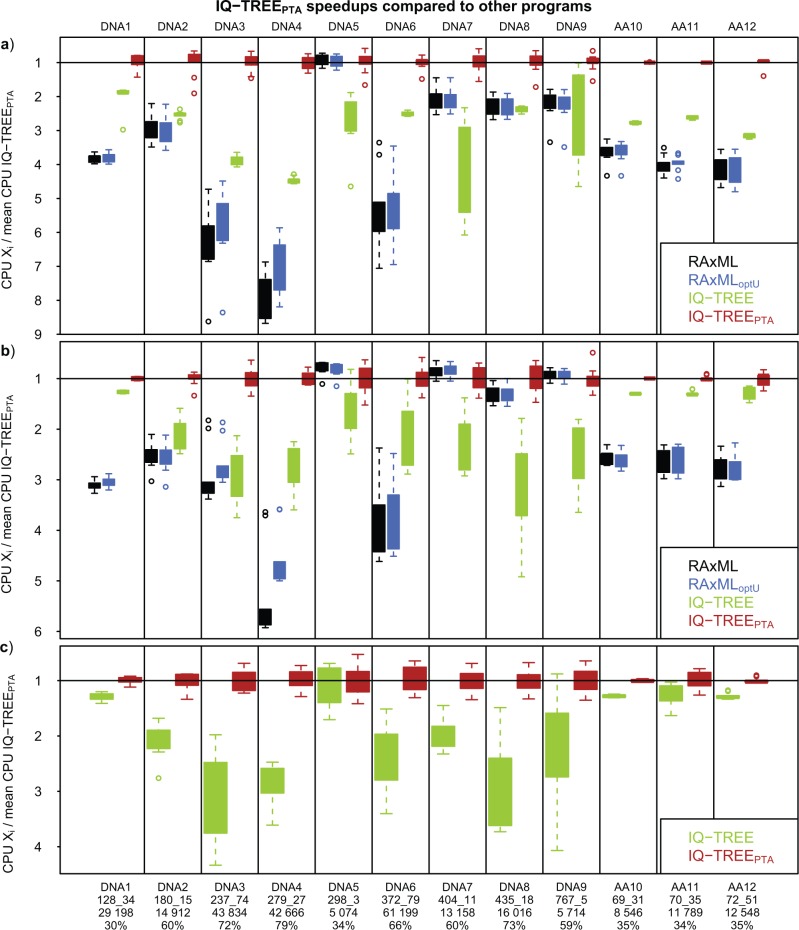
In phylogenomics the analysis of concatenated gene alignments, the so-called supermatrix, is commonly accompanied by the assumption of partition models. Under such models each gene, or more generally partition, is allowed to evolve under its own evolutionary model. Although partition models provide a more comprehensive analysis of supermatrices, missing data may hamper the tree search algorithms due to the existence of phylogenetic (partial) terraces. Here, we introduce the phylogenetic terrace aware (PTA) data structure for the efficient analysis under partition models. In the presence of missing data PTA exploits (partial) terraces and induced partition trees to save computation time. We show that an implementation of PTA in IQ-TREE leads to a substantial speedup of up to 4.5 and 8 times compared with the standard IQ-TREE and RAxML implementations, respectively. PTA is generally applicable to all types of partition models and common topological rearrangements thus can be employed by all phylogenomic inference software.
Overview
The claims and statistics of this paper haven’t been checked yet.
Free: it reads the open-access text and checks the first 5 claims that cite a source we can check. Create a free account to check every claim.
Integrity signals
Registry
Cites
Statistics
Figures



Verification
Claims the paper makes
The claims and statistics of this paper haven’t been checked yet.
Free: it reads the open-access text and checks the first 5 claims that cite a source we can check. Create a free account to check every claim.
Claims other papers make about this one
Each is checked against this paper’s own text: does it say what the citing paper says it does?
The source backs part of the claim, not all of it — or backs it for a different population, condition or comparison.
In the citing paper
“IQ-TREE 2 exploits partial terraces to improve tree search under partitioned models and achieves up to 4.5- and 8-fold speedups compared with IQ-TREE 1 and RAxML, respectively (Chernomor et al. 2016).”
From IQ-TREE 2: New Models and Efficient Methods for Phylogenetic Inference in the Genomic Era (2020) · cites this paper as Chernomor et al. 2016
Experimental — accuracy not yet measuredIn the citing paper
“This finding might not be entirely surprising because IQ-TREE represents the latest development in fast phylogenetic programs and has implemented a novel data structure to facilitate concatenation analysis (Chernomor et al. 2016).”
From Evaluating fast maximum likelihood-based phylogenetic programs using empirical phylogenomic data sets (2018) · cites this paper as Chernomor et al. 2016
Self-check
Percentages, sums and reported differences re-computed from the paper’s own numbers.
The self-check needs the paper’s full text.
Citations
Cites
1 retracted
RETRACTED ARTICLE: TREEFINDER: a powerful graphical analysis environment for molecular phylogenetics
Jobb, G., von Haeseler, A., & Strimmer, K. (2004) · BMC Evolutionary Biology · doi:10.1186/1471-2148-4-18 · Cited by 1,112
RetractedRAxML version 8: a tool for phylogenetic analysis and post-analysis of large phylogenies
Stamatakis, A. (2014) · Bioinformatics · doi:10.1093/bioinformatics/btu033 · Cited by 32,291 · cited 1×
“RAxML (Stamatakis 2014) x x TreeFinder ( IQ-TREE ( Jobb et al. 2004) x x x Nguyen et al. 2015) x x x EL, edge-linked; EUL, which yielded a substantial computation time and memory saving.”
MethodIQ-TREE: A Fast and Effective Stochastic Algorithm for Estimating Maximum-Likelihood Phylogenies
Nguyen, L.-T., Schmidt, H. A., von Haeseler, A., & Minh, B. Q. (2015) · Molecular Biology and Evolution · doi:10.1093/molbev/msu300 · Cited by 26,046 · cited 6×
“RAxML (Stamatakis 2014) x x TreeFinder ( IQ-TREE ( Jobb et al. 2004) x x x Nguyen et al. 2015) x x x EL, edge-linked; EUL, which yielded a substantial computation time and memory saving.”
BackgroundMethodInfluentialSelf-citationGuindon, S., Dufayard, J.-F., Lefort, V., Anisimova, M., Hordijk, W., & Gascuel, O. (2010) · Systematic Biology · doi:10.1093/sysbio/syq010 · Cited by 18,376
RAxML-VI-HPC: maximum likelihood-based phylogenetic analyses with thousands of taxa and mixed models
Stamatakis, A. (2006) · Bioinformatics · doi:10.1093/bioinformatics/btl446 · Cited by 15,582
Lanfear, R., Calcott, B., Ho, S. Y. W., & Guindon, S. (2012) · Molecular Biology and Evolution · doi:10.1093/molbev/mss020 · Cited by 5,732
Zwickl, D. J. (2006) · Texas ScholarWorks (Texas Digital Library) · Cited by 3,530
An Improved General Amino Acid Replacement Matrix
Le, S. Q., & Gascuel, O. (2008) · Molecular Biology and Evolution · doi:10.1093/molbev/msn067 · Cited by 3,127 · cited 1×
“For all partition models we assumed the GTR+ (Lanave et al. 1984; Yang 1994) and the LG+ (Yang 1994; Le and Gascuel 2008) models for all genes in the DNA and the AA alignments, respectively.”
MethodYang, Z. (1994) · Journal of Molecular Evolution · doi:10.1007/bf00160154 · Cited by 2,960 · cited 3×
“1984; Yang 1994) and the LG+ (Yang 1994; Le and Gascuel 2008) models for all genes in the DNA and the AA alignments, respectively.”
BackgroundMethodBroad phylogenomic sampling improves resolution of the animal tree of life
Dunn, C. W., Hejnol, A., Matus, D. Q., Pang, K., Browne, W. E., Smith, S. A., Seaver, E., Rouse, G. W., Obst, M., Edgecombe, G. D., et al. (2008) · Nature · doi:10.1038/nature06614 · Cited by 1,921
Cited by
Items 101–200 of 1,004
Insect Mitochondrial Genomics: A Decade of Progress
Cameron, S. L. (2024) · Annual Review of Entomology · doi:10.1146/annurev-ento-013024-015553 · Cited by 71
Roos, C., Kothe, M., Alba, D. M., Delson, E., & Zinner, D. P. (2019) · Journal of Human Evolution · doi:10.1016/j.jhevol.2019.05.017 · Cited by 71
Origin and Evolution of Polycyclic Triterpene Synthesis
Santana‐Molina, C., Rivas‐Marín, E., Rojas, A. M., & Devos, D. P. (2020) · Molecular Biology and Evolution · doi:10.1093/molbev/msaa054 · Cited by 71
“We obtained branch supports with the ultrafast bootstrap (Hoang et al. 2018) implemented in the IQ-TREE software.”
MethodInfluentialCalonje, M. A., MEEROW, A. W., Griffith, M. P., Salas-Leiva, D. E., Vovides, A. P., Coiro, M., & Francisco‐Ortega, J. (2019) · International Journal of Plant Sciences · doi:10.1086/702642 · Cited by 70
Wang, Q., & Li, H. (2020) · Zoologica Scripta · doi:10.1111/zsc.12407 · Cited by 70
A Total-Evidence Dated Phylogeny of Echinoidea Combining Phylogenomic and Paleontological Data
Koch, N. M., & Thompson, J. R. (2020) · Systematic Biology · doi:10.1093/sysbio/syaa069 · Cited by 70
A higher‐level nuclear phylogenomic study of the carrot family (Apiaceae)
Clarkson, J. J., Zuntini, A. R., Maurin, O., Downie, S. R., Plunkett, G. M., Nicolas, A. N., Smith, J. F., Feist, M. A., Gutierrez, K., Malakasi, P., et al. (2021) · American Journal of Botany · doi:10.1002/ajb2.1701 · Cited by 70
“10 (Minh et al., 2020), using ultrafast bootstrapping with data set partitioning (Chernomor et al., 2016).”
MethodCoiro, M., Allio, R., Mazet, N., Seyfullah, L. J., & Condamine, F. L. (2023) · New Phytologist · doi:10.1111/nph.19010 · Cited by 69
“T REE 2.2.0 (Minh et al ., 2020) using M ODEL F INDER to select the best-fit partition scheme and the best-fitting substitution model for each partition ( -m MFP + MERGE , Chernomor et al ., 2016; Kalyaanamoorthy et al ., 2017).”
InfluentialSenatore, M. T., Ward, T. J., Cappelletti, E., Beccari, G., McCormick, S. P., Busman, M., Laraba, I., O'Donnell, K. L., & Prodi, A. (2021) · International Journal of Food Microbiology · doi:10.1016/j.ijfoodmicro.2021.109298 · Cited by 68
Beyond Drosophila: resolving the rapid radiation of schizophoran flies with phylotranscriptomics
Bayless, K. M., Trautwein, M., Meusemann, K., Shin, S., Petersen, M., Donath, A., Podsiadłowski, L., Mayer, C., Niehuis, O., Peters, R. S., et al. (2021) · BMC Biology · doi:10.1186/s12915-020-00944-8 · Cited by 68
Phylotranscriptomic evidence for pervasive ancient hybridization among Old World salamanders
Rancilhac, L., Irisarri, I., Angelini, C., Arntzen, J. W., Babik, W., Bossuyt, F., Künzel, S., Lüddecke, T., Pasmans, F., Sanchez, E., et al. (2020) · Molecular Phylogenetics and Evolution · doi:10.1016/j.ympev.2020.106967 · Cited by 67
Stephens, T. G., Ragan, M. A., Bhattacharya, D., & Chan, C. X. (2018) · Scientific Reports · doi:10.1038/s41598-018-35620-z · Cited by 66
Chai, M., Cheng, H., Yan, M., Priyadarshani, S., Zhang, M., He, Q., Huang, Y., Chen, F., Liu, L., Huang, X., et al. (2020) · PeerJ · doi:10.7717/peerj.9006 · Cited by 65
Monadjem, A., Demos, T. C., Dalton, D. L., Webala, P. W., Musila, S., Peterhans, J. C. K., & Patterson, B. D. (2020) · Zoological Journal of the Linnean Society · doi:10.1093/zoolinnean/zlaa087 · Cited by 65
Naser-Khdour, S., Minh, B. Q., & Lanfear, R. (2021) · Systematic Biology · doi:10.1093/sysbio/syab067 · Cited by 64
Self-citationBank-Aubin, S., Cumming, R. T., Li, Y., Henze, K., Tirant, S. L., & Bradler, S. (2021) · Communications Biology · doi:10.1038/s42003-021-02436-z · Cited by 64
A transcriptome-based phylogenetic study of hard ticks (Ixodidae)
Charrier, N. P., Hermouet, A., Hervet, C., Agoulon, A., Barker, S. C., Heylen, D., Toty, C., McCoy, K. D., Plantard, O., & Rispe, C. (2019) · Scientific Reports · doi:10.1038/s41598-019-49641-9 · Cited by 64
Bioremediation of a Common Product of Food Processing by a Human Gut Bacterium
Wolf, A. R., Wesener, D. A., Cheng, J., Houston‐Ludlam, A. N., Beller, Z. W., Hibberd, M. C., Giannone, R. J., Peters, S. L., Hettich, R. L., Leyn, S. A., et al. (2019) · Cell Host & Microbe · doi:10.1016/j.chom.2019.09.001 · Cited by 64
“A phylogenetic tree of FrlR proteins was built using a maximum likelihood algorithm implemented in the IQ-Tree Web tool (Chernomor et al., 2016) and visualized in Dendroscope (Huson and Scornavacca, 2012).”
MethodRodrigues, J. A., Espley, R. V., & Allan, A. C. (2021) · Horticulture Research · doi:10.1038/s41438-021-00514-1 · Cited by 63
European mushroom assemblages are darker in cold climates
Krah, F., Büntgen, U., Schaefer, H., Müller, J. C., Andrew, C. J., Boddy, L., Diez, J. M., Egli, S., Freckleton, R. P., Gange, A. C., et al. (2019) · Nature Communications · doi:10.1038/s41467-019-10767-z · Cited by 63
Loiseau, O., Olivares, I., Paris, M., Harpe, M. D. L., Weigand, A., Koubínová, D., Rolland, J., Bacon, C. D., Balslev, H., Borchsenius, F., et al. (2019) · Frontiers in Plant Science · doi:10.3389/fpls.2019.00864 · Cited by 63
“We partitioned the data by gene (Chernomor et al., 2016), using a GTR+GAMMA model of substitutions for each gene, and estimated support using the ultrafast bootstrap option (Hoang et al.”
MethodVoss, R. S., Giarla, T. C., Díaz‐Nieto, J. F., & Jansa, S. A. (2020) · Bulletin of the American Museum of Natural History · doi:10.1206/0003-0090.439.1.1 · Cited by 63
“, 2017) and partitioning capabilities (Chernomor et al., 2016) to simultaneously estimate the tree and the best-fitting model for each codon position.”
BackgroundMethodInfluentialGut Microbiota Perturbation in IgA Deficiency Is Influenced by IgA-Autoantibody Status
Moll, J. M., Myers, P. N., Zhang, C., Eriksen, C., Wolf, J., Appelberg, K. S., Lindberg, G., Bahl, M. I., Zhao, H., Pan‐Hammarström, Q., et al. (2021) · Gastroenterology · doi:10.1053/j.gastro.2021.02.053 · Cited by 63
Carter, T. A., Singh, M., Dumbović, G., Chobirko, J. D., Rinn, J. L., & Feschotte, C. (2022) · eLife · doi:10.7554/elife.76257 · Cited by 63
Bell, A. A., Gu, A., Olvey, J., Wagner, T. A., Tashpulatov, Z., Prom, S., Quintana, J., Nichols, R. L., & Liu, J. (2019) · Plant Disease · doi:10.1094/pdis-09-18-1624-re · Cited by 62
Mackiewicz, P., Matosiuk, M., Świsłocka, M., Zachos, F. E., Hajji, G. M., Saveljev, A. P., Seryodkin, I. V., Farahvash, T., Rezaei, H. R., Torshizi, R. V., et al. (2022) · Scientific Reports · doi:10.1038/s41598-022-20763-x · Cited by 61
Molari, M., Hassenrueck, C., Laso-Pérez, R., Wegener, G., Offre, P., Scilipoti, S., & Boëtius, A. (2023) · Nature Microbiology · doi:10.1038/s41564-023-01342-w · Cited by 62
DeRaad, D. A., McCullough, J. M., DeCicco, L. H., Hime, P. M., Joseph, L., Andersen, M. J., & Moyle, R. G. (2023) · Molecular Ecology · doi:10.1111/mec.17080 · Cited by 62
Huang, X., Zhou, Z., Liu, H., Li, Y., Ge, T., Tang, X., He, Y., Ma, B., Xu, J. M., Anantharaman, K., et al. (2023) · Soil Biology and Biochemistry · doi:10.1016/j.soilbio.2023.109279 · Cited by 61
Fungal Planet description sheets: 1614???1696
Crous, P. W., Jurjević, Ž., Balashov, S. V., Lastra, S. D. L. P., Mateos, A., Pinruan, U., guez, A. R.-R., Osieck, E. R., Altés, A., Czachura, P., et al. (2024) · Fungal Systematics and Evolution · doi:10.3114/fuse.2024.13.11 · Cited by 61
Lee, J., Venkatesh, J., Jo, J., Jang, S., Kim, G., Kim, J.-M., Han, K., Ro, N., Lee, H., Kwon, J., et al. (2022) · Horticulture Research · doi:10.1093/hr/uhac210 · Cited by 60
“2 (−bb 1000 –m GTR + ASC) was used to generate a phylogenetic tree using a phylip-formatted SNP dataset [59].”
MethodPast and present giant viruses diversity explored through permafrost metagenomics
Rigou, S., Santini, S., Abergel, C., Claverie, J., & Legendre, M. (2022) · Nature Communications · doi:10.1038/s41467-022-33633-x · Cited by 60
Chan, K. O., Hutter, C. R., Wood, P. L., Grismer, L. L., & Brown, R. M. (2020) · Molecular Phylogenetics and Evolution · doi:10.1016/j.ympev.2020.106899 · Cited by 60
Parks, M., Wickett, N. J., & Alverson, A. J. (2017) · Molecular Biology and Evolution · doi:10.1093/molbev/msx268 · Cited by 59
“Concatenation-based species trees were estimated using IQ-TREE with ultrafast bootstrapping and SH-aLRT testing (1,000 replicates each) to evaluate support (Guindon et al. 2010; Minh et al. 2013; Nguyen, Schmidt et al. 2015; Chernomor et al. 2016).”
MethodDiversity and divergence: evolution of secondary metabolism in the tropical tree genus Inga
Forrister, D. L., Endara, M., Soule, A. J., Younkin, G. C., Mills, A. G., Lokvam, J., Dexter, K. G., Pennington, R. T., Kidner, C. A., Nicholls, J. A., et al. (2022) · New Phytologist · doi:10.1111/nph.18554 · Cited by 59
Convergent Adaptation of True Crabs (Decapoda: Brachyura) to a Gradient of Terrestrial Environments
Wolfe, J. M., Ballou, L., Luque, J., Watson-Zink, V. M., Ahyong, S. T., Barido‐Sottani, J., Chan, T., Chu, K. H., Crandall, K. A., Daniels, S. R., et al. (2023) · Systematic Biology · doi:10.1093/sysbio/syad066 · Cited by 59
“Best-fitting partitions (Chernomor et al. 2016) and substitution models (Kalyaanamoorthy et al.”
MethodInfluentialOrdovician origin and subsequent diversification of the brown algae
Choi, S., Graf, L., Choi, J. W., Jo, J., Boo, G. H., Kawai, H., Choi, C. G., Xiao, S., Knoll, A. H., Andersen, R. A., et al. (2024) · Current Biology · doi:10.1016/j.cub.2023.12.069 · Cited by 59
Vanhove, M. P. M., Briscoe, A. G., Jorissen, M. W. P., Littlewood, D. T. J., & Huyse, T. (2018) · BMC Genomics · doi:10.1186/s12864-018-4893-5 · Cited by 59
Kotov, A. A., Garibian, P. G., Bekker, E. I., Taylor, D. J., & Павлович, К. Д. (2020) · Zoological Journal of the Linnean Society · doi:10.1093/zoolinnean/zlaa046 · Cited by 59
Sharanowski, B. J., Ridenbaugh, R. D., Piekarski, P., Broad, G. R., Burke, G. R., DEANS, A. R., Lemmon, A. R., Lemmon, E. C. M., Diehl, G. J., Whitfield, J. B., et al. (2020) · Molecular Phylogenetics and Evolution · doi:10.1016/j.ympev.2020.107023 · Cited by 59
Phylogenetic Insights into Chinese Rubus (Rosaceae) from Multiple Chloroplast and Nuclear DNAs
Wang, Y., Chen, Q., Chen, T., Tang, H., Liu, L., & Wang, X. (2016) · Frontiers in Plant Science · doi:10.3389/fpls.2016.00968 · Cited by 58
“4.2, which could implemented individual assigned substitution models for each partition (Nguyen et al., 2015; Chernomor et al., 2016).”
BackgroundInfluentialKusy, D., He, J., Bybee, S., Motyka, M., Bi, W., Podsiadłowski, L., Li, X., & Bocák, L. (2020) · Systematic Entomology · doi:10.1111/syen.12451 · Cited by 58
“Model selection for each gene was performed with ModelFinder (Chernomor et al., 2016; Kalyaanamoorthy et al., 2017) using the -MFP option.”
MethodFungal Systematics and Evolution : FUSE 6
Haelewaters, D., Dima, B., Abdel-Hafiz, A. I. I., Abdel‐Wahab, M. A., Abul-Ezz, S. R., Acar, İ., Aguirre-Acosta, E., Aime, M. C., Aldemir, S., Ali, M., et al. (2020) · Sydowia · doi:10.12905/0380.sydowia72-2020-0231 · Cited by 58
Thomas, A. E., Igea, J., Meudt, H. M., Albach, D. C., Lee, W. G., & Tanentzap, A. J. (2021) · American Journal of Botany · doi:10.1002/ajb2.1678 · Cited by 59
Rapid Radiation and Rampant Reticulation: Phylogenomics of South AmericanLiolaemusLizards
Esquerré, D., Keogh, J. S., Demangel, D., Morando, M. M., Ávila, L. J., Sites, J. W., Ferri‐Yáñez, F., & Leaché, A. D. (2021) · Systematic Biology · doi:10.1093/sysbio/syab058 · Cited by 58
Wolbachia-driven selective sweep in a range expanding insect species
Deng, J., Assandri, G., Chauhan, P., Futahashi, R., Galimberti, A., Hansson, B., Lancaster, L. T., Takahashi, Y., SVENSSON, E. I., & Duplouy, A. (2021) · BMC Ecology and Evolution · doi:10.1186/s12862-021-01906-6 · Cited by 57
Kusy, D., Motyka, M., Boček, M., Masek, M., & Bocák, L. (2019) · Systematic Entomology · doi:10.1111/syen.12363 · Cited by 58
“…sequences (Table 2). iq-tree v.1.6.8 (Nguyen et al., 2015) was used to construct maximum likelihood (ML) trees, partitions and models were identified using modelfinder (Chernomor et al., 2016; © 2019 The Royal Entomological Society, Systematic Entomology, 44, 911–925 Kalyaanamoorthy et al., 2017).”
MethodInfluentialVasilikopoulos, A., Balke, M., BEUTEL, R. G., Donath, A., Podsiadłowski, L., Pflug, J. M., Waterhouse, R. M., Meusemann, K., Peters, R. S., Escalona, H. E., et al. (2019) · Molecular Phylogenetics and Evolution · doi:10.1016/j.ympev.2019.02.022 · Cited by 56
Griese, E., Caarls, L., Mohammadin, S., Bassetti, N., Bukovinszkine’Kiss, G., Breman, F. C., Poelman, E. H., Gols, R., Schranz, M. E., & Fatouros, N. E. (2020) · New Phytologist · doi:10.1111/nph.17145 · Cited by 56
Pfeiffer, J. M., Graf, D. L., Cummings, K. S., & Page, L. M. (2021) · Invertebrate Systematics · doi:10.1071/is20044 · Cited by 56
Johanndrees, O., Baggs, E. L., Uhlmann, C., Locci, F., Laessle, H., Melkonian, K., Käufer, K., Dongus, J. A., Nakagami, H., Krasileva, K. V., et al. (2022) · PLANT PHYSIOLOGY · doi:10.1093/plphys/kiac480 · Cited by 56
“The ML phylogenetic trees were inferred with IQ-TREE (version 1.6.12, options: -nt AUTO -alrt 1,000 -bb 1,000 -bnni; options for the EDS1 family tree: -nt AUTO -b 500; Nguyen et al., 2015; Chernomor et al., 2016).”
MethodInfluentialPopulation dynamics of Baltic herring since the Viking Age revealed by ancient DNA and genomics
Atmore, L. M., Martínez-García, L., Makowiecki, D., André, C., Lõugas, L., Barrett, J. H., & Star, B. (2022) · Proceedings of the National Academy of Sciences · doi:10.1073/pnas.2208703119 · Cited by 56
Fan, X., Dai, R.-C., Zhang, S., Geng, Y.-Y., Kang, M., Guo, D.-W., Mei, Y.-N., Pan, Y.-H., Sun, Z.-Y., Xu, Y.-C., et al. (2023) · Nature Communications · doi:10.1038/s41467-023-43380-2 · Cited by 55
“The Edge-linked Partition Model was utilized to determine the most suitable DNA model, and branch supports were assessed using 1000 ultrafast bootstrap replicate 54,55 .”
Kusy, D., Motyka, M., Boček, M., Vogler, A. P., & Bocák, L. (2018) · Scientific Reports · doi:10.1038/s41598-018-35328-0 · Cited by 55
FAVITES: simultaneous simulation of transmission networks, phylogenetic trees and sequences
Moshiri, N., Ragonnet‐Cronin, M., Wertheim, J. O., & Mirarab, S. (2018) · Bioinformatics · doi:10.1093/bioinformatics/bty921 · Cited by 55
The Phylogeny of Carangiform Fishes: Morphological and Genomic Investigations of a New Fish Clade
Girard, M. G., Davis, M. P., & Smith, W. L. (2020) · Copeia · doi:10.1643/ci-19-320 · Cited by 46
“6.11 (Nguyen et al., 2015; Chernomor et al., 2016).”
InfluentialBank-Aubin, S., Buckley, T. R., Büscher, T. H., Bresseel, J., Constant, J., de Haan, M., Dittmar, D., Dräger, H., Kahar, R. S., Kang, A., et al. (2021) · Systematic Entomology · doi:10.1111/syen.12472 · Cited by 55
“A Maximum Likelihood (ML) phylogeny was inferred from the final supermatrix with a partitioned analysis in iq-tree v. 1.6.10 (Nguyen et al., 2015; Chernomor et al., 2016) using the subsets and substitution models suggested by PartitionFinder.”
MethodInfluentialLaraba, I., Busman, M., Geiser, D. M., & O'Donnell, K. L. (2022) · Phytopathology · doi:10.1094/phyto-09-21-0394-r · Cited by 55
Discovery of disease-adapted bacterial lineages in inflammatory bowel diseases
Kumbhari, A., Cheng, T. N. H., Ananthakrishnan, A. N., Kochar, B., Burke, K. E., Shannon, K., Lau, H., Xavier, R. J., & Smillie, C. S. (2024) · Cell Host & Microbe · doi:10.1016/j.chom.2024.05.022 · Cited by 54
Doña, J., Sweet, A. D., Johnson, K. P., Serrano, D., Mironov, S. V., & Jovani, R. (2017) · Molecular Phylogenetics and Evolution · doi:10.1016/j.ympev.2017.08.005 · Cited by 54
Imhoff, J. F., Rahn, T., Künzel, S., & Neulinger, S. C. (2019) · Microorganisms · doi:10.3390/microorganisms7110576 · Cited by 54
“and ‘bchXYZpufHLM’), substitution models were used as so-called partition models [20].”
MethodCosta, W. J. E. M., Henschel, E., & Katz, A. M. (2020) · Zoologica Scripta · doi:10.1111/zsc.12403 · Cited by 54
Gosselin, S. P., Fullmer, M. S., Feng, Y., & Gogarten, J. P. (2021) · Systematic Biology · doi:10.1093/sysbio/syab060 · Cited by 54
“5) was executed with the MLSA file and built the phylogenetic tree with 1000 ultrafast bootstraps (Nguyen et al. 2015; Chernomor et al. 2016; Kalyaanamoorthy et al. 2017; Hoang et al. 2018).”
MethodPelosi, J. A., Kim, E. H., Barbazuk, W. B., & Sessa, E. B. (2022) · Frontiers in Plant Science · doi:10.3389/fpls.2022.882441 · Cited by 55
Pauli, T., Cajas, R. F. C., Rosa, P., Kukowka, S., Berg, A., van den Berghe, E., Fornoff, F., Hopfenmül-Ler, S., Niehuis, M., Peters, R. S., et al. (2018) · Systematic Entomology · doi:10.1111/syen.12323 · Cited by 53
“Phylogenetic relationships between and within major cuckoo wasp lineages (continued in Figure S2) inferred in a Bayesian framework with the software MrBayes and applying the same supermatrix and the same substitution models as in the analysis with the software IQ-TREE (see Figs 1, 2).”
BackgroundMethodInfluentialGarvetto, A., Nézan, É., Badis, Y., Bilien, G., Arce, P., Bresnan, E., Gachon, C. M. M., & Siano, R. (2018) · Frontiers in Microbiology · doi:10.3389/fmicb.2018.02918 · Cited by 53
“, 2009), were combined in a partition model (Chernomor et al., 2016) allowing each protein to have its own evolution rate (IQ-TREE option spp).”
BackgroundAoki, T., Smith, J. A., Kasson, M. T., Freeman, S., Geiser, D. M., Geering, A. D. W., & O'Donnell, K. L. (2019) · Mycologia · doi:10.1080/00275514.2019.1647074 · Cited by 53
“ML analyses of the combined four-locus data set were implemented in IQ-TREE (Nguyen et al. 2015; http://www.iqtree.org/) using separate models for each partition (Chernomor et al. 2016).”
MethodAmplification and sequencing of entire tick mitochondrial genomes for a phylogenomic analysis
Kneubehl, A. R., Muñoz‐Leal, S., Filatov, S., de Klerk, D. G., Pienaar, R., Lohmeyer, K. H., Bermúdez, S. E., Suriyamongkol, T., Mali, I., Kanduma, E., et al. (2022) · Scientific Reports · doi:10.1038/s41598-022-23393-5 · Cited by 52
Riehl, T., & Smet, B. D. (2020) · PeerJ · doi:10.7717/peerj.8621 · Cited by 51
Resurrecting ancestral antibiotics: unveiling the origins of modern lipid II targeting glycopeptides
Hansen, M. H., Adamek, M., Iftime, D., Petras, D., Schuseil, F., Grond, S., Stegmann, E., Cryle, M. J., & Ziemert, N. (2023) · Nature Communications · doi:10.1038/s41467-023-43451-4 · Cited by 51
“IQ-tree employs a fast and ef fi cient maximum likelihood tree search algorithm for data set processing 60,61 .”
MethodCerca, J., Meyer, C., Purschke, G., & Struck, T. H. (2019) · Molecular Phylogenetics and Evolution · doi:10.1016/j.ympev.2019.106663 · Cited by 51
Rapid molecular evolution of Spiroplasma symbionts of Drosophila
Gerth, M., Martínez-Montoya, H., Ramirez, P., Masson, F., Griffin, J. S., Aramayo, R., Siozios, S., Lemaître, B., Mateos, M., & Hurst, G. D. D. (2021) · Microbial Genomics · doi:10.1099/mgen.0.000503 · Cited by 51
“Each locus was treated as a separate partition with a distinct evolutionary rate (Chernomor et al., 2016), and optimal models and number of partitions was estimated with IQ-TREE (Kalyaanamoorthy et al., 2017; Lanfear et al., 2012).”
MethodTorix Rickettsia are widespread in arthropods and reflect a neglected symbiosis
Pilgrim, J., Thongprem, P., Davison, H., Siozios, S., Baylis, M., Zakharov, E. V., Ratnasingham, S., deWaard, J. R., Macadam, C. R., Smith, M. A., et al. (2021) · GigaScience · doi:10.1093/gigascience/giab021 · Cited by 51
Scobeyeva, V. A., Artyushin, I. V., Krinitsina, A. A., Nikitin, P., Antipin, M. I., Kuptsov, S., Belenikin, M. S., Omelchenko, D. O., Logacheva, M. D., Konorov, E. A., et al. (2021) · Frontiers in Genetics · doi:10.3389/fgene.2021.674783 · Cited by 51
“Phylogenetic analysis was conducted with IQ-TREE v 2.0.6 (Chernomor et al., 2016; Minh et al., 2020).”
MethodInfluentialStabilized Morphological Evolution of Spiders Despite Mosaic Changes in Foraging Ecology
Wolff, J. O., Wierucka, K., Paterno, G. B., Coddington, J. A., Hormiga, G., Kelly, M. B. J., Herberstein, M. E., & Ramírez, M. J. (2022) · Systematic Biology · doi:10.1093/sysbio/syac023 · Cited by 50
Oyebanji, O. O., Zhang, R., Chen, S., & Yi, T. (2020) · Frontiers in Plant Science · doi:10.3389/fpls.2020.00151 · Cited by 50
Systematics of big-eyed bats, genus Chiroderma Peters, 1860 (Chiroptera: Phyllostomidae)
Garbino, G. S. T., Lim, B. K., & Tavares, V. D. C. (2020) · Zootaxa · doi:10.11646/zootaxa.4846.1.1 · Cited by 50
A phylotranscriptomic framework for flesh fly evolution (Diptera, Calyptratae, Sarcophagidae)
Yan, L., Buenaventura, E., Pape, T., Kutty, S. N., Bayless, K. M., & Zhang, D. (2020) · Cladistics · doi:10.1111/cla.12449 · Cited by 50
“IQ-TREE (version 1.6.5; Nguyen et al., 2015; Chernomor et al., 2016) was used for ML T a b le 1 ( C o n ti n u ed ) S p ec ie s A u th o r n a m e A cc es si o n a n d re fe re n ce L ib ra ry ID N u m b er o f tr a n sc ri p ts A ss em b ly si ze /b p N 5 0 /b p N u m b er o f a ss ig n ed o rt h…”
MethodInfluentialMedeiros, I. D., Mazur, E., Miądlikowska, J., Flakus, A., Flakus, P. R., la Hoz, C. J. P., Cieślak, E., Śliwa, L., & Lutzoni, F. M. (2021) · Frontiers in Microbiology · doi:10.3389/fmicb.2021.774839 · Cited by 49
Smith, C. H., Johnson, N. A., Inoue, K., Doyle, R. D., & Randklev, C. R. (2019) · Systematics and Biodiversity · doi:10.1080/14772000.2019.1607615 · Cited by 49
Zhang, J., Lindsey, A. R. I., Peters, R. S., Heraty, J. M., Hopper, K. R., Werren, J. H., Martinson, E. O., Woolley, J. B., Yoder, M. J., & Krogmann, L. (2020) · Systematic Entomology · doi:10.1111/syen.12427 · Cited by 49
“The top 10% of partition schemes (−rcluster 10) and maximum 10 000 partition pairs (−rcluster-max 10 000) were considered for all datasets, except for the ChalCOS-562-AA dataset, where the options ‘-rcluster 10 -rcluster-max 5000’ were used (Chernomor et al., 2016; Kalyaanamoorthy et al., 2017).”
MethodSu, T., He, B., Li, K., & Liang, A. (2018) · BMC Genomics · doi:10.1186/s12864-018-5365-7 · Cited by 48
Sann, M., Meusemann, K., Niehuis, O., Escalona, H. E., Mokrousov, M. V., Ohl, M., Pauli, T., & Schmid‐Egger, C. (2021) · Systematic Entomology · doi:10.1111/syen.12475 · Cited by 48
“12 (Nguyen et al., 2014; Chernomor et al., 2016) on the inferred supermatrices (i.”
MethodInfluentialTarget sequence data shed new light on the infrafamilial classification of Araceae
Haigh, A. L., Gibernau, M., Maurin, O., Bailey, P. C. E., Carlsen, M. M., Hay, A., Leempoel, K., McGinnie, C., Mayo, S. J., Morris, S., et al. (2022) · American Journal of Botany · doi:10.1002/ajb2.16117 · Cited by 48
Vallejos-Garrido, P., Pino, K., Espinoza-Aravena, N., Pari, A., Inostroza‐Michael, O., Toledo-Muñoz, M., Castillo-Ravanal, B., Romero-Alarcón, V., Hernández, C. E., Palma, R. E., et al. (2023) · Scientific Reports · doi:10.1038/s41598-023-28497-0 · Cited by 48
“Our results show that the Central-Southern Andes was the most important sink, receiving the highest number of lineages (44; 14%).”
BackgroundInfluentialDietz, L., Seidel, M., Eberle, J., Misof, B. Y., Pacheco, T. L., Podsiadłowski, L., Ranasinghe, S., Gunter, N. L., Niehuis, O., Mayer, C., et al. (2023) · Systematic Entomology · doi:10.1111/syen.12602 · Cited by 49
Smith, B. T., Thom, G., & Joseph, L. (2024) · Bulletin of the American Museum of Natural History · doi:10.1206/0003-0090.468.1.1 · Cited by 48
Habich, A., Vargas, V. C., Robinson, L. A., Allsopp, L. P., & Unterweger, D. (2025) · Nature Communications · doi:10.1038/s41467-024-54649-5 · Cited by 48
“The maximum-likelihood tree was then inferred with IQ-tree 105,106 (version 1.6.12) based on 1000 ultrafast bootstrap replicates.”
InfluentialZinner, D. P., Atickem, A., Beehner, J. C., Bekele, A., Bergman, T. J., Burke, R. J., Dolotovskaya, S., Fashing, P. J., Gippoliti, S., Knauf, S., et al. (2018) · PLoS ONE · doi:10.1371/journal.pone.0202303 · Cited by 48
Vasilikopoulos, A., Balke, M., Kukowka, S., Pflug, J. M., Martín, S., Meusemann, K., Hendrich, L., Mayer, C., Maddison, D. R., Niehuis, O., et al. (2021) · Systematic Entomology · doi:10.1111/syen.12508 · Cited by 48
“The results show that the overall Ct/Cn ratio is much higher than the value of one for the majority of species, which in turn suggests that the enrichment of the target regions was successful for the majority of species in our dataset (File S1: Table S2, Ct/Cn median values: Carabidae = 22.163, Noteridae = 39.414, Hal…”
MethodInfluentialTaxonomic studies of some often over-looked Diaporthomycetidae and Sordariomycetidae
Huang, J., Hyde, K. D., Mapook, A., Maharachchikumbura, S. S. N., Bhat, J. D., McKenzie, E. H. C., Jeewon, R., & Wen, T. (2021) · Fungal Diversity · doi:10.1007/s13225-021-00488-4 · Cited by 48
Segmental duplications drive the evolution of accessory regions in a major crop pathogen
van Westerhoven, A. C., Aguilera-Gálvez, C., Nakasato‐Tagami, G., Shi‐Kunne, X., de la Parte, E. M., Chavarro‐Carrero, E. A., Meijer, H. J. G., Feurtey, A., Maryani, N., Ordonez, N., et al. (2024) · New Phytologist · doi:10.1111/nph.19604 · Cited by 47
Spiders did not repeatedly gain, but repeatedly lost, foraging webs
Coddington, J. A., Agnarsson, I., Hamilton, C. A., & Bond, J. E. (2019) · PeerJ · doi:10.7717/peerj.6703 · Cited by 47
“Using IQTree version 1.6.4 (Nguyen et al., 148 2015, Chernomor et al., 2016) we inferred a phylogeny sufficiently similar to that used by F&al 149 to test the effect of alternative web codings.”
MethodInfluentialMerda, D., Felten, A., Vingadassalon, N., Denayer, S., Titouche, Y., Decastelli, L., Hickey, B., Kourtis, C., Daskalov, H., Mistou, M., et al. (2020) · Frontiers in Microbiology · doi:10.3389/fmicb.2020.01483 · Cited by 47
Badano, D., Fratini, M., Maugeri, L., Palermo, F., Pieroni, N., Cedola, A., Haug, J. T., Weiterschan, T., Velten, J., Mei, M., et al. (2021) · Systematic Entomology · doi:10.1111/syen.12482 · Cited by 47
“The partitioned maximum likelihood (ML) analyses, combining the genomic and the molecular datasets, were performed in IQ-TREE (v.2.1.1) (Minh et al., 2020) on Extreme Science and Engineering Discovery Environment (XSEDE) at Cyberinfrastructure for Phylogenetic Research (CIPRES) (Miller et al., 2010).”
MethodInfluentialA Global Phylogenomic Study of the Thelypteridaceae
Fawcett, S., Smith, A. Р., Sundue, M., Burleigh, J. G., Sessa, E. B., Kuo, L., Chen, C., Testo, W., Kessler, M. R., & Barrington, D. S. (2021) · Systematic Botany · doi:10.1600/036364421x16370109698650 · Cited by 49
“ModelFinder: Fast model selection for accurate phylogenetic estimates.”
MethodPyron, R. A., O’Connell, K. A., Lemmon, E. M., Lemmon, A. R., & Beamer, D. A. (2022) · Ecology and Evolution · doi:10.1002/ece3.8574 · Cited by 47
Gnezdilov, V. M., Konstantinov, F. V., & Алексеевна, Н. А. (2022) · Systematic Entomology · doi:10.1111/syen.12546 · Cited by 47
“(Stamatakis, 2016) and IQ-Tree (Chernomor et al., 2016) for the molecular dataset.”
BackgroundMethodToubiana, W., Armisén, D., Dechaud, C., Arbore, R., & Khila, A. (2021) · BMC Biology · doi:10.1186/s12915-021-01021-4 · Cited by 46
Jardim, B. R., Tran‐Nguyen, L. T. T., Gambley, C., Al-Sadi, A. M., Al‐Subhi, A. M., Foissac, X., Salar, P., Cai, H., Yang, J., Davis, R. I., et al. (2023) · INTERNATIONAL JOURNAL OF SYSTEMATIC AND EVOLUTIONARY MICROBIOLOGY · doi:10.1099/ijsem.0.005977 · Cited by 46
Metadata
- Authors
- Chernomor, O., von Haeseler, A., & Minh, B. Q.
- Affiliations
- University of Vienna (AT)
- ORCID
- Chernomor, Olga
- Venue
- Systematic Biology
- Publisher
- Oxford University Press (OUP)
- Published
- 2016-04-26
- Volume
- 65
- Issue
- 6
- Pages
- 997-1008
- ISSN
- 1063-5157 (ISSN-L)
- 1076-836X
- PMC
- PMC5066062
- OpenAlex
- W2344940607
- Cited by
- 2,252
- References
- 41
- Citations by year
- 2026: 240 · 2025: 285 · 2024: 328 · 2023: 322 · 2022: 289 · 2021: 331 · 2020: 214 · 2019: 134 · 2018: 75 · 2017: 31 · 2016: 3
- FWCI
- 42.08
- Type
- journal article
- Language
- en
- Open access
- hybrid
- doi.org
- Licence
- cc-by-nc
- Locations
- Systematic Biology (publishedVersion, cc-by-nc)
- PubMed Central (publishedVersion, cc-by-nc)
- PubMed (publishedVersion)
- HighWire Press Open Archive (submittedVersion)
- Funders
- Austrian Science Fund (I-2805-B29, I-1824-B22)
- Topics
- Life Sciences › Biochemistry, Genetics and Molecular Biology › Molecular Biology › Genomics and Phylogenetic Studies
- Life Sciences › Biochemistry, Genetics and Molecular Biology › Molecular Biology › RNA and protein synthesis mechanisms
- Life Sciences › Agricultural and Biological Sciences › Ecology, Evolution, Behavior and Systematics › Plant Diversity and Evolution
- Keywords
- partition model, supermatrix, missing data, phylogenetic tree search, IQ-TREE, RAxML, data structures
- MeSH terms
- Algorithms, Classification, Biological Evolution, Models, Biological, Phylogeny, Software, Sequence Analysis, DNA
About these checks
Registry, retraction, Cites and statistics results are computed, not judged, with one exception: a printed reference that no index lists is read once by a model before it counts as a citation error. Claims are extracted by a model and kept only when their quote appears verbatim in the text; each cited source is then checked, with a model’s help, for whether it says what the claim relies on. Those verdicts can be wrong — read the claim’s quote and the cited source before relying on one.
Statistics and arithmetic are recomputed, not judged.
Confidence bands are shown only for fields calibrated on our annotated test set. None is calibrated yet, so no band is shown.
What counts as a claim ›How we measure confidence ›How we check this ›
Are you an author, or do you see a problem with this page? Request a review
Data sources
Bibliographic data: Semantic Scholar, OpenAlex, Crossref.
Contains information from the Semantic Scholar Academic Graph Datasets, made available under the ODC Attribution License (ODC-BY 1.0).
Semantic Scholar’s data is described in: Kinney, R., et al. (2023). The Semantic Scholar Open Data Platform. arXiv:2301.10140.
