

Terrace Aware Data Structure for Phylogenomic Inference from Supermatrices
Open accessThe DOI matches its Crossref record; 43 of the 43 references it cites were found in a registry or an index.
Abstract
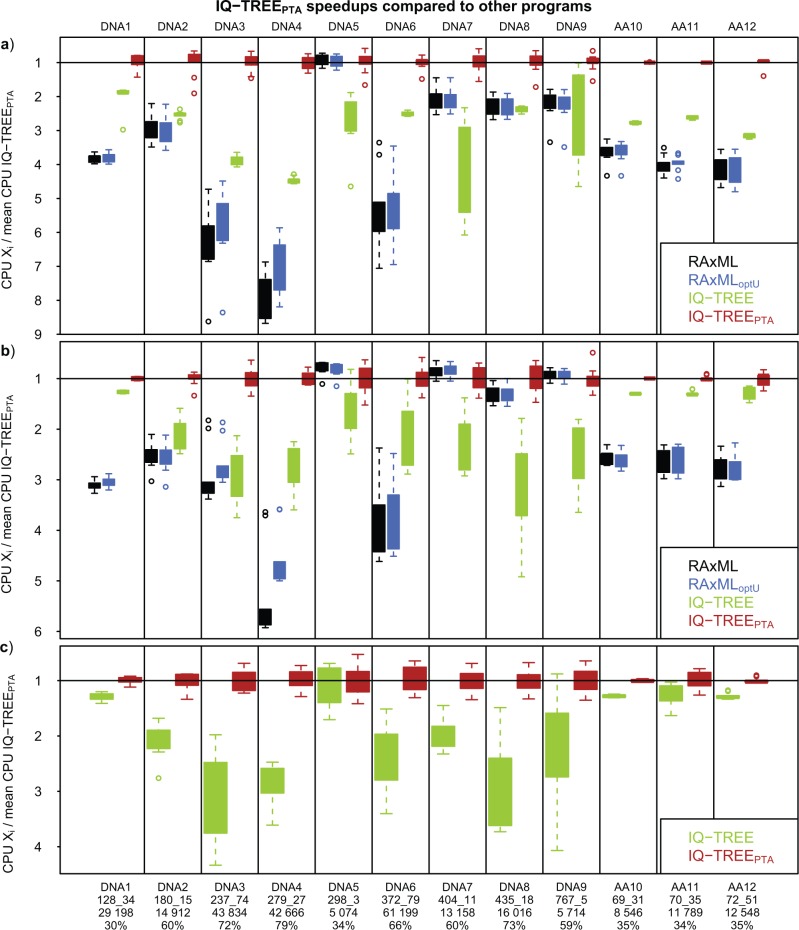
In phylogenomics the analysis of concatenated gene alignments, the so-called supermatrix, is commonly accompanied by the assumption of partition models. Under such models each gene, or more generally partition, is allowed to evolve under its own evolutionary model. Although partition models provide a more comprehensive analysis of supermatrices, missing data may hamper the tree search algorithms due to the existence of phylogenetic (partial) terraces. Here, we introduce the phylogenetic terrace aware (PTA) data structure for the efficient analysis under partition models. In the presence of missing data PTA exploits (partial) terraces and induced partition trees to save computation time. We show that an implementation of PTA in IQ-TREE leads to a substantial speedup of up to 4.5 and 8 times compared with the standard IQ-TREE and RAxML implementations, respectively. PTA is generally applicable to all types of partition models and common topological rearrangements thus can be employed by all phylogenomic inference software.
Overview
The claims and statistics of this paper haven’t been checked yet.
Free: it reads the open-access text and checks the first 5 claims that cite a source we can check. Create a free account to check every claim.
Integrity signals
Registry
Cites
Statistics
Figures



Verification
Claims the paper makes
The claims and statistics of this paper haven’t been checked yet.
Free: it reads the open-access text and checks the first 5 claims that cite a source we can check. Create a free account to check every claim.
Claims other papers make about this one
Each is checked against this paper’s own text: does it say what the citing paper says it does?
The source backs part of the claim, not all of it — or backs it for a different population, condition or comparison.
In the citing paper
“IQ-TREE 2 exploits partial terraces to improve tree search under partitioned models and achieves up to 4.5- and 8-fold speedups compared with IQ-TREE 1 and RAxML, respectively (Chernomor et al. 2016).”
From IQ-TREE 2: New Models and Efficient Methods for Phylogenetic Inference in the Genomic Era (2020) · cites this paper as Chernomor et al. 2016
Experimental — accuracy not yet measuredIn the citing paper
“This finding might not be entirely surprising because IQ-TREE represents the latest development in fast phylogenetic programs and has implemented a novel data structure to facilitate concatenation analysis (Chernomor et al. 2016).”
From Evaluating fast maximum likelihood-based phylogenetic programs using empirical phylogenomic data sets (2018) · cites this paper as Chernomor et al. 2016
Self-check
Percentages, sums and reported differences re-computed from the paper’s own numbers.
The self-check needs the paper’s full text.
Citations
Cites
1 retracted
RETRACTED ARTICLE: TREEFINDER: a powerful graphical analysis environment for molecular phylogenetics
Jobb, G., von Haeseler, A., & Strimmer, K. (2004) · BMC Evolutionary Biology · doi:10.1186/1471-2148-4-18 · Cited by 1,112
RetractedRAxML version 8: a tool for phylogenetic analysis and post-analysis of large phylogenies
Stamatakis, A. (2014) · Bioinformatics · doi:10.1093/bioinformatics/btu033 · Cited by 32,291 · cited 1×
“RAxML (Stamatakis 2014) x x TreeFinder ( IQ-TREE ( Jobb et al. 2004) x x x Nguyen et al. 2015) x x x EL, edge-linked; EUL, which yielded a substantial computation time and memory saving.”
MethodIQ-TREE: A Fast and Effective Stochastic Algorithm for Estimating Maximum-Likelihood Phylogenies
Nguyen, L.-T., Schmidt, H. A., von Haeseler, A., & Minh, B. Q. (2015) · Molecular Biology and Evolution · doi:10.1093/molbev/msu300 · Cited by 26,046 · cited 6×
“RAxML (Stamatakis 2014) x x TreeFinder ( IQ-TREE ( Jobb et al. 2004) x x x Nguyen et al. 2015) x x x EL, edge-linked; EUL, which yielded a substantial computation time and memory saving.”
BackgroundMethodInfluentialSelf-citationGuindon, S., Dufayard, J.-F., Lefort, V., Anisimova, M., Hordijk, W., & Gascuel, O. (2010) · Systematic Biology · doi:10.1093/sysbio/syq010 · Cited by 18,376
RAxML-VI-HPC: maximum likelihood-based phylogenetic analyses with thousands of taxa and mixed models
Stamatakis, A. (2006) · Bioinformatics · doi:10.1093/bioinformatics/btl446 · Cited by 15,582
Lanfear, R., Calcott, B., Ho, S. Y. W., & Guindon, S. (2012) · Molecular Biology and Evolution · doi:10.1093/molbev/mss020 · Cited by 5,732
Zwickl, D. J. (2006) · Texas ScholarWorks (Texas Digital Library) · Cited by 3,530
An Improved General Amino Acid Replacement Matrix
Le, S. Q., & Gascuel, O. (2008) · Molecular Biology and Evolution · doi:10.1093/molbev/msn067 · Cited by 3,127 · cited 1×
“For all partition models we assumed the GTR+ (Lanave et al. 1984; Yang 1994) and the LG+ (Yang 1994; Le and Gascuel 2008) models for all genes in the DNA and the AA alignments, respectively.”
MethodYang, Z. (1994) · Journal of Molecular Evolution · doi:10.1007/bf00160154 · Cited by 2,960 · cited 3×
“1984; Yang 1994) and the LG+ (Yang 1994; Le and Gascuel 2008) models for all genes in the DNA and the AA alignments, respectively.”
BackgroundMethodBroad phylogenomic sampling improves resolution of the animal tree of life
Dunn, C. W., Hejnol, A., Matus, D. Q., Pang, K., Browne, W. E., Smith, S. A., Seaver, E., Rouse, G. W., Obst, M., Edgecombe, G. D., et al. (2008) · Nature · doi:10.1038/nature06614 · Cited by 1,921
Cited by
Items 801–900 of 1,004
Leaping through Tree Space: Continuous Phylogenetic Inference for Rooted and Unrooted Trees
Penn, M. J., Scheidwasser, N., Penn, J., Donnelly, C. A., Duchêne, D. A., & Bhatt, S. (2023) · Genome Biology and Evolution · doi:10.1093/gbe/evad213 · Cited by 12
“The challenge of exploring tree space is exacerbated when concatenating multiple genes in supermatrices (Rokas et al. 2003; de Queiroz and Gatesy 2007; Chernomor et al. 2016) or when using genomic-scale datasets which require extensive computational resources.”
BackgroundRakesh, S., Aravind, L., & Krishnan, A. (2024) · Nucleic Acids Research · doi:10.1093/nar/gkad1213 · Cited by 12
“Phylogenetic tree topologies were also derived using ML methods based on the edge-linked partition model implemented in the IQ-TREE software ( 43 ,44 ).”
MethodKovacs, T. G. L., Walker, J., Hellemans, S., Bourguignon, T., Tatarnic, N. J., McRae, J. M., Ho, S. Y. W., & Lo, N. C. (2024) · Systematic Biology · doi:10.1093/sysbio/syae002 · Cited by 12
“For our data sets containing UCEs (UCE and UCE+mtPCG+ 16S ), we selected the partitioning scheme in ModelFinder using a greedy algorithm to merge individual UCEs and mitochondrial genes (-m TESTMERGE) (Lanfear et al. 2012; Chernomor et al. 2016).”
MethodSimonov, E., Lopatina, N. V., Titov, S. V., Ivanova, A. D., Brandler, O. V., Сурин, В. Л., Matrosova, V. A., Dvilis, A. E., Oreshkova, N. V., Kapustina, S., et al. (2024) · Molecular Phylogenetics and Evolution · doi:10.1016/j.ympev.2024.108057 · Cited by 12
Phylogenomics-driven host test list selection for weed biological control
Chen, S. H., Gooden, B., Rafter, M. A., Hunter, G. C., Grealy, A. C., Knerr, N. J., & Schmidt‐Lebuhn, A. N. (2024) · Biological Control · doi:10.1016/j.biocontrol.2024.105529 · Cited by 12
Gómez-Zapata, P. A., Díaz‐Valderrama, J. R., Fatemi, S., Ruiz-Castro, C. O., & Aime, M. C. (2024) · IMA Fungus · doi:10.1186/s43008-024-00145-w · Cited by 12
“We performed maximum likelihood (ML) inference using IQ-TREE (Minh et al. 2020) under partitioned models (Chernomor et al. 2016) and selected the best nucleotide substitution model under Akaike’s information criterion corrected for small sample size (AICc) using ModelFinder (Kalyaanamoorthy et al.…”
MethodViral genomic methylation and the interspecies evolutionary relationships of ranavirus
Pan, W., Liang, M., You, Y., Li, Z., Weng, S., He, J., & Guo, C.-J. (2024) · PLoS Pathogens · doi:10.1371/journal.ppat.1012736 · Cited by 12
Aliyu, H., Gorte, O., Zhou, X., Neumann, A., & Ochsenreither, K. (2020) · Frontiers in Bioengineering and Biotechnology · doi:10.3389/fbioe.2020.00226 · Cited by 12
Gargouri, S., Balmas, V., Burgess, L. W., Paulitz, T. C., Laraba, I., Kim, H.-S., Proctor, R. H., Busman, M., Felker, F. C., Murray, T. D., et al. (2020) · Mycologia · doi:10.1080/00275514.2020.1767493 · Cited by 12
Funk, E. C., Breen, C., Sanketi, B. D., Kurpios, N. A., & McCune, A. R. (2020) · Evolution & Development · doi:10.1111/ede.12354 · Cited by 12
Tu, Y., Li, W., Lee, F., Huang, C., Chang, J., Hsu, W.-C., Hu, S.-C., Chiou, C.-J., & Chen, Y.-P. (2020) · Avian Pathology · doi:10.1080/03079457.2020.1832199 · Cited by 12
“…relationships among the viral isolates were analysed by the maximum likelihood method with a best-fit substitution model and partition scheme (Chernomor et al., 2016; Kalyaanamoorthy et al., 2017) evaluated using ModelFinder (Kalyaanamoorthy et al., 2017) based on the Bayesian information…”
MethodFour new species of Hydnellum (Thelephorales, Basidiomycota) with a note on Sarcodon illudens
Nitare, J., Ainsworth, A. M., Larsson, E., Parfitt, D., Suz, L. M., Svantesson, S., & Larsson, K. (2021) · Fungal Systematics and Evolution · doi:10.3114/fuse.2021.07.12 · Cited by 12
“ITS1, 5.8S, ITS2 and 28S were treated as separate partitions (Chernomor et al .”
A new cryptic species of the Darevskia parvula group from NE Anatolia (Squamata, Lacertidae)
Arribas, Ó. J., Candan, K., Kurnaz, M., Kumlutaş, Y., Yıldırım, E., & Ilgaz, Ç. (2022) · Organisms Diversity & Evolution · doi:10.1007/s13127-022-00540-4 · Cited by 12
“ModelFinder (Chernomor et al., 2016; Kalyaanamoorthy et al., 2017) implemented in the IQ-TREE web server (Trifinopoulos et al., 2016; http:// iqtree. cibiv. univie. ac. at) was used to determine the most suitable nucleotide evolutionary model for each DNA region, based on the BIC criterion, and to…”
Costa, W. J. E. M., Sampaio, W. M. S., Giongo, P., de Almeida, F. B., Azevedo-Santos, V. M., & Katz, A. M. (2022) · Zoologischer Anzeiger · doi:10.1016/j.jcz.2022.02.007 · Cited by 12
Adjei, J. A., Aserse, A. A., Yli‐Halla, M., Ahiabor, B. D. K., Abaidoo, R. C., & Lindström, K. (2022) · FEMS Microbiology Ecology · doi:10.1093/femsec/fiac043 · Cited by 12
“A best-fit model according to BIC was determined by the ModelFinder for all single gene alignments and the edge-proportional partition model (Chernomor et al. 2016) was used for the concatenated gene alignment.”
MethodJoshi, M., Espeland, M., Dincă, V., Vila, R., Tahami, M. S., Dietz, L., Mayer, C., Martín, S., Dapporto, L., & Mutanen, M. (2022) · Systematic Entomology · doi:10.1111/syen.12557 · Cited by 12
Griebenow, Z. H., Isaia, M., & Moradmand, M. (2022) · Invertebrate Systematics · doi:10.1071/is22035 · Cited by 12
“…(BIC) deciding among available partitioning schemes, followed by maximum-likelihood (ML) phylogenetic inference under these partition schemes (Chernomor et al. 2016) for 1000 ultrafast bootstraps (UFBoot) (Hoang et al. 2018) and SH-like approximate likelihood ratio test (SH-aLRT) (Guindon et…”
MethodKantor, A., Kučera, J., Šlenker, M., Breidy, J., Dönmez, A. A., Marhold, K., Slovák, M., Svitok, M., & Zozomová‐Lihová, J. (2023) · Annals of Botany · doi:10.1093/aob/mcad008 · Cited by 12
Kraisitudomsook, N., Ahrendt, S. R., Riley, R. W., LaButti, K. M., Lipzen, A., Daum, C. G., Barry, K., Grigoriev, I. V., Rämä, T., Martin, F. M., et al. (2024) · Molecular Phylogenetics and Evolution · doi:10.1016/j.ympev.2024.108010 · Cited by 12
González, J. M., Camino, D., Simon, S., & Cusumano, A. (2018) · Frontiers in Ecology and Evolution · doi:10.3389/fevo.2017.00172 · Cited by 12
“We further selected the tree with the best log-likelihood score found in 50 completely independent tree searches using IQ-TREE v.1.5.0 (Nguyen et al., 2015; Chernomor et al., 2016).”
MethodInfluentialThe genera Rugonectria and Thelonectria (Hypocreales, Nectriaceae) in China
Zeng, Z.-Q., & Zhuang, W.-Y. (2019) · MycoKeys · doi:10.3897/mycokeys.55.34527 · Cited by 12
“ML analysis was conducted with IQ-Tree 1.6.10 (Nguyen et al. 2015) using the best model for each locus chose by ModelFinder (Chernomor et al. 2016).”
MethodInfluentialGąsiorek, P., Vončina, K., Degma, P., & Michalczyk, Ł. (2020) · Zoosystematics and Evolution · doi:10.3897/zse.96.50821 · Cited by 12
“2017) under the Akaike Information Criterion (AIC) and corrected AIC (AICc) was used to find the best substitution models for two predefined partitions (Chernomor et al. 2016).”
MethodYu, F.-M., Jayawardena, R. S., Liu, J., Hyde, K. D., & Zhao, Q. (2020) · Biodiversity Data Journal · doi:10.3897/bdj.8.e53490 · Cited by 12
Yuzefovich, A. P., Artyushin, I. V., & Kruskop, S. V. (2021) · Diversity · doi:10.3390/d13050218 · Cited by 12
Ye, L., Yao, T., Lu, J., Jiang, J., & Bai, C.-M. C. (2021) · Scientific Reports · doi:10.1038/s41598-021-92994-3 · Cited by 12
Motyka, M., Kusy, D., Boček, M., Bílková, R., & Bocák, L. (2021) · eLife · doi:10.7554/elife.71895 · Cited by 12
“ModelFinder tool implemented in IQ-TREE was used to identify the best fit models using the Bayesian Information Criterion (Chernomor et al., 2016).”
MethodInfluentialLópez-Alonso, R., Pascual-Parra, E., González‐Toral, C., del Cerro, A., Muñoz, M., Soto-López, V., Menéndez-Teleña, D., Carrera-Rodríguez, I., García-Maza, J. Á., Cires, E., et al. (2024) · Regional Studies in Marine Science · doi:10.1016/j.rsma.2024.103758 · Cited by 11
Mahillon, M., Debonneville, C., Groux, R., Roquis, D., Brodard, J., Faoro, F., Foissac, X., Schumpp, O., & Dittmer, J. (2025) · mSystems · doi:10.1128/msystems.01496-24 · Cited by 11
Lind, A., McDonald, N. A., Gerrick, E. R., Bhatt, A. S., & Pollard, K. S. (2025) · Genome Research · doi:10.1101/gr.279080.124 · Cited by 11
Tu, Y., Li, X., Hayashi, F., Zhang, F., Yang, D., Condamine, F. L., & Liu, X. (2025) · Systematic Biology · doi:10.1093/sysbio/syaf030 · Cited by 11
“We conducted maximum likelihood (ML) analyses in IQ-TREE 2.2.2.6 (Minh et al. 2020b) for our concatenated data-sets with the partition model (“-p”) (Chernomor et al. 2016).”
InfluentialMorinaga, G., Balcazar, D., Badolo, A., Iyaloo, D. P., Tantely, M. L., Mouillaud, T., Sharakhova, M. V., Geib, S. M., Paupy, C., Ayala, D., et al. (2025) · Genome Biology and Evolution · doi:10.1093/gbe/evaf142 · Cited by 11
The complex evolution and genomic dynamics of mating-type loci in Cryptococcus and Kwoniella
Coelho, M. A., Palma, M. D., Marincowitz, S., Aylward, J., Pham, N. Q., Yurkov, A. M., Wingfield, B. D., Wingfield, M. J., Sun, S., & Heitman, J. (2025) · PLoS Biology · doi:10.1371/journal.pbio.3003417 · Cited by 11
“The edge-linked proportional partition model [155] was applied to account for differences in evolutionary rates across partitions, and the best-fit substitution model for each partition was identified with ModelFinder [156] under the Bayesian information criterion.”
Zhang, M., Wang, R., Khan, R. A. A., Xin, Z., Ren, S., Jiang, H., Zheng, C., Wu, Y., Yang, F., Yu, X., et al. (2025) · Plant Cell & Environment · doi:10.1111/pce.70250 · Cited by 11
“A phylogenetic tree (Letunic and Bork 2019; Chernomor et al. 2016; Nguyen et al. 2015; Edgar 2022) was constructed using the 16S rDNA sequences of all the bacterial isolated strains and the sequences of differentially abundant OTUs from different treatments to identify corresponding bacterial…”
Gajanayake, A. J., Jayawardena, R. S., Hyde, K., Luangharn, T., Liyanage, W., Lu, C., & Zhao, Q. (2025) · Mycosphere · doi:10.5943/mycosphere/16/1/22 · Cited by 11
Striking convergent selection history of wheat and barley and its potential for breeding
Sow, M. D., Forestan, C., Pont, C., Civáň, P., Battaglia, R., Seidel, M. A., Siguret, C., Curci, P. L., Tondelli, A., Bustos‐Korts, D., et al. (2025) · Nature Plants · doi:10.1038/s41477-025-02128-0 · Cited by 11
Creedy, T. J., Ding, Y., Gregory, K. M., Swaby, L., Zhang, F., & Vogler, A. P. (2025) · Systematic Biology · doi:10.1093/sysbio/syaf031 · Cited by 11
Çelebioğlu, B., Roy, J. K., Farmer, A. D., English, S., Yu, X., Xu, X., McClean, P. E., Gepts, P., & Parker, T. A. (2025) · Molecular Plant · doi:10.1016/j.molp.2025.12.010 · Cited by 11
Genomic erosion across avian lineages in the context of their evolutionary history
Wang, X., Fontsere, C., Caballero, L. X. A., Nielsen, S. D., Groombridge, J. J., Hansson, B., van Oosterhout, C., Pacheco, C., & Morales, H. E. (2026) · Molecular Biology and Evolution · doi:10.1093/molbev/msag070 · Cited by 11
“…include the target Mauritius species, we used IQ-TREE (Minh et al. 2020) to infer a maximum-likelihood tree us-ing the edge-linked partition model (Chernomor et al. 2016) constraining deeper relationships based on the topology from Stiller et al. (2024) This approach allowed us to integrate our…”
Chalcid wasp paleoviruses bridge the evolutionary gap between bracoviruses and nudiviruses
Zhang, Y., Wang, J., & Han, G. (2020) · Virology · doi:10.1016/j.virol.2020.01.007 · Cited by 11
MacGuigan, D. J., Hoagstrom, C. W., Domisch, S., Hulsey, C. D., & Near, T. J. (2021) · Zoologica Scripta · doi:10.1111/zsc.12504 · Cited by 11
Dupin, J., Hong‐Wa, C., Pillon, Y., & Besnard, G. (2022) · Botanical Journal of the Linnean Society · doi:10.1093/botlinnean/boac024 · Cited by 11
Forthman, M., Miller, C. W., & Kimball, R. T. (2022) · Organisms Diversity & Evolution · doi:10.1007/s13127-022-00548-w · Cited by 11
“For each partitioned dataset, three separate maximum likelihood analyses were performed in IQ-Tree (-p option; Chernomor et al., 2016), with the Shimodaira-Hasegawa-like approximate likelihood ratio test (SH-aLRT) on 1000 replicates (-alrt; Guindon et al.”
MethodInfluentialБолотов, И. Н., Eliseeva, T. A., Kondakov, A. V., Konopleva, E. S., Palatov, D. M., Sokolova, A. M., Vikhrev, I. V., Gofarov, M. Y., Бовыкина, Г. В., Chan, N., et al. (2022) · Limnologica · doi:10.1016/j.limno.2022.126028 · Cited by 11
Svensson, M., & Fryday, A. M. (2022) · Mycological Progress · doi:10.1007/s11557-022-01838-5 · Cited by 11
“1.6.12 (Chernomor et al. 2016; Nguyen et al. 2015), using the partitioning scheme and models of molecular evolution from ModelFinder.”
MethodInfluentialKemkuignou, B. M., Lambert, C. R., Schmidt, K., Schweizer, L., Anoumedem, E. G. M., Kouam, S. F., Stadler, M., Stradal, T. E. B., & Marín-Felix, Y. (2022) · Fitoterapia · doi:10.1016/j.fitote.2023.105434 · Cited by 11
Cedeño‐Sánchez, M. L., Schiefelbein, R., Stadler, M., Voglmayr, H., Bensch, K., & Lambert, C. R. (2023) · Botanical studies · doi:10.1186/s40529-023-00372-1 · Cited by 11
Effect of Different Types of Sequence Data on Palaeognath Phylogeny
Takezaki, N. (2023) · Genome Biology and Evolution · doi:10.1093/gbe/evad092 · Cited by 11
“15(6) https://doi.org/10.1093/gbe/evad092 Advance Access publication 25 May 2023 (Chernomor et al. 2016) were used.”
MethodInfluentialDescription of a new Pavlovskyella species (Acari: Argasidae) from Chile
Muñoz‐Leal, S., Venzal, J. M., Kneubehl, A. R., López, J. E., Martins, T. F., & Labruna, M. B. (2023) · Journal of Medical Entomology · doi:10.1093/jme/tjad091 · Cited by 11
Arencibia, V., Muñoz, M., Crespo, C. M., Russo, M. G., Vera, P., Lia, V. V., Guráieb, S. G., Goñi, R. A., Avena, S. A., Puebla, A., et al. (2023) · American Journal of Biological Anthropology · doi:10.1002/ajpa.24822 · Cited by 11
Arias-Cárdenas, A., Barrientos, L. S., Pardo‐Díaz, C., Paz, A., Crawford, A. J., & Salazar, C. A. (2023) · Zoological Journal of the Linnean Society · doi:10.1093/zoolinnean/zlad085 · Cited by 11
Gunn, B. F., Murphy, D. J., Walsh, N. G., Conran, J. G., Pires, J. C., Macfarlane, T. D., Crisp, M. D., Cook, L. G., & Birch, J. L. (2023) · Botanical Journal of the Linnean Society · doi:10.1093/botlinnean/boad034 · Cited by 11
Evolution and diversity of nucleotide and dinucleotide composition in poxviruses
Molteni, C., Forni, D., Cagliani, R., Bravo, I. G., & Sironi, M. (2023) · Journal of General Virology · doi:10.1099/jgv.0.001897 · Cited by 11
Thines, M., Mishra, B., & Ploch, S. (2023) · Mycological Progress · doi:10.1007/s11557-023-01932-2 · Cited by 11
Shedko, S. V., Shedko, M. B., Мирошниченко, И. Л., & Nemkova, G. A. (2023) · Russian Journal of Genetics · doi:10.1134/s1022795423100113 · Cited by 11
“The phylogenetic tree was constructed by maximum likelihood (ML) estimation with the IQ-TREE v. 2.2 program [31, 32] using optimal models of nucleotide substitutions (TN + F + I and K3Pu + F + G4) selected in this program for two subgroups of the nucleotide sequences of the COI gene fragment: (1)…”
MethodInfluentialHektoen, M. M., Bakken, T., Ekrem, T., Radashevsky, V. I., & Dunshea, G. (2024) · Zoologica Scripta · doi:10.1111/zsc.12648 · Cited by 11
“Next, ModelFinder implemented in IQ-TREE 2 multicore version 2.2.2.3 (Chernomor et al., 2016; Kalyaanamoorthy et al., 2017; Minh et al., 2020) was used to infer best-fitting evolutionary models and partitions.”
MethodInfluentialLópez‐Cuamatzi, I. L., Ortega, J., Ospina‐Garcés, S. M., Zúñiga, G., & G., M. C. M. (2024) · PLoS ONE · doi:10.1371/journal.pone.0296275 · Cited by 11
Huang, W., Shen, C., Xu, H., Shu, L., Mamtimin, S., Wu, Y., & Zhu, R. (2024) · Plants · doi:10.3390/plants13131759 · Cited by 11
“…TPM2u+F+I+G4 for rps 19-rpl 2-partition, rpo B-partition, rps 4-trn T-partition, and trn L-trn F intergenic spacers, and TPM3+F+G4 for t rn H-psb A-partition) selected by ModelFinder according to the Bayesian information criterion (BIC) [83,84], and the fast bootstrap option with 1000 replicates.”
MethodDNA barcoding is currently unreliable for species identification in most crayfishes
Allison, P. F., Pickich, E. T., Barnett, Z. C., & Garrick, R. C. (2024) · Ecology and Evolution · doi:10.1002/ece3.70050 · Cited by 11
“The “-m MFP + MERGE” command was used to automatically find the best nucleotide substitution model for each partition (Chernomor et al., 2016 ; Kalyaanamoorthy et al., 2017 ).”
Phylogenetic Accuracy Under Non-stationary and Non-homogeneous Conditions: A Simulation Study
Naser-Khdour, S., Minh, B. Q., & Lanfear, R. (2026) · Systematic Biology · doi:10.1093/sysbio/syag010 · Cited by 11
“For each data set, we ran IQ-TREE with the best-fit fully partitioned model ( Chernomor et al. 2016 ), which allows each partition to have its own evolutionary model and edge-linked rates determined by ModelFinder ( Kalyaanamoorthy et al. 2017 ).”
Self-citationDömel, J. S., Dietz, L., Macher, T., Rozenberg, A., Mayer, C., Spaak, J. M., Melzer, R. R., & Leese, F. (2020) · Polar Biology · doi:10.1007/s00300-020-02636-z · Cited by 11
The Genome of the Softshell Clam Mya arenaria and the Evolution of Apoptosis
Plachetzki, D. C., Pankey, M. S., MacManes, M. D., Lesser, M. P., & Walker, C. W. (2020) · Genome Biology and Evolution · doi:10.1093/gbe/evaa143 · Cited by 11
A new eyeless species of Nicon (Annelida: Nereididae) from the deep Northwest Pacific Ocean
Wang, Y.-Y., Cheng, H., & Wang, C. (2021) · Acta Oceanologica Sinica · doi:10.1007/s13131-021-1886-z · Cited by 11
“The phylogenetic tree was performed with MaximumLikelihood (ML) analysis via RAxML GUI v.1.5 software (Stamatakis, 2014; Silvestro and Michalak, 2012) and IQ-TREE package (Nguyen et al., 2015, Chernomor et al., 2016).”
MethodInfluentialLyra, M. L., Monteiro, J. P. C., Rancilhac, L., Irisarri, I., Künzel, S., Sanchez, E., Condez, T. H., Rojas-Padilla, O., Solé, M., Toledo, L. F., et al. (2021) · Toxins · doi:10.3390/toxins13110816 · Cited by 11
“8 [53,54], with best-fitting substitution models and gene partitions selected with BIC in ModelFinder [55], as implemented in IQ-TREE.”
MethodMitogenomics and the Phylogeny of Mantis Shrimps (Crustacea: Stomatopoda)
Koga, C., & Rouse, G. W. (2021) · Diversity · doi:10.3390/d13120647 · Cited by 11
Васильева, Е. Д., Васильев, В. П., Nemkova, G. A., & Shedko, S. V. (2022) · Journal of Ichthyology · doi:10.1134/s0032945222010131 · Cited by 11
“The phylogenetic tree was constructed using the maximum likelihood method using the IQ-TREE v. 1.6.12 (Nguyen et al., 2015; Chernomor et al., 2016) with the activated “spp” option when using the optimal models of nucleotide substitutions (TN+F+I+G4 and TIM2+F+G4), selected in the specified program…”
MethodInfluentialVillastrigo, A., Bilton, D. T., Abellán, P., Millán, A., Ribera, I., & Velasco, J. (2022) · Zoological Journal of the Linnean Society · doi:10.1093/zoolinnean/zlac032 · Cited by 11
O'Donnell, K. L., Gräfenhan, T., Laraba, I., Busman, M., Proctor, R. H., Kim, H.-S., Wiederhold, N. P., Geiser, D. M., & Seifert, K. A. (2022) · Mycologia · doi:10.1080/00275514.2022.2071563 · Cited by 11
“The latter were based on the Bayesian information criterion (BIC) scores (Chernomor et al. 2016) using ModelFinder (Kalyaanamoorthy et al. 2017).”
MethodHernández-Orts, J. S., Lisitsyna, O. I., & Kuzmina, Т. А. (2022) · Parasitology International · doi:10.1016/j.parint.2022.102616 · Cited by 11
Molecular phylogeny of Columbellidae (Gastropoda: Neogastropoda)
deMaintenon, M. J., & Strong, E. E. (2022) · PeerJ · doi:10.7717/peerj.13996 · Cited by 11
Three New Species of Fusicolla (Hypocreales) from China
Zeng, Z.-Q., & Zhuang, W.-Y. (2023) · Journal of Fungi · doi:10.3390/jof9050572 · Cited by 11
“The ML analysis was performed via IQ-Tree 1.6.12 [26] using the best model for each locus chosen by ModelFinder [27].”
MethodInfluentialParys, A., Vereecke, N., Vandoorn, E., Theuns, S., & Reeth, K. V. (2023) · Emerging infectious diseases · doi:10.3201/eid2907.221499 · Cited by 11
“For both HA and NA sequences, we performed maximum-likelihood phylogenetic analyses (10) (Figures 1, 2).”
MethodHeinz, M. D., Brennan, I. G., Jackman, T. R., & Bauer, A. M. (2021) · Bulletin of the Museum of Comparative Zoology · doi:10.3099/0027-4100-163.5.151 · Cited by 11
“Following this exercise, we concatenated the fully sampled alignments and implemented a concatenated partition-by-locus model (option -q; Chernomor et al., 2016) with preferred substitution models determined by ModelFinder (Kalyaanamoorthy et al., 2017).”
MethodConradie, W., Keates, C., Baptista, N., & Lobón‐Rovira, J. (2022) · ZooKeys · doi:10.3897/zookeys.1121.85693 · Cited by 11
“The following settings were used: -p partition file (each partition has own evolution rate), a greedy strategy and the FreeRate heterogeneity model excluded (only invariable site and Gamma rate heterogeneity considered) (Chernomor et al. 2016; Kalyaanamoorthy et al. 2017).”
MethodAnsorge, R., Romano, S., Sayavedra, L., Rubin‐Blum, M., Gruber‐Vodicka, H. R., Scilipoti, S., Molari, M., Dubilier, N., & Petersen, J. M. (2020) · bioRxiv (Cold Spring Harbor Laboratory) · doi:10.1101/2020.12.11.421487 · Cited by 11
“9) [55] based on the concatenated protein sequences of the core genes, following the selection of the best evolution model by the ModelFinder module of IQ-TREE, using partition models [56] and ultrafast bootstrap [57].”
MethodThe fitness cost of spurious phosphorylation
Bradley, D., Hogrebe, A., Dandage, R., Dubé, A. K., Leutert, M., Dionne, U., Chang, A., Villén, J., & Landry, C. R. (2024) · The EMBO Journal · doi:10.1038/s44318-024-00200-7 · Cited by 10
Khammassi, M., Nouira, S., Badry, A., Sadine, S. E., & Harris, D. J. (2024) · Organisms Diversity & Evolution · doi:10.1007/s13127-024-00649-8 · Cited by 10
“The maximum likelihood (ML) tree was constructed using the edge-linked partition model in IQ-TREE version 2.2.0 (Chernomor et al., 2016; Nguyen et al., 2015).”
InfluentialReclassification of eleven corticioid basidiomycetes with nine typifications
Larsson, K. H., Spirin, V., Ryvarden, L., & Larsson, E. (2025) · Fungal Systematics and Evolution · doi:10.3114/fuse.2025.16.1 · Cited by 10
Koch, N. M., Thompson, J. R., Mooi, R., & Rouse, G. W. (2025) · Systematic Biology · doi:10.1093/sysbio/syaf055 · Cited by 10
“Partition merging was activated ( Chernomor et al. 2016 ), and best-fit models were selected based on Bayesian information criterion (BIC) scores.”
Bespalaya, Y. V., Kropotin, A. V., Aksenova, O. V., Gofarov, M. Y., Kondakov, A. V., Konopleva, E. S., Khrebtova, I. S., Mabrouki, Y., Palatov, D. M., Prokin, A. A., et al. (2025) · Zoologica Scripta · doi:10.1111/zsc.70022 · Cited by 10
“6.12 (W- IQ-TREE) with automatic identification of the best evolutionary models (Chernomor et al. 2016) and ultrafast bootstrapping algorithm (UFBoot) with 5000 replicates (Hoang et al. 2018).”
InfluentialTippery, N. P., Olson, A. L., & Wendtlandt, J. L. (2021) · Invasive Plant Science and Management · doi:10.1017/inp.2021.14 · Cited by 10
“Separate phylogenetic analyses were run for the plastid and nuclear data matrices, using maximum-likelihood criteria in IQ-TREE v. 2.0.5 (Nguyen et al. 2015) with separate partitions (Chernomor et al. 2016) for nucleotide and binary indel data.”
MethodInfluentialSynthesizing Existing Phylogenetic Data to Advance Phylogenetic Research in Orobanchaceae
Mortimer, S. M. E., Boyko, J. D., Beaulieu, J. M., & Tank, D. C. (2022) · Systematic Botany · doi:10.1600/036364422x16512564801560 · Cited by 10
Neri, F., Crucitti, D., Negrini, F., Pacifico, D., Ceredi, G., Carimi, F., Lolas, M. A., Collina, M., & Baraldi, E. (2022) · Plant Pathology · doi:10.1111/ppa.13662 · Cited by 10
Molecular phylogeny of Cercopidae (Hemiptera, Cercopoidea)
Crispolon, E. S. J., Soulier‐Perkins, A., & Guilbert, É. (2023) · Zoologica Scripta · doi:10.1111/zsc.12597 · Cited by 10
“However, some non- crop host plants of spittlebugs have been reported in Europe (Cobos, 1995; Covassi et al., 1989; Notario et al., 1981; Roversi et al., 1989), in the Americas (CastroValderramal et al., 2017; Peck, 1998; Thompson, 1997, 2013; Wilson, 1991), and in the Philippines (Crispolon et al., 2019). Only a few…”
MethodInfluentialRosales-García, R. A., Rautsaw, R. M., Hofmann, E. P., Grünwald, C. I., Franz-Chávez, H., Ahumada-Carrillo, I. T., Ramírez-Chaparro, R., de la Torre‐Loranca, M. A., Strickland, J. L., Mason, A. J., et al. (2023) · Journal of Molecular Evolution · doi:10.1007/s00239-023-10115-2 · Cited by 10
“B Species tree scaled with IQtree from the inferred Astral tree; lineages with crotoxin-like subunit homologs are purple; support values correspond to the Astral species tree.”
MethodMuseomics reveals evolutionary history of Oreina alpine leaf beetles (Coleoptera: Chrysomelidae)
Gauthier, J., Borer, M., Toussaint, E. F. A., Bilat, J., Kippenberg, H., & Álvarez, N. (2023) · Systematic Entomology · doi:10.1111/syen.12601 · Cited by 10
“0.5 (Minh et al., 2020) using the edge-linked partition model (Chernomor et al., 2016).”
InfluentialZeng, Z.-Q., & Zhuang, W.-Y. (2023) · Life · doi:10.3390/life13071515 · Cited by 10
“The ML analysis was conducted by using IQ-Tree 1.6.12 [36] using the best model for each locus chosen via ModelFinder [37].”
MethodInfluentialPatterns of speciation in a parapatric pair of Saturnia moths as revealed by target capture
Khan, M., Joshi, M., Espeland, M., Huemer, P., López‐Vaamonde, C., & Mutanen, M. (2023) · Molecular Ecology · doi:10.1111/mec.17194 · Cited by 10
“To partition the data according to loci, we set up partitioned analysis using IQTREE with the option -m TESTMERGEONLY to resemble PartitionFinder (Chernomor et al., 2016) and the rcluster algorithm (Lanfear et al., 2014 ) with the rcluster percentage set to 10, under the AICc criterion.”
MethodParanannizziopsis spp. infections in wild snakes and a qPCR assay for detection of the fungus
Lorch, J. M., Winzeler, M. E., Lankton, J. S., Raverty, S., Snyman, H. N., Schwantje, H. M., Thacker, C., Knowles, S., Cai, H. Y., & Grear, D. A. (2023) · Frontiers in Microbiology · doi:10.3389/fmicb.2023.1302586 · Cited by 10
The Limits of the Constant-rate Birth–Death Prior for Phylogenetic Tree Topology Inference
Khurana, M. P., Scheidwasser, N., Penn, M. J., Bhatt, S., & Duchêne, D. A. (2023) · Systematic Biology · doi:10.1093/sysbio/syad075 · Cited by 10
“Avenues to overcome this difficulty might include methods that are terrace-aware (Chernomor et al. 2016) or ameliorating substitution model performance issues associated with short branches (Kalyaanamoorthy et al. 2017; Duchêne et al. 2018; Crotty et al. 2019).”
MethodTanney, J. B., Feau, N., Shamoun, S. F., Kope, H. H., Dicaire, A., Drugmand, B., Walker, J., Burlakoti, P., & Joshi, V. (2024) · Canadian Journal of Plant Pathology · doi:10.1080/07060661.2024.2369324 · Cited by 10
“6.11 (Trifinopoulos et al. 2016), with the best-fit substitution model selected automatically for each partition with ModelFinder (Chernomor et al. 2016; Kalyaanamoorthy et al. 2017) and node support computed with 10 000 ultrafast boot-straps (Hoang et al. 2018), 10 000 SH-aLRT branch tests (Guindon et al. 2010) and a…”
InfluentialEvangelista, D. A., Nelson, D., Varadínová, Z. K., Kotyk, M., Rousseaux, N., Shanahan, T., Grandcolas, P., & Legendre, F. (2024) · Molecular Phylogenetics and Evolution · doi:10.1016/j.ympev.2024.108177 · Cited by 10
Jardim, B. R., Tran‐Nguyen, L. T. T., Gambley, C., Webster, C. G., Kehoe, M. A., Bond, S., Rodoni, B., & Constable, F. E. (2024) · INTERNATIONAL JOURNAL OF SYSTEMATIC AND EVOLUTIONARY MICROBIOLOGY · doi:10.1099/ijsem.0.006502 · Cited by 10
“The 48 shared single-copy orthologue genes were individually aligned using mafft [21], and then analysed in iq-tree version 2.0.5 [25–27] to concatenate and construct the subsequent phylogenomic tree.”
InfluentialVingadassalon, N., Merda, D., Felten, A., Chesnais, V., Kourtis, C., Nieuwenhuysen, T. V., Nia, Y., Hennekinne, J., & Cavaiuolo, M. (2024) · Food Microbiology · doi:10.1016/j.fm.2024.104625 · Cited by 10
Gutierrez, A. C., Ordoqui, E., Leclerque, A., & Lastra, C. C. L. (2020) · Mycologia · doi:10.1080/00275514.2020.1726134 · Cited by 10
Page, L. M., Pfeiffer, J. M., Suksri, S., Randall, Z. S., & Boyd, D. (2020) · Ichthyology & Herpetology · doi:10.1643/ci-19-305 · Cited by 10
“A partitioned maximum-likelihood (ML) analysis was conducted with IQ-TREE (Nguyen et al., 2015; Chernomor et al., 2016) using 1,000 ultrafast bootstraps (Hoang et al., 2018).”
MethodSmith, C. H., & Johnson, N. A. (2020) · Diversity · doi:10.3390/d12070281 · Cited by 10
Khang, T. F., Puaad, N. A. D. M., Teh, S. H., & Mohamed, Z. (2021) · Journal of Forensic Sciences · doi:10.1111/1556-4029.14655 · Cited by 10
Loney, T., Khansaheb, H. H., Ramaswamy, S., Harilal, D., Deesi, Z., Varghese, R. M., Ali, A. B. A., Khadeeja, A., Suwaidi, H. S. A., AlKhajeh, A. S., et al. (2021) · Transboundary and Emerging Diseases · doi:10.1111/tbed.14004 · Cited by 10
“6.12 with a bootstrap of 1,000 replicates (Chernomor et al., 2016).”
BackgroundInfluentialCandan, K., Kornilios, P., Ayaz, D., Kumlutaş, Y., Gül, S., Yıldırım, E., & Ilgaz, Ç. (2021) · Systematics and Biodiversity · doi:10.1080/14772000.2021.1909171 · Cited by 10
Cophylogenetic analyses ofTrachymyrmexant‐fungal specificity: “One to one with some exceptions”
Beigel, K., Matthews, A. E., Kellner, K., Pawlik, C. V., Greenwold, M. J., & Seal, J. N. (2021) · Molecular Ecology · doi:10.1111/mec.16140 · Cited by 10
“IQ- Tree allows partitioning so that different substitution models can be applied to different genes of a concatenated set of genes (Chernomor et al., 2016).”
Method
Metadata
- Authors
- Chernomor, O., von Haeseler, A., & Minh, B. Q.
- Affiliations
- University of Vienna (AT)
- ORCID
- Chernomor, Olga
- Venue
- Systematic Biology
- Publisher
- Oxford University Press (OUP)
- Published
- 2016-04-26
- Volume
- 65
- Issue
- 6
- Pages
- 997-1008
- ISSN
- 1063-5157 (ISSN-L)
- 1076-836X
- PMC
- PMC5066062
- OpenAlex
- W2344940607
- Cited by
- 2,252
- References
- 41
- Citations by year
- 2026: 240 · 2025: 285 · 2024: 328 · 2023: 322 · 2022: 289 · 2021: 331 · 2020: 214 · 2019: 134 · 2018: 75 · 2017: 31 · 2016: 3
- FWCI
- 42.08
- Type
- journal article
- Language
- en
- Open access
- hybrid
- doi.org
- Licence
- cc-by-nc
- Locations
- Systematic Biology (publishedVersion, cc-by-nc)
- PubMed Central (publishedVersion, cc-by-nc)
- PubMed (publishedVersion)
- HighWire Press Open Archive (submittedVersion)
- Funders
- Austrian Science Fund (I-2805-B29, I-1824-B22)
- Topics
- Life Sciences › Biochemistry, Genetics and Molecular Biology › Molecular Biology › Genomics and Phylogenetic Studies
- Life Sciences › Biochemistry, Genetics and Molecular Biology › Molecular Biology › RNA and protein synthesis mechanisms
- Life Sciences › Agricultural and Biological Sciences › Ecology, Evolution, Behavior and Systematics › Plant Diversity and Evolution
- Keywords
- partition model, supermatrix, missing data, phylogenetic tree search, IQ-TREE, RAxML, data structures
- MeSH terms
- Algorithms, Classification, Biological Evolution, Models, Biological, Phylogeny, Software, Sequence Analysis, DNA
About these checks
Registry, retraction, Cites and statistics results are computed, not judged, with one exception: a printed reference that no index lists is read once by a model before it counts as a citation error. Claims are extracted by a model and kept only when their quote appears verbatim in the text; each cited source is then checked, with a model’s help, for whether it says what the claim relies on. Those verdicts can be wrong — read the claim’s quote and the cited source before relying on one.
Statistics and arithmetic are recomputed, not judged.
Confidence bands are shown only for fields calibrated on our annotated test set. None is calibrated yet, so no band is shown.
What counts as a claim ›How we measure confidence ›How we check this ›
Are you an author, or do you see a problem with this page? Request a review
Data sources
Bibliographic data: Semantic Scholar, OpenAlex, Crossref.
Contains information from the Semantic Scholar Academic Graph Datasets, made available under the ODC Attribution License (ODC-BY 1.0).
Semantic Scholar’s data is described in: Kinney, R., et al. (2023). The Semantic Scholar Open Data Platform. arXiv:2301.10140.
