

Accurate prediction of protein structures and interactions using a 3-track network
Open accessThe DOI matches its Crossref record; 85 of the 85 references it cites were found in a registry or an index; 13 of the 36 sources its claims cite were checked for support.
Abstract
DeepMind presented remarkably accurate protein structure predictions at the CASP14 conference. We explored network architectures incorporating related ideas and obtained the best performance with a 3-track network in which information at the 1D sequence level, the 2D distance map level, and the 3D coordinate level is successively transformed and integrated. The 3-track network produces structure predictions with accuracies approaching those of DeepMind in CASP14, enables rapid solution of challenging X-ray crystallography and cryo-EM structure modeling problems, and provides insights into the functions of proteins of currently unknown structure. The network also enables rapid generation of accurate models of protein-protein complexes from sequence information alone, short circuiting traditional approaches which require modeling of individual subunits followed by docking. We make the method available to the scientific community to speed biological research. One-Sentence Summary: Accurate protein structure modeling enables rapid solution of structure determination problems and provides insights into biological function.
Overview
CoChat Summary
TL;DR
RoseTTAFold is a 3-track neural network that integrates 1D sequence, 2D distance-map, and 3D coordinate information to predict protein structures and interactions. It approaches AlphaFold2 accuracy in CASP14, solves challenging crystallography and cryo-EM modeling problems, and generates protein-complex models directly from sequence.
Key findings
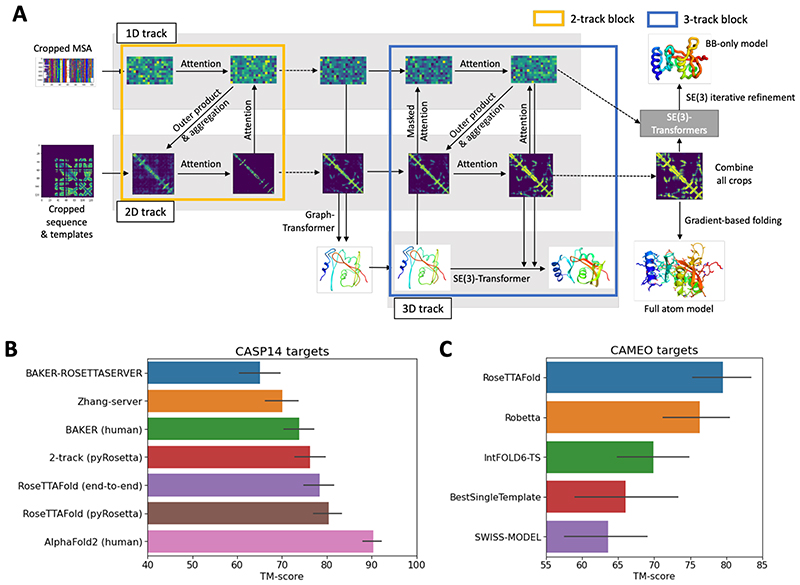
- In CASP14, the 3-track RoseTTAFold outperformed the top 2 server groups (Zhang-server and BAKER-ROSETTASERVER), the BAKER human group, and the authors’ 2-track models, though its performance was still not as good as AlphaFold2.
- On CAMEO, over 69 medium and hard targets released May 15–June 19, 2021, RoseTTAFold outperformed all other evaluated servers, including Robetta, IntFold6-TS, BestSingleTemplate, and SWISS-MODEL.
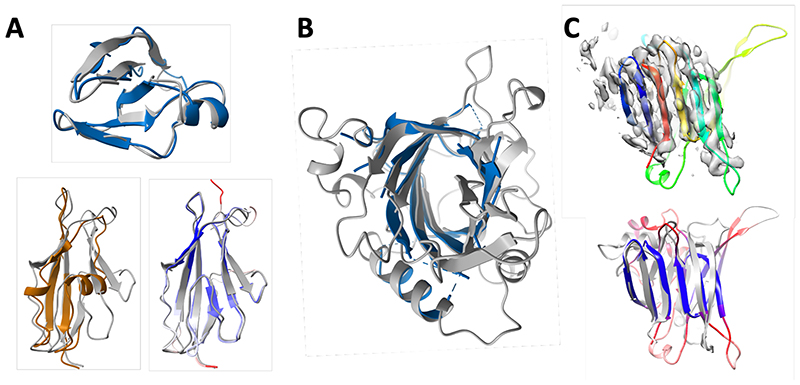
- RoseTTAFold models enabled molecular-replacement solutions for four previously unsolved crystallographic datasets; for the cryo-EM p101 Gβγ binding domain, the Cα-RMSD between predicted and refined structure was 3.0 Å over the beta-sheets.
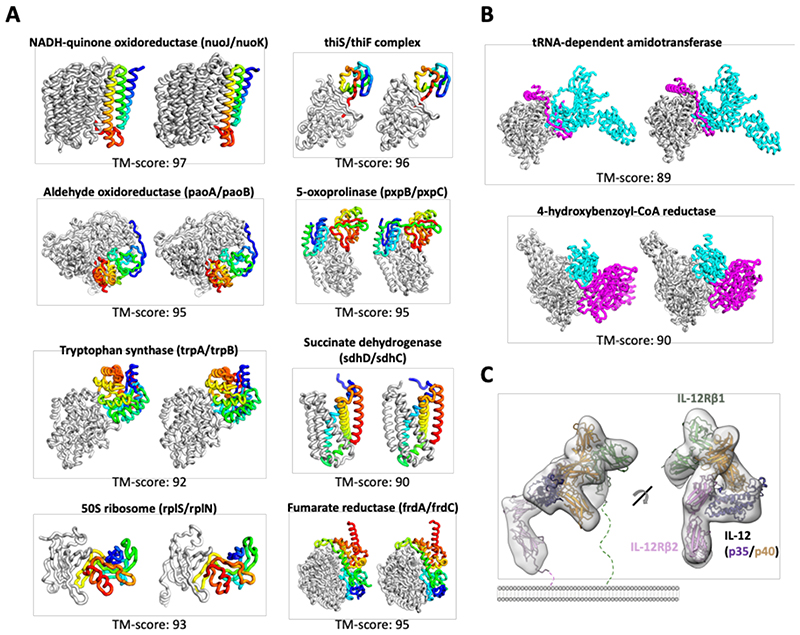
- Among 693 domains from human disease-related proteins, over one-third had predicted lDDT > 0.8, corresponding to an average Cα-RMSD of 2.6 Å on CASP14 targets; many protein-complex models had TM-score > 0.8, with complex generation taking ~30 min on a 24G TITAN RTX GPU.
Methods
- The 3-track network transforms and integrates information at the 1D sequence/MSA level, the 2D distance/orientation-map level, and the 3D backbone-coordinate level, with information flowing between tracks; training used discontinuous sequence crops spanning 260 residues.
- Final 3D structures were generated either by feeding predicted distance/orientation distributions into pyRosetta for all-atom models or by an end-to-end SE(3)-equivariant layer producing backbone coordinates directly.
- Evaluation included CASP14 targets, CAMEO blind server assessment, four X-ray molecular-replacement datasets, a cryo-EM PI3Kγ complex, GPCRs, 693 human disease-related domains, and paired-sequence complexes of known structure, using accuracy comparisons, Cα-RMSD, lDDT, TM-score, and MR/cryo-EM fit.
Limitations
- Stated: hardware memory limitations constrained model size and training; performance remained below AlphaFold2; the end-to-end version was less accurate than the pyRosetta version due to incomplete optimization and neglect of side-chain information; the accuracy predictor did not consistently identify models better than the rapid single-pass method; the network was trained on monomeric proteins, not complexes; and current RoseTTAFold uses only the top 1000 sequences due to memory limits.
- Stated: the Perceiver-based extension for using all available sequences gave promising initial results, but more training is required for rigorous comparison.
- Evident: CASP14 and CAMEO evaluations cover limited target sets and time windows, and the end-to-end model does not produce side chains.
Model-written summary. Check it against the paper before relying on it.
Integrity signals
Registry
Cites
Statistics
Figures
Verification
Claims the paper makes
3 Valid · 8 Not valid · 14 Not checked · 44 Own results and interpretations
The cited sources support only part of this claim — read each source’s verdict below.
In the paper
“The bi-annual Critical Assessment of Structure (CASP) meetings have demonstrated that deep learning methods such as AlphaFold (1, 2) and trRosetta (3), that extract information from the large database of known protein structures in the PDB, outperform more traditional approaches that explicitly model the folding process.”
§ Accurate prediction of protein structures and interactions using a 3-track neural network > Abstract
What the sources say
- Not matchedcites [1] Jumper John Evans Richard Pritzel Alexander Green Tim Figurnov Michael Tunyasuvunakool Kathryn Ronneberger Olaf Bates Russ Augustin Žídek Alex Bridgland Clemens Meyer Fourteenth Critical Assessment of Techniques for Protein Structure Prediction
Its entry has no title and year that we can search by.
- Partly supportedcites [2] Anishchenko I Chidyausiku TM Ovchinnikov S Pellock SJ Baker D De novo protein design by deep network hallucination bioRxiv 2020 2020.07.22.211482 PMC9293396 34853475 sourceExperimental — accuracy not yet measured
The Introduction (page not provided) says deep networks improved protein-structure prediction accuracy, notes an AlphaFold observation at CASP13, and reports that trRosetta outperformed other methods in benchmark tests. The Conclusion says the network learned from native protein structures and contrasts it with physically based approaches. The paper does not establish the claimed CASP comparison in which both AlphaFold and trRosetta outperform approaches that explicitly model folding. (LLM, conf=0.82)
- Not checked — no full text of the sourcecites [3] Yang J Anishchenko I Park H Peng Z Ovchinnikov S Baker D Improved protein structure prediction using predicted interresidue orientations Proc Natl Acad Sci U S A 2020 117 1496 1503 31896580 PMC6983395 source
boostedstates a cause- Asserted: passes — The authors put it forward as true.
- Checkable: passes — It can be checked against evidence.
- Load-bearing: passes — The paper’s conclusions depend on it.
- Based: passes — The paper gives a reason why it holds.
- Not matched
The cited sources that could be checked couldn’t confirm or dispute this claim.
In the paper
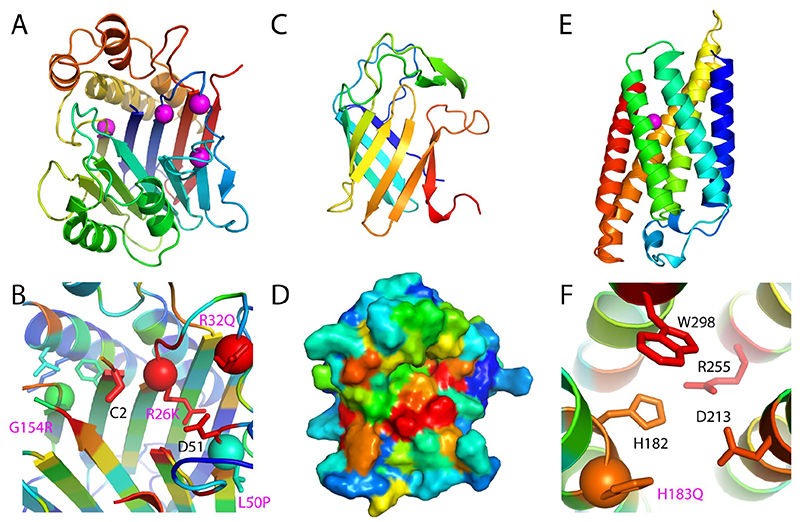
“The RoseTTAFold CERS1 model for residues 98 to 304 (Pfam TLC domain) (29) includes six TMH that traverse the membrane in an up and down arrangement (Fig. 3E).”
§ Accurate prediction of protein structures and interactions using a 3-track neural network > Providing insights into biological function
What the sources say
- Could not verifycites [29] Cong Q Anishchenko I Ovchinnikov S Baker D Protein interaction networks revealed by proteome coevolution Science 2019 365 185 189 31296772 PMC6948103 sourceExperimental — accuracy not yet measured
The paper’s Abstract (page unavailable) describes coevolution-based protein interaction models in E. coli and M. tuberculosis, not a CERS1 model. Searches for CERS1, the Pfam TLC domain, RoseTTAFold, and six transmembrane helices found no passage in our copy addressing the cited domain identification or the stated membrane arrangement. (LLM, conf=0.76)
plain- Asserted: passes — The authors put it forward as true.
- Checkable: passes — It can be checked against evidence.
- Load-bearing: passes — The paper’s conclusions depend on it.
- Based: passes — The paper gives a reason why it holds.
- Could not verify
A result the paper reports from its own data — it cites no other source for it, so there is none to check. The quote shows it is in the paper.
In the paper
“in the case of SLP, only a distant model covering part of the N-terminal domain (38% of the sequence) was available in the PDB”
§ Accurate prediction of protein structures and interactions using a 3-track neural network > Enabling experimental protein structure determination
plainSingle case- Asserted: passes — The authors put it forward as true.
- Checkable: passes — It can be checked against evidence.
- Load-bearing: passes — The paper’s conclusions depend on it.
- Based: passes — The paper gives a reason why it holds.
A result the paper reports from its own data — it cites no other source for it, so there is none to check. The quote shows it is in the paper.
In the paper
“trRosetta failed to predict the correct fold with the same MSA input (fig. S6)”
§ Accurate prediction of protein structures and interactions using a 3-track neural network > Enabling experimental protein structure determination
plainSingle case- Asserted: passes — The authors put it forward as true.
- Checkable: passes — It can be checked against evidence.
- Load-bearing: passes — The paper’s conclusions depend on it.
- Based: passes — The paper gives a reason why it holds.
A result the paper reports from its own data — it cites no other source for it, so there is none to check. The quote shows it is in the paper.
In the paper
“The 3-track models with attention operating at the 1D, 2D, and 3D levels and information flowing between the three levels were the best models we tested (Fig. 1B), clearly outperforming the top 2 server groups (Zhang-server and BAKER-ROSETTASERVER), BAKER human group (ranked second among all groups), and our 2-track attention models on CASP14 targets.”
§ Accurate prediction of protein structures and interactions using a 3-track neural network > Network architecture development
boostedstates a cause- Asserted: passes — The authors put it forward as true.
- Checkable: passes — It can be checked against evidence.
- Load-bearing: passes — The paper’s conclusions depend on it.
- Based: passes — The paper gives a reason why it holds.
33 more claims
Create a free account to see all 69 claims and to verify the 2 references still open.
- It may state two separate claims as one. 24
- Probably not a substantial claim. 13
- The quote only partly states this claim. 2
Claims other papers make about this one
Each is checked against this paper’s own text: does it say what the citing paper says it does?
The source backs part of the claim, not all of it — or backs it for a different population, condition or comparison.
In the citing paper
“RF has properties well suited for use in a protein design DDPM (Fig. 1a): it generates protein structures with high precision, operates on a rigid-frame representation of residues with rotational equivariance and has an architecture enabling conditioning on design specifications at the individual residue, inter-residue distance and orientation, and 3D coordinate levels.”
From De novo design of protein structure and function with RFdiffusion (2023) · cites this paper as [18]
Experimental — accuracy not yet measuredThe source backs part of the claim, not all of it — or backs it for a different population, condition or comparison.
In the citing paper
“are the best and most accurate answer to the structure prediction problem to date”
From The power and pitfalls of AlphaFold2 for structure prediction beyond rigid globular proteins (2024) · cites this paper as [18]
Experimental — accuracy not yet measuredThe source backs part of the claim, not all of it — or backs it for a different population, condition or comparison.
In the citing paper
“DeepMind’s AlphaFold2 success in sequence-based protein structure prediction,4 as well as the RoseTTAFold70 open-source counterpart, and the publicly available AlphaFold2 prediction of all human proteins203 are major steps that benefit the scientific community.”
From AlphaFold, Artificial Intelligence (AI), and Allostery (2022) · cites this paper as [70]
Experimental — accuracy not yet measuredThe source backs part of the claim, not all of it — or backs it for a different population, condition or comparison.
In the citing paper
“The unprecedented accuracy of AlphaFold2,127 RosettaFold,128 and others129,130 offers, at least in principle, the opportunity to virtually screen any protein of interest with the structure-based approach, irrespective of its a priori ligandability (after AlphaFold2, the structural coverage of the human proteome increased from 48% to 76% of the total residues).131”
From Advancing Targeted Protein Degradation via Multiomics Profiling and Artificial Intelligence (2023) · cites this paper as [128]
Experimental — accuracy not yet measuredThe source backs part of the claim, not all of it — or backs it for a different population, condition or comparison.
In the citing paper
“The programs were also shown to accurately assess their confidence at the level of individual residues and interdomain contacts (27,28,62).”
From AI-based structure prediction empowers integrative structural analysis of human nuclear pores (2022) · cites this paper as [27]
Experimental — accuracy not yet measured
17 more claims about this paper
Create a free account to see every claim other papers make about this one.
Citations
Cites
Vaswani, A., Shazeer, N., Parmar, N., Uszkoreit, J., Jones, L., Gomez, A. N., Kaiser, L., & Polosukhin, I. (2017) · arXiv · doi:10.48550/arxiv.1706.03762 · Cited by 120,404
MAFFT Multiple Sequence Alignment Software Version 7: Improvements in Performance and Usability
Katoh, K., & Standley, D. M. (2013) · Molecular Biology and Evolution · doi:10.1093/molbev/mst010 · Cited by 46,209
Features and development of Coot
Emsley, P., Lohkamp, B., Scott, W. G., & Cowtan, K. (2010) · Acta Crystallographica Section D Biological Crystallography · doi:10.1107/s0907444910007493 · Cited by 29,915
Clustal W and Clustal X version 2.0
Larkin, M. A., Blackshields, G., Brown, N. P., Chenna, R., McGettigan, P. A., McWilliam, H., Valentin, F., Wallace, I. M., Wilm, A., Lopez, R., et al. (2007) · Bioinformatics · doi:10.1093/bioinformatics/btm404 · Cited by 28,358
Phaser crystallographic software
McCoy, A. J., Grosse-Kunstleve, R. W., Adams, P. D., Winn, M. D., Storoni, L. C., & Read, R. J. (2007) · Journal of Applied Crystallography · doi:10.1107/s0021889807021206 · Cited by 20,612
Self-citationSWISS-MODEL: homology modelling of protein structures and complexes
Waterhouse, A., Bertoni, M., Bienert, S., Studer, G., Tauriello, G., Gumienny, R., Heer, F. T., de Beer, T. A. P., Rempfer, C., Bordoli, L., et al. (2018) · Nucleic Acids Research · doi:10.1093/nar/gky427 · Cited by 13,067 · cited 2×
“Fortunately,theContinuousAutomated ModelEvaluation(CAMEO)experiment( 7 ) tests structure prediction servers blindly on protein structures as they are submitted to the PDB. RoseTTAFold has been evaluated since 15 May 2021 on CAMEO; over the 69 medium and hard targets released during this time (15 May 2021 to 19 June 20…”
UCSF ChimeraX: Structure visualization for researchers, educators, and developers
Pettersen, E. F., Goddard, T. D., Huang, C. C., Meng, E. C., Couch, G. S., Croll, T. I., Morris, J. H., & Ferrin, T. E. (2021) · Protein Science · doi:10.1002/pro.3943 · Cited by 9,514
Liebschner, D., Afonine, P. V., Baker, M. L., Bunkóczi, G., Chen, V. B., Croll, T. I., Hintze, B., Hung, L.-W., Jain, S., McCoy, A. J., et al. (2019) · Acta Crystallographica Section D Structural Biology · doi:10.1107/s2059798319011471 · Cited by 7,953
Self-citationUniProt: the Universal Protein knowledgebase
Apweiler, R. (2004) · Nucleic Acids Research · doi:10.1093/nar/gkh131 · Cited by 7,498
Towards automated crystallographic structure refinement with phenix.refine
Afonine, P. V., Grosse-Kunstleve, R. W., Echols, N., Headd, J. J., Moriarty, N. W., Mustyakimov, M., Terwilliger, T. C., Urzhumtsev, A., Zwart, P. H., & Adams, P. D. (2012) · Acta Crystallographica Section D Biological Crystallography · doi:10.1107/s0907444912001308 · Cited by 5,511
Self-citation
Research works printed but not linked: 2
- Bunkóczi G Read RJ phenix. ensembler: a tool for multiple superposition Comput Crystallogr Newsl 2011 2 8 9
- Vagin A Lebedev A ACTA CRYSTALLOGRAPHICA A-FOUNDATION AND ADVANCES INT UNION CRYSTALLOGRAPHY 2 ABBEY SQ, CHESTER, CH1 2HU ENGLAND 2015 71 S19
Cited by
Items 1,401–1,500 of 5,643
Zhao, Q., Zhao, H., Guo, L., Zheng, K., Li, Y., Ling, Q., Tang, J. P., Li, Y., & Wang, J. (2025) · Nature Communications · doi:10.1038/s41467-025-61745-7 · Cited by 27
“Furthermore, ColdstartCPI is a highly scalable framework that can further improve predictive performance by integrating pre-trained models of other modalities on compounds (i.e., the 2D graph structure 95 and the 3D geometry 96 ) and proteins (i.e., the 3D structure 19,97,98 ).”
Self-citationParametrically guided design of beta barrels and transmembrane nanopores using deep learning
Kim, D. E., Watson, J. L., Juergens, D., Majumder, S., Sonigra, R., Gerben, S. R., Kang, A., Bera, A. K., Li, X., & Baker, D. (2025) · Proceedings of the National Academy of Sciences · doi:10.1073/pnas.2425459122 · Cited by 21
Self-citationOf Revolutions and Roadblocks: The Emerging Role of Machine Learning in Biocatalysis
Vornholt, T., Stockinger, P., Mutný, M., Jeschek, M., Nestl, B. M., Oberdorfer, G., Osuna, S., Pleiss, J., Welner, D. H., Krause, A., et al. (2025) · ACS Central Science · doi:10.1021/acscentsci.5c00949 · Cited by 24
Song, C., Gu, J., Ren, H., Li, Z., Xie, D., Han, L., Qiao, J., Cheng, Z., Nie, Y., & Zhou, Z. (2025) · Biotechnology Advances · doi:10.1016/j.biotechadv.2025.108716 · Cited by 21
Artificial intelligence for radiopharmaceutical and molecular imaging
Tao, J., Liang, L., Hao, S., Chen, Y., Yang, Z., Cai, Y., & Zhu, H. (2025) · Acta Pharmaceutica Sinica B · doi:10.1016/j.apsb.2025.09.039 · Cited by 25
“Meanwhile, generative AI, represented by RoseTTAFold 16 , and reinforcement learning techniques can expedite the design of radioligands and optimize dosing regimens.”
Flow matching meets biology and life science: a survey
Li, Z., Zeng, Z., Lin, X., Fang, F., Qu, Y., Xu, Z., Liu, Z., Ning, X., Wei, T., Liu, G., et al. (2026) · npj Artificial Intelligence · doi:10.1038/s44387-025-00066-y · Cited by 25
“Modeling such systems has long been a grand challenge across scienti fi c disciplines,demandingtoolsthatcanreconcileprecisionwith fl exibility 55 – 60 .”
Zhou, X., Peng, C., Zheng, W. H., Li, Y., Zhang, G., & Zhang, Y. (2022) · Nucleic Acids Research · doi:10.1093/nar/gkac340 · Cited by 23
Direct interaction of a chaperone-bound type III secretion substrate with the export gate
Gilzer, D., Schreiner, M., & Niemann, H. H. (2022) · Nature Communications · doi:10.1038/s41467-022-30487-1 · Cited by 21
TrmB Family Transcription Factor as a Thiol-Based Regulator of Oxidative Stress Response
Mondragon, P., Hwang, S., Kasirajan, L., Oyetoro, R. O., Nasthas, A., Winters, E., Couto-Rodríguez, R. L., Schmid, A., & Maupin-furlow, J. A. (2022) · mBio · doi:10.1128/mbio.00633-22 · Cited by 23
Evolution of a chordate-specific mechanism for myoblast fusion
Zhang, H., Shang, R., Kim, K., Zheng, W. H., Johnson, C. J., Sun, L., Niu, X., Liu, L., Zhou, J., Liu, L., et al. (2022) · Science Advances · doi:10.1126/sciadv.add2696 · Cited by 23
Self-citationTime Series Analysis of SARS-CoV-2 Genomes and Correlations among Highly Prevalent Mutations
Periwal, N., Rathod, S. B., Sarma, S., Johar, G. S., Jain, A., Barnwal, R. P., Srivastava, K. R., Kaur, B., Arora, P., & Sood, V. (2022) · Microbiology Spectrum · doi:10.1128/spectrum.01219-22 · Cited by 25
“The RoseTTAFold modelled all these missing residues in three proteins except 9 histidine residues at the C-terminal in RdRp.”
MethodKnoot, C. J., Wantuch, P. L., Robinson, L. S., Rosen, D. A., Scott, N. E., & Harding, C. M. (2022) · Glycobiology · doi:10.1093/glycob/cwac070 · Cited by 21
The Evolution and Global Spatiotemporal Dynamics of Senecavirus A
Wu, H., Li, C., Ji, Y., Mou, C., Chen, Z., & Zhao, J. (2022) · Microbiology Spectrum · doi:10.1128/spectrum.02090-22 · Cited by 23
Deep learning of protein sequence design of protein–protein interactions
Syrlybaeva, R. R., & Strauch, E. (2022) · Bioinformatics · doi:10.1093/bioinformatics/btac733 · Cited by 21
“Recent work using neural networks improved substantially accuracy in structure prediction (Baek et al., 2021; Jumper et al., 2021; Senior et al., 2020) and protein sequence design (Anand et al., 2020; Chen et al., 2020; Gao et al., 2020; O’Connell et al., 2018).”
MethodEvseev, P. V., Gutnik, D., Shneider, M. M., & Анатольевич, М. К. (2023) · Biomolecules · doi:10.3390/biom13010110 · Cited by 24
DPReLU: Dynamic Parametric Rectified Linear Unit and Its Proper Weight Initialization Method
Yang, D., Ngoc, K. M., Shin, I., & Hwang, M. (2023) · International Journal of Computational Intelligence Systems · doi:10.1007/s44196-023-00186-w · Cited by 21
“Deep learning has yielded state-of-the-art results in various fields, such as computer vision [33, 35], natural language processing [2, 25], public health [14, 32], biology [1, 12], and recommendation [6, 8].”
BackgroundChang, T.-H., Hsieh, F.-L., Gu, X., Smallwood, P. M., Kavran, J. M., Gabelli, S. B., & Nathans, J. (2023) · Proceedings of the National Academy of Sciences · doi:10.1073/pnas.2221103120 · Cited by 22
Computational modeling and prediction of deletion mutants
Woods, H., Schiano, D. L., Aguirre, J. I., Ledwitch, K. V., McDonald, E. F., Voehler, M., Meiler, J., & Schoeder, C. T. (2023) · Structure · doi:10.1016/j.str.2023.04.005 · Cited by 22
Mezősi-Csaplár, M., Szöőr, Á., & Vereb, G. (2023) · Cancers · doi:10.3390/cancers15123081 · Cited by 25
“We applied the RoseTTAFold deep learning-based protein structure prediction algorithm to determine the tertiary structure of various domains in the four different CAR constructs [20] and the native CD3ζ protein.”
MethodComputational Modeling of DNA 3D Structures: From Dynamics and Mechanics to Folding
Mu, Z.-C., Tan, Y.-L., Liu, J., Zhang, B., & Shi, Y.-Z. (2023) · Molecules · doi:10.3390/molecules28124833 · Cited by 23
“For example, 3D structure prediction methods such as AlphaFold2 [157] and RoseTTAFold [158] have gained popularity due to their ability to accurately predict protein structures.”
MethodHuang, M.-H., Wang, J., Zhang, J., Mao, X.-L., Peng, G.-X., Lin, X., Lv, D., Yuan, C., Lin, H., Wang, E., et al. (2023) · 中国科学通报:英文版 · doi:10.1016/j.scib.2023.08.002 · Cited by 22
Self-citationMishra, S., Chaudhary, R., Pandey, B., Singh, G. P., & Sharma, P. K. (2023) · Scientific Reports · doi:10.1038/s41598-023-45051-0 · Cited by 23
Qi, Z., Tong, X., Zhang, Y., Jia, S., Fang, X., & Zhao, L. (2023) · Journal of Agricultural and Food Chemistry · doi:10.1021/acs.jafc.3c06459 · Cited by 22
Exploring the Alternative Conformation of a Known Protein Structure Based on Contact Map Prediction
(2023) · doi:10.1021/acs.jcim.3c01381 · Cited by 21
Structural insights into membrane adenylyl cyclases, initiators of cAMP signaling
Schuster, D., Khanppnavar, B., Kantarci, I., Mehta, V., & Korkhov, V. M. (2023) · Trends in Biochemical Sciences · doi:10.1016/j.tibs.2023.12.002 · Cited by 25
Molecular basis of chromatin remodelling by DDM1 involved in plant DNA methylation
Liu, Y., Zhang, Z., Hu, H., Chen, W., Zhang, F., Wang, Q., Wang, C., Yan, K., & Du, J. (2024) · Nature Plants · doi:10.1038/s41477-024-01640-z · Cited by 23
Reengineering of a flavin‐binding fluorescent protein using ProteinMPNN
Nikolaev, A., Kuzmin, A., Markeeva, E., Kuznetsova, E., Ryzhykau, Y. L., Semenov, O., Anuchina, A. A., Remeeva, A., & Gushchin, I. (2024) · Protein Science · doi:10.1002/pro.4958 · Cited by 22
Catalytic Mechanism and Heterologous Biosynthesis Application of Sesquiterpene Synthases
Nie, S., Wang, S., Chen, R., Ge, M., Yan, X., & Qiao, J. (2024) · Journal of Agricultural and Food Chemistry · doi:10.1021/acs.jafc.4c00030 · Cited by 21
Accelerating Genetic Sensor Development, Scale-up, and Deployment Using Synthetic Biology
Joshi, S. H.-N., Jenkins, C., Ulaeto, D., & Gorochowski, T. E. (2024) · BioDesign Research · doi:10.34133/bdr.0037 · Cited by 26
Pala, Z. R., Silva, T. L. A. E., Minai, M., Crews, B., Patiño‐Martínez, E., Carmona‐Rivera, C., Leon, P. C. V., Martín-Martín, I., Flores-García, Y., Cachau, R. E., et al. (2024) · Nature Communications · doi:10.1038/s41467-024-52502-3 · Cited by 26
Metabolic gatekeepers: Dynamic roles of sugar transporters in insect metabolism and physiology
Chaudhari, B. Y., Pradhan, A. G., & Joshi, R. S. (2024) · Insect Molecular Biology · doi:10.1111/imb.12963 · Cited by 22
Covalent-Allosteric Inhibitors: Do We Get the Best of Both Worlds?
Tao, H., Yang, B., Farhangian, A., Xu, K., Li, T., Zhang, Z., & Li, J. (2025) · Journal of Medicinal Chemistry · doi:10.1021/acs.jmedchem.4c02760 · Cited by 22
Bertalan, É., Lesca, E., Schertler, G. F. X., & Bondar, A. (2021) · Journal of Chemical Information and Modeling · doi:10.1021/acs.jcim.1c00827 · Cited by 21
Feng, C., Tian, L., Jiao, Y., Tan, Y., Liu, C., Luo, Y., & Hong, H. (2022) · Food Chemistry · doi:10.1016/j.foodchem.2022.132160 · Cited by 22
Insidious Insights: Implications of viral vector engineering for pathogen enhancement
Sandbrink, J. B., Alley, E. C., Watson, M. C., Koblentz, G. D., & Esvelt, K. M. (2022) · Gene Therapy · doi:10.1038/s41434-021-00312-3 · Cited by 22
Chu, C., Li, L., Li, S., Zhou, Q., Zheng, P., Zhang, Y., Duan, A., Lü, D., & Wu, Y. (2022) · Human Genomics · doi:10.1186/s40246-022-00385-0 · Cited by 21
You, Y., & Shen, Y. (2022) · Bioinformatics · doi:10.1093/bioinformatics/btac470 · Cited by 21
Tu, Z., Hu, Y. P., Raizada, D., Bassal, M. A., Tenen, D. G., & Karnoub, A. E. (2022) · Proceedings of the National Academy of Sciences · doi:10.1073/pnas.2203180119 · Cited by 24
Structural analogue-based protein structure domain assembly assisted by deep learning
Peng, C.-X., Zhou, X.-G., Xia, Y.-H., Liu, J., Hou, M.-H., & Zhang, G.-J. (2022) · Bioinformatics · doi:10.1093/bioinformatics/btac553 · Cited by 21
Exploring the alternative conformation of a known protein structure based on contact map prediction
Li, J., Wang, L., Zhu, Z., & Song, C. (2022) · doi:10.1101/2022.06.07.495232 · Cited by 21
Predicting the conformational flexibility of antibody and T-cell receptor CDRs
Spoendlin, F. C., Fernández-Quintero, M. L., Raghavan, S. S. R., Turner, H. L., Gharpure, A., Loeffler, J. R., Wong, W. K., Bujotzek, A., Georges, G., Ward, A. B., et al. (2025) · doi:10.1101/2025.03.19.644119 · Cited by 20
Hallucinating structure-conditioned antibody libraries for target-specific binders
Mahajan, S. P., Ruffolo, J. A., Frick, R., & Gray, J. J. (2022) · Frontiers in Immunology · doi:10.3389/fimmu.2022.999034 · Cited by 20
“Second, the framework can be applied to hallucinate sequences that optimize the heavy and light chain interface (29), a task that is not suitable for hallucination frameworks with models trained on single sequences [trRosetta (30), RoseTTAFold (31)].”
MethodSpoendlin, F. C., Fernández-Quintero, M. L., Raghavan, S. S. R., Turner, H. L., Gharpure, A., Loeffler, J. R., Wong, W. K., Bujotzek, A., Georges, G., Ward, A. B., et al. (2025) · Nature Machine Intelligence · doi:10.1038/s42256-025-01131-6 · Cited by 20
“13–15), and more recently developed tools are also showing promise at protein complex prediction (for example, refs.”
Fast, accurate ranking of engineered proteins by target-binding propensity using structure modeling
Ding, X., Chen, X., Sullivan, E. E., Shay, T. F., & Gradinaru, V. (2024) · Molecular Therapy · doi:10.1016/j.ymthe.2024.04.003 · Cited by 20
Soh, T. K., Ognibene, S., Sanders, S., Schäper, R., Kaufer, B. B., & Bosse, J. B. (2024) · Nature Communications · doi:10.1038/s41467-024-54668-2 · Cited by 20
“With the development of machine learning-based prediction software 1,2 , the accuracy of the structural information has increased so that it can often be directly used for building wet-lab testable hypotheses, making it an invaluable tool for molecular biologists 3 .”
Targeting GPCRs and Their Signaling as a Therapeutic Option in Melanoma
Raymond, J. H., Aktary, Z., Larue, L., & Delmas, V. (2022) · Cancers · doi:10.3390/cancers14030706 · Cited by 20
Li, B., Luo, S., Wang, W., Xu, J., Liu, D., Shameem, M., Mattila, J., Franklin, M. C., Hawkins, P. G., & Atwal, G. S. (2025) · mAbs · doi:10.1080/19420862.2025.2474521 · Cited by 23
“Here, thanks to recent advances in 3D structure prediction and sequence modeling for proteins 33–35 and antibodies, 36,37 we developed a versatile and integrative computational tool called PROPERMAB to enable in silico developability assessment of mAbs using machine learning.”
Protein-derived cofactors: chemical innovations expanding enzyme catalysis
Graciano, A., & Liu, A. (2025) · Chemical Society Reviews · doi:10.1039/d4cs00981a · Cited by 21
A structural perspective on enzymes and their catalytic mechanisms
Borkakoti, N., Ribeiro, A. J. M., & Thornton, J. M. (2025) · Current Opinion in Structural Biology · doi:10.1016/j.sbi.2025.103040 · Cited by 25
Use of AI-methods over MD simulations in the sampling of conformational ensembles in IDPs
Sil, S., Datta, I., & Basu, S. (2025) · Frontiers in Molecular Biosciences · doi:10.3389/fmolb.2025.1542267 · Cited by 15
State-of-the-Art and Future Directions in Structural Proteomics
Happonen, L., & Varjosalo, M. T. (2025) · Molecular & Cellular Proteomics · doi:10.1016/j.mcpro.2025.101065 · Cited by 22
“On the computational front, the advent of artificial intelligence (AI)-based model prediction ( e.g. , AlphaFold, RoseTTAFold) (14–17) has revolutionized the generation of high-accuracy protein models, enabling the integration of these predicted models with experimental data to resolve complex…”
The Role of AI-Driven De Novo Protein Design in the Exploration of the Protein Functional Universe
Zhang, G., Liu, C., Lu, J., Zhang, S., & Zhu, L. (2025) · Biology · doi:10.3390/biology14091268 · Cited by 24
“The Baker laboratory developed RoseTTAFold [69], which uses a three-track network to simultaneously process MSAs, residue pair distances, and 3D coordinates.”
Odorant Reception in Insects: Functional and Evolutionary Perspectives
Leal, W. S. (2025) · Annual Review of Entomology · doi:10.1146/annurev-ento-121423-013351 · Cited by 20
A bacterial nutrition strategy for plant disease control
Wang, S., Zhu, L., Tian, M. L., Wu, W., Hu, X., Li, X., Wang, J., Zhu, Y., Xu, J., Mou, B., et al. (2025) · Science · doi:10.1126/science.ady8325 · Cited by 20
Self-citationNiazi, S. (2025) · Computational and Structural Biotechnology Reports · doi:10.1016/j.csbr.2025.100064 · Cited by 23
Assembly and recognition of keratins: A structural perspective
Yu, B., Kong, D., Cheng, C., Xiang, D., Cao, L., Liu, Y., & He, Y. (2021) · Seminars in Cell and Developmental Biology · doi:10.1016/j.semcdb.2021.09.018 · Cited by 20
Martin, W., Sheynkman, G., Lightstone, F. C., Nussinov, R., & Cheng, F. (2021) · Current Opinion in Structural Biology · doi:10.1016/j.sbi.2021.09.001 · Cited by 22
Zill, D., Lettau, E., Lorent, C., Seifert, F., Singh, P. K., & Lauterbach, L. (2022) · ChemBioChem · doi:10.1002/cbic.202200195 · Cited by 20
Deep learning geometrical potential for high-accuracy ab initio protein structure prediction
Li, Y., Zhang, C., Yu, D., & Zhang, Y. (2022) · iScience · doi:10.1016/j.isci.2022.104425 · Cited by 22
Scoping review and classification of deep learning in medical genetics
Hanchard, S. E. L., Dwyer, M. C., Liu, S., Hu, P., Tekendo‐Ngongang, C., Waikel, R. L., Duong, D., & Solomon, B. D. (2022) · Genetics in Medicine · doi:10.1016/j.gim.2022.04.025 · Cited by 20
Immunogenicity of Novel AAV Capsids for Retinal Gene Therapy
Gehrke, M., Diedrichs‐Möhring, M., Bogedein, J., Büning, H., Michalakis, S., & Wildner, G. (2022) · Cells · doi:10.3390/cells11121881 · Cited by 20
“Models were generated using the RoseTTAfold deep learning algorithm [36] available at https://robetta.”
MethodSi, Y., & Yan, C. (2022) · Briefings in Bioinformatics · doi:10.1093/bib/bbac208 · Cited by 17
Structure of V-ATPase from citrus fruit
Tan, Y. Z., Keon, K. A., Abdelaziz, R., Imming, P., Schulze, W. X., Schumacher, K., & Rubinstein, J. L. (2022) · Structure · doi:10.1016/j.str.2022.07.006 · Cited by 21
Apprehending the NAD+–ADPr-Dependent Systems in the Virus World
Iyer, L. M., Burroughs, A. M., Anantharaman, V., & Aravind, L. (2022) · Viruses · doi:10.3390/v14091977 · Cited by 23
“Structural modeling was performed using the RoseTTAFold program, which uses a “three-track” neural network, utilizing patterns of sequence conservation, distance inferred from coevolutionary changes in MSAs, and coordinate information [72].”
MethodFluorescent proteins for a brighter science
Lukyanov, K. A. (2022) · Biochemical and Biophysical Research Communications · doi:10.1016/j.bbrc.2022.08.089 · Cited by 20
(2022) · doi:10.3389/fmolb.2022.1044509 · Cited by 20
“, 2020), which now appears set to become the preferred method in structural biology (Hand, 2020), and the advent of machine learning approaches for protein structure prediction (Baek et al., 2021; Jumper et al., 2021).”
MethodMartins, D. O. S., Souza, R. A. C., Freire, M. C. L. C., Mesquita, N. C. D. M. R., Santos, I. A., de Oliveira, D. M., Nicolau-Júnior, N., de Paiva, R. E. F., Harris, M., Oliveira, C. G., et al. (2022) · JBIC Journal of Biological Inorganic Chemistry · doi:10.1007/s00775-022-01974-z · Cited by 20
Structure of a RecT/Redβ family recombinase in complex with a duplex intermediate of DNA annealing
Caldwell, B. J., Norris, A. S., Karbowski, C. F., Wiegand, A. M., Wysocki, V. H., & Bell, C. E. (2022) · Nature Communications · doi:10.1038/s41467-022-35572-z · Cited by 20
Cai, T., Xie, L., Zhang, S., Chen, M., He, D., Badkul, A., Liu, Y., Krishna, N. H., Dorogan, M., Harding, W. W., et al. (2023) · PLoS Computational Biology · doi:10.1371/journal.pcbi.1010851 · Cited by 23
Tellis, M. B., Chaudhari, B. Y., Deshpande, S. V., Nikam, S. V., Barvkar, V. T., Kotkar, H. M., & Joshi, R. S. (2023) · Gene · doi:10.1016/j.gene.2023.147259 · Cited by 20
Baltoumas, F. A., Karatzas, E., Páez-Espino, D., Venetsianou, N. K., Aplakidou, E., Oulas, A., Finn, R. D., Ovchinnikov, S., Pafilis, E., Kyrpides, N. C., et al. (2023) · Frontiers in Bioinformatics · doi:10.3389/fbinf.2023.1157956 · Cited by 25
“Other implementations of deep learning methods include RoseTTAFold (Baek et al., 2021) and DeepFold (Pearce et al., 2022).”
MethodInfluentialSelf-citationRobust total X-ray scattering workflow to study correlated motion of proteins in crystals
Meisburger, S. P., Case, D. A., & Ando, N. (2023) · Nature Communications · doi:10.1038/s41467-023-36734-3 · Cited by 20
“Spring constants were refined in four stages with progressively fewer restraints: (1) a single Gaussian spring constant was fit globally; (2) a Gaussian spring constant was fit for each unique protein-protein interface; (3) a hybrid spring constant was fit for each unique protein-protein interface; and (4) a hybrid sp…”
The laboratory of Babel: highlighting community needs for integrated materials data management
Pelkie, B. G., & Pozzo, L. D. (2023) · Digital Discovery · doi:10.1039/d3dd00022b · Cited by 20
De Novo Design of Polyhedral Protein Assemblies: Before and After the AI Revolution
Mallik, B. B., Stanislaw, J., Alawathurage, T. M., & Khmelinskaia, A. (2023) · ChemBioChem · doi:10.1002/cbic.202300117 · Cited by 23
Seeking the interspecies crosswalk for filamentous microbe effectors
Stuer, N., Damme, P. V., Goormachtig, S., & Dingenen, J. V. (2023) · Trends in Plant Science · doi:10.1016/j.tplants.2023.03.017 · Cited by 21
Hui, T., Descoteaux, M., Miao, J., & Lin, Y. (2023) · Journal of Chemical Theory and Computation · doi:10.1021/acs.jctc.3c00154 · Cited by 23
Advancing CRISPR/Cas gene editing with machine learning
Fong, J. H. C., & Wong, A. S. L. (2023) · Current Opinion in Biomedical Engineering · doi:10.1016/j.cobme.2023.100477 · Cited by 23
Mani, H., Chang, C., Hsu, H., Yang, C.-H., Yen, J.-H., & Liou, J.-W. (2023) · Bioengineering · doi:10.3390/bioengineering10091004 · Cited by 24
“The accuracy and reliability of the predictions were continually evaluated (Continuous Automated Model Evaluation web server) [12].”
BackgroundResultShen, J., Zheng, L., Zhang, Y., Chen, G., Mei, X., Chang, Y., & Xue, C. (2023) · Carbohydrate Polymers · doi:10.1016/j.carbpol.2023.121442 · Cited by 21
Dual function of Zika virus NS2B-NS3 protease
Shiryaev, S. A., Cieplak, P., Cheltsov, A. V., Liddington, R., & Terskikh, A. V. (2023) · PLoS Pathogens · doi:10.1371/journal.ppat.1011795 · Cited by 20
“For building a structural model for the full protein sequence, e.g., ZIKV NS2B co-factor protein, we employed RoseTTAFold program that uses deep learning approach for quick structure prediction [27].”
MethodInfluentialDesigning Multivalent and Multispecific Biologics
Kang, J. J., Ohoka, A., & Sarkar, C. A. (2023) · Annual Review of Chemical and Biomolecular Engineering · doi:10.1146/annurev-chembioeng-100722-112440 · Cited by 23
Limitations of Protein Structure Prediction Algorithms in Therapeutic Protein Development
Niazi, S. K., Mariam, Z., & Paracha, R. Z. (2024) · BioMedInformatics · doi:10.3390/biomedinformatics4010007 · Cited by 22
A general computational design strategy for stabilizing viral class I fusion proteins
Gonzalez, K. J., Huang, J., Criado, M. F., Banerjee, A., Tompkins, S. M., Mousa, J. J., & Strauch, E.-M. (2024) · Nature Communications · doi:10.1038/s41467-024-45480-z · Cited by 20
“Nonetheless, we believe that the remarkable advancements of recent structure prediction algorithms, such as AlphaFold 42 and RoseTTAFold 43 , can facilitate the rapid modeling of both states.”
Karimzadegan, V., Koirala, M., Sobhanverdi, S., Mérindol, N., Majhi, B. B., Gélinas, S., Timokhin, V. I., Ralph, J., Dastmalchi, M., & Desgagné‐Penix, I. (2024) · Plant Physiology and Biochemistry · doi:10.1016/j.plaphy.2024.108612 · Cited by 20
Elisée, E., Ducrot, L., Méheust, R., Bastard, K., Fossey‐Jouenne, A., Grogan, G., Pelletier, É., Petit, J., Stam, M. R., de Berardinis, V., et al. (2024) · Nature Communications · doi:10.1038/s41467-024-49009-2 · Cited by 20
“In addition, the recent rise of computational approaches to accurately predict protein structures could help to expedite structural studies of enzyme families with few experimentally determined 3D structures 40,61,62 .”
Tips and Tricks in the Modeling of Supramolecular Peptide Assemblies
Piskorz, T. K., Perez‐Chirinos, L., Qiao, B., & Sasselli, I. R. (2024) · ACS Omega · doi:10.1021/acsomega.4c02628 · Cited by 20
Chen, S., Tang, Z., You, L., & Chen, C. Y. (2024) · Knowledge-Based Systems · doi:10.1016/j.knosys.2024.112209 · Cited by 22
Development of a novel multi-epitope vaccine for brucellosis prevention
Shang, K., Zhu, Y., Tian, T., Shi, H., Yin, Z., He, Y., Shi, J., Ding, J., & Zhang, F. (2024) · Heliyon · doi:10.1016/j.heliyon.2024.e34721 · Cited by 23
Photonic deep residual time-delay reservoir computing
Zhou, C., Huang, Y., Yang, Y., Cai, D., Zhou, P., & Li, N. (2024) · Neural Networks · doi:10.1016/j.neunet.2024.106575 · Cited by 23
Burgie, E. S., Basore, K., Rau, M., Summers, B. T., Mickles, A. J., Grigura, V., Fitzpatrick, J. A. J., & Vierstra, R. D. (2024) · Nature Communications · doi:10.1038/s41467-024-50412-y · Cited by 20
Unlocking the Gates: Therapeutic Agents for Noninvasive Drug Delivery Across the Blood-Brain Barrier
Culkins, C., Adomanis, R., Phan, N., Robinson, B., Slaton, E. W., Lothrop, E., Chen, Y., & Kimmel, B. R. (2024) · Molecular Pharmaceutics · doi:10.1021/acs.molpharmaceut.4c00604 · Cited by 25
Cutting-edge computational approaches in enzyme design and activity enhancement
Sun, R., Wu, D., Chen, P., & Zheng, P. (2024) · Biochemical Engineering Journal · doi:10.1016/j.bej.2024.109510 · Cited by 20
Protein A-like Peptide Design Based on Diffusion and ESM2 Models
Zhao, L., He, Q., Song, H., Zhou, T., Luo, A., Wen, Z., Wang, T., & Lin, X. (2024) · Molecules · doi:10.3390/molecules29204965 · Cited by 20
“RfDiffusion combines structure prediction (RoseTTAFold) with diffusion model generation [23] to design proteins from scratch.”
MethodRepeatsDB in 2025: expanding annotations of structured tandem repeats proteins on AlphaFoldDB
Clementel, D., Arrías, P. N., Mozaffari, S., Osmanli, Z., Castro, X. A., curators, R., Borucki, E. L., Cabrera, M., Chinestrad, P., Czarnowski, I., et al. (2024) · Nucleic Acids Research · doi:10.1093/nar/gkae965 · Cited by 21
Li, Y., Arghittu, S. M., Dietz, M. S., Hella, G. J., Haße, D., Ferraris, D. M., Freund, P., Barth, H., Iamele, L., de Jonge, H., et al. (2024) · Nature Communications · doi:10.1038/s41467-024-53772-7 · Cited by 20
“Our approach is generally applicable to distinguish between con fl icting structural models of ligand-receptor complexes or to scrutinize putative complex structures predicted by low-resolution experiments or computational tools such as AlphaFold 21 and RoseTTaFold 22 .”
MethodChallenges and approaches to studying pore-forming proteins
Benton, J. T., & Bayly-Jones, C. (2021) · Biochemical Society Transactions · doi:10.1042/bst20210706 · Cited by 23
Machine learning applications in macromolecular X-ray crystallography
Vollmar, M., & Evans, G. (2021) · Crystallography Reviews · doi:10.1080/0889311x.2021.1982914 · Cited by 22
Machine Learning at the Interface of Polymer Science and Biology: How Far Can We Go?
Gianti, E., & Percec, S. (2022) · Biomacromolecules · doi:10.1021/acs.biomac.1c01436 · Cited by 21
Exploring cryo-electron microscopy with molecular dynamics
Vant, J., Sarkar, D., Nguyen, J. T., Baker, A. T., Vermaas, J. V., & Singharoy, A. (2022) · Biochemical Society Transactions · doi:10.1042/bst20210485 · Cited by 22
Synthetic RNA-based post-transcriptional expression control methods and genetic circuits
Pardi, M. L., Wu, J., Kawasaki, S., & Saito, H. (2022) · Advanced Drug Delivery Reviews · doi:10.1016/j.addr.2022.114196 · Cited by 21
Metadata
- Authors
- Baek, M., DiMaio, F., Anishchenko, I., Dauparas, J., Ovchinnikov, S., Lee, G. R., Wang, J., Cong, Q., Kinch, L. N., Schaeffer, R. D., Millán, C., Park, H., Adams, C., Glassman, C. R., DeGiovanni, A., Pereira, J. H., Rodrigues, A. V., van Dijk, A. A., Ebrecht, A. C., Opperman, D. J., Sagmeister, T., Buhlheller, C., Pavkov-Keller, T., Rathinaswamy, M. K., Dalwadi, U., Yip, C. K., Burke, J. E., Garcia, K. C., Grishin, N. V., Adams, P. D., Read, R. J., & Baker, D.
- Affiliations
- University of Washington (US)
- Harvard University (US)
- The University of Texas Southwestern Medical Center (US)
- Howard Hughes Medical Institute (US)
- University of Cambridge (GB)
- Stanford Medicine (US)
- Lawrence Berkeley National Laboratory (US)
- North-West University (ZA)
- University of the Free State (ZA)
- University of Graz (AT)
- University of Victoria (CA)
- University of British Columbia (CA)
- Corresponding author
- Baker, David
- ORCID
- Baek, Minkyung
- DiMaio, Frank
- Anishchenko, Ivan
- Dauparas, Justas
- Ovchinnikov, Sergey
- Lee, Gyu Rie
- Wang, Jue
- Cong, Qian
- Kinch, Lisa N.
- Schaeffer, R. Dustin
- Millán, Claudia
- Park, Hahnbeom
- Adams, Carson
- Glassman, Caleb R.
- Pereira, Jose H.
- Rodrigues, Andria V.
- van Dijk, Alberdina A.
- Ebrecht, Ana C.
- Opperman, Diederik J.
- Sagmeister, Theo
- Buhlheller, Christoph
- Rathinaswamy, Manoj K
- Dalwadi, Udit
- Yip, Calvin K
- Burke, John E
- Grishin, Nick V.
- Adams, Paul D.
- Read, Randy J.
- Baker, David
- Venue
- Science
- Publisher
- openRxiv
- Published
- 2021-06-15
- Volume
- 373
- Issue
- 6557
- Pages
- 871-876
- ISSN
- 0036-8075 (ISSN-L)
- PMC
- PMC7612213
- OpenAlex
- W3186179742
- Semantic Scholar
- 51362860fb8ad08255660303550ed4bc345535fc
- Cited by
- 5,549
- References
- 85
- Citations by year
- 2026: 912 · 2025: 1108 · 2024: 1165 · 2023: 1144 · 2022: 982 · 2021: 227
- FWCI
- 247.22
- Type
- journal article
- Language
- en
- Open access
- hybrid
- doi.org
- Licence
- cc-by
- Locations
- Science (publishedVersion, cc-by)
- bioRxiv (Cold Spring Harbor Laboratory) (submittedVersion, cc-by-nc-nd)
- PubMed (publishedVersion)
- PubMed Central (acceptedVersion, cc-by)
- eScholarship (California Digital Library) (submittedVersion, cc-by)
- OSTI OAI (U.S. Department of Energy Office of Scientific and Technical Information) (submittedVersion, cc-by)
- DESY Publication Database (PUBDB) (Deutsches Elektronen-Synchrotron) (submittedVersion)
- Apollo (University of Cambridge) (submittedVersion, cc-by)
- Apollo (cc-by)
- Funders
- National Science Foundation (GM127390, 1937533)
- Welch Foundation (I‐1505)
- Washington Research Foundation
- Microsoft
- TU Graz, Internationale Beziehungen und Mobilitätsprogramme
- Wellcome Trust (Z/17/Z, 209407/Z/17/Z, 209407)
- G. Harold and Leila Y. Mathers Foundation
- Diamond Light Source
- Open Philanthropy Project
- Global Challenges Research Fund (ST/R002754/1)
- Schmidt Family Foundation
- European Synchrotron Radiation Facility
- Austrian Science Fund (P 29432, DOC 50)
- National Institutes of Health (DP5OD026389, RO1-AI51321)
- Canadian Institutes of Health Research (168998, 168907)
- Science and Technology Facilities Council (ST/R002754/1)
- Deutsches Elektronen-Synchrotron
- National Institute of General Medical Sciences (P01GM063210, R35GM127390, R01GM123089)
- National Institute of Allergy and Infectious Diseases (R01AI051321)
- Topics
- Life Sciences › Biochemistry, Genetics and Molecular Biology › Molecular Biology › Protein Structure and Dynamics
- Life Sciences › Biochemistry, Genetics and Molecular Biology › Molecular Biology › Machine Learning in Bioinformatics
- Life Sciences › Biochemistry, Genetics and Molecular Biology › Structural Biology › Enzyme Structure and Function
- Keywords
- protein structure prediction, protein-protein complex prediction, distance maps, sequence-based structure prediction, CASP14, protein function prediction
- MeSH terms
- Deep Learning, Amino Acid Sequence, Computer Simulation, Membrane Proteins, Models, Molecular, Protein Conformation, Proteins, Neural Networks, Computer, Protein Folding, Crystallography, X-Ray, Cryoelectron Microscopy, Protein Subunits, Databases, Protein, Receptors, G-Protein-Coupled, Multiprotein Complexes, Sphingosine N-Acyltransferase, ADAM Proteins
About these checks
Registry, retraction, Cites and statistics results are computed, not judged, with one exception: a printed reference that no index lists is read once by a model before it counts as a citation error. Claims are extracted by a model and kept only when their quote appears verbatim in the text; each cited source is then checked, with a model’s help, for whether it says what the claim relies on. Those verdicts can be wrong — read the claim’s quote and the cited source before relying on one.
The claim verdicts this report counts are experimental: their accuracy is not yet measured.
A language model drew the claims from the paper on 2026-10-10, under version 3 of the claim definition (model deepseek-v4.1-flash, prompt extract-v3).
A second model labelled each claim on 2026-10-10 (model jev-1.13-20260917, definition revision gold-guideline-v0.2).
Cited sources are checked with a language model’s help (gpt-6-sol).
Statistics and arithmetic are recomputed, not judged.
Confidence bands are shown only for fields calibrated on our annotated test set. None is calibrated yet, so no band is shown.
What counts as a claim ›How we measure confidence ›How we check this ›
Are you an author, or do you see a problem with this page? Request a review
Data sources
Bibliographic data: Semantic Scholar, OpenAlex, Crossref.
Contains information from the Semantic Scholar Academic Graph Datasets, made available under the ODC Attribution License (ODC-BY 1.0).
Semantic Scholar’s data is described in: Kinney, R., et al. (2023). The Semantic Scholar Open Data Platform. arXiv:2301.10140.
