

Accurate prediction of protein structures and interactions using a 3-track network
Open accessThe DOI matches its Crossref record; 85 of the 85 references it cites were found in a registry or an index; 13 of the 36 sources its claims cite were checked for support.
Abstract
DeepMind presented remarkably accurate protein structure predictions at the CASP14 conference. We explored network architectures incorporating related ideas and obtained the best performance with a 3-track network in which information at the 1D sequence level, the 2D distance map level, and the 3D coordinate level is successively transformed and integrated. The 3-track network produces structure predictions with accuracies approaching those of DeepMind in CASP14, enables rapid solution of challenging X-ray crystallography and cryo-EM structure modeling problems, and provides insights into the functions of proteins of currently unknown structure. The network also enables rapid generation of accurate models of protein-protein complexes from sequence information alone, short circuiting traditional approaches which require modeling of individual subunits followed by docking. We make the method available to the scientific community to speed biological research. One-Sentence Summary: Accurate protein structure modeling enables rapid solution of structure determination problems and provides insights into biological function.
Overview
CoChat Summary
TL;DR
RoseTTAFold is a 3-track neural network that integrates 1D sequence, 2D distance-map, and 3D coordinate information to predict protein structures and interactions. It approaches AlphaFold2 accuracy in CASP14, solves challenging crystallography and cryo-EM modeling problems, and generates protein-complex models directly from sequence.
Key findings
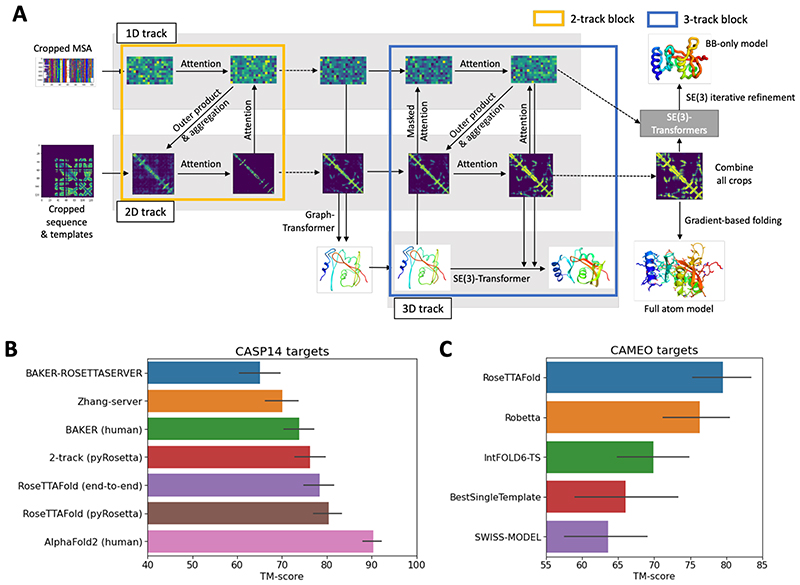
- In CASP14, the 3-track RoseTTAFold outperformed the top 2 server groups (Zhang-server and BAKER-ROSETTASERVER), the BAKER human group, and the authors’ 2-track models, though its performance was still not as good as AlphaFold2.
- On CAMEO, over 69 medium and hard targets released May 15–June 19, 2021, RoseTTAFold outperformed all other evaluated servers, including Robetta, IntFold6-TS, BestSingleTemplate, and SWISS-MODEL.
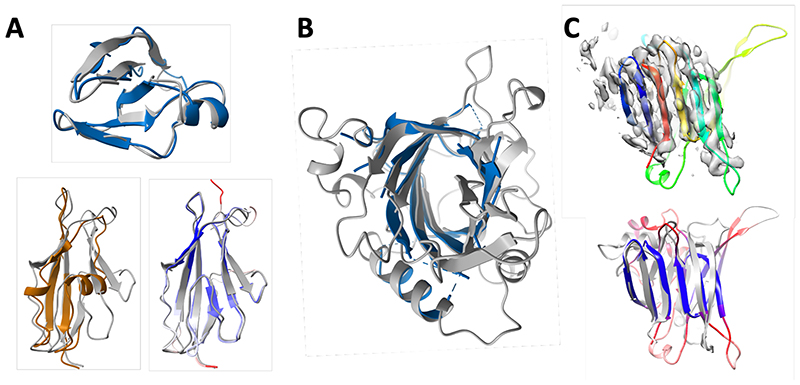
- RoseTTAFold models enabled molecular-replacement solutions for four previously unsolved crystallographic datasets; for the cryo-EM p101 Gβγ binding domain, the Cα-RMSD between predicted and refined structure was 3.0 Å over the beta-sheets.
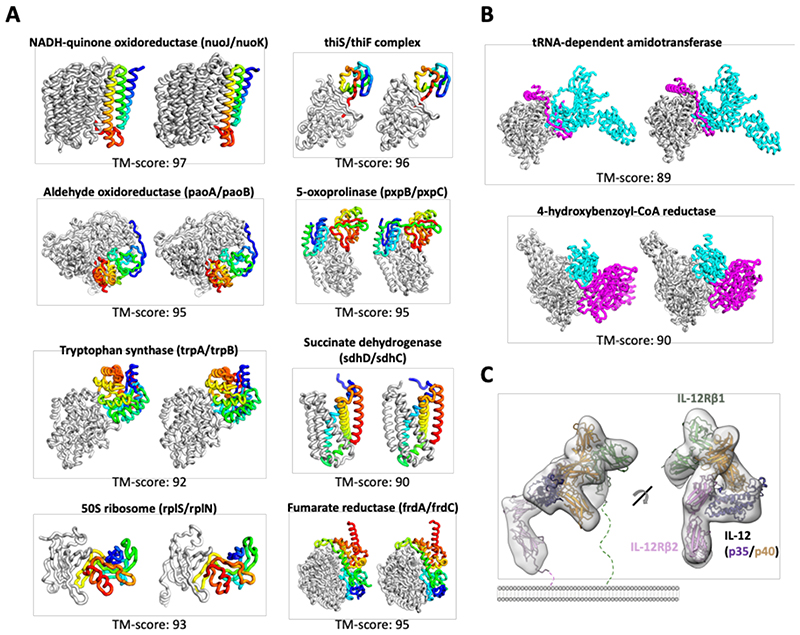
- Among 693 domains from human disease-related proteins, over one-third had predicted lDDT > 0.8, corresponding to an average Cα-RMSD of 2.6 Å on CASP14 targets; many protein-complex models had TM-score > 0.8, with complex generation taking ~30 min on a 24G TITAN RTX GPU.
Methods
- The 3-track network transforms and integrates information at the 1D sequence/MSA level, the 2D distance/orientation-map level, and the 3D backbone-coordinate level, with information flowing between tracks; training used discontinuous sequence crops spanning 260 residues.
- Final 3D structures were generated either by feeding predicted distance/orientation distributions into pyRosetta for all-atom models or by an end-to-end SE(3)-equivariant layer producing backbone coordinates directly.
- Evaluation included CASP14 targets, CAMEO blind server assessment, four X-ray molecular-replacement datasets, a cryo-EM PI3Kγ complex, GPCRs, 693 human disease-related domains, and paired-sequence complexes of known structure, using accuracy comparisons, Cα-RMSD, lDDT, TM-score, and MR/cryo-EM fit.
Limitations
- Stated: hardware memory limitations constrained model size and training; performance remained below AlphaFold2; the end-to-end version was less accurate than the pyRosetta version due to incomplete optimization and neglect of side-chain information; the accuracy predictor did not consistently identify models better than the rapid single-pass method; the network was trained on monomeric proteins, not complexes; and current RoseTTAFold uses only the top 1000 sequences due to memory limits.
- Stated: the Perceiver-based extension for using all available sequences gave promising initial results, but more training is required for rigorous comparison.
- Evident: CASP14 and CAMEO evaluations cover limited target sets and time windows, and the end-to-end model does not produce side chains.
Model-written summary. Check it against the paper before relying on it.
Integrity signals
Registry
Cites
Statistics
Figures
Verification
Claims the paper makes
3 Valid · 8 Not valid · 14 Not checked · 44 Own results and interpretations
The cited sources support only part of this claim — read each source’s verdict below.
In the paper
“The bi-annual Critical Assessment of Structure (CASP) meetings have demonstrated that deep learning methods such as AlphaFold (1, 2) and trRosetta (3), that extract information from the large database of known protein structures in the PDB, outperform more traditional approaches that explicitly model the folding process.”
§ Accurate prediction of protein structures and interactions using a 3-track neural network > Abstract
What the sources say
- Not matchedcites [1] Jumper John Evans Richard Pritzel Alexander Green Tim Figurnov Michael Tunyasuvunakool Kathryn Ronneberger Olaf Bates Russ Augustin Žídek Alex Bridgland Clemens Meyer Fourteenth Critical Assessment of Techniques for Protein Structure Prediction
Its entry has no title and year that we can search by.
- Partly supportedcites [2] Anishchenko I Chidyausiku TM Ovchinnikov S Pellock SJ Baker D De novo protein design by deep network hallucination bioRxiv 2020 2020.07.22.211482 PMC9293396 34853475 sourceExperimental — accuracy not yet measured
The Introduction (page not provided) says deep networks improved protein-structure prediction accuracy, notes an AlphaFold observation at CASP13, and reports that trRosetta outperformed other methods in benchmark tests. The Conclusion says the network learned from native protein structures and contrasts it with physically based approaches. The paper does not establish the claimed CASP comparison in which both AlphaFold and trRosetta outperform approaches that explicitly model folding. (LLM, conf=0.82)
- Not checked — no full text of the sourcecites [3] Yang J Anishchenko I Park H Peng Z Ovchinnikov S Baker D Improved protein structure prediction using predicted interresidue orientations Proc Natl Acad Sci U S A 2020 117 1496 1503 31896580 PMC6983395 source
boostedstates a cause- Asserted: passes — The authors put it forward as true.
- Checkable: passes — It can be checked against evidence.
- Load-bearing: passes — The paper’s conclusions depend on it.
- Based: passes — The paper gives a reason why it holds.
- Not matched
The cited sources that could be checked couldn’t confirm or dispute this claim.
In the paper
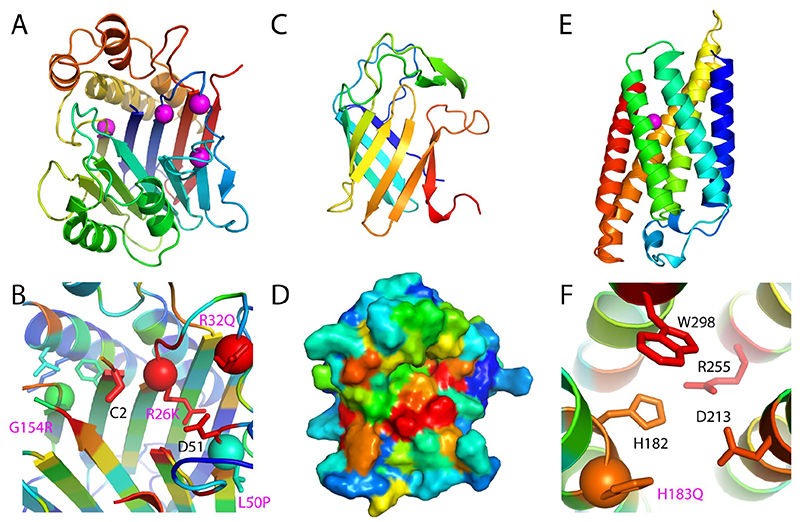
“The RoseTTAFold CERS1 model for residues 98 to 304 (Pfam TLC domain) (29) includes six TMH that traverse the membrane in an up and down arrangement (Fig. 3E).”
§ Accurate prediction of protein structures and interactions using a 3-track neural network > Providing insights into biological function
What the sources say
- Could not verifycites [29] Cong Q Anishchenko I Ovchinnikov S Baker D Protein interaction networks revealed by proteome coevolution Science 2019 365 185 189 31296772 PMC6948103 sourceExperimental — accuracy not yet measured
The paper’s Abstract (page unavailable) describes coevolution-based protein interaction models in E. coli and M. tuberculosis, not a CERS1 model. Searches for CERS1, the Pfam TLC domain, RoseTTAFold, and six transmembrane helices found no passage in our copy addressing the cited domain identification or the stated membrane arrangement. (LLM, conf=0.76)
plain- Asserted: passes — The authors put it forward as true.
- Checkable: passes — It can be checked against evidence.
- Load-bearing: passes — The paper’s conclusions depend on it.
- Based: passes — The paper gives a reason why it holds.
- Could not verify
A result the paper reports from its own data — it cites no other source for it, so there is none to check. The quote shows it is in the paper.
In the paper
“in the case of SLP, only a distant model covering part of the N-terminal domain (38% of the sequence) was available in the PDB”
§ Accurate prediction of protein structures and interactions using a 3-track neural network > Enabling experimental protein structure determination
plainSingle case- Asserted: passes — The authors put it forward as true.
- Checkable: passes — It can be checked against evidence.
- Load-bearing: passes — The paper’s conclusions depend on it.
- Based: passes — The paper gives a reason why it holds.
A result the paper reports from its own data — it cites no other source for it, so there is none to check. The quote shows it is in the paper.
In the paper
“trRosetta failed to predict the correct fold with the same MSA input (fig. S6)”
§ Accurate prediction of protein structures and interactions using a 3-track neural network > Enabling experimental protein structure determination
plainSingle case- Asserted: passes — The authors put it forward as true.
- Checkable: passes — It can be checked against evidence.
- Load-bearing: passes — The paper’s conclusions depend on it.
- Based: passes — The paper gives a reason why it holds.
A result the paper reports from its own data — it cites no other source for it, so there is none to check. The quote shows it is in the paper.
In the paper
“The 3-track models with attention operating at the 1D, 2D, and 3D levels and information flowing between the three levels were the best models we tested (Fig. 1B), clearly outperforming the top 2 server groups (Zhang-server and BAKER-ROSETTASERVER), BAKER human group (ranked second among all groups), and our 2-track attention models on CASP14 targets.”
§ Accurate prediction of protein structures and interactions using a 3-track neural network > Network architecture development
boostedstates a cause- Asserted: passes — The authors put it forward as true.
- Checkable: passes — It can be checked against evidence.
- Load-bearing: passes — The paper’s conclusions depend on it.
- Based: passes — The paper gives a reason why it holds.
33 more claims
Create a free account to see all 69 claims and to verify the 2 references still open.
- It may state two separate claims as one. 24
- Probably not a substantial claim. 13
- The quote only partly states this claim. 2
Claims other papers make about this one
Each is checked against this paper’s own text: does it say what the citing paper says it does?
The source backs part of the claim, not all of it — or backs it for a different population, condition or comparison.
In the citing paper
“RF has properties well suited for use in a protein design DDPM (Fig. 1a): it generates protein structures with high precision, operates on a rigid-frame representation of residues with rotational equivariance and has an architecture enabling conditioning on design specifications at the individual residue, inter-residue distance and orientation, and 3D coordinate levels.”
From De novo design of protein structure and function with RFdiffusion (2023) · cites this paper as [18]
Experimental — accuracy not yet measuredThe source backs part of the claim, not all of it — or backs it for a different population, condition or comparison.
In the citing paper
“are the best and most accurate answer to the structure prediction problem to date”
From The power and pitfalls of AlphaFold2 for structure prediction beyond rigid globular proteins (2024) · cites this paper as [18]
Experimental — accuracy not yet measuredThe source backs part of the claim, not all of it — or backs it for a different population, condition or comparison.
In the citing paper
“DeepMind’s AlphaFold2 success in sequence-based protein structure prediction,4 as well as the RoseTTAFold70 open-source counterpart, and the publicly available AlphaFold2 prediction of all human proteins203 are major steps that benefit the scientific community.”
From AlphaFold, Artificial Intelligence (AI), and Allostery (2022) · cites this paper as [70]
Experimental — accuracy not yet measuredThe source backs part of the claim, not all of it — or backs it for a different population, condition or comparison.
In the citing paper
“The unprecedented accuracy of AlphaFold2,127 RosettaFold,128 and others129,130 offers, at least in principle, the opportunity to virtually screen any protein of interest with the structure-based approach, irrespective of its a priori ligandability (after AlphaFold2, the structural coverage of the human proteome increased from 48% to 76% of the total residues).131”
From Advancing Targeted Protein Degradation via Multiomics Profiling and Artificial Intelligence (2023) · cites this paper as [128]
Experimental — accuracy not yet measuredThe source backs part of the claim, not all of it — or backs it for a different population, condition or comparison.
In the citing paper
“The programs were also shown to accurately assess their confidence at the level of individual residues and interdomain contacts (27,28,62).”
From AI-based structure prediction empowers integrative structural analysis of human nuclear pores (2022) · cites this paper as [27]
Experimental — accuracy not yet measured
18 more claims about this paper
Create a free account to see every claim other papers make about this one.
Citations
Cites
Vaswani, A., Shazeer, N., Parmar, N., Uszkoreit, J., Jones, L., Gomez, A. N., Kaiser, L., & Polosukhin, I. (2017) · arXiv · doi:10.48550/arxiv.1706.03762 · Cited by 120,404
MAFFT Multiple Sequence Alignment Software Version 7: Improvements in Performance and Usability
Katoh, K., & Standley, D. M. (2013) · Molecular Biology and Evolution · doi:10.1093/molbev/mst010 · Cited by 46,209
Features and development of Coot
Emsley, P., Lohkamp, B., Scott, W. G., & Cowtan, K. (2010) · Acta Crystallographica Section D Biological Crystallography · doi:10.1107/s0907444910007493 · Cited by 29,915
Clustal W and Clustal X version 2.0
Larkin, M. A., Blackshields, G., Brown, N. P., Chenna, R., McGettigan, P. A., McWilliam, H., Valentin, F., Wallace, I. M., Wilm, A., Lopez, R., et al. (2007) · Bioinformatics · doi:10.1093/bioinformatics/btm404 · Cited by 28,358
Phaser crystallographic software
McCoy, A. J., Grosse-Kunstleve, R. W., Adams, P. D., Winn, M. D., Storoni, L. C., & Read, R. J. (2007) · Journal of Applied Crystallography · doi:10.1107/s0021889807021206 · Cited by 20,612
Self-citationSWISS-MODEL: homology modelling of protein structures and complexes
Waterhouse, A., Bertoni, M., Bienert, S., Studer, G., Tauriello, G., Gumienny, R., Heer, F. T., de Beer, T. A. P., Rempfer, C., Bordoli, L., et al. (2018) · Nucleic Acids Research · doi:10.1093/nar/gky427 · Cited by 13,067 · cited 2×
“Fortunately,theContinuousAutomated ModelEvaluation(CAMEO)experiment( 7 ) tests structure prediction servers blindly on protein structures as they are submitted to the PDB. RoseTTAFold has been evaluated since 15 May 2021 on CAMEO; over the 69 medium and hard targets released during this time (15 May 2021 to 19 June 20…”
UCSF ChimeraX: Structure visualization for researchers, educators, and developers
Pettersen, E. F., Goddard, T. D., Huang, C. C., Meng, E. C., Couch, G. S., Croll, T. I., Morris, J. H., & Ferrin, T. E. (2021) · Protein Science · doi:10.1002/pro.3943 · Cited by 9,514
Liebschner, D., Afonine, P. V., Baker, M. L., Bunkóczi, G., Chen, V. B., Croll, T. I., Hintze, B., Hung, L.-W., Jain, S., McCoy, A. J., et al. (2019) · Acta Crystallographica Section D Structural Biology · doi:10.1107/s2059798319011471 · Cited by 7,953
Self-citationUniProt: the Universal Protein knowledgebase
Apweiler, R. (2004) · Nucleic Acids Research · doi:10.1093/nar/gkh131 · Cited by 7,498
Towards automated crystallographic structure refinement with phenix.refine
Afonine, P. V., Grosse-Kunstleve, R. W., Echols, N., Headd, J. J., Moriarty, N. W., Mustyakimov, M., Terwilliger, T. C., Urzhumtsev, A., Zwart, P. H., & Adams, P. D. (2012) · Acta Crystallographica Section D Biological Crystallography · doi:10.1107/s0907444912001308 · Cited by 5,511
Self-citation
Research works printed but not linked: 2
- Bunkóczi G Read RJ phenix. ensembler: a tool for multiple superposition Comput Crystallogr Newsl 2011 2 8 9
- Vagin A Lebedev A ACTA CRYSTALLOGRAPHICA A-FOUNDATION AND ADVANCES INT UNION CRYSTALLOGRAPHY 2 ABBEY SQ, CHESTER, CH1 2HU ENGLAND 2015 71 S19
Cited by
Items 2,001–2,100 of 5,659
Srinivasan, S., Ghosh, C., Das, S., Thakare, A., Singh, S., Ganesh, A., Mahawar, H., Jaisimha, A., Krishna, M., Chattopadhyay, A., et al. (2022) · Scientific Reports · doi:10.1038/s41598-022-23780-y · Cited by 13
Mann, L., Ganapathy, U. S., Abdelaziz, R., Lang, M. A., Zimmerman, M., Dartois, V. A., Dick, T., & Richter, A. (2022) · Microbiology Spectrum · doi:10.1128/spectrum.02760-22 · Cited by 13
Zhu, F., Ma, S., Wen, H., Rao, M., Zhang, P., Peng, W., Cui, Y., Yang, H., Tan, C., Chen, J., et al. (2022) · Journal of Biomolecular Structure and Dynamics · doi:10.1080/07391102.2022.2154846 · Cited by 16
“To obtain the three-dimensional structure of a protein, the Robetta server (https://robetta.baker-lab.org/) was used to construct the protein model (Baek et al., 2021), and the PROCHECK server (https://www.ebi.ac.uk/thorn-ton-srv/software/PROCHECK/), the ERRAT server (https://saves. mbi.ucla.edu/),…”
MethodWeraduwage, S. M., Sahu, A., Kulke, M., Vermaas, J. V., & Sharkey, T. D. (2023) · Plant Direct · doi:10.1002/pld3.483 · Cited by 13
“The initial protein structure was homology modeled with the RoseTTAfold web server (Baek et al., 2021) and solvated in explicit water.”
Functional Protein Dynamics Directly from Sequences
Jia, K., Kilinc, M., & Jernigan, R. L. (2023) · The Journal of Physical Chemistry B · doi:10.1021/acs.jpcb.2c05766 · Cited by 13
Modulation of Allosteric Control and Evolution of Hemoglobin
Brunori, M., & Miele, A. E. (2023) · Biomolecules · doi:10.3390/biom13030572 · Cited by 14
“The “future” proved that Perutz’s vision was correct, and due to the open data accumulated in public databases, artificial intelligence algorithms such as ECOD (Evolutionary Classification Of protein Domains [49]), AlphaFold [50] and RoseTTA Fold [51,52] can now predict with accuracy structural features based on the a…”
BackgroundMészáros, B., Park, E., Malinverni, D., Sejdiu, B. I., Immadisetty, K., Sandhu, M., Lang, B., & Babu, M. M. (2023) · Current Opinion in Structural Biology · doi:10.1016/j.sbi.2023.102608 · Cited by 14
Chiliveri, S. C., Shen, Y., Baber, J. L., Ying, J., Sagar, V., Wistow, G. J., Anfinrud, P., & Bax, A. (2023) · Journal of the American Chemical Society · doi:10.1021/jacs.3c05710 · Cited by 14
Small Molecules against Metastatic Tumors: Concrete Perspectives and Shattered Dreams
Serra, M., Rubes, D., Schinelli, S., & Paolillo, M. (2023) · Cancers · doi:10.3390/cancers15164173 · Cited by 13
The energetics and evolution of oxidoreductases in deep time
McGuinness, K. N., Fehon, N., Feehan, R., Miller, M., Mutter, A. C., Rybak, L. A., Nam, J., AbuSalim, J. E., Atkinson, J. T., Heidari, H., et al. (2023) · Proteins Structure Function and Bioinformatics · doi:10.1002/prot.26563 · Cited by 13
Recent Advances in Structural Studies of Single-Stranded RNA Bacteriophages
Thongchol, J., Lill, Z., Hoover, Z., & Zhang, J. (2023) · Viruses · doi:10.3390/v15101985 · Cited by 17
Role of environmental specificity in CASP results
Roterman, I., Stąpor, K., & Konieczny, L. (2023) · BMC Bioinformatics · doi:10.1186/s12859-023-05559-8 · Cited by 14
“The three-track neural network linking a one-dimensional sequence level with the distance map, and the coordinate level expressing the integration of these three approaches was applied in CASP14 with good results [26].”
Ricker, B., Mitra, S., Castellanos, E., Grady, C. J., Woldring, D., Pelled, G., & Gilad, A. A. (2023) · Open Biology · doi:10.1098/rsob.230019 · Cited by 13
“The structure of EPG was predicted using RoseTTAFold [28] protein structure prediction software and visualized with the PyMol molecular visualization system.”
MethodBiophysical and structural characterization of a multifunctional viral genome packaging motor
Prokhorov, N. S., Davis, C. R., Maruthi, K., Yang, Q., Sherman, M. B., Woodson, M., White, M. A., Miller, L. M., Jarrold, M. F., Catalano, C. E., et al. (2023) · Nucleic Acids Research · doi:10.1093/nar/gkad1135 · Cited by 13
“We used AI, machine learning-based structure prediction tools, including different implementations of Alphafold2 and Rosettafold, to predict the quaternary structure of the termi-nase protomer ( 60 , 69 , 70 ).”
MethodHormazábal-Abarza, F., Bustos, D., Rodríguez-Arriaza, F., Sáez, D., Urra, G., Parra-Palma, C., Méndez-Yáñez, Á., Ramos, P., & Morales‐Quintana, L. (2024) · Plant Physiology and Biochemistry · doi:10.1016/j.plaphy.2024.108417 · Cited by 13
De novo prediction of RNA 3D structures with deep generative models
Ramakers, J., Blum, C. F., König, S., Harmeling, S., & Kollmann, M. (2024) · PLoS ONE · doi:10.1371/journal.pone.0297105 · Cited by 14
A unified view on enzyme catalysis by cryo-EM study of a DNA topoisomerase
Chang, C.-W. M., Wang, S., Wang, C.-H., Pang, A. H., Yang, C., Chang, Y.-K., Wu, W., & Tsai, M. (2024) · Communications Chemistry · doi:10.1038/s42004-024-01129-y · Cited by 14
Structure-guided drug discovery: back to the future
Arrowsmith, C. H. (2024) · Nature Structural & Molecular Biology · doi:10.1038/s41594-024-01244-3 · Cited by 13
On knowing a gene: A distributional hypothesis of gene function
Kwon, J. J., Pan, J., Gonzalez, G., Hahn, W. C., & Žitnik, M. (2024) · Cell Systems · doi:10.1016/j.cels.2024.04.008 · Cited by 15
“83 However, the reliance on experimentally determined structures, which are less abundant than sequence data, poses a significant limitation.”
BackgroundPerlinska, A. P., Nguyen, M. L., Pilla, S. P., Staszor, E., Lewandowska, I., Bernat, A., Purta, E., Augustyniak, R., Bujnicki, J. M., & Sulkowska, J. I. (2024) · Frontiers in Molecular Biosciences · doi:10.3389/fmolb.2023.1223830 · Cited by 15
Multimodal Deep Representation Learning for Quantum Cross-Platform Verification
Qian, Y., Du, Y., He, Z., Hsieh, M.-H., & Tao, D. (2024) · Physical Review Letters · doi:10.1103/physrevlett.133.130601 · Cited by 24
Camporesi, G., Minzoni, A., Morasso, L., Ciurli, S., & Musiani, F. (2021) · Metallomics · doi:10.1093/mtomcs/mfab066 · Cited by 13
Construction of a Deep Neural Network Energy Function for Protein Physics
Yang, H., Xiong, Z., & Zonta, F. (2022) · Journal of Chemical Theory and Computation · doi:10.1021/acs.jctc.2c00069 · Cited by 16
Valcárcel-Hernández, V., Guillén-Yunta, M., Bueno-Arribas, M., Montero‐Pedrazuela, A., Grijota-Martínez, C., Markossian, S., García-Aldea, Á., Flamant, F., Bárez‐López, S., & Guadaño‐Ferraz, A. (2022) · Neurobiology of Disease · doi:10.1016/j.nbd.2022.105896 · Cited by 14
Widespread Horizontal Gene Transfer Among Animal VirusesPreprint
Buck, C. B., Welch, N. L., Belford, A. K., Varsani, A., Pastrana, D. V., Tisza, M. J., & Starrett, G. J. (2024) · bioRxiv (Cold Spring Harbor Laboratory) · doi:10.1101/2024.03.25.586562 · Cited by 18
Xie, X., Li, C. Z., Lee, J. S., & Kim, P. M. (2025) · bioRxiv (Cold Spring Harbor Laboratory) · doi:10.1101/2025.02.11.637752 · Cited by 17
Pathfinder: Protein folding pathway prediction based on conformational sampling
Huang, Z., Cui, X., Xia, Y., Zhao, K., & Zhang, G. (2023) · PLOS Computational Biology · doi:10.1371/journal.pcbi.1011438 · Cited by 13
“The splendid computational success of AlphaFold2 [1] and RoseTTAFold [2] in protein structure prediction may have solved the static single domain protein folding problem [3].”
BackgroundExploring “dark-matter” protein folds using deep learning
Harteveld, Z., Van Hall-Beauvais, A., Morozova, I., Southern, J., Goverde, C., Georgeon, S., Rosset, S., Defferrard, M., Loukas, A., Vandergheynst, P., et al. (2024) · Cell Systems · doi:10.1016/j.cels.2024.09.006 · Cited by 13
Cryo‐EM structure of the octameric pore of Clostridium perfringens β‐toxin
Bruggisser, J., Iacovache, I., Musson, S. C., Degiacomi, M. T., Posthaus, H., & Zuber, B. (2022) · The EMBO Reports · doi:10.15252/embr.202254856 · Cited by 13
(2023) · doi:10.1101/2023.04.17.537185 · Cited by 13
Deep learning opens up protein science’s next frontiers
Miller, J. L. (2021) · Physics Today · doi:10.1063/pt.3.4850 · Cited by 12
OPUS-Mut: Studying the Effect of Protein Mutation through Side-Chain Modeling
Xu, G., Wang, Q., & Ma, J. (2023) · Journal of Chemical Theory and Computation · doi:10.1021/acs.jctc.2c00847 · Cited by 12
“In recent years, many protein structure prediction methods have been proposed (9-12).”
BackgroundSTRPsearch: fast detection of structured tandem repeat proteins
Mozaffari, S., Arrías, P. N., Clementel, D., Piovesan, D., Ferrari, C., Tosatto, S. C. E., & Monzon, A. M. (2024) · Bioinformatics · doi:10.1093/bioinformatics/btae690 · Cited by 12
De novo design of Ras isoform selective binders
Zhang, J. Z., Li, X., Batingana, A. R., Liu, C., Jiang, H., Shannon, K., Huang, B. J., Wu, K., & Baker, D. (2026) · Cell Chemical Biology · doi:10.1016/j.chembiol.2026.02.008 · Cited by 12
“Recent advances in protein design 7–9 now enable the design of binders to a wide range of protein targets.”
Self-citationMulti- e GO: Model Improvements toward the Study of Complex Self-Assembly Processes
Bačić Toplek, F., Scalone, E., Stegani, B., Paissoni, C., Capelli, R., & Camilloni, C. (2024) · Journal of Chemical Theory and Computation · doi:10.1021/acs.jctc.3c01182 · Cited by 12
Systematic benchmarking of deep-learning methods for tertiary RNA structure prediction
Bahai, A., Kwoh, C. K., Mu, Y., & Li, Y. (2024) · PLOS Computational Biology · doi:10.1371/journal.pcbi.1012715 · Cited by 12
Azinas, S., & Carroni, M. (2023) · Current Opinion in Structural Biology · doi:10.1016/j.sbi.2023.102621 · Cited by 13
Wu, Y. R., Zhang, J., Wang, B., Zhang, Y., Li, H., Liu, Y., Yin, J., He, D., Luo, H., Gan, F., et al. (2023) · Microbiology Spectrum · doi:10.1128/spectrum.00288-23 · Cited by 12
De novo designed ice-binding proteins from twist-constrained helices
de Haas, R. J., Tas, R. P., van den Broek, D., Zheng, C., Nguyen, H., Kang, A., Bera, A. K., King, N. P., Voets, I. K., & de Vries, R. (2023) · Proceedings of the National Academy of Sciences · doi:10.1073/pnas.2220380120 · Cited by 12
Maliński, B., Vertemara, J., Faustini, E., Ladenvall, C., Norberg, A., Zhang, Y., von Castelmur, E., Baliakas, P., Tisi, R., Cammenga, J., et al. (2023) · Human Molecular Genetics · doi:10.1093/hmg/ddad114 · Cited by 14
Rinmaker: a fast, versatile and reliable tool to determine residue interaction networks in proteins
Spanò, A., Fanton, L., Pizzolato, D., Moi, J., Vinci, F., Pesce, A., Foumthuim, C. J. D., Giacometti, A., & Simeoni, M. (2023) · BMC Bioinformatics · doi:10.1186/s12859-023-05466-y · Cited by 12
Hevler, J. F., & Heck, A. J. R. (2023) · Molecular & Cellular Proteomics · doi:10.1016/j.mcpro.2023.100657 · Cited by 12
“In contrast, de novo structural prediction tools, such as AlphaFold2 (121) and RoseTTA-fold (122), enable the generation of structural models based solely on the sequence of a protein.”
BackgroundFusionPDB: a knowledgebase of human fusion proteins
Kumar, H., Tang, L.-Y., Yang, C., & Kim, P. (2023) · Nucleic Acids Research · doi:10.1093/nar/gkad920 · Cited by 12
Unveiling Recent Trends in Biomedical Artificial Intelligence Research: Analysis of Top-Cited Papers
Glicksberg, B. S., & Klang, E. (2024) · Applied Sciences · doi:10.3390/app14020785 · Cited by 15
Szadkowska, M., Kocot, A. M., Sowik, D., Wyrzykowski, D., Jankowska, E., Kozlowski, L. P., Makowska, J., & Płotka, M. (2024) · Frontiers in Microbiology · doi:10.3389/fmicb.2023.1303794 · Cited by 14
Zhang, L., Chen, G., Zeng, X., Yue, H., Zheng, Q., Hu, Q., Tian, Q., Liang, L., Zhao, X., Yang, Z., et al. (2024) · Inflammatory Bowel Diseases · doi:10.1093/ibd/izae063 · Cited by 16
Noncanonical microprotein regulation of immunity
Nichols, C. M., Do-Thi, V. A., & Peltier, D. (2024) · Molecular Therapy · doi:10.1016/j.ymthe.2024.05.021 · Cited by 13
Combined effect of SAR-endolysin LysKpV475 with polymyxin B and Salmonella bacteriophage phSE-5
Gontijo, M. T. P., Teles, M. P., CORREIA, H. M., Jorge, G. P., Goes, I. C. R. D. S., Flores, A. J. F., Braz, M., Ceseti, L. D. M., Ramos, P. Z., Silva, I. R. E., et al. (2024) · Microbiology · doi:10.1099/mic.0.001462 · Cited by 16
“Using RoseTTAFold version 3.13 modelling [29], the 3D in silico structures of LysKpV475 (UniProtKB: A0A1B0Z137), LysZZ1 (UniProtKB: I3WVU6) as a non-SAR GH24 control, and a LysKpV475 hybrid containing the N-terminus of LysZZ1 were determined.”
MethodInfluentialAtz, K., Nippa, D. F., Müller, A. T., Jost, V., Anelli, A., Reutlinger, M., Krämer, C., Martin, R. E., Grether, U., Schneider, G., et al. (2024) · RSC Medicinal Chemistry · doi:10.1039/d4md00196f · Cited by 17
AI accurately predicting the structure of biomolecular interactions
Peng, Z., Lu, P., & Yang, J. (2024) · Cell Research · doi:10.1038/s41422-024-00991-8 · Cited by 13
Leng, W., Li, Y., Liang, X., Li, X., & Gao, R. (2024) · Food Chemistry · doi:10.1016/j.foodchem.2024.140121 · Cited by 12
Advancing biofoundry development: strategies and challenges
Gupta, A., Lee, S., Sung, B. H., Lee, D., Cho, B., Kim, D., & Kim, H. (2024) · Biotechnology and Bioprocess Engineering · doi:10.1007/s12257-024-00121-6 · Cited by 12
“Generative AI-based sequence generation models, such as proteinMPNN [26] and RFdiffusion [27], can be used in designing targeted libraries.”
Transporter annotations are holding up progress in metabolic modeling
Casey, J. R., Bennion, B. J., D’haeseleer, P., Kimbrel, J. A., Marschmann, G. L., & Navid, A. (2024) · Frontiers in Systems Biology · doi:10.3389/fsysb.2024.1394084 · Cited by 13
“This step takes advantage of advances in structure prediction (e.g., AlphaFold; Jumper et al., 2021; RoseTTAFold; Baek et al., 2021), binding site inference, docking and molecular dynamics simulations (e.g., Ohnuki et al., 2023).”
BackgroundHan, R., Zhu, T., Kong, Z., Zhang, X., Wang, D., & Liu, J. (2024) · International Journal of Biological Macromolecules · doi:10.1016/j.ijbiomac.2024.134821 · Cited by 12
Improving glioma drug delivery: A multifaceted approach for glioma drug development
Yonk, M. G., Lim, M. A., Thompson, C. M., Tora, M. S., Lakhina, Y., Du, Y., Hoang, K. B., Molinaro, A. M., Boulis, N. M., Hassaneen, W., et al. (2024) · Pharmacological Research · doi:10.1016/j.phrs.2024.107390 · Cited by 14
Advances and Challenges in Scoring Functions for RNA–Protein Complex Structure Prediction
Zeng, C., Chen, Z., Gao, J., Liu, H., & Zhao, Y. (2024) · Biomolecules · doi:10.3390/biom14101245 · Cited by 14
Learning a generalized graph transformer for protein function prediction in dissimilar sequences
Fu, Y., Gu, Z., Luo, X., Guo, Q., Lai, L., & Deng, M. (2024) · GigaScience · doi:10.1093/gigascience/giae093 · Cited by 16
Drug repositioning for Parkinson’s disease: An emphasis on artificial intelligence approaches
Karimi-Sani, I., Sharifi, M., Abolpour, N., Lotfi, M., Atapour, A., Takhshid, M. A., & Sahebkar, A. (2025) · Ageing Research Reviews · doi:10.1016/j.arr.2024.102651 · Cited by 14
Automated Engineering Protein Dynamics via Loop Grafting: Improving Renilla Luciferase Catalysis
Planas-Iglesias, J., Majerova, M., Pluskal, D., Vasina, M., Damborský, J., Prokop, Z., Marek, M., & Bednář, D. (2025) · ACS Catalysis · doi:10.1021/acscatal.4c06207 · Cited by 12
The structural basis of the G protein–coupled receptor and ion channel axis
Luo, Y., Sun, L., & Peng, Y. (2025) · Current Research in Structural Biology · doi:10.1016/j.crstbi.2025.100165 · Cited by 13
“Similarly, Rosetta has evolved with innovations like RosettaFold all-atoms (RFAA), RosettaFold diffusion (RFdiffusion), and the integrative RFdiffAA model, progressively refining the framework for predicting biomolecular complexes (Baek et al., 2021; Krishna et al., 2024; Watson et al., 2023).”
A comprehensive primer and review of PROTACs and their In Silico design
Zattoni, J., Vottero, P., Carena, G., Uliveto, C., Pozzati, G., Morabito, B., Gitari, E., Tuszyński, J. A., & Aminpour, M. (2025) · Computer Methods and Programs in Biomedicine · doi:10.1016/j.cmpb.2025.108687 · Cited by 18
RoseTTAFold diffusion-guided short peptide design: a case study of binders against Keap1/Nrf2
Morena, F., Cencini, C., Emiliani, C., & Martino, S. (2025) · Computational and Structural Biotechnology Journal · doi:10.1016/j.csbj.2025.02.032 · Cited by 13
Niazi, S. K. (2025) · Computational and Structural Biotechnology Reports · doi:10.1016/j.csbr.2025.100039 · Cited by 16
Angelis, J., Schröder, E. A., Xiao, Z., Gabriel, W., & Wilhelm, M. (2025) · PROTEOMICS · doi:10.1002/pmic.202400398 · Cited by 15
“The study compared AlphaFold2 to other structure prediction models, including PEP-FOLD3 [133], Omega-Fold [134], RoseTTAFold [135], and APPTEST [136], demonstrating that AlphaFold2 either outperformed or was at least comparable to these alternatives [128].”
A new chapter for RCSB Protein Data Bank Molecule of the Month in 2025
Iwasa, J., Goodsell, D. S., Burley, S. K., & Zardecki, C. (2025) · Structural Dynamics · doi:10.1063/4.0000302 · Cited by 13
Kroll, A., & Rousset, Y. (2025) · Current Opinion in Structural Biology · doi:10.1016/j.sbi.2025.103070 · Cited by 14
Advancing active compound discovery for novel drug targets: insights from AI-driven approaches
Wang, X.-Y., Chen, Y., Li, Y.-F., Wei, C., Liu, M.-Y., Yuan, C.-X., Zheng, Y.-Y., Qin, M.-H., Sheng, Y.-F., Tong, X., et al. (2025) · Acta Pharmacologica Sinica · doi:10.1038/s41401-025-01591-x · Cited by 18
“RoseTTAFold [18] employs a hybrid architecture combining sequence, distance, and structural features in a three-track neural network, achieving accuracy comparable to AlphaFold2 with reduced computational demands.”
AI4Protein: transforming the future of protein design
Wang, D., Tan, Z., Gao, J., Zhang, S., Shen, J., & Lu, Y. (2025) · Science China Life Sciences · doi:10.1007/s11427-024-2906-3 · Cited by 15
“The emergence of structure prediction models like RoseTTAFold (Baek et al., 2021), AlphaFold2 (Jumper et al., 2021), RoseTTA-Fold All-Atom (Krishna et al., 2024), and AlphaFold3 (Abram-son et al., 2024) has generated vast amounts of accurate protein structures, creating new opportunities for…”
InfluentialProtGO: universal protein function prediction utilizing multi-modal gene ontology knowledge
Wang, B., Geng, Y.-A., Cheng, X., Chen, B., Bei, Z., Wang, W., Tang, J., & Song, L. (2025) · Bioinformatics · doi:10.1093/bioinformatics/btaf390 · Cited by 15
Biomolecular Interaction Prediction: The Era of AI
Wang, H., Meng, X., & Zhang, Y. (2025) · Advanced Science · doi:10.1002/advs.202509501 · Cited by 18
Chen, B., Bülbül, E. F., Bang, S., Minas, H. A., & Bozhüyük, K. A. J. (2025) · Natural Product Reports · doi:10.1039/d5np00041f · Cited by 12
Zhao, L., Cao, J., Xiaqing, L., Li, Y., Wu, J., & Su, L. (2025) · Bioresource Technology · doi:10.1016/j.biortech.2025.133266 · Cited by 14
Predictive and therapeutic applications of protein language models
Furui, K., Sakano, K., & Ohue, M. (2025) · Allergology International · doi:10.1016/j.alit.2025.08.004 · Cited by 12
Yang, S., Ren, J., Gao, W., Cao, L., & Ling, S. (2025) · npj Soft Matter · doi:10.1038/s44431-025-00005-6 · Cited by 14
Majidian, S., Hadziahmetovic, A., Langschied, F., Pascarelli, S., Prieto-Baños, S., Rojas-Vargas, J., Arvestad, L., Cheema, J., Cosentino, S., Ebersberger, I., et al. (2025) · Journal of Molecular Evolution · doi:10.1007/s00239-025-10272-6 · Cited by 16
“This explosion of CSMs is the result of groundbreaking advances in the field of computational protein structure prediction, driven by tools like AlphaFold (Jumper et al. 2021), RoseTTAFold (Baek et al. 2021), and OpenFold (Ahdritz et al. 2024).”
Mishra, S. K., Patil, R. B., Sherpa, A. T., Uddin, M. B., Harun‐Or‐Rashid, M., Ahmed, M., Dawoud, T. M. S., & Georrge, J. J. (2025) · Journal of Cellular and Molecular Medicine · doi:10.1111/jcmm.70907 · Cited by 16
Sung, Y., Yu, Y. C., Lee, M., Lim, S., Lee, Y., Kang, M., Kwon, D., Parajulee, A., Choi, J., Min, D. S., et al. (2025) · Nature Communications · doi:10.1038/s41467-025-64730-2 · Cited by 15
“We assessed the top 20 models and chose a trimeric structure derived from the structure of the monomeric model predicted by RoseTTAFold, which revealed interactions between the HP1 and TM3 domains (Fig.”
InfluentialYao, C., Zhang, Q., Lu, H., Zhang, X., Fan, Y., Luo, J., Fang, R., Liu, H., Lyu, J., Feng, F., et al. (2025) · Journal of the American Chemical Society · doi:10.1021/jacs.5c16333 · Cited by 11
Self-citationKim, J., Correy, G. J., Hall, B. W., Rachman, M. M., Mailhot, O., Togo, T., Gonciarz, R. L., Jaishankar, P., Neitz, R. J., Hantz, E. R., et al. (2026) · eLife · doi:10.64898/2025.12.25.696505 · Cited by 15
“Deep Learning methods such as AlphaFold2 (Jumper et al. 2021) and RosettaFold (Baek et al. 2021) revolutionized protein structure prediction.”
Mimetic Neural Networks: A Unified Framework for Protein Design and Folding
Eliasof, M., Boesen, T., Haber, E., Keasar, C., & Treister, E. (2022) · Frontiers in Bioinformatics · doi:10.3389/fbinf.2022.715006 · Cited by 12
Dubey, S., Majumder, P., Penmatsa, A., & Sardesai, A. A. (2021) · Journal of Biological Chemistry · doi:10.1016/j.jbc.2021.101168 · Cited by 12
“The RoseTTAFold prediction for LysO was a poly-alanine model, to minimize the computational load.”
BackgroundMethodInfluentialJalali, B., Zhou, Y., Kadambi, A., & Roychowdhury, V. (2022) · Machine Learning Science and Technology · doi:10.1088/2632-2153/ac9215 · Cited by 16
Dey, D., Dhar, D., Fortunato, H., Obata, D., Tanaka, A., Tanaka, R., Basu, S., & Itô, H. (2021) · Computational and Structural Biotechnology Journal · doi:10.1016/j.csbj.2021.09.023 · Cited by 15
Palethorpe, S., Milton, M. E., Pesci, E. C., & Cavanagh, J. (2021) · The Journal of Biochemistry · doi:10.1093/jb/mvab102 · Cited by 12
“With that in mind, we attempted to express and crystallize the C-terminal DNA-binding domain of A. baumannii PmrA (PmrAC), but we have been unsuccessful to this point.”
MethodQSalignWeb: A Server to Predict and Analyze Protein Quaternary Structure
Dey, S., Prilusky, J., & Levy, E. D. (2022) · Frontiers in Molecular Biosciences · doi:10.3389/fmolb.2021.787510 · Cited by 11
“Sequence-based tertiary structure predictions have seen a recent breakthrough, notably with Alphafold2 (Cramer, 2021; Jumper et al., 2021) and Rosettafold (Baek et al., 2021).”
BackgroundAn inductive transfer learning force field (ITLFF) protocol builds protein force fields in seconds
Han, Y., Wang, Z., Chen, A., Ali, I., Cai, J., Ye, S., & Li, J. (2022) · Briefings in Bioinformatics · doi:10.1093/bib/bbab590 · Cited by 13
Wang, P., Wang, X., Liu, X., Sun, M., Liang, X., Bai, J., & Jiang, P. (2022) · Frontiers in Pharmacology · doi:10.3389/fphar.2022.879733 · Cited by 12
Enzyme active sites: Identification and prediction of function using computational chemistry
Barnsley, K. K., & Ondrechen, M. J. (2022) · Current Opinion in Structural Biology · doi:10.1016/j.sbi.2022.102384 · Cited by 12
Complexity of Viral Epitope Surfaces as Evasive Targets for Vaccines and Therapeutic Antibodies
Miller, N. L., Raman, R., Clark, T., & Sasisekharan, R. (2022) · Frontiers in Immunology · doi:10.3389/fimmu.2022.904609 · Cited by 15
Conformational Variability of Amyloid-β and the Morphological Diversity of Its Aggregates
Yagi‐Utsumi, M., & Kato, K. (2022) · Molecules · doi:10.3390/molecules27154787 · Cited by 14
“Recently, the accuracy of protein structure predictions based on deep learning methods has been dramatically improved and, in the case of natively folded proteins, their threedimensional structures can now be reliably predicted from amino acid sequences [75,76].”
BackgroundExhaustive Mapping of the Conformational Space of Natural Dipeptides by the DFT-D3//COSMO-RS Method
Kalvoda, T., Culka, M., Rulı́šek, L., & Andris, E. (2022) · The Journal of Physical Chemistry B · doi:10.1021/acs.jpcb.2c02861 · Cited by 12
Qiu, X.-Y., Wu, H., & Shao, J. (2022) · Computers in Biology and Medicine · doi:10.1016/j.compbiomed.2022.105938 · Cited by 12
Li, L., Peng, S., Wang, Z., Zhang, T., Li, H., Xiao, Y., Li, J., Liu, Y., & Yin, H. (2022) · Frontiers in Plant Science · doi:10.3389/fpls.2022.1025122 · Cited by 16
“, 2021) and RoseTTAFold (Baek et al., 2021), we have generated full-length structure predictions of proteins encoded by all detected microbe-originated HGT genes in plants related to abiotic stress resistance in this study.”
BackgroundMethodInfluentialStructural and functional mapping of ars gene cluster in Deinococcus indicus DR1
Ranganathan, S., Sethi, D., Kasivisweswaran, S., Ramya, L., Priyadarshini, R., & Yennamalli, R. M. (2022) · Computational and Structural Biotechnology Journal · doi:10.1016/j.csbj.2022.12.015 · Cited by 14
Lim, H., & No, K. T. (2022) · BMC Bioinformatics · doi:10.1186/s12859-022-05010-4 · Cited by 13
Kuo, C., Tsai, M., Lin, H., Wang, Y., Singh, A. K., Chang, C., Lin, J., Hung, P., & Lin, K. (2023) · Epilepsia Open · doi:10.1002/epi4.12685 · Cited by 12
Zhao, H.-F., Zhang, H., She, Z., Gao, Z., Wang, Q., Geng, Z. Z., & Dong, Y. (2023) · International Journal of Molecular Sciences · doi:10.3390/ijms24032740 · Cited by 13
“In this section, another six computational models of the B318L protein were also generated using OmegaFold [30], ESMFold [31], RoseTTAfold [32], SWISS-MODEL [33], Phyre2 [34], and i-TASSER [35] for comparison.”
MethodInfluentialHou, Y., Lu, X., Xu, Z., Qu, J., & Huang, J. (2023) · RSC Advances · doi:10.1039/d2ra07472a · Cited by 13
“31 Further explorations based on AlphaFold have been actively pursued from di ff erent aspects, such as sampling alternative conformational states, 32 establishing protein fold atlas, 33 and detecting topologically links in predicted structures.”
Cytidine deaminases catalyze the conversion of N ( S , O ) 4 -substituted pyrimidine nucleosides
Urbelienė, N., Tiškus, M., Tamulaitienė, G., Gasparavičiūtė, R., Lapinskaitė, R., Jauniškis, V., Sūdžius, J., Meškienė, R., Tauraitė, D., Skrodenytė, E., et al. (2023) · Science Advances · doi:10.1126/sciadv.ade4361 · Cited by 13
Li, N., Xu, W., Liu, H., Zhou, R., Zou, S., Wang, S., Li, S., Yang, Z., Piao, Y., & Zhang, Y. (2023) · Frontiers in Genetics · doi:10.3389/fgene.2023.1154067 · Cited by 13
“To determine the exact location and feature of the variant site, we predicted the protein structure of GPR84 by RoseTTAFold (Baek et al., 2021).”
Background
Metadata
- Authors
- Baek, M., DiMaio, F., Anishchenko, I., Dauparas, J., Ovchinnikov, S., Lee, G. R., Wang, J., Cong, Q., Kinch, L. N., Schaeffer, R. D., Millán, C., Park, H., Adams, C., Glassman, C. R., DeGiovanni, A., Pereira, J. H., Rodrigues, A. V., van Dijk, A. A., Ebrecht, A. C., Opperman, D. J., Sagmeister, T., Buhlheller, C., Pavkov-Keller, T., Rathinaswamy, M. K., Dalwadi, U., Yip, C. K., Burke, J. E., Garcia, K. C., Grishin, N. V., Adams, P. D., Read, R. J., & Baker, D.
- Affiliations
- University of Washington (US)
- Harvard University (US)
- The University of Texas Southwestern Medical Center (US)
- Howard Hughes Medical Institute (US)
- University of Cambridge (GB)
- Stanford Medicine (US)
- Lawrence Berkeley National Laboratory (US)
- North-West University (ZA)
- University of the Free State (ZA)
- University of Graz (AT)
- University of Victoria (CA)
- University of British Columbia (CA)
- Corresponding author
- Baker, David
- ORCID
- Baek, Minkyung
- DiMaio, Frank
- Anishchenko, Ivan
- Dauparas, Justas
- Ovchinnikov, Sergey
- Lee, Gyu Rie
- Wang, Jue
- Cong, Qian
- Kinch, Lisa N.
- Schaeffer, R. Dustin
- Millán, Claudia
- Park, Hahnbeom
- Adams, Carson
- Glassman, Caleb R.
- Pereira, Jose H.
- Rodrigues, Andria V.
- van Dijk, Alberdina A.
- Ebrecht, Ana C.
- Opperman, Diederik J.
- Sagmeister, Theo
- Buhlheller, Christoph
- Rathinaswamy, Manoj K
- Dalwadi, Udit
- Yip, Calvin K
- Burke, John E
- Grishin, Nick V.
- Adams, Paul D.
- Read, Randy J.
- Baker, David
- Venue
- Science
- Publisher
- openRxiv
- Published
- 2021-06-15
- Volume
- 373
- Issue
- 6557
- Pages
- 871-876
- ISSN
- 0036-8075 (ISSN-L)
- PMC
- PMC7612213
- OpenAlex
- W3186179742
- Semantic Scholar
- 51362860fb8ad08255660303550ed4bc345535fc
- Cited by
- 5,549
- References
- 85
- Citations by year
- 2026: 912 · 2025: 1108 · 2024: 1165 · 2023: 1144 · 2022: 982 · 2021: 227
- FWCI
- 247.22
- Type
- journal article
- Language
- en
- Open access
- hybrid
- doi.org
- Licence
- cc-by
- Locations
- Science (publishedVersion, cc-by)
- bioRxiv (Cold Spring Harbor Laboratory) (submittedVersion, cc-by-nc-nd)
- PubMed (publishedVersion)
- PubMed Central (acceptedVersion, cc-by)
- eScholarship (California Digital Library) (submittedVersion, cc-by)
- OSTI OAI (U.S. Department of Energy Office of Scientific and Technical Information) (submittedVersion, cc-by)
- DESY Publication Database (PUBDB) (Deutsches Elektronen-Synchrotron) (submittedVersion)
- Apollo (University of Cambridge) (submittedVersion, cc-by)
- Apollo (cc-by)
- Funders
- National Science Foundation (GM127390, 1937533)
- Welch Foundation (I‐1505)
- Washington Research Foundation
- Microsoft
- TU Graz, Internationale Beziehungen und Mobilitätsprogramme
- Wellcome Trust (Z/17/Z, 209407/Z/17/Z, 209407)
- G. Harold and Leila Y. Mathers Foundation
- Diamond Light Source
- Open Philanthropy Project
- Global Challenges Research Fund (ST/R002754/1)
- Schmidt Family Foundation
- European Synchrotron Radiation Facility
- Austrian Science Fund (P 29432, DOC 50)
- National Institutes of Health (DP5OD026389, RO1-AI51321)
- Canadian Institutes of Health Research (168998, 168907)
- Science and Technology Facilities Council (ST/R002754/1)
- Deutsches Elektronen-Synchrotron
- National Institute of General Medical Sciences (P01GM063210, R35GM127390, R01GM123089)
- National Institute of Allergy and Infectious Diseases (R01AI051321)
- Topics
- Life Sciences › Biochemistry, Genetics and Molecular Biology › Molecular Biology › Protein Structure and Dynamics
- Life Sciences › Biochemistry, Genetics and Molecular Biology › Molecular Biology › Machine Learning in Bioinformatics
- Life Sciences › Biochemistry, Genetics and Molecular Biology › Structural Biology › Enzyme Structure and Function
- Keywords
- protein structure prediction, protein-protein complex prediction, distance maps, sequence-based structure prediction, CASP14, protein function prediction
- MeSH terms
- Deep Learning, Amino Acid Sequence, Computer Simulation, Membrane Proteins, Models, Molecular, Protein Conformation, Proteins, Neural Networks, Computer, Protein Folding, Crystallography, X-Ray, Cryoelectron Microscopy, Protein Subunits, Databases, Protein, Receptors, G-Protein-Coupled, Multiprotein Complexes, Sphingosine N-Acyltransferase, ADAM Proteins
About these checks
Registry, retraction, Cites and statistics results are computed, not judged, with one exception: a printed reference that no index lists is read once by a model before it counts as a citation error. Claims are extracted by a model and kept only when their quote appears verbatim in the text; each cited source is then checked, with a model’s help, for whether it says what the claim relies on. Those verdicts can be wrong — read the claim’s quote and the cited source before relying on one.
The claim verdicts this report counts are experimental: their accuracy is not yet measured.
A language model drew the claims from the paper on 2026-10-10, under version 3 of the claim definition (model deepseek-v4.1-flash, prompt extract-v3).
A second model labelled each claim on 2026-10-10 (model jev-1.13-20260917, definition revision gold-guideline-v0.2).
Cited sources are checked with a language model’s help (gpt-6-sol).
Statistics and arithmetic are recomputed, not judged.
Confidence bands are shown only for fields calibrated on our annotated test set. None is calibrated yet, so no band is shown.
What counts as a claim ›How we measure confidence ›How we check this ›
Are you an author, or do you see a problem with this page? Request a review
Data sources
Bibliographic data: Semantic Scholar, OpenAlex, Crossref.
Contains information from the Semantic Scholar Academic Graph Datasets, made available under the ODC Attribution License (ODC-BY 1.0).
Semantic Scholar’s data is described in: Kinney, R., et al. (2023). The Semantic Scholar Open Data Platform. arXiv:2301.10140.
