

The DOI matches its Crossref record; 15 of the 15 references it cites were found in a registry or an index.
Millennials' attitude toward chatbots: an experimental study in a social relationship perspective
Abstract
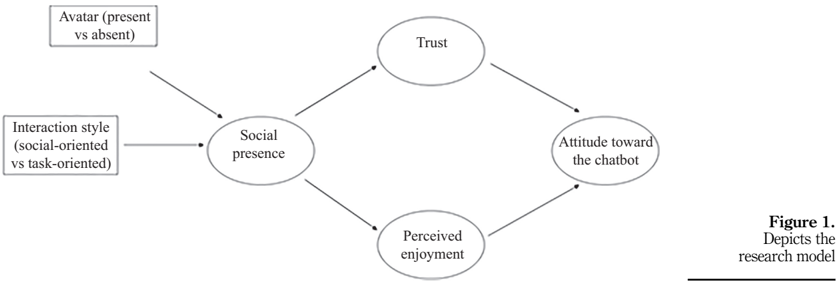
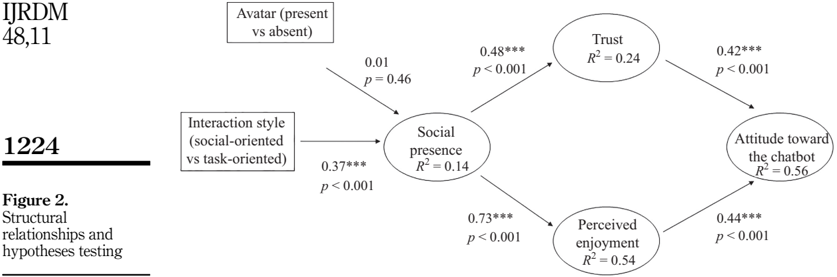
Purpose: Chatbots represent an innovative channel for retailers to meet young customers' needs anywhere and at any time. Being an emergent technology, however, it is important to investigate more thoroughly how users perceive it, and which are the variables that enhance a positive attitude towards this technology. On this premise, this study applies a social relationship perspective to the design of chatbots addressed to younger consumers. Design/methodology/approach: The study adopts a between-participants factorial design to investigate the effects of visual cues (avatar presence vs avatar absence) and interaction styles (social-oriented vs task-oriented) on social presence and how this, in turn, enhances millennials' perceived enjoyment, trust and, ultimately, attitude towards the chatbot. A survey experiment was employed to conduct the study on data collected from 193 Italian millennials. Findings: The results show that applying a social-oriented interaction style increases users' perception of social presence, while an insignificant effect was found for avatar presence. The partial least square structural equation modeling (PLS-SEM) analysis further confirms the hypothesised model. Originality/value: The adoption of new digital technologies such as chatbots is likely to have a far reaching effect on retailers, consumers, employees and society. For this reason, a broad understanding of the phenomenon is needed. To the best of our knowledge, this is the first study to provide results from an experimental design in which both interaction style (social- vs task-oriented) and avatar (presence vs absence) of a chatbot are manipulated to directly explore social presence and its effect on trust, perceived enjoyment and millennials' attitude towards a chatbot applied for retailing purposes.
Overview
The claims and statistics of this paper haven’t been checked yet.
Run the check — free, no account needed. It reads the open-access text and checks the sources it cites.
Integrity signals
Registry
Cites
Statistics
Figures

Verification
Claims the paper makes
The claims and statistics of this paper haven’t been checked yet.
Run the check — free, no account needed. It reads the open-access text and checks the sources it cites.
Claims other papers make about this one
Each is checked against this paper’s own text: does it say what the citing paper says it does?
In the citing paper
“Media Equation theory suggested that people unconsciously respond to media and technology as if they were human, especially when it is perceived to possess characteristics typically associated with human behavior [42].”
From Understanding Teen Overreliance on AI Companion Chatbots Through Self-Reported Reddit Narratives (2026) · cites this paper as [42]
Self-check
Percentages, sums and reported differences re-computed from the paper’s own numbers.
The self-check needs the paper’s full text.
Citations
Cites
Attitude-behavior relations: A theoretical analysis and review of empirical research
Ajzen, I., & Fishbein, M. (1977) · Psychological Bulletin · doi:10.1037/0033-2909.84.5.888 · Cited by 7,611
Extrinsic and Intrinsic Motivation to Use Computers in the Workplace 1
Davis, F. D., Bagozzi, R. P., & Warshaw, P. R. (1992) · Journal of Applied Social Psychology · doi:10.1111/j.1559-1816.1992.tb00945.x · Cited by 6,231
The Effects of Personalization and Familiarity on Trust and Adoption of Recommendation Agents1
Komiak, S. Y. X., & Benbasat, I. (2006) · MIS Quarterly · doi:10.2307/25148760 · Cited by 1,374
Go, E., & Sundar, S. S. (2019) · Computers in Human Behavior · doi:10.1016/j.chb.2019.01.020 · Cited by 1,089
Qiu, L., & Benbasat, I. (2009) · Journal of Management Information Systems · doi:10.2753/mis0742-1222250405 · Cited by 737
Can a Retail Web Site Be Social?
Wang, L. C., Baker, J., Wagner, J. A., & Wakefield, K. (2007) · Journal of Marketing · doi:10.1509/jmkg.71.3.143 · Cited by 672
Ho, A., Hancock, J., & Miner, A. S. (2018) · Journal of Communication · doi:10.1093/joc/jqy026 · Cited by 629
Chattaraman, V., Kwon, W.-S., Gilbert, J. E., & Ross, K. (2019) · Computers in Human Behavior · doi:10.1016/j.chb.2018.08.048 · Cited by 510
Should Machines Express Sympathy and Empathy? Experiments with a Health Advice Chatbot
Liu, B., & Sundar, S. S. (2018) · Cyberpsychology, Behavior, and Social Networking · doi:10.1089/cyber.2018.0110 · Cited by 447
Technology Adaptation in E-commerce:
Chen, L.-D., & Tan, J. (2004) · European Management Journal · doi:10.1016/j.emj.2003.11.014 · Cited by 306
Wang, W., & Benbasat, I. (2008) · Journal of Management Information Systems · doi:10.2753/mis0742-1222240410 · Cited by 241
The effect of social presence and chatbot errors on trust
Toader, D.-C., Boca, G., Toader, R., Măcelaru, M., Toader, C., Ighian, D., & Rădulescu, A. T. (2019) · Sustainability · doi:10.3390/su12010256 · Cited by 233
Predicting consumer responses to a chatbot on facebook
Zarouali, B., Van den Broeck, E., Walrave, M., & Poels, K. (2018) · Cyberpsychology, Behavior, and Social Networking · doi:10.1089/cyber.2017.0518 · Cited by 229
Textual paralanguage and its implications for marketing communications
Luangrath, A. W., Peck, J., & Barger, V. A. (2017) · Journal of Consumer Psychology · doi:10.1016/j.jcps.2016.05.002 · Cited by 221
Chatbot Personalities Matters: Improving the User Experience of Chatbot Interfaces
Smestad, T. L., & Volden, F. (2019) · Lecture Notes in Computer Science · doi:10.1007/978-3-030-17705-8_15 · Cited by 52
Research works printed but not linked: 61
- 2018, The differential effect of cognitive and emotional elements of experience quality on the customer-service provider's relationship, International Journal of Retail and Distribution Management, 46, 125, 10.1108/IJRDM-03-2017-0058 · DOI
- 2012, A short measure of the need for affect, Journal of Personality Assessment, 94, 418, 10.1080/00223891.2012.666921 · DOI
- 2018, Living up to the chatbot hype: the influence of anthropomorphic design cues and communicative agency framing on conversational agent and company perceptions, Computers in Human Behavior, 85, 183, 10.1016/j.chb.2018.03.051 · DOI · Paper page
- 2019, Understanding the webrooming phenomenon, International Journal of Retail and Distribution Management, 47, 1074, 10.1108/IJRDM-01-2019-0026 · DOI
- 2003, Toward a more robust theory and measure of social presence: review and suggested criteria, Presence: Teleoperators and Virtual Environments, 12, 456, 10.1162/105474603322761270 · DOI
- 2005, Differential impacts of social presence on the behaviour modeling approach, International Journal of Technology and Human Interaction, 1, 64, 10.4018/jthi.2005040104 · DOI
- 2001, Hedonic and utilitarian motivations for online retail shopping behaviour, Journal of Retailing, 77, 511, 10.1016/S0022-4359(01)00056-2 · DOI · Paper page
- 2018, Chatbot e-service and customer satisfaction regarding luxury brands, Journal of Business Research, 10.1016/j.jbusres.2018.10.004 · DOI
- 2019, In the shades of the uncanny valley: an experimental study of human–chatbot interaction, Future Generation Computer Systems, 92, 539, 10.1016/j.future.2018.01.055 · DOI
- 2016, Co-constructing intersubjectivity with artificial conversational agents: people are more likely to initiate repairs of misunderstandings with agents represented as human, Computers in Human Behavior, 58, 431, 10.1016/j.chb.2015.12.039 · DOI · Paper page
- 2007, The role of social presence in establishing loyalty in e-service environments, Interacting with Computers, 19, 43, 10.1016/j.intcom.2006.07.010 · DOI
- 2016, Antecedents and consequences of trust: an e-tail branding perspective, International Journal of Retail and Distribution Management, 44, 713, 10.1108/IJRDM-06-2015-0089 · DOI
- 2016, The impact of online real-time interactivity on patronage intention: the use of avatars, Computers in human behaviour, 61, 227, 10.1016/j.chb.2016.03.045 · DOI
- 1981, Evaluating structural equation models with unobservable variables and measurement error, Journal of Marketing Research, 18, 39, 10.1177/002224378101800104 · DOI · Paper page
- 2003, Managing user trust in B2C e-services, e-service Journal, 2, 7, 10.2979/esj.2003.2.2.7 · DOI · Paper page
- 2019, Conversational AI: how (chat) bots will reshape the digital experience, 81
- 2009, Consumer e-shopping acceptance: antecedents in a technology acceptance model, Journal of Business Research, 62, 565, 10.1016/j.jbusres.2008.06.016 · DOI · Paper page
- 2016, The digitalization of retailing: an exploratory framework, International Journal of Retail and Distribution Management, 44, 694, 10.1108/IJRDM-09-2015-0140 · DOI
- 2011, PLS-SEM: indeed a silver bullet, Journal of Marketing Theory and Practice, 19, 139, 10.2753/MTP1069-6679190202 · DOI · Paper page
- 2017, Advanced Issues in Partial Least Squares Structural Equation Modeling
- 2005, The impact of infusing social presence in the web interface: an investigation across product types, International Journal of Electronic Commerce, 10, 31, 10.2753/JEC1086-4415100202 · DOI
- 2007, Manipulating perceived social presence through the web interface and its impact on attitude towards online shopping, International Journal of Human-Computer Studies, 65, 689, 10.1016/j.ijhcs.2006.11.018 · DOI · Paper page
- 2009, A cross-cultural comparison of the impact of social presence on website trust, usefulness and enjoyment, International Journal of Electronic Business, 7, 625, 10.1504/IJEB.2009.029050 · DOI
- 2015, Real conversations with artificial intelligence: a comparison between human–human online conversations and human–chatbot conversations, Computers in Human Behavior, 49, 245, 10.1016/j.chb.2015.02.026 · DOI · Paper page
- 2019, Investigating the role of social presence dimensions and information support on consumers' trust and shopping intentions, Journal of Retailing and Consumer Services, 51, 263, 10.1016/j.jretconser.2019.06.007 · DOI
- 2013, Effects of collaborative online shopping on shopping experience through social and relational perspectives, Information and Management, 50, 169, 10.1016/j.im.2013.02.003 · DOI
- 2002, Applying the technology acceptance model and flow theory to online consumer behaviour, Information Systems Research, 13, 205, 10.1287/isre.13.2.205.83 · DOI
- 2003, Influence of salesperson characteristics and customer emotion on retail dyadic relationships, International Review of Retail Distribution and Consumer Research, 13, 21
- 2003, The contribution of commitment value in Internet commerce: an empirical investigation, Journal of the Association for Information Systems, 4, 2
- 1993, Fast Food, Fast Talk: Service Work and the Routinization of Everyday Life
- 2005, Understanding individual adoption of instant messaging: an empirical investigation, Journal of the Association for Information Systems, 6, 102, 10.17705/1jais.00066 · DOI
- 1997, At the heart of it all: the concept of presence, Journal of Computer-Mediated Communication, 3, 1
- 2016, Social presence, trust, and social commerce purchase intention: an empirical research, Computers in Human Behavior, 56, 225, 10.1016/j.chb.2015.11.057 · DOI
- 2006, On‐screen characters: their design and influence on consumer trust, Journal of Services Marketing
- 1995, An integrative model of organizational trust, Academy of Management Review, 20, 709, 10.5465/amr.1995.9508080335 · DOI · Paper page
- 2002, Relationship formation on the internet: what's the big attraction?, Journal of Social Issues, 58, 9, 10.1111/1540-4560.00246 · DOI · Paper page
- 2018, The effects of two-way communication and chat service usage on consumer attitudes in the e-commerce retailing sector, Electronic Markets, 28, 205, 10.1007/s12525-017-0281-2 · DOI
- 2009, Factors influencing the adoption of internet banking: an integration of TAM and TPB with perceived risk and perceived benefit, Electronic Commerce Research and Applications, 8, 130, 10.1016/j.elerap.2008.11.006 · DOI · Paper page
- 2001, Extending the TAM for a WorldWideWeb context, Information and Management, 38, 217, 10.1016/S0378-7206(00)00061-6 · DOI · Paper page
- 2012, Interactive media usage among millennial consumers, Journal of Consumer Marketing, 29, 436, 10.1108/07363761211259241 · DOI
- 2003, The effect of the agency and anthropomorphism on users' sense of telepresence, copresence, and social presence in virtual environments, Presence: Teleoperators and Virtual Environments, 12, 481, 10.1162/105474603322761289 · DOI
- 2018, Avatars and computer-mediated communication: a review of the definitions, uses, and effects of digital representations, Review of Communication Research, 6, 30, 10.12840/issn.2255-4165.2018.06.01.015 · DOI
- 2017, An experimental investigation of the influence of website emotional design features on trust in unfamiliar online vendors, Computers in Human Behavior, 67, 49, 10.1016/j.chb.2016.10.018 · DOI
- 1996, The Media Equation: How People Treat Computers, Television, and New Media like Real People and Places
- 2012, Social comparison, social presence, and enjoyment in the acceptance of social shopping websites, Journal of Electronic Commerce Research, 13, 198
- 2003, Building customer trust in mobile commerce, Communications of the ACM, 46, 91, 10.1145/641205.641211 · DOI · Paper page
- 2007, The role of social presence in interactive agent-based persuasion, Media Psychology, 10, 385, 10.1080/15213260701533102 · DOI
- 2019, Help! Is my chatbot falling into the uncanny valley?: an empirical study of user experience in human-chatbot interaction, Human Technology, 15
- 2002, Effect of trust on customer acceptance of Internet banking, Electronic Commerce Research and Applications, 1, 247, 10.1016/S1567-4223(02)00017-0 · DOI · Paper page
- 2007, Online buying innovativeness: effects of perceived value, perceived risk and perceived enjoyment, International Journal of Business and Society, 8, 81
- 2018, The role of self-efficacy and customer satisfaction in driving loyalty to the mobile shopping application, International Journal of Retail and Distribution Management, 46, 283, 10.1108/IJRDM-11-2016-0214 · DOI
- 2019, Examining the customer experience of using banking Chatbots and its impact on brand love: the moderating role of perceived risk, Journal of Internet Commerce, 18, 91, 10.1080/15332861.2019.1567188 · DOI
- 2018, Conversational commerce–a new era for service business development?, 81, 10.1007/978-3-658-22426-4_4 · DOI
- 2003, Factors influencing the usage of websites: the case of a generic portal in The Netherlands, Information and Management, 40, 541, 10.1016/S0378-7206(02)00079-4 · DOI
- 2004, User acceptance of hedonic information systems, MIS Quarterly, 28, 695, 10.2307/25148660 · DOI · Paper page
- 2007, Satisfaction with online commercial group chat: the influence of perceived technology attributes, chat group characteristics, and advisor communication style, Journal of Retailing, 83, 339, 10.1016/j.jretai.2007.03.004 · DOI
- 2018, Does recommendation matter for trusting beliefs and trusting intentions? Focused on different types of recommender system and sponsored recommendation, International Journal of Retail and Distribution Management, 46, 944, 10.1108/IJRDM-06-2017-0122 · DOI
- 2005, An extension of Trust and TAM model with TPB in the initial adoption of on-line tax: an empirical study, International Journal of Human-Computer Studies, 62, 784, 10.1016/j.ijhcs.2005.03.003 · DOI · Paper page
- 2015, An online shopping behaviour model integrating personality traits, perceived risk, and technology acceptance, Social Behaviour and Personality: An International Journal, 43, 85, 10.2224/sbp.2015.43.1.85 · DOI
- 2007, The effects of trust and enjoyment on intention to play online games, Journal of Electronic Commerce Research, 8, 128
- 2005, Extending the TAM for a t-commerce, Information and Management, 42, 965, 10.1016/j.im.2004.11.001 · DOI
Cited by
Sorted by citations
Exploring relationship development with social chatbots: A mixed-method study of replika
Pentina, I., Hancock, T., & Xie, T. (2023) · Computers in Human Behavior · doi:10.1016/j.chb.2022.107600 · Cited by 522
Nicolescu, L., & Tudorache, M. T. (2022) · Electronics · doi:10.3390/electronics11101579 · Cited by 280
Xie, T., & Pentina, I. (2022) · Proceedings of the Annual Hawaii International Conference on System Sciences · doi:10.24251/hicss.2022.258 · Cited by 219
Friend, mentor, lover: does chatbot engagement lead to psychological dependence?
Xie, T., Pentina, I., & Hancock, T. (2023) · Journal of Service Management · doi:10.1108/josm-02-2022-0072 · Cited by 204
Why do users trust algorithms? A review and conceptualization of initial trust and trust over time
Cabiddu, F., Moi, L., Patriotta, G., & Allen, D. G. (2022) · European Management Journal · doi:10.1016/j.emj.2022.06.001 · Cited by 138
Metadata
- Authors
- De Cicco, R., Silva, S. C., & Alparone, F. R.
- ORCID
- Silva, Susana C.
- Venue
- International Journal of Retail & Distribution Management
- Publisher
- Emerald
- Published
- 2020-07-08
- Volume
- 48
- Issue
- 11
- Pages
- 1213-1233
- ISSN
- 0959-0552
- Cited by
- 258
- References
- 15
- Language
- en
About these checks
Registry, retraction, Cites and statistics results are computed, not judged, with one exception: a printed reference that no index lists is read once by a model before it counts as a citation error. Claims are extracted by a model and kept only when their quote appears verbatim in the text; each cited source is then checked, with a model’s help, for whether it says what the claim relies on. Those verdicts can be wrong — read the claim’s quote and the cited source before relying on one.
Statistics and arithmetic are recomputed, not judged.
Confidence bands are shown only for fields calibrated on our annotated test set. None is calibrated yet, so no band is shown.
What counts as a claim ›How we measure confidence ›How we check this ›
Are you an author, or do you see a problem with this page? Request a review
