

An Introduction to Deep Learning for the Physical Layer
Open accessThe DOI matches its Crossref record; 90 of the 92 references it cites were found in a registry or an index, and 2 are not checked yet; 8 of the 32 sources its claims cite were checked for support.
Abstract
We present and discuss several novel applications of deep learning for the physical layer. By interpreting a communications system as an autoencoder, we develop a fundamental new way to think about communications system design as an end-to-end reconstruction task that seeks to jointly optimize transmitter and receiver components in a single process. We show how this idea can be extended to networks of multiple transmitters and receivers and present the concept of radio transformer networks as a means to incorporate expert domain knowledge in the machine learning model. Lastly, we demonstrate the application of convolutional neural networks on raw IQ samples for modulation classification which achieves competitive accuracy with respect to traditional schemes relying on expert features. This paper is concluded with a discussion of open challenges and areas for future investigation.
Verified 2026-11-19 · 2 references not checked yet
Overview
CoChat Summary
TL;DR
The paper introduces deep learning for the physical layer by treating a communications system as an autoencoder that jointly learns transmitter and receiver implementations end-to-end. It also extends this idea to multi-user interference channels, proposes radio transformer networks (RTNs) to inject expert domain knowledge, and shows CNNs on raw IQ samples can outperform expert-feature modulation classifiers.
Key findings
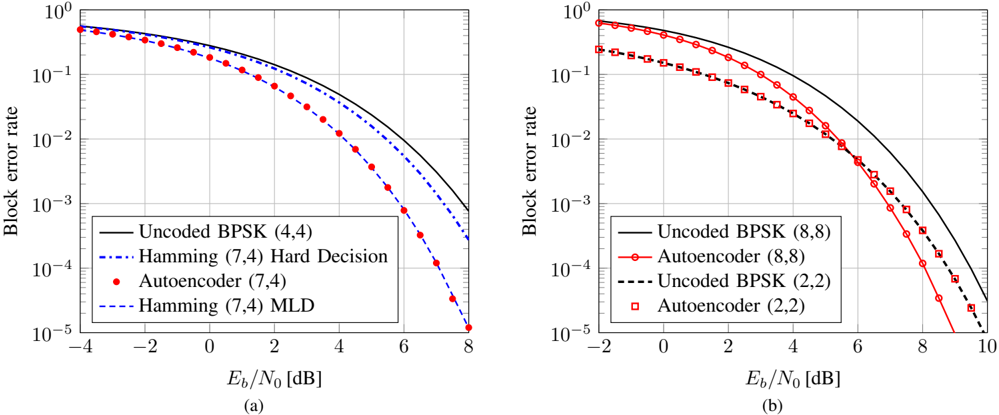
- A learned autoencoder for a (7,4) system at rate R = 4/7 achieves the same block error rate (BLER) as a Hamming (7,4) code with maximum likelihood decoding, while an (8,8) autoencoder outperforms uncoded BPSK over the full E_b/N_0 range, indicating learned joint coding and modulation.
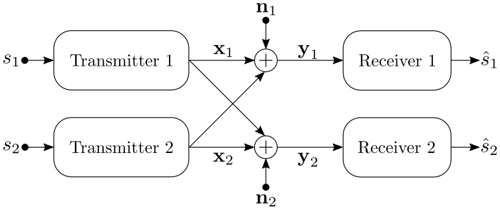
- For the two-user AWGN interference channel, the autoencoder matches time-sharing for (1,1) and (2,2), but achieves gains of about 0.7 dB for (4,4) and 1 dB for (4,8) at a BLER of 10^-3.
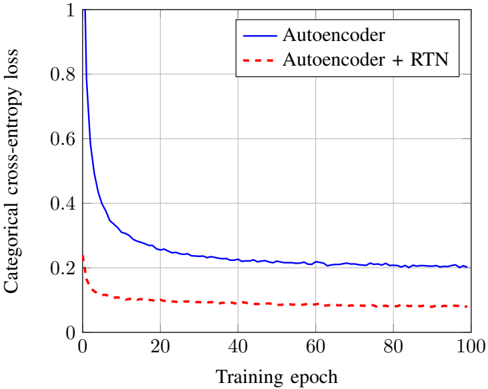
- An autoencoder (8,4) with an RTN over a multipath fading channel with L = 3 Rayleigh taps outperforms differential BPSK with maximum likelihood sequence estimation and a Hamming (7,4) code, whereas the plain autoencoder struggles to match it; RTNs also show faster training convergence.
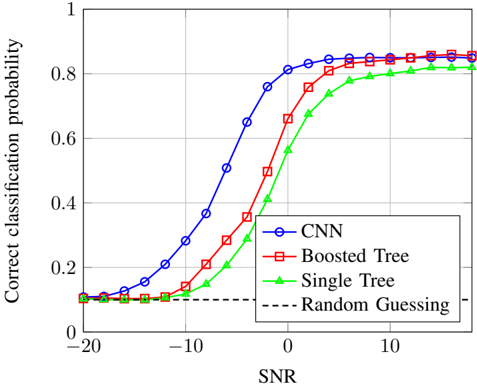
- For modulation classification on 1.2M sequences of 128 complex-valued IQ samples across ten modulation schemes and SNRs from -20 dB to 18 dB, the CNN outperforms a boosted expert-feature classifier by around 4 dB in the low-to-medium SNR range, with almost identical high-SNR performance; a single tree is about 6 dB worse at medium SNR and 3.5% worse at high SNR.
Methods
- The transmitter, channel, and receiver are represented as one deep neural network trained as an autoencoder: one-hot message input, dense layers, normalization layer for transmit constraints, additive noise channel layer, and softmax receiver output, trained with categorical cross-entropy using SGD/Adam at learning rate 0.001 and fixed E_b/N_0 = 7 dB.
- The autoencoder concept is extended to multiple transmitter-receiver pairs in a two-user interference channel, with dynamic loss weights α_t per mini-batch to balance the two cross-entropy losses; performance is compared against 2^{2k/n}-QAM with time-sharing.
- RTNs combine a learned parameter estimator, a differentiable parametric transform, and a discriminative network; the paper demonstrates phase-offset compensation and multipath inverse filtering. For modulation classification, a VGG-like CNN with 324,330 trainable parameters is trained on the RML2016.10b dataset.
Limitations
- The paper states that scalability to large message sets M is a major challenge: for k = 100 bits, training complexity is prohibitive because the autoencoder must see at least every message once.
- The paper states that optimal data representations, loss functions, training SNR, and hyperparameters are not well understood; training at one SNR does not necessarily generalize to others, and no common communications benchmarks or datasets comparable to MNIST or ImageNet exist.
- The paper states that end-to-end learning over real channels requires system identification because backpropagation assumes a known channel transfer function; complex-valued neural networks are not supported by current DL libraries. Evident from the text: the reported results are simulation-based, use small (n,k) settings, assume known channel models during training, and the paper explicitly leaves detailed performance comparisons for various channel types and parameters to future work.
Model-written summary. Check it against the paper before relying on it.
Integrity signals
Registry
Cites
Statistics
Figures






Verification
Claims the paper makes
6 Valid · 4 Not valid · 18 Not checked · 65 Own results and interpretations
Every source the paper cites for this claim was checked and supports it.
In the paper
“For instance in [22], it was shown that training with a single codeword is sufficient since the structure of the code is embedded in the NN through the Tanner graph.”
What the sources say
- Supportedcites [22] [22] E. Nachmani, Y. Be'ery, and D. Burshtein, 'Learning to decode linear codes using deep learning,' in Proc. IEEE Annu. Allerton Conf. Commun., Control, and Computing (Allerton) , 2016, pp. 341-346. - source
The Introduction says the decoder uses a Tanner graph representing the code and that one codeword suffices for training. Section III explains the precise condition: over a binary memoryless symmetric channel, the decoder’s error rate is independent of the transmitted codeword, so training can use noisy versions of a single codeword. (LLM, conf=0.91)
boostedstates a cause- Asserted: passes — The authors put it forward as true.
- Checkable: passes — It can be checked against evidence.
- Load-bearing: unclear — It is unclear whether the paper’s conclusions depend on it.
- Based: passes — The paper gives a reason why it holds.
- Supported
A result the paper reports from its own data — it cites no other source for it, so there is none to check. The quote shows it is in the paper.
In the paper
“We study the use of NNs on complex-valued IQ samples for the problem of modulation classification and show that convolutional neural networks (CNNs), which are the cornerstone of most DL systems for computer vision, can outperform traditional classification techniques based on expert features.”
plainstates a cause- Asserted: passes — The authors put it forward as true.
- Checkable: passes — It can be checked against evidence.
- Load-bearing: passes — The paper’s conclusions depend on it.
- Based: passes — The paper gives a reason why it holds.
The paper states this without a source or data behind it here, so there is nothing to check it against. The quote shows it is in the paper.
In the paper
“Training at low SNR for instance does not allow for the discovery of structure important in higher SNR scenarios.”
plainstates a cause- Asserted: passes — The authors put it forward as true.
- Checkable: passes — It can be checked against evidence.
- Load-bearing: unclear — It is unclear whether the paper’s conclusions depend on it.
- Based: unclear — It is unclear why the paper says it holds.
A result the paper reports from its own data — it cites no other source for it, so there is none to check. The quote shows it is in the paper.
In the paper
“Another advantage of RTNs is faster training convergence which can be seen from Fig. 10 that compares the validation loss of the autoencoder with and without RTN as a function of the training epochs.”
plainstates a cause- Asserted: passes — The authors put it forward as true.
- Checkable: passes — It can be checked against evidence.
- Load-bearing: unclear — It is unclear whether the paper’s conclusions depend on it.
- Based: passes — The paper gives a reason why it holds.
A result the paper reports from its own data — it cites no other source for it, so there is none to check. The quote shows it is in the paper.
In the paper
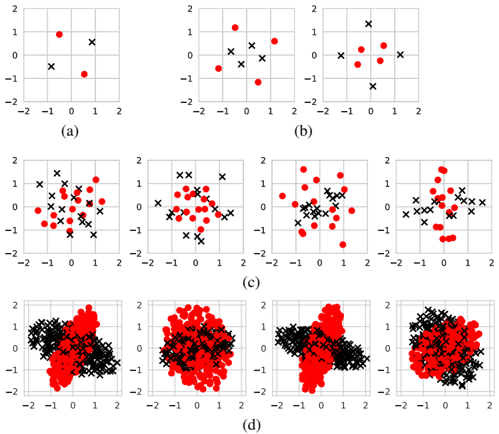
“Similarly, Fig. 4b shows a (4 , 2) system which leads to a rotated 16-PSK constellation.”
plainstates a cause- Asserted: passes — The authors put it forward as true.
- Checkable: passes — It can be checked against evidence.
- Load-bearing: unclear — It is unclear whether the paper’s conclusions depend on it.
- Based: passes — The paper gives a reason why it holds.
39 more claims
Create a free account to see all 93 claims and to verify the 4 references still open.
- Probably not a substantial claim. 29
- It may state two separate claims as one. 24
Self-check
Percentages, sums and reported differences re-computed from the paper’s own numbers.
Each contradiction between two passages listed here was confirmed by an independent check.
Rated minor: it would not touch a result — a value no result rests on, a p-value that stays on the same side of the significance level, or a conflict that is clerical, resolved elsewhere in the paper, or outside its own findings.
In the paper
§ A. Autoencoders for end-to-end communications systems · p. 5
“Similarly, Fig. 4b shows a (4 , 2) system which leads to a rotated 16-PSK constellation.”
§ A. Autoencoders for end-to-end communications systems · p. 6
“Figure 4: Constellations produced by autoencoders using parameters ( n, k ) : (a) (2 , 2) (b) (2 , 4) , (c) (2 , 4) with average power constraint, (d) (7 , 4) 2-dimensional t-SNE embedding of received symbols.”
Citations
Cites
Very Deep Convolutional Networks for Large-Scale Image Recognition
Simonyan, K., & Zisserman, A. (2014) · arXiv · doi:10.48550/arxiv.1409.1556 · Cited by 114,148 · cited 1×
“dense/fully-connected layers and terminated with a dense softmax layer for our classifier (similar to a VGG architecture [55]).”
BackgroundAdam: A Method for Stochastic Optimization
Kingma, D. P., & Ba, J. (2014) · arXiv · doi:10.48550/arxiv.1412.6980 · Cited by 98,946 · cited 4×
“Training was done at a fixed value of Eb/N0 = 7 dB (see Section IV-B) using Adam [46] with learning rate 0.”
BackgroundMethodInfluentialA Mathematical Theory of Communication
Shannon, C. E. (1948) · Bell System Technical Journal · doi:10.1002/j.1538-7305.1948.tb01338.x · Cited by 88,486
Scikit-learn: Machine Learning in Python
Pedregosa, F., Varoquaux, G., Gramfort, A., Michel, V., Thirion, B., Grisel, O., Blondel, M., Müller, A., Nothman, J., Louppe, G., et al. (2012) · arXiv · doi:10.48550/arxiv.1201.0490 · Cited by 71,016 · cited 1×
“11, we compare the classification accuracy of the CNN against that of extreme gradient boosting7 with 1000 estimators, as well as a single scikit-learn decision tree [56], operating on a mix of 16 analog and cumulant expert features as proposed in [53] and [57].”
Method(2014) · Cited by 33,419
(2008) · Journal of Machine Learning Research · Cited by 33,051
Human-level control through deep reinforcement learning
Mnih, V., Kavukcuoglu, K., Silver, D., Rusu, A. A., Veness, J., Bellemare, M. G., Graves, A., Riedmiller, M., Fidjeland, A. K., Ostrovski, G., et al. (2015) · Nature · doi:10.1038/nature14236 · Cited by 30,357
(2007) · Electronics: A First Course · doi:10.4324/9780080477527-64 · Cited by 24,923
Pan, S. J., & Yang, Q. (2010) · IEEE Transactions on Knowledge and Data Engineering · doi:10.1109/tkde.2009.191 · Cited by 23,387 · cited 1×
“learning [64] is one appealing candidate for adapting an endto-end communications system trained on a statistical model to”
BackgroundMultilayer feedforward networks are universal approximators
Hornik, K., Stinchcombe, M., & White, H. (1989) · Neural Networks · doi:10.1016/0893-6080(89)90020-8 · Cited by 21,728 · cited 1×
“Third, it has been shown that NNs are universal function approximators [13] and recent work has shown a remarkable”
Background
Research works printed but not linked: 2
- [35] I. Goodfellow, Y. Bengio, and A. Courville, Deep Learning . MIT Press, 2016. -
- [52] J. Estaran et al. , 'Artificial neural networks for linear and non-linear impairment mitigation in high-baudrate IM/DD systems,' in Proc. 42nd European Conf. Optical Commun. (ECOC) . VDE, 2016, pp. 1-3. -
Cited by
Items 101–200 of 2,995
Deep Learning for Channel Estimation: Interpretation, Performance, and Comparison
Hu, Q., Gao, F., Zhang, H., Jin, S., & Li, G. Y. (2021) · IEEE Transactions on Wireless Communications · doi:10.1109/twc.2020.3042074 · Cited by 191
“There have been many interesting results for the physical layer (PHY) [4] or network layer of communications [5], including channel estimation [6], [7], channel state information (CSI) feedback compression [8], signal detection [9], and resource management [10], [11], etc.”
Background6G White Paper on Machine Learning in Wireless Communication NetworksPreprint
Ali, S., Saad, W., Rajatheva, N., Chang, K., Steinbach, D., Sliwa, B., Wietfeld, C., Mei, K., Shiri, H., Zepernick, H., et al. (2020) · arXiv (Cornell University) · doi:10.48550/arxiv.2004.13875 · Cited by 252
“ional methods and is able to address complicated channel distortions. Future directions in physical layer optimization with ML center around the paradigm of an autoencoder that has been introduced in [21] aiming at a deep learning-based end-to-end physical layer architecture. In this approach, transmitter and receiver…”
BackgroundRFAL: Adversarial Learning for RF Transmitter Identification and Classification
Roy, D., Mukherjee, T., Chatterjee, M., Blasch, E., & Pasiliao, E. (2020) · IEEE Transactions on Cognitive Communications and Networking · doi:10.1109/tccn.2019.2948919 · Cited by 192
“In [30] the authors have demonstrated the use of NN for modulation detection.”
BackgroundMethodOFDM-Guided Deep Joint Source Channel Coding for Wireless Multipath Fading Channels
Yang, M., Bian, C., & Kim, H.-S. (2022) · IEEE Transactions on Cognitive Communications and Networking · doi:10.1109/tccn.2022.3151935 · Cited by 191
“Motivated by model-based deep learning approaches [23] [24] [25] [26] [27] [28], we incorporate orthogonal frequency division multiplexing (OFDM) as our domain knowledge, where equalization is performed in frequency domain for orthogonal sub-carriers without inter-symbol interference.”
MethodTrainable Communication Systems: Concepts and Prototype
Cammerer, S., Aoudia, F. A., Dorner, S., Stark, M., Hoydis, J., & ten Brink, S. (2020) · IEEE Transactions on Communications · doi:10.1109/tcomm.2020.3002915 · Cited by 192
Self-citationAutomatic Modulation Classification: A Deep Architecture Survey
Huynh-The, T., Pham, Q.-V., Nguyen, T.-V., Nguyen, T. T., Ruby, R., Zeng, M., & Kim, D.-S. (2021) · IEEE Access · doi:10.1109/access.2021.3120419 · Cited by 183
“With the number of neurons [5, 13, 6, 6] defined in four hidden layers, the network achieved high accuracy with six effortless loworder digital modulations, including ASK, FSK, and PSK.”
BackgroundJdid, B., Hassan, K., Dayoub, I., Lim, W. H., & Mokayef, M. (2021) · IEEE Access · doi:10.1109/access.2021.3071801 · Cited by 184
“Then in [39], the authors extended their prior work on using deep CNNs for AMR [38], [44], [51].”
BackgroundChannel-Aware Adversarial Attacks Against Deep Learning-Based Wireless Signal Classifiers
Kim, B., Sagduyu, Y. E., Davaslioglu, K., Erpek, T., & Ulukus, S. (2022) · IEEE Transactions on Wireless Communications · doi:10.1109/twc.2021.3124855 · Cited by 188
Evaluating Adversarial Evasion Attacks in the Context of Wireless Communications
Flowers, B., Buehrer, R. M., & Headley, W. C. (2020) · IEEE Transactions on Information Forensics and Security · doi:10.1109/tifs.2019.2934069 · Cited by 189
ViterbiNet: A Deep Learning Based Viterbi Algorithm for Symbol Detection
Shlezinger, N., Farsad, N., Eldar, Y. C., & Goldsmith, A. J. (2020) · IEEE Transactions on Wireless Communications · doi:10.1109/twc.2020.2972352 · Cited by 172
“Due to the large amount of recent works on this topic, we only discuss a few representative papers; detailed surveys can be found in [7]–[10]: The work [11] used deep learning for decoding”
BackgroundMachine and Deep Learning for Resource Allocation in Multi-Access Edge Computing: A Survey
Djigal, H., Xu, J., Liu, L., & Zhang, Y. (2022) · IEEE Communications Surveys & Tutorials · doi:10.1109/comst.2022.3199544 · Cited by 166
Towards artificial intelligence enabled 6G: State of the art, challenges, and opportunities
Zhang, S., & Zhu, D. (2020) · Computer Networks · doi:10.1016/j.comnet.2020.107556 · Cited by 162
Deep Learning for Wireless Communications
Erpek, T., O’Shea, T. J., Sagduyu, Y. E., Shi, Y., & Clancy, T. C. (2020) · Studies in Computational Intelligence · doi:10.1007/978-3-030-31764-5_9 · Cited by 165
“plexity of such capacity-achieving schemes is typically high to be realized in practical systems. Recently, deep learning-based end-to-end communication systems have been developed for single antenna [15], [16], multiple antenna [17], and multiuser [15], [18] systems to improve the performance of the traditional appro…”
BackgroundInfluentialSelf-citationGong, J., Xu, X., & Lei, Y. (2020) · IEEE Transactions on Information Forensics and Security · doi:10.1109/tifs.2020.2978620 · Cited by 169
“Deep learning (DL) has also recently demonstrated great potential in various wireless applications [15]–[18], resulting in improved performance compared to traditional techniques.”
BackgroundSim, M. S., Lim, Y.-G., Park, S. H., Dai, L., & Chae, C.-B. (2020) · IEEE Access · doi:10.1109/access.2020.2980285 · Cited by 166
“Therefore, it has been adopted in the field of wireless communications for modulation [13], detection [14], [15], channel estimation [16], nonorthogonal multiple access (NOMA), massive multiple-input multiple-output (MIMO) systems [17], etc.”
BackgroundAI for 5G: research directions and paradigms
You, X., Zhang, C., Tan, X., Jin, S., & Wu, H. (2019) · Science China Information Sciences · doi:10.1007/s11432-018-9596-5 · Cited by 165
Power Control in Cellular Massive MIMO With Varying User Activity: A Deep Learning Solution
Van Chien, T., Nguyen Canh, T., Bjornson, E., & Larsson, E. G. (2020) · IEEE Transactions on Wireless Communications · doi:10.1109/twc.2020.2996368 · Cited by 164
“Despite its complicated and rather heuristic training phase, deep learning has recently shown promising results in communication applications [10], [11].”
BackgroundEnabling AI in Future Wireless Networks: A Data Life Cycle Perspective
Nguyen, D. C., Cheng, P., Ding, M., Lopez-Perez, D., Pathirana, P. N., Li, J., Seneviratne, A., Li, Y., & Poor, H. V. (2021) · IEEE Communications Surveys & Tutorials · doi:10.1109/comst.2020.3024783 · Cited by 160
“Particularly, it is shown that a deep neural network with online learning is able to facilitate the parameter tuning and expedite the convergence rate, which improves the estimation of CSI without occupation of uplink bandwidth resource [109].”
BackgroundPhysical Adversarial Attacks Against End-to-End Autoencoder Communication Systems
Sadeghi, M., & Larsson, E. G. (2019) · IEEE Communications Letters · doi:10.1109/lcomm.2019.2901469 · Cited by 161
Deep learning in the stock market—a systematic survey of practice, backtesting, and applications
Olorunnimbe, K., & Viktor, H. L. (2022) · Artificial Intelligence Review · doi:10.1007/s10462-022-10226-0 · Cited by 173
“2019; O’Shea and Hoydis 2017; Xiao 2021), with the stock market applications this survey considers adopting even more derivative architectures with easily identifiable and well-known foundations.”
BackgroundSemantics-Empowered Communications: A Tutorial-Cum-Survey
Lu, Z., Li, R., Lu, K., Chen, X., Hossain, E., Zhao, Z., & Zhang, H. (2023) · IEEE Communications Surveys & Tutorials · doi:10.1109/comst.2023.3333342 · Cited by 214
“Typically, DL-based physical layer schemes [49], [50] and end-toend communications [51]–[53] are now serving as important precursors of SemCom, demonstrating superior performance in a variety of tasks [54]–[56].”
BackgroundMethodInfluentialArtificial Intelligence in 6G Wireless Networks: Opportunities, Applications, and Challenges
Alhammadi, A., Shayea, I. A. M., El‐Saleh, A. A., Azmi, M. H., Ismail, Z. H., Kouhalvandi, L., & Saad, S. A. (2024) · International Journal of Intelligent Systems · doi:10.1155/2024/8845070 · Cited by 228
“Due to the strong prediction and ability to analyze data, AI methods, including DNN, tackle the problems of conventional methods [58].”
MethodA taxonomy of AI techniques for 6G communication networks
Sheth, K., Patel, K., Shah, H., Tanwar, S., Gupta, R., & Kumar, N. (2020) · Computer Communications · doi:10.1016/j.comcom.2020.07.035 · Cited by 171
Redefining Wireless Communication for 6G: Signal Processing Meets Deep Learning With Deep Unfolding
Jagannath, A., Jagannath, J., & Melodia, T. (2021) · IEEE Transactions on Artificial Intelligence · doi:10.1109/tai.2021.3108129 · Cited by 187
“Deep learning (DL) [8] - a subset of ML - has been applied to wireless communication problems such as signal recognition [9], [10], [11], detection, characterization, channel estimation, optimal network resource allocation [12], error correction coding schemes, and other physical layer applications…”
BackgroundUnderstanding autoencoders with information theoretic concepts
Yu, S., & Príncipe, J. C. (2019) · Neural Networks · doi:10.1016/j.neunet.2019.05.003 · Cited by 183
Deep Learning for Modulation Recognition: A Survey With a Demonstration
Zhou, R., Liu, F., & Gravelle, C. (2020) · IEEE Access · doi:10.1109/access.2020.2986330 · Cited by 171
Data-driven Optical Fiber Channel Modeling: A Deep Learning Approach
Wang, D., Song, Y., Li, J., Qin, J., Yang, T., Zhang, M., Chen, X., & Boucouvalas, A. C. (2020) · Journal of Lightwave Technology · doi:10.1109/jlt.2020.2993271 · Cited by 168
“[13] and recently introduced in optical communication systems [14].”
BackgroundTransfer Learning for Wireless Networks: A Comprehensive Survey
Nguyen, C. T., Huynh, N. V., Chu, N. H., Saputra, Y. M., Hoang, D. T., Nguyen, D. N., Pham, Q., Niyato, D. T., Dutkiewicz, E., & Hwang, W. (2022) · Proceedings of the IEEE · doi:10.1109/jproc.2022.3175942 · Cited by 180
DeepNOMA: A Unified Framework for NOMA Using Deep Multi-Task Learning
Ye, N., Li, X., Yu, H., Zhao, L. Y., Liu, W., & Hou, X. (2020) · IEEE Transactions on Wireless Communications · doi:10.1109/twc.2019.2963185 · Cited by 162
“The booming of DL has also shed new light on the end-to-end optimization of wireless communication technologies in complicated scenarios [4]–[9].”
BackgroundDeep Learning-Based Channel Estimation Algorithm Over Time Selective Fading Channels
Bai, Q., Wang, J., Zhang, Y., & Song, J. (2019) · IEEE Transactions on Cognitive Communications and Networking · doi:10.1109/tccn.2019.2943455 · Cited by 169
“Rhh = ⎡ ⎢⎢⎢⎢⎣ R[0] R[1] R[2] · · · R[L − 1] R[1] R[0] R[1] · · · R[L − 2] R[2] R[1] R[0] · · · R[L − 3] .”
MethodA Survey on Deep Learning Techniques in Wireless Signal Recognition
Li, X., Dong, F., Zhang, S., & Guo, W. (2019) · Wireless Communications and Mobile Computing · doi:10.1155/2019/5629572 · Cited by 181
“Recently, deep learning as an extension of ANN is showing its great potential in modulation recognition [28].”
BackgroundMIMO Channel Information Feedback Using Deep Recurrent Network
Lu, C., Xu, W., Shen, H., Zhu, J., & Wang, K. (2018) · IEEE Communications Letters · doi:10.1109/lcomm.2018.2882829 · Cited by 149
Distributed Deep Convolutional Compression for Massive MIMO CSI Feedback
Mashhadi, M. B., Yang, Q., & Gündüz, D. (2020) · IEEE Transactions on Wireless Communications · doi:10.1109/twc.2020.3043502 · Cited by 148
“Following the recent resurgence of machine learning, and more specifically deep learning (DL) techniques for physical layer communications [7], [8], DL-based MIMO CSI estimation, compression”
Fusion Methods for CNN-Based Automatic Modulation Classification
Zheng, S., Qi, P., Chen, S., & Yang, X. (2019) · IEEE Access · doi:10.1109/access.2019.2918136 · Cited by 158
“In recent years, deep learning was used for several areas in wireless communications [24] and radio signal processing [6], such as beamforming [25], channel estimation [26]–[29], RF fingerprinting [30],[31], non-orthogonal multiple access (NOMA) scheme [32], [33], sparse signal regulation and recovery [34], [35], reso…”
MethodDeepcode: Feedback Codes via Deep Learning
Kim, H., Jiang, Y., Kannan, S., Oh, S., & Viswanath, P. (2020) · IEEE Journal on Selected Areas in Information Theory · doi:10.1109/jsait.2020.2986752 · Cited by 165
“Designing codes driven by deep learning has been of significant interest recently, starting from [14] which proposes an autoencoder framework for communications.”
BackgroundEnd-to-End Learning for OFDM: From Neural Receivers to Pilotless Communication
Aoudia, F. A., & Hoydis, J. (2021) · IEEE Transactions on Wireless Communications · doi:10.1109/twc.2021.3101364 · Cited by 206
“Since its first application to wireless communications [5], end-to-end learning has been extended to other fields including optical wireless [6] and optical fiber [7].”
BackgroundInfluentialSelf-citationHu, X., Masouros, C., & Wong, K. (2021) · IEEE Transactions on Communications · doi:10.1109/tcomm.2021.3066495 · Cited by 158
“One way to overcome this drawback is leveraging the deep learning methods, not only due to the fact that DNNs are regarded as universal function approximators but also because deep learning is well known as a promising way to achieve effective online implementations [16]–[18].”
Video Processing Using Deep Learning Techniques: A Systematic Literature Review
Sharma, V., Gupta, M., Kumar, A., & Mishra, D. (2021) · IEEE Access · doi:10.1109/access.2021.3118541 · Cited by 178
“In addition, DL has also been successfully applied to communication signals/packets, e.g. [1], [2].”
MethodDRL-Based Energy-Efficient Resource Allocation Frameworks for Uplink NOMA Systems
Wang, X., Zhang, Y., Shen, R., Xu, Y., & Zheng, F. (2020) · IEEE Internet of Things Journal · doi:10.1109/jiot.2020.2982699 · Cited by 152
“ing [22], [23] as a model-free and data-driven approach to reduce the computational complexity with available training inputs and outputs [24]–[26].”
BackgroundHow Machine Learning Changes the Nature of Cyberattacks on IoT Networks: A Survey
Bout, E., Loscri, V., & Gallais, A. (2022) · IEEE Communications Surveys & Tutorials · doi:10.1109/comst.2021.3127267 · Cited by 139
“Deep learning (DL) algorithms can be used at the physical layer of wireless communication systems to substitute elements of the conventional communication system and create a new DL-based architecture [59].”
Background6G mobile communication networks: vision, challenges, and key technologies
Yajun, Z. H. A. O., Guanghui, Y. U., & Hanqing, X. U. (2019) · Scientia Sinica Informationis · doi:10.1360/n112019-00033 · Cited by 167
Rethinking Modern Communication from Semantic Coding to Semantic Communication
Lu, K., Zhou, Q., Li, R., Zhao, Z., Chen, X., Wu, J., & Zhang, H. (2022) · IEEE Wireless Communications · doi:10.1109/mwc.013.2100642 · Cited by 149
“[6] and [7] exemplified deep learningbased approaches towards applicable joint source and channel coding (JSCC) systems.”
BackgroundMethodInfluentialDeep Learning-Based Cooperative Automatic Modulation Classification Method for MIMO Systems
Wang, Y., Wang, J., Zhang, W., Yang, J., & Gui, G. (2020) · IEEE Transactions on Vehicular Technology · doi:10.1109/tvt.2020.2976942 · Cited by 156
“AMC can strengthen the cognition capabilities of the communication systems via identifying modulation types of unknown signals, and it is widely applied into the military and civilian domains [9].”
BackgroundMethodInternet of Things 2.0: Concepts, Applications, and Future Directions
Zhou, I., Makhdoom, I., Shariati, N., Raza, M. A., Keshavarz, R., Lipman, J., Abolhasan, M., & Jamalipour, A. (2021) · IEEE Access · doi:10.1109/access.2021.3078549 · Cited by 162
“The authors of [101] explored the usages of deep learning in end-to-end communication systems.”
BackgroundDeepSIC: Deep Soft Interference Cancellation for Multiuser MIMO Detection
Shlezinger, N., Fu, R., & Eldar, Y. C. (2020) · IEEE Transactions on Wireless Communications · doi:10.1109/twc.2020.3032663 · Cited by 163
“machine learning schemes are gradually influencing the design of digital communication systems, resulting in a multitude of recent works on the application of DNNs in communications; see detailed surveys in [18]–[23].”
BackgroundO’Shea, T. J., Roy, T., & West, N. (2019) · 2012 International Conference on Computing, Networking and Communications (ICNC) · doi:10.1109/iccnc.2019.8685573 · Cited by 168
Self-citationDeep Learning for B5G Open Radio Access Network: Evolution, Survey, Case Studies, and Challenges
Brik, B., Boutiba, K., & Ksentini, A. (2022) · IEEE Open Journal of the Communications Society · doi:10.1109/ojcoms.2022.3146618 · Cited by 168
“It aims at providing spectrum efficiency based on the new enabled 5G technologies, including Massive MIMO and mmWave [73][74][75][76].”
MethodDeep Learning Aided Grant-Free NOMA Toward Reliable Low-Latency Access in Tactile Internet of Things
Ye, N., Li, X., Yu, H., Wang, A., Liu, W., & Hou, X. (2019) · IEEE Transactions on Industrial Informatics · doi:10.1109/tii.2019.2895086 · Cited by 136
“The booming of DL has shed a new light on optimizing the wireless communication system [32]–[34].”
BackgroundClerckx, B., Huang, K., Varshney, L. R., Ulukuş, Ş., & Alouini, M. (2021) · IEEE Journal of Selected Topics in Signal Processing · doi:10.1109/jstsp.2021.3098478 · Cited by 170
Soni, B., Patel, D. K., & López‐Benítez, M. (2020) · IEEE Access · doi:10.1109/access.2020.2995633 · Cited by 148
Machine Learning Meets Communication Networks: Current Trends and Future Challenges
Ahmad, I., Shahabuddin, S., Malik, H. H., Harjula, E., Leppänen, T., Lovén, L., Anttonen, A., Sodhro, A. H., Alam, M. M., Juntti, M. J., et al. (2020) · IEEE Access · doi:10.1109/access.2020.3041765 · Cited by 162
Wu, Y., Lemić, F., Han, C. Z., & Chen, Z. (2022) · IEEE Transactions on Communications · doi:10.1109/tcomm.2022.3225920 · Cited by 152
Artificial Intelligence for 5G and Beyond 5G: Implementations, Algorithms, and Optimizations
Zhang, C., Ueng, Y.-L., Studer, C., & Burg, A. P. (2020) · IEEE Journal on Emerging and Selected Topics in Circuits and Systems · doi:10.1109/jetcas.2020.3000103 · Cited by 149
“An extreme case is the end-to-end learning [130], [131], which will be more interesting and complex for future research.”
BackgroundGenerative Adversarial Networks (GANs) in networking: A comprehensive survey & evaluation
Navidan, H., Moshiri, P. F., Nabati, M., Shahbazian, R., Ghorashi, S. A., Shah-Mansouri, V., & Windridge, D. (2021) · Computer Networks · doi:10.1016/j.comnet.2021.108149 · Cited by 131
“This approach consists of an encoder encoding symbols into a distinct transmitted value, a stochastic channel model, and a decoder network which seeks to estimate the transmitted symbols from the received samples and outputs a probability distribution over all possible decoded messages [93].”
BackgroundWang, Y., Gui, G., Ohtsuki, T. O., & Adachi, F. (2021) · IEEE Transactions on Wireless Communications · doi:10.1109/twc.2021.3052222 · Cited by 141
“In contrast, the previous proposed CNN-based AMC method [7], [9], [29]–[32] is denoted as a fixed AMC (FAMC) method, and it does not equip with powerful generalization capability.”
MethodInfluentialDeep Joint Source-channel Coding for Wireless Image Transmission
Bourtsoulatze, E., Kurka, D. B., & Gündüz, D. (2019) · IEEE International Conference on Acoustics Speech and Signal Processing · doi:10.1109/icassp.2019.8683463 · Cited by 168
“Some examples of such designs include decoder design for existing channel codes [12], [13], blind channel equalization [14], learning physical layer signal representation for SISO [11] and MIMO [15] systems, OFDM systems [16], [17], JSCC of text messages [18] and JSCC for MNIST images for analog storage [19].”
InfluentialDeep-Waveform: A Learned OFDM Receiver Based on Deep Complex-Valued Convolutional Networks
Zhao, Z., Vuran, M. C., Guo, F., & Scott, S. (2021) · IEEE Journal on Selected Areas in Communications · doi:10.1109/jsac.2021.3087241 · Cited by 155
“An MLP-based channel estimator for FBMC shows good performance in high mobility channels [50].”
BackgroundMethodInfluentialDeep Learning for Distributed Optimization: Applications to Wireless Resource Management
Lee, H., Lee, S. H., & Quek, T. Q. S. (2019) · IEEE Journal on Selected Areas in Communications · doi:10.1109/jsac.2019.2933890 · Cited by 129
“To overcome the drawbacks of traditional optimization techniques, deep learning (DL) frameworks have been recently investigated in wireless resource management [7]–[12] and end-to-end communication system design [13]–[17].”
Robust Beamforming for RIS-Aided Communications: Gradient-Based Manifold Meta Learning
Zhu, F., Wang, X., Huang, C., Yang, Z., Chen, X., Alhammadi, A., Zhang, Z., Yuen, C., & Debbah, M. A. (2024) · IEEE Transactions on Wireless Communications · doi:10.1109/twc.2024.3435023 · Cited by 162
“Recently, the application of deep learning (DL) in wireless communications has gained much attention due to its capability in solving complex and challenging problems [11, 12], since it is naturally adept at extracting valuable features in high-dimensional space with the low complexity.”
BackgroundA Machine Learning Approach to 5G Infrastructure Market Optimization
Bega, D., Gramaglia, M., Banchs, A., Sciancalepore, V., & Costa‐Pérez, X. (2019) · IEEE Transactions on Mobile Computing · doi:10.1109/tmc.2019.2896950 · Cited by 151
“of [28] employ a deep learning approach for modulation classification, which achieves competitive accuracy with respect to traditional schemes.”
BackgroundAI-Driven Blind Signature Classification for IoT Connectivity: A Deep Learning Approach
Pan, J., Ye, N., Yu, H., Hong, T., Al–Rubaye, S., Mumtaz, S., Al‐Dulaimi, A., & Chih‐Lin, I. (2022) · IEEE Transactions on Wireless Communications · doi:10.1109/twc.2022.3145399 · Cited by 132
“With the extracted features, these deep learning-based methods can approach near maximum-likelihood performance [27], [29].”
MethodRoadmap on optical communications
Agrell, E., Karlsson, M., Poletti, F., Namiki, S., Chen, X., Rusch, L. A., Puttnam, B. J., Bayvel, P., Schmalen, L., Tao, Z., et al. (2024) · Journal of Optics · doi:10.1088/2040-8986/ad261f · Cited by 167
Deep Learning-Aided 6G Wireless Networks: A Comprehensive Survey of Revolutionary PHY Architectures
Ozpoyraz, B., Doğukan, A. T., Gevez, Y., Altun, U., & Başar, E. (2022) · IEEE Open Journal of the Communications Society · doi:10.1109/ojcoms.2022.3210648 · Cited by 152
“Reference [125] extends the single-input single-output (SISO) IC system over AWGN channel investigated in [25] to SISO and MIMO interference channel systems over Rayleigh”
BackgroundMethodInfluentialMachine Learning-Based 5G-and-Beyond Channel Estimation for MIMO-OFDM Communication Systems
Le, H. A., Chien, T. V., Nguyễn, T. H., Choo, H., & Nguyễn, V. Đ. (2021) · Sensors · doi:10.3390/s21144861 · Cited by 146
Physical Layer Communications System Design Over-the-Air Using Adversarial Networks
O’Shea, T. J., Roy, T., West, N., & Hilburn, B. C. (2018) · European Signal Processing Conference (EUSIPCO) · doi:10.23919/eusipco.2018.8553233 · Cited by 143
Self-citationOne-Bit OFDM Receivers via Deep Learning
Balevi, E., & Andrews, J. G. (2019) · IEEE Transactions on Communications · doi:10.1109/tcomm.2019.2903811 · Cited by 133
“Furthermore, [24]–[26] model the end-to-end communication system as an autoencoder for reliable detection”
BackgroundDeep Learning in Mobile and Wireless Networking: A Survey
Zhang, C., Patras, P., & Haddadi, H. (2018) · arXiv (Cornell University) · doi:10.48550/arxiv.1803.04311 · Cited by 122
“[349] Modulation recognition Radio transformer network O’Shea and Hoydis [350] Modulation classification CNN Gonzalez and Vallina [351] Network data monetisation Unknown Kaminski et al.”
MethodIoT Devices Fingerprinting Using Deep Learning
Jafari, H., Omotere, O., Adesina, D. S., Wu, H.-H., & Qian, L. (2018) · IEEE Military Communications Conference (MILCOM) · doi:10.1109/milcom.2018.8599826 · Cited by 140
“in [9], authors introduced application of deep learning to the Milcom 2018 Track 5 - Big Data and Machine Learning”
BackgroundJoint Transceiver Optimization for Wireless Communication PHY Using Neural Network
Zhu, B., Wang, J., He, L., & Song, J. (2019) · IEEE Journal on Selected Areas in Communications · doi:10.1109/jsac.2019.2904361 · Cited by 130
“We summarize the challenges and deficiency of deep learning based physical layer design as follows: • In previous work [21], the input is restricted to one-hot”
Deep Learning-Based Detector for OFDM-IM
Luong, T. V., Ko, Y., Vien, N. A., Nguyen, D. H. N., & Matthaiou, M. (2019) · IEEE Wireless Communications Letters · doi:10.1109/lwc.2019.2909893 · Cited by 130
“For example, in [10], a DL autoencoder was proposed to replace both the transmitter and receiver of communication systems with DNNs.”
MethoddApps: Distributed Applications for Real-Time Inference and Control in O-RAN
D’Oro, S., Polese, M., Bonati, L., Cheng, H., & Melodia, T. (2022) · IEEE Communications Magazine · doi:10.1109/mcom.002.2200079 · Cited by 118
“…channel quality information, latency) [4, 9, 10], as well as by processing in parallel (thus not affecting demodulation and decoding procedures) I/Q samples collected at the PHY layer that carry detailed information on channel conditions and spatial information of received waveforms [8, 11].”
Survey on artificial intelligence based techniques for emerging robotic communication
Alsamhi, S. H., Ma, O., & Ansari, M. S. (2019) · Telecommunication Systems · doi:10.1007/s11235-019-00561-z · Cited by 131
Backpropagating Through the Air: Deep Learning at Physical Layer Without Channel Models
Raj, V., & Kalyani, S. (2018) · IEEE Communications Letters · doi:10.1109/lcomm.2018.2868103 · Cited by 131
“O’Shea and Hoydis [1] present a novel way of rethinking the communication system as an end-to-end reconstruction problem, and applied autoencoder [2] based deep architecture.”
BackgroundMethodResultInfluentialMachine Learning for Wireless Communication Channel Modeling: An Overview
Aldossari, S. A., & Chen, K. (2019) · Wireless Personal Communications · doi:10.1007/s11277-019-06275-4 · Cited by 142
Zheng, S., Chen, S., & Yang, X. (2020) · IEEE Transactions on Cognitive Communications and Networking · doi:10.1109/tccn.2020.3018736 · Cited by 128
“2) DL-Based Communications System: In addition to using deep learning to learn the function of a certain module of the receiver, there are some research work on end-to-end optimization of wireless communication systems based on deep learning [41]–[45].”
BackgroundDual CNN-Based Channel Estimation for MIMO-OFDM Systems
Jiang, P., Wen, C.-K., Jin, S., & Li, G. Y. (2021) · IEEE Transactions on Communications · doi:10.1109/tcomm.2021.3085895 · Cited by 139
Overfitting and Underfitting Analysis for Deep Learning Based End-to-end Communication Systems
Zhang, H., Zhang, L., & Jiang, Y. (2019) · International Conference on Wireless Communications and Signal Processing (WCSP) · doi:10.1109/wcsp.2019.8927876 · Cited by 160
“The benchmarks are used in [4] as well.”
MethodInfluentialActivity Pattern Aware Spectrum Sensing: A CNN-Based Deep Learning Approach
Xie, J., Liu, C., Liang, Y., & Fang, J. (2019) · IEEE Communications Letters · doi:10.1109/lcomm.2019.2910176 · Cited by 122
“network’s (DNN) powerful ability to learn features out of data samples [7], [8], in this letter, we propose a deep learning-based activity pattern aware spectrum sensing”
BackgroundLearning to Demodulate From Few Pilots via Offline and Online Meta-Learning
Park, S., Jang, H., Simeone, O., & Kang, J. (2020) · IEEE Transactions on Signal Processing · doi:10.1109/tsp.2020.3043879 · Cited by 129
“the design of demodulators or decoders, from the 90s [3] to many recent contributions, including [6]–[8] and references therein.”
BackgroundBalatsoukas‐Stimming, A. (2018) · IEEE International Workshop on Signal Processing Advances in Wireless Communications (SPAWC) · doi:10.1109/spawc.2018.8445987 · Cited by 142
Deep Joint Source Channel Coding for Wireless Image Transmission with OFDM
Yang, M., Bian, C., & Kim, H.-S. (2021) · International Conference on Communications · doi:10.1109/icc42927.2021.9500996 · Cited by 144
“Combining machine learning with expert domain knowledge has shown great success in many applications such as radio transformer network (RTN) [12], symbol modulation and demodulation for OFDM [13], channel estimation [19], and peak-to-average power Ratio (PAPR) reduction [20].”
BackgroundA Comprehensive Exploration of 6G Wireless Communication Technologies
Siddiky, M. N. A., Rahman, M. E., Uzzal, M. S., & Kabir, H. M. D. (2025) · Computers · doi:10.3390/computers14010015 · Cited by 146
Deep Learning Classification of 3.5-GHz Band Spectrograms With Applications to Spectrum Sensing
Lees, W. M., Wunderlich, A., Jeavons, P., Hale, P. D., & Souryal, M. R. (2019) · IEEE Transactions on Cognitive Communications and Networking · doi:10.1109/tccn.2019.2899871 · Cited by 126
“…such as convolutional neural networks (CNNs) and long short-term memory (LSTM) recurrent neural networks [11], which are the current state-of-the-art for many classification tasks [11], [12], have been applied to various areas in wireless communications, including spectrum sensing, e.g., [13]–[16].”
BackgroundUnsupervised Deep Learning for Massive MIMO Hybrid Beamforming
Hojatian, H., Nadal, J., Frigon, J.-F., & Leduc-Primeau, F. (2021) · IEEE Transactions on Wireless Communications · doi:10.1109/twc.2021.3080672 · Cited by 135
“Several works have investigated the use of deep neural network (DNN) to deal with difficult problems within the physical layer [19], including channel coding, channel estimation [20], detection [21] and, beamforming [22]–[25].”
BackgroundNELoRa: Towards Ultra-low SNR LoRa Communication with Neural-enhanced Demodulation
Li, C., Guo, H., Tong, S., Zeng, X., Cao, Z., Zhang, M., Yan, Q., Xiao, L., Wang, J., & Liu, Y. (2021) · ACM Conference on Embedded Networked Sensor Systems (SenSys) · doi:10.1145/3485730.3485928 · Cited by 148
Deep Learning in Digital Modulation Recognition Using High Order Cumulants
Xie, W., Hu, S., Yu, C. T., Zhu, P., Peng, X., & Jing-cheng, O. (2019) · IEEE Access · doi:10.1109/access.2019.2916833 · Cited by 120
Traffic Sign Detection via Improved Sparse R-CNN for Autonomous Vehicles
Liang, T., Bao, H., Pan, W., & Pan, F. (2022) · Journal of Advanced Transportation · doi:10.1155/2022/3825532 · Cited by 139
“,e deep neural networks have successfully applied in many fields, such as computer vision, communications [1], and networking [2].”
Physics-Based Deep Learning for Fiber-Optic Communication Systems
Häger, C., & Pfister, H. D. (2020) · IEEE Journal on Selected Areas in Communications · doi:10.1109/jsac.2020.3036950 · Cited by 142
“More generally, one can treat the entire design of a communication system as an end-toend reconstruction task and jointly optimize transmitter and receiver NNs [8].”
BackgroundInfluentialIntrusion Detection System on IoT with 5G Network Using Deep Learning
Yadav, N., Pande, S. D., Khamparia, A., & Gupta, D. K. (2022) · Wireless Communications and Mobile Computing · doi:10.1155/2022/9304689 · Cited by 113
Transfer Learning for Semi-Supervised Automatic Modulation Classification in ZF-MIMO Systems
Wang, Y., Gui, G., Gacanin, H., Ohtsuki, T. O., Sari, H., & Adachi, F. (2020) · IEEE Journal on Emerging and Selected Topics in Circuits and Systems · doi:10.1109/jetcas.2020.2992128 · Cited by 117
“Based on [31], Z. Zhang, et al. [32] proposed a feature fusion algorithm, and authors attempted to fuse various images and handcrafted features of signals into more robust and effective features for better classification performance.”
BackgroundMethodInfluentialZhang, X., Zhao, H., Zhu, H., Adebisi, B., Gui, G., Gacanin, H., & Adachi, F. (2022) · IEEE Transactions on Cognitive Communications and Networking · doi:10.1109/tccn.2022.3169740 · Cited by 122
Generative AI for Physical Layer Communications: A Survey
Huynh, N. V., Wang, J., Du, H., Hoang, D. T., Niyato, D. T., Nguyen, D. N., Kim, D. I., & Letaief, K. B. (2024) · IEEE Transactions on Cognitive Communications and Networking · doi:10.1109/tccn.2024.3384500 · Cited by 152
“These studies primarily concentrate on the application of DL in various domains, including signal detection and compression [40], coding [6], [41], [42], security [43], [44], and communication delay [45].”
BackgroundDeep Learning Based Channel Estimation Schemes for IEEE 802.11p Standard
Gizzini, A. K., Chafii, M., Nimr, A., & Fettweis, G. P. (2020) · IEEE Access · doi:10.1109/access.2020.3003286 · Cited by 123
“ˆ̃ hInitiali [−7] are added at the beginning while the other two pilots ˆ̃ hInitiali [7] and ˆ̃ hInitiali [21] are concatenated at the end.”
BackgroundEmpowering the 6G Cellular Architecture With Open RAN
Polese, M., Döhler, M., Dressler, F., Erol‐Kantarci, M., Jana, R., Knopp, R., & Melodia, T. (2023) · IEEE Journal on Selected Areas in Communications · doi:10.1109/jsac.2023.3334610 · Cited by 153
“To achieve these target, there is an opportunity to rethink the cellular architecture and operations with a holistic approach which can provide more gains than the improvements in the lower layers of the RAN protocol stack (e.g., the redesign the physical layer with AI [47], [48]).”
BackgroundAI Coding: Learning to Construct Error Correction Codes
Huang, L., Zhang, H., Li, R., Ge, Y., & Wang, J. (2019) · IEEE Transactions on Communications · doi:10.1109/tcomm.2019.2951403 · Cited by 120
“By treating an end-to-end communication sys-tem as an autoencoder, people proposed to optimize an entire transceiver jointly given a channel model without any expert knowledge about channel coding and modulation [16].”
MethodAI Empowered Wireless Communications: From Bits to Semantics
Qin, Z., Liang, L., Wang, Z., Jin, S., Tao, X., Tong, W., & Li, G. Y. (2024) · Proceedings of the IEEE · doi:10.1109/jproc.2024.3437730 · Cited by 155
“As a pioneering work, a learning-based system over an AWGN channel with a short block size is investigated in [81], as illustrated in Fig.”
BackgroundMethodWang, Y., Gui, G., Gacanin, H., Adebisi, B., Sari, H., & Adachi, F. (2022) · IEEE Transactions on Cognitive Communications and Networking · doi:10.1109/tccn.2021.3089738 · Cited by 108
Channel measurements and models for 6G: current status and future outlook
Zhang, J., Tang, P., Yu, L., Jiang, T., & Tian, L. (2020) · Frontiers of Information Technology & Electronic Engineering · doi:10.1631/fitee.1900450 · Cited by 121
Turbo Autoencoder: Deep learning based channel codes for point-to-point communication channelsPreprint
Jiang, Y., Kim, H., Asnani, H., Kannan, S., Oh, S., & Viswanath, P. (2019) · arXiv (Cornell University) · doi:10.48550/arxiv.1911.03038 · Cited by 190
Nawaz, S. J., Sharma, S. K., Mansoor, B., Patwary, M., & Khan, N. M. (2021) · IEEE Access · doi:10.1109/access.2021.3061499 · Cited by 130
“ML at the physical layer of the communication systems can support various exciting applications and operations [246] spanning from the estimation of parame-”
Background
Metadata
- Authors
- O'Shea, T., & Hoydis, J.
- Affiliations
- Nokia (France) (FR)
- Venue
- IEEE Transactions on Cognitive Communications and Networking
- Published
- 2017-12
- Volume
- 3
- Issue
- 4
- Pages
- 563-575
- ISSN
- 2332-7731 (ISSN-L)
- OpenAlex
- W2734408173
- Semantic Scholar
- 78989616eeeac55b202e3e4205225e7135054185
- Cited by
- 2,980
- References
- 69
- Citations by year
- 2026: 307 · 2025: 327 · 2024: 305 · 2023: 368 · 2022: 432 · 2021: 409 · 2020: 406 · 2019: 322 · 2018: 95 · 2017: 9
- FWCI
- 122.29
- Type
- journal article
- Language
- en
- Open access
- green
- arxiv.org
- Locations
- IEEE Transactions on Cognitive Communications and Networking (publishedVersion)
- arXiv (Cornell University) (submittedVersion)
- arXiv (Cornell University)
- Topics
- Physical Sciences › Computer Science › Artificial Intelligence › Wireless Signal Modulation Classification
- Physical Sciences › Engineering › Electrical and Electronic Engineering › Advanced Wireless Communication Techniques
- Physical Sciences › Engineering › Electrical and Electronic Engineering › Advanced Wireless Communication Technologies
- Keywords
- end-to-end reconstruction, domain knowledge integration, convolutional neural networks, automatic modulation classification, IQ samples
About these checks
Registry, retraction, Cites and statistics results are computed, not judged, with one exception: a printed reference that no index lists is read once by a model before it counts as a citation error. Claims are extracted by a model and kept only when their quote appears verbatim in the text; each cited source is then checked, with a model’s help, for whether it says what the claim relies on. Those verdicts can be wrong — read the claim’s quote and the cited source before relying on one.
The claim verdicts this report counts are experimental: their accuracy is not yet measured.
A language model drew the claims from the paper on 2026-11-07, under version 3 of the claim definition (model deepseek-v4.1-flash, prompt extract-v3).
A second model labelled each claim on 2026-11-07 (model jev-1.13-20260917, definition revision gold-guideline-v0.2).
Cited sources are checked with a language model’s help (gpt-6-sol).
Statistics and arithmetic are recomputed, not judged.
Confidence bands are shown only for fields calibrated on our annotated test set. None is calibrated yet, so no band is shown.
What counts as a claim ›How we measure confidence ›How we check this ›
Are you an author, or do you see a problem with this page? Request a review
Data sources
Bibliographic data: Semantic Scholar, OpenAlex, Crossref.
Contains information from the Semantic Scholar Academic Graph Datasets, made available under the ODC Attribution License (ODC-BY 1.0).
Semantic Scholar’s data is described in: Kinney, R., et al. (2023). The Semantic Scholar Open Data Platform. arXiv:2301.10140.
