

An Introduction to Deep Learning for the Physical Layer
Open accessThe DOI matches its Crossref record; 90 of the 92 references it cites were found in a registry or an index, and 2 are not checked yet; 8 of the 32 sources its claims cite were checked for support.
Abstract
We present and discuss several novel applications of deep learning for the physical layer. By interpreting a communications system as an autoencoder, we develop a fundamental new way to think about communications system design as an end-to-end reconstruction task that seeks to jointly optimize transmitter and receiver components in a single process. We show how this idea can be extended to networks of multiple transmitters and receivers and present the concept of radio transformer networks as a means to incorporate expert domain knowledge in the machine learning model. Lastly, we demonstrate the application of convolutional neural networks on raw IQ samples for modulation classification which achieves competitive accuracy with respect to traditional schemes relying on expert features. This paper is concluded with a discussion of open challenges and areas for future investigation.
Verified 2026-11-19 · 2 references not checked yet
Overview
CoChat Summary
TL;DR
The paper introduces deep learning for the physical layer by treating a communications system as an autoencoder that jointly learns transmitter and receiver implementations end-to-end. It also extends this idea to multi-user interference channels, proposes radio transformer networks (RTNs) to inject expert domain knowledge, and shows CNNs on raw IQ samples can outperform expert-feature modulation classifiers.
Key findings
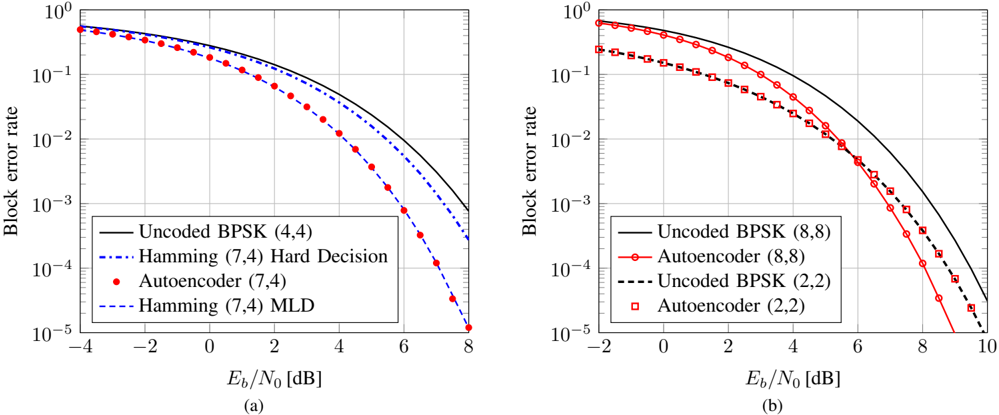
- A learned autoencoder for a (7,4) system at rate R = 4/7 achieves the same block error rate (BLER) as a Hamming (7,4) code with maximum likelihood decoding, while an (8,8) autoencoder outperforms uncoded BPSK over the full E_b/N_0 range, indicating learned joint coding and modulation.
- For the two-user AWGN interference channel, the autoencoder matches time-sharing for (1,1) and (2,2), but achieves gains of about 0.7 dB for (4,4) and 1 dB for (4,8) at a BLER of 10^-3.
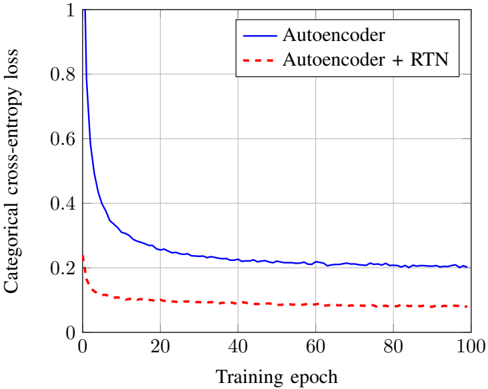
- An autoencoder (8,4) with an RTN over a multipath fading channel with L = 3 Rayleigh taps outperforms differential BPSK with maximum likelihood sequence estimation and a Hamming (7,4) code, whereas the plain autoencoder struggles to match it; RTNs also show faster training convergence.
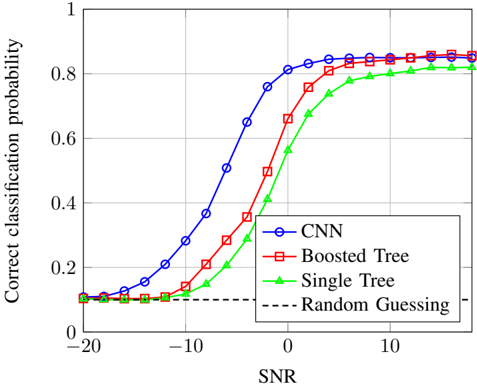
- For modulation classification on 1.2M sequences of 128 complex-valued IQ samples across ten modulation schemes and SNRs from -20 dB to 18 dB, the CNN outperforms a boosted expert-feature classifier by around 4 dB in the low-to-medium SNR range, with almost identical high-SNR performance; a single tree is about 6 dB worse at medium SNR and 3.5% worse at high SNR.
Methods
- The transmitter, channel, and receiver are represented as one deep neural network trained as an autoencoder: one-hot message input, dense layers, normalization layer for transmit constraints, additive noise channel layer, and softmax receiver output, trained with categorical cross-entropy using SGD/Adam at learning rate 0.001 and fixed E_b/N_0 = 7 dB.
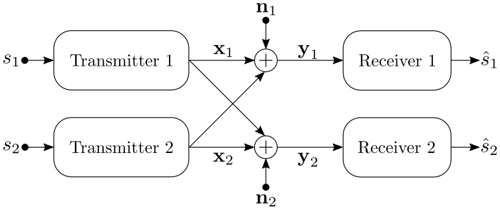
- The autoencoder concept is extended to multiple transmitter-receiver pairs in a two-user interference channel, with dynamic loss weights α_t per mini-batch to balance the two cross-entropy losses; performance is compared against 2^{2k/n}-QAM with time-sharing.
- RTNs combine a learned parameter estimator, a differentiable parametric transform, and a discriminative network; the paper demonstrates phase-offset compensation and multipath inverse filtering. For modulation classification, a VGG-like CNN with 324,330 trainable parameters is trained on the RML2016.10b dataset.
Limitations
- The paper states that scalability to large message sets M is a major challenge: for k = 100 bits, training complexity is prohibitive because the autoencoder must see at least every message once.
- The paper states that optimal data representations, loss functions, training SNR, and hyperparameters are not well understood; training at one SNR does not necessarily generalize to others, and no common communications benchmarks or datasets comparable to MNIST or ImageNet exist.
- The paper states that end-to-end learning over real channels requires system identification because backpropagation assumes a known channel transfer function; complex-valued neural networks are not supported by current DL libraries. Evident from the text: the reported results are simulation-based, use small (n,k) settings, assume known channel models during training, and the paper explicitly leaves detailed performance comparisons for various channel types and parameters to future work.
Model-written summary. Check it against the paper before relying on it.
Integrity signals
Registry
Cites
Statistics
Figures






Verification
Claims the paper makes
6 Valid · 4 Not valid · 18 Not checked · 65 Own results and interpretations
Every source the paper cites for this claim was checked and supports it.
In the paper
“For instance in [22], it was shown that training with a single codeword is sufficient since the structure of the code is embedded in the NN through the Tanner graph.”
What the sources say
- Supportedcites [22] [22] E. Nachmani, Y. Be'ery, and D. Burshtein, 'Learning to decode linear codes using deep learning,' in Proc. IEEE Annu. Allerton Conf. Commun., Control, and Computing (Allerton) , 2016, pp. 341-346. - source
The Introduction says the decoder uses a Tanner graph representing the code and that one codeword suffices for training. Section III explains the precise condition: over a binary memoryless symmetric channel, the decoder’s error rate is independent of the transmitted codeword, so training can use noisy versions of a single codeword. (LLM, conf=0.91)
boostedstates a cause- Asserted: passes — The authors put it forward as true.
- Checkable: passes — It can be checked against evidence.
- Load-bearing: unclear — It is unclear whether the paper’s conclusions depend on it.
- Based: passes — The paper gives a reason why it holds.
- Supported
A result the paper reports from its own data — it cites no other source for it, so there is none to check. The quote shows it is in the paper.
In the paper
“We study the use of NNs on complex-valued IQ samples for the problem of modulation classification and show that convolutional neural networks (CNNs), which are the cornerstone of most DL systems for computer vision, can outperform traditional classification techniques based on expert features.”
plainstates a cause- Asserted: passes — The authors put it forward as true.
- Checkable: passes — It can be checked against evidence.
- Load-bearing: passes — The paper’s conclusions depend on it.
- Based: passes — The paper gives a reason why it holds.
The paper states this without a source or data behind it here, so there is nothing to check it against. The quote shows it is in the paper.
In the paper
“Training at low SNR for instance does not allow for the discovery of structure important in higher SNR scenarios.”
plainstates a cause- Asserted: passes — The authors put it forward as true.
- Checkable: passes — It can be checked against evidence.
- Load-bearing: unclear — It is unclear whether the paper’s conclusions depend on it.
- Based: unclear — It is unclear why the paper says it holds.
A result the paper reports from its own data — it cites no other source for it, so there is none to check. The quote shows it is in the paper.
In the paper
“Another advantage of RTNs is faster training convergence which can be seen from Fig. 10 that compares the validation loss of the autoencoder with and without RTN as a function of the training epochs.”
plainstates a cause- Asserted: passes — The authors put it forward as true.
- Checkable: passes — It can be checked against evidence.
- Load-bearing: unclear — It is unclear whether the paper’s conclusions depend on it.
- Based: passes — The paper gives a reason why it holds.
A result the paper reports from its own data — it cites no other source for it, so there is none to check. The quote shows it is in the paper.
In the paper
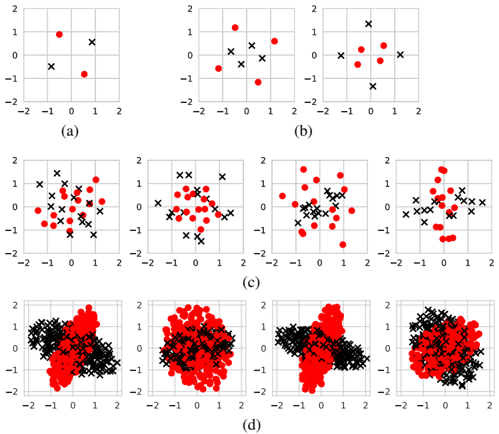
“Similarly, Fig. 4b shows a (4 , 2) system which leads to a rotated 16-PSK constellation.”
plainstates a cause- Asserted: passes — The authors put it forward as true.
- Checkable: passes — It can be checked against evidence.
- Load-bearing: unclear — It is unclear whether the paper’s conclusions depend on it.
- Based: passes — The paper gives a reason why it holds.
39 more claims
Create a free account to see all 93 claims and to verify the 4 references still open.
- Probably not a substantial claim. 29
- It may state two separate claims as one. 24
Self-check
Percentages, sums and reported differences re-computed from the paper’s own numbers.
Each contradiction between two passages listed here was confirmed by an independent check.
Rated minor: it would not touch a result — a value no result rests on, a p-value that stays on the same side of the significance level, or a conflict that is clerical, resolved elsewhere in the paper, or outside its own findings.
In the paper
§ A. Autoencoders for end-to-end communications systems · p. 5
“Similarly, Fig. 4b shows a (4 , 2) system which leads to a rotated 16-PSK constellation.”
§ A. Autoencoders for end-to-end communications systems · p. 6
“Figure 4: Constellations produced by autoencoders using parameters ( n, k ) : (a) (2 , 2) (b) (2 , 4) , (c) (2 , 4) with average power constraint, (d) (7 , 4) 2-dimensional t-SNE embedding of received symbols.”
Citations
Cites
Very Deep Convolutional Networks for Large-Scale Image Recognition
Simonyan, K., & Zisserman, A. (2014) · arXiv · doi:10.48550/arxiv.1409.1556 · Cited by 114,148 · cited 1×
“dense/fully-connected layers and terminated with a dense softmax layer for our classifier (similar to a VGG architecture [55]).”
BackgroundAdam: A Method for Stochastic Optimization
Kingma, D. P., & Ba, J. (2014) · arXiv · doi:10.48550/arxiv.1412.6980 · Cited by 98,946 · cited 4×
“Training was done at a fixed value of Eb/N0 = 7 dB (see Section IV-B) using Adam [46] with learning rate 0.”
BackgroundMethodInfluentialA Mathematical Theory of Communication
Shannon, C. E. (1948) · Bell System Technical Journal · doi:10.1002/j.1538-7305.1948.tb01338.x · Cited by 88,486
Scikit-learn: Machine Learning in Python
Pedregosa, F., Varoquaux, G., Gramfort, A., Michel, V., Thirion, B., Grisel, O., Blondel, M., Müller, A., Nothman, J., Louppe, G., et al. (2012) · arXiv · doi:10.48550/arxiv.1201.0490 · Cited by 71,016 · cited 1×
“11, we compare the classification accuracy of the CNN against that of extreme gradient boosting7 with 1000 estimators, as well as a single scikit-learn decision tree [56], operating on a mix of 16 analog and cumulant expert features as proposed in [53] and [57].”
Method(2014) · Cited by 33,419
(2008) · Journal of Machine Learning Research · Cited by 33,051
Human-level control through deep reinforcement learning
Mnih, V., Kavukcuoglu, K., Silver, D., Rusu, A. A., Veness, J., Bellemare, M. G., Graves, A., Riedmiller, M., Fidjeland, A. K., Ostrovski, G., et al. (2015) · Nature · doi:10.1038/nature14236 · Cited by 30,357
(2007) · Electronics: A First Course · doi:10.4324/9780080477527-64 · Cited by 24,923
Pan, S. J., & Yang, Q. (2010) · IEEE Transactions on Knowledge and Data Engineering · doi:10.1109/tkde.2009.191 · Cited by 23,387 · cited 1×
“learning [64] is one appealing candidate for adapting an endto-end communications system trained on a statistical model to”
BackgroundMultilayer feedforward networks are universal approximators
Hornik, K., Stinchcombe, M., & White, H. (1989) · Neural Networks · doi:10.1016/0893-6080(89)90020-8 · Cited by 21,728 · cited 1×
“Third, it has been shown that NNs are universal function approximators [13] and recent work has shown a remarkable”
Background
Research works printed but not linked: 2
- [35] I. Goodfellow, Y. Bengio, and A. Courville, Deep Learning . MIT Press, 2016. -
- [52] J. Estaran et al. , 'Artificial neural networks for linear and non-linear impairment mitigation in high-baudrate IM/DD systems,' in Proc. 42nd European Conf. Optical Commun. (ECOC) . VDE, 2016, pp. 1-3. -
Cited by
Items 401–500 of 2,995
Deep Learning in Barcode Recognition: A Systematic Literature Review
Wudhikarn, R., Charoenkwan, P., & Malang, C. (2022) · IEEE Access · doi:10.1109/access.2022.3143033 · Cited by 51
“system [26], mobile traffic classification [27], IoT-basedUAV systems [14], named entity recognition [28], as well as the most recent research in biological domain that points out at the potential of DL in scRNA-seq data analysis [29].”
BackgroundDeep Learning for Channel Coding via Neural Mutual Information Estimation
Fritschek, R., Schaefer, R. F., & Wunder, G. (2019) · IEEE International Workshop on Signal Processing Advances in Wireless Communications (SPAWC) · doi:10.1109/spawc.2019.8815464 · Cited by 50
“One of the most prominent recent examples is the end-to-end learning of communication systems utilizing (deep) neural networks (NNs) as encoding and decoding functions with an in-between noise layer that represents the channel [1].”
BackgroundEnd-to-End Learning for Integrated Sensing and Communication
Mateos-Ramos, J. M., Song, J., Wu, Y., Häger, C., Keskin, M. F., Yajnanarayana, V., & Wymeersch, H. (2022) · International Conference on Communications · doi:10.1109/icc45855.2022.9838308 · Cited by 62
“In particular, end-to-end autoencoders (AEs) [32] are potentially well-suited for ISAC problems because they allow for the joint optimization of both the transmit waveforms as well as the communication and radar receivers.”
BackgroundMethodInfluentialWen, D., Wang, X., Huang, Z., & Xu, Q. (2022) · IEEE Communications Letters · doi:10.1109/lcomm.2022.3225566 · Cited by 48
“The CNN [12], LSTM [13], CNN-LSTM [14], AMR-CapsNet [2], and WSMF [5] network structures were selected for the performance comparison.”
MethodXu, T., Xu, T., & Darwazeh, I. (2018) · Progress in Electromagnetics Research Symposium (PIERS) · doi:10.23919/piers.2018.8597902 · Cited by 51
“The simplicity of the system enables black box modelling approach of the system [14, 15], which skipped unknown mathematical models.”
BackgroundMethodBlock Deep Neural Network-Based Signal Detector for Generalized Spatial Modulation
Hasan, H., Singh, K. K., Biswas, S., Li, C., & Alouini, M. (2020) · IEEE Communications Letters · doi:10.1109/lcomm.2020.3015810 · Cited by 51
“In the last layer, softmax function [6] is used to map the output in the range [0,1].”
BackgroundMethodWaveform Learning for Next-Generation Wireless Communication Systems
Aoudia, F. A., & Hoydis, J. (2022) · IEEE Transactions on Communications · doi:10.1109/tcomm.2022.3164060 · Cited by 67
Self-citationUnderstanding Deep MIMO Detection
Hu, Q., Gao, F., Zhang, H., Li, G. Y., & Xu, Z. (2023) · IEEE Transactions on Wireless Communications · doi:10.1109/twc.2023.3272525 · Cited by 56
“Recently, DL has been applied to the design of communication systems, including physical layer processing [13], [14], [15] and resource management [16], [17], etc.”
MethodBoas, E. C. V., Silva, J. D. S. E., de Figueiredo, F. A. P., Mendes, L. L., & de Souza, R. A. A. (2022) · EURASIP Journal on Wireless Communications and Networking · doi:10.1186/s13638-022-02195-3 · Cited by 59
“[45] A discussion about several novel deep learning applications for the physical layer.”
BackgroundMethodWhen Wireless Security Meets Machine Learning: Motivation, Challenges, and Research DirectionsPreprint
Sagduyu, Y. E., Shi, Y., Erpek, T., Headley, W. C., Flowers, B., Stantchev, G. M., & Lu, Z. (2020) · arXiv (Cornell University) · doi:10.48550/arxiv.2001.08883 · Cited by 47
“…as spectrum sensing [61]–[63] and end-to-end communications with an autoencoder [64] (note that instead of using conventional communication blocks, an autoencoder is trained with two deep neural networks, one as an encoder at the transmitter and the other one as a decoder at the receiver [65]).”
BackgroundLearning a Physical Layer Scheme for the MIMO Interference Channel
Erpek, T., O’Shea, T. J., & Clancy, T. C. (2018) · International Conference on Communications · doi:10.1109/icc.2018.8422339 · Cited by 46
“The benefits in [14] were extended to single-user multiple-input multiple-output (MIMO) systems using both spatial diversity and spatial multiplexing in [13].”
BackgroundMethodSelf-citationDeep Learning-Based Packet Detection and Carrier Frequency Offset Estimation in IEEE 802.11ah
Ninković, V., Valka, A., Dumic, D., & Vukobratović, D. (2021) · IEEE Access · doi:10.1109/access.2021.3096853 · Cited by 51
“Recently, these methods are challenged by the databased approaches relying on deep neural networks (DNN) [7]– [9].”
MethodMitigation of Adversarial Examples in RF Deep Classifiers Utilizing AutoEncoder Pre-training
Kokalj-Filipović, S., Miller, R., Chang, N. B., & Lau, C. L. (2019) · International Conference on Military Communications and Information Systems (ICMCIS) · doi:10.1109/icmcis.2019.8842663 · Cited by 55
“retraining deep learning classifiers in the RF domain by an autoencoder (AE) of the matching architecture. 1) Existing Work: The research in the area of RF-based DL of the PHY layer is still embryonic [7]. Modulation recognition (ModRec) is the most popular application of DL here. Most of the existing work is based on…”
MethodWang, B., Xu, K., Zheng, S., Zhou, H., & Liu, Y. (2022) · IEEE Transactions on Reliability · doi:10.1109/tr.2022.3148114 · Cited by 52
Sun, H., Pu, W., Fu, X., Chang, T., & Hong, M. (2022) · IEEE Transactions on Signal Processing · doi:10.1109/tsp.2022.3143372 · Cited by 59
“Recent works have also demonstrated that deep learning can be applied in communication systems, either by replacing an individual function module in the system (such as signal detection [6,7], channel decoding [8], channel estimation [9,10]), or by jointly representing the entire system [11,12] for achieving state-of-…”
BackgroundNew Trends and Advancement in Next Generation Mobile Wireless Communication (6G): A Survey
Ali, S., Sohail, M. A., Shah, S. B. H., Koundal, D., Hassan, M. A., Abdollahi, A., & Khan, I. U. (2021) · Wireless Communications and Mobile Computing · doi:10.1155/2021/9614520 · Cited by 52
Mohamed, S., Dong, J., Junejo, A. R., & Zuo, D. C. (2019) · IEEE Access · doi:10.1109/access.2019.2916701 · Cited by 55
“This problem motivates the utilization of Deep Learning (DL) [8] to allow optimization of the MC as an end-toend system [9]–[14].”
MethodDeep learning based detection technique for FSO communication systems
Amirabadi, M. A., Kahaei, M. H., & Nezamalhosseini, S. A. (2020) · Physical Communication · doi:10.1016/j.phycom.2020.101229 · Cited by 45
Zhou, H., Jiao, L., Zheng, S., Yang, L., Shen, W., & Yang, X. (2020) · China Communications · doi:10.23919/jcc.2020.10.011 · Cited by 45
“04c dataset [17] and real-world ACARS signal dataset, to verify its effectiveness for electromagnetic signal type classifi - cation and emitter individual identification.”
BackgroundMethodUnderwater Acoustic Communication Receiver Using Deep Belief Network
Lee-Leon, A., Yuen, C., & Herremans, D. (2021) · IEEE Transactions on Communications · doi:10.1109/tcomm.2021.3063353 · Cited by 45
“Other studies like [21], [22] used deep neural network (NN)-based auto encoders to demodulate received signals.”
BackgroundSpatio-Temporal Neural Network for Channel Prediction in Massive MIMO-OFDM Systems
Liu, G., Hu, Z., Wang, L., Xue, J., Yin, H., & Gesbert, D. (2022) · IEEE Transactions on Communications · doi:10.1109/tcomm.2022.3215198 · Cited by 50
“Due to the successful applications in computer vision (CV) and natural language processing (NLP), deep learning (DL) has recently been introduced into wireless communication [21], [22], [23].”
BackgroundMobility-Aware Split-Federated With Transfer Learning for Vehicular Semantic Communication Networks
Zheng, G., Ni, Q., Navaie, K., Pervaiz, H., Min, G., Kaushik, A., & Zarakovitis, C. C. (2024) · IEEE Internet of Things Journal · doi:10.1109/jiot.2024.3360230 · Cited by 57
“The successful application of Autoencoder, a deep unsupervised learning model, has recently been demonstrated in the design of semantic communication architectures [10], [30], [31].”
MethodDeep Learning Based Transmitter Identification using Power Amplifier Nonlinearity
Hanna, S., & Čabrić, D. (2019) · 2012 International Conference on Computing, Networking and Communications (ICNC) · doi:10.1109/iccnc.2019.8685569 · Cited by 45
“ensions are 256 2. As for the classifier, we used deep neural networks. Deep neural networks are widely used in computer vision and recently has been used to address several problems in communications [11]. Since our feature size is small (256 or 512), we are able to use fully connected networks. Hence, the two archite…”
MethodA Machine Learning Solution for Beam Tracking in mmWave Systems
Burghal, D., Abbasi, N. A., & Molisch, A. F. (2019) · Asilomar Conference on Signals, Systems and Computers (ACSSC) · doi:10.1109/ieeeconf44664.2019.9048770 · Cited by 50
AI-Inspired Non-Terrestrial Networks for IIoT: Review on Enabling Technologies and Applications
Michailidis, E. T., Potirakis, S. M., & Kanatas, Α. G. (2020) · IoT · doi:10.3390/iot1010003 · Cited by 54
Deep Speaker Recognition: Process, Progress, and Challenges
Ohi, A. Q., Mridha, M. F., Hamid, M. A., & Monowar, M. M. (2021) · IEEE Access · doi:10.1109/access.2021.3090109 · Cited by 52
Autoencoder Based PAPR Reduction for OTFS Modulation
Liu, M., Zhao, M.-M., Lei, M., & Zhao, M.-J. (2021) · IEEE Vehicular Technology Conference · doi:10.1109/vtc2021-fall52928.2021.9625251 · Cited by 47
Islam, N., & Shin, S. (2024) · IEEE Open Journal of the Communications Society · doi:10.1109/ojcoms.2024.3425314 · Cited by 64
“…L (θ t ) is the loss function approximation, calculated from random mini-batch from the training example S t ⊂ { 1 , 2 , . . . , S } at the iteration: S t is intentionally smaller than S to simplify the computation of the gradient and to decrease the variance in the weight update, as cited in [6].”
BackgroundMethodInfluentialA Journey From Improper Gaussian Signaling to Asymmetric Signaling
Javed, S., Amin, O., Shihada, B., & Alouini, M. (2020) · IEEE Communications Surveys & Tutorials · doi:10.1109/comst.2020.2989626 · Cited by 52
“ment is achieved when the auto-encoder learns asymmetrical constellation in 2U IC setting [276].”
BackgroundMachine learning-based physical layer security: techniques, open challenges, and applications
Kamboj, A. K., Jindal, P., & Verma, P. (2021) · Wireless Networks · doi:10.1007/s11276-021-02781-1 · Cited by 47
Tiny Machine Learning (Tiny-ML) for Efficient Channel Estimation and Signal Detection
Liu, H., Wei, Z., Zhang, H., Li, B., & Zhao, C. (2022) · IEEE Transactions on Vehicular Technology · doi:10.1109/tvt.2022.3163786 · Cited by 56
“Recently, machine learning (ML) has attained the impressive performance in intelligent signal processing, including channel feedback [1], signal encoding and decoding [2], channel estimation and signal detection [3].”
BackgroundFederated Meta-Learning Enhanced Acoustic Radio Cooperative Framework for Ocean of Things
Zhao, H., Ji, F., Li, Q., Guan, Q., Wang, S., & Wen, M. (2022) · IEEE Journal of Selected Topics in Signal Processing · doi:10.1109/jstsp.2022.3144020 · Cited by 48
“With the improving computational resources and the quantity of data, deep learning brings a new era for communication system that many novel system architecture and algorithm are designed [17].”
BackgroundLow computationally complex recurrent neural network for high speed optical fiber transmission
Zhou, Q., Yang, C., Liang, A., Zheng, X., & Chen, Z. (2019) · Optics Communications · doi:10.1016/j.optcom.2019.02.037 · Cited by 48
Reinforcement Learning for Channel Coding: Learned Bit-Flipping Decoding
Carpi, F., Häger, C., Martalò, M., Raheli, R., & Pfister, H. D. (2019) · Allerton Conference on Communication, Control, and Computing · doi:10.1109/allerton.2019.8919799 · Cited by 66
Intelligent and Reliable Deep Learning LSTM Neural Networks-Based OFDM-DCSK Demodulation Design
Zhang, L., Zhang, H., Jiang, Y., & Wu, Z. (2020) · IEEE Transactions on Vehicular Technology · doi:10.1109/tvt.2020.3022043 · Cited by 47
“For example, in the physical layer, DNN has been applied to implement demodulation [11], channel estimation [12], modulation recognition [13] and end-to-end communication [14], etc.”
MethodZhang, J., Wen, C.-K., Jin, S., & Li, G. Y. (2019) · IEEE Access · doi:10.1109/access.2019.2914928 · Cited by 45
Task-Oriented Communications for NextG: End-to-end Deep Learning and AI Security Aspects
Sagduyu, Y. E., Ulukuş, Ş., & Yener, A. (2023) · IEEE Wireless Communications · doi:10.1109/mwc.006.2200494 · Cited by 67
“Autoencoder communications typically combines channel coding and modulation at the transmitter and demodulation and channel decoding at the receiver [2].”
BackgroundWani, M. S., Kretschmer, M., Schröder, B., Grebe, A., & Rademacher, M. (2024) · IEEE Open Journal of the Communications Society · doi:10.1109/ojcoms.2024.3430823 · Cited by 44
“C ELLULAR networks are becoming ever more complex with the advent of innovative technologies such as Network Slicing [1], [2], Massive Multiple-Input Multiple-Output (MIMO) [3], Multi-Band and Multi-Technology support, Millimeter wave, and Machine Learning-based developments [4], [5], [6].”
Miuccio, L., Panno, D., & Riolo, S. (2022) · IEEE Transactions on Vehicular Technology · doi:10.1109/tvt.2022.3216028 · Cited by 44
“In this regard, the authors in [21] represent a simple communications system consisting of a transmitter and a receiver connected through a channel as one DNN that can be trained as an AutoEncoder (AE).”
BackgroundMIND: Model Independent Neural Decoder
Jiang, Y., Kim, H., Asnani, H., & Kannan, S. (2019) · IEEE International Workshop on Signal Processing Advances in Wireless Communications (SPAWC) · doi:10.1109/spawc.2019.8815537 · Cited by 52
“plying general purpose deep learning models to channel coding design has received intensive attention recently [25] [26].”
BackgroundKaranov, B., Chagnon, M., Aref, V., Lavery, D., Bayvel, P., & Schmalen, L. (2020) · Optical Fiber Communication Conference · doi:10.1364/ofc.2020.th2a.48 · Cited by 44
Sun, L., Wang, Y., Swindlehurst, A. L., & Tang, X. (2020) · IEEE Journal on Selected Areas in Communications · doi:10.1109/jsac.2020.3036954 · Cited by 49
CNN Aided Weighted Interpolation for Channel Estimation in Vehicular Communications
Gizzini, A. K., Chafii, M., Nimr, A., Shubair, R. M., & Fettweis, G. P. (2021) · IEEE Transactions on Vehicular Technology · doi:10.1109/tvt.2021.3120267 · Cited by 55
“Recently, deep learning (DL) algorithms have been integrated into wireless communications physical layer applications [6], [7] including channel estimation [8]–[10], due to its great success in improving the overall system performance, especially when employed on top of low-complexity conventional estimators.”
BackgroundA Novel Multitask Learning Empowered Codebook Design for Downlink SCMA Networks
Luo, Q., Liu, Z., Chen, G., Ma, Y., & Xiao, P. (2022) · IEEE Wireless Communications Letters · doi:10.1109/lwc.2022.3163810 · Cited by 44
“A comprehensive introduction on autoencoder for end-to-end communication system was contributed by O’shea and Hoydis in [12].”
BackgroundMethodAl-Andoli, M. N., Tan, S. C., Cheah, W. P., & Tan, S. Y. (2021) · IEEE Access · doi:10.1109/access.2021.3095335 · Cited by 47
“It has achieved remarkable success in many domains and applications, such as speech recognition, image analysis and text comprehension [15], communications and networking [61], [62], etc., and CD is no exception.”
BackgroundLi, M., Li, O., Liu, G., & Zhang, C. (2018) · Sensors · doi:10.3390/s18113913 · Cited by 45
Artificial Intelligence-Based Security Authentication: Applications in Wireless Multimedia Networks
Qiu, X., Du, Z., & Sun, X. (2019) · IEEE Access · doi:10.1109/access.2019.2956480 · Cited by 45
“Along this line, the introduction to deep learning for lightweight physical layer security is presented in [30], dealing with tractable mathematical models.”
BackgroundA Transformer-based CTDNN Structure for Automatic Modulation Recognition
Kong, W., Yang, Q., Jiao, X., Niu, Y., & Ji, G. (2021) · IEEE International Conference on Computer and Communications (ICCC) · doi:10.1109/iccc54389.2021.9674558 · Cited by 42
A novel deep neural network based approach for sparse code multiple access
Lin, J., Feng, S., Zhang, Y., Yang, Z., & Zhang, Y. (2019) · Neurocomputing · doi:10.1016/j.neucom.2019.11.066 · Cited by 48
Deep Joint Source-Channel Coding of Images with Feedback
Kurka, D. B., & Gündüz, D. (2020) · IEEE International Conference on Acoustics Speech and Signal Processing · doi:10.1109/icassp40776.2020.9054216 · Cited by 42
“We build upon the recent success of deep neural networks (DNNs) both for coding and communication problems, such as channel decoding [20, 21], or end-to-end code design [22–24], as well as image compression [25–27].”
BackgroundInfluentialMachine Learning Tips and Tricks for Power Line Communications
Tonello, A. M., Letizia, N. A., Righini, D., & Marcuzzi, F. (2019) · IEEE Access · doi:10.1109/access.2019.2923321 · Cited by 48
Energy-Efficient Power Control in Wireless Networks With Spatial Deep Neural Networks
Zhang, T., & Mao, S. (2019) · IEEE Transactions on Cognitive Communications and Networking · doi:10.1109/tccn.2019.2945774 · Cited by 42
“…deep learning can be viewed as an efficient tool in solving communication problems, such as channel estimation [18], [19], signal detection [20]–[22], channel modeling [23]–[25], beam selection [26], [27], resource allocations [28]–[30], indoor fingerprinting [31], [32], and smart congestion…”
BackgroundDeep Convolutional Neural Network-Based Detector for Index Modulation
Wang, T., Yang, F. C., Song, J., & Han, Z. (2020) · IEEE Wireless Communications Letters · doi:10.1109/lwc.2020.3001731 · Cited by 45
“Recently, the concept of deep learning has been introduced to the physical layer design in wireless communication systems, including channel modeling, decoding, and signal detection [6].”
BackgroundAutomatic Modulation Recognition of Dual-Component Radar Signals Using ResSwinT-SwinT Network
Ren, B., Teh, K. C., An, H., & Gunawan, E. (2023) · IEEE Transactions on Aerospace and Electronic Systems · doi:10.1109/taes.2023.3277430 · Cited by 41
“Automatic modulation recognition is a preceding autonomous process of signal demodulation in the physical layer [1], which is incorporated in different military and civilian applications, such as electronic support, radar emitter identification, and civilian self-driving [2], [3].”
BackgroundDeep neural network‐based underwater OFDM receiver
Zhang, J., Cao, Y., Han, G., & Fu, X. (2019) · IET Communications · doi:10.1049/iet-com.2019.0243 · Cited by 44
“A deep neural network (DNN) model is also applied to many signal processing parts in physical layer communication, such as modulation recognition [10–12], channel coding [13], signal detection [14–16], and channel estimation [17–19].”
MethodYuan, Y., Sun, Z., Wei, Z., & Jia, K. (2019) · IEEE Access · doi:10.1109/access.2019.2923084 · Cited by 44
“To address the aforementioned challenges, we propose to construct a deep learning model, which has been proved to be effective in modern wireless communications [9].”
MethodDeep neural network-based clustering technique for secure IIoT
Mukherjee, A., Goswami, P., Yang, L., Tyagi, S. K. S., Samal, U. C., & Mohapatra, S. K. (2020) · Neural Computing and Applications · doi:10.1007/s00521-020-04763-4 · Cited by 44
Component identification and defect detection in transmission lines based on deep learning
Zheng, X., Jia, R., Aisikaer, A., Gong, L., Zhang, G., & Dang, J. (2020) · Journal of Intelligent & Fuzzy Systems · doi:10.3233/jifs-189353 · Cited by 50
“The size of the candidate regions generated by sliding frames is fixed, and a large number adds a large burden to subsequent calculations [30].”
Artificial Intelligence for Wireless Physical-Layer Technologies (AI4PHY): A Comprehensive Survey
Ye, N., Miao, S., Pan, J., Ouyang, Q., Li, X., & Hou, X. (2024) · IEEE Transactions on Cognitive Communications and Networking · doi:10.1109/tccn.2024.3382973 · Cited by 57
“Some previous surveys have reviewed the technological advances of AI4PHY [21], [22], [23], [24], [25], [26], [27], [28], [29], [30], [31], [32].”
BackgroundGong, J., Xu, X., Qin, Y., & Dong, W. (2019) · International Conference on Wireless Communications and Signal Processing (WCSP) · doi:10.1109/wcsp.2019.8927888 · Cited by 44
“Deep learning (DL) has recently shown its great progress in various wireless applications [9]- [12].”
BackgroundDeep Learning-Based Cellular Random Access Framework
Jang, H. S., Lee, H., Quek, T. Q. S., & Shin, H. (2021) · IEEE Transactions on Wireless Communications · doi:10.1109/twc.2021.3085303 · Cited by 42
“For this reason, the CNN has been also employed in one-dimensional (1D) signal processing applications such as modulation classification [30] and signal reconstruction [31].”
MethodLv, C., & Luo, Z. (2023) · Electronics · doi:10.3390/electronics12244965 · Cited by 56
Shi, M. (2021) · Mathematical Problems in Engineering · doi:10.1155/2021/6627114 · Cited by 41
RetractedUribe, J. D. J. R., Guillen, E. P., & Cardoso, L. S. (2021) · Journal of King Saud University - Computer and Information Sciences · doi:10.1016/j.jksuci.2021.04.003 · Cited by 52
ML-Assisted UE Positioning: Performance Analysis and 5G Architecture Enhancements
Butt, M. M., Pantelidou, A., & Kovács, I. Z. (2021) · IEEE Open Journal of Vehicular Technology · doi:10.1109/ojvt.2021.3110134 · Cited by 47
Rahman, M. H., Sejan, M. A. S., Aziz, M. A., You, Y., & Song, H. (2023) · IEEE Access · doi:10.1109/access.2023.3290217 · Cited by 47
Cross Model Deep Learning Scheme for Automatic Modulation Classification
Ma, H., Xu, G., Meng, H., Wang, M., Yang, S., Wu, R., & Wang, W. (2020) · IEEE Access · doi:10.1109/access.2020.2988727 · Cited by 40
“In [21] and [22], CNNs were used to deal with the complex-valued raw signals, and the classification results on RML2016.”
MethodmpNet: Variable Depth Unfolded Neural Network for Massive MIMO Channel Estimation
Yassine, T., & Magoarou, L. L. (2022) · IEEE Transactions on Wireless Communications · doi:10.1109/twc.2022.3142737 · Cited by 52
“Machine learning holds promise for wireless communications (see [25], [26], [27] for exhaustive surveys).”
Unsupervised Deep Learning for MU-SIMO Joint Transmitter and Noncoherent Receiver Design
Xue, S., Ma, Y., Yi, N., & Tafazolli, R. (2018) · IEEE Wireless Communications Letters · doi:10.1109/lwc.2018.2865563 · Cited by 42
“Moreover, it is interesting to find that the proposed DNN offers slightly better performance (around 0.8 dB) in comparison with the DNN-PTN approach.”
BackgroundMethodResultInfluentialLow-complexity Delay-Doppler Symbol DNN for OTFS Signal Detection
Naikoti, A., & Chockalingam, A. (2021) · IEEE Vehicular Technology Conference · doi:10.1109/vtc2021-spring51267.2021.9448630 · Cited by 39
“Constellation design, transceiver design, codes design using autoencoders, signal detection and demodulation are some of the areas where DNNs have been successfully employed [11]- [18].”
MethodRNN Based Channel Estimation in Doubly Selective Environments
Gizzini, A. K., & Chafii, M. (2023) · IEEE Transactions on Machine Learning in Communications and Networking · doi:10.1109/tmlcn.2023.3332021 · Cited by 39
“Recently, a great success of deep learning (DL) has been witnessed in several wireless communications applications [9], [10], including localization [11]–[13], and channel estimation [14]–[17], particularly when integrated with conventional SBS and FBF estimators.”
BackgroundDeep empirical neural network for optical phase retrieval over a scattering medium
Tu, H., Liu, H., Pan, T., Xie, W., Ma, Z., Zhang, F., Xu, P., Wu, L., Xu, O., Xu, Y., et al. (2025) · Nature Communications · doi:10.1038/s41467-025-56522-5 · Cited by 45
“General natural scene images thatistoodiversetobeprecisely retrievedusingdata-drivenDNNscan be explicitly retrieved utilizing the DENN, where the highest retrieved fi delity is more than 58% better than the data-driven case (30000 data pairs).”
InfluentialDense Layer Dropout Based CNN Architecture for Automatic Modulation Classification
Dileep, P., Das, D., & Bora, P. K. (2020) · National Conference on Communications · doi:10.1109/ncc48643.2020.9055989 · Cited by 39
“In an effort to reduce the complexity of this CNN, OShea and Hoydis, in their work [11] recommended a new CNN (MaxCNN) having a lower number of trainable parameters compared to the existing work.”
ResultVehicle Detection in High Resolution Satellite Remote Sensing Images Based on Deep Learning
Tan, Q., Ling, J., Hu, J., Qin, X., & Hu, J. (2020) · IEEE Access · doi:10.1109/access.2020.3017894 · Cited by 45
“Newton accelerated gradient algorithm is an improvement of Momentum optimizer, which can predict the direction of parameter update and calculate the gradient of next position parameter [20].”
MethodDeep Learning in Wireless Communication Receivers: A Survey
Doha, S. R., & Abdelhadi, A. (2025) · IEEE Access · doi:10.1109/access.2025.3584000 · Cited by 64
Deep Learning-Based Polar Code Design
Ebada, M., Cammerer, S., Elkelesh, A., & ten Brink, S. (2019) · Allerton Conference on Communication, Control, and Computing · doi:10.1109/allerton.2019.8919804 · Cited by 50
“, for multiple-input multiple-output (MIMO) [8] or for molecular channels [9] up to end-to-end learning of a complete communication system [10].”
BackgroundA Waveform Parameter Assignment Framework for 6G With the Role of Machine Learning
Yazar, A., & Arslan, H. (2020) · IEEE Open Journal of Vehicular Technology · doi:10.1109/ojvt.2020.2992502 · Cited by 42
“Signal identification for emerging intelligent radios and end-to-end learning from spectrum data are investigated in several papers [50]–[53].”
BackgroundAdversarial unsupervised domain adaptation for cross scenario waveform recognition
Wang, Q., Du, P., Liu, X., Yang, J., & Wang, G. (2020) · Signal Processing · doi:10.1016/j.sigpro.2020.107526 · Cited by 38
Wang, Y., Zhang, H., Xu, L., Cao, C., & Gulliver, T. A. (2020) · Journal of the Franklin Institute · doi:10.1016/j.jfranklin.2020.09.047 · Cited by 40
Deep Reinforcement Learning Autoencoder with Noisy Feedback
Goutay, M., Aoudia, F. A., & Hoydis, J. (2019) · International Symposium on Modeling and Optimization in Mobile, Ad Hoc, and Wireless Networks (WiOpt) · doi:10.23919/wiopt47501.2019.9144089 · Cited by 42
“Recently, it was proposed [2] to interpret end-to-end communication systems as autoencoders [3], where the transmitter and receiver are implemented as deep neural networks (NNs).”
BackgroundMethodSelf-citationJdid, B., Lim, W. H., Dayoub, I., Hassan, K., & Juhari, M. R. B. M. (2021) · IEEE Access · doi:10.1109/access.2021.3099222 · Cited by 44
“Their previous works [3], [5], [6] with adaptation of CNNs for AMR were extended to solve the new dataset, where in-depth investigation in terms of the design parameters, channel impairment and training dataset parameters were studied through various simulations including over-the-air measurement of AMR performance.”
MethodReasoning Over the Air: A Reasoning- Based Implicit Semantic-Aware Communication Framework
Xiao, Y. L., Liao, Y., Li, Y., Shi, G., Poor, H. V., Saad, W., Debbah, M. A., & Bennis, M. (2023) · IEEE Transactions on Wireless Communications · doi:10.1109/twc.2023.3312115 · Cited by 45
“11, we compare our proposed G-RML with previously proposed semantic coding algorithms including Au-toencoder [34], deepSC [35], and JSCC [36] under different knowledge datasets.”
BackgroundMethodAdversarial Attacks with Multiple Antennas Against Deep Learning-Based Modulation Classifiers
Kim, B., Sagduyu, Y. E., Erpek, T., Davaslıoğlu, K., & Ulukuş, Ş. (2020) · IEEE Globecom Workshops (GC Wkshps) · doi:10.1109/gcwkshps50303.2020.9367473 · Cited by 37
“To evaluate the performance, we use the VT-CNN2 classifier from [24] as the modulation classifier (also used in [11], [20]) where the classifier consists of two convolution layers and two fully connected layers, and train it with GNU radio ML dataset RML2016.”
MethodKaranov, B., Chagnon, M., Aref, V., Ferreira, F. M., Lavery, D., Bayvel, P., & Schmalen, L. (2020) · SiPS ... design and implementation - IEEE Workshop on Signal Processing Systems · doi:10.1109/sips50750.2020.9195215 · Cited by 37
“An efficient auto-encoder implements the complete chain of transmitter, channel and receiver as an end-to-end deep ANN, whose parameters are optimized in a single, joint learning process [9].”
InfluentialEnd-to-End Learning for RIS-Aided Communication Systems
Jiang, H., Dai, L., Hao, M., & MacKenzie, R. (2022) · IEEE Transactions on Vehicular Technology · doi:10.1109/tvt.2022.3162624 · Cited by 43
“3To solve the problem that the optimization of individual modules doesn’t mean the global optimization of the whole communication system [9], [12], the E2E learning of communication system has been proposed recently [9], [13].”
BackgroundMethodCommunication without Interception: Defense against Modulation Detection
Hameed, M. Z., György, A., & Gündüz, D. (2019) · IEEE Global Conference on Signal and Information Processing · doi:10.1109/globalsip45357.2019.8969541 · Cited by 37
“As the classifier, we first consider the same CNN architecture in [7] for the intruder, which operates on the aforementioned 256-dimensional data.”
MethodInfluentialRobust Symbol-Level Precoding Via Autoencoder-Based Deep Learning
Sohrabi, F., Cheng, H. V., & Yu, W. (2020) · IEEE International Conference on Acoustics Speech and Signal Processing · doi:10.1109/icassp40776.2020.9054488 · Cited by 37
“This communication task can be treated as a classification problem for which the categorical cross-entropy is a common choice of loss function [18].”
BackgroundDeepRx MIMO: Convolutional MIMO Detection with Learned Multiplicative Transformations
Korpi, D., Honkala, M., Huttunen, J. M. J., & Starck, V. (2021) · International Conference on Communications · doi:10.1109/icc42927.2021.9500518 · Cited by 57
“There are also more extreme approaches which aim at learning the complete end-to-end link from the transmitter to the receiver [4], [5].”
BackgroundDeep learning for personalized health monitoring and prediction: A review
Damaševičius, R., Jagatheesaperumal, S. K., Rajesh, K. N. V. P. S., Hussain, S., Alizadehsani, R., & Górriz, J. M. (2024) · Computational Intelligence · doi:10.1111/coin.12682 · Cited by 50
Autoencoder-Based Error Correction Coding for One-Bit Quantization
Balevi, E., & Andrews, J. G. (2020) · IEEE Transactions on Communications · doi:10.1109/tcomm.2020.2977280 · Cited by 45
“The closest study to our paper that we know of is [3], which proposes an autoencoder to learn transmit”
BackgroundMethodInfluentialDeep Reinforcement Learning Based Blind mmWave MIMO Beam Alignment
Raj, V., Nayak, N., & Kalyani, S. (2022) · IEEE Transactions on Wireless Communications · doi:10.1109/twc.2022.3169900 · Cited by 50
“Deep learning has been successfully used in channel estimation [13], [14], end to end communication systems [15]–[17], OFDM systems [18] etc.”
MethodAdaNN: Adaptive Neural Network-Based Equalizer via Online Semi-Supervised Learning
Zhou, Q., Zhang, F., & Yang, C. (2020) · Journal of Lightwave Technology · doi:10.1109/jlt.2020.2991028 · Cited by 43
“However, many nonlinearities (modulation nonlinearity together with square law detection) that exist in practical systems can only be approximately captured and are difficult to compensate with conventional DSP techniques [14].”
BackgroundPath loss modeling based on neural networks and ensemble method for future wireless networks
Elmezughi, M. K., Salih, O., Afullo, T. J. O., & Duffy, K. J. (2023) · Heliyon · doi:10.1016/j.heliyon.2023.e19685 · Cited by 42
Deep Learning for Massive MIMO Channel State Acquisition and Feedback
Mashhadi, M. B., & Gündüz, D. (2020) · Journal of the Indian Institute of Science · doi:10.1007/s41745-020-00169-2 · Cited by 37
Elsayed, M. I., El-Banna, A. A. A., Dobre, O. A., Shiu, W., & Wang, P. (2023) · IEEE Open Journal of Vehicular Technology · doi:10.1109/ojvt.2023.3331185 · Cited by 46
“…area of computer science, has currently made a profound technological revolution in all disciplines of communications [58], [59], [60], [61], [62], [63], [64], [65], [66], [67], [68], [69], [70], [71], [72], [73], [74], [75], [76], [77], [78], [79], [80], [81], [82], [83], [84], [85], [86], [87].”
BackgroundDeep Learning-Based Channel Estimation for High-Dimensional SignalsPreprint
Balevi, E., & Andrews, J. G. (2019) · arXiv (Cornell University) · doi:10.48550/arxiv.1904.09346 · Cited by 47
Capacity-Driven Autoencoders for Communications
Letizia, N. A., & Tonello, A. M. (2021) · IEEE Open Journal of the Communications Society · doi:10.1109/ojcoms.2021.3087815 · Cited by 45
“…typically measured in terms of bit error rate (BER) or block error rate (BLER) The autoencoder ability to learn joint coding and modulation schemes [2], [4] for any type of channel (even for those without a known model) and for any type of non-linear effects (e.g., from amplifiers and clipping)…”
BackgroundInfluentialMiao, P., Zhu, B., Qi, C., Jin, Y., & Lin, C. (2019) · IEEE Access · doi:10.1109/access.2019.2919983 · Cited by 39
“A comprehensive introduction and overview of DL for physical layer communications can be found in [22]–[24].”
BackgroundMethodDeep Learning Constellation Design for the AWGN Channel With Additive Radar Interference
Alberge, F. (2018) · IEEE Transactions on Communications · doi:10.1109/tcomm.2018.2875721 · Cited by 36
“system, the perturbation is introduced here at the output of the encoder and before entering the decoder [15].”
BackgroundMethodGhasemzadeh, P., Hempel, M., Wang, H., & Sharif, H. (2023) · IEEE Transactions on Wireless Communications · doi:10.1109/twc.2023.3239311 · Cited by 41
“are robust in pattern recognition [16].”
Metadata
- Authors
- O'Shea, T., & Hoydis, J.
- Affiliations
- Nokia (France) (FR)
- Venue
- IEEE Transactions on Cognitive Communications and Networking
- Published
- 2017-12
- Volume
- 3
- Issue
- 4
- Pages
- 563-575
- ISSN
- 2332-7731 (ISSN-L)
- OpenAlex
- W2734408173
- Semantic Scholar
- 78989616eeeac55b202e3e4205225e7135054185
- Cited by
- 2,980
- References
- 69
- Citations by year
- 2026: 307 · 2025: 327 · 2024: 305 · 2023: 368 · 2022: 432 · 2021: 409 · 2020: 406 · 2019: 322 · 2018: 95 · 2017: 9
- FWCI
- 122.29
- Type
- journal article
- Language
- en
- Open access
- green
- arxiv.org
- Locations
- IEEE Transactions on Cognitive Communications and Networking (publishedVersion)
- arXiv (Cornell University) (submittedVersion)
- arXiv (Cornell University)
- Topics
- Physical Sciences › Computer Science › Artificial Intelligence › Wireless Signal Modulation Classification
- Physical Sciences › Engineering › Electrical and Electronic Engineering › Advanced Wireless Communication Techniques
- Physical Sciences › Engineering › Electrical and Electronic Engineering › Advanced Wireless Communication Technologies
- Keywords
- end-to-end reconstruction, domain knowledge integration, convolutional neural networks, automatic modulation classification, IQ samples
About these checks
Registry, retraction, Cites and statistics results are computed, not judged, with one exception: a printed reference that no index lists is read once by a model before it counts as a citation error. Claims are extracted by a model and kept only when their quote appears verbatim in the text; each cited source is then checked, with a model’s help, for whether it says what the claim relies on. Those verdicts can be wrong — read the claim’s quote and the cited source before relying on one.
The claim verdicts this report counts are experimental: their accuracy is not yet measured.
A language model drew the claims from the paper on 2026-11-07, under version 3 of the claim definition (model deepseek-v4.1-flash, prompt extract-v3).
A second model labelled each claim on 2026-11-07 (model jev-1.13-20260917, definition revision gold-guideline-v0.2).
Cited sources are checked with a language model’s help (gpt-6-sol).
Statistics and arithmetic are recomputed, not judged.
Confidence bands are shown only for fields calibrated on our annotated test set. None is calibrated yet, so no band is shown.
What counts as a claim ›How we measure confidence ›How we check this ›
Are you an author, or do you see a problem with this page? Request a review
Data sources
Bibliographic data: Semantic Scholar, OpenAlex, Crossref.
Contains information from the Semantic Scholar Academic Graph Datasets, made available under the ODC Attribution License (ODC-BY 1.0).
Semantic Scholar’s data is described in: Kinney, R., et al. (2023). The Semantic Scholar Open Data Platform. arXiv:2301.10140.
