

An Introduction to Deep Learning for the Physical Layer
Open accessThe DOI matches its Crossref record; 90 of the 92 references it cites were found in a registry or an index, and 2 are not checked yet; 8 of the 32 sources its claims cite were checked for support.
Abstract
We present and discuss several novel applications of deep learning for the physical layer. By interpreting a communications system as an autoencoder, we develop a fundamental new way to think about communications system design as an end-to-end reconstruction task that seeks to jointly optimize transmitter and receiver components in a single process. We show how this idea can be extended to networks of multiple transmitters and receivers and present the concept of radio transformer networks as a means to incorporate expert domain knowledge in the machine learning model. Lastly, we demonstrate the application of convolutional neural networks on raw IQ samples for modulation classification which achieves competitive accuracy with respect to traditional schemes relying on expert features. This paper is concluded with a discussion of open challenges and areas for future investigation.
Verified 2026-11-19 · 2 references not checked yet
Overview
CoChat Summary
TL;DR
The paper introduces deep learning for the physical layer by treating a communications system as an autoencoder that jointly learns transmitter and receiver implementations end-to-end. It also extends this idea to multi-user interference channels, proposes radio transformer networks (RTNs) to inject expert domain knowledge, and shows CNNs on raw IQ samples can outperform expert-feature modulation classifiers.
Key findings
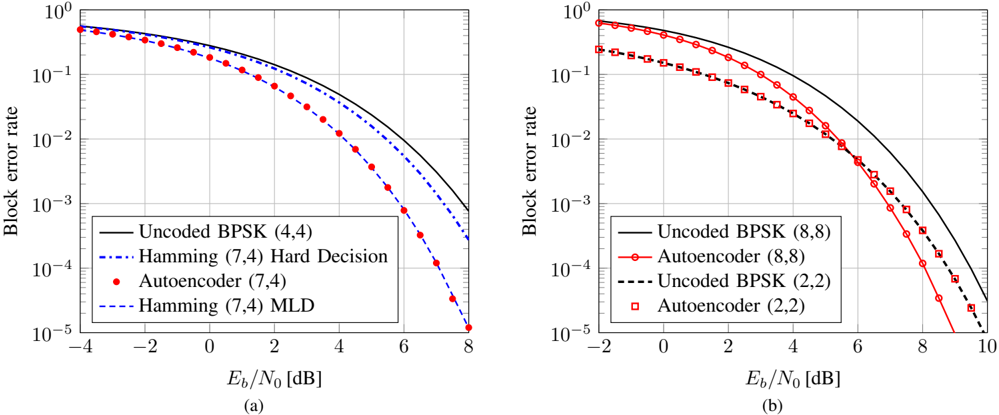
- A learned autoencoder for a (7,4) system at rate R = 4/7 achieves the same block error rate (BLER) as a Hamming (7,4) code with maximum likelihood decoding, while an (8,8) autoencoder outperforms uncoded BPSK over the full E_b/N_0 range, indicating learned joint coding and modulation.
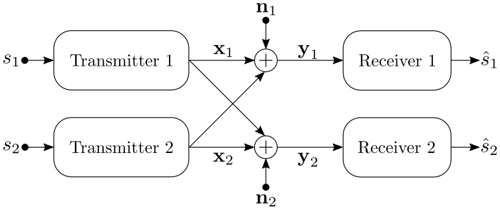
- For the two-user AWGN interference channel, the autoencoder matches time-sharing for (1,1) and (2,2), but achieves gains of about 0.7 dB for (4,4) and 1 dB for (4,8) at a BLER of 10^-3.
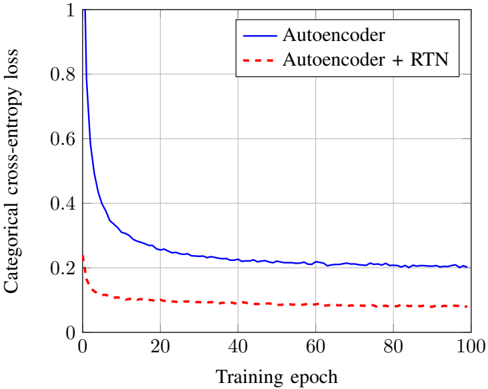
- An autoencoder (8,4) with an RTN over a multipath fading channel with L = 3 Rayleigh taps outperforms differential BPSK with maximum likelihood sequence estimation and a Hamming (7,4) code, whereas the plain autoencoder struggles to match it; RTNs also show faster training convergence.
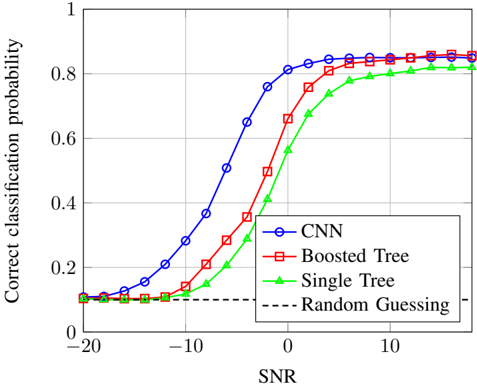
- For modulation classification on 1.2M sequences of 128 complex-valued IQ samples across ten modulation schemes and SNRs from -20 dB to 18 dB, the CNN outperforms a boosted expert-feature classifier by around 4 dB in the low-to-medium SNR range, with almost identical high-SNR performance; a single tree is about 6 dB worse at medium SNR and 3.5% worse at high SNR.
Methods
- The transmitter, channel, and receiver are represented as one deep neural network trained as an autoencoder: one-hot message input, dense layers, normalization layer for transmit constraints, additive noise channel layer, and softmax receiver output, trained with categorical cross-entropy using SGD/Adam at learning rate 0.001 and fixed E_b/N_0 = 7 dB.
- The autoencoder concept is extended to multiple transmitter-receiver pairs in a two-user interference channel, with dynamic loss weights α_t per mini-batch to balance the two cross-entropy losses; performance is compared against 2^{2k/n}-QAM with time-sharing.
- RTNs combine a learned parameter estimator, a differentiable parametric transform, and a discriminative network; the paper demonstrates phase-offset compensation and multipath inverse filtering. For modulation classification, a VGG-like CNN with 324,330 trainable parameters is trained on the RML2016.10b dataset.
Limitations
- The paper states that scalability to large message sets M is a major challenge: for k = 100 bits, training complexity is prohibitive because the autoencoder must see at least every message once.
- The paper states that optimal data representations, loss functions, training SNR, and hyperparameters are not well understood; training at one SNR does not necessarily generalize to others, and no common communications benchmarks or datasets comparable to MNIST or ImageNet exist.
- The paper states that end-to-end learning over real channels requires system identification because backpropagation assumes a known channel transfer function; complex-valued neural networks are not supported by current DL libraries. Evident from the text: the reported results are simulation-based, use small (n,k) settings, assume known channel models during training, and the paper explicitly leaves detailed performance comparisons for various channel types and parameters to future work.
Model-written summary. Check it against the paper before relying on it.
Integrity signals
Registry
Cites
Statistics
Figures






Verification
Claims the paper makes
6 Valid · 4 Not valid · 18 Not checked · 65 Own results and interpretations
Every source the paper cites for this claim was checked and supports it.
In the paper
“For instance in [22], it was shown that training with a single codeword is sufficient since the structure of the code is embedded in the NN through the Tanner graph.”
What the sources say
- Supportedcites [22] [22] E. Nachmani, Y. Be'ery, and D. Burshtein, 'Learning to decode linear codes using deep learning,' in Proc. IEEE Annu. Allerton Conf. Commun., Control, and Computing (Allerton) , 2016, pp. 341-346. - source
The Introduction says the decoder uses a Tanner graph representing the code and that one codeword suffices for training. Section III explains the precise condition: over a binary memoryless symmetric channel, the decoder’s error rate is independent of the transmitted codeword, so training can use noisy versions of a single codeword. (LLM, conf=0.91)
boostedstates a cause- Asserted: passes — The authors put it forward as true.
- Checkable: passes — It can be checked against evidence.
- Load-bearing: unclear — It is unclear whether the paper’s conclusions depend on it.
- Based: passes — The paper gives a reason why it holds.
- Supported
A result the paper reports from its own data — it cites no other source for it, so there is none to check. The quote shows it is in the paper.
In the paper
“We study the use of NNs on complex-valued IQ samples for the problem of modulation classification and show that convolutional neural networks (CNNs), which are the cornerstone of most DL systems for computer vision, can outperform traditional classification techniques based on expert features.”
plainstates a cause- Asserted: passes — The authors put it forward as true.
- Checkable: passes — It can be checked against evidence.
- Load-bearing: passes — The paper’s conclusions depend on it.
- Based: passes — The paper gives a reason why it holds.
The paper states this without a source or data behind it here, so there is nothing to check it against. The quote shows it is in the paper.
In the paper
“Training at low SNR for instance does not allow for the discovery of structure important in higher SNR scenarios.”
plainstates a cause- Asserted: passes — The authors put it forward as true.
- Checkable: passes — It can be checked against evidence.
- Load-bearing: unclear — It is unclear whether the paper’s conclusions depend on it.
- Based: unclear — It is unclear why the paper says it holds.
A result the paper reports from its own data — it cites no other source for it, so there is none to check. The quote shows it is in the paper.
In the paper
“Another advantage of RTNs is faster training convergence which can be seen from Fig. 10 that compares the validation loss of the autoencoder with and without RTN as a function of the training epochs.”
plainstates a cause- Asserted: passes — The authors put it forward as true.
- Checkable: passes — It can be checked against evidence.
- Load-bearing: unclear — It is unclear whether the paper’s conclusions depend on it.
- Based: passes — The paper gives a reason why it holds.
A result the paper reports from its own data — it cites no other source for it, so there is none to check. The quote shows it is in the paper.
In the paper
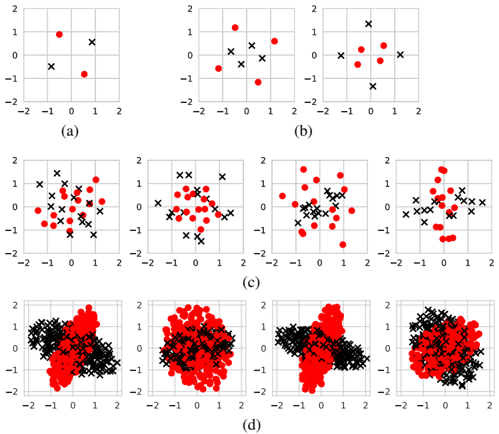
“Similarly, Fig. 4b shows a (4 , 2) system which leads to a rotated 16-PSK constellation.”
plainstates a cause- Asserted: passes — The authors put it forward as true.
- Checkable: passes — It can be checked against evidence.
- Load-bearing: unclear — It is unclear whether the paper’s conclusions depend on it.
- Based: passes — The paper gives a reason why it holds.
39 more claims
Create a free account to see all 93 claims and to verify the 4 references still open.
- Probably not a substantial claim. 29
- It may state two separate claims as one. 24
Self-check
Percentages, sums and reported differences re-computed from the paper’s own numbers.
Each contradiction between two passages listed here was confirmed by an independent check.
Rated minor: it would not touch a result — a value no result rests on, a p-value that stays on the same side of the significance level, or a conflict that is clerical, resolved elsewhere in the paper, or outside its own findings.
In the paper
§ A. Autoencoders for end-to-end communications systems · p. 5
“Similarly, Fig. 4b shows a (4 , 2) system which leads to a rotated 16-PSK constellation.”
§ A. Autoencoders for end-to-end communications systems · p. 6
“Figure 4: Constellations produced by autoencoders using parameters ( n, k ) : (a) (2 , 2) (b) (2 , 4) , (c) (2 , 4) with average power constraint, (d) (7 , 4) 2-dimensional t-SNE embedding of received symbols.”
Citations
Cites
Very Deep Convolutional Networks for Large-Scale Image Recognition
Simonyan, K., & Zisserman, A. (2014) · arXiv · doi:10.48550/arxiv.1409.1556 · Cited by 114,148 · cited 1×
“dense/fully-connected layers and terminated with a dense softmax layer for our classifier (similar to a VGG architecture [55]).”
BackgroundAdam: A Method for Stochastic Optimization
Kingma, D. P., & Ba, J. (2014) · arXiv · doi:10.48550/arxiv.1412.6980 · Cited by 98,946 · cited 4×
“Training was done at a fixed value of Eb/N0 = 7 dB (see Section IV-B) using Adam [46] with learning rate 0.”
BackgroundMethodInfluentialA Mathematical Theory of Communication
Shannon, C. E. (1948) · Bell System Technical Journal · doi:10.1002/j.1538-7305.1948.tb01338.x · Cited by 88,486
Scikit-learn: Machine Learning in Python
Pedregosa, F., Varoquaux, G., Gramfort, A., Michel, V., Thirion, B., Grisel, O., Blondel, M., Müller, A., Nothman, J., Louppe, G., et al. (2012) · arXiv · doi:10.48550/arxiv.1201.0490 · Cited by 71,016 · cited 1×
“11, we compare the classification accuracy of the CNN against that of extreme gradient boosting7 with 1000 estimators, as well as a single scikit-learn decision tree [56], operating on a mix of 16 analog and cumulant expert features as proposed in [53] and [57].”
Method(2014) · Cited by 33,419
(2008) · Journal of Machine Learning Research · Cited by 33,051
Human-level control through deep reinforcement learning
Mnih, V., Kavukcuoglu, K., Silver, D., Rusu, A. A., Veness, J., Bellemare, M. G., Graves, A., Riedmiller, M., Fidjeland, A. K., Ostrovski, G., et al. (2015) · Nature · doi:10.1038/nature14236 · Cited by 30,357
(2007) · Electronics: A First Course · doi:10.4324/9780080477527-64 · Cited by 24,923
Pan, S. J., & Yang, Q. (2010) · IEEE Transactions on Knowledge and Data Engineering · doi:10.1109/tkde.2009.191 · Cited by 23,387 · cited 1×
“learning [64] is one appealing candidate for adapting an endto-end communications system trained on a statistical model to”
BackgroundMultilayer feedforward networks are universal approximators
Hornik, K., Stinchcombe, M., & White, H. (1989) · Neural Networks · doi:10.1016/0893-6080(89)90020-8 · Cited by 21,728 · cited 1×
“Third, it has been shown that NNs are universal function approximators [13] and recent work has shown a remarkable”
Background
Research works printed but not linked: 2
- [35] I. Goodfellow, Y. Bengio, and A. Courville, Deep Learning . MIT Press, 2016. -
- [52] J. Estaran et al. , 'Artificial neural networks for linear and non-linear impairment mitigation in high-baudrate IM/DD systems,' in Proc. 42nd European Conf. Optical Commun. (ECOC) . VDE, 2016, pp. 1-3. -
Cited by
Items 201–300 of 2,995
Full-Duplex Backscatter Communications in Symbiotic Radio Systems
Long, R., Guo, H., Zhang, L., & Liang, Y. (2019) · IEEE Access · doi:10.1109/access.2019.2898474 · Cited by 107
“The BD can even exploit the adaptive QAM modulation according to the instantaneous CSI, and then the PR can adaptively classify the BD’s modulation schemes by some powerful deep learning tools [18]–[20].”
Intelligent integrated sensing and communication: a survey
Zhang, J., Lu, W., Xing, C., Zhao, N., Al‐Dhahir, N., Karagiannidis, G. K., & Yang, X. (2024) · Science China Information Sciences · doi:10.1007/s11432-024-4205-8 · Cited by 130
Safeguarding Next-Generation Multiple Access Using Physical Layer Security Techniques: A Tutorial
Lv, L., Xu, D., Hu, R. Q., Ye, Y., Yang, L. X., Lei, X., Wang, X., Kim, D. I., & Nallanathan, A. (2024) · Proceedings of the IEEE · doi:10.1109/jproc.2024.3420127 · Cited by 120
“In recent years, optimization methods based on ML have been rapidly developed in wireless communication [273], unsupervised DL strategies have been used to solve resource allocation problems [274].”
MethodSemantic Communications for Speech Signals
Weng, Z., Qin, Z., & Li, G. Y. (2021) · ICC 2021 - IEEE International Conference on Communications · doi:10.1109/icc42927.2021.9500590 · Cited by 96
Karanov, B., Lavery, D., Bayvel, P., & Schmalen, L. (2019) · Optics Express · doi:10.1364/oe.27.019650 · Cited by 108
“The complete optical communication system is implemented as an end-to-end deep neural network as in [4], following the idea of [2].”
MethodThe Role of 6G Technologies in Advancing Smart City Applications: Opportunities and Challenges
Sharma, S. K., Popli, R., Singh, S. P., Chhabra, G., Saini, G. S., Singh, M., Sandhu, A., Sharma, A., & Kumar, R. (2024) · Sustainability · doi:10.3390/su16167039 · Cited by 128
Pervasive intelligent endogenous 6G wireless systems: Prospects, theories and key technologies
Chen, Y., Liu, W., Niu, Z., Feng, Z., Hu, Q., & Jiang, T. (2020) · Digital Communications and Networks · doi:10.1016/j.dcan.2020.07.002 · Cited by 115
Deep Learning Based End-to-End Wireless Communication Systems Without Pilots
Ye, H., Li, G. Y., & Juang, B.-H. F. (2021) · IEEE Transactions on Cognitive Communications and Networking · doi:10.1109/tccn.2021.3061464 · Cited by 130
Elfatih, N. M., Hasan, M. K., Kamal, Z., Gupta, D., Saeed, R. A., Ali, E. S., & Hosain, M. S. (2021) · IET Communications · doi:10.1049/cmu2.12315 · Cited by 124
An improved faster-RCNN model for handwritten character recognition
Albahli, S., Nawaz, M., Javed, A., & Irtaza, A. (2021) · Arabian Journal for Science and Engineering · doi:10.1007/s13369-021-05471-4 · Cited by 107
AI-RAN in 6G Networks: State-of-the-Art and Challenges
Khani, N. A. K. K., & Schmid, S. (2023) · IEEE Open Journal of the Communications Society · doi:10.1109/ojcoms.2023.3343069 · Cited by 136
“In such complex scenarios, AI/ML/DL has become an important aspect that plays a central role in solving complex problems such as self-healing, self-optimization, and self-configuration in intelligent networks [14].”
Zhang, P., Xu, W., Liu, Y., Qin, X., Niu, K., Cui, S. R., Shi, G., Qin, Z., Xu, X., Wang, F., et al. (2024) · IEEE Communications Surveys & Tutorials · doi:10.1109/comst.2024.3443193 · Cited by 155
“O’Shea and Hoydis [72] implemented a differentiable binary phase-shift keying (BPSK) method using the fully convolutional network (FCN).”
A CNN-Based End-to-End Learning Framework Toward Intelligent Communication Systems
Wu, N., Wang, X., Lin, B., & Zhang, K. (2019) · IEEE Access · doi:10.1109/access.2019.2926843 · Cited by 114
“The simple yet powerful autoencoder system [19] evolved further in [13] with the help of radio transformer networks [20] as a means to combine expert domain knowledge in a DL model.”
BackgroundMethodDeep Learning of Geometric Constellation Shaping Including Fiber Nonlinearities
Jones, R. T., Eriksson, T. A., Yankov, M. P., & Zibar, D. (2018) · European Conference on Optical Communication · doi:10.1109/ecoc.2018.8535453 · Cited by 101
Salient Object Detection Techniques in Computer Vision—A Survey
Gupta, A. K., Seal, A., Prasad, M., & Khanna, P. (2020) · Entropy · doi:10.3390/e22101174 · Cited by 111
“Researchers from diverse fields such as natural language processing [3,137], computer networks [138–140], stock market analysis [141,142], document analysis and recognition [143,144], and of course computer vision [55–63] have effectively leveraged deep-learning to devise models that achieve…”
BackgroundScoring the Terabit/s Goal:Broadband Connectivity in 6GPreprint
Rajatheva, N., Atzeni, I., Bicaïs, S., Björnson, E., Bourdoux, A., Buzzi, S., D’Andrea, C., Doré, J., Erküçük, S., Fuentes, M., et al. (2020) · arXiv (Cornell University) · doi:10.48550/arxiv.2008.07220 · Cited by 123
“A model similar to the model proposed in [300] is implemented with slight variations [309].”
MethodDeep Learning for SVD and Hybrid Beamforming
Peken, T., Adiga, S., Tandon, R., & Bose, T. (2020) · IEEE Transactions on Wireless Communications · doi:10.1109/twc.2020.3004386 · Cited by 106
“In [14], the authors study the use of convolutional neural”
BackgroundGenerative AI for Secure Physical Layer Communications: A Survey
Zhao, C., Du, H., Niyato, D. T., Kang, J., Xiong, Z., Kim, D. I., Shen, X., & Letaief, K. B. (2024) · IEEE Transactions on Cognitive Communications and Networking · doi:10.1109/tccn.2024.3438379 · Cited by 141
“Due to its ability to thoroughly learn data features via unsupervised or self-supervised learning, GAI can adapt to changing environmental factors in communication systems, ensuring continuous maintenance of robust security measures [22].”
Deep Learning for Decoding of Linear Codes - A Syndrome-Based Approach
Bennatan, A., Choukroun, Y., & Kisilev, P. (2018) · IEEE International Symposium on Information Theory (ISIT) · doi:10.1109/isit.2018.8437530 · Cited by 104
Spectrum Prediction Based on Taguchi Method in Deep Learning With Long Short-Term Memory
Yu, L. M., Chen, J., Ding, G., Tu, Y., Yang, J., & Sun, J. (2018) · IEEE Access · doi:10.1109/access.2018.2864222 · Cited by 102
“Its deep architecture and ingenious structural design make deep learning have better power to model and tackle certain problem, achieving outstanding performance in computer vision [14], natural language processing [15] and other fields [16], [17].”
BackgroundUL-CSI Data Driven Deep Learning for Predicting DL-CSI in Cellular FDD Systems
Wang, J., Ding, Y., Bian, S., Peng, Y., Liu, M., & Gui, G. (2019) · IEEE Access · doi:10.1109/access.2019.2929091 · Cited by 105
“Fortunately, with the development of the deep neural networks (DNN), machine learning, especially deep learning, has been applied in wireless communications [12], such as channel estimation [13], [14], channel feedback [11], signal detection [15], [16], beamforming [17], resource allocation [18], and modulated signal…”
BackgroundJoint Learning of Geometric and Probabilistic Constellation Shaping
Stark, M., Aoudia, F. A., & Hoydis, J. (2019) · IEEE Globecom Workshops (GC Wkshps) · doi:10.1109/gcwkshps45667.2019.9024567 · Cited by 122
“This idea was pioneered in [1], and has led to many extensions [5]–[8].”
BackgroundMethodInfluentialSelf-citationArtificial Intelligence Techniques for Next-Generation Massive Satellite Networks
Homssi, B. A., Dakic, K., Wang, K., Alpcan, T., Allen, B., Boyce, R., Kandeepan, S., Al‐Hourani, A., & Saad, W. (2023) · IEEE Communications Magazine · doi:10.1109/mcom.004.2300277 · Cited by 97
“Different AI architectures such as multi-layer perceptron (MLP), CNN, and RNN can be employed for signal detection [8].”
MethodIntelligent Wireless Communications Enabled by Cognitive Radio and Machine LearningPreprint
Zhou, X., Sun, M., Li, G. Y., & Juang, B.-H. F. (2017) · arXiv (Cornell University) · doi:10.48550/arxiv.1710.11240 · Cited by 113
Han, S., Xie, T., Chih‐Lin, I., Chai, L., Liu, Z., Yuan, Y., & Cui, C. (2020) · IEEE Communications Magazine · doi:10.1109/mcom.001.2000218 · Cited by 108
“…PHY layer design strongly evokes the application of general hardware hardware, which could implement various functions algorithms with similar hardware architecture The utilization of general hardware offers much convenience in wireless network upgrade, which helps to reduce the network…”
BackgroundPhysical layer deep learning of encodings for the MIMO fading channel
O’Shea, T. J., Erpek, T., & Clancy, T. C. (2017) · Allerton Conference on Communication, Control, and Computing · doi:10.1109/allerton.2017.8262721 · Cited by 94
“The idea of the channel autoencoder [8], [11] applies deep unsupervised learning with a reconstruction loss function to jointly optimize encoding, decoding, and signal representation over some impaired communications channel.”
BackgroundMethodSelf-citationIntelligent Radio Signal Processing: A Survey
Pham, Q., Nguyen, N. T., Huynh‐The, T., Le, L. B., Lee, K., & Hwang, W. (2021) · IEEE Access · doi:10.1109/access.2021.3087136 · Cited by 99
“The concept of end-to-end DL was first introduced in 2017 [8] to model the entire physical communication as”
BackgroundMethodInfluentialOver-the-Air Adversarial Attacks on Deep Learning Based Modulation Classifier over Wireless Channels
Kim, B., Sagduyu, Y. E., Davaslıoğlu, K., Erpek, T., & Ulukuş, Ş. (2020) · Conference on Information Sciences and Systems · doi:10.1109/ciss48834.2020.1570617416 · Cited by 99
“We use VT-CNN2 classifier used in [9] and [10], and train it with GNU radio ML dataset RML2016.”
BackgroundMethodBaek, M.-S., Kwak, S., Jung, J.-Y., Kim, H. M., & Choi, D.-J. (2019) · IEEE Transactions on Broadcasting · doi:10.1109/tbc.2019.2891051 · Cited by 94
“Especially, many deep learning researches on communication engineering area are actively investigated in recent years [4]–[6].”
BackgroundAutomatic Modulation Classification for MIMO Systems via Deep Learning and Zero-Forcing Equalization
Wang, Y., Gui, J., Yin, Y., Wang, J., Sun, J., Gui, G., Gacanin, H., Sari, H., & Adachi, F. (2020) · IEEE Transactions on Vehicular Technology · doi:10.1109/tvt.2020.2981995 · Cited by 102
“T. J. Oshea et al ., firstly proposed a convolutional neuron network (CNN)-based AMC method, trained on a large number of IQ samples, and achieved outstanding performances [22].”
MethodInterference Suppression Using Deep Learning: Current Approaches and Open Challenges
Oyedare, T., Shah, V. K., Jakubisin, D. J., & Reed, J. H. (2022) · IEEE Access · doi:10.1109/access.2022.3185124 · Cited by 114
RNN Decoding of Linear Block Codes
Nachmani, E., Marciano, E., Burshtein, D., & Be'ery, Y. (2017) · arXiv · doi:10.48550/arxiv.1702.07560 · Cited by 93
Adaptive Spatial Modulation MIMO Based on Machine Learning
Yang, P., Xiao, Y., Xiao, M., Guan, Y. L., Li, S., & Xiang, W. (2019) · IEEE Journal on Selected Areas in Communications · doi:10.1109/jsac.2019.2929404 · Cited by 101
Neural Networks-Based Equalizers for Coherent Optical Transmission: Caveats and Pitfalls
Freire, P. J., Napoli, A., Spinnler, B., Costa, N. M. S., Turitsyn, S. K., & Prilepsky, J. E. (2022) · IEEE Journal of Selected Topics in Quantum Electronics · doi:10.1109/jstqe.2022.3174268 · Cited by 108
Lei, L., Lagunas, E., Yuan, Y., Kibria, M. G., Chatzinotas, S., & Ottersten, B. (2020) · IEEE Access · doi:10.1109/access.2020.3011746 · Cited by 107
“, machine learning techniques in in physical layer communications [14], deep learning for power allocation [15] and scheduling [16], [17], Q-learning for power control [18] and interference control [19].”
BackgroundPower Allocation in Multi-User Cellular Networks with Deep Q Learning Approach
Meng, F., Chen, P., & Wu, L. (2019) · ICC 2019 - 2019 IEEE International Conference on Communications (ICC) · doi:10.1109/icc.2019.8761431 · Cited by 87
Zhu, M., Li, Y., Pan, Z., & Yang, J. W. (2019) · Signal Processing · doi:10.1016/j.sigpro.2019.107393 · Cited by 91
SSRCNN: A Semi-Supervised Learning Framework for Signal Recognition
Dong, Y., Jiang, X., Cheng, L., & Shi, Q. (2021) · IEEE Transactions on Cognitive Communications and Networking · doi:10.1109/tccn.2021.3067916 · Cited by 95
The Best Defense Is a Good Offense: Adversarial Attacks to Avoid Modulation Detection
Hameed, M. Z., György, A., & Gündüz, D. (2020) · IEEE Transactions on Information Forensics and Security · doi:10.1109/tifs.2020.3025441 · Cited by 101
“Note that QAM16 and QAM64 are very difficult to classify even without any perturbations, which is in line with the observation made in [8].”
MethodResultInfluentialGu, H., Wang, Y., Hong, S., & Gui, G. (2019) · IEEE Access · doi:10.1109/access.2019.2934354 · Cited by 116
“Actually, the CNN architecture [21] is a neural network containing multiple hidden layers, each of which has several twodimensional planes consisting of several neurons.”
BackgroundIn-Network Machine Learning Using Programmable Network Devices: A Survey
Zheng, C., Hong, X., Ding, D., Vargaftik, S., Ben-Itzhak, Y., & Zilberman, N. (2023) · IEEE Communications Surveys & Tutorials · doi:10.1109/comst.2023.3344351 · Cited by 123
Artificial neural networks for photonic applications—from algorithms to implementation: tutorial
Freire, P. J., Manuylovich, E. S., Prilepsky, J. E., & Turitsyn, S. K. (2023) · Advances in Optics and Photonics · doi:10.1364/aop.484119 · Cited by 111
Physical-Layer Adversarial Robustness for Deep Learning-Based Semantic Communications
Nan, G., Li, Z., Zhai, J., Cui, Q., Chen, G., Du, X., Zhang, X., Tao, X., Han, Z., & Quek, T. Q. S. (2023) · IEEE Journal on Selected Areas in Communications · doi:10.1109/jsac.2023.3288249 · Cited by 114
“[16], [17] have been proposed recently, which employ an”
BackgroundRobust Adversarial Attacks Against DNN-Based Wireless Communication Systems
Bahramali, A., Nasr, M., Houmansadr, A., Goeckel, D., & Towsley, D. (2021) · ACM SIGSAC Conference on Computer and Communications Security (CCS) · doi:10.1145/3460120.3484777 · Cited by 116
“…major DNN-based wireless communication applications , as introduced below: End-to-End Autoencoder Communication Systems: DNNs are used for end-to-end learning of communication systems using autoencoders [23], [24], [26], and they can outperform the contemporary modularized design of these systems.”
InfluentialLEARN Codes: Inventing Low-Latency Codes via Recurrent Neural Networks
Jiang, Y., Kim, H., Asnani, H., Kannan, S., Oh, S., & Viswanath, P. (2020) · IEEE Journal on Selected Areas in Information Theory · doi:10.1109/jsait.2020.2988577 · Cited by 87
“This has generated recent excitement in applying deep learning methods to communication system design [16] [17].”
BackgroundMethodA Graph Neural Network Approach for Scalable Wireless Power Control
Shen, Y., Shi, Y., Zhang, J., & Letaief, K. B. (2019) · 2019 IEEE Globecom Workshops (GC Wkshps) · doi:10.1109/gcwkshps45667.2019.9024538 · Cited by 87
“The receivers are uniformly distributed within [2, 10] meters away from the transmitter.”
BackgroundEl-Hajj, M. I. (2025) · Network · doi:10.3390/network5010001 · Cited by 122
Karanov, B., Lavery, D., Bayvel, P., & Schmalen, L. (2019) · Repository KITopen (Karlsruhe Institute of Technology) · doi:10.5445/ir/1000096544 · Cited by 86
YOLOShipTracker: Tracking ships in SAR images using lightweight YOLOv8
Yasir, M., Liu, S., Pirasteh, S., Xu, M., Sheng, H., Wan, J., de Figueiredo, F. A. P., Aguilar, F. J., & Li, J. (2024) · International Journal of Applied Earth Observation and Geoinformation · doi:10.1016/j.jag.2024.104137 · Cited by 121
Artificial Intelligence for 6G Networks: Technology Advancement and Standardization
Shehzad, M. K., Rose, L., Butt, M. M., Kovács, I. Z., Assaad, M., & Guizani, M. (2022) · IEEE Vehicular Technology Magazine · doi:10.1109/mvt.2022.3164758 · Cited by 86
“, supporting channel acquisition [3] and modulation classification [4] at PHY.”
BackgroundMethodPhotonic neural networks and optics-informed deep learning fundamentals
Tsakyridis, A., Moralis‐Pegios, M., Giamougiannis, G., Kirtas, M., Passalis, N., Tefas, A., & Pleros, N. (2024) · APL Photonics · doi:10.1063/5.0169810 · Cited by 94
Learning-Driven Wireless Communications, towards 6G
Piran, M. J., & Suh, D. Y. (2019) · 2019 International Conference on Computing, Electronics & Communications Engineering (iCCECE) · doi:10.1109/iccece46942.2019.8941882 · Cited by 61
Deep Learning-Based Sphere Decoding
Mohammadkarimi, M., Mehrabi, M., Ardakani, M., & Jing, Y. (2019) · IEEE Transactions on Wireless Communications · doi:10.1109/twc.2019.2924220 · Cited by 90
Distributed Learning for Automatic Modulation Classification in Edge Devices
Wang, Y., Guo, L., Zhao, Y., Yang, J., Adebisi, B., Gacanin, H., & Gui, G. (2020) · IEEE Wireless Communications Letters · doi:10.1109/lwc.2020.3016822 · Cited by 87
“O’Shea and Hoydis firstly applied the convolutional neural network (CNN) into AMC [12], and the classification performance of the CNN is far beyond that of the traditional methods based on manmade features and machine learning.”
MethodSNR-Adaptive Deep Joint Source-Channel Coding for Wireless Image Transmission
Ding, M., Li, J., Ma, M., & Fan, X. (2021) · IEEE International Conference on Acoustics Speech and Signal Processing · doi:10.1109/icassp39728.2021.9414037 · Cited by 97
Deep Learning Based Channel Estimation for MIMO Systems With Received SNR Feedback
Kang, J., Chun, C.-J., & Kim, I. (2020) · IEEE Access · doi:10.1109/access.2020.3006518 · Cited by 92
“Particularly, to address all above issues intelligently and effectively, we exploit the deep learning technique, which has recently gained an upsurge of research interest including in the area of wireless communications [13]–[21].”
BackgroundMethodResultInfluentialTask offloading in edge computing for machine learning-based smart healthcare
Aazam, M., Zeadally, S., & Flushing, E. F. (2021) · Computer Networks · doi:10.1016/j.comnet.2021.108019 · Cited by 98
Machine learning for optical fiber communication systems: An introduction and overview
Nevin, J. W., Nallaperuma, S., Shevchenko, N. A., Li, X., Faruk, M. S., & Savory, S. J. (2021) · APL Photonics · doi:10.1063/5.0070838 · Cited by 95
Massive MIMO is a Reality -- What is Next? Five Promising Research Directions for Antenna ArraysPreprint
Björnson, E., Sanguinetti, L., Wymeersch, H., Hoydis, J., & Marzetta, T. L. (2019) · arXiv (Cornell University) · doi:10.48550/arxiv.1902.07678 · Cited by 82
“Some recent examples include MIMO detection [141], blind channel equalization [142], channel estimation [143] and feedback [144], Massive MIMO power control [145], [146], user positioning [90], as well as full learning of transceiver implementations [147].”
MethodSelf-citationTransferred deep learning based waveform recognition for cognitive passive radar
Wang, Q., Du, P., Yang, J., Wang, G., Lei, J., & Hou, C. (2018) · Signal Processing · doi:10.1016/j.sigpro.2018.09.038 · Cited by 83
Compression and Acceleration of Neural Networks for Communications
Guo, J., Wang, J., Wen, C.-K., Jin, S., & Li, G. Y. (2020) · IEEE Wireless Communications · doi:10.1109/mwc.001.1900473 · Cited by 86
A Compressive Sensing Approach for Federated Learning Over Massive MIMO Communication Systems
Jeon, Y., Amiri, M. M., Li, J., & Poor, H. V. (2020) · IEEE Transactions on Wireless Communications · doi:10.1109/twc.2020.3038407 · Cited by 91
“…been demonstrated that the learned model can be exploited either to improve the performance of conventional model-based techniques (e.g., [3], [4]) or to describe an unknown input-output relation whose characterization was otherwise challenging due to mathematical intractability (e.g., [5], [6]).”
BackgroundMoura, J., & Hutchison, D. (2020) · Journal of Network and Computer Applications · doi:10.1016/j.jnca.2020.102784 · Cited by 95
Deep Learning at the Physical Layer: System Challenges and Applications to 5G and Beyond
Restuccia, F., & Melodia, T. (2020) · IEEE Communications Magazine · doi:10.1109/mcom.001.2000243 · Cited by 88
Deep Learning-Based Channel Estimation and Equalization Scheme for FBMC/OQAM Systems
Cheng, X., Liu, D., Wang, C., Song, Y., & Zhu, Z. (2019) · IEEE Wireless Communications Letters · doi:10.1109/lwc.2019.2898437 · Cited by 85
“Due to its strong ability to learn, recognize and predict, DL has also been introduced into communication systems especially for the physical layer [7].”
BackgroundMohsan, S. A. H., Li, Y., Shvetsov, A. V., Aldás, J. V., Mostafa, S. M., & Elfikky, A. (2023) · Sensors · doi:10.3390/s23062946 · Cited by 91
Achievable Information Rates for Nonlinear Fiber Communication via End-to-end Autoencoder Learning
Shen, L., Häger, C., Garcia, N., & Wymeersch, H. (2018) · European Conference on Optical Communication · doi:10.1109/ecoc.2018.8535456 · Cited by 77
Matthiesen, B., Zappone, A., Besser, K.-L., Jorswieck, E. A., & Debbah, M. A. (2020) · IEEE Transactions on Signal Processing · doi:10.1109/tsp.2020.3000328 · Cited by 90
“Finally, having efficient global optimization algorithms represents a key requirement also for the use of deep learning in wireless communications, a topic that has been gaining momentum recently [16], [17].”
BackgroundUnsupervised Deep Spectrum Sensing: A Variational Auto-Encoder Based Approach
Xie, J., Fang, J., Liu, C., & Yang, L. (2020) · IEEE Transactions on Vehicular Technology · doi:10.1109/tvt.2020.2982203 · Cited by 93
“In [31]–[33], the autoencoder structure was exploited in joint modulation-demodulation optimization.”
MethodA Novel OFDM Autoencoder Featuring CNN-Based Channel Estimation for Internet of Vessels
Lin, B., Wang, X., Yuan, W., & Wu, N. (2020) · IEEE Internet of Things Journal · doi:10.1109/jiot.2020.2986442 · Cited by 80
“In particular, the pioneering work of O’Shea and Hoydis [7] and O’Shea et al.”
BackgroundGraph Deep Learning: State of the Art and Challenges
Georgousis, S., Kenning, M. P., & Xie, X. (2021) · IEEE Access · doi:10.1109/access.2021.3055280 · Cited by 86
“The wide variety of fields in which CNNs have been effective include engineering, in fault detection [6], communications [7] and networking with applications ranging from web search [8] to encrypted traffic classification [9].”
BackgroundRole of Deep Learning in Wireless Communications
Yu, W., Sohrabi, F., & Jiang, T. (2022) · IEEE BITS the Information Theory Magazine · doi:10.1109/mbits.2022.3212978 · Cited by 94
AI-Aided Online Adaptive OFDM Receiver: Design and Experimental Results
Jiang, P., Wang, T., Han, B., Gao, X., Zhang, J., Wen, C.-K., Jin, S., & Li, G. Y. (2021) · IEEE Transactions on Wireless Communications · doi:10.1109/twc.2021.3087191 · Cited by 80
“[8]–[11] revealed the benefits of AI in physical layer of communications.”
BackgroundDeep Learning for Massive MIMO Uplink Detectors
Albreem, M. A. M., Alhabbash, A., Shahabuddin, S., & Juntti, M. J. (2021) · IEEE Communications Surveys & Tutorials · doi:10.1109/comst.2021.3135542 · Cited by 97
“• It has a superior algorithmic learning ability despite the complex channel conditions [29].”
BackgroundMachine Learning Threatens 5G Security
Suomalainen, J., Juhola, A., Shahabuddin, S., Mämmelä, A., & Ahmad, I. (2020) · IEEE Access · doi:10.1109/access.2020.3031966 · Cited by 92
“In much of the literature, the training is done offline due to the complexity and time required for the training algorithm [91], [92].”
BackgroundTeng, C.-F., Chou, C.-Y., Chen, C., & Wu, A.-Y. A. (2020) · IEEE Transactions on Vehicular Technology · doi:10.1109/tvt.2020.3041843 · Cited by 76
“Additionally, there are also some works adopting this concept to design their own networks in order to overcome common channel impairments, such as radio transformer network in [44], [45] and channel compensation network in our previous work [33].”
BackgroundDeep Learning for Large-Scale Real-World ACARS and ADS-B Radio Signal Classification
Chen, S., Zheng, S., Yang, L., & Yang, X. (2019) · IEEE Access · doi:10.1109/access.2019.2925569 · Cited by 81
“In recent years, with the development of deep learning [7], [8] technology, it has been widely used in the fields of image recognition [9], [10], speech recognition [11], natural language processing [12], and wireless communications [13]–[20].”
BackgroundISAC-NET: Model-Driven Deep Learning for Integrated Passive Sensing and Communication
Jiang, W., Ma, D., Wei, Z., Feng, Z., Zhang, P., & Peng, J. (2024) · IEEE Transactions on Communications · doi:10.1109/tcomm.2024.3375818 · Cited by 97
“ComNet uses neural network to expand the modules in traditional processing methods, and obtains more application-specific hyper-parameters through training, which reduces the computational complexity and improves the processing performance compared with traditional methods [19].”
BackgroundMethodMatrix-Inverse-Free Deep Unfolding of the Weighted MMSE Beamforming Algorithm
Pellaco, L., Bengtsson, M., & Jaldén, J. (2021) · IEEE Open Journal of the Communications Society · doi:10.1109/ojcoms.2021.3139858 · Cited by 90
Robust Wireless Fingerprinting via Complex-Valued Neural Networks
Gopalakrishnan, S., Cekic, M., & Madhow, U. (2019) · Globecom · doi:10.1109/globecom38437.2019.9013154 · Cited by 72
“A purely learning based approach was studied in [3, 14], albeit for modulation recognition and not device fingerprinting.”
BackgroundMehrabi, M., Mohammadkarimi, M., Ardakani, M., & Jing, Y. (2019) · IEEE Journal on Selected Areas in Communications · doi:10.1109/jsac.2019.2934004 · Cited by 77
“DL can fix this drawback in communication and information theory and offer algorithms without mathematically tractable models [18].”
BackgroundAnton-Haro, C., & Mestre, X. (2019) · IEEE Access · doi:10.1109/access.2019.2895594 · Cited by 71
Deep Learning-Empowered Semantic Communication Systems With a Shared Knowledge Base
Yi, P., Cao, Y., Kang, X., & Liang, Y. (2023) · IEEE Transactions on Wireless Communications · doi:10.1109/twc.2023.3330744 · Cited by 93
“…communication system design as an end-to-end reconstruction task, isolated functions (e.g., source/channel coding and modulation) are replaced with deep neural networks (DNNs), which allows the transmitter and receiver to be jointly optimized for information compression and noise resistance [14].”
BackgroundAutomatic Modulation Classification Scheme Based on LSTM With Random Erasing and Attention Mechanism
Chen, Y., Shao, W., Liu, J., Yu, L., & Qian, Z. (2020) · IEEE Access · doi:10.1109/access.2020.3017641 · Cited by 78
Automatic Modulation Recognition Based on Adaptive Attention Mechanism and ResNeXt WSL Model
Liang, Z. J., Tao, M., Wang, L., Su, J., & Yang, X. (2021) · IEEE Communications Letters · doi:10.1109/lcomm.2021.3093485 · Cited by 70
Deep Learning-Aided 5G Channel Estimation
Ha, A. L., Chien, T. V., Nguyễn, T. H., Choi, W., & Nguyễn, V. Đ. (2021) · International Conference on Ubiquitous Information Management and Communication (IMCOM) · doi:10.1109/imcom51814.2021.9377351 · Cited by 69
“Machine learning has recently drawn much attention in various applications of wireless communications such as radio resource allocation, signal decoding, and channel estimation [10]–[13].”
BackgroundJoint Detection and Classification of RF Signals Using Deep Learning
Vagollari, A., Schram, V., Wicke, W., Hirschbeck, M., & Gerstacker, W. (2021) · IEEE Vehicular Technology Conference · doi:10.1109/vtc2021-spring51267.2021.9449073 · Cited by 71
“After remarkable corresponding results in computer vision, natural language processing, and automatic speech recognition, further studies have shown that DL holds great potential for various communication tasks, including signal detection and classification [5].”
MethodResultBlind Channel Equalization Using Variational Autoencoders
Caciularu, A., & Burshtein, D. (2018) · IEEE International Conference on Communications workshops · doi:10.1109/iccw.2018.8403666 · Cited by 71
Unsupervised Linear and Nonlinear Channel Equalization and Decoding Using Variational Autoencoders
Caciularu, A., & Burshtein, D. (2020) · IEEE Transactions on Cognitive Communications and Networking · doi:10.1109/tccn.2020.2990773 · Cited by 72
“For example, in [1]–[4] deep learning methods were considered to solve the problem of channel decoding, in [5] an autoencoder for short blocklength end-to-end communications was proposed, and in [6] deep learning was used for MIMO detection.”
MethodAdversarial Examples in RF Deep Learning: Detection and Physical Robustness
Kokalj-Filipović, S., Miller, R., & Vanhoy, G. (2019) · IEEE Global Conference on Signal and Information Processing · doi:10.1109/globalsip45357.2019.8969138 · Cited by 78
“The recent success of deep-learning (DL) approaches to radio frequency (RF) signal processing tasks such as modulation classification and waveform design have prompted research into the possibility of augmenting or replacing many existing signal processing algorithms with machine learning (ML) models [1], [2].”
BackgroundIntelligent Massive MIMO Antenna Selection Using Monte Carlo Tree Search
Chen, J., Chen, S., Qi, Y., & Fu, S. (2019) · IEEE Transactions on Signal Processing · doi:10.1109/tsp.2019.2940128 · Cited by 71
“encoder-based modulation signal processing method is proposed in [34], where the transmitting signal is generated autonomously following the changing of the channel.”
MethodDeep UL2DL: Data-Driven Channel Knowledge Transfer From Uplink to Downlink
Safari, M. S., Pourahmadi, V., & Sodagari, S. (2019) · IEEE Open Journal of Vehicular Technology · doi:10.1109/ojvt.2019.2962631 · Cited by 83
“Deep learning has been also used in physical layer communications [16]–[23].”
BackgroundMethodBit-Level Optimized Neural Network for Multi-Antenna Channel Quantization
Lu, C., Xu, W., Jin, S., & Wang, K. (2019) · IEEE Wireless Communications Letters · doi:10.1109/lwc.2019.2942908 · Cited by 75
From Learning to Meta-Learning: Reduced Training Overhead and Complexity for Communication Systems
Simeone, O., Park, S., & Kang, J. (2020) · Joint European Conference on Networks and Communications & 6G Summit (EuCNC/6G Summit) · doi:10.1109/6gsummit49458.2020.9083856 · Cited by 73
“For instance, an encoder and decoder pair trained by minimizing an average performance loss over a given fading channel distribution can only perform as well as a non-coherent modulation and coding scheme [6].”
BackgroundMethodInfluentialQuantum Neural Networks for Resource Allocation in Wireless Communications
Narottama, B., & Shin, S. Y. (2021) · IEEE Transactions on Wireless Communications · doi:10.1109/twc.2021.3102139 · Cited by 72
“A neural network (NN), which is often a network of simple functions (i.e., neurons ), is a promising alternative for obtaining near-optimal solutions [4].”
BackgroundA Radio Signal Recognition Approach Based on Complex-Valued CNN and Self-Attention Mechanism
Liang, Z. J., Tao, M., Xie, J. B., Yang, X., & Wang, L. (2022) · IEEE Transactions on Cognitive Communications and Networking · doi:10.1109/tccn.2022.3179450 · Cited by 69
“The reason is the small signal observation window in the two datasets which causes an excessive loss of modulation information [52].”
BackgroundFeng, L., Zhu, S., Zhou, L., Zhao, Y., Bao, Y., Zhang, C., & He, Y. (2019) · IEEE Access · doi:10.1109/access.2019.2917267 · Cited by 71
“4.0 (MXNetAmazon, Seattle, WA, USA) [51].”
InfluentialEnhancing Automatic Modulation Recognition Through Robust Global Feature Extraction
Qu, Y., Lu, Z., Zeng, R., Wang, J., & Wang, J. (2024) · IEEE Transactions on Vehicular Technology · doi:10.1109/tvt.2024.3486079 · Cited by 81
“Index Terms —Automatic modulation recognition, transformer, LSTM, deep learning, data augmentation.”
Successive Refinement of Images with Deep Joint Source-Channel Coding
Kurka, D. B., & Gündüz, D. (2019) · 2019 IEEE 20th International Workshop on Signal Processing Advances in Wireless Communications (SPAWC) · doi:10.1109/spawc.2019.8815416 · Cited by 67
“In particular, the similarities between the autoencoder architecture and the digital communication systems have motivated many studies including decoder design for existing channel codes [6], [7], blind channel equalization [8], learning codes for SISO [9] and MIMO [10] systems, OFDM systems [11], [12], JSCC of text m…”
BackgroundDeep Learning Framework for Wireless Systems: Applications to Optical Wireless Communications
Lee, H., Lee, S. H., Quek, T. Q. S., & Lee, I. (2019) · IEEE Communications Magazine · doi:10.1109/mcom.2019.1800584 · Cited by 67
Metadata
- Authors
- O'Shea, T., & Hoydis, J.
- Affiliations
- Nokia (France) (FR)
- Venue
- IEEE Transactions on Cognitive Communications and Networking
- Published
- 2017-12
- Volume
- 3
- Issue
- 4
- Pages
- 563-575
- ISSN
- 2332-7731 (ISSN-L)
- OpenAlex
- W2734408173
- Semantic Scholar
- 78989616eeeac55b202e3e4205225e7135054185
- Cited by
- 2,980
- References
- 69
- Citations by year
- 2026: 307 · 2025: 327 · 2024: 305 · 2023: 368 · 2022: 432 · 2021: 409 · 2020: 406 · 2019: 322 · 2018: 95 · 2017: 9
- FWCI
- 122.29
- Type
- journal article
- Language
- en
- Open access
- green
- arxiv.org
- Locations
- IEEE Transactions on Cognitive Communications and Networking (publishedVersion)
- arXiv (Cornell University) (submittedVersion)
- arXiv (Cornell University)
- Topics
- Physical Sciences › Computer Science › Artificial Intelligence › Wireless Signal Modulation Classification
- Physical Sciences › Engineering › Electrical and Electronic Engineering › Advanced Wireless Communication Techniques
- Physical Sciences › Engineering › Electrical and Electronic Engineering › Advanced Wireless Communication Technologies
- Keywords
- end-to-end reconstruction, domain knowledge integration, convolutional neural networks, automatic modulation classification, IQ samples
About these checks
Registry, retraction, Cites and statistics results are computed, not judged, with one exception: a printed reference that no index lists is read once by a model before it counts as a citation error. Claims are extracted by a model and kept only when their quote appears verbatim in the text; each cited source is then checked, with a model’s help, for whether it says what the claim relies on. Those verdicts can be wrong — read the claim’s quote and the cited source before relying on one.
The claim verdicts this report counts are experimental: their accuracy is not yet measured.
A language model drew the claims from the paper on 2026-11-07, under version 3 of the claim definition (model deepseek-v4.1-flash, prompt extract-v3).
A second model labelled each claim on 2026-11-07 (model jev-1.13-20260917, definition revision gold-guideline-v0.2).
Cited sources are checked with a language model’s help (gpt-6-sol).
Statistics and arithmetic are recomputed, not judged.
Confidence bands are shown only for fields calibrated on our annotated test set. None is calibrated yet, so no band is shown.
What counts as a claim ›How we measure confidence ›How we check this ›
Are you an author, or do you see a problem with this page? Request a review
Data sources
Bibliographic data: Semantic Scholar, OpenAlex, Crossref.
Contains information from the Semantic Scholar Academic Graph Datasets, made available under the ODC Attribution License (ODC-BY 1.0).
Semantic Scholar’s data is described in: Kinney, R., et al. (2023). The Semantic Scholar Open Data Platform. arXiv:2301.10140.
