

An Introduction to Deep Learning for the Physical Layer
Open accessThe DOI matches its Crossref record; 90 of the 92 references it cites were found in a registry or an index, and 2 are not checked yet; 8 of the 32 sources its claims cite were checked for support.
Abstract
We present and discuss several novel applications of deep learning for the physical layer. By interpreting a communications system as an autoencoder, we develop a fundamental new way to think about communications system design as an end-to-end reconstruction task that seeks to jointly optimize transmitter and receiver components in a single process. We show how this idea can be extended to networks of multiple transmitters and receivers and present the concept of radio transformer networks as a means to incorporate expert domain knowledge in the machine learning model. Lastly, we demonstrate the application of convolutional neural networks on raw IQ samples for modulation classification which achieves competitive accuracy with respect to traditional schemes relying on expert features. This paper is concluded with a discussion of open challenges and areas for future investigation.
Verified 2026-11-19 · 2 references not checked yet
Overview
CoChat Summary
TL;DR
The paper introduces deep learning for the physical layer by treating a communications system as an autoencoder that jointly learns transmitter and receiver implementations end-to-end. It also extends this idea to multi-user interference channels, proposes radio transformer networks (RTNs) to inject expert domain knowledge, and shows CNNs on raw IQ samples can outperform expert-feature modulation classifiers.
Key findings
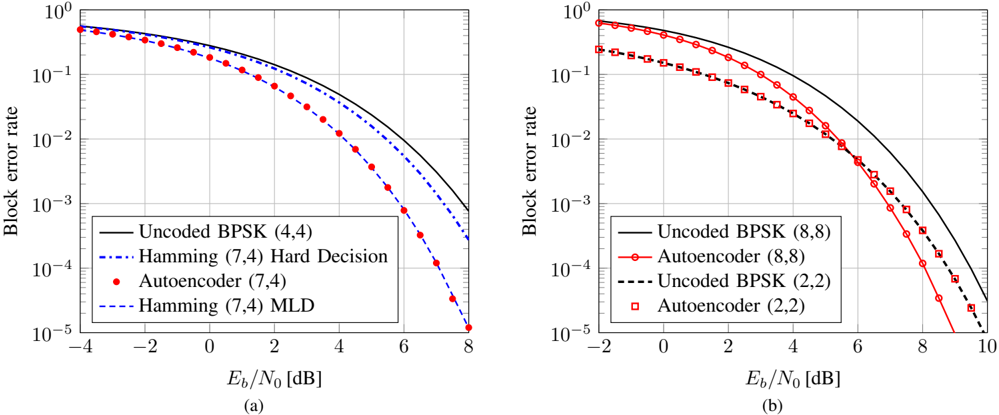
- A learned autoencoder for a (7,4) system at rate R = 4/7 achieves the same block error rate (BLER) as a Hamming (7,4) code with maximum likelihood decoding, while an (8,8) autoencoder outperforms uncoded BPSK over the full E_b/N_0 range, indicating learned joint coding and modulation.
- For the two-user AWGN interference channel, the autoencoder matches time-sharing for (1,1) and (2,2), but achieves gains of about 0.7 dB for (4,4) and 1 dB for (4,8) at a BLER of 10^-3.
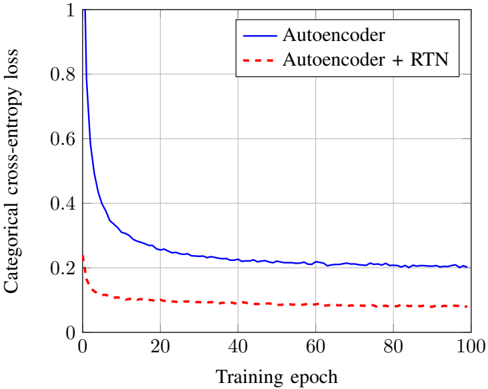
- An autoencoder (8,4) with an RTN over a multipath fading channel with L = 3 Rayleigh taps outperforms differential BPSK with maximum likelihood sequence estimation and a Hamming (7,4) code, whereas the plain autoencoder struggles to match it; RTNs also show faster training convergence.
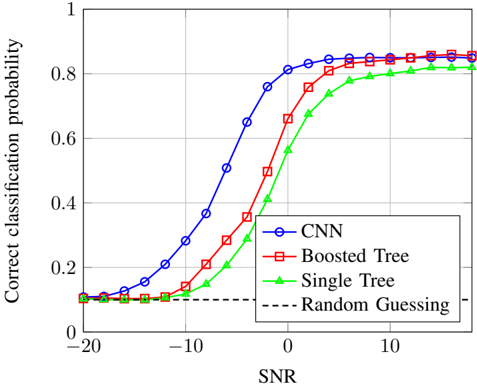
- For modulation classification on 1.2M sequences of 128 complex-valued IQ samples across ten modulation schemes and SNRs from -20 dB to 18 dB, the CNN outperforms a boosted expert-feature classifier by around 4 dB in the low-to-medium SNR range, with almost identical high-SNR performance; a single tree is about 6 dB worse at medium SNR and 3.5% worse at high SNR.
Methods
- The transmitter, channel, and receiver are represented as one deep neural network trained as an autoencoder: one-hot message input, dense layers, normalization layer for transmit constraints, additive noise channel layer, and softmax receiver output, trained with categorical cross-entropy using SGD/Adam at learning rate 0.001 and fixed E_b/N_0 = 7 dB.
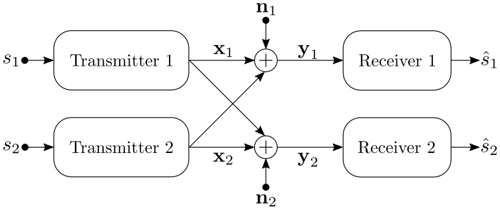
- The autoencoder concept is extended to multiple transmitter-receiver pairs in a two-user interference channel, with dynamic loss weights α_t per mini-batch to balance the two cross-entropy losses; performance is compared against 2^{2k/n}-QAM with time-sharing.
- RTNs combine a learned parameter estimator, a differentiable parametric transform, and a discriminative network; the paper demonstrates phase-offset compensation and multipath inverse filtering. For modulation classification, a VGG-like CNN with 324,330 trainable parameters is trained on the RML2016.10b dataset.
Limitations
- The paper states that scalability to large message sets M is a major challenge: for k = 100 bits, training complexity is prohibitive because the autoencoder must see at least every message once.
- The paper states that optimal data representations, loss functions, training SNR, and hyperparameters are not well understood; training at one SNR does not necessarily generalize to others, and no common communications benchmarks or datasets comparable to MNIST or ImageNet exist.
- The paper states that end-to-end learning over real channels requires system identification because backpropagation assumes a known channel transfer function; complex-valued neural networks are not supported by current DL libraries. Evident from the text: the reported results are simulation-based, use small (n,k) settings, assume known channel models during training, and the paper explicitly leaves detailed performance comparisons for various channel types and parameters to future work.
Model-written summary. Check it against the paper before relying on it.
Integrity signals
Registry
Cites
Statistics
Figures






Verification
Claims the paper makes
6 Valid · 4 Not valid · 18 Not checked · 65 Own results and interpretations
Every source the paper cites for this claim was checked and supports it.
In the paper
“For instance in [22], it was shown that training with a single codeword is sufficient since the structure of the code is embedded in the NN through the Tanner graph.”
What the sources say
- Supportedcites [22] [22] E. Nachmani, Y. Be'ery, and D. Burshtein, 'Learning to decode linear codes using deep learning,' in Proc. IEEE Annu. Allerton Conf. Commun., Control, and Computing (Allerton) , 2016, pp. 341-346. - source
The Introduction says the decoder uses a Tanner graph representing the code and that one codeword suffices for training. Section III explains the precise condition: over a binary memoryless symmetric channel, the decoder’s error rate is independent of the transmitted codeword, so training can use noisy versions of a single codeword. (LLM, conf=0.91)
boostedstates a cause- Asserted: passes — The authors put it forward as true.
- Checkable: passes — It can be checked against evidence.
- Load-bearing: unclear — It is unclear whether the paper’s conclusions depend on it.
- Based: passes — The paper gives a reason why it holds.
- Supported
A result the paper reports from its own data — it cites no other source for it, so there is none to check. The quote shows it is in the paper.
In the paper
“We study the use of NNs on complex-valued IQ samples for the problem of modulation classification and show that convolutional neural networks (CNNs), which are the cornerstone of most DL systems for computer vision, can outperform traditional classification techniques based on expert features.”
plainstates a cause- Asserted: passes — The authors put it forward as true.
- Checkable: passes — It can be checked against evidence.
- Load-bearing: passes — The paper’s conclusions depend on it.
- Based: passes — The paper gives a reason why it holds.
The paper states this without a source or data behind it here, so there is nothing to check it against. The quote shows it is in the paper.
In the paper
“Training at low SNR for instance does not allow for the discovery of structure important in higher SNR scenarios.”
plainstates a cause- Asserted: passes — The authors put it forward as true.
- Checkable: passes — It can be checked against evidence.
- Load-bearing: unclear — It is unclear whether the paper’s conclusions depend on it.
- Based: unclear — It is unclear why the paper says it holds.
A result the paper reports from its own data — it cites no other source for it, so there is none to check. The quote shows it is in the paper.
In the paper
“Another advantage of RTNs is faster training convergence which can be seen from Fig. 10 that compares the validation loss of the autoencoder with and without RTN as a function of the training epochs.”
plainstates a cause- Asserted: passes — The authors put it forward as true.
- Checkable: passes — It can be checked against evidence.
- Load-bearing: unclear — It is unclear whether the paper’s conclusions depend on it.
- Based: passes — The paper gives a reason why it holds.
A result the paper reports from its own data — it cites no other source for it, so there is none to check. The quote shows it is in the paper.
In the paper
“Similarly, Fig. 4b shows a (4 , 2) system which leads to a rotated 16-PSK constellation.”
plainstates a cause- Asserted: passes — The authors put it forward as true.
- Checkable: passes — It can be checked against evidence.
- Load-bearing: unclear — It is unclear whether the paper’s conclusions depend on it.
- Based: passes — The paper gives a reason why it holds.
39 more claims
Create a free account to see all 93 claims and to verify the 4 references still open.
- Probably not a substantial claim. 29
- It may state two separate claims as one. 24
Self-check
Percentages, sums and reported differences re-computed from the paper’s own numbers.
Each contradiction between two passages listed here was confirmed by an independent check.
Rated minor: it would not touch a result — a value no result rests on, a p-value that stays on the same side of the significance level, or a conflict that is clerical, resolved elsewhere in the paper, or outside its own findings.
In the paper
§ A. Autoencoders for end-to-end communications systems · p. 5
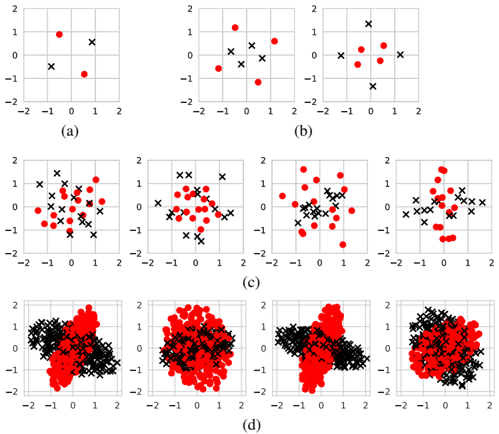
“Similarly, Fig. 4b shows a (4 , 2) system which leads to a rotated 16-PSK constellation.”
§ A. Autoencoders for end-to-end communications systems · p. 6
“Figure 4: Constellations produced by autoencoders using parameters ( n, k ) : (a) (2 , 2) (b) (2 , 4) , (c) (2 , 4) with average power constraint, (d) (7 , 4) 2-dimensional t-SNE embedding of received symbols.”
Citations
Cites
Very Deep Convolutional Networks for Large-Scale Image Recognition
Simonyan, K., & Zisserman, A. (2014) · arXiv · doi:10.48550/arxiv.1409.1556 · Cited by 114,148 · cited 1×
“dense/fully-connected layers and terminated with a dense softmax layer for our classifier (similar to a VGG architecture [55]).”
BackgroundAdam: A Method for Stochastic Optimization
Kingma, D. P., & Ba, J. (2014) · arXiv · doi:10.48550/arxiv.1412.6980 · Cited by 98,946 · cited 4×
“Training was done at a fixed value of Eb/N0 = 7 dB (see Section IV-B) using Adam [46] with learning rate 0.”
BackgroundMethodInfluentialA Mathematical Theory of Communication
Shannon, C. E. (1948) · Bell System Technical Journal · doi:10.1002/j.1538-7305.1948.tb01338.x · Cited by 88,486
Scikit-learn: Machine Learning in Python
Pedregosa, F., Varoquaux, G., Gramfort, A., Michel, V., Thirion, B., Grisel, O., Blondel, M., Müller, A., Nothman, J., Louppe, G., et al. (2012) · arXiv · doi:10.48550/arxiv.1201.0490 · Cited by 71,016 · cited 1×
“11, we compare the classification accuracy of the CNN against that of extreme gradient boosting7 with 1000 estimators, as well as a single scikit-learn decision tree [56], operating on a mix of 16 analog and cumulant expert features as proposed in [53] and [57].”
Method(2014) · Cited by 33,419
(2008) · Journal of Machine Learning Research · Cited by 33,051
Human-level control through deep reinforcement learning
Mnih, V., Kavukcuoglu, K., Silver, D., Rusu, A. A., Veness, J., Bellemare, M. G., Graves, A., Riedmiller, M., Fidjeland, A. K., Ostrovski, G., et al. (2015) · Nature · doi:10.1038/nature14236 · Cited by 30,357
(2007) · Electronics: A First Course · doi:10.4324/9780080477527-64 · Cited by 24,923
Pan, S. J., & Yang, Q. (2010) · IEEE Transactions on Knowledge and Data Engineering · doi:10.1109/tkde.2009.191 · Cited by 23,387 · cited 1×
“learning [64] is one appealing candidate for adapting an endto-end communications system trained on a statistical model to”
BackgroundMultilayer feedforward networks are universal approximators
Hornik, K., Stinchcombe, M., & White, H. (1989) · Neural Networks · doi:10.1016/0893-6080(89)90020-8 · Cited by 21,728 · cited 1×
“Third, it has been shown that NNs are universal function approximators [13] and recent work has shown a remarkable”
Background
Research works printed but not linked: 2
- [35] I. Goodfellow, Y. Bengio, and A. Courville, Deep Learning . MIT Press, 2016. -
- [52] J. Estaran et al. , 'Artificial neural networks for linear and non-linear impairment mitigation in high-baudrate IM/DD systems,' in Proc. 42nd European Conf. Optical Commun. (ECOC) . VDE, 2016, pp. 1-3. -
Cited by
Items 501–600 of 2,995
Enabling AI in future wireless networks: a data life cycle perspective
Nguyen, D. C., Cheng, P., Ding, M., López‐Pérez, D., Pathirana, P. N., Li, J., Seneviratne, A. P., Li, Y., & Poor, H. V. (2024) · Figshare · Cited by 36
End-to-End Learning of a Constellation Shape Robust to Channel Condition Uncertainties
Jovanovic, O., Yankov, M. P., Ros, F. D., & Zibar, D. (2022) · Journal of Lightwave Technology · doi:10.1109/jlt.2022.3169993 · Cited by 36
“End-to-end learning was introduced in [6], where it was shown that a communication system (or some of its processes) can be optimized for a specific channel and performance metric by utilizing a deep learning concept known as au-”
BackgroundMethodRF Transmitter Fingerprinting Exploiting Spatio-Temporal Properties in Raw Signal Data
Roy, D., Mukherjee, T., Chatterjee, M., & Pasiliao, E. (2019) · International Conference on Machine Learning and Applications · doi:10.1109/icmla.2019.00023 · Cited by 40
“Inspired by the success of deep learning systems for the task of characterizing RF environments [13] and the successful use of recurrent neural networks (RNN) for the task of analyzing time series data [14], we propose to use deep recurrent structures for learning transmitter “fingerprints” for the task of transmitter…”
BackgroundMethodUsage of Network Simulators in Machine-Learning-Assisted 5G/6G Networks
Wilhelmi, F., Carrascosa, M., Cano, C., Jönsson, A., Ram, V., & Bellalta, B. (2021) · IEEE Wireless Communications · doi:10.1109/mwc.001.2000206 · Cited by 44
“ML has shown great potential for improving a plethora of applications in communications (see, for instance, the surveys in [5–9] and the references therein).”
BackgroundDeep Learning Techniques for Advancing 6G Communications in the Physical Layer
Zhang, S., Liu, J., Rodrigues, T. K., & Kato, N. (2021) · IEEE Wireless Communications · doi:10.1109/mwc.001.2000516 · Cited by 42
“J oInt d EsIgn of b Lock -s tructurEd And”
BackgroundDeep Expectation-Maximization for Joint MIMO Channel Estimation and Signal Detection
Zhang, Y., Sun, J., Xue, J., Li, G. Y., & Xu, Z. (2022) · IEEE Transactions on Signal Processing · doi:10.1109/tsp.2022.3205478 · Cited by 41
“Besides, deep learning based end-to-end transceiver design is also a popular topic [36], [37].”
BackgroundJoint Task and Data-Oriented Semantic Communications: A Deep Separate Source-Channel Coding Scheme
Huang, J., Li, D., Huang, C. Z., Qin, X., & Zhang, W. (2023) · IEEE Internet of Things Journal · doi:10.1109/jiot.2023.3293154 · Cited by 54
Distributed Intelligence in Wireless Networks
Liu, X., Yu, J., Liu, Y., Gao, Y., Mahmoodi, T., Lambotharan, S., & Tsang, D. H. K. (2023) · IEEE Open Journal of the Communications Society · doi:10.1109/ojcoms.2023.3265425 · Cited by 48
“The implementation of DL in a physical layer can be categorized into partial algorithm replacement and complete algorithm replacement [201].”
Semantic Information Recovery in Wireless Networks
Beck, E., Bockelmann, C., & Dekorsy, A. (2023) · Sensors · doi:10.3390/s23146347 · Cited by 51
“, [4], unsupervised optimization of AEs is treated like a supervised learning problem.”
BackgroundMethodInfluentialGraph Neural Networks Approach for Joint Wireless Power Control and Spectrum Allocation
Marwani, M., & Kaddoum, G. (2024) · IEEE Transactions on Machine Learning in Communications and Networking · doi:10.1109/tmlcn.2024.3408723 · Cited by 46
Gradient-Free Training of Autoencoders for Non-Differentiable Communication Channels
Jovanovic, O., Yankov, M. P., Ros, F. D., & Zibar, D. (2021) · Journal of Lightwave Technology · doi:10.1109/jlt.2021.3103339 · Cited by 48
“In [2], this optimization is performed in an end-toend manner by embedding a differentiable channel model”
MethodPerformance enhancement of ACO-OFDM-based VLC systems using a hybrid autoencoder scheme
Hao, L., Wang, D., Cheng, W., Li, J., & Ma, A. (2019) · Optics Communications · doi:10.1016/j.optcom.2019.03.013 · Cited by 37
CNN and RNN-based Deep Learning Methods for Digital Signal Demodulation
Wu, T. B. (2019) · International Conference on Image, Video and Signal Processing (IVSP) · doi:10.1145/3317640.3317656 · Cited by 40
Complexity-Scalable Neural-Network-Based MIMO Detection With Learnable Weight Scaling
Mohammad, A., Masouros, C., & Andreopoulos, Y. (2020) · IEEE Transactions on Communications · doi:10.1109/tcomm.2020.3007622 · Cited by 43
“[24], who implemented unsupervised learning using an auto-encoder as an extension of end-to-end learning of previous attempts [22].”
BackgroundMachine Learning for MU-MIMO Receive Processing in OFDM Systems
Goutay, M., Aoudia, F. A., Hoydis, J., & Gorce, J.-M. (2021) · IEEE Journal on Selected Areas in Communications · doi:10.1109/jsac.2021.3087224 · Cited by 45
“Machine learning (ML) has transformed many research areas in the past decade but only started to revolutionize wireless communications in recent years with applications to end-to-end learning [1], channel coding [2], resource management [3], and many others [4].”
BackgroundSelf-citationAutomatic modulation classification using techniques from image classification
Sun, Y., & Ball, E. A. (2022) · IET Communications · doi:10.1049/cmu2.12335 · Cited by 38
Deep Neural Network: An Alternative to Traditional Channel Estimators in Massive MIMO Systems
Melgar, A., de la Fuente, A., Carro‐Calvo, L., Barquero‐Pérez, Ó., & Morgado, E. (2022) · IEEE Transactions on Cognitive Communications and Networking · doi:10.1109/tccn.2022.3164888 · Cited by 45
Circular Convolutional Auto-Encoder for Channel Coding
Ye, H., Liang, L., & Li, G. Y. (2019) · IEEE International Workshop on Signal Processing Advances in Wireless Communications (SPAWC) · doi:10.1109/spawc.2019.8815483 · Cited by 42
“The DNN has achieve the performance of decoding similar to maximum likelihood decoding.”
BackgroundMethodInfluentialPrivacy-Aware Communication over a Wiretap Channel with Generative Networks
Erdemir, E., Dragotti, P. L., & Gündüz, D. (2022) · IEEE International Conference on Acoustics Speech and Signal Processing · doi:10.1109/icassp43922.2022.9747068 · Cited by 44
“Although deep learning applications of data transmission have also been well investigated, deep learning in wireless communications and physical layer security has only recently become popular [13, 14].”
BackgroundArtificial Intelligence for 5G and Beyond 5G: Implementations, Algorithms, and Optimizations
Zhang, C., Ueng, Y.-L., Studer, C., & Burg, A. P. (2020) · IEEE Journal on Emerging and Selected Topics in Circuits and Systems · doi:10.1109/jetcas.2020.2999944 · Cited by 35
Multidimensional CNN-LSTM Network for Automatic Modulation Classification
Wang, N., Liu, Y., Ma, L., Yang, Y., & Wang, H. (2021) · Electronics · doi:10.3390/electronics10141649 · Cited by 35
“Adopting the in-phase (I) and quadrature components (Q) as inputs, it significantly outperforms traditional methods with handcrafted features [17,18].”
MethodRecognition of weld defects from X-ray images based on improved convolutional neural network
Hu, A., Li-jian, W., Huang, J., Fan, D., & Zhenya, X. (2022) · Multimedia Tools and Applications · doi:10.1007/s11042-022-12546-3 · Cited by 35
“In order to improve the performance of the CNN network, the excitation function of each neuron in the fully connected layer generally uses the ReLU function [16], and the output layer is classified by softmax regression.”
MethodDeep Neural Embedding for Software Vulnerability Discovery: Comparison and Optimization
Yuan, X., Lin, G., Tai, Y., & Zhang, J. (2022) · Security and Communication Networks · doi:10.1155/2022/5203217 · Cited by 35
“ese techniques have been applied in the field of communications and networking and have achieved promising outcomes [9, 10].”
BackgroundDeep Channel Prediction: A DNN Framework for Receiver Design in Time-Varying Fading Channels
Mattu, S. R., Theagarajan, L. N., & Chockalingam, A. (2022) · IEEE Transactions on Vehicular Technology · doi:10.1109/tvt.2022.3162887 · Cited by 42
“In the field of communications, neural networks have been employed in a wide range of problems in the physical layer design [1]–[3].”
Method6G: A Welcome Chance to Unify Channel Coding?
Geiselhart, M., Krieg, F., Clausius, J., Tandler, D., & ten Brink, S. (2023) · IEEE BITS the Information Theory Magazine · doi:10.1109/mbits.2023.3322974 · Cited by 34
“Consequently, such learned encoding requires learned decoding, which yields autoencoder structure [59].”
BackgroundVijay, E. V., & Aparna, K. (2024) · e-Prime - Advances in Electrical Engineering Electronics and Energy · doi:10.1016/j.prime.2024.100659 · Cited by 45
Deep Learning Based on Orthogonal Approximate Message Passing for CP-Free OFDM
Zhang, J., He, H., Wen, C.-K., Jin, S., & Li, G. Y. (2019) · IEEE International Conference on Acoustics Speech and Signal Processing · doi:10.1109/icassp.2019.8682639 · Cited by 38
“Deep learning (DL) has been recently introduced to physical layer communications owing to its strong ability to perform channel estimation and signal detection and address transceiver’s imperfection [8-12].”
BackgroundThe Extended SLM Combined Autoencoder of the PAPR Reduction Scheme in DCO-OFDM Systems
Hao, L., Wang, D., Tao, Y., Cheng, W., Li, J., & Liu, Z. (2019) · Applied Sciences · doi:10.3390/app9050852 · Cited by 34
“For the training of the AE, the stochastic gradient descent (SGD) [33] optimization method is popular used which starts with some random initial values of θ = θ 0 and update θ iteratively as where λ > 0 is the learning rate, θ denotes parameters of the AE and ∇ θ denotes the Gradient operation”
MethodInfluentialAutoencoder-Based Transceiver Design for OWC Systems in Log-Normal Fading Channel
Zhu, Z.-R., Zhang, J., Chen, R., & Yu, H. (2019) · IEEE photonics journal · doi:10.1109/jphot.2019.2938231 · Cited by 43
“In the AWGN channel, we observe that AE schemes achieve the same performance of OOK schemes, which seems contradictory to the results of [13] Fig.”
BackgroundResultShah, M. H., & Dang, X. (2019) · IEEE Signal Processing Letters · doi:10.1109/lsp.2019.2957924 · Cited by 33
“Keeping in view the advancements in the field of artificial intelligence in recent years, communication engineers have resorted to utilize its strength for several applications, particularly involving blind scenarios [4], [5].”
BackgroundDeep Energy Autoencoder for Noncoherent Multicarrier MU-SIMO Systems
Luong, T. V., Ko, Y., Vien, N. A., Matthaiou, M., & Ngo, H. Q. (2020) · IEEE Transactions on Wireless Communications · doi:10.1109/twc.2020.2979138 · Cited by 36
“Unlike existing schemes [21] which utilize complex signals, the encoder of NC-EA outputs a real-valued vector whose elements represent the sub-carrier power levels, while its decoder is fed only with the combined energy of signals from the receive antennas without any knowledge of CSI.”
BackgroundMethodResultInfluentialDeep learning‐based pilot‐assisted channel state estimator for OFDM systems
Essai, M. H. (2020) · IET Communications · doi:10.1049/cmu2.12051 · Cited by 35
“There are three reasons for the use of deep learning neural networks (DLNNs) in various fields [5, 6].”
BackgroundDesign and Evaluation of a Graphical Deep Learning Approach for RF Fingerprinting
Li, B., & Cetin, E. (2021) · IEEE Sensors Journal · doi:10.1109/jsen.2021.3088137 · Cited by 33
Kumar, A., Srinivas, K. K., & Majhi, S. (2023) · IEEE Access · doi:10.1109/access.2023.3286939 · Cited by 33
Channel Pruning Method for Signal Modulation Recognition Deep Learning Models
Chen, Z., Wang, Z., Gao, X., Zhou, J., Xu, D., Zheng, S., Xuan, Q., & Yang, X. (2023) · IEEE Transactions on Cognitive Communications and Networking · doi:10.1109/tccn.2023.3329000 · Cited by 39
“To verify the effectiveness of our proposed method, we use typical convolutional neural networks proposed for AMR task (2D-CNN [13], VTCNN2 [52]) and residual network models (ResNet50 [14], ResNet8 [53], 1D-ResNet [12]) as the models to be pruned.”
MethodFadul, M. K. M., Reising, D. R., Weerasena, L. P., Loveless, T. D., Sartipi, M., & Tyler, J. H. (2024) · IEEE Transactions on Information Forensics and Security · doi:10.1109/tifs.2024.3360851 · Cited by 37
“…(DL) due to its successful application in spectrum management [35], [36], modulation and emitter identification [37], [38], [39], system design [37], [40], [41], [42], [43], as well as its ability to thrive under increasing amounts of information while removing the need for hand-crafted…”
BackgroundFramework on Deep Learning-Based Joint Hybrid Processing for mmWave Massive MIMO Systems
Dong, P., Zhang, H., & Li, G. Y. (2020) · IEEE Access · doi:10.1109/access.2020.3000601 · Cited by 35
“The BP algorithm makes the DNN based end-to-end communications over the air possible so long as the optimized performance metric is differentiable [15], [29], [30].”
BackgroundDeep Learning Based Prediction of Signal-to-Noise Ratio (SNR) for LTE and 5G Systems
Ngo, T., Kelley, B., & Rad, P. (2020) · International Conference on Wireless Networks and Mobile Communications (WINCOM) · doi:10.1109/wincom50532.2020.9272470 · Cited by 42
“In wireless communication, DL has been applied in physical layers [7]–[9], modulation recognition [11], channel estimation [13], power allocation [10], and signal detection [12].”
MethodKaneda, N., Chuang, C.-Y., Zhu, Z., Mahadevan, A., Farah, B., Bergman, K., van Veen, D., & Houtsma, V. E. (2021) · Journal of Lightwave Technology · doi:10.1109/jlt.2021.3133723 · Cited by 33
“considered in the machine learning community [9] and have also been proposed as a part of DNN application in the physical layer equalization [24] for general communication systems.”
BackgroundBeyond 5G: Leveraging Cell Free TDD Massive MIMO Using Cascaded Deep Learning
Athreya, N., Raj, V., & Kalyani, S. (2020) · IEEE Wireless Communications Letters · doi:10.1109/lwc.2020.2996745 · Cited by 34
“Deep learning has been successfully applied in the problems of communication systems design [8]–[10],”
MethodMateos-Ramos, J. M., Häger, C., Keskin, M. F., Magoarou, L. L., & Wymeersch, H. (2025) · IEEE Transactions on Wireless Communications · doi:10.1109/twc.2024.3522667 · Cited by 57
Deep Learning-Aided Dynamic Read Thresholds Design for Multi-Level-Cell Flash Memories
Mei, Z., Cai, K., & He, X. (2020) · IEEE Transactions on Communications · doi:10.1109/tcomm.2020.2974723 · Cited by 32
“Recently, the deep learning (DL) techniques have been developed rapidly and they have shown superior performance in many aspects of communication systems [17, 18].”
Design of Communication Systems Using Deep Learning: A Variational Inference Perspective
Raj, V., & Kalyani, S. (2020) · IEEE Transactions on Cognitive Communications and Networking · doi:10.1109/tccn.2020.2985371 · Cited by 39
Deep Learning for Robust Automatic Modulation Recognition Method for IoT Applications
Zhang, T., Cong, S., & Zhou, Y. (2020) · IEEE Access · doi:10.1109/access.2020.2981130 · Cited by 36
“Paper [44] proposed a convolutional neural network (CNN)-based AMR, which is realized by training CNN on the in-phase and quadrature (IQ) component of signals.”
BackgroundBenchmarking and Interpreting End-to-End Learning of MIMO and Multi-User Communication
Song, J., Häger, C., Schröder, J., O'Shea, T. J., Agrell, E., & Wymeersch, H. (2022) · IEEE Transactions on Wireless Communications · doi:10.1109/twc.2022.3157467 · Cited by 43
“• Lastly, we revisit the interference-channel scenario in [11] where significant performance gains were demonstrated by AE-based communication compared to the considered time-sharing baseline scheme.”
BackgroundMethodInfluentialSelf-citationNon-Terrestrial Networks with UAVs: A Projection on Flying Ad-Hoc Networks
Nemati, M., Homssi, B. A., Krishnan, S., Park, J., Loke, S. W., & Choi, J. (2022) · Drones · doi:10.3390/drones6110334 · Cited by 42
“Most notably, AI and ML have led to significant improvements in (i) the physical layer by enhancing digital signal detection [137], (ii) the medium access layer through cognitive radio and spectrum access [138], and (iii) the network layer using network management and optimization [139].”
BackgroundRecent Advances in Deep Learning for Channel Coding: A Survey
Matsumine, T., & Ochiai, H. (2024) · IEEE Open Journal of the Communications Society · doi:10.1109/ojcoms.2024.3472094 · Cited by 46
“In recent years, DL has been successfully applied to the physical layer of communication systems 1 [31], [42], [44], [46]–[50], [58]–[73].”
Learned Factor Graphs for Inference From Stationary Time Sequences
Shlezinger, N., Farsad, N., Eldar, Y. C., & Goldsmith, A. J. (2021) · IEEE Transactions on Signal Processing · doi:10.1109/tsp.2021.3139506 · Cited by 37
Koufos, K., Haloui, K. E., Dianati, M., Higgins, M. D., Elmirghani, J. M. H., Imran, M. A., & Tafazolli, R. (2021) · Journal of Sensor and Actuator Networks · doi:10.3390/jsan10040060 · Cited by 45
“Additionally, it was observed that training at a low SNR does not necessarily generalise well at high SNRs [22], while training at multiple SNRs will prohibitively increase the size of required labelled datasets and time to train the NN. 2.”
BackgroundMethodInfluentialProductAE: Toward Training Larger Channel Codes based on Neural Product Codes
Jamali, M. V., Saber, H., Hatami, H., & Bae, J. H. (2022) · International Conference on Communications · doi:10.1109/icc45855.2022.9839215 · Cited by 36
Adversarial Networks for Secure Wireless Communications
Marchioro, T., Laurenti, N., & Gündüz, D. (2020) · IEEE International Conference on Acoustics Speech and Signal Processing · doi:10.1109/icassp40776.2020.9053216 · Cited by 31
“Data-driven approaches to wireless communications is receiving increasing attention [9], including autoencoderbased end-to-end design for channel coding [10], as well as for joint source-channel coding (JSCC) [11, 12].”
BackgroundDeep Learning based Automatic Modulation Classification for Varying SNR Environment
Xie, X., Ni, Y., Peng, S., & Yao, Y. (2019) · Wireless and Optical Communications Conference · doi:10.1109/wocc.2019.8770611 · Cited by 31
“In [15], convolutional neural network (CNN) is utilized to classify modulation types.”
MethodBreaking Wireless Propagation Environmental Uncertainty With Deep Learning
Morocho-Cayamcela, M. E., Maier, M., & Lim, W. (2020) · IEEE Transactions on Wireless Communications · doi:10.1109/twc.2020.2986202 · Cited by 33
“…wireless communications for the physical layer is already apparent from recent networking paradigms such as radio modulation recognition [5], channel impairment learning for multiple input multiple output (MIMO) communications [6], and end-to-end communication learning with autoencoders [7]–[9].”
BackgroundHybrid-Layers Neural Network Architectures for Modeling the Self-Interference in Full-Duplex Systems
Elsayed, M. I., El-Banna, A. A. A., Dobre, O. A., Shiu, W., & Wang, P. (2022) · IEEE Transactions on Vehicular Technology · doi:10.1109/tvt.2022.3159535 · Cited by 37
“For instance, NNs have brought breakthroughs in signal detection [17], signal classification [18], channel estimation [19], [20], channel equalization [21], channel coding [22], PA modeling [23]–[25], digital pre-distortion [24]–[27], and non-linearity compensation in optical fiber systems [28].”
BackgroundLearning with Limited Samples: Meta-Learning and Applications to Communication Systems
Chen, L., Jose, S. T., Nikoloska, I., Park, S., Chen, T., & Simeone, O. (2023) · Foundations and Trends® in Signal Processing · doi:10.1561/2000000115 · Cited by 46
Automatic Multicarrier Waveform Classification via PCA and Convolutional Neural Networks
Duan, S., Chen, K., Yu, X., & Qian, M. (2018) · IEEE Access · doi:10.1109/access.2018.2869901 · Cited by 31
“In fact, CNN has been extensively used in image denoising and AMC field due to its outstanding advantages of features extraction and nonlinearmapping capability [16], [17], [23], [24].”
MethodGupta, A., Ghanshala, K. K., & Joshi, R. C. (2021) · International Journal of Interactive Multimedia and Artificial Intelligence · doi:10.9781/ijimai.2021.03.004 · Cited by 38
“Machine learning algorithms are classified as [36], [39]-[42]: Supervised Learning : This algorithm learns from the specimen data and related results to predict the correct result when given new data similar to specimen data.”
BackgroundVulnerabilities of Deep Learning-Driven Semantic Communications to Backdoor (Trojan) Attacks
Sagduyu, Y. E., Erpek, T., Ulukuş, Ş., & Yener, A. (2023) · Conference on Information Sciences and Systems · doi:10.1109/ciss56502.2023.10089692 · Cited by 33
“Machine learning has been extensively applied to optimize the transmitter and receiver operations such as in the joint design by autoencoder communications [1].”
BackgroundConvAE: A New Channel Autoencoder Based on Convolutional Layers and Residual Connections
Ji, D. J., Park, J., & Cho, D. (2019) · IEEE Communications Letters · doi:10.1109/lcomm.2019.2930287 · Cited by 31
“Reference [1] proposed to use convolutional layers for modulation classification, taking the symbols as input and returning the used modulation scheme.”
BackgroundMethodOvercoming the Channel Estimation Barrier in Massive MIMO Communication via Deep Learning
Liu, Z., Zhang, L., & Ding, Z. J. (2020) · IEEE Wireless Communications · doi:10.1109/mwc.001.1900413 · Cited by 33
Artificial neural network design for improved spectrum sensing in cognitive radio
Patel, D. K., López‐Benítez, M., Soni, B., & García‐Fernández, Á. F. (2020) · Wireless Networks · doi:10.1007/s11276-020-02423-y · Cited by 31
Spiking Neural Networks for Detecting Satellite Internet of Things Signals
Dakic, K., Homssi, B. A., Walia, S., & Al‐Hourani, A. (2023) · IEEE Transactions on Aerospace and Electronic Systems · doi:10.1109/taes.2023.3334216 · Cited by 36
“In addition to the SNN, a second network based on the CNN called the CSNN is also investigated to combine the superior feature extraction and the power efficiency of the CNN relative to other DL networks, such as the ANN [51], with the ultralow power consumption of the SNN.”
Deep Learning Empowered Semi-Blind Joint Detection in Cooperative NOMA
Emir, A., Kara, F., Kaya, H., & Yanıkömeroğlu, H. (2021) · IEEE Access · doi:10.1109/access.2021.3074350 · Cited by 32
Modulation and Coding for NOMA and RSMA
Jafarkhani, H., Maleki, H., & Vaezi, M. (2024) · Proceedings of the IEEE · doi:10.1109/jproc.2024.3472501 · Cited by 51
“This approach provides a fresh alternative to the prevalent block-by-block design philosophy in contemporary communication systems [22]–[24], [171], [177]–[179].”
Deep-Learning-Aided Cross-Layer Resource Allocation of OFDMA/NOMA Video Communication Systems
Tseng, S., Chen, Y., Tsai, C.-S., & Tsai, W. (2019) · IEEE Access · doi:10.1109/access.2019.2950127 · Cited by 30
“Augmenting only specific sub-task, cross-layer user grouping/subcarrier assignments in this paper is therefore more practical [37].”
BackgroundMethodInfluentialZhao, T., Li, F., & Tian, P. (2020) · IEEE Transactions on Vehicular Technology · doi:10.1109/tvt.2020.2992080 · Cited by 31
“2992080 communication [7].”
VLCnet: Deep Learning Based End-to-End Visible Light Communication System
Ulkar, M. G., Baykaş, T., & Pusane, A. E. (2020) · Journal of Lightwave Technology · doi:10.1109/jlt.2020.3006827 · Cited by 30
“In [17],”
BackgroundDeep Learning-Aided Multicarrier Systems
Luong, T. V., Ko, Y., Matthaiou, M., Vien, N. A., Le, M.-T., & Ngo, V.-D. (2020) · IEEE Transactions on Wireless Communications · doi:10.1109/twc.2020.3039180 · Cited by 36
“3 The proposed MC-AE is very different from the traditional AE-based schemes, which are based on the RTN [16], [17].”
BackgroundMethodInfluentialFiltered Multicarrier Waveforms Classification: A Deep Learning-Based Approach
Zerhouni, K., Amhoud, E. M., & Chafii, M. (2021) · IEEE Access · doi:10.1109/access.2021.3078252 · Cited by 30
“) is a sub-sampling function computing maximum, average value, or L2-norm of its input vector [40].”
BackgroundMethodInfluentialLearning-Aided Beam Prediction in mmWave MU-MIMO Systems for High-Speed Railway
Meng, F. Y., Liu, S., Huang, Y., & Lu, Z. (2021) · IEEE Transactions on Communications · doi:10.1109/tcomm.2021.3124963 · Cited by 34
“The learningbased approach is data-driven, and inherently applicable for the scenarios with imperfect models and/or intractable problems, where the model-driven method cannot work well [5]– [8].”
BackgroundMIMO-GAN: Generative MIMO Channel Modeling
Orekondy, T., Behboodi, A., & Soriaga, J. B. (2022) · International Conference on Communications · doi:10.1109/icc45855.2022.9839123 · Cited by 33
“First, neural channel models allow end-to-end learning [18], [19] of the physical layer.”
BackgroundOnline Label Recovery for Deep Learning-based Communication through Error Correcting Codes
Schibisch, S., Cammerer, S., Dörner, S., Hoydis, J., & ten Brink, S. (2018) · International Symposium on Wireless Communication Systems · doi:10.1109/iswcs.2018.8491189 · Cited by 34
Self-citationAhmed, I., & Khammari, H. (2018) · IEEE Globecom Workshops (GC Wkshps) · doi:10.1109/glocomw.2018.8644454 · Cited by 33
“Machine learning (ML) applications for physical layer of wireless communication systems are described in [6].”
BackgroundRecurrent neural networks achieving MLSE performance for optical channel equalization
Kalla, S. C. K., Gagné, C., Zeng, M., & Rusch, L. A. (2021) · Optics Express · doi:10.1364/oe.423103 · Cited by 30
Multi-Domain Networks for Wireless Interference Recognition
Wang, P., Cheng, Y., Dong, B., Peng, Q., & Li, S. (2022) · IEEE Transactions on Vehicular Technology · doi:10.1109/tvt.2022.3164908 · Cited by 36
“In this subsection, we also evaluate the popular WIR models for comparisons, including FE method [23], CNN [29], ResNet [30], ViT [53], ResNeXt [55] and SKNet [56].”
MethodDeep Learning-Based Constellation Optimization for Physical Network Coding in Two-Way Relay Networks
Matsumine, T., Koike–Akino, T., & Wang, Y. (2019) · International Conference on Communications · doi:10.1109/icc.2019.8761963 · Cited by 29
“For example, DNNbased signal detection [13], [14], joint source-channel coding [15], channel decoding [16], [17] and DNN-based autoencoder [18]–[21] were investigated.”
MethodWGAN-based Autoencoder Training Over-the-air
Dörner, S., Henninger, M., Cammerer, S., & ten Brink, S. (2020) · IEEE International Workshop on Signal Processing Advances in Wireless Communications (SPAWC) · doi:10.1109/spawc48557.2020.9154335 · Cited by 37
Exploiting Deep Learning for Secure Transmission in an Underlay Cognitive Radio Network
Zhang, M., Cumanan, K., Thiyagalingam, J., Tang, Y., Wang, W., Ding, Z., & Dobre, O. A. (2021) · IEEE Transactions on Vehicular Technology · doi:10.1109/tvt.2021.3050104 · Cited by 33
“Second, the literature demonstrate that NN schemes have the capability to substantially reduce the computational complexity, and processing time for a variety of problems in wireless communications, such as, resource allocation [33], [35], [51], channel estimation and signal detection [30], and physical layer designs…”
BackgroundMethodJoint Design of Radar Waveform and Detector via End-to-End Learning With Waveform Constraints
Jiang, W., Haimovich, A. M., & Simeone, O. (2021) · IEEE Transactions on Aerospace and Electronic Systems · doi:10.1109/taes.2021.3103560 · Cited by 31
“Notably, in [33], it is proposed to jointly design the transmitter and receiver of communication systems via end-to-end learning.”
BackgroundDeep Learning-Assisted TeraHertz QPSK Detection Relying on Single-Bit Quantization
He, D., Wang, Z., Quek, T. Q. S., Chen, S., & Hanzo, L. (2021) · IEEE Transactions on Communications · doi:10.1109/tcomm.2021.3112216 · Cited by 31
“Benefiting from its superior ability in handling complicated and nonlinear issues, deep learning, also known as deep neural network, has been widely regarded as a promising direction in solving intractable wireless communication problems [21].”
BackgroundLearning-Based Channel Estimation and Phase Noise Compensation in Doubly-Selective Channels
Mattu, S. R., & Chockalingam, A. (2022) · IEEE Communications Letters · doi:10.1109/lcomm.2022.3155186 · Cited by 32
“Recently, deep neural networks are finding use in a wide range of problems in the physical layer design, including transceiver designs [4]- [7].”
BackgroundYang, J., Wang, Y., Zhao, H., & Gui, G. (2022) · IEEE Transactions on Vehicular Technology · doi:10.1109/tvt.2022.3184994 · Cited by 35
“In recent years, deep learning (DL) has been a powerful algorithm for classification and regression tasks, and it has also been introduced into various classification and regression tasks in wireless communication systems [10]–[15].”
BackgroundTowards Practical Indoor Positioning Based on Massive MIMO Systems
Widmaier, M., Arnold, M., Dörner, S., Cammerer, S., & ten Brink, S. (2019) · IEEE Vehicular Technology Conference · doi:10.1109/vtcfall.2019.8891273 · Cited by 35
“This is similar to the idea of transformer networks [17].”
ResultLow PAPR MIMO-OFDM Design Based on Convolutional Autoencoder
Huleihel, Y., & Permuter, H. H. (2024) · IEEE Transactions on Communications · doi:10.1109/tcomm.2023.3348839 · Cited by 37
“In [14], [15], and [16] an AE was offered to design a physical layer in which DL-based CSI encoding was suggested for different scenarios to achieve lower BER together with better robustness to the wireless channel characteristics.”
BackgroundConvolutional-Neural-Network-Based Detection Algorithm for Uplink Multiuser Massive MIMO Systems
Li, L., Hou, H., & Meng, W. (2020) · IEEE Access · doi:10.1109/access.2020.2985083 · Cited by 31
“In machine learning, deep learning technology has been employed and has achieved many advantages in wireless physical communications [20]–[30], including signal processing and channel estimation.”
MethodXue, W., Yang, H., Wu, Y., Peng, K., Xu, H., Wu, P., & Ma, X. (2021) · IEEE Journal of Selected Topics in Applied Earth Observations and Remote Sensing · doi:10.1109/jstars.2021.3129182 · Cited by 29
Zhang, J., Xia, W., You, M., Zheng, G., Lambotharan, S., & Wong, K. (2020) · IEEE Transactions on Wireless Communications · doi:10.1109/twc.2020.2977340 · Cited by 35
“arities [27]. In these situations, DL based detection has been proposed to tackle the underlying unknown nonlinearities [28]. Another area of interest is to optimize the end-to-end system performance [29], [30]. Conventional communication systems are based on the modular design and each block (e.g., coding, modulation…”
BackgroundDL-based CSI Feedback and Cooperative Recovery in Massive MIMOPreprint
Guo, J., Yang, X., Wen, C.-K., Jin, S., & Li, G. Y. (2020) · arXiv (Cornell University) · Cited by 36
Path of career planning and employment strategy based on deep learning in the information age
Zhang, Y. (2024) · PLoS ONE · doi:10.1371/journal.pone.0308654 · Cited by 36
Das, B. R., Hasan, S. R., Sabuj, S. R., Hossain, M. A., & Ray, S. K. (2025) · International Journal of Intelligent Networks · doi:10.1016/j.ijin.2025.06.001 · Cited by 49
Chagnon, M., Karanov, B., & Schmalen, L. (2018) · European Conference on Optical Communication · doi:10.1109/ecoc.2018.8535165 · Cited by 28
“[ ] [ ] [ ] [ 1] [ ] , k k k k k NL a f a b W (1)”
BackgroundPoudel, B., Oshima, J., Kobayashi, H., & Iwashita, K. (2019) · Optics Communications · doi:10.1016/j.optcom.2019.02.016 · Cited by 29
Neskorniuk, V., Carnio, A., Bajaj, V., Marsella, D., Turitsyn, S. K., Prilepsky, J. E., & Aref, V. (2021) · European Conference on Optical Communication · doi:10.1109/ecoc52684.2021.9605928 · Cited by 28
Chaotic Signal Denoising Based on Simplified Convolutional Denoising Auto-Encoder
Lou, S., Deng, J., & Lyu, S. (2022) · Chaos Solitons & Fractals · doi:10.1016/j.chaos.2022.112333 · Cited by 31
Radio Localization and Sensing—Part II: State-of-the-Art and Challenges
Wymeersch, H., & Seco‐Granados, G. (2022) · IEEE Communications Letters · doi:10.1109/lcomm.2022.3206846 · Cited by 45
“such as the use of artificial intelligence (AI) to tackle certain classes of problems that are hard to solve with model-based methods [15], as well as novel localization and mapping methods [16], analysis tools [17], and signal designs [18].”
BackgroundInnovative Variational AutoEncoder for an End-to-End Communication System
Alawad, M. A., Hamdan, M. Q., & Hamdi, K. A. (2022) · IEEE Access · doi:10.1109/access.2022.3224922 · Cited by 28
“Considering the DL-based communications system design, the optimization of E2E as one black box block is proposed in [3] and [16].”
BackgroundMethodInfluentialHassan, S. G., Tariq, N., Naqvi, R. A., Rehman, A. U., & Kaabar, M. K. A. (2022) · Journal of Sensors · doi:10.1155/2022/2053086 · Cited by 34
DeepFIR: Channel-Robust Physical-Layer Deep Learning Through Adaptive Waveform Filtering
Restuccia, F., D’Oro, S., Al-Shawabka, A., Rendon, B. C., Ioannidis, S., & Melodia, T. (2021) · IEEE Transactions on Wireless Communications · doi:10.1109/twc.2021.3089878 · Cited by 30
“Among others, deep learning has been extensively used to address modulation recognition [3], [29]–[33].”
BackgroundRethinking Autocorrelation for Deep Spectrum Sensing in Cognitive Radio Networks
Chae, K., Park, J., & Kim, Y. (2022) · IEEE Internet of Things Journal · doi:10.1109/jiot.2022.3200968 · Cited by 30
“Recently, the deep learning has shown a significant potential in signal processing [13], [14], [15], [16].”
BackgroundTyler, J. H., Fadul, M. K. M., & Reising, D. R. (2023) · Information · doi:10.3390/info14090479 · Cited by 31
Metadata
- Authors
- O'Shea, T., & Hoydis, J.
- Affiliations
- Nokia (France) (FR)
- Venue
- IEEE Transactions on Cognitive Communications and Networking
- Published
- 2017-12
- Volume
- 3
- Issue
- 4
- Pages
- 563-575
- ISSN
- 2332-7731 (ISSN-L)
- OpenAlex
- W2734408173
- Semantic Scholar
- 78989616eeeac55b202e3e4205225e7135054185
- Cited by
- 2,980
- References
- 69
- Citations by year
- 2026: 307 · 2025: 327 · 2024: 305 · 2023: 368 · 2022: 432 · 2021: 409 · 2020: 406 · 2019: 322 · 2018: 95 · 2017: 9
- FWCI
- 122.29
- Type
- journal article
- Language
- en
- Open access
- green
- arxiv.org
- Locations
- IEEE Transactions on Cognitive Communications and Networking (publishedVersion)
- arXiv (Cornell University) (submittedVersion)
- arXiv (Cornell University)
- Topics
- Physical Sciences › Computer Science › Artificial Intelligence › Wireless Signal Modulation Classification
- Physical Sciences › Engineering › Electrical and Electronic Engineering › Advanced Wireless Communication Techniques
- Physical Sciences › Engineering › Electrical and Electronic Engineering › Advanced Wireless Communication Technologies
- Keywords
- end-to-end reconstruction, domain knowledge integration, convolutional neural networks, automatic modulation classification, IQ samples
About these checks
Registry, retraction, Cites and statistics results are computed, not judged, with one exception: a printed reference that no index lists is read once by a model before it counts as a citation error. Claims are extracted by a model and kept only when their quote appears verbatim in the text; each cited source is then checked, with a model’s help, for whether it says what the claim relies on. Those verdicts can be wrong — read the claim’s quote and the cited source before relying on one.
The claim verdicts this report counts are experimental: their accuracy is not yet measured.
A language model drew the claims from the paper on 2026-11-07, under version 3 of the claim definition (model deepseek-v4.1-flash, prompt extract-v3).
A second model labelled each claim on 2026-11-07 (model jev-1.13-20260917, definition revision gold-guideline-v0.2).
Cited sources are checked with a language model’s help (gpt-6-sol).
Statistics and arithmetic are recomputed, not judged.
Confidence bands are shown only for fields calibrated on our annotated test set. None is calibrated yet, so no band is shown.
What counts as a claim ›How we measure confidence ›How we check this ›
Are you an author, or do you see a problem with this page? Request a review
Data sources
Bibliographic data: Semantic Scholar, OpenAlex, Crossref.
Contains information from the Semantic Scholar Academic Graph Datasets, made available under the ODC Attribution License (ODC-BY 1.0).
Semantic Scholar’s data is described in: Kinney, R., et al. (2023). The Semantic Scholar Open Data Platform. arXiv:2301.10140.
