

An Introduction to Deep Learning for the Physical Layer
Open accessThe DOI matches its Crossref record; 90 of the 92 references it cites were found in a registry or an index, and 2 are not checked yet; 8 of the 32 sources its claims cite were checked for support.
Abstract
We present and discuss several novel applications of deep learning for the physical layer. By interpreting a communications system as an autoencoder, we develop a fundamental new way to think about communications system design as an end-to-end reconstruction task that seeks to jointly optimize transmitter and receiver components in a single process. We show how this idea can be extended to networks of multiple transmitters and receivers and present the concept of radio transformer networks as a means to incorporate expert domain knowledge in the machine learning model. Lastly, we demonstrate the application of convolutional neural networks on raw IQ samples for modulation classification which achieves competitive accuracy with respect to traditional schemes relying on expert features. This paper is concluded with a discussion of open challenges and areas for future investigation.
Verified 2026-11-19 · 2 references not checked yet
Overview
CoChat Summary
TL;DR
The paper introduces deep learning for the physical layer by treating a communications system as an autoencoder that jointly learns transmitter and receiver implementations end-to-end. It also extends this idea to multi-user interference channels, proposes radio transformer networks (RTNs) to inject expert domain knowledge, and shows CNNs on raw IQ samples can outperform expert-feature modulation classifiers.
Key findings
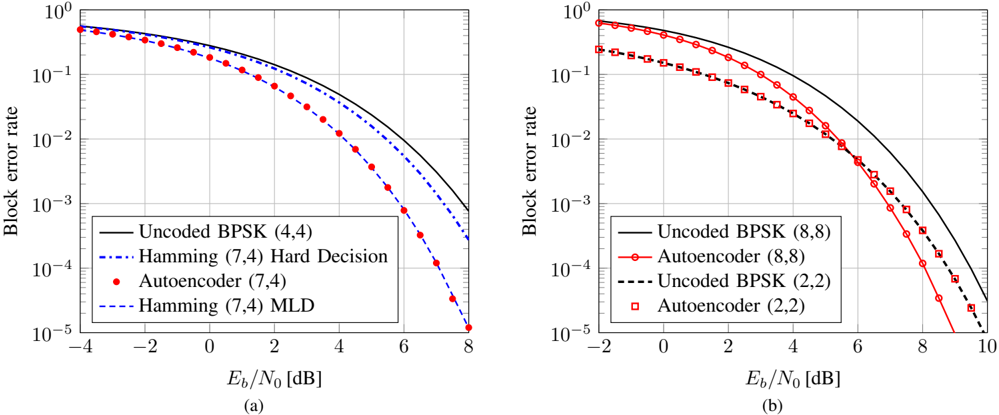
- A learned autoencoder for a (7,4) system at rate R = 4/7 achieves the same block error rate (BLER) as a Hamming (7,4) code with maximum likelihood decoding, while an (8,8) autoencoder outperforms uncoded BPSK over the full E_b/N_0 range, indicating learned joint coding and modulation.
- For the two-user AWGN interference channel, the autoencoder matches time-sharing for (1,1) and (2,2), but achieves gains of about 0.7 dB for (4,4) and 1 dB for (4,8) at a BLER of 10^-3.
- An autoencoder (8,4) with an RTN over a multipath fading channel with L = 3 Rayleigh taps outperforms differential BPSK with maximum likelihood sequence estimation and a Hamming (7,4) code, whereas the plain autoencoder struggles to match it; RTNs also show faster training convergence.
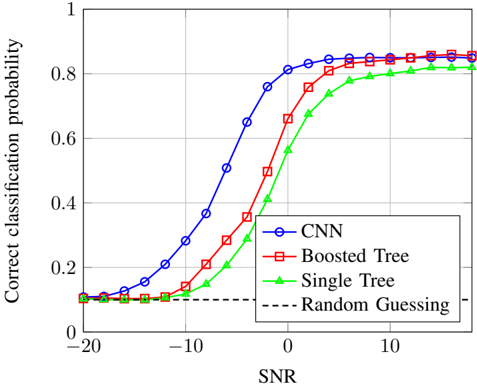
- For modulation classification on 1.2M sequences of 128 complex-valued IQ samples across ten modulation schemes and SNRs from -20 dB to 18 dB, the CNN outperforms a boosted expert-feature classifier by around 4 dB in the low-to-medium SNR range, with almost identical high-SNR performance; a single tree is about 6 dB worse at medium SNR and 3.5% worse at high SNR.
Methods
- The transmitter, channel, and receiver are represented as one deep neural network trained as an autoencoder: one-hot message input, dense layers, normalization layer for transmit constraints, additive noise channel layer, and softmax receiver output, trained with categorical cross-entropy using SGD/Adam at learning rate 0.001 and fixed E_b/N_0 = 7 dB.
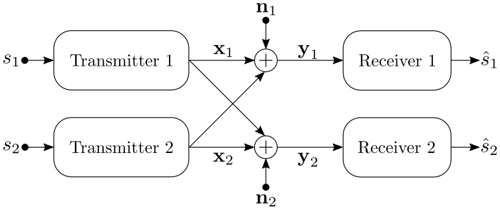
- The autoencoder concept is extended to multiple transmitter-receiver pairs in a two-user interference channel, with dynamic loss weights α_t per mini-batch to balance the two cross-entropy losses; performance is compared against 2^{2k/n}-QAM with time-sharing.
- RTNs combine a learned parameter estimator, a differentiable parametric transform, and a discriminative network; the paper demonstrates phase-offset compensation and multipath inverse filtering. For modulation classification, a VGG-like CNN with 324,330 trainable parameters is trained on the RML2016.10b dataset.
Limitations
- The paper states that scalability to large message sets M is a major challenge: for k = 100 bits, training complexity is prohibitive because the autoencoder must see at least every message once.
- The paper states that optimal data representations, loss functions, training SNR, and hyperparameters are not well understood; training at one SNR does not necessarily generalize to others, and no common communications benchmarks or datasets comparable to MNIST or ImageNet exist.
- The paper states that end-to-end learning over real channels requires system identification because backpropagation assumes a known channel transfer function; complex-valued neural networks are not supported by current DL libraries. Evident from the text: the reported results are simulation-based, use small (n,k) settings, assume known channel models during training, and the paper explicitly leaves detailed performance comparisons for various channel types and parameters to future work.
Model-written summary. Check it against the paper before relying on it.
Integrity signals
Registry
Cites
Statistics
Figures






Verification
Claims the paper makes
6 Valid · 4 Not valid · 18 Not checked · 65 Own results and interpretations
Every source the paper cites for this claim was checked and supports it.
In the paper
“For instance in [22], it was shown that training with a single codeword is sufficient since the structure of the code is embedded in the NN through the Tanner graph.”
What the sources say
- Supportedcites [22] [22] E. Nachmani, Y. Be'ery, and D. Burshtein, 'Learning to decode linear codes using deep learning,' in Proc. IEEE Annu. Allerton Conf. Commun., Control, and Computing (Allerton) , 2016, pp. 341-346. - source
The Introduction says the decoder uses a Tanner graph representing the code and that one codeword suffices for training. Section III explains the precise condition: over a binary memoryless symmetric channel, the decoder’s error rate is independent of the transmitted codeword, so training can use noisy versions of a single codeword. (LLM, conf=0.91)
boostedstates a cause- Asserted: passes — The authors put it forward as true.
- Checkable: passes — It can be checked against evidence.
- Load-bearing: unclear — It is unclear whether the paper’s conclusions depend on it.
- Based: passes — The paper gives a reason why it holds.
- Supported
A result the paper reports from its own data — it cites no other source for it, so there is none to check. The quote shows it is in the paper.
In the paper
“We study the use of NNs on complex-valued IQ samples for the problem of modulation classification and show that convolutional neural networks (CNNs), which are the cornerstone of most DL systems for computer vision, can outperform traditional classification techniques based on expert features.”
plainstates a cause- Asserted: passes — The authors put it forward as true.
- Checkable: passes — It can be checked against evidence.
- Load-bearing: passes — The paper’s conclusions depend on it.
- Based: passes — The paper gives a reason why it holds.
The paper states this without a source or data behind it here, so there is nothing to check it against. The quote shows it is in the paper.
In the paper
“Training at low SNR for instance does not allow for the discovery of structure important in higher SNR scenarios.”
plainstates a cause- Asserted: passes — The authors put it forward as true.
- Checkable: passes — It can be checked against evidence.
- Load-bearing: unclear — It is unclear whether the paper’s conclusions depend on it.
- Based: unclear — It is unclear why the paper says it holds.
A result the paper reports from its own data — it cites no other source for it, so there is none to check. The quote shows it is in the paper.
In the paper
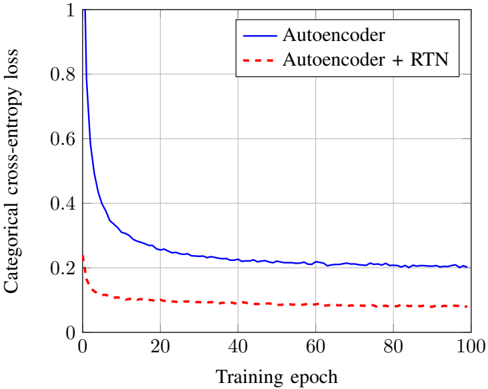
“Another advantage of RTNs is faster training convergence which can be seen from Fig. 10 that compares the validation loss of the autoencoder with and without RTN as a function of the training epochs.”
plainstates a cause- Asserted: passes — The authors put it forward as true.
- Checkable: passes — It can be checked against evidence.
- Load-bearing: unclear — It is unclear whether the paper’s conclusions depend on it.
- Based: passes — The paper gives a reason why it holds.
A result the paper reports from its own data — it cites no other source for it, so there is none to check. The quote shows it is in the paper.
In the paper
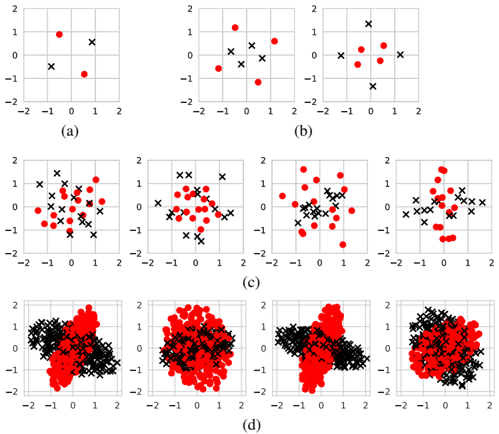
“Similarly, Fig. 4b shows a (4 , 2) system which leads to a rotated 16-PSK constellation.”
plainstates a cause- Asserted: passes — The authors put it forward as true.
- Checkable: passes — It can be checked against evidence.
- Load-bearing: unclear — It is unclear whether the paper’s conclusions depend on it.
- Based: passes — The paper gives a reason why it holds.
39 more claims
Create a free account to see all 93 claims and to verify the 4 references still open.
- Probably not a substantial claim. 29
- It may state two separate claims as one. 24
Self-check
Percentages, sums and reported differences re-computed from the paper’s own numbers.
Each contradiction between two passages listed here was confirmed by an independent check.
Rated minor: it would not touch a result — a value no result rests on, a p-value that stays on the same side of the significance level, or a conflict that is clerical, resolved elsewhere in the paper, or outside its own findings.
In the paper
§ A. Autoencoders for end-to-end communications systems · p. 5
“Similarly, Fig. 4b shows a (4 , 2) system which leads to a rotated 16-PSK constellation.”
§ A. Autoencoders for end-to-end communications systems · p. 6
“Figure 4: Constellations produced by autoencoders using parameters ( n, k ) : (a) (2 , 2) (b) (2 , 4) , (c) (2 , 4) with average power constraint, (d) (7 , 4) 2-dimensional t-SNE embedding of received symbols.”
Citations
Cites
Very Deep Convolutional Networks for Large-Scale Image Recognition
Simonyan, K., & Zisserman, A. (2014) · arXiv · doi:10.48550/arxiv.1409.1556 · Cited by 114,148 · cited 1×
“dense/fully-connected layers and terminated with a dense softmax layer for our classifier (similar to a VGG architecture [55]).”
BackgroundAdam: A Method for Stochastic Optimization
Kingma, D. P., & Ba, J. (2014) · arXiv · doi:10.48550/arxiv.1412.6980 · Cited by 98,946 · cited 4×
“Training was done at a fixed value of Eb/N0 = 7 dB (see Section IV-B) using Adam [46] with learning rate 0.”
BackgroundMethodInfluentialA Mathematical Theory of Communication
Shannon, C. E. (1948) · Bell System Technical Journal · doi:10.1002/j.1538-7305.1948.tb01338.x · Cited by 88,486
Scikit-learn: Machine Learning in Python
Pedregosa, F., Varoquaux, G., Gramfort, A., Michel, V., Thirion, B., Grisel, O., Blondel, M., Müller, A., Nothman, J., Louppe, G., et al. (2012) · arXiv · doi:10.48550/arxiv.1201.0490 · Cited by 71,016 · cited 1×
“11, we compare the classification accuracy of the CNN against that of extreme gradient boosting7 with 1000 estimators, as well as a single scikit-learn decision tree [56], operating on a mix of 16 analog and cumulant expert features as proposed in [53] and [57].”
Method(2014) · Cited by 33,419
(2008) · Journal of Machine Learning Research · Cited by 33,051
Human-level control through deep reinforcement learning
Mnih, V., Kavukcuoglu, K., Silver, D., Rusu, A. A., Veness, J., Bellemare, M. G., Graves, A., Riedmiller, M., Fidjeland, A. K., Ostrovski, G., et al. (2015) · Nature · doi:10.1038/nature14236 · Cited by 30,357
(2007) · Electronics: A First Course · doi:10.4324/9780080477527-64 · Cited by 24,923
Pan, S. J., & Yang, Q. (2010) · IEEE Transactions on Knowledge and Data Engineering · doi:10.1109/tkde.2009.191 · Cited by 23,387 · cited 1×
“learning [64] is one appealing candidate for adapting an endto-end communications system trained on a statistical model to”
BackgroundMultilayer feedforward networks are universal approximators
Hornik, K., Stinchcombe, M., & White, H. (1989) · Neural Networks · doi:10.1016/0893-6080(89)90020-8 · Cited by 21,728 · cited 1×
“Third, it has been shown that NNs are universal function approximators [13] and recent work has shown a remarkable”
Background
Research works printed but not linked: 2
- [35] I. Goodfellow, Y. Bengio, and A. Courville, Deep Learning . MIT Press, 2016. -
- [52] J. Estaran et al. , 'Artificial neural networks for linear and non-linear impairment mitigation in high-baudrate IM/DD systems,' in Proc. 42nd European Conf. Optical Commun. (ECOC) . VDE, 2016, pp. 1-3. -
Cited by
Items 2,701–2,800 of 2,995
Benosman, M. M., Bendimerad, M. Y., & Bendimerad, F. T. (2026) · TELKOMNIKA (Telecommunication Computing Electronics and Control) · doi:10.12928/telkomnika.v24i1.27236
Deep Learning-Based Uplink Sampling Frequency Offset Estimation for Ambient IoT System
Huang, K., Wang, H., Hu, C., & Li, Y. (2025) · International Conference on Communication and Information Processing (ICCIP) · doi:10.1145/3784833.3784855
“In recent years, deep learning techniques have gained considerable attention in wireless communication for physical layer solutions [7].”
MIMO Channel Modeling Based on Physics-Constrained Generative Neural Networks
Li, H., Wang, H., Liu, S., & Zhang, W. (2025) · IEEE International Conference on Trust, Security and Privacy in Computing and Communications (TrustCom) · doi:10.1109/trustcom66490.2025.00397
“The application potential of deep learning in physical layer communications was first systematically explored in [10], subsequently, researchers began to explore the application of neural networks to channel modeling.”
CNN-ResNet Based Robust Automatic Modulation Classification in MIMO Systems
Shalu, & Singh, B. (2025) · International Conference on Computational Intelligence and Communication Networks (CICN) · doi:10.1109/cicn67655.2025.11368013
“Recently, deep learning (DL) is emerging as a data-driven approach with applications across the physical layer of wireless communication, including adaptive communication, modulation recognition, and spectrum awareness [6].”
KAN-AE with Non-Linearity Score and Symbolic Regression for Energy-Efficient Channel Coding
Perre, A. J., Huggins, P., & Sahin, A. (2026) · IEEE Consumer Communications and Networking Conference · doi:10.1109/ccnc65079.2026.11366411 · Cited by 1
“In this study, we investigate the use of autoencoders (AEs) for channel coding, which is discussed in several prior works [9, 10, 11].”
A Semantic Coding Scheme for Robust Image Transmission over Noisy Channels
Canoglu, A. S., Sarı, T. T., & Seçinti, G. (2026) · IEEE Consumer Communications and Networking Conference · doi:10.1109/ccnc65079.2026.11366567
“Deep joint source-channel coding (JSCC) solves this problem by replacing encoding pipelines with an auto encoder trained over a noisy channel layer [1], [2].”
Machine Learning and Deep Learning Framework for SNR Classification in 5G Beamforming Systems
Shari, R., & Jacob, S. (2025) · International Conference on Computational Intelligence and Communication Networks (CICN) · doi:10.1109/cicn67655.2025.11368037
(2026) · Elsevier eBooks · doi:10.1016/b978-0-44-327410-7.00040-5
AI enhancements in the 6G physical layer via generative modeling
Turan, N., Weißer, F., Baur, M., Burmeister, F., Fettweis, G. P., & Utschick, W. (2026) · Elsevier eBooks · doi:10.1016/b978-0-44-327410-7.00019-3
Moumena, A. (2026) · Telecommunication Systems · doi:10.1007/s11235-026-01414-2
“ML techniques have shown great promise in addressing various challenges in wireless communication, including signal classification, interference detection, and resource management [12].”
Аналіз архітектур Dense Neurla Network для класифікації сигналів на основі комплексних вибірок
Слюсар, В. І., Козлов, В., & Козлов, Д. (2025) · Озброєння та військова техніка · doi:10.34169/2414-0651.2025.3(47).57-64
CEEMDAN-AI Based Equalizer for Nonlinear Distortion Mitigation in Satellite Communications
Kim, Y., Lee, J., 박민용, & Lee, B. (2025) · International Conference on Information and Communication Technology Convergence (ICTC) · doi:10.1109/ictc66702.2025.11389083
SSA-RF-Based Radio Propagation Path Loss Prediction Model
Wu, Y. (2025) · International Conference on Digital Society and Intelligent Computing · doi:10.1145/3788910.3788940
AI-augmented 6G Massive MIMO System: Challenges, Opportunities and Key Technologies
Wang, X., Deng, J., Chen, T., He, Z., Li, Y., & Cui, Y. (2025) · IEEE International Conference on Smart City and Informatization (iSCI) · doi:10.1109/isci66495.2025.00010
“By leveraging large-scale datasets, AI can generalize from empirical evidence and continuously improve its performance, offering a flexible and powerful alternative to conventional methods that struggle with unmodeled dynamics and practical imperfections [6].”
Robust Beamforming via Graph Neural Networks and Attention Mechanisms for MU-MISO Systems
Li, R., Jin, W., Zhang, J., He, H., Li, Y., & Jin, S. (2025) · IEEE International Conference on Communication Technology (ICCT) · doi:10.1109/icct67417.2025.11374144
“Recent advances in deep learning (DL) offer a promising alternative for wireless communications [6].”
Shu, Z., Chang, J., Ge, J., & Zhang, J. (2025) · IEEE International Conference on Communication Technology (ICCT) · doi:10.1109/icct67417.2025.11373956
“…characteristics, in order to improve the performance of wireless communication in dynamically changing environments and to solve the problems that are difficult to be solved by traditional communication algorithms, a lot of literatures have utilized deep learning to solve such problems [5] [6].”
Communication receiver design with pre-trained models based natural redundancy decoding
Wang, Z.-Y., Yu, H., & Yang, Y.-Z. (2026) · Digital Communications and Networks · doi:10.1016/j.dcan.2026.02.006
A Novel Multi-Modulation-Order Technique Based on Deep Learning for Communication Systems
Dao, T.-N. (2026) · IEEE Communications Letters · doi:10.1109/lcomm.2026.3668274
“…(AE) is used to simulate communication systems where the encoder maps a transmission symbol to a complex signal in the constellation space and the decoder recovers the transmission symbol from the received signal, usually under a noisy channel [1], [2], [3], [4], [5], [6], [7], [8], [9].”
LoraNet: Robust LoRa Signal Classification using Deep Convolutional Neural Networks and Spectrograms
Srivastava, S., Arora, S., Kalsotra, S., & Agarwal, S. (2025) · IEEE DELCON - International Conference on Recent Smart Technologies in Engineering for Sustainable Development (DELCON) · doi:10.1109/delcon68055.2025.11399967
“Machine learning (ML), and particularly Deep Learning (DL), has emerged as a powerful alternative, offering the ability to learn intricate features directly from raw or minimally processed signal data [4].”
Kim, D. J., Kim, S. J., & Suh, J. H. (2026) · IEEE Access · doi:10.1109/access.2026.3669550 · Cited by 1
Fast-Tactical Diffusion for On-Board AAV Spectrum-Level Signal Deception
Xu, L., Wu, Y., Zhang, Z., Feng, L., Zhu, C., Wang, F., & An, J. (2026) · IEEE Internet of Things Journal · doi:10.1109/jiot.2026.3669156
“This structure is consistent with the local stationarity and energy concentration properties typical of communication signals, [35] indicating that the dataset preserves modulation-dependent spectral textures across samples.”
Start-of-Packet Detection Using Machine Learning
Kaur, S., Ahmad, A., & Agarwal, S. (2026) · IEEE Transactions on Communications · doi:10.1109/tcomm.2026.3669492
“The authors in [14], [15], [16], and [17] explored DL techniques such as Artificial Neural Networks (ANN), Recurrent Neural Networks (RNN), and Convolutional Neural Networks (CNN) for SOP detection, highlighting their signifi-cance in communication systems.”
Ku, M., Yang, M.-H., Song, Y.-Z., & Quek, T. Q. S. (2026) · IEEE Internet of Things Journal · doi:10.1109/jiot.2026.3669903 · Cited by 1
“Inspired by the AE architecture [42] which is capable of generating decodable encoded representation vectors through encoder and decoder pairs, we employ an AE to design G .”
Babar, M., Moturi, S., Kumar, N. V., Ismail, S., Reddy, G. R. R., Vinay, N., & Ooruchintala, O. (2025) · IEEE International Conference on Recent Advances in Computing and Systems (REACS) · doi:10.1109/reacs67479.2025.11413388
“T. O’Shea and J. Hoydis [18]and Zisserman [19] developed VGGNet, establishing a deep learning baseline for vision tasks.”
An RNN-based decoding scheme for IM/DD visible light communication systems
Dinh, D. L., Van, T. N., & Thanh, P. P. (2026) · The University of Danang - Journal of Science and Technology · doi:10.31130/ud-jst.2026.24(1).596e
“Key research efforts have successfully utilized neural architectures for signal classification [8] and error-correction decoding [9]-[13].”
A Diversity-Enhanced Neural Network Approach for Wireless Transmission Power Control
Pan, X., Mo, Y., Zheng, J., & Chan, T.-T. (2026) · IEEE Communications Letters · doi:10.1109/lcomm.2026.3671409
“Recent years have witnessed a surge of research leveraging machine learning to drive the intelligence and efficiency of wireless networks [4], [5], [6], [7], [8], [9].”
Nie, T., Zheng, W., Ding, C., Bai, Y., Xiao, L., & Xiao, P. (2026) · Complex & Intelligent Systems · doi:10.1007/s40747-026-02240-4
Optimizing the Complexity-Performance Tradeoff in Deep Learning Wireless Autoencoder Architectures
Abo-Zahhad, M., Ismail, E., Ali, A., & Elnahas, O. (2025) · International Japan-Africa Conference on Electronics, Communications, and Computations (JAC-ECC) · doi:10.1109/jac-ecc67970.2025.11417516
“[6], where the encoder represented the transmitter and the decoder represented the receiver.”
Sparse Channel Estimation for Next Generation Wireless Communication Systems Using GANs
Abheeshek, D., & Joshi, S. (2026) · International Conference on Communication Systems & Networks (COMSNETS) · doi:10.1109/comsnets67989.2026.11418197
“In [1], the authors proposed using DL techniques to optimize communication systems.”
Deep Learning Based Channel Estimator for Non-gaussian Channel Statistics
Sree Harsha, A., Vaidhiyan, N. K., & Rajagopal, S. (2026) · International Conference on Communication Systems & Networks (COMSNETS) · doi:10.1109/comsnets67989.2026.11418305
“For example, [3] employs a neural network jointly for channel estimation and symbol detection, [4] explores modulation recognition using deep learning, and [5] explores MIMO signal detection.”
Reliability-Aware Neural Decoding with Adaptive Multi-Source Information Fusion
Fu, P., Wang, Z., Guo, J., Zhang, Y., Wang, F., Zhu, R., & Huang, Z. (2026) · Entropy · doi:10.3390/e28030323
“In recent years, the integration of deep learning with channel decoding has emerged as an active research area [6,7].”
Deep Joint Source-Channel Coding for Integrated Multi-hop Image Transmission and Reconstruction
Sun, X., Yang, S., & Shi, Y. (2025) · IEEE International Conference on Information, Communication and Networks (ICICN) · doi:10.1109/icicn67355.2025.11430455
“The integration of AE and communication system has driven investigations on E2E physical layer design based on deep learning [9].”
Li, S., Wang, J., Zhou, M., Song, R., Qian, Z., Cui, Y., Sun, H., Zhang, A., & Pan, H. (2026) · Journal of Physics Conference Series · doi:10.1088/1742-6596/3178/1/012062
“Leveraging these strengths, CNNs are employed in this work to process UWA communication signals, as they can automatically learn complex channel characteristics, capturing nonlinear distortions, multi-path effects, and Doppler shifts that are difficult to model analytically [12, 13, 14].”
Vanteru, M. K., Adupa, C., K.Shashidhar, & Deepthi, G. (2025) · International Conference on Advanced Computing and Emerging Technologies (ACET) · doi:10.1109/acet67282.2025.11430312
“Deep learning-based CSI feedback and comprehensive surveys [11] established its importance in wireless communication.”
DL-NOMA-CancelNet: A Deep Learning Framework for Interference Cancellation Using CNN and BiLSTM
Hussien, E. A. (2026) · Diyala Journal of Engineering Sciences · doi:10.24237/djes.2026.19111
“The integration of advanced signal processing and machine learning techniques, especially deep learning, is necessary to address these issues [8, 9].”
Achieving Pilot-Efficient MIMO-OFDM Receiver by Generative Diffusion Models
Yang, Y., Alhussein, O., Zhang, Z., & Debbah, M. A. (2025) · Globecom · doi:10.1109/globecom59602.2025.11432466
“In recent years, data-driven approaches based on neural networks (NNs) have emerged as powerful alternatives to channel characterization tasks [3].”
Patra, M. C., Kisku, R., Patra, J., & Dwari, B. C. (2026) · International Journal of Innovative Science and Research Technology (IJISRT) · doi:10.38124/ijisrt/26feb914
End-to-end Neural-Classical Concatenated Feedback Coding with OFDM Guidance
Büyükşirin, A. C., & Kim, H. (2025) · Globecom · doi:10.1109/globecom59602.2025.11432731
“Inspired by the recent remarkable progress of deep-learning (DL) based physical layer communication and coding schemes [2]–[6], researchers have specifically investigated DL-based feedback coding schemes.”
Orthogonality-Aware Neural Waveform Design for MIMO Systems With Alamouti-Like Structures
K, A. M., & Bhatnagar, M. R. (2026) · IEEE Transactions on Vehicular Technology · doi:10.1109/tvt.2026.3675632
Adaptive Modulation Inference via Input Skipping and Budget-Efficient Exiting
Xiang, K., Zhang, X., Zheng, X., Ma, Y., Meng, F., & Zhang, Q. (2025) · Globecom · doi:10.1109/globecom59602.2025.11432692
“These are typically rearranged into a real-valued matrix format: where 𝐼 [ 𝑛 ] and 𝑄 [ 𝑛 ] denote the IQ components of the 𝑛 -th received sample [2].”
High Performance Signal Design for Optical OFDM Systems Using Variational Autoencoder
Luong, N. N., Nguyen, C. T., & Pham, T. V. (2026) · IEEE Transactions on Vehicular Technology · doi:10.1109/tvt.2026.3676058 · Cited by 1
“Beyond its applications in constellation shaping, AEs have also been extensively utilized for PAPR reduction in OFDM-based systems.”
Zhang, Y., Wang, Y., Zhao, Q., Pan, S., Xie, F., Luo, S., Zhai, Y., & Yang, J. (2026) · Journal of King Saud University - Computer and Information Sciences · doi:10.1007/s44443-026-00675-w
The Transformer as a Parametric Filter for Sequence MIMO Equalization
Yu, K., Gao, Y., Lin, Y., Lyu, Z., Zhao, J., & Xiao, M. (2025) · International Conference on Electronic Communication, Computer Science and Technology (ECCST) · doi:10.1109/eccst68196.2025.11441010
“To address these limitations, data-driven deep learning (DL) solutions have been explored to learn the mapping from received signals to transmitted symbols directly [5], [11].”
Self-Attention Enhanced Deep Learning Demodulator for Dual Domain DCSK Systems
Gong, W. (2025) · IEEE International Conference of Safe Production and Informatization (IICSPI) · doi:10.1109/iicspi66775.2025.11437805
“Recent advances in deep learning have revolutionized wireless communications by demonstrating that neural networks can learn optimal signal processing strategies directly from data [6].”
Lightweight Spectrum Sensing via Multi-Source Knowledge Distillation for Cognitive Radio Networks
Wang, S., Zhou, Y., Chen, Q., & Li, W. (2025) · IEEE International Conference on Computer and Communications (ICCC) · doi:10.1109/iccc68654.2025.11437768
“Compared with traditional approaches, deep learning-based methods can extract deep-seated features of signals to achieve higher recognition accuracy [8].”
KAE: A Kolmogorov-Arnold Autoencoder Designed for End-to-End Learning in Z-Interference Channel
Guo, L., Gao, H., Li, J., Wang, Q., & Liu, G. (2025) · IEEE International Conference on Computer and Communications (ICCC) · doi:10.1109/iccc68654.2025.11437814
“Deep learning applied to raw IQ samples for modulation classification has demonstrated competitive accuracy, outperforming traditional methods that rely on expert features [1].”
A Physics-Guided Receiver for WiFi that Learns Hardware Nonlinearities without Training DataPreprint
Pasupuleti, R. R. (2026) · Research Square · doi:10.21203/rs.3.rs-9192715/v1
Joint Super-Resolution and Denoising for Channel Estimation in OFDM System
Jiang, X., Guo, Z., Chen, Y., Zheng, W., & Li, J. (2025) · IEEE International Conference on Computer and Communications (ICCC) · doi:10.1109/iccc68654.2025.11437940
“In terms of introducing computer vision methods, reference[5] first applied the denoising convolutional neural network (DnCNN) to beam space channel estimation in millimeter wave systems.”
An End-to-End Learning Framework for MIMO Communications
Chahine, K., Bae, J. H., Bai, D., & Kim, H. (2025) · Asilomar Conference on Signals, Systems and Computers (ACSSC) · doi:10.1109/ieeeconf67917.2025.11443715
“In the modular approach, each block is optimized in isolation, often assuming ideal behavior from preceding or following stages [15], [24].”
Anusha, C., & Sundru, A. (2026) · Research Square · doi:10.21203/rs.3.rs-8107878/v1
Лисецкий, Ю. М., Bobrov, S. I., М., Я. Н., & Німич, О. (2026) · COMPUTER-INTEGRATED TECHNOLOGIES EDUCATION SCIENCE PRODUCTION · doi:10.36910/6775-2524-0560-2026-62-39
深層ニューラルネットワークによる到来方向推定 : 深層学習の利点と限界
安藤, ダ. 明. (2024) · Institutional Repositories DataBase (IRDB) · doi:10.14943/doctoral.k16175
Pasupuleti, R. R. (2026) · Research Square · doi:10.21203/rs.3.rs-9278612/v1
Pasupuleti, R. R. (2026) · Research Square · doi:10.21203/rs.3.rs-9233609/v1
Advanced AI Systems for Noise Suppression in Wireless Signal Transmission Using Deep Learning
Jyothi, M., Senthamarai, R., Narasimhulu, K., Kumar, G. R., Naidu, G. R., & Nathiya, M. (2025) · International Conference on Advancement in Futuristic Technologies (ICAFT) · doi:10.1109/icaft66710.2025.11453152
“The application scope of deep learning for wireless communication systems noise suppression is studied [7] within their survey of AI-based techniques for IoT noise suppression.”
Himanshu Gupta, D. G. K. P. (2026) · International Journal of Advanced Research in Science Communication and Technology · doi:10.48175/ijarsct-32320
Decoding algorithms for lattices
Corlay, V. (2020) · theses.fr (ABES) · doi:10.70675/efeb9289zef55z4920z927bz18b645e1c7b6
The uplink reception and downlink transmission in MU-MIMO for 5G
Askri, A. (2021) · theses.fr (ABES) · doi:10.70675/c99d9c8fz1309z41c5zb7f6zcfcb1190a1ea
Study and mitigation techniques of RF impairments for beyond 5G multi-carrier waveforms
Cheng, X. (2021) · theses.fr (ABES) · doi:10.70675/40381656z3e81z4ec7zbafaz6c0861a56c2b · Cited by 1
Enhanced Physical Layer Security through Frequency and Spatial Diversity
Ajayi, I. (2023) · theses.fr (ABES) · doi:10.70675/a19d99c2z2296z4432za233z2c7a8e5196e6
CFO Estimation for OFDM-Based Wireless Communication Systems Under Impulsive Noise
Rai, S., Jain, S., Chaudhari, M. S., & Thakur, P. S. (2026) · IEEE International Conference on Interdisciplinary Approaches in Technology and Management for Social Innovation (IATMSI) · doi:10.1109/iatmsi68868.2026.11466154
“In recent years, deep learning (DL) has emerged as a powerful alternative to classical estimation theory [5].”
AI models for digital signal processing in future 6G-IoT networks
Larue, G. (2023) · theses.fr (ABES) · doi:10.70675/b70858e5z6800z430dza632z33528def55bb · Cited by 3
Kim, S., Won, Y., & Park, J. (2026) · Photonics · doi:10.3390/photonics13040356
Development of Optimal Reconfigurable Smart Surfaces for Massive MIMO Wireless Communications
Hussein, Y. (2024) · theses.fr (ABES) · doi:10.70675/b1a6aae5zec56z47b3zb5f1zc1b9827472b3
CSI Feedback Enhancement using Machine Learning
Shehzad, M. K. (2023) · theses.fr (ABES) · doi:10.70675/ed051865z41b3z4415za70ez2e5d09bbf5ef
Transformer-Based Cognitive Radio: Adaptive Modulation Strategies Using Transformer Models
Melis, A., Piroddi, A., & Girau, R. (2025) · International Conference on Electrical, Computer and Energy Technologies (ICECET) · doi:10.1109/icecet63943.2025.11472517
“Deep learning, especially CNNs, now enables end-to-end modulation classification with high accuracy, even in low SNR conditions [6].”
Multiplication-free intelligent communication receiver enabled by bimodal power-aware quantization
Zhang, Y., Xiong, X., Liang, Y., Lam, C., Ng, B. K., Wu, Q., & Xu, R. (2026) · Physical Communication · doi:10.1016/j.phycom.2026.103118
Hybrid Deep Learning for Channel Estimation and Tracking in RIS-Assisted UAV Wireless Communications
Markos, T. E. (2026) · International Journal of Research and Innovation in Applied Science · doi:10.51584/ijrias.2026.11030060
End-to-end ADC digital calibration via multi-output compression-recovery network
Li, J., Deng, H., Li, L., Wu, L., Li, M., Yang, X., & Yin, Y. (2026) · Microelectronics Journal · doi:10.1016/j.mejo.2026.107210
Xia, Z., & Lin, Y. (2026) · IEEE Internet of Things Journal · doi:10.1109/jiot.2026.3685655
“A MR is regarded as one of the key technologies for spectrum awareness and resource optimization in the IoT [1], [2], [3].”
Robust End-to-End Communication via NeuroCom: A Learned Symbol Mapping and Decoding Framework
Sar, D., Mahapatra, R., Das, D., & Udutalapally, V. (2026) · National Conference on Communications · doi:10.1109/ncc68160.2026.11479127
“End-to-end learning for communication systems was first demonstrated using autoencoder-based architectures [5], enabling joint training of transmitters and receivers.”
InfluentialAutoencoder-Based Resnet Block for Laser Phase Noise in Optical Communications
Asadi, A. Z. R. A., Alnaseri, O., Attallah, H. A., Himeur, Y., & Ala’anzy, M. A. (2026) · International Conference on Electronics, Computer and Computation · doi:10.1109/icecco67619.2026.11488813
Hoyos, E. A., Orozco, H. F. B., & Rodríguez-Idrobo, N. C. (2026) · Information · doi:10.3390/info17050410 · Cited by 1
Narkhede, V. P., Narkhede, P., & Shirbhate, R. (2026) · International Journal of Computer Applications · doi:10.5120/ijca37deb8841fd3
A Novel Scheme for Single-Carrier VLC With Multidimensional Constellations
Osmanca, M. S. (2026) · IEEE Wireless Communications Letters · doi:10.1109/lwc.2026.3688258
“Deep learning offers a perspective in which a communication system can be viewed as an autoen-coder that jointly optimizes transmitter and receiver mappings for end-to-end performance [9], and this concept has been extended to OFDM settings via OFDM-autoencoders [10].”
Valera, H. A., & Goyal, S. (2026) · IEEE International Conference on AI Engineering and Innovations (AIEI) · doi:10.1109/aiei69164.2026.11496926 · Cited by 1
“Recent works have demonstrated this feasibility by presenting frameworks for the physical layer providing insights into latency, synchronization, and real-time robustness [27].”
Neural Network Assisted Turbo Code Decoding for Energy Efficient IoT Networks
Balakrishna, D. P., & Pramod Kumar, P. (2026) · IEEE International Conference on Emerging Computing and Intelligent Technologies (ICoECIT) · doi:10.1109/icoecit68303.2026.11496700
“Traditional techniques to reduce turbo decoding complexity include Max-Log-MAP approximation and early stopping criteria [6][7].”
Reinforcement Learning-Based Optimization of Turbo Decoder Iterations for Low-Power IoT Devices
Balakrishna, D. P., & Pramod Kumar, P. (2026) · IEEE International Conference on Emerging Computing and Intelligent Technologies (ICoECIT) · doi:10.1109/icoecit68303.2026.11496910
“O’Shea and Hoydis [6] introduced neural network-based modulation classification and end-to-end learning for the physical layer.”
AI-Driven Adaptive Turbo Decoding Framework for Dynamic IoT Communication Environments
Balakrishna, P., & Pramod Kumar, P. (2026) · IEEE International Conference on Emerging Computing and Intelligent Technologies (ICoECIT) · doi:10.1109/icoecit68303.2026.11497458
“Use of deep learning for physical-layer optimization was illustrated by O’Shea and Hoydis (2017), and end-to-end learning based design of adaptive encoders and decoders has also been demonstrated by Aoudia and Hoydis (2019) [3][4].”
Ha, S., Pyo, S., Lee, D., Kim, T., & Bang, I. (2026) · IEEE Communications Letters · doi:10.1109/lcomm.2026.3691047
“Recently, deep learning-based autoencoder (AE) architectures have gained attention for end-to-end physical layer optimization [9], [10], [11].”
Neural Transceiver Design for 6G: Cross-Channel Performance Analysis
Asif, M., Benhaddou, D., & Lent, R. (2026) · IEEE International Conference on Communication Systems and Network Technologies (CSNT) · doi:10.1109/csnt69054.2026.11502507
“O’Shea and Hoydis [5] proposed treating the entire communication link as an autoencoder, jointly training neural network encoders and decoders to minimize end-to-end reconstruction error, as illustrated in Fig.”
Hybrid Machine Learning Framework for Adaptive Error Correction in 6G Enabled IoT Systems
Balakrishna, D. P., Kumar, P., Gangadhar, S., Reddy, L. A., Shivaprasad, K., & Komira, Y. (2026) · International Conference on Intelligent Computing and Control Systems (ICICCS) · doi:10.1109/iciccs67901.2026.11502755
“In order to keep up with the dynamicity and intelligence required by 6G networks, communication systems need to evolve from static algorithm based to learning-based, context-awarearchitectures [5].”
MIMO-Based Jamming-Resilient Communication System
K.Sangeetha, Gangisetty, S. S., Vegi, A. N., & Datla, D. (2026) · IEEE International Conference for Convergence in Computing Technology (I3CTCON) · doi:10.1109/i3ctcon68242.2026.11507459
Adaptive Belief-Based Fusion for Robust RF Classification Under Low SNR
Nfata, H., & Fezai, N. (2026) · IEEE International Conference on Advanced Systems and Emergent Technologies (IC_ASET) · doi:10.1109/ic_aset69920.2026.11502158
“Classification of radio-frequency (RF) signals is a central problem in modern telecommunications, with applications in spectrum monitoring, secure communications, and modulation recognition [2], [15].”
Transformer‐Enhanced Multi‐Satellite IRS Coordination for Next‐Generation LEO Communications
Radhi, A. H., Feghhi, M. M., & Balafar, M. A. (2026) · IET Communications · doi:10.1049/cmu2.70160
Yu, E., Li, Q., & Chen, H. (2026) · IEEE Transactions on Communications · doi:10.1109/tcomm.2026.3693041
“• CD-E2E: A CSI-dependent E2E learning framework that requires retraining for each channel deployment [4], [30].”
ML-based detection for MIMO-NOMA downlink signal
Dhope, T. S., Butalia, A., Deshpande, P., Jha, P. K., Gupta, V., & Gupta, D. (2026) · AIP conference proceedings · doi:10.1063/5.0330173
Adaptive Multi-Resolution RF Classification Using CNN-BiLSTM Noise-Aware Curriculum Learning
Arunkumar, P., K, K. S., G, M. K. M., Meha, T., Harish, K., & Vidhya, P. (2026) · International Conference on Artificial Intelligence and Machine Learning Applications Theme: Healthcare and Internet of Things (AIMLA) · doi:10.1109/aimla67915.2026.11522354
“Although these methods enabled basic modulation recognition, their performance significantly degraded under low-SNR conditions and in environments with multi-protocol interference [1], [2].”
Saeedzada, I. (2025) · Multidisciplinary Journal of Research in Engineering and Technology · doi:10.65521/mjret.v12i2.2787
Ioannou, I. I., Georgiades, M., Nagaradjane, P., Khalifeh, A. F., Christophorou, C., Raspopoulos, M., & Vassiliou, V. (2026) · Network · doi:10.3390/network6020035 · Cited by 1
“O’Shea and Hoydis [17] provided a foundational introduction to deep learning for the physical layer, demonstrating that autoencoder architectures, including GAN-inspired designs, can learn end-to-end communication system representations that jointly optimize modulation, coding and detection.”
., K., & Baghmar, P. (2026) · International Journal For Multidisciplinary Research · doi:10.36948/ijfmr.2026.v08i03.79932
The Trainable BCJR and Its Applications
Magnaldi, M., & Montorsi, G. (2026) · IEEE Transactions on Communications · doi:10.1109/tcomm.2026.3698889 · Cited by 1
“In [3], a survey of the initial deployment of DL on the physical layer signal processing of communication systems is presented.”
Liu, G.-L., Shih, C., & Lin, C. Y.-T. (2026) · Advances in Space Research · doi:10.1016/j.asr.2026.05.094
Comparative analysis of DT and KNN for AMC
Ali, A., & Ahmed, H. I. (2026) · IEEE International Conference on Computing and Machine Intelligence (ICMI) · doi:10.1109/icmi68585.2026.11539884
“…AMC algorithms across two primary analog modulation schemes (AM and FM) and varying SNR levels, incorporating realistic channel impairments [8, 9, 10] The feature set of instantaneous statistics, higher-order cumulants (HOCs), and spectral properties is established as the canonical and…”
Okoyeigbo, O., Deng, X. T., Sheriff, R. E., Jeremiah, D. D., & Shobayo, O. (2026) · Telecom · doi:10.3390/telecom7030065
“More broadly, existing studies and surveys consistently identify deep learning as a strong enabler for physical-layer design, highlighting its ability to learn compact channel representations and support data-driven, end-to-end optimization of wireless communication systems [6].”
Quraishi, M. H. M., & Nagrale, P. N. (2026) · myresearchgo · doi:10.64448/myresearchgo.vol.2.issue.5.15
Qasim, M., Kavalcıoğlu, C., Tackie, S. N., & Dimililer, K. (2026) · International Congress on Human-Computer Interaction, Optimization and Robotic Applications (ICHORA) · doi:10.1109/ichora69329.2026.11537212
“This is a methodological justification of the use of that same philosophy for yielding quality indicators, like SNR, in adaptive systems [12].”
Metadata
- Authors
- O'Shea, T., & Hoydis, J.
- Affiliations
- Nokia (France) (FR)
- Venue
- IEEE Transactions on Cognitive Communications and Networking
- Published
- 2017-12
- Volume
- 3
- Issue
- 4
- Pages
- 563-575
- ISSN
- 2332-7731 (ISSN-L)
- OpenAlex
- W2734408173
- Semantic Scholar
- 78989616eeeac55b202e3e4205225e7135054185
- Cited by
- 2,980
- References
- 69
- Citations by year
- 2026: 307 · 2025: 327 · 2024: 305 · 2023: 368 · 2022: 432 · 2021: 409 · 2020: 406 · 2019: 322 · 2018: 95 · 2017: 9
- FWCI
- 122.29
- Type
- journal article
- Language
- en
- Open access
- green
- arxiv.org
- Locations
- IEEE Transactions on Cognitive Communications and Networking (publishedVersion)
- arXiv (Cornell University) (submittedVersion)
- arXiv (Cornell University)
- Topics
- Physical Sciences › Computer Science › Artificial Intelligence › Wireless Signal Modulation Classification
- Physical Sciences › Engineering › Electrical and Electronic Engineering › Advanced Wireless Communication Techniques
- Physical Sciences › Engineering › Electrical and Electronic Engineering › Advanced Wireless Communication Technologies
- Keywords
- end-to-end reconstruction, domain knowledge integration, convolutional neural networks, automatic modulation classification, IQ samples
About these checks
Registry, retraction, Cites and statistics results are computed, not judged, with one exception: a printed reference that no index lists is read once by a model before it counts as a citation error. Claims are extracted by a model and kept only when their quote appears verbatim in the text; each cited source is then checked, with a model’s help, for whether it says what the claim relies on. Those verdicts can be wrong — read the claim’s quote and the cited source before relying on one.
The claim verdicts this report counts are experimental: their accuracy is not yet measured.
A language model drew the claims from the paper on 2026-11-07, under version 3 of the claim definition (model deepseek-v4.1-flash, prompt extract-v3).
A second model labelled each claim on 2026-11-07 (model jev-1.13-20260917, definition revision gold-guideline-v0.2).
Cited sources are checked with a language model’s help (gpt-6-sol).
Statistics and arithmetic are recomputed, not judged.
Confidence bands are shown only for fields calibrated on our annotated test set. None is calibrated yet, so no band is shown.
What counts as a claim ›How we measure confidence ›How we check this ›
Are you an author, or do you see a problem with this page? Request a review
Data sources
Bibliographic data: Semantic Scholar, OpenAlex, Crossref.
Contains information from the Semantic Scholar Academic Graph Datasets, made available under the ODC Attribution License (ODC-BY 1.0).
Semantic Scholar’s data is described in: Kinney, R., et al. (2023). The Semantic Scholar Open Data Platform. arXiv:2301.10140.
