

An Introduction to Deep Learning for the Physical Layer
Open accessThe DOI matches its Crossref record; 90 of the 92 references it cites were found in a registry or an index, and 2 are not checked yet; 8 of the 32 sources its claims cite were checked for support.
Abstract
We present and discuss several novel applications of deep learning for the physical layer. By interpreting a communications system as an autoencoder, we develop a fundamental new way to think about communications system design as an end-to-end reconstruction task that seeks to jointly optimize transmitter and receiver components in a single process. We show how this idea can be extended to networks of multiple transmitters and receivers and present the concept of radio transformer networks as a means to incorporate expert domain knowledge in the machine learning model. Lastly, we demonstrate the application of convolutional neural networks on raw IQ samples for modulation classification which achieves competitive accuracy with respect to traditional schemes relying on expert features. This paper is concluded with a discussion of open challenges and areas for future investigation.
Verified 2026-11-19 · 2 references not checked yet
Overview
CoChat Summary
TL;DR
The paper introduces deep learning for the physical layer by treating a communications system as an autoencoder that jointly learns transmitter and receiver implementations end-to-end. It also extends this idea to multi-user interference channels, proposes radio transformer networks (RTNs) to inject expert domain knowledge, and shows CNNs on raw IQ samples can outperform expert-feature modulation classifiers.
Key findings
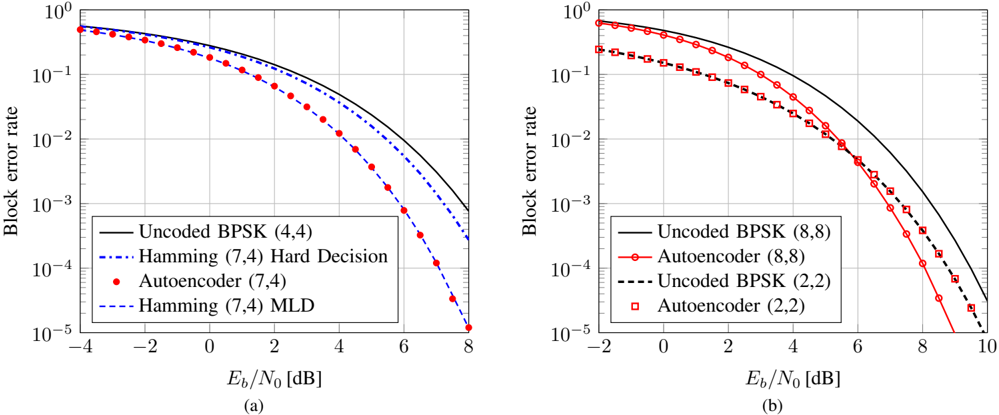
- A learned autoencoder for a (7,4) system at rate R = 4/7 achieves the same block error rate (BLER) as a Hamming (7,4) code with maximum likelihood decoding, while an (8,8) autoencoder outperforms uncoded BPSK over the full E_b/N_0 range, indicating learned joint coding and modulation.
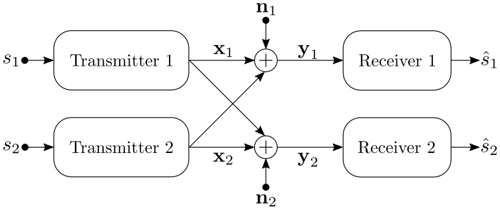
- For the two-user AWGN interference channel, the autoencoder matches time-sharing for (1,1) and (2,2), but achieves gains of about 0.7 dB for (4,4) and 1 dB for (4,8) at a BLER of 10^-3.
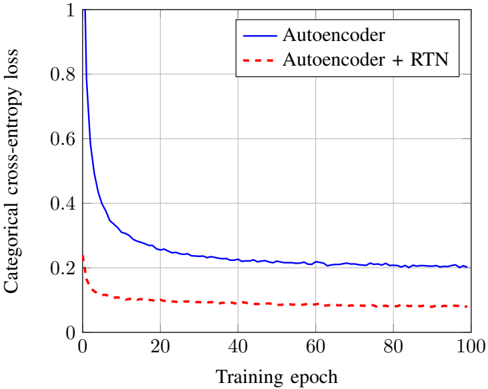
- An autoencoder (8,4) with an RTN over a multipath fading channel with L = 3 Rayleigh taps outperforms differential BPSK with maximum likelihood sequence estimation and a Hamming (7,4) code, whereas the plain autoencoder struggles to match it; RTNs also show faster training convergence.
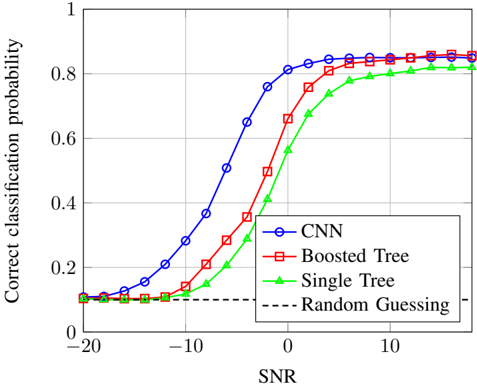
- For modulation classification on 1.2M sequences of 128 complex-valued IQ samples across ten modulation schemes and SNRs from -20 dB to 18 dB, the CNN outperforms a boosted expert-feature classifier by around 4 dB in the low-to-medium SNR range, with almost identical high-SNR performance; a single tree is about 6 dB worse at medium SNR and 3.5% worse at high SNR.
Methods
- The transmitter, channel, and receiver are represented as one deep neural network trained as an autoencoder: one-hot message input, dense layers, normalization layer for transmit constraints, additive noise channel layer, and softmax receiver output, trained with categorical cross-entropy using SGD/Adam at learning rate 0.001 and fixed E_b/N_0 = 7 dB.
- The autoencoder concept is extended to multiple transmitter-receiver pairs in a two-user interference channel, with dynamic loss weights α_t per mini-batch to balance the two cross-entropy losses; performance is compared against 2^{2k/n}-QAM with time-sharing.
- RTNs combine a learned parameter estimator, a differentiable parametric transform, and a discriminative network; the paper demonstrates phase-offset compensation and multipath inverse filtering. For modulation classification, a VGG-like CNN with 324,330 trainable parameters is trained on the RML2016.10b dataset.
Limitations
- The paper states that scalability to large message sets M is a major challenge: for k = 100 bits, training complexity is prohibitive because the autoencoder must see at least every message once.
- The paper states that optimal data representations, loss functions, training SNR, and hyperparameters are not well understood; training at one SNR does not necessarily generalize to others, and no common communications benchmarks or datasets comparable to MNIST or ImageNet exist.
- The paper states that end-to-end learning over real channels requires system identification because backpropagation assumes a known channel transfer function; complex-valued neural networks are not supported by current DL libraries. Evident from the text: the reported results are simulation-based, use small (n,k) settings, assume known channel models during training, and the paper explicitly leaves detailed performance comparisons for various channel types and parameters to future work.
Model-written summary. Check it against the paper before relying on it.
Integrity signals
Registry
Cites
Statistics
Figures






Verification
Claims the paper makes
6 Valid · 4 Not valid · 18 Not checked · 65 Own results and interpretations
Every source the paper cites for this claim was checked and supports it.
In the paper
“For instance in [22], it was shown that training with a single codeword is sufficient since the structure of the code is embedded in the NN through the Tanner graph.”
What the sources say
- Supportedcites [22] [22] E. Nachmani, Y. Be'ery, and D. Burshtein, 'Learning to decode linear codes using deep learning,' in Proc. IEEE Annu. Allerton Conf. Commun., Control, and Computing (Allerton) , 2016, pp. 341-346. - source
The Introduction says the decoder uses a Tanner graph representing the code and that one codeword suffices for training. Section III explains the precise condition: over a binary memoryless symmetric channel, the decoder’s error rate is independent of the transmitted codeword, so training can use noisy versions of a single codeword. (LLM, conf=0.91)
boostedstates a cause- Asserted: passes — The authors put it forward as true.
- Checkable: passes — It can be checked against evidence.
- Load-bearing: unclear — It is unclear whether the paper’s conclusions depend on it.
- Based: passes — The paper gives a reason why it holds.
- Supported
A result the paper reports from its own data — it cites no other source for it, so there is none to check. The quote shows it is in the paper.
In the paper
“We study the use of NNs on complex-valued IQ samples for the problem of modulation classification and show that convolutional neural networks (CNNs), which are the cornerstone of most DL systems for computer vision, can outperform traditional classification techniques based on expert features.”
plainstates a cause- Asserted: passes — The authors put it forward as true.
- Checkable: passes — It can be checked against evidence.
- Load-bearing: passes — The paper’s conclusions depend on it.
- Based: passes — The paper gives a reason why it holds.
The paper states this without a source or data behind it here, so there is nothing to check it against. The quote shows it is in the paper.
In the paper
“Training at low SNR for instance does not allow for the discovery of structure important in higher SNR scenarios.”
plainstates a cause- Asserted: passes — The authors put it forward as true.
- Checkable: passes — It can be checked against evidence.
- Load-bearing: unclear — It is unclear whether the paper’s conclusions depend on it.
- Based: unclear — It is unclear why the paper says it holds.
A result the paper reports from its own data — it cites no other source for it, so there is none to check. The quote shows it is in the paper.
In the paper
“Another advantage of RTNs is faster training convergence which can be seen from Fig. 10 that compares the validation loss of the autoencoder with and without RTN as a function of the training epochs.”
plainstates a cause- Asserted: passes — The authors put it forward as true.
- Checkable: passes — It can be checked against evidence.
- Load-bearing: unclear — It is unclear whether the paper’s conclusions depend on it.
- Based: passes — The paper gives a reason why it holds.
A result the paper reports from its own data — it cites no other source for it, so there is none to check. The quote shows it is in the paper.
In the paper
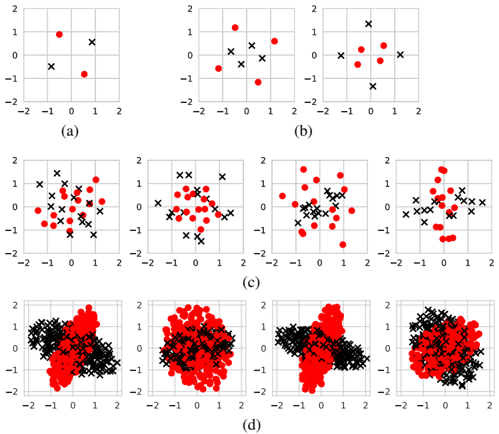
“Similarly, Fig. 4b shows a (4 , 2) system which leads to a rotated 16-PSK constellation.”
plainstates a cause- Asserted: passes — The authors put it forward as true.
- Checkable: passes — It can be checked against evidence.
- Load-bearing: unclear — It is unclear whether the paper’s conclusions depend on it.
- Based: passes — The paper gives a reason why it holds.
39 more claims
Create a free account to see all 93 claims and to verify the 4 references still open.
- Probably not a substantial claim. 29
- It may state two separate claims as one. 24
Self-check
Percentages, sums and reported differences re-computed from the paper’s own numbers.
Each contradiction between two passages listed here was confirmed by an independent check.
Rated minor: it would not touch a result — a value no result rests on, a p-value that stays on the same side of the significance level, or a conflict that is clerical, resolved elsewhere in the paper, or outside its own findings.
In the paper
§ A. Autoencoders for end-to-end communications systems · p. 5
“Similarly, Fig. 4b shows a (4 , 2) system which leads to a rotated 16-PSK constellation.”
§ A. Autoencoders for end-to-end communications systems · p. 6
“Figure 4: Constellations produced by autoencoders using parameters ( n, k ) : (a) (2 , 2) (b) (2 , 4) , (c) (2 , 4) with average power constraint, (d) (7 , 4) 2-dimensional t-SNE embedding of received symbols.”
Citations
Cites
Very Deep Convolutional Networks for Large-Scale Image Recognition
Simonyan, K., & Zisserman, A. (2014) · arXiv · doi:10.48550/arxiv.1409.1556 · Cited by 114,148 · cited 1×
“dense/fully-connected layers and terminated with a dense softmax layer for our classifier (similar to a VGG architecture [55]).”
BackgroundAdam: A Method for Stochastic Optimization
Kingma, D. P., & Ba, J. (2014) · arXiv · doi:10.48550/arxiv.1412.6980 · Cited by 98,946 · cited 4×
“Training was done at a fixed value of Eb/N0 = 7 dB (see Section IV-B) using Adam [46] with learning rate 0.”
BackgroundMethodInfluentialA Mathematical Theory of Communication
Shannon, C. E. (1948) · Bell System Technical Journal · doi:10.1002/j.1538-7305.1948.tb01338.x · Cited by 88,486
Scikit-learn: Machine Learning in Python
Pedregosa, F., Varoquaux, G., Gramfort, A., Michel, V., Thirion, B., Grisel, O., Blondel, M., Müller, A., Nothman, J., Louppe, G., et al. (2012) · arXiv · doi:10.48550/arxiv.1201.0490 · Cited by 71,016 · cited 1×
“11, we compare the classification accuracy of the CNN against that of extreme gradient boosting7 with 1000 estimators, as well as a single scikit-learn decision tree [56], operating on a mix of 16 analog and cumulant expert features as proposed in [53] and [57].”
Method(2014) · Cited by 33,419
(2008) · Journal of Machine Learning Research · Cited by 33,051
Human-level control through deep reinforcement learning
Mnih, V., Kavukcuoglu, K., Silver, D., Rusu, A. A., Veness, J., Bellemare, M. G., Graves, A., Riedmiller, M., Fidjeland, A. K., Ostrovski, G., et al. (2015) · Nature · doi:10.1038/nature14236 · Cited by 30,357
(2007) · Electronics: A First Course · doi:10.4324/9780080477527-64 · Cited by 24,923
Pan, S. J., & Yang, Q. (2010) · IEEE Transactions on Knowledge and Data Engineering · doi:10.1109/tkde.2009.191 · Cited by 23,387 · cited 1×
“learning [64] is one appealing candidate for adapting an endto-end communications system trained on a statistical model to”
BackgroundMultilayer feedforward networks are universal approximators
Hornik, K., Stinchcombe, M., & White, H. (1989) · Neural Networks · doi:10.1016/0893-6080(89)90020-8 · Cited by 21,728 · cited 1×
“Third, it has been shown that NNs are universal function approximators [13] and recent work has shown a remarkable”
Background
Research works printed but not linked: 2
- [35] I. Goodfellow, Y. Bengio, and A. Courville, Deep Learning . MIT Press, 2016. -
- [52] J. Estaran et al. , 'Artificial neural networks for linear and non-linear impairment mitigation in high-baudrate IM/DD systems,' in Proc. 42nd European Conf. Optical Commun. (ECOC) . VDE, 2016, pp. 1-3. -
Cited by
Items 2,801–2,900 of 2,995
A novel multi-dimensional constellation rotation method for physical layer security
Tek, Y. İ., Yildirim, F., & Başar, E. (2026) · npj Wireless Technology · doi:10.1038/s44459-026-00040-3
“In this context, AEs have been shown to learn irregular, non-conventional constellations that maximize distance propertiessuch as the squared minimum Euclidean distance (SMED), leading to improved error performance compared to classical modulation schemes 18 .”
Robust Drone Identification via RF Spectrogram Analysis Using Robustspecnet
Jain, A. J., Simran, Chhaperwal, A., & Kumar, V. (2026) · International Conference on Intelligent Systems in Engineering, Secured Systems and Cybersecurity (ICISESSC) · doi:10.1109/icisessc68634.2026.11542680
“These signals can be captured using Software Defined Radio (SDR) devices without transmitting any signal, making passive RF systems non intrusive, covert, and suitable for sensitive locations [4], [5].”
Performance of Deep Learning-Based Alamouti STBC Over Correlated Fading Channels
Naicker, A., Quazi, T., & Patel, S. S. (2026) · International Conference on Artificial Intelligence & Machine Learning in Communication and Power Systems (AIMLCPS) · doi:10.1109/aimlcps68702.2026.11542247
“In its canonical form, the model employs Fully Connected Neural Networks (FCNNs) on both sides [15].”
End-to-End Deep Learning-Based Communication System Using Autoencoders
Shahi, A., Sharma, H., Kalyan, B. S., & Goyal, S. (2026) · International Conference Big Data and Machine Learning · doi:10.1109/icbdml68582.2026.11544301
Position-Aware Masked Transformer for Automatic Modulation Recognition in MIMO Systems
Qu, Y., Sun, Y., Wu, J., & Wang, J. (2026) · IEEE Wireless Communications Letters · doi:10.1109/lwc.2026.3701007
“A UTOMATIC Modulation Recognition (AMR) is a key step in wireless signal recognition, aiming to identify the modulation scheme of received signals in complex environments [1], especially in non-cooperative scenarios where transmitter prior information is unavailable.”
Data-Driven Approach for Wideband Frequency-Invariant Beamforming
Chang, J.-W., Kim, S.-K., & Park, C. S. (2026) · The Journal of Korean Institute of Electromagnetic Engineering and Science · doi:10.5515/kjkiees.2026.37.5.452
Han, T. T., Phan, T. C., Quynh, N. V., Huu, P. N., & Dinh, T. H. (2026) · Measurement Science and Technology · doi:10.1088/1361-6501/ae7b6b
“Specifically, the integration of artificial intelligence (AI) has revolutionized the field of radio localization by modeling complex signal propagation processes [21].”
High-Order Cumulants and AI-Based Methods for Blind Identification and Equalization in 5G Networks
Elkassimi, S., Manaut, B., & Safi, S. (2026) · International Journal of Computer Theory and Engineering · doi:10.7763/ijcte.2026.v18.1396
“One of the critical challenges in this context is the accurate identification and equalization of radio channels, especially in scenarios where the use of pilot symbols is restricted or unavailable-commonly referred to as blind channel estimation and equalization [1].”
Perceptron-Based Multi-Criteria Scheduler for 5G and Beyond Networks
Mahato, R. K., & Singh, P. (2026) · IEEE Communications Letters · doi:10.1109/lcomm.2026.3695765
“To address the limitations of existing scheduling algorithms in managing heterogeneous QoS requirements [4], [5], [11], we propose a lightweight PB-MC scheduler with a single-layer perceptron that enables real-time scheduling due to the following reasons.”
Deep learning-based joint communication and sensing for underwater acoustic networks
Esmaiel, H. (2026) · Physical Communication · doi:10.1016/j.phycom.2026.103216
Deep Learning Augmented Wireless Channel Estimation: Over the Air Training and Validation
ulhaq, S. A., Aadya, & Darak, S. J. (2026) · IEEE Wireless Communications and Networking Conference · doi:10.1109/wcnc65185.2026.11555583
“DL-based PHY designs generally follow two approaches: (i) end-to-end DL PHY, which replaces the entire baseband chain with a large DL model [7–9], and (ii) DL-augmented PHY, which integrates DL into selected sub-blocks of a conventional baseband PHY [10–13].”
Han, Y., Tan, J., Zeng, R., & Wang, J. (2026) · IEEE Wireless Communications and Networking Conference · doi:10.1109/wcnc65185.2026.11555193
Unified Trellis Design for Realizing Pilot-Symbol-Less Wireless Communications
Chen, Y., & Hottinen, A. (2026) · IEEE Wireless Communications and Networking Conference · doi:10.1109/wcnc65185.2026.11555417
Transmission of Binary Sequences Over Gaussian Channels Under Privacy Constraints
Ceyani, E. E., Kazıklı, E., & Gezici, S. (2026) · IEEE Wireless Communications and Networking Conference · doi:10.1109/wcnc65185.2026.11555746
“Due to the prohibitive complexity of calculating the optimal g in (8), especially in higher dimensions, we propose an ML approach in which the mapping g ( x , y ) is parameterized by a multi-layer perceptron (MLP) [19].”
Deep Learning-Based Zak-OTFS Receiver with Embedded and Interleaved Pilots
Nazir, N. B., & Chockalingam, A. (2026) · IEEE Wireless Communications and Networking Conference · doi:10.1109/wcnc65185.2026.11555052
“In this work, we adopt a deep learning framework [10]–[12] that performs I/O estimation and symbol detection jointly.”
Risk-Aware Edge-Assisted UAV Perception with Confidence and SLA Gating
Maitlo, N., Arain, R. H., Arshid, K., Noonari, N., & Mustafa, G. (2026) · Machines · doi:10.3390/machines14060685
Xu, F., Liu, G., Liu, C., Li, Q., Liu, H., Ai, J., & Ma, L. (2026) · IEEE Transactions on Cognitive Communications and Networking · doi:10.1109/tccn.2026.3704569
“…future work, we will focus on integrating SC-WIM with MIMO systems, developing dedicated channel estimation methods, and extending the framework with advanced modulation techniques such as multidimensional constellations [51], [52], to further exploit waveform DoFS and enhance system performance.”
Das, S. P., & Bhatnagar, M. R. (2026) · IEEE Wireless Communications and Networking Conference Workshops (WCNCW) · doi:10.1109/wcncw67598.2026.11555353
“Second, deep learning architectures such as convolutional neural networks, recurrent networks, or autoencoder based end to end communication systems could be explored to capture more complex relationships between received samples and transmitted symbols [10], [12].”
A Signal-Adaptive Semi-Supervised Framework for Robust ISAC Under Hardware Impairments
Yang, Q., Wei, H., Sheng, B., & Kong, H. (2026) · Lecture notes in electrical engineering · doi:10.1007/978-981-95-7660-9_20
CPM-TransDetector: A transformer-based detector for continuous phase modulation signal detection
Wang, L., & Wu, K. (2026) · Digital Signal Processing · doi:10.1016/j.dsp.2026.106362
Task-Oriented Wireless Transmission of 3D Point Clouds: Geometric Versus Semantic Robustness
Ninković, V., Sobot, T., Vincan, V., Gojić, G., Mišković, D., & Vukobratović, D. (2026) · Global 6G Conference (Global 6G) · doi:10.1109/global6g69473.2026.11566822
“End-to-End Learned Communication Systems: End-to-end learned communication systems replace the traditional modular design, separating source coding, channel coding, and modulation, with jointly optimized neural transmitter–receiver architectures [20].”
NN-WUC: Wi-Fi to UWB Cross-Technology Communication via Neural Networks
Wang, B., Zhang, Z. M., & Wang, S. (2026) · International Conference on Sensor-Cloud and Edge Computing System (SCECS) · doi:10.1109/scecs69812.2026.11565885
“Sionna and related neural PHY studies demonstrate that communication blocks can be modeled and optimized in differentiable frameworks [19], [20].”
A Neural Network Based Trellis Coded Modulation Optimization Scheme
Wang, Y., Ma, M., Yang, Y., & Du, C. (2026) · International Conference on Electronics, Circuits and Information Engineering (ECIE) · doi:10.1109/ecie69549.2026.11565805
“Inspired by the[24], the input dimension is set to n to directly process the convolutional encoder output.”
AI-enabled Real-time Sensing Using 5G Base Stations for Dynamic Spectrum Sharing
Ionescu, S., Maas, A., Li, D., & Ramchandran, H. (2026) · IEEE International Symposium on Dynamic Spectrum Access Networks · doi:10.1109/dyspan69846.2026.11571158
“Deep learning models, particularly convolutional neural networks (CNNs), have shown strong potential for RF signal identification and physical-layer tasks [8].”
Fu, T. (2026) · International Conference on Artificial Intelligence and Industrial Technology Applications (AIITA) · doi:10.1109/aiita69518.2026.11567360
“Different from the traditional physical layer deep learning frameworks that rely on massive training datasets [11] , this paper directly uses LLM's powerful logical reasoning and context understanding ability to perform zero-shot threshold decisions.”
Wireless communications in the era of artificial intelligence
Huang, J., & Huang, C. P. (2026) · Elsevier eBooks · doi:10.1016/b978-0-44-341497-8.00007-9
METHOD FOR THE BLIND SEPARATION OF PSK SIGNALS BASED ON NEURAL NETWORK
Semenov, V., & Semenova, Y. V. (2026) · Kibernetyka ta Systemnyi Analiz · doi:10.34229/kca2522-9664.26.4.13
Mishra, R., Mandayam, N. B., & Seskar, I. (2026) · IEEE Conference on Computer Communications (INFOCOM) · doi:10.1109/infocom59046.2026.11571231
“Lefcourt et al. [4] demonstrate lightweight CNN-based RFI and spoofing detection for GNSS systems, while terrestrial and cognitive-radio literature widely adopts spectrogram-based deep learning for interference detection and modulation classification [3], [5].”
Hoyos, E. A., Orozco, H. F. B., & Rodríguez-Idrobo, N. C. (2026) · Future Internet · doi:10.3390/fi18070343
“We construct a RadioML-style synthetic dataset of raw in-phase/quadrature (I/Q) signal samples, following the methodology established by O’Shea, Corgan, and Clancy [11] and subsequently adopted by the broader AMC research community [12,15,31].”
DIFFRACT: Neuralized Utility Maximization for Wireless Networks by Differentiable Programming
Tan, C. W., & Chen, S. (2026) · IEEE Conference on Computer Communications (INFOCOM) · doi:10.1109/infocom59046.2026.11571642
“…shown great potential for wireless resource optimization, offering the ability to learn adaptive policies directly from data in complex and dynamic environments such as non-terrestrial and satellite-to-cell networks, bypassing the need for explicit modeling of channels and interference [6]–[11].”
Bharti, S., Rani, N., Kumar, R. B., Kumar, R., & Kumar, P. (2026) · International Journal of Computer Information Systems and Industrial Management Applications · doi:10.70917/ijcisim-2026-2410
Advances in Massive MIMO Technology: Developments, Challenges, and Future Trajectories
Al-Hilfi, H. M. T., Kadhim, R. H., & Ioannou, I. I. (2025) · Asian Conference on Communication and Networks (ASIANComNet) · doi:10.1109/asiancomnet68615.2025.11579656
Low-autocorrelation signal design for covert communication systems using an enhanced autoencoder
Zhang, R., Lin, W., & Chen, B. (2026) · Physical Communication · doi:10.1016/j.phycom.2026.103253
Inter-Cell Interference Rejection Based on Ultrawideband Walsh-Domain Wireless Autoencoding
Alonso, R. M., Thys, C., Pollin, S., Dehos, C., & Guzman, Y. E. G. (2026) · Joint European Conference on Networks and Communications & 6G Summit (EuCNC/6G Summit) · doi:10.1109/eucnc/6gsummit68295.2026.11577625
“We ensure a consistent Signal-to-Noise-ratio (SNR) or energy-per-bit to noise variance ratio ( E b /N 0 ) by using a normalization layer at the transmitter [10], [11].”
Model-data dual-driven dynamic adaptive signal detection method for mining environments
Rong, Y., Wang, A., Wang, M. Y., & Shang, Z. (2026) · Signal Processing · doi:10.1016/j.sigpro.2026.110813
E2E-WAVE: End-to-End Learned Waveform Generation for Underwater Video Multicasting
Anjum, K., Jiang, T., & Pompili, D. (2026) · IEEE International Conference on Sensing, Communication, and Networking (SECON) · doi:10.1109/secon68281.2026.11579081
“Recent learned communication systems [12], [13] jointly optimize transmitter-receiver chains but focus on short message transmission rather than video.”
Yang, F., Zhao, Y., Wang, Y., Hu, J., & Nie, Z. (2026) · IEEE Transactions on Vehicular Technology · doi:10.1109/tvt.2026.3710182
Quan, C., Guo, Z., & Sun, W. (2026) · Research Square · doi:10.21203/rs.3.rs-10125054/v1
RIS-Enhanced Gaussian Mixture Deep Unfolding for Beamspace Channel Estimation in mmWave Massive MIMO
Iqbal, M., Ashraf, T., Akram, M. S., Ahmad, A., Aldalbahi, A. S., & Pan, J. (2026) · International Wireless Communications and Mobile Computing Conference (IWCMC) · doi:10.1109/iwcmc69287.2026.11579971
Asif, M., Benhaddou, D., & Lent, R. (2026) · International Wireless Communications and Mobile Computing Conference (IWCMC) · doi:10.1109/iwcmc69287.2026.11580091
“O’Shea and Hoydis [4] introduced deep learning for physical layer design, demonstrating that neural networks could learn communication strategies competitive with traditional meth-ods.”
Meng, F. Y., Liu, S., Wang, Z., Zhang, C. T., & Huang, Y. (2026) · Chinese Journal of Electronics · doi:10.23919/cje.2025.00.097
Tu, D., Wang, J., & Liu, L. (2026) · International Wireless Communications and Mobile Computing Conference (IWCMC) · doi:10.1109/iwcmc69287.2026.11580058
“Deep reinforcement learning (DRL), in particular, offers a powerful framework for dynamic decision-making in complex environments where explicit optimization is intractable [9].”
Marriwala, N. K., Dasarwar, P. B., Singh, P., Kousalya, C. G., & Shabu, S. L. J. (2026) · Soft Computing · doi:10.1007/s00500-026-11393-w
“…studies have been developed to address complex and dynamic time series information, including tragedy-based learning where neural networks are trained with evolutionary or swarm-based optimization methods (GRU or LSTM models) (Chen et al. 1995; Ye et al. 2018; O’Shea and Hoydis 2017; Haykin 2009).”
Light Weight Convolutional Gated Recurrent Network for Automatic Modulation Recognition
Awan, S., Khan, Q. U., Liaqat, M., & Sheikh, S. A. (2026) · IEEE Wireless Communications Letters · doi:10.1109/lwc.2026.3709913
“Convolutional neural networks (CNNs) such as MAXCNN [6] a shallow convolutional network introduced by O’Shea and Hoydis demonstrated the feasibility of end-to-end feature learning raw complex samples.”
Milovančević, M. (2026) · Journal of AI-Driven Communication Engineering · doi:10.31875/2979-1081.2026.02.03
“…resource management in heterogeneous multi-cell networks [10]; (iii) end-to-end learned communication systems that dissolve the boundary between transmitter and receiver design [11]; and (iv) energy-aware inference at the network edge, where computational resources are severely constrained [12].”
Результаты разработки и исследования OFDM-модема УКВ-диапазона с адаптивными режимами работы
Агаев, Ф. М. О., & Чиров, Д. С. (2026) · Электросвязь · doi:10.34832/elsv.2026.80.6.004
Transformer-Enhanced Autoencoder for End-to-End Communication Over Non-Gaussian Channels
Liang, B. (2026) · International Conference on Signal Image Processing and Communication (ICSIPC) · doi:10.1109/icsipc69751.2026.11584199
Guo, L., Wu, D., Wei, X., & Zhou, L. (2026) · IEEE Transactions on Cognitive Communications and Networking · doi:10.1109/tccn.2026.3711113
“O’Shea et al. [10] were among the first to apply convolutional neural networks (CNNs) directly to raw signal sequences, confirming the efficacy of CNNs in modulation recognition tasks.”
InfluentialZhang, Y., Hu, X., Liu, C., & Peng, M. (2026) · IEEE Wireless Communications Letters · doi:10.1109/lwc.2026.3711177
“In recent years, deep learning (DL) has significantly advanced channel equalization due to its strong non-linear modeling and hierarchical feature extraction capabilities [2], [3], [4].”
LSTM Network-Based Channel Prediction for FDD Massive MIMO Systems
Mohamed, A. A. A.-R., Hussein, M., & Marconi, A. (2026) · ICEENG International Conference for Innovations in Electronics, EM-Waves, and Communications (IEEC) · doi:10.1109/ieec69628.2026.11584184
“Its effectiveness has also been widely recognized in wireless communication applications, including autoencoder-based transceiver design [7] and UAV (drone) placement optimization [8].”
Raycom: A CLI-based Digital Twin Tool for RF-to-Image Reconstruction using Ray-Tracing and GANs
Kokkinis, G., & Liaskos, C. (2026) · doi:10.1109/ict70370.2026.11594676
“Furthermore, deep learning has revolutionized physical layer design [9], massive MIMO feedback [10], and beamforming [11], [12] in mmWave systems [13], building upon fundamental principles [14] and metasurfaces [15].”
Li, J., Wei, H., Liu, X., Liu, Y., & Peng, M. (2026) · IEEE Transactions on Wireless Communications · doi:10.1109/twc.2026.3709663
“By embedding domain-specific knowledge and priors into their architectural designs, these methods offer enhanced reliability and improved interpretability [30].”
Wei, L., Xu, W., Shen, X., Chen, C., & Yuan, H. (2026) · International Conference on Communications · doi:10.1109/icc59461.2026.11587556
Forward-Forward Autoencoder Architectures for Energy-Efficient Wireless Communications
Seifert, D., Günlü, O., & Schaefer, R. F. (2026) · International Conference on Communications · doi:10.1109/icc59461.2026.11588295
“In the field of communications, deep learning-based approaches aim to overcome the suboptimality originating from inadequate mathematical modeling and block-wise processing [2], [3].”
InfluentialOn-Device Learning and Decoding Using Tsetlin Machines: A Hamming(7, 4) Case Study
Duong, Q.-T. (2026) · IEICE Communications Express · doi:10.23919/comex.2026xbl0068
Unsupervised Out-of-Distribution Sample Selection for Reliable ML in Wireless Systems
Tassie, C., Mahadevan, A., & Chowdhury, K. R. (2026) · International Conference on Communications · doi:10.1109/icc59461.2026.11586972
SemCast: One Representation Semantic Communication for Multi-task Receivers
Yun, S., & Wang, P. (2026) · International Conference on Communications · doi:10.1109/icc59461.2026.11587635
“Traditional receivers use pilot-based channel estimation and equalization [1], [15], while deep learning approaches include channel estimation networks [16], learned equalizers [17], end-to-end optimization [18], Meta-learning [19] and online adaptation [20] to improve robustness.”
AI-Driven Turbulence Compensation in Free-Space Optical Links for Sustainable Digital Infrastructure
Gupta, R., Kumar, L., Rana, P., Shrivastava, A., Bindal, A. K., & Rekha, C. (2026) · International Conference Big Data and Machine Learning · doi:10.1109/icbdml68582.2026.11597929
“We show that such a configuration may also be expressed as a multi-input, multi-output NN and that all implementations of the transmitter and receiver can be jointly optimized in terms of a shared or separate performance metric(s) [9-10].”
Autoencoder-based Constellation Learning for Unified SWIPT Receivers
Mavrovoltsos, T., Faddoul, E., Ashraf, Z. B., Psomas, C., Smida, B., & Krikidis, I. (2026) · International Conference on Communications · doi:10.1109/icc59461.2026.11587377
“To bridge this gap, learning-based methods are promising alternatives [10], [11].”
A Multi-Class Autoencoder Framework for Wiretap Code Design
Rammaha, A., Rezki, Z., Elfikky, A., & Sadjadpour, H. R. (2026) · International Conference on Communications · doi:10.1109/icc59461.2026.11587992
“The latter approach [7], known as end-to-end design, uses autoencoders to jointly optimize the transmitter and receiver as a single, unified system, guaranteeing end-to-end performance without relying on a precise channel model [8], [9].”
Han, L., Yi, F., & Wang, J. (2026) · Discover Computing · doi:10.1007/s10791-026-10359-8
Deep Learning-Based Waveform Learning for Superimposed Pilot Systems
Yang, G., Chen, W., Guo, Y., Cheng, J., Ai, B., & Li, L. (2026) · IEEE International Conference on Communications workshops · doi:10.1109/iccworkshops63917.2026.11586360
“In recent years, deep learning (DL) has emerged as an innovative technology for the physical layer (PHY) [11], [12].”
Advancing End-to-End Communication Systems With Physics-Aware Learning
Yuan, W., Chen, C., Li, Y., Zhang, H., Liu, Y., Li, F., Shen, C., Chi, N., Shi, J., & Zhang, J. (2026) · IEEE Transactions on Cognitive Communications and Networking · doi:10.1109/tccn.2026.3714071
“Initially introduced in [2], this approach models both the transmitter and receiver as neural networks (NNs), with the channel represented as a non-trainable intermediate layer.”
Sairam, M. V. S., Szymanski, J. R., Żurek-Mortka, M., & Sathiyanarayanan, M. (2026) · Engineering Research Express · doi:10.1088/2631-8695/ae8d80
“V2X can be implemented using dedicated short-range communication (DSRC, IEEE 802.11p) or Cellular V2X (C-V2X, including 5G NR-V2X) [1–3].”
Sakkara, S., & Cyril Prasanna Raj, P. (2026) · Journal of Innovative Image Processing · doi:10.36548/jiip.2026.3.019
“Most underwater communication systems [21] use channel estimation algorithms to estimate channel state information by using a pilot signal that is transmitted and estimated at the receiver, thus providing information on channel noise [22, 23].”
Digital-twin-driven real-time inverse modulation design for elastic optical networks
Patil, R., Raghuvanshi, M., Rane, M. E., Wyawahare, M. V., & Rane, Y. K. (2026) · Journal of Optical Communications · doi:10.1515/joc-2026-0067
“Studies investigated channel adaptation through fi xed-modulation schemes or lookup-table based adaptation determined by OSNR thresholds [13, 14].”
Spectrogram-Based Deep Learning Framework for RF Signal Classification
Rolly, R. M., Thomas, N. M., Paul, N., Regi, R. M., & George, S. (2026) · International Conference on Computing, Communication, Security and Intelligent Systems (IC3SIS) · doi:10.1109/ic3sis69949.2026.11608317
“O’Shea and Hoydis [5] showed the power of deep learning in end-to-end learning in wireless systems.”
InfluentialLv, Y. (2026) · IEEE International Conference on Electronic Technology, Communication and Information (ICETCI) · doi:10.1109/icetci68937.2026.11610791
“Third, deep neural network (DNN), residual network (ResNet), and convolutional neural network (CNN) receivers have been applied to channel estimation, equalization, and signal detection in OFDM and FBMC-OQAM systems [2], [6], [7], [12].”
Deep Spectrum Sensing Under Realistic RF Conditions: A Cross-Dataset Study
Mahabub, A., Djellouli, M., & Vakili, S. (2026) · Conference proceedings - Canadian Conference on Electrical and Computer Engineering · doi:10.1109/ccece68150.2026.11610042
“Hybrid and physical-layer DL frameworks further improve robustness under fading and carrier frequency offset (CFO) impairments [7], [11].”
COPACI, C.-A. (2026) · International Conference on Electronics, Computers and Artificial Intelligence (ECAI) · doi:10.1109/ecai69016.2026.11613790
Gao, J., & Zhang, D. (2026) · Journal of Business and Green Innovation · doi:10.63646/rmjt3631
“Deep learning for the physical layer shows how transmitter and receiver functions can be optimized jointly in data-driven communication systems ( O'Shea & Hoydis,2017 ) .”
Liu, X., Zhang, Y., Guo, J., Zhu, R., Wang, F., & Wang, L. (2026) · PLoS ONE · doi:10.1371/journal.pone.0354675
“In recent years, with the widespread application of deep learning in communication physical layer technologies [19], existing schemes [20–23] have successfully achieved PAPR reduction by leveraging deep neural networks (DNNs).”
Broadband encoding and high-speed probabilistic bit generation with integrated microwave neurons
Govind, B., RAIGOZA, P., & Apsel, A. (2026) · Nature Communications · doi:10.1038/s41467-026-75783-2
“The ability to ef fi ciently encode small amounts of information by forming complex relationships among them and later decode these relationships is fundamental to fast communication systems 1,2 , cryptography 3,4 , and arti fi cial intelligence 5,6 .”
On the Rate-Distortion Theory for Task-Adaptive Semantic Communication
Chai, J., Xiao, Y. L., Shi, G., & Zhang, P. (2026) · IEEE Transactions on Network Science and Engineering · doi:10.1109/tnse.2026.3718228
A Neural Network-Based Method for Blind PSK Signal Separation
Semenov, V., & Semenova, Y. V. (2026) · Cybernetics and Systems Analysis · doi:10.1007/s10559-026-00904-0
RF-Based Drone Detection, Direction of Arrival, and Identification Techniques Using MATLAB
Dayyeni, N. (2026) · Journal of Telecommunication and Computer Technology · doi:10.25195/jtct.v1i1.4
FLAccShield: Federated learning with accuracy-weighted aggregation for DDoS detection
Hasan, M. M., Said, A. B., Sidhu, K. S., Shahriar, N., & Saha, S. (2026) · ITU Journal on Future and Evolving Technologies · doi:10.52953/fnli6371
Context-Aware Embedding Masking Based on Reinforcement Learning for Semantic Multiplexing
Lee, K.-H., Choi, H.-H., & Lee, J.-R. (2026) · IEEE Wireless Communications Letters · doi:10.1109/lwc.2026.3718953
“S EMANTIC communications aim to convey task-relevant meaning rather than individual bits [1], [2], [3], and recent systems built on frozen pre-trained language models (PLMs) compress text into high-dimensional embeddings that are transmitted through deep joint source and channel coding [4], [5].”
Optimizing Least Squares Channel Estimation Using Deep Learning in 5G NR PUSCH
Mrunalini, P. T. N., Moyella, S., Goutam, P., & Pradeep, N. (2026) · International Conference on Signal Processing and Communications (SPCOM) · doi:10.1109/spcom71105.2026.11623030
“Deep Neural Networks (DNNs) have emerged as an effective solution to address this limitation [9].”
Dynamic Power Adjustment in SDR Networks for Energy Optimization
Dinesh, E., Sowmiya, R., Showmethaa, A. S., & Kiruba, D. (2026) · International Conference on Inventive Computation and Information Technologies (ICICIT) · doi:10.1109/icicit69063.2026.11634182
“SDR technology has also enabled the reconfiguration of communication parameters such as power, frequency, and modulation through software, offering flexibility in system design [3], [7].”
Xue, H., Qie, R., Chen, C., He, Q., Wang, P., Dou, X., Guo, L., & Sun, H. (2026) · International Conference on Control and Automation · doi:10.1109/icca69928.2026.11618031
“To adapt the complex output matrix for the YOLO26 visual input layer, we extract the Power Spectral Density (PSD) and convert it to a logarithmic scale to enhance the visualization of weak signal features [20]”
mgannem, S., Aloui, R., Hamdi, B., Mhatli, S., & Llamas-Garro, I. (2026) · Data in Brief · doi:10.1016/j.dib.2026.113127
“…signals were transformed into time–frequency spectrogram images using the Short-Time Fourier Transform (STFT) to support machine learning and deep learning applications [1] The dataset was annotated using LabelImg [2] in a YOLO-compatible format to support object detection and classification tasks.”
Rate-Adaptive Vector Quantization for Deep Joint Source-Channel Coding
Seo, J., Ha, J., & Kang, J. (2026) · IEEE Transactions on Cognitive Communications and Networking · doi:10.1109/tccn.2026.3720206
“Recent advances in machine learning (ML) have led to rapid progress in JSCC design [10], particularly in the context of semantic and goal-oriented communications for future wireless networks [11], [12].”
GRAPH-BASED DEEP LEARNING APPROACH FOR EQUALIZATION IN IRS-AIDED MIMO COMMUNICATIONS
Babu, S. J., Mohapatra, P. K., Panda, R. N., Rout, S. K., & Samantaray, R. (2026) · Proceedings on Engineering Sciences · doi:10.24874/pes08.02.009
ML-enabled deformable matched filters for band-limit compensation in free-space optics
Haigh, P. A. (2026) · npj Wireless Technology · doi:10.1038/s44459-026-00073-8
The Walsh Domain: Open New Dimensions for Next-Generation RF Systems [Feature]
Rivet, F., Alonso, R. M., Dehos, C., Guzman, Y. E. G., Thys, C., Deltimple, N., Ferrer, P., Fellmann, M., Ghiaasi, G., Lapuyade, H., et al. (2026) · IEEE Circuits and Systems Magazine · doi:10.1109/mcas.2026.3683017
“Machine learning is an efficient tool for tackling non-linear problems in communication circuits and systems [41], [42].”
Ali, S., & Mustafa, M. (2026) · Physical Communication · doi:10.1016/j.phycom.2026.103298
A Physics-Informed Neural Network Framework for Signal Modulation Recognition
Chen, M., Wang, Y., Zhai, X., & Niu, Y. (2026) · International Conference on Electronic Information Technology and Computer Engineering (EITCE) · doi:10.1109/eitce70137.2026.11634298
“Subsequent work extended this approach with multi-scale feature aggregation, LSTM-based temporal modeling, and Transformer-style architectures such as MCDFormer and PET-CGDNN [16]–[20].”
Sarawong, J., Mata, T., & Boonsrimuang, P. (2026) · ETRI Journal · doi:10.4218/etrij.2025-0416
A Speculative GLRT-Backed Approach for Robust Deep Learning-Based Array Processing
Wang, N.-C., & Sahay, R. (2026) · IEEE Wireless Communications Letters · doi:10.1109/lwc.2026.3722609 · Cited by 1
“DL has emerged as a low-latency alternative, learning directly from raw in-phase and quadrature samples or covariance measurements with strong performance across wireless tasks [3], [8], [9], [10].”
Learning Multitone Modulation for Nonlinear Dual-Unified SWIPT Receivers
Mavrovoltsos, T., Faddoul, E., Mitsiou, N. A., & Krikidis, I. (2026) · IEEE Wireless Communications Letters · doi:10.1109/lwc.2026.3723241
“This makes learning-based techniques a promising alternative [7], [8].”
Bouguerra, F., Benacer, I., & Saidi, L. (2026) · Engineering Technology & Applied Science Research · doi:10.48084/etasr.19842
Gbaden, T., & Demenongo, A. M. (2026) · Journal of Networking and Communication Systems (JNACS) · doi:10.46253/jnacs.v9i1.a1
Zhan, 朱. Z., Dongdong, 韩. H., Jiang, J., & Jiamin, 巩. G. (2026) · Acta Optica Sinica · doi:10.3788/aos252048
Chang, C., Li, Z., Gu, X., Li, Z., & Chen, H. (2026) · IEEE Open Journal of the Communications Society · doi:10.1109/ojcoms.2026.3723369
“…state-of-the-art deep neural networks have achieved impressive recognition performance, many existing models contain millions of parameters and require considerable computational complexity, making them unsuitable for lightweight spectrum-sensing terminals and low-power wireless devices [17], [18].”
Lightweight SNR-Adaptive Receiver-Side Enhancement for DeepJSCC-Based Wireless Image Transmission
Hou, S., Zhao, P., & Chen, N. (2026) · Sensors · doi:10.3390/s26165134
AI-Driven Optimization of Multisine Waveforms for Intelligent and Energy- Efficient SWIPT Systems
Lajnef, S., & Souli, S. (2026) · International Conference on Control, Automation and Diagnosis (ICCAD) · doi:10.1109/iccad69956.2026.11643056
“…classification, which is essential for efficient signal detection, interference mitigation, and spectrum management in cognitive radio systems [5] This capability is especially valuable in highly dynamic wireless environments, where multiple communication technologies coexist and adaptive…”
Hardware-Efficient Neural Architecture Search for Wireless Signal Classification on Edge Devices
Bonilla, F. D. S., Rosa, J. M. D. L., & Liñán, G. (2026) · International Conference on Synthesis, Modeling, Analysis and Simulation Methods and Applications to Circuit Design · doi:10.1109/smacd70206.2026.11647835
“Automatic wireless signal classification has become essential for spectrum monitoring, cognitive radio networks, and interference detection [1].”
CNN-Based Automatic Modulation Classification on the RadioML2016.10a Dataset
Tetik, E., Shayea, I. A. M., Rzayeva, L., & Tazhibayeva, P. (2026) · International Conference on Cybersecurity, Digital Forensics, and AI Applications (ICCSDFAI) · doi:10.1109/iccsdfai70505.2026.11648013
“The role of AMC in communication is significant in various communication applications, including cognitive radio, channel monitoring, electronic warfare, and adaptive receivers, since the channel is naturally uncertain [4].”
RadioLLM-V2: Prototype-Augmented Large Language Models for Few-Shot Cognitive Radio Sensing
Li, J., Huang, M., Yang, J., & Xiao, Z. (2026) · IEEE Transactions on Cognitive Communications and Networking · doi:10.1109/tccn.2026.3724175
“Deep learning (DL) methods have been used in key CRT tasks such as automatic modulation recognition (AMR) [5], [6], [7], [8], signal denoising [9], [10], and interference suppression [11].”
Metadata
- Authors
- O'Shea, T., & Hoydis, J.
- Affiliations
- Nokia (France) (FR)
- Venue
- IEEE Transactions on Cognitive Communications and Networking
- Published
- 2017-12
- Volume
- 3
- Issue
- 4
- Pages
- 563-575
- ISSN
- 2332-7731 (ISSN-L)
- OpenAlex
- W2734408173
- Semantic Scholar
- 78989616eeeac55b202e3e4205225e7135054185
- Cited by
- 2,980
- References
- 69
- Citations by year
- 2026: 307 · 2025: 327 · 2024: 305 · 2023: 368 · 2022: 432 · 2021: 409 · 2020: 406 · 2019: 322 · 2018: 95 · 2017: 9
- FWCI
- 122.29
- Type
- journal article
- Language
- en
- Open access
- green
- arxiv.org
- Locations
- IEEE Transactions on Cognitive Communications and Networking (publishedVersion)
- arXiv (Cornell University) (submittedVersion)
- arXiv (Cornell University)
- Topics
- Physical Sciences › Computer Science › Artificial Intelligence › Wireless Signal Modulation Classification
- Physical Sciences › Engineering › Electrical and Electronic Engineering › Advanced Wireless Communication Techniques
- Physical Sciences › Engineering › Electrical and Electronic Engineering › Advanced Wireless Communication Technologies
- Keywords
- end-to-end reconstruction, domain knowledge integration, convolutional neural networks, automatic modulation classification, IQ samples
About these checks
Registry, retraction, Cites and statistics results are computed, not judged, with one exception: a printed reference that no index lists is read once by a model before it counts as a citation error. Claims are extracted by a model and kept only when their quote appears verbatim in the text; each cited source is then checked, with a model’s help, for whether it says what the claim relies on. Those verdicts can be wrong — read the claim’s quote and the cited source before relying on one.
The claim verdicts this report counts are experimental: their accuracy is not yet measured.
A language model drew the claims from the paper on 2026-11-07, under version 3 of the claim definition (model deepseek-v4.1-flash, prompt extract-v3).
A second model labelled each claim on 2026-11-07 (model jev-1.13-20260917, definition revision gold-guideline-v0.2).
Cited sources are checked with a language model’s help (gpt-6-sol).
Statistics and arithmetic are recomputed, not judged.
Confidence bands are shown only for fields calibrated on our annotated test set. None is calibrated yet, so no band is shown.
What counts as a claim ›How we measure confidence ›How we check this ›
Are you an author, or do you see a problem with this page? Request a review
Data sources
Bibliographic data: Semantic Scholar, OpenAlex, Crossref.
Contains information from the Semantic Scholar Academic Graph Datasets, made available under the ODC Attribution License (ODC-BY 1.0).
Semantic Scholar’s data is described in: Kinney, R., et al. (2023). The Semantic Scholar Open Data Platform. arXiv:2301.10140.
