

The DOI matches its Crossref record; 22 of the 22 references it cites were found in a registry or an index.
Ancient genomic time transect from the Central Asian Steppe unravels the history of the Scythians
Abstract
Ancient genomic time-transect across the Central Asian Steppe sheds new light onto the origins and demise of the Scythians.
Overview
The claims and statistics of this paper haven’t been checked yet.
Run the check — free, no account needed. It reads the open-access text and checks the sources it cites.
Integrity signals
Registry
Cites
Statistics
Figures
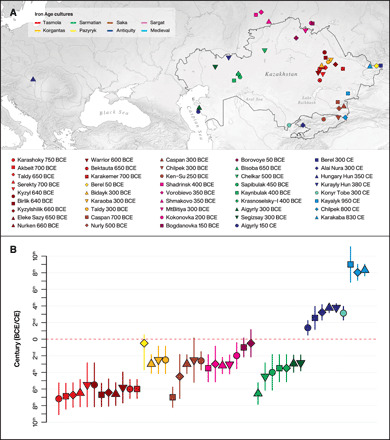
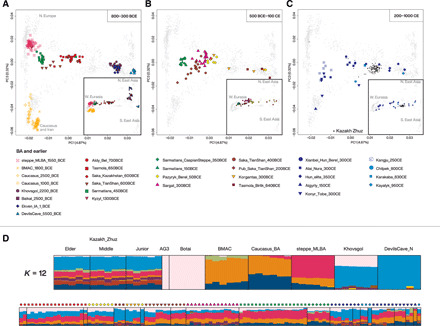
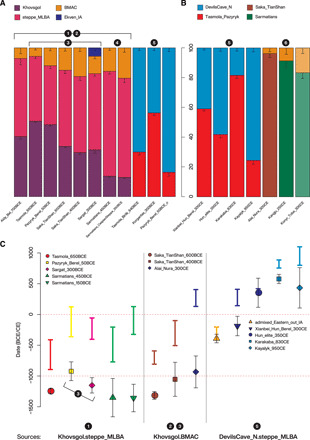
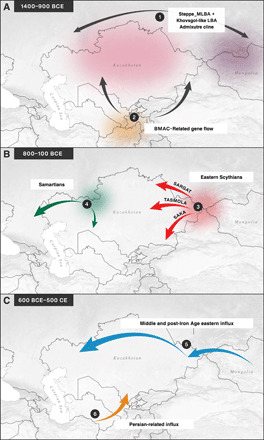
Verification
Claims the paper makes
The claims and statistics of this paper haven’t been checked yet.
Run the check — free, no account needed. It reads the open-access text and checks the sources it cites.
Claims other papers make about this one
Each is checked against this paper’s own text: does it say what the citing paper says it does?
In the citing paper
“DA28, excavated from the Ulitau region (30), harbored the same haplogroup but formed a different clade with KLK002, which was excavated from a mausoleum near the medieval town of Koylik (aka Kayalyk) (33), where Carpini sojourned in the 13th century (5).”
From Genomes of the Golden Horde elites and their implications for the rulers of the Mongol Empire (2026) · cites this paper as [33]
In the citing paper
“Subsequently, this lineage was discovered in the Site of Kayalyk (n=1) (Gnecchi-Ruscone et al., 2021) and the Golden Horde (n=1) (Damgaard et al., 2018) in Kazakhstan, as well as in the Mongol empire (n=5) (Jeong et al., 2020) during the Medieval Age.”
From Y chromosome evidence confirms northeast Asian origin of Xinjiang Kazakhs and genetic influence from 18th century expansion of Kerey clan (2023) · cites this paper as Gnecchi-Ruscone et al., 2021
Self-check
Percentages, sums and reported differences re-computed from the paper’s own numbers.
The self-check needs the paper’s full text.
Citations
Cites
IntCal13 and Marine13 radiocarbon age calibration curves 0–50,000 years cal BP
Reimer, P. J., Bard, E., Bayliss, A., Beck, J. W., Blackwell, P. G., Ramsey, C. B., Buck, C. E., Cheng, H., Edwards, R. L., Friedrich, M., et al. (2013) · Radiocarbon · doi:10.2458/azu_js_rc.55.16947 · Cited by 14,591
Second-generation PLINK: rising to the challenge of larger and richer datasets
Chang, C. C., Chow, C. C., Tellier, L. C., Vattikuti, S., Purcell, S. M., & Lee, J. J. (2015) · Gigascience · doi:10.1186/s13742-015-0047-8 · Cited by 12,709
Population Structure and Eigenanalysis
Patterson, N., Price, A. L., & Reich, D. (2006) · PLoS Genetics · doi:10.1371/journal.pgen.0020190 · Cited by 5,280
ANGSD: Analysis of Next Generation Sequencing Data
Korneliussen, T. S., Albrechtsen, A., & Nielsen, R. (2014) · BMC Bioinformatics · doi:10.1186/s12859-014-0356-4 · Cited by 2,982
Ancient Admixture in Human History
Patterson, N., Moorjani, P., Luo, Y., Mallick, S., Rohland, N., Zhan, Y., Genschoreck, T., Webster, T., & Reich, D. (2012) · Genetics · doi:10.1534/genetics.112.145037 · Cited by 2,848
Massive migration from the steppe was a source for Indo-European languages in Europe
Haak, W., Lazaridis, I., Patterson, N., Rohland, N., Mallick, S., Llamas, B., Brandt, G., Nordenfelt, S., Harney, E., Stewardson, K., et al. (2015) · Nature · doi:10.1038/nature14317 · Cited by 1,940
Self-citationmapDamage2.0: fast approximate Bayesian estimates of ancient DNA damage parameters
Jónsson, H., Ginolhac, A., Schubert, M., Johnson, P. L. F., & Orlando, L. (2013) · Bioinformatics · doi:10.1093/bioinformatics/btt193 · Cited by 1,669
Population genomics of Bronze Age Eurasia
Allentoft, M. E., Sikora, M., Sjögren, K.-G., Rasmussen, S., Rasmussen, M., Stenderup, J., Damgaard, P. B., Schroeder, H., Ahlström, T., Vinner, L., et al. (2015) · Nature · doi:10.1038/nature14507 · Cited by 1,550
Genome-wide patterns of selection in 230 ancient Eurasians
Mathieson, I., Lazaridis, I., Rohland, N., Mallick, S., Patterson, N., Roodenberg, S. A., Harney, E., Stewardson, K., Fernandes, D., Novak, M., et al. (2015) · Nature · doi:10.1038/nature16152 · Cited by 1,515
Self-citationDabney, J., Knapp, M., Glocke, I., Gansauge, M.-T., Weihmann, A., Nickel, B., Valdiosera, C., García, N., Pääbo, S., Arsuaga, J.-L., et al. (2013) · Proceedings of the National Academy of Sciences · doi:10.1073/pnas.1314445110 · Cited by 1,443
Research works printed but not linked: 70
- L. Koryakova Europe to Asia in The Oxford Handbook of the European Iron Age C. Haselgrove K. Rebay-Salisbury P. S. Wells Eds. (Oxford Univ. Press 2018) pp. 1–41. · DOI
- J. Davis-Kimball L. Koryakova E. M. Murphy L. T. Yablonsky Kurgans Ritual Sites and Settlements: Eurasian Bronze and Iron Age (British Archaeological Reports Limited 2000) 324 pp. · DOI
- L. Koryakova A. Epimakhov The Urals and Western Siberia in the Bronze and Iron Ages. 10.1017/cbo9780511618451 (2007). · DOI
- 10.1126/science.aar7711 · DOI · Paper page
- 10.1126/science.aat7487 · DOI · Paper page
- B. van Geel, N. A. Bokovenko, N. D. Burova, K. V. Chugunov, V. A. Dergachev, V. G. Dirksen, M. Kulkova, A. Nagler, H. Parzinger, J. van der Plicht, S. S. Vasiliev, G. I. Zaitseva, The sun, climate change and the expansion of the Scythian culture after 850 BC. NATO Sci. Ser. 42, 151–158 (2004).
- 10.1038/ncomms14615 · DOI · Paper page
- 10.1126/sciadv.aat4457 · DOI
- 10.1038/s41586-018-0094-2 · DOI · Paper page
- 10.1016/j.cub.2019.06.019 · DOI
- 10.1017/S0033822200041746 · DOI
- V. Mordvinceva S. Reinhold The northern Black Sea and North Caucasus in The Oxford Handbook of the European Iron Age C. Haselgrove K Rebay-Salisbury P. S. Wells Eds. (Oxford Univ. Press 2018) pp. 1–50. · DOI
- A. Farkas, Frozen tombs of Siberia: The Pazyryk burials of Iron Age horsemen. By Sergei I. Rudenko. Translated, with a preface, by M. W. Thompson. Berkeley and Los Angeles: University of California Press, 1970. xxxvi, 340 pp. 33 color, 147 black and white plates. $30.00. Slav. Rev. 30, 657–658 (1971). · DOI
- 10.1017/S0003598X00085781 · DOI
- The Routledge Handbook of Archaeology and Globalization (2016); 10.4324/9781315449005. · DOI
- J. Bemmann, Complexity of interaction along the Eurasian Steppe Zone in the first millennium CE. Bonn Contrib. Asian Archeol. 7, 708 (2015).
- 10.1163/221023997X00762 · DOI
- S. Kenzheakhmetuli in Seven Treasures: Collection of 2 Books A. A. Tili Ed. (2002) pp. 134–135.
- 10.1080/09720073.2016.11892125 · DOI
- 10.1038/s41559-019-0878-2 · DOI · Paper page
- 10.1073/pnas.1813608115 · DOI · Paper page
- 10.1038/s41598-018-22995-2 · DOI
- 10.1016/j.nimb.2012.03.004 · DOI
- 10.1101/pdb.prot5448 · DOI
- 10.1186/s13059-016-0918-z · DOI · Paper page
- 10.1186/s13104-016-1900-2 · DOI
- 10.1093/bioinformatics/btp324 · DOI · Paper page
- 10.1093/bioinformatics/btp352 · DOI · Paper page
- 10.1101/gr.176552.114 · DOI · Paper page
- 10.1038/s41467-018-08220-8 · DOI
- 10.1038/s41467-018-07483-5 · DOI
- 10.1038/s41586-019-1279-z · DOI · Paper page
- I. W. Kim, A. C. Khadilkar, E. Y. Ko, E. S. Sabanegh Jr., 47,XYY Syndrome and Male Infertility. Rev. Urol. 15, 188–196 (2013).
- 10.1002/humu.21382 · DOI
- G. D. Poznik, Identifying Y-chromosome haplogroups in arbitrarily large samples of sequenced or genotyped men. bioRxiv, 088716 (2016).
- 10.1101/gr.094052.109 · DOI · Paper page
- 10.1038/nature11258 · DOI · Paper page
- 10.1126/sciadv.1601877 · DOI · Paper page
- 10.1534/genetics.112.147330 · DOI · Paper page
- 10.1016/j.ajhg.2013.09.002 · DOI
- 10.1126/science.1243518 · DOI · Paper page
- O. Bottyán, Data to the anthropology of the Hun Period population in Hungary. Annales historico-naturales Musei nationalis hungarici 59, 455–464 (1967).
- M. Nagy A Hun-Age burial with male skeleton and horse bones found in Budapest in Neglected Barbarians F. Curta Ed. (Studies in the Early Middle Ages Brepols Publishers 2010) vol. 32 pp. 137–175. · DOI
- A. Z. Beisenov Burial and ritual complex “Kurgan 37 Warriors ” in Bulletin of SUSU (Series “Social and Human Sciences ” South Ural State University Chelyabinsk 2015) (in Russian) vol. 15 pp. 6–12.
- A. Z. Beisenov E. P. Kitov Posthumous Skull Trepanation in Elite Burial Grounds of the Saka Period in Central Kazakhstan (FSBEIHE Altai State University 2014) (in Russian); 10.14258/izvasu. · DOI
- A. Z. Beisenov Earrings of the Saka epoch. Bulletin of Tomsk State University. History 6 (2014) (in Russian) pp. 121–128.
- E. P. Kitov, A. Z. Beisenov, Skulls with trepanations from barrows of the early iron age of Saryarka. Bulletin of Moscow University. Series XXIII. Anthropol. Forum 1, 37–48 (2015).
- 10.37445/adiu.2018.02.28 · DOI
- A. Z. Beisenov, R. S. Minasyan, Mirror from the Tasmola burial ground Birlik. Bull. Dagestan Sci. Center 58, 58–62 (2015).
- A. Z. Beisenov, Tasmola burials of the Kyzyl burial ground. Modern solutions of actual problems of Eurasian archeology. Collect. Sci. Articles 2, 139–149 (2018).
- A. Z. Beisenov, A. E. Kasenalin, Kyzylshilik burial ground of the Tasmola culture. Foreign Archeol. 4, (2018).
- A. Z. Beisenov, Dromos kurgans of the Saka time on the Zharly river (central Kazakhstan). Samara Scientific Herald 3, 77–86 (2016).
- A. Z. Beisenov E. P. Kitov The Taldy II burial ground of Tasmola Culture in the Central Kazakhstan (craniological analysis). Science Journal of Volgograd State University History. Area Studies. International Relations 4 71–85 (2014). · DOI
- Z. Samashev E. M. Kariev S. E. Erbolatov Hun-Syanbian cultural and chronological horizon of Berel in Materials of the International Archaeological Conferences B.A. Baytanayev Ed. (L.N. Gumilyov Eurasian National University 2019) (in Russian) pp. 385–394.
- Z. S. Samashev G. S. Zhumabekova A. S. Ermolaeva G. Omarov Military archeology. Weapon and military affair in a historical and social perspective. Early Saka arrowheads from Kazakhstan Altai - SPb (State Hermitage 1998) (in Russian) pp. 155–160.
- Z. S. Samashev A. S. Ermolaeva G. S. Zhumabekova Kazakh Altai in the 1st millennium BC. Kazakhstan in the Saka era in Collective Monograph. Almaty (Institute of Archeology Named after A.Kh. Margulan 2017) (in Russian) pp. 101–156.
- A. Onggaruly G. Kiyasbek M. Kyzirkhanov A. Kairmagambetov The sanctuary of Aigyrly 2 in Mangystau (preliminary results) in Religion and the Worldview System of Ancient and Medieval Nomads of Eurasia. Collection of scientific articles A. Onggaruly Ed. (Institute of Archeology named after A.Kh. Margulan 2016) (in Russian) pp. 93–106.
- A. Onggaruly The image of the sarmatian batyr by the materials of the sacred Aral-Caspian streams. Heritage of the Great Steppe: masterpieces of jewelry art. IV . The world of art images of nomads. The exhibition catalogue (The National Museum of the Republic of Kazakhstan 2018) pp. 47–51.
- A. A. Bisembaev A. I. Havansky Excavations of the burial ground Kajynbulak II in Aktyubinsk region of the Republic of Kazakhstan in 2017. International scientific conference "New in the research of the early Iron Age of Eurasia: problems discoveries methods" : abstracts. Ans. ed. A.A. Malyshev (MAX Press 2018) (in Russian) p. 174.
- A. M. Mamedov, E. P. Kitov, Funeral ceremony of early nomads from the top Ilek (on the materials of the burial ground Sapibulak). News Natl. Acad. Sci. Republic Kazakhstan 6, 19–60 (2015).
- A. Z. Beisenov, L. Kreshioli, G. S. Jumabekova, G. A. Bazarbayeva, E. Barinova, The Early Iron age Burial Ground Kaspan-6 in Jetusy. Theor. Pract. Archaeol. Res. 2, 97–108 (2017).
- A. Z. Beisenov, D. B. Duisenbay, E. P. Kitov, M. A. Kulkova, Study of the Saka time barrows in the Kaspan valley in the Zhetysu. Foreign Archeol. 3, 10 (2018).
- A. A. Bisembaev, A. I. Khavansky, M. N. Duisengali, A. M. Mamedov, N. M. Bairov, V. A. Amelin, Research of monuments of the Hun time in the Aktobe region in 2018 (preliminary report). Archaeol. Kazakhstan. 1-2, 235–244 (2018).
- Z. Samashev, Monuments of the medieval nomads of Karakaba river in Kazakh Altai. Archeol. Middle Ages, 379–409 (2016).
- A. Saipov, S. S. Akylbek, A. K. Avizova, A. S. Maisupova, Archaeological study of necropolis of the industrial oasis. Izvestiya of the Samara Science Centre of the Russian Academy of Sciences. Social, humanitarian, medicobiological sciences 21, 77–85 (2019).
- M. V. Voevodovsky, M. P. Gryaznov, U-Sun burial grounds on the territory of the Kyrgyz SSR. Bull. Ancient History 3, 162–179 (1938).
- B. A. Ribakov, Steppe zone of the Asian part of the USSR in Scythian-Sarmatian time. Ser. Archeol. USSR 10, 494 (1992).
- V. A. Mogilnikov To the question of Sargat culture in Problems of Archeology and the Ancient History of the Ugrians A.P. Smirnov V.N. Chernetsov I.F. Erdeli Eds. (Nauka 1972) (in Russian) pp. 66–87.
- V. A. Buldashev Funeral rites of the Gorokhov culture. Abstract. Cand. Diss. Novosibirsk (Ph.D. thesis Institute of History and Archaeology Ural Branch Russian Academy of Sciences 1998) (in Russian).
- V. E. Stoyanov, V. N. Frolov, Burial mounds near the village of Vorobyovo. Issues Archeol. Ural 4, 53–87 (1962).
Cited by
Zhabagin, M., Wei, L.-H., Sabitov, Z., Ma, P.-C., Sun, J., Dyussenova, Z., Balanovska, E., Li, H., & Ramankulov, Y. (2022) · Genes · doi:10.3390/genes13101776 · Cited by 17
Genomes of the Golden Horde elites and their implications for the rulers of the Mongol Empire
Askapuli, A., Kanzawa-Kiriyama, H., Kakuda, T., Kassenali, A., Yessen, S., Schamiloglu, U., Schrodi, S. J., Hawks, J., & Saitou, N. (2026) · Proceedings of the National Academy of Sciences · doi:10.1073/pnas.2531003123 · Cited by 5
Wang, B., Liang, J., Allen, E., Chang, X., Jiang, Z., Yu, Y., Shi, M., & Wen, S. (2023) · Frontiers in Ecology and Evolution · doi:10.3389/fevo.2023.1264718 · Cited by 1
Metadata
- Authors
- Gnecchi-Ruscone, G. A., Khussainova, E., Kahbatkyzy, N., Musralina, L., Spyrou, M. A., Bianco, R. A., Radzeviciute, R., Martins, N. F. G., Freund, C., Iksan, O., Garshin, A., Zhaniyazov, Z., Bekmanov, B., Kitov, E., Samashev, Z., Beisenov, A., Berezina, N., Berezin, Y., Bíró, A. Z., Évinger, S., Bissembaev, A., Akhatov, G., Mamedov, A., Onggaruly, A., Voyakin, D., Chotbayev, A., Kariyev, Y., Buzhilova, A., Djansugurova, L., Jeong, C., & Krause, J.
- Affiliations
- Department of Archaeogenetics, Max Planck Institute for the Science of Human History, 07745 Jena, Germany.
- Laboratory of Population Genetics, Institute of General Genetics and Cytology, 050060, al-Farabi Ave., 93 Almaty, Kazakhstan.
- Kazakh National University by al-Farabi, 050040, al-Farabi Ave., 71 Almaty, Kazakhstan.
- State Historical and Cultural Museum-Reserve “Berel,” village Zhambyl, Katon-Karagay district, East Kazakhstan region, 070906, Kazakhstan.
- Institute of Arсhaeology by A.Kh. Margulan, 050010, Dostyk Ave., 44 Almaty, Kazakhstan.
- Research Institute and Museum of Anthropology, Lomonosov Moscow State University, Mokhovaya Str. 11, Moscow 125009, Russian Federation.
- Department of Anthropology, Hungarian Natural History Museum, Ludovika tér 2-6, Budapest H-1083, Hungary.
- Branch of Institute of Archaeology by A.Kh. Margulan, 010011, Republic Ave., 24, of. 511, Nur-Sultan, Kazakhstan.
- Aktobe Regional Historical Museum, Oraza Tateuly Ave. 3, Batys-2 microdistrict, Astana district, Aktobe 030000, Kazakhstan.
- Scientific-Research Institute “Halyq qazynasy,” National Museum of the Republic of Kazakhstan, Tauelsizdik Ave. 54, Nur-Sultan 010000, Kazakhstan.
- Scientific Center “Altaytanu” of East-Kazakhstan State University by S.A. Amanzholov, Kazakhstan Str. 55, Ust-Kamenogorsk 070004, Kazakhstan.
- ORCID
- Gnecchi-Ruscone, Guido Alberto
- Khussainova, Elmira
- Musralina, Lyazzat
- Radzeviciute, Rita
- Martins, Nuno Filipe Gomes
- Freund, Caecilia
- Iksan, Olzhas
- Garshin, Alexander
- Zhaniyazov, Zhassulan
- Bekmanov, Bakhytzhan
- Kitov, Egor
- Samashev, Zainolla
- Beisenov, Arman
- Berezina, Natalia
- Berezin, Yakov
- Bíró, András Zsolt
- Évinger, Sándor
- Bissembaev, Arman
- Akhatov, Gaziz
- Mamedov, Aslan
- Onggaruly, Akhan
- Voyakin, Dmitriy
- Chotbayev, Aidos
- Kariyev, Yeldos
- Buzhilova, Alexandra
- Djansugurova, Leyla
- Jeong, Choongwon
- Krause, Johannes
- Venue
- Science Advances
- Published
- 2021-03-26
- Volume
- 7
- Issue
- 13
- ISSN
- 2375-2548
- PMC
- PMC7997506
- Cited by
- 112
- References
- 22
- Language
- en
- Funders
- European Research Council (BR05233709, AP08857177, 2020R1C1C1003879, 771234 PALE)
- National Research Foundation of Korea (2020R1C1C1003879)
- Ministry of Education and Science of the Republic of Kazakhstan (BR05233709, AP08857177)
- Max Planck-Harvard Research center for the Archaeoscience of the ancient Mediterranean
About these checks
Registry, retraction, Cites and statistics results are computed, not judged, with one exception: a printed reference that no index lists is read once by a model before it counts as a citation error. Claims are extracted by a model and kept only when their quote appears verbatim in the text; each cited source is then checked, with a model’s help, for whether it says what the claim relies on. Those verdicts can be wrong — read the claim’s quote and the cited source before relying on one.
Statistics and arithmetic are recomputed, not judged.
Confidence bands are shown only for fields calibrated on our annotated test set. None is calibrated yet, so no band is shown.
What counts as a claim ›How we measure confidence ›How we check this ›
Are you an author, or do you see a problem with this page? Request a review
