

The DOI matches its Crossref record; 59 of the 59 references it cites were found in a registry or an index; 2 of the 14 sources its claims cite were checked for support.
Distinct antibody and memory B cell responses in SARS-CoV-2 naïve and recovered individuals after mRNA vaccination
Open accessPublished version of a preprint
Abstract
Key differences in both antibody and memory B cell responses to mRNA vaccination were identified on the basis of prior SARS-CoV-2 exposure.
Overview
AI snapshot
Written from the paper’s full text.
TL;DR
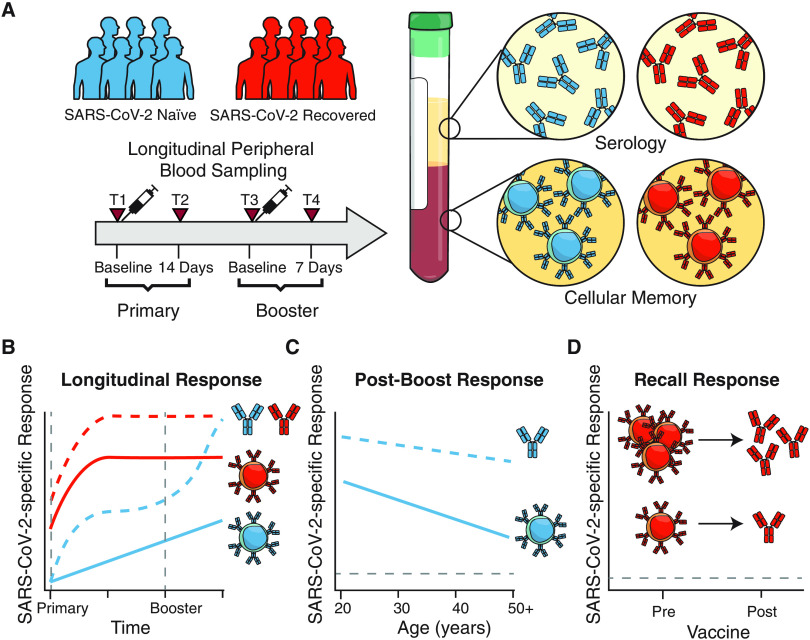
In a longitudinal cohort of 44 mRNA-vaccinated adults (33 SARS-CoV-2 naïve, 11 recovered), naïve individuals required two doses for optimal antibody and memory B cell responses, including neutralization of B.1.351, whereas recovered individuals were boosted after the first dose with no further increase after the second. Pre-existing memory B cells correlated with recall antibody responses in recovered individuals, and memory B cell induction declined with age.
Key findings
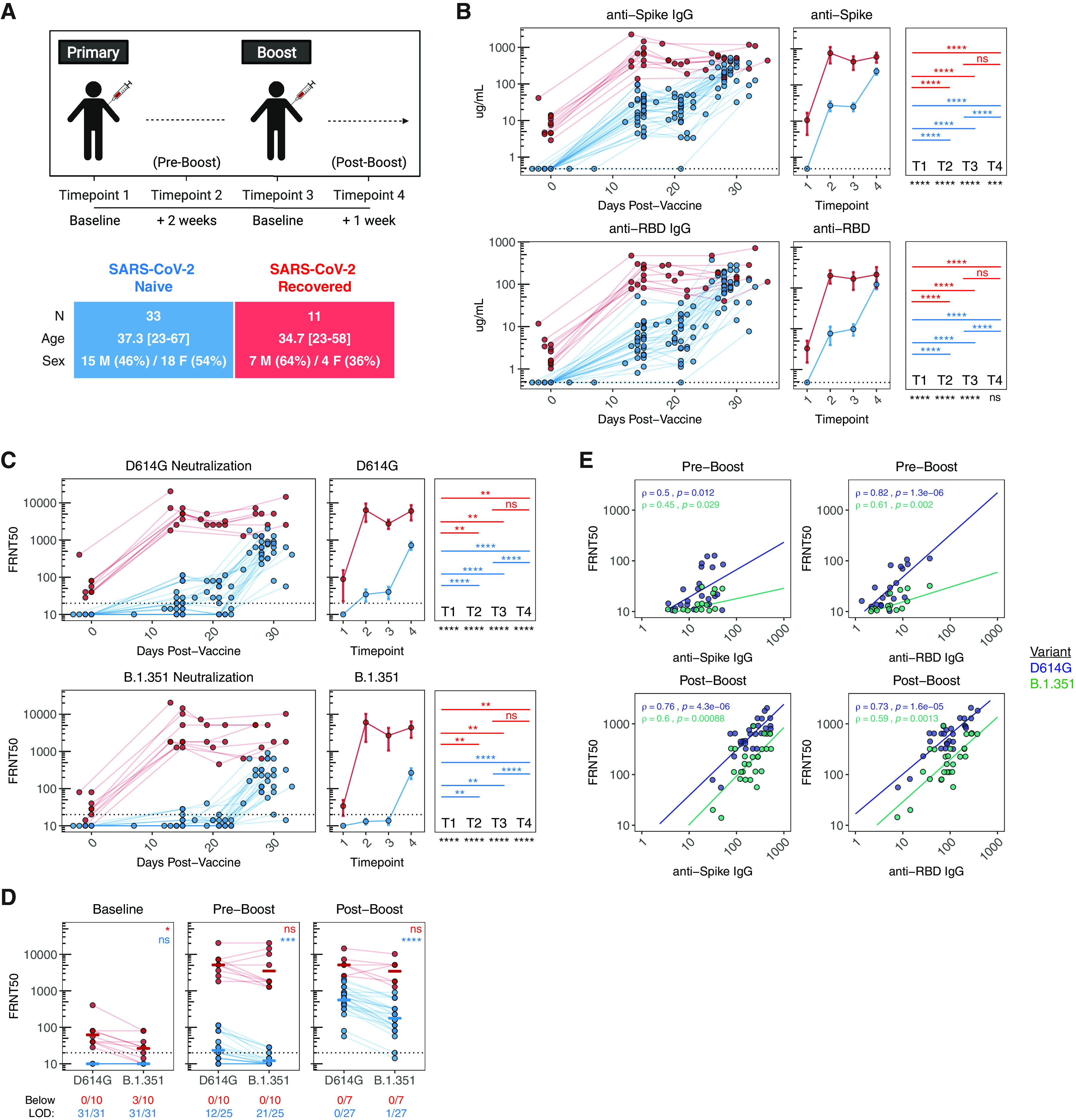
- SARS-CoV-2 naïve individuals had undetectable baseline anti-spike and anti-RBD IgG; primary vaccination increased antibodies and the booster further enhanced them. After primary immunization, ~50% developed detectable D614G neutralizing antibodies and only 4/25 developed B.1.351 neutralization above limit of detection; post-boost, all participants neutralized D614G and 26/27 neutralized B.1.351.
- SARS-CoV-2 recovered individuals had detectable baseline anti-spike and anti-RBD IgG, which increased after the first dose but showed no additional increase after the second. Neutralizing titers against D614G and B.1.351 also peaked after the first dose with no further increase post-boost, and anti-RBD IgG levels were similar between naïve and recovered individuals at 1 week post-boost.
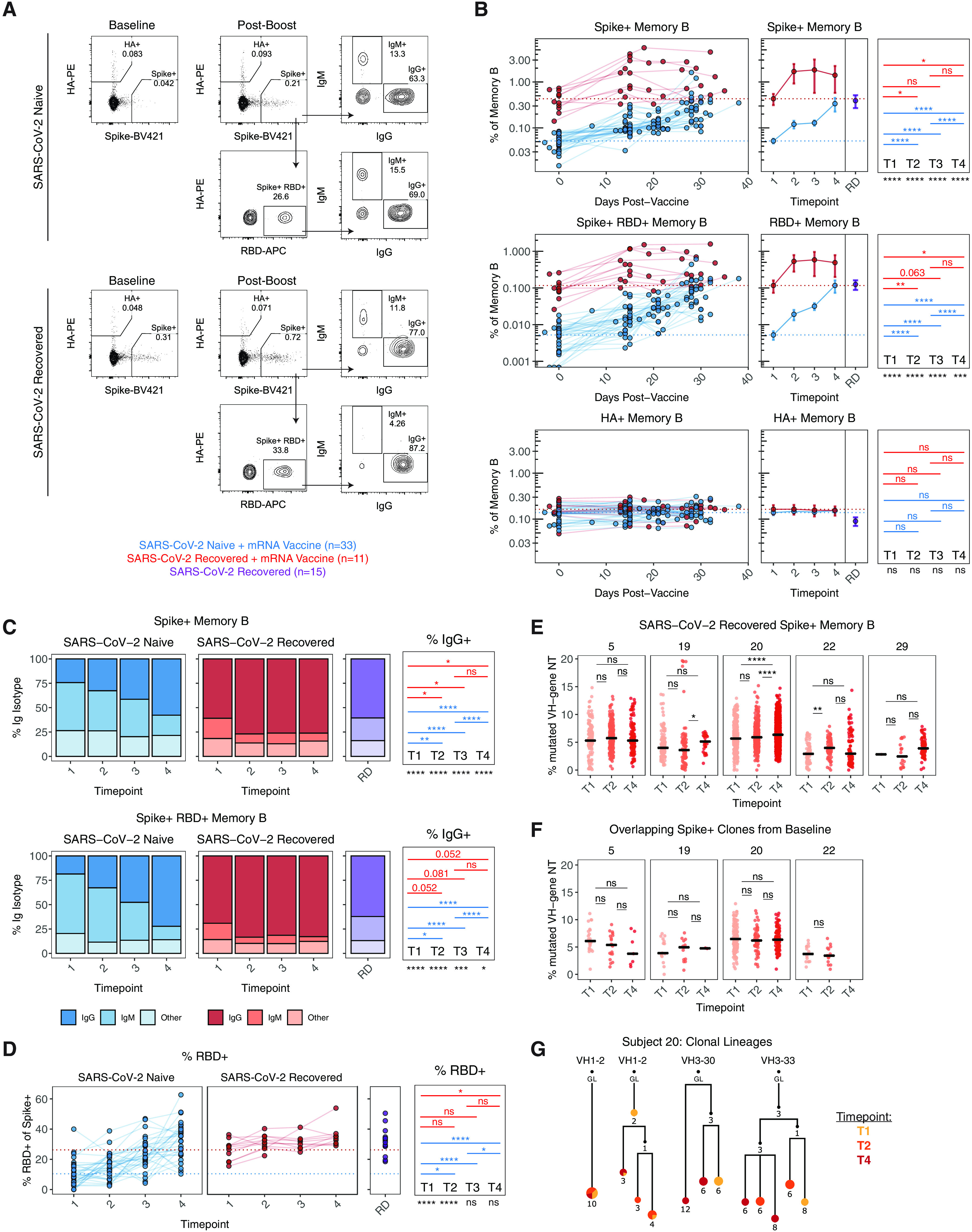
- Memory B cells specific for spike and RBD were minimally detectable at baseline in naïve individuals, increased after primary vaccination, and were further boosted after the second dose, approaching levels in non-vaccinated recovered donors. Recovered individuals had baseline spike-specific memory B cells ranging from ~0.15–0.8% of total memory B cells, expanded after the first dose, and showed no additional boosting after the second.
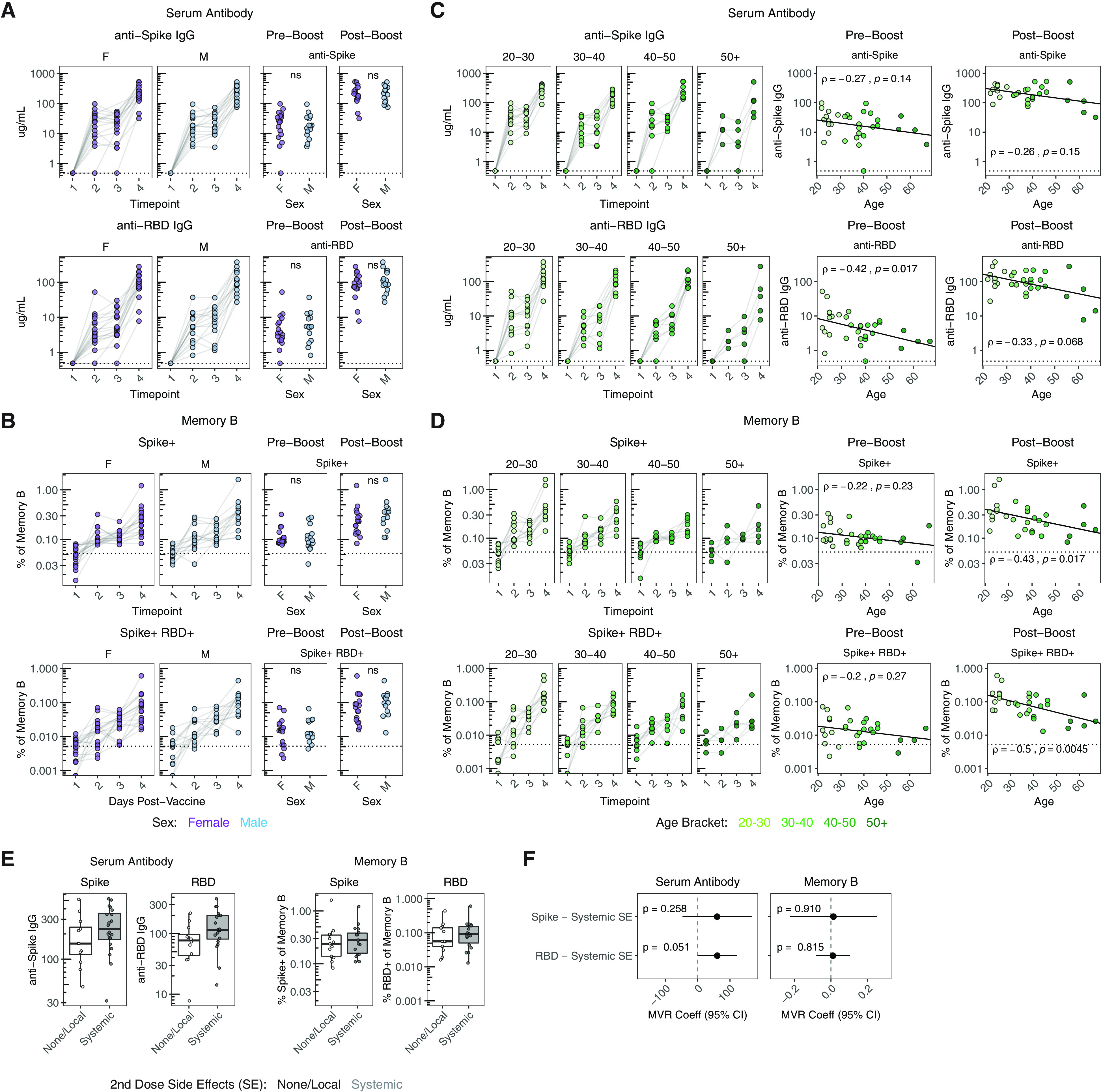
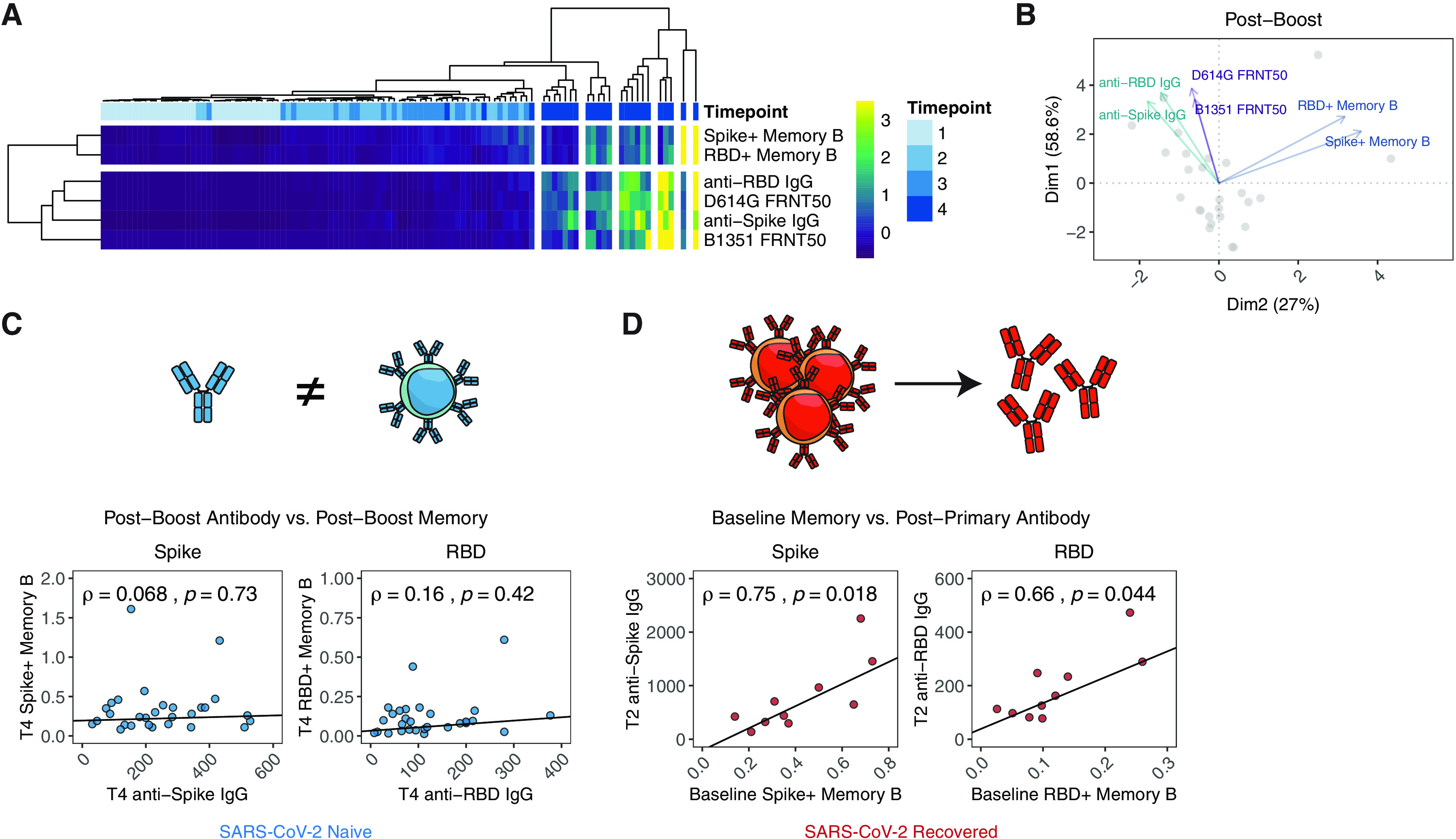
- Post-boost antigen-specific memory B cells showed a clear negative correlation with age, though all age groups increased over baseline. Baseline memory B cell frequency strongly correlated with post-primary antibody levels for spike and RBD in recovered individuals, while post-boost antibodies and memory B cells did not correlate in naïve individuals.
Methods
- Longitudinal cohort of 44 healthy adults (33 SARS-CoV-2 naïve, 11 recovered; prior infection 65–275 days before vaccination) receiving Pfizer BNT162b2 or Moderna mRNA-1273, with samples at baseline, 2 weeks post-primary, day of second dose, and 1 week post-boost.
- Assays included ELISA for anti-spike and anti-RBD IgG/IgM, VSV pseudovirus neutralization against D614G and B.1.351, flow cytometric antigen-probe detection of spike-, RBD-, and influenza HA-specific memory B cells, and BCR sequencing of sorted spike+ memory B cells from 5 recovered donors.
- Statistical analyses used Wilcoxon tests with Holm correction, Spearman rank correlations, hierarchical clustering, principal component analysis, and multivariable linear regression controlling for sex and age.
Limitations
- Stated: the study was small and designed for deep immunological analysis, so it could not directly address protection or true vaccine efficacy; larger clinical studies are needed to examine one versus two doses in recovered individuals. The cohort consisted of individuals not hospitalized during SARS-CoV-2 infection, and identifying recovered individuals by self-report or laboratory tests may be practically challenging.
- Stated: the timeframe was short, durability and long-term immunological memory remain unknown, and SHM analyses were limited to a small number of individuals and the first few weeks after vaccination. The cohort was not extensively enriched in those over 50 years old and does not directly address elderly vaccinees.
- Evident: the small sample size limits subgroup analyses, the healthy/no chronic-condition cohort limits generalizability, and some comparisons used unpaired tests because of missing data or samples for some participants.
Model-written summary. Check it against the paper before relying on it.
Integrity signals
Registry
Cites
Statistics
Figures
Verification
Claims the paper makes
52 Own result · 17 Own method · 12 Own interpretation · 6 Not checked yet · 1 Partly supported · accuracy not yet measured
A result the paper reports from its own data — it cites no other source for it, so there is none to check. The quote shows it is in the paper.
In the paper
“In SARS-CoV-2 recovered individuals, antibody and memory B cell responses were significantly boosted after the first vaccine dose; however, there was no increase in circulating antibodies, neutralizing titers, or antigen-specific memory B cells after the second dose.”
- Also stated in: § Antibody responses to SARS-CoV-2 mRNA vaccination · plain
“these antibody responses were significantly increased after the first dose of vaccine (Fig. 1B).”
§ Distinct antibody and memory B cell responses in SARS-CoV-2 naïve and recovered individuals following mRNA vaccination > Abstract
plaindirectn = 11- Asserted: passes — The authors put it forward as true.
- Checkable: passes — It can be checked against evidence.
- Load-bearing: passes — The paper’s conclusions depend on it.
- Based: passes — The paper gives a reason why it holds.
- Also stated in: § Antibody responses to SARS-CoV-2 mRNA vaccination · plain
A result the paper reports from its own data — it cites no other source for it, so there is none to check. The quote shows it is in the paper.
In the paper
“At baseline, SARS-CoV-2 naïve individuals had undetectable levels of IgG antibodies specific for either full-length spike protein or the spike receptor binding domain (RBD) (Fig. 1B).”
§ Distinct antibody and memory B cell responses in SARS-CoV-2 naïve and recovered individuals following mRNA vaccination > RESULTS > Antibody responses to SARS-CoV-2 mRNA vaccination
plain- Asserted: passes — The authors put it forward as true.
- Checkable: passes — It can be checked against evidence.
- Load-bearing: passes — The paper’s conclusions depend on it.
- Based: passes — The paper gives a reason why it holds.
A result the paper reports from its own data — it cites no other source for it, so there is none to check. The quote shows it is in the paper.
In the paper
“SARS-CoV-2 naïve individuals required both vaccine doses for optimal increases in antibodies, particularly for neutralizing titers against the B.1.351 variant.”
- Also stated in: § Antibody responses to SARS-CoV-2 mRNA vaccination · plain
“primary immunization was largely ineffective to induce functional antibodies against the B.1.351 variant with only 4/25 individuals developing neutralizing titers above limit of detection over the same time frame (Fig. 1C-D).”
- Also stated in: § Antibody responses to SARS-CoV-2 mRNA vaccination · plain
“Neutralizing titers were significantly increased after the second dose in SARS-CoV-2 naïve individuals, with all participants achieving neutralization against D614G and 26/27 achieving detectable neutralization against B.1.351 at 7 days post-boost (Fig. 1C-D).”
§ Distinct antibody and memory B cell responses in SARS-CoV-2 naïve and recovered individuals following mRNA vaccination > Abstract
plaindirectn = 25- Asserted: passes — The authors put it forward as true.
- Checkable: passes — It can be checked against evidence.
- Load-bearing: passes — The paper’s conclusions depend on it.
- Based: passes — The paper gives a reason why it holds.
- Also stated in: § Antibody responses to SARS-CoV-2 mRNA vaccination · plain
A result the paper reports from its own data — it cites no other source for it, so there is none to check. The quote shows it is in the paper.
In the paper
“This robust boosting after the first vaccine dose strongly correlated with levels of pre-existing memory B cells in recovered individuals, identifying a key role for memory B cells in mounting recall responses to SARS-CoV-2 antigens.”
- Also stated in: § Relationships between antibody and memory B cell responses to SARS-CoV-2 mRNA vaccination · boosted
“the baseline frequency of antigen-specific memory B cells strongly correlated with post-primary vaccination antibody levels for both spike and RBD (Fig. 4D), consistent with the notion that these pre-vaccination memory B cells are major contributors to the SARS-CoV-2 antibody recall response.”
§ Distinct antibody and memory B cell responses in SARS-CoV-2 naïve and recovered individuals following mRNA vaccination > Abstract
boostedcorrelationaln = 11- Asserted: passes — The authors put it forward as true.
- Checkable: passes — It can be checked against evidence.
- Load-bearing: passes — The paper’s conclusions depend on it.
- Based: passes — The paper gives a reason why it holds.
- Also stated in: § Relationships between antibody and memory B cell responses to SARS-CoV-2 mRNA vaccination · boosted
A result the paper reports from its own data — it cites no other source for it, so there is none to check. The quote shows it is in the paper.
In the paper
“though the memory B cell response declined slightly with age.”
- Also stated in: § Demographic and clinical factors associate with B cell responses to SARS-CoV-2 mRNA vaccination · boosted
“there was a clear negative correlation between the post-boost frequency of antigen-specific memory B cells and age (Fig. 3D).”
§ Distinct antibody and memory B cell responses in SARS-CoV-2 naïve and recovered individuals following mRNA vaccination > Abstract
boostedcorrelationaln = 11- Asserted: passes — The authors put it forward as true.
- Checkable: passes — It can be checked against evidence.
- Load-bearing: unclear — It is unclear whether the paper’s conclusions depend on it.
- Based: passes — The paper gives a reason why it holds.
- Also stated in: § Demographic and clinical factors associate with B cell responses to SARS-CoV-2 mRNA vaccination · boosted
A result the paper reports from its own data — it cites no other source for it, so there is none to check. The quote shows it is in the paper.
In the paper
“Memory B cells specific for full-length spike protein and the spike receptor binding domain (RBD) were also efficiently primed by mRNA vaccination and detectable in all SARS-CoV-2 naive subjects after the second vaccine dose, though the memory B cell response declined slightly with age.”
- Also stated in: § Memory B Cell responses to SARS-CoV-2 mRNA vaccination · plain
“These memory B cells were also significantly boosted after adminstration of the second vaccine dose, approaching the levels of memory B cells observed in non-vaccinated SARS-CoV-2 recovered donors (Fig. 2B).”
§ Distinct antibody and memory B cell responses in SARS-CoV-2 naïve and recovered individuals following mRNA vaccination > Abstract
plaindirectn = 11- Asserted: passes — The authors put it forward as true.
- Checkable: passes — It can be checked against evidence.
- Load-bearing: passes — The paper’s conclusions depend on it.
- Based: passes — The paper gives a reason why it holds.
- Also stated in: § Memory B Cell responses to SARS-CoV-2 mRNA vaccination · plain
A result the paper reports from its own data — it cites no other source for it, so there is none to check. The quote shows it is in the paper.
In the paper
“However, in SARS-CoV-2 recovered subjects, there was no additional increase in antibody levels following the second vaccine dose (Fig. 1B).”
- Also stated in: § Abstract · plain
“however, there was no increase in circulating antibodies, neutralizing titers, or antigen-specific memory B cells after the second dose.”
§ Distinct antibody and memory B cell responses in SARS-CoV-2 naïve and recovered individuals following mRNA vaccination > RESULTS > Antibody responses to SARS-CoV-2 mRNA vaccination
plainn = 11- Asserted: passes — The authors put it forward as true.
- Checkable: passes — It can be checked against evidence.
- Load-bearing: passes — The paper’s conclusions depend on it.
- Based: passes — The paper gives a reason why it holds.
- Also stated in: § Abstract · plain
A result the paper reports from its own data — it cites no other source for it, so there is none to check. The quote shows it is in the paper.
In the paper
“SHM levels in the overlapping clones did not increase after vaccination (Fig. 2F).”
§ Distinct antibody and memory B cell responses in SARS-CoV-2 naïve and recovered individuals following mRNA vaccination > RESULTS > Memory B Cell responses to SARS-CoV-2 mRNA vaccination
plain- Asserted: passes — The authors put it forward as true.
- Checkable: passes — It can be checked against evidence.
- Load-bearing: passes — The paper’s conclusions depend on it.
- Based: passes — The paper gives a reason why it holds.
A result the paper reports from its own data — it cites no other source for it, so there is none to check. The quote shows it is in the paper.
In the paper
“Indeed, pre-existing memory B cells in SARS-CoV-2 recovered subjects correlated strongly with post-vaccination antibody levels in our cohort”
§ Distinct antibody and memory B cell responses in SARS-CoV-2 naïve and recovered individuals following mRNA vaccination > DISCUSSION
boostedcorrelational- Asserted: passes — The authors put it forward as true.
- Checkable: passes — It can be checked against evidence.
- Load-bearing: passes — The paper’s conclusions depend on it.
- Based: passes — The paper gives a reason why it holds.
- Rests on an assumption: Pfizer BNT162b2 and Moderna mRNA-1273 vaccines can be grouped together as mRNA vaccination for the analyses.
A result the paper reports from its own data — it cites no other source for it, so there is none to check. The quote shows it is in the paper.
In the paper
“Such a trend was not observed for the memory B cell response (Fig. 3E).”
§ Distinct antibody and memory B cell responses in SARS-CoV-2 naïve and recovered individuals following mRNA vaccination > RESULTS > Demographic and clinical factors associate with B cell responses to SARS-CoV-2 mRNA vaccination
plain- Asserted: passes — The authors put it forward as true.
- Checkable: passes — It can be checked against evidence.
- Load-bearing: unclear — It is unclear whether the paper’s conclusions depend on it.
- Based: passes — The paper gives a reason why it holds.
A result the paper reports from its own data — it cites no other source for it, so there is none to check. The quote shows it is in the paper.
In the paper
“Notably, the levels of anti-RBD IgG were similar in the SARS-CoV-2 naïve and SARS-CoV-2 recovered individuals at 1 week post-boost (timepoint 4) (Fig. 1B).”
§ Distinct antibody and memory B cell responses in SARS-CoV-2 naïve and recovered individuals following mRNA vaccination > RESULTS > Antibody responses to SARS-CoV-2 mRNA vaccination
plain- Asserted: passes — The authors put it forward as true.
- Checkable: passes — It can be checked against evidence.
- Load-bearing: passes — The paper’s conclusions depend on it.
- Based: passes — The paper gives a reason why it holds.
A result the paper reports from its own data — it cites no other source for it, so there is none to check. The quote shows it is in the paper.
In the paper
“In contrast, all SARS-CoV-2 recovered individuals had detectable levels of anti-spike and anti-RBD IgG at baseline, and these antibody responses were significantly increased after the first dose of vaccine (Fig. 1B).”
§ Distinct antibody and memory B cell responses in SARS-CoV-2 naïve and recovered individuals following mRNA vaccination > RESULTS > Antibody responses to SARS-CoV-2 mRNA vaccination
plain- Asserted: passes — The authors put it forward as true.
- Checkable: passes — It can be checked against evidence.
- Load-bearing: passes — The paper’s conclusions depend on it.
- Based: passes — The paper gives a reason why it holds.
A result the paper reports from its own data — it cites no other source for it, so there is none to check. The quote shows it is in the paper.
In the paper
“Similarly, pre-vaccine baseline antibody levels did not correlate with baseline memory B cell frequencies in SARS-CoV-2 recovered individuals (figure S5A).”
§ Distinct antibody and memory B cell responses in SARS-CoV-2 naïve and recovered individuals following mRNA vaccination > RESULTS > Relationships between antibody and memory B cell responses to SARS-CoV-2 mRNA vaccination
plain- Asserted: passes — The authors put it forward as true.
- Checkable: passes — It can be checked against evidence.
- Load-bearing: passes — The paper’s conclusions depend on it.
- Based: passes — The paper gives a reason why it holds.
A result the paper reports from its own data — it cites no other source for it, so there is none to check. The quote shows it is in the paper.
In the paper
“Hierarchical clustering of the different readouts of antigen-specific humoral immunity also revealed that antibodies and memory B cells clustered separately (Fig. 4A).”
§ Distinct antibody and memory B cell responses in SARS-CoV-2 naïve and recovered individuals following mRNA vaccination > RESULTS > Relationships between antibody and memory B cell responses to SARS-CoV-2 mRNA vaccination
plain- Asserted: passes — The authors put it forward as true.
- Checkable: passes — It can be checked against evidence.
- Load-bearing: passes — The paper’s conclusions depend on it.
- Based: passes — The paper gives a reason why it holds.
A result the paper reports from its own data — it cites no other source for it, so there is none to check. The quote shows it is in the paper.
In the paper
“Consistent with the antibody data, SARS-CoV-2 naïve individuals had minimal spike-specific memory B cells at baseline, whereas SARS-CoV-2 recovered individuals had a significant population of spike-specific memory B cells ranging from ~0.15-0.8% of total memory B cells (Fig. 2A-B).”
§ Distinct antibody and memory B cell responses in SARS-CoV-2 naïve and recovered individuals following mRNA vaccination > RESULTS > Memory B Cell responses to SARS-CoV-2 mRNA vaccination
plain- Asserted: passes — The authors put it forward as true.
- Checkable: passes — It can be checked against evidence.
- Load-bearing: passes — The paper’s conclusions depend on it.
- Based: passes — The paper gives a reason why it holds.
A result the paper reports from its own data — it cites no other source for it, so there is none to check. The quote shows it is in the paper.
In the paper
“In SARS-CoV-2 naïve subjects, the fraction of the overall spike-specific memory B cell response that was focused on RBD increased over time, becoming equivalent to that observed in SARS-CoV-2 recovered individuals after the second vaccine dose (Fig. 2D).”
§ Distinct antibody and memory B cell responses in SARS-CoV-2 naïve and recovered individuals following mRNA vaccination > RESULTS > Memory B Cell responses to SARS-CoV-2 mRNA vaccination
plaindirect- Asserted: passes — The authors put it forward as true.
- Checkable: passes — It can be checked against evidence.
- Load-bearing: passes — The paper’s conclusions depend on it.
- Based: passes — The paper gives a reason why it holds.
A result the paper reports from its own data — it cites no other source for it, so there is none to check. The quote shows it is in the paper.
In the paper
“whereas SARS-CoV-2 recovered individuals had a significant population of spike-specific memory B cells ranging from ~0.15-0.8% of total memory B cells (Fig. 2A-B).”
§ Distinct antibody and memory B cell responses in SARS-CoV-2 naïve and recovered individuals following mRNA vaccination > RESULTS > Memory B Cell responses to SARS-CoV-2 mRNA vaccination
plain- Asserted: passes — The authors put it forward as true.
- Checkable: passes — It can be checked against evidence.
- Load-bearing: passes — The paper’s conclusions depend on it.
- Based: passes — The paper gives a reason why it holds.
A result the paper reports from its own data — it cites no other source for it, so there is none to check. The quote shows it is in the paper.
In the paper
“The frequency of IgG+ memory B cells increased to >50% following the second dose of vaccine in these subjects (Fig. 2C), consistent with a qualitative improvement in memory B cells after the boost.”
§ Distinct antibody and memory B cell responses in SARS-CoV-2 naïve and recovered individuals following mRNA vaccination > RESULTS > Memory B Cell responses to SARS-CoV-2 mRNA vaccination
plaindirect- Asserted: passes — The authors put it forward as true.
- Checkable: passes — It can be checked against evidence.
- Load-bearing: passes — The paper’s conclusions depend on it.
- Based: passes — The paper gives a reason why it holds.
A result the paper reports from its own data — it cites no other source for it, so there is none to check. The quote shows it is in the paper.
In the paper
“Although all subjects, regardless of age, had significant humoral and memory B cell responses to vaccination, these data highlight a need to further understand the age-related changes in responses to mRNA vaccination (33).”
§ Distinct antibody and memory B cell responses in SARS-CoV-2 naïve and recovered individuals following mRNA vaccination > DISCUSSION
plain- Asserted: passes — The authors put it forward as true.
- Checkable: passes — It can be checked against evidence.
- Load-bearing: unclear — It is unclear whether the paper’s conclusions depend on it.
- Based: passes — The paper gives a reason why it holds.
A result the paper reports from its own data — it cites no other source for it, so there is none to check. The quote shows it is in the paper.
In the paper
“Antibody and memory B cell measurements had distinct contributions to the first 2 principal components, with total binding antibodies and neutralizing titers primarily contributing to dimension 1 (Dim1) and memory cells primarily contributing to dimension 2 (Dim2) (Fig. 4B).”
§ Distinct antibody and memory B cell responses in SARS-CoV-2 naïve and recovered individuals following mRNA vaccination > RESULTS > Relationships between antibody and memory B cell responses to SARS-CoV-2 mRNA vaccination
plaincorrelational- Asserted: passes — The authors put it forward as true.
- Checkable: passes — It can be checked against evidence.
- Load-bearing: passes — The paper’s conclusions depend on it.
- Based: passes — The paper gives a reason why it holds.
A result the paper reports from its own data — it cites no other source for it, so there is none to check. The quote shows it is in the paper.
In the paper
“Specifically, we found no relationship between post-vaccination serum antibody levels and memory B cells in SARS-CoV-2 naïve subjects”
§ Distinct antibody and memory B cell responses in SARS-CoV-2 naïve and recovered individuals following mRNA vaccination > DISCUSSION
plain- Asserted: passes — The authors put it forward as true.
- Checkable: passes — It can be checked against evidence.
- Load-bearing: passes — The paper’s conclusions depend on it.
- Based: passes — The paper gives a reason why it holds.
- Rests on an assumption: Pfizer BNT162b2 and Moderna mRNA-1273 vaccines can be grouped together as mRNA vaccination for the analyses.
A result the paper reports from its own data — it cites no other source for it, so there is none to check. The quote shows it is in the paper.
In the paper
“This multivariate analysis similarly revealed a positive association of systemic side effects with anti-spike and anti-RBD antibody levels 7 days after the booster immunization (Fig. 3F).”
§ Distinct antibody and memory B cell responses in SARS-CoV-2 naïve and recovered individuals following mRNA vaccination > RESULTS > Demographic and clinical factors associate with B cell responses to SARS-CoV-2 mRNA vaccination
plaincorrelational- Asserted: passes — The authors put it forward as true.
- Checkable: passes — It can be checked against evidence.
- Load-bearing: unclear — It is unclear whether the paper’s conclusions depend on it.
- Based: passes — The paper gives a reason why it holds.
A result the paper reports from its own data — it cites no other source for it, so there is none to check. The quote shows it is in the paper.
In the paper
“In SARS-CoV-2 naïve vaccinees with systemic side-effects following the second dose, there was a trend toward an increase in antibody responses at the post-boost timepoint (Fig. 3E).”
§ Distinct antibody and memory B cell responses in SARS-CoV-2 naïve and recovered individuals following mRNA vaccination > RESULTS > Demographic and clinical factors associate with B cell responses to SARS-CoV-2 mRNA vaccination
hedgedcorrelational- Asserted: passes — The authors put it forward as true.
- Checkable: passes — It can be checked against evidence.
- Load-bearing: unclear — It is unclear whether the paper’s conclusions depend on it.
- Based: passes — The paper gives a reason why it holds.
A result the paper reports from its own data — it cites no other source for it, so there is none to check. The quote shows it is in the paper.
In the paper
“After primary immunization, SARS-CoV-2 naïve individuals had a significant increase in spike-specific and RBD-specific memory B cells over baseline (Fig. 2B).”
§ Distinct antibody and memory B cell responses in SARS-CoV-2 naïve and recovered individuals following mRNA vaccination > RESULTS > Memory B Cell responses to SARS-CoV-2 mRNA vaccination
plaindirect- Asserted: passes — The authors put it forward as true.
- Checkable: passes — It can be checked against evidence.
- Load-bearing: passes — The paper’s conclusions depend on it.
- Based: passes — The paper gives a reason why it holds.
A result the paper reports from its own data — it cites no other source for it, so there is none to check. The quote shows it is in the paper.
In the paper
“Pre-boost anti-RBD antibodies were more predictive of neutralization titers against D614G and B.1.351 (Fig. 1E) than anti-spike antibodies.”
§ Distinct antibody and memory B cell responses in SARS-CoV-2 naïve and recovered individuals following mRNA vaccination > RESULTS > Antibody responses to SARS-CoV-2 mRNA vaccination
plaincorrelational- Asserted: passes — The authors put it forward as true.
- Checkable: passes — It can be checked against evidence.
- Load-bearing: passes — The paper’s conclusions depend on it.
- Based: passes — The paper gives a reason why it holds.
A result the paper reports from its own data — it cites no other source for it, so there is none to check. The quote shows it is in the paper.
In the paper
“While there was no association between age and anti-spike IgG after the first immunization (i.e., pre-boost), there was a trend toward a negative relationship between age and pre-boost RBD-specific IgG (Fig. 3C).”
§ Distinct antibody and memory B cell responses in SARS-CoV-2 naïve and recovered individuals following mRNA vaccination > RESULTS > Demographic and clinical factors associate with B cell responses to SARS-CoV-2 mRNA vaccination
hedgedcorrelational- Asserted: passes — The authors put it forward as true.
- Checkable: passes — It can be checked against evidence.
- Load-bearing: unclear — It is unclear whether the paper’s conclusions depend on it.
- Based: passes — The paper gives a reason why it holds.
A result the paper reports from its own data — it cites no other source for it, so there is none to check. The quote shows it is in the paper.
In the paper
“Although this relationship represented weaker induction of memory B cells with older age, all age groups still displayed an increase in the frequency of SARS-CoV-2 specific memory B cells compared to pre-vaccine baseline (Fig. 3C-D).”
§ Distinct antibody and memory B cell responses in SARS-CoV-2 naïve and recovered individuals following mRNA vaccination > RESULTS > Demographic and clinical factors associate with B cell responses to SARS-CoV-2 mRNA vaccination
plaindirect- Asserted: passes — The authors put it forward as true.
- Checkable: passes — It can be checked against evidence.
- Load-bearing: unclear — It is unclear whether the paper’s conclusions depend on it.
- Based: passes — The paper gives a reason why it holds.
A result the paper reports from its own data — it cites no other source for it, so there is none to check. The quote shows it is in the paper.
In the paper
“There was also no change in the frequency of total memory B cells by sex or age, indicating the antigen-specific nature of this effect (figure S4).”
§ Distinct antibody and memory B cell responses in SARS-CoV-2 naïve and recovered individuals following mRNA vaccination > RESULTS > Demographic and clinical factors associate with B cell responses to SARS-CoV-2 mRNA vaccination
plain- Asserted: passes — The authors put it forward as true.
- Checkable: passes — It can be checked against evidence.
- Load-bearing: passes — The paper’s conclusions depend on it.
- Based: passes — The paper gives a reason why it holds.
A result the paper reports from its own data — it cites no other source for it, so there is none to check. The quote shows it is in the paper.
In the paper
“However, there was a clear negative correlation between the post-boost frequency of antigen-specific memory B cells and age (Fig. 3D).”
§ Distinct antibody and memory B cell responses in SARS-CoV-2 naïve and recovered individuals following mRNA vaccination > RESULTS > Demographic and clinical factors associate with B cell responses to SARS-CoV-2 mRNA vaccination
boostedcorrelational- Asserted: passes — The authors put it forward as true.
- Checkable: passes — It can be checked against evidence.
- Load-bearing: passes — The paper’s conclusions depend on it.
- Based: passes — The paper gives a reason why it holds.
A result the paper reports from its own data — it cites no other source for it, so there is none to check. The quote shows it is in the paper.
In the paper
“Interestingly, the baseline levels of SARS-CoV-2-specific antibody correlated with the level of anti-spike, but not anti-RBD antibody achieved after primary vaccine in SARS-CoV-2 recovered donors (figure S5B).”
§ Distinct antibody and memory B cell responses in SARS-CoV-2 naïve and recovered individuals following mRNA vaccination > RESULTS > Relationships between antibody and memory B cell responses to SARS-CoV-2 mRNA vaccination
plaincorrelational- Asserted: passes — The authors put it forward as true.
- Checkable: passes — It can be checked against evidence.
- Load-bearing: passes — The paper’s conclusions depend on it.
- Based: passes — The paper gives a reason why it holds.
A result the paper reports from its own data — it cites no other source for it, so there is none to check. The quote shows it is in the paper.
In the paper
“While there was no association between age and anti-spike IgG after the first immunization (i.e., pre-boost), there was a trend toward a negative relationship between age and pre-boost RBD-specific IgG (Fig. 3C).”
§ Distinct antibody and memory B cell responses in SARS-CoV-2 naïve and recovered individuals following mRNA vaccination > RESULTS > Demographic and clinical factors associate with B cell responses to SARS-CoV-2 mRNA vaccination
plain- Asserted: passes — The authors put it forward as true.
- Checkable: passes — It can be checked against evidence.
- Load-bearing: unclear — It is unclear whether the paper’s conclusions depend on it.
- Based: passes — The paper gives a reason why it holds.
A result the paper reports from its own data — it cites no other source for it, so there is none to check. The quote shows it is in the paper.
In the paper
“however, the spike- and RBD-specific antibody levels appeared to plateau between the first and second doses of vaccine before increasing again following booster vaccination.”
§ Distinct antibody and memory B cell responses in SARS-CoV-2 naïve and recovered individuals following mRNA vaccination > DISCUSSION
hedgeddirect- Asserted: passes — The authors put it forward as true.
- Checkable: passes — It can be checked against evidence.
- Load-bearing: passes — The paper’s conclusions depend on it.
- Based: passes — The paper gives a reason why it holds.
A result the paper reports from its own data — it cites no other source for it, so there is none to check. The quote shows it is in the paper.
In the paper
“Analysis of bulk B cell populations revealed no change in the frequency of naïve, non-naïve, or memory B cells across the timecourse of vaccination, or between SARS-CoV-2 naïve and recovered individuals (figure S2B), highlighting the stability of the overall B cell compartment.”
§ Distinct antibody and memory B cell responses in SARS-CoV-2 naïve and recovered individuals following mRNA vaccination > RESULTS > Memory B Cell responses to SARS-CoV-2 mRNA vaccination
plain- Asserted: passes — The authors put it forward as true.
- Checkable: passes — It can be checked against evidence.
- Load-bearing: unclear — It is unclear whether the paper’s conclusions depend on it.
- Based: passes — The paper gives a reason why it holds.
A result the paper reports from its own data — it cites no other source for it, so there is none to check. The quote shows it is in the paper.
In the paper
“SARS-CoV-2 naïve individuals had a moderate response to primary immunization with ~50% of participants developing detectable levels of neutralizing antibodies against D614G two weeks post-primary (Fig. 1C-D).”
§ Distinct antibody and memory B cell responses in SARS-CoV-2 naïve and recovered individuals following mRNA vaccination > RESULTS > Antibody responses to SARS-CoV-2 mRNA vaccination
plaindirect- Asserted: passes — The authors put it forward as true.
- Checkable: passes — It can be checked against evidence.
- Load-bearing: unclear — It is unclear whether the paper’s conclusions depend on it.
- Based: passes — The paper gives a reason why it holds.
A result the paper reports from its own data — it cites no other source for it, so there is none to check. The quote shows it is in the paper.
In the paper
“Both anti-spike and anti-RBD antibodies correlated more strongly with neutralizing titers against D614G and B.1.351 after the second dose (Fig. 1E), indicating a marked improvement in the quality of the antibody response.”
§ Distinct antibody and memory B cell responses in SARS-CoV-2 naïve and recovered individuals following mRNA vaccination > RESULTS > Antibody responses to SARS-CoV-2 mRNA vaccination
plaincorrelational- Asserted: passes — The authors put it forward as true.
- Checkable: passes — It can be checked against evidence.
- Load-bearing: passes — The paper’s conclusions depend on it.
- Based: passes — The paper gives a reason why it holds.
A result the paper reports from its own data — it cites no other source for it, so there is none to check. The quote shows it is in the paper.
In the paper
“Antibody for both spike and RBD had a similarly negative, but statistically insignificant, correlation with age after the second vaccine dose (Fig. 3C).”
§ Distinct antibody and memory B cell responses in SARS-CoV-2 naïve and recovered individuals following mRNA vaccination > RESULTS > Demographic and clinical factors associate with B cell responses to SARS-CoV-2 mRNA vaccination
plaincorrelational- Asserted: passes — The authors put it forward as true.
- Checkable: passes — It can be checked against evidence.
- Load-bearing: unclear — It is unclear whether the paper’s conclusions depend on it.
- Based: passes — The paper gives a reason why it holds.
A result the paper reports from its own data — it cites no other source for it, so there is none to check. The quote shows it is in the paper.
In the paper
“Conversely, in SARS-CoV-2 recovered individuals, ~60-70% of spike-specific memory B cells detected prior to vaccination were IgG+ (Fig. 2C).”
§ Distinct antibody and memory B cell responses in SARS-CoV-2 naïve and recovered individuals following mRNA vaccination > RESULTS > Memory B Cell responses to SARS-CoV-2 mRNA vaccination
plain- Asserted: passes — The authors put it forward as true.
- Checkable: passes — It can be checked against evidence.
- Load-bearing: passes — The paper’s conclusions depend on it.
- Based: passes — The paper gives a reason why it holds.
A result the paper reports from its own data — it cites no other source for it, so there is none to check. The quote shows it is in the paper.
In the paper
“We also find associations of vacccine-induced immune responses with age and side effects”
§ Distinct antibody and memory B cell responses in SARS-CoV-2 naïve and recovered individuals following mRNA vaccination > DISCUSSION
plaincorrelational- Asserted: passes — The authors put it forward as true.
- Checkable: passes — It can be checked against evidence.
- Load-bearing: unclear — It is unclear whether the paper’s conclusions depend on it.
- Based: passes — The paper gives a reason why it holds.
- Rests on an assumption: Pfizer BNT162b2 and Moderna mRNA-1273 vaccines can be grouped together as mRNA vaccination for the analyses.
A result the paper reports from its own data — it cites no other source for it, so there is none to check. The quote shows it is in the paper.
In the paper
“However, the baseline frequency of antigen-specific memory B cells strongly correlated with post-primary vaccination antibody levels for both spike and RBD (Fig. 4D), consistent with the notion that these pre-vaccination memory B cells are major contributors to the SARS-CoV-2 antibody recall response.”
§ Distinct antibody and memory B cell responses in SARS-CoV-2 naïve and recovered individuals following mRNA vaccination > RESULTS > Relationships between antibody and memory B cell responses to SARS-CoV-2 mRNA vaccination
boostedcorrelational- Asserted: passes — The authors put it forward as true.
- Checkable: passes — It can be checked against evidence.
- Load-bearing: passes — The paper’s conclusions depend on it.
- Based: passes — The paper gives a reason why it holds.
A result the paper reports from its own data — it cites no other source for it, so there is none to check. The quote shows it is in the paper.
In the paper
“our analysis of antibodies and cellular memory reveals distinct responses to SARS-CoV-2 mRNA vaccines based on prior history of infection.”
§ Distinct antibody and memory B cell responses in SARS-CoV-2 naïve and recovered individuals following mRNA vaccination > DISCUSSION
plaincorrelational- Asserted: passes — The authors put it forward as true.
- Checkable: passes — It can be checked against evidence.
- Load-bearing: passes — The paper’s conclusions depend on it.
- Based: passes — The paper gives a reason why it holds.
- Rests on an assumption: Pfizer BNT162b2 and Moderna mRNA-1273 vaccines can be grouped together as mRNA vaccination for the analyses.
A result the paper reports from its own data — it cites no other source for it, so there is none to check. The quote shows it is in the paper.
In the paper
“In our cohort of SARS-CoV-2 naïve vaccinees, there were no associations between sex and antibody or memory B cell responses (Fig. 3A, 3B).”
§ Distinct antibody and memory B cell responses in SARS-CoV-2 naïve and recovered individuals following mRNA vaccination > RESULTS > Demographic and clinical factors associate with B cell responses to SARS-CoV-2 mRNA vaccination
plain- Asserted: passes — The authors put it forward as true.
- Checkable: passes — It can be checked against evidence.
- Load-bearing: unclear — It is unclear whether the paper’s conclusions depend on it.
- Based: passes — The paper gives a reason why it holds.
A result the paper reports from its own data — it cites no other source for it, so there is none to check. The quote shows it is in the paper.
In the paper
“As expected, post-boost (timepoint 4) samples clustered away from the earlier timepoints, with some sub-grouping of patients based on the relative magnitude of antibody and memory B cell responses (Fig. 4A).”
§ Distinct antibody and memory B cell responses in SARS-CoV-2 naïve and recovered individuals following mRNA vaccination > RESULTS > Relationships between antibody and memory B cell responses to SARS-CoV-2 mRNA vaccination
plaincorrelational- Asserted: passes — The authors put it forward as true.
- Checkable: passes — It can be checked against evidence.
- Load-bearing: unclear — It is unclear whether the paper’s conclusions depend on it.
- Based: passes — The paper gives a reason why it holds.
A result the paper reports from its own data — it cites no other source for it, so there is none to check. The quote shows it is in the paper.
In the paper
“Interestingly, the first dose of vaccine also appeared to resolve baseline differences in neutralization between D614G and B.1.351 in this group (Fig. 1D).”
§ Distinct antibody and memory B cell responses in SARS-CoV-2 naïve and recovered individuals following mRNA vaccination > RESULTS > Antibody responses to SARS-CoV-2 mRNA vaccination
hedgeddirect- Asserted: passes — The authors put it forward as true.
- Checkable: passes — It can be checked against evidence.
- Load-bearing: unclear — It is unclear whether the paper’s conclusions depend on it.
- Based: passes — The paper gives a reason why it holds.
A result the paper reports from its own data — it cites no other source for it, so there is none to check. The quote shows it is in the paper.
In the paper
“These memory B cells were also significantly boosted after adminstration of the second vaccine dose, approaching the levels of memory B cells observed in non-vaccinated SARS-CoV-2 recovered donors (Fig. 2B).”
§ Distinct antibody and memory B cell responses in SARS-CoV-2 naïve and recovered individuals following mRNA vaccination > RESULTS > Memory B Cell responses to SARS-CoV-2 mRNA vaccination
plaindirect- Asserted: passes — The authors put it forward as true.
- Checkable: passes — It can be checked against evidence.
- Load-bearing: passes — The paper’s conclusions depend on it.
- Based: passes — The paper gives a reason why it holds.
A conclusion the paper draws from its own results — it cites no other source for it, so there is none to check. The quote shows it is in the paper.
In the paper
“whereby COVID-19 recovered subjects may only require a single vaccine dose to achieve peak antibody and memory B cell responses.”
- Also stated in: § DISCUSSION · hedged
“These data suggest that only a single vaccine dose in individuals confirmed to have previously been infected with SARS-CoV-2 may be enough to induce antibody and memory B cell responses.”
§ Distinct antibody and memory B cell responses in SARS-CoV-2 naïve and recovered individuals following mRNA vaccination > Abstract
hedgedconditional- Asserted: passes — The authors put it forward as true.
- Checkable: passes — It can be checked against evidence.
- Load-bearing: passes — The paper’s conclusions depend on it.
- Based: passes — The paper gives a reason why it holds.
- Rests on an assumption: The prior SARS-CoV-2 infection status of recovered individuals is accurately known.
- Also stated in: § DISCUSSION · hedged
A conclusion the paper draws from its own results — it cites no other source for it, so there is none to check. The quote shows it is in the paper.
In the paper
“identifying a key role for memory B cells in mounting recall responses to SARS-CoV-2 antigens.”
- Also stated in: § Relationships between antibody and memory B cell responses to SARS-CoV-2 mRNA vaccination · hedged
“consistent with the notion that these pre-vaccination memory B cells are major contributors to the SARS-CoV-2 antibody recall response.”
§ Distinct antibody and memory B cell responses in SARS-CoV-2 naïve and recovered individuals following mRNA vaccination > Abstract
plaindirectn = 11- Asserted: passes — The authors put it forward as true.
- Checkable: passes — It can be checked against evidence.
- Load-bearing: passes — The paper’s conclusions depend on it.
- Based: passes — The paper gives a reason why it holds.
- Also stated in: § Relationships between antibody and memory B cell responses to SARS-CoV-2 mRNA vaccination · hedged
A conclusion the paper draws from its own results — it cites no other source for it, so there is none to check. The quote shows it is in the paper.
In the paper
“if circulating antibodies wane over time, our data suggest that durable memory B cells are likely to provide a rapid source of protective antibody upon SARS-CoV-2 re-exposure.”
§ Distinct antibody and memory B cell responses in SARS-CoV-2 naïve and recovered individuals following mRNA vaccination > DISCUSSION
hedgedconditional- Asserted: passes — The authors put it forward as true.
- Checkable: passes — It can be checked against evidence.
- Load-bearing: passes — The paper’s conclusions depend on it.
- Based: passes — The paper gives a reason why it holds.
- Rests on an assumption: Pfizer BNT162b2 and Moderna mRNA-1273 vaccines can be grouped together as mRNA vaccination for the analyses.
What the paper did — it cites no source for this, so there is none to check. The quote shows it is in the paper.
In the paper
“However, with a study of this size designed for deep immunological analysis, it was not possible to directly address protection or true vaccine efficacy.”
§ Distinct antibody and memory B cell responses in SARS-CoV-2 naïve and recovered individuals following mRNA vaccination > DISCUSSION
plain- Asserted: passes — The authors put it forward as true.
- Checkable: passes — It can be checked against evidence.
- Load-bearing: passes — The paper’s conclusions depend on it.
- Based: passes — The paper gives a reason why it holds.
What the paper did — it cites no source for this, so there is none to check. The quote shows it is in the paper.
In the paper
“Our cohort also consisted of individuals who were not hospitalized during their SARS-CoV-2 infections, and it may be necessary to address this question of one versus two doses of vaccine in individuals who experienced more severe COVID-19.”
§ Distinct antibody and memory B cell responses in SARS-CoV-2 naïve and recovered individuals following mRNA vaccination > DISCUSSION
plain- Asserted: passes — The authors put it forward as true.
- Checkable: passes — It can be checked against evidence.
- Load-bearing: unclear — It is unclear whether the paper’s conclusions depend on it.
- Based: passes — The paper gives a reason why it holds.
A conclusion the paper draws from its own results — it cites no other source for it, so there is none to check. The quote shows it is in the paper.
In the paper
“Together, these data are consistent with the need for a two dose mRNA vaccine schedule in SARS-CoV-2 naïve individuals to achieve optimal levels of humoral immunity, including neutralizing antibodies against the B.1.351 variant.”
§ Distinct antibody and memory B cell responses in SARS-CoV-2 naïve and recovered individuals following mRNA vaccination > DISCUSSION
hedgeddirect- Asserted: passes — The authors put it forward as true.
- Checkable: passes — It can be checked against evidence.
- Load-bearing: passes — The paper’s conclusions depend on it.
- Based: passes — The paper gives a reason why it holds.
In the paper
“The estimated sensitivity of the test is 100% [95% confidence interval (CI), 89.1 to 100.0%], and the specificity is 98.9% (95% CI, 98.0 to 99.5%) (45).”
§ Distinct antibody and memory B cell responses in SARS-CoV-2 naïve and recovered individuals following mRNA vaccination > MATERIALS AND METHODS > Detection of SARS-CoV-2-Specific Antibodies
What the sources say
- Not checked yetcites [45] D. D. Flannery, S. Gouma, M. B. Dhudasia, S. Mukhopadhyay, M. R. Pfeifer, E. C. Woodford, J. S. Gerber, C. P. Arevalo, M. J. Bolton, M. E. Weirick, E. C. Goodwin, E. M. Anderson, A. R. Greenplate, J. Kim, N. Han, A. Pattekar, J. Dougherty, O. Kuthuru, D. Mathew, A. E. Baxter, L. A. Vella, J. Weaver, A. Verma, R. Leite, J. S. Morris, D. J. Rader, M. A. Elovitz, E. J. Wherry, K. M. Puopolo, S. E. Hensley, SARS-CoV-2 seroprevalence among parturient women in Philadelphia. Sci. Immunol. 5, eabd5709 (2020). 10.1126/sciimmunol.abd5709 32727884 PMC7594018 source
hedged- Asserted: passes — The authors put it forward as true.
- Checkable: passes — It can be checked against evidence.
- Load-bearing: unclear — It is unclear whether the paper’s conclusions depend on it.
- Based: passes — The paper gives a reason why it holds.
A conclusion the paper draws from its own results — it cites no other source for it, so there is none to check. The quote shows it is in the paper.
In the paper
“However, the magnitude of the memory B cell response following the second dose was lower with increased age, confirming age as a key variable in mRNA vaccine-induced immunity.”
§ Distinct antibody and memory B cell responses in SARS-CoV-2 naïve and recovered individuals following mRNA vaccination > DISCUSSION
boostedcorrelational- Asserted: passes — The authors put it forward as true.
- Checkable: passes — It can be checked against evidence.
- Load-bearing: passes — The paper’s conclusions depend on it.
- Based: passes — The paper gives a reason why it holds.
A conclusion the paper draws from its own results — it cites no other source for it, so there is none to check. The quote shows it is in the paper.
In the paper
“consistent with the notion that these pre-vaccination memory B cells are major contributors to the SARS-CoV-2 antibody recall response.”
§ Distinct antibody and memory B cell responses in SARS-CoV-2 naïve and recovered individuals following mRNA vaccination > RESULTS > Relationships between antibody and memory B cell responses to SARS-CoV-2 mRNA vaccination
hedgeddirect- Asserted: passes — The authors put it forward as true.
- Checkable: passes — It can be checked against evidence.
- Load-bearing: passes — The paper’s conclusions depend on it.
- Based: passes — The paper gives a reason why it holds.
A conclusion the paper draws from its own results — it cites no other source for it, so there is none to check. The quote shows it is in the paper.
In the paper
“These data suggested that pre-existing spike-specific memory clones in SARS-CoV-2 recovered individuals did not increase their level of SHM in response to either dose of vaccine.”
§ Distinct antibody and memory B cell responses in SARS-CoV-2 naïve and recovered individuals following mRNA vaccination > RESULTS > Memory B Cell responses to SARS-CoV-2 mRNA vaccination
hedged- Asserted: passes — The authors put it forward as true.
- Checkable: passes — It can be checked against evidence.
- Load-bearing: passes — The paper’s conclusions depend on it.
- Based: passes — The paper gives a reason why it holds.
- The authors state this as an assumption: Pre-existing spike-binding memory B cell clones present before vaccination in recovered individuals arose during the initial SARS-CoV-2 infection.
A conclusion the paper draws from its own results — it cites no other source for it, so there is none to check. The quote shows it is in the paper.
In the paper
“indicating that short-term serological responses and memory B cell responses may be distinct immunological features of response to mRNA vaccination.”
§ Distinct antibody and memory B cell responses in SARS-CoV-2 naïve and recovered individuals following mRNA vaccination > RESULTS > Relationships between antibody and memory B cell responses to SARS-CoV-2 mRNA vaccination
hedged- Asserted: passes — The authors put it forward as true.
- Checkable: passes — It can be checked against evidence.
- Load-bearing: passes — The paper’s conclusions depend on it.
- Based: passes — The paper gives a reason why it holds.
In the paper
“The estimated sensitivity of the test is 100% [95% confidence interval (CI), 89.1 to 100.0%], and the specificity is 98.9% (95% CI, 98.0 to 99.5%) (45).”
§ Distinct antibody and memory B cell responses in SARS-CoV-2 naïve and recovered individuals following mRNA vaccination > MATERIALS AND METHODS > Detection of SARS-CoV-2-Specific Antibodies
What the sources say
- Not checked yetcites [45] D. D. Flannery, S. Gouma, M. B. Dhudasia, S. Mukhopadhyay, M. R. Pfeifer, E. C. Woodford, J. S. Gerber, C. P. Arevalo, M. J. Bolton, M. E. Weirick, E. C. Goodwin, E. M. Anderson, A. R. Greenplate, J. Kim, N. Han, A. Pattekar, J. Dougherty, O. Kuthuru, D. Mathew, A. E. Baxter, L. A. Vella, J. Weaver, A. Verma, R. Leite, J. S. Morris, D. J. Rader, M. A. Elovitz, E. J. Wherry, K. M. Puopolo, S. E. Hensley, SARS-CoV-2 seroprevalence among parturient women in Philadelphia. Sci. Immunol. 5, eabd5709 (2020). 10.1126/sciimmunol.abd5709 32727884 PMC7594018 source
hedged- Asserted: passes — The authors put it forward as true.
- Checkable: passes — It can be checked against evidence.
- Load-bearing: unclear — It is unclear whether the paper’s conclusions depend on it.
- Based: passes — The paper gives a reason why it holds.
A conclusion the paper draws from its own results — it cites no other source for it, so there is none to check. The quote shows it is in the paper.
In the paper
“Together, these data supported the importance of a 2 dose-regimen for effective antibody responses, especially against the B.1.351 variant, in SARS-CoV-2 naïve individuals.”
§ Distinct antibody and memory B cell responses in SARS-CoV-2 naïve and recovered individuals following mRNA vaccination > RESULTS > Antibody responses to SARS-CoV-2 mRNA vaccination
plaindirect- Asserted: passes — The authors put it forward as true.
- Checkable: passes — It can be checked against evidence.
- Load-bearing: passes — The paper’s conclusions depend on it.
- Based: passes — The paper gives a reason why it holds.
A conclusion the paper draws from its own results — it cites no other source for it, so there is none to check. The quote shows it is in the paper.
In the paper
“indicating a marked improvement in the quality of the antibody response.”
§ Distinct antibody and memory B cell responses in SARS-CoV-2 naïve and recovered individuals following mRNA vaccination > RESULTS > Antibody responses to SARS-CoV-2 mRNA vaccination
hedgeddirect- Asserted: passes — The authors put it forward as true.
- Checkable: passes — It can be checked against evidence.
- Load-bearing: passes — The paper’s conclusions depend on it.
- Based: passes — The paper gives a reason why it holds.
In the paper
“underscoring the immunological connection between memory B cells and antibody recall responses (35).”
§ Distinct antibody and memory B cell responses in SARS-CoV-2 naïve and recovered individuals following mRNA vaccination > DISCUSSION
What the sources say
- Not checked yetcites [35] M. McHeyzer-Williams, S. Okitsu, N. Wang, L. McHeyzer-Williams, Molecular programming of B cell memory. Nat. Rev. Immunol. 12, 24– 34 (2011). 10.1038/nri3128 22158414 PMC3947622 source
plaincorrelational- Asserted: passes — The authors put it forward as true.
- Checkable: passes — It can be checked against evidence.
- Load-bearing: passes — The paper’s conclusions depend on it.
- Based: passes — The paper gives a reason why it holds.
- Rests on an assumption: Pfizer BNT162b2 and Moderna mRNA-1273 vaccines can be grouped together as mRNA vaccination for the analyses.
A conclusion the paper draws from its own results — it cites no other source for it, so there is none to check. The quote shows it is in the paper.
In the paper
“indicating that antibody and memory B cell induction may be independent features of the immune response to mRNA vaccination.”
§ Distinct antibody and memory B cell responses in SARS-CoV-2 naïve and recovered individuals following mRNA vaccination > DISCUSSION
hedged- Asserted: passes — The authors put it forward as true.
- Checkable: passes — It can be checked against evidence.
- Load-bearing: passes — The paper’s conclusions depend on it.
- Based: passes — The paper gives a reason why it holds.
- Rests on an assumption: Pfizer BNT162b2 and Moderna mRNA-1273 vaccines can be grouped together as mRNA vaccination for the analyses.
None of the sources cited for this claim have been checked yet.
In the paper
“The addition of memory B cells in this analysis, both in terms of frequency and phenotype, provides complemenary data that strengthens current serology-based evidence (20, 21, 23, 24, 28, 29) for a single-dose vaccine schedule in COVID-19 recovered individuals.”
§ Distinct antibody and memory B cell responses in SARS-CoV-2 naïve and recovered individuals following mRNA vaccination > DISCUSSION
What the sources say
- Not checked yetcites [20] F. Krammer, K. Srivastava, P. Team, V. Simon, H. Alshammary, A. Amoako, M. Awawda, K. Beach, C. M. Bermúdez-González, D. Bialak, J. M. Carreño, R. Chernet, L. Eaker, E. Ferreri, D. Floda, C. Gleason, J. Hamburger, K. Jiang, G. D. Kleiner, J. Jurczyszak, W. Matthews, L. Mendez, I. Mulder, A. Nabeel, K. Raskin, A. Russo, M. Salimbangon, A. Saksena, G. Shin, L. Singh, D. Sominsky, medRxiv, in press, doi:. 10.1101/2021.01.29.21250653
- Not checked yetcites [21] S. Saadat, Zahra, R. Tehrani, J. Logue, M. Newman, M. B. Frieman, A. D. Harris, M. M. Sajadi, medRxiv, in press, doi:. 10.1101/2021.01.30.21250843
- Not checked yetcites [23] M. I. Samanovic, A. R. Cornelius, J. P. Wilson, T. Karmacharya, S. L. Gray-Gaillard, J. R. Allen, S. W. Hyman, G. Moritz, M. Ali, S. B. Koralov, M. J. Mulligan, R. S. Herati, Poor antigen-specific responses to the second BNT162b2 mRNA vaccine dose in SARS-CoV-2-experienced individuals. medRxiv 2021.02.07.21251311 (2021). 10.1101/2021.02.07.21251311 33594383 PMC7885942
- Not checked yetcites [24] L. Stamatatos, J. Czartoski, Y.-H. Wan, L. J. Homad, V. Rubin, H. Glantz, M. Neradilek, E. Seydoux, M. F. Jennewein, A. J. MacCamy, J. Feng, G. Mize, S. C. De Rosa, A. Finzi, M. P. Lemos, K. W. Cohen, Z. Moodie, M. J. McElrath, A. T. McGuire, A single mRNA immunization boosts cross-variant neutralizing antibodies elicited by SARS-CoV-2 infection. medRxiv 2021.02.05.21251182, in press (2021). 10.1101/2021.02.05.21251182 33766944 PMC8139425
- Not checked yetcites [28] R. Levi, E. Azzolini, C. Pozzi, L. Ubaldi, M. Lagioia, A. Mantovani, M. Rescigno, A cautionary note on recall vaccination in ex-COVID-19 subjects 1 2. medRxiv, 4 (2021).
- Not checked yetcites [29] K. Abu Jabal, H. Ben-Amram, K. Beiruti, Y. Batheesh, C. Sussan, S. Zarka, M. Edelstein, Impact of age, ethnicity, sex and prior infection status on immunogenicity following a single dose of the BNT162b2 mRNA COVID-19 vaccine: Real-world evidence from healthcare workers, Israel, December 2020 to January 2021. Euro Surveill. 26, 2100096 (2021). 10.2807/1560-7917.ES.2021.26.6.2100096 33573712 PMC7879501 source
boostedcorrelational- Asserted: passes — The authors put it forward as true.
- Checkable: passes — It can be checked against evidence.
- Load-bearing: passes — The paper’s conclusions depend on it.
- Based: passes — The paper gives a reason why it holds.
- Rests on an assumption: Pfizer BNT162b2 and Moderna mRNA-1273 vaccines can be grouped together as mRNA vaccination for the analyses.
- Probably not a substantial claim. 18
- It may state two separate claims as one. 13
- The quote only partly states this claim. 1
The cited sources support only part of this claim — read each source’s verdict below.
In the paper
“Timepoints were chosen a priori to capture the peak antigen-specific response for primary (41) and secondary responses (42, 43) in SARS-CoV-2 naïve individuals.”
§ Distinct antibody and memory B cell responses in SARS-CoV-2 naïve and recovered individuals following mRNA vaccination > MATERIALS AND METHODS > Recruitment and Clinical Sample Collection
What the sources say
- Not checked yetcites [41] J. D. Miller, R. G. van der Most, R. S. Akondy, J. T. Glidewell, S. Albott, D. Masopust, K. Murali-Krishna, P. L. Mahar, S. Edupuganti, S. Lalor, S. Germon, C. Del Rio, M. J. J. Mulligan, S. I. Staprans, J. D. Altman, M. B. Feinberg, R. Ahmed, Human effector and memory CD8+ T cell responses to smallpox and yellow fever vaccines. Immunity 28, 710– 722 (2008). 10.1016/j.immuni.2008.02.020 18468462 source
- Partly supportedcites [42] D. V. Dolfi, K. D. Mansfield, R. K. Kurupati, S. Kannan, S. A. Doyle, H. C. J. Ertl, K. E. Schmader, E. J. Wherry, Vaccine-induced boosting of influenza virus-specific CD4 T cells in younger and aged humans. PLOS ONE 8, e77164 (2013). 10.1371/journal.pone.0077164 24155927 PMC3796569 sourceExperimental — accuracy not yet measured
The Results section reports influenza-specific CD4 T-cell responses peaking on days 7 and 14 after vaccination. The Discussion suggests that day-7 responses may come from previously primed or boosted cells, but calls this one possible interpretation and says the study cannot distinguish the responses definitively. The paper does not establish peak timing for secondary responses in SARS-CoV-2-naïve individuals. (LLM, conf=0.85)
- Partly supportedcites [43] R. S. Herati, M. A. Reuter, D. V. Dolfi, K. D. Mansfield, H. Aung, O. Z. Badwan, R. K. Kurupati, S. Kannan, H. Ertl, K. E. Schmader, M. R. Betts, D. H. Canaday, E. J. Wherry, Circulating CXCR5+PD-1+ response predicts influenza vaccine antibody responses in young adults but not elderly adults. J. Immunol. 193, 3528– 3537 (2014). 10.4049/jimmunol.1302503 25172499 PMC4170011 sourceExperimental — accuracy not yet measured
The Results (no page number available) report influenza-vaccine responses measured on days 0, 7, and 14, including increased influenza-specific IgM and IgG at day 7 in young adults. This supports using an early post-vaccination timepoint for a response, but the paper does not establish a peak antigen-specific response after a secondary SARS-CoV-2 vaccination in SARS-CoV-2-naïve individuals. (LLM, conf=0.82)
plain- Asserted: passes — The authors put it forward as true.
- Checkable: passes — It can be checked against evidence.
- Load-bearing: passes — The paper’s conclusions depend on it.
- Based: passes — The paper gives a reason why it holds.
Probably not a substantial claim.
A result the paper reports from its own data — it cites no other source for it, so there is none to check. The quote shows it is in the paper.
In the paper
“Together, our data demonstrated robust serological and cellular priming by mRNA vaccines and revealed distinct responses based on prior SARS-CoV-2 exposure”
- Also stated in: § DISCUSSION · boosted
“Here, we demonstrated that mRNA vaccines to SARS-CoV-2 induced robust antibody and memory B cell responses to full-length spike and the RBD.”
§ Distinct antibody and memory B cell responses in SARS-CoV-2 naïve and recovered individuals following mRNA vaccination > Abstract
boosteddirectn = 11- Asserted: passes — The authors put it forward as true.
- Checkable: passes — It can be checked against evidence.
- Load-bearing: passes — The paper’s conclusions depend on it.
- Based: passes — The paper gives a reason why it holds.
It may state two separate claims as one.
- Rests on an assumption: The mRNA vaccines BNT162b2 and mRNA-1273 are similar enough to be analyzed together as mRNA vaccines.
- Also stated in: § DISCUSSION · boosted
A result the paper reports from its own data — it cites no other source for it, so there is none to check. The quote shows it is in the paper.
In the paper
“Primary vaccination induced a significant increase in SARS-CoV-2-specific antibodies, that was further enhanced by the booster dose (Fig. 1B).”
- Also stated in: § Abstract · plain
“SARS-CoV-2 naïve individuals required both vaccine doses for optimal increases in antibodies, particularly for neutralizing titers against the B.1.351 variant.”
§ Distinct antibody and memory B cell responses in SARS-CoV-2 naïve and recovered individuals following mRNA vaccination > RESULTS > Antibody responses to SARS-CoV-2 mRNA vaccination
plaindirect- Asserted: passes — The authors put it forward as true.
- Checkable: passes — It can be checked against evidence.
- Load-bearing: passes — The paper’s conclusions depend on it.
- Based: passes — The paper gives a reason why it holds.
It may state two separate claims as one.
- Also stated in: § Abstract · plain
A result the paper reports from its own data — it cites no other source for it, so there is none to check. The quote shows it is in the paper.
In the paper
“In SARS-CoV-2 recovered individuals, antibody and memory B cell responses were significantly boosted after the first vaccine dose; however, there was no increase in circulating antibodies, neutralizing titers, or antigen-specific memory B cells after the second dose.”
- Also stated in: § Memory B Cell responses to SARS-CoV-2 mRNA vaccination · plain
“SARS-CoV-2 recovered individuals had a robust expansion of spike- and RBD-specific memory B cells following primary immunization, but had no additional boosting after the second vaccine dose (Fig. 2B).”
§ Distinct antibody and memory B cell responses in SARS-CoV-2 naïve and recovered individuals following mRNA vaccination > Abstract
plaindirectn = 11- Asserted: passes — The authors put it forward as true.
- Checkable: passes — It can be checked against evidence.
- Load-bearing: passes — The paper’s conclusions depend on it.
- Based: passes — The paper gives a reason why it holds.
It may state two separate claims as one.
- Also stated in: § Memory B Cell responses to SARS-CoV-2 mRNA vaccination · plain
A result the paper reports from its own data — it cites no other source for it, so there is none to check. The quote shows it is in the paper.
In the paper
“SARS-CoV-2 experienced individuals had a robust increase in neutralizing antibodies following primary immunization, with no further increase in neutralization titers against D614G and B.1.351 after the second dose (Fig. 1C).”
- Also stated in: § DISCUSSION · plain
“neutralizing titers against both D614G and the B.1.351 South African variant reached a peak after the first dose in recovered subjects.”
§ Distinct antibody and memory B cell responses in SARS-CoV-2 naïve and recovered individuals following mRNA vaccination > RESULTS > Antibody responses to SARS-CoV-2 mRNA vaccination
plaindirect- Asserted: passes — The authors put it forward as true.
- Checkable: passes — It can be checked against evidence.
- Load-bearing: passes — The paper’s conclusions depend on it.
- Based: passes — The paper gives a reason why it holds.
It may state two separate claims as one.
- Also stated in: § DISCUSSION · plain
A result the paper reports from its own data — it cites no other source for it, so there is none to check. The quote shows it is in the paper.
In the paper
“Although the frequency of IgG+ memory B cells increased slightly to ~75% following the first dose of vaccine, further increases were not observed after the second immunization (Fig. 2C-D).”
§ Distinct antibody and memory B cell responses in SARS-CoV-2 naïve and recovered individuals following mRNA vaccination > RESULTS > Memory B Cell responses to SARS-CoV-2 mRNA vaccination
plaindirect- Asserted: passes — The authors put it forward as true.
- Checkable: passes — It can be checked against evidence.
- Load-bearing: passes — The paper’s conclusions depend on it.
- Based: passes — The paper gives a reason why it holds.
It may state two separate claims as one.
A result the paper reports from its own data — it cites no other source for it, so there is none to check. The quote shows it is in the paper.
In the paper
“In examining correlates of vaccine-induced immune responses, we also uncovered a trend suggesting that vaccine-induced side effects may be related to post-vaccination serum antibodies, but not memory B cells.”
§ Distinct antibody and memory B cell responses in SARS-CoV-2 naïve and recovered individuals following mRNA vaccination > DISCUSSION
hedgedconditional- Asserted: passes — The authors put it forward as true.
- Checkable: passes — It can be checked against evidence.
- Load-bearing: unclear — It is unclear whether the paper’s conclusions depend on it.
- Based: passes — The paper gives a reason why it holds.
It may state two separate claims as one.
A result the paper reports from its own data — it cites no other source for it, so there is none to check. The quote shows it is in the paper.
In the paper
“The frequency of these antigen-unrelated memory B cells remained stable throughout the mRNA vaccination timecourse (Fig. 2B), confirming the specificity of this memory B cell assay.”
§ Distinct antibody and memory B cell responses in SARS-CoV-2 naïve and recovered individuals following mRNA vaccination > RESULTS > Memory B Cell responses to SARS-CoV-2 mRNA vaccination
boosted- Asserted: passes — The authors put it forward as true.
- Checkable: passes — It can be checked against evidence.
- Load-bearing: passes — The paper’s conclusions depend on it.
- Based: passes — The paper gives a reason why it holds.
It may state two separate claims as one. The quote only partly states this claim.
A result the paper reports from its own data — it cites no other source for it, so there is none to check. The quote shows it is in the paper.
In the paper
“On day 15 after primary immunization, ~25-30% of spike-specific memory B cells were IgG+ and ~40-50% were IgM+ in SARS-CoV-2 naïve individuals (Fig. 2C).”
§ Distinct antibody and memory B cell responses in SARS-CoV-2 naïve and recovered individuals following mRNA vaccination > RESULTS > Memory B Cell responses to SARS-CoV-2 mRNA vaccination
plain- Asserted: passes — The authors put it forward as true.
- Checkable: passes — It can be checked against evidence.
- Load-bearing: passes — The paper’s conclusions depend on it.
- Based: passes — The paper gives a reason why it holds.
It may state two separate claims as one.
What the paper did — it cites no source for this, so there is none to check. The quote shows it is in the paper.
In the paper
“Of the self-reported naïve subjects, one individual was found to have positive SARS-CoV-2 specific antibodies and memory B cells at baseline and was retroactively classified as SARS-CoV-2 recovered.”
§ Distinct antibody and memory B cell responses in SARS-CoV-2 naïve and recovered individuals following mRNA vaccination > MATERIALS AND METHODS > Recruitment and Clinical Sample Collection
plainSingle case- Asserted: passes — The authors put it forward as true.
- Checkable: passes — It can be checked against evidence.
- Load-bearing: fails — The paper’s conclusions may not depend on it.
- Based: passes — The paper gives a reason why it holds.
Probably not a substantial claim. The paper’s conclusions may not depend on it.
What the paper did — it cites no source for this, so there is none to check. The quote shows it is in the paper.
In the paper
“All timepoints for individual subjects were run in the same experiment to minimize batch effects.”
§ Distinct antibody and memory B cell responses in SARS-CoV-2 naïve and recovered individuals following mRNA vaccination > MATERIALS AND METHODS > Flow Cytometry and Cell Sorting
plain- Asserted: passes — The authors put it forward as true.
- Checkable: passes — It can be checked against evidence.
- Load-bearing: passes — The paper’s conclusions depend on it.
- Based: passes — The paper gives a reason why it holds.
Probably not a substantial claim.
What the paper did — it cites no source for this, so there is none to check. The quote shows it is in the paper.
In the paper
“Two biological replicates were run on all samples.”
§ Distinct antibody and memory B cell responses in SARS-CoV-2 naïve and recovered individuals following mRNA vaccination > MATERIALS AND METHODS > B Cell Receptor (BCR) Sequencing
plain- Asserted: passes — The authors put it forward as true.
- Checkable: passes — It can be checked against evidence.
- Load-bearing: fails — The paper’s conclusions may not depend on it.
- Based: passes — The paper gives a reason why it holds.
Probably not a substantial claim. The paper’s conclusions may not depend on it.
A conclusion the paper draws from its own results — it cites no other source for it, so there is none to check. The quote shows it is in the paper.
In the paper
“Conversely, a single dose of vaccine was able to achieve highly effective antibody responses in SARS-CoV-2 recovered individuals with no further improvement post-boost.”
§ Distinct antibody and memory B cell responses in SARS-CoV-2 naïve and recovered individuals following mRNA vaccination > RESULTS > Antibody responses to SARS-CoV-2 mRNA vaccination
plaindirect- Asserted: passes — The authors put it forward as true.
- Checkable: passes — It can be checked against evidence.
- Load-bearing: passes — The paper’s conclusions depend on it.
- Based: passes — The paper gives a reason why it holds.
It may state two separate claims as one.
What the paper did — it cites no source for this, so there is none to check. The quote shows it is in the paper.
In the paper
“All participants were otherwise healthy and based on self-reported health screening did not report any history of chronic health conditions.”
§ Distinct antibody and memory B cell responses in SARS-CoV-2 naïve and recovered individuals following mRNA vaccination > MATERIALS AND METHODS > Recruitment and Clinical Sample Collection
plainn = 44- Asserted: passes — The authors put it forward as true.
- Checkable: passes — It can be checked against evidence.
- Load-bearing: fails — The paper’s conclusions may not depend on it.
- Based: passes — The paper gives a reason why it holds.
Probably not a substantial claim. The paper’s conclusions may not depend on it. It may state two separate claims as one.
- Rests on an assumption: Self-reported health screening accurately identifies participants without chronic health conditions.
In the paper
“Previous work has found that antibodies and memory B cells correlate for some vaccines or antigens, but do not correlate for many others (34).”
§ Distinct antibody and memory B cell responses in SARS-CoV-2 naïve and recovered individuals following mRNA vaccination > DISCUSSION
What the sources say
- Not checked yetcites [34] I. J. Amanna, N. E. Carlson, M. K. Slifka, Duration of humoral immunity to common viral and vaccine antigens. N. Engl. J. Med. 357, 1903– 1915 (2007). 10.1056/NEJMoa066092 17989383 source
plaincorrelational- Asserted: passes — The authors put it forward as true.
- Checkable: passes — It can be checked against evidence.
- Load-bearing: fails — The paper’s conclusions may not depend on it.
- Based: passes — The paper gives a reason why it holds.
Probably not a substantial claim. The paper’s conclusions may not depend on it. It may state two separate claims as one.
In the paper
“there are many scenarios where circulating antibodies may not achieve sterilizing immunity and additional immune responses from memory cells will be necessary (36).”
§ Distinct antibody and memory B cell responses in SARS-CoV-2 naïve and recovered individuals following mRNA vaccination > DISCUSSION
What the sources say
- Not checked yetcites [36] M. M. Rosado, M. Scarsella, E. Pandolfi, S. Cascioli, E. Giorda, P. Chionne, E. Madonne, F. Gesualdo, M. Romano, C. M. Ausiello, M. Rapicetta, A. R. Zanetti, A. Tozzi, R. Carsetti, Switched memory B cells maintain specific memory independently of serum antibodies: The hepatitis B example. Eur. J. Immunol. 41, 1800– 1808 (2011). 10.1002/eji.201041187 21469123 source
hedgedconditional- Asserted: passes — The authors put it forward as true.
- Checkable: passes — It can be checked against evidence.
- Load-bearing: passes — The paper’s conclusions depend on it.
- Based: passes — The paper gives a reason why it holds.
Probably not a substantial claim.
What the paper did — it cites no source for this, so there is none to check. The quote shows it is in the paper.
In the paper
“All tests were performed two-sided with a nominal significance threshold of p < 0.05.”
§ Distinct antibody and memory B cell responses in SARS-CoV-2 naïve and recovered individuals following mRNA vaccination > MATERIALS AND METHODS > Data Visualization and Statistics
plain- Asserted: passes — The authors put it forward as true.
- Checkable: passes — It can be checked against evidence.
- Load-bearing: fails — The paper’s conclusions may not depend on it.
- Based: passes — The paper gives a reason why it holds.
Probably not a substantial claim. The paper’s conclusions may not depend on it.
What the paper did — it cites no source for this, so there is none to check. The quote shows it is in the paper.
In the paper
“In all cases of multiple comparisons, adjustment was performed using Holm correction.”
§ Distinct antibody and memory B cell responses in SARS-CoV-2 naïve and recovered individuals following mRNA vaccination > MATERIALS AND METHODS > Data Visualization and Statistics
plain- Asserted: passes — The authors put it forward as true.
- Checkable: passes — It can be checked against evidence.
- Load-bearing: fails — The paper’s conclusions may not depend on it.
- Based: passes — The paper gives a reason why it holds.
Probably not a substantial claim. The paper’s conclusions may not depend on it.
What the paper did — it cites no source for this, so there is none to check. The quote shows it is in the paper.
In the paper
“FRNT50 titers for each sample were measured in at least two technical replicates and were reported for each sample as the geometric mean of the technical replicates.”
§ Distinct antibody and memory B cell responses in SARS-CoV-2 naïve and recovered individuals following mRNA vaccination > MATERIALS AND METHODS > SARS-CoV-2 Neutralization Assay
plain- Asserted: passes — The authors put it forward as true.
- Checkable: passes — It can be checked against evidence.
- Load-bearing: fails — The paper’s conclusions may not depend on it.
- Based: passes — The paper gives a reason why it holds.
Probably not a substantial claim. The paper’s conclusions may not depend on it. It may state two separate claims as one.
What the paper did — it cites no source for this, so there is none to check. The quote shows it is in the paper.
In the paper
“Standardized SPHERO rainbow beads (Spherotech) were used to track and adjust photomultiplier tubes over time.”
§ Distinct antibody and memory B cell responses in SARS-CoV-2 naïve and recovered individuals following mRNA vaccination > MATERIALS AND METHODS > Flow Cytometry and Cell Sorting
plain- Asserted: passes — The authors put it forward as true.
- Checkable: passes — It can be checked against evidence.
- Load-bearing: fails — The paper’s conclusions may not depend on it.
- Based: passes — The paper gives a reason why it holds.
Probably not a substantial claim. The paper’s conclusions may not depend on it.
What the paper did — it cites no source for this, so there is none to check. The quote shows it is in the paper.
In the paper
“For comparisons between timepoints, unpaired tests were used due to missing data/samples for some participants.”
§ Distinct antibody and memory B cell responses in SARS-CoV-2 naïve and recovered individuals following mRNA vaccination > MATERIALS AND METHODS > Data Visualization and Statistics
plain- Asserted: passes — The authors put it forward as true.
- Checkable: passes — It can be checked against evidence.
- Load-bearing: fails — The paper’s conclusions may not depend on it.
- Based: passes — The paper gives a reason why it holds.
Probably not a substantial claim. The paper’s conclusions may not depend on it.
What the paper did — it cites no source for this, so there is none to check. The quote shows it is in the paper.
In the paper
“Within each lineage, sequences with fewer than ten copies across all samples in a donor were excluded to reduce the effect of sequencing error and improve fidelity.”
§ Distinct antibody and memory B cell responses in SARS-CoV-2 naïve and recovered individuals following mRNA vaccination > MATERIALS AND METHODS > B Cell Receptor (BCR) Sequence Analysis
plaindirect- Asserted: passes — The authors put it forward as true.
- Checkable: passes — It can be checked against evidence.
- Load-bearing: fails — The paper’s conclusions may not depend on it.
- Based: passes — The paper gives a reason why it holds.
Probably not a substantial claim. The paper’s conclusions may not depend on it.
What the paper did — it cites no source for this, so there is none to check. The quote shows it is in the paper.
In the paper
“Antigen-specific gates were set based on healthy donors stained without antigen probes (similar to an FMO control) and were kept the same for all experimental runs.”
§ Distinct antibody and memory B cell responses in SARS-CoV-2 naïve and recovered individuals following mRNA vaccination > MATERIALS AND METHODS > Flow Cytometry and Cell Sorting
plain- Asserted: passes — The authors put it forward as true.
- Checkable: passes — It can be checked against evidence.
- Load-bearing: passes — The paper’s conclusions depend on it.
- Based: passes — The paper gives a reason why it holds.
Probably not a substantial claim. It may state two separate claims as one.
What the paper did — it cites no source for this, so there is none to check. The quote shows it is in the paper.
In the paper
“44 individuals (33 SARS-CoV-2 naïve, 11 SARS-CoV-2 recovered) were consented and enrolled in the study with approval from the University of Pennsylvania Institutional Review Board (IRB# 844642).”
§ Distinct antibody and memory B cell responses in SARS-CoV-2 naïve and recovered individuals following mRNA vaccination > MATERIALS AND METHODS > Recruitment and Clinical Sample Collection
plainn = 44- Asserted: passes — The authors put it forward as true.
- Checkable: passes — It can be checked against evidence.
- Load-bearing: fails — The paper’s conclusions may not depend on it.
- Based: passes — The paper gives a reason why it holds.
Probably not a substantial claim. The paper’s conclusions may not depend on it.
What the paper did — it cites no source for this, so there is none to check. The quote shows it is in the paper.
In the paper
“After sequences were collapsed into clones, non-productive sequences and clones with 1 copy number sequences were excluded from all downstream analysis.”
§ Distinct antibody and memory B cell responses in SARS-CoV-2 naïve and recovered individuals following mRNA vaccination > MATERIALS AND METHODS > B Cell Receptor (BCR) Sequence Analysis
plain- Asserted: passes — The authors put it forward as true.
- Checkable: passes — It can be checked against evidence.
- Load-bearing: fails — The paper’s conclusions may not depend on it.
- Based: passes — The paper gives a reason why it holds.
Probably not a substantial claim. The paper’s conclusions may not depend on it.
What the paper did — it cites no source for this, so there is none to check. The quote shows it is in the paper.
In the paper
“UltraComp eBeads (Thermo Fisher) were used for compensation.”
§ Distinct antibody and memory B cell responses in SARS-CoV-2 naïve and recovered individuals following mRNA vaccination > MATERIALS AND METHODS > Flow Cytometry and Cell Sorting
plain- Asserted: passes — The authors put it forward as true.
- Checkable: passes — It can be checked against evidence.
- Load-bearing: fails — The paper’s conclusions may not depend on it.
- Based: passes — The paper gives a reason why it holds.
Probably not a substantial claim. The paper’s conclusions may not depend on it.
What the paper did — it cites no source for this, so there is none to check. The quote shows it is in the paper.
In the paper
“The primer binding region (IMGT nucleotide positions 1-80) was replaced with Ns and sequences beginning after IMGT position 90 were removed to avoid incorrect V-gene calls and skewed SHM analysis.”
§ Distinct antibody and memory B cell responses in SARS-CoV-2 naïve and recovered individuals following mRNA vaccination > MATERIALS AND METHODS > B Cell Receptor (BCR) Sequence Analysis
plaindirect- Asserted: passes — The authors put it forward as true.
- Checkable: passes — It can be checked against evidence.
- Load-bearing: passes — The paper’s conclusions depend on it.
- Based: passes — The paper gives a reason why it holds.
Probably not a substantial claim.
The paper relies on this without support.
The prior SARS-CoV-2 infection status of recovered individuals is accurately known.
“Of this cohort, 11 individuals had a prior SARS-CoV-2 infection, ranging from 65 to 275 days prior to vaccination.”
“Moreover, there may be practical challenges to identifying SARS-CoV-2 recovered individuals based on self-reported infection or laboratory confirmed tests such as RT-PCR or serology.”
The authors state this as an assumption.
Pre-existing spike-binding memory B cell clones present before vaccination in recovered individuals arose during the initial SARS-CoV-2 infection.
“These clones, which were present before the first vaccine dose, presumably arose during the initial infection with SARS-CoV-2.”
The paper relies on this without support.
The mRNA vaccines BNT162b2 and mRNA-1273 are similar enough to be analyzed together as mRNA vaccines.
“who received SARS-CoV-2 mRNA vaccines (Pfizer BNT162b2 or Moderna mRNA-1273) at the University of Pennsylvania Health System”
“Here, we demonstrated that mRNA vaccines to SARS-CoV-2 induced robust antibody and memory B cell responses to full-length spike and the RBD.”
The paper relies on this without support.
The measured antibody and memory B cell responses are relevant to vaccine efficacy or protection.
“These results are encouraging for both short- and long-term vaccine efficacy and add to our understanding of SARS-CoV-2 mRNA vaccine-induced immune responses in several ways.”
“The data presented document key differences in immune responses associated with vaccine efficacy in SARS-CoV-2 naïve versus SARS-CoV-2 recovered individuals.”
The paper relies on this without support.
Pfizer BNT162b2 and Moderna mRNA-1273 vaccines can be grouped together as mRNA vaccination for the analyses.
“All subjects received either Pfizer (BNT162b2) or Moderna (mRNA-1273) mRNA vaccines.”
The paper relies on this without support.
Self-reported health screening accurately identifies participants without chronic health conditions.
“All participants were otherwise healthy and based on self-reported health screening did not report any history of chronic health conditions.”
The paper relies on this without support.
Memory B cells are important for durability of immune memory and potential recall responses to infection or future booster vaccination.
“which are important for durability of immune memory and potential recall responses to infection or future booster .”
The paper relies on this without support.
High circulating titers of neutralizing antibodies are common surrogates of protective immunity.
“Although high circulating titers of neutralizing antibodies are common surrogates of protective immunity”
Claims other papers make about this one
Each is checked against this paper’s own text: does it say what the citing paper says it does?
The cited source says what the claim attributes to it.
In the citing paper
“These studies have found that vaccination with a single dose of mRNA vaccine is sufficient to boost responses in previously infected individuals (and indeed a second dose has minimal effect).28, 29”
From Neutralising antibody titres as predictors of protection against SARS-CoV-2 variants and the impact of boosting: a meta-analysis (2022) · cites this paper as [29]
In the citing paper
“a study comparing individuals who are SARS-CoV-2 naive and individuals who have recovered from SARS-CoV-2 identified that either prior infection or vaccination with BNT162b2 was able to efficiently prime memory B cell responses, such that the second exposure (first vaccine dose after previous infection or second vaccine dose in individuals who are SARS-CoV-2 naïve) resulted in boosting of memory B”
From Immunological mechanisms of vaccine-induced protection against COVID-19 in humans (2021) · cites this paper as [86]
In the citing paper
“mRNA vaccines induce robust germinal center responses in humans (14, 15), which result in memory B cells that are specific for both the full-length SARS-CoV-2 spike protein and the spike receptor-binding domain (RBD) (16–18).”
From mRNA vaccines induce durable immune memory to SARS-CoV-2 and variants of concern (2021) · cites this paper as [16]
In the citing paper
“As reported previously by our group and others, mRNA vaccines induced robust circulating antibody responses to the SARS-CoV-2 spike protein and spike RBD with distinct patterns of early response in SARS-CoV-2–naïve and –recovered individuals (Fig. 1B) (16, 34–36).”
From mRNA vaccines induce durable immune memory to SARS-CoV-2 and variants of concern (2021) · cites this paper as [16]
In the citing paper
“Consistent with previous reports5–8, vaccination increased the plasma RBD antibody levels, with IgG titres increasing by nearly 30-fold compared with unvaccinated individuals (Fig. 1a, right).”
From Naturally enhanced neutralizing breadth against SARS-CoV-2 one year after infection (2021) · cites this paper as [5]
In the citing paper
“By contrast, and consistent with previous reports5,8,20, individuals who recovered from COVID-19 and received mRNA vaccines showed an average increase of 8.6-fold in the number of circulating RBD-specific memory B cells (Fig. 2a).”
From Naturally enhanced neutralizing breadth against SARS-CoV-2 one year after infection (2021) · cites this paper as [5]
In the citing paper
“Vaccination boosts the neutralizing response by 1.5 orders of magnitude by inducing additional plasma cell differentiation from the memory B cell compartment5,7,35.”
From Naturally enhanced neutralizing breadth against SARS-CoV-2 one year after infection (2021) · cites this paper as [5]
In the citing paper
“The neutralization data reported here are in line with previous reports (42, 47–49).”
From SARS-CoV-2 variants of concern partially escape humoral but not T cell responses in COVID-19 convalescent donors and vaccine recipients (2021) · cites this paper as [42]
In the citing paper
“In line with previous studies (42), a single vaccination led to a rapid and strong recall response in COVID-19–recovered participants, without detectable boosting after the second dose.”
From SARS-CoV-2 variants of concern partially escape humoral but not T cell responses in COVID-19 convalescent donors and vaccine recipients (2021) · cites this paper as [42]
In the citing paper
“Concerning neutralization of VOCs, recent studies have consistently reported lower neutralizing antibody titers against B.1.351 after vaccination but not against B.1.1.7 (39, 42, 48–59).”
From SARS-CoV-2 variants of concern partially escape humoral but not T cell responses in COVID-19 convalescent donors and vaccine recipients (2021) · cites this paper as [42]
In the citing paper
“Recent studies have documented strong memory B cell and antibody responses post-vaccination that neutralize SARS-CoV-2, including variants of concern (VOCs) such as B.1.351 (Beta) (Goel et al., 2021; Krammer et al., 2021; Sahin et al., 2020; Widge et al., 2021).”
From Rapid induction of antigen-specific CD4+ T cells is associated with coordinated humoral and cellular immunity to SARS-CoV-2 mRNA vaccination (2021) · cites this paper as Goel et al., 2021
In the citing paper
“This observation may be noteworthy given the gradual development of antigen-specific CD8+ T cells observed here and the previous observations for humoral responses (Goel et al., 2021; Jackson et al., 2020), which only consistently reach maximal levels after the second vaccine dose.”
From Rapid induction of antigen-specific CD4+ T cells is associated with coordinated humoral and cellular immunity to SARS-CoV-2 mRNA vaccination (2021) · cites this paper as Goel et al., 2021
In the citing paper
“These data point to the early induction of antigen-specific CD4+ T cells as a possible contributor to the protection observed in clinical trials as early as two weeks after the first vaccine dose (Baden et al., 2021; Polack et al., 2020), when neutralizing antibody titers are still low in many individuals (Goel et al., 2021).”
From Rapid induction of antigen-specific CD4+ T cells is associated with coordinated humoral and cellular immunity to SARS-CoV-2 mRNA vaccination (2021) · cites this paper as Goel et al., 2021
In the citing paper
“Aggregating these studies, we found that vaccination of convalescent individuals led to 2–10-fold higher neutralisation titres than that seen in naive individuals after primary vaccination (figure 3 ; appendix p 19)26, 27, 28, 29, 30, 31”
From Neutralising antibody titres as predictors of protection against SARS-CoV-2 variants and the impact of boosting: a meta-analysis (2022) · cites this paper as [29]
In the citing paper
“and improved cross-reactivity to variants.27, 28, 29, 30”
From Neutralising antibody titres as predictors of protection against SARS-CoV-2 variants and the impact of boosting: a meta-analysis (2022) · cites this paper as [29]
Self-check
Percentages, sums and reported differences re-computed from the paper’s own numbers.
Each contradiction between two passages listed here was confirmed by an independent check.
Rated major: it would touch a result — a value a result rests on, reported and recomputed p-values on opposite sides of the significance level, two passages that conflict with no sign which is right, or a cited work retracted before this paper was published.
In the paper
§ Distinct antibody and memory B cell responses in SARS-CoV-2 naïve and recovered individuals following mRNA vaccination > RESULTS > Antibody responses to SARS-CoV-2 mRNA vaccination
“only 4/25 individuals developing neutralizing titers above limit of detection over the same time frame”
§ Distinct antibody and memory B cell responses in SARS-CoV-2 naïve and recovered individuals following mRNA vaccination > DISCUSSION
“only 2/25 had neutralizing antibodies to the B.1.351 variant after the first dose of vaccine”
Citations
Cites
Safety and Efficacy of the BNT162b2 mRNA Covid-19 Vaccine
Polack, F. P., Thomas, S. J., Kitchin, N., Absalon, J., Gurtman, A., Lockhart, S., Perez, J. L., Pérez Marc, G., Moreira, E. D., Zerbini, C., et al. (2020) · New England Journal of Medicine · doi:10.1056/nejmoa2034577 · Cited by 14,592
mRNA vaccines — a new era in vaccinology
Pardi, N., Hogan, M. J., Porter, F. W., & Weissman, D. (2018) · Nature Reviews Drug Discovery · doi:10.1038/nrd.2017.243 · Cited by 4,667
Immunological memory to SARS-CoV-2 assessed for up to 8 months after infection.
Dan, J. M., Mateus, J., Kato, Y., Hastie, K. M., Yu, E. D., Faliti, C. E., Grifoni, A., Ramirez, S. I., Haupt, S., Frazier, A., et al. (2021) · Science · doi:10.1126/science.abf4063 · Cited by 2,656
ETE 3: Reconstruction, Analysis, and Visualization of Phylogenomic Data
Huerta‐Cepas, J., Serra, F., & Bork, P. (2016) · Molecular Biology and Evolution · doi:10.1093/molbev/msw046 · Cited by 2,255
COVID-19 vaccine BNT162b1 elicits human antibody and TH1 T cell responses
Sahin, U., Muik, A., Derhovanessian, E., Vogler, I., Kranz, L. M., Vormehr, M., Baum, A., Pascal, K., Quandt, J., Maurus, D., et al. (2020) · Nature · doi:10.1038/s41586-020-2814-7 · Cited by 1,977
Adaptive immunity to SARS-CoV-2 and COVID-19
Sette, A., & Crotty, S. (2021) · Cell · doi:10.1016/j.cell.2021.01.007 · Cited by 1,860
Evolution of antibody immunity to SARS-CoV-2
Gaebler, C., Wang, Z., Lorenzi, J. C. C., Muecksch, F., Finkin, S., Tokuyama, M., Cho, A., Jankovic, M., Schaefer-Babajew, D., Oliveira, T. Y., et al. (2021) · Nature · doi:10.1038/s41586-021-03207-w · Cited by 1,674
Mulligan, M. J., Lyke, K. E., Kitchin, N., Absalon, J., Gurtman, A., Lockhart, S., Neuzil, K., Raabe, V., Bailey, R., Swanson, K. A., et al. (2020) · doi:10.1101/2020.06.30.20142570 · Cited by 1,569
Mathew, D., Giles, J. R., Baxter, A. E., Oldridge, D. A., Greenplate, A. R., Wu, J. E., Alanio, C., Kuri-Cervantes, L., Pampena, M. B., D’Andrea, K., et al. (2020) · Science · doi:10.1126/science.abc8511 · Cited by 1,509
Self-citationMultiple SARS-CoV-2 variants escape neutralization by vaccine-induced humoral immunity
Garcia-Beltran, W. F., Lam, E. C., St. Denis, K., Nitido, A. D., Garcia, Z. H., Hauser, B. M., Feldman, J., Pavlovic, M. N., Gregory, D. J., Poznansky, M. C., et al. (2021) · Cell · doi:10.1016/j.cell.2021.03.013 · Cited by 1,353
Research works printed but not linked: 1
- R. Levi, E. Azzolini, C. Pozzi, L. Ubaldi, M. Lagioia, A. Mantovani, M. Rescigno, A cautionary note on recall vaccination in ex-COVID-19 subjects. medRxiv 10.1101/2021.02.01.21250923 (2021). · DOI
Cited by
Sorted by citations
Safety and Efficacy of the BNT162b2 mRNA Covid-19 Vaccine through 6 Months
Thomas, S. J., Moreira, E. D., Kitchin, N., Absalon, J., Gurtman, A., Lockhart, S., Perez, J. L., Pérez Marc, G., Polack, F. P., Zerbini, C., et al. (2021) · New England Journal of Medicine · doi:10.1056/nejmoa2110345 · Cited by 1,640
The biological and clinical significance of emerging SARS-CoV-2 variants
Tao, K., Tzou, P. L., Nouhin, J., Gupta, R. K., de Oliveira, T., Kosakovsky Pond, S. L., Fera, D., & Shafer, R. W. (2021) · Nature Reviews Genetics · doi:10.1038/s41576-021-00408-x · Cited by 1,009
Fiolet, T., Kherabi, Y., MacDonald, C.-J., Ghosn, J., & Peiffer-Smadja, N. (2022) · Clinical Microbiology and Infection · doi:10.1016/j.cmi.2021.10.005 · Cited by 911
mRNA vaccines induce durable immune memory to SARS-CoV-2 and variants of concern
Goel, R. R., Painter, M. M., Apostolidis, S. A., Mathew, D., Meng, W., Rosenfeld, A. M., Lundgreen, K. A., Reynaldi, A., Khoury, D. S., Pattekar, A., et al. (2021) · Science · doi:10.1126/science.abm0829 · Cited by 873
Self-citationNaturally enhanced neutralizing breadth against SARS-CoV-2 one year after infection
Wang, Z., Muecksch, F., Schaefer-Babajew, D., Finkin, S., Viant, C., Gaebler, C., Hoffmann, H. H., Barnes, C. O., Cipolla, M., Ramos, V., et al. (2021) · Nature · doi:10.1038/s41586-021-03696-9 · Cited by 721
Metadata
- Authors
- Goel, R. R., Apostolidis, S. A., Painter, M. M., Mathew, D., Pattekar, A., Kuthuru, O., Gouma, S., Hicks, P., Meng, W., Rosenfeld, A. M., Dysinger, S., Lundgreen, K. A., Kuri-Cervantes, L., Adamski, S., Hicks, A., Korte, S., Oldridge, D. A., Baxter, A. E., Giles, J. R., Weirick, M. E., McAllister, C. M., Dougherty, J., Long, S., D’Andrea, K., Hamilton, J. T., Betts, M. R., Luning Prak, E. T., Bates, P., Hensley, S. E., Greenplate, A. R., & Wherry, E. J.
- Affiliations
- University of Pennsylvania (US)
- Institute for Immunology, University of Pennsylvania Perelman School of Medicine, Philadelphia, PA, USA.
- Corresponding author
- Goel, Rishi R.
- Apostolidis, Sokratis A.
- Painter, Mark M.
- Mathew, Divij
- Wherry, E. John
- ORCID
- Goel, Rishi R.
- Apostolidis, Sokratis A.
- Painter, Mark M.
- Mathew, Divij
- Pattekar, Ajinkya
- Kuthuru, Oliva
- Gouma, Sigrid
- Hicks, Philip
- Meng, Wenzhao
- Rosenfeld, Aaron M.
- Dysinger, Sarah
- Lundgreen, Kendall A.
- Kuri-Cervantes, Leticia
- Adamski, Sharon
- Hicks, Amanda
- Korte, Scott
- Oldridge, Derek A.
- Baxter, Amy E.
- Giles, Josephine R.
- Weirick, Madison E.
- McAllister, Christopher M.
- Dougherty, Jeanette
- Long, Sherea
- D’Andrea, Kurt
- Hamilton, Jacob T.
- Betts, Michael R.
- Luning Prak, Eline T.
- Bates, Paul
- Hensley, Scott E.
- Greenplate, Allison R.
- Wherry, E. John
- Venue
- Science Immunology
- Published
- 2021-04-02
- Volume
- 6
- Issue
- 58
- ISSN
- 2470-9468 (ISSN-L)
- PMC
- PMC8158969
- OpenAlex
- W3155262144
- Cited by
- 655
- References
- 54
- Citations by year
- 2026: 31 · 2025: 55 · 2024: 73 · 2023: 112 · 2022: 230 · 2021: 153
- FWCI
- 44.92
- Type
- journal article
- Language
- en
- Open access
- hybrid
- doi.org
- Licence
- cc-by
- Locations
- Science Immunology (publishedVersion, cc-by)
- medRxiv (acceptedVersion, cc-by-nc-nd)
- PubMed Central (publishedVersion, cc-by)
- PubMed (publishedVersion)
- PubMed Central (submittedVersion, cc-by-nc-nd)
- Funders
- National Institutes of Health (AI105343, AI082630, AI108545, AI155577, AI149680, AI152236, HL143613, T32 AI055400, P30-AI0450080, T32 CA009140, T32 AR076951-01, U19AI082630)
- University of Pennsvlvania (21st Century Scholar Fund, COVID Research Fund)
- Cancer Research Institute (Mark Foundation Fellowship)
- Chen Family Research Fund
- Parker Institute for Cancer Immunotherapy
- Paul G. Allen Frontiers Group
- Topics
- Health Sciences › Medicine › Infectious Diseases › SARS-CoV-2 and COVID-19 Research
- Life Sciences › Immunology and Microbiology › Immunology › Immune responses and vaccinations
- Life Sciences › Immunology and Microbiology › Immunology › T-cell and B-cell Immunology
- Keywords
- SARS-CoV-2, COVID-19 pandemic, mRNA vaccines, memory B cells, antibody response, neutralizing antibodies, prior SARS-CoV-2 infection, recovered patients, B.1.351 variant, spike protein receptor-binding domain, booster vaccination, age-related immune decline, cell-mediated immunity
About these checks
Registry, retraction, Cites and statistics results are computed, not judged, with one exception: a printed reference that no index lists is read once by a model before it counts as a citation error. Claims are extracted by a model and kept only when their quote appears verbatim in the text; each cited source is then checked, with a model’s help, for whether it says what the claim relies on. Those verdicts can be wrong — read the claim’s quote and the cited source before relying on one.
A language model drew the claims from the paper on 2026-10-06, under version 3 of the claim definition (model deepseek-v4.1-flash, prompt extract-v3).
A second model labelled each claim on 2026-10-06 (model jev-1.13-20260917, definition revision gold-guideline-v0.2).
Cited sources are checked with a language model’s help (gpt-6-sol).
Statistics and arithmetic are recomputed, not judged.
Confidence bands are shown only for fields calibrated on our annotated test set. None is calibrated yet, so no band is shown.
What counts as a claim ›How we measure confidence ›How we check this ›
Are you an author, or do you see a problem with this page? Request a review
