

Directed Evolution Detects Supernumerary Centric Chromosomes Conferring Resistance to Azoles in Candida auris
Open accessThe DOI matches its Crossref record; 56 of the 56 references it cites were found in a registry or an index.
Abstract
Fungal pathogens develop drug resistance through multiple pathways by acquiring gene mutations, increasing the copy number of genes, or altering gene expression. In this study, we attempt to understand the mechanisms of drug resistance in the recently emerged superbug, C. auris .
Overview
The claims and statistics of this paper haven’t been checked yet.
Free: it reads the open-access text and checks the first 5 claims that cite a source we can check. Create a free account to check every claim.
Integrity signals
Registry
Cites
Statistics
Figures
Verification
Claims the paper makes
The claims and statistics of this paper haven’t been checked yet.
Free: it reads the open-access text and checks the first 5 claims that cite a source we can check. Create a free account to check every claim.
Self-check
Percentages, sums and reported differences re-computed from the paper’s own numbers.
The self-check needs the paper’s full text.
Citations
Cites
Basic local alignment search tool
Altschul, S. F., Gish, W., Miller, W., Myers, E. W., & Lipman, D. J. (1990) · Journal of Molecular Biology · doi:10.1006/jmbi.1990.9999 · Cited by 98,669 · cited 1×
“Genes were annotated for functional information using BLAST7 (46) homology search against Candida albicans protein sequences from the UniProt database.”
MethodThe Sequence Alignment/Map format and SAMtools
Li, H., Handsaker, B., Wysoker, A., Fennell, T., Ruan, J., Homer, N., Marth, G., Abecasis, G., Durbin, R., & 1000 Genome Project Data Processing Subgroup (2009) · Bioinformatics · doi:10.1093/bioinformatics/btp352 · Cited by 62,041
Fast and accurate short read alignment with Burrows-Wheeler transform
Li, H., & Durbin, R. (2009) · Bioinformatics · doi:10.1093/bioinformatics/btp324 · Cited by 58,607
Fast gapped-read alignment with Bowtie 2
Langmead, B., & Salzberg, S. L. (2012) · Nature Methods · doi:10.1038/nmeth.1923 · Cited by 56,400
fastp: an ultra-fast all-in-one FASTQ preprocessor
Chen, S., Zhou, Y., Chen, Y., & Gu, J. (2018) · Bioinformatics · doi:10.1093/bioinformatics/bty560 · Cited by 29,721
HTSeq—a Python framework to work with high-throughput sequencing data
Anders, S., Pyl, P. T., & Huber, W. (2015) · Bioinformatics · doi:10.1093/bioinformatics/btu638 · Cited by 21,464
Differential expression analysis for sequence count data
Anders, S., & Huber, W. (2010) · Genome Biology · doi:10.1186/gb-2010-11-10-r106 · Cited by 15,581
Fast and accurate long-read alignment with Burrows-Wheeler transform.
Li, H., & Durbin, R. (2010) · Bioinformatics · doi:10.1093/bioinformatics/btp698 · Cited by 12,063
MultiQC: summarize analysis results for multiple tools and samples in a single report
Ewels, P., Magnusson, M., Lundin, S., & Käller, M. (2016) · Bioinformatics · doi:10.1093/bioinformatics/btw354 · Cited by 10,143
KAAS: an automatic genome annotation and pathway reconstruction server
Moriya, Y., Itoh, M., Okuda, S., Yoshizawa, A. C., & Kanehisa, M. (2007) · Nucleic Acids Research · doi:10.1093/nar/gkm321 · Cited by 4,153
Lockhart, S. R., Etienne, K. A., Vallabhaneni, S., Farooqi, J., Chowdhary, A., Govender, N. P., Colombo, A. L., Calvo, B., Cuomo, C. A., Desjardins, C. A., et al. (2017) · Clinical Infectious Diseases · doi:10.1093/cid/ciw691 · Cited by 1,662
Satoh, K., Makimura, K., Hasumi, Y., Nishiyama, Y., Uchida, K., & Yamaguchi, H. (2009) · Microbiology and Immunology · doi:10.1111/j.1348-0421.2008.00083.x · Cited by 1,381
Turning a hobby into a job: How duplicated genes find new functions
Conant, G. C., & Wolfe, K. H. (2008) · Nature Reviews Genetics · doi:10.1038/nrg2482 · Cited by 1,281 · cited 1×
“which can be neofunctionalization, subfunctionalization, or gene dosage effects (35).”
BackgroundCingolani, P., Patel, V. M., Coon, M., Nguyen, T., Land, S. J., Ruden, D. M., & Lu, X. (2012) · Frontiers in Genetics · doi:10.3389/fgene.2012.00035 · Cited by 1,064
Reference method for broth dilution antifungal susceptibility testing of yeasts : Approved standard
Rex, J. H., & Clinical (2008) · Clinical and Laboratory Standards Institute eBooks · Cited by 1,052
Threats Posed by the Fungal Kingdom to Humans, Wildlife, and Agriculture
Fisher, M. C., Gurr, S. J., Cuomo, C. A., Blehert, D. S., Jin, H., Stukenbrock, E. H., Stajich, J. E., Kahmann, R., Boone, C., Denning, D. W., et al. (2020) · mBio · doi:10.1128/mbio.00449-20 · Cited by 536
Sionov, E., Lee, H., Chang, Y. C., & Kwon-Chung, K. J. (2010) · PLoS Pathogens · doi:10.1371/journal.ppat.1000848 · Cited by 479 · cited 1×
“ated with an increase in FLC resistance in Cryptococcus neoformans (18).”
BackgroundChow, N. A., Muñoz, J. F., Gade, L., Berkow, E., Li, X., Welsh, R. M., Forsberg, K., Lockhart, S. R., Adam, R., Alanio, A., et al. (2020) · doi:10.1101/2020.01.06.896548 · Cited by 463
Molecular Evolution of Antifungal Drug Resistance
Robbins, N., Caplan, T., & Cowen, L. E. (2017) · Annual Review of Microbiology · doi:10.1146/annurev-micro-030117-020345 · Cited by 441
The causes of evolvability and their evolution
Payne, J. L., & Wagner, A. (2019) · Nature Reviews Genetics · doi:10.1038/s41576-018-0069-z · Cited by 385
An isochromosome confers drug resistance in vivo by amplification of two genes, ERG11 and TAC1
Selmecki, A., Gerami‐Nejad, M., Paulson, C., Forche, A., & Berman, J. (2008) · Molecular Microbiology · doi:10.1111/j.1365-2958.2008.06176.x · Cited by 325
Carolus, H., Pierson, S., Muñoz, J. F., Subotić, A., Cruz, R. B., Cuomo, C. A., & Van Dijck, P. (2021) · mBio · doi:10.1128/mbio.03333-20 · Cited by 211 · cited 5×
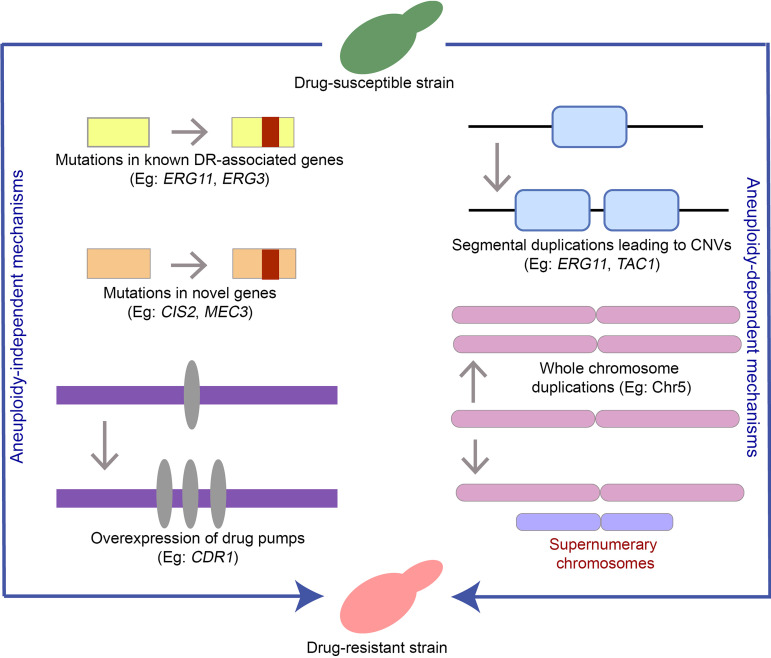
“Aneuploidyindependent mechanisms involve mutations in known drug resistance (DR)-associated genes (8, 11, 19, 41), mutations in novel genes (11), and overexpression of drug efflux pumps (19, 55).”
BackgroundInfluentialCalabrese, D., Bille, J., & Sanglard, D. (2000) · Microbiology · doi:10.1099/00221287-146-11-2743 · Cited by 209
Evolution of Drug Resistance in Experimental Populations of Candida albicans
Cowen, L. E., Sanglard, D., Calabrese, D., Sirjusingh, C., Anderson, J. B., & Kohn, L. M. (2000) · Journal of Bacteriology · doi:10.1128/jb.182.6.1515-1522.2000 · Cited by 207 · cited 2×
“MDR1 can result in azole resistance (5), while rapid acquisition of fluconazole resistance”
BackgroundFormation of new chromosomes as a virulence mechanism in yeast Candida glabrata
Poláková, S., Blume, C., Zárate, J. Á., Mentel, M., Jørck-Ramberg, D., Stenderup, J., & Piškur, J. (2009) · Proceedings of the National Academy of Sciences · doi:10.1073/pnas.0809793106 · Cited by 206
Mutations in TAC1B : a Novel Genetic Determinant of Clinical Fluconazole Resistance in Candida auris
Rybak, J. M., Muñoz, J. F., Barker, K. S., Parker, J. E., Esquivel, B. D., Berkow, E. L., Lockhart, S. R., Gade, L., Palmer, G. E., White, T. C., et al. (2020) · mBio · doi:10.1128/mbio.00365-20 · Cited by 202 · cited 2×
“in the presence of fluconazole was previously shown to select for missense mutations (R495G and F241S) (12) and codon deletions (ttcagt/agt) (11) in TAC1B.”
BackgroundBiswas, K., & Morschhäuser, J. (2005) · Molecular Microbiology · doi:10.1111/j.1365-2958.2005.04576.x · Cited by 185
Liu, S., Hou, Y., Liu, W., Lu, C., Wang, W., & Sun, S. (2015) · Eukaryotic Cell · doi:10.1128/ec.00271-14 · Cited by 174
Rogers, P. D., & Barker, K. S. (2003) · Antimicrobial Agents and Chemotherapy · doi:10.1128/aac.47.4.1220-1227.2003 · Cited by 157
Abbey, D. A., Funt, J., Lurie-Weinberger, M. N., Thompson, D. A., Regev, A., Myers, C. L., & Berman, J. (2014) · Genome Medicine · doi:10.1186/s13073-014-0100-8 · Cited by 147 · cited 2×
“GCA_003013715) using YMAP (http:// lovelace.cs.umn.edu/Ymap/) that detected two segmental duplications as distinct peaks, one each in F1.”
MethodAbrogation of Triazole Resistance upon Deletion of CDR1 in a Clinical Isolate of Candida auris
Rybak, J. M., Doorley, L. A., Nishimoto, A. T., Barker, K. S., Palmer, G. E., & Rogers, P. D. (2019) · Antimicrobial Agents and Chemotherapy · doi:10.1128/aac.00057-19 · Cited by 141 · cited 2×
“Aneuploidyindependent mechanisms involve mutations in known drug resistance (DR)-associated genes (8, 11, 19, 41), mutations in novel genes (11), and overexpression of drug efflux pumps (19, 55).”
BackgroundMethodExpandable and reversible copy number amplification drives rapid adaptation to antifungal drugs
Todd, R. T., & Selmecki, A. (2020) · eLife · doi:10.7554/elife.58349 · Cited by 138
Chakrabarti, A., & Sood, P. (2021) · Journal of Medical Microbiology · doi:10.1099/jmm.0.001318 · Cited by 133
Self-citationLeach, M. D., Budge, S., Walker, L., Munro, C., Cowen, L. E., & Brown, A. J. P. (2012) · PLoS Pathogens · doi:10.1371/journal.ppat.1003069 · Cited by 131
Ksiezopolska, E., Schikora-Tamarit, M. À., Beyer, R., Nunez-Rodriguez, J. C., Schüller, C., & Gabaldón, T. (2021) · Current Biology · doi:10.1016/j.cub.2021.09.084 · Cited by 107 · cited 1×
“to a high diversity ofmutations occurring in a restricted set of genes (4).”
BackgroundAneuploidy Enables Cross-Adaptation to Unrelated Drugs
Yang, F., Teoh, F., Tan, A. S. M., Cao, Y., Pavelka, N., & Berman, J. (2019) · Molecular Biology and Evolution · doi:10.1093/molbev/msz104 · Cited by 101 · cited 1×
“sistance to hydroxyurea as well as caspofungin (17).”
BackgroundNine Things Genomics Can Tell Us About Candida auris
Chybowska, A. D., Childers, D. S., & Farrer, R. A. (2020) · Frontiers in Genetics · doi:10.3389/fgene.2020.00351 · Cited by 96
Wasi, M., Khandelwal, N. K., Moorhouse, A. J., Nair, R., Vishwakarma, P., Bravo Ruiz, G., Ross, Z. K., Lorenz, A., Rudramurthy, S. M., Chakrabarti, A., et al. (2019) · Frontiers in Microbiology · doi:10.3389/fmicb.2019.01445 · Cited by 89 · cited 1×
“Aneuploidyindependent mechanisms involve mutations in known drug resistance (DR)-associated genes (8, 11, 19, 41), mutations in novel genes (11), and overexpression of drug efflux pumps (19, 55).”
BackgroundSelf-citationBing, J., Hu, T., Zheng, Q., Muñoz, J. F., Cuomo, C. A., & Huang, G. (2020) · Antimicrobial Agents and Chemotherapy · doi:10.1128/aac.01466-20 · Cited by 86 · cited 3×
“It was also observed that on passaging in the absence of the drug, the CNV was lost, and the strain lost the acquired resistance (32).”
BackgroundPloidy plasticity: a rapid and reversible strategy for adaptation to stress
Berman, J. (2016) · FEMS Yeast Research · doi:10.1093/femsyr/fow020 · Cited by 83
Novel ERG11 and TAC1b Mutations Associated with Azole Resistance in Candida auris
Li, J., Coste, A. T., Liechti, M., Bachmann, D., Sanglard, D., & Lamoth, F. (2021) · Antimicrobial Agents and Chemotherapy · doi:10.1128/aac.02663-20 · Cited by 82
Burrack, L. S., Todd, R. T., Soisangwan, N., Wiederhold, N. P., & Selmecki, A. (2022) · mBio · doi:10.1128/mbio.00842-22 · Cited by 82
The fitness costs and benefits of trisomy of each Candida albicans chromosome
Yang, F., Todd, R. T., Selmecki, A., Jiang, Y.-Y., Cao, Y.-B., & Berman, J. (2021) · Genetics · doi:10.1093/genetics/iyab056 · Cited by 72
Evolution of drug resistance in an antifungal-naive chronic Candida lusitaniae infection
Demers, E. G., Biermann, A. R., Masonjones, S., Crocker, A. W., Ashare, A., Stajich, J. E., & Hogan, D. A. (2018) · Proceedings of the National Academy of Sciences · doi:10.1073/pnas.1807698115 · Cited by 67
Costa, C., Pires, C., Cabrito, T. R., Renaudin, A., Ohno, M., Chibana, H., Sá-Correia, I., & Teixeira, M. C. (2013) · Antimicrobial Agents and Chemotherapy · doi:10.1128/aac.00811-12 · Cited by 66
Clade II Candida auris possess genomic structural variations related to an ancestral strain
Sekizuka, T., Iguchi, S., Umeyama, T., Inamine, Y., Makimura, K., Kuroda, M., Miyazaki, Y., & Kikuchi, K. (2019) · PLOS ONE · doi:10.1371/journal.pone.0223433 · Cited by 59
Eldesouky, H. E., Salama, E. A., Lanman, N. A., Hazbun, T. R., & Seleem, M. N. (2020) · Antimicrobial Agents and Chemotherapy · doi:10.1128/aac.00684-20 · Cited by 56 · cited 1×
“Most noteworthy among other upregulated transporters are sugar transporters, whose role as drug importers has been explored recently (40).”
BackgroundGerstein, A. C., & Berman, J. (2020) · mSphere · doi:10.1128/msphere.00480-20 · Cited by 44
Genomic Multiplication and Drug Efflux Influence Ketoconazole Resistance in Malassezia restricta
Park, M., Cho, Y., Lee, Y. W., & Jung, W. H. (2020) · Frontiers in Cellular and Infection Microbiology · doi:10.3389/fcimb.2020.00191 · Cited by 43
Kumar, M., Singh, A., Kumari, S., Kumar, P., Wasi, M., Mondal, A. K., Rudramurthy, S. M., Chakrabarti, A., Gaur, N. A., Gow, N. A. R., et al. (2020) · Biochimica et Biophysica Acta (BBA) - Molecular and Cell Biology of Lipids · doi:10.1016/j.bbalip.2020.158815 · Cited by 41
Self-citationSphingolipids: Regulators of azole drug resistance and fungal pathogenicity
Song, J., Xiao, L., & Li, R. (2020) · Molecular Microbiology · doi:10.1111/mmi.14586 · Cited by 40
Transcriptome Signatures Predict Phenotypic Variations of Candida auris
Jenull, S., Tscherner, M., Kashko, N., Shivarathri, R., Stoiber, A., Chauhan, M., Petryshyn, A., Chauhan, N., & Kuchler, K. (2021) · Frontiers in Cellular and Infection Microbiology · doi:10.3389/fcimb.2021.662563 · Cited by 32
Pais, P., Pires, C., Costa, C., Okamoto, M., Chibana, H., & Teixeira, M. C. (2016) · Frontiers in Microbiology · doi:10.3389/fmicb.2016.02045 · Cited by 29
Narayanan, A., Vadnala, R. N., Ganguly, P., Selvakumar, P., Rudramurthy, S. M., Prasad, R., Chakrabarti, A., Siddharthan, R., & Sanyal, K. (2021) · mBio · doi:10.1128/mbio.00905-21 · Cited by 28
Self-citationShort Read Alignment Using SOAP2
Hurgobin, B. (2015) · Methods in molecular biology · doi:10.1007/978-1-4939-3167-5_13 · Cited by 24
Nitrogen concentration affects amphotericin B and fluconazole tolerance of pathogenic cryptococci
Bosch, C., Toplis, B., Vreulink, J.-M., Volschenk, H., & Botha, A. (2020) · FEMS Yeast Research · doi:10.1093/femsyr/foaa010 · Cited by 12 · cited 1×
“In Cryptococcus neoformans, lower nitrogen concentrations promote ergosterol and capsule biosynthesis (27).”
Background
Cited by
Fungal Drug Response and Antimicrobial Resistance
Osset-Trénor, P., Pascual‐Ahuir, A., & Proft, M. (2023) · Journal of Fungi · doi:10.3390/jof9050565 · Cited by 119
Evolution of antifungal resistance in the environment
van Rhijn, N., & Rhodes, J. L. (2025) · Nature Microbiology · doi:10.1038/s41564-025-02055-y · Cited by 94
Sharma, C., & Kadosh, D. (2023) · PLoS Pathogens · doi:10.1371/journal.ppat.1011190 · Cited by 64
The evolution of antifungal therapy: Traditional agents, current challenges and future perspectives
de Souza, C. M., Bezerra, B. T., Mellon, D. A., & de Oliveira, H. C. (2025) · Current Research in Microbial Sciences · doi:10.1016/j.crmicr.2025.100341 · Cited by 53
Zhang, Y., Zeng, L., Huang, X., Wang, Y., Chen, G., Moses, M., Zou, Y., Xiong, S., Xue, W., Dong, Y., et al. (2025) · Nature Communications · doi:10.1038/s41467-025-59898-6 · Cited by 33
Metadata
- Authors
- Narayanan, A., Kumar, P., Chauhan, A., Kumar, M., Yadav, K., Banerjee, A., Sharma, R. D., Rudramurthy, S. M., Chakrabarti, A., Sanyal, K., & Prasad, R.
- Affiliations
- Jawaharlal Nehru Centre for Advanced Scientific Research (IN)
- Amity University Gurugram (IN)
- Post Graduate Institute of Medical Education and Research (IN)
- Corresponding author
- Sanyal, Kaustuv
- Prasad, Rajendra
- ORCID
- Venue
- mBio
- Publisher
- American Society for Microbiology
- Published
- 2022-12-20
- Volume
- 13
- Issue
- 6
- Pages
- e0305222-e0305222
- ISSN
- 2150-7511 (ISSN-L)
- PMC
- PMC9765433
- OpenAlex
- W4310463477
- Cited by
- 35
- References
- 56
- Citations by year
- 2026: 9 · 2025: 12 · 2024: 9 · 2023: 5
- FWCI
- 3.17
- Type
- journal article
- Language
- en
- Open access
- gold
- doi.org
- Licence
- cc-by
- creativecommons.org/licenses/by/4.0/ (vor)
- journals.asm.org/non-commercial-tdm-license (tdm)
- Locations
- mBio (publishedVersion, cc-by)
- PubMed Central (publishedVersion, cc-by)
- PubMed (publishedVersion)
- DOAJ (DOAJ: Directory of Open Access Journals) (submittedVersion, cc-by-sa)
- Greater South Information System
- Funders
- DST | Science and Engineering Research Board (JCB/2020/000021, PDF/2016/003256)
- Indian Council of Medical Research (2020-7196/CMB-BMS, AMR/149/2018- ECD-II)
- Topics
- Health Sciences › Medicine › Infectious Diseases › Antifungal resistance and susceptibility
- Life Sciences › Biochemistry, Genetics and Molecular Biology › Molecular Biology › Fungal and yeast genetics research
- Life Sciences › Agricultural and Biological Sciences › Plant Science › Fungal Plant Pathogen Control
- Keywords
- Candida auris, azole resistance, fluconazole resistance, segmental duplication, drug resistance mechanisms, antifungal resistance, gene amplification, drug efflux pumps, directed evolution
- MeSH terms
- Candida auris, Antifungal Agents, Azoles, Candida, Chromosomes, Microbial Sensitivity Tests, Fluconazole, Drug Resistance, Fungal
About these checks
Registry, retraction, Cites and statistics results are computed, not judged, with one exception: a printed reference that no index lists is read once by a model before it counts as a citation error. Claims are extracted by a model and kept only when their quote appears verbatim in the text; each cited source is then checked, with a model’s help, for whether it says what the claim relies on. Those verdicts can be wrong — read the claim’s quote and the cited source before relying on one.
Statistics and arithmetic are recomputed, not judged.
Confidence bands are shown only for fields calibrated on our annotated test set. None is calibrated yet, so no band is shown.
What counts as a claim ›How we measure confidence ›How we check this ›
Are you an author, or do you see a problem with this page? Request a review
Data sources
Bibliographic data: Semantic Scholar, OpenAlex, Crossref.
Contains information from the Semantic Scholar Academic Graph Datasets, made available under the ODC Attribution License (ODC-BY 1.0).
Semantic Scholar’s data is described in: Kinney, R., et al. (2023). The Semantic Scholar Open Data Platform. arXiv:2301.10140.
