

Methods and dimensions of electronic health record data quality assessment: enabling reuse for clinical research
Open accessThe DOI matches its Crossref record; 113 of the 114 references it cites were found in a registry or an index; 9 of the 41 sources its claims cite were checked for support.
Abstract
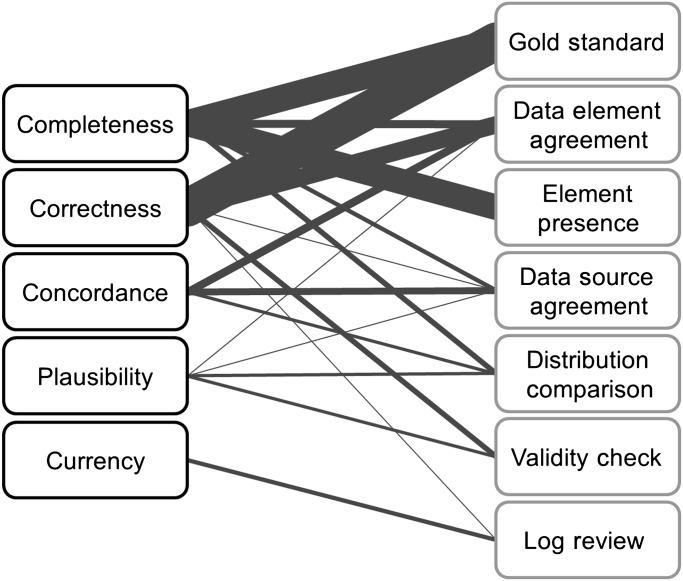
OBJECTIVE: To review the methods and dimensions of data quality assessment in the context of electronic health record (EHR) data reuse for research. MATERIALS AND METHODS: A review of the clinical research literature discussing data quality assessment methodology for EHR data was performed. Using an iterative process, the aspects of data quality being measured were abstracted and categorized, as well as the methods of assessment used. RESULTS: Five dimensions of data quality were identified, which are completeness, correctness, concordance, plausibility, and currency, and seven broad categories of data quality assessment methods: comparison with gold standards, data element agreement, data source agreement, distribution comparison, validity checks, log review, and element presence. DISCUSSION: Examination of the methods by which clinical researchers have investigated the quality and suitability of EHR data for research shows that there are fundamental features of data quality, which may be difficult to measure, as well as proxy dimensions. Researchers interested in the reuse of EHR data for clinical research are recommended to consider the adoption of a consistent taxonomy of EHR data quality, to remain aware of the task-dependence of data quality, to integrate work on data quality assessment from other fields, and to adopt systematic, empirically driven, statistically based methods of data quality assessment. CONCLUSION: There is currently little consistency or potential generalizability in the methods used to assess EHR data quality. If the reuse of EHR data for clinical research is to become accepted, researchers should adopt validated, systematic methods of EHR data quality assessment.
Overview
CoChat Summary
TL;DR
This review identifies five dimensions of electronic health record (EHR) data quality—completeness, correctness, concordance, plausibility, and currency—and seven broad categories of assessment methods. It concludes that EHR data quality assessment for research lacks consistency and generalizability, and recommends validated, systematic, statistically based methods.
Key findings
- Five data quality dimensions were derived: completeness, correctness, concordance, plausibility, and currency. Seven assessment method categories were identified: comparison with gold standards, data element agreement, data source agreement, distribution comparison, validity checks, log review, and element presence.
- Completeness was the most commonly assessed dimension, in 61 (64%) of 95 articles, followed by correctness in 57 (60%), concordance in 16 (17%), plausibility in 7 (7%), and currency in 4 (4%).
- Gold standard comparison was used in 37 of 95 articles; element presence was used only for completeness, while currency was assessed only through log review.
- The authors argue that only correctness, completeness, and currency are fundamental dimensions; concordance and plausibility appear to serve as proxies when fundamental dimensions cannot be assessed directly.
Methods
- Literature search performed on PubMed in February 2012, using data quality terms and EHR-related terms; the search produced 230 articles, which were manually reviewed.
- Inclusion criteria retained original research using data quality assessment methods, focused on EHR-derived data, and published in peer-reviewed journals; administrative claims databases were excluded. This yielded 44 articles, and an ancestor search added 51 more, for a final pool of 95 articles.
- From each article, the authors abstracted data quality features, assessment methods, and descriptive information; through iterative review, they inductively derived dimensions and method categories, then recategorized all 95 articles by dimension and assessment strategy.
Limitations
- The paper states the search was limited: lack of MeSH terms for data quality and variation in terminology may have caused relevant articles to be missed, though reference review was believed to improve saturation.
- The paper states classification was largely subjective and performed by only one author, so original researchers might disagree with the interpretations.
- The paper states that underreporting likely affected results, because routine data checking such as distributions and summary statistics is rarely described in publications; evident from the text, the review is descriptive and does not empirically validate the proposed taxonomy.
Model-written summary. Check it against the paper before relying on it.
Integrity signals
Registry
Cites
Statistics
Figures
Verification
Claims the paper makes
8 Valid · 1 Not valid · 16 Not checked · 59 Own results and interpretations
Every source the paper cites for this claim was checked and supports it.
In the paper
“Thiru et al,9 in calculating the sensitivity of different types of EHR data in the literature, found values ranging between 0.26 and 1.00.”
§ Methods and dimensions of electronic health record data quality assessment: enabling reuse for clinical research > Abstract > Conclusion
What the sources say
- Supportedcites [9] Thiru K Hassey A Sullivan F Systematic review of scope and quality of electronic patient record data in primary care. BMJ 2003; 326: 1070 12750210 PMC155692 source
Table 3 (Results) lists sensitivities for different types of electronic patient record data. The values range from 26% for socioeconomic data to 100% for several categories, matching 0.26–1.00. (LLM, conf=0.94)
plain- Asserted: passes — The authors put it forward as true.
- Checkable: passes — It can be checked against evidence.
- Load-bearing: passes — The paper’s conclusions depend on it.
- Based: passes — The paper gives a reason why it holds.
- Supported
The cited sources support only part of this claim — read each source’s verdict below.
In the paper
“Hogan and Wagner8 suggested specific statistical measures of the correctness and completeness of EHR elements that have been adopted by other researchers.”
§ Methods and dimensions of electronic health record data quality assessment: enabling reuse for clinical research > Discussion > Data quality assessment methodology
What the sources say
- Partly supportedcites [8] Hogan WR Wagner MM Accuracy of data in computer-based patient records. J Am Med Inform Assoc 1997; 4: 342– 55 9292840 PMC61252 sourceExperimental — accuracy not yet measured
The Methodological Recommendations section (page not provided) defines correctness and completeness as specific proportions and recommends that future studies report numerical measures of both. The paper does not establish the claim that other researchers subsequently adopted those measures. (LLM, conf=0.88)
plainstates a cause- Asserted: passes — The authors put it forward as true.
- Checkable: passes — It can be checked against evidence.
- Load-bearing: unclear — It is unclear whether the paper’s conclusions depend on it.
- Based: passes — The paper gives a reason why it holds.
- Partly supported
The sources with a verdict support this claim; the rest weren’t checked yet, have no full text we could read, or their verdicts aren’t rated yet.
In the paper
“Some researchers looking at the quality of research databases pulled from general practices in the UK have adopted relatively consistent approaches to comparing the distributions of data concerning specific clinical phenomena to information from registries and surveys.31 98 99 102”
§ Methods and dimensions of electronic health record data quality assessment: enabling reuse for clinical research > Discussion > Data quality assessment methodology
What the sources say
- Not checked — no full text of the sourcecites [31] Lewis JD Brensinger C Agreement between GPRD smoking data: a survey of general practitioners and a population-based survey. Pharmacoepidemiol Drug Saf 2004; 13: 437– 41 15269927 source
- Not checked — no full text of the sourcecites [98] Haynes K Forde KA Schinnar R Cancer incidence in The Health Improvement Network. Pharmacoepidemiol Drug Saf 2009; 18: 730– 6 19479713 source
- Supportedcites [99] Iyen-Omofoman B Hubbard RB Smith CJ The distribution of lung cancer across sectors of society in the United Kingdom: a study using national primary care data. BMC Public Health 2011; 11: 857 22074413 PMC3282683 source
The Methods and Discussion > Lung cancer Incidence describe comparing lung cancer data from the UK general-practice database THIN with national cancer registry and National Lung Cancer Audit data to assess its representativeness. This paper therefore exemplifies the comparison approach attributed to the cited group of researchers; the sentence does not require each cited study to use both registries and surveys. (LLM, conf=0.85)
plain- Asserted: passes — The authors put it forward as true.
- Checkable: passes — It can be checked against evidence.
- Load-bearing: unclear — It is unclear whether the paper’s conclusions depend on it.
- Based: passes — The paper gives a reason why it holds.
The cited sources support only part of this claim — read each source’s verdict below.
In the paper
“In three of the four, researchers reviewed whether desired data were entered into the EHR within a set time limit.36 46 52”
§ Methods and dimensions of electronic health record data quality assessment: enabling reuse for clinical research > Results > Currency
What the sources say
- Not checked — no full text of the sourcecites [36] Ndira SP Rosenberger KD Wetter T Assessment of data quality of and staff satisfaction with an electronic health record system in a developing country (Uganda): a qualitative and quantitative comparative study. Methods Inf Med 2008; 47: 489– 98 19057805 source
- Partly supportedcites [46] Vawdrey DK Gardner RM Evans RS Assessing data quality in manual entry of ventilator settings. J Am Med Inform Assoc 2007; 14: 295– 303 17329731 PMC2244881 sourceExperimental — accuracy not yet measured
The Methods (Data Analysis; page unavailable) say the researchers measured charting delay—the interval between observing ventilator settings and entering them into the computer—to assess timeliness. The Results report an average delay of 6.1 minutes, but the study does not assess whether entries met a set time limit. The 30-minute limit in the Background describes an earlier study by East et al., not this study's measure. (LLM, conf=0.85)
- Not checked — no full text of the sourcecites [52] Faulconer ER de Lusignan S An eight-step method for assessing diagnostic data quality in practice: chronic obstructive pulmonary disease as an exemplar. Inform Prim Care 2004; 12: 243– 54 15808026 source
plain- Asserted: passes — The authors put it forward as true.
- Checkable: passes — It can be checked against evidence.
- Load-bearing: unclear — It is unclear whether the paper’s conclusions depend on it.
- Based: passes — The paper gives a reason why it holds.
A result the paper reports from its own data — it cites no other source for it, so there is none to check. The quote shows it is in the paper.
In the paper
“For example, 37 of the 95 articles in our sample relied on a gold standard to assess data quality.”
§ Methods and dimensions of electronic health record data quality assessment: enabling reuse for clinical research > Discussion > Data quality assessment methodology
plainn = 95- Asserted: passes — The authors put it forward as true.
- Checkable: passes — It can be checked against evidence.
- Load-bearing: unclear — It is unclear whether the paper’s conclusions depend on it.
- Based: passes — The paper gives a reason why it holds.
40 more claims
Create a free account to see all 84 claims and every source verdict.
- It may state two separate claims as one. 23
- Probably not a substantial claim. 24
Claims other papers make about this one
Each is checked against this paper’s own text: does it say what the citing paper says it does?
The source backs part of the claim, not all of it — or backs it for a different population, condition or comparison.
In the citing paper
“While these developments have advanced the understanding of data quality in the context of medical applications, frameworks for EHR frequently focus on the data quality of individual patients86,87, neglecting data quality aspects for the overall population.”
From The METRIC-framework for assessing data quality for trustworthy AI in medicine: A systematic review (2024) · cites this paper as [87]
Experimental — accuracy not yet measuredThe cited source says what the claim attributes to it.
In the citing paper
“The current DQ literature is inconsistent in the use of terms that describe the complex multidimensional aspects of DQ.42–51”
From A harmonized data quality assessment terminology and framework for the secondary use of electronic health record data (2016) · cites this paper as [45]
The cited source says what the claim attributes to it.
In the citing paper
“In particular, representativeness is often not a factor86,87 while it is a crucial property for secondary use of data in clinical studies88 or when reusing medical data as training data for ML applications.”
From The METRIC-framework for assessing data quality for trustworthy AI in medicine: A systematic review (2024) · cites this paper as [87]
Self-check
Percentages, sums and reported differences re-computed from the paper’s own numbers.
Each contradiction between two passages listed here was confirmed by an independent check.
Rated minor: it would not touch a result — a value no result rests on, a p-value that stays on the same side of the significance level, or a conflict that is clerical, resolved elsewhere in the paper, or outside its own findings.
In the paper
§ Methods and dimensions of electronic health record data quality assessment: enabling reuse for clinical research > Results > Plausibility
“The most common approach to assessing the plausibility of EHR data was to perform some sort of validity check to determine if specific elements within the EHR were likely to be true or not.”
§ Methods and dimensions of electronic health record data quality assessment: enabling reuse for clinical research > Results
“| Distribution comparison | 97–100 | | 31 57 97 | 50 101 102 103 | | 10 | | Validity checks | | 32 62 104 105 106 | | 73 89 | | 7 |”
Citations
Cites
A General Inductive Approach for Analyzing Qualitative Evaluation Data
Thomas, D. R. (2006) · American Journal of Evaluation · doi:10.1177/1098214005283748 · Cited by 10,858 · cited 1×
“Furthermore, using an existing model to guide analysis is a deductive approach, which has the potential to obscure information contained in the data.(11) By imposing an existing model from a different discipline, we would have run the risk of missing important findings.”
MethodBeyond Accuracy: What Data Quality Means to Data Consumers
Wang, R. Y., & Strong, D. M. (1996) · Journal of Management Information Systems · doi:10.1080/07421222.1996.11518099 · Cited by 4,672
(2020) · Journal of Medical Education · doi:10.5812/jme · Cited by 3,490
The American Journal of Managed Care
(2020) · The American Journal of Managed Care · doi:10.37765/ajmc · Cited by 3,237
Pipino, L. L., Lee, Y. W., & Wang, R. Y. (2002) · Communications of the ACM · doi:10.1145/505248.506010 · Cited by 1,724
Juran's Quality Control Handbook
Ziegel, E. R. (1990) · Technometrics · doi:10.1080/00401706.1990.10484602 · Cited by 1,384
Jick, H., Jick, S. S., & Derby, L. E. (1991) · BMJ · doi:10.1136/bmj.302.6779.766 · Cited by 839
Safran, C., Bloomrosen, M., Hammond, W. E., Labkoff, S., Markel-Fox, S., Tang, P. C., & Detmer, D. E. (2007) · Journal of the American Medical Informatics Association · doi:10.1197/jamia.m2273 · Cited by 705 · cited 1×
“As the adoption of electronic health records (EHRs) has made it easier to access and aggregate clinical data, there has been growing interest in conducting research with data collected during the course of clinical care.(1) 2 The Natonal Institutes of Health has called for increasing the reuse of electronic records fo…”
MethodInformatics in Primary Care: Strategies in Information Management for the Healthcare Provider
(2002) · Health Informatics · doi:10.1007/978-1-4613-0069-4 · Cited by 422
Accuracy of Data in Computer-based Patient Records
Hogan, W. R., & Wagner, M. M. (1997) · Journal of the American Medical Informatics Association · doi:10.1136/jamia.1997.0040342 · Cited by 389 · cited 5×
“As observed by Hogan and Wagner in their literature review, there is no medical subheadings (MeSH) term fi ‘ ’ ‘ ’ ‘ ’ ‘ consistency ’ , ‘ data completeness ’ , and ‘ data error ’ .”
BackgroundInfluential
Research works printed but not linked: 14
- 1997, Journal of the American Medical Informatics Association, 4, 342, 10.1136/jamia.1997.0040342 · DOI · Paper page
- 2006, Journal of the American Medical Informatics Association, 13, 12, 10.1197/jamia.M1813 · DOI · Paper page
- 2000, Journal of the American Medical Informatics Association, 7, 55, 10.1136/jamia.2000.0070055 · DOI · Paper page
- 1996, Journal of the American Medical Informatics Association, 3, 234, 10.1136/jamia.1996.96310637 · DOI · Paper page
- 2007, Journal of the American Medical Informatics Association, 14, 295, 10.1197/jamia.M2219 · DOI · Paper page
- 2007, Journal of the American Medical Informatics Association, 14, 10, 10.1197/jamia.M2198 · DOI · Paper page
- Harabagiu, 2010, 2010, 1
- 2004, Journal of the American Medical Informatics Association, 11, 351, 10.1197/jamia.M1498 · DOI · Paper page
- 2000, Journal of the American Medical Informatics Association, 7, 42, 10.1136/jamia.2000.0070042 · DOI · Paper page
- 2010, Family Practice, 27, 121, 10.1093/fampra/cmp068 · DOI
- 2004, Journal of the American Medical Informatics Association, 11, 78, 10.1197/jamia.M1362 · DOI
- 1999, Journal of the American Medical Informatics Association, 6, 245, 10.1136/jamia.1999.0060245 · DOI · Paper page
- 2003, Journal of the American Medical Informatics Association, 10, 470, 10.1197/jamia.M1290 · DOI · Paper page
- Committee on Improving the Patient Record Institute of Medicine The Computer-Based Patient Record: An Essential Technology for Health Care, Revised Edition. Institute of Medicine. The National Academies Press, 1997 http://iom.edu/Reports/1997/The-Computer-Based-Patient-Record-An-Essential-Technology-for-Health-Care-Revised-Edition.aspx 25121222
Cited by
Items 901–1,000 of 1,209
Lu, Y., Duong, T. T., Miao, Z., Thieu, T., Lamichhane, J., Ahmed, A., & Delen, D. (2024) · Journal of the American Medical Informatics Association · doi:10.1093/jamia/ocae140 · Cited by 1
“42,43 Various methods exist for handling missingness and imbalance within health data, yet there is a lack of widespread consensus and acceptance within the scientific community regarding the most effective methodology.”
Considerations and Challenges When Using Clinical and Vital Record Review for Suicide Research
Arias, S. A., Gaudiano, B. A., Epstein-Lubow, G. P., Zylberfuden, S., & Weinstock, L. M. (2025) · Journal of Patient Safety · doi:10.1097/pts.0000000000001325 · Cited by 2
“35 For instance, in cases involving emergency medical services response to a suicide death incident, the decedent may be directly transported to the local coroner or medical examiner ’ s of fi ce, thereby bypassing health care facility contact and documentation in the health record.”
Methodology for assessing the quality of electronic medical records data
Андрейченко, А. Е., Kaftanov, A. N., & Gusev, A. V. (2024) · Vrach i informacionnye tehnologii · doi:10.25881/18110193_2024_4_48 · Cited by 1
Entwicklung und Umsetzung eines Transparenz-Leitfadens
Hradecky, D. M. (2025) · Springer eBooks · doi:10.1007/978-3-658-48125-4_7 · Cited by 1
Open Research Issues and Emerging Research Directions in Data Quality for Public Health.
Sundararaman, A. T., & Ramanathan, S. V. (2016) · ICIQ · Cited by 1
A Predictive Method to Determine Incomplete Electronic Medical Records
Talaei‐Khoei, A., Motiwalla, L., & Kazemi, S.-F. (2018) · ACM SIGCPR Conference on Computer Personnel Research (SIGCPR) · doi:10.1145/3209626.3209706 · Cited by 1
“In a systematic literature review, Weiskopf and Weng (2013) have defined four dimensions of missing data for EMRs: breadth, density, predictive, and documentation .”
BackgroundQuality of Electronic Health Record Data on Which We Stand
Harrington, L. (2019) · AACN Advanced Critical Care · doi:10.4037/aacnacc2019556 · Cited by 1
An Association-Based Intrinsic Quality Index for Healthcare Dataset Ranking
Shi, J., Zhang, J., & Ge, Y. (2019) · IEEE International Conference on Healthcare Informatics (ICHI) · doi:10.1109/ichi.2019.8904553 · Cited by 2
“For example, EHR data quality has been categorized into completeness, correctness, concordance, plausibility, and currency in 2013 [6], conformance, completeness,”
BackgroundInteractive Deep Metric Learning for Healthcare Cohort Discovery
Wang, Y., Long, G., Peng, X., Clarke, A., Stevenson, R., & Gerrard, L. (2019) · Communications in computer and information science · doi:10.1007/978-981-15-1699-3_17 · Cited by 1
Rolle der Dokumentations-IT in der Rheumatologie
Pallua, J. D., & Schirmer, M. (2021) · rheuma plus · doi:10.1007/s12688-021-00396-0 · Cited by 1
Analysis and Curation of the Database of a Colo-Rectal Cancer Screening Program
Aznar-Gimeno, R., Carrera‐Lasfuentes, P., Rodrigálvarez-Chamarro, M. D. L. V., Alonso, R. D. H., Lanas, Á., & Doblaré, M. (2021) · IntechOpen eBooks · doi:10.5772/intechopen.95899 · Cited by 1
Anantharama, N., Buntine, W., & Nunn, A. K. (2021) · ACI Open · doi:10.1055/s-0041-1735975 · Cited by 1
Sairaalan reaaliaikainen tilannekuva päivittäisessä johtamisessa
Mykkänen, M., Miettinen, M., Siponen, T., & Saranto, K. (2021) · Finnish Journal of eHealth and eWelfare · doi:10.23996/fjhw.109940 · Cited by 21
Diaz‐Garelli, F., Long, A., Bancks, M. P., Bertoni, A. G., Narayanan, A., & Wells, B. J. (2021) · PubMed Central · Cited by 1
Modelagem, Mineração e Análise de Jornadas / Trajetórias de Pacientes
Rosa, C., Ito, M., Vieira, A. B., & Gomes, A. M. T. (2022) · doi:10.5753/sbc.10508.0.3 · Cited by 1
A Conceptual Model of Health Monitoring Systems Centered on ADLs Performance in Older Adults
García-Moreno, F. M., Bermúdez-Edo, M., Pérez‐Mármol, J. M., Garrido, J. L. G., & Rodríguez‐Fórtiz, M. J. (2022) · Lecture notes in computer science · doi:10.1007/978-3-031-22036-4_3 · Cited by 2
Cancer reporting: timeliness analysis and process reengineering
Jabour, A. M. (2015) · IUScholarWorks (Indiana University) · doi:10.7912/c2k88h · Cited by 2
“Some of the dimensions that are frequently discussed with respect to health data include accessibility, accuracy, completeness, and timeliness (Weiskopf & Weng, 2013).”
BackgroundMarais, H. J. (2017) · SUNScholar (Stellenbosch University) · Cited by 2
Exploration Of The Timeliness Of ICD Codes In Administrative Databases: A Nationwide StudyPreprint
Simon, M., Rance, B., Katsahian, S., Bounebache, S. K., Rey, G., Châtellier, G., Neuraz, A., Burgun, A., & Looten, V. (2018) · bioRxiv (Cold Spring Harbor Laboratory) · doi:10.1101/491951 · Cited by 1
“The general topic of data quality has been widely explored in the literature[35,36].”
BackgroundSharafoddini, A. (2019) · UWSpace (University of Waterloo) · Cited by 2
Ouchi, D., Giner‐Soriano, M., Gómez-Lumbreras, A., et al. (2022) · doi:10.2196/preprints.37976 · Cited by 1
Integrated Data Governance, Digital Health, and the Common Data Model (OMOP-CDM)Preprint
Hallinan, C. M., Ward, R., Hart, G. K., Sullivan, C. M., Pratt, N. L., Ng, A. P., Daniel Capurro, N., van der Vegt, A. H., Liaw, S., Daly, J. O., et al. (2023) · Research Square · doi:10.21203/rs.3.rs-3479039/v1 · Cited by 1
Bönisch, C. (2023) · eDiss (Georg-August-Universität Göttingen) · doi:10.53846/goediss-10167 · Cited by 3
“In order to achieve high-quality healthcare, the usefulness of clinical data collected depends largely on its quality [2], [3].”
Cogan, A. M., Roberts, P. S., & Mallinson, T. (2024) · OTJR Occupational Therapy Journal of Research · doi:10.1177/15394492241246544 · Cited by 2
“Rather, data quality must be evaluated specifically for the research purpose for which it is intended (Weiskopf & Weng, 2013).”
Enhancing reusability of veterinary epidemiological data by creating contextual metadata
Faverjon, C., Delavenne, C., Bareille, S., Cameron, A. R., Carmo, L. P., Dean, K. R., Nardi, M. D., Ezanno, P., Frössling, J., Gustafsson, W., et al. (2026) · Scientific Data · doi:10.1038/s41597-026-08217-9 · Cited by 1
Leonard, S. A., Dysart, K., Callahan, A., Siadat, S., Zhang, J. C., Handley, S. C., Huybrechts, K. F., Igbinosa, I. I., & Bateman, B. T. (2026) · medRxiv · doi:10.64898/2026.06.02.26354757 · Cited by 1
Individual Trajectories in Asthma and COPD: A Longitudinal Perspective to Obstructive Lung Disease
Koskela, J. T. (2015) · Helda - University of Helsinki Institutional Repository · Cited by 1
Understanding and Reducing Clinical Data Biases
Fort, D. G. (2015) · doi:10.7916/d85x27rd
Implementación de un servicio web basado en REST para la medición de la calidad de datos
Martínez, P. M. (2014)
Appropriate antibiotic prescribing in Community-Acquired Pneumonia in a Norwegian hospital setting
Høgli, J. U. (2015) · NORA - Norwegian Open Research Archives · Cited by 1
Disseminating informatics knowledge and training the next generation of leaders
Ohno-Machado, L. (2014) · Journal of the American Medical Informatics Association · doi:10.1136/amiajnl-2014-noveditorial
Lyons, A. (2016) · ProQuest Demo Repository · doi:10.26053/0h-r50e-mgg0
Content coding and search for risk assessment: Problems and solutions
Malin, J. T., Thronesbery, C., & Throop, D. R. (2016) · Proceedings - IEEE Aerospace Conference · doi:10.1109/aero.2016.7500687
“Criteria for the quality of coding schemes include utility, clarity (or interpretability), difficulty and reproducibility [11; 12; 13].”
BackgroundCeruti, M., Geninatti, S., & Siliquini, R. (2014) · Advances in healthcare information systems and administration book series · doi:10.4018/978-1-4666-6316-9.ch011
Morgan, J. S. (2015) · doi:10.7282/t3vh5qpk
“As the name, ‘gold standard’, implies; this is used as a trusted source of truth for quality improvement systems to reference as appropriate.(36)”
DiazVasquez, J. F. (2016) · Digital Commons-TMC (Texas Medical Center) · Cited by 2
A MVC based User Interface Design for Clinical Research Data Extraction
Yang, C. Y., Young, C., & Liu, C. (2015)
Medical Record for Clinicians: Present and Future Vision
Gaddi, A. V. (2017) · TELe-Health · doi:10.1007/978-3-319-28661-7_8
Meulendijk, M. C., Spruit, M. R., Lefebvre, A., et al. (2017) · IET Software · doi:10.1049/iet-sen.2016.0301
Zitzelberger, J., Roussel, L., Wright, E. L., et al. (2017)
Aboudy, T., Brezinov, Y., Even, A., & Vaisbuch, E. (2016) · ICIQ
Nathan, W. T. (2017) · Productivity Press eBooks · doi:10.1201/9781315102245-9
A Case Study of the International Niemann-Pick Disease Registry (INPDR)
Glöckner, S., Toikkanen, S., Rui, J., Hu, W. T., & Sinnott, R. (2017) · IEEE International Conference on e-Health Networking, Applications and Services (Healthcom) · doi:10.1109/healthcom.2017.8210764
“Most common used DQ dimensions are data completeness (DC), data accuracy (DA) and data timeliness [10], [11].”
BackgroundVP147 Implementing Electronic Health Record In A Children's Hospital
Andellini, M., Faggiano, F. C., Sabusco, F., Derrico, P., & Ritrovato, M. (2017) · International Journal of Technology Assessment in Health Care · doi:10.1017/s0266462317003919
User acceptance analysis of patient data management software
Rosslan, A. S., Soetarman, A. S. B., Nursyazana, R., Ibrahim, Z., & Supriyanto, E. (2017) · International Conference on Robotics, Automation and Sciences (ICORAS) · doi:10.1109/icoras.2017.8308059
“The National Institutes of Health have called for increasing the reuse of electronic records for research [2].”
BackgroundQuality assessment of input data for emergency department simulation
Vanbrabant, L., Martin, N., Ramaekers, K. M., & Braekers, K. (2017) · Document Server@UHasselt (UHasselt)
Pisa, F. E., Palese, F., Romanese, F., Barbone, F., Logroscino, G., & Riedel, O. (2018) · International Journal of Methods in Psychiatric Research · doi:10.1002/mpr.1724
“Studies evaluating data quality in its multiple dimensions and using consistent methodology are thus highly needed (Weiskopf & Weng, 2013).”
MethodElectronic Information Sharing to Improve Post-Acute Care Transitions
Cross, D. A., Adler‐Milstein, J., Banaszak‐Holl, J., & McCullough, J. S. (2018) · Academy of Management Proceedings · doi:10.5465/ambpp.2018.17468abstract · Cited by 2
Alali, A. (2017) · White Rose eTheses Online (University of Leeds, The University of Sheffield, University of York) · Cited by 2
Carsley, S. (2018) · TSpace (University of Toronto)
Namukwambi, R. N. (2017) · Unisa Institutional Repository (University of South Africa)
A Practice-Based Evidence Approach For Clinical Decision Support
Osop, H. (2018) · Queensland University of Technology · doi:10.5204/thesis.eprints.123320 · Cited by 1
Image and Text Fusion for Character-Based Breast Cancer Classification
Qiao, P., Jin, Y., Chen, D., & Zhang, Y. (2018) · IEEE International Conference on High Performance Computing and Communications; IEEE International Conference on Smart City; IEEE International Conference on Data Science and Systems (HPCC/SmartCity/DSS) · doi:10.1109/hpcc/smartcity/dss.2018.00070
“,Sigmoid or ReLU [3]).”
Dekkers-Sánchez, P. M., & de Wind, A. E. (2019) · International Archives of Occupational and Environmental Health · doi:10.1007/s00420-019-01409-4
Zhang, L., Ding, X., Yanyuan Ma, B., Muthu, N., Ajmal, I., Moore, J. H., Herman, D. S., & Chen, J. (2019) · arXiv (Cornell University) · doi:10.48550/arxiv.1902.10060
Liu, D., Lei, L., Ruan, T., & He, P. (2019) · Chinese Medical Sciences Journal · doi:10.24920/003579 · Cited by 4
A Road Map for Health Information Management in Oman
Kiyumi, R. H. M. A. (2019) · Queensland University of Technology · doi:10.5204/thesis.eprints.130603 · Cited by 2
Optimising the investigation of haematuria and bladder cancer
Tan, W. S. (2019) · UCL Discovery (University College London)
Asthma in electronic health records: validity and phenotyping
Nissen, F. (2019) · LSHTM Research Online (London School of Hygiene and Tropical Medicine) · doi:10.17037/pubs.04653375
“review of the chart notes or in clinic, ii) a reference standard such as another linked dataset or iii) a patient questionnaire.(266) A previous systematic review by Sharifi et al reviewed validation methods to capture acute bronchospasm in administrative or claims data;(253) this review identified two validation stud…”
BackgroundMethodInfluentialPEER-TO-PEER PERSONAL HEALTH RECORD
Horne, W. C. (2019) · Purdue e-Pubs (Purdue University System) · doi:10.25394/pgs.8977421.v1
Predicting the genetic ancestry of 2.6 million New York City patients using clinical dataPreprint
Ramlall, V., Quinnies, K. M., Vanguri, R., Lorberbaum, T., Goldstein, D. B., & Tatonetti, N. P. (2019) · bioRxiv (Cold Spring Harbor Laboratory) · doi:10.1101/768440
Interface Redesign of an Electronic Medical Record Review System Using User-Centered Design
Parmar, H. S. (2019) · UWSpace (University of Waterloo)
Bayesian Modeling of Latent Heterogeneity in Complex Survey Data and Electronic Health Records
Anthopolos, R. (2019) · doi:10.7916/d8-px1j-7442
“Despite the potential for new scientific insights from analyzing the vast amounts of data in EHRs, one of the primary challenges faced by researchers is how to handle the often large numbers of missing values [Weiskopf and Weng, 2013].”
BackgroundSupporting Clinical Decision Making in Cancer Care Delivery
Beauchemin, M. (2019) · doi:10.7916/d8-70wy-w603
Rogers, C. G., Drake, A. R., Peruski, A. H., Stinnette, S. E., & Adams, B. B. (2020) · UTC Scholar (University of Tennessee at Chattanooga)
Moseley, E. T., Wu, J. T.-Y., Welt, J. A., Foote, J., Tyler, P. D., Grant, D. W., Carlson, E. T., Gehrmann, S., Dernoncourt, F., & Celi, L. A. (2020) · arXiv (Cornell University) · doi:10.48550/arxiv.2003.03044 · Cited by 7
“While much EHR data are structured and amenable to analysis, there appears to be limited homogeneity in data completeness and quality (Weiskopf and Weng, 2013), and it is estimated that the majority of healthcare data are being generated in unstructured, text-based format (Murdoch and Detsky, 2013).”
BackgroundStudenter bør lære å dokumentere sykepleie med et fellesspråk
Drange, B. B., & Høyvik, E. (2020) · Sykepleien Forskning · doi:10.4220/sykepleiens.2020.83002
Etzioni, R., Mandel, M., & Gulati, R. (2020) · Springer texts in statistics · doi:10.1007/978-3-030-59889-1_1
An Empirical Case Analysis on Electronic Health Records on Global Perspectives
Ramu, A., & Haldorai, A. (2020) · INTERNATIONAL JOURNAL OF ADVANCED INFORMATION AND COMMUNICATION TECHNOLOGY · doi:10.46532/ijaict-2020032
“As showed up by a KLAS report, just three of these agents expanded their bit of the pie in 2013 - Epic, Cerner and MEDITECH.”
BackgroundTeaching Analytics Medical-Data Common Sense
Sagi, T., Shmueli, N., Friedman, B., & Bergman, R. (2021) · Lecture notes in computer science · doi:10.1007/978-3-030-71055-2_14
Using Secondary Health Data in Research
Omari, M. A. (2021) · Malaysian Journal of Medical and Biological Research · doi:10.18034/mjmbr.v8i1.544 · Cited by 4
“Poor-quality data decreases the relevance and authenticity of the outcomes and as such, the overall study becomes invalid and inappropriate (Weiskopf & Weng, 2013).”
BackgroundMethodKOSCIELNIAK, N. J. (2020) · Deep Blue (University of Michigan)
Diaz‐Garelli, F., Lenoir, K. M., & Wells, B. J. (2020) · PubMed
Sohrabi, B., Yazdani, H. R., Ershadi, M. J., & Dorvash, S. (2021) · پژوهشنامه پردازش و مدیریت اطلاعات · doi:10.52547/jipm.36.3.737 · Cited by 1
Hewins, K. J. (2020) · KU ScholarWorks (The University of Kansas)
Bots, S. H. (2021) · Utrecht University Repository (Utrecht University) · doi:10.33540/720
Communication Efficient Generalized Tensor Factorization for Decentralized Healthcare NetworksPreprint
Ma, J., Zhang, Q., Lou, J., Xiong, L., Bhavani, S. V., & Ho, J. C. (2021) · arXiv (Cornell University) · doi:10.48550/arxiv.2109.01718
“Yet, successfully mining the massive, high-dimensional EHR data is a challenging task due to sparse, missing, and noisy measurements [3], [4].”
BackgroundLiu, T. (2021) · Scholarship@Western (Western University)
Shepherd, B. E., Han, K., Chen, T., Bian, A., Pugh, S., Duda, S. N., Lumley, T., Heerman, W. J., & Shaw, P. A. (2021) · arXiv (Cornell University) · doi:10.48550/arxiv.2109.14001
Mise en œuvre de l’apprentissage machine en santé
Verma, A. A., Murray, J., Greiner, R., Cohen, J., Shojania, K. G., Ghassemi, M., Straus, S. E., Pou-Prom, C., & Mamdani, M. (2021) · Canadian Medical Association Journal · doi:10.1503/cmaj.202434-f · Cited by 1
Sharma, V., Augustine, T., Ainsworth, J., et al. (2021) · SSRN Electronic Journal · doi:10.2139/ssrn.3992285
Pian, W., Lin, L., Li, B., Qin, C., & Lin, H. (2022) · doi:10.2196/preprints.37950
Lin, J. S., Murad, M. H., Leas, B. F., Treadwell, J. R., Chou, R., Ivlev, I., & Kansagara, D. L. (2020) · doi:10.23970/ahrqepcmethqualimprintegrating
Ballester, B., Bukiet, F., & Dufour, J.-C. (2021) · doi:10.2196/preprints.28027
Development of Information Road map for Personalized Colorectal Cancer Screening in IranPreprint
Maserat, E., Mohammadzadeh, Z., & Zali, M. R. (2020) · doi:10.21203/rs.3.rs-17085/v1
Yip, K. Y.-L. (2018) · Faculty Opinions – Post-Publication Peer Review of the Biomedical Literature · doi:10.3410/f.733250970.793553406
Süer, A., Riepenhausen, S., Storck, M., Greulich, L., Zeidler, C., Ständer, S., & Dugas, M. (2022) · Studies in health technology and informatics · doi:10.3233/shti220229
Reinecke, I., Siebel, J., Fuhrmann, S., et al. (2022) · doi:10.2196/preprints.40312
Lamer, A., Fruchart, M., Paris, N., Popoff, B., Payen, A., Balcaen, T., Gacquer, W., Bouzillé, G., Marc Cuggia, A., Doutreligne, M., et al. (2022) · doi:10.2196/preprints.38936
CLINICAL PATHWAY - TO FOLLOW OR NOT TO FOLLOW
Ovaskainen, P., Alin, J., Arve, S., & Nykänen, R. S. A. P. (2022) · doi:10.33965/is2022_202201l022
The role of machine learning to predict treatment response and target drug therapies
Taylor, C. O., & Stevenson, J. M. (2022) · Elsevier eBooks · doi:10.1016/b978-0-12-824453-1.00002-6
Fadahunsi, K. P., Wark, P. A., Mastellos, N., Neves, A. L., Gallagher, J., Majeed, A., Webster, A. R., Smith, A. J., Choo‐Kang, B., Leon, C., et al. (2022) · SSRN Electronic Journal · doi:10.2139/ssrn.4166779
Data Analytics, Artificial Intelligence and Data Visualization
Ozkaynak, M., & Skiba, D. J. (2022) · Health informatics · doi:10.1007/978-3-030-91237-6_19
Metadata
- Authors
- Weiskopf, N. G., & Weng, C.
- Affiliations
- Columbia University (US)
- Corresponding author
- Weiskopf, N. G.
- Venue
- Journal of the American Medical Informatics Association
- Publisher
- Oxford University Press (OUP)
- Published
- 2013-01-01
- Volume
- 20
- Issue
- 1
- Pages
- 144-151
- ISSN
- 1067-5027 (ISSN-L)
- 1527-974X
- PMC
- PMC3555312
- OpenAlex
- W2158939484
- Cited by
- 1,216
- References
- 114
- Citations by year
- 2026: 153 · 2025: 102 · 2024: 97 · 2023: 92 · 2022: 88 · 2021: 108 · 2020: 88 · 2019: 106 · 2018: 102 · 2017: 88 · 2016: 70 · 2015: 54 · 2014: 38 · 2013: 23
- FWCI
- 6.18
- Type
- journal article
- Language
- en
- Open access
- hybrid
- doi.org
- Licence
- cc-by-nc
- Locations
- Journal of the American Medical Informatics Association (publishedVersion, cc-by-nc)
- Europe PMC (PubMed Central) (publishedVersion, cc-by-nc)
- PubMed Central (publishedVersion, cc-by-nc)
- PubMed (publishedVersion)
- Funders
- U.S. National Library of Medicine (R01LM010815, R01LM009886, T15LM007079)
- Topics
- Health Sciences › Health Professions › Health Information Management › Electronic Health Records Systems
- Health Sciences › Health Professions › Health Information Management › Medical Coding and Health Information
- Physical Sciences › Computer Science › Information Systems › Data Quality and Management
- Keywords
- electronic health records, data quality assessment, clinical research data, data completeness, data correctness, concordance, plausibility, data currency, gold standard comparison, data source agreement, validity testing
- MeSH terms
- Data Collection, Humans, Quality Control, Research Design, Reproducibility of Results, Information Dissemination, Electronic Health Records
About these checks
Registry, retraction, Cites and statistics results are computed, not judged, with one exception: a printed reference that no index lists is read once by a model before it counts as a citation error. Claims are extracted by a model and kept only when their quote appears verbatim in the text; each cited source is then checked, with a model’s help, for whether it says what the claim relies on. Those verdicts can be wrong — read the claim’s quote and the cited source before relying on one.
The claim verdicts this report counts are experimental: their accuracy is not yet measured.
A language model drew the claims from the paper on 2026-09-30, under version 3 of the claim definition (model deepseek-v4.1-flash, prompt extract-v3).
A second model labelled each claim on 2026-09-30 (model jev-1.13-20260917, definition revision gold-guideline-v0.2).
Cited sources are checked with a language model’s help (gpt-6-sol).
Statistics and arithmetic are recomputed, not judged.
Confidence bands are shown only for fields calibrated on our annotated test set. None is calibrated yet, so no band is shown.
What counts as a claim ›How we measure confidence ›How we check this ›
Are you an author, or do you see a problem with this page? Request a review
Data sources
Bibliographic data: Semantic Scholar, OpenAlex, Crossref.
Contains information from the Semantic Scholar Academic Graph Datasets, made available under the ODC Attribution License (ODC-BY 1.0).
Semantic Scholar’s data is described in: Kinney, R., et al. (2023). The Semantic Scholar Open Data Platform. arXiv:2301.10140.
