

Methods and dimensions of electronic health record data quality assessment: enabling reuse for clinical research
Open accessThe DOI matches its Crossref record; 113 of the 114 references it cites were found in a registry or an index; 9 of the 41 sources its claims cite were checked for support.
Abstract
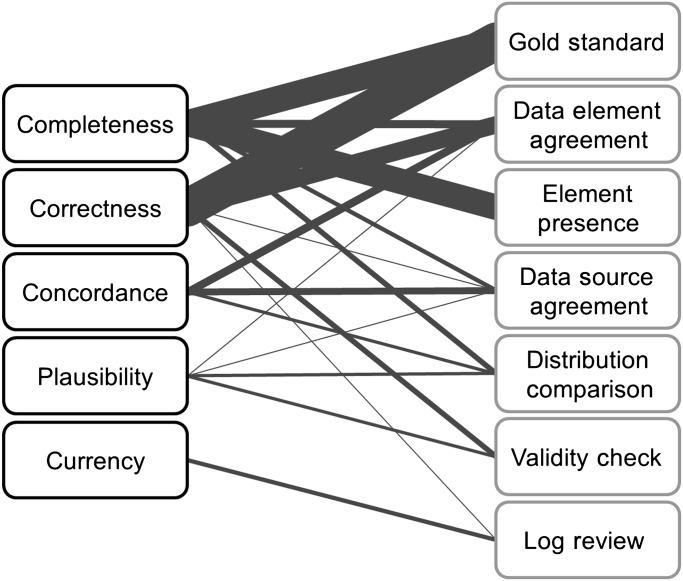
OBJECTIVE: To review the methods and dimensions of data quality assessment in the context of electronic health record (EHR) data reuse for research. MATERIALS AND METHODS: A review of the clinical research literature discussing data quality assessment methodology for EHR data was performed. Using an iterative process, the aspects of data quality being measured were abstracted and categorized, as well as the methods of assessment used. RESULTS: Five dimensions of data quality were identified, which are completeness, correctness, concordance, plausibility, and currency, and seven broad categories of data quality assessment methods: comparison with gold standards, data element agreement, data source agreement, distribution comparison, validity checks, log review, and element presence. DISCUSSION: Examination of the methods by which clinical researchers have investigated the quality and suitability of EHR data for research shows that there are fundamental features of data quality, which may be difficult to measure, as well as proxy dimensions. Researchers interested in the reuse of EHR data for clinical research are recommended to consider the adoption of a consistent taxonomy of EHR data quality, to remain aware of the task-dependence of data quality, to integrate work on data quality assessment from other fields, and to adopt systematic, empirically driven, statistically based methods of data quality assessment. CONCLUSION: There is currently little consistency or potential generalizability in the methods used to assess EHR data quality. If the reuse of EHR data for clinical research is to become accepted, researchers should adopt validated, systematic methods of EHR data quality assessment.
Overview
CoChat Summary
TL;DR
This review identifies five dimensions of electronic health record (EHR) data quality—completeness, correctness, concordance, plausibility, and currency—and seven broad categories of assessment methods. It concludes that EHR data quality assessment for research lacks consistency and generalizability, and recommends validated, systematic, statistically based methods.
Key findings
- Five data quality dimensions were derived: completeness, correctness, concordance, plausibility, and currency. Seven assessment method categories were identified: comparison with gold standards, data element agreement, data source agreement, distribution comparison, validity checks, log review, and element presence.
- Completeness was the most commonly assessed dimension, in 61 (64%) of 95 articles, followed by correctness in 57 (60%), concordance in 16 (17%), plausibility in 7 (7%), and currency in 4 (4%).
- Gold standard comparison was used in 37 of 95 articles; element presence was used only for completeness, while currency was assessed only through log review.
- The authors argue that only correctness, completeness, and currency are fundamental dimensions; concordance and plausibility appear to serve as proxies when fundamental dimensions cannot be assessed directly.
Methods
- Literature search performed on PubMed in February 2012, using data quality terms and EHR-related terms; the search produced 230 articles, which were manually reviewed.
- Inclusion criteria retained original research using data quality assessment methods, focused on EHR-derived data, and published in peer-reviewed journals; administrative claims databases were excluded. This yielded 44 articles, and an ancestor search added 51 more, for a final pool of 95 articles.
- From each article, the authors abstracted data quality features, assessment methods, and descriptive information; through iterative review, they inductively derived dimensions and method categories, then recategorized all 95 articles by dimension and assessment strategy.
Limitations
- The paper states the search was limited: lack of MeSH terms for data quality and variation in terminology may have caused relevant articles to be missed, though reference review was believed to improve saturation.
- The paper states classification was largely subjective and performed by only one author, so original researchers might disagree with the interpretations.
- The paper states that underreporting likely affected results, because routine data checking such as distributions and summary statistics is rarely described in publications; evident from the text, the review is descriptive and does not empirically validate the proposed taxonomy.
Model-written summary. Check it against the paper before relying on it.
Integrity signals
Registry
Cites
Statistics
Figures
Verification
Claims the paper makes
8 Valid · 1 Not valid · 16 Not checked · 59 Own results and interpretations
Every source the paper cites for this claim was checked and supports it.
In the paper
“Thiru et al,9 in calculating the sensitivity of different types of EHR data in the literature, found values ranging between 0.26 and 1.00.”
§ Methods and dimensions of electronic health record data quality assessment: enabling reuse for clinical research > Abstract > Conclusion
What the sources say
- Supportedcites [9] Thiru K Hassey A Sullivan F Systematic review of scope and quality of electronic patient record data in primary care. BMJ 2003; 326: 1070 12750210 PMC155692 source
Table 3 (Results) lists sensitivities for different types of electronic patient record data. The values range from 26% for socioeconomic data to 100% for several categories, matching 0.26–1.00. (LLM, conf=0.94)
plain- Asserted: passes — The authors put it forward as true.
- Checkable: passes — It can be checked against evidence.
- Load-bearing: passes — The paper’s conclusions depend on it.
- Based: passes — The paper gives a reason why it holds.
- Supported
The cited sources support only part of this claim — read each source’s verdict below.
In the paper
“Hogan and Wagner8 suggested specific statistical measures of the correctness and completeness of EHR elements that have been adopted by other researchers.”
§ Methods and dimensions of electronic health record data quality assessment: enabling reuse for clinical research > Discussion > Data quality assessment methodology
What the sources say
- Partly supportedcites [8] Hogan WR Wagner MM Accuracy of data in computer-based patient records. J Am Med Inform Assoc 1997; 4: 342– 55 9292840 PMC61252 sourceExperimental — accuracy not yet measured
The Methodological Recommendations section (page not provided) defines correctness and completeness as specific proportions and recommends that future studies report numerical measures of both. The paper does not establish the claim that other researchers subsequently adopted those measures. (LLM, conf=0.88)
plainstates a cause- Asserted: passes — The authors put it forward as true.
- Checkable: passes — It can be checked against evidence.
- Load-bearing: unclear — It is unclear whether the paper’s conclusions depend on it.
- Based: passes — The paper gives a reason why it holds.
- Partly supported
The sources with a verdict support this claim; the rest weren’t checked yet, have no full text we could read, or their verdicts aren’t rated yet.
In the paper
“Some researchers looking at the quality of research databases pulled from general practices in the UK have adopted relatively consistent approaches to comparing the distributions of data concerning specific clinical phenomena to information from registries and surveys.31 98 99 102”
§ Methods and dimensions of electronic health record data quality assessment: enabling reuse for clinical research > Discussion > Data quality assessment methodology
What the sources say
- Not checked — no full text of the sourcecites [31] Lewis JD Brensinger C Agreement between GPRD smoking data: a survey of general practitioners and a population-based survey. Pharmacoepidemiol Drug Saf 2004; 13: 437– 41 15269927 source
- Not checked — no full text of the sourcecites [98] Haynes K Forde KA Schinnar R Cancer incidence in The Health Improvement Network. Pharmacoepidemiol Drug Saf 2009; 18: 730– 6 19479713 source
- Supportedcites [99] Iyen-Omofoman B Hubbard RB Smith CJ The distribution of lung cancer across sectors of society in the United Kingdom: a study using national primary care data. BMC Public Health 2011; 11: 857 22074413 PMC3282683 source
The Methods and Discussion > Lung cancer Incidence describe comparing lung cancer data from the UK general-practice database THIN with national cancer registry and National Lung Cancer Audit data to assess its representativeness. This paper therefore exemplifies the comparison approach attributed to the cited group of researchers; the sentence does not require each cited study to use both registries and surveys. (LLM, conf=0.85)
plain- Asserted: passes — The authors put it forward as true.
- Checkable: passes — It can be checked against evidence.
- Load-bearing: unclear — It is unclear whether the paper’s conclusions depend on it.
- Based: passes — The paper gives a reason why it holds.
The cited sources support only part of this claim — read each source’s verdict below.
In the paper
“In three of the four, researchers reviewed whether desired data were entered into the EHR within a set time limit.36 46 52”
§ Methods and dimensions of electronic health record data quality assessment: enabling reuse for clinical research > Results > Currency
What the sources say
- Not checked — no full text of the sourcecites [36] Ndira SP Rosenberger KD Wetter T Assessment of data quality of and staff satisfaction with an electronic health record system in a developing country (Uganda): a qualitative and quantitative comparative study. Methods Inf Med 2008; 47: 489– 98 19057805 source
- Partly supportedcites [46] Vawdrey DK Gardner RM Evans RS Assessing data quality in manual entry of ventilator settings. J Am Med Inform Assoc 2007; 14: 295– 303 17329731 PMC2244881 sourceExperimental — accuracy not yet measured
The Methods (Data Analysis; page unavailable) say the researchers measured charting delay—the interval between observing ventilator settings and entering them into the computer—to assess timeliness. The Results report an average delay of 6.1 minutes, but the study does not assess whether entries met a set time limit. The 30-minute limit in the Background describes an earlier study by East et al., not this study's measure. (LLM, conf=0.85)
- Not checked — no full text of the sourcecites [52] Faulconer ER de Lusignan S An eight-step method for assessing diagnostic data quality in practice: chronic obstructive pulmonary disease as an exemplar. Inform Prim Care 2004; 12: 243– 54 15808026 source
plain- Asserted: passes — The authors put it forward as true.
- Checkable: passes — It can be checked against evidence.
- Load-bearing: unclear — It is unclear whether the paper’s conclusions depend on it.
- Based: passes — The paper gives a reason why it holds.
A result the paper reports from its own data — it cites no other source for it, so there is none to check. The quote shows it is in the paper.
In the paper
“For example, 37 of the 95 articles in our sample relied on a gold standard to assess data quality.”
§ Methods and dimensions of electronic health record data quality assessment: enabling reuse for clinical research > Discussion > Data quality assessment methodology
plainn = 95- Asserted: passes — The authors put it forward as true.
- Checkable: passes — It can be checked against evidence.
- Load-bearing: unclear — It is unclear whether the paper’s conclusions depend on it.
- Based: passes — The paper gives a reason why it holds.
40 more claims
Create a free account to see all 84 claims and every source verdict.
- It may state two separate claims as one. 23
- Probably not a substantial claim. 24
Claims other papers make about this one
Each is checked against this paper’s own text: does it say what the citing paper says it does?
The source backs part of the claim, not all of it — or backs it for a different population, condition or comparison.
In the citing paper
“While these developments have advanced the understanding of data quality in the context of medical applications, frameworks for EHR frequently focus on the data quality of individual patients86,87, neglecting data quality aspects for the overall population.”
From The METRIC-framework for assessing data quality for trustworthy AI in medicine: A systematic review (2024) · cites this paper as [87]
Experimental — accuracy not yet measuredThe cited source says what the claim attributes to it.
In the citing paper
“The current DQ literature is inconsistent in the use of terms that describe the complex multidimensional aspects of DQ.42–51”
From A harmonized data quality assessment terminology and framework for the secondary use of electronic health record data (2016) · cites this paper as [45]
The cited source says what the claim attributes to it.
In the citing paper
“In particular, representativeness is often not a factor86,87 while it is a crucial property for secondary use of data in clinical studies88 or when reusing medical data as training data for ML applications.”
From The METRIC-framework for assessing data quality for trustworthy AI in medicine: A systematic review (2024) · cites this paper as [87]
Self-check
Percentages, sums and reported differences re-computed from the paper’s own numbers.
Each contradiction between two passages listed here was confirmed by an independent check.
Rated minor: it would not touch a result — a value no result rests on, a p-value that stays on the same side of the significance level, or a conflict that is clerical, resolved elsewhere in the paper, or outside its own findings.
In the paper
§ Methods and dimensions of electronic health record data quality assessment: enabling reuse for clinical research > Results > Plausibility
“The most common approach to assessing the plausibility of EHR data was to perform some sort of validity check to determine if specific elements within the EHR were likely to be true or not.”
§ Methods and dimensions of electronic health record data quality assessment: enabling reuse for clinical research > Results
“| Distribution comparison | 97–100 | | 31 57 97 | 50 101 102 103 | | 10 | | Validity checks | | 32 62 104 105 106 | | 73 89 | | 7 |”
Citations
Cites
A General Inductive Approach for Analyzing Qualitative Evaluation Data
Thomas, D. R. (2006) · American Journal of Evaluation · doi:10.1177/1098214005283748 · Cited by 10,858 · cited 1×
“Furthermore, using an existing model to guide analysis is a deductive approach, which has the potential to obscure information contained in the data.(11) By imposing an existing model from a different discipline, we would have run the risk of missing important findings.”
MethodBeyond Accuracy: What Data Quality Means to Data Consumers
Wang, R. Y., & Strong, D. M. (1996) · Journal of Management Information Systems · doi:10.1080/07421222.1996.11518099 · Cited by 4,672
(2020) · Journal of Medical Education · doi:10.5812/jme · Cited by 3,490
The American Journal of Managed Care
(2020) · The American Journal of Managed Care · doi:10.37765/ajmc · Cited by 3,237
Pipino, L. L., Lee, Y. W., & Wang, R. Y. (2002) · Communications of the ACM · doi:10.1145/505248.506010 · Cited by 1,724
Juran's Quality Control Handbook
Ziegel, E. R. (1990) · Technometrics · doi:10.1080/00401706.1990.10484602 · Cited by 1,384
Jick, H., Jick, S. S., & Derby, L. E. (1991) · BMJ · doi:10.1136/bmj.302.6779.766 · Cited by 839
Safran, C., Bloomrosen, M., Hammond, W. E., Labkoff, S., Markel-Fox, S., Tang, P. C., & Detmer, D. E. (2007) · Journal of the American Medical Informatics Association · doi:10.1197/jamia.m2273 · Cited by 705 · cited 1×
“As the adoption of electronic health records (EHRs) has made it easier to access and aggregate clinical data, there has been growing interest in conducting research with data collected during the course of clinical care.(1) 2 The Natonal Institutes of Health has called for increasing the reuse of electronic records fo…”
MethodInformatics in Primary Care: Strategies in Information Management for the Healthcare Provider
(2002) · Health Informatics · doi:10.1007/978-1-4613-0069-4 · Cited by 422
Accuracy of Data in Computer-based Patient Records
Hogan, W. R., & Wagner, M. M. (1997) · Journal of the American Medical Informatics Association · doi:10.1136/jamia.1997.0040342 · Cited by 389 · cited 5×
“As observed by Hogan and Wagner in their literature review, there is no medical subheadings (MeSH) term fi ‘ ’ ‘ ’ ‘ ’ ‘ consistency ’ , ‘ data completeness ’ , and ‘ data error ’ .”
BackgroundInfluential
Research works printed but not linked: 14
- 1997, Journal of the American Medical Informatics Association, 4, 342, 10.1136/jamia.1997.0040342 · DOI · Paper page
- 2006, Journal of the American Medical Informatics Association, 13, 12, 10.1197/jamia.M1813 · DOI · Paper page
- 2000, Journal of the American Medical Informatics Association, 7, 55, 10.1136/jamia.2000.0070055 · DOI · Paper page
- 1996, Journal of the American Medical Informatics Association, 3, 234, 10.1136/jamia.1996.96310637 · DOI · Paper page
- 2007, Journal of the American Medical Informatics Association, 14, 295, 10.1197/jamia.M2219 · DOI · Paper page
- 2007, Journal of the American Medical Informatics Association, 14, 10, 10.1197/jamia.M2198 · DOI · Paper page
- Harabagiu, 2010, 2010, 1
- 2004, Journal of the American Medical Informatics Association, 11, 351, 10.1197/jamia.M1498 · DOI · Paper page
- 2000, Journal of the American Medical Informatics Association, 7, 42, 10.1136/jamia.2000.0070042 · DOI · Paper page
- 2010, Family Practice, 27, 121, 10.1093/fampra/cmp068 · DOI
- 2004, Journal of the American Medical Informatics Association, 11, 78, 10.1197/jamia.M1362 · DOI
- 1999, Journal of the American Medical Informatics Association, 6, 245, 10.1136/jamia.1999.0060245 · DOI · Paper page
- 2003, Journal of the American Medical Informatics Association, 10, 470, 10.1197/jamia.M1290 · DOI · Paper page
- Committee on Improving the Patient Record Institute of Medicine The Computer-Based Patient Record: An Essential Technology for Health Care, Revised Edition. Institute of Medicine. The National Academies Press, 1997 http://iom.edu/Reports/1997/The-Computer-Based-Patient-Record-An-Essential-Technology-for-Health-Care-Revised-Edition.aspx 25121222
Cited by
Items 301–400 of 1,209
Design and Refinement of a Data Quality Assessment Workflow for a Large Pediatric Research Network
Khare, R., Utidjian, L., Razzaghi, H., Soucek, V., Burrows, E. K., Eckrich, D., Hoyt, R., Weinstein, H., Miller, M. W., Soler, D., et al. (2019) · eGEMs (Generating Evidence & Methods to improve patient outcomes) · doi:10.5334/egems.294 · Cited by 30
Usmanova, G., Lalchandani, K., Srivastava, A., Joshi, C. S., Bhatt, D. C., Bairagi, A. K., Jain, Y., Afzal, M., Dhoundiyal, R., Benawri, J., et al. (2021) · BMC Pregnancy and Childbirth · doi:10.1186/s12884-021-03710-y · Cited by 26
“We have included completeness of case sheets in application as a measure of data quality as it is commonly assessed dimension of data quality mentioned in a review [25].”
MethodFan, S., Shi, X., Annan, W., Hou, T., Li, K., & Diao, Y.-P. (2021) · Journal of Biomedical Informatics · doi:10.1016/j.jbi.2021.103904 · Cited by 24
Röchner, P., & Rothlauf, F. (2023) · BMC Medical Research Methodology · doi:10.1186/s12874-023-01946-0 · Cited by 38
“Implausible records In our experiments, we define a record as implausible—following Weiskopf et al. [3]— when it contains combinations of values that are not consistent with common medical knowledge or information.”
BackgroundInfluentialChen, W., Xie, F., McCarthy, D., Reynolds, K., Lee, M. S., Coleman, K. J., Getahun, D., Koebnick, C., & Jacobsen, S. J. (2023) · PubMed Central · doi:10.1093/jamiaopen/ooad039 · Cited by 46
Evaluation of data quality of multisite electronic health record data for secondary analysis
Nobles, A. L., Vilankar, K., Wu, H., & Barnes, L. E. (2015) · IEEE International Conference on Big Data (BigData) · doi:10.1109/bigdata.2015.7364060 · Cited by 32
“…data provide a unique opportunity to examine longitudinal data across a diverse population, it is also advantageous because it eliminates or reduces patient recruitment and data collection, thereby reducing research costs and accelerating the time required for discoveries to reach application [7].”
BackgroundMethodDjennaoui, M., Grégoire, F., Beuscart, R., & Chazard, E. (2015) · Studies in health technology and informatics · doi:10.3233/978-1-61499-512-8-419 · Cited by 25
“Introduction The main purpose of electronic health records (EHRs) is to support health care of the patient.”
BackgroundIoT-Stream: A Lightweight Ontology for Internet of Things Data Streams
Elsaleh, T., Bermúdez-Edo, M., Enshaeifar, S., Acton, S. T., Rezvani, R., & Barnaghi, P. M. (2019) · Global Internet of Things Summit (GIoTS) · doi:10.1109/giots.2019.8766367 · Cited by 28
“There are five common metrics; Completeness, Correctness, Concordance, Currency and Plausibility [13].”
BackgroundData quality-aware genomic data integration
Bernasconi, A. (2021) · Computer Methods and Programs in Biomedicine Update · doi:10.1016/j.cmpbup.2021.100009 · Cited by 29
“We are aware of important work that is being conducted in parallel on health data [40, 72, 24, 65, 38], also employing the data warehouse paradigm as a guarantor of up-to-date de-duplicated data within a public network of research centers [37], usually oriented to support analytics [39].”
MethodTowards interactive event log forensics: Detecting and quantifying timestamp imperfections
Fischer, D. A., Goel, K., Andrews, R., van Dun, C., Wynn, M. T., & Röglinger, M. (2022) · Information Systems · doi:10.1016/j.is.2022.102039 · Cited by 33
Clinical data quality: a data life cycle perspective
Weng, C.-H. (2019) · Biostatistics & Epidemiology · doi:10.1080/24709360.2019.1572344 · Cited by 15
“Typical methods include uses of gold standards, data element agreement, element presence, data source agreement, distribution comparison, validity check, and log review [4].”
BackgroundMethodSelf-citationMiao, Z., Sealey, M. D., Sathyanarayanan, S., Delen, D., Zhu, L., & Shepherd, S. (2022) · Information Systems · doi:10.1016/j.is.2022.102130 · Cited by 26
Data quality assessment in emergency medical services: an objective approach
Mashoufi, M., Ayatollahi, H., Khorasani‐Zavareh, D., & Azadboni, T. T. (2023) · BMC Emergency Medicine · doi:10.1186/s12873-023-00781-2 · Cited by 31
“It is noteworthy that in the present study and other similar ones, patient medical records were considered as a gold standard [19].”
ResultKawazoe, Y., Imai, T., & Ohe, K. (2016) · JMIR Medical Informatics · doi:10.2196/medinform.5275 · Cited by 22
“This not only improves the usability of query expressions for specialists but also suggests the possibility of reusing queries (ie, using the same query at multiple hospitals) [34,35].”
Fixing rules for data cleaning based on conditional functional dependency
Salem, R., & Abdo, A. S. (2016) · Future Computing and Informatics Journal · doi:10.1016/j.fcij.2017.03.002 · Cited by 31
“In particular, acquiring accurate and dependable information about diseases treatment is based on precise and consistent data stored about patient [11,33].”
IoTCrawler: Browsing the Internet of Things
Skármeta, A., Santa, J., Martinez, J. A., Parreira, J. X., Barnaghi, P. M., Enshaeifar, S., Beliatis, M. J., Presser, M. A., Iggena, T., Fischer, M., et al. (2018) · Global Internet of Things Summit (GIoTS) · doi:10.1109/giots.2018.8534528 · Cited by 23
“In [13] the authors provide a table of different terms used to describe one of the dimensions of data quality.”
BackgroundHigh-dimensionality Data Analysis of Pharmacological Systems Associated with Complex Diseases
Hendrickx, J. O., van Gastel, J., Leysen, H., Martin, B., & Maudsley, S. R. (2019) · Pharmacological Reviews · doi:10.1124/pr.119.017921 · Cited by 28
Cardiovascular Safety Outcome Trials: A meeting report from the Cardiac Safety Research Consortium
Sager, P. T., Seltzer, J. H., Turner, J. R., Anderson, J. L., Hiatt, W. R., Kowey, P. R., Prochaska, J. J., Stockbridge, N., & White, W. B. (2015) · American Heart Journal · doi:10.1016/j.ahj.2015.01.007 · Cited by 24
“However, although this technology is rapidly evolving, current challenges include the lack of acceptable EHR study methodologies for CV safety assessments aswell as practical and technical issues such as intraoperability and research process models.(32,33) 4.”
BackgroundThe design and evaluation of a novel algorithm for automated preference card optimization
Scheinker, D., Hollingsworth, M., Brody, A., Phelps, C., Bryant, W., Pei, F., Petersen, K., Reddy, A., & Wall, J. K. (2021) · Journal of the American Medical Informatics Association · doi:10.1093/jamia/ocaa275 · Cited by 22
Real-World Evidence of COVID-19 Patients’ Data Quality in the Electronic Health Records
Binkheder, S., Asiri, M. A., Altowayan, K. W., Alshehri, T. M., Alzarie, M. F., Aldekhyyel, R. N., AlMaghlouth, I. A., & Almulhem, J. A. (2021) · Healthcare · doi:10.3390/healthcare9121648 · Cited by 31
“The criterion for measuring the inaccuracy was assessed by evaluating the documentation of the correct final diagnosis ICD-10 codes or the agreement with the general medical knowledge or information [13,38] (the WHO COVID-19 case definitions [19]).”
BackgroundMethodA Review of the State of the Art of Data Quality in Healthcare
Liu, C., Talaei‐Khoei, A., Storey, V. C., & Peng, G. (2023) · Journal of Global Information Management · doi:10.4018/jgim.316236 · Cited by 31
“For example, some reviews identified several methods used to measure specific issues of EMR data under two or three data quality dimensions (Chen et al., 2014; Kahn et al., 2016; Thiru et al., 2003; Weiskopf & Weng, 2013).”
BackgroundMethodInfluentialWurster, F., di Gion, P., Goldberg, N., Hautsch, V., Hefter, K., Herrmann, C., Langebartels, G., Pfaff, H., & Karbach, U. (2024) · Implementation Science Communications · doi:10.1186/s43058-024-00614-8 · Cited by 32
“Weiskopf & Weng [30] also highlighted completeness as the most important criterion for the quality of documentation in electronic patient records, especially regarding the described secondary and tertiary functions of documentation.”
BackgroundBerrouiguet, S., Barrigón, M. L., Brandt, S. A., Ovejero, S., Álvarez-García, R., Carballo, J. J., Lenca, P., Courtet, P., MEmind Study Group, & Baca‐García, E. (2016) · PLoS ONE · doi:10.1371/journal.pone.0163796 · Cited by 29
Perez, G., Popadiuk, S., & César, A. M. R. V. C. (2016) · RAI revista de administração e inovação · doi:10.1016/j.rai.2016.12.003 · Cited by 21
Assessing the validity of existing dental sealant quality measures
Kumar, S. V., Bangar, S., Neumann, A. C., Kookal, K. K., Yansane, A., Tokede, O. A., Obadan-Udoh, E. M., Mertz, E., Simmons, K. L., Even, J., et al. (2018) · The Journal of the American Dental Association · doi:10.1016/j.adaj.2018.05.001 · Cited by 20
Matched Learning for Optimizing Individualized Treatment Strategies Using Electronic Health Records
Wu, P., Zeng, D., & Wang, Y. (2018) · Journal of the American Statistical Association · doi:10.1080/01621459.2018.1549050 · Cited by 33
Harris, N., Shealy, T., Kramer, H., Granderson, J., & Reichard, G. (2018) · Energy and Buildings · doi:10.1016/j.enbuild.2018.03.033 · Cited by 22
“Development of the MBCx framework The qualitative data analysis method is similar to a previously developed inductive coding method [24] that has been used in disciplines such as design [25] and healthcare [25,26].”
MethodPayrovnaziri, S. N., Xing, A., Salman, S., Liu, X., Bian, J., & He, Z. (2020) · medRxiv · doi:10.1101/2020.06.06.20124347 · Cited by 33
Data Quality–Driven Improvement in Health Care: Systematic Literature Review
Lighterness, A., Adcock, M., Scanlon, L. A., & Price, G. (2024) · Journal of Medical Internet Research · doi:10.2196/57615 · Cited by 26
“It generally describes the conformance of data to expected value ranges, patterns, formats, general medical knowledge, or data standards as set by local or external authorities [22,26,28,38].”
InfluentialCanelón, S. P., Burris, H. H., Levine, L. D., & Boland, M. R. (2020) · International Journal of Medical Informatics · doi:10.1016/j.ijmedinf.2020.104339 · Cited by 21
Garies, S., McBrien, K., Quan, H., et al. (2021) · BMC Public Health · doi:10.1186/s12889-021-10295-w · Cited by 20
“Because EMR data are recorded to support individual patient care and administrative tasks, they may not be produced with the same standardization and rigor as research data; as such, some concern exists about their re-use for secondary purposes [7].”
BackgroundTemporal relationship of computed and structured diagnoses in electronic health record data
Schulz, W. L., Young, H. P., Coppi, A., Mortazavi, B. J., Lin, Z., Jean, R. A., & Krumholz, H. M. (2021) · BMC Medical Informatics and Decision Making · doi:10.1186/s12911-021-01416-x · Cited by 20
Quantitative and qualitative assessment of the bovine abortion surveillance system in France
Bronner, A., Gay, E., Fortané, N., Palussiere, M., Hendrikx, P., Hénaux, V., & Calavas, D. (2015) · Preventive Veterinary Medicine · doi:10.1016/j.prevetmed.2015.02.019 · Cited by 26
“However, some methods lack consistency or the potential to be generalised (Weiskopf and Weng, 2013) and no study or methodology dedicated to data quality was PRESS”
BackgroundMethodInfluentialUse of Real-World Data for the Research, Development, and Evaluation of Oncology Precision Medicines
Lewis, J. R. R., Kerridge, I., & Lipworth, W. L. (2017) · JCO Precision Oncology · doi:10.1200/po.17.00157 · Cited by 31
Walsh, K. E., Marsolo, K. A., Davis, C., Todd, T., Martineau, B., Arbaugh, C. J., Frederique, V., Samson, C. M., & Margolis, P. A. (2018) · Journal of the American Medical Informatics Association · doi:10.1093/jamia/ocy027 · Cited by 21
Pellathy, T., Saul, M. I., Clermont, G., Dubrawski, A. W., Pinsky, M. R., & Hravnak, M. (2021) · Journal of Clinical Monitoring and Computing · doi:10.1007/s10877-021-00664-6 · Cited by 23
Alharbi, A., Bulpitt, A. J., & Johnson, O. A. (2017) · Lecture notes in business information processing · doi:10.1007/978-3-319-65015-9_6 · Cited by 21
“There is growing interest in using process mining on data from electronic health record systems to model and improve care processes and to reduce costs [3] despite widely recognized issues with data quality [4].”
BackgroundPersonal health records: a new type of electronic medical record
Hawthorne, K. H., & Richards, L. L. (2017) · Records Management Journal · doi:10.1108/rmj-08-2016-0020 · Cited by 30
Wurster, F., Beckmann, M., Cecon, N., Dittmer, K., Hansen, T. J., Jaschke, J., Köberlein–Neu, J., Okumu, M.-R., Rusniok, C., Pfaff, H., et al. (2024) · JMIR Medical Informatics · doi:10.2196/47761 · Cited by 37
“Weiskopf and Weng [9] described this selection mechanism for assessing data quality based on the parallels between the EMR and the paper-based record.”
Extracting relevant information from physician-patient dialogues for automated clinical note taking
Jeblee, S., Khattak, F. K., Crampton, N. H., Mamdani, M., & Rudzicz, F. (2019) · International Workshop on Health Text Mining and Information Analysis (LOUHI) · doi:10.18653/v1/d19-6209 · Cited by 25
“Weiskopf and Weng (2013) showed that EMR data is frequently incomplete, and is often not evaluated for quality.”
BackgroundPersson, R., Sponholtz, T. R., Vasilakis‐Scaramozza, C., Hagberg, K. W., Williams, T. J., Kotecha, D., Myles, P. R., & Jick, S. S. (2021) · Clinical Epidemiology · doi:10.2147/clep.s319245 · Cited by 24
PheNominal: an EHR-integrated web application for structured deep phenotyping at the point of care
Havrilla, J. M., Singaravelu, A., Driscoll, D. M., Minkovsky, L., Helbig, I., Medne, L., Wang, K., Krantz, I. D., & Desai, B. R. (2022) · BMC Medical Informatics and Decision Making · doi:10.1186/s12911-022-01927-1 · Cited by 16
Electronic Health Records as Source of Research Data
Wang, W., Ferrari, D., Haddon-Hill, G. W., & Ćurčin, V. (2023) · Neuromethods · doi:10.1007/978-1-0716-3195-9_11 · Cited by 43
Zantvoort, K., Scharfenberger, J., Boß, L., Lehr, D., & Funk, B. (2023) · Journal of Healthcare Informatics Research · doi:10.1007/s41666-023-00148-z · Cited by 21
“We use the five categories (i.e., completeness, correctness, concordance, plausibility, and currency) to assess data quality for clinical research proposed by the review of Weiskopf and Weng [90].”
MethodPeckham, D. G., Etherington, C., White, H., Mehta, A., Shaw, N., Morton, A. M., Pollard, K., Lee, T., Brownlee, K. G., Taylor, J., et al. (2014) · Journal of Cystic Fibrosis · doi:10.1016/j.jcf.2014.03.002 · Cited by 20
“Due to the differences in measurement, recording, information systems, and clinical focus, the quality of ECR data continues to be viewed as highly variable [14].”
BackgroundTrends in biomedical informatics: automated topic analysis of JAMIA articles
Han, D., Wang, S., Jiang, C., Jiang, X., Kim, H., Sun, J., & Ohno-Machado, L. (2015) · Journal of the American Medical Informatics Association · doi:10.1093/jamia/ocv157 · Cited by 19
A New Paradigm to Analyze Data Completeness of Patient Data
Nasir, A., Liu, X., & Gurupur, V. P. (2016) · Applied Clinical Informatics · doi:10.4338/aci-2016-04-ra-0063 · Cited by 25
Kern, D. M., Barron, J. J., Wu, B., Ganetsky, A., Willey, V. J., Quimbo, R. A., Fisch, M. J., Singer, J. R., Nguyen, A., & Mamtani, R. (2017) · Pragmatic and Observational Research · doi:10.2147/por.s140579 · Cited by 20
“The integration of EHR data with administrative claims has recently become popular in outcomes research, but there are limitations to the relatively new data source, such as a high variation in the validity of data across different clinical variables,(24) variation across different EHR systems,(25) and the current lac…”
Draeger, C. L., Akutsu, R. D. C. C. D. A., Araújo, W. M. C., da Silva, I. C. R., Botelho, R. B. A., & Zandonadi, R. P. (2018) · International Journal of Environmental Research and Public Health · doi:10.3390/ijerph15102284 · Cited by 18
“If the quality of the information is not considered, the obtained results may not represent the reality, thus compromising the knowledge and health actions [22].”
BackgroundZhang, L., Ding, X., Ma, Y., Muthu, N., Ajmal, I., Moore, J. H., Herman, D. S., & Chen, J. (2019) · Journal of the American Medical Informatics Association · doi:10.1093/jamia/ocz170 · Cited by 25
Cusick, M. M., Sholle, E., Davila, M. A., Kabariti, J., Cole, C. L., & Campion, T. R. (2020) · Applied Clinical Informatics · doi:10.1055/s-0040-1718756 · Cited by 22
NETIMIS: Dynamic Simulation of Health Economics Outcomes Using Big Data
Johnson, O. A., Hall, P. S., & Hulme, C. T. (2016) · PharmacoEconomics · doi:10.1007/s40273-016-0384-1 · Cited by 19
“Weiskopf and Weng [16] reviewed 95 journal papers which discussed EHR data quality and their thematic analysis identified fi v common quality dimensions (completeness, correctness, concordance, plausibility and currency) and s eve quality assessment methods including comparison between data sources and “gold standards…”
BackgroundMethodInfluentialGass, J. D., Misra, A., Yadav, M. N. S., Sana, F., Singh, C., Mankar, A., Neal, B. J., Fisher-Bowman, J., Maisonneuve, J. J., Delaney, M. M., et al. (2017) · Trials · doi:10.1186/s13063-017-2159-1 · Cited by 19
Bustamante, R., Earles, A., Murphy, J. D., Bryant, A. K., Patterson, O. V., Gawron, A. J., Kaltenbach, T. R., Whooley, M. A., Fisher, D. A., Saini, S. D., et al. (2019) · Medical Care · doi:10.1097/mlr.0000000000001065 · Cited by 20
Addressing Note Bloat: Solutions for Effective Clinical Documentation
Genes, N. G., Sills, J., Heaton, H. A., Shy, B. D., & Scofi, J. (2025) · Journal of the American College of Emergency Physicians Open · doi:10.1016/j.acepjo.2024.100031 · Cited by 29
“34,35 Many EM clinicians were trained under documentation requirements predating widespread EHR use.”
An Active Learning Framework for Efficient Condition Severity Classification
Nissim, N., Boland, M. R., Moskovitch, R., Tatonetti, N. P., Elovici, Y., Shahar, Y., & Hripcsak, G. M. (2015) · Lecture notes in computer science · doi:10.1007/978-3-319-19551-3_3 · Cited by 21
Richesson, R. (2014) · Journal of Biomedical Informatics · doi:10.1016/j.jbi.2014.01.002 · Cited by 16
A conceptual framework for evaluating data suitability for observational studies
Shang, N., Weng, C., & Hripcsak, G. M. (2017) · Journal of the American Medical Informatics Association · doi:10.1093/jamia/ocx095 · Cited by 24
“Studies have shown that the quality of EHR data is highly variable.(10) Poor data quality can cause unreliable research results.”
BackgroundSelf-citationDecision-Centered Design of Patient Information Visualizations to Support Chronic Pain Care
Harle, C. A., Diiulio, J., Downs, S. M., Danielson, E. C., Anders, S. H., Cook, R. L., Hurley, R. W., Mamlin, B. W., & Militello, L. G. (2019) · Applied Clinical Informatics · doi:10.1055/s-0039-1696668 · Cited by 20
Giganti, M. J., Shepherd, B. E., Caro-Vega, Y. N., Luz, P. M., Rebeiro, P. F., Maia, M. M. M., Julmiste, G., Cortés, C. P., McGowan, C. C., & Duda, S. N. (2019) · BMC Public Health · doi:10.1186/s12889-019-8105-2 · Cited by 22
Diaz‐Garelli, F., Strowd, R. E., III, Lawson, V., Mayorga, M. E., Wells, B. J., Lycan, T. W., & Topaloĝlu, Ü. (2020) · JCO Clinical Cancer Informatics · doi:10.1200/cci.19.00114 · Cited by 19
“Current clinical data reuse research seeks to develop data quality assessment methods separately from clinical practice.(6,53-64) However, our work shows that clinical data and clinical workflows are closely related and should be viewed as a product and production process.”
BackgroundHruby, G. W., Matsoukas, K., Cimino, J. J., & Weng, C. (2016) · Journal of Biomedical Informatics · doi:10.1016/j.jbi.2016.03.004 · Cited by 22
Self-citationCharacterization of the phenotypic consequences of the Duffy-null genotype
Hysong, M. R., Shuey, M. M., Huffman, J. E., Auer, P. L., Reiner, A. P., & Raffield, L. M. (2025) · Blood Advances · doi:10.1182/bloodadvances.2024014399 · Cited by 27
Sucharew, H. J., Kleindorfer, D., Khoury, J. C., Alwell, K., Haverbusch, M. A., Stanton, R. J., Demel, S. L., Rosa, F. D. L. R. L., Ferioli, S., Jasne, A. S., et al. (2021) · Cerebrovascular Diseases · doi:10.1159/000516571 · Cited by 19
Optimizing the Use of Electronic Data Sources in Clinical Trials: The Landscape, Part 1
Kellar, E., Bornstein, S. M., Caban, A., Célingant, C., Crouthamel, M., Johnson, C., McIntire, P. A., Milstead, K. R., Patterson, J. K., & Wilson, B. (2016) · Therapeutic Innovation & Regulatory Science · doi:10.1177/2168479016670689 · Cited by 17
Nissim, N., Shahar, Y., Elovici, Y., Hripcsak, G. M., & Moskovitch, R. (2017) · Artificial Intelligence in Medicine · doi:10.1016/j.artmed.2017.03.003 · Cited by 18
“Hurdles faced by experts when defining phenotype-extraction algorithms include overcoming definition discrepancies (4), data sparseness, data quality (5), bias (6), and healthcare process effects”
BackgroundEstiri, H., & Stephens, K. A. (2017) · eGEMs (Generating Evidence & Methods to improve patient outcomes) · doi:10.13063/2327-9214.1277 · Cited by 19
Walker, J. N., Liddle, J., Jordan, K. P., & Campbell, P. (2017) · BMC Psychiatry · doi:10.1186/s12888-017-1354-7 · Cited by 20
“investigate disease epidemiology, comorbidity, prognosis, process and delivery of care, and evaluate outcomes of care in a wide spectrum of diseases and illnesses [35, 36].”
BackgroundPredicting Causes of Data Quality Issues in a Clinical Data Research Network.
Khare, R., Ruth, B. J., Miller, M. W., Tucker, J. S., Utidjian, L., Razzaghi, H., Patibandla, N., Ek, B., & Bailey, L. C. (2018) · PubMed Central · Cited by 18
Zheng, C., Duffy, J., Liu, I. A., Sy, L. S., Navarro, R. A., Kim, S. S., Ryan, D. S., Chen, W., Qian, L., Mercado, C., et al. (2022) · JMIR Public Health and Surveillance · doi:10.2196/30426 · Cited by 17
“For clinical research, NLP facilitates the identification and extraction of information unavailable or incomplete in structured data [17-19].”
BackgroundLiljamo, P., Kinnunen, U., & Saranto, K. (2018) · Health Informatics Journal · doi:10.1177/1460458218813613 · Cited by 24
“There were three separate Excel datafiles of the same patients: (1) patients’ encrypted identity with care episodes, diagnosis, and operation codes; (2) coded nursing data with free-text in all phases of nursing process; and (3) data of NI.”
BackgroundMethodInfluentialFu, S., Wen, A., Schaeferle, G. M., Wilson, P., Demuth, G. O., Ruan, X., Liu, S., Storlie, C. B., & Liu, H. (2022) · Unpublished · doi:10.13140/rg.2.2.29516.54400 · Cited by 16
Boland, M. R., Tatonetti, N. P., & Hripcsak, G. M. (2015) · Journal of Biomedical Semantics · doi:10.1186/s13326-015-0010-8 · Cited by 18
“Extracting phenotypes from EHRs involves many EHR-specific complexities including data sparseness, low data quality [6], bias [7], and health-care process effects [8].”
BackgroundSkyttberg, N., Chen, R., & Koch, S. (2018) · BMC Emergency Medicine · doi:10.1186/s12873-018-0205-2 · Cited by 20
Merging Data Diversity of Clinical Medical Records to Improve Effectiveness
Helgheim, B. I., Maia, R., Ferreira, J. C., & Martins, A. (2019) · International Journal of Environmental Research and Public Health · doi:10.3390/ijerph16050769 · Cited by 22
“…applied Back in 2013, concerned with the lack of standardized data preprocessing approaches in data-driven biomedicine research, Weiskopf and Weng [40] analyzed 95 data-driven biomedicine research articles searching for the data quality dimensions most frequently referred by authors.”
BackgroundMethodHsu, C., Huang, K., Lin, F., et al. (2022) · Frontiers in Pharmacology · doi:10.3389/fphar.2022.845949 · Cited by 16
Papoulias, C., Robotham, D., Drake, G., Rose, D. S., & Wykes, T. (2014) · BMC Psychiatry · doi:10.1186/s12888-014-0377-6 · Cited by 19
“Concerns over record validity are neither unwarranted nor unique to mental health: indeed, studies have shown that the digitalisation of health records may result in a proliferation of errors [13-15].”
BackgroundLarburu, N., Bults, R. G. A., Sinderen, M. J. V., Widya, I., & Hermens, H. J. (2015) · IEEE Journal of Translational Engineering in Health and Medicine · doi:10.1109/jtehm.2015.2458870 · Cited by 17
“Other studies focus on how to determine the quality of data stored in medical databases, such as for electronic health records, and its impact on health-care [2], [5].”
BackgroundCharacter-Based Convolutional Grid Neural Network for Breast Cancer Classification
Pan, Q., Zhang, Y., Chen, D., & Xu, G. (2017) · International Conference on Green Informatics (ICGI) · doi:10.1109/icgi.2017.31 · Cited by 19
“([2],[3],[4]).”
Looten, V., Chang, L. K. W., Neuraz, A., Loriot, M., Vedie, B., Paul, J., Mauge, L., Rivet, N., Bonifati, A., Châtellier, G., et al. (2018) · Computer Methods and Programs in Biomedicine · doi:10.1016/j.cmpb.2018.12.030 · Cited by 18
“Weiskopf and Weng[11] identified two additional dimensions in their review of methods and dimension for data quality: plausibility and currency.”
An automatic diagnostic system based on deep learning, to diagnose hyperlipidemia
Zhang, Q., Liu, Y., Liu, G., Zhao, G., Qu, Z., & Yang, W. (2019) · Diabetes Metabolic Syndrome and Obesity · doi:10.2147/dmso.s198547 · Cited by 21
Naik, S. R., Voong, S., Bamford, M., Smith, K., Joyce, A., & Grinspun, D. R. (2020) · Journal of the American Medical Informatics Association · doi:10.1093/jamia/ocaa031 · Cited by 18
Rogers, J. R., Hripcsak, G. M., Cheung, Y. K., & Weng, C. (2021) · Journal of Biomedical Informatics · doi:10.1016/j.jbi.2021.103822 · Cited by 18
Self-citationIppolito, P. R., Larson, E., Furuya, E. Y., Liu, J., & Seres, D. S. (2014) · Journal of Parenteral and Enteral Nutrition · doi:10.1177/0148607114536580 · Cited by 16
“There are inherent methodological challenges with retrospective extraction of data from EMRs in such a way that the data can be reused for research purposes.(22) Natural language-processing tools that convert free text into structured data might help facilitate future data extraction; however, hospitals will need to r…”
BackgroundAssessing and Improving EHRs Data Quality through a Socio-technical Approach
Darko-Yawson, S., & Ellingsen, G. (2016) · Procedia Computer Science · doi:10.1016/j.procs.2016.09.039 · Cited by 23
Boffin, N., Moreels, S., Deblonde, J., et al. (2017) · BMJ Open · doi:10.1136/bmjopen-2016-012118 · Cited by 16
“The conceptual framework we used does not provide unambiguous criteria to label the dimensions (correctness, completeness, concordance, plausibility and currency) that are covered by data quality studies.(7) The agreement between the SGP data distributions by year and between the SGP-based incidence estimates and the…”
MethodPersonalised medicine challenges: quality of data
Cruz-Correia, R. J., Ferreira, D., Bacelar-Silva, G. M., Vieira‐Marques, P., & Maranhao, P. A. (2018) · International Journal of Data Science and Analytics · doi:10.1007/s41060-018-0127-9 · Cited by 19
EHR Data Preparation for Case Based Reasoning Construction
El–Sappagh, S., Elmogy, M. M., Riad, A. M., Zaghlol, H., & Badria, F. A.-E. (2014) · Communications in computer and information science · doi:10.1007/978-3-319-13461-1_45 · Cited by 17
“Weiskopf and Weng [15] have determined five dimensions to measure the quality of EHR data.”
BackgroundElectronic Health Record Data Quality and Performance Assessments: Scoping Review
Penev, Y. P., Buchanan, T. R., Ruppert, M. M., Liu, M., Shekouhi, R., Guan, Z., Balch, J. A., Ozrazgat‐Baslanti, T., Shickel, B., Loftus, T. J., et al. (2024) · JMIR Medical Informatics · doi:10.2196/58130 · Cited by 45
Data-Driven Methods for Advancing Precision Oncology
Nedungadi, P., Iyer, A., Gutjahr, G., Bhaskar, J., & Pillai, A. (2018) · Current Pharmacology Reports · doi:10.1007/s40495-018-0127-4 · Cited by 19
“Data from EHR can be used to generate hypotheses about risk factors for cancer and to improve the care for a patient [41], for example, by identifying adverse drug effects based on certain patient characteristics [42].”
Patel, J. S., Brandon, R. G., Téllez, M., Albandar, J. M., Rao, R., Krois, J., & Wu, H. (2022) · Methods of Information in Medicine · doi:10.1055/s-0042-1757880 · Cited by 16
“10,11 There are challenges associated with questionable quality and reliability, missing information, and fragmented information in different sectionsoftheEDR.”
BackgroundElectronic health record data quality variability across a multistate clinical research network
Mohamed, Y., Song, X., McMahon, T. M., Sahil, S., Zozus, M. N., Wang, Z., Collaborative, G. P., & Waitman, L. R. (2023) · Journal of Clinical and Translational Science · doi:10.1017/cts.2023.548 · Cited by 23
“Weiskopf andWeng [8] described the standardmethods used to assess the data quality, such as comparing to a gold standard, data element agreement, element presence, data source agreement, distribution comparison, validity checks, and log review.”
MethodVerma, A. A., Trbovich, P., Mamdani, M., & Shojania, K. G. (2023) · BMJ Quality & Safety · doi:10.1136/bmjqs-2022-015713 · Cited by 19
“84–86 The data inputs for the models and the main outcome measurement and its reliability should be described.”
BackgroundConsiderations for using research data to verify clinical data accuracy.
Fort, D. G., Weng, C., Henry, S. B., & Wilcox, A. B. (2014) · PubMed Central · Cited by 15
Self-citationDeep learning: from chemoinformatics to precision medicine
Kim, I., & Oh, J. M. (2017) · Journal of Pharmaceutical Investigation · doi:10.1007/s40005-017-0332-x · Cited by 18
“EHR data is challenging to represent and model due to its high noise, sparseness, incompleteness, random errors, dimensionality, heterogeneity, and systematic nature (Jensen et al. 2012; Weiskopf et al. 2013; Weiskopf and Weng 2013).”
BackgroundLingren, T., Sadhasivam, S., Zhang, X. J., & Marsolo, K. A. (2017) · International Journal of Medical Informatics · doi:10.1016/j.ijmedinf.2017.12.014 · Cited by 15
Jackson, R., Patel, R., Velupillai, S. U., Gkotsis, G., Hoyle, D. C., & Stewart, R. J. (2018) · F1000Research · doi:10.12688/f1000research.13830.2 · Cited by 17
Ford, E. M., Rooney, P., Hurley, P. D., Oliver, S., Bremner, S. A., & Cassell, J. (2020) · Frontiers in Public Health · doi:10.3389/fpubh.2020.00054 · Cited by 18
Information quality life cycle in secondary use of EHR data
Hausvik, G. I., Thapa, D., & Munkvold, B. E. (2020) · International Journal of Information Management · doi:10.1016/j.ijinfomgt.2020.102227 · Cited by 18
Metadata
- Authors
- Weiskopf, N. G., & Weng, C.
- Affiliations
- Columbia University (US)
- Corresponding author
- Weiskopf, N. G.
- Venue
- Journal of the American Medical Informatics Association
- Publisher
- Oxford University Press (OUP)
- Published
- 2013-01-01
- Volume
- 20
- Issue
- 1
- Pages
- 144-151
- ISSN
- 1067-5027 (ISSN-L)
- 1527-974X
- PMC
- PMC3555312
- OpenAlex
- W2158939484
- Cited by
- 1,216
- References
- 114
- Citations by year
- 2026: 153 · 2025: 102 · 2024: 97 · 2023: 92 · 2022: 88 · 2021: 108 · 2020: 88 · 2019: 106 · 2018: 102 · 2017: 88 · 2016: 70 · 2015: 54 · 2014: 38 · 2013: 23
- FWCI
- 6.18
- Type
- journal article
- Language
- en
- Open access
- hybrid
- doi.org
- Licence
- cc-by-nc
- Locations
- Journal of the American Medical Informatics Association (publishedVersion, cc-by-nc)
- Europe PMC (PubMed Central) (publishedVersion, cc-by-nc)
- PubMed Central (publishedVersion, cc-by-nc)
- PubMed (publishedVersion)
- Funders
- U.S. National Library of Medicine (R01LM010815, R01LM009886, T15LM007079)
- Topics
- Health Sciences › Health Professions › Health Information Management › Electronic Health Records Systems
- Health Sciences › Health Professions › Health Information Management › Medical Coding and Health Information
- Physical Sciences › Computer Science › Information Systems › Data Quality and Management
- Keywords
- electronic health records, data quality assessment, clinical research data, data completeness, data correctness, concordance, plausibility, data currency, gold standard comparison, data source agreement, validity testing
- MeSH terms
- Data Collection, Humans, Quality Control, Research Design, Reproducibility of Results, Information Dissemination, Electronic Health Records
About these checks
Registry, retraction, Cites and statistics results are computed, not judged, with one exception: a printed reference that no index lists is read once by a model before it counts as a citation error. Claims are extracted by a model and kept only when their quote appears verbatim in the text; each cited source is then checked, with a model’s help, for whether it says what the claim relies on. Those verdicts can be wrong — read the claim’s quote and the cited source before relying on one.
The claim verdicts this report counts are experimental: their accuracy is not yet measured.
A language model drew the claims from the paper on 2026-09-30, under version 3 of the claim definition (model deepseek-v4.1-flash, prompt extract-v3).
A second model labelled each claim on 2026-09-30 (model jev-1.13-20260917, definition revision gold-guideline-v0.2).
Cited sources are checked with a language model’s help (gpt-6-sol).
Statistics and arithmetic are recomputed, not judged.
Confidence bands are shown only for fields calibrated on our annotated test set. None is calibrated yet, so no band is shown.
What counts as a claim ›How we measure confidence ›How we check this ›
Are you an author, or do you see a problem with this page? Request a review
Data sources
Bibliographic data: Semantic Scholar, OpenAlex, Crossref.
Contains information from the Semantic Scholar Academic Graph Datasets, made available under the ODC Attribution License (ODC-BY 1.0).
Semantic Scholar’s data is described in: Kinney, R., et al. (2023). The Semantic Scholar Open Data Platform. arXiv:2301.10140.
