

Methods and dimensions of electronic health record data quality assessment: enabling reuse for clinical research
Open accessThe DOI matches its Crossref record; 113 of the 114 references it cites were found in a registry or an index; 9 of the 41 sources its claims cite were checked for support.
Abstract
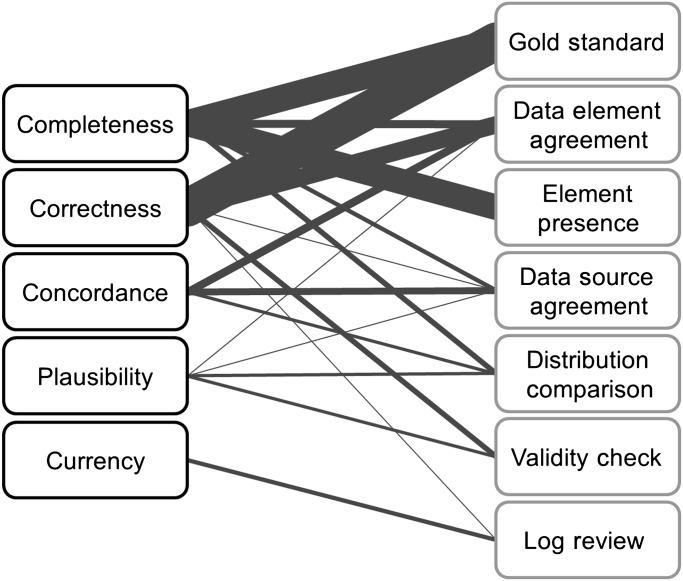
OBJECTIVE: To review the methods and dimensions of data quality assessment in the context of electronic health record (EHR) data reuse for research. MATERIALS AND METHODS: A review of the clinical research literature discussing data quality assessment methodology for EHR data was performed. Using an iterative process, the aspects of data quality being measured were abstracted and categorized, as well as the methods of assessment used. RESULTS: Five dimensions of data quality were identified, which are completeness, correctness, concordance, plausibility, and currency, and seven broad categories of data quality assessment methods: comparison with gold standards, data element agreement, data source agreement, distribution comparison, validity checks, log review, and element presence. DISCUSSION: Examination of the methods by which clinical researchers have investigated the quality and suitability of EHR data for research shows that there are fundamental features of data quality, which may be difficult to measure, as well as proxy dimensions. Researchers interested in the reuse of EHR data for clinical research are recommended to consider the adoption of a consistent taxonomy of EHR data quality, to remain aware of the task-dependence of data quality, to integrate work on data quality assessment from other fields, and to adopt systematic, empirically driven, statistically based methods of data quality assessment. CONCLUSION: There is currently little consistency or potential generalizability in the methods used to assess EHR data quality. If the reuse of EHR data for clinical research is to become accepted, researchers should adopt validated, systematic methods of EHR data quality assessment.
Overview
CoChat Summary
TL;DR
This review identifies five dimensions of electronic health record (EHR) data quality—completeness, correctness, concordance, plausibility, and currency—and seven broad categories of assessment methods. It concludes that EHR data quality assessment for research lacks consistency and generalizability, and recommends validated, systematic, statistically based methods.
Key findings
- Five data quality dimensions were derived: completeness, correctness, concordance, plausibility, and currency. Seven assessment method categories were identified: comparison with gold standards, data element agreement, data source agreement, distribution comparison, validity checks, log review, and element presence.
- Completeness was the most commonly assessed dimension, in 61 (64%) of 95 articles, followed by correctness in 57 (60%), concordance in 16 (17%), plausibility in 7 (7%), and currency in 4 (4%).
- Gold standard comparison was used in 37 of 95 articles; element presence was used only for completeness, while currency was assessed only through log review.
- The authors argue that only correctness, completeness, and currency are fundamental dimensions; concordance and plausibility appear to serve as proxies when fundamental dimensions cannot be assessed directly.
Methods
- Literature search performed on PubMed in February 2012, using data quality terms and EHR-related terms; the search produced 230 articles, which were manually reviewed.
- Inclusion criteria retained original research using data quality assessment methods, focused on EHR-derived data, and published in peer-reviewed journals; administrative claims databases were excluded. This yielded 44 articles, and an ancestor search added 51 more, for a final pool of 95 articles.
- From each article, the authors abstracted data quality features, assessment methods, and descriptive information; through iterative review, they inductively derived dimensions and method categories, then recategorized all 95 articles by dimension and assessment strategy.
Limitations
- The paper states the search was limited: lack of MeSH terms for data quality and variation in terminology may have caused relevant articles to be missed, though reference review was believed to improve saturation.
- The paper states classification was largely subjective and performed by only one author, so original researchers might disagree with the interpretations.
- The paper states that underreporting likely affected results, because routine data checking such as distributions and summary statistics is rarely described in publications; evident from the text, the review is descriptive and does not empirically validate the proposed taxonomy.
Model-written summary. Check it against the paper before relying on it.
Integrity signals
Registry
Cites
Statistics
Figures
Verification
Claims the paper makes
8 Valid · 1 Not valid · 16 Not checked · 59 Own results and interpretations
Every source the paper cites for this claim was checked and supports it.
In the paper
“Thiru et al,9 in calculating the sensitivity of different types of EHR data in the literature, found values ranging between 0.26 and 1.00.”
§ Methods and dimensions of electronic health record data quality assessment: enabling reuse for clinical research > Abstract > Conclusion
What the sources say
- Supportedcites [9] Thiru K Hassey A Sullivan F Systematic review of scope and quality of electronic patient record data in primary care. BMJ 2003; 326: 1070 12750210 PMC155692 source
Table 3 (Results) lists sensitivities for different types of electronic patient record data. The values range from 26% for socioeconomic data to 100% for several categories, matching 0.26–1.00. (LLM, conf=0.94)
plain- Asserted: passes — The authors put it forward as true.
- Checkable: passes — It can be checked against evidence.
- Load-bearing: passes — The paper’s conclusions depend on it.
- Based: passes — The paper gives a reason why it holds.
- Supported
The cited sources support only part of this claim — read each source’s verdict below.
In the paper
“Hogan and Wagner8 suggested specific statistical measures of the correctness and completeness of EHR elements that have been adopted by other researchers.”
§ Methods and dimensions of electronic health record data quality assessment: enabling reuse for clinical research > Discussion > Data quality assessment methodology
What the sources say
- Partly supportedcites [8] Hogan WR Wagner MM Accuracy of data in computer-based patient records. J Am Med Inform Assoc 1997; 4: 342– 55 9292840 PMC61252 sourceExperimental — accuracy not yet measured
The Methodological Recommendations section (page not provided) defines correctness and completeness as specific proportions and recommends that future studies report numerical measures of both. The paper does not establish the claim that other researchers subsequently adopted those measures. (LLM, conf=0.88)
plainstates a cause- Asserted: passes — The authors put it forward as true.
- Checkable: passes — It can be checked against evidence.
- Load-bearing: unclear — It is unclear whether the paper’s conclusions depend on it.
- Based: passes — The paper gives a reason why it holds.
- Partly supported
The sources with a verdict support this claim; the rest weren’t checked yet, have no full text we could read, or their verdicts aren’t rated yet.
In the paper
“Some researchers looking at the quality of research databases pulled from general practices in the UK have adopted relatively consistent approaches to comparing the distributions of data concerning specific clinical phenomena to information from registries and surveys.31 98 99 102”
§ Methods and dimensions of electronic health record data quality assessment: enabling reuse for clinical research > Discussion > Data quality assessment methodology
What the sources say
- Not checked — no full text of the sourcecites [31] Lewis JD Brensinger C Agreement between GPRD smoking data: a survey of general practitioners and a population-based survey. Pharmacoepidemiol Drug Saf 2004; 13: 437– 41 15269927 source
- Not checked — no full text of the sourcecites [98] Haynes K Forde KA Schinnar R Cancer incidence in The Health Improvement Network. Pharmacoepidemiol Drug Saf 2009; 18: 730– 6 19479713 source
- Supportedcites [99] Iyen-Omofoman B Hubbard RB Smith CJ The distribution of lung cancer across sectors of society in the United Kingdom: a study using national primary care data. BMC Public Health 2011; 11: 857 22074413 PMC3282683 source
The Methods and Discussion > Lung cancer Incidence describe comparing lung cancer data from the UK general-practice database THIN with national cancer registry and National Lung Cancer Audit data to assess its representativeness. This paper therefore exemplifies the comparison approach attributed to the cited group of researchers; the sentence does not require each cited study to use both registries and surveys. (LLM, conf=0.85)
plain- Asserted: passes — The authors put it forward as true.
- Checkable: passes — It can be checked against evidence.
- Load-bearing: unclear — It is unclear whether the paper’s conclusions depend on it.
- Based: passes — The paper gives a reason why it holds.
The cited sources support only part of this claim — read each source’s verdict below.
In the paper
“In three of the four, researchers reviewed whether desired data were entered into the EHR within a set time limit.36 46 52”
§ Methods and dimensions of electronic health record data quality assessment: enabling reuse for clinical research > Results > Currency
What the sources say
- Not checked — no full text of the sourcecites [36] Ndira SP Rosenberger KD Wetter T Assessment of data quality of and staff satisfaction with an electronic health record system in a developing country (Uganda): a qualitative and quantitative comparative study. Methods Inf Med 2008; 47: 489– 98 19057805 source
- Partly supportedcites [46] Vawdrey DK Gardner RM Evans RS Assessing data quality in manual entry of ventilator settings. J Am Med Inform Assoc 2007; 14: 295– 303 17329731 PMC2244881 sourceExperimental — accuracy not yet measured
The Methods (Data Analysis; page unavailable) say the researchers measured charting delay—the interval between observing ventilator settings and entering them into the computer—to assess timeliness. The Results report an average delay of 6.1 minutes, but the study does not assess whether entries met a set time limit. The 30-minute limit in the Background describes an earlier study by East et al., not this study's measure. (LLM, conf=0.85)
- Not checked — no full text of the sourcecites [52] Faulconer ER de Lusignan S An eight-step method for assessing diagnostic data quality in practice: chronic obstructive pulmonary disease as an exemplar. Inform Prim Care 2004; 12: 243– 54 15808026 source
plain- Asserted: passes — The authors put it forward as true.
- Checkable: passes — It can be checked against evidence.
- Load-bearing: unclear — It is unclear whether the paper’s conclusions depend on it.
- Based: passes — The paper gives a reason why it holds.
A result the paper reports from its own data — it cites no other source for it, so there is none to check. The quote shows it is in the paper.
In the paper
“For example, 37 of the 95 articles in our sample relied on a gold standard to assess data quality.”
§ Methods and dimensions of electronic health record data quality assessment: enabling reuse for clinical research > Discussion > Data quality assessment methodology
plainn = 95- Asserted: passes — The authors put it forward as true.
- Checkable: passes — It can be checked against evidence.
- Load-bearing: unclear — It is unclear whether the paper’s conclusions depend on it.
- Based: passes — The paper gives a reason why it holds.
40 more claims
Create a free account to see all 84 claims and every source verdict.
- It may state two separate claims as one. 23
- Probably not a substantial claim. 24
Claims other papers make about this one
Each is checked against this paper’s own text: does it say what the citing paper says it does?
The source backs part of the claim, not all of it — or backs it for a different population, condition or comparison.
In the citing paper
“While these developments have advanced the understanding of data quality in the context of medical applications, frameworks for EHR frequently focus on the data quality of individual patients86,87, neglecting data quality aspects for the overall population.”
From The METRIC-framework for assessing data quality for trustworthy AI in medicine: A systematic review (2024) · cites this paper as [87]
Experimental — accuracy not yet measuredThe cited source says what the claim attributes to it.
In the citing paper
“The current DQ literature is inconsistent in the use of terms that describe the complex multidimensional aspects of DQ.42–51”
From A harmonized data quality assessment terminology and framework for the secondary use of electronic health record data (2016) · cites this paper as [45]
The cited source says what the claim attributes to it.
In the citing paper
“In particular, representativeness is often not a factor86,87 while it is a crucial property for secondary use of data in clinical studies88 or when reusing medical data as training data for ML applications.”
From The METRIC-framework for assessing data quality for trustworthy AI in medicine: A systematic review (2024) · cites this paper as [87]
Self-check
Percentages, sums and reported differences re-computed from the paper’s own numbers.
Each contradiction between two passages listed here was confirmed by an independent check.
Rated minor: it would not touch a result — a value no result rests on, a p-value that stays on the same side of the significance level, or a conflict that is clerical, resolved elsewhere in the paper, or outside its own findings.
In the paper
§ Methods and dimensions of electronic health record data quality assessment: enabling reuse for clinical research > Results > Plausibility
“The most common approach to assessing the plausibility of EHR data was to perform some sort of validity check to determine if specific elements within the EHR were likely to be true or not.”
§ Methods and dimensions of electronic health record data quality assessment: enabling reuse for clinical research > Results
“| Distribution comparison | 97–100 | | 31 57 97 | 50 101 102 103 | | 10 | | Validity checks | | 32 62 104 105 106 | | 73 89 | | 7 |”
Citations
Cites
A General Inductive Approach for Analyzing Qualitative Evaluation Data
Thomas, D. R. (2006) · American Journal of Evaluation · doi:10.1177/1098214005283748 · Cited by 10,858 · cited 1×
“Furthermore, using an existing model to guide analysis is a deductive approach, which has the potential to obscure information contained in the data.(11) By imposing an existing model from a different discipline, we would have run the risk of missing important findings.”
MethodBeyond Accuracy: What Data Quality Means to Data Consumers
Wang, R. Y., & Strong, D. M. (1996) · Journal of Management Information Systems · doi:10.1080/07421222.1996.11518099 · Cited by 4,672
(2020) · Journal of Medical Education · doi:10.5812/jme · Cited by 3,490
The American Journal of Managed Care
(2020) · The American Journal of Managed Care · doi:10.37765/ajmc · Cited by 3,237
Pipino, L. L., Lee, Y. W., & Wang, R. Y. (2002) · Communications of the ACM · doi:10.1145/505248.506010 · Cited by 1,724
Juran's Quality Control Handbook
Ziegel, E. R. (1990) · Technometrics · doi:10.1080/00401706.1990.10484602 · Cited by 1,384
Jick, H., Jick, S. S., & Derby, L. E. (1991) · BMJ · doi:10.1136/bmj.302.6779.766 · Cited by 839
Safran, C., Bloomrosen, M., Hammond, W. E., Labkoff, S., Markel-Fox, S., Tang, P. C., & Detmer, D. E. (2007) · Journal of the American Medical Informatics Association · doi:10.1197/jamia.m2273 · Cited by 705 · cited 1×
“As the adoption of electronic health records (EHRs) has made it easier to access and aggregate clinical data, there has been growing interest in conducting research with data collected during the course of clinical care.(1) 2 The Natonal Institutes of Health has called for increasing the reuse of electronic records fo…”
MethodInformatics in Primary Care: Strategies in Information Management for the Healthcare Provider
(2002) · Health Informatics · doi:10.1007/978-1-4613-0069-4 · Cited by 422
Accuracy of Data in Computer-based Patient Records
Hogan, W. R., & Wagner, M. M. (1997) · Journal of the American Medical Informatics Association · doi:10.1136/jamia.1997.0040342 · Cited by 389 · cited 5×
“As observed by Hogan and Wagner in their literature review, there is no medical subheadings (MeSH) term fi ‘ ’ ‘ ’ ‘ ’ ‘ consistency ’ , ‘ data completeness ’ , and ‘ data error ’ .”
BackgroundInfluential
Research works printed but not linked: 14
- 1997, Journal of the American Medical Informatics Association, 4, 342, 10.1136/jamia.1997.0040342 · DOI · Paper page
- 2006, Journal of the American Medical Informatics Association, 13, 12, 10.1197/jamia.M1813 · DOI · Paper page
- 2000, Journal of the American Medical Informatics Association, 7, 55, 10.1136/jamia.2000.0070055 · DOI · Paper page
- 1996, Journal of the American Medical Informatics Association, 3, 234, 10.1136/jamia.1996.96310637 · DOI · Paper page
- 2007, Journal of the American Medical Informatics Association, 14, 295, 10.1197/jamia.M2219 · DOI · Paper page
- 2007, Journal of the American Medical Informatics Association, 14, 10, 10.1197/jamia.M2198 · DOI · Paper page
- Harabagiu, 2010, 2010, 1
- 2004, Journal of the American Medical Informatics Association, 11, 351, 10.1197/jamia.M1498 · DOI · Paper page
- 2000, Journal of the American Medical Informatics Association, 7, 42, 10.1136/jamia.2000.0070042 · DOI · Paper page
- 2010, Family Practice, 27, 121, 10.1093/fampra/cmp068 · DOI
- 2004, Journal of the American Medical Informatics Association, 11, 78, 10.1197/jamia.M1362 · DOI
- 1999, Journal of the American Medical Informatics Association, 6, 245, 10.1136/jamia.1999.0060245 · DOI · Paper page
- 2003, Journal of the American Medical Informatics Association, 10, 470, 10.1197/jamia.M1290 · DOI · Paper page
- Committee on Improving the Patient Record Institute of Medicine The Computer-Based Patient Record: An Essential Technology for Health Care, Revised Edition. Institute of Medicine. The National Academies Press, 1997 http://iom.edu/Reports/1997/The-Computer-Based-Patient-Record-An-Essential-Technology-for-Health-Care-Revised-Edition.aspx 25121222
Cited by
Items 1,001–1,100 of 1,209
Yu, Y., Guo, W., Chen, Y., Zhang, Y., Zhuo, L., Meng, R., Chen, Y., Shi, H., Lin, Z., Zhan, S., et al. (2022) · doi:10.2196/preprints.41181
Shi, J. M., Fassett, M. J., Chiu, V. Y., et al. (2022) · doi:10.2196/preprints.42955
García-de-León-Chocano, R. (2022) · RiuNet (Universitat Politècnica de València) · doi:10.4995/thesis/10251/188372
Khader, Y. S., Al-Rahamneh, M. J., Abaza, H., Shatnawi, A. A., Abuhmed, I., Khudair, S. A., Rumman, A. S. A., Okkah, K., Alghoul, S. M., Maia, I. F., et al. (2022) · JMIR Public Health and Surveillance · doi:10.2196/43753
Pedrera‐Jiménez, M. (2022) · UPM Digital Archive (Technical University of Madrid) · doi:10.20868/upm.thesis.72139 · Cited by 1
Design and Application of Clinical Big Data Management System for Oncology
Ma, L., Bao, C., Li, Q., Wu, J., Pan, H., Li, P., Zhang, L., & Zhan, Q. (2022) · Strategic Study of CAE · doi:10.15302/j-sscae-2022.06.011
Hoeyer, K. (2023) · The MIT Press eBooks · doi:10.7551/mitpress/14926.003.0012
(2023) · Archives of Epidemiology & Public Health Research · doi:10.33140/aephr.02.02.03
Fruchart, M., Quindroit, P., Jacquemont, C., Beuscart, J., Calafiore, M., & Lamer, A. (2023) · doi:10.2196/preprints.49542
Lestari, T. N. (2023) · El-Hekam · doi:10.31958/jeh.v8i1.8765
“This Research uses qualitative research methods by describing and describing how to facilitate the search for reference collections at Tunas Luhur High School using InlisLite Automation (Mannering & Bhat, 2014; Weiskopf & Weng, 2013).”
Explore Data Quality Challenges Based on Data Structure of Electronic Health Records
Liu, C., Peng, G., Lan, C., & Kong, S. (2023) · Lecture notes in computer science · doi:10.1007/978-3-031-35132-7_17
Canaway, R., Chidgey, C., Hallinan, C. M., Daniel Capurro, N., & Boyle, D. I. (2023) · Research Square · doi:10.21203/rs.3.rs-3287418/v1
Kumari, A., & Rajput, V. S. (2023) · Springer eBooks · doi:10.1007/978-981-19-7952-1_1
RetractedJusto, G., & Moseray, H. S. (2023) · Journal of ICT Systems · doi:10.56279/jicts.v1i2.38
“Mapping data quality dimensions (left) versus respective assessment methods (right) [29].”
BackgroundMethodInfluentialPedrera‐Jiménez, M., Frid, S. A., Barrio, N. G., Cucó, G. B., Boscá, D., Moner, D., Carrero, A. M., & Balazote, P. S. (2023) · Research Square · doi:10.21203/rs.3.rs-3550497/v1
Fernández-Antón, E., Rodríguez-Miguel, A., Gil, M., et al. (2024) · Journal of Clinical Medicine · doi:10.3390/jcm13020361
Sari, K. P., Adi, K., & Agushybana, F. (2023) · Journal of Electronics Electromedical Engineering and Medical Informatics · doi:10.35882/jeeemi.v5i4.317
Dougherty, K., Creber, R. M., Zawtha, B., & Benda, N. C. (2023) · PubMed Central · Cited by 1
An AI Method for Assessing Coding Consistency in a Large DatasetPreprint
Nelson, S. J., Yin, Y., Shao, Y., Ma, P., Tuttle, M. S., & Zeng‐Treitler, Q. (2023) · medRxiv · doi:10.1101/2024.01.17.24301268
Sood, P. D., Liu, S., Lehmann, H. P., et al. (2024) · doi:10.2196/preprints.56734
Shi, J. M., Chiu, V. Y., Avila, C. C., Lewis, S., Park, D., Peltier, M. R., & Getahun, D. T. (2024) · doi:10.2196/preprints.56812
Wabwire, P., Asimwe, D., Nalubega, J., et al. (2024) · Student s Journal of Health Research Africa · doi:10.51168/sjhrafrica.v5i3.972
Electronic Health Record Data Quality and Performance Assessments: A Scoping Review (Preprint)Preprint
Penev, Y. P., Buchanan, T. R., Ruppert, M. M., Liu, M., Shekouhi, R., Guan, Z., Balch, J. A., Ozrazgat‐Baslanti, T., Shickel, B., Loftus, T. J., et al. (2024) · doi:10.2196/preprints.58130
Analytics for an Audience of Healthcare Professionals: Curriculum Design and Student Perceptions
Xu, J., & Garfield, M. J. (2024) · Information Systems Education Journal · doi:10.62273/owzr5858
Lu, Y., Duong, T. T., Miao, Z., et al. (2024) · SSRN Electronic Journal · doi:10.2139/ssrn.4756710
Afshari, A. J. (2023) · Azerbaijan Journal of High Performance Computing · doi:10.32010/26166127.2023.6.2.135.152
Information Management and Technology
Gruss, C. L., & Ehrenfeld, J. M. (2024) · Elsevier eBooks · doi:10.1016/b978-0-323-93273-8.00029-8 · Cited by 1
Gouse, B. M., Oblath, R., Gibbs, J. S., Reagan, E. G., & Brown, H. E. (2024) · Schizophrenia Research · doi:10.1016/j.schres.2024.02.017
Building a Foundation for High-Quality Health Data: A Multi-Hospital Study in Belgium (Preprint)Preprint
Declerck, J., Vandenberk, B., Deschepper, M., Colpaert, K. E., Cool, L., Goemaere, J., Bové, M., Staelens, F., Meester, K. D., Verbeke, E., et al. (2024) · doi:10.2196/preprints.60244
Physics or Archaeology? Process Organization Studies in the Age of Data Abundance
Jones, M. (2024) · Oxford University Press eBooks · doi:10.1093/oso/9780198899457.003.0006
Dasa, O., Bai, C., Sajdeya, R., Kimmel, S. E., Pepine, C. J., Gurka, M. J., Laubenbacher, R., Pearson, T. A., & Mardini, M. (2024) · JMIR Public Health and Surveillance · doi:10.2196/54421
Artificial intelligence in healthcare
Canelas‐Pais, M., Coutinho‐Almeida, J., Araujo, S. M., Rafael, F. M., Cruz-Correia, R. J., & Rodrigues, P. P. (2024) · Elsevier eBooks · doi:10.1016/b978-0-323-91819-0.00009-9 · Cited by 1
Nursing Records Regarding Decision-Making in Cancer Supportive Care: A Retrospective Study in Japan
Kawasaki, Y., Nii, M., & Nishioka, E. (2024) · Healthcare Informatics Research · doi:10.4258/hir.2024.30.4.364
“However, this carries several challenges, including issues with data standardization [3], difficulty measuring data quality [4], and the absence of a standardized approach for assessing EHR data quality [5].”
BackgroundArtificial Intelligence in the Investigation of Medical Crimes: Perspectives and Challenges
Pisarenco, C. (2024) · Studii Juridice Universitare · doi:10.54481/sju.2024.2.13
Barragán, A., Fontecha, J., Gónzalez, I., & Cabañero, L. (2024) · Lecture notes in networks and systems · doi:10.1007/978-3-031-77571-0_23
10.1016/b978-0-323-35944-3.00028-2
(2000) · Time to knit · doi:10.1016/b978-0-323-35944-3.00028-2
Inukonda, J. (2025) · International Journal of Health Sciences · doi:10.47941/ijhs.2468
“OLAP tools commonly come with data warehouses to support multidimensional queries and analysis [16] [22].”
Yiu, A. J., Stephenson, G. S., Chow, E., & O’Connell, R. (2025) · Applied Clinical Informatics · doi:10.1055/a-2441-3677 · Cited by 3
Giesa, N., Dell’Orco, A., Scheel, M., Finke, C., Balzer, F., Spies, C., & Sekutowicz, M. (2025) · medRxiv · doi:10.1101/2025.02.20.25322564
Buchanan, Z. V., Hopkins, S. E., Boyer, B. B., & Fohner, A. E. (2025) · International Journal of Epidemiology · doi:10.1093/ije/dyaf013
Delord, M., & Douiri, A. (2025) · medRxiv · doi:10.1101/2025.03.10.25323670
“Although primary care electronic health records are widely regarded as a dependable data source and are increasingly utilised for research, surveillance, and public health planning [42, 43], the accuracy and completeness of recorded information may raise concerns.”
Msendema, M. B., Kaasbøll, J., Chigona, W., et al. (2025) · The Electronic Journal of Information Systems in Developing Countries · doi:10.1002/isd2.70010
Data from Routine Primary Healthcare: Opportunities and Threats for Obesity Epidemiological Research
Valente, B., Rodrigues, M., Ramos, J. P., & Azevedo, A. (2025) · Portuguese Journal of Public Health · doi:10.1159/000545337
Rigalma, B., Belhiah, M., Ziti, S., & Ouhnni, H. (2025) · Lecture notes in networks and systems · doi:10.1007/978-3-031-86698-2_33
Hummel, L. M., Lorenz-Artz, K., Bierbooms, J. J. P. A., & Bongers, I. M. B. (2025) · doi:10.2196/preprints.74240
Thuraisingam, S., Marasinghe, D. H., Barrick, K., Aghajafari, F., Manski-Nankervis, J.-A. E., Dowsey, M. M., Quan, H., Williamson, T. S., & Garies, S. (2025) · Journal of Medical Internet Research · doi:10.2196/69631 · Cited by 4
“The framework developed by Weiskopf and Weng [14] is more foundational and conceptual, focusing on the implications of EHR data quality for research.”
Paving the Way for Brazil’s First National Rare Diseases Registry: The RARAS Data Governance ModelPreprint
Bernardi, F. A., Lima, V., Alonso, M., et al. (2025) · Research Square · doi:10.21203/rs.3.rs-6009008/v1
Responsible Data Repurposing: A Conceptual FoundationPreprint
Ogunseye, S., & Parsons, J. (2025) · SSRN Electronic Journal · doi:10.2139/ssrn.5255086 · Cited by 1
Innovation tools and technologies in cardio-oncology
Jumbo, U. E., Otto, C., Rickards, J., MacLeod, J., Olson, J. M. G., & Brown, S.-A. N. (2025) · Elsevier eBooks · doi:10.1016/b978-0-443-29829-5.00010-4
Senevirathna, P., Pires, D. E. V., & Daniel Capurro, N. (2025) · Journal of Biomedical Informatics · doi:10.1016/j.jbi.2025.104876
Digital Health Maturity Stage 3: Standardized and interoperable
Kahn, M. G., Jonnagaddala, J., & Liaw, S. (2025) · Elsevier eBooks · doi:10.1016/b978-0-323-95260-6.00003-4
Goldhahn, L., Bienzeisler, J., Otto, R., Swart, E., & Drynda, S. (2025) · Das Gesundheitswesen · doi:10.1055/a-2592-5734
Care Planning Across the Health System: Intersectoral Application of the interRAI Assessment System
Schumacher, C., Saari, M., Northwood, M., Mowbray, F., Mensink, C., Heyer, M., Bail, K. S., & Pyatt, G. (2025) · Healthcare Management Forum · doi:10.1177/08404704251370371
Data Quality, Privacy, and Security Concerns in Healthcare
Shajeena, J., Shiny, R. M., & Bindhu, A. (2025) · Advances in computational intelligence and robotics book series · doi:10.4018/979-8-3373-2787-7.ch004
Bills, M., Bessen, T., Williams, M., Conway, A., Stretton, B., Loan, T., Kovoor, J. G., Liew, D., Bacchi, S., & O’Callaghan, G. (2026) · BMC Health Services Research · doi:10.21203/rs.3.rs-7577977/v1 · Cited by 1
“These limitations are well-recognised in real-world data, where incomplete and heterogeneous data collection can limit interpretability, to reliably analyse, contextualise and apply to operational decision making [25].”
Beyond Accuracy: Evaluating LLMs for Validating Community Service Provider Directory
Saei, S., Ghimire, S., & Anreddy, S. (2025) · Communications in computer and information science · doi:10.1007/978-3-032-08649-5_23 · Cited by 1
Review of autism spectrum disorder databases for the identification of candidate genes
Martínez-Minguet, D., Noël, R., Alberto García, S., Costa, M., & Pastor, O. (2025) · Database · doi:10.1093/database/baaf067 · Cited by 1
“For this study, we focus on five specific dimensions ( Table 1 ): Accessibility [ 20 , 21 ], Currency [ 18 , 20 ], Rel-evance [ 18 , 21 ], Completeness [ 17 , 21 , 22 ], and Consistency [ 17 , 23 ].”
Kellett, J. G., & Holland, M. (2025) · Postgraduate Medical Journal · doi:10.1093/postmj/qgaf130
Nguyen, T. T., & Elmaleh, D. R. (2025) · Big Data and Cognitive Computing · doi:10.3390/bdcc9110275 · Cited by 1
“…the foundation of structured high-quality data which adheres to five key criteria: completeness, correctness, concordance, plausibility, and currency [9–11]. frameworks, and multimodal AI pipelines in a fully client-controlled environment that ensures regulatory compliance and scalability.”
Park, N., Na, K., Sunwoo, W., Baek, J., Lee, Y., Lee, S., & Woo, H. (2025) · JMIR Medical Informatics · doi:10.2196/73884
“For example, such methods often rely on automated systems or checklists to minimize input errors or to validate the accuracy of collected data [40].”
Advancing event log preparation with quality optimization for hospital process miningPreprint
Guo, R. Z., Ritchie, A., Lu, Y., Choy, S. T. B., Smith, R., Min, H., Chen, Q., & Poon, S. K.-S. (2025) · Research Square · doi:10.21203/rs.3.rs-7796031/v1
Belisle, D. (2025) · Perioperative Care and Operating Room Management · doi:10.1016/j.pcorm.2025.100600
Multimorbidity measurement strategies for predicting hospital visits
Neves, B. D., Moreira, J. M., Gonçalves, S., Cerejo, J., Mota, I., Silva, N. A., Leite, F., & Silva, M. J. (2025) · BMC Health Services Research · doi:10.1186/s12913-025-13817-z
Additional file 3 of A method for interoperable knowledge-based data quality assessment
Tute, E., Scheffner, I., & Marschollek, M. (2021) · Figshare · doi:10.6084/m9.figshare.14190093
Additional file 2 of Database quality assessment in research in paramedicine: a scoping review
McDonald, N., Little, N., Kriellaars, D. J., Doupe, M. B., Giesbrecht, G. G., & Pryce, R. T. (2024) · Figshare · doi:10.6084/m9.figshare.26638662
Ngusie, H. S., Kassie, S. Y., Chereka, A. A., & Enyew, E. B. (2022) · Figshare · doi:10.6084/m9.figshare.19290151
Zhao, Y., Weroha, S. J., Goode, E. L., Liu, H., & Wang, C. (2021) · Figshare · doi:10.6084/m9.figshare.13533452
Gesicho, M. B., Were, M. C., & Babic, A. (2020) · Figshare · doi:10.6084/m9.figshare.13237564
Taye, B. K., Gezie, L. D., Atnafu, A., Mengiste, S. A., & Tilahun, B. C. (2024) · Figshare · doi:10.6084/m9.figshare.26634504
Gesicho, M. B., Were, M. C., & Babic, A. (2020) · Figshare · doi:10.6084/m9.figshare.13237567
Mao, J. M., Gomez, G. G. F., Wang, M., Xu, H., & Thyvalikakath, T. P. (2024) · Figshare · doi:10.6084/m9.figshare.25200615
Mao, J. M., Gomez, G. G. F., Wang, M., Xu, H., & Thyvalikakath, T. P. (2024) · Figshare · doi:10.6084/m9.figshare.26679200
Additional file 3 of Database quality assessment in research in paramedicine: a scoping review
McDonald, N., Little, N., Kriellaars, D. J., Doupe, M. B., Giesbrecht, G. G., & Pryce, R. T. (2024) · Figshare · doi:10.6084/m9.figshare.26638665
Mao, J. M., Gomez, G. G. F., Wang, M., Xu, H., & Thyvalikakath, T. P. (2024) · Figshare · doi:10.6084/m9.figshare.25200710
Zhao, Y., Weroha, S. J., Goode, E. L., Liu, H., & Wang, C. (2021) · Figshare · doi:10.6084/m9.figshare.13533455
Tian, Q., Han, Z., Yu, P., An, J., Lu, X., & 段会龙 (2021) · Figshare · doi:10.6084/m9.figshare.14369914
Tian, Q., Han, Z., Yu, P., An, J., Xudong, L., & 段会龙 (2021) · Figshare · doi:10.6084/m9.figshare.14369917
Virdee, P. S., Fuller, A., Jacobs, M., et al. (2020) · Figshare · doi:10.6084/m9.figshare.13219197
Canaway, R., Chidgey, C., Hallinan, C. M., Daniel Capurro, N., & Boyle, D. I. (2024) · Figshare · doi:10.6084/m9.figshare.26729998
Zhao, Y., Weroha, S. J., Goode, E. L., Liu, H., & Wang, C. (2021) · Figshare · doi:10.6084/m9.figshare.13533458
Additional file 5 of A data driven learning approach for the assessment of data quality
Tute, E., Ganapathy, N., & Wulff, A. (2021) · Figshare · doi:10.6084/m9.figshare.16916715
Additional file 1 of Database quality assessment in research in paramedicine: a scoping review
McDonald, N., Little, N., Kriellaars, D. J., Doupe, M. B., Giesbrecht, G. G., & Pryce, R. T. (2024) · Figshare · doi:10.6084/m9.figshare.26638659
Benoit, B., Frédéric, B., & Jean-Charles, D. (2022) · Figshare · doi:10.6084/m9.figshare.19619276
335Enhancing Healthcare Delivery Through Evidence-Based Data Utilization
Podder, A., Ghosh, S., & Paul, S. (2025) · De Gruyter eBooks · doi:10.1515/9783111541235-017
Health Data – Quality, Interoperability and Security: Systematic Review
Bento, L. M., & Postolache, O. A. (2026) · Lecture notes in networks and systems · doi:10.1007/978-3-032-10731-2_36
de Aquino, N. C., Reichert, C. O., Callefi, V. D. C., Ramos, V. S. D., Sznajder, Y., Lage, L. A. D. P. C., Culler, H. F., Rocha, V., Freitas, M. S., & Pereira, J. W. (2025) · doi:10.2196/preprints.89644
Alfakhri, A., Almadani, O. A., Asiri, I. M., Alsuhebany, N., Alanazi, A., & Althunian, T. A. (2026) · JCO Clinical Cancer Informatics · doi:10.1200/cci-25-00248 · Cited by 2
Evaluating Frailty Index Integrity: Insights from an International Network StudyPreprint
Cavanaugh, R., Wong, C., Smith, L. H., Bivas‐Benita, M., Akiva, P., El‐Hay, T., Orkaby, A. R., Yanover, C., & Olivieri‐Mui, B. L. (2026) · medRxiv · doi:10.64898/2026.01.12.26343698
Ketfi, R., Masry, Z. A., Noureddine Zerhouni, A., & Devalland, C. (2026) · Biomedical Signal Processing and Control · doi:10.1016/j.bspc.2026.109650
Uchida, H., Shirakawa, T., Ishii, K., Kato, Y., Yamajo, Y., Igusa, T., Sakimoto, M., Machida, C., Shimada, T., Tsuchiya, K., et al. (2026) · European Geriatric Medicine · doi:10.1007/s41999-025-01401-x · Cited by 1
“The potential for biases, such as data entry errors, cannot be ruled out [54].”
Privacy-preserving data quality assessment for federated health data networks
Tomášik, R., Kussel, T., Dudová, Z., Kacová, R., Hrstka, R., Lablans, M., & Holub, P. (2026) · BMC Medical Informatics and Decision Making · doi:10.1186/s12911-025-03328-6 · Cited by 2
“These were identified through a review of key literature on data quality frameworks and assessment methodologies [5–8].”
Defining and measuring maternal intentions and practices regarding infant feeding: a scoping review
Saito, Y., Nambu, M., & Matsuoka, M. (2026) · BMC Pregnancy and Childbirth · doi:10.1186/s12884-026-08768-0
“In contrast, studies conducted using medical record data offer greater objectivity; however, they are limited by issues related to recording accuracy and inconsistent definitions [66].”
Moallemian, S., Saghafi, A., Deshpande, R., Perez, J. M., Budak, M., Fausto, B. A., Elahi, F. M., & Gluck, M. A. (2026) · Cognitive Neurodynamics · doi:10.1007/s11571-026-10422-6
“The high level of missingness, which is commonly encountered in medical and clinical datasets (Weiskopf and Weng 2013), highlights the importance of implementing appropriate missing data imputation strategies.”
Agentic Trial Emulation to Learn Health System-specific Drug Effects At ScalePreprint
Kauffman, J., Duan, L., Gelman, S., Klang, E., Sakhuja, A., Bhatt, D. L., Reddy, V. Y. Y., Charney, A. W., Nadkarni, G. N., Qu, Y., et al. (2026) · medRxiv · doi:10.64898/2026.02.19.26346539 · Cited by 2
Branda, F., Defilippo, A., Lomoio, U., Puccio, B., Ciccozzi, M., Scarpa, F., Veltri, P., & Guzzi, P. H. (2026) · BMC Medical Informatics and Decision Making · doi:10.1186/s12911-026-03379-3 · Cited by 1
“All flagged records, together with a random sample of 10% of the automatically extracted data, were manually reviewed by comparison with the original PDF bulletin, in line with recommended practices for partial manual validation of large health datasets [31].”
Cardiovascular Outcomes with α1 Adrenergic Receptor Antagonists vs 5α-Reductase InhibitorsPreprint
Kirkland, L. G., Goyal, M., Kubinski, D. J., Zhuo, S., Li, Q., & Jensen, B. C. (2026) · medRxiv · doi:10.64898/2026.02.23.26346940
Barboi, C., Ouyang, F., Lembcke, L. R., Martin, A., Griffith, A., Allen, K. S., Li, X., Xu, H., & Grannis, S. J. (2026) · JMIR Formative Research · doi:10.2196/78622 · Cited by 1
Metadata
- Authors
- Weiskopf, N. G., & Weng, C.
- Affiliations
- Columbia University (US)
- Corresponding author
- Weiskopf, N. G.
- Venue
- Journal of the American Medical Informatics Association
- Publisher
- Oxford University Press (OUP)
- Published
- 2013-01-01
- Volume
- 20
- Issue
- 1
- Pages
- 144-151
- ISSN
- 1067-5027 (ISSN-L)
- 1527-974X
- PMC
- PMC3555312
- OpenAlex
- W2158939484
- Cited by
- 1,216
- References
- 114
- Citations by year
- 2026: 153 · 2025: 102 · 2024: 97 · 2023: 92 · 2022: 88 · 2021: 108 · 2020: 88 · 2019: 106 · 2018: 102 · 2017: 88 · 2016: 70 · 2015: 54 · 2014: 38 · 2013: 23
- FWCI
- 6.18
- Type
- journal article
- Language
- en
- Open access
- hybrid
- doi.org
- Licence
- cc-by-nc
- Locations
- Journal of the American Medical Informatics Association (publishedVersion, cc-by-nc)
- Europe PMC (PubMed Central) (publishedVersion, cc-by-nc)
- PubMed Central (publishedVersion, cc-by-nc)
- PubMed (publishedVersion)
- Funders
- U.S. National Library of Medicine (R01LM010815, R01LM009886, T15LM007079)
- Topics
- Health Sciences › Health Professions › Health Information Management › Electronic Health Records Systems
- Health Sciences › Health Professions › Health Information Management › Medical Coding and Health Information
- Physical Sciences › Computer Science › Information Systems › Data Quality and Management
- Keywords
- electronic health records, data quality assessment, clinical research data, data completeness, data correctness, concordance, plausibility, data currency, gold standard comparison, data source agreement, validity testing
- MeSH terms
- Data Collection, Humans, Quality Control, Research Design, Reproducibility of Results, Information Dissemination, Electronic Health Records
About these checks
Registry, retraction, Cites and statistics results are computed, not judged, with one exception: a printed reference that no index lists is read once by a model before it counts as a citation error. Claims are extracted by a model and kept only when their quote appears verbatim in the text; each cited source is then checked, with a model’s help, for whether it says what the claim relies on. Those verdicts can be wrong — read the claim’s quote and the cited source before relying on one.
The claim verdicts this report counts are experimental: their accuracy is not yet measured.
A language model drew the claims from the paper on 2026-09-30, under version 3 of the claim definition (model deepseek-v4.1-flash, prompt extract-v3).
A second model labelled each claim on 2026-09-30 (model jev-1.13-20260917, definition revision gold-guideline-v0.2).
Cited sources are checked with a language model’s help (gpt-6-sol).
Statistics and arithmetic are recomputed, not judged.
Confidence bands are shown only for fields calibrated on our annotated test set. None is calibrated yet, so no band is shown.
What counts as a claim ›How we measure confidence ›How we check this ›
Are you an author, or do you see a problem with this page? Request a review
Data sources
Bibliographic data: Semantic Scholar, OpenAlex, Crossref.
Contains information from the Semantic Scholar Academic Graph Datasets, made available under the ODC Attribution License (ODC-BY 1.0).
Semantic Scholar’s data is described in: Kinney, R., et al. (2023). The Semantic Scholar Open Data Platform. arXiv:2301.10140.
