

Methods and dimensions of electronic health record data quality assessment: enabling reuse for clinical research
Open accessThe DOI matches its Crossref record; 113 of the 114 references it cites were found in a registry or an index; 9 of the 41 sources its claims cite were checked for support.
Abstract
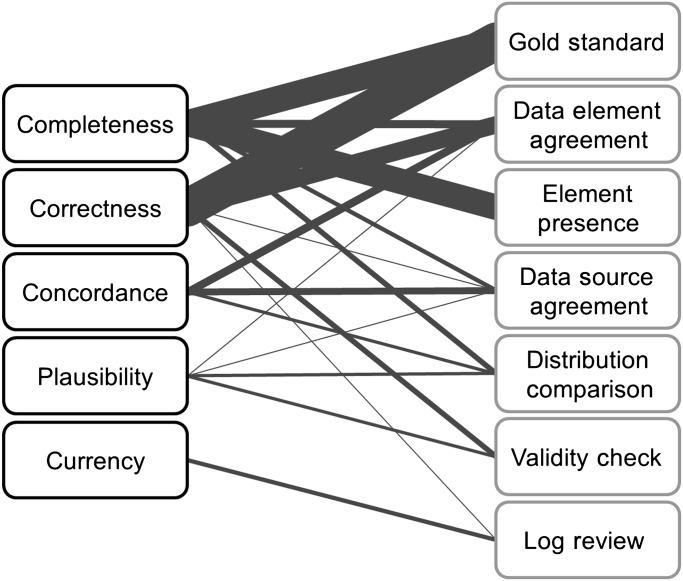
OBJECTIVE: To review the methods and dimensions of data quality assessment in the context of electronic health record (EHR) data reuse for research. MATERIALS AND METHODS: A review of the clinical research literature discussing data quality assessment methodology for EHR data was performed. Using an iterative process, the aspects of data quality being measured were abstracted and categorized, as well as the methods of assessment used. RESULTS: Five dimensions of data quality were identified, which are completeness, correctness, concordance, plausibility, and currency, and seven broad categories of data quality assessment methods: comparison with gold standards, data element agreement, data source agreement, distribution comparison, validity checks, log review, and element presence. DISCUSSION: Examination of the methods by which clinical researchers have investigated the quality and suitability of EHR data for research shows that there are fundamental features of data quality, which may be difficult to measure, as well as proxy dimensions. Researchers interested in the reuse of EHR data for clinical research are recommended to consider the adoption of a consistent taxonomy of EHR data quality, to remain aware of the task-dependence of data quality, to integrate work on data quality assessment from other fields, and to adopt systematic, empirically driven, statistically based methods of data quality assessment. CONCLUSION: There is currently little consistency or potential generalizability in the methods used to assess EHR data quality. If the reuse of EHR data for clinical research is to become accepted, researchers should adopt validated, systematic methods of EHR data quality assessment.
Overview
CoChat Summary
TL;DR
This review identifies five dimensions of electronic health record (EHR) data quality—completeness, correctness, concordance, plausibility, and currency—and seven broad categories of assessment methods. It concludes that EHR data quality assessment for research lacks consistency and generalizability, and recommends validated, systematic, statistically based methods.
Key findings
- Five data quality dimensions were derived: completeness, correctness, concordance, plausibility, and currency. Seven assessment method categories were identified: comparison with gold standards, data element agreement, data source agreement, distribution comparison, validity checks, log review, and element presence.
- Completeness was the most commonly assessed dimension, in 61 (64%) of 95 articles, followed by correctness in 57 (60%), concordance in 16 (17%), plausibility in 7 (7%), and currency in 4 (4%).
- Gold standard comparison was used in 37 of 95 articles; element presence was used only for completeness, while currency was assessed only through log review.
- The authors argue that only correctness, completeness, and currency are fundamental dimensions; concordance and plausibility appear to serve as proxies when fundamental dimensions cannot be assessed directly.
Methods
- Literature search performed on PubMed in February 2012, using data quality terms and EHR-related terms; the search produced 230 articles, which were manually reviewed.
- Inclusion criteria retained original research using data quality assessment methods, focused on EHR-derived data, and published in peer-reviewed journals; administrative claims databases were excluded. This yielded 44 articles, and an ancestor search added 51 more, for a final pool of 95 articles.
- From each article, the authors abstracted data quality features, assessment methods, and descriptive information; through iterative review, they inductively derived dimensions and method categories, then recategorized all 95 articles by dimension and assessment strategy.
Limitations
- The paper states the search was limited: lack of MeSH terms for data quality and variation in terminology may have caused relevant articles to be missed, though reference review was believed to improve saturation.
- The paper states classification was largely subjective and performed by only one author, so original researchers might disagree with the interpretations.
- The paper states that underreporting likely affected results, because routine data checking such as distributions and summary statistics is rarely described in publications; evident from the text, the review is descriptive and does not empirically validate the proposed taxonomy.
Model-written summary. Check it against the paper before relying on it.
Integrity signals
Registry
Cites
Statistics
Figures
Verification
Claims the paper makes
8 Valid · 1 Not valid · 16 Not checked · 59 Own results and interpretations
Every source the paper cites for this claim was checked and supports it.
In the paper
“Thiru et al,9 in calculating the sensitivity of different types of EHR data in the literature, found values ranging between 0.26 and 1.00.”
§ Methods and dimensions of electronic health record data quality assessment: enabling reuse for clinical research > Abstract > Conclusion
What the sources say
- Supportedcites [9] Thiru K Hassey A Sullivan F Systematic review of scope and quality of electronic patient record data in primary care. BMJ 2003; 326: 1070 12750210 PMC155692 source
Table 3 (Results) lists sensitivities for different types of electronic patient record data. The values range from 26% for socioeconomic data to 100% for several categories, matching 0.26–1.00. (LLM, conf=0.94)
plain- Asserted: passes — The authors put it forward as true.
- Checkable: passes — It can be checked against evidence.
- Load-bearing: passes — The paper’s conclusions depend on it.
- Based: passes — The paper gives a reason why it holds.
- Supported
The cited sources support only part of this claim — read each source’s verdict below.
In the paper
“Hogan and Wagner8 suggested specific statistical measures of the correctness and completeness of EHR elements that have been adopted by other researchers.”
§ Methods and dimensions of electronic health record data quality assessment: enabling reuse for clinical research > Discussion > Data quality assessment methodology
What the sources say
- Partly supportedcites [8] Hogan WR Wagner MM Accuracy of data in computer-based patient records. J Am Med Inform Assoc 1997; 4: 342– 55 9292840 PMC61252 sourceExperimental — accuracy not yet measured
The Methodological Recommendations section (page not provided) defines correctness and completeness as specific proportions and recommends that future studies report numerical measures of both. The paper does not establish the claim that other researchers subsequently adopted those measures. (LLM, conf=0.88)
plainstates a cause- Asserted: passes — The authors put it forward as true.
- Checkable: passes — It can be checked against evidence.
- Load-bearing: unclear — It is unclear whether the paper’s conclusions depend on it.
- Based: passes — The paper gives a reason why it holds.
- Partly supported
The sources with a verdict support this claim; the rest weren’t checked yet, have no full text we could read, or their verdicts aren’t rated yet.
In the paper
“Some researchers looking at the quality of research databases pulled from general practices in the UK have adopted relatively consistent approaches to comparing the distributions of data concerning specific clinical phenomena to information from registries and surveys.31 98 99 102”
§ Methods and dimensions of electronic health record data quality assessment: enabling reuse for clinical research > Discussion > Data quality assessment methodology
What the sources say
- Not checked — no full text of the sourcecites [31] Lewis JD Brensinger C Agreement between GPRD smoking data: a survey of general practitioners and a population-based survey. Pharmacoepidemiol Drug Saf 2004; 13: 437– 41 15269927 source
- Not checked — no full text of the sourcecites [98] Haynes K Forde KA Schinnar R Cancer incidence in The Health Improvement Network. Pharmacoepidemiol Drug Saf 2009; 18: 730– 6 19479713 source
- Supportedcites [99] Iyen-Omofoman B Hubbard RB Smith CJ The distribution of lung cancer across sectors of society in the United Kingdom: a study using national primary care data. BMC Public Health 2011; 11: 857 22074413 PMC3282683 source
The Methods and Discussion > Lung cancer Incidence describe comparing lung cancer data from the UK general-practice database THIN with national cancer registry and National Lung Cancer Audit data to assess its representativeness. This paper therefore exemplifies the comparison approach attributed to the cited group of researchers; the sentence does not require each cited study to use both registries and surveys. (LLM, conf=0.85)
plain- Asserted: passes — The authors put it forward as true.
- Checkable: passes — It can be checked against evidence.
- Load-bearing: unclear — It is unclear whether the paper’s conclusions depend on it.
- Based: passes — The paper gives a reason why it holds.
The cited sources support only part of this claim — read each source’s verdict below.
In the paper
“In three of the four, researchers reviewed whether desired data were entered into the EHR within a set time limit.36 46 52”
§ Methods and dimensions of electronic health record data quality assessment: enabling reuse for clinical research > Results > Currency
What the sources say
- Not checked — no full text of the sourcecites [36] Ndira SP Rosenberger KD Wetter T Assessment of data quality of and staff satisfaction with an electronic health record system in a developing country (Uganda): a qualitative and quantitative comparative study. Methods Inf Med 2008; 47: 489– 98 19057805 source
- Partly supportedcites [46] Vawdrey DK Gardner RM Evans RS Assessing data quality in manual entry of ventilator settings. J Am Med Inform Assoc 2007; 14: 295– 303 17329731 PMC2244881 sourceExperimental — accuracy not yet measured
The Methods (Data Analysis; page unavailable) say the researchers measured charting delay—the interval between observing ventilator settings and entering them into the computer—to assess timeliness. The Results report an average delay of 6.1 minutes, but the study does not assess whether entries met a set time limit. The 30-minute limit in the Background describes an earlier study by East et al., not this study's measure. (LLM, conf=0.85)
- Not checked — no full text of the sourcecites [52] Faulconer ER de Lusignan S An eight-step method for assessing diagnostic data quality in practice: chronic obstructive pulmonary disease as an exemplar. Inform Prim Care 2004; 12: 243– 54 15808026 source
plain- Asserted: passes — The authors put it forward as true.
- Checkable: passes — It can be checked against evidence.
- Load-bearing: unclear — It is unclear whether the paper’s conclusions depend on it.
- Based: passes — The paper gives a reason why it holds.
A result the paper reports from its own data — it cites no other source for it, so there is none to check. The quote shows it is in the paper.
In the paper
“For example, 37 of the 95 articles in our sample relied on a gold standard to assess data quality.”
§ Methods and dimensions of electronic health record data quality assessment: enabling reuse for clinical research > Discussion > Data quality assessment methodology
plainn = 95- Asserted: passes — The authors put it forward as true.
- Checkable: passes — It can be checked against evidence.
- Load-bearing: unclear — It is unclear whether the paper’s conclusions depend on it.
- Based: passes — The paper gives a reason why it holds.
40 more claims
Create a free account to see all 84 claims and every source verdict.
- It may state two separate claims as one. 23
- Probably not a substantial claim. 24
Claims other papers make about this one
Each is checked against this paper’s own text: does it say what the citing paper says it does?
The source backs part of the claim, not all of it — or backs it for a different population, condition or comparison.
In the citing paper
“While these developments have advanced the understanding of data quality in the context of medical applications, frameworks for EHR frequently focus on the data quality of individual patients86,87, neglecting data quality aspects for the overall population.”
From The METRIC-framework for assessing data quality for trustworthy AI in medicine: A systematic review (2024) · cites this paper as [87]
Experimental — accuracy not yet measuredThe cited source says what the claim attributes to it.
In the citing paper
“The current DQ literature is inconsistent in the use of terms that describe the complex multidimensional aspects of DQ.42–51”
From A harmonized data quality assessment terminology and framework for the secondary use of electronic health record data (2016) · cites this paper as [45]
The cited source says what the claim attributes to it.
In the citing paper
“In particular, representativeness is often not a factor86,87 while it is a crucial property for secondary use of data in clinical studies88 or when reusing medical data as training data for ML applications.”
From The METRIC-framework for assessing data quality for trustworthy AI in medicine: A systematic review (2024) · cites this paper as [87]
Self-check
Percentages, sums and reported differences re-computed from the paper’s own numbers.
Each contradiction between two passages listed here was confirmed by an independent check.
Rated minor: it would not touch a result — a value no result rests on, a p-value that stays on the same side of the significance level, or a conflict that is clerical, resolved elsewhere in the paper, or outside its own findings.
In the paper
§ Methods and dimensions of electronic health record data quality assessment: enabling reuse for clinical research > Results > Plausibility
“The most common approach to assessing the plausibility of EHR data was to perform some sort of validity check to determine if specific elements within the EHR were likely to be true or not.”
§ Methods and dimensions of electronic health record data quality assessment: enabling reuse for clinical research > Results
“| Distribution comparison | 97–100 | | 31 57 97 | 50 101 102 103 | | 10 | | Validity checks | | 32 62 104 105 106 | | 73 89 | | 7 |”
Citations
Cites
A General Inductive Approach for Analyzing Qualitative Evaluation Data
Thomas, D. R. (2006) · American Journal of Evaluation · doi:10.1177/1098214005283748 · Cited by 10,858 · cited 1×
“Furthermore, using an existing model to guide analysis is a deductive approach, which has the potential to obscure information contained in the data.(11) By imposing an existing model from a different discipline, we would have run the risk of missing important findings.”
MethodBeyond Accuracy: What Data Quality Means to Data Consumers
Wang, R. Y., & Strong, D. M. (1996) · Journal of Management Information Systems · doi:10.1080/07421222.1996.11518099 · Cited by 4,672
(2020) · Journal of Medical Education · doi:10.5812/jme · Cited by 3,490
The American Journal of Managed Care
(2020) · The American Journal of Managed Care · doi:10.37765/ajmc · Cited by 3,237
Pipino, L. L., Lee, Y. W., & Wang, R. Y. (2002) · Communications of the ACM · doi:10.1145/505248.506010 · Cited by 1,724
Juran's Quality Control Handbook
Ziegel, E. R. (1990) · Technometrics · doi:10.1080/00401706.1990.10484602 · Cited by 1,384
Jick, H., Jick, S. S., & Derby, L. E. (1991) · BMJ · doi:10.1136/bmj.302.6779.766 · Cited by 839
Safran, C., Bloomrosen, M., Hammond, W. E., Labkoff, S., Markel-Fox, S., Tang, P. C., & Detmer, D. E. (2007) · Journal of the American Medical Informatics Association · doi:10.1197/jamia.m2273 · Cited by 705 · cited 1×
“As the adoption of electronic health records (EHRs) has made it easier to access and aggregate clinical data, there has been growing interest in conducting research with data collected during the course of clinical care.(1) 2 The Natonal Institutes of Health has called for increasing the reuse of electronic records fo…”
MethodInformatics in Primary Care: Strategies in Information Management for the Healthcare Provider
(2002) · Health Informatics · doi:10.1007/978-1-4613-0069-4 · Cited by 422
Accuracy of Data in Computer-based Patient Records
Hogan, W. R., & Wagner, M. M. (1997) · Journal of the American Medical Informatics Association · doi:10.1136/jamia.1997.0040342 · Cited by 389 · cited 5×
“As observed by Hogan and Wagner in their literature review, there is no medical subheadings (MeSH) term fi ‘ ’ ‘ ’ ‘ ’ ‘ consistency ’ , ‘ data completeness ’ , and ‘ data error ’ .”
BackgroundInfluential
Research works printed but not linked: 14
- 1997, Journal of the American Medical Informatics Association, 4, 342, 10.1136/jamia.1997.0040342 · DOI · Paper page
- 2006, Journal of the American Medical Informatics Association, 13, 12, 10.1197/jamia.M1813 · DOI · Paper page
- 2000, Journal of the American Medical Informatics Association, 7, 55, 10.1136/jamia.2000.0070055 · DOI · Paper page
- 1996, Journal of the American Medical Informatics Association, 3, 234, 10.1136/jamia.1996.96310637 · DOI · Paper page
- 2007, Journal of the American Medical Informatics Association, 14, 295, 10.1197/jamia.M2219 · DOI · Paper page
- 2007, Journal of the American Medical Informatics Association, 14, 10, 10.1197/jamia.M2198 · DOI · Paper page
- Harabagiu, 2010, 2010, 1
- 2004, Journal of the American Medical Informatics Association, 11, 351, 10.1197/jamia.M1498 · DOI · Paper page
- 2000, Journal of the American Medical Informatics Association, 7, 42, 10.1136/jamia.2000.0070042 · DOI · Paper page
- 2010, Family Practice, 27, 121, 10.1093/fampra/cmp068 · DOI
- 2004, Journal of the American Medical Informatics Association, 11, 78, 10.1197/jamia.M1362 · DOI
- 1999, Journal of the American Medical Informatics Association, 6, 245, 10.1136/jamia.1999.0060245 · DOI · Paper page
- 2003, Journal of the American Medical Informatics Association, 10, 470, 10.1197/jamia.M1290 · DOI · Paper page
- Committee on Improving the Patient Record Institute of Medicine The Computer-Based Patient Record: An Essential Technology for Health Care, Revised Edition. Institute of Medicine. The National Academies Press, 1997 http://iom.edu/Reports/1997/The-Computer-Based-Patient-Record-An-Essential-Technology-for-Health-Care-Revised-Edition.aspx 25121222
Cited by
Items 1,101–1,200 of 1,209
Sharma, V., Chawla, G. K., Kukreti, S., Ahuja, K., & Singh, S. (2026) · Exploration of Medicine · doi:10.37349/emed.2026.1001383 · Cited by 3
Tahar, K., Verbuecheln, R., Martin, T., Graessner, H., Biergans, S. D., & Krefting, D. (2026) · BMC Medical Informatics and Decision Making · doi:10.1186/s12911-025-03153-x · Cited by 1
Lee, J., Hwang, S., & Lee, K.-H. (2026) · JMIR Medical Informatics · doi:10.2196/83487
Model calibration and evaluation via optimal subsampling using electronic health record data
Lee, J., Dai, G., Rader, D. J., & Chen, J. (2026) · Journal of the Royal Statistical Society Series A (Statistics in Society) · doi:10.1093/jrsssa/qnag036
Delord, M., & Douiri, A. (2026) · BMC Medicine · doi:10.1186/s12916-026-04752-9 · Cited by 1
“Although primary care electronic health records are widely regarded as a dependable data source and are increasingly utilised for research, surveillance, and public health planning [46, 47], the accuracy and completeness of recorded information may raise concerns.”
Udalova, V. M., Limburg, A., Carey, T. S., Ganguly, A., Powers, J., Pfaff, E. R., & Entwisle, B. (2026) · Social Science & Medicine · doi:10.1016/j.socscimed.2026.119151
Wang, S., Wang, J., Guitton, F., Tao, G., Dai, C., Truong, N. B., Kennedy, M., & Sun, K. (2025) · IEEE International Conference on Big Data (BigData) · doi:10.1109/bigdata66926.2025.11402446
“As a result, maintaining coherent datasets, ensuring timely propagation of corrections, and preserving reliable provenance become increasingly challenging [3].”
Harris, F., MCBURNIE, J. G., & Edwards, M. (2026) · doi:10.14293/pr2199.003098.v1
Shoman, Y., Leuenberger, L. M., Sommer, G., Bielicki, J. A., Brazzola, P., Valle, S. D., Diezi, M., Drozdov, D., Gumy‐Pause, F., Stücklin, A. G., et al. (2026) · JMIR Research Protocols · doi:10.2196/87007 · Cited by 1
“Various computational methods [38] will identify missing cases and assess the extent and characteristics of incomplete data.”
Ethical and Regulatory Challenges in In Silico Modeling
Joshi, D. M., Bhatt, H., & Patel, H. K. (2026) · BENTHAM SCIENCE PUBLISHERS eBooks · doi:10.2174/9798898813635126010010
A Clinical Feature Engineering and Imbalance-Aware Framework for Hospital Readmission Prediction
Jadav, V., & Ruparel, R. (2025) · International Conference on Computer and Applications (ICCA) · doi:10.1109/icca66035.2025.11430924
“Several challenges in the dataset mirror real-world clinical analytics [10].”
Dong, K., Fuccello, A., Vyas, V., et al. (2026) · Journal of Surgical Oncology · doi:10.1002/jso.70239
Phiri, J., Zimba, A., Njovu, C., & Lumpa, M. (2026) · Research Square · doi:10.21203/rs.3.rs-9227225/v1
Lim, M., An, D., Sunwoo, W., Son, N., & Lee, S. (2024) · doi:10.2196/preprints.68935
Kim, J., Kim, J. H., & Choi, A. (2026) · Computational and Structural Biotechnology Journal · doi:10.34133/csbj.0064
“Efforts to manually abstract this data are not scalable, being both time-consuming and prone to inter-rater variability [ 2 – 4 ].”
Agkatsev, S., Templeton, M. D., Lazaridis, L., Nowak, H., Kebir, S., & Seliger, C. (2026) · Neuro-Oncology Advances · doi:10.1093/noajnl/vdag083 · Cited by 1
Moysan, M. (2019) · theses.fr (ABES) · doi:10.70675/b4080159z1445z41efzacddz2eb02854b6d9 · Cited by 1
Mbenga, R. O. (2023) · theses.fr (ABES) · doi:10.70675/970454b0z0cefz4e31z8376z6c0c8f191c34 · Cited by 1
AMMAD: A Multimodal Approach for Disease Diagnosis with Symptoms and Tests
Tran-Nguyen, M.-T., Ma, T.-T., Tran, V.-C., Nguyen, C.-M., & Luu, T.-D. (2026) · Lecture notes in networks and systems · doi:10.1007/978-3-032-18162-6_11
Moscetti, L. I., Calanchi, E., Pettorelli, E., Spallanzani, A., Bertolini, F., Fogliani, R., Orsini, M., Delsante, L., Civallero, M., Depenni, R., et al. (2026) · Frontiers in Digital Health · doi:10.3389/fdgth.2026.1760649
“As suggested by Weiskopf and Weng, EHR-derived data intended for secondary use require systematic quality assessment methodologies tailored to the research task (7).”
Feldman, K. A., Hamza, S., Stocking, J. C., et al. (2026) · Journal of Medical Systems · doi:10.1007/s10916-026-02377-2
Carter, E., Thompson, M., Johnson, S., Lee, D., Adams, R., & Srinivas, C. (2021) · International Journal of Scientific Research in Computer Science Engineering and Information Technology · doi:10.32628/cseit2282149
Life Support in the ICU: Outcomes among Patients Undergoing Gastrointestinal Cancer Surgery
Ekenze, S. O., Woldesenbet, S., Chatzipanagiotou, O. P., & Pawlik, T. M. (2026) · Journal of the American College of Surgeons · doi:10.1097/xcs.0000000000001973 · Cited by 1
Health in a Digital Age: From Determinants to Dynamic Systems
Williams, M. (2026) · Health Data Science · doi:10.34133/hds.0465
“For example, clinical data captured for billing purposes differ fundamentally from research-grade measurements; self-reported behavioral data are subject to recall bias and social desirability effects; environmental exposures are often estimated from models rather than measured directly [ 10 ].”
Haug, M., Ilves, N., Umov, N., Šuvalov, H., Mooses, K., Tamm, S., Loorents, H., Oja, M., Reisberg, S., Vilo, J., et al. (2026) · medRxiv · doi:10.64898/2026.04.22.26351461
Carroll, A., Jacob, B. M., Kenny, A., Henry, L., Adams, B., & Redmond, P. (2026) · HRB Open Research · doi:10.12688/hrbopenres.14407.1
Improving Psychiatric History-Taking Documentation: A Quality Improvement Audit and Re-Audit
Farooq, Q., & Saleem, T. (2026) · Cureus · doi:10.7759/cureus.108114
“While previous studies suggest that structured documentation systems can improve completeness [8,9], they may also risk promoting a checklist-driven approach if not balanced with clinical emphasis on patient safety.”
Priou, S., Kempf, E., Janković, M., Châtellier, G., & Lamé, G. (2026) · Health Systems · doi:10.1080/20476965.2026.2665355
Quality of information: effective estimation of web service usefulness by selecting test inputs
Li, Z., Song, Z., Yu, W., Feldman, D., Soby, M., & Tilevich, E. (2026) · Service Oriented Computing and Applications · doi:10.1007/s11761-026-00492-z
Artificial intelligence in ovarian cancer: advancing in precision diagnosis and clinical management
Shao, M., Wang, T., Ji, L., Xu, L., Zhang, Y., Wang, D. Q., Jia, C., Chen, L., Zhang, H., Yan, W., et al. (2026) · Frontiers in Immunology · doi:10.3389/fimmu.2026.1795144
Babli, S. A., Gairola, P., Ogbu, C. E., Longa, F. A., Rautaray, A., Alamu, O. S., & Rizvi, S. F. H. (2026) · Cureus · doi:10.7759/cureus.108550
“These tasks are conceptually straightforward but labor-intensive for human analysts, requiring familiarity with institution-specific data dictionaries and analyte-specific conversion factors [4,5].”
Li, B., Han, Y., Sun, C., Shi, M., Ran, X., Wang, Y., Shu, D., & Zhao, Y. (2026) · British Journal of Dermatology · doi:10.1093/bjd/ljag186
Wang, T., Lei, Y., Li, L., Wang, Y., Tang, H., Wu, Y., Chen, S., Zhang, B., Hu, J., Wang, H., et al. (2026) · Research Square · doi:10.21203/rs.3.rs-9613167/v1
“First, exposure and outcome definitions were based on structured EHR data, which may be incomplete or inconsistently recorded across sites 14–16 .”
Ross, E., Bouissou, O., Helland, Å., & Faxvaag, A. (2026) · International Journal of Medical Informatics · doi:10.1016/j.ijmedinf.2026.106501
Campomanes, F., Kuffer, M., Stein, A., Oliveira, L. T., Dijkstra, A. M., van Vliet, J., Taubenböck, H., Abascal, Á., Georganos, S., & Belgiu, M. (2026) · SSRN Electronic Journal · doi:10.2139/ssrn.6836279
Liu, Y., Pan, Y., Zhen, W., & Duan, J. (2026) · Communications in computer and information science · doi:10.1007/978-981-95-7299-1_25
Campomanes, F., Kuffer, M., Stein, A., Oliveira, L. T., Dijkstra, A. M., van Vliet, J., Taubenböck, H., Abascal, Á., Georganos, S., & Belgiu, M. (2026) · SSRN Electronic Journal · doi:10.2139/ssrn.6876992
Hayes, C., & Kucinski, V. (2026) · AJOG Global Reports · doi:10.1016/j.xagr.2026.100658
Oak, A., Cheulkar, S., Kannusamy, S., John, R., Jadhav, M., Patil, D., Dashmukhe, E., Patil, A., wankhade, S., Gode, P., et al. (2026) · Frontiers in Oncology · doi:10.3389/fonc.2026.1852225 · Cited by 2
Agrawal, R., Delen, D., & Benjamin, B. (2026) · Sensors · doi:10.3390/s26123687
É., E. E., Raimi, O., Bademosi, A., Wegbom, A. I., & Ordu, S. (2026) · International Journal of Public Health and Pharmacology · doi:10.52589/ijphp-khuzlfqv
Park, Y., Son, Y., Nara, S., Woo, J., Shin, S.-Y., Park, H. S., Cho, D., Lee, K.-J., & Kang, H. (2026) · BMC Medical Informatics and Decision Making · doi:10.1186/s12911-026-03595-x
“Timeliness refers to several time-related characteristics of data and is also known as currency, recency, or freshness [9, 24].”
InfluentialLee, Y. A., Lu, Y., Morris, E. J., He, X., Winterstein, A. G., Henriksen, C. H., Bian, J., & Guo, J. (2026) · JAMIA Open · doi:10.1093/jamiaopen/ooag102
“15,17,18 However, few studies have systematically assessed a single health system’s EHR against linked Medicare claims across multiple data quality dimensions while explicitly mapping the findings to core target trial emulation elements, including eligibility, treatment initiation, baseline…”
Harkener, S., Bott, O. J., Draeger, C., Hartz, T., Jenetzky, E., Löbe, M., March, S., Schubert, C., & Stausberg, J. (2026) · Journal of Medical Internet Research · doi:10.2196/90482
“The same is true for secondary analyses of data, for example, from electronic health records [12].”
Development and validation of a minimum data set for total joint arthroplasty registries
Moulaei, K., Kharazinejad, E., Hemmatipour, A., & Kazemi-Arpanahi, H. (2026) · BMC Musculoskeletal Disorders · doi:10.1186/s12891-026-10095-6 · Cited by 1
“Previous studies have demonstrated that variability in documentation practices and differences in electronic medical record systems can negatively affect registry completeness and comparability across institutions [30, 31].”
Reimagining procedural distress as a candidate quality domain in pediatric emergency medicine
Xu, X., Chen, H., Ruan, Q.-N., & Yan, W. (2026) · Frontiers in Pediatrics · doi:10.3389/fped.2026.1841168
Hansen, B. B., Leth, K., Hansen, N. R., Abrahamsen, B., Fuggle, N. R., Brønd, J. C., & Rubin, K. H. (2026) · Calcified Tissue International · doi:10.1007/s00223-026-01563-1
“Contrary or inaccurate evidence can easily arise when comparing findings from such databases across countries and time periods, as local coding practices, healthcare policies and diagnostic criteria heavily influence the underlying data structure and thus any models derived from such data [52].”
Wang, J., Buto, P. T., Ferguson, E. L., Chen, R., Pederson, A. M., Choi, M., Murchland, A. R., Ackley, S. F., Blacker, D., Hayes‐Larson, E., et al. (2026) · Epidemiology · doi:10.1097/ede.0000000000002016
Equity-by-design for socially assistive robots as digital health tools
Kachouie, R., & Barton, B. (2026) · Journal of the American Medical Informatics Association · doi:10.1093/jamia/ocag105
Challenges in Identifying Heart Failure Diagnoses from the Electronic Health Record
Klein, S., Mukhopadhyay, A., HAMO, C. E., Adhikari, S., Samal, L., & Blecker, S. (2026) · Journal of Cardiac Failure - Intersections · doi:10.1016/j.yjcafi.2026.06.009
de Sousa, A. L. S., Ocampos, L. C. L., Tillería, N. G., Rivera, Y. C., Najenson, A., Ferreira, D. D. S., Barrios, I., Ventriglio, A., Castaldelli-Maia, J. M., & Torales, J. C. (2026) · International Review of Psychiatry · doi:10.1080/09540261.2026.2683076
Evaluating data quality in the dissolved oxygen monitoring of Atlantic salmon sea cages
Berntsson, E. V. C., Liland, K. H., & Stevik, T. K. (2026) · Frontiers in Aquaculture · doi:10.3389/faquc.2026.1881186
“Various frameworks for managing and measuring DQ exist in the literature (Cichy and Rass, 2019), where some focus on speci fi c industries, including healthcare (Weiskopf and Weng, 2012; Lighterness et al., 2024) and building energy (Morewood, 2023).”
Racial and Ethnic Variations in a Multi-Channel Psychiatric Emergency Services Program
Oh, S., Herrera, C., Duncan, A. M., Syed, S., Xu, C., Brown, E. M., Brown, H. E., Henderson, D. C., Were, L. P. O., & Oblath, R. (2026) · Community Mental Health Journal · doi:10.1007/s10597-026-01679-6
Ningsih, K. P., Hartono, H., & Hikmayani, N. H. (2026) · F1000Research · doi:10.12688/f1000research.183114.1
Multi-modal machine learning for breast cancer recurrence prediction
Shao, J., Wang, X., Khan, A. N., Brett, C. L., Li, X., & Yao, B. (2026) · IISE Transactions on Healthcare Systems Engineering · doi:10.1080/24725579.2026.2701461
“Furthermore, manual data entry introduces transcription errors; definitive information often originates in pathology reports but is prone to errors when transcribed into downstream systems (Weiskopf & Weng, 2013; Renshaw et al., 2018; X. Wang et al., 2024).”
Matia, S. K., Hamed, M., Kambale, W. V., Choudhary, A., & Kyamakya, K. (2026) · Lecture notes in networks and systems · doi:10.1007/978-3-032-26319-3_7
Characterization and validation of electronic medical record data for pharmacoepidemiologic research
Schneider, T., Punjani, T., Silva, J. M., Mbuagbaw, L., Gibson, P., & Holbrook, A. M. (2026) · Frontiers in Pharmacology · doi:10.3389/fphar.2026.1812502
Llorca-Bofí, V., Valero-Bover, D., Carot-Sans, G., García, X. G., Fradera, M., Haro, J. M., Martínez-Cerdá, J.-F., Mortier, P., Palao, D. J., Peña-Gómez, C., et al. (2026) · JMIR Formative Research · doi:10.2196/preprints.104955
Selvaraj, S. M. (2026) · Research Square · doi:10.21203/rs.3.rs-10452670/v1
An Auditable Pricing Reference Framework for Medical Data Products: An Early Proof-of-Concept Study
Wang, J., Dai, W., Zhu, K., & Qu, B. (2026) · Symmetry · doi:10.3390/sym18081263
Güneştepe, K. (2026) · Journal of Health Organization and Management · doi:10.1108/jhom-09-2025-0574
Mwalungali, G., Chola, E., Hampango, P., Kampamba, M., Mweetwa, L. L., Mutati, C., Chisunka, C. G., Silwimba, A., & Hangoma, J. M. (2026) · Health Science Reports · doi:10.1002/hsr2.72946
Muralidharan, S., Sweeney‐Magee, M., Charbonneau, K., et al. (2026) · doi:10.2196/preprints.107634
Key Real-World Data Management Practices for Registry Evaluation and Quality Assurance
Choi, E., Piao, Z., & Han, E. (2026) · Therapeutic Innovation & Regulatory Science · doi:10.1007/s43441-026-01028-5
Virupakshappa, D., Sharanesha, R. B., Abushanan, A., Alghamdi, S. A., Alagla, M., & Alotaibi, F. F. (2026) · Data · doi:10.3390/data11080193
“As described in Theme 2, claims data accuracy varies, and misclassification can weaken or exaggerate observed associations [19,49].”
Yang, E., Sun, J., Dong, Y., Chang, C., Zhong, L., Tse, G., Cheung, B. M. Y., García-Zamora, S., & Koh, A. S.-M. (2026) · American Journal of Physiology-Heart and Circulatory Physiology · doi:10.1152/ajpheart.00450.2026
Mikkelsen, Y. (2026) · JMIR Medical Informatics · doi:10.2196/preprints.99638 · Cited by 1
Pinzon, N., Gulati, S., Re, A. M. D., Taioli, E., Flores, R. M., Wolf, A., & Tuminello, S. (2026) · Cancers · doi:10.3390/cancers18162624
“Data quality was considered with respect to provenance, completeness, consistency, and fitness for the intended analyses, in accordance with established frameworks for the secondary use of EMR data [21,22].”
Luc, C. M., Chi, G. C., Patrick, R., Chiu, V. Y., Feaster, M., & Tartof, S. Y. (2026) · Environmental Research · doi:10.1016/j.envres.2026.125525
Piera-Jiménez, J., Requejo, P. L. A., Boscá, D., Roy, A. D., López, L. M., Moner, D., Margüello, E. P., González-Tablas, T. P., & Valle, L. (2026) · International Digital Public Health Conference (DPH) · doi:10.1109/dph70309.2026.11650201
“Data quality issues introduced during clinical documentation propagate downstream, limiting the validity of surveillance outputs and research findings [9].”
Aghayev, E., Farshad, M., & Jentzsch, T. (2026) · Global Spine Journal · doi:10.1177/21925682261481442
“11-13, 1.”
Wang, J., Xu, Y., Li, W., Yang, Z., Sun, Y., Zhang, X., & Pan, H. (2026) · JMIR Nursing · doi:10.2196/96679
“Current studies focus primarily on constructing various data quality frameworks for health records [14,15].”
Haug, M., Ilves, N., Umov, N., Šuvalov, H., Mooses, K., Tamm, S., Loorents, H., Oja, M., Reisberg, S., Vilo, J., et al. (2026) · Informatics in Medicine Unlocked · doi:10.1016/j.imu.2026.101806
Gorenshtein, A., Adiniaev, Y., Srour, A., Klang, E., & Daniel, O. (2026) · medRxiv · doi:10.64898/2026.08.27.26361534
Trinh, S. H., Balog, V., Bogner, L. L., et al. (2026) · Orvosi Hetilap · doi:10.1556/650.2026.33593
Ji, J., Sun, Z., Ying, X., Hao, J., Fu, Z., Shi, D., Kong, X., Xu, Y., Zhang, X., Du, X., et al. (2026) · medRxiv · doi:10.64898/2026.08.28.26361585
Mahundi, M. H., Senyoni, W., Luambano, M. M., Sæbø, J. I., Müller, S. D., Ngwila, M., Kihinga, C. N. B., Rutachunzibwa, T., Kumalija, C., & Braa, J. A. (2026) · SSM - Health Systems · doi:10.1016/j.ssmhs.2026.100304
Li, H., Iscoe, M. S., Lutz, J., et al. (2026) · PLOS Digital Health · doi:10.1371/journal.pdig.0001140
“…use disorder sensitivity 47–83% vs medical-record validation) [29,30], we used a high-cardinality, inclusive set of OUD-related diagnosis codes to improve sensitivity and reduce under-ascertainment, although residual documentation and coding variation may still introduce misclassification [31].”
Wang, Z., & Richard, J. (2026) · doi:10.2196/preprints.111104
Zhang, H., Li, X., Fang, K., Ma, Y., Li, L., Yan, H., Liu, Y., Yu, Y., & Wang, J. (2026) · Journal of Medical Internet Research · doi:10.2196/92921
“Critical diagnostic information is often embedded in imaging and narrative reports, which are difficult to quantify using traditional statistical methods [13,14].”
Breast Cancer Risk Assessment Has a Data Integration Problem: Can Artificial Intelligence Solve It?
Shah, P. D., & Parikh, R. B. (2026) · Journal of Clinical Oncology · doi:10.1200/jco-26-01598
James Raj, K., & Prabhat, K. S. J. (2026) · Springer eBooks · doi:10.1007/978-981-92-3294-9_14
Gómez-Costa, D., Prados, P. L., Valverde, M. O., & Aizpurua, L. C. (2026) · Healthcare · doi:10.3390/healthcare14182938
“Data-quality assessment should address completeness, conformance and plausibility, because apparently precise administrative counts may represent different clinical constructs across services [32,33].”
Tizie, S. B., Gebeyew, A. S., Shimie, A. W., Mengistie, M. B., Mengistu, A. K., Bitew, T., Gete, M., Senishaw, A. F., Anteneh, A., Assaye, B. T., et al. (2026) · Digital Health · doi:10.1177/20552076261486950
“41,42 Successful digital transformation requires complementary investments in workforce capacity, governance, organizational readiness, and digital infrastructure.”
Lam, J. Y. J., Barras, M. A., Scott, I. A., Abdel‐Hafez, A., & Falconer, N. (2026) · Journal of Evaluation in Clinical Practice · doi:10.1111/jep.70592
“Therefore, there is a need for preprocessing to optimise data quality, especially before ML model deployment [42].”
Navale, G. J., Wagh, K., Chaudhari, S., Chaudhari, T., & Aghav, P. (2026) · International Conference on Trends in Quantum Computing and Emerging Business Technologies (TQCEBT) · doi:10.1109/tqcebt67648.2026.11681277
“However, provider data comes from diverse sources such as hospital credentialing databases, state licensing authorities, and certification organizations, all of which have different update cycles and heterogeneous formats [1].”
Ningsih, K. P., Hartono, H., & Hikmayani, N. H. (2026) · F1000Research · doi:10.12688/f1000research.183114.2
Kuo, F. H., Fierstein, J. L., Gonzales, F., Tudor, B. H., Crabtree, E., Rehman, M., Jennings, R., & Ahumada, L. M. (2026) · Journal of Medical Systems · doi:10.1007/s10916-026-02462-6
Xin, W., Li, X., Qu, W., Nie, W., Zhao, Y., Wang, H., Yi, H., & Tan, S. (2026) · doi:10.2196/preprints.110943
Phiri, J., Zimba, A., Njovu, C., Kashoka, A., Chiboma, I., Chiwele, M., Sinkala, T., Mutale, J., & Lumpa, M. (2026) · Discover Artificial Intelligence · doi:10.1007/s44163-026-02293-x · Cited by 1
“We adapted the Weiskopf–Weng EHR data quality framework [12] to eight dimensions specific to AI applications in resource-limited HIV EHR systems (Table 1).”
0000-0002-2787-4088 (2026) · Philosophical Psychology · doi:10.1080/09515089.2026.2736740
Carpenter, A., & Jannach, D. (2026) · ACM Conference on Recommender Systems (RecSys) · doi:10.1145/3773078.3831844
Wei, M. Y., Kang, A. J., Klomhaus, A. M., Chen, L., Bell, D. S., Elashoff, D. A., & Tseng, C.-H. (2026) · Journal of the American Medical Informatics Association · doi:10.1093/jamia/ocag161
Spatial bias in quality of estimated delivery date records in the electronic health record
Lewis, A., Foraker, R., Lian, M., Zhao, M., Oh, I. Y., Gupta, A., Frolova, A., & Payne, P. (2026) · JAMIA Open · doi:10.1093/jamiaopen/ooag183
Oke, F. (2026) · Frontiers in Digital Health · doi:10.3389/fdgth.2026.1953969 · Cited by 1
Ningsih, K. P., Hartono, H., & Hikmayani, N. H. (2026) · F1000Research · doi:10.12688/f1000research.183114.3
Muralidharan, S., Sweeney‐Magee, M., Charbonneau, K. D., McKee, S., Zachariuk, C., Tamana, S. K., Dominguez-Menéndez, G., Tang, T. S., Borycki, E. M., Kushniruk, A. W., et al. (2026) · JMIR Research Protocols · doi:10.2196/107634
Metadata
- Authors
- Weiskopf, N. G., & Weng, C.
- Affiliations
- Columbia University (US)
- Corresponding author
- Weiskopf, N. G.
- Venue
- Journal of the American Medical Informatics Association
- Publisher
- Oxford University Press (OUP)
- Published
- 2013-01-01
- Volume
- 20
- Issue
- 1
- Pages
- 144-151
- ISSN
- 1067-5027 (ISSN-L)
- 1527-974X
- PMC
- PMC3555312
- OpenAlex
- W2158939484
- Cited by
- 1,216
- References
- 114
- Citations by year
- 2026: 153 · 2025: 102 · 2024: 97 · 2023: 92 · 2022: 88 · 2021: 108 · 2020: 88 · 2019: 106 · 2018: 102 · 2017: 88 · 2016: 70 · 2015: 54 · 2014: 38 · 2013: 23
- FWCI
- 6.18
- Type
- journal article
- Language
- en
- Open access
- hybrid
- doi.org
- Licence
- cc-by-nc
- Locations
- Journal of the American Medical Informatics Association (publishedVersion, cc-by-nc)
- Europe PMC (PubMed Central) (publishedVersion, cc-by-nc)
- PubMed Central (publishedVersion, cc-by-nc)
- PubMed (publishedVersion)
- Funders
- U.S. National Library of Medicine (R01LM010815, R01LM009886, T15LM007079)
- Topics
- Health Sciences › Health Professions › Health Information Management › Electronic Health Records Systems
- Health Sciences › Health Professions › Health Information Management › Medical Coding and Health Information
- Physical Sciences › Computer Science › Information Systems › Data Quality and Management
- Keywords
- electronic health records, data quality assessment, clinical research data, data completeness, data correctness, concordance, plausibility, data currency, gold standard comparison, data source agreement, validity testing
- MeSH terms
- Data Collection, Humans, Quality Control, Research Design, Reproducibility of Results, Information Dissemination, Electronic Health Records
About these checks
Registry, retraction, Cites and statistics results are computed, not judged, with one exception: a printed reference that no index lists is read once by a model before it counts as a citation error. Claims are extracted by a model and kept only when their quote appears verbatim in the text; each cited source is then checked, with a model’s help, for whether it says what the claim relies on. Those verdicts can be wrong — read the claim’s quote and the cited source before relying on one.
The claim verdicts this report counts are experimental: their accuracy is not yet measured.
A language model drew the claims from the paper on 2026-09-30, under version 3 of the claim definition (model deepseek-v4.1-flash, prompt extract-v3).
A second model labelled each claim on 2026-09-30 (model jev-1.13-20260917, definition revision gold-guideline-v0.2).
Cited sources are checked with a language model’s help (gpt-6-sol).
Statistics and arithmetic are recomputed, not judged.
Confidence bands are shown only for fields calibrated on our annotated test set. None is calibrated yet, so no band is shown.
What counts as a claim ›How we measure confidence ›How we check this ›
Are you an author, or do you see a problem with this page? Request a review
Data sources
Bibliographic data: Semantic Scholar, OpenAlex, Crossref.
Contains information from the Semantic Scholar Academic Graph Datasets, made available under the ODC Attribution License (ODC-BY 1.0).
Semantic Scholar’s data is described in: Kinney, R., et al. (2023). The Semantic Scholar Open Data Platform. arXiv:2301.10140.
