

Methods and dimensions of electronic health record data quality assessment: enabling reuse for clinical research
Open accessThe DOI matches its Crossref record; 113 of the 114 references it cites were found in a registry or an index; 9 of the 41 sources its claims cite were checked for support.
Abstract
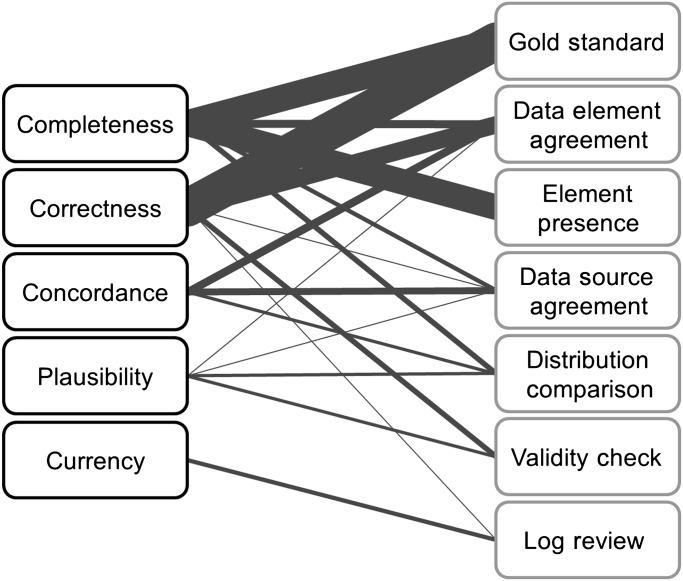
OBJECTIVE: To review the methods and dimensions of data quality assessment in the context of electronic health record (EHR) data reuse for research. MATERIALS AND METHODS: A review of the clinical research literature discussing data quality assessment methodology for EHR data was performed. Using an iterative process, the aspects of data quality being measured were abstracted and categorized, as well as the methods of assessment used. RESULTS: Five dimensions of data quality were identified, which are completeness, correctness, concordance, plausibility, and currency, and seven broad categories of data quality assessment methods: comparison with gold standards, data element agreement, data source agreement, distribution comparison, validity checks, log review, and element presence. DISCUSSION: Examination of the methods by which clinical researchers have investigated the quality and suitability of EHR data for research shows that there are fundamental features of data quality, which may be difficult to measure, as well as proxy dimensions. Researchers interested in the reuse of EHR data for clinical research are recommended to consider the adoption of a consistent taxonomy of EHR data quality, to remain aware of the task-dependence of data quality, to integrate work on data quality assessment from other fields, and to adopt systematic, empirically driven, statistically based methods of data quality assessment. CONCLUSION: There is currently little consistency or potential generalizability in the methods used to assess EHR data quality. If the reuse of EHR data for clinical research is to become accepted, researchers should adopt validated, systematic methods of EHR data quality assessment.
Overview
CoChat Summary
TL;DR
This review identifies five dimensions of electronic health record (EHR) data quality—completeness, correctness, concordance, plausibility, and currency—and seven broad categories of assessment methods. It concludes that EHR data quality assessment for research lacks consistency and generalizability, and recommends validated, systematic, statistically based methods.
Key findings
- Five data quality dimensions were derived: completeness, correctness, concordance, plausibility, and currency. Seven assessment method categories were identified: comparison with gold standards, data element agreement, data source agreement, distribution comparison, validity checks, log review, and element presence.
- Completeness was the most commonly assessed dimension, in 61 (64%) of 95 articles, followed by correctness in 57 (60%), concordance in 16 (17%), plausibility in 7 (7%), and currency in 4 (4%).
- Gold standard comparison was used in 37 of 95 articles; element presence was used only for completeness, while currency was assessed only through log review.
- The authors argue that only correctness, completeness, and currency are fundamental dimensions; concordance and plausibility appear to serve as proxies when fundamental dimensions cannot be assessed directly.
Methods
- Literature search performed on PubMed in February 2012, using data quality terms and EHR-related terms; the search produced 230 articles, which were manually reviewed.
- Inclusion criteria retained original research using data quality assessment methods, focused on EHR-derived data, and published in peer-reviewed journals; administrative claims databases were excluded. This yielded 44 articles, and an ancestor search added 51 more, for a final pool of 95 articles.
- From each article, the authors abstracted data quality features, assessment methods, and descriptive information; through iterative review, they inductively derived dimensions and method categories, then recategorized all 95 articles by dimension and assessment strategy.
Limitations
- The paper states the search was limited: lack of MeSH terms for data quality and variation in terminology may have caused relevant articles to be missed, though reference review was believed to improve saturation.
- The paper states classification was largely subjective and performed by only one author, so original researchers might disagree with the interpretations.
- The paper states that underreporting likely affected results, because routine data checking such as distributions and summary statistics is rarely described in publications; evident from the text, the review is descriptive and does not empirically validate the proposed taxonomy.
Model-written summary. Check it against the paper before relying on it.
Integrity signals
Registry
Cites
Statistics
Figures
Verification
Claims the paper makes
8 Valid · 1 Not valid · 16 Not checked · 59 Own results and interpretations
Every source the paper cites for this claim was checked and supports it.
In the paper
“Thiru et al,9 in calculating the sensitivity of different types of EHR data in the literature, found values ranging between 0.26 and 1.00.”
§ Methods and dimensions of electronic health record data quality assessment: enabling reuse for clinical research > Abstract > Conclusion
What the sources say
- Supportedcites [9] Thiru K Hassey A Sullivan F Systematic review of scope and quality of electronic patient record data in primary care. BMJ 2003; 326: 1070 12750210 PMC155692 source
Table 3 (Results) lists sensitivities for different types of electronic patient record data. The values range from 26% for socioeconomic data to 100% for several categories, matching 0.26–1.00. (LLM, conf=0.94)
plain- Asserted: passes — The authors put it forward as true.
- Checkable: passes — It can be checked against evidence.
- Load-bearing: passes — The paper’s conclusions depend on it.
- Based: passes — The paper gives a reason why it holds.
- Supported
The cited sources support only part of this claim — read each source’s verdict below.
In the paper
“Hogan and Wagner8 suggested specific statistical measures of the correctness and completeness of EHR elements that have been adopted by other researchers.”
§ Methods and dimensions of electronic health record data quality assessment: enabling reuse for clinical research > Discussion > Data quality assessment methodology
What the sources say
- Partly supportedcites [8] Hogan WR Wagner MM Accuracy of data in computer-based patient records. J Am Med Inform Assoc 1997; 4: 342– 55 9292840 PMC61252 sourceExperimental — accuracy not yet measured
The Methodological Recommendations section (page not provided) defines correctness and completeness as specific proportions and recommends that future studies report numerical measures of both. The paper does not establish the claim that other researchers subsequently adopted those measures. (LLM, conf=0.88)
plainstates a cause- Asserted: passes — The authors put it forward as true.
- Checkable: passes — It can be checked against evidence.
- Load-bearing: unclear — It is unclear whether the paper’s conclusions depend on it.
- Based: passes — The paper gives a reason why it holds.
- Partly supported
The sources with a verdict support this claim; the rest weren’t checked yet, have no full text we could read, or their verdicts aren’t rated yet.
In the paper
“Some researchers looking at the quality of research databases pulled from general practices in the UK have adopted relatively consistent approaches to comparing the distributions of data concerning specific clinical phenomena to information from registries and surveys.31 98 99 102”
§ Methods and dimensions of electronic health record data quality assessment: enabling reuse for clinical research > Discussion > Data quality assessment methodology
What the sources say
- Not checked — no full text of the sourcecites [31] Lewis JD Brensinger C Agreement between GPRD smoking data: a survey of general practitioners and a population-based survey. Pharmacoepidemiol Drug Saf 2004; 13: 437– 41 15269927 source
- Not checked — no full text of the sourcecites [98] Haynes K Forde KA Schinnar R Cancer incidence in The Health Improvement Network. Pharmacoepidemiol Drug Saf 2009; 18: 730– 6 19479713 source
- Supportedcites [99] Iyen-Omofoman B Hubbard RB Smith CJ The distribution of lung cancer across sectors of society in the United Kingdom: a study using national primary care data. BMC Public Health 2011; 11: 857 22074413 PMC3282683 source
The Methods and Discussion > Lung cancer Incidence describe comparing lung cancer data from the UK general-practice database THIN with national cancer registry and National Lung Cancer Audit data to assess its representativeness. This paper therefore exemplifies the comparison approach attributed to the cited group of researchers; the sentence does not require each cited study to use both registries and surveys. (LLM, conf=0.85)
plain- Asserted: passes — The authors put it forward as true.
- Checkable: passes — It can be checked against evidence.
- Load-bearing: unclear — It is unclear whether the paper’s conclusions depend on it.
- Based: passes — The paper gives a reason why it holds.
The cited sources support only part of this claim — read each source’s verdict below.
In the paper
“In three of the four, researchers reviewed whether desired data were entered into the EHR within a set time limit.36 46 52”
§ Methods and dimensions of electronic health record data quality assessment: enabling reuse for clinical research > Results > Currency
What the sources say
- Not checked — no full text of the sourcecites [36] Ndira SP Rosenberger KD Wetter T Assessment of data quality of and staff satisfaction with an electronic health record system in a developing country (Uganda): a qualitative and quantitative comparative study. Methods Inf Med 2008; 47: 489– 98 19057805 source
- Partly supportedcites [46] Vawdrey DK Gardner RM Evans RS Assessing data quality in manual entry of ventilator settings. J Am Med Inform Assoc 2007; 14: 295– 303 17329731 PMC2244881 sourceExperimental — accuracy not yet measured
The Methods (Data Analysis; page unavailable) say the researchers measured charting delay—the interval between observing ventilator settings and entering them into the computer—to assess timeliness. The Results report an average delay of 6.1 minutes, but the study does not assess whether entries met a set time limit. The 30-minute limit in the Background describes an earlier study by East et al., not this study's measure. (LLM, conf=0.85)
- Not checked — no full text of the sourcecites [52] Faulconer ER de Lusignan S An eight-step method for assessing diagnostic data quality in practice: chronic obstructive pulmonary disease as an exemplar. Inform Prim Care 2004; 12: 243– 54 15808026 source
plain- Asserted: passes — The authors put it forward as true.
- Checkable: passes — It can be checked against evidence.
- Load-bearing: unclear — It is unclear whether the paper’s conclusions depend on it.
- Based: passes — The paper gives a reason why it holds.
A result the paper reports from its own data — it cites no other source for it, so there is none to check. The quote shows it is in the paper.
In the paper
“For example, 37 of the 95 articles in our sample relied on a gold standard to assess data quality.”
§ Methods and dimensions of electronic health record data quality assessment: enabling reuse for clinical research > Discussion > Data quality assessment methodology
plainn = 95- Asserted: passes — The authors put it forward as true.
- Checkable: passes — It can be checked against evidence.
- Load-bearing: unclear — It is unclear whether the paper’s conclusions depend on it.
- Based: passes — The paper gives a reason why it holds.
40 more claims
Create a free account to see all 84 claims and every source verdict.
- It may state two separate claims as one. 23
- Probably not a substantial claim. 24
Claims other papers make about this one
Each is checked against this paper’s own text: does it say what the citing paper says it does?
The source backs part of the claim, not all of it — or backs it for a different population, condition or comparison.
In the citing paper
“While these developments have advanced the understanding of data quality in the context of medical applications, frameworks for EHR frequently focus on the data quality of individual patients86,87, neglecting data quality aspects for the overall population.”
From The METRIC-framework for assessing data quality for trustworthy AI in medicine: A systematic review (2024) · cites this paper as [87]
Experimental — accuracy not yet measuredThe cited source says what the claim attributes to it.
In the citing paper
“The current DQ literature is inconsistent in the use of terms that describe the complex multidimensional aspects of DQ.42–51”
From A harmonized data quality assessment terminology and framework for the secondary use of electronic health record data (2016) · cites this paper as [45]
The cited source says what the claim attributes to it.
In the citing paper
“In particular, representativeness is often not a factor86,87 while it is a crucial property for secondary use of data in clinical studies88 or when reusing medical data as training data for ML applications.”
From The METRIC-framework for assessing data quality for trustworthy AI in medicine: A systematic review (2024) · cites this paper as [87]
Self-check
Percentages, sums and reported differences re-computed from the paper’s own numbers.
Each contradiction between two passages listed here was confirmed by an independent check.
Rated minor: it would not touch a result — a value no result rests on, a p-value that stays on the same side of the significance level, or a conflict that is clerical, resolved elsewhere in the paper, or outside its own findings.
In the paper
§ Methods and dimensions of electronic health record data quality assessment: enabling reuse for clinical research > Results > Plausibility
“The most common approach to assessing the plausibility of EHR data was to perform some sort of validity check to determine if specific elements within the EHR were likely to be true or not.”
§ Methods and dimensions of electronic health record data quality assessment: enabling reuse for clinical research > Results
“| Distribution comparison | 97–100 | | 31 57 97 | 50 101 102 103 | | 10 | | Validity checks | | 32 62 104 105 106 | | 73 89 | | 7 |”
Citations
Cites
A General Inductive Approach for Analyzing Qualitative Evaluation Data
Thomas, D. R. (2006) · American Journal of Evaluation · doi:10.1177/1098214005283748 · Cited by 10,858 · cited 1×
“Furthermore, using an existing model to guide analysis is a deductive approach, which has the potential to obscure information contained in the data.(11) By imposing an existing model from a different discipline, we would have run the risk of missing important findings.”
MethodBeyond Accuracy: What Data Quality Means to Data Consumers
Wang, R. Y., & Strong, D. M. (1996) · Journal of Management Information Systems · doi:10.1080/07421222.1996.11518099 · Cited by 4,672
(2020) · Journal of Medical Education · doi:10.5812/jme · Cited by 3,490
The American Journal of Managed Care
(2020) · The American Journal of Managed Care · doi:10.37765/ajmc · Cited by 3,237
Pipino, L. L., Lee, Y. W., & Wang, R. Y. (2002) · Communications of the ACM · doi:10.1145/505248.506010 · Cited by 1,724
Juran's Quality Control Handbook
Ziegel, E. R. (1990) · Technometrics · doi:10.1080/00401706.1990.10484602 · Cited by 1,384
Jick, H., Jick, S. S., & Derby, L. E. (1991) · BMJ · doi:10.1136/bmj.302.6779.766 · Cited by 839
Safran, C., Bloomrosen, M., Hammond, W. E., Labkoff, S., Markel-Fox, S., Tang, P. C., & Detmer, D. E. (2007) · Journal of the American Medical Informatics Association · doi:10.1197/jamia.m2273 · Cited by 705 · cited 1×
“As the adoption of electronic health records (EHRs) has made it easier to access and aggregate clinical data, there has been growing interest in conducting research with data collected during the course of clinical care.(1) 2 The Natonal Institutes of Health has called for increasing the reuse of electronic records fo…”
MethodInformatics in Primary Care: Strategies in Information Management for the Healthcare Provider
(2002) · Health Informatics · doi:10.1007/978-1-4613-0069-4 · Cited by 422
Accuracy of Data in Computer-based Patient Records
Hogan, W. R., & Wagner, M. M. (1997) · Journal of the American Medical Informatics Association · doi:10.1136/jamia.1997.0040342 · Cited by 389 · cited 5×
“As observed by Hogan and Wagner in their literature review, there is no medical subheadings (MeSH) term fi ‘ ’ ‘ ’ ‘ ’ ‘ consistency ’ , ‘ data completeness ’ , and ‘ data error ’ .”
BackgroundInfluential
Research works printed but not linked: 14
- 1997, Journal of the American Medical Informatics Association, 4, 342, 10.1136/jamia.1997.0040342 · DOI · Paper page
- 2006, Journal of the American Medical Informatics Association, 13, 12, 10.1197/jamia.M1813 · DOI · Paper page
- 2000, Journal of the American Medical Informatics Association, 7, 55, 10.1136/jamia.2000.0070055 · DOI · Paper page
- 1996, Journal of the American Medical Informatics Association, 3, 234, 10.1136/jamia.1996.96310637 · DOI · Paper page
- 2007, Journal of the American Medical Informatics Association, 14, 295, 10.1197/jamia.M2219 · DOI · Paper page
- 2007, Journal of the American Medical Informatics Association, 14, 10, 10.1197/jamia.M2198 · DOI · Paper page
- Harabagiu, 2010, 2010, 1
- 2004, Journal of the American Medical Informatics Association, 11, 351, 10.1197/jamia.M1498 · DOI · Paper page
- 2000, Journal of the American Medical Informatics Association, 7, 42, 10.1136/jamia.2000.0070042 · DOI · Paper page
- 2010, Family Practice, 27, 121, 10.1093/fampra/cmp068 · DOI
- 2004, Journal of the American Medical Informatics Association, 11, 78, 10.1197/jamia.M1362 · DOI
- 1999, Journal of the American Medical Informatics Association, 6, 245, 10.1136/jamia.1999.0060245 · DOI · Paper page
- 2003, Journal of the American Medical Informatics Association, 10, 470, 10.1197/jamia.M1290 · DOI · Paper page
- Committee on Improving the Patient Record Institute of Medicine The Computer-Based Patient Record: An Essential Technology for Health Care, Revised Edition. Institute of Medicine. The National Academies Press, 1997 http://iom.edu/Reports/1997/The-Computer-Based-Patient-Record-An-Essential-Technology-for-Health-Care-Revised-Edition.aspx 25121222
Cited by
Items 701–800 of 1,209
Charting Diagnostic Safety: Exploring Patient-Provider Discordance in Medical Record Documentation
Giardina, T. D., Vaghani, V., Upadhyay, D. K., Scott, T. M. T., Korukonda, S., Spitzmueller, C., & Singh, H. (2024) · Journal of General Internal Medicine · doi:10.1007/s11606-024-09007-y · Cited by 4
Tou, S., Matsumoto, K., Hashinokuchi, A., Kinoshita, F., Nakaguma, H., Kozuma, Y., Sugeta, R., Nohara, Y., Yamashita, T., Wakata, Y., et al. (2024) · Learning Health Systems · doi:10.1002/lrh2.10469 · Cited by 7
“4 Additionally, missing data are inevitable during routine patient care and treat-ment, potentially introducing significant bias.”
Tracking provenance in clinical data warehouses for quality management
Johns, M., Baum, L., & Praßer, F. (2024) · International Journal of Medical Informatics · doi:10.1016/j.ijmedinf.2024.105690 · Cited by 11
Characterisation of Data Quality in Electronic Healthcare Records
Dungey, S., Beloff, N., Williams, R., Williams, T. J., Puri, S., & Tate, A. R. (2015) · Springer eBooks · doi:10.1007/978-3-319-17963-6_7 · Cited by 4
Data Quality Oriented Efficacy Evaluation Method for Ambient Assisted Living Technologies
Beevi, F. H. A., Wagner, S. R., Pedersen, C. F., & Hallerstede, S. (2016) · International Conference on Pervasive Computing Technologies for Healthcare · doi:10.4108/eai.16-5-2016.2263753 · Cited by 4
Is data quality enough for a clinical decision?: Apply machine learning and avoid bias
Hee, K. E. (2017) · IEEE International Conference on Big Data (BigData) · doi:10.1109/bigdata.2017.8258221 · Cited by 12
“Many researchers have investigated and identified various dimensions [10], [11], however there is no clear consensus among researchers.”
BackgroundTHE POSSIBILITY OF USING ELECTRONIC MEDICAL RECORDS FOR CLINICAL OBSERVATION
Kurbanov, R. D., & Хусаиновна, Т. Р. (2021) · Eurasian heart journal · doi:10.38109/2225-1685-2021-2-78-82 · Cited by 4
Khorrami, F., Ahmadi, M., Karami, N. A., Alipour, J., & Sheikhtaheri, A. (2022) · Informatics in Medicine Unlocked · doi:10.1016/j.imu.2022.100949 · Cited by 4
Data Quality and Data Quantity: Complements or Contradictions?
Stausberg, J., & Harkener, S. (2023) · Studies in health technology and informatics · doi:10.3233/shti230414 · Cited by 5
Mulholland, R. J., Ciminata, G., Quinn, T., Pollock, K. G., Lister, S., & Geue, C. (2024) · PharmacoEconomics · doi:10.1007/s40273-024-01419-2 · Cited by 5
“Data cleaning and pre-processing were completed in accordance with the accepted methodologies for routinely collected health datasets [15].”
MethodUsability assessment of an electronic health record in a comprehensive dental clinic
Suebnukarn, S., Rittipakorn, P., Thongyoi, B., Boonpitak, K., Wongsapai, M., & Pakdeesan, P. (2013) · SpringerPlus · doi:10.1186/2193-1801-2-220 · Cited by 4
“…reduced transcription errors, improved legibility of reports, eliminated redundancy, facilitated billing and financial functions, and provided a wide variety of other benefits, which indirectly do affect patient safety, health care quality, and efficacy (Poissant et al. 2005; Weiskopf & Weng 2013).”
BackgroundRule based Medical Content Classification for Secure Remote Health Monitoring
Balachander, J. S., & Ramanujam, E. (2017) · International Journal of Computer Applications · doi:10.5120/ijca2017913852 · Cited by 4
“SPARQL query evaluation is based on sub group matching [2,9].”
MethodScott, K. A., Bacon, E., Kraus, E. M., Steiner, J. F., Budney, G., Bondy, J., McEwen, D., & Davidson, A. J. (2020) · Public Health Reports · doi:10.1177/0033354920941158 · Cited by 6
Kovach, C. R., & Evans, C.-R. (2018) · Springer eBooks · doi:10.1007/978-3-319-95369-4_8 · Cited by 7
Loukides, G., Liagouris, J., Gkoulalas-Divanis, A., & Terrovitis, M. (2015) · Springer eBooks · doi:10.1007/978-3-319-23633-9_7 · Cited by 5
Quality evidence, quality decisions: Ways to improve security and privacy of EHR systems
Osop, H., & Sahama, T. R. (2016) · IEEE International Conference on e-Health Networking, Applications and Services (Healthcom) · doi:10.1109/healthcom.2016.7749424 · Cited by 5
“…health records, especially those during actual clinical care practice, contain highly rich and valuable practical clinical information that can be used for patient-centered research, improving the overall care of patients and even in helping to manage healthcare costs and expenditure [7].”
BackgroundWeiskopf, N. G., Khan, F. J., Woodcock, D., Dorr, D. A., Cigarroa, J. E., & Cohen, A. M. (2016) · PubMed Central · Cited by 4
Self-citationKibbe, W. A. (2016) · Elsevier eBooks · doi:10.1016/b978-0-12-802115-6.00003-3 · Cited by 4
Bauer, H., Nowak, D., & Herbig, B. (2017) · Risk Analysis · doi:10.1111/risa.12951 · Cited by 8
“Although we analyzed only well-established, easy-to-measure outcomes, it is possible that variation in measurement and documentation quality decreased the reliability of our results;(51) it is, however, not apparent that this would systematically bias the central comparison (aging-related change in markers in younger…”
MethodAli, S. M., Anjum, N., Boulos, M. N. K., Ishaq, M., Aamir, J., & Haider, G. R. (2018) · BMC Research Notes · doi:10.1186/s13104-018-3161-8 · Cited by 6
“In other domains and instances, business data consumers identified 179 data quality dimensions through survey [28], and a review of electronic medical record literature identified 27 data quality dimensions [29].”
BackgroundXu, S., Clarke, C. L., Newcomer, S. R., Daley, M. F., & Glanz, J. M. (2018) · Biometrical Journal · doi:10.1002/bimj.201700088 · Cited by 4
“Observational studies using electronic health record (EHR) data are important in health care research and in postmarketing surveillance of drug and vaccine safety (Hersh, 2007; Platt & Carnahan, 2012; Platt et al., 2009; Safran et al., 2007; Weiskopf & Weng, 2013).”
BackgroundDetecting and ranking outliers in high-dimensional data
Kaur, A., & Datta, A. (2018) · International Journal of Advances in Engineering Sciences and Applied Mathematics · doi:10.1007/s12572-018-0240-y · Cited by 4
A Smart Mapping Editor for Standardised Data Transformation
Hannes, U., Germer, S., Kock-Schoppenhauer, A.-K., et al. (2020) · Studies in health technology and informatics · doi:10.3233/shti200354 · Cited by 4
“But often, the origin and prior processing steps are not well documented, impeding the ability to reliably determine the data origin and thus hampering reproducible research [2].”
BackgroundKey observations in terms of management of electronic health records from a mHealth perspective
Gurupur, V. P. (2022) · mHealth · doi:10.21037/mhealth-21-39 · Cited by 4
“Weiskopf and Weng (17) noted that “data completeness of electronic”
BackgroundInfluentialAl-Hgaish, A. M., Atan, R. B., Yaakob, R., & Osman, M. H. (2025) · IEEE Access · doi:10.1109/access.2025.3601031 · Cited by 6
“Furthermore, inconsistencies in terminology across studies exacerbate these challenges, complicating comparisons and discussions of data quality dimensions and impeding the resolution of specific issues [15], [16], [17], [18].”
Enhancing data interoperability in human biomonitoring studies: the HBM data toolkit
Peeters, R., Martín, L. R., Zhang, F., Willems, H., Gilles, L., Theunis, J., Bessems, J. G. M., de Souza, C. M. T., Baken, S., Devriendt, D., et al. (2025) · International Journal of Hygiene and Environmental Health · doi:10.1016/j.ijheh.2025.114669 · Cited by 7
The Association Between Stimulant Medication Use and Mortality
Morrow, J., Moreton, U., Xu, T., Tatonetti, N. P., Wang, Y., & Walsh, B. T. (2025) · Journal of Clinical Psychopharmacology · doi:10.1097/jcp.0000000000002066 · Cited by 2
Ong, C. Y., Xu, H., Yuan, J., Ng, A. J. J., Lee, J. M. H., & Ong, M. E. H. (2025) · Journal of the American Medical Directors Association · doi:10.1016/j.jamda.2025.105900 · Cited by 4
Towards Intelligent Virtual Clerks: AI-Driven Automation for Clinical Data Entry in Dialysis Care
Worragin, P., Chernbumroong, S., Puritat, K., Julrode, P., & Intawong, K. (2025) · Technologies · doi:10.3390/technologies13110530 · Cited by 7
Pham, A. N., Lindeman, C., Cummings, M., Aponte-Hao, S., & Kjelland, K. (2026) · Journal of International Medical Research · doi:10.1177/03000605251412076 · Cited by 4
Towards an Ontology-Based Phenotypic Query Model
Beger, C., Matthies, F., Schäfermeier, R., Kirsten, T., Heinrich Herre, B., & Uciteli, A. (2022) · Applied Sciences · doi:10.3390/app12105214 · Cited by 4
Zabolinezhad, H., Eslami, S., Hassibian, M. R., & Dorri, S. (2022) · Frontiers in Digital Health · doi:10.3389/fdgth.2022.856010 · Cited by 4
“In recent years, there has been a growing interest in researching electronic medical records (EMRs) collected in HIS (3).”
BackgroundUwase, M., Iradukunda, J. D. D., Rusa, D. U., Ndahimana, R., Mvuyekure, B., Birindabagabo, P., Ruton, H., Mpunga, T., Mugisha, M., Twizere, C., et al. (2023) · Studies in health technology and informatics · doi:10.3233/shti230513 · Cited by 4
“Other aspects of data quality included accuracy, concordance, plausibility, and currency [10].”
BackgroundBig Data Analytics: Challenges and Applications in Healthcare
Mohammed, F., & Naaz, M. (2023) · International Journal of Science and Research (IJSR) · doi:10.21275/sr23905020213 · Cited by 4
“Inaccurate or incomplete data can lead to incorrect diagnoses and treatment decisions (21)”
Digital Health Data Imperfection Patterns and Their Manifestations in an Australian Digital Hospital
Goel, K., Sadeghianasl, S., Andrews, R., ter Hofstede, A. H. M., Wynn, M., Geeganage, D. K., Leemans, S., McGree, J. M., Eden, R., Staib, A. N., et al. (2023) · Hawaii International Conference on System Sciences (HICSS) · doi:10.24251/hicss.2023.398 · Cited by 7
“Frequency distributions of alternate datasets and goodness-of-fit tests for anticipated distributions (Feder, 2018) as well as measures of central tendency such as mean, median, mode, and standard deviation (Weiskopf & Weng, 2013) are other detection techniques.”
Yang, L., Ren, M., Sun, S., Lu, J., & Wu, Y. (2024) · JAMIA Open · doi:10.1093/jamiaopen/ooae142 · Cited by 3
Liu, X., Wang, Y., Luo, Z., Xi, T., Huang, W., Zhang, X., Cao, T., Yu, P., & Guo, Y. (2025) · Computer Methods and Programs in Biomedicine · doi:10.1016/j.cmpb.2025.108825 · Cited by 3
MediSim: Multi-granular simulation for enriching longitudinal, multi-modal electronic health records
Theodorou, B., Xiao, C., Glass, L. M., & Sun, J. (2025) · Patterns · doi:10.1016/j.patter.2025.101261 · Cited by 7
Bouckley, T., Myton, R., Peiris, D., Nambiar, D., Prince, S., Bishop, S., Cordery, D. V., Hill, F. R., Correll, P., Feyer, A.-M., et al. (2025) · BMJ Open · doi:10.1136/bmjopen-2025-102055 · Cited by 4
Electronic Health Record: What Do You Expect From Them?*
Bracco, D., & Labeau, F. (2015) · Critical Care Medicine · doi:10.1097/ccm.0000000000001007 · Cited by 3
“Omrani et al (9) reported a retrospective”
BackgroundMonitoring data stream reliability in smart city environments
Kuemper, D., Iggena, T., Fischer, M., Toenjes, R., & Pulvermueller, E. (2016) · IEEE World Forum on Internet of Things (WF-IoT) · doi:10.1109/wf-iot.2016.7845441 · Cited by 3
“[1] provides a table of different terms used to describe one of the dimensions of data quality.”
Characterization of the Stakeholders of Medical Imaging Based on an Image Repository
Santos, M., Silva, A., & Rocha, N. P. (2017) · Advances in intelligent systems and computing · doi:10.1007/978-3-319-56538-5_81 · Cited by 4
IoT European Security and Privacy Projects: Integration, Architectures and Interoperability
Ferrera, E., Pastrone, C., Brun, P.-E., et al. (2022) · River Publishers eBooks · doi:10.1201/9781003338963-7 · Cited by 3
Aouira, N., Khan, S. A., McDERMOTT, B. M., Heussler, H., Haywood, A., Karaksha, A., & Bor, W. (2019) · Children and Youth Services Review · doi:10.1016/j.childyouth.2019.104666 · Cited by 6
Drummond, M., Johnston, B. M., & Quinn, T. J. (2021) · Health & Social Care in the Community · doi:10.1111/hsc.13463 · Cited by 5
Deriving Weight From Big Data: Comparison of Body Weight Measurement–Cleaning Algorithms
Evans, R. R., Burns, J., Damschroder, L. J., Annis, A., Freitag, M. B., Raffa, S. D., & Wiitala, W. L. (2022) · JMIR Medical Informatics · doi:10.2196/30328 · Cited by 4
“For these reasons, many have called for increased transparency regarding data cleaning efforts, methods to assess EHR data quality [7], and increased reporting and sharing of methods for selecting clinical codes [8,9].”
BackgroundKellett, J. G., Holland, M., Alsma, J., Nickel, C. H., Brabrand, M., & Lumala, A. (2022) · Clinical Medicine · doi:10.7861/clinmed.2021-0712 · Cited by 3
Ford, E. M., Tyler, R. S., Johnston, N., Spencer-Hughes, V., Evans, G., Elsom, J., Madzvamuse, A., Clay, J., Gilchrist, K., & Rees-Roberts, M. (2023) · Information · doi:10.3390/info14020106 · Cited by 3
The Priorities of End Users of Emergency Department Electronic Health Records: Modified Delphi Study
Yip, M., Ackery, A., Jamieson, T., & Mehta, S. (2023) · JMIR Human Factors · doi:10.2196/43103 · Cited by 5
Real-World Data for Interdisciplinary Health Care Research: A Case Example
Nahm, E., Zhu, S., Seidl, K. L., Chen, L., Day, J., & Seong, H. (2023) · Advances in Nursing Science · doi:10.1097/ans.0000000000000496 · Cited by 3
“20 In addition, collection of health data in practice is designed to provide care services, not for use for research purposes; thus, the meaning of a specific data element might differ in practice and research.”
BackgroundMethodReliability of Electronic Health Records in Recording Veterans’ Tobacco Use Status
Sun, D. Q., Basi, J., Kreinbrook, J., Mhaskar, R. S., & Leonelli, F. M. (2023) · Military Medicine · doi:10.1093/milmed/usad290 · Cited by 3
Understanding Clinician EHR Data Quality for Reuse in Predictive Modelling
Wassell, M., Murray, J. L., Kumar, C., Verspoor, K. M., & Butler-Henderson, K. A. (2024) · Studies in health technology and informatics · doi:10.3233/shti230949 · Cited by 8
Ru, B., Sillah, A., Desai, K. D., Chandwani, S., Yao, L., & Kothari, S. (2024) · JMIR Medical Informatics · doi:10.2196/47744 · Cited by 5
“Therefore, adopting validated systematic methods for evaluating data quality is important for research leveraging RWD [10-12].”
MethodAbada, W., & Bouramoul, A. (2024) · International Conference on Advanced Technologies for Signal and Image Processing · doi:10.1109/atsip62566.2024.10638960 · Cited by 3
“This includes leveraging electronic health records (EHRs) and data from clinical trials, which are pivotal in shaping effective, evidence-based interventions [7].”
BackgroundLimburg, A., Young, J., Carey, T. S., Chelminski, P. R., Udalova, V. M., & Entwisle, B. (2024) · Demography · doi:10.1215/00703370-11582088 · Cited by 4
van den Akker, O. R., Thibault, R. T., Ioannidis, J. P. A., Schorr, S. G., & Strech, D. (2025) · Royal Society Open Science · doi:10.1098/rsos.241364 · Cited by 7
Data governance in radiology Part I: Overview of data management approaches to radiology
Chhor, C. M., Raichandani, S., du Preez, L., Brandser, N. R., Fotos, J. S., Jiwani, R. A., Li, D. S., Rajiah, P. S., Sin, J. M., & Nguyen, X. V. (2025) · Current Problems in Diagnostic Radiology · doi:10.1067/j.cpradiol.2025.06.004 · Cited by 3
Tolonen, H. M., Kaukovuori, J., Airaksinen, M., & Holmström, A.-R. (2025) · Health Informatics Journal · doi:10.1177/14604582251363501 · Cited by 3
“16,17,21 In this study, for example, the values of administration-related parameters did not always correspond to the description of the parameter; a single value in the data could re fl ect either administration times per day or the dose in milligrams per one administration.”
A data extraction algorithm for assessment of contraceptive counseling and provision
Roser, B., Rubin, S., Nagarajan, N., Wieland, D., & Benfield, N. (2017) · American Journal of Obstetrics and Gynecology · doi:10.1016/j.ajog.2017.11.578 · Cited by 2
DICOM metadata quality auditing for medical imaging stakeholders characterisation: a pilot study
Santos, M., Silva, A., & Rocha, N. P. (2018) · Computer Methods in Biomechanics and Biomedical Engineering Imaging & Visualization · doi:10.1080/21681163.2018.1480971 · Cited by 4
Machine Learning-Based Cognitive Support System for Healthcare
Ramalatha, M., Shivappriya, S. N., & Malarvizhi, K. (2018) · EAI/Springer Innovations in Communication and Computing · doi:10.1007/978-3-030-00865-9_5 · Cited by 6
Empirical study of Data Completeness in Electronic Health Records in China
Caihua, L., Zowghi, D., Talaei‐Khoei, A., & Jin, Z. G. (2020) · Pacific Asia journal of the Association for Information Systems · doi:10.17705/1pais.12204 · Cited by 4
“First, addressing missing data and interpreting the processed incomplete data require more effort, and incompleteness is considered as the primary challenge in dealing with data availability for reuse in healthcare research and planning (Weiskopf & Weng, 2013).”
BackgroundQuality of data measurements in the big data era: Lessons learned from MIDAS project
Epelde, G., Beristain, A., Álvarez, R., Arrúe, M., Ezkerra, I., Belar, O., Bilbao, R., Nikolic, G., Shi, X., Moor, B. D., et al. (2020) · IEEE Instrumentation & Measurement Magazine · doi:10.1109/mim.2020.9234761 · Cited by 3
“Interesting research has been carried out to evaluate which dimensions are most considered in different application fields (e.g., public health information systems [7] or electronic health record data re-use [8]).”
BackgroundKOSCIELNIAK, N. J., Tucker, C. A., Grogan‐Kaylor, A. C., Friedman, C. P., Richesson, R., Tucker, J. S., & Piatt, G. (2021) · Physical Therapy · doi:10.1093/ptj/pzab234 · Cited by 5
Data Item Quality for Biobanks
Shekhovtsov, V. A., & Eder, J. (2021) · Lecture notes in computer science · doi:10.1007/978-3-662-64553-6_5 · Cited by 4
English, T. M., Kinney, R. L., Davis, M. J., Kamberi, A., Chan, W., Sadasivam, R. S., & Houston, T. K. (2015) · JMIR Medical Informatics · doi:10.2196/medinform.3738 · Cited by 3
“There are certainly caveats to using data collected for clinical purposes for research [14-16].”
BackgroundTransfusion medicine data as product
Skeate, R. C. (2013) · Transfusion · doi:10.1111/trf.12226 · Cited by 4
“…reviews detail operational definitions for the common data quality variables reported (completeness, correctness, concordance, plausibility, and currency; 15 accuracy, completeness, and comparability 16 ) and are a good starting point when considering how to evaluate the quality of our own data.”
BackgroundInfluentialLai, C. K. Y., Kwan, R. Y. C., Cheung, D. S. K., Wu, Y. M., & Yap, L. S. Y. (2016) · CIN Computers Informatics Nursing · doi:10.1097/cin.0000000000000283 · Cited by 4
“13 Further Developments Studies have shown that computerized training is feasible for people with mild cognitive impairment 14 and may lead to an improvement in their global cognitive status.”
BackgroundFactors impacting physician use of information charted by others
Zozus, M. N., Penning, M. L., & Hammond, W. E. (2018) · JAMIA Open · doi:10.1093/jamiaopen/ooy041 · Cited by 6
Martin, G. P., & Mamas, M. A. (2019) · Cardiovascular Research · doi:10.1093/cvr/cvy290 · Cited by 4
Self-Service Data Preprocessing and Cohort Analysis for Medical Researchers
Burmeister, J., Bernard, J., May, T., & Kohlhammer, J. (2019) · Workshop on Visual Analytics in Healthcare (VAHC) · doi:10.1109/vahc47919.2019.8945040 · Cited by 3
“The statistical methods should be familiar to medical researchers [5] and provide a visual interface that is easy to access.”
BackgroundMethodMiran, S. M., Nelson, S. J., Redd, D., & Zeng‐Treitler, Q. (2020) · International Journal of Medical Informatics · doi:10.1016/j.ijmedinf.2020.104368 · Cited by 5
Quality of Information for IoT-Frameworks
Iggena, T., Ilyas, E. B. B., & Tönjes, R. (2020) · IEEE International Smart Cities Conference (ISC2) · doi:10.1109/isc251055.2020.9239043 · Cited by 5
Emnet: A System for Privacy-preserving Statistical Computation on Distributed Health Data
Hailemichael, M. A. (2015) · NORA - Norwegian Open Research Archives · Cited by 3
Polubriaginof, F. C. G., Vanguri, R., Quinnies, K., Belbin, G. M., Yahi, A., Salmasian, H., Lorberbaum, T., Nwankwo, V., Li, L., Shervey, M., et al. (2018) · SSRN Electronic Journal · doi:10.1101/066068 · Cited by 5
“The caveat is that these data are known to contain issues regarding missingness and accuracy which limits their use (9, 10).”
BackgroundReport on Data Quality in Biobanks: Problems, Issues, State-of-the-ArtPreprint
Ranasinghe, S., Pichler, H., & Eder, J. (2018) · arXiv.org · doi:10.48550/arxiv.1812.10423 · Cited by 5
“Study investigators frequently develop ad-hoc metrics that are specific to the study, and cannot be replicated [28], [30].”
BackgroundMartucci, V. L., Liu, N., Kerchberger, V. E., Osterman, T. J., Torstenson, E. S., Richmond, B. W., & Aldrich, M. C. (2019) · bioRxiv (Cold Spring Harbor Laboratory) · doi:10.1101/716779 · Cited by 3
Utilizing Electronic Dental Record Data to Track Periodontal Disease Change
Patel, J. S. (2020) · Purdue University Indianapolis (Indiana University) · doi:10.7912/c2/958 · Cited by 3
Delord, M., & Douiri, A. (2024) · medRxiv · doi:10.1101/2024.04.08.24305017 · Cited by 3
“Though primary care electronic health records are considered a reliable source of data and have been increasingly used in research, surveillance and public health planning [26], concerns may arise regarding accuracy or completeness of collected electronic health records [27].”
BackgroundDigital health research governance: from FAIR to RE-AIM
Bernardi, F. A. (2024) · Digital Library of Theses and Dissertations (Universidade de São Paulo) · doi:10.11606/t.82.2024.tde-05072024-092611 · Cited by 5
Röchner, P., & Rothlauf, F. (2025) · Journal of the American Medical Informatics Association · doi:10.1093/jamia/ocaf011 · Cited by 4
Data Quality of Resident Documentation in Long-Term Care: A Systematic Review and Meta-analysis
Monticelli, A., Zúñiga, F., Huang, J., Osińska, M., Poncin, E., Wellens, N. I. H., Curreri, N. A., Corna, L., & Grootven, B. V. (2025) · Journal of the American Medical Directors Association · doi:10.1016/j.jamda.2025.105531 · Cited by 3
Morton, J. I., Livori, A., Nedkoff, L. J., Magliano, D. J., Lopez, D. G., Stacey, I., & Ademi, Z. (2025) · International Journal of Medical Informatics · doi:10.1016/j.ijmedinf.2025.105847 · Cited by 2
Awuklu, Y. K., Fleur Mougin, A., Griffier, R., Bienvenu, M., & Jouhet, V. (2025) · Journal of Biomedical Informatics · doi:10.1016/j.jbi.2025.104808 · Cited by 4
Greenberg, S. E., Reys, B. D., Fisher, H., & Basit, M. A. (2025) · Journal of Genetic Counseling · doi:10.1002/jgc4.70058 · Cited by 2
“Completeness and currency are especially key in time-based studies and accurate data reporting (Weiskopf & Weng, 2013).”
Improving personalized healthcare with automated longitudinal EHR analysis
Pal, G. (2025) · International Journal of Medical Informatics · doi:10.1016/j.ijmedinf.2025.106010 · Cited by 3
Paving the way for Brazil’s first national rare diseases registry: the RARAS data governance model
Bernardi, F. A., Lima, V., Alonso, M., de Oliveira, B. M., Lorea, C. F., Moraes, J. C., Cassão, V., Soares, G. T., Baiochi, J. F., Vinci, A. L. T., et al. (2025) · BMC Digital Health · doi:10.1186/s44247-025-00200-5 · Cited by 3
“Comparative analyses with the most recent data allowed us to identify key improvements and persistent gaps [8].”
InfluentialCheng, A., Shyr, C., Lewis, A., Delacqua, F., Bosler, T., Banasiewicz, M. K., Taylor, R., Lindsell, C. J., & Harris, P. A. (2025) · JAMIA Open · doi:10.1093/jamiaopen/ooaf111 · Cited by 2
Zhu, Y., Wang, E., Ngo, A. N., Greenberg, M., & FERRARA, A. (2025) · Journal of Clinical Epidemiology · doi:10.1016/j.jclinepi.2025.112007 · Cited by 4
DeBoer, M. D., Gurka, M. J., Jones, M., & Smolkin, M. E. (2025) · Metabolism Open · doi:10.1016/j.metop.2025.100415 · Cited by 3
“…between clinics (e.g. time spent seated prior to blood pressure testing), inconsistent instructions to patients (e.g. fasting status before phlebotomy) and use of different laboratories performing blood tests [9,11], we found that MetS-Z exhibited strong correlations with diabetes and CVD.”
Shabbir, M. R., Adeeb, O., Baig, A., Taimur, M., Shahzad, M., Majid, A., Sikander, M., Imtiaz, M., Sharma, P., & Osama, M. (2025) · Journal of Interventional Cardiac Electrophysiology · doi:10.1007/s10840-025-02190-w · Cited by 2
“Third, TriNetX provides de-identified, aggregate-level data, which limits the ability to assess arrhythmia mechanisms, procedural complications, or cause-specific mortality [28 ].”
Hummel, L., Lorenz-Artz, K. C. A. G., Bierbooms, J. J. P. A., & Bongers, I. M. B. (2026) · JMIR Medical Informatics · doi:10.2196/74240 · Cited by 4
“Addressing this, data quality issues span all 5 dimensions identified by Weiskopf and Weng [52]: completeness, correctness, concordance, plausibility, and currency.”
Secondary use of health data: applications, models, algorithms, and ethical considerations
Soliman, M., Abdelziz, O., Radwan, A. A., Shehata, M. S., Ronquillo, C., & Shearer, K. (2026) · AI and Ethics · doi:10.1007/s43681-026-01017-2 · Cited by 4
“Issues of data quality, including missing values, inaccurate entries, and inconsistent data formats, are pervasive and can significantly impact the reliability of research find - ings [22].”
Validating exacerbations of asthma in electronic health records: a systematic review
Moore, E., Gassasse, Z., Sinha, I., Hawcutt, D. B., & Quint, J. K. (2026) · European Respiratory Review · doi:10.1183/16000617.0004-2026 · Cited by 3
“To assess the validity of the identification algorithms, studies commonly compare EHR data with a gold standard, such as chart reviews by treating physicians, patient questionnaires or linkable datasets [22].”
Kleinlein, R., Bates, D. W., Guan, C. S., Gray, K. J., & Kovacheva, V. (2026) · Computer Methods and Programs in Biomedicine · doi:10.1016/j.cmpb.2026.109517 · Cited by 6
Digital health ecosystems: Use of informatics, connectivity and system interoperability
Hovenga, E. J. S., & Lowe, C. (2020) · Elsevier eBooks · doi:10.1016/b978-0-12-816977-3.00009-5 · Cited by 2
Enabling Automated, Conversational Health Coaching with Human-Centered Artificial Intelligence
Mitchell, E. G. (2021) · doi:10.7916/d8-drwc-b875 · Cited by 3
Reynard, C., Martin, G. P., Kontopantelis, E., Jenkins, D. A., Heagerty, A. M., McMillan, B., Jafar, A. J. N., Garlapati, R., & Body, R. M. (2021) · Diagnostic and Prognostic Research · doi:10.1186/s41512-021-00105-7 · Cited by 2
Васильевич, И. М., Витальевна, Б. Е., Звартау, Н. Э., Avdonina, N. G., Balakhontceva, M. A., Kovalchuk, S. V., & Конради, А. О. (2022) · Scientific and technical journal of information technologies mechanics and optics · doi:10.17586/2226-1494-2022-22-1-217-222 · Cited by 4
Henriyadi, H., Esichaikul, V., & Anutariya, C. (2022) · Agriculture · doi:10.3390/agriculture12060866 · Cited by 8
Metadata
- Authors
- Weiskopf, N. G., & Weng, C.
- Affiliations
- Columbia University (US)
- Corresponding author
- Weiskopf, N. G.
- Venue
- Journal of the American Medical Informatics Association
- Publisher
- Oxford University Press (OUP)
- Published
- 2013-01-01
- Volume
- 20
- Issue
- 1
- Pages
- 144-151
- ISSN
- 1067-5027 (ISSN-L)
- 1527-974X
- PMC
- PMC3555312
- OpenAlex
- W2158939484
- Cited by
- 1,216
- References
- 114
- Citations by year
- 2026: 153 · 2025: 102 · 2024: 97 · 2023: 92 · 2022: 88 · 2021: 108 · 2020: 88 · 2019: 106 · 2018: 102 · 2017: 88 · 2016: 70 · 2015: 54 · 2014: 38 · 2013: 23
- FWCI
- 6.18
- Type
- journal article
- Language
- en
- Open access
- hybrid
- doi.org
- Licence
- cc-by-nc
- Locations
- Journal of the American Medical Informatics Association (publishedVersion, cc-by-nc)
- Europe PMC (PubMed Central) (publishedVersion, cc-by-nc)
- PubMed Central (publishedVersion, cc-by-nc)
- PubMed (publishedVersion)
- Funders
- U.S. National Library of Medicine (R01LM010815, R01LM009886, T15LM007079)
- Topics
- Health Sciences › Health Professions › Health Information Management › Electronic Health Records Systems
- Health Sciences › Health Professions › Health Information Management › Medical Coding and Health Information
- Physical Sciences › Computer Science › Information Systems › Data Quality and Management
- Keywords
- electronic health records, data quality assessment, clinical research data, data completeness, data correctness, concordance, plausibility, data currency, gold standard comparison, data source agreement, validity testing
- MeSH terms
- Data Collection, Humans, Quality Control, Research Design, Reproducibility of Results, Information Dissemination, Electronic Health Records
About these checks
Registry, retraction, Cites and statistics results are computed, not judged, with one exception: a printed reference that no index lists is read once by a model before it counts as a citation error. Claims are extracted by a model and kept only when their quote appears verbatim in the text; each cited source is then checked, with a model’s help, for whether it says what the claim relies on. Those verdicts can be wrong — read the claim’s quote and the cited source before relying on one.
The claim verdicts this report counts are experimental: their accuracy is not yet measured.
A language model drew the claims from the paper on 2026-09-30, under version 3 of the claim definition (model deepseek-v4.1-flash, prompt extract-v3).
A second model labelled each claim on 2026-09-30 (model jev-1.13-20260917, definition revision gold-guideline-v0.2).
Cited sources are checked with a language model’s help (gpt-6-sol).
Statistics and arithmetic are recomputed, not judged.
Confidence bands are shown only for fields calibrated on our annotated test set. None is calibrated yet, so no band is shown.
What counts as a claim ›How we measure confidence ›How we check this ›
Are you an author, or do you see a problem with this page? Request a review
Data sources
Bibliographic data: Semantic Scholar, OpenAlex, Crossref.
Contains information from the Semantic Scholar Academic Graph Datasets, made available under the ODC Attribution License (ODC-BY 1.0).
Semantic Scholar’s data is described in: Kinney, R., et al. (2023). The Semantic Scholar Open Data Platform. arXiv:2301.10140.
