

The DOI matches its Crossref record; 66 of the 66 references it cites were found in a registry or an index; 53 of the 107 sources its claims cite were checked for support.
How does hormone transition in transgender women change body composition, muscle strength and haemoglobin? Systematic review with a focus on the implications for sport participation
Open accessAbstract
Objectives: We systemically reviewed the literature to assess how long-term testosterone suppressing gender-affirming hormone therapy influenced lean body mass (LBM), muscular area, muscular strength and haemoglobin (Hgb)/haematocrit (HCT). Design: Systematic review. Data sources: Four databases (BioMed Central, PubMed, Scopus and Web of Science) were searched in April 2020 for papers from 1999 to 2020. Eligibility criteria for selecting studies: Eligible studies were those that measured at least one of the variables of interest, included transwomen and were written in English. Results: Twenty-four studies were identified and reviewed. Transwomen experienced significant decreases in all parameters measured, with different time courses noted. After 4 months of hormone therapy, transwomen have Hgb/HCT levels equivalent to those of cisgender women. After 12 months of hormone therapy, significant decreases in measures of strength, LBM and muscle area are observed. The effects of longer duration therapy (36 months) in eliciting further decrements in these measures are unclear due to paucity of data. Notwithstanding, values for strength, LBM and muscle area in transwomen remain above those of cisgender women, even after 36 months of hormone therapy. Conclusion: In transwomen, hormone therapy rapidly reduces Hgb to levels seen in cisgender women. In contrast, hormone therapy decreases strength, LBM and muscle area, yet values remain above that observed in cisgender women, even after 36 months. These findings suggest that strength may be well preserved in transwomen during the first 3 years of hormone therapy.
Overview
AI snapshot
Written from the paper’s full text.
TL;DR
This systematic review of 24 studies found that gender-affirming hormone therapy in transwomen rapidly lowers haemoglobin/haematocrit to cisgender female levels, while strength, lean body mass and muscle area decrease more slowly and remain above cisgender female values even after 36 months. The authors conclude that transwomen may retain strength advantages over cisgender women during the first 3 years of hormone therapy.
Key findings
- Twenty-four studies were reviewed; transwomen experienced significant decreases in all measured parameters, but with different time courses. After 4 months of hormone therapy, Hgb/HCT levels were equivalent to those of cisgender women; after 12 months, significant decreases in strength, LBM and muscle area were observed.
- LBM decreased by 3.0%–5.4% following hormone transition (p<0.05) in seven studies, and muscle CSA decreased by 1.5%–11.7% over 12–36 months. Strength reductions after 12 months ranged from non-significant to 7.1%, with the largest ENIGI study (n=249) reporting a 4.3% reduction (p<0.001).
- Hgb/HCT decreased by 4.6%–14.0% (p<0.01) in eight studies. Cross-sectional comparisons found transwomen after ≥48 months of GAHT had 17% lower LBM, 24% smaller CSA and 24% lower hand grip/quadriceps strength than cisgender men, yet values for strength, LBM and muscle area remained above those of cisgender women even after 36 months.
Methods
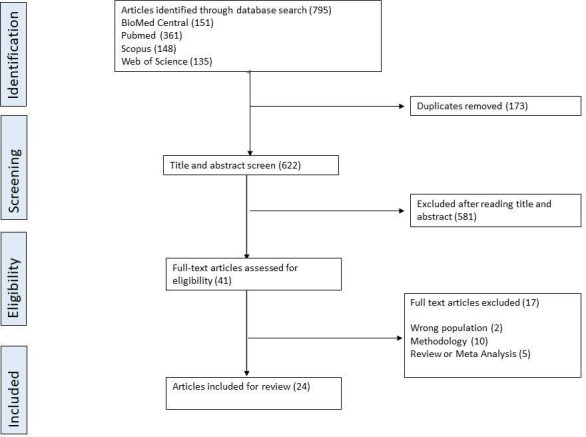
- Systematic review conducted in line with PRISMA guidelines; four databases (BioMed Central, PubMed, Scopus, Web of Science) were searched in April 2020 for papers from 1999 to 2020. Eligible studies measured at least one variable of interest, included transwomen and were written in English.
- Twenty-four studies were included, with sample sizes from 12 to 249. Designs included 13 follow-up studies, 2 follow-up plus cross-sectional studies, 6 cross-sectional studies and 3 prospective studies. Quality was assessed with the EPHPP tool; all studies were categorised as moderate quality.
- Data were extracted on lean body mass, muscle cross-sectional area, muscular strength and haemoglobin/haematocrit. Meta-analysis was not possible due to overlapping participants in the ENIGI studies and heterogeneous methodology.
Limitations
- The paper states that the effects of GAHT on athletic performance in transgender people who train and compete remain unknown; physical activity levels were not reported; studies were English-only and conducted in Western countries, contributing to geographical bias; sparse data risk existed due to small sample sizes and short study durations; participant overlap and heterogeneous methodology precluded meaningful meta-analysis; and the review only focused on binary transgender individuals, not non-binary individuals.
- The text makes evident that most included participants were non-athletic, many data were extracted from medical charts (nine studies from the same research group), posing risk of selective data reporting and publication bias, and five studies had post-GAHT testosterone values greater than 5 nmol/L, a possible confounder, with four of these in adolescent transfemales.
Model-written summary. Check it against the paper before relying on it.
Integrity signals
Registry
Cites
Statistics
Figures
Verification
Claims the paper makes
25 No full text of the sources · 16 Partly supported · 13 No basis given · 10 Own method · 7 Own result · 6 Couldn’t confirm · 6 Own interpretation · 5 Supported · 5 Supported so far · 1 Mixed support · 1 Not supported · 1 Sources not found · 1 Not checked yet · accuracy not yet measured
Some cited sources support this claim and some don’t — read each source’s verdict below.
In the paper
“Seven of these studies,15 36 39–41 44 51 including the large (n=179) ENIGI study,15 and two studies40 51 with high post-GAHT testosterone (~8 nmol/L), showed that total LBM was decreased by 3.0%–5.4% following hormone transition (p<0.05).”
§ How does hormone transition in transgender women change body composition, muscle strength and haemoglobin? Systematic review with a focus on the implications for sport participation > Results > Muscle mass and body fat changes
What the sources say
- Supportedcites [15] source
The citation identifies this paper as the large ENIGI study, rather than as evidence for all seven studies or the two studies with high post-GAHT testosterone. The Study population and study design section identifies it as part of ENIGI; the Results report 179 transwomen and a 3% decrease in total lean body mass after one year of hormone therapy (P < 0.001). (LLM, conf=0.93)
- Partly supportedcites [36] Wierckx, 2014, Cross-sex hormone therapy in trans persons is safe and effective at short-time follow-up: results from the European network for the investigation of gender incongruence, J Sex Med sourceExperimental — accuracy not yet measured
The Trans Women results report a decrease in total body lean mass after treatment, and Table 3 (page not available) shows significant decreases in both estrogen-treatment groups at 12 months (P<0.001 and P=0.02). But Table 3 lists 53 trans women and 53 trans men, not a follow-up sample of 179; this paper also cannot substantiate the results attributed to the other six studies or the two studies described as having high post-GAHT testosterone. (LLM, conf=0.86)
- Disputedcites [39] Auer, 2018, Effects of sex hormone treatment on the metabolic syndrome in transgender individuals: focus on metabolic cytokines, J Clin Endocrinol Metab sourceExperimental — accuracy not yet measured
The Markers of the MS section reports that lean mass remained unchanged in transwomen and increased in transmen after GAHT, contrary to the attributed decrease. The Patients section describes a cohort of 69, not the n=179 ENIGI study named in the citing sentence. No page numbers are available in our copy. (LLM, conf=0.90)
Checked by a reasoning model — may be wrong.
plaindirect- Asserted: passes — The authors put it forward as true.
- Checkable: passes — It can be checked against evidence.
- Load-bearing: passes — The paper’s conclusions depend on it.
- Based: passes — The paper gives a reason why it holds.
- Supported
The cited sources support only part of this claim — read each source’s verdict below.
In the paper
“In cisgender males, increases in testosterone due to puberty promote muscular strength in association with increased muscle CSA, and increased lean muscle mass.26”
§ How does hormone transition in transgender women change body composition, muscle strength and haemoglobin? Systematic review with a focus on the implications for sport participation > Introduction
What the sources say
- Partly supportedcites [26] sourceExperimental — accuracy not yet measured
The Introduction and Discussion say that male puberty brings greater muscle mass and strength, and that testosterone increases both. The Discussion also refers to increased muscular size, but our copy does not specifically establish an increase in muscle cross-sectional area (CSA). (LLM, conf=0.83)
plaindirect- Asserted: passes — The authors put it forward as true.
- Checkable: passes — It can be checked against evidence.
- Load-bearing: passes — The paper’s conclusions depend on it.
- Based: passes — The paper gives a reason why it holds.
- Partly supported
Every source the paper cites for this claim was checked and supports it.
In the paper
“Testosterone exerts erythrogenic effects that results in increases in both HCT and Hgb.23”
§ How does hormone transition in transgender women change body composition, muscle strength and haemoglobin? Systematic review with a focus on the implications for sport participation > Introduction
What the sources say
- Supportedcites [23] source
The Abstract states that testosterone has a dose-dependent stimulatory effect on erythropoiesis and describes a testosterone-induced rise in both hemoglobin and hematocrit. The Hemoglobin and hematocrit results section also reports dose-dependent changes in both measures. Page numbers are not provided in these passages. (LLM, conf=0.94)
plaindirect- Asserted: passes — The authors put it forward as true.
- Checkable: passes — It can be checked against evidence.
- Load-bearing: passes — The paper’s conclusions depend on it.
- Based: passes — The paper gives a reason why it holds.
- Supported
The cited sources that could be checked couldn’t confirm or dispute this claim.
In the paper
“Low Hgb, or low HCT, the volume of red blood cells compared with total blood volume, can lead to a diminished supply of oxygen to the tissues, and therefore have a direct effect on endurance performance.”
§ How does hormone transition in transgender women change body composition, muscle strength and haemoglobin? Systematic review with a focus on the implications for sport participation > Introduction
What the sources say
- Could not verifycites [20] sourceExperimental — accuracy not yet measured
The Methods describe hematocrit values used to prepare red-cell samples, and the Results examine hemoglobin removal from erythrocyte membranes (page numbers unavailable). Neither those passages nor searches for oxygen transport, tissue oxygen supply, anemia, or exercise address the claimed effect on endurance performance. (LLM, conf=0.77)
plaindirect- Asserted: passes — The authors put it forward as true.
- Checkable: passes — It can be checked against evidence.
- Load-bearing: passes — The paper’s conclusions depend on it.
- Based: passes — The paper gives a reason why it holds.
- Could not verify
The cited sources support only part of this claim — read each source’s verdict below.
In the paper
“One of these studies40 examined adolescent participants who only reached a final testosterone level of 8.8 nmol/L and exhibited forearm and calf CSA decreases of 4.1% and 8.9%, respectively.”
§ How does hormone transition in transgender women change body composition, muscle strength and haemoglobin? Systematic review with a focus on the implications for sport participation > Results > Muscle mass and body fat changes
What the sources say
- Partly supportedcites [40] Tack, 2018, Proandrogenic and antiandrogenic progestins in transgender youth: differential effects on body composition and bone metabolism, J Clin Endocrinol Metab sourceExperimental — accuracy not yet measured
The Body composition and grip strength section reports decreased forearm and lower-leg muscle area in adolescent trans girls. Table 2 gives their final mean testosterone as 253.35 ng/dL, approximately 8.8 nmol/L. Our copy does not report the claimed 4.1% and 8.9% decreases, so those magnitudes cannot be verified. (LLM, conf=0.86)
plain- Asserted: passes — The authors put it forward as true.
- Checkable: passes — It can be checked against evidence.
- Load-bearing: unclear — It is unclear whether the paper’s conclusions depend on it.
- Based: passes — The paper gives a reason why it holds.
- Partly supported
The cited sources support only part of this claim — read each source’s verdict below.
In the paper
“The large ENIGI study15 was the only study in which the limits of agreement would indicate a change in LBM at the 95% CI.”
§ How does hormone transition in transgender women change body composition, muscle strength and haemoglobin? Systematic review with a focus on the implications for sport participation > Results > Muscle mass and body fat changes
What the sources say
- Partly supportedcites [15] sourceExperimental — accuracy not yet measured
The Study population and study design section identifies this as an ENIGI study with 341 participants, larger than previous studies of this topic. The Results section reports changes in total lean body mass for transwomen and transmen with 95% confidence intervals excluding zero. It does not report limits of agreement or establish that this was the only study meeting the citing paper’s criterion. (LLM, conf=0.86)
hedged- Asserted: passes — The authors put it forward as true.
- Checkable: passes — It can be checked against evidence.
- Load-bearing: unclear — It is unclear whether the paper’s conclusions depend on it.
- Based: passes — The paper gives a reason why it holds.
- Partly supported
Every source the paper cites for this claim was checked and supports it.
In the paper
“HCT values are also higher in males (42%–52%) than females (37%–47%).22”
§ How does hormone transition in transgender women change body composition, muscle strength and haemoglobin? Systematic review with a focus on the implications for sport participation > Introduction
What the sources say
- Supportedcites [22] Cohen, 2017, Relationship between hematocrit levels and intraocular pressure in men and women: a population-based cross-sectional study, Medicine source
The Results section (‘Mean IOP by hematocrit level’) gives normal hematocrit ranges of 42%–52% for men and 37%–47% for women, exactly matching the cited values. (LLM, conf=0.95)
plaincorrelational- Asserted: passes — The authors put it forward as true.
- Checkable: passes — It can be checked against evidence.
- Load-bearing: passes — The paper’s conclusions depend on it.
- Based: passes — The paper gives a reason why it holds.
- Supported
The cited sources support only part of this claim — read each source’s verdict below.
In the paper
“Five longitudinal studies16 17 37 40 41 investigated the muscular strength of transwomen.”
§ How does hormone transition in transgender women change body composition, muscle strength and haemoglobin? Systematic review with a focus on the implications for sport participation > Results > Muscle mass and body fat changes
What the sources say
- Not checked — no full text of the sourcecites [16] Wiik, 2020, Muscle strength, size, and composition following 12 months of Gender-affirming treatment in transgender individuals, J Clin Endocrinol Metab source
- Supportedcites [17] Scharff, 2019, Change in grip strength in trans people and its association with lean body mass and bone density, Endocr Connect source
The Abstract (Design and methods) identifies this as a prospective study that measured grip strength in 249 transwomen at baseline and after one year. It therefore supports citing this paper as one of the longitudinal studies of muscular strength in transwomen; the citation does not by itself establish the total of five. (LLM, conf=0.92)
- Partly supportedcites [37] Auer, 2016, 12-Months metabolic changes among gender dysphoric individuals under cross-sex hormone treatment: a targeted metabolomics study, Sci Rep sourceExperimental — accuracy not yet measured
The Patient population section describes transwomen assessed at baseline and after 12 months, supporting the longitudinal-study aspect. The Methods describe body-composition and laboratory measurements, but not a muscular-strength assessment; muscle mass discussed elsewhere is not the same as strength. No page numbers are available in our copy. (LLM, conf=0.84)
plain- Asserted: passes — The authors put it forward as true.
- Checkable: passes — It can be checked against evidence.
- Load-bearing: passes — The paper’s conclusions depend on it.
- Based: passes — The paper gives a reason why it holds.
The cited sources support only part of this claim — read each source’s verdict below.
In the paper
“A decrease in CSA of 1.5%–11.7% was reported over periods ranging from 12 to 36 months.”
§ How does hormone transition in transgender women change body composition, muscle strength and haemoglobin? Systematic review with a focus on the implications for sport participation > Results > Muscle mass and body fat changes
What the sources say
- Not checked — no full text of the sourcecites [16] Wiik, 2020, Muscle strength, size, and composition following 12 months of Gender-affirming treatment in transgender individuals, J Clin Endocrinol Metab source
- Partly supportedcites [40] Tack, 2018, Proandrogenic and antiandrogenic progestins in transgender youth: differential effects on body composition and bone metabolism, J Clin Endocrinol Metab sourceExperimental — accuracy not yet measured
The Body composition and grip strength section (page not available) reports decreased forearm and lower-leg muscle area in trans girls treated with cyproterone acetate, but does not give the claimed 1.5%–11.7% range. The Results give a mean interval of 10.57 months between examinations for trans girls, not a 12–36-month observation period. Participants and treatments says measurements were taken before addition of cross-sex hormones, so the reported decrease was not observed during GAHT as the claim suggests. (LLM, conf=0.90)
- Not checked — no full text of the sourcecites [41] Van Caenegem, 2015, Preservation of volumetric bone density and geometry in trans women during cross-sex hormonal therapy: a prospective observational study, Osteoporos Int source
plaindirect- Asserted: passes — The authors put it forward as true.
- Checkable: passes — It can be checked against evidence.
- Load-bearing: passes — The paper’s conclusions depend on it.
- Based: passes — The paper gives a reason why it holds.
The cited sources support only part of this claim — read each source’s verdict below.
In the paper
“Since GAHT significantly lowers testosterone levels in transgender women,24 it is possible that they may experience reductions in HCT and Hgb, which would be anticipated to negatively affect endurance performance.”
§ How does hormone transition in transgender women change body composition, muscle strength and haemoglobin? Systematic review with a focus on the implications for sport participation > Introduction
What the sources say
- Partly supportedcites [24] Weinand, 2015, Hormone therapy in transgender adults is safe with provider supervision; a review of hormone therapy sequelae for transgender individuals, J Clin Transl Endocrinol sourceExperimental — accuracy not yet measured
The ‘Other considerations > Androgen deprivation in MTF individuals’ section describes androgen deprivation in transgender women, which supports the general direction of the claim. It does not report measured testosterone levels or establish that the reduction is statistically significant; no page number is available in our copy. (LLM, conf=0.75)
plaindirect- Asserted: passes — The authors put it forward as true.
- Checkable: passes — It can be checked against evidence.
- Load-bearing: passes — The paper’s conclusions depend on it.
- Based: passes — The paper gives a reason why it holds.
- Partly supported
- It may state two separate claims as one. 27
- Probably not a substantial claim. 10
- The quote only partly states this claim. 1
At least one cited source doesn’t support this claim or points to a different paper, and none confirmed it — see the verdicts below.
In the paper
“Aside from these three studies, data were extracted from medical charts (nine of which were from the same research group,15 17 19 36–41) posing a risk of selective data reporting and publication bias.”
§ How does hormone transition in transgender women change body composition, muscle strength and haemoglobin? Systematic review with a focus on the implications for sport participation > Results > Study characteristics
What the sources say
- Disputedcites [15] sourceExperimental — accuracy not yet measured
The Study population and study design section (page unavailable) identifies this as a prospective observational study and describes scheduled clinic visits for data collection. That contradicts treating this paper as one of the studies whose data were extracted from medical charts. The paper does not establish the claim about nine studies from one research group or the resulting bias risk. (LLM, conf=0.85)
Checked by a reasoning model — may be wrong.
- Disputedcites [17] Scharff, 2019, Change in grip strength in trans people and its association with lean body mass and bone density, Endocr Connect sourceExperimental — accuracy not yet measured
The Materials and methods section (Study design and study population; page not provided) identifies this paper as part of a multicenter prospective cohort, with measurements taken at baseline and follow-up. That contradicts its apparent inclusion among studies whose data were extracted from medical charts. The paper does not establish the citing sentence’s count of nine studies or its publication-bias assessment. (LLM, conf=0.86)
Checked by a reasoning model — may be wrong.
- Disputedcites [19] Defreyne, 2018, Prospective evaluation of hematocrit in gender-affirming hormone treatment: results from European network for the investigation of gender incongruence, Andrology sourceExperimental — accuracy not yet measured
The Methods (page unavailable) identify this paper as a multicenter prospective cohort study with scheduled follow-up visits and blood sampling, not a study based on data extracted from medical charts. The Discussion (page unavailable) likewise calls it a prospective study. This paper therefore does not support classifying it among the chart-based studies; it does not assess the claimed count of nine or publication-bias risk across those studies. (LLM, conf=0.86)
Checked by a reasoning model — may be wrong.
plain- Asserted: passes — The authors put it forward as true.
- Checkable: passes — It can be checked against evidence.
- Load-bearing: unclear — It is unclear whether the paper’s conclusions depend on it.
- Based: passes — The paper gives a reason why it holds.
It may state two separate claims as one.
- Disputed
The sources with a verdict support this claim; the rest weren’t checked yet, have no full text we could read, or their verdicts aren’t rated yet.
In the paper
“However, studies in non-athletic transwomen undergoing GAHT also report changes in lean body mass (LBM),15 muscle cross-sectional area (CSA),16 muscular strength17 and haemoglobin (Hgb)18 and/or haematocrit (HCT).19”
§ How does hormone transition in transgender women change body composition, muscle strength and haemoglobin? Systematic review with a focus on the implications for sport participation > Introduction
What the sources say
- Supportedcites [15] source
Citation 15 is attached specifically to the lean-body-mass finding, not to the separate claims about muscle cross-sectional area, strength, or blood measures. The Results report that total lean body mass decreased by 3% in transwomen during the first year of cross-sex hormone treatment. The paper does not specify participants’ athletic status. (LLM, conf=0.92)
- Not checked — no full text of the sourcecites [16] Wiik, 2020, Muscle strength, size, and composition following 12 months of Gender-affirming treatment in transgender individuals, J Clin Endocrinol Metab source
- Supportedcites [17] Scharff, 2019, Change in grip strength in trans people and its association with lean body mass and bone density, Endocr Connect source
Citation 17 is attached to the muscular-strength part of the sentence, not the claims about body composition or blood measures. The Results > Grip strength section reports that transwomen’s grip strength decreased by 1.8 kg during the first year of hormone treatment. (LLM, conf=0.92)
plaindirect- Asserted: passes — The authors put it forward as true.
- Checkable: passes — It can be checked against evidence.
- Load-bearing: passes — The paper’s conclusions depend on it.
- Based: passes — The paper gives a reason why it holds.
It may state two separate claims as one.
- Supported
The cited sources support only part of this claim — read each source’s verdict below.
In the paper
“Three large studies from the ENIGI group published in 2018 and 201915 17 19 contained much novel data, but also included many participants from previous studies making it impossible to accurately state the number of unique participants.”
§ How does hormone transition in transgender women change body composition, muscle strength and haemoglobin? Systematic review with a focus on the implications for sport participation > Results > Study characteristics
What the sources say
- Partly supportedcites [15] sourceExperimental — accuracy not yet measured
The Study population and study design section (page unavailable) identifies this as an ENIGI study and reports 341 participants, a larger body-composition study population than any before it. It does not say that participants overlapped with previous studies or that the number of unique participants across the cited studies cannot be determined. (LLM, conf=0.85)
- Partly supportedcites [17] Scharff, 2019, Change in grip strength in trans people and its association with lean body mass and bone density, Endocr Connect sourceExperimental — accuracy not yet measured
The Study design and study population section (page not available) identifies this as an ENIGI cohort study and reports 527 participants in its analyses. It does not establish how many participants appeared in earlier studies or say that the number of unique participants across the cited studies cannot be determined. (LLM, conf=0.82)
- Partly supportedcites [19] Defreyne, 2018, Prospective evaluation of hematocrit in gender-affirming hormone treatment: results from European network for the investigation of gender incongruence, Andrology sourceExperimental — accuracy not yet measured
The Methods and Results (page numbers unavailable) identify this as a large ENIGI study and report its analyzed participant counts. The Discussion describes a novel comparison. Our copy does not establish that participants overlapped with previous studies or that the number of unique participants across the three studies cannot be determined. (LLM, conf=0.84)
plain- Asserted: passes — The authors put it forward as true.
- Checkable: passes — It can be checked against evidence.
- Load-bearing: unclear — It is unclear whether the paper’s conclusions depend on it.
- Based: passes — The paper gives a reason why it holds.
It may state two separate claims as one.
- Partly supported
Every source the paper cites for this claim was checked and supports it.
In the paper
“This systematic review was conducted in line with Preferred Reporting Items for Systematic Reviews and Meta-Analyses (PRISMA) guidelines.32”
§ How does hormone transition in transgender women change body composition, muscle strength and haemoglobin? Systematic review with a focus on the implications for sport participation > Materials and methods > Search strategy and selection criteria
What the sources say
- Supportedcites [32] source
The Scope of PRISMA section identifies this paper as the PRISMA Statement’s explanatory guidance for reporting systematic reviews. The citation supports the identification of the guidelines, though the source cannot independently verify whether the citing review followed them. (LLM, conf=0.91)
plain- Asserted: passes — The authors put it forward as true.
- Checkable: passes — It can be checked against evidence.
- Load-bearing: fails — The paper’s conclusions may not depend on it.
- Based: passes — The paper gives a reason why it holds.
Probably not a substantial claim. The paper’s conclusions may not depend on it.
- Supported
The cited sources support only part of this claim — read each source’s verdict below.
In the paper
“Two ENIGI studies37 40 found no significant strength differences, although one of these studies40 was carried out on adolescents who failed to reach typical female testosterone levels (8.8 nmol/L after GAHT).”
§ How does hormone transition in transgender women change body composition, muscle strength and haemoglobin? Systematic review with a focus on the implications for sport participation > Results > Muscle mass and body fat changes
What the sources say
- Could not verifycites [37] Auer, 2016, 12-Months metabolic changes among gender dysphoric individuals under cross-sex hormone treatment: a targeted metabolomics study, Sci Rep sourceExperimental — accuracy not yet measured
The Patient population section identifies this as an ENIGI study, but the Methods and Results passages describe metabolite, body-composition, and hormone measurements, not strength outcomes. Searches for strength differences, adolescents, and 8.8 nmol/L found no passage supporting the cited claim; pages are not specified in our copy. (LLM, conf=0.76)
- Partly supportedcites [40] Tack, 2018, Proandrogenic and antiandrogenic progestins in transgender youth: differential effects on body composition and bone metabolism, J Clin Endocrinol Metab sourceExperimental — accuracy not yet measured
The Body composition and grip strength section reports no significant change in grip strength among trans girls during the study, but it does not report no strength differences between groups. Table 2 reports mean total testosterone of 253.35 ng/dL after cyproterone acetate treatment in trans girls, approximately 8.8 nmol/L. The paper describes this as progestin treatment, not GAHT. (LLM, conf=0.85)
plain- Asserted: passes — The authors put it forward as true.
- Checkable: passes — It can be checked against evidence.
- Load-bearing: unclear — It is unclear whether the paper’s conclusions depend on it.
- Based: passes — The paper gives a reason why it holds.
It may state two separate claims as one.
- Could not verify
The sources with a verdict support this claim; the rest weren’t checked yet, have no full text we could read, or their verdicts aren’t rated yet.
In the paper
“The largest of the three (n=249) ENIGI studies17 and one other study41 found significant (p<0.001) reductions (4.3% and 7.1%, respectively) after 12 months on GAHT.”
§ How does hormone transition in transgender women change body composition, muscle strength and haemoglobin? Systematic review with a focus on the implications for sport participation > Results > Muscle mass and body fat changes
What the sources say
- Supportedcites [17] Scharff, 2019, Change in grip strength in trans people and its association with lean body mass and bone density, Endocr Connect source
The Methods report 249 transwomen in the grip-strength analysis. Table 1 in Results gives a decline from 41.8 to 40.0 kg after treatment, approximately 4.3%, and Results > Grip strength reports a −1.8 kg change with a 95% CI of −2.6 to −1.0, consistent with p<0.001. The separate 7.1% finding is attributed to citation 41, not this paper. (LLM, conf=0.88)
- Not checked — no full text of the sourcecites [41] Van Caenegem, 2015, Preservation of volumetric bone density and geometry in trans women during cross-sex hormonal therapy: a prospective observational study, Osteoporos Int source
plaindirect- Asserted: passes — The authors put it forward as true.
- Checkable: passes — It can be checked against evidence.
- Load-bearing: passes — The paper’s conclusions depend on it.
- Based: passes — The paper gives a reason why it holds.
It may state two separate claims as one.
- Supported
The sources with a verdict support this claim; the rest weren’t checked yet, have no full text we could read, or their verdicts aren’t rated yet.
In the paper
“Although the transwomen in most of the studies achieved testosterone levels within the reference range for cisgender women, there were five studies38 40 47 49 51 in which the transfemales had post-GAHT testosterone values greater than 5 nmol/L.”
§ How does hormone transition in transgender women change body composition, muscle strength and haemoglobin? Systematic review with a focus on the implications for sport participation > Results > Medical treatments
What the sources say
- Not checked — no full text of the sourcecites [38] Tack, 2017, Consecutive cyproterone acetate and estradiol treatment in Late-Pubertal transgender female adolescents, J Sex Med source
- Supportedcites [40] Tack, 2018, Proandrogenic and antiandrogenic progestins in transgender youth: differential effects on body composition and bone metabolism, J Clin Endocrinol Metab source
Table 2 (Discussion; page unavailable) reports mean total testosterone of 253.35 ng/dL in trans girls after cyproterone acetate treatment, equivalent to approximately 8.8 nmol/L. This supports citing the study as one in which the post-treatment value exceeded 5 nmol/L; the other four studies are not attributed to this source. (LLM, conf=0.91)
- Not checked — no full text of the sourcecites [47] source
plain- Asserted: passes — The authors put it forward as true.
- Checkable: passes — It can be checked against evidence.
- Load-bearing: passes — The paper’s conclusions depend on it.
- Based: passes — The paper gives a reason why it holds.
It may state two separate claims as one.
The cited sources that could be checked couldn’t confirm or dispute this claim.
In the paper
“Typical values for Hgb differ between males and females, with ‘normal’ values ranging between 131–179 g/L for men and 117–155 g/L for women.21”
§ How does hormone transition in transgender women change body composition, muscle strength and haemoglobin? Systematic review with a focus on the implications for sport participation > Introduction
What the sources say
- Could not verifycites [21] sourceExperimental — accuracy not yet measured
The Review introduction gives 14 g/dL as an example of normal haemoglobin concentration in men, but does not provide a male reference range or a female value. Searches for the stated endpoints and sex-specific normal ranges found no passage establishing 131–179 g/L for men or 117–155 g/L for women. (LLM, conf=0.77)
plaincorrelational- Asserted: passes — The authors put it forward as true.
- Checkable: passes — It can be checked against evidence.
- Load-bearing: passes — The paper’s conclusions depend on it.
- Based: passes — The paper gives a reason why it holds.
It may state two separate claims as one.
- Could not verify
The sources with a verdict support this claim; the rest weren’t checked yet, have no full text we could read, or their verdicts aren’t rated yet.
In the paper
“Nine studies16 19 36–38 43 47–49 reported the levels of Hgb or HCT in transwomen before and after GAHT, from a minimum of three to a maximum of 36 months post hormone therapy.”
§ How does hormone transition in transgender women change body composition, muscle strength and haemoglobin? Systematic review with a focus on the implications for sport participation > Results > Muscle mass and body fat changes
What the sources say
- Not checked — no full text of the sourcecites [16] Wiik, 2020, Muscle strength, size, and composition following 12 months of Gender-affirming treatment in transgender individuals, J Clin Endocrinol Metab source
- Supportedcites [19] Defreyne, 2018, Prospective evaluation of hematocrit in gender-affirming hormone treatment: results from European network for the investigation of gender incongruence, Andrology source
The Results report hematocrit levels in trans women before treatment and at three months. The Methods describe follow-up visits through 36 months, so this paper qualifies as one of the studies identified in the citing sentence; it is not being cited to establish the total of nine on its own. Page numbers were not available in our copy. (LLM, conf=0.91)
- Supportedcites [36] Wierckx, 2014, Cross-sex hormone therapy in trans persons is safe and effective at short-time follow-up: results from the European network for the investigation of gender incongruence, J Sex Med source
Table 2 (indexed under Conclusion; page unavailable) reports hematocrit levels in trans women at baseline and after 12 months of hormone therapy. This establishes that the cited paper is one of the studies described; the nine-study count and 3–36-month range describe the cited studies collectively, not this paper alone. (LLM, conf=0.91)
- Supportedcites [37] Auer, 2016, 12-Months metabolic changes among gender dysphoric individuals under cross-sex hormone treatment: a targeted metabolomics study, Sci Rep source
The Results (General characteristics) report hematocrit levels in transwomen after 12 months of hormone treatment. The Methods (Patient population) specify that participants were assessed at baseline and after 12 months, making this paper one of the studies described by the citing sentence. (LLM, conf=0.92)
- Not checked — no full text of the sourcecites [38] Tack, 2017, Consecutive cyproterone acetate and estradiol treatment in Late-Pubertal transgender female adolescents, J Sex Med source
plain- Asserted: passes — The authors put it forward as true.
- Checkable: passes — It can be checked against evidence.
- Load-bearing: unclear — It is unclear whether the paper’s conclusions depend on it.
- Based: passes — The paper gives a reason why it holds.
It may state two separate claims as one.
The cited sources support only part of this claim — read each source’s verdict below.
In the paper
“cisgender women demonstrating 31% lower LBM,59 36%60 lower hand-grip strength and 35%61 lower knee extension strength than cisgender men”
§ How does hormone transition in transgender women change body composition, muscle strength and haemoglobin? Systematic review with a focus on the implications for sport participation > Discussion
What the sources say
- Partly supportedcites [59] sourceExperimental — accuracy not yet measured
The Results report that men had, on average, 18 kg more lean body mass than women, supporting the direction of the comparison. Our copy does not give the cited 31% figure or establish that participants were cisgender. The hand-grip and knee-extension figures have separate citations and are not attributed to this paper. (LLM, conf=0.82)
- Partly supportedcites [60] Bohannon, 2019, Handgrip strength: a comparison of values obtained from the NHANES and NIH Toolbox studies, Am J Occup Ther sourceExperimental — accuracy not yet measured
The Results (page unavailable) report significantly higher handgrip strength in males than females. The cited paper does not report a 36% difference or identify participants as cisgender; the adjacent lean-body-mass and knee-extension figures have separate citations and are not judged here. (LLM, conf=0.84)
- Not checked — no full text of the sourcecites [61] source
plain- Asserted: passes — The authors put it forward as true.
- Checkable: passes — It can be checked against evidence.
- Load-bearing: passes — The paper’s conclusions depend on it.
- Based: passes — The paper gives a reason why it holds.
It may state two separate claims as one.
- Partly supported
A result the paper reports from its own data — it cites no other source for it, so there is none to check. The quote shows it is in the paper.
In the paper
“Twenty-four studies were identified and reviewed.”
- Also stated in: § Search results · plain
“From an initial yield of 795 articles, 24 studies15–19 36–54 were included in this review.”
§ How does hormone transition in transgender women change body composition, muscle strength and haemoglobin? Systematic review with a focus on the implications for sport participation > Abstract > Results
plain- Asserted: passes — The authors put it forward as true.
- Checkable: passes — It can be checked against evidence.
- Load-bearing: fails — The paper’s conclusions may not depend on it.
- Based: passes — The paper gives a reason why it holds.
Probably not a substantial claim. The paper’s conclusions may not depend on it.
- Also stated in: § Search results · plain
A result the paper reports from its own data — it cites no other source for it, so there is none to check. The quote shows it is in the paper.
In the paper
“Transwomen experienced significant decreases in all parameters measured, with different time courses noted.”
§ How does hormone transition in transgender women change body composition, muscle strength and haemoglobin? Systematic review with a focus on the implications for sport participation > Abstract > Results
plaindirect- Asserted: passes — The authors put it forward as true.
- Checkable: passes — It can be checked against evidence.
- Load-bearing: passes — The paper’s conclusions depend on it.
- Based: passes — The paper gives a reason why it holds.
It may state two separate claims as one.
A claim is checked only against the cited paper’s full text, never its abstract, and none is available for its sources.
In the paper
“These studies reported 6.4% and 8.0% lower LBM than in cisgender men and reductions of 4% in LBM in the transwomen with 12 months of GAHT.”
§ How does hormone transition in transgender women change body composition, muscle strength and haemoglobin? Systematic review with a focus on the implications for sport participation > Results > Muscle mass and body fat changes
What the sources say
- Not checked — no full text of the sourcecites [41] Van Caenegem, 2015, Preservation of volumetric bone density and geometry in trans women during cross-sex hormonal therapy: a prospective observational study, Osteoporos Int source
- Not checked — no full text of the sourcecites [51] source
- Not checked — no full text of the sourcecites [54] source
plaindirect- Asserted: passes — The authors put it forward as true.
- Checkable: passes — It can be checked against evidence.
- Load-bearing: passes — The paper’s conclusions depend on it.
- Based: passes — The paper gives a reason why it holds.
It may state two separate claims as one.
In the paper
“One study reported 9% smaller CSA in hormone-naive transwomen41 than in cisgender men, with the transwomen undergoing a further 4% decrease in CSA with 24 months of GAHT.”
§ How does hormone transition in transgender women change body composition, muscle strength and haemoglobin? Systematic review with a focus on the implications for sport participation > Results > Muscle mass and body fat changes
What the sources say
- Not checked — no full text of the sourcecites [41] Van Caenegem, 2015, Preservation of volumetric bone density and geometry in trans women during cross-sex hormonal therapy: a prospective observational study, Osteoporos Int source
plaindirect- Asserted: passes — The authors put it forward as true.
- Checkable: passes — It can be checked against evidence.
- Load-bearing: unclear — It is unclear whether the paper’s conclusions depend on it.
- Based: passes — The paper gives a reason why it holds.
It may state two separate claims as one.
A result the paper reports from its own data — it cites no other source for it, so there is none to check. The quote shows it is in the paper.
In the paper
“The sample sizes of the studies varied from 12 to 249.”
§ How does hormone transition in transgender women change body composition, muscle strength and haemoglobin? Systematic review with a focus on the implications for sport participation > Results > Study characteristics
plain- Asserted: passes — The authors put it forward as true.
- Checkable: passes — It can be checked against evidence.
- Load-bearing: fails — The paper’s conclusions may not depend on it.
- Based: passes — The paper gives a reason why it holds.
Probably not a substantial claim. The paper’s conclusions may not depend on it.
In the paper
“The same study reported that compared with baseline, forearm CSA was decreased by 8.6% after 12 months, yet at 24 months was 4.4% lower than baseline, indicating that forearm CSA was 4.2% larger at 24 months than at 12 months.”
§ How does hormone transition in transgender women change body composition, muscle strength and haemoglobin? Systematic review with a focus on the implications for sport participation > Results > Muscle mass and body fat changes
What the sources say
- Not checked — no full text of the sourcecites [41] Van Caenegem, 2015, Preservation of volumetric bone density and geometry in trans women during cross-sex hormonal therapy: a prospective observational study, Osteoporos Int source
hedgeddirect- Asserted: passes — The authors put it forward as true.
- Checkable: passes — It can be checked against evidence.
- Load-bearing: unclear — It is unclear whether the paper’s conclusions depend on it.
- Based: passes — The paper gives a reason why it holds.
It may state two separate claims as one.
In the paper
“The participants also failed to reach typical female testosterone levels (after 6 months mean testosterone=6.9 nmol/L)”
§ How does hormone transition in transgender women change body composition, muscle strength and haemoglobin? Systematic review with a focus on the implications for sport participation > Results > Muscle mass and body fat changes
What the sources say
- Not checked — no full text of the sourcecites [47] source
plain- Asserted: passes — The authors put it forward as true.
- Checkable: passes — It can be checked against evidence.
- Load-bearing: unclear — It is unclear whether the paper’s conclusions depend on it.
- Based: passes — The paper gives a reason why it holds.
It may state two separate claims as one.
The paper states this without a source or data behind it here, so there is nothing to check it against. The quote shows it is in the paper.
In the paper
“Overall, the findings demonstrate a reduction in these parameters over time.”
§ How does hormone transition in transgender women change body composition, muscle strength and haemoglobin? Systematic review with a focus on the implications for sport participation > Discussion
boosteddirect- Asserted: passes — The authors put it forward as true.
- Checkable: passes — It can be checked against evidence.
- Load-bearing: passes — The paper’s conclusions depend on it.
- Based: passes — The paper gives a reason why it holds.
It may state two separate claims as one.
In the paper
“The fifth longitudinal study to assess strength measured upper leg strength using knee flexion and extension and found no significant difference after 12 months.16”
§ How does hormone transition in transgender women change body composition, muscle strength and haemoglobin? Systematic review with a focus on the implications for sport participation > Results > Muscle mass and body fat changes
What the sources say
- Not checked — no full text of the sourcecites [16] Wiik, 2020, Muscle strength, size, and composition following 12 months of Gender-affirming treatment in transgender individuals, J Clin Endocrinol Metab source
plain- Asserted: passes — The authors put it forward as true.
- Checkable: passes — It can be checked against evidence.
- Load-bearing: unclear — It is unclear whether the paper’s conclusions depend on it.
- Based: passes — The paper gives a reason why it holds.
It may state two separate claims as one.
A claim is checked only against the cited paper’s full text, never its abstract, and none is available for its sources.
In the paper
“Three cross-sectional studies45 50 52 found significant differences45 50 (p<0.05) or large effect sizes52 (Cohen’s d=1.0) in HCT between transwomen after 6 months of GAHT and hormone-naive transwomen, and HCT decreases of 7.4%–10.9%.”
§ How does hormone transition in transgender women change body composition, muscle strength and haemoglobin? Systematic review with a focus on the implications for sport participation > Results > Muscle mass and body fat changes
What the sources say
- Not checked — no full text of the sourcecites [45] 2012, Altered arterial stiffness in male-to-female transsexuals undergoing hormonal treatment, J Obstet Gynaecol Res source
- Not checked — no full text of the sourcecites [50] Jain, 2019, Medroxyprogesterone acetate in Gender-Affirming therapy for Transwomen: results from a retrospective study, J Clin Endocrinol Metab source
- Not checked — no full text of the sourcecites [52] source
plaincorrelational- Asserted: passes — The authors put it forward as true.
- Checkable: passes — It can be checked against evidence.
- Load-bearing: unclear — It is unclear whether the paper’s conclusions depend on it.
- Based: passes — The paper gives a reason why it holds.
It may state two separate claims as one.
In the paper
“The mean age of participants in the latter study was 18 years and the range was 14–25 years.”
§ How does hormone transition in transgender women change body composition, muscle strength and haemoglobin? Systematic review with a focus on the implications for sport participation > Results > Muscle mass and body fat changes
What the sources say
- Not checked — no full text of the sourcecites [47] source
plain- Asserted: passes — The authors put it forward as true.
- Checkable: passes — It can be checked against evidence.
- Load-bearing: fails — The paper’s conclusions may not depend on it.
- Based: passes — The paper gives a reason why it holds.
Probably not a substantial claim. The paper’s conclusions may not depend on it. It may state two separate claims as one. The quote only partly states this claim.
In the paper
“One study found 14% lower hand grip strength in hormone-naive transwomen than in cisgender men (p<0.001)41 and a further 7% reduction in hand grip strength of the transwomen after 12 months of GAHT.”
§ How does hormone transition in transgender women change body composition, muscle strength and haemoglobin? Systematic review with a focus on the implications for sport participation > Results > Muscle mass and body fat changes
What the sources say
- Not checked — no full text of the sourcecites [41] Van Caenegem, 2015, Preservation of volumetric bone density and geometry in trans women during cross-sex hormonal therapy: a prospective observational study, Osteoporos Int source
plaindirect- Asserted: passes — The authors put it forward as true.
- Checkable: passes — It can be checked against evidence.
- Load-bearing: passes — The paper’s conclusions depend on it.
- Based: passes — The paper gives a reason why it holds.
It may state two separate claims as one.
None of the sources cited for this claim have been checked yet.
In the paper
“Overall, this review reports decreases in muscle strength, LBM and muscle CSA in response to 12–36 months”
§ How does hormone transition in transgender women change body composition, muscle strength and haemoglobin? Systematic review with a focus on the implications for sport participation > Discussion
plaindirect- Asserted: passes — The authors put it forward as true.
- Checkable: passes — It can be checked against evidence.
- Load-bearing: passes — The paper’s conclusions depend on it.
- Based: passes — The paper gives a reason why it holds.
It may state two separate claims as one.
None of the sources cited for this claim could be matched to a paper in Crossref, so there is nothing to check it against.
In the paper
“Presently, World Athletics requires that transgender athletes5 and athletes with differences of sexual development6 have testosterone levels ≤5 nmol/L in order to be eligible for the female category.”
§ How does hormone transition in transgender women change body composition, muscle strength and haemoglobin? Systematic review with a focus on the implications for sport participation > Introduction
What the sources say
- Not matchedcites [5] World Athletics . Eligibility regulations transgender regulation, 2019. Available: https://www.worldathletics.org/about-iaaf/documents/book-of-rules
Couldn’t be matched to a paper in Crossref, so it can’t be checked.
- Not matchedcites [6] World Athletics . Eligibility regulations for the female classification, 2019. Available: https://www.worldathletics.org/about-iaaf/documents/book-of-rules
Couldn’t be matched to a paper in Crossref, so it can’t be checked.
plain- Asserted: passes — The authors put it forward as true.
- Checkable: passes — It can be checked against evidence.
- Load-bearing: fails — The paper’s conclusions may not depend on it.
- Based: passes — The paper gives a reason why it holds.
Probably not a substantial claim. The paper’s conclusions may not depend on it.
- Not matched
In the paper
“Each study was initially categorised based on its design (eg, cohort, case–control) and examined for quality in line with the Effective Public Health Practise Project (EPHPP) tool.33”
§ How does hormone transition in transgender women change body composition, muscle strength and haemoglobin? Systematic review with a focus on the implications for sport participation > Materials and methods > Study selection, quality assessment, and data extraction
What the sources say
- Not checked — no full text of the sourcecites [33] source
plain- Asserted: passes — The authors put it forward as true.
- Checkable: passes — It can be checked against evidence.
- Load-bearing: passes — The paper’s conclusions depend on it.
- Based: passes — The paper gives a reason why it holds.
Probably not a substantial claim.
In the paper
“Myonuclei number is increased with training and with use of anabolic steroids.28”
§ How does hormone transition in transgender women change body composition, muscle strength and haemoglobin? Systematic review with a focus on the implications for sport participation > Introduction
What the sources say
- Not checked — no full text of the sourcecites [28] source
plaindirect- Asserted: passes — The authors put it forward as true.
- Checkable: passes — It can be checked against evidence.
- Load-bearing: passes — The paper’s conclusions depend on it.
- Based: passes — The paper gives a reason why it holds.
It may state two separate claims as one.
What the paper did — it cites no source for this, so there is none to check. The quote shows it is in the paper.
In the paper
“The high post-GAHT testosterone is a possible confounder, and potential physiological differences between adolescent and adult participants may also confound results.”
§ How does hormone transition in transgender women change body composition, muscle strength and haemoglobin? Systematic review with a focus on the implications for sport participation > Results > Medical treatments
hedgedconditional- Asserted: passes — The authors put it forward as true.
- Checkable: passes — It can be checked against evidence.
- Load-bearing: passes — The paper’s conclusions depend on it.
- Based: passes — The paper gives a reason why it holds.
It may state two separate claims as one.
A claim is checked only against the cited paper’s full text, never its abstract, and none is available for its sources.
In the paper
“This is a generic tool used to evaluate a variety of intervention study designs and is suitable for use in systematic reviews,34 having content and construct validity.35”
§ How does hormone transition in transgender women change body composition, muscle strength and haemoglobin? Systematic review with a focus on the implications for sport participation > Materials and methods > Study selection, quality assessment, and data extraction
What the sources say
- Not checked — no full text of the sourcecites [34] Storebø, 2018, Methylphenidate for attention deficit hyperactivity disorder (ADHD) in children and adolescents - assessment of adverse events in non-randomised studies, Cochrane Database Syst Rev source
- Not checked — no full text of the sourcecites [35] source
plain- Asserted: passes — The authors put it forward as true.
- Checkable: passes — It can be checked against evidence.
- Load-bearing: fails — The paper’s conclusions may not depend on it.
- Based: passes — The paper gives a reason why it holds.
Probably not a substantial claim. The paper’s conclusions may not depend on it. It may state two separate claims as one.
A conclusion the paper draws from its own results — it cites no other source for it, so there is none to check. The quote shows it is in the paper.
In the paper
“the effects of GAHT on these parameters, or indeed athletic performance in transgender people who engage in training and competition, remain unknown.”
§ How does hormone transition in transgender women change body composition, muscle strength and haemoglobin? Systematic review with a focus on the implications for sport participation > Discussion
plain- Asserted: passes — The authors put it forward as true.
- Checkable: passes — It can be checked against evidence.
- Load-bearing: passes — The paper’s conclusions depend on it.
- Based: passes — The paper gives a reason why it holds.
It may state two separate claims as one.
- Rests on an assumption: Changes in body composition, muscle strength, and Hgb/HCT in non-athletic transwomen are informative about athletic performance in transwomen athletes.
What the paper did — it cites no source for this, so there is none to check. The quote shows it is in the paper.
In the paper
“The levels of physical activity of the transwomen compared with cisgender women in the studies were not reported.”
§ How does hormone transition in transgender women change body composition, muscle strength and haemoglobin? Systematic review with a focus on the implications for sport participation > Discussion
plain- Asserted: passes — The authors put it forward as true.
- Checkable: passes — It can be checked against evidence.
- Load-bearing: fails — The paper’s conclusions may not depend on it.
- Based: passes — The paper gives a reason why it holds.
Probably not a substantial claim. The paper’s conclusions may not depend on it.
What the paper did — it cites no source for this, so there is none to check. The quote shows it is in the paper.
In the paper
“Other limitations include the studies being written in English only”
§ How does hormone transition in transgender women change body composition, muscle strength and haemoglobin? Systematic review with a focus on the implications for sport participation > Discussion
plain- Asserted: passes — The authors put it forward as true.
- Checkable: passes — It can be checked against evidence.
- Load-bearing: fails — The paper’s conclusions may not depend on it.
- Based: passes — The paper gives a reason why it holds.
Probably not a substantial claim. The paper’s conclusions may not depend on it.
A conclusion the paper draws from its own results — it cites no other source for it, so there is none to check. The quote shows it is in the paper.
In the paper
“These observations in trained transgender individuals are consistent with the findings of the current review in untrained transgender individuals, whereby 30 months of GAHT may be sufficient to attenuate some, but not all, influencing factors associated with muscular endurance and performance.”
§ How does hormone transition in transgender women change body composition, muscle strength and haemoglobin? Systematic review with a focus on the implications for sport participation > Discussion
hedgedconditional- Asserted: passes — The authors put it forward as true.
- Checkable: passes — It can be checked against evidence.
- Load-bearing: unclear — It is unclear whether the paper’s conclusions depend on it.
- Based: passes — The paper gives a reason why it holds.
It may state two separate claims as one.
- Rests on an assumption: Changes in body composition, muscle strength, and Hgb/HCT in non-athletic transwomen are informative about athletic performance in transwomen athletes.
What the paper did — it cites no source for this, so there is none to check. The quote shows it is in the paper.
In the paper
“This review only focused on binary transgender individuals”
§ How does hormone transition in transgender women change body composition, muscle strength and haemoglobin? Systematic review with a focus on the implications for sport participation > Discussion
plain- Asserted: passes — The authors put it forward as true.
- Checkable: passes — It can be checked against evidence.
- Load-bearing: fails — The paper’s conclusions may not depend on it.
- Based: passes — The paper gives a reason why it holds.
Probably not a substantial claim. The paper’s conclusions may not depend on it. It may state two separate claims as one.
What the paper did — it cites no source for this, so there is none to check. The quote shows it is in the paper.
In the paper
“the overlap of participants in the ENIGI studies and the heterogenous methodology in the other studies precluded the possibility of meaningful meta-analysis.”
§ How does hormone transition in transgender women change body composition, muscle strength and haemoglobin? Systematic review with a focus on the implications for sport participation > Discussion
plaindirect- Asserted: passes — The authors put it forward as true.
- Checkable: passes — It can be checked against evidence.
- Load-bearing: passes — The paper’s conclusions depend on it.
- Based: passes — The paper gives a reason why it holds.
It may state two separate claims as one.
The paper relies on this without support.
The performance-related differences between transwomen who have received gender-affirming hormone treatment and cisgender women are less clear.
“In contrast, the performance-related differences between transwomen who have received gender affirming hormone treatment (GAHT) and cisgender women are less clear.”
The paper relies on this without support.
No prospective studies have investigated changes in athletic performance in transgender athletes after hormonal transition.
“To date, there have been no prospective studies investigating the changes in athletic performance in transgender athletes after hormonal transition.”
The paper relies on this without support.
The effects of testosterone suppression on physiology, and the time course in which these changes occur, are less clear.
“While it is known that testosterone levels are markedly reduced in transgender women taking testosterone suppressing GAHT,29 the effects of this hormonal change on physiology, and the time course in which these changes occur, are less clear.”
The paper relies on this without support.
Lean body mass, muscle cross-sectional area, muscular strength, and Hgb/HCT are strongly associated with athletic performance.
“four characteristics strongly associated with athletic performance: LBM, muscle CSA, muscular strength, and Hgb/ HCT levels.”
The paper relies on this without support.
Changes in body composition, muscle strength, and Hgb/HCT in non-athletic transwomen are informative about athletic performance in transwomen athletes.
“We summarise changes induced by GAHT in non-athletic transwomen in four characteristics strongly associated with athletic performance: LBM, muscle CSA, muscular strength, and Hgb/ HCT levels.”
The paper relies on this without support.
There is much debate on whether and when transwomen should be permitted to compete in the female category in sport.
“There is much debate on whether (and when) transwomen should be permitted to compete in the female category in sport.”
Self-check
Percentages, sums and reported differences re-computed from the paper’s own numbers.
Each contradiction between two passages listed here was confirmed by an independent check.
Rated minor: it would not touch a result — a value no result rests on, a p-value that stays on the same side of the significance level, or a conflict that is clerical, resolved elsewhere in the paper, or outside its own findings.
In the paper
§ How does hormone transition in transgender women change body composition, muscle strength and haemoglobin? Systematic review with a focus on the implications for sport participation > Results > Study characteristics
“The sample sizes of the studies varied from 12 to 249.”
§ How does hormone transition in transgender women change body composition, muscle strength and haemoglobin? Systematic review with a focus on the implications for sport participation > Results > Study characteristics
“| Jain et al (2019)50 | Cross-sectional | USA | Mod | 277 | – | – | 102 |”
Rated minor: it would not touch a result — a value no result rests on, a p-value that stays on the same side of the significance level, or a conflict that is clerical, resolved elsewhere in the paper, or outside its own findings.
In the paper
§ How does hormone transition in transgender women change body composition, muscle strength and haemoglobin? Systematic review with a focus on the implications for sport participation > Results > Study characteristics
“| Lapauw et al (2008)54 | Cross-sectional | Belgium | Mod | 23 | 20 | – | – |”
§ How does hormone transition in transgender women change body composition, muscle strength and haemoglobin? Systematic review with a focus on the implications for sport participation > Results > Muscle mass and body fat changes
“| Lapauw et al (2008)54 | 23 | 46 | | 51.2±8.4 | 61.8±7.9 | −17.2 | <0.001 | 1.1 |”
Citations
Cites
Liberati, A., Altman, D. G., Tetzlaff, J., Mulrow, C., Gøtzsche, P. C., Ioannidis, J. P. A., Clarke, M., Devereaux, P. J., Kleijnen, J., & Moher, D. (2009) · PLoS Medicine · doi:10.1371/journal.pmed.1000100 · Cited by 28,164
Coleman, E., Bockting, W. O., Botzer, M., Cohen‐Kettenis, P. T., Cuypere, G. D., Feldman, J., Fraser, L., Green, J., Knudson, G., Meyer, W. J., et al. (2012) · International Journal of Transgenderism · doi:10.1080/15532739.2011.700873 · Cited by 3,273
Hembree, W. C., Cohen-Kettenis, P. T., Gooren, L., Hannema, S. E., Meyer, W. J., Murad, M. H., Rosenthal, S. M., Safer, J. D., Tangpricha, V., & T’Sjoen, G. G. (2017) · The Journal of Clinical Endocrinology & Metabolism · doi:10.1210/jc.2017-01658 · Cited by 2,328
Thomas, B. H., Ciliska, D., Dobbins, M., & Micucci, S. (2004) · Worldviews on Evidence-Based Nursing · doi:10.1111/j.1524-475x.2004.04006.x · Cited by 2,118
Armijo‐Olivo, S., Stiles, C. R., Hagen, N. A., Biondo, P. D., & Cummings, G. G. (2012) · Journal of Evaluation in Clinical Practice · doi:10.1111/j.1365-2753.2010.01516.x · Cited by 1,539
Sparse data bias: a problem hiding in plain sight
Greenland, S., Mansournia, M. A., & Altman, D. G. (2016) · BMJ · doi:10.1136/bmj.i1981 · Cited by 898
Red blood cells in sports: Effects of exercise and training on oxygen supply by red blood cells
Mairbäurl, H. (2013) · Frontiers in Physiology · doi:10.3389/fphys.2013.00332 · Cited by 482
Hembree, W. C., Cohen‐Kettenis, P. T., Gooren, L. J., Hannema, S. E., Meyer, W. J., Murad, M. H., Rosenthal, S. M., Safer, J. D., Tangpricha, V., & T'Sjoen, G. G. (2017) · Endocrine Practice · doi:10.4158/1934-2403-23.12.1437 · Cited by 416
Effects of graded doses of testosterone on erythropoiesis in healthy young and older men
Coviello, A. D., Kaplan, B., Lakshman, K. M., Chen, T., Singh, A. B., & Bhasin, S. (2008) · The Journal of Clinical Endocrinology & Metabolism · doi:10.1210/jc.2007-1692 · Cited by 404
Myonuclei acquired by overload exercise precede hypertrophy and are not lost on detraining
Bruusgaard, J. C., Johansen, I. B., Egner, I. M., Rana, Z. A., & Gundersen, K. (2010) · Proceedings of the National Academy of Sciences · doi:10.1073/pnas.0913935107 · Cited by 327
Research works printed but not linked: 1
- Hutcheon D . Hyperandrogenism in athletics: a review of Chand V. IAAF. law in sport, 2015. Available: https://www.lawinsport.com/topics/item/hyperandrogenism-in-athletics-a-review-of-chand-v iaaf
Cited by
Sorted by citations
Items 101–200 of 206
Nokoff, N., & Rogol, A. D. (2025) · Current Opinion in Pediatrics · doi:10.1097/mop.0000000000001456 · Cited by 1
Práticas esportivas e pessoas trans: a promoção da Saúde como forma de (re)existir
de Oliveira, J. B., & Moretti-Pires, R. O. (2025) · Saúde e Sociedade · doi:10.1590/s0104-12902025240066pt · Cited by 1
Lundberg, T. R., & Menickelli, J. (2025) · European Journal of Sport Science · doi:10.1002/ejsc.70008 · Cited by 1
Frare, A. B., Sousa, A. B. D. S., Saint-Martin, D. R. F., Vieira, G. R., Barreto, K. A., Porto, A. L. A., Neves, F. D. A. R., & Martini, A. G. (2025) · Editora Studies Publicações eBooks · doi:10.54033/cadpedv22n13-245 · Cited by 1
Ceolin, C., Savino, S., Gregorio, C., Beraldo, G., Dall’Agnol, M., Termini, G., Vetrano, D. L., Scala, A., Ferlin, A., Sergi, G., et al. (2025) · Endocrine Practice · doi:10.1016/j.eprac.2025.12.012 · Cited by 1
Atherton, P. J., Hu, K., Jones, B., Cheung, A. S.-Z., Costa, R. J. S., Eynon, N., Seto, J. T., Moesgaard, L., Hostrup, M., Lima, G. H. O., et al. (2026) · Frontiers in Sports and Active Living · doi:10.3389/fspor.2025.1735032 · Cited by 1
Medical Care of Transgender Athletes and Policy Implications: ACSM Contemporary Issue Statement
Marra, J., Christensen, D. A., Harper, J. M., Iwamoto, S. J., Ryan, W., Safer, J. D., Streed, C. G., Nokoff, N., & Moreau, K. L. (2026) · Translational Journal of the American College of Sports Medicine · doi:10.1249/tjx.0000000000000336 · Cited by 1
Self-citationAvcı, S., Kara, Z., Durcan, E., Korkmaz, Ö. P., Kimiaei, A., Safaei, S., Turan, Ş., Döventaş, A., Erdinçler, D. S., & Kadıoğlu, P. (2026) · Frontiers in Endocrinology · doi:10.3389/fendo.2026.1694472 · Cited by 1
BURT, C. H. (2026) · Theory and Society · doi:10.1007/s11186-026-09687-x · Cited by 1
The British Association of Sport and Exercise Sciences abstracts
Stebbings, G. K., Herbert, A., Pielke, R., Jr., Tucker, R., Williams, A. G., & Heffernan, S. M. (2021) · Journal of Sports Sciences · doi:10.1080/02640414.2021.1978748 · Cited by 1
Effect of cross-sex hormones on the quality of life in transgenders
Kumchenko, S. K., Tkhostov, A. S., & Рассказова, Е. (2023) · National Psychological Journal · doi:10.11621/npj.2023.0104 · Cited by 1
Trans and cis women in sport: Citius, altius, fortius, sed aequitas
Moreno-Perez, Ó., & Pardo, I. M. (2025) · Endocrinología Diabetes y Nutrición (English ed ) · doi:10.1016/j.endien.2025.501547 · Cited by 1
Nutrition Assessment for Gender-Affirming Hormone Therapy in a Transgender Woman: A Case StudyPreprint
Chicarelli, D., Kniwles, R., & Kellogg, B. (2021) · SSRN Electronic Journal · doi:10.2139/ssrn.3991042 · Cited by 1
O’Connor, M. I. (2024) · Clinical Orthopaedics and Related Research · doi:10.1097/corr.0000000000003004 · Cited by 1
Hamilton, B., Hu, K., Guppy, F. M., & Pitsiladis, Y. P. (2024) · Translational Exercise Biomedicine · doi:10.1515/teb-2024-0036 · Cited by 1
The role of forensic physicians in assessing cannabis detection test results in the trans community
Ni’Man, M., & Lemos, N. P. (2021) · Medicine Science and the Law · doi:10.1177/00258024211057953
(2021) · Revista Médica de Minas Gerais · doi:10.5935/2238-3182.v31supl.8
Development of a trail running injury screening instrument (TRISI)
Viljoen, C. T. (2022) · doi:10.5463/thesis.78
TRANSSEXUAL SELF-ESTEEM IN DIFFERENT STAGES OF TRANSGENDER TRANSITION
Kumchenko, S. K., Tkhostov, A. S., & Рассказова, Е. (2022) · Moscow University Psychology Bulletin · doi:10.11621/vsp.2022.04.10
The Transgender Woman and Sport Performance
Schiller, T., Yaish, I., Tordjman, K. M., & Constantini, N. (2023) · Springer eBooks · doi:10.1007/978-3-031-21881-1_17
Equality of Opportunity in Sport
Holm, S. (2023) · Springer eBooks · doi:10.1007/978-3-319-52269-2_82-1
Wolf, S. F., & Carl, R. L. (2023) · Elsevier eBooks · doi:10.1016/b978-0-323-99992-2.00008-6
Alvares, L. A. M. (2022) · Digital Library of Theses and Dissertations (Universidade de São Paulo) · doi:10.11606/t.5.2022.tde-18042023-163159
The effects of the gender transition on musculoskeletal health
West, A. M., Chen, C., Garcia, J. A., Sperzel, C., Ahsan, M., & Shah, P. (2023) · Elsevier eBooks · doi:10.1016/b978-0-323-91619-6.00005-1
Transgender athlete sport inclusion polices: the current state
Olewinski, L. (2023) · Elsevier eBooks · doi:10.1016/b978-0-323-91619-6.00010-5
Hilton, E. N., & Lundberg, T. R. (2023) · Sports Medicine · doi:10.1007/s40279-023-01930-0
Comments on Sports Participation and Transgender Youths—Reply
Sin, A., Rizzone, K. H., & Gonzales, G. (2024) · Archives of Pediatrics and Adolescent Medicine · doi:10.1001/jamapediatrics.2023.5963
Tensiones Residuales: una propuesta metodológica para alumnos de Ingeniería Industrial
Gregoris, J. A. B., & Díaz, F. V. (2024) · Brazilian Journal of Development · doi:10.34117/bjdv10n1-047
REPORT OF AN ATYPICAL CASE OF ZUSKA'S DISEASE – SQUAMOUS METAPLASIA OF LACTIFEROUS DUCTS
Lóta, F. C., Almeida, L. F. G. D., Silva, A. P. D. O., Maiolo, V. C. A., Carneiro, A. H. P. C., & Djahjah, M. C. R. (2024) · Editora Studies Publicações eBooks · doi:10.54033/stebook.978-65-83309-53-2_26
Manonelles, P., Audı́, L., Soto, M. D. V., González, G. M. C., Lecumberri, O. E., Bonafonte, L. F., Rocañín, J. C. F., Ansón, F. J. P., Pérez, F. J. R., Gómez, M. C. R., et al. (2024) · Archivos de medicina del deporte: revista de la Federación Española de Medicina del Deporte y de la Confederación Iberoamericana de Medicina del Deporte · doi:10.18176/archmeddeporte.00157
Francisco, W. V. (2024) · Digital Library of Theses and Dissertations (Universidade de São Paulo) · doi:10.11606/t.39.2024.tde-14062024-151305
Equality of Opportunity in Sport
Holm, S. (2024) · Springer eBooks · doi:10.1007/978-3-031-55897-9_82
Safe and supportive prescribing in transgender and non‐binary patients with cancer
D'Elia, M., Nabhani‐Gebara, S., & O’Callaghan, S. (2024) · British Journal of Clinical Pharmacology · doi:10.1111/bcp.16235
Female Language in Research Articles Written by Transgender Scientists
Limnios, O. A. (2024) · Gender Studies · doi:10.2478/genst-2024-0011
Can Sex Competition Be Considered a Sport?
Sabater-Sala, A. I., Álvarez‐Dardet, C., & Marcos‐Marcos, J. (2025) · Archives of Sexual Behavior · doi:10.1007/s10508-025-03094-6
Marcondes, M. D. B., & Colombo‐Souza, P. (2025) · Contribuciones a las Ciencias Sociales · doi:10.55905/revconv.18n.2-097
Mujeres trans y cis en el deporte: citius, altius, fortius, sed aequitas
Moreno-Perez, Ó., & Pardo, I. M. (2025) · Endocrinología Diabetes y Nutrición · doi:10.1016/j.endinu.2025.501547
Navigating Fairness and Inclusion
Kamis, D., & Glick, I. D. (2025) · Advances in Psychiatry and Behavioral Health · doi:10.1016/j.ypsc.2025.01.001
Wolf, S. F., Kuhns, L. M., Voss, R. V., Rybacki, D., Carl, R. L., Burgess, J. K., Baptiste, S., & Garofalo, R. (2025) · BMJ Open Sport & Exercise Medicine · doi:10.1136/bmjsem-2025-002477
Trans Rights to Puberty Blockers
Cosker-Rowland, R. (2025) · Oxford University Press eBooks · doi:10.1093/9780198948018.003.0011
Four Virtues of the Subjective Fit Account
Cosker-Rowland, R. (2025) · Oxford University Press eBooks · doi:10.1093/9780198948018.003.0004
Cosker-Rowland, R. (2025) · Oxford University Press eBooks · doi:10.1093/9780198948018.003.0001
Cosker-Rowland, R. (2025) · Oxford University Press eBooks · doi:10.1093/9780198948018.003.0012
Other Gender Freedoms and Alternative Approaches
Cosker-Rowland, R. (2025) · Oxford University Press eBooks · doi:10.1093/9780198948018.003.0009
Cosker-Rowland, R. (2025) · Oxford University Press eBooks · doi:10.1093/9780198948018.003.0006
Cosker-Rowland, R. (2025) · Oxford University Press eBooks · doi:10.1093/9780198948018.003.0005
Rights to Gender-Affirming Healthcare
Cosker-Rowland, R. (2025) · Oxford University Press eBooks · doi:10.1093/9780198948018.003.0010
Cosker-Rowland, R. (2025) · Oxford University Press eBooks · doi:10.1093/9780198948018.002.0005
Scepticism about Gender Identity
Cosker-Rowland, R. (2025) · Oxford University Press eBooks · doi:10.1093/9780198948018.003.0015
The Subjective Fit Account of Gender Identity
Cosker-Rowland, R. (2025) · Oxford University Press eBooks · doi:10.1093/9780198948018.003.0003
Cosker-Rowland, R. (2025) · Oxford University Press eBooks · doi:10.1093/9780198948018.003.0014
Cosker-Rowland, R. (2025) · Oxford University Press eBooks · doi:10.1093/9780198948018.003.0008
Cosker-Rowland, R. (2025) · Oxford University Press eBooks · doi:10.1093/9780198948018.003.0013
Llobell-Fernández, R., & Mollina, P. (2025) · Disjuntiva Crítica de les Ciències Socials · doi:10.14198/disjuntiva2025.6.2.4
Guerra, M. C. O., Osorio, A. M. S., & Tovar, H. (2025) · Revista Colombiana de Endocrinología Diabetes & Metabolismo · doi:10.53853/encr.12.2.933
When All Is Not Equal in Ventilatory Equivalents
Tanayan, C., & Ong, C. (2025) · CHEST Journal · doi:10.1016/j.chest.2025.05.032
Crudup, B. F., Mallette, J. H., Nabors, H. S., Willis, A. T., Cockrell, K. L., Shields, C. A., da Silva, A. A., Bishop, G. R., Yanes-Cardozo, L. L., & Alexander, B. T. (2025) · Journal of the Endocrine Society · doi:10.1210/jendso/bvaf153
Cardo, I. A. R. (2025) · Lex Social Revista de Derechos Sociales · doi:10.46661/lexsocial.12784
Prokop, H. G., Dreyer, A. J., & Palmateer, B. L. (2025) · Journal of Psychosexual Health · doi:10.1177/26318318251392502
Musculoskeletal Health in Ageing Transgender and Gender Diverse Women: A Pilot StudyPreprint
Hamilton, B., Mitic, N., Linscott, C., Hu, K., Esselaar, M., & Ireland, A. (2025) · medRxiv · doi:10.64898/2025.12.08.25341839
Morrell, E. A. (2023) · ScholarWorks - UA (University of Alaska System)
Seminara, G., Greco, F., Raffa, A., Leuzzi, M., Zagari, M. C., Greco, A., Palomba, S., Segura‐Garcìa, C., Aversa, A., & Emerenziani, G. P. (2026) · International Journal of Transgender Health · doi:10.1080/26895269.2026.2747072
Schindler, L. S., Gill, D., Oppenheimer, H., Barth, C., Andreassen, O. A., Draganski, B., Westlye, L. T., Topiwala, A., & de Lange, A. G. (2026) · npj Women s Health · doi:10.1038/s44294-026-00130-1
EFFECTS OF SGLT2 INHIBITOR THERAPY IN PATIENTS WITH HEART FAILURE: A SYSTEMATIC REVIEW
Condé, C. M. M., Dutra, C. S. P., Soares, M., & Diniz, M. D. F. G. (2026) · Editora Studies Publicações eBooks · doi:10.54033/stebook.978-65-83309-53-2_4
THE WOMEN'S PERCEPTION REGARDING HPV IN A BASIC HEALTH UNIT IN THE CITY OF INDAIATUBA –SP
Takamori, M. L. H., Rosa, L. C., Marchioli, W. A. A., Arcanjo, Y. B., & Hipólito, M. C. V. (2026) · Editora Studies Publicações eBooks · doi:10.54033/stebook.978-65-83309-53-2_11
ACUTE DIVERTICULITIS IN THE TRANSPOSED COLON AFTER ONCOLOGIC ESOPHAGOGASTRECTOMY: A CASE REPORT
Godoy, B. B., Zanatta, J. V. A., da Silva, G. R. D. M. G., Silva, J. D. F. S. D., Caricati, A. L. L., Silva, M. S., Damacena, T. D. A., Domingos, A. L. B., Strasser, R. T., & Ribeiro, L. C. (2026) · Editora Studies Publicações eBooks · doi:10.54033/stebook.978-65-83309-53-2_14
Jacob, R. F., & Barreto, S. A. F. (2026) · Editora Studies Publicações eBooks · doi:10.54033/stebook.978-65-83309-53-2_7
ANALYSIS OF THE HISTOLOGICAL PROFILE OF CERVICAL CANCER IN BRAZIL BETWEEN 2014-2023
Marchioli, W. A. A., Lochter, J. V., Hipólito, M. C. V., Perini, T. H. W., & Vianna, M. D. S. C. (2026) · Editora Studies Publicações eBooks · doi:10.54033/stebook.978-65-83309-53-2_2
CASE REPORT: TREATMENT-RESISTANT SCHIZOPHRENIA AND THE FRONTIERS OF PSYCHIATRY
Pinto, D. N., Alvarenga, J. M., Nicolato, R., Soares, A. A., & Drummond, A. V. (2026) · Editora Studies Publicações eBooks · doi:10.54033/stebook.978-65-83309-53-2_19
dos Santos, A. L., Lima, M. D. C. B., Brito, Z. C., Bezerra, J. D. S., & Tavares, M. S. D. A. (2026) · Editora Studies Publicações eBooks · doi:10.54033/stebook.978-65-83309-53-2_18
Marchioli, W. A. A., de Jesus, L. O. M., Lochter, J. V., Hipólito, M. C. V., Vianna, M. D. S. C., & Schneider, L. V. (2026) · Editora Studies Publicações eBooks · doi:10.54033/stebook.978-65-83309-53-2_17
Hoffmann, N., Bichofe, A. R., Gonçalves, R. C., Miranda, R. L., Cogo, M. E., Lobato, V. L. W., da Silva, R. A., TEIXEIRA, D. O. D. S., & Krapp, M. (2026) · Editora Studies Publicações eBooks · doi:10.54033/stebook.978-65-83309-53-2_6
NONOPERATIVE MANAGEMENT OF PENETRATING GUNSHOT WOUND TO THE RIGHT FLANK: A CASE REPORT
Zanatta, J. V. A., Godoy, B. B., da Silva, G. R. D. M. G., Silva, J. D. F. S. D., Caricati, A. L. L., Ynada, L. K., Garabini, G. V., Rosa, M. N., Marques, P. D. A., & Espada, P. C. (2026) · Editora Studies Publicações eBooks · doi:10.54033/stebook.978-65-83309-53-2_13
Cartaxo, M. C. B., & Cartaxo, M. S. B. (2026) · Editora Studies Publicações eBooks · doi:10.54033/stebook.978-65-83309-53-2_15
Silva, J. B. D., da Silva, T. B., Rodrigues, J. R. L., Rufino, A. C. D. S., Araújo, A. C. G., de Andrade, J. A. A., Dantas, S. H., & de Andrade, J. A. A. (2026) · Editora Studies Publicações eBooks · doi:10.54033/stebook.978-65-83309-53-2_16
INTRODUCTION OF THE OROTRACHEAL INTUBATION TUBE IN A CADAVER: A PRACTICAL VIEW OF THE PROCEDURE
Costa, G. K. D. S., Santos, I. D. O., Motta, I. G., Moreira, L. S. M., Ferreira, M. E. D. A. L. M., Brasileiro, R. V., Cavalcanti, T. R. F., & Nogueira, W. B. D. A. G. (2026) · Editora Studies Publicações eBooks · doi:10.54033/stebook.978-65-83309-53-2_12
Soares, A. M. D. S., do Nascimento, R. P., & da Rocha, V. A. A. (2026) · Editora Studies Publicações eBooks · doi:10.54033/stebook.978-65-83309-53-2_9
THE GIFTED BRAIN: A REVIEW OF THE NEUROSCIENTIFIC LITERATURE
Schiehl, M. F. (2026) · Editora Studies Publicações eBooks · doi:10.54033/stebook.978-65-83309-53-2_10
Marques, R. N. S., Magalhães, R. S. G. G., Corrêa, P. H. D., & Nicolato, R. (2026) · Editora Studies Publicações eBooks · doi:10.54033/stebook.978-65-83309-53-2_22
FALCÃO, R. D. O., de Lima, J. G., Feliciano, G. D. O., Aguiar, F. F., Duarte, N. S., Ramos, J. M., & Pereira, E. L. (2026) · Editora Studies Publicações eBooks · doi:10.54033/stebook.978-65-83309-53-2_3
PREVALENCE OF MALOCCLUSIONS IN CHILDREN WITH AUTISM SPECTRUM DISORDER (ASD) 331
Costa, F. D. O. C., & Carballal, A. F. S. D. O. (2026) · Editora Studies Publicações eBooks · doi:10.54033/stebook.978-65-83309-53-2_21
HOME PSYCHOLOGICAL CARE FOR CHILDREN WITH AUTISM USING THE ABA METHOD
Santos, C. R. D. M. R., de CARVALHO, D. P. Q., & Martins, D. M. (2026) · Editora Studies Publicações eBooks · doi:10.54033/stebook.978-65-83309-53-2_29
DENGUE IN BRAZIL: BIBLIOMETRIC ANALYSIS OF SCIENTIFIC PRODUCTION WITH AN EPIDEMIOLOGICAL FOCUS
Carvalho, L. M. D. F., Monteiro, É. M. H., Meurer, I. R., Silvério, M. S., Silva, L. M., Leite, J. B., & Pereira, O. D. S. (2026) · Editora Studies Publicações eBooks · doi:10.54033/stebook.978-65-83309-53-2_27
Romero, M. A. M. (2026) · Editora Studies Publicações eBooks · doi:10.54033/stebook.978-65-83309-53-2_25
Gonçalves, A., & de Oliveira, V. J. (2026) · Editora Studies Publicações eBooks · doi:10.54033/stebook.978-65-83309-53-2_24
Chiu, Y. C., & Shen, Y. C. (2026) · Frontiers in Sports and Active Living · doi:10.3389/fspor.2026.1648181
Blood donor safety and selection criteria for individuals self‐identifying as trans or non‐binary
LEBLANC, J., Thibeault, C., Renaud, C., & Lewin, A. (2026) · Vox Sanguinis · doi:10.1111/vox.70301
JACKSON, N. J., Buljubasic, N., Kalantar‐Zadeh, K., Wolfe, H. L., Neugarten, J., & Hashemi, L. (2026) · Clinical Journal of the American Society of Nephrology · doi:10.2215/cjn.0000001131
Shinohara, T. (2026) · Sports Law and Governance Journal · doi:10.53300/001c.146686
Bad Arguments, Bad Science, and Bad Consequences: A Response to an Anti-Trans Keynote
Bloomfield, E. F., & Ceccarelli, L. (2026) · Argumentation · doi:10.1007/s10503-026-09714-2
The conducting airways before and after gender‐affirming hormone therapy in transgender individuals
Kipp, S., Ramsook, A. H., Miller, A. J., Bustos, S. S., Martinez‐Jorge, J., Welch, B. T., Ripoll, J. G., & Joyner, M. J. (2026) · Experimental Physiology · doi:10.1113/ep093927
Holness, T. A. (2026) · ScholarWorks (Walden University)
Kugelmann, D., Haupt, C., Beck, H., Wöllmer, A., Wild‐Bode, C., & Raschka, C. (2026) · Springer eBooks · doi:10.1007/978-3-662-72761-4_2
Re-examining the Cass Review: A critical commentary on gender diversity research
Sargeant, C., O’Hare, D., Markland, B., & Wright, S. (2026) · Educational and Child Psychology · doi:10.53841/bpsecp.2026.43.1.109
Penerimaan dan Penolakan Transgender di Dunia Olahraga: Sebuah Kajian Literatur
Meidigra, M. R., Rubiyatno, R., & Putra Sastaman, B. (2026) · Jurnal Pendidikan Olah Raga · doi:10.31571/jpo.v15i1.10732
Trans Women and Fairness in Elite Sport: Rethinking Divisions in Women's Boxing
Radgiglou, S. N., Martínez-Corcuera, R., & Mohammadi, M. (2026) · Women in Sport and Physical Activity Journal · doi:10.1123/wspaj.2025-0146
Queering gender and the body in the American possessed slasher
Thorpe, E. M. (2025) · UCA Research Online (University for the Creative Arts)
Joyner, M. J., Senefeld, J. W., Bermon, S., Moreau, K. L., & Hunter, S. K. (2026) · Translational Journal of the American College of Sports Medicine · doi:10.1249/mss.0000000000004087
Bermon, S. (2026) · Journal of Applied Physiology · doi:10.1152/japplphysiol.90031.2026
Metadata
- Authors
- Harper, J., O'Donnell, E., Sorouri Khorashad, B., McDermott, H., & Witcomb, G. L.
- Affiliations
- Loughborough University (GB)
- Corresponding author
- Witcomb, Gemma L
- Venue
- British Journal of Sports Medicine
- Publisher
- BMJ
- Published
- 2021-03-01
- Volume
- 55
- Issue
- 15
- Pages
- 865-872
- ISSN
- 0306-3674 (ISSN-L)
- 1473-0480
- PMC
- PMC8311086
- OpenAlex
- W3134761747
- Cited by
- 206
- References
- 65
- Citations by year
- 2026: 49 · 2025: 44 · 2024: 33 · 2023: 43 · 2022: 22 · 2021: 15
- FWCI
- 3.93
- Type
- journal article
- Language
- en
- Open access
- hybrid
- doi.org
- Licence
- Locations
- British Journal of Sports Medicine (publishedVersion, cc-by-nc)
- PubMed Central (publishedVersion, cc-by-nc)
- PubMed (publishedVersion)
- Loughborough University Research Repository (Loughborough University) (submittedVersion, cc-by-nc)
- Topics
- Health Sciences › Medicine › Endocrinology, Diabetes and Metabolism › Hormonal and reproductive studies
- Social Sciences › Psychology › Social Psychology › LGBTQ Health, Identity, and Policy
- Social Sciences › Gender Studies › Sports, Gender, and Society
- Keywords
- transgender women, gender-affirming hormone therapy, testosterone suppression, body composition, lean body mass, muscle strength, muscle area, hemoglobin, hematocrit, sports participation
- MeSH terms
- Adipose Tissue, Androgen Antagonists, Body Composition, Estradiol, Female, Hematocrit, Hemoglobin A, Humans, Male, Sports, Testosterone, Time Factors, Transsexualism, Cyproterone Acetate, Muscle, Skeletal, Muscle Strength, Athletic Performance, Transgender Persons
About these checks
Registry, retraction, Cites and statistics results are computed, not judged, with one exception: a printed reference that no index lists is read once by a model before it counts as a citation error. Claims are extracted by a model and kept only when their quote appears verbatim in the text; each cited source is then checked, with a model’s help, for whether it says what the claim relies on. Those verdicts can be wrong — read the claim’s quote and the cited source before relying on one.
A language model drew the claims from the paper on 2026-10-09, under version 3 of the claim definition (model deepseek-v4.1-flash, prompt extract-v3).
A second model labelled each claim on 2026-10-09 (model jev-1.13-20260917, definition revision gold-guideline-v0.2).
Cited sources are checked with a language model’s help (gpt-6-sol).
Statistics and arithmetic are recomputed, not judged.
Confidence bands are shown only for fields calibrated on our annotated test set. None is calibrated yet, so no band is shown.
What counts as a claim ›How we measure confidence ›How we check this ›
Are you an author, or do you see a problem with this page? Request a review
