

The DOI matches its Crossref record; 135 of the 141 references it cites were found in a registry or an index; none of the 35 sources its claims cite is checked for support yet.
Review of 99 self-report measures for assessing well-being in adults: exploring dimensions of well-being and developments over time
Open accessAbstract
Objective: Investigators within many disciplines are using measures of well-being, but it is not always clear what they are measuring, or which instruments may best meet their objectives. The aims of this review were to: systematically identify well-being instruments, explore the variety of well-being dimensions within instruments and describe how the production of instruments has developed over time. Design: Systematic searches, thematic analysis and narrative synthesis were undertaken. Data sources: MEDLINE, EMBASE, EconLit, PsycINFO, Cochrane Library and CINAHL from 1993 to 2014 complemented by web searches and expert consultations through 2015. Eligibility criteria: Instruments were selected for review if they were designed for adults (≥18 years old), generic (ie, non-disease or context specific) and available in an English version. Results: A total of 99 measures of well-being were included, and 196 dimensions of well-being were identified within them. Dimensions clustered around 6 key thematic domains: mental well-being, social well-being, physical well-being, spiritual well-being, activities and functioning, and personal circumstances. Authors were rarely explicit about how existing theories had influenced the design of their tools; however, the 2 most referenced theories were Diener's model of subjective well-being and the WHO definition of health. The period between 1990 and 1999 produced the greatest number of newly developed well-being instruments (n=27). An illustration of the dimensions identified and the instruments that measure them is provided within a thematic framework of well-being. Conclusions: This review provides researchers with an organised toolkit of instruments, dimensions and an accompanying glossary. The striking variability between instruments supports the need to pay close attention to what is being assessed under the umbrella of ‘well-being’ measurement.
Overview
AI snapshot
Written from the paper’s full text.
TL;DR
This systematic review identified 99 generic self-report well-being measures for adults and catalogued 196 dimensions, clustering into six key thematic domains plus a global well-being set. It found substantial variability in definitions, dimensions and instrument design, with Diener’s subjective well-being model and the WHO definition of health as the most referenced theories.
Key findings
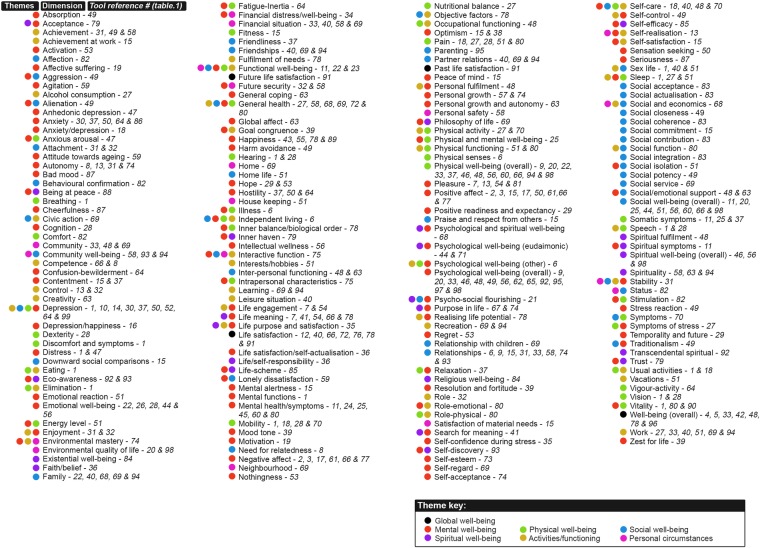
- 99 measures were included and 196 dimensions of well-being were identified; dimensions clustered around 6 key thematic domains: mental well-being, social well-being, physical well-being, spiritual well-being, activities and functioning, and personal circumstances, with a seventh set measuring global well-being overall.
- 67/99 instruments were multidimensional, containing on average 5 dimensions (range 1–15); 69% of dimensions (136/196) appeared in only one instrument. Recurring dimensions included psychological well-being overall (n=13), physical well-being overall (n=12), social well-being overall (n=9), depression (n=9), positive affect (n=8) and relationships (n=8).
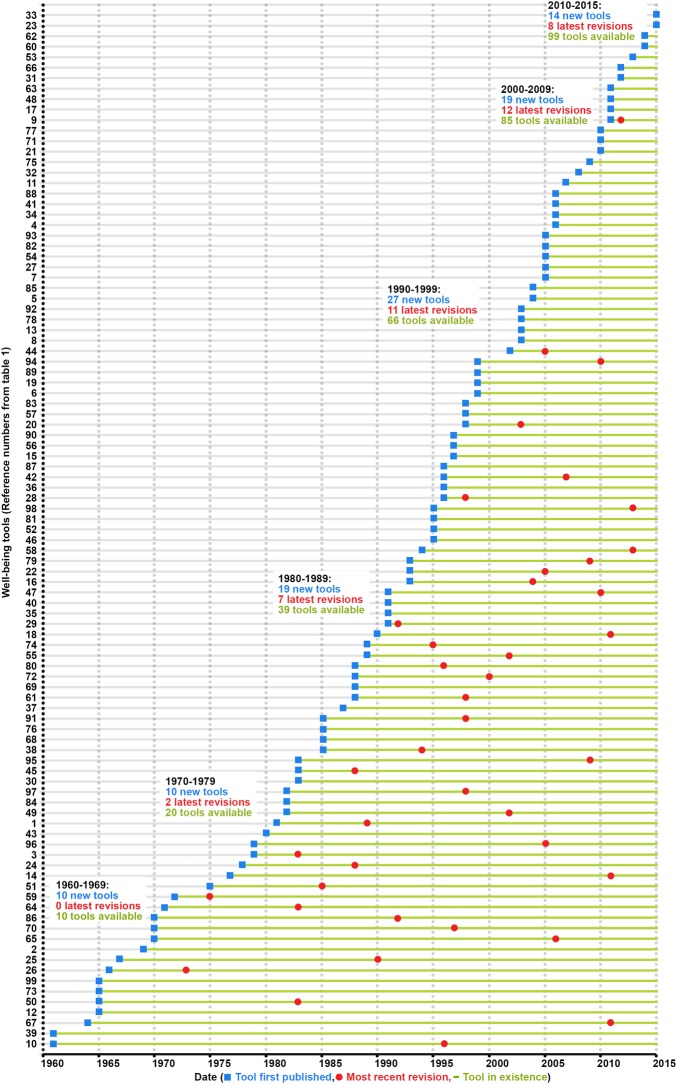
- The period 1990–1999 produced the greatest number of newly developed well-being instruments (n=27); since 2010, 14 new tools and 8 revisions had been published. The oldest instruments were from 1961 and the newest from 2015.
- The two most referenced theories were Diener’s model of subjective well-being and the WHO definition of health; however, authors were rarely explicit about how existing theories influenced their tool design. Compared with the largest review of the topic to date, this review contained an additional 40 instruments.
Methods
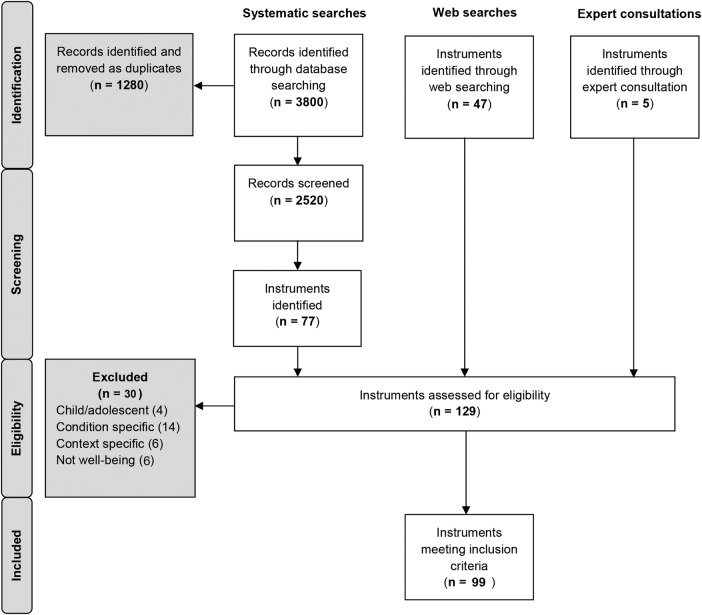
- Systematic searches were conducted in MEDLINE, EMBASE, EconLit, PsycINFO, Cochrane Library and CINAHL from 1993 to 2014, complemented by web searches and expert consultations through 2015; 2520 unique records were screened, 129 instruments assessed for eligibility, 30 excluded, and 99 included.
- Instruments were included if designed for adults (≥18 years), generic (non-disease or context-specific), available in English, and intended to assess well-being including concepts such as quality of life, happiness and wellness; disease-specific, context-specific, and child/adolescent instruments were excluded.
- Data extraction was undertaken by two reviewers, and dimensions were organised using thematic analysis in NVivo V.8, with discrepancies resolved through discussion with a third reviewer; results were synthesised narratively.
Limitations
- Stated in the paper: the review was limited to adult generic measures due to practical constraints, so condition-specific instruments and tools for children and adolescents were not included.
- Stated in the paper: the extensive literature, inconsistent phrasing and disorganisation make a definitive list of instruments unlikely; the review does not recommend any one specific instrument, and further research is needed on psychometric properties, especially content and construct validity.
- Evident from the text: the review does not assess the psychometric quality, validity or reliability of the included instruments; definitions of well-being and dimensions were often incomplete or unclear, and dimensions may overlap or be used inconsistently.
Model-written summary. Check it against the paper before relying on it.
Integrity signals
Registry
Cites
Statistics
Figures
Verification
Claims the paper makes
30 Own result · 21 Not checked yet · 20 No basis given · 12 Own interpretation · 6 Own method
A result the paper reports from its own data — it cites no other source for it, so there is none to check. The quote shows it is in the paper.
In the paper
“Authors were rarely explicit about how existing theories had influenced the design of their tools”
- Also stated in: § Instrument characteristics · plain
“In many cases, however, authors did not specify the theories that had influenced the design of their instrument.”
§ Review of 99 self-report measures for assessing well-being in adults: exploring dimensions of well-being and developments over time > Abstract > Results
plain- Asserted: passes — The authors put it forward as true.
- Checkable: passes — It can be checked against evidence.
- Load-bearing: unclear — It is unclear whether the paper’s conclusions depend on it.
- Based: passes — The paper gives a reason why it holds.
- Also stated in: § Instrument characteristics · plain
A result the paper reports from its own data — it cites no other source for it, so there is none to check. The quote shows it is in the paper.
In the paper
“Dimensions clustered around 6 key thematic domains: mental well-being, social well-being, physical well-being, spiritual well-being, activities and functioning, and personal circumstances.”
- Also stated in: § Dimensions linked to themes · plain
“The dimensions clustered around six key themes: ‘mental well-being’, ‘social well-being’, ‘physical well-being’, ‘spiritual well-being’, ‘personal circumstances’ and ‘activities and functioning’.”
§ Review of 99 self-report measures for assessing well-being in adults: exploring dimensions of well-being and developments over time > Abstract > Results
plaincorrelational- Asserted: passes — The authors put it forward as true.
- Checkable: passes — It can be checked against evidence.
- Load-bearing: passes — The paper’s conclusions depend on it.
- Based: passes — The paper gives a reason why it holds.
- Also stated in: § Dimensions linked to themes · plain
None of the sources cited for this claim have been checked yet.
In the paper
“the 2 most referenced theories were Diener's model of subjective well-being and the WHO definition of health.”
- Also stated in: § Instrument characteristics · plain
“The two theoretical influences most commonly reported in the literature were Diener's127 model of SWB and the WHO definition of health”
§ Review of 99 self-report measures for assessing well-being in adults: exploring dimensions of well-being and developments over time > Abstract > Results
What the sources say
- Not checked yetcites [127] source
- Not checked yetcites [128] World Health Organization. Constitution of the World Health Organization, as adopted by the International Health Conference, New York, 19–22 June 1946; signed on 22 July 1946 by the representatives of 61 States (Official Records of the World Health Organization, no. 2, p. 100) and entered into force on 7 April 1948. WHO, Geneva, Switzerland. 1948. Constitution of the World Health Organization. 2006. www.who.int/governance/eb/who_constitution_en.pdf
plain- Asserted: passes — The authors put it forward as true.
- Checkable: passes — It can be checked against evidence.
- Load-bearing: unclear — It is unclear whether the paper’s conclusions depend on it.
- Based: passes — The paper gives a reason why it holds.
- Also stated in: § Instrument characteristics · plain
A result the paper reports from its own data — it cites no other source for it, so there is none to check. The quote shows it is in the paper.
In the paper
“196 dimensions of well-being were identified within them.”
- Also stated in: § Dimensions of well-being · plain
“Across the 99 instruments identified, 196 different dimensions were found.”
§ Review of 99 self-report measures for assessing well-being in adults: exploring dimensions of well-being and developments over time > Abstract > Results
plain- Asserted: passes — The authors put it forward as true.
- Checkable: passes — It can be checked against evidence.
- Load-bearing: passes — The paper’s conclusions depend on it.
- Based: passes — The paper gives a reason why it holds.
- Also stated in: § Dimensions of well-being · plain
A result the paper reports from its own data — it cites no other source for it, so there is none to check. The quote shows it is in the paper.
In the paper
“A total of 99 measures of well-being were included”
- Also stated in: § Identification of instruments · plain
“Table 1 contains details on each of the 99 instruments included in the final review.”
§ Review of 99 self-report measures for assessing well-being in adults: exploring dimensions of well-being and developments over time > Abstract > Results
plain- Asserted: passes — The authors put it forward as true.
- Checkable: passes — It can be checked against evidence.
- Load-bearing: passes — The paper’s conclusions depend on it.
- Based: passes — The paper gives a reason why it holds.
- Also stated in: § Identification of instruments · plain
The paper states this without a source or data behind it here, so there is nothing to check it against. The quote shows it is in the paper.
In the paper
“Although hundreds of dimensions of well-being were identified, there was little differentiation between which were considered determinants of well-being, which were states of being well and which were consequences of a person's general health or well-being.”
§ Review of 99 self-report measures for assessing well-being in adults: exploring dimensions of well-being and developments over time > Results > Dimensions of well-being
plain- Asserted: passes — The authors put it forward as true.
- Checkable: passes — It can be checked against evidence.
- Load-bearing: passes — The paper’s conclusions depend on it.
- Based: passes — The paper gives a reason why it holds.
A result the paper reports from its own data — it cites no other source for it, so there is none to check. The quote shows it is in the paper.
In the paper
“Unidimensional instruments were most frequent measures of ‘well-being overall’, ‘happiness’ or ‘depression’.”
§ Review of 99 self-report measures for assessing well-being in adults: exploring dimensions of well-being and developments over time > Results > Dimensions of well-being
plain- Asserted: passes — The authors put it forward as true.
- Checkable: passes — It can be checked against evidence.
- Load-bearing: unclear — It is unclear whether the paper’s conclusions depend on it.
- Based: passes — The paper gives a reason why it holds.
A result the paper reports from its own data — it cites no other source for it, so there is none to check. The quote shows it is in the paper.
In the paper
“The period between 1990 and 1999 produced the greatest number of newly developed well-being instruments (n=27).”
- Also stated in: § Instrument characteristics · plain
“The 1990s provided the biggest period for the development of new tools (n=27).”
§ Review of 99 self-report measures for assessing well-being in adults: exploring dimensions of well-being and developments over time > Abstract > Results
plainn = 27- Asserted: passes — The authors put it forward as true.
- Checkable: passes — It can be checked against evidence.
- Load-bearing: unclear — It is unclear whether the paper’s conclusions depend on it.
- Based: passes — The paper gives a reason why it holds.
- Also stated in: § Instrument characteristics · plain
A result the paper reports from its own data — it cites no other source for it, so there is none to check. The quote shows it is in the paper.
In the paper
“Although the systematic searches were limited to 1993 and 2014, almost half of the instruments we identified during this time had been first developed in the decades prior to this period (44/99).”
§ Review of 99 self-report measures for assessing well-being in adults: exploring dimensions of well-being and developments over time > Results > Instrument characteristics
plain- Asserted: passes — The authors put it forward as true.
- Checkable: passes — It can be checked against evidence.
- Load-bearing: unclear — It is unclear whether the paper’s conclusions depend on it.
- Based: passes — The paper gives a reason why it holds.
A result the paper reports from its own data — it cites no other source for it, so there is none to check. The quote shows it is in the paper.
In the paper
“Of these, the most common dimension was ‘depression’ (found within 3/10 tools).”
§ Review of 99 self-report measures for assessing well-being in adults: exploring dimensions of well-being and developments over time > Results > Dimensions of well-being
plain- Asserted: passes — The authors put it forward as true.
- Checkable: passes — It can be checked against evidence.
- Load-bearing: unclear — It is unclear whether the paper’s conclusions depend on it.
- Based: passes — The paper gives a reason why it holds.
- Probably not a substantial claim. 44
- It may state two separate claims as one. 26
In the paper
“and psychological well-being was used as an alternative phrasing for mental health.74”
§ Review of 99 self-report measures for assessing well-being in adults: exploring dimensions of well-being and developments over time > Results > Definitions of well-being
What the sources say
- Not checked yetcites [74] source
plain- Asserted: passes — The authors put it forward as true.
- Checkable: passes — It can be checked against evidence.
- Load-bearing: fails — The paper’s conclusions may not depend on it.
- Based: passes — The paper gives a reason why it holds.
Probably not a substantial claim. The paper’s conclusions may not depend on it.
The paper states this without a source or data behind it here, so there is nothing to check it against. The quote shows it is in the paper.
In the paper
“However, classifying instruments by discipline proved impractical.”
§ Review of 99 self-report measures for assessing well-being in adults: exploring dimensions of well-being and developments over time > Results > Instrument characteristics
plain- Asserted: passes — The authors put it forward as true.
- Checkable: passes — It can be checked against evidence.
- Load-bearing: fails — The paper’s conclusions may not depend on it.
- Based: passes — The paper gives a reason why it holds.
Probably not a substantial claim. The paper’s conclusions may not depend on it.
A result the paper reports from its own data — it cites no other source for it, so there is none to check. The quote shows it is in the paper.
In the paper
“The majority of instruments were multidimensional (67/99), and on average contained 5 dimensions (range 1–15).”
§ Review of 99 self-report measures for assessing well-being in adults: exploring dimensions of well-being and developments over time > Results > Dimensions of well-being
plain- Asserted: passes — The authors put it forward as true.
- Checkable: passes — It can be checked against evidence.
- Load-bearing: unclear — It is unclear whether the paper’s conclusions depend on it.
- Based: passes — The paper gives a reason why it holds.
It may state two separate claims as one.
A result the paper reports from its own data — it cites no other source for it, so there is none to check. The quote shows it is in the paper.
In the paper
“From the identified publications, a total of 129 instruments were assessed for eligibility”
§ Review of 99 self-report measures for assessing well-being in adults: exploring dimensions of well-being and developments over time > Results > Identification of instruments
plain- Asserted: passes — The authors put it forward as true.
- Checkable: passes — It can be checked against evidence.
- Load-bearing: fails — The paper’s conclusions may not depend on it.
- Based: passes — The paper gives a reason why it holds.
Probably not a substantial claim. The paper’s conclusions may not depend on it.
A result the paper reports from its own data — it cites no other source for it, so there is none to check. The quote shows it is in the paper.
In the paper
“the oldest instruments identified were developed in 1961 (tool 39: LSI-A and tool 10 V.1: BDI) while the newest tools were developed in 2015 (tool 33: ICOPPE and tool 23: FWBS).”
§ Review of 99 self-report measures for assessing well-being in adults: exploring dimensions of well-being and developments over time > Results > Instrument characteristics
plain- Asserted: passes — The authors put it forward as true.
- Checkable: passes — It can be checked against evidence.
- Load-bearing: unclear — It is unclear whether the paper’s conclusions depend on it.
- Based: passes — The paper gives a reason why it holds.
It may state two separate claims as one.
A result the paper reports from its own data — it cites no other source for it, so there is none to check. The quote shows it is in the paper.
In the paper
“Since 2010, 14 new tools and 8 revisions have already been published.”
§ Review of 99 self-report measures for assessing well-being in adults: exploring dimensions of well-being and developments over time > Results > Instrument characteristics
plain- Asserted: passes — The authors put it forward as true.
- Checkable: passes — It can be checked against evidence.
- Load-bearing: unclear — It is unclear whether the paper’s conclusions depend on it.
- Based: passes — The paper gives a reason why it holds.
It may state two separate claims as one.
A result the paper reports from its own data — it cites no other source for it, so there is none to check. The quote shows it is in the paper.
In the paper
“30 of these instruments were excluded as they were either: designed for use in children/adolescents (4/30); explicitly designed for use in specific clinical conditions (14/30); designed for specific contexts (6/30) or were deemed by the review team to not be measures of well-being (6/30).”
§ Review of 99 self-report measures for assessing well-being in adults: exploring dimensions of well-being and developments over time > Results > Identification of instruments
plainn = 4- Asserted: passes — The authors put it forward as true.
- Checkable: passes — It can be checked against evidence.
- Load-bearing: unclear — It is unclear whether the paper’s conclusions depend on it.
- Based: passes — The paper gives a reason why it holds.
It may state two separate claims as one.
A result the paper reports from its own data — it cites no other source for it, so there is none to check. The quote shows it is in the paper.
In the paper
“The majority of measures contained multiple items (95/99), the largest containing 317 items (tool 78: SEQOL).”
§ Review of 99 self-report measures for assessing well-being in adults: exploring dimensions of well-being and developments over time > Results > Instrument characteristics
plain- Asserted: passes — The authors put it forward as true.
- Checkable: passes — It can be checked against evidence.
- Load-bearing: unclear — It is unclear whether the paper’s conclusions depend on it.
- Based: passes — The paper gives a reason why it holds.
It may state two separate claims as one.
A result the paper reports from its own data — it cites no other source for it, so there is none to check. The quote shows it is in the paper.
In the paper
“Most of the instruments used verbal questions (97/99), however two tools were pictorial (tool 12: CL and tool 96: WPS).”
§ Review of 99 self-report measures for assessing well-being in adults: exploring dimensions of well-being and developments over time > Results > Instrument characteristics
plain- Asserted: passes — The authors put it forward as true.
- Checkable: passes — It can be checked against evidence.
- Load-bearing: fails — The paper’s conclusions may not depend on it.
- Based: passes — The paper gives a reason why it holds.
Probably not a substantial claim. The paper’s conclusions may not depend on it. It may state two separate claims as one.
In the paper
“mental well-being and mental health were acknowledged as being used interchangeably throughout the literature,133”
§ Review of 99 self-report measures for assessing well-being in adults: exploring dimensions of well-being and developments over time > Results > Definitions of well-being
What the sources say
- Not checked yetcites [133] source
plain- Asserted: passes — The authors put it forward as true.
- Checkable: passes — It can be checked against evidence.
- Load-bearing: fails — The paper’s conclusions may not depend on it.
- Based: passes — The paper gives a reason why it holds.
Probably not a substantial claim. The paper’s conclusions may not depend on it.
None of the sources cited for this claim have been checked yet.
In the paper
“The subjective component of well-being was consistently divided into an ‘affective’ component concerned with emotions and a ‘cognitive’ component concerned with how people evaluate their own lives.50 109”
§ Review of 99 self-report measures for assessing well-being in adults: exploring dimensions of well-being and developments over time > Results > Definitions of well-being
What the sources say
plain- Asserted: passes — The authors put it forward as true.
- Checkable: passes — It can be checked against evidence.
- Load-bearing: fails — The paper’s conclusions may not depend on it.
- Based: passes — The paper gives a reason why it holds.
Probably not a substantial claim. The paper’s conclusions may not depend on it.
The paper states this without a source or data behind it here, so there is nothing to check it against. The quote shows it is in the paper.
In the paper
“Authors were generally inconsistent on whether happiness should be understood as synonymous with SWB, specifically the affective portion of SWB, or a separate concept in itself.”
§ Review of 99 self-report measures for assessing well-being in adults: exploring dimensions of well-being and developments over time > Results > Definitions of well-being
plain- Asserted: passes — The authors put it forward as true.
- Checkable: passes — It can be checked against evidence.
- Load-bearing: fails — The paper’s conclusions may not depend on it.
- Based: passes — The paper gives a reason why it holds.
Probably not a substantial claim. The paper’s conclusions may not depend on it.
The paper states this without a source or data behind it here, so there is nothing to check it against. The quote shows it is in the paper.
In the paper
“The difference between SWB and terms used synonymously seemed to be unclear.”
§ Review of 99 self-report measures for assessing well-being in adults: exploring dimensions of well-being and developments over time > Results > Definitions of well-being
hedged- Asserted: passes — The authors put it forward as true.
- Checkable: passes — It can be checked against evidence.
- Load-bearing: fails — The paper’s conclusions may not depend on it.
- Based: passes — The paper gives a reason why it holds.
Probably not a substantial claim. The paper’s conclusions may not depend on it.
The paper states this without a source or data behind it here, so there is nothing to check it against. The quote shows it is in the paper.
In the paper
“Finally, over the past 15 years, there have been significant efforts to contrast the many measures of ill health and unhappiness with measures of positive functioning and adaptation to negative circumstances.”
§ Review of 99 self-report measures for assessing well-being in adults: exploring dimensions of well-being and developments over time > Results > Instrument characteristics
plain- Asserted: passes — The authors put it forward as true.
- Checkable: passes — It can be checked against evidence.
- Load-bearing: fails — The paper’s conclusions may not depend on it.
- Based: passes — The paper gives a reason why it holds.
Probably not a substantial claim. The paper’s conclusions may not depend on it.
A result the paper reports from its own data — it cites no other source for it, so there is none to check. The quote shows it is in the paper.
In the paper
“In contrast, more favourable dimensions such as ‘positive affect’ (found within 8 tools) have gradually appeared within instruments over time”
§ Review of 99 self-report measures for assessing well-being in adults: exploring dimensions of well-being and developments over time > Results > Dimensions of well-being
plaincorrelationaln = 8- Asserted: passes — The authors put it forward as true.
- Checkable: passes — It can be checked against evidence.
- Load-bearing: unclear — It is unclear whether the paper’s conclusions depend on it.
- Based: passes — The paper gives a reason why it holds.
It may state two separate claims as one.
The paper states this without a source or data behind it here, so there is nothing to check it against. The quote shows it is in the paper.
In the paper
“Most instruments were developed by interdisciplinary teams.”
§ Review of 99 self-report measures for assessing well-being in adults: exploring dimensions of well-being and developments over time > Results > Instrument characteristics
plain- Asserted: passes — The authors put it forward as true.
- Checkable: passes — It can be checked against evidence.
- Load-bearing: fails — The paper’s conclusions may not depend on it.
- Based: passes — The paper gives a reason why it holds.
Probably not a substantial claim. The paper’s conclusions may not depend on it.
A result the paper reports from its own data — it cites no other source for it, so there is none to check. The quote shows it is in the paper.
In the paper
“The systematic search provided 2520 unique records after duplicates had been removed.”
§ Review of 99 self-report measures for assessing well-being in adults: exploring dimensions of well-being and developments over time > Results > Identification of instruments
plain- Asserted: passes — The authors put it forward as true.
- Checkable: passes — It can be checked against evidence.
- Load-bearing: fails — The paper’s conclusions may not depend on it.
- Based: passes — The paper gives a reason why it holds.
Probably not a substantial claim. The paper’s conclusions may not depend on it.
None of the sources cited for this claim have been checked yet.
In the paper
“Authors frequently quoted the WHO definition of health as ‘a state of complete physical, mental and social well-being, not merely the absence of a disease’.93 104”
§ Review of 99 self-report measures for assessing well-being in adults: exploring dimensions of well-being and developments over time > Results > Definitions of well-being
What the sources say
plain- Asserted: passes — The authors put it forward as true.
- Checkable: passes — It can be checked against evidence.
- Load-bearing: fails — The paper’s conclusions may not depend on it.
- Based: passes — The paper gives a reason why it holds.
Probably not a substantial claim. The paper’s conclusions may not depend on it.
In the paper
“Greater specificity was provided by definitions that partitioned well-being into a subjective domain, and a separate objective domain.42”
§ Review of 99 self-report measures for assessing well-being in adults: exploring dimensions of well-being and developments over time > Results > Definitions of well-being
What the sources say
- Not checked yetcites [42] source
plaindirect- Asserted: passes — The authors put it forward as true.
- Checkable: passes — It can be checked against evidence.
- Load-bearing: fails — The paper’s conclusions may not depend on it.
- Based: passes — The paper gives a reason why it holds.
Probably not a substantial claim. The paper’s conclusions may not depend on it.
In the paper
“SWB was noted as a synonym of happiness,116”
§ Review of 99 self-report measures for assessing well-being in adults: exploring dimensions of well-being and developments over time > Results > Definitions of well-being
What the sources say
- Not checked yetcites [116] source
plain- Asserted: passes — The authors put it forward as true.
- Checkable: passes — It can be checked against evidence.
- Load-bearing: fails — The paper’s conclusions may not depend on it.
- Based: passes — The paper gives a reason why it holds.
Probably not a substantial claim. The paper’s conclusions may not depend on it.
The paper states this without a source or data behind it here, so there is nothing to check it against. The quote shows it is in the paper.
In the paper
“Throughout the literature, incomplete and unclear definitions were provided.”
§ Review of 99 self-report measures for assessing well-being in adults: exploring dimensions of well-being and developments over time > Results > Definitions of well-being
plain- Asserted: passes — The authors put it forward as true.
- Checkable: passes — It can be checked against evidence.
- Load-bearing: fails — The paper’s conclusions may not depend on it.
- Based: passes — The paper gives a reason why it holds.
Probably not a substantial claim. The paper’s conclusions may not depend on it.
In the paper
“Broadly speaking, however, well-being was defined as a multidimensional construct.130”
§ Review of 99 self-report measures for assessing well-being in adults: exploring dimensions of well-being and developments over time > Results > Definitions of well-being
What the sources say
- Not checked yetcites [130] source
hedged- Asserted: passes — The authors put it forward as true.
- Checkable: passes — It can be checked against evidence.
- Load-bearing: fails — The paper’s conclusions may not depend on it.
- Based: passes — The paper gives a reason why it holds.
Probably not a substantial claim. The paper’s conclusions may not depend on it.
The paper states this without a source or data behind it here, so there is nothing to check it against. The quote shows it is in the paper.
In the paper
“As the instruments were attempting to measure well-being through self-reported means, little explanation was given regarding how objective well-being should be conceptualised.”
§ Review of 99 self-report measures for assessing well-being in adults: exploring dimensions of well-being and developments over time > Results > Definitions of well-being
plain- Asserted: passes — The authors put it forward as true.
- Checkable: passes — It can be checked against evidence.
- Load-bearing: fails — The paper’s conclusions may not depend on it.
- Based: passes — The paper gives a reason why it holds.
Probably not a substantial claim. The paper’s conclusions may not depend on it.
A result the paper reports from its own data — it cites no other source for it, so there is none to check. The quote shows it is in the paper.
In the paper
“Psychological well-being overall (n=13); physical well-being overall (n=12); social well-being overall (n=9); depression (n=9); positive affect (n=8) and relationships (n=8) appeared multiple times within the instruments examined.”
§ Review of 99 self-report measures for assessing well-being in adults: exploring dimensions of well-being and developments over time > Results > Dimensions of well-being
plainn = 13- Asserted: passes — The authors put it forward as true.
- Checkable: passes — It can be checked against evidence.
- Load-bearing: unclear — It is unclear whether the paper’s conclusions depend on it.
- Based: passes — The paper gives a reason why it holds.
It may state two separate claims as one.
A result the paper reports from its own data — it cites no other source for it, so there is none to check. The quote shows it is in the paper.
In the paper
“Instruments were named after key authors (11/99) such as the Rosenberg Self-Esteem Scale, academic affiliation (7/99) as with the Oxford Happiness Questionnaire or organisational affiliation (5/99) as with the WHO-5.”
§ Review of 99 self-report measures for assessing well-being in adults: exploring dimensions of well-being and developments over time > Results > Instrument characteristics
plain- Asserted: passes — The authors put it forward as true.
- Checkable: passes — It can be checked against evidence.
- Load-bearing: fails — The paper’s conclusions may not depend on it.
- Based: passes — The paper gives a reason why it holds.
Probably not a substantial claim. The paper’s conclusions may not depend on it. It may state two separate claims as one.
The paper states this without a source or data behind it here, so there is nothing to check it against. The quote shows it is in the paper.
In the paper
“However, the majority of the tools used five-point bipolar Likert scales.”
§ Review of 99 self-report measures for assessing well-being in adults: exploring dimensions of well-being and developments over time > Results > Instrument characteristics
plain- Asserted: passes — The authors put it forward as true.
- Checkable: passes — It can be checked against evidence.
- Load-bearing: fails — The paper’s conclusions may not depend on it.
- Based: passes — The paper gives a reason why it holds.
Probably not a substantial claim. The paper’s conclusions may not depend on it.
The paper states this without a source or data behind it here, so there is nothing to check it against. The quote shows it is in the paper.
In the paper
“The explicit difference between definitions of well-being and health appeared paradoxical.”
§ Review of 99 self-report measures for assessing well-being in adults: exploring dimensions of well-being and developments over time > Results > Definitions of well-being
hedged- Asserted: passes — The authors put it forward as true.
- Checkable: passes — It can be checked against evidence.
- Load-bearing: fails — The paper’s conclusions may not depend on it.
- Based: passes — The paper gives a reason why it holds.
Probably not a substantial claim. The paper’s conclusions may not depend on it.
The paper states this without a source or data behind it here, so there is nothing to check it against. The quote shows it is in the paper.
In the paper
“Unhelpfully, terms like functioning, welfare, wellness and satisfaction continue to be used interchangeably.”
§ Review of 99 self-report measures for assessing well-being in adults: exploring dimensions of well-being and developments over time > Discussion
plain- Asserted: passes — The authors put it forward as true.
- Checkable: passes — It can be checked against evidence.
- Load-bearing: fails — The paper’s conclusions may not depend on it.
- Based: fails — The paper may give no reason why it holds.
Probably not a substantial claim. The paper’s conclusions may not depend on it. The paper may give no reason why it holds.
A result the paper reports from its own data — it cites no other source for it, so there is none to check. The quote shows it is in the paper.
In the paper
“We have provided a detailed inventory of 99 generic measures of adult well-being, a timeline illustrating the development of these tools over the past 50 years and a thematically catalogued register of 196 available dimensions.”
§ Review of 99 self-report measures for assessing well-being in adults: exploring dimensions of well-being and developments over time > Discussion
plainn = 99- Asserted: passes — The authors put it forward as true.
- Checkable: passes — It can be checked against evidence.
- Load-bearing: passes — The paper’s conclusions depend on it.
- Based: passes — The paper gives a reason why it holds.
Probably not a substantial claim.
The paper states this without a source or data behind it here, so there is nothing to check it against. The quote shows it is in the paper.
In the paper
“The quantitative difference between some concepts such as happiness and emotional well-being, or life purpose and life meaning, remain unclear.”
§ Review of 99 self-report measures for assessing well-being in adults: exploring dimensions of well-being and developments over time > Discussion
plain- Asserted: passes — The authors put it forward as true.
- Checkable: passes — It can be checked against evidence.
- Load-bearing: passes — The paper’s conclusions depend on it.
- Based: fails — The paper may give no reason why it holds.
Probably not a substantial claim. The paper may give no reason why it holds.
The paper states this without a source or data behind it here, so there is nothing to check it against. The quote shows it is in the paper.
In the paper
“Short measures of global well-being, such as the Arizona Integrative Outcomes Scale (AIOS) or the WHO-5 provide quick global snapshots on well-being, while taking up very little time from participants.”
§ Review of 99 self-report measures for assessing well-being in adults: exploring dimensions of well-being and developments over time > Discussion
plaindirect- Asserted: passes — The authors put it forward as true.
- Checkable: passes — It can be checked against evidence.
- Load-bearing: fails — The paper’s conclusions may not depend on it.
- Based: fails — The paper may give no reason why it holds.
Probably not a substantial claim. The paper’s conclusions may not depend on it. The paper may give no reason why it holds. It may state two separate claims as one.
The paper states this without a source or data behind it here, so there is nothing to check it against. The quote shows it is in the paper.
In the paper
“our work highlights a diverse set of tools, many the products of cross-disciplinary collaborations that draw on influences across different schools of thought.”
§ Review of 99 self-report measures for assessing well-being in adults: exploring dimensions of well-being and developments over time > Discussion
plain- Asserted: passes — The authors put it forward as true.
- Checkable: passes — It can be checked against evidence.
- Load-bearing: unclear — It is unclear whether the paper’s conclusions depend on it.
- Based: passes — The paper gives a reason why it holds.
It may state two separate claims as one.
The paper states this without a source or data behind it here, so there is nothing to check it against. The quote shows it is in the paper.
In the paper
“In comparison, broader scoped instruments such as the Biopsychosocialspiritual Inventory (BIOPSSI) or the Mental Physical Spiritual Well-Being Scale (MPS) assess well-being separately across themes, and are thus able to provide a more comprehensive assessment.”
§ Review of 99 self-report measures for assessing well-being in adults: exploring dimensions of well-being and developments over time > Discussion
plaindirect- Asserted: passes — The authors put it forward as true.
- Checkable: passes — It can be checked against evidence.
- Load-bearing: fails — The paper’s conclusions may not depend on it.
- Based: passes — The paper gives a reason why it holds.
Probably not a substantial claim. The paper’s conclusions may not depend on it. It may state two separate claims as one.
The paper states this without a source or data behind it here, so there is nothing to check it against. The quote shows it is in the paper.
In the paper
“Other instruments assess more specific dimensions such as financial distress/well-being or social acceptance. These instruments are conceptually narrower and, as a result, are better equipped to facilitate more focused assessment.”
§ Review of 99 self-report measures for assessing well-being in adults: exploring dimensions of well-being and developments over time > Discussion
plaindirect- Asserted: passes — The authors put it forward as true.
- Checkable: passes — It can be checked against evidence.
- Load-bearing: fails — The paper’s conclusions may not depend on it.
- Based: passes — The paper gives a reason why it holds.
Probably not a substantial claim. The paper’s conclusions may not depend on it. It may state two separate claims as one.
A result the paper reports from its own data — it cites no other source for it, so there is none to check. The quote shows it is in the paper.
In the paper
“The majority of dimensions were linked to ‘mental well-being’, followed by ‘social well-being’ and ‘activities and functioning’.”
§ Review of 99 self-report measures for assessing well-being in adults: exploring dimensions of well-being and developments over time > Results > Dimensions linked to themes
plaincorrelational- Asserted: passes — The authors put it forward as true.
- Checkable: passes — It can be checked against evidence.
- Load-bearing: unclear — It is unclear whether the paper’s conclusions depend on it.
- Based: passes — The paper gives a reason why it holds.
It may state two separate claims as one.
A conclusion the paper draws from its own results — it cites no other source for it, so there is none to check. The quote shows it is in the paper.
In the paper
“This understanding blurs the boundaries between health and well-being.”
§ Review of 99 self-report measures for assessing well-being in adults: exploring dimensions of well-being and developments over time > Results > Definitions of well-being
plaindirect- Asserted: passes — The authors put it forward as true.
- Checkable: passes — It can be checked against evidence.
- Load-bearing: fails — The paper’s conclusions may not depend on it.
- Based: passes — The paper gives a reason why it holds.
Probably not a substantial claim. The paper’s conclusions may not depend on it.
None of the sources cited for this claim have been checked yet.
In the paper
“Although the biological, psychological, social, economic and spiritual dimensions of well-being have been acknowledged in the literature,22–24 the way in which they are operationalised as dimensions across measures of well-being is largely unstated.”
§ Review of 99 self-report measures for assessing well-being in adults: exploring dimensions of well-being and developments over time > Introduction
What the sources say
plain- Asserted: passes — The authors put it forward as true.
- Checkable: passes — It can be checked against evidence.
- Load-bearing: passes — The paper’s conclusions depend on it.
- Based: passes — The paper gives a reason why it holds.
It may state two separate claims as one.
A conclusion the paper draws from its own results — it cites no other source for it, so there is none to check. The quote shows it is in the paper.
In the paper
“As such, many measures of well-being resemble multidimensional measures of health.”
§ Review of 99 self-report measures for assessing well-being in adults: exploring dimensions of well-being and developments over time > Results > Definitions of well-being
plaincorrelational- Asserted: passes — The authors put it forward as true.
- Checkable: passes — It can be checked against evidence.
- Load-bearing: fails — The paper’s conclusions may not depend on it.
- Based: passes — The paper gives a reason why it holds.
Probably not a substantial claim. The paper’s conclusions may not depend on it.
In the paper
“Despite efforts by the Organisation for Economic Co-operation and Development (OECD) to formalise the measurement of well-being,25 not enough exhaustive advice is provided on how researchers can effectively use the many self-report instruments that have already been developed within existing literature.”
§ Review of 99 self-report measures for assessing well-being in adults: exploring dimensions of well-being and developments over time > Introduction
What the sources say
- Not checked yetcites [25] OECD. How's life? 2013. Paris: OECD Publishing, 2013.
plain- Asserted: passes — The authors put it forward as true.
- Checkable: fails — It may be too vague to check against evidence.
- Load-bearing: passes — The paper’s conclusions depend on it.
- Based: passes — The paper gives a reason why it holds.
Probably not a substantial claim. It may be too vague to check against evidence.
None of the sources cited for this claim have been checked yet.
In the paper
“Regardless, new tools continue to be developed in order to reflect differing perspectives,14 changing clinical needs15 and input from newly interested disciplines, such as public health.16”
§ Review of 99 self-report measures for assessing well-being in adults: exploring dimensions of well-being and developments over time > Introduction
What the sources say
- Not checked yetcites [14] Diener, 2010, New well-being measures: short scales to assess flourishing and positive and negative feelings, Soc Indicators Res source
- Not checked yetcites [15] Joseph, 2014, Positive functioning inventory: initial validation of a 12-item self-report measure of well-being, Psychol Wellbeing
- Not checked yetcites [16] Bann, 2012, Development and psychometric evaluation of the public health surveillance well-being scale, Qual Life Res source
plaindirect- Asserted: passes — The authors put it forward as true.
- Checkable: passes — It can be checked against evidence.
- Load-bearing: fails — The paper’s conclusions may not depend on it.
- Based: passes — The paper gives a reason why it holds.
Probably not a substantial claim. The paper’s conclusions may not depend on it.
None of the sources cited for this claim have been checked yet.
In the paper
“Previous reviews have highlighted some of the available tools.29–31 However, not all have used systematic methods for identifying measures.”
§ Review of 99 self-report measures for assessing well-being in adults: exploring dimensions of well-being and developments over time > Introduction
What the sources say
- Not checked yetcites [29] Schiaffino, 2003, Other measures of psychological well-being: the Affect Balance Scale (ABS), General Health Questionnaire (GHQ-12), Life Satisfaction Index-A (LSI-A), Rosenberg Self-Esteem Scale, Satisfaction with Life Scale (SWLS), and State-Trait Anxiety Index (STAI), Arthritis Care Res source
- Not checked yetcites [30] source
- Not checked yetcites [31] source
plain- Asserted: passes — The authors put it forward as true.
- Checkable: passes — It can be checked against evidence.
- Load-bearing: passes — The paper’s conclusions depend on it.
- Based: passes — The paper gives a reason why it holds.
It may state two separate claims as one.
In the paper
“Despite the continued development of new instruments, no universally accepted measure has emerged,13 in part because there are no agreed conceptual criteria concerning what an instrument should contain.”
§ Review of 99 self-report measures for assessing well-being in adults: exploring dimensions of well-being and developments over time > Introduction
What the sources say
- Not checked yetcites [13] source
plaindirect- Asserted: passes — The authors put it forward as true.
- Checkable: passes — It can be checked against evidence.
- Load-bearing: passes — The paper’s conclusions depend on it.
- Based: passes — The paper gives a reason why it holds.
It may state two separate claims as one.
In the paper
“Instruments are scattered across disciplines, inconsistently labelled, and the differences between them are unclear.18”
§ Review of 99 self-report measures for assessing well-being in adults: exploring dimensions of well-being and developments over time > Introduction
What the sources say
- Not checked yetcites [18] Gasper, 2010, Understanding the diversity of conceptions of well-being and quality of life, J Socio Econ source
plain- Asserted: passes — The authors put it forward as true.
- Checkable: passes — It can be checked against evidence.
- Load-bearing: passes — The paper’s conclusions depend on it.
- Based: passes — The paper gives a reason why it holds.
It may state two separate claims as one.
None of the sources cited for this claim have been checked yet.
In the paper
“Theories of well-being are problematic due to their vast numbers; for example, some investigators approach the topic from the perspective of basic human needs,10 while others examine the capabilities of individuals11 and multiple theories have been integrated into new hybrid approaches.12”
§ Review of 99 self-report measures for assessing well-being in adults: exploring dimensions of well-being and developments over time > Introduction
What the sources say
plain- Asserted: passes — The authors put it forward as true.
- Checkable: passes — It can be checked against evidence.
- Load-bearing: unclear — It is unclear whether the paper’s conclusions depend on it.
- Based: passes — The paper gives a reason why it holds.
It may state two separate claims as one.
What the paper did — it cites no source for this, so there is none to check. The quote shows it is in the paper.
In the paper
“The aim of the review was limited to adult generic measures due to practical constraints, and as a result condition-specific instruments and tools designed for use with children and adolescents were not included.”
§ Review of 99 self-report measures for assessing well-being in adults: exploring dimensions of well-being and developments over time > Abstract > Conclusions
plaindirect- Asserted: passes — The authors put it forward as true.
- Checkable: passes — It can be checked against evidence.
- Load-bearing: passes — The paper’s conclusions depend on it.
- Based: passes — The paper gives a reason why it holds.
Probably not a substantial claim. It may state two separate claims as one.
In the paper
“The spike in the number of instruments developed in the past 20 years in particular may have been influenced by the growing academic recognition that self-reported data produced by measures of well-being have demonstrable empirical and economic value.134”
§ Review of 99 self-report measures for assessing well-being in adults: exploring dimensions of well-being and developments over time > Discussion
What the sources say
- Not checked yetcites [134] source
hedgedconditional- Asserted: passes — The authors put it forward as true.
- Checkable: passes — It can be checked against evidence.
- Load-bearing: fails — The paper’s conclusions may not depend on it.
- Based: passes — The paper gives a reason why it holds.
Probably not a substantial claim. The paper’s conclusions may not depend on it.
A conclusion the paper draws from its own results — it cites no other source for it, so there is none to check. The quote shows it is in the paper.
In the paper
“The growth observed is likely due to increasing multidisciplinary interest in the topic.”
§ Review of 99 self-report measures for assessing well-being in adults: exploring dimensions of well-being and developments over time > Discussion
hedgedconditional- Asserted: passes — The authors put it forward as true.
- Checkable: fails — It may be too vague to check against evidence.
- Load-bearing: fails — The paper’s conclusions may not depend on it.
- Based: passes — The paper gives a reason why it holds.
Probably not a substantial claim. It may be too vague to check against evidence. The paper’s conclusions may not depend on it.
In the paper
“‘SWB’ may differ from health in that it inherently targets how individuals think and feel about the quality of their own lives.127”
§ Review of 99 self-report measures for assessing well-being in adults: exploring dimensions of well-being and developments over time > Discussion
What the sources say
- Not checked yetcites [127] source
hedged- Asserted: passes — The authors put it forward as true.
- Checkable: passes — It can be checked against evidence.
- Load-bearing: fails — The paper’s conclusions may not depend on it.
- Based: passes — The paper gives a reason why it holds.
Probably not a substantial claim. The paper’s conclusions may not depend on it.
A conclusion the paper draws from its own results — it cites no other source for it, so there is none to check. The quote shows it is in the paper.
In the paper
“Others developed many years ago may simply no longer be of value due to the ongoing development of newer instruments or because they are based on outdated theories.”
§ Review of 99 self-report measures for assessing well-being in adults: exploring dimensions of well-being and developments over time > Discussion
hedgedconditional- Asserted: passes — The authors put it forward as true.
- Checkable: fails — It may be too vague to check against evidence.
- Load-bearing: fails — The paper’s conclusions may not depend on it.
- Based: passes — The paper gives a reason why it holds.
Probably not a substantial claim. It may be too vague to check against evidence. The paper’s conclusions may not depend on it. It may state two separate claims as one.
A conclusion the paper draws from its own results — it cites no other source for it, so there is none to check. The quote shows it is in the paper.
In the paper
“It contains positive phenomena such as joy and social acceptance, negative phenomena such as anxiety and pain, subjective feelings and perceptions, and more ‘objective’ material circumstances or health states.”
§ Review of 99 self-report measures for assessing well-being in adults: exploring dimensions of well-being and developments over time > Discussion
plain- Asserted: passes — The authors put it forward as true.
- Checkable: passes — It can be checked against evidence.
- Load-bearing: passes — The paper’s conclusions depend on it.
- Based: passes — The paper gives a reason why it holds.
Probably not a substantial claim. It may state two separate claims as one.
What the paper did — it cites no source for this, so there is none to check. The quote shows it is in the paper.
In the paper
“The review team included academics with backgrounds in psychology (M-JL), economics (AM-L) and clinical medicine/public health (PD), helping to minimise disciplinary biases.”
§ Review of 99 self-report measures for assessing well-being in adults: exploring dimensions of well-being and developments over time > Methods > Thematic analysis
plaindirect- Asserted: passes — The authors put it forward as true.
- Checkable: passes — It can be checked against evidence.
- Load-bearing: fails — The paper’s conclusions may not depend on it.
- Based: passes — The paper gives a reason why it holds.
Probably not a substantial claim. The paper’s conclusions may not depend on it. It may state two separate claims as one.
What the paper did — it cites no source for this, so there is none to check. The quote shows it is in the paper.
In the paper
“Prior to the analysis, the review team (M-JL, AM-L and PD) examined the full set of dimensions and combined dimensions that were unanimously identified as being indistinguishable.”
§ Review of 99 self-report measures for assessing well-being in adults: exploring dimensions of well-being and developments over time > Methods > Thematic analysis
plain- Asserted: passes — The authors put it forward as true.
- Checkable: passes — It can be checked against evidence.
- Load-bearing: fails — The paper’s conclusions may not depend on it.
- Based: passes — The paper gives a reason why it holds.
Probably not a substantial claim. The paper’s conclusions may not depend on it.
A conclusion the paper draws from its own results — it cites no other source for it, so there is none to check. The quote shows it is in the paper.
In the paper
“Taken together, however, well-being should be understood as a multidimensional construct, reflecting themes that often overlap.”
§ Review of 99 self-report measures for assessing well-being in adults: exploring dimensions of well-being and developments over time > Discussion
plain- Asserted: passes — The authors put it forward as true.
- Checkable: fails — It may be too vague to check against evidence.
- Load-bearing: passes — The paper’s conclusions depend on it.
- Based: passes — The paper gives a reason why it holds.
Probably not a substantial claim. It may be too vague to check against evidence. It may state two separate claims as one.
A conclusion the paper draws from its own results — it cites no other source for it, so there is none to check. The quote shows it is in the paper.
In the paper
“It is unlikely that any search strategy could collate a definitive list of instruments; however, hopefully the broad approach taken in the current work is able to complement the selective reviews already in existence.”
§ Review of 99 self-report measures for assessing well-being in adults: exploring dimensions of well-being and developments over time > Discussion
hedged- Asserted: passes — The authors put it forward as true.
- Checkable: fails — It may be too vague to check against evidence.
- Load-bearing: passes — The paper’s conclusions depend on it.
- Based: passes — The paper gives a reason why it holds.
Probably not a substantial claim. It may be too vague to check against evidence.
A conclusion the paper draws from its own results — it cites no other source for it, so there is none to check. The quote shows it is in the paper.
In the paper
“For example, some of the measures available may be too similar to other instruments already in use.”
§ Review of 99 self-report measures for assessing well-being in adults: exploring dimensions of well-being and developments over time > Discussion
hedged- Asserted: passes — The authors put it forward as true.
- Checkable: passes — It can be checked against evidence.
- Load-bearing: fails — The paper’s conclusions may not depend on it.
- Based: fails — The paper may give no reason why it holds.
Probably not a substantial claim. The paper’s conclusions may not depend on it. The paper may give no reason why it holds.
A conclusion the paper draws from its own results — it cites no other source for it, so there is none to check. The quote shows it is in the paper.
In the paper
“The consistent rate at which new instruments have been developed suggests that continued growth can be expected.”
§ Review of 99 self-report measures for assessing well-being in adults: exploring dimensions of well-being and developments over time > Conclusion
hedgedconditional- Asserted: passes — The authors put it forward as true.
- Checkable: passes — It can be checked against evidence.
- Load-bearing: passes — The paper’s conclusions depend on it.
- Based: fails — The paper may give no reason why it holds.
Probably not a substantial claim. The paper may give no reason why it holds.
A conclusion the paper draws from its own results — it cites no other source for it, so there is none to check. The quote shows it is in the paper.
In the paper
“The evidence suggests that there is little consistent agreement on how well-being should be measured, how instruments should be designed or which dimensions should be included.”
§ Review of 99 self-report measures for assessing well-being in adults: exploring dimensions of well-being and developments over time > Discussion
hedgedn = 99- Asserted: passes — The authors put it forward as true.
- Checkable: passes — It can be checked against evidence.
- Load-bearing: passes — The paper’s conclusions depend on it.
- Based: passes — The paper gives a reason why it holds.
It may state two separate claims as one.
What the paper did — it cites no source for this, so there is none to check. The quote shows it is in the paper.
In the paper
“Coding was undertaken by two reviewers (M-JL and AM-L) and any discrepancies that arose were solved through discussion with the third member of the review team (PD).”
§ Review of 99 self-report measures for assessing well-being in adults: exploring dimensions of well-being and developments over time > Methods > Thematic analysis
plain- Asserted: passes — The authors put it forward as true.
- Checkable: passes — It can be checked against evidence.
- Load-bearing: fails — The paper’s conclusions may not depend on it.
- Based: passes — The paper gives a reason why it holds.
Probably not a substantial claim. The paper’s conclusions may not depend on it. It may state two separate claims as one.
What the paper did — it cites no source for this, so there is none to check. The quote shows it is in the paper.
In the paper
“Data extraction was undertaken by two reviewers (M-JL and AM-L).”
§ Review of 99 self-report measures for assessing well-being in adults: exploring dimensions of well-being and developments over time > Methods > Data extraction
plain- Asserted: passes — The authors put it forward as true.
- Checkable: passes — It can be checked against evidence.
- Load-bearing: fails — The paper’s conclusions may not depend on it.
- Based: passes — The paper gives a reason why it holds.
Probably not a substantial claim. The paper’s conclusions may not depend on it.
The paper relies on this without support.
Definitions of well-being often differ by discipline and are frequently confused with related topics such as health-related quality of life, happiness and wellness.
“For example, definitions of well-being often differ by discipline, and are frequently confused with related topics such as health-related quality of life, happiness and wellness.”
The paper relies on this without support.
Relatively little attention has been paid to how varying perspectives have influenced the development and range of well-being measurement instruments.
“However, relatively little attention has been paid to how these varying perspectives have influenced the development and range of well-being measurement instruments in existence.”
The paper relies on this without support.
Ambiguity is caused by variability in the dimensions of well-being used between instruments.
“Ambiguity is also caused by variability in the dimensions of well-being used between instruments.”
The paper relies on this without support.
There is no agency or group that oversees and coordinates the development and organisation of well-being measures.
“As with most domains of measurement, there is no agency or group that oversees and coordinates the development and organisation of well-being measures.”
The paper relies on this without support.
Many previous reviews focused on psychometric properties such as validity and reliability, but the tools themselves are typically listed without clear analysis of how their content differs.
“Many of the reviews to date have focused on psychometric properties such as validity and reliability; however, the tools themselves are typically listed without clear analysis of how their content differs.”
The paper relies on this without support.
The evolution of instruments over time and their theoretical underpinnings have not been described.
“Further, the evolution of instruments over time and their theoretical underpinnings have not been described.”
The paper relies on this without support.
What is a priority for measuring well-being in one discipline may not be a priority in another context.
“Further, what is a priority for measuring well-being in one discipline, such as health economics, may not be a priority in another context, such as clinical psychology.”
Claims other papers make about this one
Each is checked against this paper’s own text: does it say what the citing paper says it does?
The cited source says what the claim attributes to it.
In the citing paper
“The self-report measures identified by Linton et al. (2016) clustered around six key themes, with most measures capturing a few of the six types of wellbeing: mental well-being, social wellbeing, physical well-being, spiritual well-being, activities and functioning, and personal circumstances.”
From What do we know about interventions to improve educator wellbeing? A systematic literature review (2024) · cites this paper as Linton et al., 2016
The cited source says what the claim attributes to it.
In the citing paper
“A broad array of self-report measures of wellbeing exist, with one review identifying 99 measures (Linton et al., 2016).”
From What do we know about interventions to improve educator wellbeing? A systematic literature review (2024) · cites this paper as Linton et al., 2016
In the citing paper
“In addition, the SLR identified two prior reviews of ‘well-being’ scales (using a very broad definition of well-being that included quality of life, physical well-being, and health), which found 99 and 60 PROs respectively [6, 7].”
From Patient-reported outcome measures for life engagement in mental health: a systematic review (2022) · cites this paper as [6]
Self-check
Percentages, sums and reported differences re-computed from the paper’s own numbers.
Each contradiction between two passages listed here was confirmed by an independent check.
Rated minor: it would not touch a result — a value no result rests on, a p-value that stays on the same side of the significance level, or a conflict that is clerical, resolved elsewhere in the paper, or outside its own findings.
In the paper
§ Review of 99 self-report measures for assessing well-being in adults: exploring dimensions of well-being and developments over time > Results > Instrument characteristics
“the Warwick-Edinburgh Mental Well-being Scale (tool 96)”
§ Review of 99 self-report measures for assessing well-being in adults: exploring dimensions of well-being and developments over time > Results > Identification of instruments
“| 95. Warwick-Edinburgh Mental Well-Being Scale-Short | WEMWBS | 1983 | 2009122 | 7 | | ● | | | | | | | 96. Well-Being Picture Scale | WPS | 1979 | 2005123 | 10 | ● | | | | | | |”
Citations
Cites
Using thematic analysis in psychology
Braun, V., & Clarke, V. (2006) · Qualitative Research in Psychology · doi:10.1191/1478088706qp063oa · Cited by 194,414
Ryan, R. M., & Deci, E. L. (2000) · American Psychologist · doi:10.1037//0003-066x.55.1.68 · Cited by 54,599
The Hospital Anxiety and Depression Scale
Zigmond, A. S., & Snaith, R. P. (1983) · Acta Psychiatrica Scandinavica · doi:10.1111/j.1600-0447.1983.tb09716.x · Cited by 47,139
Preferred reporting items for systematic reviews and meta-analyses: the PRISMA Statement.
(2009) · PubMed Central · Cited by 44,859
Preferred reporting items for systematic reviews and meta-analyses: The PRISMA statement
Moher, D., Liberati, A., Tetzlaff, J., Altman, D. G., & the PRISMA Group* (2009) · Annals of Internal Medicine · doi:10.7326/0003-4819-151-4-200908180-00135 · Cited by 37,554
Development and validation of brief measures of positive and negative affect: The PANAS scales.
Watson, D., Clark, L. A., & Tellegen, A. (1988) · Journal of Personality and Social Psychology · doi:10.1037/0022-3514.54.6.1063 · Cited by 32,433
The satisfaction with life scale
Diener, E., Emmons, R. A., Larsen, R. J., & Griffin, S. (1985) · Journal of Personality Assessment · doi:10.1207/s15327752jpa4901_13 · Cited by 31,768
Society and the Adolescent Self-Image
Rosenberg, M. (1965) · doi:10.1515/9781400876136 · Cited by 30,126
Maslow, A. H. (1943) · Psychological Review · doi:10.1037/h0054346 · Cited by 21,563
Happiness is everything, or is it? Explorations on the meaning of psychological well-being.
Ryff, C. D. (1989) · Journal of Personality and Social Psychology · doi:10.1037/0022-3514.57.6.1069 · Cited by 14,847
Research works printed but not linked: 3
- Sintonen, 1989, A generic 15 dimensional measure of health-related quality of life (15D), J Soc Med, 26, 85
- Prawitz, 2006, InCharge financial distress/financial well-being scale: development, administration, and score interpretation, J Financ Counsel Plan, 17, 34
- World Health Organization. Constitution of the World Health Organization, as adopted by the International Health Conference, New York, 19–22 June 1946; signed on 22 July 1946 by the representatives of 61 States (Official Records of the World Health Organization, no. 2, p. 100) and entered into force on 7 April 1948. WHO, Geneva, Switzerland. 1948. Constitution of the World Health Organization. 2006. www.who.int/governance/eb/who_constitution_en.pdf
Cited by
Sorted by citations
Items 301–400 of 638
Sutton, A. (2023) · Journal of Individual Differences · doi:10.1027/1614-0001/a000408 · Cited by 5
Abdelmageed, S., Horak, V. J., Virtanen, P. S., Lam, S. K., Burchiel, K. J., & Raskin, J. S. (2024) · World Neurosurgery · doi:10.1016/j.wneu.2024.02.093 · Cited by 8
Using Well-Being Measurements to Enhance Clinical Practice
Vogt, D. S., Borowski, S. C., Etingen, B., Merker, V. L., Bokhour, B. G., & Kligler, B. (2024) · Medical Care · doi:10.1097/mlr.0000000000002072 · Cited by 5
Soraci, P., Bevan, N., Griffiths, M. D., Pisanti, R., Servidio, R. C., Ferrari, A., Bernardo, C. D., & Pakpour, A. H. (2024) · BMC Psychology · doi:10.1186/s40359-024-02177-8 · Cited by 5
Bishwajit, G., Huang, R., Etowa, J. B., & Tang, S. (2021) · Psychiatry International · doi:10.3390/psychiatryint2020013 · Cited by 5
Bigelow, T. M., Das, B., Gilfillan, B. H., Forziat‐Pytel, K., Galván, A., & Kim, S. R. (2021) · Journal of Creativity in Mental Health · doi:10.1080/15401383.2021.1924096 · Cited by 5
Medzo-M’engone, J. (2021) · Journal of Psychology in Africa · doi:10.1080/14330237.2021.1927334 · Cited by 7
Mohaghegh, F., Eslami, M., Dadfar, M., Lester, D., Ayten, A., Rashidizadeh, A., & Shirzad, F. (2022) · Mental Health Religion & Culture · doi:10.1080/13674676.2022.2051462 · Cited by 5
Gilbert, A. S., Eyler, A. A., Cesarone, G., Harris, J. K., Hayibor, L., & Evanoff, B. (2023) · Workplace Health & Safety · doi:10.1177/21650799221147814 · Cited by 7
Connecting to Zoos and Aquariums during a COVID-19 Lockdown
Macri, A. M., & Wells, D. L. (2023) · Journal of Zoological and Botanical Gardens · doi:10.3390/jzbg4020035 · Cited by 5
U-SMILE: a brief version of the Short Multidimensional Inventory on Lifestyle Evaluation
Boni, R. B. D., da Mota, J. C., Schuch, F. B., Pires, D. A., Matias, T. S., Monteiro-Júnior, R. S., Deslandes, A. C., da Silva, D. R. P., Moura, H. F., Coelho, N. L. G., et al. (2023) · Trends in Psychiatry and Psychotherapy · doi:10.47626/2237-6089-2023-0722 · Cited by 5
Wellbeing After Finalization of a Workers’ Compensation Claim: A Systematic Scoping Review
Weir, J., Fary, R. E., Gibson, M., Mitchell, T., Johnston, V., Wyatt, M., Guthrie, R., MYERS, B. J., & Beales, D. J. (2024) · Journal of Occupational Rehabilitation · doi:10.1007/s10926-023-10168-6 · Cited by 5
Urbina‐Garcia, A. (2024) · Journal of Happiness and Health · doi:10.47602/johah.v4i2.74 · Cited by 5
Chen, X., Hoek, G., Frijters, P., Dyer, G. M. C., Gössling, S., Khomenko, S., Khreis, H., Kolb, E., Mueller, N., Staatsen, B. A. M., et al. (2026) · Environment International · doi:10.1016/j.envint.2026.110067 · Cited by 4
Competing Models of the Structure of Subjective Well‐Being: Have All Won and Must All Have Prizes?
Jovanović, V. (2024) · Journal of Personality · doi:10.1111/jopy.12985 · Cited by 4
Sarwar, M., Ramos, R., Elahi, R., Yousaf, M., Badar, F., & Baka, M. A. (2020) · Asia-Pacific Journal of Oncology Nursing · doi:10.4103/apjon.apjon_7_20 · Cited by 4
The Lotus in the Mud: A Conceptual Model of Livestream Yoga Service Experience
Fitzgerald, S. H. M. (2021) · The ICT and Evolution of Work · doi:10.1007/978-981-33-4126-5_7 · Cited by 4
Történeti tabló a pozitív pszichológiai jóllét és mentális egészség elméletekről és előzményeikről
Zábó, V., Oláh, A., & Vargha, A. (2023) · Magyar Pszichológiai Szemle · doi:10.1556/0016.2023.00041 · Cited by 8
Gittins, H., Dandy, N., Wynne‐Jones, S., & Morrison, V. (2023) · Wellbeing Space and Society · doi:10.1016/j.wss.2023.100160 · Cited by 5
Development and testing of the Perceived Wellbeing in Outdoor Shared Spaces (PWOSS) scale
McDougall, C., Malden, S., Morrison, K., Mason, S., Williams, A. J., & Jepson, R. G. (2024) · Wellbeing Space and Society · doi:10.1016/j.wss.2024.100203 · Cited by 4
Conceptualising wellbeing among health-care workers during the Covid-19 pandemic
McHugh, J., Trotman, P., Nicholson, H. D., & Smith-Han, K. (2024) · Health An Interdisciplinary Journal for the Social Study of Health Illness and Medicine · doi:10.1177/13634593241279206 · Cited by 4
Brauchle, J., Unger, V., & Hochweber, J. (2025) · Frontiers in Education · doi:10.3389/feduc.2025.1518609 · Cited by 6
McGrath, M., Smith, J. P., Rattray, N. A., Lillie, A., Crow, S., Myers, L. J., Myers, J. L., Perkins, A. J., Wasmuth, S., Burns, D. S., et al. (2020) · Arts & Health · doi:10.1080/17533015.2020.1827277 · Cited by 7
Subgroups in Late Adulthood Are Associated With Cognition and Wellbeing Later in Life
Radhoe, T. A., van Rentergem, J. A. A., Kok, A. A. L., Huisman, M. A., & Geurts, H. M. (2021) · Frontiers in Psychology · doi:10.3389/fpsyg.2021.780575 · Cited by 4
Life Conditions as Mediators of Welfare State Effect on Mental Wellbeing among Oldest Old in Europe
Cresswell‐Smith, J., Wahlbeck, K., & Kalseth, J. (2022) · International Journal of Environmental Research and Public Health · doi:10.3390/ijerph19074363 · Cited by 4
Hughes, C. (2021) · Journal of Accounting and Finance · doi:10.33423/jaf.v21i3.4400 · Cited by 4
Rechsteiner, B., Compagnoni, M., Merki, K. M., & Wullschleger, A. (2022) · Frontiers in Psychology · doi:10.3389/fpsyg.2022.885616 · Cited by 4
de Plaza, M. A. P., Beleigoli, A. M. R., Brown, S., Bulto, L. N., Gebremichael, L. G., Nesbitt, K., Tieu, M., Pearson, V., Noonan, S., McMillan, P., et al. (2022) · JBI Evidence Synthesis · doi:10.11124/jbies-21-00410 · Cited by 4
Chukwuorji, J. C., & Osondu, O. M. (2023) · Journal of Psychological Research · doi:10.30564/jpr.v5i4.5907 · Cited by 4
Sindermann, C., Scholz, R. W., Löchner, N., Heinzelmann, R., & Montag, C. (2023) · International Journal of Human-Computer Interaction · doi:10.1080/10447318.2023.2278292 · Cited by 8
Grimard, C., Lapalme, V., Wagner-Lapierre, S., & Blank, S. (2024) · International Journal on Homelessness · doi:10.5206/ijoh.2023.3.16645 · Cited by 4
Anderson, J., Benton, J. S., Macintyre, V. G., Rothwell, J. J., & French, D. (2021) · Wellbeing Space and Society · doi:10.1016/j.wss.2021.100030 · Cited by 4
Urban Wellbeing in the Contemporary City
Biloria, N. M., Reddy, P., Fatimah, Y. A., & Mehta, D. (2019) · S.M.A.R.T. environments · doi:10.1007/978-3-030-12180-8_16 · Cited by 4
Wellbeing Among Older People: An Introduction
Appau, S., Churchill, S. A., & Farrell, L. (2020) · Springer eBooks · doi:10.1007/978-981-15-2353-3_1 · Cited by 4
Shore, C. B., Hubbard, G., Gorely, T., Hunter, A., & Galloway, S. (2021) · BMC Public Health · doi:10.1186/s12889-021-11094-z · Cited by 3
Ziegeler, B., D'Souza, W. J., Vinton, A., Mulukutla, S., Shaw, C. P., & Carne, R. P. (2022) · American Journal of Lifestyle Medicine · doi:10.1177/15598276221086584 · Cited by 4
Naehrig, D. N., Glozier, N., Klinner, C., Acland, L., Goodger, B. G., Hickie, I. B., & Milton, A. C. (2022) · BMJ Open · doi:10.1136/bmjopen-2021-058616 · Cited by 4
Close relationships and subjective well-being
Buijs, V. L. (2024) · University of Groningen research database (University of Groningen / Centre for Information Technology) · doi:10.33612/diss.916082280 · Cited by 4
Gerami, A., Foster, C., & Murphy, J. (2022) · International Journal of Environmental Research and Public Health · doi:10.3390/ijerph192416732 · Cited by 3
How Are You Doing… Really ? A Review of Whole Person Health Assessments
Gold, S. B., Costello, A., Gissen, M., Odman, S., Green, L. A., Stange, K. C., Rl, S., & Etz, R. (2025) · Milbank Quarterly · doi:10.1111/1468-0009.12727 · Cited by 5
Sgherza, T. R., Becerra, R., & Naragon‐Gainey, K. (2025) · Journal of Affective Disorders · doi:10.1016/j.jad.2025.119809 · Cited by 4
Rø, K. I., Hyldig, C. L., & Gjerde, P. B. (2026) · Scandinavian Journal of Primary Health Care · doi:10.1080/02813432.2026.2617516 · Cited by 3
The impact of COVID-19 on the well-being of funeral parlour employees
Ndelu, L., & Mtembu, V. N. (2023) · Corporate Governance and Organizational Behavior Review · doi:10.22495/cgobrv7i2sip6 · Cited by 3
Öğrencilerin Gözünden Sosyalleşme Alanları: Aidiyet Hissi ve Psikolojik İyi Oluşun Anahtarı
Yılmaz, C., & Ciftci, E. E. (2024) · Anadolu Üniversitesi Sosyal Bilimler Dergisi · doi:10.18037/ausbd.1321510 · Cited by 3
Floridi, G., Carrino, L., & Glaser, K. (2024) · European Societies · doi:10.1080/14616696.2024.2333515 · Cited by 3
Abortion and well-being: A narrative literature review
Coast, E., Nandagiri, R., Fry, A., Almada, M. D., Johnston, H. B., Atay, H., Ganatra, B., Lavelanet, A. F., Alhassan, N., Banke-Thomas, A. O., et al. (2024) · SSM - Qualitative Research in Health · doi:10.1016/j.ssmqr.2024.100508 · Cited by 3
Kelle, N., Bünning, M., & Simonson, J. (2025) · Social Indicators Research · doi:10.1007/s11205-025-03566-1 · Cited by 3
Music-Based Interventions for the Wellbeing of People in Prison: A Systematic Review
Roveda, A., Sydes, M. L., & Wood, W. R. (2025) · Victims & Offenders · doi:10.1080/15564886.2025.2470772 · Cited by 3
Emotional wellbeing in neurodivergent populations
Pincus, J. D., & Beller, K. (2025) · Frontiers in Psychology · doi:10.3389/fpsyg.2025.1606232 · Cited by 4
Proyer, R. T., & Wolf, A. (2017) · Elsevier eBooks · doi:10.1016/b978-0-12-809324-5.05590-5 · Cited by 3
Foong, A. L. S., Sow, C.-F., Ramasamy, S., & Yap, P. S. (2019) · International Journal of Medical Education · doi:10.5116/ijme.5c30.988d · Cited by 3
Hitz, S., Brann, E., Albertsson-Wikland, K. G., Schillmöller, Z., & Chaplin, J. E. (2018) · Journal of Well-Being Assessment · doi:10.1007/s41543-019-00016-x · Cited by 3
Integrated Mind/Body Care in Women’s Health
Batra, P. (2019) · Obstetrics and Gynecology Clinics of North America · doi:10.1016/j.ogc.2019.04.006 · Cited by 3
Valimaki, M. A., Hipp, K., Chen, J., Huang, X., Guo, J., & Wong, M. S. (2021) · BMJ Open · doi:10.1136/bmjopen-2021-054408 · Cited by 3
O QUE É BEM-ESTAR SUBJETIVO? ANÁLISE CRÍTICA DO ARTIGO SUBJECTIVE WELL-BEING DE ED DIENER
Sewaybricker, L. E., & Massola, G. M. (2022) · Psicologia & Sociedade · doi:10.1590/1807-0310/2022v34258310 · Cited by 3
The Teacher’s Wellbeing as a Binary Asset When Working with Newly Arrived Immigrant Pupils
Norozi, S. A., & Ness, O. (2023) · Education Sciences · doi:10.3390/educsci13080800 · Cited by 3
Library Support: Implications on Student Well-being
Samo, S. J. P., & Agcito, M. R. (2024) · British Journal of Multidisciplinary and Advanced Studies · doi:10.37745/bjmas.2022.0448 · Cited by 3
Kalaidjian, E., Kurth, M., Kucharski, J., Galaitsi, S., & Yeates, E. (2024) · Frontiers in Ecology and Evolution · doi:10.3389/fevo.2024.1271182 · Cited by 5
Kawabe, M., Moriyama, Y., Sugiyama, T., & Tamiya, N. (2024) · Archives of Gerontology and Geriatrics Plus · doi:10.1016/j.aggp.2024.100101 · Cited by 3
Bilecen, B. (2025) · KZfSS Kölner Zeitschrift für Soziologie und Sozialpsychologie · doi:10.1007/s11577-025-01027-8 · Cited by 3
Harrison, S. R., Garrido‐Cumbrera, M., Navarro‐Compán, V., Correa-Fernández, J., Webb, D., Christen, L., & Marzo‐Ortega, H. (2021) · Rheumatology Advances in Practice · doi:10.1093/rap/rkab098 · Cited by 3
Socialinio tinklo dydis, asmenybė ir gerovė prieš pensiją ir pensijoje
Jurkuvėnas, V., Zamalijeva, O., Pakalniškienė, V., Kairys, A., & Bagdonas, A. (2017) · Psichologija · doi:10.15388/psichol.2017.55.10733 · Cited by 5
Sook, L. J. (2019) · Journal of Digital Convergence · doi:10.14400/jdc.2019.17.7.235 · Cited by 3
The Handbook of Wellness Medicine
Snellings, J. E. (2021) · Family Medicine · doi:10.22454/fammed.2021.204951 · Cited by 3
Yan, X., Gao, Y., Zhang, H., Liang, C., Yu, H., Wang, L., Li, S., Li, Y., & Tong, H. (2022) · Frontiers in Psychology · doi:10.3389/fpsyg.2022.899880 · Cited by 3
Marquez, J., Humphrey, N., Black, L., Cutts, M., & Khanna, D. (2022) · doi:10.31235/osf.io/75xvd · Cited by 3
Practical application of the biopsychosocial model to medical care—Are we nearly there yet?
Sensky, T. (2024) · Acta Psychiatrica Scandinavica · doi:10.1111/acps.13681 · Cited by 3
Older Consumer Well-Being: A Life Course Perspective
Moschis, G. P., & Mathur, A. (2024) · International series on consumer science · doi:10.1007/978-3-031-59144-0_2 · Cited by 2
Farris, S., Zhang, L., Dempsey, N., McEwan, K., Hoyle, H. E., & Cameron, R. W. F. (2024) · Cities & Health · doi:10.1080/23748834.2024.2383825 · Cited by 2
Cebolla, A., Navarro-Siurana, J., Galante, J., Sarrión, P., Vidal, J., Fernández-Castilla, B., Lecuona, Ó., Vázquez, C., & Baños, R. M. (2025) · Applied Psychology: Health and Well-Being · doi:10.1111/aphw.70069 · Cited by 5
Noticing nature: The role of environmental awareness in promoting well‐being
Harries, B., Chalmin‐Pui, L. S., Gatersleben, B., Griffiths, A., & Ratcliffe, E. (2025) · People and Nature · doi:10.1002/pan3.70113 · Cited by 3
Sharma, A., Rautela, S., & Panackal, N. (2025) · Journal for the Study of Spirituality · doi:10.1080/20440243.2025.2530946 · Cited by 1
Belal, M., Luong, N., Aledavood, T., & Kulshrestha, J. (2025) · Journal of Medical Internet Research · doi:10.2196/78775 · Cited by 4
Wang, A., & Derakhshan, A. (2025) · Perceptual and Motor Skills · doi:10.1177/00315125251385739 · Cited by 3
Teulings, I. J. E., Deserno, M. K., Liu, J., Nes, R. B., Røysamb, E., Vittersø, J., & Bjørndal, L. D. (2026) · The Journal of Positive Psychology · doi:10.1080/17439760.2026.2651077 · Cited by 2
Servant, D., Drumez, É., Raynal, S., Demarty, A.-L., Salembier, A., Deschepper, M. H., Bizet, M. A., Pisanu-Zimny, A., Culem, J. B., Labreuche, J., et al. (2019) · Revue d Épidémiologie et de Santé Publique · doi:10.1016/j.respe.2019.05.011 · Cited by 4
محمود, س. ش. م., & زايد, أ. م. أ. (2021) · المجلة التربوية لکلية التربية بسوهاج · doi:10.21608/edusohag.2021.208700 · Cited by 2
Олефір, В. О., Боснюк, В. Ф., & Malofeikina, K. (2021) · Visnyk of V N Karazin Kharkiv National University A Series of Psychology · doi:10.26565/2225-7756-2021-71-04 · Cited by 2
In their own words: how has Covid-19 affected Jordanian translators’ wellbeing?
Mahadin, D. K., & Olimat, S. N. (2022) · The Translator · doi:10.1080/13556509.2022.2159284 · Cited by 2
Eum, K., Lee, S., Jo, M., & Doh, Y. Y. (2023) · Proceedings of the ACM on Human-Computer Interaction · doi:10.1145/3611038 · Cited by 2
Mendes, M., Simões, P. A., Simões, J. A., Santiago, L. M., Prazeres, F., & Maricoto, T. (2023) · Family Medicine & Primary Care Review · doi:10.5114/fmpcr.2023.130090 · Cited by 3
Geografía y segregación socioespacial urbana. Una mirada desde Iberoamérica
López, G. A., Cáceres, C. H. S., & Robaina, I. M. M. (2024) · Universidad de Burgos eBooks · doi:10.36443/9788418465635 · Cited by 2
Singha, R., & Singha, S. (2024) · Advances in medical technologies and clinical practice book series · doi:10.4018/979-8-3693-1123-3.ch004 · Cited by 2
Jónasdóttir, D., Ásgeirsdóttir, T. L., Thorsteinsdóttir, T., Mogensen, B., Lund, S. H., Arnarson, E. Ö., & Ashikali, E. (2024) · Journal of Aggression Maltreatment & Trauma · doi:10.1080/10926771.2024.2380519 · Cited by 2
Heinze, N., Davies, F., York, S., Chan, S. H.-Y., Farrell, D. P., & Gomes, R. S. M. (2024) · Frontiers in Psychology · doi:10.3389/fpsyg.2024.1395636 · Cited by 2
Funawatari, R., Sumiya, M., Iwabuchi, T., & Senju, A. (2024) · Brain Sciences · doi:10.3390/brainsci14100962 · Cited by 2
Wellbeing after finalisation of a workers’ compensation claim: a cross-sectional survey
Weir, J., Fary, R. E., Mitchell, T., Johnston, V., Wyatt, M., Guthrie, R., MYERS, B. J., & Beales, D. J. (2024) · Journal of Occupational and Environmental Medicine · doi:10.1097/jom.0000000000003264 · Cited by 2
Bueddefeld, J. N. H., Reining, C. E., Lavallee, L. F., Brady, R. M., Groulx, M. W., & Lemieux, C. J. (2025) · JMIR Research Protocols · doi:10.2196/63338 · Cited by 2
The relationship between tennis participation and wellbeing: a survey of 2287 adults
Stubbs, B., & Werneck, A. O. (2025) · International Journal of Racket Sports Science · doi:10.30827/ijrss.33250 · Cited by 2
Community Perspective on Pancreatic Enzyme Replacement Therapy in Cystic Fibrosis
Borowitz, D., Brooks, J. F., Aliaj, E., & Gallotto, D. (2022) · Journal of Pediatric Gastroenterology and Nutrition · doi:10.1097/mpg.0000000000003606 · Cited by 2
Teaching Well-Being Within the Context of Sport: The What, Why, How and for Whom!
Mack, D. E., Wilson, P. M., Kelley, C., & Mooradian, J. (2019) · Social indicators research series · doi:10.1007/978-3-030-21551-4_14 · Cited by 2
Perera, D. M., & Moe, J. L. (2020) · Cambridge University Press eBooks · doi:10.1017/9781108650182.005 · Cited by 2
Wellness Interventions in the Workplace
Chernoff, R. A. (2020) · Cambridge University Press eBooks · doi:10.1017/9781108650182.020 · Cited by 2
Sharma‐Brymer, V., Dashper, K. L., & Brymer, E. (2020) · Cambridge University Press eBooks · doi:10.1017/9781108650182.034 · Cited by 2
Wellbeing index avoiding scaling and weights
Chakrabartty, S. N. (2021) · Cultura Educación y Sociedad · doi:10.17981/cultedusoc.12.2.2021.11 · Cited by 2
Psychometric Properties of the Indonesian Version Students Well-Being Scale
Suranata, K., Rangka, I. B., Apriliana, I. P. A., Ifdil, I., Paramartha, W. E., & Dharsana, I. K. (2021) · Advances in Social Science, Education and Humanities Research/Advances in social science, education and humanities research · doi:10.2991/assehr.k.211222.002 · Cited by 2
Using Technology to Predict Leisure Activities and Quality of Life
Mušura, A., & Mikloušić, I. (2022) · Health informatics · doi:10.1007/978-3-030-94212-0_22 · Cited by 2
Chief Researcher of the Biomedical Study “Challenges of COVID-19 in Family Medicine”, L., Budrevičiūtė, A., Raila, G., Paukštaitienė, R., & Valius, L. (2022) · Journal of Family Medicine · doi:10.26420/jfammed.2022.1298 · Cited by 2
Saha, S. G., Rashid, M., Pandit, D., & Basu, S. (2022) · Ageing International · doi:10.1007/s12126-022-09506-5 · Cited by 2
Sewaybricker, L. E., & Massola, G. M. (2022) · Psicologia & Sociedade · doi:10.1590/1807-0310/2022v34258310-en · Cited by 2
Metadata
- Authors
- Linton, M.-J., Dieppe, P., & Medina-Lara, A.
- Affiliations
- University of Exeter (GB)
- Health Economics Group, University of Exeter, Exeter, UK
- Corresponding author
- Linton, Myles-Jay
- Venue
- BMJ Open
- Publisher
- BMJ
- Published
- 2016-07
- Volume
- 6
- Issue
- 7
- Pages
- e010641
- ISSN
- 2044-6055 (ISSN-L)
- PMC
- PMC4947747
- OpenAlex
- W2460276213
- Semantic Scholar
- 62658ff9d536a2117aed56f19b81b5688fa17d35
- Cited by
- 638
- References
- 141
- Citations by year
- 2026: 43 · 2025: 80 · 2024: 78 · 2023: 84 · 2022: 83 · 2021: 95 · 2020: 103 · 2019: 43 · 2018: 21 · 2017: 7 · 2016: 1
- FWCI
- 3.73
- Type
- journal article
- Language
- en
- Open access
- gold
- doi.org
- Licence
- cc-by-nc
- Locations
- BMJ Open (publishedVersion, cc-by-nc)
- Europe PMC (PubMed Central) (publishedVersion, cc-by-nc)
- PubMed Central (publishedVersion, cc-by-nc)
- PubMed (publishedVersion)
- Figshare (submittedVersion)
- HighWire Press Open Archive (submittedVersion)
- Open Research Exeter (University of Exeter) (submittedVersion, cc-by-nc)
- Explore Bristol Research (submittedVersion, cc-by)
- Bristol Research (University of Bristol) (submittedVersion, cc-by)
- Funders
- University of Exeter
- Topics
- Social Sciences › Psychology › Social Psychology › Psychological Well-being and Life Satisfaction
- Social Sciences › Decision Sciences › Management Science and Operations Research › Psychometric Methodologies and Testing
- Health Sciences › Health Professions › General Health Professions › Health, psychology, and well-being
- Keywords
- well-being, self-report measures, well-being dimensions, psychological well-being, social well-being, physical well-being, spiritual well-being, subjective well-being, WHO definition of health, instrument development, adults
- MeSH terms
- Activities of Daily Living, Health Status, Humans, Mental Health, Surveys and Questionnaires, Spirituality, Self Report
About these checks
Registry, retraction, Cites and statistics results are computed, not judged, with one exception: a printed reference that no index lists is read once by a model before it counts as a citation error. Claims are extracted by a model and kept only when their quote appears verbatim in the text; each cited source is then checked, with a model’s help, for whether it says what the claim relies on. Those verdicts can be wrong — read the claim’s quote and the cited source before relying on one.
A language model drew the claims from the paper on 2026-10-10, under version 3 of the claim definition (model deepseek-v4.1-flash, prompt extract-v3).
A second model labelled each claim on 2026-10-10 (model jev-1.13-20260917, definition revision gold-guideline-v0.2).
Statistics and arithmetic are recomputed, not judged.
Confidence bands are shown only for fields calibrated on our annotated test set. None is calibrated yet, so no band is shown.
What counts as a claim ›How we measure confidence ›How we check this ›
Are you an author, or do you see a problem with this page? Request a review
