

Effects of bright light therapy for depression during pregnancy: a randomised, double-blind controlled trial
Open accessThe DOI matches its Crossref record; 80 of the 83 references it cites were found in a registry or an index; 20 of the 67 sources its claims cite were checked for support.
Abstract
Objectives: Approximately 11%–13% of pregnant women suffer from depression. Bright light therapy (BLT) is a promising treatment, combining direct availability, sufficient efficacy, low costs and high safety for both mother and child. Here, we examined the effects of BLT on depression during pregnancy. Design: Randomised, double-blind controlled trial. Setting: Primary and secondary care in The Netherlands, from November 2016 to March 2019. Participants: 67 pregnant women (12–32 weeks gestational age) with a DSM-5 diagnosis of depressive disorder (Diagnostic and Statistical Manual of Mental Disorders). Interventions: Participants were randomly allocated to treatment with either BLT (9000 lux, 5000 K) or dim red light therapy (DRLT, 100 lux, 2700 K), which is considered placebo. For 6 weeks, both groups were treated daily at home for 30 min on awakening. Follow-up took place weekly during the intervention, after 6 weeks of therapy, 3 and 10 weeks after treatment and 2 months postpartum. Primary and secondary outcome measures: Depressive symptoms were measured primarily with the Structured Interview Guide for the Hamilton Depression Scale—Seasonal Affective Disorder. Secondary measures were the Hamilton Rating Scale for Depression and the Edinburgh Postnatal Depression Scale. Changes in rating scale scores of these questionnaires over time were analysed using generalised linear mixed models. Results: Median depression scores decreased by 40.6%–53.1% in the BLT group and by 50.9%–66.7% in the DRLT group. We found no statistically significant difference in symptom change scores between BLT and DRLT. Sensitivity and post-hoc analyses did not change our findings. Conclusions: Depressive symptoms of pregnant women with depression improved in both treatment arms. More research is necessary to determine whether these responses represent true treatment effects, non-specific treatment responses, placebo effects or a combination hereof. Trial registration number: NTR5476.
Overview
CoChat Summary
TL;DR
In this randomized, double-blind trial of 67 pregnant women with DSM-5 depressive disorder, 6 weeks of bright light therapy (9000 lux) did not outperform dim red light therapy (100 lux) for depressive symptoms. Symptoms improved substantially in both arms, and the authors conclude more research is needed to distinguish true treatment effects from nonspecific or placebo responses.
Key findings
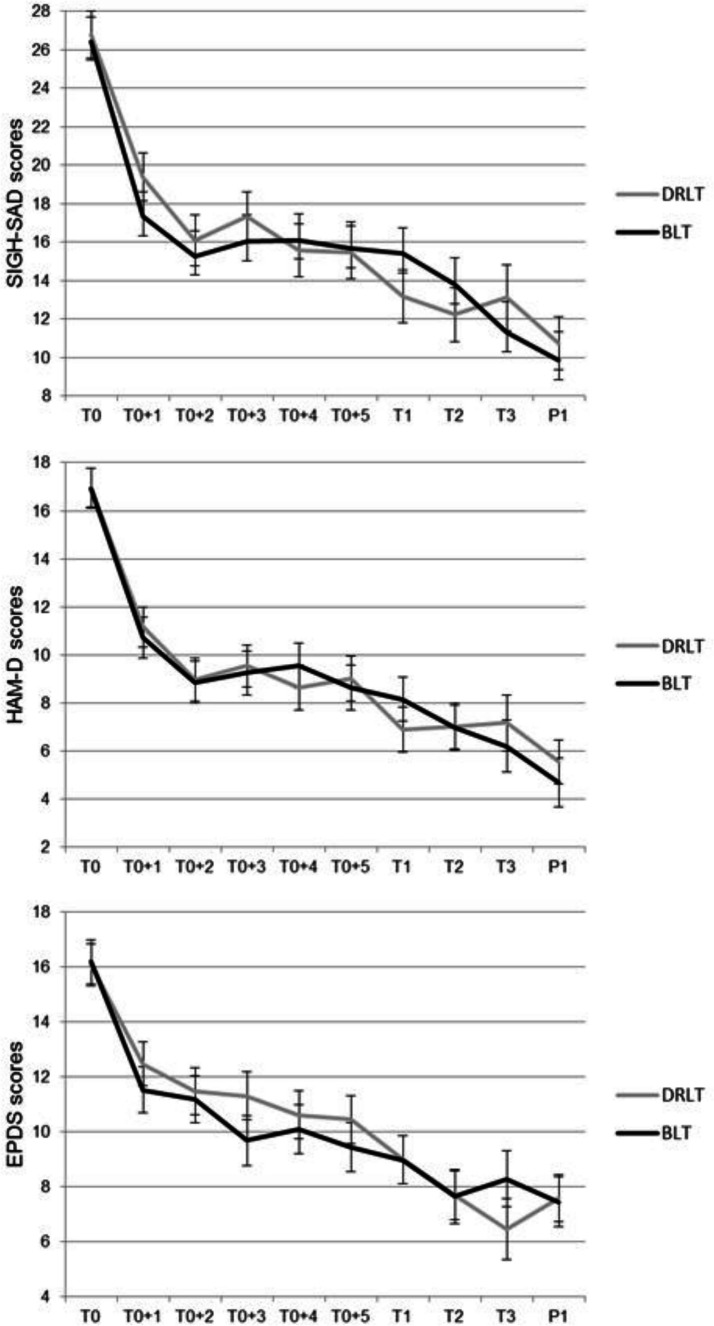
- No statistically significant difference was found between BLT and DRLT on the primary SIGH-SAD outcome: intervention-period β=−0.68 (95% CI −1.84 to 0.49); entire-study β=−0.16 (95% CI −0.82 to 0.51). Secondary HAM-D and EPDS outcomes were also null.
- Median depression scores decreased during the intervention by 42.6% (SIGH-SAD), 53.1% (HAM-D), and 40.6% (EPDS) in the BLT group, versus 50.9%, 66.7%, and 59.4% in the DRLT group; the abstract reports ranges of 40.6%–53.1% for BLT and 50.9%–66.7% for DRLT.
- Responder rates were 13 BLT vs 17 DRLT on HAM-D (p=0.46) and 11 vs 9 on EPDS (p=0.60). Side effects were not more common with BLT than DRLT (p=0.52); headaches were reported by 30.3% of BLT and 20.6% of DRLT participants.
- At 2 months postpartum, BLT showed no increase in EPDS scores, whereas DRLT showed an increase; SIGH-SAD and HAM-D scores decreased in both arms.
Methods
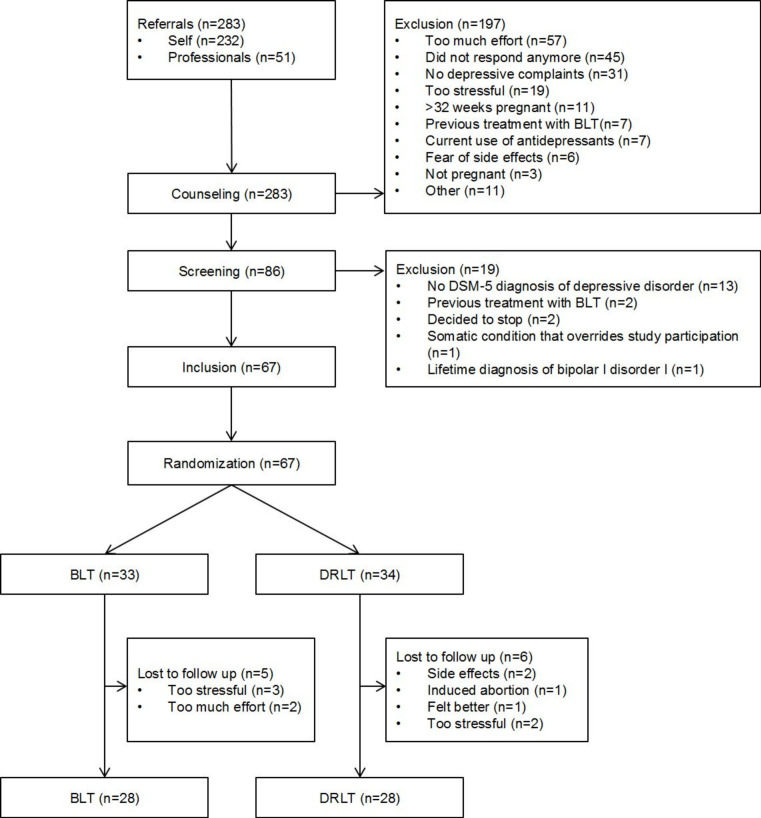
- Randomized, double-blind, placebo-controlled trial in primary and secondary care in The Netherlands from November 2016 to March 2019. Participants were 67 pregnant women at 12–32 weeks gestational age with a DSM-5 depressive disorder, randomized 1:1 to BLT (9000 lux, 5000 K) or DRLT (100 lux, 2700 K), 30 min daily on awakening for 6 weeks, with follow-up weekly during treatment, after treatment, and up to 2 months postpartum.
- Primary outcome was SIGH-SAD; secondary outcomes were 17-item HAM-D and EPDS. Changes over time were analyzed with general linear mixed models using intention-to-treat, including time, allocation, time×allocation, and baseline score; adjusted analyses used propensity scores, chronotype, and month of treatment, with sensitivity analyses using last observation carried forward and post-hoc analyses for compliance and baseline severity.
- The sample size calculation required 126 participants (63 per arm), and the study aimed to include 150; inclusion stopped at 67 due to limited resources.
Limitations
- Stated: an unforeseen lack of resources prevented inclusion of 150 participants, so the study could detect only large treatment effects; depressive symptoms were assessed by questionnaires rather than diagnostic criteria; psychiatric history was collected by interview rather than medical records, risking recall bias; several covariates were self-reported; and differential attrition occurred at 10 weeks after treatment and 2 months postpartum, though sensitivity analyses were reported as robust.
- Evident: the final sample of 67 was substantially below the planned 126–150, leaving it underpowered for small-to-medium effects; the field researcher who delivered the lamps was not blinded to allocation, although outcome assessors and the primary statistician were blinded; and treatment compliance was self-reported.
Model-written summary. Check it against the paper before relying on it.
Integrity signals
Registry
Cites
Statistics
Figures
Verification
Claims the paper makes
17 Valid · 2 Not valid · 27 Not checked · 86 Own results and interpretations
The cited sources support only part of this claim — read each source’s verdict below.
In the paper
“Children who are exposed to maternal depression during pregnancy have a higher risk of adverse birth outcomes, such as prematurity and being small for gestational age.9 10”
§ Effects of bright light therapy for depression during pregnancy: a randomised, double-blind controlled trial > Introduction
What the sources say
- Partly supportedcites [9] Grote NK, Bridge JA, Gavin AR, et al A meta-analysis of depression during pregnancy and the risk of preterm birth, low birth weight, and intrauterine growth restriction. Arch Gen Psychiatry 2010; 67: 1012– 24. 10.1001/archgenpsychiatry.2010.111 20921117 PMC3025772 sourceExperimental — accuracy not yet measured
The Results report that antenatal depression was significantly associated with preterm birth. But the same section found no significant association with intrauterine growth restriction, an outcome that the Methods say included small-for-gestational-age studies. The source therefore supports the prematurity example but not the claimed higher risk of being small for gestational age. (LLM, conf=0.92)
- Not checked — no full text of the sourcecites [10] Jarde A, Morais M, Kingston D, et al Neonatal outcomes in women with untreated antenatal depression compared with women without depression: a systematic review and meta-analysis. JAMA Psychiatry 2016; 73: 826-37. 10.1001/jamapsychiatry.2016.0934 27276520 source
plainstates an association- Asserted: passes — The authors put it forward as true.
- Checkable: passes — It can be checked against evidence.
- Load-bearing: passes — The paper’s conclusions depend on it.
- Based: passes — The paper gives a reason why it holds.
- Partly supported
The sources with a verdict support this claim; the rest weren’t checked yet, have no full text we could read, or their verdicts aren’t rated yet.
In the paper
“However, psychotherapy might not be readily available and the safety of maternal use of antidepressants, which cross the placenta, still remains to be established.”
§ Effects of bright light therapy for depression during pregnancy: a randomised, double-blind controlled trial > Introduction
What the sources say
- Supportedcites [20] Byatt N, Deligiannidis KM, Freeman MP Antidepressant use in pregnancy: a critical review focused on risks and controversies. Acta Psychiatr Scand 2013; 127: 94– 114. 10.1111/acps.12042 23240634 PMC4006272 source
The Clinical Importance of Results section (page unavailable) calls the evidence on the risks and benefits of antidepressant use in pregnancy inconclusive. The Later Pregnancy Controversies section (page unavailable) also reports that SSRIs and venlafaxine cross the placenta. Together, these passages support the attributed statement without implying that the drugs have been shown to be unsafe. (LLM, conf=0.91)
- Not checked — no full text of the sourcecites [21] Hanley GE, Oberlander TF The effect of perinatal exposures on the infant: antidepressants and depression. Best Pract Res Clin Obstet Gynaecol 2014; 28: 37– 48. 10.1016/j.bpobgyn.2013.09.001 24100223 source
plain- Asserted: passes — The authors put it forward as true.
- Checkable: passes — It can be checked against evidence.
- Load-bearing: passes — The paper’s conclusions depend on it.
- Based: passes — The paper gives a reason why it holds.
- Supported
The sources with a verdict support this claim; the rest weren’t checked yet, have no full text we could read, or their verdicts aren’t rated yet.
In the paper
“The use of antidepressants is controversial, because of potential teratogenicity.20 21”
§ Effects of bright light therapy for depression during pregnancy: a randomised, double-blind controlled trial > Introduction
What the sources say
- Supportedcites [20] Byatt N, Deligiannidis KM, Freeman MP Antidepressant use in pregnancy: a critical review focused on risks and controversies. Acta Psychiatr Scand 2013; 127: 94– 114. 10.1111/acps.12042 23240634 PMC4006272 source
The Introduction identifies conflicting reports about first-trimester teratogenicity as a controversy in antidepressant use during pregnancy. The Results section, “First Trimester Exposure: Is There Evidence of Teratogenicity?”, discusses the potential for congenital malformations while cautioning that risk estimates can be overstated. This supports the claim of potential risk, not a claim that teratogenicity is established. (LLM, conf=0.94)
- Not checked — no full text of the sourcecites [21] Hanley GE, Oberlander TF The effect of perinatal exposures on the infant: antidepressants and depression. Best Pract Res Clin Obstet Gynaecol 2014; 28: 37– 48. 10.1016/j.bpobgyn.2013.09.001 24100223 source
plainstates a possible cause- Asserted: passes — The authors put it forward as true.
- Checkable: passes — It can be checked against evidence.
- Load-bearing: passes — The paper’s conclusions depend on it.
- Based: passes — The paper gives a reason why it holds.
- Supported
The cited sources support only part of this claim — read each source’s verdict below.
In the paper
“Additionally, children of mothers with antepartum depression show more often cognitive, emotional and behavioural problems in childhood, adolescence and adulthood11 12”
§ Effects of bright light therapy for depression during pregnancy: a randomised, double-blind controlled trial > Introduction
What the sources say
- Partly supportedcites [11] Talge NM, Neal C, Glover V, et al Antenatal maternal stress and long-term effects on child neurodevelopment: how and why? J Child Psychol Psychiatry 2007; 48: 245– 61. 10.1111/j.1469-7610.2006.01714.x 17355398 PMC11016282 sourceExperimental — accuracy not yet measured
The copy’s Abstract reports that antenatal depression was associated with child behavioral problems, and its discussion of infant social/emotional outcomes links maternal depression symptoms to greater negative affect in infants. It does not establish that maternal depression is associated with all three types of problems—cognitive, emotional, and behavioral—across childhood, adolescence, and adulthood; the adolescent findings cited concern maternal anxiety, and no adult outcome is shown. (LLM, conf=0.87)
- Partly supportedcites [12] Hentges RF, Graham SA, Plamondon A, et al A developmental cascade from prenatal stress to child internalizing and Externalizing problems. J Pediatr Psychol 2019; 44: 1057– 67. 10.1093/jpepsy/jsz044 31166597 sourceExperimental — accuracy not yet measured
The Introduction (p. 1) links prenatal maternal depression, alongside stress and anxiety, to increased risk of ADHD, depression, and behavior problems. The study assesses child internalizing and externalizing problems at age five (Abstract, p. 1); it does not establish the claimed range of cognitive, emotional, and behavioural problems across childhood, adolescence, and adulthood. (LLM, conf=0.88)
plainstates an association- Asserted: passes — The authors put it forward as true.
- Checkable: passes — It can be checked against evidence.
- Load-bearing: passes — The paper’s conclusions depend on it.
- Based: passes — The paper gives a reason why it holds.
- Partly supported
Every source the paper cites for this claim was checked and supports it.
In the paper
“DRLT can be considered to be biologically inactive and thus as placebo treatment.46”
§ Effects of bright light therapy for depression during pregnancy: a randomised, double-blind controlled trial > Material and methods > Light therapy
What the sources say
- Supportedcites [46] Tuunainen A, Kripke DF, Endo T Light therapy for non-seasonal depression. Cochrane Database Syst Rev 2004: CD004050. 10.1002/14651858.CD004050.pub2 15106233 PMC6669243 source
The review's 'Types of interventions' section defines the comparison as bright light versus 'Inactive placebo treatment (dim light or other inactive treatment)', and 'Participants' states that 'Inactive placebo treatment was almost always dim light, mostly red (10 studies) and varied in intensity between 25 to 500 lux' — with included trials listing dim red light controls at 50 lux (Loving 2002) and 150 lux (Colombo 2000). The Background supplies the basis for calling such light inactive: the minimal intensity appearing necessary for an antidepressant effect is 2500 lux for two hours (or 10,000 lux for 30 minutes), far above these red-light controls. The only caveat is that the 2500-lux figure is drawn from seasonal affective disorder research (Tam 1995) rather than non-seasonal depression, and the review elsewhere stresses that patients were not blind to brightness — but neither contradicts the attribution that dim red light served as the inactive placebo control. (LLM, conf=0.85)
plain- Asserted: passes — The authors put it forward as true.
- Checkable: passes — It can be checked against evidence.
- Load-bearing: passes — The paper’s conclusions depend on it.
- Based: passes — The paper gives a reason why it holds.
- Supported
50 more claims · 5 with their cited sources checked
Create a free account to see all 132 claims and to verify the 3 references still open.
- Probably not a substantial claim. 50
- It may state two separate claims as one. 48
- The quote only partly states this claim. 2
Claims other papers make about this one
Each is checked against this paper’s own text: does it say what the citing paper says it does?
The cited source says what the claim attributes to it.
In the citing paper
“However, only a few studies have used BLT in either antenatal or postnatal depression, with overall promising but partly divergent findings. 4 , 5”
From Sustained remission from perinatal depression after bright light therapy: A pilot randomised, placebo‐controlled trial (2022) · cites this paper as [5]
The cited source says what the claim attributes to it.
In the citing paper
“Moreover, in contrast to previous studies, which used placebo lights in a range between 70 and 600 lux, 4 , 5 , 14 we adopted a low‐intensity control light, likely further differentiating the neurobiological effects of the experimental light interventions.”
From Sustained remission from perinatal depression after bright light therapy: A pilot randomised, placebo‐controlled trial (2022) · cites this paper as [5]
Self-check
Percentages, sums and reported differences re-computed from the paper’s own numbers.
Rated minor: it would not touch a result — a value no result rests on, a p-value that stays on the same side of the significance level, or a conflict that is clerical, resolved elsewhere in the paper, or outside its own findings.
In the paper
“| Other | 6 (19.2%) | 8 (33.5%) |”
§ Effects of bright light therapy for depression during pregnancy: a randomised, double-blind controlled trial > Results > Demographic and clinical characteristics
Reported 19.2 · recomputed 18.181818
Rated minor: it would not touch a result — a value no result rests on, a p-value that stays on the same side of the significance level, or a conflict that is clerical, resolved elsewhere in the paper, or outside its own findings.
In the paper
“| Other | 6 (19.2%) | 8 (33.5%) |”
§ Effects of bright light therapy for depression during pregnancy: a randomised, double-blind controlled trial > Results > Demographic and clinical characteristics
Reported 33.5 · recomputed 23.529412
Rated minor: it would not touch a result — a value no result rests on, a p-value that stays on the same side of the significance level, or a conflict that is clerical, resolved elsewhere in the paper, or outside its own findings.
In the paper
“| Psychotherapy | 14 (48.5%) | 16 (47.1%) |”
§ Effects of bright light therapy for depression during pregnancy: a randomised, double-blind controlled trial > Results > Demographic and clinical characteristics
Reported 48.5 · recomputed 42.424242
Citations
Cites
Detection of Postnatal Depression: Development of the 10-item Edinburgh Postnatal Depression Scale
Cox, J. L., Holden, J. M., & Sagovsky, R. (1987) · British Journal of Psychiatry · doi:10.1192/bjp.150.6.782 · Cited by 14,183
CONSORT 2010 Statement: updated guidelines for reporting parallel group randomised trials
the CONSORT Group, Schulz, K. F., Altman, D. G., & Moher, D. (2010) · BMC Medicine · doi:10.1186/1741-7015-8-18 · Cited by 13,371
Why Most Published Research Findings Are False
Ioannidis, J. P. A. (2005) · PLoS Medicine · doi:10.1371/journal.pmed.0020124 · Cited by 10,505
CONSORT 2010 Statement: updated guidelines for reporting parallel group randomised trials
Schulz, K. F., Altman, D. G., Moher, D., & for the CONSORT Group (2010) · BMJ · doi:10.1136/bmj.c332 · Cited by 9,329
Why Most Published Research Findings Are False
Ioannidis, J. P. A. (2005) · CHANCE · doi:10.1080/09332480.2005.10722754 · Cited by 4,702
The effect of mindfulness based therapy on anxiety and depression: A meta analytic review
Hofmann, S. G., Sawyer, A. T., Witt, A. A., & Oh, D. (2010) · Journal of Consulting and Clinical Psychology · doi:10.1037/a0018555 · Cited by 3,846
Life between Clocks: Daily Temporal Patterns of Human Chronotypes
Roenneberg, T., Wirz-Justice, A., & Merrow, M. (2003) · Journal of Biological Rhythms · doi:10.1177/0748730402239679 · Cited by 2,662
Mindfulness-based therapy: a comprehensive meta-analysis
Khoury, B., Lecomte, T., Fortin, G., Masse, M., Therien, P., Bouchard, V., Chapleau, M.-A., Paquin, K., & Hofmann, S. G. (2013) · Clinical Psychology Review · doi:10.1016/j.cpr.2013.05.005 · Cited by 2,003
Grote, N. K., Bridge, J. A., Gavin, A. R., Melville, J. L., Iyengar, S., & Katon, W. J. (2010) · Archives of General Psychiatry · doi:10.1001/archgenpsychiatry.2010.111 · Cited by 1,882
A systematic review and meta-regression of the prevalence and incidence of perinatal depression
Woody, C. A., Ferrari, A. J., Siskind, D. J., Whiteford, H. A., & Harris, M. G. (2017) · Journal of Affective Disorders · doi:10.1016/j.jad.2017.05.003 · Cited by 1,577
Antenatal maternal stress and long‐term effects on child neurodevelopment: how and why?
Talge, N. M., Neal, C., Glover, V., & the Early Stress, T. R. A. P. S. N. F. A. N. E. O. C. A. A. M. H. (2007) · Journal of Child Psychology and Psychiatry · doi:10.1111/j.1469-7610.2006.01714.x · Cited by 1,349
Risk factors for depressive symptoms during pregnancy: a systematic review
Lancaster, C. A., Gold, K. J., Flynn, H. A., Yoo, H., Marcus, S. M., & Davis, M. M. (2010) · American Journal of Obstetrics and Gynecology · doi:10.1016/j.ajog.2009.09.007 · Cited by 1,208
Zeitzer, J. M., Dijk, D., Kronauer, R. E., Brown, E. N., & Czeisler, C. A. (2000) · The Journal of Physiology · doi:10.1111/j.1469-7793.2000.00695.x · Cited by 1,175
Light as a central modulator of circadian rhythms, sleep and affect
LeGates, T. A., Fernandez, D. C., & Hattar, S. (2014) · Nature Reviews Neuroscience · doi:10.1038/nrn3743 · Cited by 1,001
Antenatal risk factors for postnatal depression: A large prospective study
Milgrom, J., Gemmill, A. W., Bilszta, J. L., Hayes, B., Barnett, B., Brooks, J., Ericksen, J., Ellwood, D., & Buist, A. (2008) · Journal of Affective Disorders · doi:10.1016/j.jad.2007.10.014 · Cited by 953
Golden, R. N., Gaynes, B. N., Ekstrom, R. D., Hamer, R. M., Jacobsen, F. M., Suppes, T., Wisner, K. L., & Nemeroff, C. B. (2005) · American Journal of Psychiatry · doi:10.1176/appi.ajp.162.4.656 · Cited by 896
Effects of light on human circadian rhythms, sleep and mood
Blume, C., Garbazza, C., & Spitschan, M. (2019) · Somnologie · doi:10.1007/s11818-019-00215-x · Cited by 695
Circadian rhythm disturbances in depression
Germain, A., & Kupfer, D. J. (2008) · Human Psychopharmacology: Clinical and Experimental · doi:10.1002/hup.964 · Cited by 644
Jarde, A., Morais, M., Kingston, D., Giallo, R., MacQueen, G. M., Giglia, L., Beyene, J., Wang, Y., & McDonald, S. D. (2016) · JAMA Psychiatry · doi:10.1001/jamapsychiatry.2016.0934 · Cited by 616
Validation of the Edinburgh Depression Scale during pregnancy
Bergink, V., Kooistra, L., Lambregtse-van den Berg, M. P., Wijnen, H., Bunevicius, R., van Baar, A., & Pop, V. (2011) · Journal of Psychosomatic Research · doi:10.1016/j.jpsychores.2010.07.008 · Cited by 601
Pearson, R. M., Evans, J., Kounali, D., Lewis, G., Heron, J., Ramchandani, P. G., O’Connor, T. G., & Stein, A. (2013) · JAMA Psychiatry · doi:10.1001/jamapsychiatry.2013.2163 · Cited by 589
Prenatal stress and the programming of the HPA axis
Glover, V., O’Connor, T. G., & O’Donnell, K. (2010) · Neuroscience & Biobehavioral Reviews · doi:10.1016/j.neubiorev.2009.11.008 · Cited by 567
Increasing use of antidepressants in pregnancy
Cooper, W. O., Willy, M. E., Pont, S. J., & Ray, W. A. (2007) · American Journal of Obstetrics and Gynecology · doi:10.1016/j.ajog.2007.01.033 · Cited by 458
GLIMMPSE : Online Power Computation for Linear Models with and without a Baseline Covariate
Kreidler, S. M., Muller, K. E., Grunwald, G. K., Ringham, B. M., Coker-Dukowitz, Z., Sakhadeo, U. R., Baron, A. E., & Glueck, D. H. (2013) · Journal of Statistical Software · doi:10.18637/jss.v054.i10 · Cited by 399
Vieten, C., & Astin, J. (2008) · Archives of Women's Mental Health · doi:10.1007/s00737-008-0214-3 · Cited by 369
Meta-analysis of the placebo response in antidepressant trials.
Rief, W., Nestoriuc, Y., Weiss, S., Welzel, E., Barsky, A. J., & Hofmann, S. G. (2009) · Journal of Affective Disorders · doi:10.1016/j.jad.2009.01.029 · Cited by 346
Bockting, C. L., Hollon, S. D., Jarrett, R. B., Kuyken, W., & Dobson, K. (2015) · Clinical Psychology Review · doi:10.1016/j.cpr.2015.02.003 · Cited by 295
Kieler, H., Artama, M., Engeland, A., Ericsson, O., Furu, K., Gissler, M., Nielsen, R. B., Norgaard, M., Stephansson, O., Valdimarsdottir, U., et al. (2011) · BMJ · doi:10.1136/bmj.d8012 · Cited by 277
Seth, S., Lewis, A. J., & Galbally, M. (2016) · BMC Pregnancy and Childbirth · doi:10.1186/s12884-016-0915-y · Cited by 266
Lieverse, R., Van Someren, E. J. W., Nielen, M. M. A., Uitdehaag, B. M. J., Smit, J. H., & Hoogendijk, W. J. G. (2011) · Archives of General Psychiatry · doi:10.1001/archgenpsychiatry.2010.183 · Cited by 261
Self-citationLight therapy for non-seasonal depression
Tuunainen, A., Kripke, D. F., & Endo, T. (2004) · Cochrane Database of Systematic Reviews · doi:10.1002/14651858.cd004050.pub2 · Cited by 261
Perinatal depression—The fourth inflammatory morbidity of pregnancy?
Osborne, L. M., & Monk, C. (2013) · Psychoneuroendocrinology · doi:10.1016/j.psyneuen.2013.03.019 · Cited by 255
A Randomized, Double-Blind, Placebo-Controlled Study of Light Therapy for Antepartum Depression
Wirz-Justice, A., Bader, A., Frisch, U., Stieglitz, R.-D., Alder, J., Bitzer, J., Hösli, I., Jazbec, S., Benedetti, F., Terman, M., et al. (2011) · The Journal of Clinical Psychiatry · doi:10.4088/jcp.10m06188blu · Cited by 241
Evening types are prone to depression
Merikanto, I., Lahti, T., Kronholm, E., Peltonen, M., Laatikainen, T., Vartiainen, E., Salomaa, V., & Partonen, T. (2013) · Chronobiology International · doi:10.3109/07420528.2013.784770 · Cited by 237
Zijlmans, M. A. C., Riksen-Walraven, J. M., & de Weerth, C. (2015) · Neuroscience & Biobehavioral Reviews · doi:10.1016/j.neubiorev.2015.02.015 · Cited by 221
Räisänen, S., Lehto, S. M., Nielsen, H. S., Gissler, M., Kramer, M. R., & Heinonen, S. (2014) · BMJ Open · doi:10.1136/bmjopen-2014-004883 · Cited by 221
Perinatal Antidepressant Use: Understanding Women’s Preferences and Concerns
BATTLE, C. L., SALISBURY, A. L., SCHOFIELD, C. A., & ORTIZ-HERNANDEZ, S. (2013) · Journal of Psychiatric Practice · doi:10.1097/01.pra.0000438183.74359.46 · Cited by 216
Posternak, M. A., & Miller, I. (2001) · Journal of Affective Disorders · doi:10.1016/s0165-0327(00)00304-9 · Cited by 215
An Open Trial of Morning Light Therapy for Treatment of Antepartum Depression
Oren, D. A., Wisner, K. L., Spinelli, M., Epperson, C. N., Peindl, K. S., Terman, J. S., & Terman, M. (2002) · American Journal of Psychiatry · doi:10.1176/appi.ajp.159.4.666 · Cited by 197
Seasonal Affective Disorder: An Overview: REVIEW
Magnusson, A., & Boivin, D. (2003) · Chronobiology International · doi:10.1081/cbi-120019310 · Cited by 196
Pathophysiology of seasonal affective disorder: a review.
(2000) · PubMed Central · Cited by 190
Bright light therapy for nonseasonal depression: meta-analysis of clinical trials
Al-Karawi, D., & Jubair, L. (2016) · Journal of Affective Disorders · doi:10.1016/j.jad.2016.03.016 · Cited by 189
Prevalence and patterns of antidepressant drug use during pregnancy
Ververs, T., Kaasenbrood, H., Visser, G., Schobben, F., de Jong-van den Berg, L., & Egberts, T. (2006) · European Journal of Clinical Pharmacology · doi:10.1007/s00228-006-0177-0 · Cited by 174
Circadian preference links to depression in general adult population
Merikanto, I., Kronholm, E., Peltonen, M., Laatikainen, T., Vartiainen, E., & Partonen, T. (2015) · Journal of Affective Disorders · doi:10.1016/j.jad.2015.08.061 · Cited by 174
Randomized Clinical Trial of Bright Light Therapy for Antepartum Depression: Preliminary Findings
Epperson, C. N., Terman, M., Terman, J. S., Hanusa, B. H., Oren, D. A., Peindl, K. S., & Wisner, K. L. (2004) · The Journal of Clinical Psychiatry · doi:10.4088/jcp.v65n0319 · Cited by 167
Maternal psychological distress and fetal growth trajectories: The Generation R Study
Henrichs, J., Schenk, J. J., Roza, S. J., van den Berg, M. P., Schmidt, H. G., Steegers, E. A. P., Hofman, A., Jaddoe, V. W. V., Verhulst, F. C., & Tiemeier, H. (2010) · Psychological Medicine · doi:10.1017/s0033291709990894 · Cited by 165
Bakker, M. K., Kölling, P., Van Den Berg, P. B., De Walle, H. E. K., & De Jong van den Berg, L. T. W. (2008) · British Journal of Clinical Pharmacology · doi:10.1111/j.1365-2125.2007.03048.x · Cited by 158
Antidepressant use in pregnancy: a critical review focused on risks and controversies
Byatt, N., Deligiannidis, K. M., & Freeman, M. P. (2013) · Acta Psychiatrica Scandinavica · doi:10.1111/acps.12042 · Cited by 158
Guidelines on treatment of perinatal depression with antidepressants: An international review
Molenaar, N. M., Kamperman, A. M., Boyce, P., & Bergink, V. (2018) · Australian & New Zealand Journal of Psychiatry · doi:10.1177/0004867418762057 · Cited by 156
Self-citationLight therapy for non-seasonal depression: systematic review and meta-analysis
Perera, S., Eisen, R., Bhatt, M., Bhatnagar, N., de Souza, R., Thabane, L., & Samaan, Z. (2016) · BJPsych Open · doi:10.1192/bjpo.bp.115.001610 · Cited by 153
Hanley, G. E., & Mintzes, B. (2014) · BMC Pregnancy and Childbirth · doi:10.1186/1471-2393-14-242 · Cited by 148
The Immune System and the Role of Inflammation in Perinatal Depression
Leff, P., Mancilla‐Herrera, I., Flores‐Ramos, M., Cruz-Fuentes, C. S., Reyes‐Grajeda, J. P., García-Cuétara, M. D. P., Bugnot-Pérez, M. D., & Pulido-Ascencio, D. E. (2016) · Neuroscience Bulletin · doi:10.1007/s12264-016-0048-3 · Cited by 139
van Ravesteyn, L. M., Lambregtse - van den Berg, M. P., Hoogendijk, W. J. G., & Kamperman, A. M. (2017) · PLOS ONE · doi:10.1371/journal.pone.0173397 · Cited by 138
Self-citationPjrek, E., Friedrich, M.-E., Cambioli, L., Dold, M., Jäger, F., Komorowski, A., Lanzenberger, R., Kasper, S., & Winkler, D. (2020) · Psychotherapy and Psychosomatics · doi:10.1159/000502891 · Cited by 136
Light modulation of human clocks, wake, and sleep
Prayag, A. S., Münch, M., Aeschbach, D., Chellappa, S. L., & Gronfier, C. (2019) · Clocks & Sleep · doi:10.3390/clockssleep1010017 · Cited by 122
Charlton, R., Jordan, S., Pierini, A., Garne, E., Neville, A., Hansen, A., Gini, R., Thayer, D., Tingay, K., Puccini, A., et al. (2015) · BJOG: An International Journal of Obstetrics & Gynaecology · doi:10.1111/1471-0528.13143 · Cited by 121
Bright white light therapy in depression: A critical review of the evidence
Mårtensson, B., Pettersson, A., Berglund, L., & Ekselius, L. (2015) · Journal of Affective Disorders · doi:10.1016/j.jad.2015.04.013 · Cited by 120
Prevalence of Antidepressant Use during Pregnancy in Denmark, a Nation-Wide Cohort Study
Jimenez-Solem, E., Andersen, J. T., Petersen, M., Broedbaek, K., Andersen, N. L., Torp-Pedersen, C., & Poulsen, H. E. (2013) · PLoS ONE · doi:10.1371/journal.pone.0063034 · Cited by 119
Dimidjian, S., Goodman, S. H., Felder, J. N., Gallop, R., Brown, A. P., & Beck, A. (2015) · Archives of Women's Mental Health · doi:10.1007/s00737-014-0468-x · Cited by 118
Ailes, E. C., Simeone, R. M., Dawson, A. L., Petersen, E. E., & Gilboa, S. M. (2016) · Birth Defects Research Part A: Clinical and Molecular Teratology · doi:10.1002/bdra.23573 · Cited by 112
Meesters, Y., Dekker, V., Schlangen, L. J., Bos, E. H., & Ruiter, M. J. (2011) · BMC Psychiatry · doi:10.1186/1471-244x-11-17 · Cited by 98
Maternal cortisol and offspring birthweight: results from a large prospective cohort study
Goedhart, G., Vrijkotte, T. G. M., Roseboom, T. J., van der Wal, M. F., Cuijpers, P., & Bonsel, G. J. (2010) · Psychoneuroendocrinology · doi:10.1016/j.psyneuen.2009.10.003 · Cited by 96
A developmental cascade from prenatal stress to child internalizing and Externalizing problems
Hentges, R. F., Graham, S. A., Plamondon, A., Tough, S., & Madigan, S. (2019) · Journal of Pediatric Psychology · doi:10.1093/jpepsy/jsz044 · Cited by 94
Nagare, R., Plitnick, B., & Figueiro, M. (2019) · Lighting Research & Technology · doi:10.1177/1477153518763003 · Cited by 85
Friedman, E. S., Davis, L. L., Zisook, S., Wisniewski, S. R., Trivedi, M. H., Fava, M., & Rush, A. J. (2012) · European Neuropsychopharmacology · doi:10.1016/j.euroneuro.2011.07.010 · Cited by 81
Morning light therapy for postpartum depression
Corral, M., Wardrop, A. A., Zhang, H., Grewal, A. K., & Patton, S. (2007) · Archives of Women's Mental Health · doi:10.1007/s00737-007-0200-1 · Cited by 69
Yazici, E., Kirkan, T. S., Akcali aslan, P., Aydın, N., & Yazici, A. B. (2015) · Neuropsychiatric Disease and Treatment · doi:10.2147/ndt.s77194 · Cited by 67
The effect of perinatal exposures on the infant: Antidepressants and depression
Hanley, G. E., & Oberlander, T. F. (2014) · Best Practice & Research Clinical Obstetrics & Gynaecology · doi:10.1016/j.bpobgyn.2013.09.001 · Cited by 56
Andrade, S. E., Reichman, M. E., Mott, K., Pitts, M., Kieswetter, C., Dinatale, M., Stone, M. B., Popovic, J., Haffenreffer, K., & Toh, S. (2016) · Archives of Women's Mental Health · doi:10.1007/s00737-016-0637-1 · Cited by 50
Maternal Psychopathology Influences Infant Heart Rate Variability: Generation R Study
Dierckx, B., Tulen, J. H. M., van den Berg, M. P., Tharner, A., Jaddoe, V. W., Moll, H. A., Hofman, A., Verhulst, F. C., & Tiemeier, H. (2009) · Psychosomatic Medicine · doi:10.1097/psy.0b013e318198a82c · Cited by 48
van Gelder, M. M. H. J., Bos, J., Roeleveld, N., & den Berg, L. T. W. D. J. (2013) · Human Reproduction · doi:10.1093/humrep/det369 · Cited by 39
Societal Valorisation of new knowledge to improve perinatal health: time to act
Steegers, E. A. P., Barker, M. E., Steegers‐Theunissen, R. P. M., & Williams, M. A. (2016) · Paediatric and Perinatal Epidemiology · doi:10.1111/ppe.12275 · Cited by 34
Molenaar, N. M., Lambregtse-van den Berg, M. P., & Bonsel, G. J. (2020) · Archives of Women's Mental Health · doi:10.1007/s00737-019-0951-5 · Cited by 30
Structured Interview Guide for the Hamilton Rating Scale for Depression
Williams, J. B. W. (1988) · PsycTESTS Dataset · doi:10.1037/t67131-000 · Cited by 28
Bais, B., Kamperman, A. M., van der Zwaag, M. D., Dieleman, G. C., Harmsen van der Vliet-Torij, H. W., Bijma, H. H., Lieverse, R., Hoogendijk, W. J. G., & Lambregtse-van den Berg, M. P. (2016) · BMC Psychiatry · doi:10.1186/s12888-016-1092-2 · Cited by 28
Self-citationAntidepressant use during pregnancy: a critical systematic review of the literature
Simoncelli, M., Martin, B.-Z., & Berard, A. (2010) · Current Drug Safety · doi:10.2174/157488610790936114 · Cited by 22
Taylor, L. G., Jean, R. T., Gordon, G., Fram, D. M., & Coster, T. S. (2015) · Pharmacoepidemiology and Drug Safety · doi:10.1002/pds.3759 · Cited by 21
Kothari, A., de Laat, J., Dulhunty, J. M., & Bruxner, G. (2019) · Australasian Psychiatry · doi:10.1177/1039856218810162 · Cited by 20
Molenaar, N. M., Brouwer, M. E., Duvekot, J. J., Burger, H., Knijff, E. M., Hoogendijk, W. J., Bockting, C. L. H., de Wolf, G. S., & Lambregtse-van den Berg, M. P. (2018) · Midwifery · doi:10.1016/j.midw.2018.02.018 · Cited by 14
Self-citationSeasonality of depressive symptoms during pregnancy
Bais, B., de Groot, N., Grootendorst-van Mil, N. H., Harmsen van der Vliet-Torij, H. W., Bijma, H. H., Dieleman, G. C., Hoogendijk, W. J. G., Lambregtse-van den Berg, M. P., & Kamperman, A. M. (2018) · Psychiatry Research · doi:10.1016/j.psychres.2018.07.022 · Cited by 3
Self-citation
Cited by
Tang, J. T., Liao, Y. L., Yan, N., et al. (2023) · American Journal of Ophthalmology · doi:10.1016/j.ajo.2023.03.036 · Cited by 85
Madireddy, S., & Madireddy, S. (2022) · International Journal of Molecular Sciences · doi:10.3390/ijms23031844 · Cited by 90
Stewart, A. L., & Payne, J. L. (2023) · Psychiatric Clinics of North America · doi:10.1016/j.psc.2023.04.003 · Cited by 46
Garbazza, C., Cirignotta, F., D'Agostino, A., Cicolin, A., Hackethal, S., Wirz‐Justice, A., Cajochen, C., Manconi, M., & the “Life‐ON” study group (2022) · Acta Psychiatrica Scandinavica · doi:10.1111/acps.13482 · Cited by 34
Donmez, M., Yorguner, N., Kora, K., & Topcuoglu, V. (2022) · Journal of Psychiatric Research · doi:10.1016/j.jpsychires.2022.02.027 · Cited by 34
Metadata
- Authors
- Bais, B., Kamperman, A. M., Bijma, H. H., Hoogendijk, W. J., Souman, J. L., Knijff, E., & Lambregtse-van den Berg, M. P.
- Affiliations
- Erasmus MC (NL)
- Signify (Netherlands) (NL)
- Corresponding author
- Bais, Babette
- Venue
- BMJ Open
- Publisher
- BMJ
- Published
- 2020-10
- Volume
- 10
- Issue
- 10
- Pages
- e038030
- ISSN
- 2044-6055 (ISSN-L)
- PMC
- PMC7594358
- OpenAlex
- W3095381367
- Semantic Scholar
- 0aca27f589c33f48e9110d1934a2b29de0dd36c6
- Cited by
- 24
- References
- 83
- Citations by year
- 2026: 1 · 2025: 5 · 2024: 5 · 2023: 8 · 2022: 3 · 2021: 2
- FWCI
- 2.43
- Type
- journal article
- Language
- en
- Open access
- gold
- doi.org
- Locations
- BMJ Open (publishedVersion, cc-by)
- PubMed Central (publishedVersion, cc-by)
- PubMed (publishedVersion)
- EUR Research Repository (Erasmus University Rotterdam) (publishedVersion)
- EUR Research Repository (Erasmus University Rotterdam) (submittedVersion)
- DOAJ (DOAJ: Directory of Open Access Journals) (submittedVersion, cc-by-sa)
- HighWire Press Open Archive (submittedVersion)
- Funders
- Nederlandse Organisatie voor Wetenschappelijk Onderzoek (058-14-003)
- Topics
- Health Sciences › Medicine › Public Health, Environmental and Occupational Health › Maternal Mental Health During Pregnancy and Postpartum
- Health Sciences › Medicine › Pharmacology (medical) › Treatment of Major Depression
- Health Sciences › Medicine › Obstetrics and Gynecology › Pregnancy-related medical research
- Keywords
- bright light therapy, antenatal depression, perinatal depression, placebo effect, postpartum depression, depressive symptoms
- MeSH terms
- Adult, Depression, Double-Blind Method, Female, Humans, Netherlands, Phototherapy, Pregnancy, Pregnancy Complications, Treatment Outcome
About these checks
Registry, retraction, Cites and statistics results are computed, not judged, with one exception: a printed reference that no index lists is read once by a model before it counts as a citation error. Claims are extracted by a model and kept only when their quote appears verbatim in the text; each cited source is then checked, with a model’s help, for whether it says what the claim relies on. Those verdicts can be wrong — read the claim’s quote and the cited source before relying on one.
The claim verdicts this report counts are experimental: their accuracy is not yet measured.
A language model drew the claims from the paper on 2026-10-10, under version 3 of the claim definition (model deepseek-v4.1-flash, prompt extract-v3).
A second model labelled each claim on 2026-10-10 (model jev-1.13-20260917, definition revision gold-guideline-v0.2).
Cited sources are checked with a language model’s help (gpt-6-sol and qwen3.8-omni-flash).
Statistics and arithmetic are recomputed, not judged.
Confidence bands are shown only for fields calibrated on our annotated test set. None is calibrated yet, so no band is shown.
What counts as a claim ›How we measure confidence ›How we check this ›
Are you an author, or do you see a problem with this page? Request a review
Data sources
Bibliographic data: Semantic Scholar, OpenAlex, Crossref.
Contains information from the Semantic Scholar Academic Graph Datasets, made available under the ODC Attribution License (ODC-BY 1.0).
Semantic Scholar’s data is described in: Kinney, R., et al. (2023). The Semantic Scholar Open Data Platform. arXiv:2301.10140.
