

Efficacy, cost-utility and physiological effects of Acceptance and Commitment Therapy (ACT) and Behavioural Activation Treatment for Depression (BATD) in patients with chronic low back pain and depression: study protocol of a randomised, controlled trial including mobile-technology-based ecological momentary assessment (IMPACT study)
Open accessThe DOI matches its Crossref record; 76 of the 77 references it cites were found in a registry or an index, and 1 are not checked yet; 8 of the 68 sources its claims cite were checked for support.
Abstract
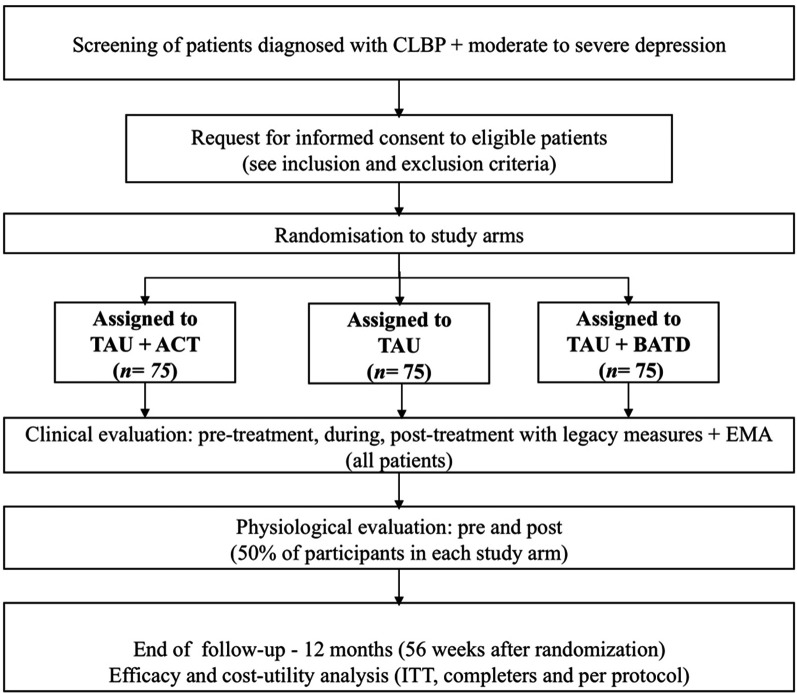
Introduction: The IMPACT study focuses on chronic low back pain (CLBP) and depression symptoms, a prevalent and complex problem that represents a challenge for health professionals. Acceptance and Commitment Therapy (ACT) and Brief Behavioural Activation Treatment for Depression (BATD) are effective treatments for patients with persistent pain and depression, respectively. The objectives of this 12 month, multicentre, randomised, controlled trial (RCT) are (i) to examine the efficacy and cost-utility of adding a group-based form of ACT or BATD to treatment-as-usual (TAU) for patients with CLBP and moderate to severe levels of depressive symptoms; (ii) identify pre–post differences in levels of some physiological variables and (iii) analyse the role of polymorphisms in the FKBP5 gene, psychological process measures and physiological variables as mediators or moderators of long-term clinical changes. Methods and analysis: Participants will be 225 patients with CLBP and moderate to severe depression symptoms recruited at Parc Sanitari Sant Joan de Déu (St. Boi de Llobregat, Spain) and Hospital del Mar (Barcelona, Spain), randomly allocated to one of the three study arms: TAU vs TAU+ACT versus TAU+BATD. A comprehensive assessment to collect clinical variables and costs will be conducted pretreatment, post-treatment and at 12 months follow-up, being pain interference the primary outcome measure. The following physiological variables will be considered at pretreatment and post-treatment assessments in 50% of the sample: immune-inflammatory markers, hair cortisol and cortisone, serum cortisol, corticosteroid-binding globulin and vitamin D. Polymorphisms in the FKBP5 gene (rs3800373, rs9296158, rs1360780, rs9470080 and rs4713916) will be analysed at baseline assessment. Moreover, we will include mobile-technology-based ecological momentary assessment, through the Pain Monitor app, to track ongoing clinical status during ACT and BATD treatments. Linear mixed-effects models using restricted maximum likelihood, and a full economic evaluation applying bootstrapping techniques, acceptability curves and sensitivity analyses will be computed. Ethics and dissemination: This study has been approved by the Ethics Committee of the Fundació Sant Joan de Déu and Hospital del Mar. The results will be actively disseminated through peer-reviewed journals, conference presentations, social media and various community engagement activities. Trial registration number: NCT04140838
Verified 2026-10-11 · 1 reference not checked yet
Overview
CoChat Summary
## TL;DR
This is a study protocol for a 12-month multicentre randomized controlled trial testing whether adding group-based ACT or BATD to treatment-as-usual improves outcomes for patients with chronic low back pain and moderate-to-severe depressive symptoms. It also plans cost-utility, physiological, genetic, and ecological momentary assessment analyses, but it reports no results because the trial is a protocol.
## Key findings
- The planned sample is 225 patients with chronic low back pain and moderate to severe depression, randomized to TAU, TAU+ACT, or TAU+BATD; the study uses pain interference as the primary outcome.
- The trial will assess clinical outcomes at pretreatment, post-treatment, and 12-month follow-up, and will analyze physiological variables in 50% of the sample.
- The biomarkers substudy includes immune-inflammatory markers, hair cortisol and cortisone, serum cortisol, corticosteroid-binding globulin, and vitamin D, and will genotype 5 FKBP5 SNPs: rs3800373, rs9296158, rs1360780, rs9470080, rs4713916.
- The protocol includes smartphone-based EMA via the Pain Monitor app, with twice-daily assessments during the 8-week treatment period; the paper notes that daily compliance in prior work has been as high as 75%.
## Methods
- Design: 12-month, multicentre, three-arm randomized controlled trial following SPIRIT/CONSORT and health-economic reporting standards; group interventions are 8 weekly 1.5-hour sessions.
- Sample/data: 225 adults aged 18–70 with CLBP (>3 months), pain intensity >4/10, and PHQ-9 ≥10; recruited from Parc Sanitari Sant Joan de Déu and Hospital del Mar in Spain.
- Analysis: Intention-to-treat and per-protocol analyses using linear mixed-effects models (restricted maximum likelihood), mediation/path analyses for process variables and outcomes, and cost-utility analyses with bootstrapping, acceptability curves, sensitivity analyses, and 1000 replications for ICUR uncertainty.
## Limitations
- The paper explicitly states that blinding of patients and therapists will not be possible.
- The authors state there may be a higher than expected dropout rate because the study lasts 1 year.
- The authors note that not all recruited patients may have a smartphone or may have unsatisfactory EMA completion rates, so EMA may not be feasible or effective for all participants.
- Evident from the protocol: because this is a study protocol, the paper provides planned methods only and no outcome data or effect estimates.
Model-written summary. Check it against the paper before relying on it.
Integrity signals
Registry
Cites
Statistics
Figures
Verification
Claims the paper makes
5 Valid · 0 Not valid · 40 Not checked · 27 Own results and interpretations
None of the sources cited for this claim have been checked yet.
In the paper
“its interaction with distal and proximal stressors has not been previously examined in comorbid chronic pain and depression.”
§ Efficacy, cost-utility and physiological effects of Acceptance and Commitment Therapy (ACT) and Behavioural Activation Treatment for Depression (BATD) in patients with chronic low back pain and depression: study protocol of a randomised, controlled trial including mobile-technology-based ecological momentary assessment (IMPACT study) > Introduction
What the sources say
- Not checked yetcites [20] Biondi M, Picardi A Psychological stress and neuroendocrine function in humans: the last two decades of research. Psychother Psychosom 1999; 68: 114– 50. 10.1159/000012323 10224513 source
- Not checked yetcites [21] Sudhaus S, Fricke B, Stachon A, et al Salivary cortisol and psychological mechanisms in patients with acute versus chronic low back pain. Psychoneuroendocrinology 2009; 34: 513– 22. 10.1016/j.psyneuen.2008.10.011 19028020 source
- Could not verifycites [22] Yin H, Galfalvy H, Pantazatos SP, et al Glucocorticoid receptor-related genes: genotype and brain gene expression relationships to suicide and major depressive disorder. Depress Anxiety 2016; 33: 531– 40. 10.1002/da.22499 27030168 PMC4889464 sourceExperimental — accuracy not yet measured
The Discussion (page unavailable) addresses FKBP5, stress responses, suicide and major depressive disorder, but not comorbid chronic pain and depression. Searches for chronic pain and distal or proximal stressors found no passage establishing whether their interaction with FKBP5 had previously been examined in that population. (LLM, conf=0.75)
- Not checked yetcites [23] Fischer S, King S, Papadopoulos A, et al Hair cortisol and childhood trauma predict psychological therapy response in depression and anxiety disorders. Acta Psychiatr Scand 2018; 138: 526– 35. 10.1111/acps.12970 30302747 source
- Could not verifycites [24] Zannas AS, Wiechmann T, Gassen NC, et al Gene-Stress-Epigenetic regulation of FKBP5: clinical and translational implications. Neuropsychopharmacology 2016; 41: 261– 74. 10.1038/npp.2015.235 26250598 PMC4677131 sourceExperimental — accuracy not yet measured
The Gene-Stress Interactions Involving FKBP5 section lists studied outcomes, including depression and general physical illness, but does not say whether FKBP5 interactions with distal and proximal stressors had been examined in people with comorbid chronic pain and depression. Searches for that comorbidity and for distal and proximal stressors found no passage establishing the claimed research gap. (LLM, conf=0.72)
- Could not verifycites [25] Roberts S, Keers R, Breen G, et al Dna methylation of FKBP5 and response to exposure-based psychological therapy. Am J Med Genet B Neuropsychiatr Genet 2019; 180: 150– 8. 10.1002/ajmg.b.32650 30334356 PMC6600698 sourceExperimental — accuracy not yet measured
The Introduction (page unavailable) discusses interactions between FKBP5 and stressful environments in relation to mental health outcomes, including depression. The Methods describe participants treated for fear-related anxiety disorders, not a comorbid chronic pain and depression population. Searches for chronic pain, depression, and distal and proximal stressors found no passage establishing whether that specific interaction had previously been examined. (LLM, conf=0.76)
- Not checked yetcites [26] Géranton SM Does epigenetic 'memory' of early-life stress predispose to chronic pain in later life? A potential role for the stress regulator FKBP5. Philos Trans R Soc Lond B Biol Sci 2019; 374: 20190283. 10.1098/rstb.2019.0283 31544613 PMC6790393 source
plain- Asserted: passes — The authors put it forward as true.
- Checkable: passes — It can be checked against evidence.
- Load-bearing: passes — The paper’s conclusions depend on it.
- Based: passes — The paper gives a reason why it holds.
The cited sources support only part of this claim — read each source’s verdict below.
In the paper
“In a meta-analysis of 11 clinical trials in patients with chronic pain,28 ACT was better than the control conditions in improving pain acceptance, functional impairment, anxiety, depression and pain intensity.”
- Also stated in: § Treatments · boosted
“Recent meta-analyses supported the effectiveness of ACT in patients with chronic pain.28 39”
§ Efficacy, cost-utility and physiological effects of Acceptance and Commitment Therapy (ACT) and Behavioural Activation Treatment for Depression (BATD) in patients with chronic low back pain and depression: study protocol of a randomised, controlled trial including mobile-technology-based ecological momentary assessment (IMPACT study) > Introduction
What the sources say
- Not checked yetcites [28] Hughes LS, Clark J, Colclough JA, et al Acceptance and commitment therapy (act) for chronic pain: a systematic review and meta-analyses. Clin J Pain 2017; 33: 552– 68. 10.1097/AJP.0000000000000425 27479642 source
- Partly supportedcites [39] Veehof MM, Trompetter HR, Bohlmeijer ET, et al Acceptance- and mindfulness-based interventions for the treatment of chronic pain: a meta-analytic review. Cogn Behav Ther 2016; 45: 5– 31. 10.1080/16506073.2015.1098724 26818413 sourceExperimental — accuracy not yet measured
The Post-treatment effects section reports improvements in pain intensity, depression, anxiety, disability and pain interference for acceptance- and mindfulness-based interventions combined; the Subgroup analyses section reports stronger depression and anxiety effects for ACT than for mindfulness-based interventions. But the Characteristics of included studies section lists 25 trials in the main analysis, only nine of ACT-based programs—not 11 ACT trials—and the reported pooled outcomes do not include pain acceptance. The paper therefore supports the broad claim that ACT can help patients with chronic pain, but not the citing sentence's precise trial count or its attribution of all five outcomes to ACT alone. (LLM, conf=0.88)
boostedstates a cause- Asserted: passes — The authors put it forward as true.
- Checkable: passes — It can be checked against evidence.
- Load-bearing: passes — The paper’s conclusions depend on it.
- Based: passes — The paper gives a reason why it holds.
- Also stated in: § Treatments · boosted
Every source the paper cites for this claim was checked and supports it.
In the paper
“The telephone-administered version of the PHQ-9 showed adequate reliability (α=0.82),43”
§ Efficacy, cost-utility and physiological effects of Acceptance and Commitment Therapy (ACT) and Behavioural Activation Treatment for Depression (BATD) in patients with chronic low back pain and depression: study protocol of a randomised, controlled trial including mobile-technology-based ecological momentary assessment (IMPACT study) > Methods and analysis > Measures for sociodemographic characteristics, clinical features and screening
What the sources say
- Supportedcites [43] Pinto-Meza A, Serrano-Blanco A, Peñarrubia MT, et al Assessing depression in primary care with the PHQ-9: can it be carried out over the telephone? J Gen Intern Med 2005; 20: 738– 42. 10.1111/j.1525-1497.2005.0144.x 16050884 PMC1490180 source
The Results report an internal consistency of 0.82 for the telephone-administered PHQ-9. The Statistical Analysis section identifies Cronbach’s α as the measure used, and the Discussion describes the internal consistency as high. (LLM, conf=0.95)
plain- Asserted: passes — The authors put it forward as true.
- Checkable: passes — It can be checked against evidence.
- Load-bearing: passes — The paper’s conclusions depend on it.
- Based: passes — The paper gives a reason why it holds.
- Supported
In the paper
“In a meta-analysis of 11 clinical trials in patients with chronic pain,28 ACT was better than the control conditions in improving pain acceptance, functional impairment, anxiety, depression and pain intensity.”
§ Efficacy, cost-utility and physiological effects of Acceptance and Commitment Therapy (ACT) and Behavioural Activation Treatment for Depression (BATD) in patients with chronic low back pain and depression: study protocol of a randomised, controlled trial including mobile-technology-based ecological momentary assessment (IMPACT study) > Introduction
What the sources say
- Not checked yetcites [28] Hughes LS, Clark J, Colclough JA, et al Acceptance and commitment therapy (act) for chronic pain: a systematic review and meta-analyses. Clin J Pain 2017; 33: 552– 68. 10.1097/AJP.0000000000000425 27479642 source
plainstates a cause- Asserted: passes — The authors put it forward as true.
- Checkable: passes — It can be checked against evidence.
- Load-bearing: passes — The paper’s conclusions depend on it.
- Based: passes — The paper gives a reason why it holds.
In the paper
“another form of CBT, Behavioural Activation Treatment for Depression (BATD), has proved to be as effective as classical CBT in reducing depressive symptoms in a meta-analysis.29”
- Also stated in: § Treatments · plain
“A meta-analysis supported the effectiveness of behavioural activation in patients with depression.29”
§ Efficacy, cost-utility and physiological effects of Acceptance and Commitment Therapy (ACT) and Behavioural Activation Treatment for Depression (BATD) in patients with chronic low back pain and depression: study protocol of a randomised, controlled trial including mobile-technology-based ecological momentary assessment (IMPACT study) > Introduction
What the sources say
- Not checked yetcites [29] Cuijpers P, van Straten A, Warmerdam L Behavioral activation treatments of depression: a meta-analysis. Clin Psychol Rev 2007; 27: 318– 26. 10.1016/j.cpr.2006.11.001 17184887 source
boostedstates a cause- Asserted: passes — The authors put it forward as true.
- Checkable: passes — It can be checked against evidence.
- Load-bearing: passes — The paper’s conclusions depend on it.
- Based: passes — The paper gives a reason why it holds.
- Also stated in: § Treatments · plain
12 more claims
Create a free account to see all 72 claims and to verify the 60 references still open.
- It may state two separate claims as one. 14
- Probably not a substantial claim. 49
Claims other papers make about this one
Each is checked against this paper’s own text: does it say what the citing paper says it does?
The source backs part of the claim, not all of it — or backs it for a different population, condition or comparison.
In the citing paper
“Like previous meta-analyses in chronic pain (Williams et al., 2020) and depression (Lorenzo-Luaces et al., 2018), the efficacy of CBT-based interventions for comorbid pain and depression is clinically relevant on average (Sanabria-Mazo et al., 2020).”
From A systematic review of cognitive behavioral therapy-based interventions for comorbid chronic pain and clinically relevant psychological distress (2023) · cites this paper as Sanabria-Mazo et al., 2020
Experimental — accuracy not yet measuredThe check wasn’t confident either way, so it gives no verdict — never disputed.
In the citing paper
“As the findings of this study point out, the effects of CBT targeting the population with chronic pain and comorbid psychological distress are more modest than targeting one of the two conditions separately (Sanabria-Mazo et al., 2020).”
From A systematic review of cognitive behavioral therapy-based interventions for comorbid chronic pain and clinically relevant psychological distress (2023) · cites this paper as Sanabria-Mazo et al., 2020
Experimental — accuracy not yet measured
Citations
Cites
Haploview: analysis and visualization of LD and haplotype maps
Barrett, J. C., Fry, B., Maller, J., & Daly, M. J. (2005) · Bioinformatics · doi:10.1093/bioinformatics/bth457 · Cited by 14,525
Lovibond, P. F., & Lovibond, S. H. (1995) · Behaviour Research and Therapy · doi:10.1016/0005-7967(94)00075-u · Cited by 14,523
CONSORT 2010 Statement: updated guidelines for reporting parallel group randomised trials
the CONSORT Group, Schulz, K. F., Altman, D. G., & Moher, D. (2010) · BMC Medicine · doi:10.1186/1741-7015-8-18 · Cited by 13,371
Spitzer, R. L. (1999) · JAMA · doi:10.1001/jama.282.18.1737 · Cited by 9,802
Development and preliminary testing of the new five-level version of EQ-5D (EQ-5D-5L)
Herdman, M., Gudex, C., Lloyd, A., Janssen, M., Kind, P., Parkin, D., Bonsel, G., & Badia, X. (2011) · Quality of Life Research · doi:10.1007/s11136-011-9903-x · Cited by 9,795
CONSORT 2010 Statement: updated guidelines for reporting parallel group randomised trials
Schulz, K. F., Altman, D. G., Moher, D., & for the CONSORT Group (2010) · BMJ · doi:10.1136/bmj.c332 · Cited by 9,329
The Pain Catastrophizing Scale: Development and validation.
Sullivan, M. J. L., Bishop, S. R., & Pivik, J. (1995) · Psychological Assessment · doi:10.1037//1040-3590.7.4.524 · Cited by 8,227
SPIRIT 2013 Statement: Defining Standard Protocol Items for Clinical Trials
Chan, A.-W., Tetzlaff, J. M., Altman, D. G., Laupacis, A., Gøtzsche, P. C., Krleža-Jerić, K., Hróbjartsson, A., Mann, H., Dickersin, K., Berlin, J. A., et al. (2013) · Annals of Internal Medicine · doi:10.7326/0003-4819-158-3-201302050-00583 · Cited by 7,363
Development and validation of a brief screening version of the Childhood Trauma Questionnaire
Bernstein, D. P., Stein, J. A., Newcomb, M. D., Walker, E., Pogge, D., Ahluvalia, T., Stokes, J., Handelsman, L., Medrano, M., Desmond, D., et al. (2003) · Child Abuse & Neglect · doi:10.1016/s0145-2134(02)00541-0 · Cited by 6,419
A Comparison of Bayesian Methods for Haplotype Reconstruction from Population Genotype Data
Stephens, M., & Donnelly, P. (2003) · The American Journal of Human Genetics · doi:10.1086/379378 · Cited by 3,513
Stress and disorders of the stress system
Chrousos, G. P. (2009) · Nature Reviews Endocrinology · doi:10.1038/nrendo.2009.106 · Cited by 3,215
The global burden of low back pain: estimates from the Global Burden of Disease 2010 study
Hoy, D., March, L., Brooks, P., Blyth, F., Woolf, A., Bain, C., Williams, G., Smith, E., Vos, T., Barendregt, J., et al. (2014) · Annals of the Rheumatic Diseases · doi:10.1136/annrheumdis-2013-204428 · Cited by 3,186
Wittchen, H.-U. (1994) · Journal of Psychiatric Research · doi:10.1016/0022-3956(94)90036-1 · Cited by 2,348
Psychometric properties of the credibility/expectancy questionnaire
Devilly, G. J., & Borkovec, T. D. (2000) · Journal of Behavior Therapy and Experimental Psychiatry · doi:10.1016/s0005-7916(00)00012-4 · Cited by 2,295
Otte, C., Gold, S. M., Penninx, B. W., Pariante, C. M., Etkin, A., Fava, M., Mohr, D. C., & Schatzberg, A. F. (2016) · Nature Reviews Disease Primers · doi:10.1038/nrdp.2016.65 · Cited by 2,269
Consolidated Health Economic Evaluation Reporting Standards (CHEERS) statement
Husereau, D., Drummond, M., Petrou, S., Carswell, C., Moher, D., Greenberg, D., Augustovski, F., Briggs, A. H., Mauskopf, J., Loder, E., et al. (2013) · BMJ · doi:10.1136/bmj.f1049 · Cited by 1,776
Vitamin D deficiency in Europe: pandemic?
Cashman, K. D., Dowling, K. G., Škrabáková, Z., Gonzalez-Gross, M., Valtueña, J., De Henauw, S., Moreno, L., Damsgaard, C. T., Michaelsen, K. F., Mølgaard, C., et al. (2016) · The American Journal of Clinical Nutrition · doi:10.3945/ajcn.115.120873 · Cited by 1,393
Behavioral activation treatments of depression: a meta-analysis.
Cuijpers, P., van Straten, A., & Warmerdam, L. (2007) · Clinical Psychology Review · doi:10.1016/j.cpr.2006.11.001 · Cited by 1,144
Hayes, S. C., Villatte, M., Levin, M., & Hildebrandt, M. (2011) · Annual Review of Clinical Psychology · doi:10.1146/annurev-clinpsy-032210-104449 · Cited by 800
Veehof, M. M., Trompetter, H. R., Bohlmeijer, E. T., & Schreurs, K. M. G. (2016) · Cognitive Behaviour Therapy · doi:10.1080/16506073.2015.1098724 · Cited by 737
Gene–Stress–Epigenetic regulation of FKBP5: clinical and translational implications
Zannas, A. S., Wiechmann, T., Gassen, N. C., & Binder, E. B. (2016) · Neuropsychopharmacology · doi:10.1038/npp.2015.235 · Cited by 622
Acceptance and Commitment Therapy (ACT) for Chronic Pain: A Systematic Review and Meta-Analyses
Hughes, L. S., Clark, J., Colclough, J. A., Dale, E., & McMillan, D. (2017) · The Clinical Journal of Pain · doi:10.1097/ajp.0000000000000425 · Cited by 611
Kroenke, K., Wu, J., Bair, M. J., Krebs, E. E., Damush, T. M., & Tu, W. (2011) · The Journal of Pain · doi:10.1016/j.jpain.2011.03.003 · Cited by 573
Vlaeyen, J. W. S., Maher, C. G., Wiech, K., Van Zundert, J., Meloto, C. B., Diatchenko, L., Battié, M. C., Goossens, M., Koes, B., & Linton, S. J. (2018) · Nature Reviews Disease Primers · doi:10.1038/s41572-018-0052-1 · Cited by 497
The efficacy of Acceptance and Commitment Therapy: An updated systematic review and meta-analysis
Öst, L.-G. (2014) · Behaviour Research and Therapy · doi:10.1016/j.brat.2014.07.018 · Cited by 476
McCracken, L. M., & Morley, S. (2014) · The Journal of Pain · doi:10.1016/j.jpain.2013.10.014 · Cited by 464
Self-citationCore outcome measurement instruments for clinical trials in nonspecific low back pain
Chiarotto, A., Boers, M., Deyo, R. A., Buchbinder, R., Corbin, T. P., Costa, L. O. P., Foster, N. E., Grotle, M., Koes, B. W., Kovacs, F. M., et al. (2018) · Pain · doi:10.1097/j.pain.0000000000001117 · Cited by 461
García Campayo, J., Rodero, B., Alda, M., Sobradiel, N., Montero, J., & Moreno, S. (2008) · Medicina Clínica · doi:10.1157/13127277 · Cited by 422
Mansfield, K. E., Sim, J., Jordan, J. L., & Jordan, K. P. (2016) · Pain · doi:10.1097/j.pain.0000000000000314 · Cited by 402
Psychological Stress and Neuroendocrine Function in Humans: The Last Two Decades of Research
Biondi, M., & Picardi, A. (1999) · Psychotherapy and Psychosomatics · doi:10.1159/000012323 · Cited by 352
Assessing depression in primary care with the PHQ-9: Can it be carried out over the telephone?
Pinto-Meza, A., Serrano-Blanco, A., Peñarrubia, M. T., Blanco, E., & Haro, J. M. (2005) · Journal of General Internal Medicine · doi:10.1111/j.1525-1497.2005.0144.x · Cited by 347
Definition And Clinical Importance Of Haplotypes.
Crawford, D. C., & Nickerson, D. A. (2005) · Annual Review of Medicine · doi:10.1146/annurev.med.56.082103.104540 · Cited by 344
The Compensatory Immune-Regulatory Reflex System (CIRS) in Depression and Bipolar Disorder
Maes, M., & Carvalho, A. F. (2018) · Molecular Neurobiology · doi:10.1007/s12035-018-1016-x · Cited by 306
Self-citationRayner, L., Hotopf, M., Petkova, H., Matcham, F., Simpson, A., & McCracken, L. M. (2016) · Pain · doi:10.1097/j.pain.0000000000000542 · Cited by 290
Self-citationThe Behavioral Activation for Depression Scale–Short Form: Development and Validation
Manos, R. C., Kanter, J. W., & Luo, W. (2011) · Behavior Therapy · doi:10.1016/j.beth.2011.04.004 · Cited by 276
(2005) · Psicothema · Cited by 269
Prevalence of chronic pain in developing countries: systematic review and meta-analysis
Sá, K. N., Moreira, L., Baptista, A. F., Yeng, L. T., Teixeira, M. J., Galhardoni, R., & de Andrade, D. C. (2019) · PAIN Reports · doi:10.1097/pr9.0000000000000779 · Cited by 255
Defining successful treatment outcome in depression using the PHQ-9: A comparison of methods
McMillan, D., Gilbody, S., & Richards, D. (2010) · Journal of Affective Disorders · doi:10.1016/j.jad.2010.04.030 · Cited by 247
Ecological momentary assessment methodology in chronic pain research: a systematic review
May, M., Junghaenel, D. U., Ono, M., Stone, A. A., & Schneider, S. (2018) · The Journal of Pain · doi:10.1016/j.jpain.2018.01.006 · Cited by 247
Consolidated Health Economic Evaluation Reporting Standards (CHEERS) statement
Husereau, D., Drummond, M., Petrou, S., Carswell, C., Moher, D., Greenberg, D., Augustovski, F., Briggs, A. H., Mauskopf, J., & Loder, E. (2013) · BMC Medicine · doi:10.1186/1741-7015-11-80 · Cited by 231
Scott, W., & McCracken, L. M. (2015) · The Journal of Pain · doi:10.1016/j.jpain.2015.02.007 · Cited by 187
Self-citationHernandez, A., Gallardo-Pujol, D., Pereda, N., Arntz, A., Bernstein, D. P., Gaviria, A. M., Labad, A., Valero, J., & Gutiérrez-Zotes, J. A. (2013) · Journal of Interpersonal Violence · doi:10.1177/0886260512468240 · Cited by 165
Taylor, R., Lovibond, P. F., Nicholas, M. K., Cayley, C., & Wilson, P. H. (2005) · The Clinical Journal of Pain · doi:10.1097/00002508-200501000-00011 · Cited by 142
Dysfunctional stress responses in chronic pain
Woda, A., Picard, P., & Dutheil, F. (2016) · Psychoneuroendocrinology · doi:10.1016/j.psyneuen.2016.05.017 · Cited by 142
A systematic review of psychoneuroimmunology-based interventions
de Moraes, L. J., Miranda, M. B., Loures, L. F., Mainieri, A. G., & Mármora, C. H. C. (2017) · Psychology Health & Medicine · doi:10.1080/13548506.2017.1417607 · Cited by 126
Kaiser, U., Kopkow, C., Deckert, S., Neustadt, K., Jacobi, L., Cameron, P., De Angelis, V., Apfelbacher, C., Arnold, B., Birch, J., et al. (2018) · Pain · doi:10.1097/j.pain.0000000000001129 · Cited by 119
Self-citationAssociation Between Inflammatory Biomarkers and Nonspecific Low Back Pain: A Systematic Review
Lim, Y. Z., Wang, Y., Cicuttini, F., Hughes, H. J., Chou, L., Urquhart, D. M., Ong, P. X., & Hussain, S. M. (2020) · Clinical Journal of Pain · doi:10.1097/ajp.0000000000000810 · Cited by 100
Pérez-Aranda, A., Feliu-Soler, A., Montero-Marín, J., García-Campayo, J., Andrés-Rodríguez, L., Borràs, X., Rozadilla-Sacanell, A., Peñarrubia-Maria, M. T., Angarita-Osorio, N., McCracken, L. M., et al. (2019) · Pain · doi:10.1097/j.pain.0000000000001655 · Cited by 98
Self-citationArango-Dávila, C. A., & Rincón-Hoyos, H. G. (2016) · Revista Colombiana de Psiquiatría · doi:10.1016/j.rcp.2016.10.007 · Cited by 98
Shipton, E. E., & Shipton, E. A. (2015) · Pain and Therapy · doi:10.1007/s40122-015-0036-8 · Cited by 92
Garcia‐Palacios, A., Herrero, R., Belmonte, M. A., Castilla, D., Guixeres, J., Molinari, G., Baños, R. M., & Botella, C. (2014) · European Journal of Pain · doi:10.1002/j.1532-2149.2013.00425.x · Cited by 90
Self-citationVitamin D and Central Hypersensitivity in Patients with Chronic Pain
von Känel, R., Müller-Hartmannsgruber, V., Kokinogenis, G., & Egloff, N. (2014) · Pain Medicine · doi:10.1111/pme.12454 · Cited by 90
O'Neill, L., Latchford, G., McCracken, L. M., & Graham, C. D. (2019) · Journal of Contextual Behavioral Science · doi:10.1016/j.jcbs.2019.08.008 · Cited by 87
Self-citationWei, J., Sun, G., Zhao, L., Yang, X., Liu, X., Lin, D., Li, T., & Ma, X. (2015) · Journal of Affective Disorders · doi:10.1016/j.jad.2015.01.023 · Cited by 84
Pu, D., Luo, J., Wang, Y., Ju, B., Lv, X., Fan, P., & He, L. (2017) · Clinical Rheumatology · doi:10.1007/s10067-017-3874-4 · Cited by 78
Feliu‐Soler, A., Cebolla, A., McCracken, L. M., D’Amico, F., Knapp, M. R. J., López-Montoyo, A., García‐Campayo, J., Soler, J., Baños, R., Pérez‐Aranda, A., et al. (2017) · Behavior Therapy · doi:10.1016/j.beth.2017.07.001 · Cited by 77
Self-citationRabey, M., Smith, A., Beales, D., Slater, H., & O’Sullivan, P. (2016) · The Clinical Journal of Pain · doi:10.1097/ajp.0000000000000363 · Cited by 76
Fish, R. A., Hogan, M. J., Morrison, T. G., Stewart, I., & McGuire, B. E. (2013) · The Journal of Pain · doi:10.1016/j.jpain.2012.11.004 · Cited by 73
Suso-Ribera, C., Castilla, D., Zaragozá, I., Ribera-Canudas, M. V., Botella, C., & García-Palacios, A. (2018) · The Clinical Journal of Pain · doi:10.1097/ajp.0000000000000618 · Cited by 73
Self-citationDNA methylation of FKBP5 and response to exposure-based psychological therapy
Roberts, S., Keers, R., Breen, G., Coleman, J. R. I., Jöhren, P., Kepa, A., Lester, K. J., Margraf, J., Scheider, S., Teismann, T., et al. (2019) · American Journal of Medical Genetics Part B: Neuropsychiatric Genetics · doi:10.1002/ajmg.b.32650 · Cited by 67
Arango-Dávila, C. A., & Rincón-Hoyos, H. G. (2018) · Revista Colombiana de Psiquiatría (English ed ) · doi:10.1016/j.rcpeng.2017.12.003 · Cited by 59
Yin, H., Galfalvy, H., Pantazatos, S. P., Huang, Y.-Y., Rosoklija, G. B., Dwork, A. J., Burke, A., Arango, V., Oquendo, M. A., & Mann, J. J. (2016) · Depression and Anxiety · doi:10.1002/da.22499 · Cited by 57
Salivary cortisol and psychological mechanisms in patients with acute versus chronic low back pain
Sudhaus, S., Fricke, B., Stachon, A., Schneider, S., Klein, H., von Düring, M., & Hasenbring, M. I. (2008) · Psychoneuroendocrinology · doi:10.1016/j.psyneuen.2008.10.011 · Cited by 55
de Castro-Català, M., Peña, E., Kwapil, T. R., Papiol, S., Sheinbaum, T., Cristóbal-Narváez, P., Ballespí, S., Barrantes-Vidal, N., & Rosa, A. (2017) · Psychoneuroendocrinology · doi:10.1016/j.psyneuen.2017.08.024 · Cited by 49
Self-citationThe inflammatory hypothesis of mood spectrum broadened to fibromyalgia and chronic fatigue syndrome.
Dell’Osso, L., Bazzichi, L. M., Baroni, S., Falaschi, V., Conversano, C., Carmassi, C., & Marazziti, D. (2015) · PubMed · Cited by 46
Is there a role for vitamin D in the treatment of chronic pain?
Martin, K. R., & Reid, D. M. (2017) · Therapeutic Advances in Musculoskeletal Disease · doi:10.1177/1759720x17708124 · Cited by 40
Barraca, J., Pérez-Álvarez, M., & Bleda, J. H. L. (2011) · The Spanish journal of psychology · doi:10.5209/rev_sjop.2011.v14.n2.45 · Cited by 39
Duarte, R., Lloyd, A., Kotas, E., Andronis, L., & White, R. (2019) · British Journal of Clinical Psychology · doi:10.1111/bjc.12208 · Cited by 39
Lahti, J., Ala-Mikkula, H., Kajantie, E., Haljas, K., Eriksson, J. G., & Räikkönen, K. (2016) · Biological Psychiatry · doi:10.1016/j.biopsych.2015.10.022 · Cited by 37
Associations between the FKBP5 haplotype, exposure to violence and anxiety in females
Isaksson, J., Comasco, E., Åslund, C., Rehn, M., Tuvblad, C., Andershed, H., & Nilsson, K. W. (2016) · Psychoneuroendocrinology · doi:10.1016/j.psyneuen.2016.07.206 · Cited by 31
Géranton, S. M. (2019) · Philosophical Transactions of the Royal Society B Biological Sciences · doi:10.1098/rstb.2019.0283 · Cited by 30
Fischer, S., King, S., Papadopoulos, A., Hotopf, M., Young, A. H., & Cleare, A. J. (2018) · Acta Psychiatrica Scandinavica · doi:10.1111/acps.12970 · Cited by 27
Hedderson, W. C., Dover, G. C., George, S. Z., Crow, J. A., & Borsa, P. A. (2017) · Clinical Journal of Pain · doi:10.1097/ajp.0000000000000484 · Cited by 27
Casey, M.-B., Smart, K., Segurado, R., Hearty, C., Gopal, H., Lowry, D., Flanagan, D., McCracken, L., & Doody, C. (2018) · Trials · doi:10.1186/s13063-018-2543-5 · Cited by 25
Self-citationImproving pain treatment with a smartphone app: Study protocol for a randomized controlled trial
Suso-Ribera, C., Mesas, Á., Medel, J., Server, A., Márquez, E., Castilla, D., Zaragozá, I., & García-Palacios, A. (2018) · Trials · doi:10.1186/s13063-018-2539-1 · Cited by 20
Self-citationSupport for the Spanish version of the CPAQ-8 as a measure of chronic pain acceptance
Sánchez‐Rodríguez, E., de la Vega, R., Racine, M., Roy, R., Jensen, M. P., & Miró, J. (2019) · Journal of Evaluation in Clinical Practice · doi:10.1111/jep.13092 · Cited by 9
(1994) · PubMed
Research works printed but not linked: 1
- Vázquez-Barquero JL, Gaite L, Cuesta MJ, et al Spanish version of the CSRI: a mental health cost evaluation interview. Arch Neurobiol 1997; 60: 171– 84.
Cited by
New generation psychological treatments in chronic pain
McCracken, L. M., Yu, L., & Vowles, K. E. (2022) · BMJ · doi:10.1136/bmj-2021-057212 · Cited by 123
Self-citationSanabria-Mazo, J. P., Colomer-Carbonell, A., Fernández-Vázquez, Ó., Noboa-Rocamora, G., Cardona-Ros, G., McCracken, L. M., Montes-Pérez, A., Castaño-Asins, J. R., Edo, S., Borràs, X., et al. (2023) · Frontiers in Psychology · doi:10.3389/fpsyg.2023.1200685 · Cited by 56
Self-citationSanabria-Mazo, J. P., Colomer-Carbonell, A., Borràs, X., Castaño-Asins, J. R., McCracken, L. M., Montero-Marin, J., Pérez-Aranda, A., Edo, S., Sanz, A., Feliu-Soler, A., et al. (2023) · The Journal of Pain · doi:10.1016/j.jpain.2023.04.008 · Cited by 40
Self-citationUse of behavioural activation to manage pain: a systematic scoping review
Walsh, S., Moseley, G. L., Gray, R. J., Gillam, M., Gunn, K. M., Barker, T., Tran, K., Eshetie, T. C., & Jones, M. (2022) · BMJ Open · doi:10.1136/bmjopen-2021-056404 · Cited by 20
The Potential Relationship Between Low Back Pain and Depression: A Comprehensive Review
Cao, L., Deng, B., Wang, X., Fang, T., Umoh, K., Liu, L., Qian, J., & Liu, F. (2025) · Brain and Behavior · doi:10.1002/brb3.71026 · Cited by 14
Metadata
- Authors
- Sanabria-Mazo, J. P., Forero, C. G., Cristobal-Narváez, P., Suso-Ribera, C., García-Palacios, A., Colomer-Carbonell, A., Pérez-Aranda, A., Andrés-Rodríguez, L., McCracken, L. M., D'Amico, F., Estivill-Rodríguez, P., Carreras-Marcos, B., Montes-Pérez, A., Comps-Vicente, O., Esteve, M., Grasa, M., Rosa, A., Cuesta-Vargas, A. I., Maes, M., Borràs, X., Edo, S., Sanz, A., Feliu-Soler, A., Castaño-Asins, J. R., & Luciano, J. V.
- Affiliations
- Department of Basic, Developmental and Educational Psychology, Autonomous University of Barcelona, Barcelona, Spain
- Universitat Internacional de Catalunya (ES)
- Parc Sanitari Sant Joan de Deu, Sant Boi de Llobregat, Catalunya, Spain
- Department of Basic and Clinical Psychology and Psychobiology, Universitat Jaume I, Castelló de la Plana, Spain
- Uppsala University (SE)
- Personal Social Services Research Unit, London School of Economics and Political Science, London, UK
- Consorci Parc de Salut MAR de Barcelona, Barcelona, Catalunya, Spain
- Instituto de Salud Carlos III (ES)
- Faculty of Health, Queensland University of Technology, Brisbane, Queensland, Australia
- Chulalongkorn University (TH)
- Universitat Autònoma de Barcelona (ES)
- Parc de Salut (ES)
- Parc Sanitari Sant Joan de Déu (ES)
- Corresponding author
- Luciano, Juan V
- ORCID
- Venue
- BMJ Open
- Publisher
- BMJ
- Published
- 2020-07
- Volume
- 10
- Issue
- 7
- Pages
- e038107
- ISSN
- 2044-6055 (ISSN-L)
- PMC
- PMC7380881
- OpenAlex
- W3045400208
- Cited by
- 16
- References
- 76
- Citations by year
- 2025: 3 · 2024: 2 · 2023: 3 · 2022: 8
- FWCI
- 1.80
- Type
- journal article
- Language
- en
- Open access
- gold
- doi.org
- Licence
- Locations
- BMJ Open (publishedVersion, cc-by-nc)
- PubMed Central (publishedVersion, cc-by-nc)
- PubMed (publishedVersion)
- QUT ePrints (Queensland University of Technology) (acceptedVersion, cc-by-nc)
- London School of Economics and Political Science Research Online (London School of Economics and Political Science) (acceptedVersion)
- London School of Economics and Political Science Theses Online (London School of Economics and Political Science) (acceptedVersion)
- Uppsala University Publications (Uppsala University) (acceptedVersion, other-oa)
- Hispana (acceptedVersion, cc-by-nc)
- HighWire Press Open Archive (acceptedVersion)
- Repositori UJI (Universitat Jaume I) (acceptedVersion, cc-by-nc)
- Dipòsit Digital de Documents de la UAB (Universitat Autònoma de Barcelona) (submittedVersion, cc-by-nc)
- Dipòsit Digital de la Universitat de Barcelona (Universitat de Barcelona) (submittedVersion, cc-by)
- LA Referencia (Red Federada de Repositorios Institucionales de Publicaciones Científicas) (submittedVersion, cc-by-nc)
- DOAJ (DOAJ: Directory of Open Access Journals) (submittedVersion, cc-by-sa)
- UIC Open Acces Archive (submittedVersion, cc-by-nc)
- Repositori digital de la UPF (Universitat Pompeu Fabra) (submittedVersion, cc-by-nc)
- Repositorio Institucional de la Universidad de Málaga (University of Málaga) (submittedVersion, other-oa)
- Funders
- Instituto de Salud Carlos III (CPII19/00003, PI16/00165, PI19/00112)
- Topics
- Health Sciences › Health Professions › Physical Therapy, Sports Therapy and Rehabilitation › Musculoskeletal pain and rehabilitation
- Social Sciences › Psychology › Clinical Psychology › Mindfulness and Compassion Interventions
- Social Sciences › Psychology › Experimental and Cognitive Psychology › Anxiety, Depression, Psychometrics, Treatment, Cognitive Processes
- Keywords
- acceptance and commitment therapy, chronic low back pain, depression, pain interference, cortisol, hair cortisol, corticosteroid-binding globulin, vitamin D, immune-inflammatory markers, cost-utility analysis, mediators and moderators, treatment acceptability, psychological flexibility, impact
- MeSH terms
- Ecological Momentary Assessment, Depression, Humans, Spain, Technology, Multicenter Studies as Topic, Randomized Controlled Trials as Topic, Low Back Pain, Acceptance and Commitment Therapy
About these checks
Registry, retraction, Cites and statistics results are computed, not judged, with one exception: a printed reference that no index lists is read once by a model before it counts as a citation error. Claims are extracted by a model and kept only when their quote appears verbatim in the text; each cited source is then checked, with a model’s help, for whether it says what the claim relies on. Those verdicts can be wrong — read the claim’s quote and the cited source before relying on one.
The claim verdicts this report counts are experimental: their accuracy is not yet measured.
A language model drew the claims from the paper on 2026-10-11, under version 3 of the claim definition (model deepseek-v4.1-flash, prompt extract-v3).
A second model labelled each claim on 2026-10-11 (model jev-1.13-20260917, definition revision gold-guideline-v0.2).
Cited sources are checked with a language model’s help (gpt-6-sol).
Statistics and arithmetic are recomputed, not judged.
Confidence bands are shown only for fields calibrated on our annotated test set. None is calibrated yet, so no band is shown.
What counts as a claim ›How we measure confidence ›How we check this ›
Are you an author, or do you see a problem with this page? Request a review
Data sources
Bibliographic data: Semantic Scholar, OpenAlex, Crossref.
Contains information from the Semantic Scholar Academic Graph Datasets, made available under the ODC Attribution License (ODC-BY 1.0).
Semantic Scholar’s data is described in: Kinney, R., et al. (2023). The Semantic Scholar Open Data Platform. arXiv:2301.10140.
