

Mental health and health behaviours before and during the initial phase of the COVID-19 lockdown: longitudinal analyses of the UK Household Longitudinal Study
Open accessPublished version of a preprint
The DOI matches its Crossref record; 36 of the 36 references it cites were found in a registry or an index.
Abstract
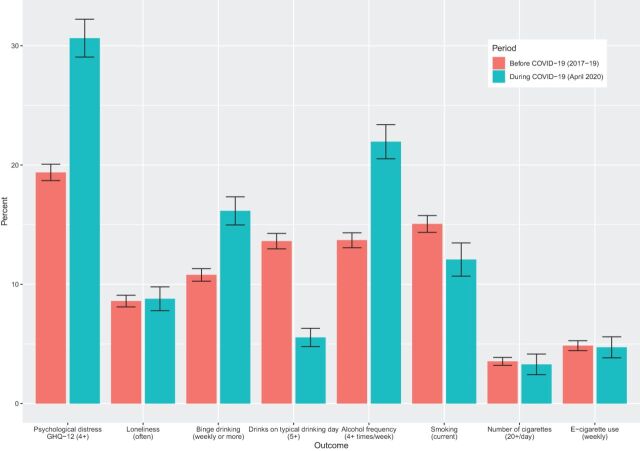
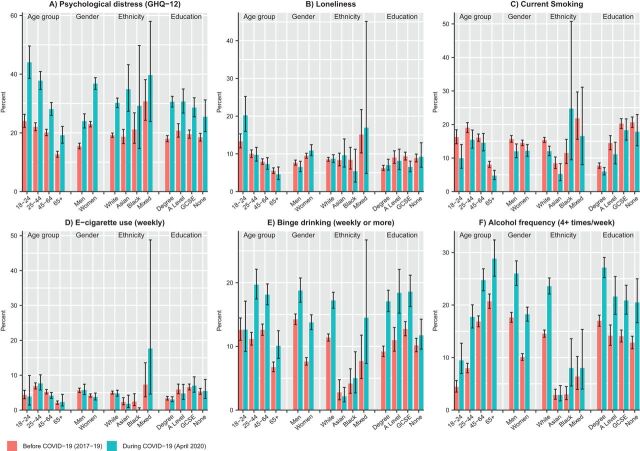
Background: There are concerns that COVID-19 mitigation measures, including the ‘lockdown’, may have unintended health consequences. We examined trends in mental health and health behaviours in the UK before and during the initial phase of the COVID-19 lockdown and differences across population subgroups. Methods: Repeated cross-sectional and longitudinal analysis of the UK Household Longitudinal Study, including representative samples of over 27,000 adults (aged 18+) interviewed in four survey waves between 2015 and 2020. A total of 9748 adults had complete data for longitudinal analyses. Outcomes included psychological distress (General Health Questionnaire-12), loneliness, current cigarette smoking, use of e-cigarettes and alcohol consumption. Cross-sectional prevalence estimates were calculated and multilevel Poisson regression assessed associations between time period and the outcomes of interest, as well as differential associations by age, gender, education level and ethnicity. Results: Psychological distress increased 1 month into lockdown with the prevalence rising from 19.4% (95% CI 18.7% to 20.1%) in 2017–2019 to 30.6% (95% CI 29.1% to 32.3%) in April 2020 (RR=1.3, 95% CI 1.2 to 1.4). Groups most adversely affected included women, young adults, people from an Asian background and those who were degree educated. Loneliness remained stable overall (RR=0.9, 95% CI 0.6 to 1.5). Smoking declined (RR=0.9, 95% CI=0.8,1.0) and the proportion of people drinking four or more times per week increased (RR=1.4, 95% CI 1.3 to 1.5), as did binge drinking (RR=1.5, 95% CI 1.3 to 1.7). Conclusions: Psychological distress increased 1 month into lockdown, particularly among women and young adults. Smoking declined, but adverse alcohol use generally increased. Effective measures are required to mitigate negative impacts on health.
Overview
The claims and statistics of this paper haven’t been checked yet.
Free: it reads the open-access text and checks the first 5 claims that cite a source we can check. Create a free account to check every claim.
Integrity signals
Registry
Cites
Statistics
Figures
Verification
Claims the paper makes
The claims and statistics of this paper haven’t been checked yet.
Free: it reads the open-access text and checks the first 5 claims that cite a source we can check. Create a free account to check every claim.
Claims other papers make about this one
Each is checked against this paper’s own text: does it say what the citing paper says it does?
The cited source says what the claim attributes to it.
In the citing paper
“such a comparison complements other studies that rely on pre-pandemic data collected during typical conditions (e.g., Niedzwiedz, et al., 2021).”
From Young Adult Adaptability to the Social Challenges of the COVID-19 Pandemic: The Protective Role of Friendships (2022) · cites this paper as Niedzwiedz, et al., 2021
In the citing paper
“there is evidence to suggest that they have resulted in adverse psychological consequences across general populations.”
Self-check
Percentages, sums and reported differences re-computed from the paper’s own numbers.
The self-check needs the paper’s full text.
Citations
Cites
The Psychological Impact of Quarantine and How to Reduce It: Rapid Review of the Evidence
Brooks, S. K., Webster, R. K., Smith, L. E., Woodland, L., Wessely, S., Greenberg, N., & Rubin, G. J. (2020) · doi:10.2139/ssrn.3532534 · Cited by 16,394
The psychological impact of quarantine and how to reduce it: Rapid review of the evidence
Brooks, S. K., Webster, R. K., Smith, L. E., Woodland, L., Wessely, S., Greenberg, N., & Rubin, G. J. (2020) · The Lancet · doi:10.1016/s0140-6736(20)30460-8 · Cited by 16,378 · cited 1×
“Research prior to the pandemic has suggested quarantine is linked to several negative psychological outcomes.(6) During the COVID-19 pandemic, concerns have been repeatedly raised about potentially long-lasting harms to mental health.”
A Modified Poisson Regression Approach to Prospective Studies with Binary Data
Zou, G. (2004) · American Journal of Epidemiology · doi:10.1093/aje/kwh090 · Cited by 9,615
Holmes, E. A., O'Connor, R. C., Perry, V. H., Tracey, I., Wessely, S., Arseneault, L., Ballard, C., Christensen, H., Cohen Silver, R., Everall, I., et al. (2020) · The Lancet Psychiatry · doi:10.1016/s2215-0366(20)30168-1 · Cited by 5,715
A global panel database of pandemic policies (Oxford COVID-19 Government Response Tracker)
Hale, T., Angrist, N., Goldszmidt, R., Kira, B., Petherick, A., Phillips, T., Webster, S., Cameron-Blake, E., Hallas, L., Majumdar, S., et al. (2021) · Nature Human Behaviour · doi:10.1038/s41562-021-01079-8 · Cited by 4,578
The Validity of Two Versions of the GHQ in the WHO Study of Mental Illness in General Health Care
GOLDBERG, D. P., GATER, R., SARTORIUS, N., USTUN, T. B., PICCINELLI, M., GUREJE, O., & RUTTER, C. (1997) · Psychological Medicine · doi:10.1017/s0033291796004242 · Cited by 3,657
Indicators of socioeconomic position (part 1): Figure 1
Galobardes, B., Shaw, M., Lawlor, D. A., Lynch, J. W., & Davey Smith, G. (2006) · Journal of Epidemiology and Community Health · doi:10.1136/jech.2004.023531 · Cited by 2,867 · cited 1×
“When analysing educational inequalities we restricted analyses to adults aged 25+ years as educational attainment tends to be stable from that age onwards.(16) For longitudinal analysis, we included participants with complete data from all four waves and aged 18+ years during wave 9.”
Clinical impact of COVID-19 on patients with cancer (CCC19): a cohort study
Kuderer, N. M., Choueiri, T. K., Shah, D. P., Shyr, Y., Rubinstein, S. M., Rivera, D. R., Shete, S., Hsu, C.-Y., Desai, A., de Lima Lopes, G., et al. (2020) · The Lancet · doi:10.1016/s0140-6736(20)31187-9 · Cited by 1,726
AUDIT‐C as a Brief Screen for Alcohol Misuse in Primary Care
Bradley, K. A., DeBenedetti, A. F., Volk, R. J., Williams, E. C., Frank, D., & Kivlahan, D. R. (2007) · Alcoholism: Clinical and Experimental Research · doi:10.1111/j.1530-0277.2007.00403.x · Cited by 1,632
Suicide risk and prevention during the COVID-19 pandemic
Gunnell, D., Appleby, L., Arensman, E., Hawton, K., John, A., Kapur, N., Khan, M., O'Connor, R. C., Pirkis, J., Appleby, L., et al. (2020) · The Lancet Psychiatry · doi:10.1016/s2215-0366(20)30171-1 · Cited by 1,513 · cited 1×
“While a body of literature is developing to articulate the expected indirect impacts of the pandemic, 3 7 25 empirical research on how mental health and health-related behaviours have changed remains limited and largely based on non-representative samples.”
Cited by
Items 101–200 of 528
Danielsen, S., Joensen, A., Andersen, P. K., Madsen, T., & Strandberg‐Larsen, K. (2023) · Nature Human Behaviour · doi:10.1038/s41562-022-01511-7 · Cited by 37
“There were no notable differences in characteristics of participants completing the DNBC-18 in each year from 2018 to 2021 (Supplementary Table 1); (3) a major strength of the longitudinal data is that we analysed the same young adults pre- and post-lockdown and thereby all time-invariant factors are adjusted for.”
BackgroundBezzo, F. B., Silva, L., & van Ham, M. (2021) · PLoS ONE · doi:10.1371/journal.pone.0255156 · Cited by 37
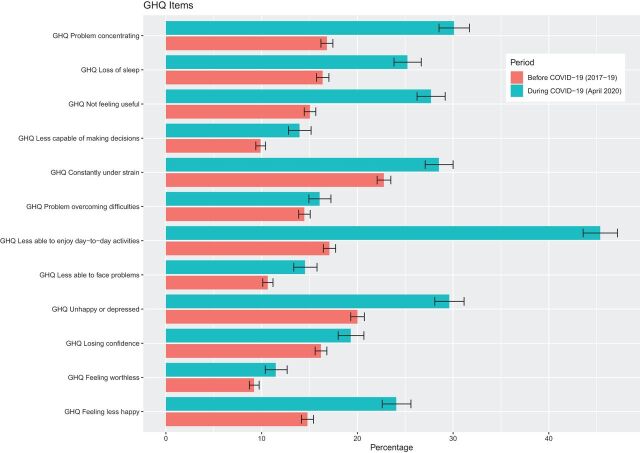
“In fact, this is coherent with previous studies which analysed the effect of the pandemic on single GHQ questions, finding that the question with the largest deterioration was enjoyment of normal day-to-day activities [22].”
BackgroundResultThe impact of COVID-19 vaccination for mental well-being
Chaudhuri, K., & Howley, P. (2022) · European Economic Review · doi:10.1016/j.euroecorev.2022.104293 · Cited by 38
“…(Anaya et al., 2021; Banks and Xu, 2020:2021; Cheng et al., 2021; Daly et al., 2020; Etheridge and Spantig, 2020; Giovanis and Ozdamar, 2020; Niedzwiedz et al., 2021; Proto and Quintana--Domeque, 2021; Schmidtke et al., 2021; Shen and Bartram, 2021; Swaziek and Wozniak, 2020; Zamarro and…”
Asper, M. M., Osika, W., Dalman, C., Pöllänen, E., Simonsson, O., Flodin, P., Sidorchuk, A., Marchetti, L., Awil, F., Castro, R., et al. (2022) · BJPsych Open · doi:10.1192/bjo.2022.587 · Cited by 43
Moreno‐Agostino, D., Fisher, H. L., Goodman, A. T., Hatch, S. L., Morgan, C., Richards, M., Das‐Munshi, J., & Ploubidis, G. B. (2023) · PLoS Medicine · doi:10.1371/journal.pmed.1004145 · Cited by 37
Impact of the COVID-19 pandemic on cardiovascular mortality and contrast analysis within subgroups
Song, S., Guo, C., Wu, R., Zhao, H., Li, Q., Dou, J., Guo, F.-S., & Wei, J. J. (2024) · Frontiers in Cardiovascular Medicine · doi:10.3389/fcvm.2024.1279890 · Cited by 40
Hardie, I., Stevely, A. K., Sasso, A., Meier, P. S., & Holmes, J. (2022) · Addiction · doi:10.1111/add.15794 · Cited by 37
“These consumption measures complement the primary outcome by providing insight into whether people were drinking more often/more heavily during the pandemic, over which previous studies have raised concerns [1, 18].”
BackgroundMaguire, A., Kent, L., O’Neill, S. M., O’Hagan, D., & O’Reilly, D. (2022) · The British Journal of Psychiatry · doi:10.1192/bjp.2022.112 · Cited by 34
Zhang, A., Gagné, T., Walsh, D., Ciancio, A., Proto, E., & McCartney, G. (2023) · Journal of Epidemiology & Community Health · doi:10.1136/jech-2022-219660 · Cited by 40
Burton, A., McKinlay, A. R., Aughterson, H., & Fancourt, D. E. (2020) · medRxiv · doi:10.1101/2020.12.01.20241067 · Cited by 30
Troschel, F. M., Ahndorf, F., Wille, L.-M., Brandt, R., Jost, J., Rekowski, S., Eich, H. T., Stummer, W., Wiewrodt, R. G., Jetschke, K., et al. (2021) · Cancers · doi:10.3390/cancers13061276 · Cited by 30
Whitley, E., Reeve, K. S., & Benzeval, M. (2021) · Psychological Medicine · doi:10.1017/s0033291721002555 · Cited by 35
Self-citationLi, A., Mansour, A., & Bentley, R. (2023) · Health & Place · doi:10.1016/j.healthplace.2023.103103 · Cited by 32
Piccolo, L. D., Donisi, V., Raffaelli, R., Garzon, S., Perlini, C., Rimondini, M., Uccella, S., Cromi, A., Ghezzi, F., Ginami, M., et al. (2021) · Frontiers in Psychology · doi:10.3389/fpsyg.2021.632999 · Cited by 29
Mitchell, K. R., Shimonovich, M., Pérez, R. B., Dema, E., Clifton, S., Riddell, J., Copas, A. J., Tanton, C., Macdowall, W. G., Bonell, C. P., et al. (2021) · The Journal of Sex Research · doi:10.1080/00224499.2022.2035663 · Cited by 28
van der Velden, P. G., Marchand, M. A. G., Das, M., Muffels, R. J. A., & Bosmans, M. W. G. (2022) · PLoS ONE · doi:10.1371/journal.pone.0276834 · Cited by 30
“[11] found that the proportion of people drinking four or more times per week increased (Relative Risk (RR) = 1.”
BackgroundA Mental Health Pandemic? Assessing the Impact of COVID-19 on Young People’s Mental Health
Lloyd, K., Schubotz, D., Roche, R. R., Manzi, J., & McKnight, M. (2023) · International Journal of Environmental Research and Public Health · doi:10.3390/ijerph20166550 · Cited by 33
Rutter, N., Hasan, E., Pilson, A., & Yeo, E. (2021) · International Journal of Qualitative Methods · doi:10.1177/16094069211019595 · Cited by 35
“While closures have resulted in increasing levels of isolation and mental health difficulties universally (Niedzwiedz et al., 2021; Torales et al., 2020), PhD students are particularly vulnerable to mental health crises; especially when transitioning to independent research without the opportunity…”
BackgroundEqually Affected? Health-Related and Socioeconomic Adversities of the COVID-19 Pandemic in Vienna
Oberndorfer, M., Dorner, T. E., Brunnmayr, M., Berger, K., Dugandzic, B., & Bach, M. (2020) · Health & Social Care in the Community · doi:10.1111/hsc.13485 · Cited by 33
“…pandemic's initial effects on mental health documenting an increase in population level anxiety, depression, psychological distress, suicidal ideation, and loneliness (Bu et al., 2020; Chandola et al., 2020; Jia et al., 2020; Niedzwiedz et al., 2021; O’Connor et al., 2020; Pierce et al., 2020).”
Łaszewska, A., Helter, T. M., & Simon, J. (2021) · BMC Public Health · doi:10.1186/s12889-021-11476-3 · Cited by 32
“Although the introduction of a lockdown is an effective strategy to slow the spread of infection [2], several studies pointed out its negative effects on mental health [3–5], health behaviours [6], social connectedness, and loneliness [4].”
BackgroundChiaramonte, D. M., Simmons, C., Hamdan, N., Ayeni, O. O., López‐Zerón, G., Farero, A. M., Sprecher, M., & Sullivan, C. M. (2021) · Journal of Community Psychology · doi:10.1002/jcop.22765 · Cited by 31
Arday, J., & Jones, C. (2022) · Higher Education · doi:10.1007/s10734-022-00939-0 · Cited by 44
“In terms of mental health impacts, for example, those at highest risk are young adults (e.g. Public Health England, 2021), women (e.g. Niedzwiedz et al., 2021), ethnic minority communities (e.g. Proto & Quintana-Domeque, 2021), people experiencing socioeconomic adversity (e.g. Wilson, 2021) ,…”
Gessa, G. D., & Price, D. (2021) · Journal of Epidemiology & Community Health · doi:10.1136/jech-2021-216405 · Cited by 32
Niedzwiedz, C. L., Benzeval, M., Hainey, K., Leyland, A. H., & Katikireddi, S. V. (2021) · BJPsych Open · doi:10.1192/bjo.2021.63 · Cited by 26
Self-citationMangot‐Sala, L., Tran, K. A., Smidt, N., & Liefbroer, A. C. (2022) · Drug and Alcohol Dependence · doi:10.1016/j.drugalcdep.2022.109349 · Cited by 42
Riepenhausen, A., Veer, I. M., Wackerhagen, C., Reppmann, Z. C., Köber, G., Ayuso‐Mateos, J. L., Bögemann, S. A., Corrao, G., Félez-Nóbrega, M., Haro, J. M., et al. (2022) · Psychological Medicine · doi:10.1017/s0033291722000563 · Cited by 37
“…gender (Daly & Robinson, 2020; Daly, Sutin, & Robinson, 2020; Gijzen et al., 2020; Holingue et al., 2020; Hyland et al., 2020; Li & Wang, 2020; Niedzwiedz et al., 2020; Peters et al., 2020; Pieh et al., 2020; Pierce et al., 2020; Zajacova et al., 2020), younger age (Daly & Robinson, 2020;…”
InfluentialGeirdal, A. Ø., Price, D., Schoultz, M., Thygesen, H., Ruffolo, M. C., Leung, J., & Bonsaksen, T. (2021) · International Journal of Environmental Research and Public Health · doi:10.3390/ijerph18084345 · Cited by 31
“British longitudinal studies based on the same population before and after the outbreak of COVID-19 concluded that prolonged deterioration in mental health occurred after the COVID-19 outbreak [13,14].”
BackgroundGagné, T., Nandi, A., & Schoon, I. (2021) · Journal of Epidemiology & Community Health · doi:10.1136/jech-2021-217266 · Cited by 28
Kromydas, T., Green, M. J., Craig, P., Katikireddi, S. V., Leyland, A. H., Niedzwiedz, C. L., Pearce, A., Thomson, R., & Demou, E. (2022) · Journal of Epidemiology & Community Health · doi:10.1136/jech-2021-218561 · Cited by 30
Self-citationJakubek, P., Parchem, K., Wieckowski, M. R., & Bartoszek, A. (2024) · International Journal of Molecular Sciences · doi:10.3390/ijms25147827 · Cited by 28
“Furthermore, the COVID-19 pandemic increased the frequency of drinking behaviours due to psychological distress [132–134], which has already been shown to lead to a greater burden of alcohol-associated liver diseases and premature mortality [135].”
BackgroundJackson, S. E., Cox, S., Holmes, J., Angus, C., Robson, D., Brose, L. S., & Brown, J. (2024) · Social Science & Medicine · doi:10.1016/j.socscimed.2024.117561 · Cited by 27
“In the UK, there was a sharp rise in psychological distress and symptoms of poor mental health at the start of the Covid-19 pandemic in 2020 (Pierce et al., 2020; Kwong et al., 2021; Daly et al., 2022; Niedzwiedz et al., 2021; Kromydas et al., 2022; Fancourt et al., 2021).”
Confined Students: A Visual-Emotional Analysis of Study and Rest Spaces in the Homes
Cuerdo-Vilches, T., & Navas-Martín, M. Á. (2021) · International Journal of Environmental Research and Public Health · doi:10.3390/ijerph18115506 · Cited by 30
“In the UK, a number of longitudinal health-related household studies were conducted before and during the initial phase of the blockade or in different waves [18,19].”
BackgroundImpacts of COVID-19 on cigarette use, smoking behaviors, and tobacco purchasing behaviors
Maloney, S. F., Combs, M., Scholtes, R. L., Underwood, M., Kilgalen, B., Soule, E. K., & Breland, A. B. (2021) · Drug and Alcohol Dependence · doi:10.1016/j.drugalcdep.2021.109144 · Cited by 26
Systemic inflammation and emotional responses during the COVID-19 pandemic
Hamilton, O. S., Cadar, D., & Steptoe, A. (2021) · Translational Psychiatry · doi:10.1038/s41398-021-01753-5 · Cited by 26
Hausman, H. K., Dai, Y. E., O’Shea, A. M., Dominguez, V. N., Fillingim, M., Calfee, K., Carballo, D., Hernandez, C. M., Perryman, S., Kraft, J. N., et al. (2022) · Frontiers in Aging Neuroscience · doi:10.3389/fnagi.2022.999107 · Cited by 28
Fawns‐Ritchie, C., Altschul, D., Campbell, A., Huggins, C. F., Nangle, C., Dawson, R., Edwards, R., Flaig, R., Hartley, L., Levein, C., et al. (2021) · Wellcome Open Research · doi:10.12688/wellcomeopenres.16987.1 · Cited by 20
“…characteristics have been associated with higher rates of psychological distress during COVID-19, including people from Asian minority ethnic groups 6,8 , people with pre-existing health conditions 6,11 , caregivers 12 , people who are unemployed or economically inactive 8 , those who report…”
BackgroundCook, M. A., & Brooke, N. (2021) · International Journal of Environmental Research and Public Health · doi:10.3390/ijerph182111133 · Cited by 23
The gender dimensions of mental health during the Covid-19 pandemic: A path analysis
Dotsikas, K., Crosby, L., McMunn, A., Osborn, D., Walters, K. R., & Dykxhoorn, J. L. (2023) · PLoS ONE · doi:10.1371/journal.pone.0283514 · Cited by 28
The association between cannabis and depression: an updated Systematic Review and Meta-analysis
Churchill, V., Chubb, C. S., Popova, L., Spears, C. A., & Pigott, T. (2025) · Psychological Medicine · doi:10.1017/s0033291724003143 · Cited by 39
“Studies have shown that rates of depression in the US have increased in recent years, especially since the start of the COVID-19 pandemic (Niedzwiedz et al., 2021; Zheng et al., 2021).”
Naous, E., Boulos, M. T., Sleilaty, G., Achkar, A. A., & Gannagé‐Yared, M. (2021) · Journal of Endocrinological Investigation · doi:10.1007/s40618-021-01701-6 · Cited by 22
“In the United Kingdom (UK) [28] and Denmark [10], the reduction in enjoyment of normal daily activities during the COVID-19 pandemic has also led to an increase in psychological distress.”
BackgroundResultVulnerability pathways to mental health outcomes in children and parents during COVID-19
Rizeq, J., Korczak, D. J., Cost, K. T., Anagnostou, E. A., Charach, A., Monga, S., Birken, C. S., Kelley, E. A., Nicolson, R., Science, S. F., et al. (2021) · Current Psychology · doi:10.1007/s12144-021-02459-z · Cited by 27
Takács, J., Katona, Z. B., & Ihász, F. (2023) · Journal of Affective Disorders · doi:10.1016/j.jad.2023.01.067 · Cited by 31
“…(UCLA-LS20) was used (Version 3) (Russell et al., 1978; Russell, 1996) to measure the unpleasant experience, when an individual perceives their social network as insufficient, i.e., a perceived discrepancy between the actual and the ideal/desired social networks/contacts (Peplau and Perman, 1979).”
MethodEducation, Financial Stress, and Trajectory of Mental Health During the COVID-19 Pandemic
Jiang, Y., Zilioli, S., Balzarini, R. N., Zoppolat, G., & Slatcher, R. B. (2021) · Clinical Psychological Science · doi:10.1177/21677026211049374 · Cited by 24
Psychological Burden During the COVID-19 Pandemic in Germany
Schelhorn, I., Ecker, A., Lüdtke, M. N., Rehm, S., Tran, T., Bereznai, J., Meyer, M. L., Sütterlin, S., Kinateder, M. T., Lugo, R. G., et al. (2021) · Frontiers in Psychology · doi:10.3389/fpsyg.2021.640518 · Cited by 19
Wyper, G. M. A., Fletcher, E., Grant, I., Harding, O., Moro, M. T. D. H., Stockton, D., & McCartney, G. (2021) · International Journal for Equity in Health · doi:10.1186/s12939-021-01547-7 · Cited by 22
Prehabilitation and preparation for surgery: has the digital revolution arrived?
Durrand, J. W., Moore, J., & Danjoux, G. R. (2021) · Anaesthesia · doi:10.1111/anae.15622 · Cited by 24
“The rates of physical inactivity, alcohol consumption and smoking may have increased, with further negative effects on diet andmental health [6, 7].”
BackgroundGémes, K., Bergström, J., Papola, D., Barbui, C., Lam, A. I. F., Hall, B. J., Seedat, S., Morina, N., Quero, S., Campos, D., et al. (2022) · Journal of Affective Disorders · doi:10.1016/j.jad.2022.05.082 · Cited by 27
Jenkins, E., Slemon, A., Richardson, C. G., Pumarino, J., McAuliffe, C., Thomson, K., Goodyear, T., Daly, Z., McGuinness, L., & Gadermann, A. (2022) · International Journal of Public Health · doi:10.3389/ijph.2022.1604685 · Cited by 25
Shehata, W. M., & Abdeldaim, D. E. (2023) · BMC Public Health · doi:10.1186/s12889-023-15177-x · Cited by 33
“Mental health consequences of the COVID-19 pandemic affected the whole population but more severely affected females, young adults, healthcare workers, and those of lower socioeconomic status as women are more likely to bear the extra burden of childcare as well as to work in sectors most affected by the pandemic [3,…”
BackgroundJaud, J., Görig, T., Konkel, T., & Diehl, K. (2023) · International Journal of Environmental Research and Public Health · doi:10.3390/ijerph20043334 · Cited by 31
“However, it is already apparent that the lockdowns had an overall negative impact on mental health [33,34] in both the general population [35] and university students [36].”
BackgroundTrends in Psychological Distress Among Adults in England, 2020-2022
Jackson, S. E., Brown, J., Shahab, L., McNeill, A. D., Munafo, M. R., & Brose, L. S. (2023) · JAMA Network Open · doi:10.1001/jamanetworkopen.2023.21959 · Cited by 29
Andersen, L. H., Fallesen, P., & Bruckner, T. A. (2021) · BMC Public Health · doi:10.1186/s12889-021-11020-3 · Cited by 23
van der Velden, P. G., Marchand, M. A. G., Das, M., Muffels, R. J. A., & Bosmans, M. (2022) · Psychiatry Research · doi:10.1016/j.psychres.2022.114528 · Cited by 25
Yu, C. C., Tou, N. X., & Low, J. A. (2022) · BMC Public Health · doi:10.1186/s12889-022-12857-y · Cited by 31
Lee, K., Sung, H. K., Yoo, S. Y., & Min, H. S. (2023) · Journal of Korean Medical Science · doi:10.3346/jkms.2023.38.e40 · Cited by 26
Wielgoszewska, B., Maddock, J., Green, M. J., Gessa, G. D., Parsons, S., Griffith, G. J., Croft, J., Stevenson, A. J., Booth, C., Silverwood, R. J., et al. (2022) · BMC Medicine · doi:10.1186/s12916-022-02343-y · Cited by 24
“Studies conducted since the COVID-19 pandemic have shown that health behaviours improved for some people while declining for others [37, 38], but our findings offer little evidence of furlough contributing to declines in healthy behaviour.”
BackgroundSelf-citationAlcohol deaths rise sharply in England and Wales
Holmes, J., & Angus, C. (2021) · BMJ · doi:10.1136/bmj.n607 · Cited by 19
Lockdown Impact on Stress, Coping Strategies, and Substance Use in Teenagers
Bourduge, C., Teissèdre, F., Morel, F., Flaudias, V., Izaute, M., & Brousse, G. (2022) · Frontiers in Psychiatry · doi:10.3389/fpsyt.2021.790704 · Cited by 27
Smith, M. L., Herbert, A., Hughes, A., Northstone, K., & Howe, L. D. (2022) · BMC Public Health · doi:10.1186/s12889-022-14184-8 · Cited by 21
“Analysis of a large UK cohort found that overall smoking declined during lockdown and that there was no interaction of smoking behaviour with education level [11].”
BackgroundCOVID-19 and Gender Differences in the Labor Market: Evidence from the Peruvian Economy
Vaccaro, G., & Paredes, T. (2022) · Documento de trabajo · doi:10.18800/2079-8474.0515 · Cited by 24
The burdens of poverty during the COVID-19 pandemic
Petersen, J., Hettich, N., Baumkötter, R., Wild, P. S., Pfeiffer, N., Münzel, T. F., König, J., Lackner, K. J., & Beutel, M. E. (2022) · Frontiers in Sociology · doi:10.3389/fsoc.2022.995318 · Cited by 25
van den Boom, W., Marra, E., van der Vliet, N., Elberse, J., van Dijken, S., van Dijk, M., Euser, S., Derks, M., Leurs, M. T. W., Albers, C. J., et al. (2023) · Public Health Reports · doi:10.1177/00333549231176000 · Cited by 23
Ayuso‐Mateos, J. L., Morillo, D., Haro, J. M., Olaya, B., Lara, E., & Miret, M. (2023) · Epidemiology and Psychiatric Sciences · doi:10.1017/s2045796023000677 · Cited by 25
“Most of the studies tracking longitudinal changes in mental health frombefore to during the pandemic have shown increases in the prevalence rate of depression and suicidal ideation (Daly et al., 2022; McGinty et al., 2020b;Niedzwiedz et al., 2021; Novotny et al., 2020; Pierce et al., 2020; Planchuelo-Gomez et al., 202…”
BackgroundMisca, G., & Thornton, G. B. (2021) · Frontiers in Psychology · doi:10.3389/fpsyg.2021.648533 · Cited by 28
“Adults living with children report higher anxiety, but lower levels of depression (Niedzwiedz et al., 2020) and lone mothers are identified as a particularly vulnerable group (Xue and McMunn, 2020).”
BackgroundInfluentialGraff, L. A., Fowler, S. A., Jones, J., Benchimol, E. I., Bitton, A., Huang, J. G., Kuenzig, M. E., Kaplan, G. G., Lee, K., Mukhtar, M. S., et al. (2021) · Journal of the Canadian Association of Gastroenterology · doi:10.1093/jcag/gwab031 · Cited by 21
Comparing Professional and Consumer Ratings of Mental Health Apps: Mixed Methods Study
Hudson, G., Negbenose, E., Neary, M., Jansli, S. M., Schueller, S. M., Wykes, T., & Jilka, S. (2022) · JMIR Formative Research · doi:10.2196/39813 · Cited by 21
Changes in Population Health-Related Behaviors During a COVID-19 Surge: A Natural Experiment
Delgado‐Ortiz, L., Carsin, A., Merino, J., Cobo, I., Koch, S., Goldberg, X., Chevance, G., de Basea, M. B., Castaño‐Vinyals, G., Espinosa, A., et al. (2022) · Annals of Behavioral Medicine · doi:10.1093/abm/kaac054 · Cited by 20
Does caring for others affect our mental health? Evidence from the COVID-19 pandemic
Costi, C., Hollingsworth, B. P., O’Sullivan, V., & Zucchelli, E. (2023) · Social Science & Medicine · doi:10.1016/j.socscimed.2023.115721 · Cited by 19
Seddon, J. L., Trevena, P., Wadd, S., Elliott, L., Dutton, M., McCann, M., & Willmott, S. (2021) · Aging & Mental Health · doi:10.1080/13607863.2021.1910794 · Cited by 19
“Emerging evidence from the UK suggests that there was a significant increase in psychological distress during the early stages of the lockdown (Niedzwiedz et al., 2020) with surveys from other countries indicating higher rates of anxiety, depression and lower mental health well-being (Ahmed et al.”
BackgroundZaninotto, P., Iob, E., Gessa, G. D., & Steptoe, A. (2025) · Aging & Mental Health · doi:10.1080/13607863.2025.2450260 · Cited by 23
“Several studies of psychological wellbeing have reported conspicuous distress early in the pandemic that resolved after a few weeks (Fancourt et al., 2021; Niedzwiedz et al., 2021).”
Clay, J. M., Stafford, L. D., & Parker, M. O. (2021) · International Journal of Mental Health and Addiction · doi:10.1007/s11469-021-00599-8 · Cited by 18
Yasuda, Y., Ishimaru, T., Nagata, M., Tateishi, S., Eguchi, H., Tsuji, M., Ogami, A., Matsuda, S., Fujino, Y., CORoNaWork project, et al. (2021) · Journal of Occupational Health · doi:10.1002/1348-9585.12259 · Cited by 16
Kim, G. J., Kim, H., Fletcher, J., Voelbel, G. T., Goverover, Y., Chen, P., O’Dell, M. W., & Genova, H. M. (2021) · Archives of Rehabilitation Research and Clinical Translation · doi:10.1016/j.arrct.2021.100176 · Cited by 20
Genç, E., Tanhan, A., & Köse, Ö. (2022) · Journal of Family Issues · doi:10.1177/0192513x221113855 · Cited by 19
“Although less commonly cited, some respondents stated having feelings of loneliness and missing their loved ones and their support, which is a common outcome of the pandemic worldwide (e.g., Killgore et al.2020; Niedzwiedz et al., 2021).”
BackgroundZhang, X., Liu, X., Mi, Y., Wang, W., & Xu, H. (2022) · Psychology Research and Behavior Management · doi:10.2147/prbm.s377158 · Cited by 25
“Psychological distress increased during the COVID-19 lockdown, particularly among young adults from an Asian background with college degrees.(26) Medical students may have higher resilience in coping with mental illnesses, with the prevalence of depressive symptoms in Malaya at 17%.”
BackgroundCollins, A., Prasannan, L., Shan, W., Dori, E., Katzow, M. W., & Blitz, M. J. (2022) · American Journal of Perinatology · doi:10.1055/a-1925-1347 · Cited by 18
“34 Social isolation and interruption of health care services during the lockdown had harmful effects on mental health 35 – 37 which may have been even more pronounced in pregnant women.”
BackgroundHampshire, A., Hellyer, P. J., Trender, W. R., & Chamberlain, S. R. (2021) · Interface Focus · doi:10.1098/rsfs.2021.0051 · Cited by 18
Jansli, S. M., Hudson, G., Negbenose, E., Erturk, S., Wykes, T., & Jilka, S. (2022) · Journal of Mental Health · doi:10.1080/09638237.2022.2091763 · Cited by 21
“In the UK, people experienced increased insomnia, anxiety, low mood, and general psychological distress during the pandemic and its “lockdowns” (Niedzwiedz et al., 2021; Pieh et al., 2021; Pierce et al., 2020).”
BackgroundBianchi, D., Baiocco, R., Pompili, S., Lonigro, A., Norcia, A. D., Cannoni, E., Longobardi, E., Zammuto, M. M., Tata, D. D., & Laghi, F. (2021) · Emerging Adulthood · doi:10.1177/21676968211058501 · Cited by 15
McGuine, T. A., Biese, K. M., Hetzel, S., Schwarz, A., Reardon, C. L., Bell, D. R., Brooks, A., Dickman, J., & Watson, A. M. (2022) · Journal of Athletic Training · doi:10.4085/1062-6050-0679.21 · Cited by 18
Bortel, T. V. V., Lombardo, C., Guo, L., Solomon, S., Martin, S., Hughes, K., Weeks, L., Crepaz‐Keay, D., McDaid, S., Chantler, O., et al. (2022) · Frontiers in Public Health · doi:10.3389/fpubh.2022.875198 · Cited by 20
Generation COVID: Young adult substance use
Hussong, A. M., Haik, A. K., & Loeb, H. M. (2023) · Current Opinion in Psychology · doi:10.1016/j.copsyc.2023.101640 · Cited by 17
“These findings were similar for young (18-24) and older adults (25-65+) and across gender and education level [21].”
Soldevila‐Domenech, N., Forcano, L., Boronat, A., Lorenzo, T., Piera, I., Puig‐Pijoan, A., Mateus, J., Gómez, J. M. G. D. E., Knezevic, I., Soteras, A., et al. (2021) · Journal of Alzheimer s Disease · doi:10.3233/jad-201408 · Cited by 18
Coronavirus Disease 2019: Psychological Stress and Cardiovascular Diseases
Komiyama, M., & Hasegawa, K. (2021) · European Cardiology Review · doi:10.15420/ecr.2021.10 · Cited by 18
Mughal, R., Thomson, L. J. M., Daykin, N., & Chatterjee, H. J. (2022) · International Journal of Environmental Research and Public Health · doi:10.3390/ijerph19074086 · Cited by 24
Burn, E., Tattarini, G., Williams, I., Lombi, L., & Gale, N. K. (2022) · Frontiers in Sociology · doi:10.3389/fsoc.2022.763088 · Cited by 18
Blake, H., Hassard, J., Thomson, L., Choo, W. H., Dulal‐Arthur, T., Karanika‐Murray, M., Delic, L., Pickford, R., & Rudkin, L. (2025) · PLoS ONE · doi:10.1371/journal.pone.0312673 · Cited by 31
Why friendship and loneliness affect our health
Dunbar, R. (2025) · Annals of the New York Academy of Sciences · doi:10.1111/nyas.15309 · Cited by 21
Green, M. J., Maddock, J., Gessa, G. D., Wielgoszewska, B., Parsons, S., Griffith, G. J., Croft, J., Stevenson, A. J., Huggins, C. F., Booth, C., et al. (2022) · BMC Medicine · doi:10.1186/s12916-022-02511-0 · Cited by 17
“Meanwhile, the frequency of drinking and binge drinking have increased [10, 13], but younger cohorts have reduced their drinking [46].”
BackgroundSelf-citationKaragiannidis, A. G., Theodorakopoulou, M. P., Ferro, C. J., Ortíz, A., Soler, M. J., Halimi, J., Januszewicz, A., Persu, A., Kreutz, R. H., & Sarafidis, P. A. (2022) · Clinical Kidney Journal · doi:10.1093/ckj/sfac235 · Cited by 16
Essadek, A., Gressier, F., Krebs, T., Corruble, E., Falissard, B., & Rabeyron, T. (2022) · European Journal of Psychotraumatology · doi:10.1080/20008066.2022.2141510 · Cited by 17
“High scores of suicidal ideation during the lifting of lockdown can be explained by the relation between distress symptoms and suicidal ideation (Panagioti et al., 2011).”
BackgroundRouxel, P. L., & Chandola, T. (2023) · Sociology · doi:10.1177/00380385231172123 · Cited by 24
“The pandemic adversely affected the mental health of populations (Patel et al., 2022; Prati and Mancini, 2021; Robinson et al., 2022), and in particular, adolescents and young adults (Niedzwiedz et al., 2021; Patel et al., 2022; Racine et al., 2021).”
BackgroundThe effects of the pandemic on mental health in persons with and without a psychiatric history
Murphy, E., Svob, C., Dijk, M. V., Gameroff, M. J., Skipper, J., Abraham, E., Yangchen, T., Posner, J., Shankman, S. A., WICKRAMARATNE, P. J., et al. (2021) · Psychological Medicine · doi:10.1017/s0033291721004372 · Cited by 21
“Among the six population-based studies, three leveraged cohorts from the UK (Kwong et al., 2020; Niedzwiedz et al., 2021; Pierce et al., 2021), and the remaining three were based respectively in Spain (Ayuso-Mateos et al., 2021), Ireland (Hyland et al., 2021), and the Netherlands (Pan et al., 2021).”
BackgroundStickley, A., Shirama, A., Inagawa, T., & Sumiyoshi, T. (2022) · Drug and Alcohol Dependence · doi:10.1016/j.drugalcdep.2022.109415 · Cited by 18
“, 2020), and other research reported an increase in BD in the early pandemic period (April to June 2020) (Barbosa et al., 2021; Niedzwiedz et al., 2021; Pollard et al., 2020; Winkler et al., 2020), other studies showed a”
Slurink, I. A. L., Smaardijk, V. R., Kop, W. J., Kupper, N. H. M., Mols, F., Schoormans, D., & Soedamah‐Muthu, S. S. (2022) · International Journal of Environmental Research and Public Health · doi:10.3390/ijerph19074375 · Cited by 15
“This finding is consistent with cross-sectional evidence, indicating that the behavioral responses of smokers to COVID-19 are mixed [46,47], yet more smokers seem to have increased their smoking behavior [14–17,28].”
ResultZang, J., Kim, Y. S., & Dong, J. (2022) · Frontiers in Public Health · doi:10.3389/fpubh.2022.964320 · Cited by 32
“In the educational institutes of South Korea, the weekdays are considered necessary for mental ability improvement and cognitive learning of the students because they provide the right opportunity for the students to develop a better understanding effectively related to the course material (32, 41).”
BackgroundTrends in alcohol-specific deaths in England, 2001–22: an observational study
Oldham, M., Jackson, S. E., Brown, J., Buss, V. H., Mehta, G., Dowd, J. B., Holmes, J., & Angus, C. (2025) · The Lancet Public Health · doi:10.1016/s2468-2667(25)00047-7 · Cited by 18
Kestler‐Peleg, M., Shamir, M. M., Pitcho‐Prelorentzos, S., & Kagan, M. (2022) · Current Psychology · doi:10.1007/s12144-023-04465-9 · Cited by 26
Kilian, C., Neufeld, M., Manthey, J., Alavidze, S., Bobrova, A., Baron‐Epel, O., Berisha, M., Bilici, R., Davletov, K., Isajeva, L., et al. (2022) · European Journal of Public Health · doi:10.1093/eurpub/ckac011 · Cited by 15
The impact of COVID-19 on benzodiazepine usage in psychiatric inpatient units
Zaki, N., & Brakoulias, V. (2022) · Australasian Psychiatry · doi:10.1177/10398562211059090 · Cited by 15
“In addition, different studies have shown increased rates of substance abuse during the pandemic, a situation that could induce or worsen existing MH conditions.(5-7)”
Background
Metadata
- Authors
- Niedzwiedz, C. L., Green, M. J., Benzeval, M., Campbell, D., Craig, P., Demou, E., Leyland, A., Pearce, A., Thomson, R., Whitley, E., & Katikireddi, S. V.
- Affiliations
- University of Glasgow (GB)
- MRC/CSO Social and Public Health Sciences Unit (GB)
- University of Essex (GB)
- MRC/CSO Social and Public Health Sciences Unit, University of Glasgow, Glasgow, UK
- Corresponding author
- Katikireddi, Srinivasa Vittal
- ORCID
- Venue
- Journal of Epidemiology and Community Health
- Publisher
- BMJ
- Published
- 2020-09-25
- Volume
- 75
- Issue
- 3
- Pages
- 224-231
- ISSN
- 0141-7681 (ISSN-L)
- 0143-005X
- 1470-2738
- PMC
- PMC7892383
- OpenAlex
- W3088359309
- Cited by
- 525
- References
- 36
- Citations by year
- 2026: 13 · 2025: 41 · 2024: 57 · 2023: 106 · 2022: 172 · 2021: 129 · 2020: 7
- FWCI
- 41.43
- Type
- journal article
- Language
- en
- Open access
- hybrid
- doi.org
- Locations
- Journal of Epidemiology & Community Health (publishedVersion, cc-by)
- medRxiv (acceptedVersion, cc-by)
- PubMed Central (publishedVersion, cc-by)
- PubMed (publishedVersion)
- ENLIGHTEN (Jurnal Bimbingan dan Konseling Islam) (acceptedVersion, cc-by-sa)
- Open Access at Essex (University of Essex) (acceptedVersion)
- HRB National Drugs Library (Health Research Board) (submittedVersion)
- Funders
- Chief Scientist Office (SCAF/15/02)
- Economic and Social Research Council (ES/N00812X/1)
- Wellcome Trust (205412/Z/16/Z, 218105/Z/19/Z)
- Medical Research Council (MC_UU_12013, MC_UU_12017, MR/R024774/1)
- Topics
- Social Sciences › Psychology › Clinical Psychology › COVID-19 and Mental Health
- Social Sciences › Sociology and Political Science › COVID-19 Prevention and Impact
- Physical Sciences › Mathematics › Modeling and Simulation › COVID-19 epidemiological studies
- Keywords
- COVID-19 lockdown, mental health, psychological distress, loneliness, cigarette smoking, electronic cigarettes, alcohol consumption, binge drinking, health behavior, sex differences, young adults, ethnicity, educational attainment, UK Household Longitudinal Study
- MeSH terms
- COVID-19, SARS-CoV-2, Adolescent, Adult, Aged, Aged, 80 and over, Alcohol Drinking, Child, Child, Preschool, Cross-Sectional Studies, Female, United Kingdom, Humans, Infant, Infant, Newborn, Loneliness, Longitudinal Studies, Male, Mental Health, Middle Aged, Quarantine, Surveys and Questionnaires, Smoking, Social Isolation, Health Behavior, Prevalence, Young Adult, Electronic Nicotine Delivery Systems
About these checks
Registry, retraction, Cites and statistics results are computed, not judged, with one exception: a printed reference that no index lists is read once by a model before it counts as a citation error. Claims are extracted by a model and kept only when their quote appears verbatim in the text; each cited source is then checked, with a model’s help, for whether it says what the claim relies on. Those verdicts can be wrong — read the claim’s quote and the cited source before relying on one.
Statistics and arithmetic are recomputed, not judged.
Confidence bands are shown only for fields calibrated on our annotated test set. None is calibrated yet, so no band is shown.
What counts as a claim ›How we measure confidence ›How we check this ›
Are you an author, or do you see a problem with this page? Request a review
Data sources
Bibliographic data: Semantic Scholar, OpenAlex, Crossref.
Contains information from the Semantic Scholar Academic Graph Datasets, made available under the ODC Attribution License (ODC-BY 1.0).
Semantic Scholar’s data is described in: Kinney, R., et al. (2023). The Semantic Scholar Open Data Platform. arXiv:2301.10140.
