

Mental health and health behaviours before and during the initial phase of the COVID-19 lockdown: longitudinal analyses of the UK Household Longitudinal Study
Open accessPublished version of a preprint
The DOI matches its Crossref record; 36 of the 36 references it cites were found in a registry or an index.
Abstract
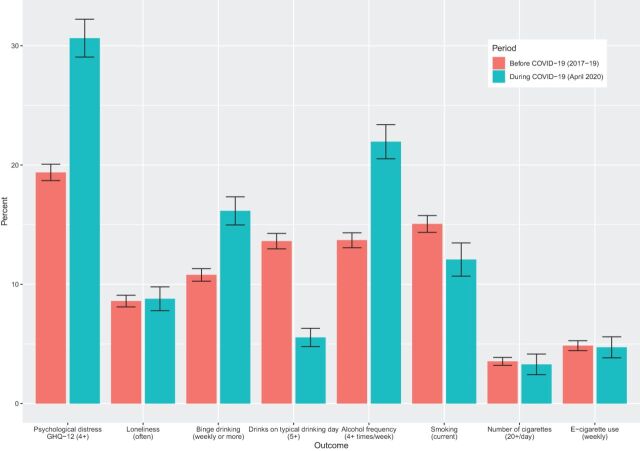
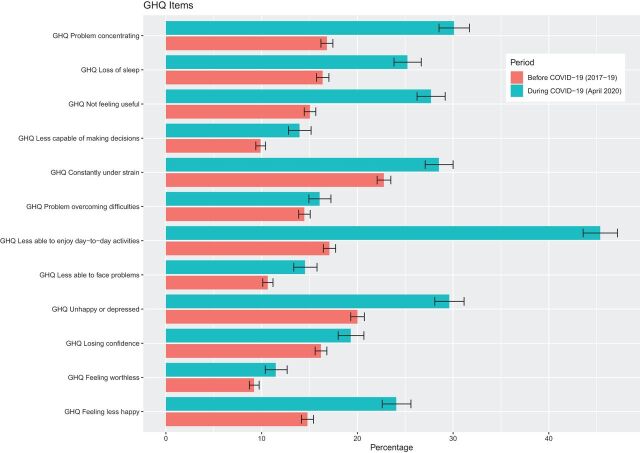
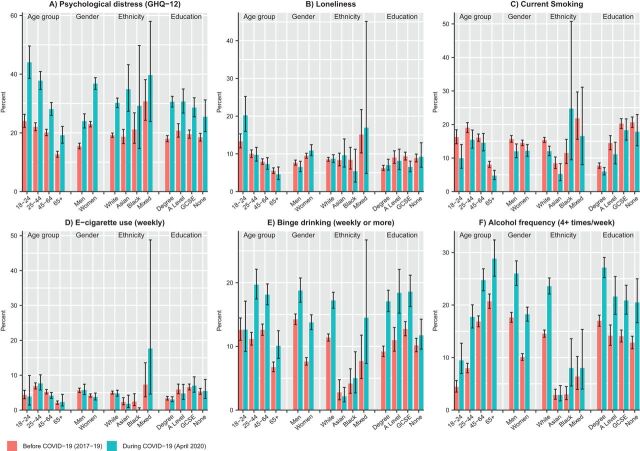
Background: There are concerns that COVID-19 mitigation measures, including the ‘lockdown’, may have unintended health consequences. We examined trends in mental health and health behaviours in the UK before and during the initial phase of the COVID-19 lockdown and differences across population subgroups. Methods: Repeated cross-sectional and longitudinal analysis of the UK Household Longitudinal Study, including representative samples of over 27,000 adults (aged 18+) interviewed in four survey waves between 2015 and 2020. A total of 9748 adults had complete data for longitudinal analyses. Outcomes included psychological distress (General Health Questionnaire-12), loneliness, current cigarette smoking, use of e-cigarettes and alcohol consumption. Cross-sectional prevalence estimates were calculated and multilevel Poisson regression assessed associations between time period and the outcomes of interest, as well as differential associations by age, gender, education level and ethnicity. Results: Psychological distress increased 1 month into lockdown with the prevalence rising from 19.4% (95% CI 18.7% to 20.1%) in 2017–2019 to 30.6% (95% CI 29.1% to 32.3%) in April 2020 (RR=1.3, 95% CI 1.2 to 1.4). Groups most adversely affected included women, young adults, people from an Asian background and those who were degree educated. Loneliness remained stable overall (RR=0.9, 95% CI 0.6 to 1.5). Smoking declined (RR=0.9, 95% CI=0.8,1.0) and the proportion of people drinking four or more times per week increased (RR=1.4, 95% CI 1.3 to 1.5), as did binge drinking (RR=1.5, 95% CI 1.3 to 1.7). Conclusions: Psychological distress increased 1 month into lockdown, particularly among women and young adults. Smoking declined, but adverse alcohol use generally increased. Effective measures are required to mitigate negative impacts on health.
Overview
The claims and statistics of this paper haven’t been checked yet.
Free: it reads the open-access text and checks the first 5 claims that cite a source we can check. Create a free account to check every claim.
Integrity signals
Registry
Cites
Statistics
Figures
Verification
Claims the paper makes
The claims and statistics of this paper haven’t been checked yet.
Free: it reads the open-access text and checks the first 5 claims that cite a source we can check. Create a free account to check every claim.
Claims other papers make about this one
Each is checked against this paper’s own text: does it say what the citing paper says it does?
The cited source says what the claim attributes to it.
In the citing paper
“such a comparison complements other studies that rely on pre-pandemic data collected during typical conditions (e.g., Niedzwiedz, et al., 2021).”
From Young Adult Adaptability to the Social Challenges of the COVID-19 Pandemic: The Protective Role of Friendships (2022) · cites this paper as Niedzwiedz, et al., 2021
In the citing paper
“there is evidence to suggest that they have resulted in adverse psychological consequences across general populations.”
Self-check
Percentages, sums and reported differences re-computed from the paper’s own numbers.
The self-check needs the paper’s full text.
Citations
Cites
The Psychological Impact of Quarantine and How to Reduce It: Rapid Review of the Evidence
Brooks, S. K., Webster, R. K., Smith, L. E., Woodland, L., Wessely, S., Greenberg, N., & Rubin, G. J. (2020) · doi:10.2139/ssrn.3532534 · Cited by 16,394
The psychological impact of quarantine and how to reduce it: Rapid review of the evidence
Brooks, S. K., Webster, R. K., Smith, L. E., Woodland, L., Wessely, S., Greenberg, N., & Rubin, G. J. (2020) · The Lancet · doi:10.1016/s0140-6736(20)30460-8 · Cited by 16,378 · cited 1×
“Research prior to the pandemic has suggested quarantine is linked to several negative psychological outcomes.(6) During the COVID-19 pandemic, concerns have been repeatedly raised about potentially long-lasting harms to mental health.”
A Modified Poisson Regression Approach to Prospective Studies with Binary Data
Zou, G. (2004) · American Journal of Epidemiology · doi:10.1093/aje/kwh090 · Cited by 9,615
Holmes, E. A., O'Connor, R. C., Perry, V. H., Tracey, I., Wessely, S., Arseneault, L., Ballard, C., Christensen, H., Cohen Silver, R., Everall, I., et al. (2020) · The Lancet Psychiatry · doi:10.1016/s2215-0366(20)30168-1 · Cited by 5,715
A global panel database of pandemic policies (Oxford COVID-19 Government Response Tracker)
Hale, T., Angrist, N., Goldszmidt, R., Kira, B., Petherick, A., Phillips, T., Webster, S., Cameron-Blake, E., Hallas, L., Majumdar, S., et al. (2021) · Nature Human Behaviour · doi:10.1038/s41562-021-01079-8 · Cited by 4,578
The Validity of Two Versions of the GHQ in the WHO Study of Mental Illness in General Health Care
GOLDBERG, D. P., GATER, R., SARTORIUS, N., USTUN, T. B., PICCINELLI, M., GUREJE, O., & RUTTER, C. (1997) · Psychological Medicine · doi:10.1017/s0033291796004242 · Cited by 3,657
Indicators of socioeconomic position (part 1): Figure 1
Galobardes, B., Shaw, M., Lawlor, D. A., Lynch, J. W., & Davey Smith, G. (2006) · Journal of Epidemiology and Community Health · doi:10.1136/jech.2004.023531 · Cited by 2,867 · cited 1×
“When analysing educational inequalities we restricted analyses to adults aged 25+ years as educational attainment tends to be stable from that age onwards.(16) For longitudinal analysis, we included participants with complete data from all four waves and aged 18+ years during wave 9.”
Clinical impact of COVID-19 on patients with cancer (CCC19): a cohort study
Kuderer, N. M., Choueiri, T. K., Shah, D. P., Shyr, Y., Rubinstein, S. M., Rivera, D. R., Shete, S., Hsu, C.-Y., Desai, A., de Lima Lopes, G., et al. (2020) · The Lancet · doi:10.1016/s0140-6736(20)31187-9 · Cited by 1,726
AUDIT‐C as a Brief Screen for Alcohol Misuse in Primary Care
Bradley, K. A., DeBenedetti, A. F., Volk, R. J., Williams, E. C., Frank, D., & Kivlahan, D. R. (2007) · Alcoholism: Clinical and Experimental Research · doi:10.1111/j.1530-0277.2007.00403.x · Cited by 1,632
Suicide risk and prevention during the COVID-19 pandemic
Gunnell, D., Appleby, L., Arensman, E., Hawton, K., John, A., Kapur, N., Khan, M., O'Connor, R. C., Pirkis, J., Appleby, L., et al. (2020) · The Lancet Psychiatry · doi:10.1016/s2215-0366(20)30171-1 · Cited by 1,513 · cited 1×
“While a body of literature is developing to articulate the expected indirect impacts of the pandemic, 3 7 25 empirical research on how mental health and health-related behaviours have changed remains limited and largely based on non-representative samples.”
Cited by
Items 201–300 of 528
Chan, C. S., Yang, C.-T., Xu, Y., He, L., & Yip, P. S. F. (2022) · Psychological Medicine · doi:10.1017/s0033291722000587 · Cited by 13
“The pandemic brought upon social isolation, work and life changes, and family separation, which were associated with psychological distress under the pandemic (Elmer et al., 2020; Niedzwiedz et al., 2021; Yip & Chau, 2020).”
COVID-19 and severity of liver diseases: Possible crosstalk and clinical implications
Imam, M. T., Almalki, Z. S., Alzahrani, A. R., Al-Ghamdi, S. S., Falemban, A. H., Alanazi, I. M., Shahzad, N., Alrooqi, M. M., Jabeen, Q., & Shahid, I. (2023) · International Immunopharmacology · doi:10.1016/j.intimp.2023.110439 · Cited by 15
“Consequently, an increase in regular alcohol consumption was translated into harmful drinking habits, particularly for liver health, during the first wave of COVID-19, where overall escalation was reported in up to 48 % of respondents [4,169].”
Ochnik, D., Rogowska, A. M., Arzenšek, A., & Benatov, J. (2022) · International Journal of Environmental Research and Public Health · doi:10.3390/ijerph19127207 · Cited by 15
Lamb, D., Gafoor, R., Scott, H. R., Carr, E., Stevelink, S. A. M., Raine, R., Hotopf, M. H., Greenberg, N. L., Hegarty, S., Madan, I., et al. (2022) · medRxiv · doi:10.1101/2022.06.16.22276479 · Cited by 16
“Alcohol use was the one outcome where there were clear associations with ethnicity: those in Black, Asian, or mixed racial or ethnic groups were less likely to meet cut-off for alcohol misuse than White participants, which is echoed in other research (Niedzwiedz et al., 2021).”
Moreno‐Agostino, D., Fisher, H. L., Hatch, S. L., Morgan, C., Ploubidis, G. B., & Das‐Munshi, J. (2022) · Psychological Medicine · doi:10.1017/s0033291722003348 · Cited by 19
“…are not only consistent with the idea that the pandemic onset had a disproportionate impact among the youngest generation (Kwong et al., 2021; Niedzwiedz et al., 2021; Pierce et al., 2020), but suggest that this impact was even larger than expected if generational inequalities had followed a…”
BackgroundThe impact of the COVID-19 pandemic on alcohol and tobacco consumption: Evidence from Peru
Sara, R. (2023) · Social Science & Medicine · doi:10.1016/j.socscimed.2023.115890 · Cited by 14
Wong, S. M. Y., Chen, E. Y. H., Suen, Y. N., Ho, W. K. O., Chan, S. K. W., Lee, E. H. M., Chan, K., Lui, S. S. Y., Wong, M. T., & Hui, C. L. M. (2023) · BMC Psychiatry · doi:10.1186/s12888-023-04933-3 · Cited by 13
“Among the several longitudinal studies available, increased levels of mental distress and psychiatric symptoms have been reported during the early months of COVID-19 [6, 10, 29, 30].”
BackgroundFergie, G., Vaczy, C., Smith, K. E., Mackenzie, M., Phan, T. T., & Hilton, S. (2023) · Health Expectations · doi:10.1111/hex.13825 · Cited by 13
“…employment opportunities and labour markets, 15,16 disruption to education and educational transitions 17,18 and trends in worsening mental health 19 have led to representations of Gen Z (those born between the mid ‐ 1990s and early 2010s) as a ‘ lost ’ 20 or ‘ precariat ’ 21 generation,…”
BackgroundWirkner, J., & Brakemeier, E. (2024) · Frontiers in Psychology · doi:10.3389/fpsyg.2024.1283919 · Cited by 18
“…and during the first year of the pandemic, some studies found an increase in psychological distress (McGinty et al., 2020; Pierce et al., 2020; Niedzwiedz et al., 2021; Ramiz et al., 2021), but others found no changes in depression symptoms (Castellini et al., 2021) or even a decrease in…”
BackgroundAlcohol Consumption During the COVID‐19 Pandemic: A Critical Review
Merlo, A., Hendriksen, P. A., Severeijns, N. R., Garssen, J., Bruce, G., & Verster, J. C. (2025) · Human Psychopharmacology Clinical and Experimental · doi:10.1002/hup.70004 · Cited by 17
“Specifically, greater alcohol use was associated with financial worries and psychological states, such as depression, stress, and anxiety caused by unpredictability of the pandemic (Capasso et al. 2021; Niedzwiedz et al. 2021).”
Ménard, J., Foucreault, A., Leduc, H., Meunier, S., & Trépanier, S. (2021) · Frontiers in Psychology · doi:10.3389/fpsyg.2021.620349 · Cited by 18
“Longitudinal studies have shown that being locked down represents a considerable risk for the mental health of all individuals (Codagnone et al., 2020; Niedzwiedz et al., 2021).”
BackgroundKhanolkar, R. A., Trajkovski, A., Agarwal, A., Pauls, M. A., & Lang, E. (2022) · Internal and Emergency Medicine · doi:10.1007/s11739-022-02932-y · Cited by 14
“Additionally, if future studies reveal that more stringent NPI measures such as lockdowns are required to achieve desired efficacy, the benefit of preventing disease spread will have to be carefully weighted against the adverse impacts these measures may have on mental health and social inequity [32, 33]”
BackgroundZhang, W., & Velez, D. (2022) · JMIR Formative Research · doi:10.2196/32387 · Cited by 18
“Second, a series of ordinal and binary logistic regression analyses were conducted to examine the effects of PA (independent variable) on the probability of experiencing mental health issues (dependent variables), considering potential confounders (age, gender, education, marital status, smoking, and ethnicity) [32-35…”
MethodMental health literacy: A focus on daily life context for population health measurement
Chua, K., Hahn, J. S., Farrell, S., Jolly, A., Khangura, R. K., & Henderson, C. (2022) · SSM - Mental Health · doi:10.1016/j.ssmmh.2022.100118 · Cited by 20
Fluctuations of psychological states on Twitter before and during COVID-19
Massell, J., Lieb, R., Meyer, A. H., & Mayor, E. (2022) · PLoS ONE · doi:10.1371/journal.pone.0278018 · Cited by 17
Fujihara, S., & Tabuchi, T. (2022) · Journal of Affective Disorders · doi:10.1016/j.jad.2022.02.055 · Cited by 19
Mezaache, S., Donadille, C., Martin, V., Gadelius, M. L. B., Appel, L., Spire, B., Madrid, L. B., Bastien, M., & Roux, P. (2022) · Harm Reduction Journal · doi:10.1186/s12954-022-00611-x · Cited by 16
“In the general population, mental health was significantly affected by the pandemic, especially during lockdown periods [36].”
BackgroundDeimel, D., Firk, C., Stöver, H., Hees, N., Scherbaum, N., & Fleißner, S. (2022) · International Journal of Environmental Research and Public Health · doi:10.3390/ijerph191912801 · Cited by 16
“For Great Britain, it is reported that excessive alcohol consumption has become more frequent [18].”
BackgroundDistress Signals: Age Differences in Psychological Distress before and during the COVID-19 Pandemic
Hale, S., Myerson, J., Strube, M., Green, L., & Lewandowski, A. B. (2023) · International Journal of Environmental Research and Public Health · doi:10.3390/ijerph20043549 · Cited by 17
“[24] appropriately compared psychological distress in the UK at the beginning of the pandemic (April 2020) with the level of distress predicted by previous upward trends.”
BackgroundKaltiala‐Heino, R., Aalto‐Setälä, T., & Kiviruusu, O. H. (2023) · Scandinavian Journal of Public Health · doi:10.1177/14034948231166466 · Cited by 18
“Moreover, increases in depression and anxiety have been reportedly greater among younger adults and women [1,2,14,15].”
Backgroundde Velde, S. M. V., Cuyper, A. D., Kort, L. D., Jacobs, K. A., Somogyi, N., Tholen, R., Eekert, N. V., & Buffel, V. (2023) · Archives of Public Health · doi:10.1186/s13690-023-01211-2 · Cited by 15
Eime, R., Harvey, J. T., Charity, M., Elliott, S., Drummond, M., Pankowiak, A., & Westerbeek, H. M. (2022) · BMC Public Health · doi:10.1186/s12889-022-13195-9 · Cited by 14
“Further, another UK study reported that psychological distress during lockdown was worse for young adults [46].”
BackgroundResultBloomfield, K., Kilian, C., Manthey, J., Rehm, J. T., Brummer, J., & Grittner, U. (2022) · European Addiction Research · doi:10.1159/000524379 · Cited by 11
Gustafsson, P. E., Nilsson, I., & Sebastiån, M. S. (2022) · BMJ Open · doi:10.1136/bmjopen-2021-060209 · Cited by 13
Anyanwu, P. E., Moriarty, Y., McCutchan, G. M., Grozeva, D., Goddard, M., Whitelock, V., Cannings-John, R. L., Quinn-Scoggins, H. D., Hughes, J., Gjini, A., et al. (2022) · BMC Public Health · doi:10.1186/s12889-022-13870-x · Cited by 12
“[34] did not observe any differential impact of the pandemic lockdown on smoking across age, sex, ethnicity or socioeconomic subgroups.”
BackgroundGambling advertising on Twitter before, during and after the initial Australian COVID-19 lockdown
Russell, A. M. T., Hing, N., Bryden, G. M., Thorne, H. B., Rockloff, M., & Browne, M. (2023) · Journal of Behavioral Addictions · doi:10.1556/2006.2023.00020 · Cited by 12
Mental-health before and during the COVID-19 pandemic in adults with neurodevelopmental disorders
Shakeshaft, A., Blakey, R., Kwong, A. S. F., Riglin, L., Smith, G. D., Stergiakouli, E., Tilling, K. M., & Thapar, A. (2023) · Journal of Psychiatric Research · doi:10.1016/j.jpsychires.2023.01.029 · Cited by 17
“…Avon Longitudinal Study of Parents and Children (ALSPAC) study is an ongoing longitudinal study which recruited pregnant woman in the Avon region of South-West England, due to give birth between April 1, 1991 and December 31, 1992 (Boyd et al., 2013; Fraser et al., 2013; Northstone et al., 2019).”
BackgroundInfluentialDisrupted transitions? Young adults and the COVID-19 pandemic
ESRI, Smyth, E., Nolan, A., & ESRI (2022) · doi:10.26504/rs142 · Cited by 22
“Niedzwiedz et al. (2021) used data from Understanding Society to examine changes in mental health and health behaviours from the pre-pandemic period in the UK.”
MethodMangot‐Sala, L., Smidt, N., & Liefbroer, A. C. (2023) · Social Psychiatry and Psychiatric Epidemiology · doi:10.1007/s00127-023-02480-6 · Cited by 11
“While some studies reported stronger negative effects, particularly for those living alone [1], allegedly due to stronger feelings of loneliness and isolation [13], others reported an overall positive effect of working from home, due to greater perceived control over work and better work-life balance [14].”
BackgroundNorström, T., & Ramstedt, M. (2024) · European Journal of Epidemiology · doi:10.1007/s10654-023-01068-3 · Cited by 11
Beese, F., Wachtler, B., Grabka, M. M., Blume, M., Kersjes, C., Guṭu, R., Mauz, E., & Hoebel, J. (2024) · BMC Public Health · doi:10.1186/s12889-024-18874-3 · Cited by 13
“We found no association with education, which is in line with research suggesting that educational inequalities in psychological well-being and stress narrowed during the early pandemic [38, 39].”
ResultThe toll of a second lockdown: A longitudinal study
Hamama‐Raz, Y., Goodwin, R. B., Leshem, E., & Ben‐Ezra, M. (2021) · Journal of Affective Disorders · doi:10.1016/j.jad.2021.06.080 · Cited by 14
Cheng, G. J., Wagner, A. L., O’Shea, B. Q., Joseph, C., Finlay, J., & Kobayashi, L. C. (2022) · Innovation in Aging · doi:10.1093/geroni/igac047 · Cited by 12
Rogowska, A. M., Kuśnierz, C., Павлова, Ю., & Chilicka, K. (2022) · Journal of Clinical Medicine · doi:10.3390/jcm11164726 · Cited by 18
The correlation between health literacy and mental health literacy in Turkish Society
Akgün, Ş., Kesgin, M. T., & Tok, H. H. (2022) · Perspectives In Psychiatric Care · doi:10.1111/ppc.13146 · Cited by 11
van Rens, T., Hanson, P., Oyebode, O. O., Walasek, L., Barber, T. M., Mujcic, R., & Al-Khudairy, L. (2022) · BMJ Nutrition Prevention & Health · doi:10.1136/bmjnph-2022-000562 · Cited by 11
“6% in April 2020 (35) and the percentage of UK adults experiencing a significant mental health problem is estimated to have risen by approximately 50% based on nationally representative data collected before and during COVID-19 lockdown (36).”
Thomson, R., Kopasker, D., Bronka, P., Richiardi, M. G., Khodygo, V., Baxter, A. J., Igelström, E., Pearce, A., Leyland, A. H., & Katikireddi, S. V. (2024) · PLoS Medicine · doi:10.1371/journal.pmed.1004358 · Cited by 14
Self-citationEmotional blunting in patients with depression. Part III: relationship with psychological trauma
Christensen, M. C., Ren, H., & Fagiolini, A. M. (2022) · Annals of General Psychiatry · doi:10.1186/s12991-022-00395-1 · Cited by 13
Long-Term Impact of COVID-19 Pandemic in Sleep Quality and Lifestyle in Young Adults
Barbouzas, A. E., Malli, F., Daniil, Z. D., & Gourgoulianis, K. I. (2022) · International Journal of Environmental Research and Public Health · doi:10.3390/ijerph191912333 · Cited by 10
“An increase in quarantine meals was also observed in the United Kingdom [55], Poland [56], and Brazil [57].”
BackgroundLaczkó, T., Ács, P., Morvay-Sey, K., Cselik, B., & Stocker, M. (2022) · International Journal of Environmental Research and Public Health · doi:10.3390/ijerph20010660 · Cited by 17
Vardavas, C. I., Nikitara, K., Aslanoglou, K., Boon, M. H., Phalkey, R. K., Leonardi‐Bee, J., Magiorkinis, G., Katsaounou, P. A., Pharris, A., Severi, E., et al. (2021) · medRxiv · doi:10.1101/2021.11.11.21266216 · Cited by 12
“(30-60) would be sufficient to achieve pandemic suppression, while indirectly decreasing”
BackgroundAlpers, S. E., Druckrey-Fiskaaen, K. T., Madebo, T., Vold, J. H., Pallesen, S., Skogen, J. C., Lunde, L.-H., Mæland, S., & Fadnes, L. T. (2024) · BMC Public Health · doi:10.1186/s12889-024-17943-x · Cited by 13
“This aligns with findings from other studies, where smokers with severe psychological distress were significantly more likely to report intentions to quit smoking and seek counseling than smokers without severe psychological distress [9, 59, 60].”
ResultIzydorczyk, B., Gruszka, A., Kałwak, W., Wendołowska, A. M., Węziak‐Białowolska, D., Czyżowska, D., Bonarska, K., Bańbura, A., Opoczyńska-Morasiewicz, M., & Sitnik‐Warchulska, K. (2025) · Social Indicators Research · doi:10.1007/s11205-024-03498-2 · Cited by 18
“During the COVID-19 pandemic, a similar trend of increased psychological distress and declining mental well-being was observed in emerging adulthood groups compared to older age groups (Banks & Xu, 2020; Guszkowska & Bodasińska, 2023; Niedzwiedz et al., 2020; Pierce et al., 2020).”
Chen, J.-H. (2021) · Aging & Mental Health · doi:10.1080/13607863.2021.2021142 · Cited by 11
Essential and non-essential US workers’ health behaviors during the COVID-19 pandemic
Martin, M. A., Lennon, R. P., Smith, R. A., Myrick, J. G., Small, M. L., & Scoy, L. J. V. (2022) · Preventive Medicine Reports · doi:10.1016/j.pmedr.2022.101889 · Cited by 14
“Yet, some studies found no behavioral change (Reynolds et al., 2021) or improvements in some health behaviors (Niedzwiedz et al., 2020; Hu et al., 2020).”
InfluentialHsu, J. T.-H., & Tsai, R. T. (2022) · Journal of Medical Internet Research · doi:10.2196/38776 · Cited by 12
“At the individual level, studies have shown that lockdown is associated with suicidal ideation, anxiety disorder, nightmares, depression, loneliness, and poor mental health [7-12].”
BackgroundHwang, I., Shaw, F. F., Hsu, W., Liu, G.-Y., Kuan, C., Gunnell, D., & Chang, S. (2022) · Crisis · doi:10.1027/0227-5910/a000877 · Cited by 14
“Some longitudinal studies showed that the prevalence of suicide ideation and psychological distress increased during the pandemic (Czeisler et al., 2020; Niedzwiedz et al., 2021; O ’ Connor et al., 2020).”
BackgroundExperience of loneliness during the COVID-19 pandemic: a cross-sectional study of 50 968 adult Danes
Christoffersen, L. A. N., Helenius, D., Schwinn, M., Erikstrup, C., Hjalgrim, H., Nissen, J., Banasik, K., Nielsen, K. R., Kaspersen, K. A., Dinh, K. M., et al. (2023) · BMJ Open · doi:10.1136/bmjopen-2022-064033 · Cited by 10
Marincowitz, C., Bouamra, O., Coats, T., Kumar, D. S., Lockey, D., Mason, L. W., Newcombe, V., Thompson, J., Edwards, A., & Lecky, F. E. (2023) · PLoS Medicine · doi:10.1371/journal.pmed.1004243 · Cited by 9
The increasing significance of disease severity in a burden of disease framework
Wyper, G. M. A., Assunção, R., Fletcher, E., Gourley, M., Grant, I., Haagsma, J. A., Hilderink, H. B. M., Idavain, J., Lesnik, T., von der Lippe, E., et al. (2021) · Scandinavian Journal of Public Health · doi:10.1177/14034948211024478 · Cited by 9
“Additionally, information has emerged to indicate the worsening of some conditions such as mental health and musculoskeletal disorders, which were already leading causes of DALYs [9,10].”
BackgroundInfluentialGambling and Gaming in the United Kingdom during the COVID-19 Lockdown
Close, J., Spicer, S. G., Nicklin, L. L., Lloyd, J., Whalley, B., & Lloyd, H. M. (2022) · COVID · doi:10.3390/covid2020007 · Cited by 13
“This was consistent across all demographic variables, although more acute amongst females—an observation consistent with a concurrent population survey [41].”
ResultBu, F., Steptoe, A., & Fancourt, D. E. (2022) · Psychological Medicine · doi:10.1017/s0033291722000605 · Cited by 12
Meaninglessness and monotony in pandemic boredom
Hughes, E. (2023) · Phenomenology and the Cognitive Sciences · doi:10.1007/s11097-023-09888-0 · Cited by 12
“14 Drawn from examples of being bored at the train station and a dinner party, Heidegger’s interpretation of boredom struggles to account for how different people’s concrete factical situations, which have ensured the unequal distribution of the pandemic’s adverse impacts upon mental health, relationships, work, educa…”
BackgroundDavies, E., Bennett, J., Matheson, L., Brett, J., & Watson, E. K. (2023) · Health Communication · doi:10.1080/10410236.2023.2245208 · Cited by 13
“The facilitator posed an opening question based on a study showing women aged 50+ drank more alcohol during the pandemic (Niedzwiedz et al., 2020).”
The long-term effects of consecutive COVID-19 waves on mental health
Novotný, J., Gonzalez-Rivas, J. P., Kunzová, Š., Skladaná, M., Pospíšilová, A., Polcrova, A. B., Vassilaki, M. E., Medina‐Inojosa, J. R., López-Jiménez, F. A., Geda, Y. E., et al. (2023) · BJPsych Open · doi:10.1192/bjo.2023.620 · Cited by 13
Atlas, L. Y., Farmer, C., Shaw, J. S., Gibbons, A. B., Guinee, E. P., Lossio-Ventura, J. A., Ballard, E. D., Ernst, M., JAPEE, S. A., Pereira, F., et al. (2025) · Nature Mental Health · doi:10.1038/s44220-024-00371-6 · Cited by 14
“We report associations with other social factors (relationship quality, social support and emotional support) in Supplementary Results (Supplementary Tables 10–13).”
InfluentialZhang, X., & Cheng, X. (2022) · Frontiers in Psychology · doi:10.3389/fpsyg.2022.953501 · Cited by 17
Bornstein, S., & Magnus, M. (2022) · Psychiatry Research · doi:10.1016/j.psychres.2022.114759 · Cited by 9
“This corroborates the findings from other countries (Benke et al., 2020; Bu et al., 2020; Groarke et al., 2020; Li and Wang, 2020; Losada-Baltar et al., 2021; Niedzwiedz et al., 2021).”
ResultSilva, L., Bezzo, F. B., & van Ham, M. (2023) · Social Science & Medicine · doi:10.1016/j.socscimed.2023.115917 · Cited by 11
Liu, L., Contreras, G. A., Pollock, N. J., Tonmyr, L., & Thompson, W. (2023) · Health Promotion and Chronic Disease Prevention in Canada · doi:10.24095/hpcdp.43.5.05 · Cited by 13
Adam, M., Moran, J. K., Kippe, Y. D., Schouler‐Ocak, M., Bermpohl, F., Gutwinski, S., & GOLDSCHMIDT, T. J. (2023) · Frontiers in Psychiatry · doi:10.3389/fpsyt.2023.1240703 · Cited by 10
Abhishek, A., Tata, L. J., Mamas, M. A., & Avery, A. J. (2022) · Annals of the Rheumatic Diseases · doi:10.1136/annrheumdis-2021-221989 · Cited by 9
Mengin, A. C., Allé, M. C., Koning, E., Pham, B., Park, S., Berna, F. S., & Giersch, A. (2022) · Schizophrenia · doi:10.1038/s41537-022-00222-2 · Cited by 10
Rozental, A., Sörman, K., Ojala, O., Jangard, S., Alaoui, S. E., Månsson, K. N. T., Shahnavaz, S., Lundin, J., Forsström, D., Hedman‐Lagerlöf, M., et al. (2022) · Frontiers in Psychiatry · doi:10.3389/fpsyt.2022.933858 · Cited by 11
“The items were assessed for the past 2 weeks and rated on a 5-point scale, corresponding to “not at all” (0), “one or two days” (1), “several days” (2), “more than half the days” (3), or “nearly every day” (4).”
BackgroundChallenges and Implications of the COVID-19 Pandemic on Mental Health: A Systematic Review
Abubakar, A. R., Tor, M. A., Ogidigo, J. O., Sani, I. H., Rowaiye, A. B., Ramalan, M. A., Najib, Y. S., Danbala, A. A., Adamu, F., Abdullah, A., et al. (2022) · Psych · doi:10.3390/psych4030035 · Cited by 11
Gambling in Canada During the Pandemic: 6 Months After the National COVID Lockdown
Shaw, C. A., Hodgins, D. C., Williams, R. J., Belanger, Y. D., Christensen, D. R., el‐Guebaly, N., McGrath, D. S., & Stevens, R. M. G. (2022) · The Canadian Journal of Addiction · doi:10.1097/cxa.0000000000000157 · Cited by 9
“Subsequently, significant changes in platform category occurred between lockdown and postlockdown (χ(2) (3,2790)= 311.”
BackgroundNovi, C. D., Martini, G., & Sturaro, C. (2023) · Economics & Human Biology · doi:10.1016/j.ehb.2023.101242 · Cited by 11
Locked down in Distress: a Causal Estimation of the Mental-Health Fallout from the COVID-19 PandemicPreprint
Anaya, L., Howley, P., Waqas, M., & Yalonetzky, G. (2021) · SSRN Electronic Journal · doi:10.2139/ssrn.3873973 · Cited by 9
Chung, J. Y., Gibbons, A. B., Atlas, L. Y., Ballard, E. D., Monique Ernst, D., JAPEE, S. A., Farmer, C., Shaw, J. S., & Pereira, F. (2021) · medRxiv · doi:10.1101/2021.10.12.21264902 · Cited by 7
Scotland, P. H. (2021) · doi:10.52487/7736 · Cited by 9
“Some previous analyses of survey data with smaller sample sizes on the effect of lockdown on drinking in the UK found that high risk drinking increased, especially for those over the age of 25 years and for women (14,29).”
BackgroundSomo, C. M. (2024) · Education Sciences · doi:10.3390/educsci14030249 · Cited by 21
“Furthermore, 24.1% of non-immigrant children in Germany reported anxiety symptoms [25], and 30.6% of children in the United Kingdom reported psychological distress [26].”
BackgroundInfluentialBalogh, R., Moortel, D. D., Gadeyne, S., Vanderleyden, J., Warhurst, C., & Vanroelen, C. (2024) · International Journal of Social Determinants of Health and Health Services · doi:10.1177/27551938241288788 · Cited by 11
“59 Low mental well-being is represented by the Short Warwick-Edinburgh Mental Well-being Scale (SWEMWBS).”
InfluentialKnipe, D. W., García, S. D. O., Salhi, L., Afzal, N., Sammut, S., Mainstone-Cotton, L., Sefi, A., Marchant, A. L., & John, A. M. (2025) · PLoS ONE · doi:10.1371/journal.pone.0316468 · Cited by 8
Merino-Casquero, A., Andrade-Gómez, E., Fagundo-Rivera, J., & Fernández-León, P. (2025) · Journal of Clinical Medicine · doi:10.3390/jcm14051546 · Cited by 12
“Some research indicates that being female is associated with a heightened risk of BD during this period [17,28,31].”
Kim, J., Seo, Y. E., Sung, H. K., Park, H. Y., Han, M. H., & Lee, S. H. (2022) · International Journal of Environmental Research and Public Health · doi:10.3390/ijerph19031092 · Cited by 9
“This is consistent with earlier studies on loneliness and depression in COVID-19 patients due to isolation during the initial phase of lockdown [28], where hospitalization duration was a major factor contributing to psychological distress [28,29].”
ResultSoerjomataram, I., Bray, F., Lansdorp‐Vogelaar, I., Ginsburg, O., Rahal, R., Sullivan, R. J., & Canfell, K. (2022) · Journal of Cancer Policy · doi:10.1016/j.jcpo.2022.100328 · Cited by 8
COVID-19: A Neoliberal Nirvana?
Watermeyer, R., Raaper, R., & Batalla, M. B. (2022) · Critical Criminology · doi:10.1007/s10612-022-09652-x · Cited by 10
“2017); bullying (Zabrodska and Kveton 2013), and microaggressions (Sue 2010); work inequalities (Niedzwiedz et al. 2020; Minello et al.”
BackgroundQuatremère, G., Guignard, R., Andler, R., Sempé, S., Houzelle, N., & Nguyen‐Thanh, V. (2022) · International Journal of Environmental Research and Public Health · doi:10.3390/ijerph192214808 · Cited by 12
“Often, an increase in tobacco consumption was more frequent than a decrease, [28,44] and inversely for alcohol [45–47].”
BackgroundGreen, M. J., Craig, P., Demou, E., Katikireddi, S. V., Leyland, A. H., & Pearce, A. (2023) · Annals of General Psychiatry · doi:10.1186/s12991-023-00454-1 · Cited by 10
Self-citationGajdics, J., Bagi, O., Farkas, F. F., Andó, B., Pribék, I. K., & Lázár, B. A. (2023) · International Journal of Environmental Research and Public Health · doi:10.3390/ijerph20206939 · Cited by 11
Pierre, M., Keller, M., Altschul, D., Fawns‐Ritchie, C., Hartley, L., Nangle, C., Edwards, R., Dawson, R., Campbell, A., Flaig, R., et al. (2021) · Wellcome Open Research · doi:10.12688/wellcomeopenres.16820.1 · Cited by 9
Forsyth, F., Sowden, E., Hossain, M. Z., Tuffnell, R., Chew-Graham, C. A., Blakeman, T., & Deaton, C. (2021) · BJGP Open · doi:10.3399/bjgpo.2021.0115 · Cited by 12
“Whilst most large-scale studies have documented trends towards worsening health behaviours during lockdown,(24-26) we are not alone in describing divergence.”
BackgroundFairman, K. A., Goodlet, K. J., Rucker, J. D., & Zawadzki, R. S. (2021) · BMJ Open · doi:10.1136/bmjopen-2021-050361 · Cited by 10
Swahn, M. H., Balenger, A., Umenze, F., Aneja, R., Bureh, T. A., Dumbili, E. W., & Obot, I. S. (2022) · Journal of Epidemiology and Global Health · doi:10.1007/s44197-022-00035-7 · Cited by 8
“Researchers in the United Kingdom reported that the proportion of people drinking four or more times per week increased during lockdown [4].”
BackgroundStevenson, N. (2023) · Event Management · doi:10.3727/152599522x16419948695198 · Cited by 8
Costello, R. E., Tazare, J., Piehlmaier, D., Herrett, E. L., Parker, E. P. K., Zheng, B., Mansfield, K. E., Henderson, A. D., Carreira, H., Bidulka, P., et al. (2023) · EClinicalMedicine · doi:10.1016/j.eclinm.2023.102077 · Cited by 10
“44,45 It is possible that this translated to hospital admissions later in the pandemic.”
BackgroundSelf-citationBrown, C. R. H., & Faulkner, P. (2021) · Nicotine & Tobacco Research · doi:10.1093/ntr/ntab176 · Cited by 8
Henseke, G., & Schoon, I. (2025) · Social Indicators Research · doi:10.1007/s11205-025-03616-8 · Cited by 11
“However, research had to rely on convenience samples (O'Connor et al., 2021), did not adjust for pre-existing trends in mental health (Niedzwiedz et al., 2021), or did not consider how differences between surveys might have in�uenced self-reported mental health (Anaya et al., 2023; Pierce et al.,…”
Independent music-making during Covid-19 and mental health
Lewis, E. (2022) · Psychology of Music · doi:10.1177/03057356221126198 · Cited by 7
“Referrals for mental health services were lower during the pandemic, likely due to a reduction in healthcare staff (Niedzwiedz et al., 2021).”
BackgroundAntezana, G., Venning, A., Smith, D., & Bidargaddi, N. P. (2022) · Digital Health · doi:10.1177/20552076221144104 · Cited by 8
Downstream health impacts of employment losses during the COVID-19 pandemic
Buajitti, E., Rosella, L. C., Bryan, K., Giesinger, I., & Goel, V. (2021) · Canadian Journal of Public Health · doi:10.17269/s41997-021-00588-3 · Cited by 12
Factors associated with changing alcohol consumption during the first UK lockdown
McAloney‐Kocaman, K., McPherson, K. E., McGlinchey, E., & Armour, C. (2022) · European Journal of Public Health · doi:10.1093/eurpub/ckac124 · Cited by 8
Lin, S., Lan, Y.-T., Hsia, P.-H., Kao, C.-L. M., Tsou, H., & Lin, Y. (2023) · Journal of Affective Disorders · doi:10.1016/j.jad.2022.12.139 · Cited by 7
“Emerging evidence also has shown increases in insomnia, anxiety, and depression during the COVID19 outbreak, particularly after the implementation of a lockdown or stay-at-home policy (Niedzwiedz et al., 2021; Pieh et al., 2021; Rossi et al., 2020).”
The association between sociodemographic inequalities, COVID-related impacts and mental health
Tibber, M. S., Milne, G. A., Fonagy, P., Saunders, R., & Dekker, T. M. (2023) · Journal of Affective Disorders · doi:10.1016/j.jad.2023.01.037 · Cited by 13
“For example, being young and female (Hyland et al., 2020; Daly et al., 2020; Niedzwiedz et al., 2021; Jia et al., 2020; Fancourt et al., 2020; Office for National Statistics, 2021b; Ellwardt and Pr ¨ ag, 2021; Smith et al., 2020; Hubbard et al., 2021; Kwong et al., 2020; Saunders et al., 2020) or…”
Brucki, B. M., Bagade, T., & Majeed, T. (2023) · BMC Public Health · doi:10.1186/s12889-022-14356-6 · Cited by 9
Northern Exposure: COVID-19 and Regional Inequalities in Health and Wealth
Bambra, C. L., Munford, L. A., Khavandi, S., & Bennett, N. C. (2023) · Policy Press eBooks · doi:10.56687/9781447369233 · Cited by 34
Rees, S. J., Mohsin, M., Tay, A. K., Moussa, B., Klein, L. A., Nadar, N., Hussain, F., Krishna, Y., Khalil, B., Yousif, M., et al. (2023) · PLOS Global Public Health · doi:10.1371/journal.pgph.0002073 · Cited by 10
Himmler, S., van Exel, J. N. A., Brouwer, W. B. F., Neumann‐Böhme, S., Sabat, I., Schreyögg, J., Stargardt, T., Barros, P. P., & Torbica, A. (2023) · The European Journal of Health Economics · doi:10.1007/s10198-023-01604-8 · Cited by 10
“Cross-sectional and longitudinal evidence from the UK points toward more negative well-being patterns in younger age groups, women, people with poor mental or physical health, and people with lower socio-economic status [10–13].”
BackgroundKishimoto, M., Masuko, K., Yamamoto, S., Fujita, R., Nakamura, S., Odawara, M., & Zeniya, M. (2023) · Journal of International Medical Research · doi:10.1177/03000605231184036 · Cited by 9
“In contrast, other studies reported increased alcohol consumption during lockdown compared with prior to lockdown.(64,65) Factors associated with increased alcohol use included psychological distress related to COVID-19 (job loss, changes in sleep, higher anxiety and depression, loneliness and lower social connectedne…”
ResultWard, M. D., Clarke, N. E., Wang, M., McGarrigle, C. A., Looze, C. D., O’Halloran, A. M., & Kenny, R. A. (2021) · HRB Open Research · doi:10.12688/hrbopenres.13248.1 · Cited by 7
“While the full effect of the public health measures implemented since March 2020 are not yet known, it is expected that they will have a damaging effect on the economic, social, physical, and psychological wellbeing of the population (Holmes et al., 2020; Niedzwiedz et al., 2021), not least older adults (Carr, 2021; M…”
Background
Metadata
- Authors
- Niedzwiedz, C. L., Green, M. J., Benzeval, M., Campbell, D., Craig, P., Demou, E., Leyland, A., Pearce, A., Thomson, R., Whitley, E., & Katikireddi, S. V.
- Affiliations
- University of Glasgow (GB)
- MRC/CSO Social and Public Health Sciences Unit (GB)
- University of Essex (GB)
- MRC/CSO Social and Public Health Sciences Unit, University of Glasgow, Glasgow, UK
- Corresponding author
- Katikireddi, Srinivasa Vittal
- ORCID
- Venue
- Journal of Epidemiology and Community Health
- Publisher
- BMJ
- Published
- 2020-09-25
- Volume
- 75
- Issue
- 3
- Pages
- 224-231
- ISSN
- 0141-7681 (ISSN-L)
- 0143-005X
- 1470-2738
- PMC
- PMC7892383
- OpenAlex
- W3088359309
- Cited by
- 525
- References
- 36
- Citations by year
- 2026: 13 · 2025: 41 · 2024: 57 · 2023: 106 · 2022: 172 · 2021: 129 · 2020: 7
- FWCI
- 41.43
- Type
- journal article
- Language
- en
- Open access
- hybrid
- doi.org
- Locations
- Journal of Epidemiology & Community Health (publishedVersion, cc-by)
- medRxiv (acceptedVersion, cc-by)
- PubMed Central (publishedVersion, cc-by)
- PubMed (publishedVersion)
- ENLIGHTEN (Jurnal Bimbingan dan Konseling Islam) (acceptedVersion, cc-by-sa)
- Open Access at Essex (University of Essex) (acceptedVersion)
- HRB National Drugs Library (Health Research Board) (submittedVersion)
- Funders
- Chief Scientist Office (SCAF/15/02)
- Economic and Social Research Council (ES/N00812X/1)
- Wellcome Trust (205412/Z/16/Z, 218105/Z/19/Z)
- Medical Research Council (MC_UU_12013, MC_UU_12017, MR/R024774/1)
- Topics
- Social Sciences › Psychology › Clinical Psychology › COVID-19 and Mental Health
- Social Sciences › Sociology and Political Science › COVID-19 Prevention and Impact
- Physical Sciences › Mathematics › Modeling and Simulation › COVID-19 epidemiological studies
- Keywords
- COVID-19 lockdown, mental health, psychological distress, loneliness, cigarette smoking, electronic cigarettes, alcohol consumption, binge drinking, health behavior, sex differences, young adults, ethnicity, educational attainment, UK Household Longitudinal Study
- MeSH terms
- COVID-19, SARS-CoV-2, Adolescent, Adult, Aged, Aged, 80 and over, Alcohol Drinking, Child, Child, Preschool, Cross-Sectional Studies, Female, United Kingdom, Humans, Infant, Infant, Newborn, Loneliness, Longitudinal Studies, Male, Mental Health, Middle Aged, Quarantine, Surveys and Questionnaires, Smoking, Social Isolation, Health Behavior, Prevalence, Young Adult, Electronic Nicotine Delivery Systems
About these checks
Registry, retraction, Cites and statistics results are computed, not judged, with one exception: a printed reference that no index lists is read once by a model before it counts as a citation error. Claims are extracted by a model and kept only when their quote appears verbatim in the text; each cited source is then checked, with a model’s help, for whether it says what the claim relies on. Those verdicts can be wrong — read the claim’s quote and the cited source before relying on one.
Statistics and arithmetic are recomputed, not judged.
Confidence bands are shown only for fields calibrated on our annotated test set. None is calibrated yet, so no band is shown.
What counts as a claim ›How we measure confidence ›How we check this ›
Are you an author, or do you see a problem with this page? Request a review
Data sources
Bibliographic data: Semantic Scholar, OpenAlex, Crossref.
Contains information from the Semantic Scholar Academic Graph Datasets, made available under the ODC Attribution License (ODC-BY 1.0).
Semantic Scholar’s data is described in: Kinney, R., et al. (2023). The Semantic Scholar Open Data Platform. arXiv:2301.10140.
