

Mental health and health behaviours before and during the initial phase of the COVID-19 lockdown: longitudinal analyses of the UK Household Longitudinal Study
Open accessPublished version of a preprint
The DOI matches its Crossref record; 36 of the 36 references it cites were found in a registry or an index.
Abstract
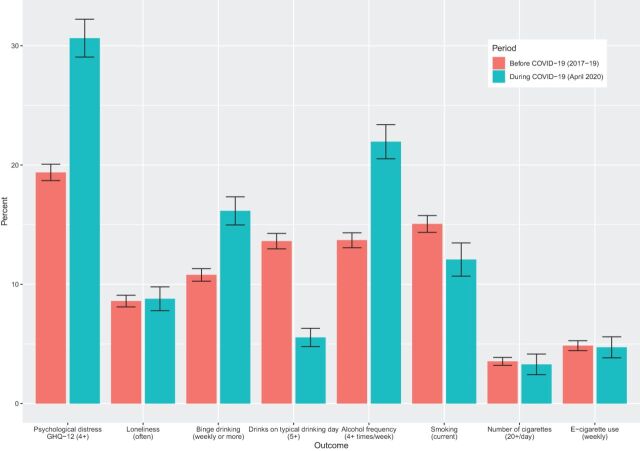
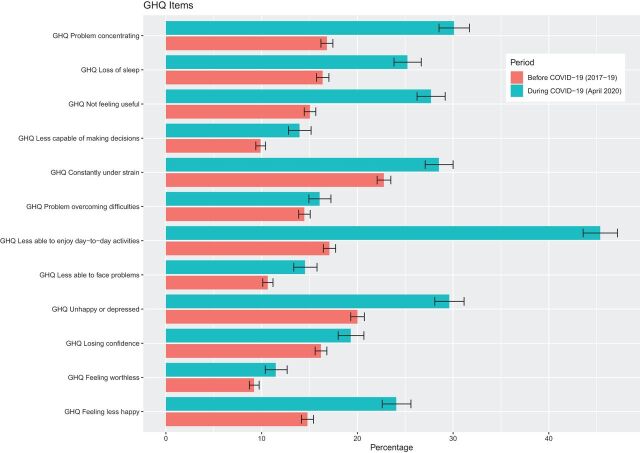
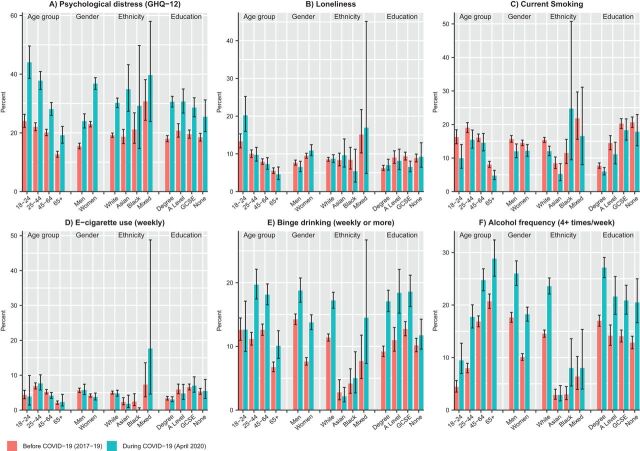
Background: There are concerns that COVID-19 mitigation measures, including the ‘lockdown’, may have unintended health consequences. We examined trends in mental health and health behaviours in the UK before and during the initial phase of the COVID-19 lockdown and differences across population subgroups. Methods: Repeated cross-sectional and longitudinal analysis of the UK Household Longitudinal Study, including representative samples of over 27,000 adults (aged 18+) interviewed in four survey waves between 2015 and 2020. A total of 9748 adults had complete data for longitudinal analyses. Outcomes included psychological distress (General Health Questionnaire-12), loneliness, current cigarette smoking, use of e-cigarettes and alcohol consumption. Cross-sectional prevalence estimates were calculated and multilevel Poisson regression assessed associations between time period and the outcomes of interest, as well as differential associations by age, gender, education level and ethnicity. Results: Psychological distress increased 1 month into lockdown with the prevalence rising from 19.4% (95% CI 18.7% to 20.1%) in 2017–2019 to 30.6% (95% CI 29.1% to 32.3%) in April 2020 (RR=1.3, 95% CI 1.2 to 1.4). Groups most adversely affected included women, young adults, people from an Asian background and those who were degree educated. Loneliness remained stable overall (RR=0.9, 95% CI 0.6 to 1.5). Smoking declined (RR=0.9, 95% CI=0.8,1.0) and the proportion of people drinking four or more times per week increased (RR=1.4, 95% CI 1.3 to 1.5), as did binge drinking (RR=1.5, 95% CI 1.3 to 1.7). Conclusions: Psychological distress increased 1 month into lockdown, particularly among women and young adults. Smoking declined, but adverse alcohol use generally increased. Effective measures are required to mitigate negative impacts on health.
Overview
The claims and statistics of this paper haven’t been checked yet.
Free: it reads the open-access text and checks the first 5 claims that cite a source we can check. Create a free account to check every claim.
Integrity signals
Registry
Cites
Statistics
Figures
Verification
Claims the paper makes
The claims and statistics of this paper haven’t been checked yet.
Free: it reads the open-access text and checks the first 5 claims that cite a source we can check. Create a free account to check every claim.
Claims other papers make about this one
Each is checked against this paper’s own text: does it say what the citing paper says it does?
The cited source says what the claim attributes to it.
In the citing paper
“such a comparison complements other studies that rely on pre-pandemic data collected during typical conditions (e.g., Niedzwiedz, et al., 2021).”
From Young Adult Adaptability to the Social Challenges of the COVID-19 Pandemic: The Protective Role of Friendships (2022) · cites this paper as Niedzwiedz, et al., 2021
In the citing paper
“there is evidence to suggest that they have resulted in adverse psychological consequences across general populations.”
Self-check
Percentages, sums and reported differences re-computed from the paper’s own numbers.
The self-check needs the paper’s full text.
Citations
Cites
The Psychological Impact of Quarantine and How to Reduce It: Rapid Review of the Evidence
Brooks, S. K., Webster, R. K., Smith, L. E., Woodland, L., Wessely, S., Greenberg, N., & Rubin, G. J. (2020) · doi:10.2139/ssrn.3532534 · Cited by 16,394
The psychological impact of quarantine and how to reduce it: Rapid review of the evidence
Brooks, S. K., Webster, R. K., Smith, L. E., Woodland, L., Wessely, S., Greenberg, N., & Rubin, G. J. (2020) · The Lancet · doi:10.1016/s0140-6736(20)30460-8 · Cited by 16,378 · cited 1×
“Research prior to the pandemic has suggested quarantine is linked to several negative psychological outcomes.(6) During the COVID-19 pandemic, concerns have been repeatedly raised about potentially long-lasting harms to mental health.”
A Modified Poisson Regression Approach to Prospective Studies with Binary Data
Zou, G. (2004) · American Journal of Epidemiology · doi:10.1093/aje/kwh090 · Cited by 9,615
Holmes, E. A., O'Connor, R. C., Perry, V. H., Tracey, I., Wessely, S., Arseneault, L., Ballard, C., Christensen, H., Cohen Silver, R., Everall, I., et al. (2020) · The Lancet Psychiatry · doi:10.1016/s2215-0366(20)30168-1 · Cited by 5,715
A global panel database of pandemic policies (Oxford COVID-19 Government Response Tracker)
Hale, T., Angrist, N., Goldszmidt, R., Kira, B., Petherick, A., Phillips, T., Webster, S., Cameron-Blake, E., Hallas, L., Majumdar, S., et al. (2021) · Nature Human Behaviour · doi:10.1038/s41562-021-01079-8 · Cited by 4,578
The Validity of Two Versions of the GHQ in the WHO Study of Mental Illness in General Health Care
GOLDBERG, D. P., GATER, R., SARTORIUS, N., USTUN, T. B., PICCINELLI, M., GUREJE, O., & RUTTER, C. (1997) · Psychological Medicine · doi:10.1017/s0033291796004242 · Cited by 3,657
Indicators of socioeconomic position (part 1): Figure 1
Galobardes, B., Shaw, M., Lawlor, D. A., Lynch, J. W., & Davey Smith, G. (2006) · Journal of Epidemiology and Community Health · doi:10.1136/jech.2004.023531 · Cited by 2,867 · cited 1×
“When analysing educational inequalities we restricted analyses to adults aged 25+ years as educational attainment tends to be stable from that age onwards.(16) For longitudinal analysis, we included participants with complete data from all four waves and aged 18+ years during wave 9.”
Clinical impact of COVID-19 on patients with cancer (CCC19): a cohort study
Kuderer, N. M., Choueiri, T. K., Shah, D. P., Shyr, Y., Rubinstein, S. M., Rivera, D. R., Shete, S., Hsu, C.-Y., Desai, A., de Lima Lopes, G., et al. (2020) · The Lancet · doi:10.1016/s0140-6736(20)31187-9 · Cited by 1,726
AUDIT‐C as a Brief Screen for Alcohol Misuse in Primary Care
Bradley, K. A., DeBenedetti, A. F., Volk, R. J., Williams, E. C., Frank, D., & Kivlahan, D. R. (2007) · Alcoholism: Clinical and Experimental Research · doi:10.1111/j.1530-0277.2007.00403.x · Cited by 1,632
Suicide risk and prevention during the COVID-19 pandemic
Gunnell, D., Appleby, L., Arensman, E., Hawton, K., John, A., Kapur, N., Khan, M., O'Connor, R. C., Pirkis, J., Appleby, L., et al. (2020) · The Lancet Psychiatry · doi:10.1016/s2215-0366(20)30171-1 · Cited by 1,513 · cited 1×
“While a body of literature is developing to articulate the expected indirect impacts of the pandemic, 3 7 25 empirical research on how mental health and health-related behaviours have changed remains limited and largely based on non-representative samples.”
Cited by
Items 401–500 of 528
Scherer, J. N., Canal, C., Kaufmann, E., Jensen, K. O., Pape, H., & Neuhaus, V. (2023) · Zeitschrift für Orthopädie und Unfallchirurgie · doi:10.1055/a-2039-3162 · Cited by 2
“Interestingly, in this study, we found not significantly but clinically meaningful more, especially more severe, head trauma but less alcohol intake in the lockdown cohort, which is contrary to several findings that showed increased alcohol intake during lockdown [4, 20, 21, 22].”
ResultCardno, S. J., & Sahraie, A. (2022) · Medical Research Archives · doi:10.18103/mra.v10i4.2748 · Cited by 3
Chapple, M., Анисимович, А., Worsley, J. D., Watkins, M., Billington, J., & Balabanova, E. (2023) · Frontiers in Psychology · doi:10.3389/fpsyg.2022.1011771 · Cited by 4
“, 2022); and individuals from racialized minorities (Iob et al., 2020; Katikireddi et al., 2021; Niedzwiedz et al., 2021).”
BackgroundInfluentialMalta, D. C., Gomes, C. S., de Vasconcelos, N. M., Barros, M. B. D. A., Lima, M. G., Júnior, P. R. B. D. S., & Szwarcwald, C. L. (2023) · Revista Brasileira de Epidemiologia · doi:10.1590/1980-549720230007.supl.1 · Cited by 8
“In this setting, some adolescents may have used risky substances as a way of dealing with bad feelings in the social distancing phase 12,21,36,37 .”
BackgroundEconomic challenges and success in the post-COVID era: A CAGE Policy Report
Crafts, N. F. R., Duchini, E., Rathelot, R., Vattuone, G., Chambers, D., Oswald, A. J., Nathan, M., & Villa-Llera, C. (2021) · University of Warwick · doi:10.31273/978-1-911675-01-3 · Cited by 2
Moreno‐Agostino, D., Fisher, H. L., Hatch, S. L., Morgan, C., Ploubidis, G. B., & Das‐Munshi, J. (2022) · medRxiv · doi:10.1101/2022.02.07.22270588 · Cited by 2
Tracking population mental health before and across stages of the COVID-19 pandemic in young adultsPreprint
Kwong, A. S. F., Northstone, K., Pearson, R. M., McIntosh, A. M., & Timpson, N. J. (2022) · medRxiv · doi:10.1101/2022.03.24.22272899 · Cited by 2
Green, M. J., Craig, P., Demou, E., Katikireddi, S. V., Leyland, A. H., & Pearce, A. (2022) · medRxiv · doi:10.1101/2022.10.27.22281616 · Cited by 2
Self-citationEthnicity and Inequality during the COVID-19 Pandemic in the UK
Madia, J. E., Nicodemo, C., & Redding, S. (2022) · Emerald Group Publishing Limited eBooks · doi:10.1108/s0573-855520220000296012 · Cited by 1
The Role of Health Education, Policies, and Services on College Students' Health Behavior
Jian-ying, L., Li, C., & Liu, M. (2022) · American Journal of Health Behavior · doi:10.5993/ajhb.46.6.4 · Cited by 1
Visser, K., Mollenhorst, G., Schutjens, V. A. J. M., & Vullings, I. (2024) · Young · doi:10.1177/11033088231206663 · Cited by 2
“Studies on young people have highlighted the impact on physical and mental health (Niedzwiedz et al., 2021; Shaikh et al., 2021; Suarez-Lopez, 2021) and future orientations (Henkens et al., 2022; Kelly et al., 2022; Timonen et al., 2021).”
BackgroundMcLean, T., Williams, M. N., & Stephens, C. (2024) · Psychology Health & Medicine · doi:10.1080/13548506.2024.2407437 · Cited by 1
“The change in alcohol use is less clear, with research from New Zealand (Every-Palmer et al., 2020) and Australia (Callinan et al., 2020) indicating consumption did not change, while studies in the United Kingdom suggest an increase (Niedzwiedz et al., 2021; Pollard et al., 2020).”
Sugano, S. (2024) · Asian Pacific Journal of Health Economics and Policy · doi:10.6011/apj.2024.10 · Cited by 1
Enabling Principal Leadership for Teacher Well-Being Through African Voices Dialogue Platform
Munger, S. D., Yassim, K., & Olumuyiwa, O. A. (2024) · Studies in Learning and Teaching · doi:10.46627/silet.v5i2.362 · Cited by 1
“Despite pre-pandemic studies recommending that school leaders enhance teacher well-being, little effort was made to educate and assist leaders in this area (Bu et al., 2020; Niedzwiedz et al., 2020; Pierce et al., 2020).”
Bowles, N. P., Rice, S. P. M., Hebl, J., Stewart, A. V., & Shea, S. A. (2025) · Journal of Cannabis Research · doi:10.1186/s42238-025-00269-9 · Cited by 1
The Sociology of Suicide After COVID-19: Assessment of the Spanish Case
Vilas, E. F., Coca, J. R., González, J. J. L., & Carrera, M. I. (2025) · Behavioral Sciences · doi:10.3390/bs15050606 · Cited by 2
“Some of the research that has tracked the evolution of mental health since before and during the pandemic has identified increases in the frequency of depression and suicidal thoughts (Daly et al., 2022; Niedzwiedz et al., 2021; Pierce et al., 2020; Winkler et al., 2020).”
Juraga, D., Rukavina, T., Glavić, M. M., Roviš, D., Racz, A., Bilajac, L., Antonić, M., Raat, H., & Vasiljev, V. (2025) · International Journal of Environmental Research and Public Health · doi:10.3390/ijerph22101588 · Cited by 2
Alcohol and Mental Health in Young Adults
Goodwin, L., Puddephatt, J., & Irizar, P. (2025) · Sustainable development goals series · doi:10.1007/978-3-031-98528-7_17 · Cited by 1
Irizar, P., Martin, C., Woolf, K., Nellums, L. B., Qureshi, I., Masood, A., Bryant, L., Goodwin, L., Pareek, M., The UK-REACH Study Collaborative Group, et al. (2025) · BMC Medicine · doi:10.1186/s12916-025-04474-4 · Cited by 1
Qadri, A. F. (2026) · Social Indicators Research · doi:10.1007/s11205-025-03749-w · Cited by 1
“Sumner et al. (2023) documented declining resilience across two years, while Niedzwiedz et al. (2020) reported sharp increases during the first lockdown followed by fluctuations in later months.”
RuralCovidLife: A new resource for the impact of the pandemic on rural Scotland.
Stevenson, A. J., Huggins, C. F., Forbes, A., Hume, J., Fulton, G., Thirlwall, C., Miles, J., Fawns‐Ritchie, C., Campbell, A., Nangle, C., et al. (2021) · Wellcome Open Research · doi:10.12688/wellcomeopenres.17325.1 · Cited by 1
Montague, A., Manitsa, I., & Barlow–Brown, F. (2022) · Emerging Adulthood · doi:10.1177/21676968211067327 · Cited by 1
“…research investigating substance use in the UK, as well as more globally, are reporting conflicting evidence and also are solely employing quantitative methods (Charles et al., 2021; Evans et al., 2021; Glowcz & Schmits, 2020; Jacob et al., 2021; Niedzwiedz et al., 2021; Winstock et al., 2020).”
BackgroundResultKawakami, N., Sasaki, N., Asaoka, H., Kuroda, R., Tsuno, K., & Imamura, K. (2022) · Journal of Affective Disorders · doi:10.1016/j.jad.2022.04.040 · Cited by 1
Divekar, A., Divekar, O., Navaratnam, D. M., & Shrivastava, R. (2022) · Cureus · doi:10.7759/cureus.23805 · Cited by 1
“These results are surprising considering studies have shown that lockdown affected the mental health wellbeing of individuals [6,7].”
ResultCheetham, M., Gorman, S., Pollard, F., Ward, S., & Wiseman, A. (2022) · BMJ Open · doi:10.1136/bmjopen-2021-052623 · Cited by 2
Wpływ izolacji związanej z pandemią COVID-19 na zdrowie psychiczne
Święcicki, Ł. (2022) · Wydawnictwo Naukowe Instytutu na rzecz Kultury Prawnej Ordo Iuris eBooks · doi:10.37873/oipress.37.42 · Cited by 1
Oberndorfer, M., Henery, P., Dundas, R., Leyland, A. H., Paranjothy, S., Stock, S. J., Wood, R., Nelson, S. M., Kearns, R. J., & Pearce, A. (2023) · BMJ Open · doi:10.1136/bmjopen-2022-066293 · Cited by 2
Self-citationOshio, T., Kimura, H., Nakazawa, S., & Kuwahara, S. (2023) · International Journal of Environmental Research and Public Health · doi:10.3390/ijerph20054594 · Cited by 2
Impacto de la COVID-19 sobre la salud mental en Uruguay
Castellano, G., Herrera, G., Heinzen, J., & Alfonso, D. A. G. (2023) · ALERTA Revista Científica del Instituto Nacional de Salud · doi:10.5377/alerta.v6i2.16213 · Cited by 1
“F 1,77 (1,42-2,21) 3,55 (2,44-5,15) 1,76 (1,39-2,23) 3,26 (2,19-4,84) 1,70 (1,35-2,13) 2,98 (2,07-4,30) 1,46 (1,16-1,85) 2,58 (1,76-3,78”
A Life Course Perspective on Women’s Health Behaviours
Chung, H., & Mishra, G. D. (2023) · Oxford University Press eBooks · doi:10.1093/oso/9780192864642.003.0015 · Cited by 1
Salazar‐Londoño, S., Rodríguez, F. B., Moreno-Contreras, J., Vanegas, V., Gómez–Restrepo, C., & Lugo, G. F. O. (2023) · Revista Colombiana de Psiquiatría · doi:10.1016/j.rcp.2023.08.006 · Cited by 1
Seo, Y.-M., & Park, K. (2023) · Medicina · doi:10.3390/medicina59091672 · Cited by 2
“Although there were few longitudinal studies, published studies suggested that certain aspects of mental health, such as psychological distress, increased significantly during the early stages of the COVID-19 pandemic compared to pre-pandemic levels [8,9].”
ResultZhang, L., Gagné, T., & McMunn, A. (2023) · PLoS ONE · doi:10.1371/journal.pone.0292540 · Cited by 1
Na, P. J., Fischer, I. C., Petrakis, I. L., & Pietrzak, R. H. (2024) · Psychiatric Quarterly · doi:10.1007/s11126-024-10067-w · Cited by 1
Case Conceptualization Through the Four Perspectives of Psychiatry
Vannorsdall, T. D., & Cranston, C. C. (2024) · Zeitschrift für Neuropsychologie · doi:10.1024/1016-264x/a000394 · Cited by 1
Calcan, A., & Holmes, M. (2021) · Advances in Dual Diagnosis · doi:10.1108/add-02-2021-0005 · Cited by 1
Ausín, B., González‐Sanguino, C., Castellanos, M. Á., & Muñoz, M. (2021) · Acción Psicológica · doi:10.5944/ap.18.1.28845 · Cited by 2
Battioni, L., Scatularo, C. E., Bellia, S., Robert, S. C.-D., Gatti, M. D. L. N., Racki, M., Soracio, G., Lescano, A., Giorgini, J., & Pereiro, S. M. (2022) · Archivos de cardiología de México · doi:10.24875/acm.21000276 · Cited by 1
IMPACTOS REAIS E/OU POTENCIAIS DA PANDEMIA DE COVID-19 NA SAÚDE MENTAL DE IDOSOS
Pedreira, R. B. S., dos Santos, L., Vilela, A. B. A., Rocha, R. M., & Boery, R. N. S. D. O. (2022) · Arquivos de Ciências da Saúde da UNIPAR · doi:10.25110/arqsaude.v26i3.2022.8488 · Cited by 7
Ansiedad, depresión y TEPT durante el confinamiento: un estudio longitudinal
Universidad de Murcia, F. D. P., Vicente-Escudero, J. L., Melchor, A., & Universidad de Murcia, F. D. P. (2022) · Avances en Psicología · doi:10.33539/avpsicol.2022.v30n2.2595 · Cited by 2
“(Moghanibashi-Mansourieh, 2020; Niedzwiedz et al., 2021; Wang et al., 2020; Qiu et al., 2020; Ho, et al., 2020).”
InfluentialThe adverse impact of consecutive COVID-19 waves on mental healthPreprint
Novotný, J., Gonzalez-Rivas, J. P., Kunzová, Š., Skladaná, M., Pospíšilová, A., Polcrova, A. B., Vassilaki, M. E., Medina‐Inojosa, J. R., López-Jiménez, F. A., Geda, Y. E., et al. (2021) · medRxiv · doi:10.1101/2021.07.25.21261094 · Cited by 1
van Baal, S. T., Verdejo‐García, A., & Hohwy, J. (2021) · medRxiv · doi:10.1101/2021.09.13.21263407 · Cited by 1
“Adhering to guidelines such as staying home during a lockdown can have immediate personal adverse impact on one’s financial situation (2), mental health (3-5), and physical health (6, 7).”
BackgroundDanielsen, S., Joensen, A., Andersen, P. K., Madsen, T., & Strandberg‐Larsen, K. (2022) · medRxiv · doi:10.1101/2022.03.08.22271980 · Cited by 1
Marincowitz, C., Bouamra, O., Coates, T., Kumar, D. S., Lockey, D., Mason, L. W., Newcombe, V., Thompson, J., Yates, D., & Lecky, F. E. (2022) · medRxiv · doi:10.1101/2022.05.10.22274804 · Cited by 2
Kromydas, T., Demou, E., Leyland, A. H., Katikireddi, S. V., & Wels, J. (2023) · medRxiv · doi:10.1101/2023.10.30.23297780 · Cited by 1
“To better assess such a relationship, this study focused on workers’ mental health changes observed between a period of a health crisis such as the COVID-19 pandemic where population and workers mental health deteriorated and a period of time before pandemic started 15,26–28 .”
Self-citationLionis, C. D., Papadakis, S., Anastasaki, M., & Carriazo, A. (2024) · Frontiers in Medicine · doi:10.3389/fmed.2024.1474005 · Cited by 1
Osteoarthritis, COVID-19 Social Isolation-Impacts, and Counter Solutions
Marks, R. (2020) · Journal Of Aging Research And Healthcare · doi:10.14302/issn.2474-7785.jarh-20-3682 · Cited by 1
“[81] Increases psychological distress, and alcohol usage”
The indirect health impacts of COVID19 restrictions: a strong debate informed by weak evidencePreprint
Ouakrim, D. A., Katar, A., Abraham, P., Grills, N., & Blakely, T. A. (2021) · medRxiv · doi:10.1101/2021.03.16.21253759
Public Health Scotland - the First Year: Successes and Lessons
Phin, N. F. (2021) · The Journal of the Royal College of Physicians of Edinburgh · doi:10.4997/jrcpe.2021.239
Wyper, G. M. A., Fletcher, E., Grant, I., Harding, O., Moro, M. T. D. H., Stockton, D., & McCartney, G. (2021) · doi:10.31235/osf.io/js3h6
Joensen, A., Danielsen, S., Groot, J., Andersen, P. K., & Strandberg‐Larsen, K. (2021) · SSRN Electronic Journal · doi:10.2139/ssrn.3946988
Anaya, L., Howley, P., Waqas, M., & Yalonetzky, G. (2022) · SSRN Electronic Journal · doi:10.2139/ssrn.4102124 · Cited by 1
Seydou, A., Hachelaf, M., Thiébaud, D., & Barondeau-Leuret, A. (2022) · Annales françaises de médecine d’urgence · doi:10.3166/afmu-2022-0414
“rapportent une augmentation de consommation d’alcool pendant le confinement chez les plus de 25 ans, mais cela ne constitue pas de facto un motif de passage aux urgences [16].”
BackgroundThe connection between mental health problems and the COVID-19 pandemic
Ibrčič, A., & Šprah, L. (2022) · ZRC SAZU, Založba ZRC eBooks · doi:10.3986/9789610506768_19
Validation of the Brief Perceived Positive Lockdown Impact Scale PPLIS-4
Rogowska, A. M., Ochnik, D., Chilicka, K., Павлова, Ю., & Kuśnierz, C. (2022) · International Journal of Environmental Research and Public Health · doi:10.3390/ijerph192013198
An Insight into the Covid-19 Pandemic's Effect on Mental Health
Sarker, M. G. R. (2022) · International Journal of Research Publication and Reviews · doi:10.55248/gengpi.2022.3.11.32
Kapfhammer, H. (2022) · Springer eBooks · doi:10.1007/978-3-662-65873-4_11
da Silva, E. A., Bezerra, M. R., & Esbalqueiro, R. B. P. (2023) · Editora Inovar eBooks · doi:10.36926/editorainovar-978-65-5388-092-4_021
Effect of lockdown on sleep-wake rhythm and alcohol use
Mauries, S., Bertrand, L., Rolland, B., Stern, É., Tebeka, S., Davido, G., Frija‐Masson, J., d’Ortho, M., Lejoyeux, M., & Geoffroy, P. A. (2023) · Chronobiology International · doi:10.1080/07420528.2023.2168199
“Moreover, our study confirmed that the subjects most at risk of increasing their consumption were those with a higher level of education (Niedzwiedz et al. 2020; Rolland et al. 2020).”
BackgroundPedrosa, T. M., & de Araujo, S. M. (2023) · Editora Inovar eBooks · doi:10.36926/editorainovar-978-65-5388-092-4_015
Nogueira, R. S. (2023) · Editora Inovar eBooks · doi:10.36926/editorainovar-978-65-5388-092-4_003
HOME OFFICE E A ERGONOMIA DOS DOCENTES DE UMA INSTITUIÇÃO DE ENSINO SUPERIOR NO PERÍODO DE PANDEMIA
dos Santos, A. A. A., Júnior, M. F. D. M., Vital, L. F. P., Costa, T. H. S., Freire, F. N. D. O., & Andrade, J. D. S. (2023) · Editora Inovar eBooks · doi:10.36926/editorainovar-978-65-5388-092-4_020
EDUCAÇÃO E JUVENTUDES: ESTUDANTES FACE AOS DESAFIOS ORIGINADOS PELA PANDEMIA DA COVID-19
da Silva, C. D. S., & Barros, P. S. (2023) · Editora Inovar eBooks · doi:10.36926/editorainovar-978-65-5388-092-4_017
The impact of the COVID-19 pandemic on alcohol consumption and harm in Scotland and England
Scotland, P. H. (2023) · doi:10.52487/118380 · Cited by 3
Prognosis Markers and Patient Health Behavior of COVID-19 on Treatment in Turkey
Bozkurt, N., Bilgenur, S., İhsan, B. A., İnan, D., & Yalçın, A. N. (2023) · American Journal of Health Behavior · doi:10.5993/ajhb.47.1.15
Physical activity may mediate pandemic effects on depression over time among older New ZealandersPreprint
McLean, T., Williams, M. N., & Stephens, C. V. (2023) · PsyArXiv (OSF Preprints) · doi:10.31234/osf.io/p4ae2
Impact of the COVID-19 Pandemic on Health Behaviors Students of the Calisia University in Kalisz
Olesińska, W., Sommermeyer, H., Wojtyła-Buciora, P., Bernatek, M., Gieburowski, K., & Piątek, J. (2022) · Journal of Health Study and Medicine · doi:10.2478/jhsm-2022-0008
Bambra, C. L., Munford, L. A., Khavandi, S., & Bennett, N. C. (2023) · Policy Press eBooks · doi:10.56687/9781447369233-013
Liu, L., Contreras, G. A., Pollock, N. J., Tonmyr, L., & Thompson, W. (2023) · Promotion de la santé et prévention des maladies chroniques au Canada · doi:10.24095/hpcdp.43.5.05f · Cited by 1
“Oui 687 (21,4) 15,4 (11,5 à 19,9) 5,0 (3,0 à 8,3)*** 4,7 (2,7 à 8,1)***”
Koca, E. K., Yıldırım, M., Söğütlü, L., Geçer, E., Tankut, Ü., Çakır, M. O., Erdemoğlu, E., Takır, H. B., & Koca, S. (2023) · Archives of Psychiatric Nursing · doi:10.1016/j.apnu.2023.07.003
Soares, S. R. S. (2023) · Digital Library of Theses and Dissertations (Universidade de São Paulo) · doi:10.11606/d.22.2023.tde-10082023-085021
Arroyo, J., & Aramburú, C. E. (2023) · Salud Colectiva · doi:10.18294/sc.2023.4494
“Una es el énfasis sobre el desajuste o desviación ante sucesos críticos como sinónimo de un problema de salud mental(19,20).”
BackgroundDisruptive life events and health: longitudinal evidence from a large cohort in the Netherlands
Sala, L. M. (2023) · University of Groningen research database (University of Groningen / Centre for Information Technology) · doi:10.33612/diss.774838041 · Cited by 1
Rahman, N. A. A., Kamaruzzaman, S. N., Zainordin, Z. M., Alias, Z., & Ishak, N. M. (2023) · AIP conference proceedings · doi:10.1063/5.0167739
CHANGES IN ELECTRONIC CIGARETTE USE PATTERNS DURING THE COVID-19 PANDEMIC
Fortuna, A. P. D. B. P., Moore, M. A. D. V. R., Abbud, L. F. H., Simões, P. M., Neto, H. S. C., & da Costa, C. B. F. (2023) · International Journal of Health Science · doi:10.22533/at.ed.1593932309111
Bilge, Y., Tankut, Ü., Bilgen, A., Belgeli, E., & Zengin, Z. (2024) · Current Research in Social Sciences · doi:10.30613/curesosc.1252237
Dacosta, L., Morandini, J. S., Pinkus, R. T., Caluwé, E. D., Chan, L. S., Lo, O., Thongnopakun, S., Visanuyothin, S., Harasymchuk, C., Joel, S., et al. (2024) · doi:10.31219/osf.io/arn5m
Atlas, L. Y., Farmer, C., Shaw, J. S., Gibbons, A. B., Guinee, E. P., Lossio-Ventura, J. A., Ballard, E. D., Monique Ernst, D., JAPEE, S. A., Pereira, F., et al. (2024) · doi:10.31234/osf.io/x34pn
COVID-19 e o impacto do isolamento social nos padrões de consumo de álcool: uma revisão sistemática
de Souza, N. F., Constant, D. M., Cajueiro, M. C., dos Santos, A. M. M., Freire, I. L. C., & Pereira, C. W. (2024) · Brazilian Journal of Health Review · doi:10.34119/bjhrv7n1-345 · Cited by 1
Chen, I., Cheng, L.-H., Lin, Y., Lin, S., & ScM, P.-H. H. (2024) · doi:10.2196/preprints.58368
Bogoslović, M., Mitrović, D., Nikolić, V., Milica, J., & Spasić, D. (2024) · Preventive Paediatrics · doi:10.46793/pp240123018b
Rudrum, D., & Williams, H. (2024) · Manchester University Press eBooks · doi:10.7765/9781526172600.00015
McQueen, F., & Osborn, S. (2024) · BMJ Open · doi:10.1136/bmjopen-2023-078850
Nakkash, R. T., Tleis, M., Khalil, J., Romani, M., & Salloum, R. G. (2024) · Tobacco Prevention & Cessation · doi:10.18332/tpc/189770
Physical and mental health of 40,000 older women in England during the COVID-19 pandemic (2020–2021)
Floud, S., Hermon, C., & REEVES, G. K. (2024) · PLoS ONE · doi:10.1371/journal.pone.0307106 · Cited by 1
Ayaz, I., Shabbir, R., & Ullah, H. (2024) · Allied Medical Research Journal · doi:10.59564/amrj/02.02/003 · Cited by 1
Mansour, S., Hammoud, R. A., Hamoud, R., Sayed, S. E., Kerbage, H., Assi, B., Assi, A., & Elbejjani, M. (2025) · Behavioral Medicine · doi:10.1080/08964289.2024.2447377
“1,4–7 Considering the extent, duration, and widespread disruptions to everyday life caused by several months of lockdowns, several investigations have also explored the impact on lifestyle and health-related behaviors, 8–15 revealing heterogeneous findings across populations and settings.”
Ma, Z., Irizar, P., & Kaushal, A. (2025) · medRxiv · doi:10.1101/2025.04.02.25325107
“( Niedzwiedz et al. 2021).”
Gálvez, A., & Pacheco‐Unguetti, A. P. (2025) · Healthcare · doi:10.3390/healthcare13111216 · Cited by 2
Kromydas, T., Demou, E., Leyland, A. H., Katikireddi, S. V., & Wels, J. (2025) · BMJ Public Health · doi:10.1136/bmjph-2024-001756
“30 43–46 The primary research objec-tive of the study is to address whether workers in union-ised workplaces experienced the same changes in mental health during the pandemic compared with workers in non-unionised workplaces.”
Self-citationTechnology-Enhanced Health Perception Management in Minority Communities
Elhija, R. A. (2025) · Springer proceedings in business and economics · doi:10.1007/978-981-96-4116-1_113
Rehill, P., Barnes, R., Biddle, N., & Edwards, B. (2025) · PLoS ONE · doi:10.1371/journal.pone.0325753
The Journey of Junior High School Learners Towards Early Marriages: The Case of Tboli Tribe
Elevencione, S. M., & Rollo, C. R. (2025) · Psychology and Education A Multidisciplinary Journal · doi:10.70838/pemj.440103
Farmer, G., Higson‐Sweeney, N., & Fullwood, C. (2025) · Frontiers in Digital Health · doi:10.3389/fdgth.2025.1608322 · Cited by 1
Saleem, A. M. (2025) · Journal of Lifestyle and SDGs Review · doi:10.47172/2965-730x.sdgsreview.v5.n07.pe07478
Villanueva, B. L. (2025) · Psychology and Education A Multidisciplinary Journal · doi:10.70838/pemj.470410
Dacosta, L., Morandini, J. S., Pinkus, R. T., Caluwé, E. D., Chan, L. S., Lo, O., Thongnopakun, S., Visanuyothin, S., Harasymchuk, C., Joel, S., et al. (2025) · Journal of Cross-Cultural Psychology · doi:10.1177/00220221251384601
“Limited research during lockdowns already indicated that people increased a range of unhealthy behaviors (Czenczek-Lewandowska et al., 2021; Naughton et al., 2021; Niedzwiedz et al., 2021), and the present study extends this research to decreased condom use.”
Nandi, A., Naumann, E., McMunn, A., Recchi, E., Molteni, F., Sani, G. M. D., & Sarti, S. (2025) · Springer eBooks · doi:10.1007/978-3-031-99349-7_4
Contemporary Family Challenges in India and Romania: Psycho- Social PerspectivePreprint
Khurana, P., & Costin, A. (2025) · SSRN Electronic Journal · doi:10.2139/ssrn.5768984
Salazar‐Londoño, S., Rodríguez, F. B., Moreno-Contreras, J., Vanegas, V., Gómez–Restrepo, C., & Lugo, G. F. O. (2025) · Revista Colombiana de Psiquiatría (English ed ) · doi:10.1016/j.rcpeng.2023.08.001
Metadata
- Authors
- Niedzwiedz, C. L., Green, M. J., Benzeval, M., Campbell, D., Craig, P., Demou, E., Leyland, A., Pearce, A., Thomson, R., Whitley, E., & Katikireddi, S. V.
- Affiliations
- University of Glasgow (GB)
- MRC/CSO Social and Public Health Sciences Unit (GB)
- University of Essex (GB)
- MRC/CSO Social and Public Health Sciences Unit, University of Glasgow, Glasgow, UK
- Corresponding author
- Katikireddi, Srinivasa Vittal
- ORCID
- Venue
- Journal of Epidemiology and Community Health
- Publisher
- BMJ
- Published
- 2020-09-25
- Volume
- 75
- Issue
- 3
- Pages
- 224-231
- ISSN
- 0141-7681 (ISSN-L)
- 0143-005X
- 1470-2738
- PMC
- PMC7892383
- OpenAlex
- W3088359309
- Cited by
- 525
- References
- 36
- Citations by year
- 2026: 13 · 2025: 41 · 2024: 57 · 2023: 106 · 2022: 172 · 2021: 129 · 2020: 7
- FWCI
- 41.43
- Type
- journal article
- Language
- en
- Open access
- hybrid
- doi.org
- Locations
- Journal of Epidemiology & Community Health (publishedVersion, cc-by)
- medRxiv (acceptedVersion, cc-by)
- PubMed Central (publishedVersion, cc-by)
- PubMed (publishedVersion)
- ENLIGHTEN (Jurnal Bimbingan dan Konseling Islam) (acceptedVersion, cc-by-sa)
- Open Access at Essex (University of Essex) (acceptedVersion)
- HRB National Drugs Library (Health Research Board) (submittedVersion)
- Funders
- Chief Scientist Office (SCAF/15/02)
- Economic and Social Research Council (ES/N00812X/1)
- Wellcome Trust (205412/Z/16/Z, 218105/Z/19/Z)
- Medical Research Council (MC_UU_12013, MC_UU_12017, MR/R024774/1)
- Topics
- Social Sciences › Psychology › Clinical Psychology › COVID-19 and Mental Health
- Social Sciences › Sociology and Political Science › COVID-19 Prevention and Impact
- Physical Sciences › Mathematics › Modeling and Simulation › COVID-19 epidemiological studies
- Keywords
- COVID-19 lockdown, mental health, psychological distress, loneliness, cigarette smoking, electronic cigarettes, alcohol consumption, binge drinking, health behavior, sex differences, young adults, ethnicity, educational attainment, UK Household Longitudinal Study
- MeSH terms
- COVID-19, SARS-CoV-2, Adolescent, Adult, Aged, Aged, 80 and over, Alcohol Drinking, Child, Child, Preschool, Cross-Sectional Studies, Female, United Kingdom, Humans, Infant, Infant, Newborn, Loneliness, Longitudinal Studies, Male, Mental Health, Middle Aged, Quarantine, Surveys and Questionnaires, Smoking, Social Isolation, Health Behavior, Prevalence, Young Adult, Electronic Nicotine Delivery Systems
About these checks
Registry, retraction, Cites and statistics results are computed, not judged, with one exception: a printed reference that no index lists is read once by a model before it counts as a citation error. Claims are extracted by a model and kept only when their quote appears verbatim in the text; each cited source is then checked, with a model’s help, for whether it says what the claim relies on. Those verdicts can be wrong — read the claim’s quote and the cited source before relying on one.
Statistics and arithmetic are recomputed, not judged.
Confidence bands are shown only for fields calibrated on our annotated test set. None is calibrated yet, so no band is shown.
What counts as a claim ›How we measure confidence ›How we check this ›
Are you an author, or do you see a problem with this page? Request a review
Data sources
Bibliographic data: Semantic Scholar, OpenAlex, Crossref.
Contains information from the Semantic Scholar Academic Graph Datasets, made available under the ODC Attribution License (ODC-BY 1.0).
Semantic Scholar’s data is described in: Kinney, R., et al. (2023). The Semantic Scholar Open Data Platform. arXiv:2301.10140.
