

Mental health and health behaviours before and during the initial phase of the COVID-19 lockdown: longitudinal analyses of the UK Household Longitudinal Study
Open accessPublished version of a preprint
The DOI matches its Crossref record; 36 of the 36 references it cites were found in a registry or an index.
Abstract
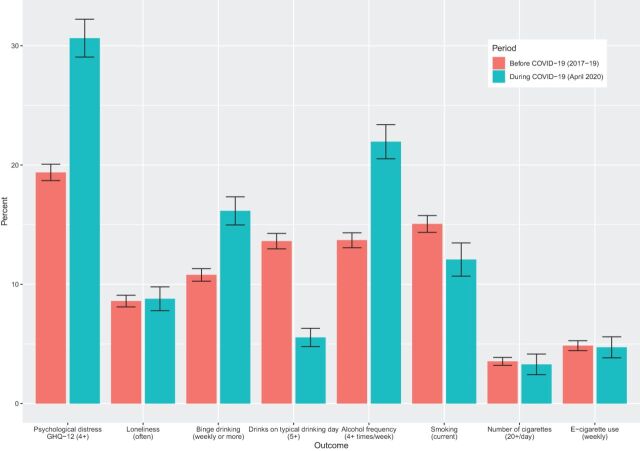
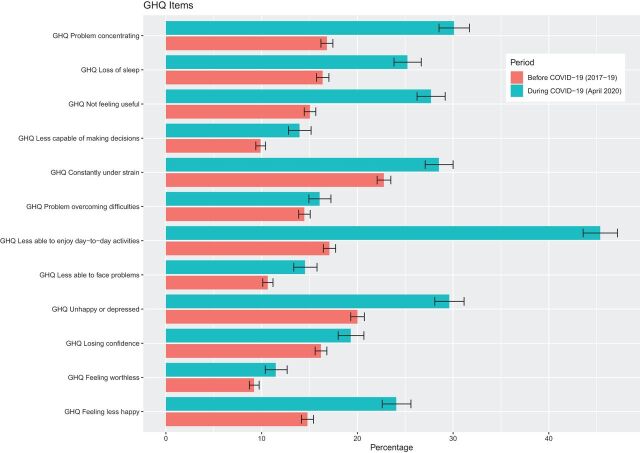
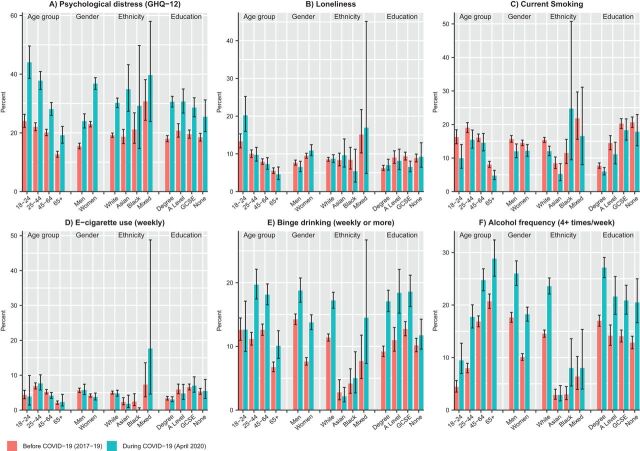
Background: There are concerns that COVID-19 mitigation measures, including the ‘lockdown’, may have unintended health consequences. We examined trends in mental health and health behaviours in the UK before and during the initial phase of the COVID-19 lockdown and differences across population subgroups. Methods: Repeated cross-sectional and longitudinal analysis of the UK Household Longitudinal Study, including representative samples of over 27,000 adults (aged 18+) interviewed in four survey waves between 2015 and 2020. A total of 9748 adults had complete data for longitudinal analyses. Outcomes included psychological distress (General Health Questionnaire-12), loneliness, current cigarette smoking, use of e-cigarettes and alcohol consumption. Cross-sectional prevalence estimates were calculated and multilevel Poisson regression assessed associations between time period and the outcomes of interest, as well as differential associations by age, gender, education level and ethnicity. Results: Psychological distress increased 1 month into lockdown with the prevalence rising from 19.4% (95% CI 18.7% to 20.1%) in 2017–2019 to 30.6% (95% CI 29.1% to 32.3%) in April 2020 (RR=1.3, 95% CI 1.2 to 1.4). Groups most adversely affected included women, young adults, people from an Asian background and those who were degree educated. Loneliness remained stable overall (RR=0.9, 95% CI 0.6 to 1.5). Smoking declined (RR=0.9, 95% CI=0.8,1.0) and the proportion of people drinking four or more times per week increased (RR=1.4, 95% CI 1.3 to 1.5), as did binge drinking (RR=1.5, 95% CI 1.3 to 1.7). Conclusions: Psychological distress increased 1 month into lockdown, particularly among women and young adults. Smoking declined, but adverse alcohol use generally increased. Effective measures are required to mitigate negative impacts on health.
Overview
The claims and statistics of this paper haven’t been checked yet.
Free: it reads the open-access text and checks the first 5 claims that cite a source we can check. Create a free account to check every claim.
Integrity signals
Registry
Cites
Statistics
Figures
Verification
Claims the paper makes
The claims and statistics of this paper haven’t been checked yet.
Free: it reads the open-access text and checks the first 5 claims that cite a source we can check. Create a free account to check every claim.
Claims other papers make about this one
Each is checked against this paper’s own text: does it say what the citing paper says it does?
The cited source says what the claim attributes to it.
In the citing paper
“such a comparison complements other studies that rely on pre-pandemic data collected during typical conditions (e.g., Niedzwiedz, et al., 2021).”
From Young Adult Adaptability to the Social Challenges of the COVID-19 Pandemic: The Protective Role of Friendships (2022) · cites this paper as Niedzwiedz, et al., 2021
In the citing paper
“there is evidence to suggest that they have resulted in adverse psychological consequences across general populations.”
Self-check
Percentages, sums and reported differences re-computed from the paper’s own numbers.
The self-check needs the paper’s full text.
Citations
Cites
The Psychological Impact of Quarantine and How to Reduce It: Rapid Review of the Evidence
Brooks, S. K., Webster, R. K., Smith, L. E., Woodland, L., Wessely, S., Greenberg, N., & Rubin, G. J. (2020) · doi:10.2139/ssrn.3532534 · Cited by 16,394
The psychological impact of quarantine and how to reduce it: Rapid review of the evidence
Brooks, S. K., Webster, R. K., Smith, L. E., Woodland, L., Wessely, S., Greenberg, N., & Rubin, G. J. (2020) · The Lancet · doi:10.1016/s0140-6736(20)30460-8 · Cited by 16,378 · cited 1×
“Research prior to the pandemic has suggested quarantine is linked to several negative psychological outcomes.(6) During the COVID-19 pandemic, concerns have been repeatedly raised about potentially long-lasting harms to mental health.”
A Modified Poisson Regression Approach to Prospective Studies with Binary Data
Zou, G. (2004) · American Journal of Epidemiology · doi:10.1093/aje/kwh090 · Cited by 9,615
Holmes, E. A., O'Connor, R. C., Perry, V. H., Tracey, I., Wessely, S., Arseneault, L., Ballard, C., Christensen, H., Cohen Silver, R., Everall, I., et al. (2020) · The Lancet Psychiatry · doi:10.1016/s2215-0366(20)30168-1 · Cited by 5,715
A global panel database of pandemic policies (Oxford COVID-19 Government Response Tracker)
Hale, T., Angrist, N., Goldszmidt, R., Kira, B., Petherick, A., Phillips, T., Webster, S., Cameron-Blake, E., Hallas, L., Majumdar, S., et al. (2021) · Nature Human Behaviour · doi:10.1038/s41562-021-01079-8 · Cited by 4,578
The Validity of Two Versions of the GHQ in the WHO Study of Mental Illness in General Health Care
GOLDBERG, D. P., GATER, R., SARTORIUS, N., USTUN, T. B., PICCINELLI, M., GUREJE, O., & RUTTER, C. (1997) · Psychological Medicine · doi:10.1017/s0033291796004242 · Cited by 3,657
Indicators of socioeconomic position (part 1): Figure 1
Galobardes, B., Shaw, M., Lawlor, D. A., Lynch, J. W., & Davey Smith, G. (2006) · Journal of Epidemiology and Community Health · doi:10.1136/jech.2004.023531 · Cited by 2,867 · cited 1×
“When analysing educational inequalities we restricted analyses to adults aged 25+ years as educational attainment tends to be stable from that age onwards.(16) For longitudinal analysis, we included participants with complete data from all four waves and aged 18+ years during wave 9.”
Clinical impact of COVID-19 on patients with cancer (CCC19): a cohort study
Kuderer, N. M., Choueiri, T. K., Shah, D. P., Shyr, Y., Rubinstein, S. M., Rivera, D. R., Shete, S., Hsu, C.-Y., Desai, A., de Lima Lopes, G., et al. (2020) · The Lancet · doi:10.1016/s0140-6736(20)31187-9 · Cited by 1,726
AUDIT‐C as a Brief Screen for Alcohol Misuse in Primary Care
Bradley, K. A., DeBenedetti, A. F., Volk, R. J., Williams, E. C., Frank, D., & Kivlahan, D. R. (2007) · Alcoholism: Clinical and Experimental Research · doi:10.1111/j.1530-0277.2007.00403.x · Cited by 1,632
Suicide risk and prevention during the COVID-19 pandemic
Gunnell, D., Appleby, L., Arensman, E., Hawton, K., John, A., Kapur, N., Khan, M., O'Connor, R. C., Pirkis, J., Appleby, L., et al. (2020) · The Lancet Psychiatry · doi:10.1016/s2215-0366(20)30171-1 · Cited by 1,513 · cited 1×
“While a body of literature is developing to articulate the expected indirect impacts of the pandemic, 3 7 25 empirical research on how mental health and health-related behaviours have changed remains limited and largely based on non-representative samples.”
Cited by
Items 501–528 of 528
Li, L., Sullivan, A., Musah, A., Stavrianaki, K., Wood, C. E., Baker, P., & Kostkova, P. (2024) · Figshare · doi:10.6084/m9.figshare.26361070
Orozco, A. L., Thomas, A. J., Raggatt, M. H., Scott, N., Eddy, S., Douglass, C. H., Wright, C. C. J., Spelman, T., & Lim, M. S. C. (2024) · Figshare · doi:10.6084/m9.figshare.27116073
Orozco, A. L., Thomas, A. J., Raggatt, M. H., Scott, N., Eddy, S., Douglass, C. H., Wright, C. C. J., Spelman, T., & Lim, M. S. C. (2024) · Figshare · doi:10.6084/m9.figshare.27116076
Green, M. J., Craig, P., Demou, E., Katikireddi, S. V., Leyland, A. H., & Pearce, A. (2024) · Figshare · doi:10.6084/m9.figshare.26594483
Self-citationWielgoszewska, B., Maddock, J., Green, M. J., Gessa, G. D., Parsons, S., Griffith, G. J., Croft, J., Stevenson, A. J., Booth, C., Silverwood, R. J., et al. (2022) · Figshare · doi:10.6084/m9.figshare.19533795
Self-citationŁaszewska, A., Helter, T. M., & Simon, J. (2021) · Figshare · doi:10.6084/m9.figshare.15102465
Wielgoszewska, B., Maddock, J., Green, M. J., Gessa, G. D., Parsons, S., Griffith, G. J., Croft, J., Stevenson, A. J., Booth, C., Silverwood, R. J., et al. (2022) · Figshare · doi:10.6084/m9.figshare.19533798
Self-citationWielgoszewska, B., Maddock, J., Green, M. J., Gessa, G. D., Parsons, S., Griffith, G. J., Croft, J., Stevenson, A. J., Booth, C., Silverwood, R. J., et al. (2022) · Figshare · doi:10.6084/m9.figshare.19533789
Self-citationOrozco, A. L., Thomas, A. J., Raggatt, M. H., Scott, N., Eddy, S., Douglass, C. H., Wright, C. C. J., Spelman, T., & Lim, M. S. C. (2024) · Figshare · doi:10.6084/m9.figshare.27116079
Li, L., Sullivan, A., Musah, A., Stavrianaki, K., Wood, C. E., Baker, P., & Kostkova, P. (2024) · Figshare · doi:10.6084/m9.figshare.26360917
Orozco, A. L., Thomas, A. J., Raggatt, M. H., Scott, N., Eddy, S., Douglass, C. H., Wright, C. C. J., Spelman, T., & Lim, M. S. C. (2024) · Figshare · doi:10.6084/m9.figshare.27116067
Green, M. J., Craig, P., Demou, E., Katikireddi, S. V., Leyland, A. H., & Pearce, A. (2024) · Figshare · doi:10.6084/m9.figshare.26594477
Self-citationBeese, F., Wachtler, B., Grabka, M. M., Blume, M., Kersjes, C., Guṭu, R., Mauz, E., & Hoebel, J. (2024) · Figshare · doi:10.6084/m9.figshare.26726498
Łaszewska, A., Helter, T. M., & Simon, J. (2021) · Figshare · doi:10.6084/m9.figshare.15102462
Additional file 1 of Stress/depression across the COVID-19 pandemic in Denmark
Cardona, M., Andersen, L. H., Fallesen, P., & Bruckner, T. A. (2024) · Figshare · doi:10.6084/m9.figshare.26564085
Wielgoszewska, B., Maddock, J., Green, M. J., Gessa, G. D., Parsons, S., Griffith, G. J., Croft, J., Stevenson, A. J., Booth, C., Silverwood, R. J., et al. (2022) · Figshare · doi:10.6084/m9.figshare.19533792
Self-citationOrozco, A. L., Thomas, A. J., Raggatt, M. H., Scott, N., Eddy, S., Douglass, C. H., Wright, C. C. J., Spelman, T., & Lim, M. S. C. (2024) · Figshare · doi:10.6084/m9.figshare.27116070
Li, L., Sullivan, A., Musah, A., Stavrianaki, K., Wood, C. E., Baker, P., & Kostkova, P. (2024) · Figshare · doi:10.6084/m9.figshare.26752891
Kotozaki, Y., Tanno, K., Otsuka, K., & Sasaki, M. (2025) · BMC Public Health · doi:10.1186/s12889-025-25996-9
Galesne, C., Arsandaux, J., Macalli, M., Texier, N., Schück, S., Tzourio, C., & Kinouani, S. (2026) · BMJ Open · doi:10.1136/bmjopen-2025-105567
Duveau, C., Nicaise, P., Smith, P., Seeber, K., Bryant, R. A., Corrao, G., Félez-Nóbrega, M., Haro, J. M., Hecker, I., McGreevy, K. R., et al. (2026) · Frontiers in Psychiatry · doi:10.3389/fpsyt.2026.1716253
The Hidden Cost of Delay: Post-Pandemic Evolution of Advanced Ovarian Cancer Profiles
Petrușan, A. M., Feier, C. V. I., Muntean, C., Gaborean, V., Petrusan, A. S., Nicoara, D., Pușcaș, M. E., Ignat, F. L., & Achimaș-Cădariu, P. (2026) · Medicina · doi:10.3390/medicina62030598
“These behavioral and structural factors explain the sustained presence of advanced-stage disease even after restrictions were lifted, confirming that the pandemic’s oncologic impact extended well beyond the acute phase [25,30].”
Liang, J., Lee, C. L., & Li, Q. (2022) · Real Estate Economics · doi:10.1111/1540-6229.70044
Mackie, C. S., Kilgariff, J. K., & Sevier‐Guy, L. (2026) · BDJ · doi:10.1038/s41415-026-9541-x
Kondo, K., Morita, I., Sakuma, S., & Ohsawa, I. (2026) · PLoS ONE · doi:10.1371/journal.pone.0350820
Kock, L. S., Brown, J., Shahab, L., Jackson, S. E., & Cox, S. (2026) · Nicotine & Tobacco Research · doi:10.1093/ntr/ntag175
The Relationship Between Menopause, Perimenopause and Alcohol Use: A Scoping Review
Teixeira, F., Picior, M., & Ajewole, O. (2026) · Substance Use & Addiction Journal · doi:10.1177/29767342261467588
Constraint or Warning? Health Shocks and Dietary Habits Among Older Adults in China
Liu, K., & Liu, Y. (2026) · Research on Aging · doi:10.1177/01640275261481532
Metadata
- Authors
- Niedzwiedz, C. L., Green, M. J., Benzeval, M., Campbell, D., Craig, P., Demou, E., Leyland, A., Pearce, A., Thomson, R., Whitley, E., & Katikireddi, S. V.
- Affiliations
- University of Glasgow (GB)
- MRC/CSO Social and Public Health Sciences Unit (GB)
- University of Essex (GB)
- MRC/CSO Social and Public Health Sciences Unit, University of Glasgow, Glasgow, UK
- Corresponding author
- Katikireddi, Srinivasa Vittal
- ORCID
- Venue
- Journal of Epidemiology and Community Health
- Publisher
- BMJ
- Published
- 2020-09-25
- Volume
- 75
- Issue
- 3
- Pages
- 224-231
- ISSN
- 0141-7681 (ISSN-L)
- 0143-005X
- 1470-2738
- PMC
- PMC7892383
- OpenAlex
- W3088359309
- Cited by
- 525
- References
- 36
- Citations by year
- 2026: 13 · 2025: 41 · 2024: 57 · 2023: 106 · 2022: 172 · 2021: 129 · 2020: 7
- FWCI
- 41.43
- Type
- journal article
- Language
- en
- Open access
- hybrid
- doi.org
- Locations
- Journal of Epidemiology & Community Health (publishedVersion, cc-by)
- medRxiv (acceptedVersion, cc-by)
- PubMed Central (publishedVersion, cc-by)
- PubMed (publishedVersion)
- ENLIGHTEN (Jurnal Bimbingan dan Konseling Islam) (acceptedVersion, cc-by-sa)
- Open Access at Essex (University of Essex) (acceptedVersion)
- HRB National Drugs Library (Health Research Board) (submittedVersion)
- Funders
- Chief Scientist Office (SCAF/15/02)
- Economic and Social Research Council (ES/N00812X/1)
- Wellcome Trust (205412/Z/16/Z, 218105/Z/19/Z)
- Medical Research Council (MC_UU_12013, MC_UU_12017, MR/R024774/1)
- Topics
- Social Sciences › Psychology › Clinical Psychology › COVID-19 and Mental Health
- Social Sciences › Sociology and Political Science › COVID-19 Prevention and Impact
- Physical Sciences › Mathematics › Modeling and Simulation › COVID-19 epidemiological studies
- Keywords
- COVID-19 lockdown, mental health, psychological distress, loneliness, cigarette smoking, electronic cigarettes, alcohol consumption, binge drinking, health behavior, sex differences, young adults, ethnicity, educational attainment, UK Household Longitudinal Study
- MeSH terms
- COVID-19, SARS-CoV-2, Adolescent, Adult, Aged, Aged, 80 and over, Alcohol Drinking, Child, Child, Preschool, Cross-Sectional Studies, Female, United Kingdom, Humans, Infant, Infant, Newborn, Loneliness, Longitudinal Studies, Male, Mental Health, Middle Aged, Quarantine, Surveys and Questionnaires, Smoking, Social Isolation, Health Behavior, Prevalence, Young Adult, Electronic Nicotine Delivery Systems
About these checks
Registry, retraction, Cites and statistics results are computed, not judged, with one exception: a printed reference that no index lists is read once by a model before it counts as a citation error. Claims are extracted by a model and kept only when their quote appears verbatim in the text; each cited source is then checked, with a model’s help, for whether it says what the claim relies on. Those verdicts can be wrong — read the claim’s quote and the cited source before relying on one.
Statistics and arithmetic are recomputed, not judged.
Confidence bands are shown only for fields calibrated on our annotated test set. None is calibrated yet, so no band is shown.
What counts as a claim ›How we measure confidence ›How we check this ›
Are you an author, or do you see a problem with this page? Request a review
Data sources
Bibliographic data: Semantic Scholar, OpenAlex, Crossref.
Contains information from the Semantic Scholar Academic Graph Datasets, made available under the ODC Attribution License (ODC-BY 1.0).
Semantic Scholar’s data is described in: Kinney, R., et al. (2023). The Semantic Scholar Open Data Platform. arXiv:2301.10140.
