

Mental health and health behaviours before and during the initial phase of the COVID-19 lockdown: longitudinal analyses of the UK Household Longitudinal Study
Open accessPublished version of a preprint
The DOI matches its Crossref record; 36 of the 36 references it cites were found in a registry or an index.
Abstract
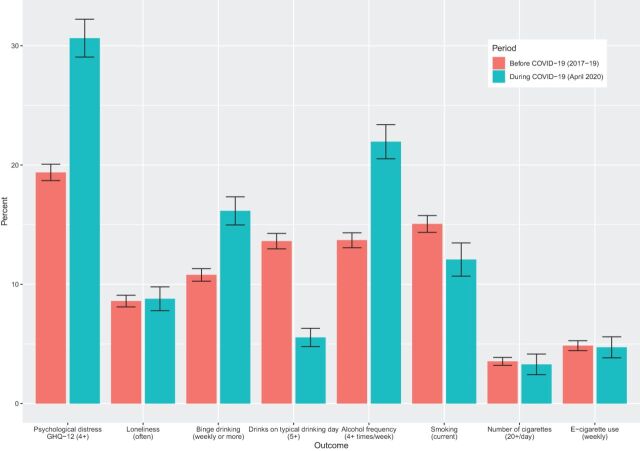
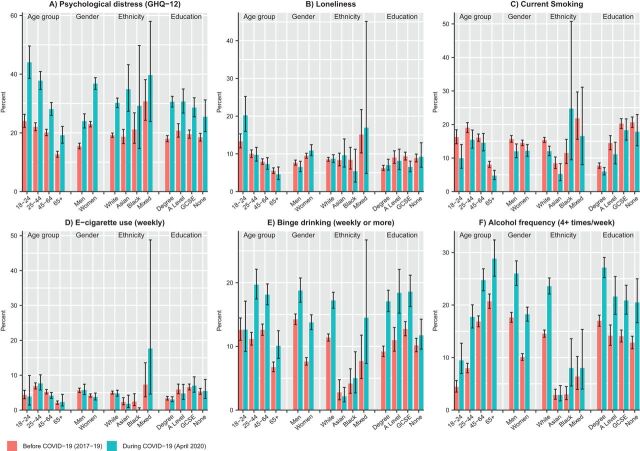
Background: There are concerns that COVID-19 mitigation measures, including the ‘lockdown’, may have unintended health consequences. We examined trends in mental health and health behaviours in the UK before and during the initial phase of the COVID-19 lockdown and differences across population subgroups. Methods: Repeated cross-sectional and longitudinal analysis of the UK Household Longitudinal Study, including representative samples of over 27,000 adults (aged 18+) interviewed in four survey waves between 2015 and 2020. A total of 9748 adults had complete data for longitudinal analyses. Outcomes included psychological distress (General Health Questionnaire-12), loneliness, current cigarette smoking, use of e-cigarettes and alcohol consumption. Cross-sectional prevalence estimates were calculated and multilevel Poisson regression assessed associations between time period and the outcomes of interest, as well as differential associations by age, gender, education level and ethnicity. Results: Psychological distress increased 1 month into lockdown with the prevalence rising from 19.4% (95% CI 18.7% to 20.1%) in 2017–2019 to 30.6% (95% CI 29.1% to 32.3%) in April 2020 (RR=1.3, 95% CI 1.2 to 1.4). Groups most adversely affected included women, young adults, people from an Asian background and those who were degree educated. Loneliness remained stable overall (RR=0.9, 95% CI 0.6 to 1.5). Smoking declined (RR=0.9, 95% CI=0.8,1.0) and the proportion of people drinking four or more times per week increased (RR=1.4, 95% CI 1.3 to 1.5), as did binge drinking (RR=1.5, 95% CI 1.3 to 1.7). Conclusions: Psychological distress increased 1 month into lockdown, particularly among women and young adults. Smoking declined, but adverse alcohol use generally increased. Effective measures are required to mitigate negative impacts on health.
Overview
The claims and statistics of this paper haven’t been checked yet.
Free: it reads the open-access text and checks the first 5 claims that cite a source we can check. Create a free account to check every claim.
Integrity signals
Registry
Cites
Statistics
Figures
Verification
Claims the paper makes
The claims and statistics of this paper haven’t been checked yet.
Free: it reads the open-access text and checks the first 5 claims that cite a source we can check. Create a free account to check every claim.
Claims other papers make about this one
Each is checked against this paper’s own text: does it say what the citing paper says it does?
The cited source says what the claim attributes to it.
In the citing paper
“such a comparison complements other studies that rely on pre-pandemic data collected during typical conditions (e.g., Niedzwiedz, et al., 2021).”
From Young Adult Adaptability to the Social Challenges of the COVID-19 Pandemic: The Protective Role of Friendships (2022) · cites this paper as Niedzwiedz, et al., 2021
In the citing paper
“there is evidence to suggest that they have resulted in adverse psychological consequences across general populations.”
Self-check
Percentages, sums and reported differences re-computed from the paper’s own numbers.
The self-check needs the paper’s full text.
Citations
Cites
The Psychological Impact of Quarantine and How to Reduce It: Rapid Review of the Evidence
Brooks, S. K., Webster, R. K., Smith, L. E., Woodland, L., Wessely, S., Greenberg, N., & Rubin, G. J. (2020) · doi:10.2139/ssrn.3532534 · Cited by 16,394
The psychological impact of quarantine and how to reduce it: Rapid review of the evidence
Brooks, S. K., Webster, R. K., Smith, L. E., Woodland, L., Wessely, S., Greenberg, N., & Rubin, G. J. (2020) · The Lancet · doi:10.1016/s0140-6736(20)30460-8 · Cited by 16,378 · cited 1×
“Research prior to the pandemic has suggested quarantine is linked to several negative psychological outcomes.(6) During the COVID-19 pandemic, concerns have been repeatedly raised about potentially long-lasting harms to mental health.”
A Modified Poisson Regression Approach to Prospective Studies with Binary Data
Zou, G. (2004) · American Journal of Epidemiology · doi:10.1093/aje/kwh090 · Cited by 9,615
Holmes, E. A., O'Connor, R. C., Perry, V. H., Tracey, I., Wessely, S., Arseneault, L., Ballard, C., Christensen, H., Cohen Silver, R., Everall, I., et al. (2020) · The Lancet Psychiatry · doi:10.1016/s2215-0366(20)30168-1 · Cited by 5,715
A global panel database of pandemic policies (Oxford COVID-19 Government Response Tracker)
Hale, T., Angrist, N., Goldszmidt, R., Kira, B., Petherick, A., Phillips, T., Webster, S., Cameron-Blake, E., Hallas, L., Majumdar, S., et al. (2021) · Nature Human Behaviour · doi:10.1038/s41562-021-01079-8 · Cited by 4,578
The Validity of Two Versions of the GHQ in the WHO Study of Mental Illness in General Health Care
GOLDBERG, D. P., GATER, R., SARTORIUS, N., USTUN, T. B., PICCINELLI, M., GUREJE, O., & RUTTER, C. (1997) · Psychological Medicine · doi:10.1017/s0033291796004242 · Cited by 3,657
Indicators of socioeconomic position (part 1): Figure 1
Galobardes, B., Shaw, M., Lawlor, D. A., Lynch, J. W., & Davey Smith, G. (2006) · Journal of Epidemiology and Community Health · doi:10.1136/jech.2004.023531 · Cited by 2,867 · cited 1×
“When analysing educational inequalities we restricted analyses to adults aged 25+ years as educational attainment tends to be stable from that age onwards.(16) For longitudinal analysis, we included participants with complete data from all four waves and aged 18+ years during wave 9.”
Clinical impact of COVID-19 on patients with cancer (CCC19): a cohort study
Kuderer, N. M., Choueiri, T. K., Shah, D. P., Shyr, Y., Rubinstein, S. M., Rivera, D. R., Shete, S., Hsu, C.-Y., Desai, A., de Lima Lopes, G., et al. (2020) · The Lancet · doi:10.1016/s0140-6736(20)31187-9 · Cited by 1,726
AUDIT‐C as a Brief Screen for Alcohol Misuse in Primary Care
Bradley, K. A., DeBenedetti, A. F., Volk, R. J., Williams, E. C., Frank, D., & Kivlahan, D. R. (2007) · Alcoholism: Clinical and Experimental Research · doi:10.1111/j.1530-0277.2007.00403.x · Cited by 1,632
Suicide risk and prevention during the COVID-19 pandemic
Gunnell, D., Appleby, L., Arensman, E., Hawton, K., John, A., Kapur, N., Khan, M., O'Connor, R. C., Pirkis, J., Appleby, L., et al. (2020) · The Lancet Psychiatry · doi:10.1016/s2215-0366(20)30171-1 · Cited by 1,513 · cited 1×
“While a body of literature is developing to articulate the expected indirect impacts of the pandemic, 3 7 25 empirical research on how mental health and health-related behaviours have changed remains limited and largely based on non-representative samples.”
Cited by
The social determinants of mental health and disorder: evidence, prevention and recommendations
Kirkbride, J. B., Anglin, D. M., Colman, I., Dykxhoorn, J., Jones, P. B., Patalay, P., Pitman, A., Soneson, E., Steare, T., Wright, T., et al. (2024) · World Psychiatry · doi:10.1002/wps.21160 · Cited by 1,253
“Inequalities in poor mental health following the COVID19 pandemic have also been reported for women 3638 , low income households 36 , and several groups minoritized by race and ethnicity 38 , gender identity and sexual orientation 39 , or migrant status 40 .”
BackgroundPrati, G., & Mancini, A. D. (2021) · Psychological Medicine · doi:10.1017/s0033291721000015 · Cited by 842
Global burden of cancer in 2020 attributable to alcohol consumption: a population-based study
Rumgay, H., Shield, K., Charvat, H., Ferrari, P., Sornpaisarn, B., Obot, I., Islami, F., Lemmens, V. E. P. P., Rehm, J., & Soerjomataram, I. (2021) · The Lancet Oncology · doi:10.1016/s1470-2045(21)00279-5 · Cited by 683
Loneliness Before and During the COVID-19 Pandemic: A Systematic Review with Meta-Analysis
Ernst, M., Niederer, D., Werner, A. M., Czaja, S. J., Mikton, C., Ong, A., Rosen, T., Braehler, E., & Beutel, M. E. (2022) · doi:10.31234/osf.io/wjx5v · Cited by 584
Loneliness before and during the COVID-19 pandemic: A systematic review with meta-analysis.
Ernst, M., Niederer, D., Werner, A. M., Czaja, S. J., Mikton, C., Ong, A. D., Rosen, T., Brähler, E., & Beutel, M. E. (2022) · American Psychologist · doi:10.1037/amp0001005 · Cited by 584
“…three studies concerning loneliness conducted in spring 2020 (Luchetti et al., 2020; Niedzwiedz et al., 2021; Tull et al., 2020), only one of which (Niedzwiedz et al., 2021) could be included in the main analyses of this review (another one (Luchetti et al., 2020) was included in a sensitivity…”
BackgroundInfluentialKauhanen, L., Wan Mohd Yunus, W. M. A., Lempinen, L., Peltonen, K., Gyllenberg, D., Mishina, K., Gilbert, S., Bastola, K., Brown, J. S. L., & Sourander, A. (2023) · European Child & Adolescent Psychiatry · doi:10.1007/s00787-022-02060-0 · Cited by 544
“Five studies were conducted in the UK [24, 27, 28, 35, 40] and in China [23, 30–33], two studies in the USA [8, 25], Italy [26, 36] and Australia [29, 39] and one study in India [34], Canada [37], Spain [38], Germany [7] and Iceland [41].”
BackgroundMethodInfluentialImpact of the COVID-19 Pandemic on Older Adults: Rapid Review
Lebrasseur, A., Fortin-Bédard, N., Lettre, J., Raymond, E., Bussières, E.-L., Lapierre, N., Faieta, J., Vincent, C., Duchesne, L., Ouellet, M.-C., et al. (2021) · JMIR Aging · doi:10.2196/26474 · Cited by 383
COVID-19 and liver disease: mechanistic and clinical perspectives
Marjot, T., Webb, G. J., Barritt, A. S., Moon, A. M., Stamataki, Z., Wong, V. W., & Barnes, E. (2021) · Nature Reviews Gastroenterology & Hepatology · doi:10.1038/s41575-021-00426-4 · Cited by 385
COVID-19 and mental health deterioration by ethnicity and gender in the UK
Proto, E., & Quintana-Domeque, C. (2021) · PLOS ONE · doi:10.1371/journal.pone.0244419 · Cited by 297
“In the UK, the first lockdown began on the 23rd of March 2020, one month before the follow-up interview, and lockdowns are likely to have an impact on social isolation and mental health [26, 32].”
BackgroundMethodZaninotto, P., Iob, E., Demakakos, P., & Steptoe, A. (2022) · JAMA Psychiatry · doi:10.1001/jamapsychiatry.2021.3749 · Cited by 229
Patel, K., Robertson, E., Kwong, A. S. F., Griffith, G. J., Willan, K., Green, M. J., Di Gessa, G., Huggins, C. F., McElroy, E., Thompson, E. J., et al. (2022) · JAMA Network Open · doi:10.1001/jamanetworkopen.2022.7629 · Cited by 218
Self-citationAcuff, S. F., Strickland, J. C., Tucker, J. A., & Murphy, J. G. (2022) · Psychology of Addictive Behaviors · doi:10.1037/adb0000796 · Cited by 214
The mental health impact of COVID-19 and lockdown-related stressors among adults in the UK
Chandola, T., Kumari, M., Booker, C. L., & Benzeval, M. (2022) · Psychological Medicine · doi:10.1017/s0033291720005048 · Cited by 199
“On the other hand, there is also evidence of higher mental distress among employed adults, as well as among adults with higher levels of education (Niedzwiedz et al., 2020; Pierce et al., 2020).”
Self-citationSarich, P., Cabasag, C. J., Liebermann, E., Vaneckova, P., Carle, C., Hughes, S., Egger, S., O'Connell, D. L., Weber, M. F., da Costa, A. M., et al. (2022) · eClinicalMedicine · doi:10.1016/j.eclinm.2022.101375 · Cited by 193
Katikireddi, S. V., Lal, S., Carrol, E. D., Niedzwiedz, C. L., Khunti, K., Dundas, R., Diderichsen, F., & Barr, B. (2021) · Journal of Epidemiology and Community Health · doi:10.1136/jech-2020-216061 · Cited by 189
“33 34 All of these six pathways arise from the wider social and political context that drive ethnic and other social inequalities, including structural racism and other power imbalances across society.”
BackgroundSelf-citationThe youth mental health crisis: analysis and solutions
McGorry, P., Gunasiri, H., Mei, C., Rice, S., & Gao, C. X. (2025) · Frontiers in Psychiatry · doi:10.3389/fpsyt.2024.1517533 · Cited by 175
Kilian, C., Rehm, J., Allebeck, P., Braddick, F., Gual, A., Barták, M., Bloomfield, K., Gil, A., Neufeld, M., O'Donnell, A., et al. (2021) · Addiction · doi:10.1111/add.15530 · Cited by 180
Effects of COVID‐19 lockdown on eating disorders and obesity: A systematic review and meta‐analysis
Sideli, L., Lo Coco, G., Bonfanti, R. C., Borsarini, B., Fortunato, L., Sechi, C., & Micali, N. (2021) · European Eating Disorders Review · doi:10.1002/erv.2861 · Cited by 173
Mental disorders following COVID-19 and other epidemics: a systematic review and meta-analysis
Leung, C. M. C., Ho, M. K., Bharwani, A. A., Cogo-Moreira, H., Wang, Y., Chow, M. S. C., Fan, X., Galea, S., Leung, G. M., & Ni, M. Y. (2022) · Translational Psychiatry · doi:10.1038/s41398-022-01946-6 · Cited by 174
“The remaining three studies examined psychological distress before and during COVID-19 using the same panel of individuals in the UK Household Longitudinal Study (Table 2) [47, 53, 55].”
BackgroundSchmidt, R. A., Genois, R., Jin, J., Vigo, D., Rehm, J., & Rush, B. (2021) · Drug and Alcohol Dependence · doi:10.1016/j.drugalcdep.2021.109065 · Cited by 169
White, H. R., Stevens, A. K., Hayes, K., & Jackson, K. M. (2020) · Journal of Studies on Alcohol and Drugs · doi:10.15288/jsad.2020.81.725 · Cited by 165
Mental health in Europe during the COVID-19 pandemic: a systematic review
Ahmed, N., Barnett, P., Greenburgh, A., Pemovska, T., Stefanidou, T., Lyons, N., Ikhtabi, S., Talwar, S., Francis, E. R., Harris, S. M., et al. (2023) · The Lancet Psychiatry · doi:10.1016/s2215-0366(23)00113-x · Cited by 162
Joensen, A., Danielsen, S., Andersen, P. K., Groot, J., & Strandberg‐Larsen, K. (2021) · Journal of Psychiatric Research · doi:10.1016/j.jpsychires.2022.03.001 · Cited by 161
“…impacted by the lockdown than men (Chodkiewicz et al., 2021; Daly et al., 2020; Fancourt et al., 2020; Kwong et al., 2020, 2021; Lee et al., 2020; Niedzwiedz et al., 2021; Pierce et al., 2020; Varga et al., 2021; et al., 2021), but for individuals with a pre-existing mental disorder, the…”
Zolopa, C., Burack, J. A., O’Connor, R. M., Corran, C., Lai, J., Bomfim, E. D. O., DeGrace, S., Dumont, J., Larney, S., & Wendt, D. C. (2022) · Adolescent Research Review · doi:10.1007/s40894-022-00185-6 · Cited by 181
Naughton, F., Ward, E., Khondoker, M. R., Belderson, P., Minihane, A. M., Dainty, J. R., Hanson, S., Holland, R., Brown, T. J., & Notley, C. J. (2021) · British Journal of Health Psychology · doi:10.1111/bjhp.12500 · Cited by 152
Kilian, C., O'Donnell, A. J., Potapova, N., López‐Pelayo, H., Schulte, B., Miquel, L., Paniello-Castillo, B., Schmidt, C. S., Gual, A., Rehm, J. T., et al. (2022) · Drug and Alcohol Review · doi:10.1111/dar.13446 · Cited by 160
“[22] Niedzwiedz CL, Green MJ, Benzeval M et al.”
BackgroundEffects of the COVID-19 pandemic and lockdown on alcohol use disorders and complications
Murthy, P., & Narasimha, V. L. (2021) · Current Opinion in Psychiatry · doi:10.1097/yco.0000000000000720 · Cited by 147
Loneliness among older adults in the community during COVID-19: A cross-sectional survey in Canada
Savage, R. D., Wu, W., Li, J., Lawson, A., Bronskill, S. E., Chamberlain, S. A., Grieve, J., Gruneir, A., Reppas-Rindlisbacher, C., Stall, N. M., et al. (2021) · BMJ Open · doi:10.1136/bmjopen-2020-044517 · Cited by 131
Changes in alcohol use during the COVID‐19 pandemic and previous pandemics: A systematic review
Sohi, I., Chrystoja, B. R., Rehm, J., Wells, S., Monteiro, M., Ali, S., & Shield, K. D. (2022) · Alcoholism: Clinical and Experimental Research · doi:10.1111/acer.14792 · Cited by 131
Koyama, S., Tabuchi, T., Okawa, S., Kadobayashi, T., Shirai, H., Nakatani, T., & Miyashiro, I. (2021) · Journal of Epidemiology · doi:10.2188/jea.je20200533 · Cited by 127
Harmey, S. J., & Moss, G. (2021) · Educational Review · doi:10.1080/00131911.2021.1966389 · Cited by 191
Jackson, K. M., Merrill, J. E., Stevens, A. K., Hayes, K. L., & WHITE, H. R. (2021) · Alcoholism Clinical and Experimental Research · doi:10.1111/acer.14574 · Cited by 136
McKinlay, A. R., May, T., Dawes, J., Fancourt, D., & Burton, A. (2022) · BMJ Open · doi:10.1136/bmjopen-2021-053676 · Cited by 115
Hampshire, A., Hellyer, P. J., Soreq, E., Mehta, M. A., Ioannidis, K., Trender, W., Grant, J. E., & Chamberlain, S. R. (2021) · Nature Communications · doi:10.1038/s41467-021-24365-5 · Cited by 108
Social isolation and the brain in the pandemic era
Bzdok, D., & Dunbar, R. I. M. (2022) · Nature Human Behaviour · doi:10.1038/s41562-022-01453-0 · Cited by 100
Simonsson, O., Bazin, O., Fisher, S. D., & Goldberg, S. B. (2021) · Psychiatry Research · doi:10.1016/j.psychres.2021.114222 · Cited by 99
García‐Esquinas, E., Ortolá, R., Giné-Vázquez, I., Carnicero, J. A. C., Mañas, A., Lara, E., Álvarez‐Bustos, A., Vicente‐Rodríguez, G., Sotos‐Prieto, M., Olaya, B., et al. (2021) · International Journal of Environmental Research and Public Health · doi:10.3390/ijerph18137067 · Cited by 106
Heterogeneous mental health development during the COVID-19 pandemic in the United Kingdom
Ellwardt, L., & Präg, P. (2021) · Scientific Reports · doi:10.1038/s41598-021-95490-w · Cited by 94
Pappa, S., Barnett, J., Berges, I., & Sakkas, N. (2021) · International Journal of Environmental Research and Public Health · doi:10.3390/ijerph18094457 · Cited by 101
“2% in the general population [47] In fact, the effects of the increased use of alcohol and cigarettes may be a “hidden” consequence of this outbreak that may only become noticeable in the long run.”
BackgroundThe Impact of COVID-19 Lockdown on Health Behaviors among Students of a French University
Tavolacci, M., Wouters, E., de Velde, S. M. V., Buffel, V., Déchelotte, P., Hal, G. F. V., & Ladner, J. (2021) · International Journal of Environmental Research and Public Health · doi:10.3390/ijerph18084346 · Cited by 135
“Early evidence during the COVID-19 outbreak also suggests negative changes in smoking and alcohol intake associated with higher levels of depression, anxiety, and stress in the general population [19,20] and in teenagers [21].”
BackgroundBurton, A., McKinlay, A., Aughterson, H., & Fancourt, D. (2023) · Journal of Mental Health · doi:10.1080/09638237.2021.1952953 · Cited by 84
“…2019 (COVID-19) pandemic caused widespread negative effects on mental health globally, with large-scale surveys from countries including the United Kingdom identifying increases in mental distress amongst general populations (Fancourt et al., 2021; Niedzwiedz et al., 2021; Pierce et al., 2020).”
BackgroundUnequal pandemic, fairer recovery: The COVID-19 impact inquiry report
Suleman, M., Sonthalia, S., Webb, C., Tinson, A., Kane, M., Bunbury, S., Finch, D., & Bibby, J. (2021) · doi:10.37829/hf-2021-hl12 · Cited by 84
The COVID-19 disaster and mental health—assessing, responding and recovering
Lindert, J., Jakubauskienė, M., & Bilsen, J. J. R. (2021) · European Journal of Public Health · doi:10.1093/eurpub/ckab153 · Cited by 106
Marjot, T., Eberhardt, C. S., Boettler, T., Belli, L. S., Berenguer, M., Buti, M., Jalan, R., Mondelli, M. U., Moreau, R., Shouval, D., et al. (2022) · Journal of Hepatology · doi:10.1016/j.jhep.2022.07.008 · Cited by 90
“heightened anxiety, social isolation, deteriorating mental health, and disruption to alcohol support services.(15,114) Furthermore, these early drinking trends appear to have persisted, with UK public health data compiled from 18 national surveys demonstrating a widespread increase in harmful alcohol consumption throu…”
BackgroundHettich, N., Entringer, T. M., Kroeger, H., Schmidt, P. S., Tibubos, A. N., Brähler, E., & Beutel, M. E. (2022) · Social Psychiatry and Psychiatric Epidemiology · doi:10.1007/s00127-022-02311-0 · Cited by 85
“However, consistent with emerging evidence [3, 14, 16], depression and anxiety symptoms increased especially in young participants aged 18–49 and in women.”
BackgroundDettmann, L. M., Adams, S. H., & Taylor, G. M. J. (2022) · British Journal of Clinical Psychology · doi:10.1111/bjc.12360 · Cited by 127
Patrick, M. E., Terry‐McElrath, Y. M., Miech, R. A., Keyes, K. M., Jager, J., & Schulenberg, J. E. (2022) · Social Science & Medicine · doi:10.1016/j.socscimed.2022.114887 · Cited by 85
Ernst, M., Klein, E. M., Beutel, M. E., & Brähler, E. (2021) · Journal of Affective Disorders · doi:10.1016/j.jad.2021.06.085 · Cited by 92
Risk Factors Underlying COVID-19 Lockdown-Induced Mental Distress
Novotný, J. S., Gonzalez-Rivas, J. P., Kunzová, Š., Skladaná, M., Pospíšilová, A., Polcrová, A., Medina-Inojosa, J. R., Lopez-Jimenez, F., Geda, Y. E., & Stokin, G. B. (2020) · Frontiers in Psychiatry · doi:10.3389/fpsyt.2020.603014 · Cited by 69
“(20), medRxiv UK 9,748 UK household longitudinal survey Online survey Increase of mental distress”
BackgroundWirkner, J., Christiansen, H., Knaevelsrud, C., Lüken, U., Wurm, S., Schneider, S., & Brakemeier, E. (2021) · European Psychologist · doi:10.1027/1016-9040/a000465 · Cited by 79
Corbett, A., Williams, G. H., Creese, B., Hampshire, A., Hayman, V., Palmer, A., Filakovszky, A., Mills, K., Cummings, J. L., Aarsland, D., et al. (2023) · The Lancet Healthy Longevity · doi:10.1016/s2666-7568(23)00187-3 · Cited by 86
Hansen, T., Nilsen, T. S., Yu, B., Knapstad, M., Skogen, J. C., Vedaa, Ø., & Nes, R. B. (2021) · Scandinavian Journal of Public Health · doi:10.1177/1403494821993711 · Cited by 66
“[18] Niedzwiedz Cl, green MJ, Benzeval M, et al.”
BackgroundBenatov, J., Ochnik, D., Rogowska, A. M., Arzenšek, A., & Bitenc, U. M. (2022) · International Journal of Environmental Research and Public Health · doi:10.3390/ijerph19031334 · Cited by 77
“Household Longitudinal Study reported that psychological distress increased one month into lockdown, particularly among women and young adults [6].”
BackgroundXu, S., Park, M., Kang, U. G., Choi, J., & Koo, J. W. (2021) · Frontiers in Psychiatry · doi:10.3389/fpsyt.2021.685964 · Cited by 76
“Furthermore, analyses of data between 2015 and 2020 from the UK Household Longitudinal Study, a nationally representative longitudinal panel study based on a clustered-stratified probability sample of UK households (9,748 participants aged 18 years and above), revealed that the COVID-19 lockdown (April 2020) increased…”
BackgroundCOVID-19, Inter-household Contact and Mental Well-Being Among Older Adults in the US and the UK
Hu, Y., & Qian, Y. (2021) · Frontiers in Sociology · doi:10.3389/fsoc.2021.714626 · Cited by 69
Devaraj, S., & Patel, P. C. (2020) · Social Science & Medicine · doi:10.1016/j.socscimed.2020.113615 · Cited by 58
Brotto, L. A., Chankasingh, K., Baaske, A., Albert, A., Booth, A., Kaida, A., Smith, L., Racey, S., Gottschlich, A., Murray, M. C. M., et al. (2021) · PLoS ONE · doi:10.1371/journal.pone.0259676 · Cited by 69
Distortions to the passage of time during England’s second national lockdown: A role for depression
Ogden, R. (2021) · PLoS ONE · doi:10.1371/journal.pone.0250412 · Cited by 64
Associations between vaping and Covid-19: Cross-sectional findings from the HEBECO study
Kale, D., Herbeć, A., Perski, O., Jackson, S. E., Brown, J., & Shahab, L. (2021) · Drug and Alcohol Dependence · doi:10.1016/j.drugalcdep.2021.108590 · Cited by 64
Juvonen, J., Lessard, L. M., Kline, N. G., & Graham, S. (2022) · Journal of Youth and Adolescence · doi:10.1007/s10964-022-01573-w · Cited by 65
Hansen, T., Nilsen, T. S., Knapstad, M., Skirbekk, V., Skogen, J. C., Vedaa, Ø., & Nes, R. B. (2021) · European Journal of Ageing · doi:10.1007/s10433-021-00648-0 · Cited by 64
Reynolds, C. M. E., Purdy, J., Rodriguez, L., & McAvoy, H. (2021) · European Journal of Public Health · doi:10.1093/eurpub/ckab050 · Cited by 59
Freiberg, A., Schubert, M., Starke, K. R., Hegewald, J., & Seidler, A. (2021) · International Journal of Environmental Research and Public Health · doi:10.3390/ijerph18168567 · Cited by 64
“With regard to the proportion of females and males, in studies on adults, an almost equal distribution—meaning a percentage of females of 45–55—was found in six studies [32,33,75,80,82,91].”
BackgroundMethodResultInfluentialSubstance, use in relation to COVID-19: A scoping review
Kumar, N., Janmohamed, K., Nyhan, K., Martins, S. S., Cerdá, M., Hasin, D. S., Scott, J., Frimpong, A. S., Pates, R. M., Ghandour, L. A., et al. (2021) · Addictive Behaviors · doi:10.1016/j.addbeh.2021.107213 · Cited by 60
Ayuso-Mateos, J. L., Morillo, D., Haro, J. M., Olaya, B., Lara, E., & Miret, M. (2021) · Epidemiology and Psychiatric Sciences · doi:10.1017/s2045796021000408 · Cited by 53
“…before to during the pandemic, some of them have showed increases in the prevalence rate of depression and suicidal ideation (Daly et al ., 2020; Niedzwiedz et al ., 2021; Novotny et al ., 2020; Pierce et al ., 2020; Planchuelo-Gomez et al ., 2020; Winkler et al ., 2020; McGinty et al ., 2020 b…”
BackgroundRetractedPanarese, P., & Azzarita, V. (2021) · Young · doi:10.1177/11033088211031389 · Cited by 63
Rogés, J., Bosque‐Prous, M., Colom, J., Folch, C., Barón-Garcia, T., González-Casals, H., Fernández, E., & Espelt, A. (2021) · International Journal of Environmental Research and Public Health · doi:10.3390/ijerph18157849 · Cited by 64
“The COVID-19 pandemic led to restrictions of social meetings, spending more time with parents at home, and in some cases the information about the worsening of respiratory problems that COVID could generate in smokers increased the health risk awareness [5], and could explain the observed decrease.”
BackgroundInfluentialPsychological distress during the COVID-19 epidemic in Chile: The role of economic uncertainty
Duarte, F., & Jiménez-Molina, Á. (2021) · PLoS ONE · doi:10.1371/journal.pone.0251683 · Cited by 74
McGuine, T. A., Biese, K. M., Hetzel, S., Petrovska, L., Kliethermes, S., Reardon, C. L., Bell, D. R., Brooks, A., & Watson, A. M. (2021) · Journal of Athletic Training · doi:10.4085/1062-6050-0739.20 · Cited by 57
Almeda, N., & Gómez‐Gómez, I. (2022) · Frontiers in Psychiatry · doi:10.3389/fpsyt.2022.941575 · Cited by 62
“The sample size ranged from 295 (35) to 22,823 (34) (median = 1,642).”
BackgroundInfluentialLimongi, F., Siviero, P., Trevisan, C., Noale, M., Catalani, F., Ceolin, C., Conti, S., Rosa, E. D., Perdixi, E., Remelli, F., et al. (2023) · Frontiers in Psychiatry · doi:10.3389/fpsyt.2023.1166815 · Cited by 56
Ishikawa, H., Kato, M., & Kiuchi, T. (2021) · BMC Public Health · doi:10.1186/s12889-021-12092-x · Cited by 59
“Further, the decline in HRQOL, especially the mental dimension, was more significant among women, consistent with previous reports [2, 5, 7].”
BackgroundResultThe Potential for Outdoor Nature-Based Interventions in the Treatment and Prevention of Depression
Owens, M., & Bunce, H. L. I. (2022) · Frontiers in Psychology · doi:10.3389/fpsyg.2022.740210 · Cited by 56
Irizar, P., Jones, A., Christiansen, P., Goodwin, L., Gage, S. H., Roberts, C. A., Knibb, G., Cooke, R. W. I., & Rose, A. K. (2021) · Drug and Alcohol Dependence · doi:10.1016/j.drugalcdep.2021.108913 · Cited by 50
Sylvestre, M., Dinkou, G. D. T., Naja, M., Riglea, T., Pelekanakis, A., Bélanger, M. F., Maximova, K., Mowat, D. L., Paradis, G., & O’Loughlin, J. L. (2022) · The Lancet Regional Health - Americas · doi:10.1016/j.lana.2021.100168 · Cited by 50
Gurney, C. M. (2021) · International Journal of Housing Policy · doi:10.1080/19491247.2021.1971033 · Cited by 55
“8% in an April 2020 lockdown (niedzwiedz et al., 2021); and in the uSA, 34% of 1,982 respondents to an online survey reported binge drinking during lockdown (Weerakoon et al.”
Gagné, T., Schoon, I., McMunn, A., & Sacker, A. (2021) · Social Psychiatry and Psychiatric Epidemiology · doi:10.1007/s00127-021-02194-7 · Cited by 54
“Doing so, we expand on the work of Banks and Xu [12] and others who analyzed the effects of the first months of the lockdown on mental distress using UKHLS data and drew attention to the different mental health dimensions measured with the GHQ-12 when studying changes across social contexts [12, 27].”
MethodO'Donnell, J., Cárdenas, D., Orazani, S. N., Evans, A., & Reynolds, K. J. (2022) · Social Science & Medicine · doi:10.1016/j.socscimed.2022.114821 · Cited by 51
Sato, K., Kondo, N., & Kondo, K. (2022) · Health & Place · doi:10.1016/j.healthplace.2022.102772 · Cited by 50
Th’ng, F., Rao, K. A., Ge, L., Mao, D. R., Neo, H. N., Molina, J. A. D. C., & Seow, E. (2021) · International Journal of Environmental Research and Public Health · doi:10.3390/ijerph182111228 · Cited by 47
“This is an interesting finding because population and healthcare studies [37,38] had shown that younger adults were associated with poorer MHOs during this COVID-19 pandemic.”
Foa, R., Fabian, M., & Gilbert, S. (2022) · PLoS ONE · doi:10.1371/journal.pone.0263570 · Cited by 46
“Studies using the United Kingdom Household Longitudinal Study, which is based on a probability sample, found that the prevalence of clinically significant levels of mental distress, measured using the General Health Questionnaire (GHQ-12), had increased by around 8 percentage points one-month into the UK lockdown comp…”
MethodValente, J. Y., Sohi, I., García-Cerde, R., Monteiro, M. G., & Sanchez, Z. M. (2021) · Drug and Alcohol Dependence · doi:10.1016/j.drugalcdep.2021.108621 · Cited by 44
Katikireddi, S. V., Hainey, K., & Beale, S. (2021) · The Journal of the Royal College of Physicians of Edinburgh · doi:10.4997/jrcpe.2021.240 · Cited by 45
Self-citationWels, J., Booth, C., Wielgoszewska, B., Green, M. J., Gessa, G. D., Huggins, C. F., Griffith, G. J., Kwong, A. S. F., Bowyer, R. C. E., Maddock, J., et al. (2022) · Social Science & Medicine · doi:10.1016/j.socscimed.2022.115226 · Cited by 49
“Overall, it has been estimated that the prevalence of mental distress in the UK increased from 19.1% pre-pandemic to 30.6% in early lock-down (April 2020), with greater deteriorations observed in young adults and women (Banks and Xu, 2020; Niedzwiedz et al., 2021).”
InfluentialSelf-citationSharp, M., Serfioti, D., Jones, M., Burdett, H. J., Pernet, D., Hull, L., Murphy, D., Wessely, S. C., & Fear, N. T. (2021) · BMJ Open · doi:10.1136/bmjopen-2021-049815 · Cited by 43
Wiedemann, A., Štochl, J., Neufeld, S., Fritz, J., Bhatti, J., Hook, R. W., Bullmore, E. T., Dolan, R. J., Goodyer, I. M., Fonagy, P., et al. (2022) · Scientific Reports · doi:10.1038/s41598-022-21053-2 · Cited by 49
“Nonetheless, the prevalence of both anxiety and depression seems high when compared to existing pre-pandemic epidemiological data within this age group 53–55 .”
Atkinson, A. M., Sumnall, H. R., & Meadows, B. (2021) · International Journal of Drug Policy · doi:10.1016/j.drugpo.2021.103376 · Cited by 45
Reme, B., Wörn, J., & Skirbekk, V. (2022) · Scientific Reports · doi:10.1038/s41598-022-06616-7 · Cited by 43
The Psychological Benefits of COVID-19 Vaccination
Nguyen, M. (2021) · Advances in Public Health · doi:10.1155/2021/1718800 · Cited by 44
“Second, as an important tool to control the pandemic, vaccination might lead to the relaxation of various stringent nonpharmaceutical measures such as lockdown that has been shown to adversely affect psychological well-being [12, 14].”
MethodLu, L., Contrand, B., Dupuy, M., Ramiz, L., Sztal-Kutas, C., & Lagarde, E. (2022) · Journal of Affective Disorders · doi:10.1016/j.jad.2022.04.095 · Cited by 41
Jain, V., Clarke, J., & Beaney, T. E. (2022) · Journal of Epidemiology & Community Health · doi:10.1136/jech-2022-218920 · Cited by 40
A REVIEW OF HEALTH MISINFORMATION ON DIGITAL PLATFORMS: CHALLENGES AND COUNTERMEASURES
Okoro, Y. O., Ayo-Farai, O., Maduka, C. P., Okongwu, C. C., & Sodamade, O. T. (2024) · International Journal of Applied Research in Social Sciences · doi:10.51594/ijarss.v6i1.689 · Cited by 50
Watson, A. M., Haraldsdóttir, K., Biese, K. M., Schwarz, A., Hetzel, S., Reardon, C. L., Brooks, M. A., Bell, D. R., & McGuine, T. A. (2022) · British Journal of Sports Medicine · doi:10.1136/bjsports-2022-105812 · Cited by 40
“29 The analyses were conducted in R for statistical computing with statistical significance set a priori at p 0.05.”
MethodInfluentialMoreno‐Agostino, D., Woodhead, C., Ploubidis, G. B., & Das‐Munshi, J. (2023) · Social Psychiatry and Psychiatric Epidemiology · doi:10.1007/s00127-023-02424-0 · Cited by 48
“…our study covers a gap in the knowledge about population mental health inequalities during the pandemic from an intersectional perspective [29], and particularly among young adults who, according to previous evidence [35, 37, 38, 41, 42], have been most adversely affected by the pandemic.”
Koinig, K. A., Arnold, C., Lehmann, J., Giesinger, J., Köck, S., Willenbacher, W., Weger, R., Holzner, B., Ganswindt, U., Wolf, D., et al. (2021) · Cancer Medicine · doi:10.1002/cam4.3950 · Cited by 34
“Secondary endpoints were (1) whether the risk of experiencing the COVID19 pandemic as having an impact on everyday life was significantly related to age, sex, or clinically relevant impairments in self- reported HRQOL, with a focus on global QOL, QLQC30SumScore, emotional, social, role, or physical functioning; and (2…”
BackgroundCummings, J. R., Zhang, X., Gandré, C., Morsella, A., Shields‐Zeeman, L., Winkelmann, J., Allin, S. M., Augusto, G. F., Cascini, F., Cserháti, Z., et al. (2023) · Health Policy · doi:10.1016/j.healthpol.2023.104878 · Cited by 45
Villadsen, A., Patalay, P., & Bann, D. (2021) · Psychological Medicine · doi:10.1017/s0033291721004657 · Cited by 43
ÓhAiseadha, C. O., Quinn, G. A., Connolly, R., Wilson, A., Connolly, M., Soon, W., & Hynds, P. D. (2023) · International Journal of Environmental Research and Public Health · doi:10.3390/ijerph20075223 · Cited by 41
“’s (2021) [100] longitudinal analysis of the UK Household Longitudinal Study (n = 9748) found a reduction in smoking (RR 0.”
BackgroundInfluentialKhalil, M. H. (2024) · Frontiers in Neuroscience · doi:10.3389/fnins.2024.1368411 · Cited by 38
Danielsen, S., Joensen, A., Andersen, P. K., Madsen, T., & Strandberg‐Larsen, K. (2023) · Nature Human Behaviour · doi:10.1038/s41562-022-01511-7 · Cited by 37
“There were no notable differences in characteristics of participants completing the DNBC-18 in each year from 2018 to 2021 (Supplementary Table 1); (3) a major strength of the longitudinal data is that we analysed the same young adults pre- and post-lockdown and thereby all time-invariant factors are adjusted for.”
Background
Metadata
- Authors
- Niedzwiedz, C. L., Green, M. J., Benzeval, M., Campbell, D., Craig, P., Demou, E., Leyland, A., Pearce, A., Thomson, R., Whitley, E., & Katikireddi, S. V.
- Affiliations
- University of Glasgow (GB)
- MRC/CSO Social and Public Health Sciences Unit (GB)
- University of Essex (GB)
- MRC/CSO Social and Public Health Sciences Unit, University of Glasgow, Glasgow, UK
- Corresponding author
- Katikireddi, Srinivasa Vittal
- ORCID
- Venue
- Journal of Epidemiology and Community Health
- Publisher
- BMJ
- Published
- 2020-09-25
- Volume
- 75
- Issue
- 3
- Pages
- 224-231
- ISSN
- 0141-7681 (ISSN-L)
- 0143-005X
- 1470-2738
- PMC
- PMC7892383
- OpenAlex
- W3088359309
- Cited by
- 525
- References
- 36
- Citations by year
- 2026: 13 · 2025: 41 · 2024: 57 · 2023: 106 · 2022: 172 · 2021: 129 · 2020: 7
- FWCI
- 41.43
- Type
- journal article
- Language
- en
- Open access
- hybrid
- doi.org
- Locations
- Journal of Epidemiology & Community Health (publishedVersion, cc-by)
- medRxiv (acceptedVersion, cc-by)
- PubMed Central (publishedVersion, cc-by)
- PubMed (publishedVersion)
- ENLIGHTEN (Jurnal Bimbingan dan Konseling Islam) (acceptedVersion, cc-by-sa)
- Open Access at Essex (University of Essex) (acceptedVersion)
- HRB National Drugs Library (Health Research Board) (submittedVersion)
- Funders
- Chief Scientist Office (SCAF/15/02)
- Economic and Social Research Council (ES/N00812X/1)
- Wellcome Trust (205412/Z/16/Z, 218105/Z/19/Z)
- Medical Research Council (MC_UU_12013, MC_UU_12017, MR/R024774/1)
- Topics
- Social Sciences › Psychology › Clinical Psychology › COVID-19 and Mental Health
- Social Sciences › Sociology and Political Science › COVID-19 Prevention and Impact
- Physical Sciences › Mathematics › Modeling and Simulation › COVID-19 epidemiological studies
- Keywords
- COVID-19 lockdown, mental health, psychological distress, loneliness, cigarette smoking, electronic cigarettes, alcohol consumption, binge drinking, health behavior, sex differences, young adults, ethnicity, educational attainment, UK Household Longitudinal Study
- MeSH terms
- COVID-19, SARS-CoV-2, Adolescent, Adult, Aged, Aged, 80 and over, Alcohol Drinking, Child, Child, Preschool, Cross-Sectional Studies, Female, United Kingdom, Humans, Infant, Infant, Newborn, Loneliness, Longitudinal Studies, Male, Mental Health, Middle Aged, Quarantine, Surveys and Questionnaires, Smoking, Social Isolation, Health Behavior, Prevalence, Young Adult, Electronic Nicotine Delivery Systems
About these checks
Registry, retraction, Cites and statistics results are computed, not judged, with one exception: a printed reference that no index lists is read once by a model before it counts as a citation error. Claims are extracted by a model and kept only when their quote appears verbatim in the text; each cited source is then checked, with a model’s help, for whether it says what the claim relies on. Those verdicts can be wrong — read the claim’s quote and the cited source before relying on one.
Statistics and arithmetic are recomputed, not judged.
Confidence bands are shown only for fields calibrated on our annotated test set. None is calibrated yet, so no band is shown.
What counts as a claim ›How we measure confidence ›How we check this ›
Are you an author, or do you see a problem with this page? Request a review
Data sources
Bibliographic data: Semantic Scholar, OpenAlex, Crossref.
Contains information from the Semantic Scholar Academic Graph Datasets, made available under the ODC Attribution License (ODC-BY 1.0).
Semantic Scholar’s data is described in: Kinney, R., et al. (2023). The Semantic Scholar Open Data Platform. arXiv:2301.10140.
