

Mental health and health behaviours before and during the initial phase of the COVID-19 lockdown: longitudinal analyses of the UK Household Longitudinal Study
Open accessPublished version of a preprint
The DOI matches its Crossref record; 36 of the 36 references it cites were found in a registry or an index.
Abstract
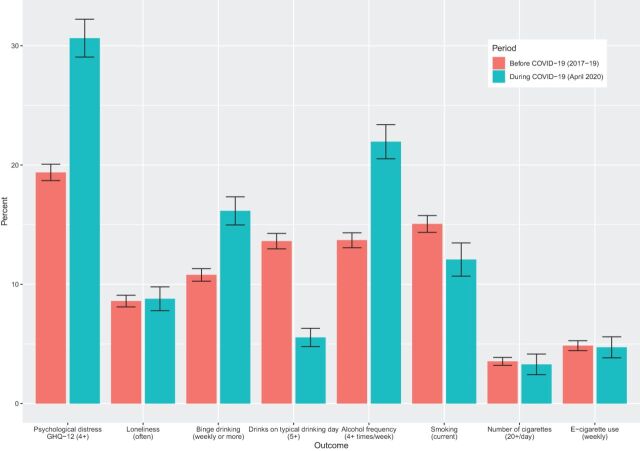
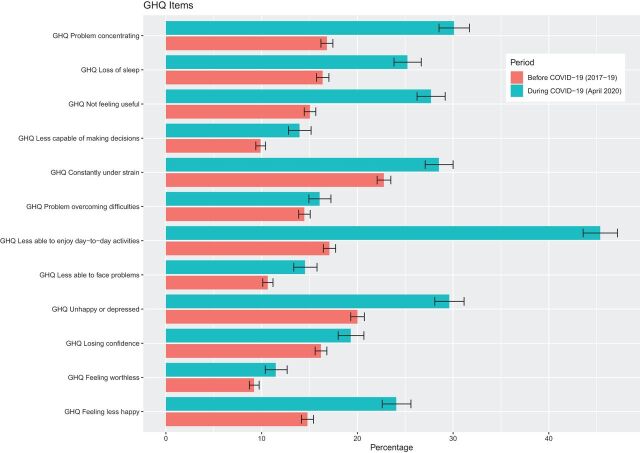
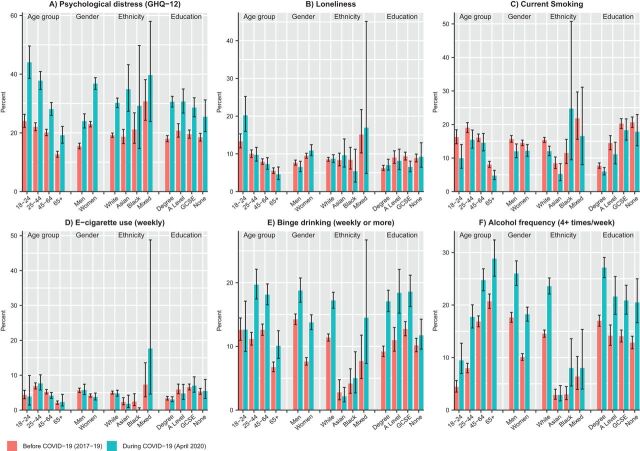
Background: There are concerns that COVID-19 mitigation measures, including the ‘lockdown’, may have unintended health consequences. We examined trends in mental health and health behaviours in the UK before and during the initial phase of the COVID-19 lockdown and differences across population subgroups. Methods: Repeated cross-sectional and longitudinal analysis of the UK Household Longitudinal Study, including representative samples of over 27,000 adults (aged 18+) interviewed in four survey waves between 2015 and 2020. A total of 9748 adults had complete data for longitudinal analyses. Outcomes included psychological distress (General Health Questionnaire-12), loneliness, current cigarette smoking, use of e-cigarettes and alcohol consumption. Cross-sectional prevalence estimates were calculated and multilevel Poisson regression assessed associations between time period and the outcomes of interest, as well as differential associations by age, gender, education level and ethnicity. Results: Psychological distress increased 1 month into lockdown with the prevalence rising from 19.4% (95% CI 18.7% to 20.1%) in 2017–2019 to 30.6% (95% CI 29.1% to 32.3%) in April 2020 (RR=1.3, 95% CI 1.2 to 1.4). Groups most adversely affected included women, young adults, people from an Asian background and those who were degree educated. Loneliness remained stable overall (RR=0.9, 95% CI 0.6 to 1.5). Smoking declined (RR=0.9, 95% CI=0.8,1.0) and the proportion of people drinking four or more times per week increased (RR=1.4, 95% CI 1.3 to 1.5), as did binge drinking (RR=1.5, 95% CI 1.3 to 1.7). Conclusions: Psychological distress increased 1 month into lockdown, particularly among women and young adults. Smoking declined, but adverse alcohol use generally increased. Effective measures are required to mitigate negative impacts on health.
Overview
The claims and statistics of this paper haven’t been checked yet.
Free: it reads the open-access text and checks the first 5 claims that cite a source we can check. Create a free account to check every claim.
Integrity signals
Registry
Cites
Statistics
Figures
Verification
Claims the paper makes
The claims and statistics of this paper haven’t been checked yet.
Free: it reads the open-access text and checks the first 5 claims that cite a source we can check. Create a free account to check every claim.
Claims other papers make about this one
Each is checked against this paper’s own text: does it say what the citing paper says it does?
The cited source says what the claim attributes to it.
In the citing paper
“such a comparison complements other studies that rely on pre-pandemic data collected during typical conditions (e.g., Niedzwiedz, et al., 2021).”
From Young Adult Adaptability to the Social Challenges of the COVID-19 Pandemic: The Protective Role of Friendships (2022) · cites this paper as Niedzwiedz, et al., 2021
In the citing paper
“there is evidence to suggest that they have resulted in adverse psychological consequences across general populations.”
Self-check
Percentages, sums and reported differences re-computed from the paper’s own numbers.
The self-check needs the paper’s full text.
Citations
Cites
The Psychological Impact of Quarantine and How to Reduce It: Rapid Review of the Evidence
Brooks, S. K., Webster, R. K., Smith, L. E., Woodland, L., Wessely, S., Greenberg, N., & Rubin, G. J. (2020) · doi:10.2139/ssrn.3532534 · Cited by 16,394
The psychological impact of quarantine and how to reduce it: Rapid review of the evidence
Brooks, S. K., Webster, R. K., Smith, L. E., Woodland, L., Wessely, S., Greenberg, N., & Rubin, G. J. (2020) · The Lancet · doi:10.1016/s0140-6736(20)30460-8 · Cited by 16,378 · cited 1×
“Research prior to the pandemic has suggested quarantine is linked to several negative psychological outcomes.(6) During the COVID-19 pandemic, concerns have been repeatedly raised about potentially long-lasting harms to mental health.”
A Modified Poisson Regression Approach to Prospective Studies with Binary Data
Zou, G. (2004) · American Journal of Epidemiology · doi:10.1093/aje/kwh090 · Cited by 9,615
Holmes, E. A., O'Connor, R. C., Perry, V. H., Tracey, I., Wessely, S., Arseneault, L., Ballard, C., Christensen, H., Cohen Silver, R., Everall, I., et al. (2020) · The Lancet Psychiatry · doi:10.1016/s2215-0366(20)30168-1 · Cited by 5,715
A global panel database of pandemic policies (Oxford COVID-19 Government Response Tracker)
Hale, T., Angrist, N., Goldszmidt, R., Kira, B., Petherick, A., Phillips, T., Webster, S., Cameron-Blake, E., Hallas, L., Majumdar, S., et al. (2021) · Nature Human Behaviour · doi:10.1038/s41562-021-01079-8 · Cited by 4,578
The Validity of Two Versions of the GHQ in the WHO Study of Mental Illness in General Health Care
GOLDBERG, D. P., GATER, R., SARTORIUS, N., USTUN, T. B., PICCINELLI, M., GUREJE, O., & RUTTER, C. (1997) · Psychological Medicine · doi:10.1017/s0033291796004242 · Cited by 3,657
Indicators of socioeconomic position (part 1): Figure 1
Galobardes, B., Shaw, M., Lawlor, D. A., Lynch, J. W., & Davey Smith, G. (2006) · Journal of Epidemiology and Community Health · doi:10.1136/jech.2004.023531 · Cited by 2,867 · cited 1×
“When analysing educational inequalities we restricted analyses to adults aged 25+ years as educational attainment tends to be stable from that age onwards.(16) For longitudinal analysis, we included participants with complete data from all four waves and aged 18+ years during wave 9.”
Clinical impact of COVID-19 on patients with cancer (CCC19): a cohort study
Kuderer, N. M., Choueiri, T. K., Shah, D. P., Shyr, Y., Rubinstein, S. M., Rivera, D. R., Shete, S., Hsu, C.-Y., Desai, A., de Lima Lopes, G., et al. (2020) · The Lancet · doi:10.1016/s0140-6736(20)31187-9 · Cited by 1,726
AUDIT‐C as a Brief Screen for Alcohol Misuse in Primary Care
Bradley, K. A., DeBenedetti, A. F., Volk, R. J., Williams, E. C., Frank, D., & Kivlahan, D. R. (2007) · Alcoholism: Clinical and Experimental Research · doi:10.1111/j.1530-0277.2007.00403.x · Cited by 1,632
Suicide risk and prevention during the COVID-19 pandemic
Gunnell, D., Appleby, L., Arensman, E., Hawton, K., John, A., Kapur, N., Khan, M., O'Connor, R. C., Pirkis, J., Appleby, L., et al. (2020) · The Lancet Psychiatry · doi:10.1016/s2215-0366(20)30171-1 · Cited by 1,513 · cited 1×
“While a body of literature is developing to articulate the expected indirect impacts of the pandemic, 3 7 25 empirical research on how mental health and health-related behaviours have changed remains limited and largely based on non-representative samples.”
Cited by
Items 301–400 of 528
Worsley, J. D., Billington, J., Balabanova, E., & Watkins, M. (2022) · Frontiers in Public Health · doi:10.3389/fpubh.2022.753973 · Cited by 8
Evaluating the therapeutic qualities of community parks: An elderly-centric perspective
Lin, X., Yusoff, W. F. M., & Sulaiman, M. K. A. M. (2025) · Urban forestry & urban greening · doi:10.1016/j.ufug.2025.128874 · Cited by 6
Irizar, P., Taylor, H. F. W., Kapadia, D., Pierce, M., Bécares, L., Goodwin, L., Katikireddi, S. V., & Nazroo, J. Y. (2024) · Journal of Affective Disorders · doi:10.1016/j.jad.2024.05.026 · Cited by 6
Self-citationHussey, L. J., Kontopantelis, E., Mok, P. L. H., Ashcroft, D. M., Carr, M., Garg, S., Chew-Graham, C. A., Kapur, N., Lovell, K., & Webb, R. T. (2024) · Journal of Child Psychology and Psychiatry · doi:10.1111/jcpp.14026 · Cited by 6
“Several UK studies found decreased mental well-being in CYP when comparing pre-pandemic rates with time periods during the pandemic (Banks & Xu, 2020; Bignardi et al., 2021; Gray et al., 2020; Niedzwiedz et al., 2021; Pierce et al., 2020).”
Zong, X., Simmons, C., & Yang, L. (2025) · Journal of Affective Disorders · doi:10.1016/j.jad.2025.119649 · Cited by 7
Purrington, J., Nye, A., & Beail, N. (2021) · Advances in Mental Health and Intellectual Disabilities · doi:10.1108/amhid-05-2021-0023 · Cited by 6
Sun, Y., Wang, P., & Tang, J. (2022) · Frontiers in Psychology · doi:10.3389/fpsyg.2022.1040413 · Cited by 6
“With poorer mental health, people were more likely to be drinking alcohol more than they used to (Niedzwiedz et al., 2021).”
BackgroundFatollahi, J. J., Bentley, S., Doran, N., & Brody, A. L. (2021) · International Journal of Environmental Research and Public Health · doi:10.3390/ijerph182211923 · Cited by 7
“For example, prior studies showed that decreased tobacco use was more apparent in younger age groups [24] and among women [25].”
MethodBorusiak, P., Mazheika, Y., Bauer, S., Haberlandt, E., Krois, I., Fricke, C. F., Simon, L., Beschoner, P., Jerg‐Bretzke, L., Geiser, F., et al. (2022) · Archives of Public Health · doi:10.1186/s13690-022-00876-5 · Cited by 8
Hertz‐Palmor, N., Ruppin, S., Matalon, N., Mosheva, M., Dorman-Ilan, S., Serur, Y., Avinir, A., Mekori‐Domachevsky, E., Hasson‐Ohayon, I., Gross, R., et al. (2023) · Psychiatry Research · doi:10.1016/j.psychres.2023.115119 · Cited by 7
“In accordance with previous reports, most PRSF affected mental health most strongly during the first lockdown (Levy and Cohen-Louck, 2021; Niedzwiedz et al., 2021; Patsali et al., 2020), and gradually declined as time elapsed (Fancourt et al.”
ResultChen, J., & Wan, L. (2024) · PLoS ONE · doi:10.1371/journal.pone.0305096 · Cited by 9
Buss, V. H., Oldham, M., Jackson, S. E., Shahab, L., Angus, C., Holmes, J., & Brown, J. (2025) · Addiction · doi:10.1111/add.70258 · Cited by 9
“Earlier studies, following the start of the coronavirus disease 2019 (COVID-19) pandemic, showed that trends in the prevalence of risky drinking and mean weekly alcohol consumption were different across socio-demographic groups [5 – 9, 15, 16].”
InfluentialCall for Action on the Upstream Determinants of Diabetes in Canada.
Fazli, G. S., & Booth, G. L. (2023) · Canadian Journal of Diabetes · doi:10.1016/j.jcjd.2023.05.011 · Cited by 5
Watson-Brown, N., Nicolls, M., Mardani, A., Fernandes, I. A., & Truelove, V. (2024) · Transportation Research Part F Traffic Psychology and Behaviour · doi:10.1016/j.trf.2024.06.016 · Cited by 6
Dhensa‐Kahlon, R. K., Wan, S. T., Coyle‐Shapiro, J. A., & Teoh, K. (2025) · BJPsych Open · doi:10.1192/bjo.2024.803 · Cited by 5
Churchill, V., Duong, H. T., Massey, Z. B., & Popova, L. (2021) · Journal of Psychoactive Drugs · doi:10.1080/02791072.2021.2013583 · Cited by 5
Niermann, C. Y. N., Bollenbach, L., & Kanning, M. K. (2022) · German Journal of Exercise and Sport Research · doi:10.1007/s12662-021-00795-7 · Cited by 6
Richardson, C. D., Roscoe, H., Green, E., Brooks, R. L., Barnes, L., Matthews, F. E., & Brayne, C. (2022) · Journal of the American Geriatrics Society · doi:10.1111/jgs.18099 · Cited by 6
COVID and college: how the pandemic impacted alcohol use disorder status among students
Sheerin, C. M., Kuo, S. I., Smith, R. L., Bannard, T., Gentry, A. E., Vassileva, J., Dick, D. M., & Amstadter, A. B. (2022) · Journal of American College Health · doi:10.1080/07448481.2022.2133963 · Cited by 5
“The differential pattern of changes in alcohol consumption identified during the pandemic may in part be explained by population (ie, increases in binge drinking for all age groups except 18–24; 10 decreases in alcohol consumption in college students 11,12 ).”
Jonsson, K. R., Taylor-Robinson, D. C., Straatmann, V. S., Melis, G., & Adjei, N. K. (2023) · Frontiers in Public Health · doi:10.3389/fpubh.2022.1064677 · Cited by 7
Stress/depression across the COVID-19 pandemic in Denmark
Cardona, M., Andersen, L. H., Fallesen, P., & Bruckner, T. A. (2023) · BMC Public Health · doi:10.1186/s12889-023-15129-5 · Cited by 5
Impacts of COVID-19 on mental health in the US: evidence from a national survey
De, P. K., & Sun, R. (2023) · Journal of Mental Health · doi:10.1080/09638237.2023.2210651 · Cited by 4
“…health, most of these studies assessed the impacts during the early phase of the pandemic (Akay 2022; Holingue, Badillo-Goicoechea, et al., 2020; Holingue, Kalb, et al., 2020; Kibbey et al., 2021; Niedzwiedz et al., 2021; Pierce et al., 2020; Reading Turchioe et al., 2021; Twenge & Joiner, 2020).”
Smoking among Brazilian adolescents during the COVID-19 pandemic: a cross-sectional study
Malta, D. C., Gomes, C. S., de Vasconcelos, N. M., Alves, F. T. A., Ferreira, A. P. D. S., Barros, M. B. D. A., Lima, M. G., & Szwarcwald, C. L. (2023) · Sao Paulo Medical Journal · doi:10.1590/1516-3180.2022.0424.r1.30032023 · Cited by 5
Zhao, S., Zhou, J., & Wang, T. (2024) · Journal of Clinical Psychology · doi:10.1002/jclp.23676 · Cited by 6
Tarr, G. A. M., Morris, K. J., Harding, A. B., Jacobs, S., Smith, M. K., Church, T. R., Berman, J. D., Rau, A., Ashida, S., & Ramirez, M. R. (2022) · PLoS ONE · doi:10.1371/journal.pone.0267261 · Cited by 6
Mental Healthcare in the ‘New Normal’: Digital Technologies for Pandemics
Clough, B. A., Cassimatis, M., Noorbala, L., Attary, T., Ghazizadeh, A., & Hamilton, K. (2022) · Springer series on bio- and neurosystems · doi:10.1007/978-3-031-10031-4_20 · Cited by 5
Patrick, M. E., Terry‐McElrath, Y. M., Peterson, S. J., & Birditt, K. S. (2023) · Prevention Science · doi:10.1007/s11121-023-01491-8 · Cited by 8
Peña, S., Ilmarinen, K., Kestilä, L., Ruokolainen, O., Ollila, H., Parikka, S., & Karvonen, S. (2023) · European Journal of Public Health · doi:10.1093/eurpub/ckad104 · Cited by 5
Bahji, A., Bach, P., Danilewitz, M., el‐Guebaly, N., Doty, B., Thompson, L. R., Clarke, D. E., Ghosh, S. M., & Crockford, D. N. (2021) · Psychiatric Research and Clinical Practice · doi:10.1176/appi.prcp.20210022 · Cited by 7
Equally Affected? Health-Related and Socioeconomic Adversities of the COVID-19 Pandemic in ViennaPreprint
Oberndorfer, M., Dorner, T. E., Brunnmayr, M., Berger, K., Dugandzic, B., & Bach, M. (2020) · SSRN Electronic Journal · doi:10.2139/ssrn.3733369 · Cited by 5
Moreno‐Agostino, D., Fisher, H. L., Goodman, A. T., Hatch, S. L., Morgan, C., Richards, M., Das‐Munshi, J., & Ploubidis, G. B. (2022) · medRxiv · doi:10.1101/2022.04.22.22274164 · Cited by 5
Bad dream frequency predicts mental health needs during the SARS-CoV-2 pandemic
Simmons, C., McKee, P., Antonios, I., Smith, A. P., & Sinnott-Armstrong, W. P. (2022) · Journal of Affective Disorders Reports · doi:10.1016/j.jadr.2022.100448 · Cited by 6
Wilson, J., Demou, E., & Kromydas, T. (2023) · Social Science & Medicine · doi:10.1016/j.socscimed.2023.116418 · Cited by 7
“For the purposes of this study, participants who scored ≥4 on the GHQ-12 were coded as likely experiencing anxiety/or depression (i.e., GHQ-12 ‘caseness’) (Kromydas et al., 2022; C. L. Niedzwiedz et al., 2021b).”
Self-citationWilson, J. J., Smith, L., Yakkundi, A., Jacob, L., Martin, S., Grabovac, I., McDermott, D. T., López‐Bueno, R., Barnett, Y., Butler, L., et al. (2022) · International Journal of Environmental Research and Public Health · doi:10.3390/ijerph19073959 · Cited by 4
“Another study also supports this finding, with a possible reason being that some could be potentially using alcohol as a coping mechanism due to a lack of recreational and social activities as the pandemic has continued on [11].”
BackgroundResultInfluentialKar, S. S., Krishnamoorthy, Y., Sivanantham, P., Anandraj, J., & Gnanadhas, J. (2022) · Journal of Postgraduate Medicine · doi:10.4103/jpgm.jpgm_1085_21 · Cited by 4
“31-33] We attempted to define compliance to lockdown in terms of reduction of social contacts, which may be useful to inform the effectiveness of non-pharmacological intervention (NPI) models for infection transmission in the region.”
Kosić, A., Kenfack, C. S. K., & Ai, A. L. (2023) · Medical Research Archives · doi:10.18103/mra.v11i2.3517 · Cited by 9
Lee, S., Moon, H., Ko, J., Çankaya, B., Caine, E. D., & You, S. (2023) · PLoS ONE · doi:10.1371/journal.pone.0292219 · Cited by 9
Mental health self-care during the COVID-19 pandemic: a prospective cohort study in Australia
Griffiths, D., Pradipta, V. M. K. D., & Collie, A. (2024) · BMC Public Health · doi:10.1186/s12889-023-17632-1 · Cited by 6
“Individuals with pre-existing mental health conditions have also been shown to be more at risk of poor mental health during the pandemic [9], and those experiencing periods of community lockdown [10], particularly women and young adults [11].”
Backgroundvan Hagen, C. C. E., Huiberts, A. J., Mutubuki, E. N., de Melker, H. E., Vos, E. R. A., van de Wijgert, J. H. H. M., van den Hof, S., Knol, M. J., & van Hoek, A. J. (2024) · PLoS ONE · doi:10.1371/journal.pone.0300324 · Cited by 5
Kelshaw, S., Boyd, J., Gallagher, I., & Sara, G. E. (2022) · Patient Experience Journal · doi:10.35680/2372-0247.1658 · Cited by 5
Greijdanus, H., & van der Voorn, M. (2022) · International Journal of Applied Positive Psychology · doi:10.1007/s41042-022-00068-0 · Cited by 6
“A large-scale longitudinal study revealed that UK citizens’ stress levels and alcohol use increased during lockdown, especially among women and young adults (Niedzwiedz et al., 2020).”
Baker, H., Gill, S. S., Aboaja, A. M., Kole, S., & Perry, A. (2022) · Psych · doi:10.3390/psych4040051 · Cited by 4
Oshio, T., Kimura, H., Nishizaki, T., & Kuwahara, S. (2022) · Preventive Medicine · doi:10.1016/j.ypmed.2022.107329 · Cited by 4
Rohrmann, T., Praus, P., Proctor, T., Benedyk, A., Tost, H., Hennig, O., Meyer‐Lindenberg, A., & Wahl, A.-S. (2022) · Frontiers in Psychiatry · doi:10.3389/fpsyt.2022.971896 · Cited by 6
van Baal, S. T., Verdejo‐García, A., & Hohwy, J. (2023) · BMC Public Health · doi:10.1186/s12889-023-15031-0 · Cited by 4
The impact of labour market shocks on mental health: evidence from the Covid-19 first wave
Bogliacino, F., Codagnone, C., Folkvord, F., & Lupiáñez‐Villanueva, F. (2023) · Economia Politica · doi:10.1007/s40888-023-00304-z · Cited by 6
“In the UK, for instance, three studies based on large samples (Hampshire et al., 2021; Jia et al., 2020; Niedzwiedz et al., 2021) compare the before and after situations to provide a picture of the increase of mental health problems prevalence as result of the Covid19 and related NPIs.”
BackgroundHonnudóttir, V., Veyhe, A. S., Mohr, M., Strøm, M., & Mohr, M. (2023) · Scandinavian Journal of Public Health · doi:10.1177/14034948231176708 · Cited by 4
“This analytical strategy was chosen, since evidence has indicated differential impact of the pandemic and subsequent lockdown in different demographic groups with respect to health and well-being [2,6,7,9].”
BackgroundMethodResultInfluentialHappy Hour: The association between trait hedonic capacity and motivation to drink alcohol
Becker, D., & Bernecker, K. (2024) · Addictive Behaviors Reports · doi:10.1016/j.abrep.2024.100537 · Cited by 4
“Some studies suggest that people had different drinking habits during the lockdown, with some drinking more and some less (Koopmann et al., 2020, 2021; Niedzwiedz et al., 2021).”
BackgroundStarkowska, A., Tyburski, E. M., Skałacka, K., & Gąsiorowska, A. (2021) · Frontiers in Psychology · doi:10.3389/fpsyg.2021.635973 · Cited by 5
Riepenhausen, A., Veer, I. M., Wackerhagen, C., Reppmann, Z. C., Köber, G., Ayuso‐Mateos, J. L., Bögemann, S. A., Corrao, G., Félez-Nóbrega, M., Haro, J. M., et al. (2021) · doi:10.31234/osf.io/fjqpb · Cited by 4
Scotland, P. H. (2021) · doi:10.52487/7734 · Cited by 4
Alcohol sales and harm in Scotland during the COVID-19 pandemic
Scotland, P. H. (2022) · doi:10.52487/58694 · Cited by 4
Ho, G. W. K., Leung, S. F., Mak, Y. W., Wong, K. H., Kwok, R. K. H., & Loke, A. Y. (2025) · BMJ Open · doi:10.1136/bmjopen-2024-092160 · Cited by 4
“Future studies can consider integrating fear into the PMT model to enrich the understanding of the relationship between appraisal processes and protection motivation in the pandemic context.”
Meng, S. (2022) · Frontiers in Psychiatry · doi:10.3389/fpsyt.2022.973520 · Cited by 6
“Similarly, once motivated by internet-based aids and physical mentorship, students work harder to develop their physical and mental health abilities because they believe that with the help of effective management and measurement, their performance could be increased to the appropriate level (54, 55).”
BackgroundSantana, G. L., Baptista, M. C., de Matos, G. A. G., Ogata, A. J. N., Malik, A. M., & Andrade, L. H. (2023) · Journal of Occupational and Environmental Medicine · doi:10.1097/jom.0000000000002797 · Cited by 3
Maimaris, J., O’Sullivan, A., Underhill, I., Green, G., Symes, A., Lowe, D. M., Burns, S. O., Campbell, M., & Elfeky, R. (2023) · Journal of Clinical Immunology · doi:10.1007/s10875-023-01538-z · Cited by 4
“(2020) report that the percentage of individuals with anxiety disorders almost doubled from 13% pre-pandemic, to 24% in April and May of 2020 [10, 11].”
Li, L., Sullivan, A., Musah, A., Stavrianaki, K., Wood, C. E., Baker, P., & Kostkova, P. (2024) · BMC Public Health · doi:10.1186/s12889-024-19480-z · Cited by 4
“The strictness of lockdowns was intersected by additional periods of various movement restrictions and other public health measures [10].”
BackgroundResultOrozco, A. L., Thomas, A. J., Raggatt, M. H., Scott, N., Eddy, S., Douglass, C. H., Wright, C. C. J., Spelman, T. D., & Lim, M. S. C. (2024) · Archives of Public Health · doi:10.1186/s13690-024-01397-z · Cited by 3
Chela-Àlvarez, X., Leiva, A., Gallardo-Alfaro, L., Bulilete, O., Vidal-Thomas, M., & Llobera, J. (2022) · Frontiers in Psychology · doi:10.3389/fpsyg.2022.842335 · Cited by 10
Chieffo, D. P. R., Avallone, C., Serio, A., Kotzalidis, G. D., Balocchi, M., Luca, I. D., Hirsch, D., del Castillo, A. G., Lanzotti, P., Marano, G., et al. (2022) · World Journal of Clinical Cases · doi:10.12998/wjcc.v10.i19.6370 · Cited by 3
Jones, R. K., Wilkins, D., Bezeczky, Z., & Thompson, S. (2022) · The British Journal of Social Work · doi:10.1093/bjsw/bcac126 · Cited by 3
Oshio, T., Kimura, H., Nishizaki, T., & Kuwahara, S. (2022) · International Journal of Environmental Research and Public Health · doi:10.3390/ijerph19158918 · Cited by 3
Malta, D. C., Gomes, C. S., de Vasconcelos, N. M., Barros, M. B. D. A., Lima, M. G., Júnior, P. R. B. D. S., & Szwarcwald, C. L. (2022) · Revista Brasileira de Epidemiologia · doi:10.1590/1980-549720230007.supl.1.1 · Cited by 7
Molarius, A., & Lundin, F. (2022) · Preventive Medicine Reports · doi:10.1016/j.pmedr.2022.102093 · Cited by 4
Terzioğlu, Ö. P., Söyler, H. Ç., & Menekşe, Ö. (2023) · Turk Turizm Arastirmalari Dergisi · doi:10.26677/tr1010.2023.1177 · Cited by 8
Murray, J., Dhami, M. K., McClatchey, K., Weiss-Cohen, L., & Ayton, P. (2023) · Europe's Journal of Psychology · doi:10.5964/ejop.7751 · Cited by 2
“Unlike the findings of Niedzwiedz et al. (2021), Pierce et al. (2020), and Sibley et al. (2020), the current research did not find that females significantly differed from males in terms of their perceptions of life changes but did find that males were more likely to begin self-improvement…”
InfluentialRodríguez‐Prat, A., Pergolizzi, D., Crespo, I., & Monforte‐Royo, C. (2023) · Behavioral Medicine · doi:10.1080/08964289.2023.2214717 · Cited by 5
Barbalat, G., Melac, A. T., Zante, É., Haesebaert, F., & Franck, N. (2023) · Frontiers in Public Health · doi:10.3389/fpubh.2023.1234023 · Cited by 4
“Yet, while social distancing may have affected loneliness (29, 65), others have suggested that the effects of loneliness on mental well-being were for the most part precedent to lockdown (66, 67).”
BackgroundMitchell, L. M., Hardman, M. L., Howarth, M. L., & Cook, P. A. (2024) · Cities & Health · doi:10.1080/23748834.2023.2290904 · Cited by 3
Hai, F., Mao, Y., & Tian, L. (2024) · Frontiers in Psychology · doi:10.3389/fpsyg.2024.1357225 · Cited by 6
Fucito, L. M., Bold, K. W., Cannon, S., Serrantino, A., Marrero, R., & O’Malley, S. S. (2022) · International Journal of Environmental Research and Public Health · doi:10.3390/ijerph19148239 · Cited by 3
“Conversely, others reported decreased use because of reduced ability to afford or access tobacco products [26,27], lower social opportunities where use typically occurred [28] and/or health concerns [20,29–32].”
BackgroundLongitudinal Distress among Brazilian University Workers during Pandemics
Zibetti, M. R., Serralta, F. B., & Evans, C. (2021) · International Journal of Environmental Research and Public Health · doi:10.3390/ijerph18179072 · Cited by 4
“This possibility would be in line with the observation of Wang et al. (2020) [13] on the stabilization at high levels of suffering, and with the data obtained in the United Kingdom that demonstrated the effects of worsening mental struggle, comparing periods before and during the pandemic, denoting the chronicity of t…”
BackgroundResultInfluentialLake, S., Assaf, R. D., Gorbach, P. M., & Cooper, Z. D. (2022) · Experimental and Clinical Psychopharmacology · doi:10.1037/pha0000572 · Cited by 2
Kwok, J. O. T., Yan, R. W. K., Kwok, C. P. C., Cheng, G. W. H., Lin, C., Wong, B. H. C., Cheng, S., Lee, A. T. C., & LAM, L. C. W. (2022) · Frontiers in Psychiatry · doi:10.3389/fpsyt.2022.909162 · Cited by 3
“Several large representative surveys of adults in the US (34), UK (35), Denmark (36), Slovenia (37) and China (38) have also found an inverse relationship between age and mental health symptoms.”
BackgroundTorrado, J. M., Duque‐Calvache, R., & Mesa-Pedrazas, Á. (2022) · Revista Española de Sociología · doi:10.22325/fes/res.2022.130 · Cited by 8
“Meanwhile, significant increases in unhealthy behaviours such as smoking and drinking were detected (Niedzwiedz et al., 2021; Szwarcwald et al., 2021), with negative effects on perceived health, especially in terms of mental health.”
BackgroundArsenyadis, F., Redman, E., Henson, J. J., Brady, E. M., Coull, N. A., Khunti, K., Hall, A. P., & Davies, M. J. (2021) · Diabetes Obesity and Metabolism · doi:10.1111/dom.14585 · Cited by 2
“Governmental advice restricting people's freedom and enforced periods at home have raised public health concerns regarding well-being beyond the risk of COVID-19 infection.(2) These concerns focused on negative impacts to lifestyle, activity, and diet, which are modifiable risk factors for mental and physical health.”
BackgroundConceptual lessons for containing an epidemic of questionable COVID-19 counterfactual comparisons
Fuller, J. (2021) · Journal of Epidemiology & Community Health · doi:10.1136/jech-2021-216825 · Cited by 3
The Impact of COVID-19 Vaccination for Mental HealthPreprint
Chaudhuri, K., & Howley, P. (2021) · SSRN Electronic Journal · doi:10.2139/ssrn.3906235 · Cited by 4
Cogan, N. A., McGibbon, M., Gardiner, A., & Morton, L. (2022) · Journal of Occupational and Environmental Medicine · doi:10.1097/jom.0000000000002711 · Cited by 4
Song, Y., Xu, L., Liu, D., Feng, M., Yang, C., Jiang, Y., & Wu, Y. (2024) · Frontiers in Public Health · doi:10.3389/fpubh.2024.1439749 · Cited by 2
Lamb, D., Scott, H. R., Carr, E., Stevelink, S. A. M., Raine, R., Hotopf, M. H., Greenberg, N. L., Almeida‐Meza, P., Penfold, C. M., Ledden, S., et al. (2026) · PLoS ONE · doi:10.1371/journal.pone.0350918 · Cited by 2
COVID-19 and health inequality: Evidence from risky behaviors
Huang, C., Li, C., Liu, F., Wei, S., & Xu, R. (2025) · Journal of Comparative Economics · doi:10.1016/j.jce.2025.06.001 · Cited by 3
Stepanova, E., Croke, S., Panagioti, M., Yu, G., & Fu, Y. (2026) · Health Expectations · doi:10.1111/hex.70567 · Cited by 4
“The prevalence of psychological distress almost doubled among Asian groups during the first lockdown, rising from 18.7% to 34.9%, compared to a rise from 19.2% to 30.2% in white groups [5].”
InfluentialParsons, S., & Schoon, I. (2022) · BMJ Open · doi:10.1136/bmjopen-2021-056736 · Cited by 6
Kodama, T., Ishimaru, T., Tateishi, S., Hino, A., Tsuji, M., Ogami, A., Nagata, T., Matsuda, S., & Fujino, Y. (2022) · Frontiers in Psychiatry · doi:10.3389/fpsyt.2022.933556 · Cited by 3
Back to live: Returning to in-person engagement with arts and culture in the Liverpool City Region
Анисимович, А., Chapple, M., Worsley, J. D., Watkins, M., Billington, J., & Balabanova, E. (2022) · Frontiers in Psychology · doi:10.3389/fpsyg.2022.1011766 · Cited by 3
“…Kwong et al., 2021), women (Daly et al., 2020; Niedzwiedz et al., 2021), black and ethnic minorities (Proto and Quintana-Domeque, 2021), as well as people from more socially disadvantaged backgrounds and those with pre-existing mental health conditions (Kwong et al., 2021; O’Connor et al., 2021).”
BackgroundKertzscher, L., Baldofski, S., Kohls, E., Schomerus, G., & Rummel‐Kluge, C. (2022) · PLoS ONE · doi:10.1371/journal.pone.0276982 · Cited by 2
“Longitudinal analyses of adults in the UK showed that psychological distress increased one month after the start of the lockdown compared to before the onset of the pandemic [2].”
BackgroundGagné, T., & McMunn, A. (2023) · Journal of Affective Disorders · doi:10.1016/j.jad.2023.01.101 · Cited by 3
Mendes, J. A., & Vanwambeke, S. (2023) · PLoS neglected tropical diseases · doi:10.1371/journal.pntd.0011237 · Cited by 2
Gohari, M. R., Varatharajan, T., MacKillop, J. M., & Leatherdale, S. T. (2023) · Healthcare · doi:10.3390/healthcare11131945 · Cited by 2
Tornquist, M., Herrmann, E., & Chiappe, D. L. (2023) · Current Psychology · doi:10.1007/s12144-023-05276-8 · Cited by 4
“…suggested that more research is needed to better understand the short-and long-term outcomes of the COVID-19 crisis (Arora & Grey, 2020), especially because most of this research was conducted during the first wave of the COVID-19 pandemic (e.g., Naughton et al., 2020; Niedzwiedz et al., 2021).”
A hazai borfogyasztás változása az utóbbi években
Harsányi, D., Hlédik, E., & Vámosi, K. Z. (2023) · Marketing & Menedzsment · doi:10.15170/mm.2023.57.ksz.03.04 · Cited by 4
“(2020) és Niedzwiedz et al. (2021) is.”
Taylor, J., Pooley, S., Canning, R., O’Higgins, A., & Bowes, L. (2024) · The British Journal of Social Work · doi:10.1093/bjsw/bcae038 · Cited by 2
Schowe, A. M., Godara, M., Czamara, D., Adli, M., Singer, T., & Binder, E. B. (2024) · European Archives of Psychiatry and Clinical Neuroscience · doi:10.1007/s00406-024-01795-y · Cited by 4
“…social isolation in March 2020 [4], shows an increase in population-level anxiety, depression, psychological distress, suicidal ideation, and loneliness [5–11], with most severe and enduring impairments in individuals of younger age, female sex, and lower socio-economic status (SES) [7, 10, 12–22].”
Puddephatt, J., Onwumere, J., Gage, S. H., Coomber, R., Das‐Munshi, J., & Goodwin, L. (2026) · Addictive Behaviors · doi:10.1016/j.addbeh.2026.108750 · Cited by 2
Jacob, N., Santos, R., & Sivey, P. M. (2024) · Health Policy · doi:10.1016/j.healthpol.2024.105168 · Cited by 2
The Effect of COVID-19 Restrictions on Calls for Service on Drugs, Alcohol, and Mental Health
Demir, M., & Park, S. (2024) · American Journal of Criminal Justice · doi:10.1007/s12103-024-09783-7 · Cited by 2
“Some studies (e.g., Andresen & Hodg-kinson, 2022; Barbosa et al., 2023; Clare et al., 2021; Daly & Robinson, 2021; Koziarski, 2021; Niedzwiedz et al., 2021; Patrick et al., 2022; Pollard et al., 2020) have incorporated data from both pre-COVID-19 years and the pandemic period.”
Fakhreddine, L. B., Sánchez, M., & Pindado, E. (2025) · Agribusiness · doi:10.1002/agr.22024 · Cited by 2
A generational relational model of nature and mental wellbeing: results of a qualitative analysis
Bunce, H. L. I., & Owens, M. (2025) · Frontiers in Psychology · doi:10.3389/fpsyg.2025.1469507 · Cited by 6
Davies, E., Coombes, L., Liddiard, C., Matley, F., Seddon, J. L., & Watson, E. K. (2025) · Psychology and Health · doi:10.1080/08870446.2025.2513931 · Cited by 2
“Evidence has suggested a rise in risky drinking among mid-life women in recent years (Daly & Robinson, 2021; Niedzwiedz et al., 2021), Women are more likely to under-report their alcohol consumption compared to men (Livingston & Callinan, 2015).”
Metadata
- Authors
- Niedzwiedz, C. L., Green, M. J., Benzeval, M., Campbell, D., Craig, P., Demou, E., Leyland, A., Pearce, A., Thomson, R., Whitley, E., & Katikireddi, S. V.
- Affiliations
- University of Glasgow (GB)
- MRC/CSO Social and Public Health Sciences Unit (GB)
- University of Essex (GB)
- MRC/CSO Social and Public Health Sciences Unit, University of Glasgow, Glasgow, UK
- Corresponding author
- Katikireddi, Srinivasa Vittal
- ORCID
- Venue
- Journal of Epidemiology and Community Health
- Publisher
- BMJ
- Published
- 2020-09-25
- Volume
- 75
- Issue
- 3
- Pages
- 224-231
- ISSN
- 0141-7681 (ISSN-L)
- 0143-005X
- 1470-2738
- PMC
- PMC7892383
- OpenAlex
- W3088359309
- Cited by
- 525
- References
- 36
- Citations by year
- 2026: 13 · 2025: 41 · 2024: 57 · 2023: 106 · 2022: 172 · 2021: 129 · 2020: 7
- FWCI
- 41.43
- Type
- journal article
- Language
- en
- Open access
- hybrid
- doi.org
- Locations
- Journal of Epidemiology & Community Health (publishedVersion, cc-by)
- medRxiv (acceptedVersion, cc-by)
- PubMed Central (publishedVersion, cc-by)
- PubMed (publishedVersion)
- ENLIGHTEN (Jurnal Bimbingan dan Konseling Islam) (acceptedVersion, cc-by-sa)
- Open Access at Essex (University of Essex) (acceptedVersion)
- HRB National Drugs Library (Health Research Board) (submittedVersion)
- Funders
- Chief Scientist Office (SCAF/15/02)
- Economic and Social Research Council (ES/N00812X/1)
- Wellcome Trust (205412/Z/16/Z, 218105/Z/19/Z)
- Medical Research Council (MC_UU_12013, MC_UU_12017, MR/R024774/1)
- Topics
- Social Sciences › Psychology › Clinical Psychology › COVID-19 and Mental Health
- Social Sciences › Sociology and Political Science › COVID-19 Prevention and Impact
- Physical Sciences › Mathematics › Modeling and Simulation › COVID-19 epidemiological studies
- Keywords
- COVID-19 lockdown, mental health, psychological distress, loneliness, cigarette smoking, electronic cigarettes, alcohol consumption, binge drinking, health behavior, sex differences, young adults, ethnicity, educational attainment, UK Household Longitudinal Study
- MeSH terms
- COVID-19, SARS-CoV-2, Adolescent, Adult, Aged, Aged, 80 and over, Alcohol Drinking, Child, Child, Preschool, Cross-Sectional Studies, Female, United Kingdom, Humans, Infant, Infant, Newborn, Loneliness, Longitudinal Studies, Male, Mental Health, Middle Aged, Quarantine, Surveys and Questionnaires, Smoking, Social Isolation, Health Behavior, Prevalence, Young Adult, Electronic Nicotine Delivery Systems
About these checks
Registry, retraction, Cites and statistics results are computed, not judged, with one exception: a printed reference that no index lists is read once by a model before it counts as a citation error. Claims are extracted by a model and kept only when their quote appears verbatim in the text; each cited source is then checked, with a model’s help, for whether it says what the claim relies on. Those verdicts can be wrong — read the claim’s quote and the cited source before relying on one.
Statistics and arithmetic are recomputed, not judged.
Confidence bands are shown only for fields calibrated on our annotated test set. None is calibrated yet, so no band is shown.
What counts as a claim ›How we measure confidence ›How we check this ›
Are you an author, or do you see a problem with this page? Request a review
Data sources
Bibliographic data: Semantic Scholar, OpenAlex, Crossref.
Contains information from the Semantic Scholar Academic Graph Datasets, made available under the ODC Attribution License (ODC-BY 1.0).
Semantic Scholar’s data is described in: Kinney, R., et al. (2023). The Semantic Scholar Open Data Platform. arXiv:2301.10140.
