

Model Cards for Model Reporting
Open accessThe DOI matches its Crossref record; 22 of the 22 references it cites were found in a registry or an index; 8 of the 34 sources its claims cite were checked for support.
Abstract
Trained machine learning models are increasingly used to perform high-impact tasks in areas such as law enforcement, medicine, education, and employment. In order to clarify the intended use cases of machine learning models and minimize their usage in contexts for which they are not well suited, we recommend that released models be accompanied by documentation detailing their performance characteristics. In this paper, we propose a framework that we call model cards, to encourage such transparent model reporting. Model cards are short documents accompanying trained machine learning models that provide benchmarked evaluation in a variety of conditions, such as across different cultural, demographic, or phenotypic groups (e.g., race, geographic location, sex, Fitzpatrick skin type [15]) and intersectional groups (e.g., age and race, or sex and Fitzpatrick skin type) that are relevant to the intended application domains. Model cards also disclose the context in which models are intended to be used, details of the performance evaluation procedures, and other relevant information. While we focus primarily on human-centered machine learning models in the application fields of computer vision and natural language processing, this framework can be used to document any trained machine learning model. To solidify the concept, we provide cards for two supervised models: One trained to detect smiling faces in images, and one trained to detect toxic comments in text. We propose model cards as a step towards the responsible democratization of machine learning and related artificial intelligence technology, increasing transparency into how well artificial intelligence technology works. We hope this work encourages those releasing trained machine learning models to accompany model releases with similar detailed evaluation numbers and other relevant documentation.
Overview
CoChat Summary
TL;DR
The paper proposes “model cards,” short documentation records accompanying trained machine learning models to report intended use, performance characteristics, and disaggregated evaluation across demographic, phenotypic, and intersectional groups. It illustrates the framework with worked examples for a smiling classifier and a toxicity classifier.
Key findings
- The authors argue there are no standardized documentation procedures for communicating trained ML model performance, especially for high-impact domains such as health care, employment, education, and law enforcement.
- They propose model card sections covering model details, intended use, factors, metrics, evaluation data, training data, quantitative analyses, ethical considerations, and caveats/recommendations.
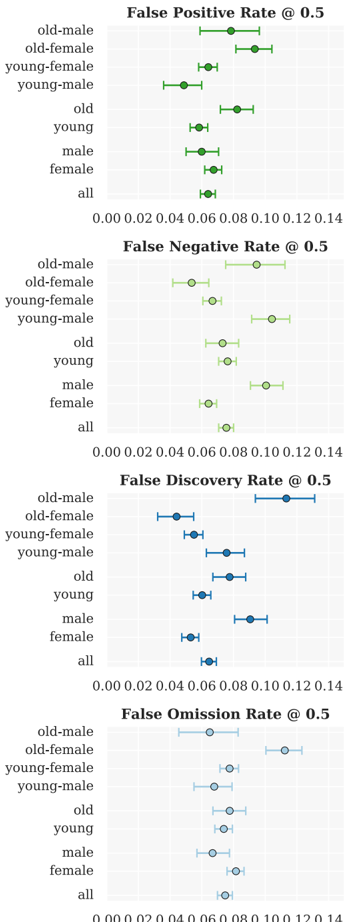
- In the smiling classifier example, all reported metrics at the .5 decision threshold have error types within the range 0.04–0.14, with 95% confidence intervals calculated by bootstrap resampling; the card notes older men have much higher false discovery rate, while men in aggregate have higher false negative rate.
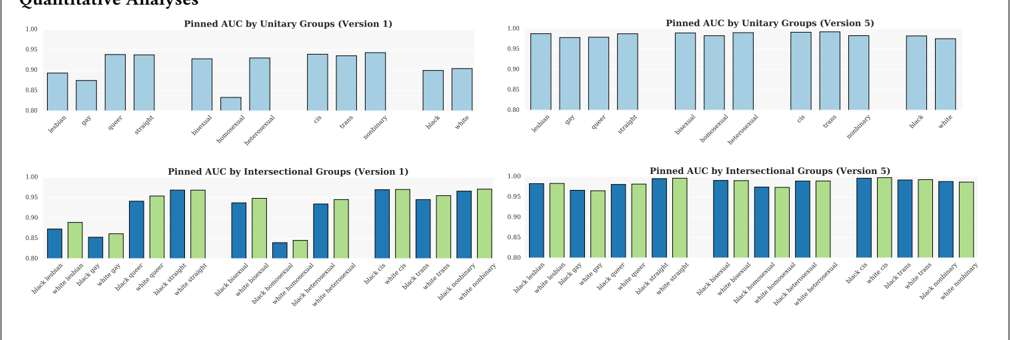
- In the toxicity example, TOXICITY v. 1 has low performance for several terms, especially “lesbian,” “gay,” and “homosexual,” while TOXICITY v. 5 shows more equitable performance after bias mitigation techniques.
Methods
- The paper is a framework/proposal paper, not an empirical study of a new model; it recommends model cards and details suggested sections and prompts.
- It provides two worked examples: a smiling classifier trained and evaluated on the CelebA dataset, using a convolutional neural net pretrained for face recognition and fine-tuned with cross-entropy loss for binary smiling classification.
- It also provides a model card for Perspective API’s TOXICITY classifier, a convolutional neural network developed by Jigsaw in 2017, evaluated on a synthetic Identity Phrase Templates test set; metrics include FPR, FNR, FDR, FOR for the smiling classifier and Pinned AUC for toxicity.
Limitations
- The paper states that model cards rely on the integrity of their creators and that it seems unlikely, at least in the near term, that they could be standardized or formalized enough to prevent misleading representations of model results.
- The paper states that evaluation datasets suitable for disaggregated evaluation are not yet common, and that the synthetic toxicity test data covers only a small set of very specific comments and is not comprehensive.
- The smiling classifier card states it does not capture race or skin type, uses binary gender classes (male/female), and that an ideal evaluation dataset would additionally include Fitzpatrick skin type, camera details, and environment details; the paper also states future work is needed to study how model information is interpreted and used by different stakeholders.
Model-written summary. Check it against the paper before relying on it.
Integrity signals
Registry
Cites
Statistics
Figures
Verification
Claims the paper makes
5 Valid · 1 Not valid · 18 Not checked · 30 Own results and interpretations
The cited sources support only part of this claim — read each source’s verdict below.
In the paper
“Synthetic data is valuable here because [11] shows that real data often has disproportionate amounts of toxicity directed at specific groups.”
What the sources say
- Partly supportedcites [11] [11] Lucas Dixon, John Li, Jeffrey Sorensen, Nithum Thain, and Lucy Vasserman. 2018. Measuring and Mitigating Unintended Bias in Text Classification. Proceedings of the AAAI/ACM Conference on AI, Ethics, and Society (2018). - sourceExperimental — accuracy not yet measured
The 'Quantifying bias in dataset' section (page unavailable) reports that certain identity terms appear disproportionately in toxic comments in the authors’ training data; for example, 'gay' appears in 3% of toxic comments but 0.5% of comments overall. It measures comments containing those terms, not whether toxicity is directed at the groups, and does not establish how often this pattern occurs across real datasets generally. (LLM, conf=0.85)
plainstates an association- Asserted: passes — The authors put it forward as true.
- Checkable: passes — It can be checked against evidence.
- Load-bearing: passes — The paper’s conclusions depend on it.
- Based: passes — The paper gives a reason why it holds.
- Partly supported
A result the paper reports from its own data — it cites no other source for it, so there is none to check. The quote shows it is in the paper.
In the paper
“For example, the false discovery rate on older men is much higher than that for other groups.”
plainstates an association- Asserted: passes — The authors put it forward as true.
- Checkable: passes — It can be checked against evidence.
- Load-bearing: passes — The paper’s conclusions depend on it.
- Based: passes — The paper gives a reason why it holds.
A result the paper reports from its own data — it cites no other source for it, so there is none to check. The quote shows it is in the paper.
In the paper
“TOXICITY v. 1 has low performance for several terms, especially 'lesbian', 'gay', and 'homosexual'.”
plain- Asserted: passes — The authors put it forward as true.
- Checkable: passes — It can be checked against evidence.
- Load-bearing: passes — The paper’s conclusions depend on it.
- Based: passes — The paper gives a reason why it holds.
None of the sources cited for this claim have been checked yet.
In the paper
“she collaborated with other researchers to demonstrate the disproportionate errors of computer vision systems on historically marginalized groups in the United States, such as darker-skinned women [5, 41].”
What the sources say
- Not checked yetcites [5] [5] Joy Buolamwini and Timnit Gebru. 2018. Gender Shades: Intersectional Accuracy Disparities in Commercial Gender Classification. In Proceedings of the 1st Conference on Fairness, Accountability and Transparency (Proceedings of Machine Learning Research) , Sorelle A. Friedler and Christo Wilson (Eds.), Vol. 81. PMLR, New York, NY, USA, 77-91. http://proceedings.mlr.press/v81/buolamwini18a.html -
- Not checked yetcites [41] [41] Inioluwa Raji. 2018. Black Panther Face Scorecard: Wakandans Under the Coded Gaze of AI. (2018). -
boostedstates an association- Asserted: passes — The authors put it forward as true.
- Checkable: passes — It can be checked against evidence.
- Load-bearing: passes — The paper’s conclusions depend on it.
- Based: passes — The paper gives a reason why it holds.
In the paper
“after MIT Media Lab graduate student Joy Buolamwini found that commercial face recognition systems failed to detect her face [4]”
What the sources say
- Not checked yetcites [4] [4] Joy Buolamwini. 2016. How I'm fighting Bias in Algorithms. (2016). https://www.ted.com/talks/joy\_buolamwini\_how\_i\_m\_fighting\_bias\_in\_ algorithms#t-63664 -
plainSingle case- Asserted: passes — The authors put it forward as true.
- Checkable: passes — It can be checked against evidence.
- Load-bearing: unclear — It is unclear whether the paper’s conclusions depend on it.
- Based: passes — The paper gives a reason why it holds.
13 more claims
Create a free account to see all 54 claims and to verify the 13 references still open.
- Probably not a substantial claim. 34
- It may state two separate claims as one. 8
Claims other papers make about this one
Each is checked against this paper’s own text: does it say what the citing paper says it does?
The source backs part of the claim, not all of it — or backs it for a different population, condition or comparison.
In the citing paper
“Model cards represent the field's standard for disclosing and documenting key facts about the architecture, training and evaluation of the model [14, 40].”
From Rethinking open source generative AI: open washing and the EU AI Act (2024) · cites this paper as [40]
Experimental — accuracy not yet measuredThe source backs part of the claim, not all of it — or backs it for a different population, condition or comparison.
In the citing paper
“Model cards (SMCs) [44] have been foundational in standardizing documentation for AI/ML model performance and characteristics, along with risks and unintended uses.”
From Interactive Model Cards: A Human-Centered Approach to Model Documentation (2022) · cites this paper as [44]
Experimental — accuracy not yet measuredThe source backs part of the claim, not all of it — or backs it for a different population, condition or comparison.
In the citing paper
“A second phase saw a more technical approach from the computer science community focusing on fairness, accountability and transparency as an engineering 'ethicalby-design' problem-solving exercise [20][21][22].”
From Putting AI ethics to work: are the tools fit for purpose? (2022) · cites this paper as [21]
Experimental — accuracy not yet measuredThe source backs part of the claim, not all of it — or backs it for a different population, condition or comparison.
In the citing paper
“These are either materials for use in design teams in workshop style events [76,77], tools for producing documentation of the design, build and test process [21,68], or technical tools for testing models, protecting privacy and security, testing for bias [69,93,94], or tracking provenance of data [95].”
From Putting AI ethics to work: are the tools fit for purpose? (2022) · cites this paper as [21]
Experimental — accuracy not yet measuredThe source backs part of the claim, not all of it — or backs it for a different population, condition or comparison.
In the citing paper
“There is some work on fairness relating to AI services, though this tends to focus on either exposing or 'auditing' certain AI services [22,38,126,133], or devising tools, methods and interventions relevant for those building (rather than using) such services [12,96,106,128].”
From Out of Context: Investigating the Bias and Fairness Concerns of “Artificial Intelligence as a Service” (2023) · cites this paper as [106]
Experimental — accuracy not yet measured
17 more claims about this paper
Create a free account to see every claim other papers make about this one.
Citations
Cites
BLEU: a method for automatic evaluation of machine translation
Papineni, K., Roukos, S., Ward, T., & Zhu, W.-J. (2001) · Proceedings of the 40th Annual Meeting on Association for Computational Linguistics - ACL '02 · doi:10.3115/1073083.1073135 · Cited by 21,344 · cited 1×
“translation system could compare BLEU scores [40] across demographic groups, and a model card for a speech recognition system could compare word-error rates.”
BackgroundCrenshaw, K. (2018) · Feminist Legal Theory · doi:10.4324/9780429500480-5 · Cited by 9,510
Deep Learning Face Attributes in the Wild
Liu, Z., Luo, P., Wang, X., & Tang, X. (2015) · 2015 IEEE International Conference on Computer Vision (ICCV) · doi:10.1109/iccv.2015.425 · Cited by 7,747 · cited 4×
“ms [5, 26] that report details of the datasets used to train and test machine learning models. We provide two example model cards in Section 5: A smiling detection model trained on the CelebA dataset [33] (Figure 2), and a public toxicity detection model, Perspective API [29] (Figure 3). Where Datasheets highlight cha…”
BackgroundMethodInfluentialThe validity and practicality of sun-reactive skin types I through VI
Fitzpatrick, T. B. (1988) · Archives of Dermatology · doi:10.1001/archderm.1988.01670060015008 · Cited by 4,339
Differential Privacy: A Survey of Results
Dwork, C. (2008) · Lecture Notes in Computer Science · doi:10.1007/978-3-540-79228-4_1 · Cited by 3,542 · cited 2×
“As such, collaboration with policy, privacy, and legal experts is necessary in order to ascertain which groups may be responsibly inferred, and how that information should be stored and accessed (for example, using differential privacy [12]).”
BackgroundCollins, G. S., Reitsma, J. B., Altman, D. G., & Moons, K. G. M. (2015) · Annals of Internal Medicine · doi:10.7326/m14-0697 · Cited by 3,267
Equality of Opportunity in Supervised Learning
Hardt, M., Price, E., & Srebro, N. (2016) · arXiv · doi:10.48550/arxiv.1610.02413 · Cited by 2,536 · cited 2×
“of Opportunity, and equal false negative and false positive rates across groups is equivalent to fulfilling Equality of Odds [26].”
BackgroundGebru, T., Morgenstern, J., Vecchione, B., Vaughan, J. W., Wallach, H., Daumé, H., & Crawford, K. (2018) · arXiv · doi:10.48550/arxiv.1803.09010 · Cited by 2,474
Self-citationA Probabilistic Interpretation of Precision, Recall and F-Score, with Implication for Evaluation
Goutte, C., & Gaussier, E. (2005) · Lecture Notes in Computer Science · doi:10.1007/978-3-540-31865-1_25 · Cited by 2,285 · cited 1×
“Confidence intervals for metrics derived from confusion matrices can be calculated by treating the matrices as probabilistic models of system performance [24].”
MethodFair prediction with disparate impact: a study of bias in recidivism prediction instruments
Chouldechova, A. (2017) · Big Data · doi:10.1089/big.2016.0047 · Cited by 2,159 · cited 1×
“or different errors that can be calculated from the confusion matrix for binary classification systems. • These also correspond to metrics in recent definitions of “fairness” in machine learning (cf. [8, 25]), where parity across subgroups for different metrics correspond to different fairness criteria. • 95% confiden…”
Background
Research works printed but not linked: 9
- [1] Avrio AI. 2018. Avrio AI: AI Talent Platform. (2018). https://www.goavrio.com/ -
- [5] Joy Buolamwini and Timnit Gebru. 2018. Gender Shades: Intersectional Accuracy Disparities in Commercial Gender Classification. In Proceedings of the 1st Conference on Fairness, Accountability and Transparency (Proceedings of Machine Learning Research) , Sorelle A. Friedler and Christo Wilson (Eds.), Vol. 81. PMLR, New York, NY, USA, 77-91. http://proceedings.mlr.press/v81/buolamwini18a.html -
- [13] Entelo. 2018. Recruitment Software | Entelo. (2018). https://www.entelo.com/ -
- [17] U.S. Food and Drug Administration. 2013. FDA Drug Safety Communication: Risk of next-morning impairment after use of insomnia drugs; FDA requires lower recommended doses for certain drugs containing zolpidem (Ambien, Ambien CR, Edluar, and Zolpimist). (2013). https://web.archive.org/web/20170428150213/ https://www.fda.gov/drugs/drugsafety/ucm352085.htm -
- [18] IIHS (Insurance Institute for Highway Safety: Highway Loss Data Institute). 2003. Special Issue: Side Impact Crashworthiness. Status Report 38, 7 (2003). -
- [19] Institute for the Future, Omidyar Network's Tech, and Society Solutions Lab. 2018. Ethical OS. (2018). https://ethicalos.org/ -
- [32] Jigsaw. 2017. Perspective API. (2017). https://www.perspectiveapi.com/ -
- [39] AI Now. 2018. Litigating Algorithms: Challenging Government Use Of Algorithmic Decision Systems. AI Now Institute. -
- [43] Mukund Sundararajan, Ankur Taly, and Qiqi Yan. 2017. In Proceedings of the 34th International Conference on Machine Learning , Vol. 70. PMLR, Sydney, Australia. -
Cited by
Items 1,801–1,900 of 2,235
Non-Ideal Foundations for Preference-Based AI Alignment
Pattison, C. (2026) · Philosophy & Technology · doi:10.1007/s13347-026-01102-8 · Cited by 1
“System cards document models’ resilience against adversarial attacks rather than their approxima - tion to any ideal (Mitchell et al. 2019; Ozoani et al., 2022; OpenAI, 2024a).”
Khlud, V. (2026) · Applied Decision Analytics · doi:10.66972/ada21202624 · Cited by 2
Dijital Dönüşümde Adaletin Kavramsal Çerçevesi: Algoritmik Önyargı ve Yapısal Yönetişim Arayışı
Ayan, M. A. (2026) · Ankara Üniversitesi SBF Dergisi · doi:10.33630/ausbf.1812108
From Principles to Practices: Implementing AI Responsibly for Social and Sustainable Impact
Blasco‐Arcas, L., & Lee, H.-H. M. (2026) · Springer eBooks · doi:10.1007/978-3-031-75316-9_42-1
Introduction to Continuous Time Series
Habiba, M., Pearlmutter, B. A., & Maleki, M. (2026) · Springer eBooks · doi:10.1007/978-3-032-18022-3_1
Algorithm-Assisted Inference and the Future of Official Statistics
Allorant, A., & Smith, P. A. (2026) · Journal of Official Statistics · doi:10.1177/0282423x261443590 · Cited by 1
Ahmadi, R., & Ghamisi, K. (2026) · Urban Science · doi:10.3390/urbansci10050275
“Anchoring sources: Mitchell et al. [61]; Gebru et al. [62]; Raji et al. [59]; NIST [21].”
InfluentialConstraint Generative Theory: Typed Constraint Effects and Scientific AvailabilityPreprint
Takahashi, K. (2026) · Zenodo (CERN European Organization for Nuclear Research) · doi:10.5281/zenodo.20199440
Predicting the impact of scientific articles through semantic analysis of abstracts
Süzen, N., Gorban, A. N., Levesley, J., & Mirkes, E. M. (2026) · Scientometrics · doi:10.1007/s11192-026-05647-5 · Cited by 5
Preserving attribution and accountability in AI-scale systems
Gahl, F. C. (2026) · Discover Artificial Intelligence · doi:10.1007/s44163-026-01415-9
“Ethical AI initiatives rely on documentation practices such as model cards, dataset statements, and impact assessments, which depend on the ability to reference prior claims, design decisions, and contextual information [13, 22].”
Conclusion and Future Directions
Lin, Z., & Li, Q. (2026) · Wireless networks · doi:10.1007/978-3-032-20416-5_6
Codecard: Leveraging LLMs to Evaluate AI Model Code Development with the System Cards Framework
Bahiru, T. K., & Kakadiaris, I. A. (2026) · Lecture notes in computer science · doi:10.1007/978-3-032-19865-5_22
Human-Centered AI in Healthcare
Majumder, N. N., & Adebiyi, B. O. (2026) · Springer eBooks · doi:10.1007/978-981-95-3658-0_112 · Cited by 1
AI Learns from Silence: Hierarchical Reporting, Data Quality, and Responsible AI GovernancePreprint
Harid, S. A. E. H. (2026) · SSRN Electronic Journal · doi:10.2139/ssrn.6748543
Choudhari, S. M., & Jain, S. (2026) · Humanities and Social Sciences Communications · doi:10.1057/s41599-026-07629-7
“The algorithms' fairness literature has introduced metrics such as statistical parity difference (SPD) and equal opportunity difference (EOD) (Mitchell et al., 2019) for predicting subgroup differences; however, little work has been done on the contribution of these metrics in insurance…”
Personnel Psychology's 40 Questions Series: Artificial Intelligence
Campion, E. D., & Tonidandel, S. (2026) · Personnel Psychology · doi:10.1111/peps.70031
Farhadi, A., Amoli, D. M., Fallahzadeh, A., & Zamnifar, A. (2026) · Springer eBooks · doi:10.1007/978-3-032-15088-2_9
From Philosophy to Regulation: The Global Evolution of AI Ethics
Andrade, R., Ayala, C., & Morillo, P. (2026) · Synthesis lectures on computer science · doi:10.1007/978-3-032-25789-5_2
Gangrade, M., & Sivasamy, S. (2026) · International Conference on Smart Multidomain Integrated Learning Environments (ICSMILE) · doi:10.1109/icsmile69273.2026.11519239
Governance, Legal Responsibility, and Post-Compliance Ethics in AI
Andrade, R., Ayala, C., & Morillo, P. (2026) · Synthesis lectures on computer science · doi:10.1007/978-3-032-25789-5_3
Digital Deceit in Finance: Deepfakes, Synthetic Identities, and the Future of Fraud Prevention
Dhingra, D., Chakraborty, P., & Sharma, K. (2026) · Contributions to finance and accounting · doi:10.1007/978-3-032-20198-0_2 · Cited by 1
False Positives, Real Consequences: The Accuracy Crisis in Automated Criminal Accusations
Booker, M. D. (2026) · Advances in computational intelligence and robotics book series · doi:10.4018/979-8-3373-7660-8.ch014
Critical Domains of AI Deployment: Ethical Stakes and Engineering Challenges
Andrade, R., Ayala, C., & Morillo, P. (2026) · Synthesis lectures on computer science · doi:10.1007/978-3-032-25789-5_1
Popowski, L., Vasconcelos, H., Heinsen, I. J. F., Mgbahurike, C., Herbrich, R., Hancock, J. T., & Bernstein, M. S. (2026) · Proceedings of the ACM on Human-Computer Interaction · doi:10.1145/3788067 · Cited by 1
Chheang, S., Chay, C., Huot, S., Phin, K., Loch, S., Hok, C., & Tep, P. (2026) · Advances in computational intelligence and robotics book series · doi:10.4018/979-8-2600-0467-8.ch013
Reproducibility, Transparency, and Open Science in AI-Driven Statistical Education
Cruz, V. P. J. D., & Musni-tagaytay, F. M. (2026) · Advances in computational intelligence and robotics book series · doi:10.4018/979-8-3373-6259-5.ch011
Bridging the silos in affective AI: a critical perspective from data to society
Inoshita, K. (2026) · AI & Society · doi:10.1007/s00146-026-03324-y · Cited by 5
Explainable artificial intelligence in finance: A bibliometric review
Ammar, O. H., Rejeb, A., & Rejeb, K. (2026) · Finance Research Open · doi:10.1016/j.finr.2026.100131 · Cited by 5
Sharma, S., Janakiraman, A. K., & Chen, L. (2026) · JMIR mhealth and uhealth · doi:10.2196/76632
“(4) There is no review attempting to explicitly tackle the standardization of reporting, for example, by adopting an existing ML model reporting framework such as model card [23].”
InfluentialSharma, A. K., & Kunkel, J. M. (2026) · IEEE Annual Computers, Software, and Applications Conference (COMPSAC) · doi:10.1109/compsac69091.2026.00379
“Model Cards [5] and Datasheets for Datasets [6] standardise how AI systems are described.”
Vemula, S. (2026) · Artificial intelligence · doi:10.5772/intechopen.1015310
Evaluating Data Availability Statements in Academic Literature: A Scalable AI Approach
Wong, J. Y. M., Cheung, A. C. Y., Feng, S., Man, F. L., & Chiu, D. K. W. (2026) · Serials Review · doi:10.1080/00987913.2026.2669760
From Data to Decision: Ethical Responses to Bias in AI Systems
Weems, M., & Liu, H. (2026) · Communications in computer and information science · doi:10.1007/978-3-032-22205-3_10
Campomanes, F., Kuffer, M., Stein, A., Oliveira, L. T., Dijkstra, A. M., van Vliet, J., Taubenböck, H., Abascal, Á., Georganos, S., & Belgiu, M. (2026) · SSRN Electronic Journal · doi:10.2139/ssrn.6836279
Osuntokun, J. O., Kevin, A., & Iriso, V. (2026) · CogNexus · doi:10.63084/cognexus.v2i1.228
Toward trustworthy healthcare AI: designing academic research for translation readiness
Hekler, A., & Buettner, F. (2026) · Molecular Systems Biology · doi:10.1038/s44320-026-00219-4
“Transparency documentation through model cards and AI system cards offers a standardized approach to communicate model capabilities, limitations, intended use cases, and known failure modes to clinical end-users (Mitchell et al, 2019).”
Resume Parsing for Candidate Ranking: A Hybrid Semantic and Learning-to-Rank Approach
Paul, N., Phapale, S., Singh, R., et al. (2026) · Lecture notes in networks and systems · doi:10.1007/978-3-032-20606-0_50
The transparency pitfall for AI regulation
Sass, R. (2026) · AI & Society · doi:10.1007/s00146-026-03128-0
“The EU AI Act, for example, either requires or encourages developers of high-risk systems to generate audit reports, value-impact assessments, and technical documentation like model cards and datasheets (Mitchell et al. 2019; Gebru et al. 2021; Novelli et al. 2024).”
Pogrebna, G., & Hills, T. T. (2026) · Cambridge University Press eBooks · doi:10.1017/9781108939010.035
Anthropomorphic Learning: Hybrid Modelling Approaches Combining Decision Theory and Machine Learning
Pogrebna, G. (2026) · Cambridge University Press eBooks · doi:10.1017/9781108939010.023
Ethics in Action: Designing Trustworthy Agentic AI for Equitable Learning
Lancaster, E. A., & Marasinghe, V. (2026) · Advances in computational intelligence and robotics book series · doi:10.4018/979-8-3373-6471-1.ch007
Tobias‐Webb, J. (2026) · Cambridge University Press eBooks · doi:10.1017/9781108939010.037
Henz, P. (2026) · Cambridge University Press eBooks · doi:10.1017/9781108939010.021
ABUS: A Framework for Evaluating Protein Language Models with Multimodal Capabilities
Ensafitakaldani, F., Haspel, N., & Haehn, D. (2026) · Communications in computer and information science · doi:10.1007/978-3-032-26028-4_11
COIN Enterprise Transformation
Ramaswamy, V., Ozcan, K., & Narayanan, K. (2026) · Springer eBooks · doi:10.1007/978-3-032-19468-8_6
Synthetic chamber: agentic mediation in representative democracy
Malý, M., & Staunæs, A. B. (2026) · AI & Society · doi:10.1007/s00146-026-03110-w · Cited by 1
“In machine learning terms, this is a constitutional adaptation of datasheets and model cards (Gebru et al. 2021; Mitchell et al. 2019) where documentation accompanies the corpus all the way through the pipeline.”
Pogrebna, G., & Hills, T. T. (2026) · Cambridge University Press eBooks · doi:10.1017/9781108939010.024
Fundamentals of Artificial Intelligence and Machine Learning in Project Settings
Shibli, F. A., Daraai, S. B. A., & Shaqri, F. A. (2026) · Advances in computational intelligence and robotics book series · doi:10.4018/979-8-3373-7605-9.ch004
Sentiment Analysis in AI-Driven Qualitative Methodology: Conceptual Structure and Research Trends
Nosios, M., & Κουτσουπιάς, Ν. (2026) · Advances in computational intelligence and robotics book series · doi:10.4018/979-8-3373-7640-0.ch001
Pogrebna, G., & Hills, T. T. (2026) · Cambridge University Press eBooks · doi:10.1017/9781108939010.015
Agent-Based Modelling in Social Networks
Angelopoulos, S. (2026) · Cambridge University Press eBooks · doi:10.1017/9781108939010.027
Naser, M. Z. (2026) · European Journal for Philosophy of Science · doi:10.1007/s13194-026-00752-x · Cited by 1
“ML models can satisfy the same requirement through explicit documentation (Mitchell et al., 2019).”
Li, J., Kang, J., Tao, G., et al. (2026) · SSRN Electronic Journal · doi:10.2139/ssrn.6848443
Rethinking Artistic Research in the Age of AI: New Frameworks, HCAI Practices, and Challenges
Pomo, C., Ardito, C. A., Micalizzi, A., Poli, E., & Lomello, E. (2026) · International Conference on Advanced Visual Interfaces (AVI) · doi:10.1145/3811427.3811491
“This theme is complementary to established documentation practices that aim to standardize transparency around models and datasets, such as model cards [3] and datasheets for datasets [2].”
A Novel Dual-Loop Causality-Traceable Retrieval Framework for Long-Horizon Conversational Agents
Chan, D. Y., Cheng, C.-Y., Wang, J.-F., & Tseng, S.-P. (2026) · Electronics · doi:10.3390/electronics15112373 · Cited by 1
Ethical Challenges in AI Decision-Making Systems
Rajak, A., Dubey, A., Khare, A., & Shrivastava, A. (2026) · International Journal of Latest Technology in Engineering Management & Applied Science · doi:10.51583/ijltemas.2026.150500062 · Cited by 1
Bit-Lian, Y. (2026) · INTERNATIONAL JOURNAL OF CARE SCHOLARS · doi:10.31436/ijcs.v9i2.450
57Bridging the Gap Between Ethics and Algorithms: Inclusive Leadership in Big Data Environments
Kyriakidou, O. (2025) · De Gruyter eBooks · doi:10.1515/9783111662145-004
Ruparel, R., Vangala, S., Dasari, S. M., et al. (2026) · doi:10.1109/icaiset66439.2026.11542070
“AI transparency practices such as model cards and datasheets motivate disclosure and documentation patterns that can be adapted to delivery governance [9], [10].”
Detecting What AI Metrics Miss: A Diagnostic Test for Value-Level Failures
Combe, C. G. (2026) · IEEE Swiss Conference on Data Science (SDS) · doi:10.1109/sds70563.2026.00010
Autonomous Data Agents for End-to-End Analytics Pipelines: From Data Discovery to Insight Generation
Kolli, N., Veeramalla, S. K., Palakurthi, A., et al. (2026) · doi:10.1109/icaiset66439.2026.11541894
“Collectively, prior work provides robust mechanisms for discovery [11], [12], integration [13], validation [14], feature and label automation [15], [16], governance [17] – [20], and explanation and monitoring [21] – [24].”
Shakeri, E., Santos, R. D. S., & Far, B. H. (2026) · IEEE Annual International Computer Software and Applications Conference (COMPSAC) · doi:10.1109/compsac69091.2026.00151 · Cited by 3
“In DRL systems, data curation, reward functions, and modeling constraints can systematically favor certain chemotypes or disease areas, while overlooking candidates that score poorly on common drug-likeness proxies (e.g., molecular-weight thresholds, logP, and hydrogen-bond counts) [11, 14–16].”
InfluentialObadiah, L. A., Godwin, D., Edward, N. M., Abubakar, N. M., Daniel, J., & Titus, D. K. (2026) · International Congress on Human-Computer Interaction, Optimization and Robotic Applications (ICHORA) · doi:10.1109/ichora69329.2026.11537050
“The structured documentation of per-group metrics, fairness scores, and mitigation outcomes across all classifiers further aligns with model reporting best practices advocated by Mitchell et al. [28], supporting transparency and accountability in algorithmic decision-making.”
Toward personalised cancer care: AI in precision and molecular oncology
Sinha, A., Anzar, D., Owusu-Boampong, A. B., Nkrumah-Boateng, P. A., Mannan, K. M., Ali, S. H., Roy, S., & Wireko, A. A. (2026) · European journal of medical research · doi:10.1186/s40001-026-04670-9
“Further steps to improve transparency and explain-ability in molecular oncology could include widespread implementation of model cards, which are short documents outlining how models should be used, how they perform and other necessary information [179].”
Watfa, M. K. (2026) · SSRN Electronic Journal · doi:10.2139/ssrn.6880210
Cha, H., Shin, S. J., Sim, J.-A., Yu, J., Chang, H., & Kim, J. (2026) · BMC Medical Ethics · doi:10.1186/s12910-026-01513-4
“Forward-looking responsibility refers to managerial and supervisory duties during the research stage; it complements institutional blind spots by specifying the over-sight functions (e.g., standardizing documentation, publishing model cards [38]) that IRBs and data review committees should perform.”
Privacy, Fairness, and Model Risk Governance in Sustainable People Analytics
Şimşek, T., & Şimşek, A. B. (2026) · IGI Global eBooks · doi:10.4018/979-8-3373-8546-4.ch010
Campomanes, F., Kuffer, M., Stein, A., Oliveira, L. T., Dijkstra, A. M., van Vliet, J., Taubenböck, H., Abascal, Á., Georganos, S., & Belgiu, M. (2026) · SSRN Electronic Journal · doi:10.2139/ssrn.6876992
스포츠 공공기관 AI 혁신의 성립 조건과 공공 AI 거버넌스의 한계: 국민체육진흥공단 경륜⋅경정 AI Pick 사례의 성능 비교
김, 필., 이, 상., & 전, 성. (2026) · 한국체육학회지 · doi:10.23949/kjpe.2026.3.65.2.36
Barrientos, K. M., ¹*, L. V. B.-P., Zea, J., Castano-Villegas, N., & Velásquez, L. (2026) · doi:10.2196/preprints.102826
Sharma, K., Sharma, P., & Sharma, P. (2026) · Indian Heart Journal · doi:10.1016/j.ihj.2026.06.002 · Cited by 4
Ruidias, R. R. S., Nunes, B. P., & da Silva, T. N. (2026) · Lecture notes in computer science · doi:10.1007/978-981-92-1468-6_27
Responsible AI in the Age of Algorithms: Emerging Trends in Ethics and Bias Mitigation
Nagpal, T., Bhasutkar, P., Kumar, J. D., Mishra, R. P., & Prashant (2026) · International Conference on Intelligent Computing and Automation for Sustainable Solutions (ICASS) · doi:10.1109/icass69550.2026.11547741
Safeguarding AI-driven digital health – An adaptation of the Swiss cheese model for safety
Denecke, K. (2026) · Digital Health · doi:10.1177/20552076261459551 · Cited by 3
Bouzinier, M., Etin, D., Etin, D., et al. (2026) · SpringerBriefs in computer science · doi:10.1007/978-3-032-21032-6_12
Addressing Challenges and Ethical Considerations in AI-Driven Faculty Development
Dey, S. (2026) · Advances in computational intelligence and robotics book series · doi:10.4018/979-8-3373-1285-9.ch002
Secure Coding Best Practices for AI Application Development: A Comprehensive Framework Approach
Ramachandran, M. (2026) · Texts in computer science · doi:10.1007/978-3-032-17367-6_14
AI-Enhanced Secure Software Development Lifecycle and Secure Requirements Engineering
Ramachandran, M. (2026) · Texts in computer science · doi:10.1007/978-3-032-17367-6_7
Ghosh, S., & Raj, D. R. (2026) · Advances in computational intelligence and robotics book series · doi:10.4018/979-8-2600-2278-8.ch006
Ethics From the Start: Teaching Fairness, Bias, and Responsibility
Zebua, N., Waruwu, Y., Maghfiroh, A. M., Aulia, E. D., & Ziraluo, Y. P. B. (2026) · Advances in computational intelligence and robotics book series · doi:10.4018/979-8-2600-2438-6.ch003 · Cited by 1
Bias, Fairness, and Accountability in Forensic AI Systems
Jain, A. K., & Vijay, P. (2026) · Advances in computational intelligence and robotics book series · doi:10.4018/979-8-2600-2278-8.ch005
Pensar con la mirada: cocreación humano-algorítmica y agencia distribuida en Visions of Destruction
Pérez-Rufí, M. I., & Rufí, J. P. P. (2026) · Artnodes · doi:10.7238/artnodes.v0i39.980000013216
AI Design Sprints: Facilitating AI Innovation within Cross-functional Industry Teams
Yildirim, N., Patel, K., Dusch, F., Knopf, D., Yusufoglu, M., Schuler, D., Holstein, K., Forlizzi, J., McCann, J., & Zimmerman, J. (2026) · Designing Interactive Systems Conference · doi:10.1145/3800645.3812991
“For instance, prior work created model cards [55], data cards [66], and factsheets [3] to document the purpose, performance, safety of AI models and downstream products and services.”
AI Model Forensics, Regulatory Compliance, and Security Governance
Ramachandran, M. (2026) · Texts in computer science · doi:10.1007/978-3-032-25874-8_11
Erokhin, D. V., & Komendantova, N. (2026) · Societies · doi:10.3390/soc16060188
The Case for Repeatable, Open, and Expert-Grounded Hallucination Benchmarks in Large Language Models
Norman, J., Rivera, M. U., & Hughes, D. A. (2026) · International Conference on Information and Computer Technologies (ICICT) · doi:10.1145/3803291.3803328 · Cited by 1
“.”
Archival Paradata and Artificial Intelligence in Archaeology
Huvila, I. (2026) · Open Archaeology · doi:10.1515/opar-2025-0091 · Cited by 1
“…record relating to AI systems and processes) and paradata for explainability, which consists of information in such documentation as AI model cards (Mitchell et al. 2019), explainability factsheets (Sokol and Flach 2020), factsheets for AI services (Arnold et al. 2019), and for example, data…”
Rethinking corporate responsibility in the age of Artificial Intelligence
Pazdera, M. (2026) · Ethics & bioethics · doi:10.2478/ebce-2026-0006
Mao, Y., Huang, L., Li, P., Qin, Z., Wang, L., & Yan, Y. (2026) · Frontiers in Medicine · doi:10.3389/fmed.2026.1836430
“We release model cards that specify the intended use, out-of-scope settings, input requirements, training data composition, performance and calibration across subgroups, uncertainty behavior, and known failure modes (72).”
Ethical issues of large language models: a multi-level thematic synthesis of the academic literature
Pervez, H., Minkkinen, M., Jylhä, H., & Mäntymäki, M. (2026) · AI and Ethics · doi:10.1007/s43681-026-01173-5 · Cited by 5
“…- tion includes scrutinizing data curation for the foundation model, implementing user-facing disclosure mechanisms at the application layer [50, 51], and distributing accountability across actors involved in different layers (i.e., infrastruc - ture providers, application developers, and…”
RewardHackingAgents: Benchmarking Evaluation Integrity for LLM ML-Engineering Agents
Atinafu, Y., & Cohen, R. (2026) · IEEE International Conference on Data Engineering Workshops (ICDEW) · doi:10.1109/icdew71238.2026.00009 · Cited by 21
“Several lines of work aim to improve transparency and trust in deployed ML systems via structured documentation artifacts: Datasheets for Datasets [25], Model Cards for reporting model behavior [26], and FactSheets for AI services [27].”
Niazi, M., Hassani, H., & Lee, M. (2026) · Automation · doi:10.3390/automation7030096 · Cited by 1
“It requires standardized documentation artifacts, Model Cards and Datasheets for Datasets, and internal auditing processes that tie design decisions to deploy-time monitoring and remediation [64,65].”
Zhang, F., Zhou, Y., Ding, D., Zhang, F., Xiao, R., & Ai, X. (2026) · bioRxiv (Cold Spring Harbor Laboratory) · doi:10.64898/2026.06.15.732231
“…benchmark performance from novel-chemistry generalization; the model code, inference pipeline, 122-compound DILIrank wet lab benchmark, per-compound predictions, calibration analysis and a Mitchell style model card [44] are released under Apache License 2.0 to support reproducible comparison.”
InfluentialA Novel Lifecycle based Framework for Synthetic Data GenerationUsing Generative AI
Kumar, S., Kumar, A., Banerjee, K., Kumar, S., Maurya, H., & Giri, D. (2026) · International Conference on Innovations in Computational Intelligence (ICICI) · doi:10.1109/icici68867.2026.11564862
“That is exactly why this paper places such a heavy emphasis on explicit manifests, benchmark dashboards, and collapse-aware diagnostics, rather than just taking the generator's output quality at face value [25][26][27].”
Kamis, A. A. (2026) · Algorithms · doi:10.3390/a19060491 · Cited by 2
Brobbey, A. A., Bhosale, N. P., & Ackom, J. (2026) · Research Square · doi:10.21203/rs.3.rs-9816076/v1
Ahmetoglu, Y., Constantinides, M., & Cox, A. L. (2026) · Annual Symposium on Human-Computer Interaction for Work (CHIWORK) · doi:10.1145/3808045.3808056 · Cited by 8
Bamil, V. (2026) · IGI Global eBooks · doi:10.4018/979-8-3373-1509-6.ch003
Metadata
- Authors
- Mitchell, M., Wu, S., Zaldivar, A., Barnes, P., Vasserman, L., Hutchinson, B., Spitzer, E., Raji, I. D., & Gebru, T.
- Venue
- Proceedings of the Conference on Fairness, Accountability, and Transparency
- Publisher
- ACM
- Published
- 2019-01-29
- Pages
- 220-229
- OpenAlex
- W2897042519
- Semantic Scholar
- 7365f887c938ca21a6adbef08b5a520ebbd4638f
- Cited by
- 2,681
- References
- 12
- Citations by year
- 2026: 831 · 2025: 446 · 2024: 376 · 2023: 366 · 2022: 243 · 2021: 260 · 2020: 102 · 2019: 54
- FWCI
- 170.95
- Type
- conference paper
- Language
- en
- Open access
- green
- arxiv.org
- Locations
- ACM Conference on Fairness, Accountability, and Transparency (FAccT) (publishedVersion)
- arXiv (Cornell University) (submittedVersion)
- arXiv (Cornell University)
- Topics
- Physical Sciences › Computer Science › Artificial Intelligence › Ethics and Social Impacts of AI
- Physical Sciences › Computer Science › Artificial Intelligence › Explainable Artificial Intelligence (XAI)
- Physical Sciences › Computer Science › Computer Vision and Pattern Recognition › Face recognition and analysis
- Keywords
- model cards, model transparency, algorithmic fairness, demographic bias, responsible AI, democratization of AI, toxic comment detection, model documentation
About these checks
Registry, retraction, Cites and statistics results are computed, not judged, with one exception: a printed reference that no index lists is read once by a model before it counts as a citation error. Claims are extracted by a model and kept only when their quote appears verbatim in the text; each cited source is then checked, with a model’s help, for whether it says what the claim relies on. Those verdicts can be wrong — read the claim’s quote and the cited source before relying on one.
The claim verdicts this report counts are experimental: their accuracy is not yet measured.
A language model drew the claims from the paper on 2026-10-07, under version 3 of the claim definition (model deepseek-v4.1-flash, prompt extract-v3).
A second model labelled each claim on 2026-10-07 (model jev-1.13-20260917, definition revision gold-guideline-v0.2).
Cited sources are checked with a language model’s help (gpt-6-sol).
Statistics and arithmetic are recomputed, not judged.
Confidence bands are shown only for fields calibrated on our annotated test set. None is calibrated yet, so no band is shown.
What counts as a claim ›How we measure confidence ›How we check this ›
Are you an author, or do you see a problem with this page? Request a review
Data sources
Bibliographic data: Semantic Scholar, OpenAlex, Crossref.
Contains information from the Semantic Scholar Academic Graph Datasets, made available under the ODC Attribution License (ODC-BY 1.0).
Semantic Scholar’s data is described in: Kinney, R., et al. (2023). The Semantic Scholar Open Data Platform. arXiv:2301.10140.
