

Model Cards for Model Reporting
Open accessThe DOI matches its Crossref record; 22 of the 22 references it cites were found in a registry or an index; 8 of the 34 sources its claims cite were checked for support.
Abstract
Trained machine learning models are increasingly used to perform high-impact tasks in areas such as law enforcement, medicine, education, and employment. In order to clarify the intended use cases of machine learning models and minimize their usage in contexts for which they are not well suited, we recommend that released models be accompanied by documentation detailing their performance characteristics. In this paper, we propose a framework that we call model cards, to encourage such transparent model reporting. Model cards are short documents accompanying trained machine learning models that provide benchmarked evaluation in a variety of conditions, such as across different cultural, demographic, or phenotypic groups (e.g., race, geographic location, sex, Fitzpatrick skin type [15]) and intersectional groups (e.g., age and race, or sex and Fitzpatrick skin type) that are relevant to the intended application domains. Model cards also disclose the context in which models are intended to be used, details of the performance evaluation procedures, and other relevant information. While we focus primarily on human-centered machine learning models in the application fields of computer vision and natural language processing, this framework can be used to document any trained machine learning model. To solidify the concept, we provide cards for two supervised models: One trained to detect smiling faces in images, and one trained to detect toxic comments in text. We propose model cards as a step towards the responsible democratization of machine learning and related artificial intelligence technology, increasing transparency into how well artificial intelligence technology works. We hope this work encourages those releasing trained machine learning models to accompany model releases with similar detailed evaluation numbers and other relevant documentation.
Overview
CoChat Summary
TL;DR
The paper proposes “model cards,” short documentation records accompanying trained machine learning models to report intended use, performance characteristics, and disaggregated evaluation across demographic, phenotypic, and intersectional groups. It illustrates the framework with worked examples for a smiling classifier and a toxicity classifier.
Key findings
- The authors argue there are no standardized documentation procedures for communicating trained ML model performance, especially for high-impact domains such as health care, employment, education, and law enforcement.
- They propose model card sections covering model details, intended use, factors, metrics, evaluation data, training data, quantitative analyses, ethical considerations, and caveats/recommendations.
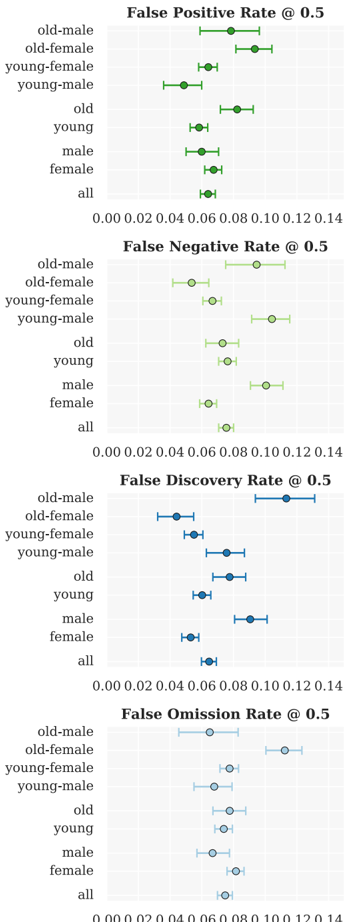
- In the smiling classifier example, all reported metrics at the .5 decision threshold have error types within the range 0.04–0.14, with 95% confidence intervals calculated by bootstrap resampling; the card notes older men have much higher false discovery rate, while men in aggregate have higher false negative rate.
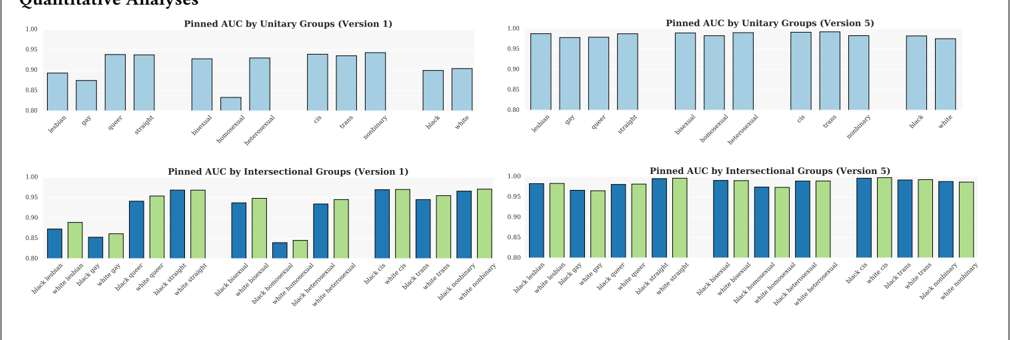
- In the toxicity example, TOXICITY v. 1 has low performance for several terms, especially “lesbian,” “gay,” and “homosexual,” while TOXICITY v. 5 shows more equitable performance after bias mitigation techniques.
Methods
- The paper is a framework/proposal paper, not an empirical study of a new model; it recommends model cards and details suggested sections and prompts.
- It provides two worked examples: a smiling classifier trained and evaluated on the CelebA dataset, using a convolutional neural net pretrained for face recognition and fine-tuned with cross-entropy loss for binary smiling classification.
- It also provides a model card for Perspective API’s TOXICITY classifier, a convolutional neural network developed by Jigsaw in 2017, evaluated on a synthetic Identity Phrase Templates test set; metrics include FPR, FNR, FDR, FOR for the smiling classifier and Pinned AUC for toxicity.
Limitations
- The paper states that model cards rely on the integrity of their creators and that it seems unlikely, at least in the near term, that they could be standardized or formalized enough to prevent misleading representations of model results.
- The paper states that evaluation datasets suitable for disaggregated evaluation are not yet common, and that the synthetic toxicity test data covers only a small set of very specific comments and is not comprehensive.
- The smiling classifier card states it does not capture race or skin type, uses binary gender classes (male/female), and that an ideal evaluation dataset would additionally include Fitzpatrick skin type, camera details, and environment details; the paper also states future work is needed to study how model information is interpreted and used by different stakeholders.
Model-written summary. Check it against the paper before relying on it.
Integrity signals
Registry
Cites
Statistics
Figures
Verification
Claims the paper makes
5 Valid · 1 Not valid · 18 Not checked · 30 Own results and interpretations
The cited sources support only part of this claim — read each source’s verdict below.
In the paper
“Synthetic data is valuable here because [11] shows that real data often has disproportionate amounts of toxicity directed at specific groups.”
What the sources say
- Partly supportedcites [11] [11] Lucas Dixon, John Li, Jeffrey Sorensen, Nithum Thain, and Lucy Vasserman. 2018. Measuring and Mitigating Unintended Bias in Text Classification. Proceedings of the AAAI/ACM Conference on AI, Ethics, and Society (2018). - sourceExperimental — accuracy not yet measured
The 'Quantifying bias in dataset' section (page unavailable) reports that certain identity terms appear disproportionately in toxic comments in the authors’ training data; for example, 'gay' appears in 3% of toxic comments but 0.5% of comments overall. It measures comments containing those terms, not whether toxicity is directed at the groups, and does not establish how often this pattern occurs across real datasets generally. (LLM, conf=0.85)
plainstates an association- Asserted: passes — The authors put it forward as true.
- Checkable: passes — It can be checked against evidence.
- Load-bearing: passes — The paper’s conclusions depend on it.
- Based: passes — The paper gives a reason why it holds.
- Partly supported
A result the paper reports from its own data — it cites no other source for it, so there is none to check. The quote shows it is in the paper.
In the paper
“For example, the false discovery rate on older men is much higher than that for other groups.”
plainstates an association- Asserted: passes — The authors put it forward as true.
- Checkable: passes — It can be checked against evidence.
- Load-bearing: passes — The paper’s conclusions depend on it.
- Based: passes — The paper gives a reason why it holds.
A result the paper reports from its own data — it cites no other source for it, so there is none to check. The quote shows it is in the paper.
In the paper
“TOXICITY v. 1 has low performance for several terms, especially 'lesbian', 'gay', and 'homosexual'.”
plain- Asserted: passes — The authors put it forward as true.
- Checkable: passes — It can be checked against evidence.
- Load-bearing: passes — The paper’s conclusions depend on it.
- Based: passes — The paper gives a reason why it holds.
None of the sources cited for this claim have been checked yet.
In the paper
“she collaborated with other researchers to demonstrate the disproportionate errors of computer vision systems on historically marginalized groups in the United States, such as darker-skinned women [5, 41].”
What the sources say
- Not checked yetcites [5] [5] Joy Buolamwini and Timnit Gebru. 2018. Gender Shades: Intersectional Accuracy Disparities in Commercial Gender Classification. In Proceedings of the 1st Conference on Fairness, Accountability and Transparency (Proceedings of Machine Learning Research) , Sorelle A. Friedler and Christo Wilson (Eds.), Vol. 81. PMLR, New York, NY, USA, 77-91. http://proceedings.mlr.press/v81/buolamwini18a.html -
- Not checked yetcites [41] [41] Inioluwa Raji. 2018. Black Panther Face Scorecard: Wakandans Under the Coded Gaze of AI. (2018). -
boostedstates an association- Asserted: passes — The authors put it forward as true.
- Checkable: passes — It can be checked against evidence.
- Load-bearing: passes — The paper’s conclusions depend on it.
- Based: passes — The paper gives a reason why it holds.
In the paper
“after MIT Media Lab graduate student Joy Buolamwini found that commercial face recognition systems failed to detect her face [4]”
What the sources say
- Not checked yetcites [4] [4] Joy Buolamwini. 2016. How I'm fighting Bias in Algorithms. (2016). https://www.ted.com/talks/joy\_buolamwini\_how\_i\_m\_fighting\_bias\_in\_ algorithms#t-63664 -
plainSingle case- Asserted: passes — The authors put it forward as true.
- Checkable: passes — It can be checked against evidence.
- Load-bearing: unclear — It is unclear whether the paper’s conclusions depend on it.
- Based: passes — The paper gives a reason why it holds.
13 more claims
Create a free account to see all 54 claims and to verify the 13 references still open.
- Probably not a substantial claim. 34
- It may state two separate claims as one. 8
Claims other papers make about this one
Each is checked against this paper’s own text: does it say what the citing paper says it does?
The source backs part of the claim, not all of it — or backs it for a different population, condition or comparison.
In the citing paper
“Model cards represent the field's standard for disclosing and documenting key facts about the architecture, training and evaluation of the model [14, 40].”
From Rethinking open source generative AI: open washing and the EU AI Act (2024) · cites this paper as [40]
Experimental — accuracy not yet measuredThe source backs part of the claim, not all of it — or backs it for a different population, condition or comparison.
In the citing paper
“Model cards (SMCs) [44] have been foundational in standardizing documentation for AI/ML model performance and characteristics, along with risks and unintended uses.”
From Interactive Model Cards: A Human-Centered Approach to Model Documentation (2022) · cites this paper as [44]
Experimental — accuracy not yet measuredThe source backs part of the claim, not all of it — or backs it for a different population, condition or comparison.
In the citing paper
“A second phase saw a more technical approach from the computer science community focusing on fairness, accountability and transparency as an engineering 'ethicalby-design' problem-solving exercise [20][21][22].”
From Putting AI ethics to work: are the tools fit for purpose? (2022) · cites this paper as [21]
Experimental — accuracy not yet measuredThe source backs part of the claim, not all of it — or backs it for a different population, condition or comparison.
In the citing paper
“These are either materials for use in design teams in workshop style events [76,77], tools for producing documentation of the design, build and test process [21,68], or technical tools for testing models, protecting privacy and security, testing for bias [69,93,94], or tracking provenance of data [95].”
From Putting AI ethics to work: are the tools fit for purpose? (2022) · cites this paper as [21]
Experimental — accuracy not yet measuredThe source backs part of the claim, not all of it — or backs it for a different population, condition or comparison.
In the citing paper
“There is some work on fairness relating to AI services, though this tends to focus on either exposing or 'auditing' certain AI services [22,38,126,133], or devising tools, methods and interventions relevant for those building (rather than using) such services [12,96,106,128].”
From Out of Context: Investigating the Bias and Fairness Concerns of “Artificial Intelligence as a Service” (2023) · cites this paper as [106]
Experimental — accuracy not yet measured
17 more claims about this paper
Create a free account to see every claim other papers make about this one.
Citations
Cites
BLEU: a method for automatic evaluation of machine translation
Papineni, K., Roukos, S., Ward, T., & Zhu, W.-J. (2001) · Proceedings of the 40th Annual Meeting on Association for Computational Linguistics - ACL '02 · doi:10.3115/1073083.1073135 · Cited by 21,344 · cited 1×
“translation system could compare BLEU scores [40] across demographic groups, and a model card for a speech recognition system could compare word-error rates.”
BackgroundCrenshaw, K. (2018) · Feminist Legal Theory · doi:10.4324/9780429500480-5 · Cited by 9,510
Deep Learning Face Attributes in the Wild
Liu, Z., Luo, P., Wang, X., & Tang, X. (2015) · 2015 IEEE International Conference on Computer Vision (ICCV) · doi:10.1109/iccv.2015.425 · Cited by 7,747 · cited 4×
“ms [5, 26] that report details of the datasets used to train and test machine learning models. We provide two example model cards in Section 5: A smiling detection model trained on the CelebA dataset [33] (Figure 2), and a public toxicity detection model, Perspective API [29] (Figure 3). Where Datasheets highlight cha…”
BackgroundMethodInfluentialThe validity and practicality of sun-reactive skin types I through VI
Fitzpatrick, T. B. (1988) · Archives of Dermatology · doi:10.1001/archderm.1988.01670060015008 · Cited by 4,339
Differential Privacy: A Survey of Results
Dwork, C. (2008) · Lecture Notes in Computer Science · doi:10.1007/978-3-540-79228-4_1 · Cited by 3,542 · cited 2×
“As such, collaboration with policy, privacy, and legal experts is necessary in order to ascertain which groups may be responsibly inferred, and how that information should be stored and accessed (for example, using differential privacy [12]).”
BackgroundCollins, G. S., Reitsma, J. B., Altman, D. G., & Moons, K. G. M. (2015) · Annals of Internal Medicine · doi:10.7326/m14-0697 · Cited by 3,267
Equality of Opportunity in Supervised Learning
Hardt, M., Price, E., & Srebro, N. (2016) · arXiv · doi:10.48550/arxiv.1610.02413 · Cited by 2,536 · cited 2×
“of Opportunity, and equal false negative and false positive rates across groups is equivalent to fulfilling Equality of Odds [26].”
BackgroundGebru, T., Morgenstern, J., Vecchione, B., Vaughan, J. W., Wallach, H., Daumé, H., & Crawford, K. (2018) · arXiv · doi:10.48550/arxiv.1803.09010 · Cited by 2,474
Self-citationA Probabilistic Interpretation of Precision, Recall and F-Score, with Implication for Evaluation
Goutte, C., & Gaussier, E. (2005) · Lecture Notes in Computer Science · doi:10.1007/978-3-540-31865-1_25 · Cited by 2,285 · cited 1×
“Confidence intervals for metrics derived from confusion matrices can be calculated by treating the matrices as probabilistic models of system performance [24].”
MethodFair prediction with disparate impact: a study of bias in recidivism prediction instruments
Chouldechova, A. (2017) · Big Data · doi:10.1089/big.2016.0047 · Cited by 2,159 · cited 1×
“or different errors that can be calculated from the confusion matrix for binary classification systems. • These also correspond to metrics in recent definitions of “fairness” in machine learning (cf. [8, 25]), where parity across subgroups for different metrics correspond to different fairness criteria. • 95% confiden…”
Background
Research works printed but not linked: 9
- [1] Avrio AI. 2018. Avrio AI: AI Talent Platform. (2018). https://www.goavrio.com/ -
- [5] Joy Buolamwini and Timnit Gebru. 2018. Gender Shades: Intersectional Accuracy Disparities in Commercial Gender Classification. In Proceedings of the 1st Conference on Fairness, Accountability and Transparency (Proceedings of Machine Learning Research) , Sorelle A. Friedler and Christo Wilson (Eds.), Vol. 81. PMLR, New York, NY, USA, 77-91. http://proceedings.mlr.press/v81/buolamwini18a.html -
- [13] Entelo. 2018. Recruitment Software | Entelo. (2018). https://www.entelo.com/ -
- [17] U.S. Food and Drug Administration. 2013. FDA Drug Safety Communication: Risk of next-morning impairment after use of insomnia drugs; FDA requires lower recommended doses for certain drugs containing zolpidem (Ambien, Ambien CR, Edluar, and Zolpimist). (2013). https://web.archive.org/web/20170428150213/ https://www.fda.gov/drugs/drugsafety/ucm352085.htm -
- [18] IIHS (Insurance Institute for Highway Safety: Highway Loss Data Institute). 2003. Special Issue: Side Impact Crashworthiness. Status Report 38, 7 (2003). -
- [19] Institute for the Future, Omidyar Network's Tech, and Society Solutions Lab. 2018. Ethical OS. (2018). https://ethicalos.org/ -
- [32] Jigsaw. 2017. Perspective API. (2017). https://www.perspectiveapi.com/ -
- [39] AI Now. 2018. Litigating Algorithms: Challenging Government Use Of Algorithmic Decision Systems. AI Now Institute. -
- [43] Mukund Sundararajan, Ankur Taly, and Qiqi Yan. 2017. In Proceedings of the 34th International Conference on Machine Learning , Vol. 70. PMLR, Sydney, Australia. -
Cited by
Items 1,501–1,600 of 2,235
Taking a Moral Gambit: Accepting Moral Responsibility for the Actions of Autonomous Weapons Systems
Taddeo, M. (2024) · Oxford University Press eBooks · doi:10.1093/oso/9780197745441.003.0007
Taddeo, M. (2024) · Oxford University Press eBooks · doi:10.1093/oso/9780197745441.002.0007
Adversarial and Non-kinetic Uses of AI: Conceptual and Ethical Challenges
Taddeo, M. (2024) · Oxford University Press eBooks · doi:10.1093/oso/9780197745441.003.0004
Taddeo, M. (2024) · Oxford University Press eBooks · doi:10.1093/oso/9780197745441.002.0003
Adversarial and Kinetic Uses of AI: The Definition of Autonomous Weapon Systems
Taddeo, M. (2024) · Oxford University Press eBooks · doi:10.1093/oso/9780197745441.003.0006 · Cited by 1
Adversarial and Non-kinetic Uses: The Case of Artificial Intelligence for Cyber Deterrence
Taddeo, M. (2024) · Oxford University Press eBooks · doi:10.1093/oso/9780197745441.003.0005
Sustainment and Support Uses of AI in Defence: The Case of AI-Augmented Intelligence Analysis
Taddeo, M. (2024) · Oxford University Press eBooks · doi:10.1093/oso/9780197745441.003.0003
Ethical Principles for AI in Defence
Taddeo, M. (2024) · Oxford University Press eBooks · doi:10.1093/oso/9780197745441.003.0002
Taddeo, M. (2024) · Oxford University Press eBooks · doi:10.1093/oso/9780197745441.002.0005
AI Regulation and EntrepreneurshipPreprint
Mulla, J. (2024) · SSRN Electronic Journal · doi:10.2139/ssrn.4986041 · Cited by 2
Teaching Dataset Creation in a Classroom Environment
Fantozzi, P., Laura, L., & Naldi, M. (2024) · Lecture notes in networks and systems · doi:10.1007/978-3-031-73538-7_19
Transparent Transparency Developing a Scheme for Understanding Transparency Requirements
Baum, D., Baum, K. L., Zamani, S., Bennoit, C., & Werth, D. (2024) · Lecture notes in computer science · doi:10.1007/978-3-031-75434-0_5 · Cited by 1
Rishik, P. (2025) · International Journal of Scientific Research in Computer Science Engineering and Information Technology · doi:10.32628/cseit251112142
A Quest Through Interconnected Datasets: Lessons From Highly-Cited ICASSP Papers
Liem, C. C. S., Taşcılar, D., & Demetriou, A. M. (2024) · International Workshop on Content-Based Multimedia Indexing (CBMI) · doi:10.1109/cbmi62980.2024.10859219
“…reflection, which typically manifests in mandatory inclusion of ethics statements, or checklists [16] accompanying submissions, as e.g. can today be seen at NeurIPS and the *CL venues, which partially are inspired by proposals for better documentation through data sheets [17] and model cards [18].”
Algoprax, a serious game to start bridging the gap between practice and A.I. usePreprint
Danzon-Chambaud, S. (2025) · SSRN Electronic Journal · doi:10.2139/ssrn.5079996
What We Teach about Race and Gender: Representation in Images and Text of Children's BooksPreprint
Adukia, A., Eble, A., Harrison, E., Runesha, H. B., & Szasz, T. (2025) · SSRN Electronic Journal · doi:10.2139/ssrn.5150727
Yokota, T., & Nakao, Y. (2025) · Communications in computer and information science · doi:10.1007/978-3-031-82633-7_8 · Cited by 1
“Mitchell et al. [27] and Lee et al. [22] emphasized the importance of acknowledging the stakeholders of ML systems.”
User Issues and Concerns in Generative AI: A Mixed-Methods Analysis of App Reviews
Bracamonte, V., Löbner, S., Tronnier, F., Lieberknecht, A.-K., & Pape, S. (2025) · Communications in computer and information science · doi:10.1007/978-3-031-82633-7_19
On-device hand model for robust gesture detection
Bondarets, I., Prokhorchuk, V., Kozyr, A., & Trunov, O. (2025) · IEEE International Conference on Acoustics Speech and Signal Processing · doi:10.1109/icassp49660.2025.10888950
“Additionally, we compare the performance of the proposed model with the Google’s Hand understanding (MediaPipe) solution [23]–[25] across our hand gesture dataset.”
Acceptable Use Policies for Foundation Models
Klyman, K. (2024) · SuperIntelligence - Robotics - Safety & Alignment · doi:10.70777/si.v1i1.10917
When AI Eats the Healthcare World - Is Trusting AI Fed, or Earned? (Preprint)Preprint
Lutfi, S. L., Alzaabi, A. A., & Saat, G. A. M. (2025) · doi:10.2196/preprints.74371
Quality Assurance Framework for Multimodal Assessment Datasets on AI Risk Factors
Han, S. H., Han, J., Lee, D.-K., & Choi, H. (2025) · IEEE International Conference on Big Data and Smart Computing (BigComp) · doi:10.1109/bigcomp64353.2025.00082
“Similarly, Mitchell et al. [27] propose ”Model Cards,” which evaluate datasets and models for fairness, accountability, and trans-parency, offering insights into how quality issues impact model performance.”
Identifying and Building Generative AI Use Cases Within Enterprise Software Products
Bhalla, A. R. (2023) · International Journal of Scientific Research in Science and Technology · doi:10.32628/ijsrst2221185 · Cited by 1
On challenges and approaches to test AI systems
Gautier, A., Bieringer, L., & Klößner, S. (2025) · Datenschutz und Datensicherheit - DuD · doi:10.1007/s11623-025-2074-7
“Correspondingly, standardized reporting schemes have evolved such as model cards [7].”
Gatete, O. (2025) · International Journal of Latest Technology in Engineering Management & Applied Science · doi:10.51583/ijltemas.2025.140400020 · Cited by 7
From Black Box to Open Book: An Emerging Transparency Imperative in Generative Ai CodebasesPreprint
Watson, E. A., & van Italie, M. (2025) · SSRN Electronic Journal · doi:10.2139/ssrn.5246320
Enhancing Emergency Response with Cloud-Based Access to Patient Medical Histories
Sharma, P., Kumar, T., & Tyagi, S. S. (2025) · International Conference on Disruptive Technologies (ICDT) · doi:10.1109/icdt63985.2025.10986368
Architectural Proposal for Reproducible, Standardized Deep Learning Research
Lübbering, M., Shah, V., Chatterjee, M., Priya, P., Soliman, O. I. I., & Sifa, R. (2025) · IEEE International Conference on Software Architecture Companion (ICSA-C) · doi:10.1109/icsa-c65153.2025.00021 · Cited by 1
“We ) [19], the checklists of premier venues, model cards [17], and the HPC reproducibility rules [22]. following the inversion of control (IoC) paradigm [16].”
Saleki, M., & Amin, M. R. (2025) · Lecture notes in computer science · doi:10.1007/978-3-031-93982-2_28
Reflective Design Theorizing with User Interviews: A Case Study for AI Energy Labels
van der Staay, A., Fischer, R., Wischnewski, M., Poitz, K., & Janiesch, C. (2025) · Lecture notes in computer science · doi:10.1007/978-3-031-93979-2_5 · Cited by 2
Faith, E., Chattopadhyay, A., & Azhar, M. Q. (2025) · doi:10.1145/3716815.3729014
“…cards are short documents accompanying trained machine learning models that provide benchmarked evaluation info in a variety of conditions, such as across different cultural, demographic, and intersectional groups (e.g., age and race) that are relevant to the intended application domain info [9].”
SYNTHETIC NARRATIVES IN HEALTHCARE: ADDRESSING BIAS AND REDEFINING VALIDITY IN QUALITATIVE RESEARCH
Judijanto, L. (2025) · International Journal of Education Humanities and Social Science · doi:10.54922/ijehss.2025.0978
“The growing call for explainable AI in healthcare demands more rigorous disclosure practices, including the adoption of model cards, prompt logs, and dataset datasheets to support traceability (Mitchell et al., 2019).”
Understanding and Supporting the ML Supply Chain Through ML Bill of Materials
Stalnaker, T. (2025) · IEEE/ACM International Conference on Software Engineering: Companion Proceedings (ICSE-Companion) · doi:10.1109/icse-companion66252.2025.00044
“MLBOM is distinct from HF model cards [23], where information is not always available in a standardized, machine-readable format [7], [8], [9].”
Schoeffer, J., De‐Arteaga, M., & Elmer, J. (2025) · ACM Conference on Fairness, Accountability, and Transparency (FAccT) · doi:10.1145/3715275.3732070 · Cited by 7
“This results in fundamental limitations for principled model selection.”
Alignment Divergence Metrics: Measuring Human-AI Concordance in Document Content Analysis
Niu, C., Sadeghi, S., Guerra, M. S. D. R., Bradley, K. D., Ammari, M. E., & Hernández, A. E. (2025) · IEEE Conference on Artificial Intelligence (CAI) · doi:10.1109/cai64502.2025.00214
“Current evaluation approaches tend to focus on task-specific performance metrics (e.g., F1 scores, ROUGE) rather than alignment with human analytical processes [3].”
García-López, I. M., Soledad, M., & Espinosa, J. M. M. (2025) · Lecture notes in educational technology · doi:10.1007/978-981-96-5658-5_131
Explaining and Interpreting Generative AI
Samek, W. (2025) · Oxford University Press eBooks · doi:10.1093/oxfordhb/9780198940272.013.0005
Leveraging AI for Public Good: Challenges and Strategies for Implementing AI in the Public Sector
Mahusin, N., Sallehudin, H., Singh, D., Falaki, N., Alzoubi, M. R., Alshurideh, M. T., Shelash, S. I., Mohammad, A. A. S., & Alzyoud, M. S. (2025) · Studies in computational intelligence · doi:10.1007/978-3-031-73899-9_42 · Cited by 2
Gender and Artificial Intelligence: Challenges and Imminent Possibilities
Souto-Romero, M., Arias-Oliva, M., Murata, K., & Rua, O. L. (2024) · Investigaciones Feministas · doi:10.5209/infe.98150 · Cited by 1
A Comprehensive Review on Harnessing Large Language Models to Overcome Recommender System ChallengesPreprint
Raja, R., Vats, A., Vats, A., & Majumder, A. (2025) · SSRN Electronic Journal · doi:10.2139/ssrn.5359269 · Cited by 13
Kumar, B., Gaba, R., & Shaw, R. (2025) · IGI Global eBooks · doi:10.4018/979-8-3373-6385-1.ch001
Kubesch, J., Kiesling, E., Ekaputra, F. J., Serles, U., Toma, I., & Havas, C. R. (2025) · Communications in computer and information science · doi:10.1007/978-3-032-02003-1_1
(2025) · Computer Science Engineering and Technology · doi:10.46632/cset/3/3/10
Coglianese, C., & Crum, C. R. (2025) · Oxford University Press eBooks · doi:10.1093/oxfordhb/9780198940272.013.0011 · Cited by 5
Schreyer, W. M., Samatham, R. V., Berry, E., et al. (2025) · medRxiv · doi:10.1101/2025.08.20.25334101
Biden administration executive order tackles AI risks, but lack of privacy laws limits reach
Susarla, A. (2023) · The Conversation · doi:10.64628/aai.sjdeumq6c
FTC probe of OpenAI: Consumer protection is the opening salvo of US AI regulation
Susarla, A. (2023) · The Conversation · doi:10.64628/aai.5pa4kwcw3
Giacalone, M. (2025) · Research Square · doi:10.21203/rs.3.rs-7446174/v1
Pioneering the future of nuclear science ; Exploring potential of AI and large-scale language model
Konishi, K., Nakajima, S., Seo, Y., et al. (2025) · Journal of the Atomic Energy Society of Japan · doi:10.3327/jaesjb.67.9_535
MLOps in the Healthcare Domain: a Systematic Literature Review
Mallardi, G., Quaranta, L., Calefato, F., & Lanubile, F. (2025) · Lecture notes in computer science · doi:10.1007/978-3-032-04200-2_23 · Cited by 2
PROVA ALGORÍTMICA NO PROCESSO PENAL AMBIENTAL: EXPLICABILIDADE, CONTRADITÓRIO E CADEIA DE CUSTÓDIA
de Freitas, B. E. M., da Silva, C. R. T., Vannucci, G. D. C., et al. (2025) · Revista Foco · doi:10.54751/revistafoco.v18n9-144
Shamikh Imran, Z. S. (2025) · Research Square · doi:10.21203/rs.3.rs-7666314/v1
Unveiling Bias in AI-Powered Recommender Systems: An Ethical and Algorithmic Survey
Patil, S., Agarwal, S., & Mohammed, A. S. (2025) · Lecture notes in networks and systems · doi:10.1007/978-981-96-6883-0_30
Responsible AI in Action: Navigating the Ethical Landscape of ChatGPT
Tiwari, A., & Kumar, P. (2025) · IGI Global eBooks · doi:10.4018/979-8-3373-0877-7.ch008
Unmaking AI: Engaging Critically and Creatively with Generative AI
Munn, L., Khan, A. H., Hettiachchi, D., Sabie, S., Ghahremanlou, L., Saghir, S., Lambourne, N., & Magee, L. (2024) · Australian Conference on Human-Computer Interaction (OzCHI) · doi:10.1145/3726986.3727943
Niloy, M. R. I., Islam, J., Farhat, M. E. K., et al. (2025) · doi:10.1109/qpain66474.2025.11171629
“To encourage broad adoption, we suggest: • Including the framework in the standards for model documentation (e.g., Model Cards [13], Datasheets [14]).”
Kayabay, K., Gökalp, M. O., Kılınç, A., Gökalp, E., & Daim, T. U. (2025) · IEEE Transactions on Engineering Management · doi:10.1109/tem.2025.3615542 · Cited by 1
Long-Term Monitoring and Performance Evaluation of AI Systems
Jaganathan, D., & Chakkaravarthy, P. (2025) · Advances in computational intelligence and robotics book series · doi:10.4018/979-8-3373-2787-7.ch005
The Multifaced Nature of Bias in AI: Impact on Model Generalization, Robustness, and Fairness
Ntoutsi, E. (2025) · Springer eBooks · doi:10.1007/978-3-658-48522-1_11 · Cited by 2
Croce, A., Ugo, F., Roveta, A., Bertolina, C., Rinaudo, C., Maconi, A., & Bertolotti, M. (2025) · Geosciences · doi:10.3390/geosciences15100395 · Cited by 1
“These measures are supported not only for internal verification but also for peer review and replication within the scientific community [67,68].”
Mast: interpretable stress testing via meta-learning for forecasting model robustness evaluation
Inácio, R., Cerqueira, V., Barandas, M., & Soares, C. (2025) · Machine Learning · doi:10.1007/s10994-025-06881-3
“Using Shapley values (Lundberg and Lee, 2017 ), we provide interpretable insights into specific conditions where models are expected to underperform, which could be added in descriptions for more responsible applications, such as model cards (Mitchell et al., 2019 ).”
Knowledge prompting: How knowledge engineers use generative AI
Koutsiana, E., Walker, J., Nwachukwu, M., Zhang, B., Meroño-Peñuela, A., & Simperl, E. P. B. (2025) · Journal of Web Semantics · doi:10.1016/j.websem.2025.100873 · Cited by 13
“As described in Section 2.3, prior research aimed at improving transparency and explainability has introduced frameworks such as Model Cards [109], Data Cards [138], and Data Statements [15].”
InfluentialRajbahadur, G. K., Gallaba, K., Rashno, E., et al. (2026) · IEEE/ACM International Conference on Software Engineering: Software Engineering in Practice (ICSE-SEIP) · doi:10.1145/3786583.3786921
“To address this limitation, the AI community has introduced transparency frameworks such as model cards [58], datasheets [33], and factsheets [21], as well as machine-readable formats like Croissant [22].”
Pronoun Matters: A Benchmark for Diagnosing Gender Bias in Emotion Classification
Aisha, Q. U. A., Cho, Y.-J., & Kim, B. G. (2025) · Communications in computer and information science · doi:10.1007/978-981-95-3141-7_9
Recognizing "Conformity Bias" in Large Language Models: A New Risk for Clinical UsePreprint
Nowroozzadeh, M. H., & Salari, R. (2025) · Research Square · doi:10.1101/2025.10.19.25338293
“Model re-engineering must aim to reinforce truthfulness and factual consistency;[15] clinical safeguards must be established to cross-verify AI outputs; and user education initiatives must ensure that healthcare professionals are prepared to engage critically with AI-generated recommendations.”
Preliminary Ranking-Based Selection for Optimized Retriever Configuration in RAG Systems
Paranhos, S. L., Tomazini, J. N., de Oliveira, S. T., Camilo-Junior, C. G., & de Oliveira, S. S. T. (2025) · Simpósio Brasileiro de Bancos de Dados (SBBD) · doi:10.5753/sbbd.2025.247492
“Therefore, developing systematic methods for optimizing retrieval components represents not only a technical advancement but a crucial step toward more accessible, fair, and responsible AI systems [Mitchell et al., 2019].”
Bias and Discrimination in Decentralized AI Decision Systems
Becker, J. (2025) · Scientific Journal of Artificial Intelligence and Blockchain Technologies · doi:10.63345/sjaibt.v2.i1.108
Blockchain Timestamping for AI Model Lifecycle Tracking
Dimitrova, P. S. (2025) · Scientific Journal of Artificial Intelligence and Blockchain Technologies · doi:10.63345/sjaibt.v2.i1.109 · Cited by 1
Bias Mitigation in Deep Learning Models for Facial Recognition
Alvarez, T. (2025) · Scientific Journal of Artificial Intelligence and Blockchain Technologies · doi:10.63345/sjaibt.v2.i3.305 · Cited by 1
Ethical Implications of AI-Based Hiring Tools
Goel, E. L. (2025) · Scientific Journal of Artificial Intelligence and Blockchain Technologies · doi:10.63345/sjaibt.v2.i3.108
AI-Powered Adaptive Learning Platforms with Credential Verification on Chain
Jain, A. K. (2025) · Scientific Journal of Artificial Intelligence and Blockchain Technologies · doi:10.63345/sjaibt.v2.i1.105 · Cited by 1
Standardized and Usage-Controlled Alert Analysis for Improved Cyber Threat Intelligence
Felde, H. M. Z., Azzabi, R., Gouy‐Pailler, C., et al. (2025) · Lecture notes in computer science · doi:10.1007/978-3-032-01823-6_10
Iman, N. (2025) · Philosophy & Technology · doi:10.1007/s13347-025-00998-y · Cited by 1
“In concrete terms, systems should be designed to admit uncertainty and invite human oversight when outside familiar contexts (cf. Mitchell et al., 2019).”
Responsible AI for Detecting Dark Patterns: Linking Calibration With Risk Matrix
cho, S., Shin, J. W., & Yoo, J. (2026) · IEEE Technology and Society Magazine · doi:10.1109/mts.2026.3700023
“Documentation and auditing artifacts, model cards, datasheets, internal algorithmic auditing frameworks, operation-alize transparency, process accountability, and harm mapping for socio-technical systems [32], [33], [34].”
Balancing explainability and privacy in AI systems: A strategic imperative for managers
Keaney, S., & Berthon, P. R. (2025) · Business Horizons · doi:10.1016/j.bushor.2025.10.004 · Cited by 2
Post-Truth Futures: The Role of Journalism in the Age of Digital Ignorance
Dinçer, E. (2025) · IGI Global eBooks · doi:10.4018/979-8-3373-2607-8.ch004
Understanding the perceived importance of disclosing ethical concerns underlying data visualizations
JUNGER, A. C. F., & Barbosa, S. D. J. (2025) · Simpósio Brasileiro de Fatores Humanos em Sistemas Computacionais (IHC) · doi:10.5753/ihc.2025.10920
“Model cards, proposed by Mitchell et al. (2019), is a way of documenting ML models [Mitchell et al. 2019].”
Kim, R. S. (2025) · SSRN Electronic Journal · doi:10.2139/ssrn.5717409
Hrčková, A., Renoux, J., Calasanz, R. T., Chudá, D., Tamajka, M., & Šimko, J. (2025) · Lecture notes in computer science · doi:10.1007/978-3-032-11108-1_34 · Cited by 2
Ramachandran, M. (2025) · Springer eBooks · doi:10.1007/978-981-95-2909-4_2
Ethical AI Testing and Evaluation Against Governance and Frameworks
Ramachandran, M. (2025) · Springer eBooks · doi:10.1007/978-981-95-2909-4_11 · Cited by 1
Analysis of Ethical Frameworks for AI
Ramachandran, M. (2025) · Springer eBooks · doi:10.1007/978-981-95-2909-4_3
Ethical Design Principles for AI Applications in Healthcare
Ramachandran, M. (2025) · Springer eBooks · doi:10.1007/978-981-95-2909-4_8
Quantifying Ethical Integrity in AI: A Framework for Ethical Impact Scoring in Data Annotation
Murugesan, G. S., & Viswanathan, S. A. (2025) · Lecture notes in networks and systems · doi:10.1007/978-981-96-8796-1_45
Bias and Justice in Neurological AI
Rudroff, T. (2025) · Neurocultural health and wellbeing · doi:10.1007/978-3-032-11596-6_7
Blockchain Driven Generative AI: Ensuring Data Provenance and Model Integrity
Alam, M., Deepak, Mishra, D., Shahid, M., & Lapina, M. (2025) · Lecture notes in networks and systems · doi:10.1007/978-3-032-07275-7_3 · Cited by 1
Gul, M. J. J., Paul, A., & Singh, K. K. (2025) · IEEE Transactions on Consumer Electronics · doi:10.1109/tce.2025.3634569
“Bayesian dropout [11] and related techniques estimate predictive uncertainty, while model-interpretability frameworks [41] and documentation standards (model cards, datasheets) promote transparency [42], [43].”
Objectifying the Subjective: Cognitive Biases in Topic Interpretations
Hingmire, S., Li, Z. S., Zeng, S. (., Awon, A. M., Guerra, L. F., & Ernst, N. (2025) · Transactions of the Association for Computational Linguistics · doi:10.1162/tacl.a.50
Training LLM with Human Feedback
Rezaei, H., Beheshti, A., & Rabhi, F. (2025) · Springer eBooks · doi:10.1007/978-981-95-3658-0_53 · Cited by 2
How LLMs Handle Cultural Bias: Reactions to Asian Minority Historical Narratives
Shujaa, S., Dorleon, G., & Tang, A. (2025) · Lecture notes in computer science · doi:10.1007/978-981-95-4861-3_3 · Cited by 5
A Rigorous Behavior Assessment of CNNs Using a Data-Domain Sampling Regime
Jiang, S., Chao, W., Haehn, D., Pfister, H., & Chen, J. (2025) · IEEE Transactions on Visualization and Computer Graphics · doi:10.1109/tvcg.2025.3633829 · Cited by 1
“A practical measure is to incorporate a model card [40], providing information on how training samples are selected, along with their ranges and distributions, image size, and the number of unique samples.”
AI Assurance Needs a Systems Engineering Approach
Bloomfield, R., & Rushby, J. (2025) · IEEE International Symposium on Software Reliability Engineering Workshops (ISSREW) · doi:10.1109/issrew67781.2025.00065
“It should encourage the development of systems-level assurance cases to extend and enhance existing “Model Cards” [5].”
Data Coverage, Failure Risk Estimation, and Explainability for Vision-Based Aircraft Detection
Imanian, A., Ganji, M., & Zarei, M. (2025) · doi:10.1109/dasc66011.2025.11257281
“Inadequate ODD coverage can lead to unanticipated model failures or unsafe behavior, especially when edge cases or rare conditions are underrepresented [4].”
Toward ethical AI through Bayesian uncertainty in neural question answering
Sipio, R. D. (2025) · AI and Ethics · doi:10.1007/s43681-025-00838-x · Cited by 1
“Such behavior is not only useful for downstream tasks like selective prediction and calibration, but also central to building systems that align with the goals of responsible and ethical AI [12, 17–19].”
Fairness Auditing of Limited-Access Models Using Protected Datasets
Zhu, Z., Kastner, M. A., & Satoh, S. (2025) · IEEE Access · doi:10.1109/access.2025.3641692
“For example, Mitchell et al. [35] introduced Model Cards , a standardized way to document model performance across different demographic groups, which can be integrated into auditing practices.”
What Is AI? The Need for AI Literacy in Education
Wilton, L., Brett, C., Ip, S., Engineer, R., & Tassis, A. (2025) · Springer eBooks · doi:10.1007/978-3-031-99804-1_4 · Cited by 2
Metadata
- Authors
- Mitchell, M., Wu, S., Zaldivar, A., Barnes, P., Vasserman, L., Hutchinson, B., Spitzer, E., Raji, I. D., & Gebru, T.
- Venue
- Proceedings of the Conference on Fairness, Accountability, and Transparency
- Publisher
- ACM
- Published
- 2019-01-29
- Pages
- 220-229
- OpenAlex
- W2897042519
- Semantic Scholar
- 7365f887c938ca21a6adbef08b5a520ebbd4638f
- Cited by
- 2,681
- References
- 12
- Citations by year
- 2026: 831 · 2025: 446 · 2024: 376 · 2023: 366 · 2022: 243 · 2021: 260 · 2020: 102 · 2019: 54
- FWCI
- 170.95
- Type
- conference paper
- Language
- en
- Open access
- green
- arxiv.org
- Locations
- ACM Conference on Fairness, Accountability, and Transparency (FAccT) (publishedVersion)
- arXiv (Cornell University) (submittedVersion)
- arXiv (Cornell University)
- Topics
- Physical Sciences › Computer Science › Artificial Intelligence › Ethics and Social Impacts of AI
- Physical Sciences › Computer Science › Artificial Intelligence › Explainable Artificial Intelligence (XAI)
- Physical Sciences › Computer Science › Computer Vision and Pattern Recognition › Face recognition and analysis
- Keywords
- model cards, model transparency, algorithmic fairness, demographic bias, responsible AI, democratization of AI, toxic comment detection, model documentation
About these checks
Registry, retraction, Cites and statistics results are computed, not judged, with one exception: a printed reference that no index lists is read once by a model before it counts as a citation error. Claims are extracted by a model and kept only when their quote appears verbatim in the text; each cited source is then checked, with a model’s help, for whether it says what the claim relies on. Those verdicts can be wrong — read the claim’s quote and the cited source before relying on one.
The claim verdicts this report counts are experimental: their accuracy is not yet measured.
A language model drew the claims from the paper on 2026-10-07, under version 3 of the claim definition (model deepseek-v4.1-flash, prompt extract-v3).
A second model labelled each claim on 2026-10-07 (model jev-1.13-20260917, definition revision gold-guideline-v0.2).
Cited sources are checked with a language model’s help (gpt-6-sol).
Statistics and arithmetic are recomputed, not judged.
Confidence bands are shown only for fields calibrated on our annotated test set. None is calibrated yet, so no band is shown.
What counts as a claim ›How we measure confidence ›How we check this ›
Are you an author, or do you see a problem with this page? Request a review
Data sources
Bibliographic data: Semantic Scholar, OpenAlex, Crossref.
Contains information from the Semantic Scholar Academic Graph Datasets, made available under the ODC Attribution License (ODC-BY 1.0).
Semantic Scholar’s data is described in: Kinney, R., et al. (2023). The Semantic Scholar Open Data Platform. arXiv:2301.10140.
