

Model Cards for Model Reporting
Open accessThe DOI matches its Crossref record; 22 of the 22 references it cites were found in a registry or an index; 8 of the 34 sources its claims cite were checked for support.
Abstract
Trained machine learning models are increasingly used to perform high-impact tasks in areas such as law enforcement, medicine, education, and employment. In order to clarify the intended use cases of machine learning models and minimize their usage in contexts for which they are not well suited, we recommend that released models be accompanied by documentation detailing their performance characteristics. In this paper, we propose a framework that we call model cards, to encourage such transparent model reporting. Model cards are short documents accompanying trained machine learning models that provide benchmarked evaluation in a variety of conditions, such as across different cultural, demographic, or phenotypic groups (e.g., race, geographic location, sex, Fitzpatrick skin type [15]) and intersectional groups (e.g., age and race, or sex and Fitzpatrick skin type) that are relevant to the intended application domains. Model cards also disclose the context in which models are intended to be used, details of the performance evaluation procedures, and other relevant information. While we focus primarily on human-centered machine learning models in the application fields of computer vision and natural language processing, this framework can be used to document any trained machine learning model. To solidify the concept, we provide cards for two supervised models: One trained to detect smiling faces in images, and one trained to detect toxic comments in text. We propose model cards as a step towards the responsible democratization of machine learning and related artificial intelligence technology, increasing transparency into how well artificial intelligence technology works. We hope this work encourages those releasing trained machine learning models to accompany model releases with similar detailed evaluation numbers and other relevant documentation.
Overview
CoChat Summary
TL;DR
The paper proposes “model cards,” short documentation records accompanying trained machine learning models to report intended use, performance characteristics, and disaggregated evaluation across demographic, phenotypic, and intersectional groups. It illustrates the framework with worked examples for a smiling classifier and a toxicity classifier.
Key findings
- The authors argue there are no standardized documentation procedures for communicating trained ML model performance, especially for high-impact domains such as health care, employment, education, and law enforcement.
- They propose model card sections covering model details, intended use, factors, metrics, evaluation data, training data, quantitative analyses, ethical considerations, and caveats/recommendations.
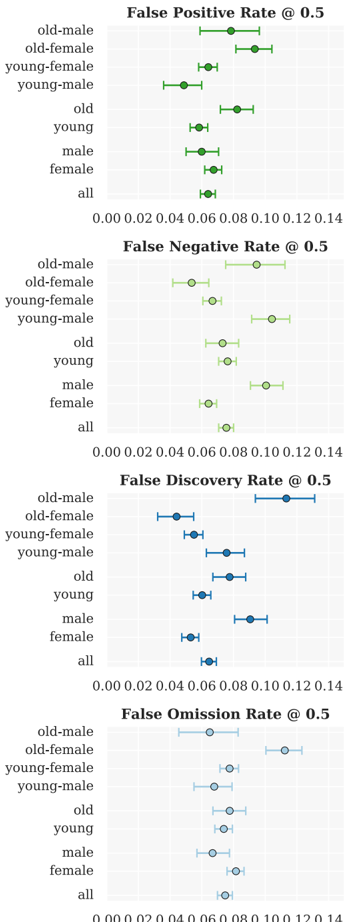
- In the smiling classifier example, all reported metrics at the .5 decision threshold have error types within the range 0.04–0.14, with 95% confidence intervals calculated by bootstrap resampling; the card notes older men have much higher false discovery rate, while men in aggregate have higher false negative rate.
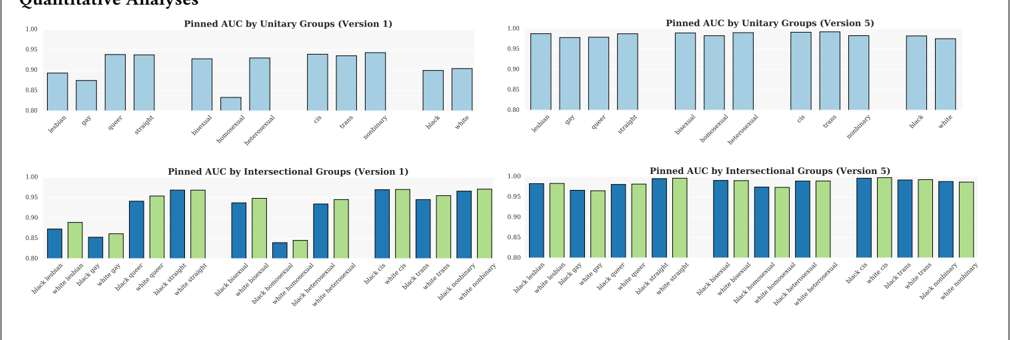
- In the toxicity example, TOXICITY v. 1 has low performance for several terms, especially “lesbian,” “gay,” and “homosexual,” while TOXICITY v. 5 shows more equitable performance after bias mitigation techniques.
Methods
- The paper is a framework/proposal paper, not an empirical study of a new model; it recommends model cards and details suggested sections and prompts.
- It provides two worked examples: a smiling classifier trained and evaluated on the CelebA dataset, using a convolutional neural net pretrained for face recognition and fine-tuned with cross-entropy loss for binary smiling classification.
- It also provides a model card for Perspective API’s TOXICITY classifier, a convolutional neural network developed by Jigsaw in 2017, evaluated on a synthetic Identity Phrase Templates test set; metrics include FPR, FNR, FDR, FOR for the smiling classifier and Pinned AUC for toxicity.
Limitations
- The paper states that model cards rely on the integrity of their creators and that it seems unlikely, at least in the near term, that they could be standardized or formalized enough to prevent misleading representations of model results.
- The paper states that evaluation datasets suitable for disaggregated evaluation are not yet common, and that the synthetic toxicity test data covers only a small set of very specific comments and is not comprehensive.
- The smiling classifier card states it does not capture race or skin type, uses binary gender classes (male/female), and that an ideal evaluation dataset would additionally include Fitzpatrick skin type, camera details, and environment details; the paper also states future work is needed to study how model information is interpreted and used by different stakeholders.
Model-written summary. Check it against the paper before relying on it.
Integrity signals
Registry
Cites
Statistics
Figures
Verification
Claims the paper makes
5 Valid · 1 Not valid · 18 Not checked · 30 Own results and interpretations
The cited sources support only part of this claim — read each source’s verdict below.
In the paper
“Synthetic data is valuable here because [11] shows that real data often has disproportionate amounts of toxicity directed at specific groups.”
What the sources say
- Partly supportedcites [11] [11] Lucas Dixon, John Li, Jeffrey Sorensen, Nithum Thain, and Lucy Vasserman. 2018. Measuring and Mitigating Unintended Bias in Text Classification. Proceedings of the AAAI/ACM Conference on AI, Ethics, and Society (2018). - sourceExperimental — accuracy not yet measured
The 'Quantifying bias in dataset' section (page unavailable) reports that certain identity terms appear disproportionately in toxic comments in the authors’ training data; for example, 'gay' appears in 3% of toxic comments but 0.5% of comments overall. It measures comments containing those terms, not whether toxicity is directed at the groups, and does not establish how often this pattern occurs across real datasets generally. (LLM, conf=0.85)
plainstates an association- Asserted: passes — The authors put it forward as true.
- Checkable: passes — It can be checked against evidence.
- Load-bearing: passes — The paper’s conclusions depend on it.
- Based: passes — The paper gives a reason why it holds.
- Partly supported
A result the paper reports from its own data — it cites no other source for it, so there is none to check. The quote shows it is in the paper.
In the paper
“For example, the false discovery rate on older men is much higher than that for other groups.”
plainstates an association- Asserted: passes — The authors put it forward as true.
- Checkable: passes — It can be checked against evidence.
- Load-bearing: passes — The paper’s conclusions depend on it.
- Based: passes — The paper gives a reason why it holds.
A result the paper reports from its own data — it cites no other source for it, so there is none to check. The quote shows it is in the paper.
In the paper
“TOXICITY v. 1 has low performance for several terms, especially 'lesbian', 'gay', and 'homosexual'.”
plain- Asserted: passes — The authors put it forward as true.
- Checkable: passes — It can be checked against evidence.
- Load-bearing: passes — The paper’s conclusions depend on it.
- Based: passes — The paper gives a reason why it holds.
None of the sources cited for this claim have been checked yet.
In the paper
“she collaborated with other researchers to demonstrate the disproportionate errors of computer vision systems on historically marginalized groups in the United States, such as darker-skinned women [5, 41].”
What the sources say
- Not checked yetcites [5] [5] Joy Buolamwini and Timnit Gebru. 2018. Gender Shades: Intersectional Accuracy Disparities in Commercial Gender Classification. In Proceedings of the 1st Conference on Fairness, Accountability and Transparency (Proceedings of Machine Learning Research) , Sorelle A. Friedler and Christo Wilson (Eds.), Vol. 81. PMLR, New York, NY, USA, 77-91. http://proceedings.mlr.press/v81/buolamwini18a.html -
- Not checked yetcites [41] [41] Inioluwa Raji. 2018. Black Panther Face Scorecard: Wakandans Under the Coded Gaze of AI. (2018). -
boostedstates an association- Asserted: passes — The authors put it forward as true.
- Checkable: passes — It can be checked against evidence.
- Load-bearing: passes — The paper’s conclusions depend on it.
- Based: passes — The paper gives a reason why it holds.
In the paper
“after MIT Media Lab graduate student Joy Buolamwini found that commercial face recognition systems failed to detect her face [4]”
What the sources say
- Not checked yetcites [4] [4] Joy Buolamwini. 2016. How I'm fighting Bias in Algorithms. (2016). https://www.ted.com/talks/joy\_buolamwini\_how\_i\_m\_fighting\_bias\_in\_ algorithms#t-63664 -
plainSingle case- Asserted: passes — The authors put it forward as true.
- Checkable: passes — It can be checked against evidence.
- Load-bearing: unclear — It is unclear whether the paper’s conclusions depend on it.
- Based: passes — The paper gives a reason why it holds.
13 more claims
Create a free account to see all 54 claims and to verify the 13 references still open.
- Probably not a substantial claim. 34
- It may state two separate claims as one. 8
Claims other papers make about this one
Each is checked against this paper’s own text: does it say what the citing paper says it does?
The source backs part of the claim, not all of it — or backs it for a different population, condition or comparison.
In the citing paper
“Model cards represent the field's standard for disclosing and documenting key facts about the architecture, training and evaluation of the model [14, 40].”
From Rethinking open source generative AI: open washing and the EU AI Act (2024) · cites this paper as [40]
Experimental — accuracy not yet measuredThe source backs part of the claim, not all of it — or backs it for a different population, condition or comparison.
In the citing paper
“Model cards (SMCs) [44] have been foundational in standardizing documentation for AI/ML model performance and characteristics, along with risks and unintended uses.”
From Interactive Model Cards: A Human-Centered Approach to Model Documentation (2022) · cites this paper as [44]
Experimental — accuracy not yet measuredThe source backs part of the claim, not all of it — or backs it for a different population, condition or comparison.
In the citing paper
“A second phase saw a more technical approach from the computer science community focusing on fairness, accountability and transparency as an engineering 'ethicalby-design' problem-solving exercise [20][21][22].”
From Putting AI ethics to work: are the tools fit for purpose? (2022) · cites this paper as [21]
Experimental — accuracy not yet measuredThe source backs part of the claim, not all of it — or backs it for a different population, condition or comparison.
In the citing paper
“These are either materials for use in design teams in workshop style events [76,77], tools for producing documentation of the design, build and test process [21,68], or technical tools for testing models, protecting privacy and security, testing for bias [69,93,94], or tracking provenance of data [95].”
From Putting AI ethics to work: are the tools fit for purpose? (2022) · cites this paper as [21]
Experimental — accuracy not yet measuredThe source backs part of the claim, not all of it — or backs it for a different population, condition or comparison.
In the citing paper
“There is some work on fairness relating to AI services, though this tends to focus on either exposing or 'auditing' certain AI services [22,38,126,133], or devising tools, methods and interventions relevant for those building (rather than using) such services [12,96,106,128].”
From Out of Context: Investigating the Bias and Fairness Concerns of “Artificial Intelligence as a Service” (2023) · cites this paper as [106]
Experimental — accuracy not yet measured
17 more claims about this paper
Create a free account to see every claim other papers make about this one.
Citations
Cites
BLEU: a method for automatic evaluation of machine translation
Papineni, K., Roukos, S., Ward, T., & Zhu, W.-J. (2001) · Proceedings of the 40th Annual Meeting on Association for Computational Linguistics - ACL '02 · doi:10.3115/1073083.1073135 · Cited by 21,344 · cited 1×
“translation system could compare BLEU scores [40] across demographic groups, and a model card for a speech recognition system could compare word-error rates.”
BackgroundCrenshaw, K. (2018) · Feminist Legal Theory · doi:10.4324/9780429500480-5 · Cited by 9,510
Deep Learning Face Attributes in the Wild
Liu, Z., Luo, P., Wang, X., & Tang, X. (2015) · 2015 IEEE International Conference on Computer Vision (ICCV) · doi:10.1109/iccv.2015.425 · Cited by 7,747 · cited 4×
“ms [5, 26] that report details of the datasets used to train and test machine learning models. We provide two example model cards in Section 5: A smiling detection model trained on the CelebA dataset [33] (Figure 2), and a public toxicity detection model, Perspective API [29] (Figure 3). Where Datasheets highlight cha…”
BackgroundMethodInfluentialThe validity and practicality of sun-reactive skin types I through VI
Fitzpatrick, T. B. (1988) · Archives of Dermatology · doi:10.1001/archderm.1988.01670060015008 · Cited by 4,339
Differential Privacy: A Survey of Results
Dwork, C. (2008) · Lecture Notes in Computer Science · doi:10.1007/978-3-540-79228-4_1 · Cited by 3,542 · cited 2×
“As such, collaboration with policy, privacy, and legal experts is necessary in order to ascertain which groups may be responsibly inferred, and how that information should be stored and accessed (for example, using differential privacy [12]).”
BackgroundCollins, G. S., Reitsma, J. B., Altman, D. G., & Moons, K. G. M. (2015) · Annals of Internal Medicine · doi:10.7326/m14-0697 · Cited by 3,267
Equality of Opportunity in Supervised Learning
Hardt, M., Price, E., & Srebro, N. (2016) · arXiv · doi:10.48550/arxiv.1610.02413 · Cited by 2,536 · cited 2×
“of Opportunity, and equal false negative and false positive rates across groups is equivalent to fulfilling Equality of Odds [26].”
BackgroundGebru, T., Morgenstern, J., Vecchione, B., Vaughan, J. W., Wallach, H., Daumé, H., & Crawford, K. (2018) · arXiv · doi:10.48550/arxiv.1803.09010 · Cited by 2,474
Self-citationA Probabilistic Interpretation of Precision, Recall and F-Score, with Implication for Evaluation
Goutte, C., & Gaussier, E. (2005) · Lecture Notes in Computer Science · doi:10.1007/978-3-540-31865-1_25 · Cited by 2,285 · cited 1×
“Confidence intervals for metrics derived from confusion matrices can be calculated by treating the matrices as probabilistic models of system performance [24].”
MethodFair prediction with disparate impact: a study of bias in recidivism prediction instruments
Chouldechova, A. (2017) · Big Data · doi:10.1089/big.2016.0047 · Cited by 2,159 · cited 1×
“or different errors that can be calculated from the confusion matrix for binary classification systems. • These also correspond to metrics in recent definitions of “fairness” in machine learning (cf. [8, 25]), where parity across subgroups for different metrics correspond to different fairness criteria. • 95% confiden…”
Background
Research works printed but not linked: 9
- [1] Avrio AI. 2018. Avrio AI: AI Talent Platform. (2018). https://www.goavrio.com/ -
- [5] Joy Buolamwini and Timnit Gebru. 2018. Gender Shades: Intersectional Accuracy Disparities in Commercial Gender Classification. In Proceedings of the 1st Conference on Fairness, Accountability and Transparency (Proceedings of Machine Learning Research) , Sorelle A. Friedler and Christo Wilson (Eds.), Vol. 81. PMLR, New York, NY, USA, 77-91. http://proceedings.mlr.press/v81/buolamwini18a.html -
- [13] Entelo. 2018. Recruitment Software | Entelo. (2018). https://www.entelo.com/ -
- [17] U.S. Food and Drug Administration. 2013. FDA Drug Safety Communication: Risk of next-morning impairment after use of insomnia drugs; FDA requires lower recommended doses for certain drugs containing zolpidem (Ambien, Ambien CR, Edluar, and Zolpimist). (2013). https://web.archive.org/web/20170428150213/ https://www.fda.gov/drugs/drugsafety/ucm352085.htm -
- [18] IIHS (Insurance Institute for Highway Safety: Highway Loss Data Institute). 2003. Special Issue: Side Impact Crashworthiness. Status Report 38, 7 (2003). -
- [19] Institute for the Future, Omidyar Network's Tech, and Society Solutions Lab. 2018. Ethical OS. (2018). https://ethicalos.org/ -
- [32] Jigsaw. 2017. Perspective API. (2017). https://www.perspectiveapi.com/ -
- [39] AI Now. 2018. Litigating Algorithms: Challenging Government Use Of Algorithmic Decision Systems. AI Now Institute. -
- [43] Mukund Sundararajan, Ankur Taly, and Qiqi Yan. 2017. In Proceedings of the 34th International Conference on Machine Learning , Vol. 70. PMLR, Sydney, Australia. -
Cited by
Items 1,401–1,500 of 2,237
Silva, J., Ferreira, A. I. S., Moreira, D. A. B., Santos, G., Bonil, G., Gondim, J. M., Pereira, L. E., Maia, H. D. A., da Silva, N. F. F., Hashiguti, S. T., et al. (2024) · Conferência Latino-Americana de Ética em Inteligência Artificial (LAAI-Ethics) · doi:10.5753/laai-ethics.2024.32452 · Cited by 4
Framework for Managing Artificial Intelligence (AI) Projects: Avoiding Harms, Losses, and Damages
Miller, G. J. (2025) · Information systems engineering and management · doi:10.1007/978-3-031-80275-1_7 · Cited by 4
FDO as an Interoperability Framework for the Biodiversity Digital Twin Project
Gordillo, J. L., & Islam, S. (2025) · Open Conference Proceedings · doi:10.52825/ocp.v5i.1190 · Cited by 1
“…a machine-actionable version of the ODMAP (Overview, Data, Model, Assessment and Prediction) protocol for reporting species distribution models [19]; aligning with HugginFace’s Model cards for sharing machine learning models [20]; adopting FAIR-IMPACT’s Research Software Metadata Guidelines [21].”
Experience: Bridging Data Measurement and Ethical Challenges with Extended Data Briefs
Rondina, M., Vetrò, A., Fabris, A., Silvello, G., Susto, G. A., Torchiano, M., & Martin, J. C. D. (2025) · Journal of Data and Information Quality · doi:10.1145/3726872 · Cited by 2
Reimagining Archives in the Age of Automation: A Decolonial and Relational Approach
Long, K., Itchuaqiyaq, C. U., Lindgren, C., Ogier, A., Boyd, L. A., Itchuaqiyaq, D. P., & Yunes, E. (2025) · Technical Communication Quarterly · doi:10.1080/10572252.2025.2490506 · Cited by 2
“…the codevelopment of a mission statement and code of ethics, enforceable accountability mechanisms, and standardized documentation practices such as model cards (Mitchell et al., 2019) and datasheets (Gebru et al., 2021; Heger et al., 2022) that trace the development of the model over time.”
On Heuristic Models, Assumptions, and Parameters
Judson, S., & Feigenbaum, J. (2025) · ACM Journal on Responsible Computing · doi:10.1145/3735562 · Cited by 3
“Thoughtful consideration of modeling assumptions, whether normative or positive, is perhaps the central focus of sociotechnical analysis of computation ( e.g. , [5, 13, 29, 57, 70, 97, 104, 107, 115, 125, 126, 132, 145]).”
A standard reporting system for the environmental impact of machine learning
Nagi, K. (2025) · AI and Ethics · doi:10.1007/s43681-025-00738-0 · Cited by 1
CAPT-AI: Study on AI Model Identification Using Ability Differences
Kajihara, S., Takaiwa, T., Shibata, T., et al. (2025) · Communications in computer and information science · doi:10.1007/978-3-031-94159-7_11 · Cited by 1
Interrogating LLM design under copyright law
Wei, J. T.-Z., Wang, M., Godbole, A., Choi, J., & Jia, R. (2025) · ACM Conference on Fairness, Accountability, and Transparency (FAccT) · doi:10.1145/3715275.3732193 · Cited by 5
Workshop on Reviewable and Auditable Pervasive Systems (WRAPS)
Norval, C., Cloete, R., Marković, M., Naja, I., & Cornelius, K. B. (2021) · ACM International Joint Conference on Pervasive and Ubiquitous Computing (UbiComp) · doi:10.1145/3460418.3479265 · Cited by 1
The Hidden Assumptions Behind Counterfactual Explanations and Principal Reasons
Raghavan, M. (2023) · ACM eBooks · doi:10.1145/3603195.3603204 · Cited by 1
Instruments and Tools to Identify Radical Textual Content
Mothe, J., Ullah, M. Z., Okon, G., Schweer, T., Juršėnas, A., & Mandravickaitė, J. (2022) · Information · doi:10.3390/info13040193 · Cited by 5
Fair Algorithm Design: Fair and Efficacious Machine Scheduling
Niu, A., Totschnig, A., & Vetta, A. R. (2023) · Lecture notes in computer science · doi:10.1007/978-3-031-43254-5_14 · Cited by 8
Igual, L., & Seguí, S. (2024) · Undergraduate topics in computer science · doi:10.1007/978-3-031-48956-3_12 · Cited by 1
A Knowledge Graph Approach to Spectrum ExplainabilityPreprint
Hood, C. S., Nagpure, V., & Zdunek, K. (2023) · SSRN Electronic Journal · doi:10.2139/ssrn.4528668 · Cited by 3
Participant Flow Diagrams for Health Equity in AI ResearchPreprint
Ellen, J., de Matos, J. C. R. G., Viola, M., Gallifant, J., Quion, J. M., Celi, L. A., & Hussein, N. S. A. (2023) · medRxiv · doi:10.1101/2023.10.05.23296611 · Cited by 1
“Building on prior endeavors to boost AI transparency [15]–[18], Data Cards are meant for general use in any AI project and are not tailored specifically for medicine.”
BackgroundAUGMENT: a framework for robust assessment of the clinical utility of segmentation algorithmsPreprint
McCague, C., Buddenkotte, T., Sánchez, L. E., Hulse, D., Pintican, R. M., Rundo, L., AUGMENT study team, Brenton, J. D., Couturier, D., Öktem, O., et al. (2024) · medRxiv · doi:10.1101/2024.09.20.24313970 · Cited by 1
“…cross-discipline agreement that combining quantitative metrics with qualitative information on performance from domain experts whose work is impacted by an algorithm’s use is a more accurate, transparent and trustworthy way of appraising an algorithm than using quantitative metrics alone(7,17,18).”
BackgroundJones‐Farmer, L. A., Megahed, F. M., Chen, Y., Zwetsloot, I. M., Knoth, S., Montgomery, D. C., & Capizzi, G. (2024) · Journal of Quality Technology · doi:10.1080/00224065.2024.2391682 · Cited by 1
“A model card, introduced by Mitchell et al. (2019), is a document that provides essential information about the AI model, including its intended use, data sources, limitations, and ethical considerations.”
Auditing Algorithmic Medical Systems to Uncover AI Harms and Remedy Racial Injustice
Broussard, M. (2025) · Oxford University Press eBooks · doi:10.1093/9780198945246.003.0020 · Cited by 1
A non-expert’s introduction to data ethics for mathematicians
Porter, M. A. (2025) · Proceedings of symposia in applied mathematics · doi:10.1090/psapm/080/00728 · Cited by 7
THE 'DARK SIDE' OF CONVERSATIONAL AI: ETHICAL AND PRIVACY CONCERNSPreprint
Bhagra, L. (2025) · SSRN Electronic Journal · doi:10.2139/ssrn.5261300 · Cited by 5
Farrag, A. N., Soliman, A. S. A., Hatef, E., Goodin, A. J., & Rouhizadeh, M. (2025) · medRxiv · doi:10.1101/2025.07.04.25330866 · Cited by 1
Alaali, H. M. H. (2025) · SSRN Electronic Journal · doi:10.2139/ssrn.5367894 · Cited by 4
Li, R., Horvat, C. M., Nourelahi, M., Claudio, E. P., Hammett, J., Wainwright, M. S., Clark, R. S. B., Au, A. K., & Hochheiser, H. (2025) · medRxiv · doi:10.1101/2025.08.01.25332805 · Cited by 1
Pastore, E. P. (2025) · World Journal of Urology · doi:10.1007/s00345-025-06002-8 · Cited by 1
Reinforcement Learning in Finance: From Current Practice to Standards and FrameworksPreprint
Jander, M., van Heeswijk, W., & Mes, M. R. K. (2025) · SSRN Electronic Journal · doi:10.2139/ssrn.5703882 · Cited by 1
Artificial Intelligence and Diversity, Equity, and Inclusion
Garard, J., Ezirigwe, J., & Ayoub, M. (2026) · Springer eBooks · doi:10.1007/978-3-031-76750-0_72 · Cited by 1
Zhang, A., & Lee, M. K. (2026) · CHI Conference on Human Factors in Computing Systems · doi:10.1145/3772318.3791306
PASTA: A Scalable Framework for Multi-Policy AI Compliance Evaluation
Yang, Y., Kim, I.-J., & Yoon, D. (2026) · CHI Conference on Human Factors in Computing Systems · doi:10.1145/3772318.3790966 · Cited by 1
PlaceWeave: Understanding Place Through Social Video Narratives and Graph-Enhanced Local Knowledge
Gao, Z., & Thebault-Spieker, J. (2026) · CHI Conference on Human Factors in Computing Systems · doi:10.1145/3772318.3791894
“…of data and the ethics of representation, we highlighted the profound responsibility we bear as designers of systems that shape how people understand and interact with the world, arguing for a future of place-based technologies grounded in transparency, provenance, and participatory design.”
Exploring the Future of AI in Clinical Collaboration: A Study on Tumor Board Case Preparation
Li, J., Hall, A. K., Zhong, R., Everett, S., Unell, A., Xu, H., Blondeel, M., Carlson, J. M., Claveau, K., Jose, T., et al. (2026) · CHI Conference on Human Factors in Computing Systems · doi:10.1145/3772318.3790448 · Cited by 4
“This approach aligns with previous strategies such as providing model cards [70], but with a stronger emphasis on data access (i.e., data cards [79]) and high-level performance descriptions that are more meaningful for oncologists, rather than technical terms like confidence scores.”
Jin, A., Asemota, A., Krane, D. E., Adams, N., & Abebe, R. (2026) · CHI Conference on Human Factors in Computing Systems · doi:10.1145/3772318.3791552 · Cited by 1
“Over the past decade, researchers and practitioners have developed an ecosystem of tools—including guidelines, frameworks, and software toolkits—to promote fairness, transparency, and accountability throughout the AI lifecycle [11, 36, 47, 48, 52, 62].”
Surfacing Governing Principles for Chatbots: A Workbench and Comparative Study
Grasso, A. M., Park, J., Willamowski, J. K., Besacier, L., & Rozen, J. (2026) · CHI Conference on Human Factors in Computing Systems · doi:10.1145/3772318.3790612
“Transparency artifacts including Model Cards [22] and Datasheets [10] similarly aim to communicate intended use, performance, and limitations of AI systems.”
Scheuerman, M. K., Hutiri, W. T., Rahmattalabi, A., Matthews, V., Xiang, A., & Andrews, J. T. A. (2026) · CHI Conference on Human Factors in Computing Systems · doi:10.1145/3772318.3790364 · Cited by 3
Gaballah, S. A., Cetinkaya, N. E., Wischnewski, M., & Sasse, M. A. (2026) · CHI Conference on Human Factors in Computing Systems · doi:10.1145/3772318.3791274 · Cited by 1
Surveilling Suitability: How AI Hiring Interviews Impact Job Seekers with Disabilities
Kameswaran, V., Hong, V., Clark, J., Hou, Y., Daumé, H., & Shilton, K. (2026) · CHI Conference on Human Factors in Computing Systems · doi:10.1145/3772318.3791516 · Cited by 2
“Community-led Audits: Routine community-led audits of AI systems, using tools like model cards [94] and auditing frameworks such as [119], can serve as a form of sousveillance [87], allowing the likes of our participants to scrutinize the AI-driven decisions and hold surveillance technologies, such…”
Reporting and Reviewing LLM-Integrated Systems in HCI: Challenges and Considerations
Navarro, K. F., Syriani, E., & Arawjo, I. (2026) · CHI Conference on Human Factors in Computing Systems · doi:10.1145/3772318.3790439 · Cited by 8
“For instance, ML frameworks like model cards [28], datasheets for datasets [15], and HELM [25] focus on model-centric details, such as provenance, evaluation data, and authorial intent.”
A call to ensure reproducibility of machine learning applications in industrial ecologyPreprint
Rankin, K. H., Donati, F., Tu, Q., Ward-Bond, J., Reitz, N., Hiser, B., van Lierde, S., Suh, S., Saxe, S., Posen, I. D., et al. (2026) · Research Square · doi:10.21203/rs.3.rs-9270723/v1 · Cited by 1
A Framework to Characterize Reporting on Generative AI Use
Balayn, A., Rao, V. N., Blodgett, S. L., Caliskan, A., & Barocas, S. (2026) · CHI Conference on Human Factors in Computing Systems · doi:10.1145/3772318.3791649 · Cited by 2
“These calls build on—and have helped accelerate the adoption of—artifacts and guidance like Model Cards [70], Datasheets for Datasets [42], the CLeAR documentation framework [27], Data Nutrition Labels [49], and a human-centered transparency roadmap [61].”
Do Citizens Agree with the EU AI Act? Public Perspectives on Risk and Regulation of AI Systems
Lima, G., Gasiola, G. G., Zufall, F., & Zou, Y. (2026) · CHI Conference on Human Factors in Computing Systems · doi:10.1145/3772318.3790535
“For instance, the risks of AI could be better described in its model cards [60], which document important information about AI systems’ training and evaluation.”
AI and Sustainable Building Automation Systems (BAS): Envisioned Roles and Emerging Challenges
Rong, E. Z., Sabie, D., Liu, M., Zakaria, C., McEwen, R. N., & Sabie, S. (2026) · CHI Conference on Human Factors in Computing Systems · doi:10.1145/3772318.3791126
Mohiyeddini, C. (2026) · doi:10.2196/preprints.107161 · Cited by 1
Algorithmic Gaslighting: Reality Distortion by Large Language ModelsPreprint
Hamidavi, A. (2026) · Research Square · doi:10.21203/rs.3.rs-10386085/v1 · Cited by 1
Authenticated Delegation and Authorized AI Agents
South, T., Marro, S., Hardjono, T., Mahari, R., Whitney, C. D., Greenwood, D., Chan, A., & Pentland, A. (2025) · arXiv · doi:10.48550/arxiv.2501.09674 · Cited by 1
Regulating transparency: a critique of the “free and open source AI” definition in the EU AI act
Ramos, S., & Pianese, F. (2026) · AI and Ethics · doi:10.1007/s43681-026-01177-1
“Without mandatory disclosure, both regimes can be circumvented, since existing methods (such as model cards) cannot guarantee complete transpar - ency as their accuracy ultimately depends on the integrity of their creators [ 18 ].”
Outlining Traceability: A Principle for Operationalizing Accountability in Computing Systems
Kroll, J. A. (2021) · Proceedings of the 2021 ACM Conference on Fairness, Accountability, and Transparency · doi:10.1145/3442188.3445937 · Cited by 2
Stark, D., & Ritter, K. (2021) · Springer eBooks · doi:10.1007/978-3-030-58080-3_244-1
Stark, D., & Ritter, K. (2022) · Springer eBooks · doi:10.1007/978-3-030-64573-1_244
Shao, Z., Wu, J. T., Zhao, W., Wang, L., Wu, H., & Sun, Q. (2021) · doi:10.1109/apsecw53869.2021.00012 · Cited by 2
General Framework for Evaluating Outbreak Prediction, Detection, and Annotation AlgorithmsPreprint
Abbood, A., & Ghozzi, S. (2022) · medRxiv · doi:10.1101/2022.03.16.22272469
“All aspects of algorithm usage should be considered [24].”
BackgroundFrom black box to glass box: algorithmic explainability as a strategic decisionPreprint
Raizonville, A., & Lambin, X. (2024) · SSRN Electronic Journal · doi:10.2139/ssrn.3958902 · Cited by 1
Sen, I., Fröhling, L., & Weller, K. (2022) · ACM Web Science Conference (WebSci) · doi:10.1145/3501247.3539504
“They often target specific parts of the research pipeline, such as Datasheets [3] or Data Statements [2] for the documentation of datasets, or Model Cards [5] for the documentation of (Machine Learning) model development and deployment.”
BackgroundWhat’s in a (Data) Type? Meaningful Type Safety for Data Science
Moher, R., Grüninger, M., & Sanner, S. (2022) · Lecture notes in business information processing · doi:10.1007/978-3-031-05760-1_2
Enterprise Modeling in Support Of Transparency in the Design and Use of Software Systems
Nolte, M., & Kaczmarek, M. (2022) · Lecture notes in business information processing · doi:10.1007/978-3-031-07475-2_11
Schouten, G. (2022) · Wageningen Academic Publishers eBooks · doi:10.3920/978-90-8686-922-0_17
What You Show is What You Get! Gestures for Microtask Crowdsourcing
Allen, G., Hu, A., & Gadiraju, U. (2023) · ACM International Conference on Intelligent User Interfaces (IUI) · doi:10.1145/3581754.3584175
Young, A. A., Petersen, S. E., & Lamata, P. (2023) · Springer eBooks · doi:10.1007/978-3-031-05071-8_9
Estimating the Risk of Individual Discrimination of Classifiers
Vasquez, J., Gitiaux, X., & Rangwala, H. (2023) · Lecture notes in computer science · doi:10.1007/978-3-031-33374-3_39
A Unified and Practical User-Centric Framework for Explainable Artificial IntelligencePreprint
Kaplan, S., Uusitalo, H. M. T., & Lensu, L. T. (2023) · SSRN Electronic Journal · doi:10.2139/ssrn.4496395
Reeder, F. M., Pomales, C., Kotras, D., et al. (2023) · IEEE Instrumentation & Measurement Magazine · doi:10.1109/mim.2023.10208252
“These artifacts include well-documented training and testing that includes datasheets, model cards [7], training/test logs, results, and lessons learned.”
BackgroundRaghavan, M. (2023) · ACM eBooks · doi:10.1145/3603195.3603213
Raghavan, M. (2023) · ACM eBooks · doi:10.1145/3603195.3603205
Raghavan, M. (2023) · ACM eBooks · doi:10.1145/3603195.3603196
How Do Classifiers Induce Agents to Behave Strategically?
Raghavan, M. (2023) · ACM eBooks · doi:10.1145/3603195.3603201
How Do Classifiers Induce Agents to Behave Strategically?
Raghavan, M. (2023) · ACM eBooks · doi:10.1145/3603195.3603210
Raghavan, M. (2023) · ACM eBooks · doi:10.1145/3603195.3603214
Mahalle, P. N., Shinde, G. R., Ingle, Y. S., & Wasatkar, N. N. (2023) · Data-intensive research · doi:10.1007/978-981-99-6353-9_1
[WORKSHOP] Augmented Humans: Provocations for collaborative AI system design
Raftopoulos, M. (2023) · International Academic Mindtrek Conference (Mindtrek) · doi:10.1145/3616961.3616969
Hirsch, D. D., Bartley, T., Chandrasekaran, A., Norris, D., Parthasarathy, S., & Turner, P. N. (2023) · SpringerBriefs in law · doi:10.1007/978-3-031-21491-2_9
Corpus Modeling and the Geometries of Text: Meaning Spaces as Metaphor and Method
Stoltz, D. S., Combs, M. A., & Taylor, M. A. (2023) · Oxford University Press eBooks · doi:10.1093/oxfordhb/9780197653609.013.1 · Cited by 2
Will Artificial Intelligence Improve Health Disparities?
Williams, N. H. (2023) · The International Library of Bioethics · doi:10.1007/978-3-031-48262-5_5
Part I: Model Construction Theory
(2023) · Royal Society of Chemistry eBooks · doi:10.1039/bk9781837670178-00001
Data-driven Model Construction
Zhang, Z., Zhang, D., & del Rio‐Chanona, E. A. (2023) · Royal Society of Chemistry eBooks · doi:10.1039/bk9781837670178-00024
Risk-Driven Architecture Modeling for Automated Driving Systems with Extended SysmlPreprint
Li, H., Du, D., Zhao, J., et al. (2024) · SSRN Electronic Journal · doi:10.2139/ssrn.4689437
Emmery, C., & Wiltshire, T. J. (2023) · Springer eBooks · doi:10.1007/978-3-031-17125-3_317-1
Aremu, T., Akinwehinmi, O., Nwagu, C., Ahmed, S. I., Orji, R., del Amo, P. A., & Saddik, A. E. (2024) · SSRN Electronic Journal · doi:10.2139/ssrn.4699451
Leveraging AI to Deliver Culturally Responsive Mental Health Care at Scale (Preprint)Preprint
Cerezo, A., Cooper, D., Palat, V., Jolley, A. L., & Lord, S. P. (2024) · doi:10.2196/preprints.56965 · Cited by 1
Dead End or Way Out? Generating Critical Information about Painting Collections with AI
Fuchsgruber, L. (2023) · Edition Museum · doi:10.14361/9783839467107-007 · Cited by 2
FairLabel: Correcting Bias in Labels
Sengamedu, S. H., & Hien, P. T. (2023) · IEEE ... International Conference on Data Mining workshops · doi:10.1109/icdmw60847.2023.00039 · Cited by 3
“One challenge in data collection is data skews [11] [12] [13] [14].”
BackgroundLearning 3D aortic root assessment based on sparse annotations
Brosig, J., Krüger, N., Wamala, I., Ivantsits, M., Sündermann, S., Kempfert, J., Heldmann, S., & Hennemuth, A. (2024) · SPIE Medical Imaging: Computer-Aided Diagnosis · doi:10.1117/12.3006445
Ethical Design Framework for Artificial Intelligence Healthcare Technologies
Martínez-Villaseñor, L., & Ponce-Espinosa, H. (2024) · Studies in big data · doi:10.1007/978-3-031-54277-0_9 · Cited by 1
Kou, T. (2024) · SSRN Electronic Journal · doi:10.2139/ssrn.4806609
Assessing and implementing trustworthy AI across multiple dimensions
Goldsteen, A., Farkash, A., & Hind, M. (2024) · Elsevier eBooks · doi:10.1016/b978-0-443-18851-0.00001-9 · Cited by 2
Tecnologias da Linguagem, Ética em IA e Regulamentação
Souza, M. (2022) · Computação Brasil. · doi:10.5753/compbr.2022.47.4405
A systems theoretic perspective on open architectures for learning systems
Cody, T., & Beling, P. A. (2024) · doi:10.1117/12.3012391
“Existing standards include model cards, 5 which focus on representing performance and bias, and the Open Neural Network Exchange (ONNX) markup language, 6 which focuses on deep learning and learned models.”
BackgroundNegotiating becoming: a Nietzschean critique of large language models
Fischer, S. W. S., & de Boer, B. (2024) · Ethics and Information Technology · doi:10.1007/s10676-024-09783-5 · Cited by 3
“During model construction, we need clear practices and rules for data and model documentation for the respective purpose (Mitchell et al., 2019).”
Yifeng, P. (2024) · SSRN Electronic Journal · doi:10.2139/ssrn.4885346
Domenico, M. D., Schiavo, F., Giuseppe, T. D., Tore, S. D., & Tore, P. A. D. (2024) · Advances in business information systems and analytics book series · doi:10.4018/979-8-3693-3003-6.ch003 · Cited by 1
Fitting Paradox: Machine Learning Algorithms Versus Statistical Modeling
Shin, E. K. (2024) · Oxford University Press eBooks · doi:10.1093/oxfordhb/9780197653609.013.20
Towards a Formal Description of Artificial Intelligence Models and Datasets in Radiology
Kahn, C. E., Suri, A., Halabi, S. S., & Trivedi, H. (2024) · Lecture notes in computer science · doi:10.1007/978-3-031-66535-6_16
Learning About Explainable AI with Very Little Programming
Dodge, J. E., Diawuo, A., Dai, E., & Das, R. K. (2024) · Springer eBooks · doi:10.1007/978-3-031-61290-9_10
Task2Box: Box Embeddings for Modeling Asymmetric Task Relationships
Daroya, R., Sun, A., & Maji, S. (2024) · IEEE Computer Society Conference on Computer Vision and Pattern Recognition/Proceedings - IEEE Computer Society Conference on Computer Vision and Pattern Recognition/Proceedings · doi:10.1109/cvpr52733.2024.02723 · Cited by 4
“Such attribute-based representations can be readily derived from datasheets [15] and modelcards [31].”
BackgroundSengupta, U. (2024) · Palgrave's critical policing studies · doi:10.1007/978-3-031-68298-8_8 · Cited by 2
Emmery, C., & Wiltshire, T. J. (2024) · Springer eBooks · doi:10.1007/978-3-031-48129-1_317
Abdelkader, H., Schneider, J.-G., Abdelrazek, M., Rani, P., & Vasa, R. (2024) · IEEE/ACM International Conference on Automated Software Engineering (ASE) · doi:10.1145/3691620.3695312 · Cited by 1
Conclusions and Open Challenges
Schedl, M., Anelli, V. W., & Lex, E. (2024) · The information retrieval series · doi:10.1007/978-3-031-69978-8_6
Schedl, M., Anelli, V. W., & Lex, E. (2024) · The information retrieval series · doi:10.1007/978-3-031-69978-8_5
Biases, Fairness, and Non-discrimination
Schedl, M., Anelli, V. W., & Lex, E. (2024) · The information retrieval series · doi:10.1007/978-3-031-69978-8_3 · Cited by 1
Schedl, M., Anelli, V. W., & Lex, E. (2024) · The information retrieval series · doi:10.1007/978-3-031-69978-8_1
Schedl, M., Anelli, V. W., & Lex, E. (2024) · The information retrieval series · doi:10.1007/978-3-031-69978-8_4 · Cited by 1
Metadata
- Authors
- Mitchell, M., Wu, S., Zaldivar, A., Barnes, P., Vasserman, L., Hutchinson, B., Spitzer, E., Raji, I. D., & Gebru, T.
- Venue
- Proceedings of the Conference on Fairness, Accountability, and Transparency
- Publisher
- ACM
- Published
- 2019-01-29
- Pages
- 220-229
- OpenAlex
- W2897042519
- Semantic Scholar
- 7365f887c938ca21a6adbef08b5a520ebbd4638f
- Cited by
- 2,681
- References
- 12
- Citations by year
- 2026: 831 · 2025: 446 · 2024: 376 · 2023: 366 · 2022: 243 · 2021: 260 · 2020: 102 · 2019: 54
- FWCI
- 170.95
- Type
- conference paper
- Language
- en
- Open access
- green
- arxiv.org
- Locations
- ACM Conference on Fairness, Accountability, and Transparency (FAccT) (publishedVersion)
- arXiv (Cornell University) (submittedVersion)
- arXiv (Cornell University)
- Topics
- Physical Sciences › Computer Science › Artificial Intelligence › Ethics and Social Impacts of AI
- Physical Sciences › Computer Science › Artificial Intelligence › Explainable Artificial Intelligence (XAI)
- Physical Sciences › Computer Science › Computer Vision and Pattern Recognition › Face recognition and analysis
- Keywords
- model cards, model transparency, algorithmic fairness, demographic bias, responsible AI, democratization of AI, toxic comment detection, model documentation
About these checks
Registry, retraction, Cites and statistics results are computed, not judged, with one exception: a printed reference that no index lists is read once by a model before it counts as a citation error. Claims are extracted by a model and kept only when their quote appears verbatim in the text; each cited source is then checked, with a model’s help, for whether it says what the claim relies on. Those verdicts can be wrong — read the claim’s quote and the cited source before relying on one.
The claim verdicts this report counts are experimental: their accuracy is not yet measured.
A language model drew the claims from the paper on 2026-10-07, under version 3 of the claim definition (model deepseek-v4.1-flash, prompt extract-v3).
A second model labelled each claim on 2026-10-07 (model jev-1.13-20260917, definition revision gold-guideline-v0.2).
Cited sources are checked with a language model’s help (gpt-6-sol).
Statistics and arithmetic are recomputed, not judged.
Confidence bands are shown only for fields calibrated on our annotated test set. None is calibrated yet, so no band is shown.
What counts as a claim ›How we measure confidence ›How we check this ›
Are you an author, or do you see a problem with this page? Request a review
Data sources
Bibliographic data: Semantic Scholar, OpenAlex, Crossref.
Contains information from the Semantic Scholar Academic Graph Datasets, made available under the ODC Attribution License (ODC-BY 1.0).
Semantic Scholar’s data is described in: Kinney, R., et al. (2023). The Semantic Scholar Open Data Platform. arXiv:2301.10140.
